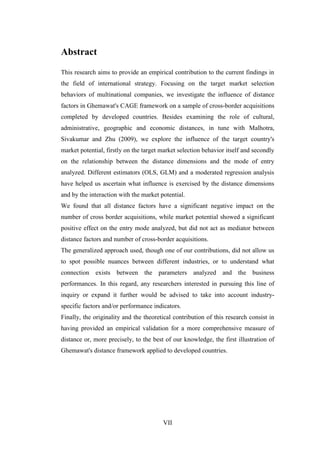
This thesis examines how cultural, administrative, geographic, and economic distances between countries, as well as target country market potential, influence the number of cross-border acquisitions made by developed countries. The author finds that all distance factors have a significant negative impact on acquisitions, while market potential has a significant positive effect. However, market potential does not moderate the relationship between distances and acquisitions. The thesis contributes to research on international strategy and target market selection by developed countries. It provides empirical support for considering a comprehensive measure of distances, as in Ghemawat's framework, but does not examine industry-specific or performance factors.






![Distance Still Matters [Sav Lecture Hb Sept 2001]](https://cdn.slidesharecdn.com/ss_thumbnails/distancestillmatterssavlecturehbsept2001-100308041947-phpapp02-thumbnail.jpg?width=640&height=640&fit=bounds)


![Cultural Distance & Learning [Md. Abdur Rakib]](https://cdn.slidesharecdn.com/ss_thumbnails/culturaldistancelearningbymd-abdurrakib377-130328114007-phpapp02-thumbnail.jpg?width=640&height=640&fit=bounds)
