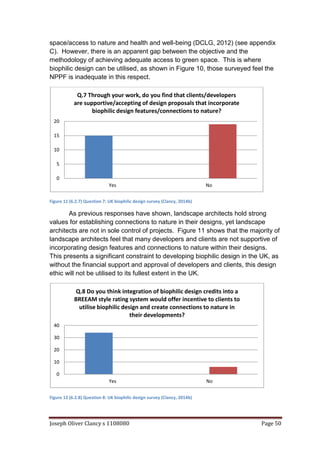
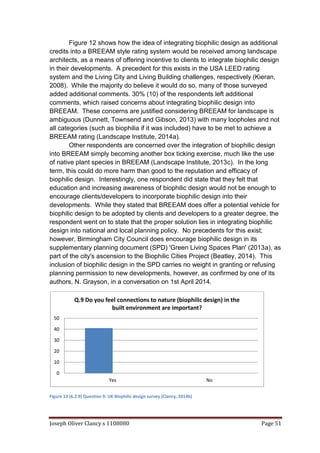
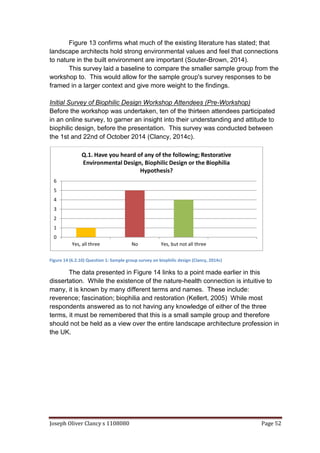
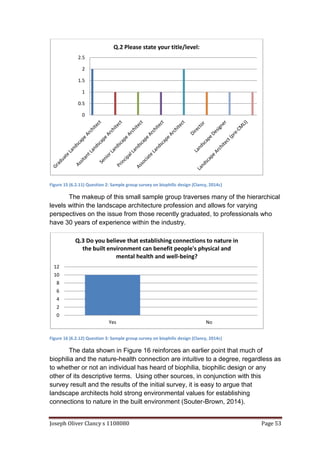
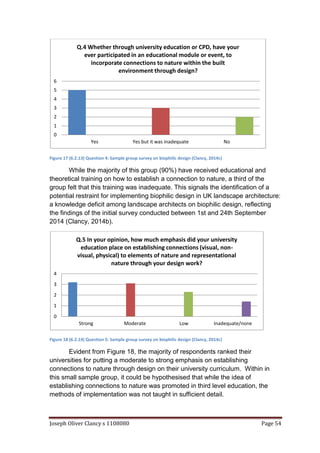
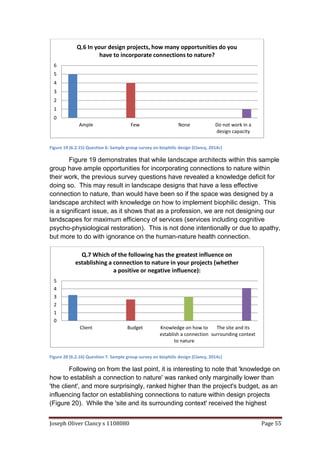
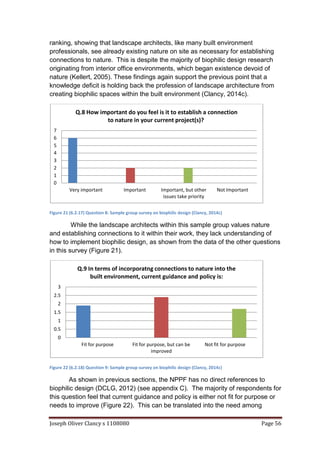
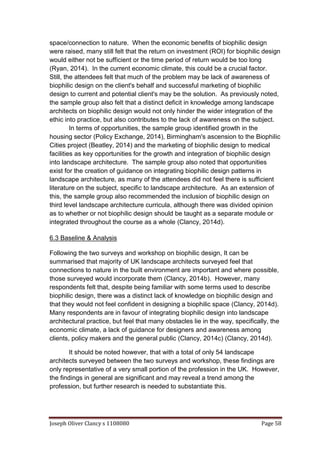
Joseph Oliver Clancy s 1108080 Page 1
Identifying Opportunities and Constraints for the Implementation of Biophilic
Design Patterns in UK Landscape Architecture
Joseph Oliver Clancy
Presented as part of the requirement for the award of the
MA Degree in Landscape Architecture
at the University of Gloucestershire
December, 2014
Joseph Oliver Clancy s 1108080 Page 2
Joseph Oliver Clancy s 1108080 Page 3
(i) Declaration
This Dissertation is the product of my own work and does not infringe the ethical
principles set out in the University’s Handbook for Research Ethics.
I agree that it may be made available for reference via any and all media by any
and all means now known or developed in the future at the discretion of the
University.
Signed
Joseph Oliver Clancy
5th December 2014
Joseph Oliver Clancy s 1108080 Page 4
(ii) Abstract
This dissertation aims to identify the opportunities and constraints for the
implementation of biophilic design patterns and assess its need/importance in
UK landscape architecture. This dissertation has utilized various sources,
including peer reviewed academic journal articles, recent publications, online
sources and personal communications with leading experts in the field of
biophilic design, including William Browning, Catie Ryan, Timothy Beatley, Gayle
Souter-Brown, Stephen Kellert, Val Kirby and Nick Grayson. The methodology
of this dissertation has included a literature review, professional work experience
with Terrapin Bright Green (a company specialising in biophilic design in the built
environment), interviews with professional UK landscape architects and biophilic
design experts, two online surveys of UK based landscape architects and an
educational workshop on biophilic design for UK based landscape architects.
The main findings of this dissertation have been: a knowledge deficit exists
among UK landscape architects on biophilic design; no direct references to
biophilic design exist in either local or national planning policy and; clients do not
envision biophilic design as being important or necessary in their developments.
It is the recommendation of this dissertation to: incorporate biophilic design into
landscape architecture university curricula; establish biophilic design CPD
events; produce individual guidance documents for each project type on biophilic
design; incentivise developers to incorporate biophilic design in their projects to
increase acceptance and awareness; incorporate biophilic design into local and
national planning policy and; found a national, multi disciplinary professional
body for biophilic design in the UK, to oversee and help implement these
recommendations.
Joseph Oliver Clancy s 1108080 Page 5
(iii) Acknowledgements
The author of this dissertation would like to thank the following:
Timothy Beatley, Teresa Heinz Professor of Sustainable Communities at the
University of Virginia School of Architecture, founder of the Biophilic Cities
Project;
David Booth, Postgraduate Programme Director, Landscape and Environment at
the University of Gloucestershire and the author's mentor for this dissertation;
Gayle Souter-Brown of Greenstone Design UK;
Nick Grayson, Climate Change and Sustainability Manager at Birmingham City
Council, head of Birmingham's Biophilic City initiative;
Stephen Kellert, Tweedy Ordway Professor Emeritus of Social Ecology and
Senior Research Scholar at the Yale University School of Forestry and
Environmental Studies;
Val Kirby of the Landscape Institute;
Barry Lupton of Blackrock Further Education Institute;
The staff at Pegasus Planning Group Ltd, and finally;
William Browning and Catie Ryan of Terrapin Bright Green, for taking me under
their wing since the Summer of 2013 and inspiring me to pursue my curiosity
further into the field of biophilic design.
Joseph Oliver Clancy s 1108080 Page 6
Joseph Oliver Clancy s 1108080 Page 7
Dedicated to the memory of my mother,
Breda Clancy,
who's love of nature she passed to her son.
"....for nothing loved is ever lost".
Joseph Oliver Clancy s 1108080 Page 8
(iv) Table of Contents
(i) Declaration....................................................................................................... 3
(ii) Abstract........................................................................................................... 4
(iii) Acknowledgements ........................................................................................ 5
(iv) Table of Contents........................................................................................... 8
(v) List of Figures................................................................................................ 10
(vi) List of Tables................................................................................................ 11
(vii) List of Acronyms Used................................................................................. 11
Section 1: Introduction........................................................................................ 13
1.1 Aims.......................................................................................................... 13
1.2 Definitions and Concepts .......................................................................... 15
1.3 Biophilic & Restorative Responses ........................................................... 16
1.4 Section Conclusion: The Need for this Paper ........................................... 17
Section 2: Biophilic Design Patterns .................................................................. 18
2.1 Terrapin Bright Green's 14 Patterns of Biophilic Design ........................... 18
2.2 Compatibility and Feasibility of Biophilic Design Patterns with UK
Landscape Architecture Projects .................................................................... 19
2.3 Section Conclusion: Are the 14 Biophilic Design Patterns, Formulated by
Terrapin Bright Green Suitable, for Implementation in UK Landscape
Architectural Projects? .................................................................................... 21
Section 3: UK & Global Context ......................................................................... 22
3.1 UK Context................................................................................................ 23
3.2 Section Conclusion: Are Biophilic Design Patterns Needed in the UK?.... 26
Section 4: European, National and Local Planning Policy.................................. 27
4.1 European Landscape Convention............................................................. 28
4.2 The Localism Act 2012 and the National Planning Policy Framework
(NPPF) (2012)................................................................................................. 28
4.3 Health and Social Care Act 2012 .............................................................. 28
4.4 Local Plans ............................................................................................... 29
4.5 Community Infrastructure Levy ................................................................. 29
4.6 Section Conclusion ................................................................................... 29
Section 5: Variability in the Built and Natural Environment................................. 30
5.1 Climate & Ecology in the UK and how it Impacts Upon Biophilic Design
Patterns........................................................................................................... 31
5.2 Culture & Demographics........................................................................... 32
Joseph Oliver Clancy s 1108080 Page 9
5.3 Character, Density and Landscape Typologies......................................... 36
5.4 Project Types and Scope.......................................................................... 37
5.5 Section Conclusion ................................................................................... 43
Section 6: Evaluation of Current Knowledge among Landscape Architects in the
UK ...................................................................................................................... 45
6.1 Method...................................................................................................... 45
6.2 Results...................................................................................................... 46
6.3 Baseline & Analysis .................................................................................. 58
6.4 Section Conclusion: Why this dissertation is needed................................ 59
Section 7. Conclusions and Recommendations: ................................................ 59
7.1 Limitations of Study................................................................................... 59
7.2 Rectifying the Knowledge Deficit through Education................................. 60
7.3 Increasing Awareness and Understanding of Biophilic Design ................. 61
7.4 Perceived Cost of Investment & Budget Cuts ........................................... 62
7.5 Utilising Current Housing Growth & the Garden Cities Competition as an
Opportunity ..................................................................................................... 63
7.6 Further Ascension of UK Cities to the Biophilic Cities Project................... 64
7.7 Integration of Biophilic Design into BREEAM............................................ 64
7.8 Production of Biophilic Design Guidance Documents ............................... 65
7.9 Integration of Biophilic Design into National and Local Planning Policy.... 65
7.10 Formulation of a Biophilic Design Case Study Template ........................ 66
7.11 Formation of a National Multi-Disciplinary Body for Biophilic Design in the
UK................................................................................................................... 66
Bibliography ....................................................................................................... 68
Appendix ............................................................................................................ 95
Appendix A: Glossary ..................................................................................... 95
Appendix B: 14 Biophilic Design Patterns....................................................... 97
Appendix C: Applicable References to Biophilic Design in the NPPF (DCLG,
2012)............................................................................................................. 106
Appendix D: Key Publications....................................................................... 109
Appendix E: Timeline Development of Biophilic Design and Contextual Factors
...................................................................................................................... 113
Joseph Oliver Clancy s 1108080 Page 10
(v) List of Figures
Figure 1 (5.4.1) Clancy (2014) Eastside City Park [Photograph] In possession of:
The author: Birmingham, UK.............................................................................. 38
Figure 2 (5.4.2) ‘West Green Road Tropical Park’ (2013) [Photograph]
At: http://now-here-this.timeout.com/2013/11/17/west-green-road-tropical-park/
(Accessed on 01.11.14) ..................................................................................... 40
Figure 3 (5.4.3) Thames Barrier Park (2012) [Digital photograph] At:
http://ericbwongderivatives.blogspot.co.uk/2012/06/thames-barrier-park.html
(Accessed on 01.11.14) ..................................................................................... 41
Figure 4 (5.4.4) The Lost Gardens of Heligan (2014) [Digital photograph] At:
http://www.torrhousecottages.co.uk/special-houses-gardens/ (Accessed on
01.11.14)............................................................................................................ 42
Figure 5 (6.2.1) Question 1: UK biophilic design survey (Clancy, 2014b) .......... 46
Figure 6 (6.2.2) Question 2: UK biophilic design survey (Clancy, 2014b) .......... 47
Figure 7 (6.2.3) Question 3: UK biophilic design survey (Clancy, 2014b) .......... 47
Figure 8 (6.2.4) Question 4: UK biophilic design survey (Clancy, 2014b) .......... 48
Figure 9 (6.2.5) Question 5: UK biophilic design survey (Clancy, 2014b) .......... 49
Figure 10 (6.2.6) Question 6: UK biophilic design survey (Clancy, 2014b) ........ 49
Figure 11 (6.2.7) Question 7: UK biophilic design survey (Clancy, 2014b) ........ 50
Figure 12 (6.2.8) Question 8: UK biophilic design survey (Clancy, 2014b) ........ 50
Figure 13 (6.2.9) Question 9: UK Biophilic design survey (Clancy, 2014b)........ 51
Figure 14 (6.2.10) Question 1: Sample group survey on biophilic design (Clancy,
2014c) ................................................................................................................ 52
Figure 15 (6.2.11) Question 2: Sample group survey on biophilic design (Clancy,
2014c) ................................................................................................................ 53
Figure 16 (6.2.12) Question 3: Sample group survey on biophilic design (Clancy,
2014c) ................................................................................................................ 53
Figure 17 (6.2.13) Question 4: Sample group survey on biophilic design (Clancy,
2014c) ................................................................................................................ 54
Figure 18 (6.2.14) Question 5: Sample group survey on biophilic design (Clancy,
2014c) ................................................................................................................ 54
Figure 19 (6.2.15) Question 6: Sample group survey on biophilic design (Clancy,
2014c) ................................................................................................................ 55
Figure 20 (6.2.16) Question 7: Sample group survey on biophilic design (Clancy,
2014c) ................................................................................................................ 55
Figure 21 (6.2.17) Question 8: Sample group survey on biophilic design (Clancy,
2014c) ................................................................................................................ 56
Joseph Oliver Clancy s 1108080 Page 11
Figure 22 (6.2.18) Question 9: Sample group survey on biophilic design (Clancy,
2014c) ................................................................................................................ 56
(vi) List of Tables
Table 1: 14 Patterns of Biophilic Design by Terrapin Bright Green (Browning,
Clancy and Ryan, 2014)......................................................................................97
(vii) List of Acronyms Used
BREEAM: Building Research Establishment Environmental Assessment
Methodology
CIL: Community infrastructure Levy
CPD: Continuing Professional Development
DCLG: Department of Communities and Local Government
DEFRA: Department of Environment, Food and Rural Affairs
EDHAC: Evidence-based Design Accreditation and Certification
ELC: European Landscape Convention
GI: Green Infrastructure
ISB: International Society for Biourbanism
LEED: Leadership in Energy & Environmental Design
LI: Landscape Institute
NHS: National Health Service
NPPF: National Planning Policy Framework
NPPG: National Planning Policy Guidance
RED: Restorative Environmental Design
SPD: Supplementary Planning Document
WHO: World Health Organization
Joseph Oliver Clancy s 1108080 Page 12
Joseph Oliver Clancy s 1108080 Page 13
Section 1: Introduction
The intent of this study is to identify the opportunities and constraints to
implementing biophilic design patterns in UK landscape architectural projects, by
examining: policy; existing knowledge among UK landscape architects; current
UK context and the feasibility of adopting biophilic design patterns.
Under a definition, put forward by Rachel and Stephen Kaplan (1998),
patterns "describe a problem which occurs over and over again in our
environment, and then describes the core of the solution to that problem, in such
a way that you can use this solution a million times over, without ever doing it the
same way twice". Patterns are used to apply biophilic design to the built
environment, due to the fact that no two applications of a biophilic design pattern
will result in the same solution, these patterns will not create a rigid formulaic
process, but will instead inform, guide and assist in the design process. This
guide can be thought of as another tool in the designer’s kit (Browning, Clancy
and Ryan, 2014).
The intended audience for this paper are professional landscape
architects, along with other related built environment professions operating in the
UK. This paper will also help inform communities, organisations, employers and
developers of the benefits of biophilic design and provide guidance on how to
consider it within new landscape projects.
There is still much unknown about the human-nature health connection
(Soule, 1993). Given the infancy of biophilic design as a design approach and
the lack of literature relating specifically to landscape applications (Lee and
Maheswaran, 2010), it can be concluded that there is a knowledge deficit on how
to implement biophilic patterns successfully in landscape architecture. No
publication to date has strictly dealt with the applications of biophilic design
patterns to landscape architecture. Indeed, no publication discusses biophilic
design in the context of the UK or any built environment profession, and its
variable factors (i.e. climate, demographics, policy) in adequate depth.
1.1 Aims
The overall aim of this proposed study is to identify opportunities and constraints
for the integration of biophilic design patterns in the built environment by
examining existing national planning policy, current UK demographics, possible
policy mechanisms and assessing the current level of knowledge among UK
based landscape architects.
This study will discuss the importance of biophilic design, the rationale
and empirical evidence behind the 14 design patterns, developed by Terrapin
Bright Green (Browning, Clancy and Ryan, 2014) (see appendix B). This
research into design patterns and the built environment builds on the work of
Joseph Oliver Clancy s 1108080 Page 14
Alexander et al (1979), the Kaplans (1998), Kellert (2008) and Jacobson,
Silverstein and Winslow (2002). Patterns have the potential to offer solutions to
almost universal problems across a variety of scenarios, settings and user
groups (Alexander et al, 1979). A suitable solution results from a pattern being
applied in a manner that responds to the local conditions appropriately. Due to
each solution responding to local conditions and context, no two applications will
yield the same result (Kaplan & Kaplan, 1998). The challenges to implementation
of biophilic design patterns, the knowledge deficit regarding the subject in the UK
and the applications of biophilic design to landscape architecture will be
examined in depth.
This dissertation aims to act as an introduction for landscape architects to
the cognitive and behavioural neurosciences behind biophilic responses, backed
by empirical evidence, research and case studies. Suggesting that common
ground for discussion between built environment professionals, cognitive &
behavioural neuroscientists, environmental psychologists and healthcare
professionals can be found. This in turn could lead to more integrative
approaches to projects in future (Eberhard, 2009). Such a discussion on
integrative approaches builds on momentum following several initiatives: the
establishment of EDHAC (Evidence-based Design Accreditation and
Certification) from the Centre for Health Design in 2009 for architects, designers
and healthcare providers (Kent, 2012); the founding of the International Society
for Biourbansim in 2010 (Serafini et al., 2010) and; the launch of the Biophilic
Cities Project in 2013 (Beatley, 2013b).
This dissertation will then discuss the various scales of projects to which
biophilic design might be applied, from retrofits to renovations and new
constructions. With current levels of interest growing in the UK on wellbeing and
'natural' or 'green' exercise, with the release of the DCLG's prospectus on
Garden Cities (2014), the Landscape Institute's position statement on healthy
landscapes (2013b) and MIND's publication on 'Ecotherapy' (2013), this study
will build on such momentum and investigate possible areas of
synergy/collaboration.
To help define the scope of the study and in an effort to garner an insight
into the current level of knowledge on biophilic design, it is proposed to conduct a
workshop on biophilic design, involving UK landscape architecture professionals.
The workshop will also seek to identify what level of experience landscape
architects have of implementing biophilic design patterns.
The product of this study will be a document identifying opportunities and
constraints on implementing biophilic design patterns in UK landscape
architecture that will act as a design tool; informing decisions, providing
reference material to support biophilic design in the UK and aiding a design
process that aims to create a connection to nature between the user and the
Joseph Oliver Clancy s 1108080 Page 15
designed/built environment. It will also produce recommendations for how to
integrate biophilic design into UK landscape architectural practice.
1.2 Definitions and Concepts
Before engaging with the detail of a biophillic approach, it is worth noting a few
established definitions of the term and approach (for more definitions, see
appendix A) (for timeline context, see appendix E).
“E. O. Wilson calls it "biophilia," Albert Schweitzer called it "reverence," Rachel
Carson called it "a sense of wonder." But by any name it is the sense of
belonging in nature and particularly in one's place. I think everyone has that
feeling to one degree or another. But it requires opportunity and the right
circumstances to flourish....” -David W. Orr (Richard, 2011)
Biophilia
Biophilia literally means "love of life or living systems." Erich Fromm stated it as a
psychological orientation of being attracted to living things and natural processes
(Fromm, 1964). However, it was biologist E.O. Wilson who popularized the
concept in 1984 (Wilson, 1984). Born from this, biophilic design aims to restore
natural stimuli in the built environment to maintain, restore, and enhance our
physiological and psychological connections to the natural world (Kellert et al,
2008).
The Biophilia Hypothesis
The biophilia hypothesis is an evolutionary theory, stating that the majority of
humanity's evolution was spent in natural environments (Tveit, Sang and
Hagerhall, 2013). This hypothesis was proposed by E.O Wilson and was
developed alongside Stephen Kellert in 'The Biophilia Hypothesis' (1993). The
hypothesis argues that humanity has spent 95-99% of its history in natural
environments. With the migration to cities only occurring in the last 200 years, it
is too short a timeframe to adapt to such a drastic change in environments that
urbanisation has brought (Juniper, 2013).
Biophilic Design
Biophilic design aims to restore natural stimuli in the built environment to
maintain, restore, and enhance our physiological, cognitive and psychological
connections to the natural world. It is a design ethic, which also goes by the term
Restorative Environmental Design (RED) (Kellert, 2005). Guidelines and criteria
for biophilic design have become incorporated, in some form or another in LEED
rating systems (Kieran, 2008) and the Living Cities and Living Building
Challenges(Herman Miller, 2013), respectively. The UK equivalent of these
development rating systems is BREEAM; however, no allowances are made for
the inclusion of biophilic design within this specific rating system.
Joseph Oliver Clancy s 1108080 Page 16
Biophilic design is not just simply the presence of nature, but the content
within the scene, its configuration and associated semantic content (Browning
and Cramer, 2008). Configuration of natural scenes to reflect the landscape
preferences of certain user groups 1) increases rates of restoration (van der Berg
et al, 2003) and 2) encourages higher participation rates by user groups,
resulting in greater numbers engaging in outdoor activities (Forsyth & Musacchio,
2005). In turn, biophilic design has economic, health, cultural, environmental
value and (when used as part of an integrative approach) ecological benefits
(Browning, Clancy and Ryan, 2014).
1.3 Biophilic & Restorative Responses
A 'biophilic response' can be defined as a measurable response triggered by
natural stimuli that leads to the restoration (Browning, Clancy and Ryan, 2014) of
depleted facilities (allostasis) (McEwen, 2000) or the enhancement of these
facilities to buffer environmental stressors (instoration) (Hartig, Mang and Evans,
1991). These responses can be classed as being either psychological (mood,
self-esteem) (Hartig et al, 1996), physiological (blood pressure, hormone levels)
(Barton and Pretty, 2010) or cognitive (creativity, mental performance) (Berman,
Jonides and Kaplan, 2008).
Cause and Effect
The underlying causes for triggering biophilic responses are still unknown to a
degree (Lee and Maheswaran, 2010). This is despite the measurable effects
which have been recorded throughout numerous studies and have attributed the
cause to experiencing (passively or actively) natural environments and stimuli
(Brown, Barton and Gladwell, 2013) or even representational nature (de Kort et
al, 2006). Current explanatory theories for why such a mechanism exists can be
classed as being either evolutionary or cultural (van der Berg, Joye and de Vries,
2013). Evolutionary theories (i.e. the Savannah Hypothesis) claim that humanity
developed such an underlying mechanism to trigger a restorative response to aid
habitat selection (Heerwagen and Orians, 1993) and to restore psycho-
physiological conditions to baseline following predatory encounters (Ulrich,
1993). Cultural theories on the other hand (i.e. the Aesthetics of Care) state that
such a mechanism exists due to landscape visual preferences of natural
environments with a specific character and geographic range, due to cultural
development (Tveit, Sang and Hagerhall, 2013).
Efficacy of Triggers and Responses
Due to numerous factors (to be discussed in section 6), the efficacy of triggers
and thus their responses can be positively and negatively affected (Bilotta and
Evans, 2013). Such factors include climate (Aldred, 2014), ecology (Nassauer,
1997), socioeconomic demographics (Elmendorf et al, 2005) (Buijs, Elands and
Joseph Oliver Clancy s 1108080 Page 17
Langers, 2005), gender (Kopec, 2006), ecological literacy (Pilgrim et al, 2008)
and even the contextual setting of the environment (Felonneau, 2004). Certain
biophilic patterns will also be more/less effective at triggering biophilic responses
depending on the time of day and year, due to the temporal and seasonal
attributes of nature (Heerwagen and Gregory, 2008).
1.4 Section Conclusion: The Need for this Paper
At the time of writing, there are no publications, position statements,
prospectuses or papers discussing biophilic design in a UK context. There are
also few publications discussing biophilic design, in the context of landscape
architecture, in adequate depth or in a global context, thus limiting the awareness
and development of biophilic design with landscape architects.
Biophilic design; by triggering either a cognitive, physiological or cognitive
response, offers an opportunity to act as part of a salutogenic approach to health
rather than the standard pathogenic approach to health (Souter-Brown, 2014).
The salutogenic approach sees 'health' as encompassing multidimensional
factors such as psychological, cognitive, social and environmental influences,
rather than just biological (van der Berg, Joye and de Vries, 2013). This ties in
with Dr. William Bird's call for a preventative, rather than a curative approach to
health (namely tackling chronic stress, which leads to chronic inflammation,
causing higher susceptibility in individuals to cancer, depression and diabetes)
(Bird, 2013). However, given the variability of efficacy of restorative responses in
individuals across cultures and demographics (Kopec, 2006) (Tveit, Sang and
Hagerhall, 2013), education on how to implement biophilic design patterns is
necessary.
This paper also comes at a crucial time, with biophilic design becoming
integrated into the LEED rating system, the Living Building and Living City
Challenges in the USA (Kieran, 2008). With no current requirement or credits
garnered from the incorporation of biophilic design in the BREEAM rating
system, the UK equivalent of the LEED rating system, this dissertation may open
up discussion for future integration of biophilic design into BREEAM.
Given the knowledge deficit about biophilic design and how to implement
it, increasing rates of urbanisation, depression (World Health Organisation,
2010), the inclusion of Birmingham City into the Biophilic Cities project (Beatley,
2014) and the call to build 40 garden cities (Policy Exchange, 2014), now is the
time to begin discussing how biophilic design patterns can be appropriately
integrated into planning policy and the design process of landscape architecture.
Joseph Oliver Clancy s 1108080 Page 18
Section 2: Biophilic Design Patterns
The descriptive term 'pattern' is being used for several reasons:
 To set out a clear and standardized term for biophilic design
implementation (Browning, Clancy and Ryan, 2014);
 To avoid confusion with multiple terms that have been used to describe
biophilic strategies (metrics, attributes, characteristics, typologies, etc)
(Kellert, 2008); and
 To be accessible for designers by using a familiar term of design language
(Alexander et al, 1977).
Patterns have the potential to offer solutions to almost universal problems
across a variety of scenarios, settings and user groups (Alexander et al, 1977). A
suitable solution results from a pattern being applied in a manner that responds
to the local conditions appropriately. Due to each solution responding to local
conditions and context, no two applications will yield the same result (Kaplan &
Kaplan, 1998).
However, biophilic design is dependant among a number of factors
(Soule, 1993) and as such, emphasises the need for guidelines on implementing
biophilic design patterns in landscape architecture. This is why patterns are
better suited than metrics, as they are less rigid and respond to the local
conditions with an appropriate response (Alexander et al, 1977). While this
offers an opportunity in terms of adaptability and wide ranging applications, it
may present a constraint in the terms of unpredictable consistency and even
reliability of its application.
2.1 Terrapin Bright Green's 14 Patterns of Biophilic Design
The patterns (see appendix B) discussed throughout this dissertation and applied
to the profession of landscape architecture within the context of the UK, were
developed by Terrapin Bright Green in their publication "14 Patterns of Biophilic
Design: Improving Health and Well-Being in the Built Environment" (Ryan et al,
2014) (Browning, Clancy and Ryan, 2014). This dissertation offers an example of
how Terrapin Bright Green’s work can be adapted in scope to suit the
parameters of a built environment design profession, located in a specific
geographic context, serving a certain population demographic user group.
Three Overarching Pillars of Biophilic Design
The 14 design patterns discussed in this paper fall under three pillar categories.
These three broad categories help explain how spaces can be designed to be
restorative, in terms of their content, spatial configuration and semantic
representation.
Joseph Oliver Clancy s 1108080 Page 19
 Nature in the Space
This is the presence and diversity of plant life, water, animal and insect
species and other natural elements within the built, natural and designed
environment (Browning and Cramer, 2008). The strongest responses are
provided by direct connections with nature (Kahn et al, 2008) with spaces
that are rich in diversity (Fuller et al, 2007).
 Nature of the Space
This category encompasses the various psychological and physiological
responses triggered by different spatial configurations (Ryan et al, 2014).
 Natural Analogues
This category covers natural and synthesized objects, materials and
patterns that evoke nature (Browning, Clancy and Ryan, 2014). These can
be representational artworks of nature, biomorphic forms and natural
materials (Kellert, 2008). Natural analogues mostly consist of non-direct
connections to nature (Green, 2010). While they register less effective
responses compared to direct contact with nature (Salingaros, 2012), they
offer strategic potential in spaces that offer limited resources for nature to
thrive.
2.2 Compatibility and Feasibility of Biophilic Design Patterns with UK Landscape
Architecture Projects
Patterns that fall under the categories of Nature in the Space and Nature of the
Space are perhaps more compatible and more likely to be feasible in outdoor
landscape environments, than interior environments. This is due to the spatial
and area requirements of patterns such as prospect (Hildebrand, 1991), refuge,
mystery (Herzog and Bryce, 2007) and connection to natural systems (Browning,
Clancy and Ryan, 2014).
Patterns within the category of Natural Analogues do have their uses
within landscape architectural projects, but are more likely to be superseded by
patterns of actual nature, as landscape projects have greater capacity for
sustaining living organisms and natural processes, than interior environments do,
in general. With actual, natural stimuli triggering a greater restorative response
than representational or symbolic nature (Grahn and Stigsdotter, 2003) (Kahn et
al, 2008), it would make sense to utilise patterns of actual nature over
representational nature, where conditions allow. However, Natural Analogues do
have their role to play in landscape architectural projects, especially in projects
with restrictions on space, soil depth, irrigation and daylight, making the inclusion
of living nature, such as vegetative species, unfeasible.
Another key factor to establish when implementing biophilic design
patterns, is at what scale, frequency and quantity is necessary to illicit a
Joseph Oliver Clancy s 1108080 Page 20
restorative response from the potential users of the designed space and how a
designer may do so. This of course is dependent upon a number of factors
outside of the designer's control (Ryan et al, 2014). However, the following will
provide some guidance to the designer to make an informed design decision, by
helping to identify potential constraints and opportunities to biophilic design
patterns on site. In turn, this will help inform which patterns are suitable and/or
suitable.
Scale
While certain patterns such as prospect and mystery will require uninterrupted
views of 30m (Hildebrand, 1991) (Herzog and Bryce, 2007), the space itself does
not necessarily have to be 30m in length, as prospective views can exist external
to the site and can be framed from within the site itself.
Visual and non-visual connections to nature, access to natural systems
and non-rhythmic stimuli depend to a degree on wildlife and the presence of
living organisms and living processes (Wilson, 2008). This can be achieved on
smaller sites by integrating into surroundings natural sites. If none exist, simpler,
less complex ecosystems may be more suitable, such as aviaries, apiaries and
fish ponds.
Specific to the pattern of presence of water, bodies of water should
occupy no more than 60% of a visual scene or space. Excessively more than
this and the presence of the body of water can trigger feelings of isolation. 60%
has been found to be the preferred amount for water to occupy within a space,
following studies on landscape preferences and specifically water (Mador, 2008)
(White et al, 2010).
It is important to note that psycho-physiological benefits of green space do
not increase as land area increases. Interestingly however, it has been recorded
that psycho-physiological benefits from green space increase with higher levels
of biodiversity (Fuller et al, 2007). This is important, as it means small spaces
can be biophilic and thus, biophilic design is achievable within high density built
environments where land is scarce (Wall and Waterman, 2010).
Frequency
As previously discussed, large scale biophilic design endeavours are not always
possible, with restrictions on developing within the green belt (DCLG, 2014a) and
space within high density urban centres becoming scarce (Wall and Waterman,
2010). Another factor to consider is the distances people will travel themselves
or allow their children to travel alone to nature, which is often less than 300m
(Natural England, 2010). Given, as the previous paragraph explained that small
spaces can trigger biophilic responses (Fuller et al, 2007) the answer lies in
creating small, high frequency biophilic spaces/environments along key routes
(to work, school, shopping) (Joye and van der Berg, 2013).
Joseph Oliver Clancy s 1108080 Page 21
Quality and Quantity
It should be remembered that one high quality biophilic design pattern is better
than several low quality biophilic design patterns. This is due to biophilic spaces
being greater than the sum of their parts, as they interact with one another to
trigger a restorative response (Hunter et al, 2010).
As regards patterns, their proportion and ratio can also influence their
efficacy. Material connections to nature and biomorphic/fractal forms should be
limited to known preferences, as excessive ratios/frequencies can lead to
negative, even toxic effects (dizziness, nausea) (Tsunetsugu et al, 2007) (see
appendix B). The quantity of mystery and peril patterns should also be limited,
depending on the scale of the site, to avoid creating a perception of danger or
sense of fear (Herzog and Bryce, 2007) (Petherick, 2000).
Adaptability and Resilience
With variability in the built and natural environments to be discussed in greater
detail in section 5, it is important to discuss the adaptability and resilience of
patterns to change. These changes in the built and natural environment can be
due to numerous factors, such as gentrification, change in local demographics
and climate change.
Changes in these factors can affect the efficacy of biophilic design
patterns and the responses they engender in individuals. For instance,
landscape preferences vary among cultures and demographics (Buijs, Elands
and Langers, 2009), especially for patterns such as: visual connection to nature;
connection to natural systems; prospect; mystery and; refuge (Forsyth and
Musacchio, 2005). However, generally speaking, there are universal landscape
preferences that can be implemented. While still being capable of triggering a
restorative response, its efficacy could be greater if designed to a specific
demographic. However, given the dynamic nature of the urban fabric, it is not
feasible for a designer to prepare for every scenario (Browning, Clancy and
Ryan, 2014). The inclusion of universal landscape preferences (Kopec, 2006)
and climate change resilient plant species and materials (Kieran, 2008) can help
ensure the adaptability and efficacy of patterns.
2.3 Section Conclusion: Are the 14 Biophilic Design Patterns, Formulated by
Terrapin Bright Green Suitable, for Implementation in UK Landscape
Architectural Projects?
It must be stressed, that the 14 biophilic design patterns put forward by Terrapin
Bright Green (Browning, Clancy and Ryan, 2014), are wide ranging in scope and
are not specific to any geographic location, demographic or climatic region. The
patterns are also not specific to any one profession, although there is a distinct
bias towards architecture and interior environments. However, this may be due
to people now spending up 90% of their times indoors (Louv, 2012), with the
benefits of biophilia having greater impact on stressed individuals in indoor
Joseph Oliver Clancy s 1108080 Page 22
environments, than on individuals who regularly visit actual nature (Heerwagen
and Hase, 2001). This means that for many reasons (to be examined further in
section 5), specific patterns will not be applicable to certain professions for
successful implementation into the built environment.
In terms of adopting the 14 patterns, research (outside the scope of this
dissertation) should look into modifying and even developing new patterns
specific to landscape architecture in a UK context. From the literature review
and examination of the patterns, it can be argued that not all of the patterns are
directly applicable to landscape architecture. The only pattern, examined in this
dissertation, that is to a large degree incompatible with implementation in
landscape architecture, is the pattern of dynamic and diffuse day lighting (see
appendix B). This is due to the interior architectural bias of the pattern
(Browning, Clancy and Ryan, 2014) and the outdoor, open character (in
comparison to many interior environments) of landscape (van der Berg, Joye and
de Vries, 2013). The effects of the pattern would be negligible in landscape
projects, as the pattern only exists to bring daylight into buildings that have (in
the last century) primarily depended on artificial light (Loftness and Snyder,
2008). The outdoor environment does not suffer from the same predicament.
However, it is still an important pattern for landscape architects to understand,
especially when designing around/near existing buildings. This is due to the
possibility of introduced vegetation blocking daylight from entering existing
buildings or introducing excessive artificial light pollution and negatively affecting
the health and well-being of the building's occupants/users (Chepesiuk, 2009).
But, for the most part, the 14 patterns developed by Terrapin Bright Green are
suitable for applications in the built environment by landscape architecture
professionals in the UK.
Section 3: UK & Global Context
While the dawn of modern man begun 200,000 years ago, it is only in the last
two hundred years that the majority of humanity began the shift to being urban
dwellers (Heerwagen and Orians, 1993). A relatively short period, considering as
that only as recent as 2007 has the majority of the global population become
urban (World Health Organisation (WHO), 2010). Humanity has spent 95-99% of
its history adapting and evolving in natural environments (Kellert, 1993). 200
years is too short a timeframe to adapt to such a drastic change in environments
that urbanisation has brought (Juniper, 2013).
Currently, over 50% of the world’s population lives in urban centres and
this is expected to rise to 60% in 2030 and 70% by 2050 (WHO, 2010). Added to
this, 80% of the built environment in America and Europe standing today will be
standing in 2050, while 80% of the built environment in China and India standing
in 2050 has yet to be constructed (Doyle, 2013). Less and less time is being
Joseph Oliver Clancy s 1108080 Page 23
spent in natural environments that have restorative properties, with people
spending up to 90% of their time indoors (Louv, 2012).
Another issue to consider is the global phenomenon, known as
Environmental Generational Amnesia (EGA). EGA describes the shifting
baseline for what is considered a normal environmental condition (Kahn et al,
2008). As environmental degradation continues, the baseline continues to shift
with each ensuing generation, each perceiving this degraded condition as the
non-degraded condition; what they perceive as the baseline for what nature
should be (Kahn, 2002). This shifting baseline varies across cultures, geographic
regions and sub-groups (Kopec, 2006).
The phenomenon of EGA is being accelerated by factors such as climate
change (Hipp and Ogunseitan, 2011) and the continued migration of populations
to urban environments (Kahn, 2002). Today, it is estimated that people in
western societies spend up to 90% of their day indoors, decreasing opportunities
for contact with nature (Kahn, 2009). Other factors, such as concerns over child
safety and the erection of physical and psychological barriers in urban
environments have reduced the distance or 'roaming range' of children
(Derbyshire, 2007). One study showed a decreased roaming range over 4
generations, from 8km to 300m (Bird, 2007). This has reduced opportunities for
interaction with nature among children.
However, it is important to note important developments in the field of
biophilic design, with the launch of the Biophilic Cities Projects (Beatley, 2014),
the founding of the International Society for Biourbanism (Serafini et al, 2010)
and the increasing frequency at which publications, research papers and
conferences are being released/held, with publications from Kellert (1993, 2005,
2008), Terrapin Bright Green (2012) (Browning, Clancy and Ryan, 2014), and
Beatley (2008), spreading awareness of biophilic design globally.
3.1 UK Context
The percentage of the UK population living in urban areas is set to hit 92.2% in
2030 (Brown, 2013). However, it should be broken down to clarify what is meant
by urban, built and natural. Following the completion of the UK National
Ecosystem Assessment, the total land areas of the following have been broken
down (Watson and Alban, 2011):
Joseph Oliver Clancy s 1108080 Page 24
% of UK Land Area Classed as Urban 7% (16,089 km2
)
England 10.6% (13,822 km2
)
Scotland 1.9% (1,489 km2
)
Northern Ireland 3.6% (498 km2
)
Wales 4.1% (852 km2
)
It is interesting to note that urban and built-on are not the same thing. For
instance, 54% of land in England classed as ‘urban’ is green space (broken
down to include parks, allotments and recreational green space). On top of this,
private domestic gardens (18%) and water bodies (6.6%) make up 24.6% of
urban land area (Easton, 2012). This means that 78.6% of urban areas in
England are classed as being ‘natural’. Further breakdown of the figures reveals
that only 2.7% of England’s land area is in fact ‘built on’. These figures may be
slightly skewed as they do not take into account the quality of the space, its
accessibility, ownership, function and location in relation to major population
centres or the fact that some cities are more/less urban than others. While these
figures may be relieving to some to see only 7% of the UK being classed as
‘urban’, they are in fact a lot more worrying. This is due to the challenge of trying
to retrofit new and improve access to, existing natural spaces into less than 4%
of the land area (that is not built on) where 92% of the UK population live (Brown,
2009).
These constraints will only lead to an exacerbation of environmental
stresses (Bilotta and Evans, 2013). The stresses of urbanisation and
displacement of connections to nature from the built environment (Orr and Pyle,
2008) is costing the UK population its wealth and perhaps more importantly, its
health (Marmot, 2010). For instance:
 Stress is now the biggest cause of sickness in the UK
 Stress related illnesses cost 105 million working days each year
 Stress affects 1 in 5 of the working population
 Cost of stress related illnesses annually: £105 billion
 Cost of maintaining 27,000 green spaces annually: £630 million
(Source: UK Health and Safety Executive, as appears in Juniper, 2013)
But why do we need to reduce stress? Chronic stress occurs throughout
our days and lives and originates from numerous factors, i.e. quality of life at
home, relationship with others, financial income and expenses, etc (Bird, 2013).
But environmental stressors, such as those in urban areas (traffic, crowds,
thermal discomfort, and perception of danger) also trigger and exacerbate
chronic stress (Bilotta and Evans, 2013).
Joseph Oliver Clancy s 1108080 Page 25
It needs to be understood, that chronic stress is related to chronic
inflammation, which in turn is the fundamental root cause of major disease
burdens, such as cancer, cardiovascular disease, depression, anxiety and
dementia. This is due to chronic stress triggering an increase in unhealthy
behaviours (alcohol, nicotine, fatty/sugary foods) in individuals as a coping
mechanism (McEwen, 2000). In tandem, not only do these behaviours damage
cell mitochondria, chronic stress has a direct effect on cell mitochondria, causing
the release of cortisol, a stress hormone. Damage to the mitochondria makes
individuals more susceptible to developing heart disease, cancer and diabetes.
Chronic stress also causes physical inactivity, which in turn leads to sedentary
mitochondria producing oxidative phosphorylation (oxidants), which can increase
risk of developing cancer (Bird, 2013).
Yet, despite the figures stated above, problems posed by chronic stress,
cost comparisons and the fact that a recent report by CABE found that 85% of
people feel the quality of a public space “has a direct impact on their lives and on
the way they feel” (Carmona et al, 2004), cuts to funding across municipalities in
the UK for parks and recreational green space continue (Abbott, 2014). For
instance, Liverpool City Council, in 2014, cut funding for the city's parks by 50%
(Cosgrove, 2014a), despite cuts of £1million in 2012 and reductions of 20% in
2011 (Abbott, 2012). While over the next four years, Birmingham City Council,
Europe's largest municipality, plans to cut £10.4 million from green space funding
(Cosgrove, 2014b). Wigan Council meanwhile have frozen council tax levels in
exchange for citizen stewardship of green spaces, in an attempt to make ends
meet and uphold quality of public green space after their budget was slashed by
£14 million (Appleby, 2014). In total, £60 million has been slashed from park and
green space budgets since 2010 under the conservative government, with the
north and midland regions being hit hardest (Ellis, 2014). These cuts have taken
place; despite recent evidence pointing to UK cities with the lowest life
expectancies had a fifth less green space than areas with the highest life
expectancies (Roberts-Hughes, 2013). These are steps in the wrong direction for
heavily urbanized UK cities with growing populations and increasing rates of
stress related illnesses. From the sources reviewed, a clear north-south divide is
appearing in terms of investment in green space, as the City of London is in the
midst of a new pocket parks programme worth £2 million across thirty projects
(Bloomfield, 2013).
Another factor to keep in mind is the recent release by the Department of
Communities and Local Government, a prospectus on 'Locally-Led Garden
Cities' (DCLG, 2014b) and the subsequent Wolfson Economics Prize
competition, with the winning entry calling for forty garden cities to be built over
the next three decades, housing 150,000 people (Hope, 2014).
In terms of biophilic design in the UK, the release of the Birmingham
Green Living Spaces Plan (Birmingham City Council, 2013a), the Trees, People
Joseph Oliver Clancy s 1108080 Page 26
and Built Environment II Conference and perhaps most importantly, the
admission of Birmingham City to the Biophilic Cities Project (Beatley, 2014), all
show growing support and political will to enhance the human-nature connection
and incorporate biophilic/restorative experiences into the UK built environment.
3.2 Section Conclusion: Are Biophilic Design Patterns Needed in the UK?
“Better health is related to green space regardless of socio-economic status.”
- Fair Society, Healthy Lives (Professor Sir Michael Marmot, 2010)
With current trends, over 70% of the world's population will be urbanized by
2050, with that number standing at 92.2% for Britain in 2050 (Brown, 2013). An
ageing, multicultural, urbanized population, with higher rates of depression and
stress related illnesses, exacerbated by the effects of climate change, living in an
ageing built environment (World Health Organisation, 2010). That is the scenario
presented. By discussing, developing, integrating and implementing biophilic
design patterns into national planning policy and the built environment,
landscape architects and other built environment professionals can help reduce
and eliminate the negative effects of living in a heavily populated urban
environment, while reducing pressure on an already struggling NHS (Juniper,
2013). Education on landscape preferences and the efficacy of biophilic design
patterns across cultures, ethnicities and demographics will also help create an
inclusive society that has equitable access to restorative environments and green
space. Again, this justifies the need for this dissertation.
By providing opportunities for restoration of cognitive, physiological and
psychological capacities at appropriate and regular intervals (Joye and van der
Berg, 2013), the negative effects of chronic stress can be dealt with at the
source, as a preventative, rather than a curative strategy (van der Berg, Joye
and de Vries, 2013). It must be remembered that reductions in stress and
elevated moods can occur within five minutes of visual engaging natural stimuli
or being present in a natural environment (Ulrich, 1999) and within twenty
minutes, concentration levels improve for children with attention deficits (Faber
Taylor and Kuo, 2009). As discussed before, access to and interaction with,
natural stimuli triggers these restorative responses. Strategies to reduce a user’s
level of chronic stress through the use of biophilic design is two-fold: firstly by
providing restoration (Hartig, Bringslimark and Patil, 2008) and reducing stress
levels through interaction with natural stimuli (Green, 2009) and; secondly, due to
reductions in stress, levels of physical activity will increase, due to chronic stress
acting as deterrent to physical activity (Bird, 2013) and the fact that individuals
and are more likely to visit and exercise if they live near a natural green space,
thus further reducing occurrences of chronic stress and inflammation in the local
population (Nielson and Hanson, 2007) (Kaczynski and Henderson, 2007).
Joseph Oliver Clancy s 1108080 Page 27
“The conditions of the physical environments in which residents are living greatly
influence this chronic stress—by creating conditions that inadvertently foster it or
alternatively help to diminish or control it. Nature and greenery are key stress-
reducing elements in cities.”
– Timothy Beatley (Beatley, 2014)
It is becoming evident that escalating costs and austerity are crippling
some sectors of the NHS (Chorley, 2014). This is where biophilic design can
create restorative environments to mitigate against, reduce or eliminate
environmental stressors from the environment (Joye and van der Berg, 2013).
Biophilic design could be integrated into the exterior built environment to help
create a 'natural health service' (Juniper, 2013) by triggering stress reduction,
mental restoration, improving mood and lowering blood pressure (Steg, 2013).
In addition, nearly two thirds of the world's population will be urbanized in
the next 15 years (Brown, 2009) and that psychological disorders in Western
Europe are set to rise from the current level of 10% to 15% by 2020 (Juniper,
2013). These numbers are accompanied by the fact that depression, a stress
related illness, is expected to be the number one disease burden worldwide,
overtaking cancer and heart disease, by 2030 (Whooley and Wong, 2013).
Biophilic design patterns offer health, well-being, and economic,
environmental and social benefits to the population of the UK. Due to the degree
of overlap in the aims of biophilic design and the Garden City Movement, the
recently published prospectus on Garden Cities (DCLG, 2014b) offers an
opportunity to biophilic design. With strong political support and emphasis on
health, well-being and equitably distributed accessible green spaces within the
Garden City movement (Howard, 1902), 'Locally-Led Garden Cities' could
provide a suitable mechanism for implementing biophilic design patterns in the
built environment.
Section 4: European, National and Local Planning Policy
The links between planning policy and biophilic design are not as clear as the
long established links between planning and health (Landscape Institute, 2013b).
However, there is a degree of overlap and relevancy between planning and
biophilic design, seen in the UK context with events such as: the rise of
importance placed on green infrastructure (Landscape Institute, 2009); the
release of guidance for Garden Cities by the DCLG (2014b); the release of a
position statement by the Landscape Institute (2013b) on the role of landscape in
health and well-being; and the release of 'Green Living Spaces Plan' by
Birmingham City Council (2013a).
Joseph Oliver Clancy s 1108080 Page 28
4.1 European Landscape Convention
The European Landscape Convention (ELC) is the first international convention
to focus specifically on issues relating landscape and was introduced by the
Council of Europe. The convention seeks to protect, maintain and enhance the
landscape through management, planning, restoration and co-operation between
European member states on landscape issues, especially those of a trans-
boundary nature (Council of Europe, 2000). The convention applies to all
landscapes (whether designated or not), their typologies, characters, forms and
conditions (Ahern and Cole, 2009a).
4.2 The Localism Act 2012 and the National Planning Policy Framework (NPPF)
(2012)
The Localism Act decentralised planning powers from national and regional level
to local authorities, giving them greater power over local planning decisions and
development (DCLG, 2011). Local Development Frameworks (LDFs) developed
by local authorities and guided by adherence to the National Planning Policy
Framework (NPPF), which carries the central theme of "presumption in favour of
sustainable development" (DCLG, 2012). This translates into not hindering
development, as long as it is sustainable nor violates local environmental
protection orders. The key understanding of sustainable development, put
forward by the government under the NPPF, must integrate three pillars of
sustainability:
 Economic: Enhancing and creating a resilient, adaptive and competitive
economy
 Social: Supporting and enhancing vibrant, resilient and healthy
communities
 Environmental: Enhancing and conserving our natural, built and historic
environments for now and future generations
There are no direct references to biophilic design in the NPPF or NPPG
(see appendix C). However, many of the paragraphs of the NPPF can be utilised
as policy mechanisms for implementing biophilic design, as green space and
access to nature is recognized within the NPPF as a key health resource,
especially in urban areas (DCLG, 2014a). However, the lack of direct references
to biophilic design in the NPPF demonstrates the knowledge deficit and lack of
awareness of biophilic design and its benefits among policy makers and built
environment professionals.
4.3 Health and Social Care Act 2012
In 2012, the Health and Social Care Act transferred responsibility for public
health to local authorities, an important development given the shift in national
Joseph Oliver Clancy s 1108080 Page 29
planning policy to 'localism'. This act has given communities greater control over
how health services are run and delivered within their own community, leading to
actions that respond to the local environmental and socioeconomic conditions, in
tandem to resources available to the local authority (Department of Health,
2012).
4.4 Local Plans
Upon the abolishment of Local Development Frameworks in 2010, the NPPF
states that every local planning authority in England must have a clear, concise,
up to date Local Plan. Local plans must operate within the NPP framework,
while meeting the needs of the local population, local development and reflect
the local community’s and stakeholder’s vision of how the area should develop
(DCLG, 2012). No local plan to date makes any direct references to biophilic
design. The closest exception is Birmingham City Council's supplementary
planning document (SPD), 'Green Living Spaces Plan' (2013a), but it is not
statutory.
4.5 Community Infrastructure Levy
The Community Infrastructure Levy (CIL) is a new levy that was introduced under
the National Planning Policy Framework (DCLG, 2012) and can operate in
conjunction with Section 106 agreements. The CIL allows local authorities the
choice over whether or not to charge new developments in their area. When
enacted, the CIL results in land owners and developers paying charges to the
local council, which are in turn used to fund services within the local authority
and community (most likely in relation to communities affected by the nearby
development that is being levied). These charges are determined by the local
authority by assessing the size, type and land area of the new development
along with its environmental impact (DCLG, 2013). Following clarification by the
Department for Communities and Local Government, the CIL can be used to
fund existing green spaces, an important development given the current austerity
measures and their impact on local authority green space budgets (Anderson,
2014).
4.6 Section Conclusion
Biophilic design, with its aims and benefits, directly ties in with the NPPF's aim of
creating healthy communities, through the reduction of health inequalities by
increasing opportunities for access to and interaction with natural environments
and natural stimuli, a strategy recommended by Marmot (2010) and Natural
England (2014). The NPPF also recognises the importance of green space in
delivering health and well-being to communities (DCLG, 2014a), thus making
biophilic design a key medium for achieving sustainable development, a role for
biophilic design that has been discussed previously by Kellert (2005).
Joseph Oliver Clancy s 1108080 Page 30
The introduction of the Health and Social Care Act (2012) has lead to the
creation of Health and Wellbeing Boards, allowing healthcare professionals from
local communities to co-operate together to improve health and wellbeing, while
reducing inequalities in terms of access and delivery of health services among
the local population (Landscape Institute, 2013b). Health and Wellbeing Boards
potentially offer a go to point for landscape architects to consult on the current
baseline conditions, needs and inequalities of a local population, who would be
directly affected by a new landscape development.
The CIL is a significant opportunity, as a suitable policy mechanism, for
the implementation of biophilic design patterns in the built environment.
Publications such as The Marmot Review (Marmot et al, 2010) and
Microeconomic Evidence for the Benefits of Investment in the Environment 2
(Natural England, 2014) could be used as part of an evidence base for justifying
the levy charge and its subsequent use for funding biophilic design. However,
the charged amount and its determined use are all dependent upon the baseline
needs of the local population and the local plan (DCLG, 2013).
Overall, on a national basis, biophilic design is not accommodated in the
NPPF, but this could be enhanced to further encourage the use of increasing
access to nature and natural stimuli through policy. As regards the transition
from national to local policy; local plans do conform to the framework set out by
the NPPF, but each plan varies across each local authority. This is due to many
factors, such as demographics, culture, character, density, typology, etc, to be
discussed in greater detail in Section 5. As such, no existing local plan to date
makes any direct references to biophilic design.
Section 5: Variability in the Built and Natural Environment
Variability in the built and natural environment can be defined, in the context of
this dissertation, as describing the varying styles of architecture, character, age
of built environment, climate, geography, ecology, socioeconomic demographics
and local cultural traditions and how all these factors interact with one another to
produce a sense of place. This variability in the environment can affect, to
differing degrees, the efficacy of and responses triggered by biophilic design
patterns (Browning, Clancy and Ryan, 2014).
In a UK context, variability in the built and natural environment is vital to
address wherever a designer seeks to implement biophilic design patterns. This
is due to numerous factors, such as:
 The UK has an ageing building stock, with 80% of the buildings
standing today will still be standing in 2050 (Doyle, 2013);
 The UK is one of the culturally diverse countries in the world, with
London being the most culturally diverse city in history (Benedictus,
Joseph Oliver Clancy s 1108080 Page 31
2005) and Birmingham being the second most culturally diverse
city in Europe (Birmingham City Council, 2014b)
 Climate change has triggered increased flooding and visible
changes within the landscape (IPCC, 2014)
 The current housing shortage puts pressure on maintaining the
character of existing communities with new developments (Policy
Exchange, 2014)
 Increases in prevalence of chronic stress related illnesses among
UK demographics and pressure on the NHS (Bird, 2013)
5.1 Climate & Ecology in the UK and how it Impacts Upon Biophilic Design
Patterns
Traditionally, the built environment has been constructed of locally sourced
materials and vegetation that reflect the contextual landscape and ecology. This
strengthens local identity and has been utilised for centuries (Bender, 2008).
However, factors such as climate change, invasive non-native species a, shifts in
plant species ranges (Harvey, 2011) (Gray, 2011) and shifts in thermal comfort
baselines (Muller et al, 2014) have made certain material choices and plant
species unfit for purpose (Gill et al, 2007). This obstacle has become more
pronounced in high density urban areas, such as London, where the effects of
the urban heat island have decision and policy makers looking into research on
tree species that can adapt and thrive within the urban heat island long enough
to become large established trees (Greater London Authority, 2005). This use of
new tree species may impact negatively on an area’s character and connection
to a region’s ecology, hindering attempts to trigger a biophilic response.
Climate change is also driving species across the world to change their
geographic ranges, moving around 18km further north every decade. In the UK,
the Comma Butterfly has moved 220km north over only two decades (Gray,
2011). These changes in geographic ranges will result in significant changes in
local ecosystems, with the added loss of an established sense of character and
place attached to built and natural environments associated with those
ecosystems (The Countryside Agency, 2002). It is important for designers to be
aware of this when establishing biophilic design patterns, to ensure efficacy of
the patterns utilised.
Aside from the previously described problems, varying climates and
ecologies across the UK offer unique opportunities for each project. One is
education. An inaccurate ideal of nature held by much of the population is that it
is always green; even what constitutes natural is often debated (Natori and
Chenoweth, 2008). By utilising local vegetative plant species, materials and
replicating natural ecosystems in coastal, moor, floodplain or highland locations,
Joseph Oliver Clancy s 1108080 Page 32
designers can help improve the user of the spaces' ecological literacy. These
can be achieved by reflecting the local regions ecology and character, instead of
imposing an alien scheme which does not connect to the surrounding landscape
(Pilgrim, Smith and Pretty, 2007). Biophilic design patterns can still be integrated
into these locations, not just in character, but in terms of climate and ecology as
well.
The dynamic properties of climate and ecology also introduce a temporal
nature to biophilic design patterns that incorporate living materials/organisms.
Vegetation such as trees and flowering shrubs have seasonal qualities, which
can result in varying degrees of the quality of connection to nature established
(Nelson, 2001). While this can be seen as a constraint, the seasonality factor
can be utilised as an opportunity in establishing biophilic design patterns such as
'connection to natural systems' (Browning, Clancy and Ryan, 2014) (see
appendix B). Recognizing this variability, designers must develop strategies to
maintain the efficacy and ability of biophilic design patterns to engender a
restorative response.
5.2 Culture & Demographics
While many landscape preferences and views of nature are, to a degree,
universal across human demographics, discrepancies in how people view,
appreciate, interact with, or how they are even affected by nature occur across
cultures (Tveit, Sang and Hagerhall, 2013), ethnic groups (Forsyth and
Musacchio, 2005), genders, ages (Kopec, 2006) and various other factors, such
as one’s profession (Natori and Chenoworth, 2008) or education level (Pilgrim et
al, 2008). It must be stressed however, that this does not mean that one group
values or appreciates nature or that the need/right to have restorative nature
nearby is any less significant than another’s; all it means is that differing
demographic groups interact with nature in different ways (Zube and Pitt, 1981).
The primary difference between evolutionary (innate) and cultural
(learned/conditioned) responses to nature is that cultural responses are the
result of an intentional cognitive evaluation of functions available from the natural
environment to individuals and communities; while evolutionary responses are
passive, immediate affective experiences (Tveit, Sang and Hagerhall, 2013).
Cultural Theories
 Topophilia
Topopihlia is an emotional connection to a place that has a distinct natural
and/or built character unique to that region. As a theory, it states that
people seek out and place attachment to what one knows (Tveit, Sang
and Hagerhall, 2013). The term was first used by W.H. Auden as a
'special love for peculiar places' and was applied as an architectural and
cultural theory by Gaston Bachelard, in his 1958 publication, 'The Poetics
Joseph Oliver Clancy s 1108080 Page 33
of Space'. This is an important theory to understand in terms of biophilic
design, as it states that experience and learned, conditioned responses
are the deciding factor for one’s landscape preferences. This theory is
evident among immigrants from far and Middle Eastern cultures, who
have low participation/user rates of public green space in western
countries (Buijs, Elands and Langers, 2009). This is due to differing
landscape preferences. The response from many immigrants is to create
and design in landscape styles within their own communities,
demonstrating the topophilic desire to seek out what one is familiar with.
This theory links in with the Aesthetics of Care theory and the
phenomenon of Environmental Generational Amnesia, which can be
thought of as a ‘temporal topophilia’.
 Aesthetics of Care
This theory, prevalent in Middle Eastern and agrarian
cultures/communities, emphasizes the importance of direct and visually
evident influence of human activity on natural environments. Landscapes
that seen to be managed, manicured and maintained are preferred over
unkempt, naturalistic nature (Tveit, Sang and Hagerhall, 2013). This
‘aesthetic’ is valued over ecological function, and clashes with current
landscape preferences in western countries for ‘wild’ nature, again
complicating the problem of low user rates of green space among
immigrants to western countries (Buijs, Elands and Langer, 2009).
 Ecological Aesthetic Theory
In contrast to the Aesthetics of Care, the Ecological Aesthetic Theory puts
forward a preference for natural and wild settings. The theory states that
ecological literacy and knowledge of the natural environment leads to
greater preference for natural developing landscapes, absent of visual
human intervention (Tveit, Sang and Hagerhall, 2013). Initial research
into this area found that higher income groups (thus those who had better
access to education) had greater preferences for naturalistic settings in
contrast to lower socioeconomic groups (Yu, 1995) (Pilgrim, Smith and
Pretty, 2007). However, recent research has shown a decline in
ecological literacy, in western countries, correlating with increasing rates
of urbanisation and rising standards of living, while in poorer, undeveloped
countries, ecological literacy and appreciation for nature remains high,
due to a greater, obvious dependency on natural resources (Pilgrim et al,
2008).
 Savannah Hypothesis
This theory proposes to explain why humans from different cultural,
geographic and ethnic backgrounds have “an odd cross-cultural
Joseph Oliver Clancy s 1108080 Page 34
uniformity” when it comes to landscape preferences (Wypijewski et al,
1997). The theory states that this is due to modern humanity’s evolution
taking place in the East African Savannah. Having preferences for certain
landscapes over others (i.e. a lush savannah over a void desert) to create
a habitat in would give an individual a greater chance of survival. This
move to the savannah and out of the forest may have also built in our
deep seated fear of heights, in turn encouraging more Homo sapiens to
leave the forest and settle on the savannah (Hartmann and Apaolaza-
Ibanez, 2010). Spatial and contextual characteristics of the African
savannah are still present inhumanity’s landscape preferences today
(Heerwagen and Orians, 1993). This theory forms the basis for biophobia
and prospect-refuge theory (Ulrich, 1993).
 Biophobia
Biophobia is the polar opposite of biophilia yet is an integral part of it as a
concept. Biophobia is a fear of or aversion to nature, natural
environments and associated stimuli (Ulrich, 1993). Biophobia is
hypothesised to be genetic to varying degrees, but it is essentially a
learned/conditioned response. It is hypothesised, like biophilia, to have
been an evolutionary trait to avoid danger and enhance survival. This is
evident in typical biophobic responses occurring to the sight of blood,
spiders and snakes (van der Berg and Heijne, 2005). Yet, biophobic
responses are not always negative, with patterns of peril and mystery
engendering a biophilic response, through a biophobic experience
(Browning, Clancy and Ryan, 2014).
 Prospect-Refuge Theory
This theory, first proposed by Appleton in 1975, and later built on by
Hildebrand (1991), sets out that humanity is attracted to landscape scenes
that have certain conditions, including: broad prospective views; visible
locations of refuge; presence of water; plant life and; other living non-
threatening species (Heerwagen and Orians, 1993). This theory also
states that humanity has a deep seated need to be on the edge of defined
spaces, for security and to ease perception of fear/danger. The need for
overhead cover as well is preferred, as it allows the restriction of views
into the space, but allows external views from within the space, while
providing a degree of protection to the surveyor (Hildebrand, 2008).
Ethnicity
As described in the preceding paragraphs, variations among various ethnic
groups as regards landscape preferences can be explained through cultural
theories, demonstrating that there is a learned/conditioned response to biophilic
experiences and landscape preferences (Tveit, Sang and Hagerhall, 2013).
These learned, in combination with evolutionary, responses are conditioned and
Joseph Oliver Clancy s 1108080 Page 35
modified by social, cultural and life experiences, as explained through the theory
of topophilia.
When considering this subject, it must be remembered that ethnicity
cannot explain all issues to do with green space use and ethnic groups. Other
factors, such as crime, psychological barriers, planning policy, social justice and
inequalities in green space distribution all contribute to skewing the figures of
park usage. The differences between ethnic groups are focused mostly on
landscape preferences and how they use the space and interact with nature in
ways that are compatible with their needs and cultural background (Forsyth and
Musacchio, 2005).
The previously explained theories show how landscape preferences can
affect usage and differ across ethnic groups. Yet, these low participation rates
among Middle Eastern immigrants to western countries do not occur to the same
extent in 2nd
and 3rd
generation immigrants, but still remain lower than the rest of
the comparable, non-immigrant descendant population (Buijs, Elands and Langer
2009).
Age
Desired uses of space or how people use a space and interact with nature varies
considerably over one’s lifetime (Scopelliti and Giuliani, 2004). Younger age
groups prefer spaces with present patterns of prospect, mystery, risk, access to
natural systems and presence of water (Castonguay and Jutras, 2009), while
teenagers prefer spaces with more refuge (Chawla et al, 2014) and elderly age
groups seek spaces with refuge, clear lines of sight and manicured vegetation
and absence of mystery/risk (Takano, Nakamura and Watanabe, 2002).
In terms of effects, younger age groups benefit the most from contact with
nature, in terms of self-esteem, with this response of an enhanced state
decreasing with age. While both the very young and elderly, in terms of
improved mood, benefit the least from contact with nature (Berto, 2007).
Gender
Even across cultures and ethnic groups, there are similarities in the differences
between the genders and how they respond to natural stimuli. The reasons for
these differences are proposed to be due to our cultural evolutionary history, with
men as hunter gatherers and women as domestic carers (Kopec, 2006).
The differences are significant and can strongly influence design decisions
for the built environment and who will ultimately use the space for restoration of
capacities. In terms of how the genders use the space, compared to men,
women prefer spaces with high density crowds of people; with little or no
personal space. The reversal of these conditions, spaces with low spatial
density, has been shown to lead to a higher occurrence of negative moods in
women. The difference between the sexes and their preferences are further
shown by the fact that men report much higher restorative responses from
patterns of refuge with low overhead cover (ceilings, tree canopies, etc).
Joseph Oliver Clancy s 1108080 Page 36
Conversely, men’s cognitive functionality has greater resistance to becoming
depleted due to noisy conditions, unlike women’s’ (Petherick, 2000) (Kopec,
2006).
In terms of need for nature, women report higher levels of daily stress
than men, yet, they are much less likely to use nearby outdoor natural spaces
(Richardson and Mitchell, 2010), in contrast to men, who will travel greater
distances to visit green space (Cohen et al, 2007). The reasons for why this is
may be due to women regarding vegetative areas with danger and possibility of
attack, most likely a result of cultural conditioning (Taylor, Kuo and Sullivan,
2001).
In regards to the effects of nature following a restorative response being
engendered, still, differences remain. For instance, following a walk in a forest,
natural killer cell activity (vital for destroying cancer cells) was enhanced in both
genders; but the timeframe duration of enhanced natural killer cell activity
differed significantly (30 days for men, 7 days for women). The reasons why are
unknown (Li, 2010) (Park et al, 2009).
5.3 Character, Density and Landscape Typologies
The character and density of the built and natural environments will strongly
influence what patterns can be implemented and the degree to which a
restorative response can be engendered. The two extremes of character and
density can be shown by comparing low density rural and high density urban
environments.
“In medicine, where the body is really matters, health is essentially place-based”.
– Dr. Richard Jackson (Green, 2012)
Within rural environments, which typically have higher levels of
biodiversity and less visual obstructions, there are fewer obstacles for
engendering a restorative experience, in comparison to urban environments.
This is due to a phenomenon known as perceptual fluency; the demand on
cognitive resources required for perceiving and processing a specific stimulus
(Joye, 2007). Natural environments and stimuli are perceptually processed with
ease by a user, thought to be the result of our species familiarity with how visual
information is structured, layered and arranged in natural environments, due to
our evolution taking place in such environments (Parraga, Troscianko and
Tolhurst, 2000). With lower demands placed on cognitive functions for
perceptually processing environmental stimuli, attentional resources are given
the opportunity to be replenished, allowing for a restorative response to occur
(Joye and van der Berg, 2013).
On the other hand, when it comes to typical, high density urban
environments, people are perceptually inarticulate, due to unfamiliarity with
processing the sensory information present in urban environments (Song and
Joseph Oliver Clancy s 1108080 Page 37
Schwars, 2009). Sensory overload is a common occurrence in urban
environments, as users’ cognitive resources are being continually depleted by
having to process excessive stimuli (Ulrich et al, 1991) (Bonnes et al, 2013). For
example, checking for traffic, waiting for lights to change, avoiding other
pedestrians, checking signs, way finding and being aware of your surroundings
all deplete cognitive resources and increase stress. Such demands are absent
from restorative environments (Karmanov and Hamel, 2008).
It is interesting to note, as previously mentioned in the sub section on
gender preferences, that clear sights lines and low density, large spatial
environments are generally preferred (Bilotta and Evans, 2013). These qualities
do not commonly occur together in high density urban environments. This poses
a problem; as such qualities quite often require large parcels of land, which is
limited and fragmented within urban cores (Wall and Waterman, 2010).
Van der Berg, Koole and Wulp (2003) stated that high levels of stress
were correlated by a greater preference for natural over urban environments.
This has positive and negative implications for biophilic design in urban
environments. In terms of positive effects, people with higher stress levels
respond with greater levels of restoration to biophilic stimuli, in comparison to
non-stressed subjects (Barton and Pretty, 2010). Thus, this factor may
compensate for the lower responses that occur when experiencing
representational nature (in comparison to real nature) (Kahn et al, 2008), which
can be more feasible to implement in urban environments than resource
demanding vegetative/natural features.
5.4 Project Types and Scope
Strategies for implementing biophilic design patterns have already been broken
down to examine variable elements that can affect it in a UK context, but this is
still a wide scope. The following, is a brief section that deals with the scope and
projects types that landscape architects operate in a design role for. This section
will only skim the surface, as investigations into the applications and
opportunities for biophilic design in these areas are deserving of their own
publications to be dealt with in adequate depth. This section will:
 How to implement biophilic design patterns in each respective project type
 Identify the most appropriate patterns for each project type
 Identify opportunities and constraints for implementing biophilic design
patterns in each project type
New build
New build projects, in some respects, have the greatest potential for biophilic
design, with fewer space constraints. However, new build projects need greater
investment in terms of time, money and resources to integrate/implement new
Joseph Oliver Clancy s 1108080 Page 38
and existing services, while existing spaces and retrofit projects would most likely
have these services already in place (Dunham-Jones and Williamson, 2011).
New build projects allow for the establishment/introduction of biophilic patterns
that can turn a source of environmental stress, into a restorative space. They
also allow for a much greater degree of enhancement of biophilic
attributes/qualities that exist in the surrounding context (Browning, Clancy and
Ryan, 2014), like Eastside City Park (Figure 1). While retrofit projects are more
likely to be shaped by their surrounding context, new build projects (of an
adequate scale and area) have the ability to influence their surrounding context.
Figure 1 (5.4.1) Clancy (2014) Eastside City Park [Photograph] in possession of: The author: Birmingham, UK.
New build projects, developed on either open brownfield land or atop a
demolished site, like Eastside City Park (Birmingham City Council, 2013a) have
fewer restrictions in terms of having to accommodate existing built form on site.
This allows for a complete re-configuration of spatial conditions, an introduction
of a new material palette and natural stimuli to occupy the space. Operating with
essentially a blank slate (not always the case), a designer can effectively
spatially configure the space to enhance (visual and non-visual) connections to
nature, internal and external to the site by effectively responding to the
surrounding contexts’ typology, character and spatial form.
Due to the opportunity of total spatial re-configuration of a space and how
it responds to the surrounding context, the most space demanding biophilic
design patterns can be implemented, including: prospect; mystery, peril and
Joseph Oliver Clancy s 1108080 Page 39
connection to natural systems. New build projects offer the opportunity (where
site conditions permit) to establish or restore ecosystems within the space,
effectively ensuring the implementation of the connection to natural systems
pattern (Browning, Clancy and Ryan, 2014) (see appendix B).
Retrofit
Retrofit projects are essentially the introduction of new elements that did not exist
at the time of original construction into spaces with a set spatial configuration,
consisting of existing built form and features (Dunham-Jones and Williamson,
2011). Retrofit, for the purpose of this dissertation, does not mean significant
removal of existing features within in the space, but rather introducing
complimentary patterns to those already existing. The inclusion of new elements
must successfully respond to and enhance existing features within the space, i.e.
enhancing natural elements with the introduction of biophilic patterns to the point
where they induce a restorative response to users of the space. Retrofit
projects; aim to enhance the existing character of the space and surrounding
environment (example shown in Figure 2).
"Retrofitting is one of the key methods for introducing these biophilic principles
and projects in cities around the world, as practitioners are working with a built
landscape, envisioning a new green layer on top of the grey one." -Katherine
Forster (2013)
Retrofitting biophilic design patterns into existing green and public spaces
provides a cheaper alternative to biophilic new builds; however, it does have its
limitations. The most apparent of these are (Dunham-Jones and Williamson,
2011):
 Space/Area
 Spatial configuration
 Surrounding built form
 Planning restrictions
 Soil quality and depth
While it has been previously discussed that small spaces can be biophilic
(Joye and van der Berg, 2013), as restorative responses rise with increases in
biodiversity, rather than increase in land area (Fuller et al, 2007); restrictions on
space (common in retrofit projects) can affect the spatial quality of a space,
hindering restorative responses.
These space restrictions translate into limitations on the levels of
vegetation that can be installed and effectively reducing access to actual nature,
further exacerbated by poor soil quality in urban areas and restrictions on root
growth (Wall and Waterman, 2010). The set spatial configuration of the space,
due to its existing built form and features on site, significantly influences whether
Joseph Oliver Clancy s 1108080 Page 40
or not certain patterns, such as prospect, mystery and refuge can be successfully
implemented (Browning, Clancy and Ryan, 2014) (see appendix B).
Figure 2 (5.4.2) ‘West Green Road Tropical Park’ (2013) [Photograph] at: http://now-here-
this.timeout.com/2013/11/17/west-green-road-tropical-park/ (Accessed on 01.11.14)
With restrictions on space and a set spatial configuration ruling out
significant elements of vegetation and prospective views of actual nature,
landscape architects can utilize natural analogues; representational nature, to
implement biophilic design patterns (Salingaros, 2012). This can be down
through the use of natural materials (material connection to nature), biomorphic
forms (biomorphic forms and patterns) and fractal geometries (complexity and
order) (Browning and Cramer, 2008) (see appendix B). Retrofit projects can
possibly implement patterns such as prospect and visual connection to nature by
framing and creating prospective views to nature that are external to the site
boundary, lying within the surrounding visual context.
Renovation
This project type lies in between on the scale of ‘retrofit’ to ‘new build’.
Renovation implies the removal of significant amounts of existing built form and
features to the point where the spatial configuration of the space has changed
(unlike retrofit projects), yet its spatial relationship to the surrounding context has
not (unlike new build projects) and; then introducing new built form and elements
into a space to a new set spatial arrangement. Renovation projects may
Joseph Oliver Clancy s 1108080 Page 41
enhance an existing character or develop to the point where the prescribed
character of the space is longer suitable or recognizable (like Thames Barrier
Park, shown in Figure 3). Renovation projects can and should connect to the
history and past use of the site through the design, to create a greater sense of
place attachment and character. While the character of the space may change,
the renovation project should aim to respond and reflect the character of the
surrounding context (Dunham-Jones and Williamson, 2011).
Renovation projects (depending on their scale, scope and area) may be
restricted by space requirements, as regards to suitable/feasible biophilic design
patterns. However, unlike retrofit projects, this project type results in the
elimination of the existing spatial configuration and content within the space
(Browning, Clancy and Ryan, 2014). Generally, this means that the only
restriction in terms of area is the site boundary (and relevant local planning
policy).
Figure 3 (5.4.3) Thames Barrier Park (2012) [Digital photograph] at:
http://ericbwongderivatives.blogspot.co.uk/2012/06/thames-barrier-park.html (Accessed on 01.11.14)
Renovation projects are essentially only limited by their surrounding
context. Thus, projects of this nature should aim to reflect the surrounding
character by using vegetative species and materials present in the existing
context. The project should also aim to create visual connections to nature
within the site from external viewpoints (visual connection to nature/prospect).
Joseph Oliver Clancy s 1108080 Page 42
By making nature visible from exterior built environments, it will signify the site as
a place of refuge, enticing users into the space (Hildebrand, 1991).
Restoration
Restoration is a mixture of the previous three project types. These projects can
be degraded, neglected or abandoned spaces, i.e. community gardens, historic
parks and gardens. These spaces often have a strong, if degraded, character, a
sense of place. Many may have pre-existing biophilic attributes or conditions
existing, but have become damaged. Other restoration projects may focus on
restoring an ecosystem or landscape, such as river, that no longer exists or has
lost its original character. The aim of such projects is to restore the
ecosystem/landscape to its previous state (Busquets et al, 2011).
Figure 4 (5.4.4) The Lost Gardens of Heligan (2014) [Digital photograph] at:
http://www.torrhousecottages.co.uk/special-houses-gardens/ (Accessed on 01.11.14)
In some ways these projects are retrofit in nature due a strong existing
spatial configuration and on site character. While in other ways a restoration
project is like a renovation project due to the fact that many elements have
become so degraded, that they need to be replaced with a new spatial
arrangement. New build may be incorporated into this project type to ensure the
space has a relevant purpose and is able to meet the needs of the local
population. Elements of restoration to the sites’ previous condition and form are
also included to ensure the previous character is not overpowered by the
introduction of new elements (Dunham-Jones and Williamson, 2011).
Joseph Oliver Clancy s 1108080 Page 43
In terms of limitations, choice of vegetative species and materials should
match the present or previous character of the site, in an effort to repair and
enhance the sense of place within the site (Busquets et al, 2011). Due to the
aged, damaged or weathered features of the site and the possibility of
established, overgrown vegetative communities, a connection to natural systems
may be possible to establish, like in the Lost Gardens of Heligan (Figure 4).
5.5 Section Conclusion
As biophilic design utilises natural elements directly affected by climate change,
such as wildlife and vegetation; species choices must be robust, resilient and
adaptive in the face of climate change. Otherwise, changing weather patterns,
shifts in species’ ranges and environmental degradation, due to climate change,
could lead to existing biophilic design patterns becoming less effective or useless
at engendering a restorative response (Hipp and Ogunseitan, 2011).
The combining of several patterns which have permanent and/or
overlapping/alternating seasonal/temporal qualities can overcome the seasonal
obstacles posed by climate. This combination and overlapping of biophilic
design patterns can lead to even greater restorative responses by engaging a
larger proportion of the brain (Liu, Wu and Berman, 2012) (Hunter et al, 2010).
Indeed, seasonal patterns can be implemented to further strengthen the
connection to the surrounding environment of the region, through its climate,
ecology and character (Kellert, 2008). Such a strategy and understanding of the
dynamics of biophilia will help establish a year round biophilic space, resilient
and adaptive in the face of climate change.
The importance of taking into account cultural values and social
demographics cannot be understated. The UK is becoming an increasingly
diverse society, with London being the most ethnically diverse city in the history
of the world (Benedictus, 2005) and Birmingham being the second most diverse
city in Europe (Birmingham City Council, 2014b). The differing landscape
preferences and degree of responses to nature poses an obstacle to
successfully implementing biophilic design. This is due to the dynamics of the
urban fabric and its demographics, which are in a constant state of flux, due to
the rise and fall and regeneration of neighbourhoods (Wall and Waterman,
2010), making it impossible to design a long term restorative environment, solely
for one demographic group. Indeed, designing a space that doesn’t meet the
needs of a specific demographic group, could lead to gentrification of urban
areas (Forsyth and Musacchio, 2005), effectively creating inequalities in access
to green space, despite green space being in reachable distance. However,
applying broad and universal landscape preferences can negate this from
happening.
Joseph Oliver Clancy s 1108080 Page 44
When designing spaces, it is important to create inclusive environments
for both genders. For women, nearby, manicured, non-threatening nature, with
noise mitigation and clear lines of sight (prospect) are recommended. While for
males, several locations for refuge, allowing personal space and wide open
spaces with prospective views, connecting to wider landscape, are preferred
(Kopec, 2006). As with responding to tangible, physical elements of the natural
or built environments, it is important to consider the effects of these
environments on the populations that occupy them. Populations from areas of
differing character and densities will have their own respective baselines, as a
result of the reciprocal influences the population and the environment exert on
one another. This will lead to local demographics and Health and Well-Being
Boards being consulted (Landscape Institute, 2013b), to establish a baseline,
identify the needs of the population and produce a desired response to
implement that will meet those needs. Otherwise, the efficacy of biophilic design
patterns and their responses can be affected or even negated (Browning, Clancy
and Ryan, 2014).
As regards to incorporating large scale patterns into dense urban cores
that require large land areas, the solutions to creating a restorative environment
in such as typology lie in developing a design strategy that allows for multiple,
brief sensory interactions with nature across several locations, which promote a
sense of well-being. This strategy is known as micro-restorative experiences
(Joye and van der Berg, 2013). These strategies are widely utilised in Japanese
garden design and in the use of parklets in cities such as San Francisco, where
the urban core is deficient in green space (Byrne and Rupprecht, 2014). When
employing such a strategy, opportunities for micro-restorative experiences need
to be located along known routes of high footfall and intersect routes adjacent
other opportunities for nature interaction. Across several micro-restorative
experiences, the desired response can be achieved.
When it comes to character of a natural and built environment, it is
important to integrate new patterns introduced through design with the existing
biophilic patterns of the surrounding natural, built and historic environment. This
can mean reflecting scales, forms, materials and species used in the existing
context (Kellert, 2008). This will help strengthen the local character of the
environment and incorporate landscape preferences of the local population, as
previously explained through topophilia (Tveit, Sang and Hagerhall, 2013) and
perceptual fluency (Joye and van der Berg, 2013).
In rural environments, where conditions and land requirements are more
appropriate, biophilic patterns implemented will more likely be actual nature,
whereas urban environments, with numerous constraints, will be more likely to
incorporate biophilic patterns that are representative and symbolic of nature
(Joye, 2007). This again emphasizes the difficultly in creating biophilic
environments in high density urban areas, as actual nature is preferred to
Joseph Oliver Clancy s 1108080 Page 45
representational nature, and it registers a stronger biophilic response and effect
(de Kort et al, 2006) (Kahn et al, 2009).
The varying types of projects landscape architect's encounter will also
pose constraints to the implementation of biophilic design in the built
environment. Existing character, spatial configurations and site context all have
to be taken into account (Dunham-Jones and Williamson, 2011). These factors
may mean some patterns are less suitable than others and vice versa. However,
each project type offers its own opportunities, with new build project types
offering fewer spatial restrictions, while restoration projects offer unique,
established characters (Busquets et al, 2011).
Section 6: Evaluation of Current Knowledge among Landscape
Architects in the UK
To make recommendations at the conclusion of this dissertation, and indeed to
help shape the development and identify opportunities, it is necessary to engage
with landscape architecture professionals in the UK. This is required to gain an
understanding of the current level of knowledge on biophilic design in the UK and
to establish a baseline to work from.
6.1 Method
An initial online survey of landscape architecture professionals (all levels) was
conducted to gauge the current level of awareness and knowledge of biophilic
design, as well as the profession's general attitude to this design ethic. Surveys
were sent, via email, to over 63 landscape architecture firms across the UK, with
instructions to forward the survey on to each of the firm's landscape architects for
completion. A total of 41 completed responses were received (Clancy, 2014b).
These surveys were conducted through the online survey tool, Survey Monkey.
Following this survey, another was issued. This time to a smaller sample
group of 13 landscape architects, who would later take part in a workshop on
biophilic design. This second survey would be used, in conjunction with the
initial survey, to gain an understanding of the current baseline knowledge and to
help determine what level of information should be presented in the workshop
(Clancy, 2014c). Following the second survey of the sample group, an
educational workshop on biophilic design was conducted, working from the
established baseline, in terms of existing level of knowledge, awareness and
misconceptions of biophilic design. The intention of this workshop was to clarify
the role of biophilic design, explain its benefits, how it can be implemented and
marketed to existing and potential clients. A small sample group was chosen for
feasibility reasons, due to time and logistical constraints, and also to facilitate
and encourage active discussion (Clancy, 2014d).
Joseph Oliver Clancy s 1108080 Page 46
6.2 Results
Initial Survey of Practicing Landscape Architects in the UK
To garner a wider ranging view of landscape architects in the UK, more varied
than would be offered by the small sample group at the Pegasus Birmingham
Office, a survey was emailed to 60+ Landscape Institute registered landscape
architecture firms and practices across the UK, with a response rate of approx
60%. The survey was conducted from September 1st 2014 to September 24th
2014 (Clancy, 2014b). This was in an attempt to gain a more representative
view of the industry in the UK on biophilic design. The results of this survey
would be used in conjunction with the results of the survey and workshop
conducted with the small sample group at Pegasus Planning Group, in
Birmingham, to identify constraints and opportunities for biophilic design in UK
landscape architecture, and from this, concluding recommendations.
The survey began with an introductory paragraph, explaining biophilia and
the benefits of biophilic design, to frame the context of the survey for those
unfamiliar with the subject.
Figure 5 (6.2.1) Question 1: UK biophilic design survey (Clancy, 2014b)
Surprisingly, the answer to this question seems to indicate that the
landscape architects surveyed do possess a degree of knowledge about biophilic
design. However, the introductory text, which explained biophilic design, may
have simply struck the reader/survey participant as being just another description
for designing with nature. Yet, this still reflects, that the majority is aware of
biophilic design.
0
5
10
15
20
25
30
35
Yes No
Q.1 Prior to the inductory text, did you have any previous
knowledge of biophilic design?
Joseph Oliver Clancy s 1108080 Page 47
Figure 6 (6.2.2) Question 2: UK biophilic design survey (Clancy, 2014b)
Figure 7 (6.2.3) Question 3: UK biophilic design survey (Clancy, 2014b)
Reinforced by comments made by V. Kirby during a conversation on 17th
July 2014, it is evident in Figure 6 and 7 that the majority of landscape architects
hold strong environmental values and aim where possible to establish
connections to nature. Yet, as question three shows, the majority of landscape
architects surveyed feel that landscape architects in the UK are not adequately
trained to implement biophilic design. This is despite being familiar with the term
biophilic design. It can be hypothesised that guidance is needed on methods of
implementation for biophilic design. Especially since question two shows that
landscape architects set out intentionally to create connections to nature. While
these intentions are good and welcomed, the follow up question shows that the
majority of those surveyed feel landscape architects are not trained adequately
enough at university to do so.
0
10
20
30
40
50
Yes No
Q.2 With the introduction in mind, do you intentionally aim to
design spaces with connections to nature in your work?
0
5
10
15
20
25
30
35
Yes No
Q3. Do you feel landscape architects in the UK are adequately
trained/educated at university to implement biophilic
design/connections to nature?
Joseph Oliver Clancy s 1108080 Page 48
Figure 8 (6.2.4) Question 4: UK biophilic design survey (Clancy, 2014b)
Those surveyed feel the most challenging obstacle to implementing
biophilic design in UK landscape architectural projects is the client, followed
closely by the budget, as shown in Figure 8. Both understandable factors; given
the current economic climate and the fact that a client’s inclinations to
sustainable development will determine whether or not implementing biophilic
design is a priority. However, lack of awareness about biophilic design among
the public, clients and policy makers was ranked only marginally lower than the
top two factors. This offers an insight into perhaps the low profile of biophilic
design and how it is not understood widely by the public or developers. This
offers a significant obstacle to biophilic design, exacerbated by the complex,
multi-disciplinary nature of the field, along with its relative infancy as a design
ethic (Kellert, 2008).
0
0.5
1
1.5
2
2.5
3
3.5
4
Budget Client Lack of
guidance/policy
Lack of
awareness
Knowledge
deficit among
landscape
architects
Q.4 Which potential obstacle you feel presents the greatest
challenge to implementing biophilic design/connections to
nature in UK landscape architecture projects
Joseph Oliver Clancy s 1108080 Page 49
Figure 9 (6.2.5) Question 5: UK biophilic design survey (Clancy, 2014b)
One of the aims of biophilic design is to re-focus the designer on the
occupant, the individual experiencing the space. While material choices and
energy inputs/outputs are all vital for sustainable development, especially in the
face of climate change, the sustainable design movement has focused solely on
material and embodied energy in design, making the user's experience of a
space less of a priority (Kellert, 2005). However, landscape architects surveyed
in this exercise have shown that establishing a connection to nature in a design
is of a higher priority than meeting the design brief (Figure 9). While this may not
be unique to landscape architecture, it does reinforce the finding that landscape
architects hold strong environmental values and view connections to nature in
the built environment as vital.
Figure 10 (6.2.6) Question 6: UK biophilic design survey (Clancy, 2014b)
As previously examined, the NPPF and NPPG make no direct references
to biophilic design, although it does acknowledge the link between green
0
0.5
1
1.5
2
2.5
3
3.5
4
4.5
5
Low energy Budget Climate
resilience
Connection to
nature
Maixmize
developable
land
Meeting the
brief
Q.5 What you feel is most important to achieve in a project
0
10
20
30
40
Yes No
Q.6 Do you feel the NPPF/NPPG provides adequate guidance
to built environment professionals, policy makers,
communities and local authorities on biophilic design?
Joseph Oliver Clancy s 1108080 Page 50
space/access to nature and health and well-being (DCLG, 2012) (see appendix
C). However, there is an apparent gap between the objective and the
methodology of achieving adequate access to green space. This is where
biophilic design can be utilised, as shown in Figure 10, those surveyed feel the
NPPF is inadequate in this respect.
Figure 11 (6.2.7) Question 7: UK biophilic design survey (Clancy, 2014b)
As previous responses have shown, landscape architects hold strong
values for establishing connections to nature in their designs, yet landscape
architects are not in sole control of projects. Figure 11 shows that the majority of
landscape architects feel that many developers and clients are not supportive of
incorporating design features and connections to nature within their designs.
This presents a significant constraint to developing biophilic design in the UK, as
without the financial support and approval of developers and clients, this design
ethic will not be utilised to its fullest extent in the UK.
Figure 12 (6.2.8) Question 8: UK biophilic design survey (Clancy, 2014b)
0
5
10
15
20
Yes No
Q.7 Through your work, do you find that clients/developers
are supportive/accepting of design proposals that incorporate
biophilic design features/connections to nature?
0
10
20
30
40
Yes No
Q.8 Do you think integration of biophilic design credits into a
BREEAM style rating system would offer incentive to clients to
utilise biophilic design and create connections to nature in
their developments?
Joseph Oliver Clancy s 1108080 Page 51
Figure 12 shows how the idea of integrating biophilic design as additional
credits into a BREEAM style rating system would be received among landscape
architects, as a means of offering incentive to clients to integrate biophilic design
in their developments. A precedent for this exists in the USA LEED rating
system and the Living City and Living Building challenges, respectively (Kieran,
2008). While the majority do believe it would do so, many of those surveyed
added additional comments. 30% (10) of the respondents left additional
comments, which raised concerns about integrating biophilic design into
BREEAM. These concerns are justified considering BREEAM for landscape is
ambiguous (Dunnett, Townsend and Gibson, 2013) with many loopholes and not
all categories (such as biophilia if it was included) have to be met to achieve a
BREEAM rating (Landscape Institute, 2014a).
Other respondents are concerned over the integration of biophilic design
into BREEAM simply becoming another box ticking exercise, much like the use
of native plant species in BREEAM (Landscape Institute, 2013c). In the long
term, this could do more harm than good to the reputation and efficacy of
biophilic design. Interestingly, one respondent did state that they felt that
education and increasing awareness of biophilic design would not be enough to
encourage clients/developers to incorporate biophilic design into their
developments. While they stated that BREEAM does offer a potential vehicle for
biophilic design to be adopted by clients and developers to a greater degree, the
respondent went on to state that the proper solution lies in integrating biophilic
design into national and local planning policy. No precedents for this exist;
however, Birmingham City Council does encourage biophilic design in its
supplementary planning document (SPD) 'Green Living Spaces Plan' (2013a), as
part of the city's ascension to the Biophilic Cities Project (Beatley, 2014). This
inclusion of biophilic design in the SPD carries no weight in granting or refusing
planning permission to new developments, however, as confirmed by one of its
authors, N. Grayson, in a conversation on 1st April 2014.
Figure 13 (6.2.9) Question 9: UK Biophilic design survey (Clancy, 2014b)
0
10
20
30
40
50
Yes No
Q.9 Do you feel connections to nature (biophilic design) in the
built environment are important?
Joseph Oliver Clancy s 1108080 Page 52
Figure 13 confirms what much of the existing literature has stated; that
landscape architects hold strong environmental values and feel that connections
to nature in the built environment are important (Souter-Brown, 2014).
This survey laid a baseline to compare the smaller sample group from the
workshop to. This would allow for the sample group's survey responses to be
framed in a larger context and give more weight to the findings.
Initial Survey of Biophilic Design Workshop Attendees (Pre-Workshop)
Before the workshop was undertaken, ten of the thirteen attendees participated
in an online survey, to garner an insight into their understanding and attitude to
biophilic design, before the presentation. This survey was conducted between
the 1st and 22nd of October 2014 (Clancy, 2014c).
Figure 14 (6.2.10) Question 1: Sample group survey on biophilic design (Clancy, 2014c)
The data presented in Figure 14 links to a point made earlier in this
dissertation. While the existence of the nature-health connection is intuitive to
many, it is known by many different terms and names. These include:
reverence; fascination; biophilia and restoration (Kellert, 2005) While most
respondents answered as to not having any knowledge of either of the three
terms, it must be remembered that this is a small sample group and therefore
should not be held as a view over the entire landscape architecture profession in
the UK.
0
1
2
3
4
5
6
Yes, all three No Yes, but not all three
Q.1. Have you heard of any of the following; Restorative
Environmental Design, Biophilic Design or the Biophilia
Hypothesis?
Joseph Oliver Clancy s 1108080 Page 53
Figure 15 (6.2.11) Question 2: Sample group survey on biophilic design (Clancy, 2014c)
The makeup of this small sample group traverses many of the hierarchical
levels within the landscape architecture profession and allows for varying
perspectives on the issue from those recently graduated, to professionals who
have 30 years of experience within the industry.
Figure 16 (6.2.12) Question 3: Sample group survey on biophilic design (Clancy, 2014c)
The data shown in Figure 16 reinforces an earlier point that much of
biophilia and the nature-health connection are intuitive to a degree, regardless as
to whether or not an individual has heard of biophilia, biophilic design or any
other of its descriptive terms. Using other sources, in conjunction with this
survey result and the results of the initial survey, it is easy to argue that
landscape architects hold strong environmental values for establishing
connections to nature in the built environment (Souter-Brown, 2014).
0
0.5
1
1.5
2
2.5
Q.2 Please state your title/level:
0
2
4
6
8
10
12
Yes No
Q.3 Do you believe that establishing connections to nature in
the built environment can benefit people's physical and
mental health and well-being?
Joseph Oliver Clancy s 1108080 Page 54
Figure 17 (6.2.13) Question 4: Sample group survey on biophilic design (Clancy, 2014c)
While the majority of this group (90%) have received educational and
theoretical training on how to establish a connection to nature, a third of the
group felt that this training was inadequate. This signals the identification of a
potential restraint for implementing biophilic design in UK landscape architecture:
a knowledge deficit among landscape architects on biophilic design, reflecting
the findings of the initial survey conducted between 1st and 24th September
2014 (Clancy, 2014b).
Figure 18 (6.2.14) Question 5: Sample group survey on biophilic design (Clancy, 2014c)
Evident from Figure 18, the majority of respondents ranked their
universities for putting a moderate to strong emphasis on establishing
connections to nature through design on their university curriculum. Within in
this small sample group, it could be hypothesised that while the idea of
establishing connections to nature was promoted in third level education, the
methods of implementation was not taught in sufficient detail.
0
1
2
3
4
5
6
Yes Yes but it was inadequate No
Q.4 Whether through university education or CPD, have your
ever participated in an educational module or event, to
incorporate connections to nature within the built
environment through design?
0
1
2
3
4
Strong Moderate Low Inadequate/none
Q.5 In your opinion, how much emphasis did your university
education place on establishing connections (visual, non-
visual, physical) to elements of nature and representational
nature through your design work?
Joseph Oliver Clancy s 1108080 Page 55
Figure 19 (6.2.15) Question 6: Sample group survey on biophilic design (Clancy, 2014c)
Figure 19 demonstrates that while landscape architects within this sample
group have ample opportunities for incorporating connections to nature within
their work, the previous survey questions have revealed a knowledge deficit for
doing so. This may result in landscape designs that have a less effective
connection to nature, than would have been so if the space was designed by a
landscape architect with knowledge on how to implement biophilic design. This
is a significant issue, as it shows that as a profession, we are not designing our
landscapes for maximum efficiency of services (services including cognitive
psycho-physiological restoration). This is not done intentionally or due to apathy,
but more to do with ignorance on the human-nature health connection.
Figure 20 (6.2.16) Question 7: Sample group survey on biophilic design (Clancy, 2014c)
Following on from the last point, it is interesting to note that 'knowledge on
how to establish a connection to nature' was ranked only marginally lower than
'the client', and more surprisingly, ranked higher than the project's budget, as an
influencing factor on establishing connections to nature within design projects
(Figure 20). While the 'site and its surrounding context' received the highest
0
1
2
3
4
5
6
Ample Few None Do not work in a
design capacity
Q.6 In your design projects, how many opportunities do you
have to incorporate connections to nature?
0
1
2
3
4
5
Client Budget Knowledge on how to
establish a connection
to nature
The site and its
surrounding context
Q.7 Which of the following has the greatest influence on
establishing a connection to nature in your projects (whether
a positive or negative influence):
Joseph Oliver Clancy s 1108080 Page 56
ranking, showing that landscape architects, like many built environment
professionals, see already existing nature on site as necessary for establishing
connections to nature. This is despite the majority of biophilic design research
originating from interior office environments, which began existence devoid of
nature (Kellert, 2005). These findings again support the previous point that a
knowledge deficit is holding back the profession of landscape architecture from
creating biophilic spaces within the built environment (Clancy, 2014c).
Figure 21 (6.2.17) Question 8: Sample group survey on biophilic design (Clancy, 2014c)
While the landscape architects within this sample group values nature
and establishing connections to it within their work, they lack understanding of
how to implement biophilic design, as shown from the data of the other questions
in this survey (Figure 21).
Figure 22 (6.2.18) Question 9: Sample group survey on biophilic design (Clancy, 2014c)
As shown in previous sections, the NPPF has no direct references to
biophilic design (DCLG, 2012) (see appendix C). The majority of respondents for
this question feel that current guidance and policy is either not fit for purpose or
needs to improve (Figure 22). This can be translated into the need among
0
1
2
3
4
5
6
7
Very important Important Important, but other
issues take priority
Not Important
Q.8 How important do you feel is it to establish a connection
to nature in your current project(s)?
0
0.5
1
1.5
2
2.5
3
Fit for purpose Fit for purpose, but can be
improved
Not fit for purpose
Q.9 In terms of incorporatng connections to nature into the
built environment, current guidance and policy is:
Joseph Oliver Clancy s 1108080 Page 57
landscape architects to have sufficient guidance on how to implement biophilic
design, rectifying the knowledge deficit, identified through this dissertation.
Biophilic Design Workshop October 22nd 2014
On the 22nd October 2014, an educational workshop on biophilic design was
held at the Birmingham office of Pegasus Planning Group Ltd, a planning
consultancy that offers numerous services including landscape architecture. The
company's landscape architecture division works on a wide range of landscape
type projects, such as: new housing developments, hospitals, commercial
developments, spa and hotel developments and renewable energy projects. The
workshop was attended by thirteen of Pegasus's landscape architects from the
Birmingham office, ranging in varying levels of seniority, from director to graduate
(Clancy, 2014c) (Clancy, 2014d).
The intention of this workshop was to present biophilic design in greater
detail to a sample group of landscape architects. Following the presentation, a
discussion on the constraints and opportunities for biophilic design in UK
landscape architecture would be held, along with ideas on how this design ethic
could be integrated into practice.
The workshop commenced with a presentation on biophilic design,
specific to UK based landscape architecture. The presentation included:
 Definitions and background of biophilia and biophilic design
 Importance and context of biophilic design and why it is needed
 Cognitive psycho-physiological benefits of interacting with nature
 14 biophilic design patterns, developed by Terrapin Bright Green and how
they can be applied in landscape architectural designs (see appendix B);
and
 How UK landscape architects could market biophilic design to existing and
potential clients of varying types (local authorities, communities,
developers, medical facility managers, education professionals, employers
and commercial retailers).
Following the workshop feedback for the integration of biophilic design
into landscape architecture in the UK was generally positive and welcomed.
Many of the attendees stated that following the presentation on biophilic design,
they felt that the subject was very much intuitive to landscape architects, but they
each admitted to not having adequate knowledge to create biophilic spaces,
because they have not explored the subject in sufficient depth.
In terms of constraints, the sample group felt that clients and developers
will be the most significant obstacle to integrating biophilic design into the built
environment. In the case of housing developers, many attendees felt that
developers would rather use available land area to maximize developable land
area, rather than release any more land area than necessary to green
Joseph Oliver Clancy s 1108080 Page 58
space/connection to nature. When the economic benefits of biophilic design
were raised, many still felt that the return on investment (ROI) for biophilic design
would either not be sufficient or the time period of return would be too long
(Ryan, 2014). In the current economic climate, this could be a crucial factor.
Still, the attendees felt that much of the problem may be lack of awareness of
biophilic design on the client's behalf and successful marketing of biophilic
design to current and potential client's may be the solution. As previously noted,
the sample group also felt that a distinct deficit in knowledge among landscape
architects on biophilic design would not only hinder the wider integration of the
ethic into practice, but also contributes to the lack of awareness on the subject.
In terms of opportunities, the sample group identified growth in the
housing sector (Policy Exchange, 2014), Birmingham's ascension to the Biophilic
Cities project (Beatley, 2014) and the marketing of biophilic design to medical
facilities as key opportunities for the growth and integration of biophilic design
into landscape architecture. The sample group also noted that opportunities
exist for the creation of guidance on integrating biophilic design patterns in
landscape architecture, as many of the attendees did not feel there is sufficient
literature on the subject, specific to landscape architecture. As an extension of
this, the sample group also recommended the inclusion of biophilic design on
third level landscape architecture curricula, although there was divided opinion
as to whether or not biophilic design should be taught as a separate module or
integrated throughout the course as a whole (Clancy, 2014d).
6.3 Baseline & Analysis
Following the two surveys and workshop on biophilic design, It can be
summarised that majority of UK landscape architects surveyed feel that
connections to nature in the built environment are important and where possible,
those surveyed would incorporate them (Clancy, 2014b). However, many
respondents felt that, despite being familiar with some terms used to describe
biophilic design, there was a distinct lack of knowledge on biophilic design and
that they would not feel confident in designing a biophilic space (Clancy, 2014d).
Many respondents are in favour of integrating biophilic design into landscape
architectural practice, but feel that many obstacles lie in the way, specifically, the
economic climate, a lack of guidance for designers and awareness among
clients, policy makers and the general public (Clancy, 2014c) (Clancy, 2014d).
It should be noted however, that with a total of only 54 landscape
architects surveyed between the two surveys and workshop, these findings are
only representative of a very small portion of the profession in the UK. However,
the findings in general are significant and may reveal a trend among the
profession, but further research is needed to substantiate this.
Joseph Oliver Clancy s 1108080 Page 59
6.4 Section Conclusion: Why this dissertation is needed
The repeating themes of the findings are (Clancy, 2014b) (Clancy, 2014c)
(Clancy, 2014d):
 A distinct deficit in knowledge among landscape architects
 A call among landscape architects for more in depth education and
guidance on biophilic design at university level and post qualification level
 A need for an awareness/marketing campaign/strategy on biophilic design
aimed at clients, developers, communities, local authorities and policy
makers
 A need to incentivise clients to adopt biophilic design measures into new
developments
 A need for the integration of biophilic design into national and local policy
 A distinct valuing of creating connections to nature among landscape
architects through their work
Through the course of this research and conducting the mentioned
surveys among UK landscape architects, this dissertation has begun to frame the
discussion on identifying opportunities and constraints for integrating biophilic
design in landscape architectural practice in the UK. By doing so, this
dissertation is laying the groundwork for the wider integration of biophilic design
into the industry of landscape architecture in the UK.
Section 7. Conclusions and Recommendations:
7.1 Limitations of Study
While much research and literature has looked at how to apply biophilic design to
the built environment or a specific space, none have looked at the larger
problems facing the wider adoption of biophilic design into the built environment
profession. Little or no literature which deals primarily with biophilic design in
landscape architecture has been produced at the time of writing either, a fact
echoed by G. Souter Brown during a personal communication with the author on
16th November 2014. These two factors impacted upon the literature review
conducted for this dissertation. However, this was negated by using wide
ranging and varying sources across numerous disciplines, including the built
environment and health professions, and establishing personal communications
with both domestic and international experts on biophilic design.
Another factor was the lack of responses to the general survey on
biophilic design, which was sent to 60+ landscape architecture practices cross
the UK, with instructions to forward the survey onto each of their landscape
architects. Overall, only 41 individual responses where received, a response
Joseph Oliver Clancy s 1108080 Page 60
rate just over 75% (Clancy, 2014b). Such numbers do not provide enough data
to generate results that could be stated to be representative of landscape
architects across the UK on biophilic design. Added to this, only one biophilic
design workshop was conducted, with a sample group of 13 landscape architects
(Clancy, 2014d). If time and other factors had permitted, the findings would have
been more conclusive if a total of ten workshops had been conducted, with an
attendance of at least ten landscape architects at each.
The lack of case studies and data on biophilic design in landscape
architecture, specific to the UK was also a limitation to the study. Without case
studies and an evidence base specific to the UK, applications of biophilic design
will be limited (Green, 2012). While many case studies exist, showcasing the link
between health, well-being and green space in the UK, such as in the LI's 'Public
Health and Landscape' (2013b) publication, it does not make direct references to
biophilia, biophilic design or restorative environmental design. Such case studies
also lack specific details, such as: post occupancy studies; area assigned to
green space, water, tree cover, and refuge, distance of prospective views;
recorded cognitive psycho-physiological effects and; number of users/frequency
of use. These are details identified by C. Ryan, in a personal communication
with the author on 29th July 2014, as necessary for case studies to be fit for
purpose.
7.2 Rectifying the Knowledge Deficit through Education
There is a distinct knowledge deficit present in the profession of landscape
architecture in the UK on the subject of biophilic design and how to implement it
(Clancy, 2014d). This is evident at the university level and at the post
qualification professional level, with no university level course or continuous
professional development (CPD) event teaching biophilic design, as confirmed
by V. Kirby in a telephone conversation with the author on 17th July 2014. While
many landscape architects are familiar with the human nature-health connection
and the benefits of interacting with nature, as shown through the surveys, they
are unaware of how to create such connections effectively (Clancy, 2014b)
(Clancy, 2014d). It may be simply a case of building on this awareness with
specific methodologies of how to implement biophilic design in the built
environment.
This factor is a constraint in several ways. For one, the lack of education
on the subject contributes to the lack of awareness of biophilic design among the
landscape architecture profession itself and thus will restrict the adoption of
biophilic design strategies into the design of the built environment. Secondly,
this lack of knowledge could lead to reduced efficacy. Thirdly, insufficient
knowledge on implementing biophilic design could be dangerous and damage
the reputation/image of biophilic design in the long run. For example, certain
biophilic design patterns, such as material connection to nature depend on the
Joseph Oliver Clancy s 1108080 Page 61
use of materials in certain ratios. At high ratios of certain materials, negative
effects, such as nausea, dizziness and reduced brain activity have been
recorded (Tsunetsugu, 2007). Other patterns, such as peril depend on
introducing an element of danger with a trusted element of safety, Executed
carelessly, this pattern could pose a legitimate danger to users of the space (van
der Berg, Sang and Hagerhall, 2013).
This knowledge deficit needs to be tackled at the university and post
qualification levels. To do this at university level, it is recommended to either
incorporate biophilic design throughout the curriculum across all years of the
undergraduate degree, which is preferable and generates a higher degree of
exposure or as an individual module at the post graduate level, while less
preferable, would be easier to accommodate in the short term. In personal
communications with the author, on 10th December 2012 and 5th March 2013,
respectively, such a measure was supported by S. Kellert and T. Beatley. For
post qualification professionals already working the field of landscape
architecture, intensive, one day CPD courses could be utilised to bridge the gap
in knowledge. These CPD events themselves could operate as feedback
sessions from professionals, helping shape methods of applying biophilic design
to the built environment through landscape architecture in the UK. With the
workshop on biophilic design revealing that landscape architects simply don't just
want to know how to implement biophilic design, but also how to market it to
existing and potential clients (Clancy, 2014d).
7.3 Increasing Awareness and Understanding of Biophilic Design
Given the low profile of biophilic design in the UK, there appears to be a lack of
awareness and even poor understanding of the subject. This has been observed
at talks on biophilia and biophilic design at Ecobuild 2013 (Beatley 2013a) and
Trees, People and the Built Environment II conference (Beatley, 2014). Several
audience members at these talks posed questions to the speakers of various
talks (Grayson, 2014), often dismissing the subject of biophilia and biophilic
design as buzzwords and unnecessary. While these events did help raise the
profile of biophilic design in the UK, it was observed that many audience
members were confused by or dismissive of the subject. This is can be
hypothesised to be due to the following reasons:
1. The relative infancy of biophilic design as a design ethic (Clancy, 2014a),
with the theory of biophilia only being put forward by EO Wilson in 1984
and the definition of the field of biophilic design circa 2005 (Kellert, 2005).
A lack of understanding and low awareness is to be expected when the
field of biophilic design is still emerging and defining itself.
2. The origins of biophilia are rooted, to a large degree, in the field of
environmental psychology (Kaplan and Kaplan, 1989). However, many
other professions have contributed to the development of biophilic design,
Joseph Oliver Clancy s 1108080 Page 62
including: anthropology; sociology; social ecology; cognitive and
behavioural neuroscience and evolutionary psychology (Kellert, 2008).
This multi-disciplinary origin, along with the jargon and descriptive terms
used by each discipline, has led to biophilia and biophilic design being
easily misunderstood by someone outside of these professions. Indeed,
the descriptive language itself may be a barrier to wider acceptance.
Much like education is needed to bridge the knowledge gap for landscape
architects on biophilic design, so too is education needed for current and
potential clients. Marketing the benefits, the need for and the return of
investment on biophilic design patterns could help sway clients and developers
to adopting biophilic design into their new and existing developments. Using
recent reports and publications such as Terrapin Bright Green's 'The Economics
of Biophilia' (2012) and the Landscape Institute's position statements 'Profitable
Places' (2014d) and 'Public Health and Landscape' (2013b), landscape
architecture firms have sufficient data at their disposal to convince clients to
adopt biophilic design measures in the design of their new developments.
7.4 Perceived Cost of Investment & Budget Cuts
From the surveys and workshops, cost, specifically to clients and developers was
identified as a significant obstacle to implementing biophilic design. Those in the
workshop sample group felt that many clients would not risk losing potential
value from developing land to incorporate biophilic design (Clancy, 2014d). This
is despite numerous studies pointing to the economic benefits of biophilic design,
from increasing land value to increasing productivity among staff (Terrapin Bright
Green, 2012). In fact, the return of investment ratio on installing biophilic features
has been shown to be 3:1 (Ryan, 2014). Regardless, no incentives currently
exist to incorporate biophilic design into new developments that would encourage
clients into doing so.
Biophilic design also has a perception of being expensive and costly to
maintain. This can be attributed to many images of top end, high specification
landscapes and features such as green roofs and living walls being used in
articles and publications on biophilic design. While these examples may be
expensive, biophilic design does not have to be (Souter-Brown, 2014). Related
to this, during a personal communication via email with the author, on 10th
November 2014, W. Browning stated that "biophilic design is still seen as a
luxury, or nice but not necessary. We believe that it is fundamental to making
buildings and urban environments more livable".
With the evidence presented in this dissertation and in the 'Economics of
Biophilia' by Terrapin Bright Green (2012), the benefits of biophilic design and
access to green space should be used in empirical evidence based arguments
for the protection and safe guarding of green space funding from budget cuts.
Joseph Oliver Clancy s 1108080 Page 63
Such an approach could be adopted by both local authorities who have seen
budgets slashed (Cosgrove, 2014e) and by landscape architects in private
practice who wish to avoid cuts to their design budgets so they may implement
adequate connections to nature in their work.
7.5 Utilising Current Housing Growth & the Garden Cities Competition as an
Opportunity
The present housing shortage and significant growth in house building in the UK
market offers an excellent opportunity for biophilic design to be integrated into
the built environment. Some groups are even calling on the UK government to
build 240,000 homes a year to meet demand (Brinded, 2014). Other figures
state that the number of households is set to grow by 221,000 every year this
decade (Policy Exchange, 2014).
As new build projects, these new developments will be able to incorporate
a large number of the biophilic design patterns and create spatial configurations
and layouts that allow for access to nature and green space (Dunham-Jones and
Williamson, 2011) (Browning and Cramer, 2008). This opportunity is made all
the more significant by the fact that 80% of the buildings standing today will still
be standing in 2050 (Doyle, 2013). It is crucial that new developments
incorporate connections to nature to mitigate the negative effects of the built
environment on health and well-being, which will impact upon, not only the
present, but future populations (Beatley, 2011b).
The winning entry of the Wolfson Economic Prize 2014 proposed the
development of 40 new garden cities over the next 30 years, while Nick Clegg
has stated that three new garden cities, each consisting of +15,000 homes, will
be built by 2020 (Policy Exchange, 2014). The release of the UK governments
Garden City prospectus (DCLG, 2014b) gives added political weight to this
opportunity as a medium through which to implement biophilic design. While
garden cities put an emphasis on health, well-being and access to green space,
it does not state how to do so at the site design level. Biophilic design could be a
key design tool and ethic to utilise in the creation of these garden cities. By
highlighting the gap between the planning and site design scales of garden cities
and the overlapping aims of the two subjects, biophilic design could become
integrated into the application of garden cities, raising the profile and awareness
of biophilic design in the UK.
It is also worth pointing out that garden cities were a proposed solution to
a series of problems that existed over a hundred years ago (Howard, 1902).
While many of those problems still exist, society and the world have changed.
The problems facing humanity today are different, more varied and complex than
those at the beginning of the 20th century. We now live in a country with: a
multi-cultural society; depression and stress set to become the number one
Joseph Oliver Clancy s 1108080 Page 64
global disease burden with 15 years and; a changing climate and more extreme
weather events (World Health Organisation, 2010). Simply put, the garden city
movement, as a solution, is outdated, to a degree. Whereas biophilic design has
recently emerged and evolved in response to our current predicaments (Kellert,
2008). This is how biophilic design can make the contemporary garden cities
movement a relevant and effective solution once again.
7.6 Further Ascension of UK Cities to the Biophilic Cities Project
Further UK cities joining Birmingham in ascending to the Biophilic Cities Project
would increase the profile and awareness of biophilic design here in the UK
(Beatley, 2014). It could act as an important stepping stone for city councils and
other local authorities to adopting biophilic design as part of local planning policy
and eventually building enough momentum to become incorporated into national
planning policy, as seen in Birmingham City Councils SPD 'Green Living Spaces
Plan' (2013b). In an interview with the author on 1st April 2014, this opportunity
was echoed by N. Grayson of Birmingham City Council.
7.7 Integration of Biophilic Design into BREEAM
From the literature review, findings of the workshop and the surveys conducted,
it is clear that an obstacle exists in convincing clients/developers of adopting
biophilic design into their new developments (Clancy, 2014c) (Clancy, 2014d). It
is perceived by the landscape architects surveyed, that clients/developers do not
wish to incur further financial costs by implementing biophilic design despite
evidence of the economic benefits of doing so (Terrapin Bright Green, 2012).
One solution to this obstacle is to incentivise developers to incorporate
connections to nature in their developments, much like Singapore has with its
Skyrise Greenery incentive program (Beatley, 2011a). A mechanism for
delivering this incentive exists in the form of BREEAM, whereas credits are given
to developers/developments that achieve certain environmental conditions in the
final construction and maintenance of a development. BREEAM appeals to
developers as it lowers running costs, raises property value and improves a
developer's environmental credentials (Landscape Institute, 2013c). A
precedent for incorporating biophilic design into an environmental rating system
exists, with LEED and the Living City/Building Challenge (Kieran, 2008).
However, through the course of conducting surveys, some landscape
architects voiced concerns over doing so, despite the majority of those surveyed
agreeing with such a measure. Such concerns include the danger of biophilic
design credits just becoming another box ticking exercise for developers, with the
integrity of biophilic design measures affected. Another point raised highlights
the ineffectiveness of BREEAM's role in landscape issues (Dunnett, Townsend
and Gibson 2014); with loopholes currently present to achieve credits without
Joseph Oliver Clancy s 1108080 Page 65
substance and the recent controversy over using non-native plants (Landscape
Institute, 2014a). The commenter felt that such an occurrence could happen
again with biophilic design (Clancy, 2014b). Such concerns were echoed by G.
Souter-Brown during an interview via email on 16th November 2014.
Overall, as a solution to incentivising developers, BREEAM is limited in its
scope. Firstly, the client must seek to achieve a BREEAM rating for their
development and in most cases, is under no obligation to do so. Even if the
client does wish to achieve a BREEAM rating, they can still do so without being
obliged to obtain all credits (Landscape Institute, 2014a); hence biophilic design
credits could potentially be ignored. BREEAM is in reality a short term solution to
raising awareness and incentivising developers, the real solution lies in
education and integrating biophilic design into local and national planning policy.
7.8 Production of Biophilic Design Guidance Documents
To address all of the variables and propose adequate methodologies for
implementing biophilic design for each project type and situation is beyond the
scope of this dissertation, and in reality, could generate several volumes of
specific material (Browning, Clancy and Ryan, 2014).
In conjunction with integrating biophilic design into the syllabus of
landscape architecture education and CPD, the production of guidance
documents will help bridge the knowledge gap among landscape architects in the
UK. Potential opportunities exist for these guidance documents to become the
basis for further CPD events (Clancy, 2014d).
7.9 Integration of Biophilic Design into National and Local Planning Policy
Currently, the NPPF and NPPG make no direct reference to biophilic design
(DCLG, 2014a) (see appendix C). While there are numerous references
outlining the need for green space, there are no references to how this green
space should be designed, what its content should be or how it should be
spatially configured. While current policy may promote green space and access
to nature, it does not specify policy to ensure that these measures enhance
health and well-being (DCLG, 2012).
At the local level, no mention of biophilic design is made in policy across
all the local authorities. The closest exception is Birmingham City Council, who
outlines the need for biophilic design to establish Birmingham as a 'biophilic city'
in its supplementary planning document (SPD), Green Living Spaces Plan
(Birmingham City Council, 2013b). However, this document is only guidance and
not policy. As such it carries no weight in decision-making and provides
inadequate detail in any case.
Joseph Oliver Clancy s 1108080 Page 66
Integration of biophilic design into national and local planning policy would
make existing policies more robust in terms of promoting health and well-being.
It would also encourage and could in some cases require developers to
incorporate biophilic design patterns, instead of depending on incentives and
rating systems, such as BREEAM, which run the risk of turning biophilic design
into a box ticking exercise (Landscape Institute, 2013c). However, doing so
presents a significant challenge, one that will need the support across the built
environment professions.
7.10 Formulation of a Biophilic Design Case Study Template
It should be noted that developing a case study template, for producing biophilic
design case studies, has been attempted recently. The author of this
dissertation, attempted to do so while working for Terrapin Bright Green in 2013.
While a case study template was developed, that produced results and specific
metrics similar to those stated in theory and research for some biophilic design
patterns, it was difficult to record many other patterns. Terrapin Bright Green
issued the case study template to various built environment and biophilic design
professionals for review. During a personal communication via email with the
author on 29th July 2014, C. Ryan of Terrapin Bright Green revealed that
feedback received stated that the case study template "lacked the technical
guidance - particularly measurements - that would make them such valuable
tools". As such, the case study template was not published.
From the research conducted at Terrapin Bright Green and during the
course of this dissertation, it is the author's conclusion that the inconsistency of
results produced by this case study template is due to variability in the built
environment, as noted in the section 5. It may be the case that specific case
study templates will have to be developed for each type of environmental setting,
typology and climate.
7.11 Formation of a National Multi-Disciplinary Body for Biophilic Design in the
UK
To raise awareness of biophilic design on a significant scale, a national body,
guiding biophilic design, across all professions in the UK is needed. Such an
institution could act as the epicentre of a marketing and PR campaign to raise
the profile of biophilic design in the UK. A national body could act as a sole
source of information for built environment professionals, developers, policy
makers and communities on the benefits and role of biophilic design in the built
environment. By appealing to all the built environment professions and not just
landscape architecture, the body could build greater critical mass, adding
significant weight behind any calls for integrating biophilic design into local and
national policy.
Joseph Oliver Clancy s 1108080 Page 67
This potential national body could theoretically organise the recommended
CPD events in this dissertation and go some way to bridging the knowledge gap
on biophilic design, not only for the profession of landscape architecture, but all
the built environment professions. This could in turn have a convergent effect,
leading to greater implementation of biophilic design in the built environment of
the UK.
For any developments, such as the inclusion of biophilic design as a credit
rating in BREEAM or integrating biophilic design into local and national planning
policy, a national body, with a significant membership is needed. This is to help
ensure that any measure of integration undertaken, whether into a rating system
or policy, is appropriate, adequate and suitable for sustainable and resilient
applications of biophilic design to the built environment of the UK.
In a personal communication via email with W. Browning on the 10th
November 2014, it was revealed that Terrapin Bright Green, along with several
other institutions, aim to launch the Institute of Biophilic Design in early to mid
2015. Such an international body could co-ordinate with the national body for
biophilic design proposed in this dissertation. With the constraints and
opportunities identified previously in mind, such a professional body should aim
to achieve the following objectives:
 To act as an educational and advisement resource on biophilic design for
built environment professionals and students in the UK, through the use of
online resources, guidance documents, CPD events and the production of
original research and case studies
 To promote the health, social, environmental and economic benefits of
biophilic design to developers, local authorities, retailers, medical
management agencies and communities through PR awareness
campaigns, workshops, consultation and research
 To campaign for the integration and recognition of biophilic design by the
Department for Communities and Local Government in local and national
planning policy
 To monitor and assess the quality of designed schemes in the built
environment that claim to be biophilic, to ensure the integrity and
reputation of biophilic design remains at a standard of quality (to be
defined)
Joseph Oliver Clancy s 1108080 Page 68
Bibliography
Abbott, J. (2012). Park chiefs prepare for next budget battle as pressure on local
council finances continues. Available: http://www.hortweek.com/park-chiefs-
prepare-next-budget-battle-pressure-local-council-finances-continues/parks-and-
gardens/article/1308545?DCMP=EMC-
CONParksGardensTurfNews&bulletin=parks-and-gardens-n. Last accessed 1st
September 2014.
Ahern, K. and Cole, L. (2009a). European Landscape Convention Guidance Part
1. Sheffield: Natural England. P1-16.
Ahern, K. and Cole, L. (2009b). European Landscape Convention Guidance Part
2. Sheffield: Natural England. P1-16.
Ahern, K. and Cole, L. (2009c). European Landscape Convention Guidance Part
3. Sheffield: Natural England. P1-12.
Alexander, C. et al (1977). A Pattern Language. New York: Oxford University
Press. Pix-937.
Alcock, I. et al. (2013). Longitudinal effects on mental health of moving to
greener and less green urban areas. Environmental Science and Technology. 48
(1), p1247-1255.
Aldred, J. (2014). IPCC report: climate impacts on wildlife. Available:
http://www.theguardian.com/environment/2014/mar/31/ipcc-climate-report-
wildlife-impact. Last accessed 1st September 2014.
Anderson, R. (2014). Community Infrastructure Levy can be used for
maintenance, DCLG confirms. Available: http://www.hortweek.com/community-
infrastructure-levy-used-maintenance-dclg-confirms/parks-and-
gardens/article/1308340. Last accessed 1st September 2014.
Andrews, T. and Coppola, D. (1999). Idiosyncratic characteristics of saccadic
eye movements when viewing different visual environments. Vision Research. 39
(17), p2947-2953.
Appleby, M. (2014). Wigan freezes council tax in lieu of citizen support.
Available: http://www.hortweek.com/wigan-freezes-council-tax-lieu-citizen-
support/parks-and-gardens/article/1306052. Last accessed 1st September 2014.
Alvarsson, J., Wiens, S. and Nilsson, M. (2010). Stress Recovery during
Exposure to Nature Sound and Environmental Noise. International Journal of
Environmental Research and Public Health. 7, p1036-1046.
Appleton, J. (1975). The Experience of Landscape. Michigan: Wiley. P22-274.
Joseph Oliver Clancy s 1108080 Page 69
Arbogast, K. et al. (2009). Vegetation and outdoor recess time at elementary
schools: What are the connections? Journal of Environmental Psychology. 29
(1), p450-456.
Atchley, R., Atchley, P. and Strayer, D. (2012). Creativity in the Wild: Improving
Creative Reasoning through Immersion in Natural Settings. PLoS ONE. 7 (12),
P1-3.
Austin, G. (2014). Green Infrastructure for Landscape Planning: Integrating
Human and Natural Systems. New York: Routledge. P15-105.
Bachelard, G. (1958). The Poetics of Space. Paris: Presses Universitaires de
France. P20-235.
Balling, J. and Falk, J. (1982). Development of visual preference for natural
environments. Environment and Behaviour. 1 (1), p4-28.
Bartczak, C., Dunbar, B. and Bohren, L. (2013). Incorporating biophilic design
through living walls: the decision-making process. In: Henn and
Hoffman Constructing Green: The Social Structures of Sustainability. Cambridge:
MIT Press. P307-330.
Barton, H., Grant, M. and Guise, R. (2010). Shaping Neighbourhoods: For Local
Health & Global Sustainability. 2nd ed. Oxon: Routledge. P6-272.
Barton, J. and Pretty, J. (2010). What is the best dose of nature and green
exercise for improving mental health? A multi-study analysis. Colchester:
University of Essex. P1-7.
Beauchamp, M. et al. (2003). fMRI Responses to Video and Point-Light Displays
of Moving Humans and Manipulable Objects. Journal of Cognitive Neuroscience.
15 (7), p 991–1001.
Beatley, T. (2008). Towards biophilic cities: Strategies for integrating nature into
urban design. In: Kellert et al Biophilic Design: The Theory, Science and Practice
of Bringing Buildings to Life. New Jersey: John Wiley & Sons, Inc. p277-296.
Beatley, T. (2011). Hospital in a Garden. Available:
http://uvadesignhealth.org/docs/blog/hospital-in-a-garden-by-timothy-beatley.
Last accessed 29th July 2013.
Beatley, T. (2012a). Singapore: City in a Garden. Available:
http://biophiliccities.org/blog-singapore/. Last accessed 29th July 2013.
Beatley, T. (2011b). Biophilic Cities: Integrating Nature into Urban Design and
Planning. Washington: Island Press. p1-156.
Joseph Oliver Clancy s 1108080 Page 70
Beatley, T. (2012). Green Cities of Europe: Global Lessons on Green Urbanism.
Washington: Island Press. p22-248.
Beatley, T. (2013a). Biophilia and the city, [Lecture at Ecobuild 2013], Excel
Arena. London. 5th March 2013.
Beatley, T. (2013b). Launching the Global Biophilic Cities Network. Available:
http://www.thenatureofcities.com/2013/12/04/launching-the-global-biophilic-cities-
network/. Last accessed 16th August 2014.
Beatley, T. (2013c). Urban Rivers of Life. Available:
http://biophiliccities.org/urban-rivers-of-life/. Last accessed 10th September 2013.
Beatley, T. (2013d). Launch Participants. Available:
http://biophiliccities.org/launch/participants/. Last accessed 10th September
2013.
Beatley, T. (2014). Connecting Health-Nature-Economy: Birmingham’s Emerging
Model*. Available: http://biophiliccities.org/connecting-health-nature-economy-
birminghams-emerging-model/. Last accessed 1st September 2014.
Bender, T. (2008). Bringing buildings to life. In: Kellert et al Biophilic Design: The
Theory, Science and Practice of Bringing Buildings to Life. New Jersey: John
Wiley & Sons, Inc. p313-324.
Benedictus, L. (2005). Every race, colour, nation and religion on earth. Available:
http://www.theguardian.com/uk/2005/jan/21/britishidentity1. Last accessed 6th
September 2014.
Berkebile, B., Fox, B. and Hartley, A. (2008). Reflections on implementing
biophilic design. In: Kellert et al Biophilic Design: The Theory, Science and
Practice of Bringing Buildings to Life. New Jersey: John Wiley & Sons, Inc. p347-
355.
Berman, M. et Al. (2012). Interacting With Nature Improves Cognition and Affect
for Individuals with Depression. Journal of Affective Disorders. 140 (1), p300-
305.
Berman, M. Jonides, J and Kaplan, S. (2008). The Cognitive Benefits of
Interacting With Nature. Psychological Science. 19 (12), p1207-1211.
Berry, M. et al. (2014). The nature of impulsivity: Visual exposure to natural
environments decreases impulsive decision making in a delay discounting
task. PLOS One. 9 (5), p1-7.
Berto, R. (2005). Exposure to restorative environments helps restore attentional
capacity. Journal of Environmental Psychology. 25 (3), p249-259.
Joseph Oliver Clancy s 1108080 Page 71
Berto, R. (2007). Assessing the restorative value of the environment: A study on
the elderly in comparison with young adults and adolescents. International
Journal of Psychology. 42 (5), p331-341.
Beute, F. and de Kort, Y. (2013). Salutogenic effects of the environment: Review
of health protective effects of nature and daylight. Applied Psychology: Health
and Well-Being. 6 (1), p67-95.
Biederman, I. and Vessel, E. (2006). Perceptual Pleasure & the Brain. American
Scientist. 94 (1), p249-255.
Bilotta, E. and Evans, G. (2013). Environmental Stress. In: Steg et al
Environmental Psychology: An Introduction. Oxford: John Wiley & Sons, Inc.
p27-35.
Bird, W. (2007). Natural Thinking: Investigating the links between the Natural
Environment, Biodiversity and Mental Health. Sheffield: RSPB. p17-113.
Bird, W. (2013). Combating NCDs—time to get moving. Available:
http://www.economistinsights.com/healthcare/opinion/combatting-
ncds%E2%80%94-walk-park. Last accessed 1st September 2014.
Birmingham City Council (2013a). Green Living Spaces Plan. Birmingham:
Birmingham City Council. p10-29.
Birmingham City Council (2013b). Birmingham Plan 2031. Birmingham:
Birmingham City Council. p82-107, p170-173.
Blood, A. and Zatorre, R. (2001). Intensely pleasurable responses to music
correlate with activity in brain regions implicated in reward and emotion. PNAS.
98 (20), p11818-11823.
Bloomfield, R. (2013). Boris Johnson wants 100 new 'pocket parks' in an aim to
make London greener. Available: http://www.homesandproperty.co.uk/property-
news/news/boris-johnson-wants-100-new-pocket-parks-aim-make-london-
greener. Last accessed 5th September 2014.
Bonnes, M. et al. (2013). Urban Environmental Quality. In: Steg et al
Environmental Psychology: An Introduction. Chicester: John Wiley & Sons, Inc.
p97-106.
BOP Consulting (2013). Green Spaces: The Benefits for London. London: City of
London Corporation. p6-21.
Bowler, D. et al. (2010). A systematic review of evidence for the added benefits
to health of exposure to natural environments. BMC Public Health. 10 (1), p456-
466.
Joseph Oliver Clancy s 1108080 Page 72
Bragg, R., Wood, C. and Barton, J. (2013). Ecominds Effects on Mental
Wellbeing. London: MIND. p9-75.
Bratman, G., Hamilton, P. and Daily, G. (2012). The impacts of nature
experience on human cognitive function and mental health. Annals of the New
York Academy of Sciences. 10 (1), p118-136.
Brinded, L. (2014). UK House Price Boom Helps Boost Persimmon Profits.
Available: http://www.ibtimes.co.uk/uk-house-price-boom-helps-boost-
persimmon-profits-1472976. Last accessed 1st November 2014.
Brown, F. (2009). Percentage of global population living in cities, by
continent. Available:
http://www.theguardian.com/news/datablog/2009/aug/18/percentage-population-
living-cities. Last accessed 10th September 2013.
Brown, D., Barton, J. and Gladwell, V. (2013). Viewing nature scenes positively
affects recovery of autonomic function following acute-mental
stress. Environmental Science and Technology. 47 (1), p5562-5569.
Browning, W. and Cramer, J. (2008). Transforming Building Practices Through
Biophilic Design. In: Kellert et al Biophilic Design: The Theory, Science and
Practice of Bringing Buildings to Life. New Jersey: John Wiley & Sons, Inc. p335-
345.
Browning, W. (2013). Constructing the biophilic community. In: Henn and
Hoffman Constructing Green: The Social Structures of Sustainability. Cambridge:
MIT Press. p341-349.
Browning, W., Clancy, J. and Ryan, C. (2014). 14 Patterns of Biophilic Design:
Improving Health and Well-Being in the Built Environment. New York: Terrapin
Bright Green. p2-44.
Buijs, A., Elands, B. and Langers, F. (2009). No Wilderness for Immigrants:
Cultural Differences in Images of Nature and Landscape Preference. Landscape
& Urban Planning. 91 (1), p113-123.
Busquets, J. et al (2011). Deconstruction/Construction: The Cheonggyecheon
Restoration Project in Seoul. Harvard: Harvard Graduate School of Design. p1-
72.
Byrne, J. and Rupprecht, C. (2014). Our cities need more green spaces for rest
and play — here’s how. Available: http://theconversation.com/our-cities-need-
more-green-spaces-for-rest-and-play-heres-how-28271. Last accessed 5th
September 2014.
CABE (2002). The Value of Good Design. London: CABE. p1-12.
Joseph Oliver Clancy s 1108080 Page 73
CABE (2005). Does Money Grow on Trees? London: CABE. P6-85.
CABE (2006). Buildings and Spaces: Why design matters. London: CABE. P2-
50.
Cackowski, J. and Nasar, J. (2003). The Restorative Effects of Roadside
Vegetation: Implications for Automobile Driver Anger and Frustration.
Environment and Behaviour. 35 (6), p736-751.
Carmona, M et al (2004). Is The Grass Greener...? Learning from International
Innovations in Urban Green Space Management. London: CABE Space. p4-88.
Castonguay, G. and Jutras, S. (2009). Children's appreciation of outdoor places
in a poor neighbourhood. Journal of Environmental Psychology. 29 (1), p101-
109.
Chawla, L. et al. (2014). Green schoolyards as havens from stress and
resources for resilience in childhood and adolescence. Health and Place. 28 (1),
p1-13.
Chepesiuk, R. (2009). Missing the Dark: Health Effects of Light Pollution.
Environmental Health Perspectives. 117 (1), p20-27.
Chorley, M. (2014). Cameron under pressure over threat of £2billion black hole in
NHS budget. Available: http://www.dailymail.co.uk/news/article-
2661467/Cameron-pressure-threat-2billion-black-hole-NHS-budget.html. Last
accessed 7th September 2014.
Clancy, J. (2013). Ecobuild 2013. Available: http://landarchs.com/ecobuild-2013/.
Last accessed 1st November 2014.
Clancy, J. ( 2014a). Re-Discovering Biophilia. In: Lupton, Horticulture Connected.
Dublin: Hortitrends. p38-40.
Clancy, J. (2014b)."UK Biophilic Design Survey." Survey. Survey Monkey. 29th
September 2014.
Clancy, J. (2014c) "Sample Group Survey on Biophilic Design." Survey. Survey
Monkey. 21st October 2014.
Clancy, J. (2014d) Identifying opportunities and constraints for implementing
biophilic design in UK landscape architecture, [Lecture to Pegasus Planning
Group Ltd] Sutton Coldfield. 22nd October 2014.
Cohen, D. et al. (2007). Contribution of Public Parks to Physical Activity.
American Journal of Public Health. 97 (3), p509-514.
Joseph Oliver Clancy s 1108080 Page 74
Coles, R. and Millman, Z. (2013). Landscape, well-being and environment. In:
Coles, R. and Millman, Z. Landscape, Well-Being and Environment. New York:
Routledge. p200-217.
Cosgrove, S. (2014a). Liverpool mayor confirms further 50 per cent funding cut
for city's parks. Available: http://www.hortweek.com/liverpool-mayor-confirms-
further-50-per-cent-funding-cut-citys-parks/parks-and-gardens/article/1228205.
Last accessed 5th September.
Cosgrove, S. (2014b). Green space jobs in Birmingham at risk as further cuts
loom. Available: http://www.hortweek.com/green-space-jobs-birmingham-risk-
further-cuts-loom/parks-and-gardens/article/1229809. Last accessed 5th
September.
Cosgrove, S. (2014c). On the brink - UK-wide HLF study warns of impending
threats to parks gains. Available: http://www.hortweek.com/brink-uk-wide-hlf-
study-warns-impending-threats-parks-
gains/landscape/article/1300290?DCMP=EMCCONArboricultureNews&bulletin=
arboriculture-news. Last accessed 1st September 2014.
Cosgrove, S. (2014d). "Cut waste and bureaucracy" and raid reserves to pay for
parks, councils told. Available: http://www.hortweek.com/cut-waste-bureaucracy-
raid-reserves-pay-parks-councils-
told/landscape/article/1300880?HAYILC=RELATED. Last accessed 1st
September 2014.
Cosgrove, S. (2014e). Council’s moot parks disposals as cuts push green space
services to the brink. Available: http://www.hortweek.com/councils-moot-parks-
disposals-cuts-push-green-space-services-brink/arboriculture/article/1300546.
Last accessed 1st September 2014.
Council of Europe (2000). European Landscape Convention. Florence: Council
of Europe. p5-90.
Crockett, D. (2014). Nature Connection Will Be the Next Big Human Trend.
Available: http://www.huffingtonpost.co.uk/daniel-crockett/nature-connection-will-
be-the-next-big-human-trend_b_5698267.html. Last accessed 1st September
2014.
de Dear, R. and Brager, G. (1998). Developing an adaptive model of thermal
comfort and preference. ASHRAE. 104 (1), P2-18.
de Kort, Y. et al. (2006). What's wrong with virtual trees? Restoring from stress in
a mediated environment. Journal of Environmental Psychology. 26 (1), p 309-
320.
Joseph Oliver Clancy s 1108080 Page 75
De Vries, S. et al. (2013). Streetscape greenery and health: Stress, social
cohesion and physical activity as mediators. Social Science and Medicine. 94
(1), p26-33.
Dearden, P. (1984). Factors influencing landscape preferences: An empirical
investigation. Landscape Planning. 11 (4), p293-306.
Department for Communities and Local Government (2011). Localism Act 2011.
London: Department for Communities and Local Government. p109-144.
Department for Communities and Local Government (2012). National Planning
Policy Framework. London: Department for Communities and Local Government.
p14-31.
Department for Communities and Local Government (2013).Community
Infrastructure Levy: Guidance. London: Department for Communities and Local
Government. p1-31.
Department for Communities and Local Government. (2014a). Planning Practice
Guidance. Available: http://planningguidance.planningportal.gov.uk/. Last
accessed 31st August 2014.
Department for Communities and Local Government (2014b). Locally-led Garden
Cities. London: Department for Communities and Local Government. p3-9.
Department for Environment, Food and Rural Affairs (2011). The Natural Choice:
Securing the Value of Nature. London: Department for Environment, Food and
Rural Affairs. p3-66.
Department of Health (2012). Health and Social Care Act 2012. London:
Department of Health. p181-200.
Derbyshire, D. (2007). How children lost the right to roam in four
generations. Available: http://www.dailymail.co.uk/news/article-462091/How-
children-lost-right-roam-generations.html. Last accessed 5th September 2014.
Doyle, A. (2013). In radical refit, buildings to generate more power than they use.
Available: http://www.reuters.com/article/2013/02/12/us-buildings-
idUSBRE91B0VC20130212. Last accessed 25th July 2013
Dunham-Jones, E. and Williamson, J. (2011). Retrofitting Suburbia: Urban
Design Solutions for Redesigning Suburbs. New Jersey: John Wiley & Sons, Inc.
p10-265.
Dunnett, N., Townsend, M. and Gibson, J. (2013). Is BREEAM bad for
landscape? Available: http://www.landscapethejournal.org/Is-BREEAM-bad-for-
landscape. Last accessed 1st November 2014.
Joseph Oliver Clancy s 1108080 Page 76
Easton, M. (2012). The great myth of urban Britain. Available:
http://www.bbc.co.uk/news/uk-18623096. Last accessed 1st September 2014.
Eberhard, J. (2009). Brain Landscape: The Co-Existence of Neuroscience &
Architecture. New York: Oxford University Press. p25-240.
Ellis, M. (2014). Tory spending cuts leaving children with nowhere to play as
parks fall into disrepair. Available: http://www.mirror.co.uk/news/uk-news/tory-
spending-cuts-leaving-children-3923859#.U-iC2vldV8E. Last accessed 1st
September 2014
Elmendorf, W. et al. (2005). Urban Park and Forest Participation and Landscape
Preference: A Comparison between Blacks and Whites in Philadelphia and
Atlanta, U.S. International Society of Arboriculture. 31 (6), p318-326.
Elzeyadi, I. (2012). Quantifying the Impacts of Green Schools on People and
Planet. Research presented at the USGBC Greenbuild Conference & Expo, San
Francisco, November 2012, pp48-60.
Faber Taylor, A. and Kuo, F. (2009). Children With Attention Deficits Concentrate
Better After Walk in the Park. Journal of Attention Disorders. 12 (5), p402-409.
Farrell, T. et al (2014). The Farrell Review of Architecture and the Built
Environment. London: Department for Culture, Media and Sport. p33-192.
Felonneau, M. (2004). Love and loathing of the city: Urbanophilia and
urbanophobia, topological identity and perceived incivilities. Journal of
Environmental Psychology. 24 (1), p43-52.
Forster, K. (2013). Biophilic Design: Could Ottawa’s Rockcliffe Lands be the first
biophilic redevelopment in Canada? Available:
http://spacing.ca/ottawa/2013/12/02/11245/. Last accessed 7th September 2014.
Forsyth, A. & Musacchio, L. (2005). Designing Small Parks: A Manual for
Addressing Social and Ecological Concerns. New Jersey: John Wiley & Sons,
Inc. p13-p30, p60-p65, p95-p98.
Frisk, P. (2008). The greening of the brain. In: Kellert et al Biophilic Design: The
Theory, Science and Practice of Bringing Buildings to Life. New Jersey: John
Wiley & Sons, Inc. p307-312.
Fromm, E. (1964). The Heart of Man: Its Genius for Good and Evil. New York:
Harper & Row. P13-143.
Frumkin, H. (2008). Nature contact and human health: Building the evidence
base. In: Kellert et al Biophilic Design: The Theory, Science and Practice of
Bringing Buildings to Life. New Jersey: John Wiley & Sons, Inc. p107-118.
Joseph Oliver Clancy s 1108080 Page 77
Fuller, R. et al. (2007). Psychological benefits of greenspace increase with
biodiversity. Biology Letters. 3, p390-394.
Garvin, C. and Kallianpurkar, N. (2012a). How Biophilia Can Improve Our Lives -
Part I. Available: http://www.treehugger.com/green-architecture/biophilia-can-
improve-lives.html. Last accessed 5th September 2014.
Garvin, C. and Kallianpurkar, N. (2012b). How Biophilia Can Improve Our Lives -
Part II. Available: http://www.treehugger.com/green-architecture/how-biophilia-
can-improve-our-lives-part-ii.html. Last accessed 5th September 2014.
Garvin, C. and Kallianpurkar, N. (2012c). How Biophilia Can Improve Our Lives -
Part III. Available: http://www.treehugger.com/green-architecture/how-biophilia-
can-improve-our-lives-part-iii.html. Last accessed 5th September 2014.
Garvin, C. and Kallianpurkar, N. (2012d). How Biophilia Can Improve Our Lives -
Part IV. Available: http://www.treehugger.com/green-architecture/how-biophilia-
can-improve-our-lives-part-iv.html. Last accessed 5th September 2014.
Geronimus, A. et al. (2006). “Weathering” and Age Patterns of Allostatic Load
Scores among Blacks and Whites in the United States. American Journal of
Public Health. 96 (5), p826-833.
Gill, S. et al. (2007). Adapting Cities for Climate Change: The Role of the Green
Infrastructure. Built Environment. 33 (1), p115-133.
Glei, D. et al. (2007). Do Chronic Stressors Lead to Physiological Dysregulation?
Testing the Theory of Allostatic Load. American Psychosomatic Society. 69,
p769-776.
Grahn, P. and Stigsdotter, U. (2003). Landscape planning and stress. Urban
Forestry and Urban Greening 2 (1): 1-18
Grahn, P. & Stigsdotter, U. (2010). The Relation between Perceived Sensory
Dimensions of Urban Green Space and Stress Restoration. Landscape and
Urban Planning. 94 (1), p264-275.
Gray, L. (2011). Climate change pushing animals further north. Available:
http://www.telegraph.co.uk/earth/earthnews/8708873/Climate-change-pushing-
animals-further-north.html. Last accessed 1st September 2014.
Grayson, N. (2014). Birmingham Biophilic City, [Lecture at Trees, People and the
Built Environment II], University of Birmingham. Birmingham. 1st April 2014.
Greater London Authority (2005). Connecting Londoners with Trees and
Woodlands: A Tree and Woodland Framework for London. London: Greater
London Authority. P1-64.
Joseph Oliver Clancy s 1108080 Page 78
Green, J. (2009). Human Responses to Green Design. Available:
http://dirt.asla.org/2009/11/04/human-responses-to-green-design/. Last accessed
2nd September 2014.
Green, J. (2010). Biophilia: “An Innate Emotional Affiliation with Nature”.
Available: http://dirt.asla.org/2010/09/13/biophilia-an-innate-emotional-affiliation-
with-nature/. Last accessed 2nd September 2014.
Green, J. (2012a). Biophilic Building Design Held Back by Lack of Data.
Available: http://dirt.asla.org/2012/05/23/biophilic-building-design-held-back-by-
lack-of-data/. Last accessed 19th August 2013.
Green, J. (2012b). Why We Need Cities in Tune with Nature. Available:
http://dirt.asla.org/2012/11/22/why-we-need-cities-in-tune-with-nature/. Last
accessed 2nd September 2014.
Groenewegen, P. et al. (2006). Vitamin G: Effects of green space on health, well-
being and social safety. Public Health. 6 (1), p1-9.
Haans, A. (2014). The natural preference in people's appraisal of light. Journal of
Environmental Psychology. 40 (1), p1-11.
Hagerhall, C., Purcell, T. and Taylor, R. (2004). Fractal Dimension of Landscape
Silhouette Outlines as a Predictor for Landscape Preference. Journal of
Environmental Psychology. 24 (1), p247-255.
Hartig, T., Mang, M. and Evans, G. (1991). Restorative Effects of Natural
Environments. Environment and Behaviour. 23 (3), p3-26.
Hartig, T. et al. (1996). Environmental influences on psychological
restoration. Scandinavian Journal of Psychology. 37 (1), p378-393.
Hartig, T. et al. (1997). A Measure of Restorative Quality in Environments.
Scandinavian Housing and Planning Research. 14 (1), p175-194.
Hartig, T. et al. (2003). Tracking restoration in natural and urban field settings.
Journal of Environmental Psychology. 23, p109-123.
Hartig, T. and Stats, H. (2003). Guest Editors’ introduction: Restorative
environments. Journal of Environmental Psychology. 23 (1), p103-107.
Hartig, T., Bringslimark, T. and Grindal Patil, G. (2008). Restorative
environmental design: What, when, where and for whom? In: Kellert et
al Biophilic Design: The Theory, Science and Practice of Bringing Buildings to
Life. New Jersey: John Wiley & Sons, Inc. p133-152.
Hartmann, P. and Apaolaza-Ibanez, V. (2010). Beyond savannah: An
evolutionary and environmental psychology approach to behavioural effects of
Joseph Oliver Clancy s 1108080 Page 79
nature scenery in green advertising. Journal of Environmental Psychology. 30
(1), p119-128.
Harvey, F. (2011). Climate change driving species out of habitats much faster
than expected. Available:
http://www.theguardian.com/environment/2011/aug/18/climate-change-species-
habitats. Last accessed 4th September 2014.
Heerwagen, J. and Orians, G. (1993). Humans, habitats and aesthetics. In:
Kellert and Wilson The Biophilia Hypothesis. Washington D.C.: Island Press.
p138-172.
Heerwagen, J. & Hase, B. (2001). Building Biophilia: Connecting People to
Nature in Building Design. Available:
http://www.usgbc.org/Docs/Archive/External/Docs8543.pdf. Last accessed 9th
July 2013.
Heerwagen, J. and Gregory, B. (2008). Biophilia and sensory aesthetics. In:
Kellert et al Biophilic Design: The Theory, Science and Practice of Bringing
Buildings to Life. New Jersey: John Wiley & Sons, Inc. p227-242.
Heerwagen, J. (2009). Biophilia, Health and Well-Being. In: Campbell and
Wiesen Restorative Commons. Philadelphia: USDA Forest Service. p39-57.
Heritage Lottery Fund (2014). State of UK Public Parks 2014: Renaissance to
risk? London: Heritage Lottery Fund. p2-15.
Herman Miller (2013). Nature-Based Design: The New Green. Michigan: Herman
Miller. p1-7.
Herzog, T. (1985). A cognitive analysis of preference for waterscapes. Journal of
Environmental Psychology. 5 (3), p225-241
Herzog, T. and Kropscott, L. (2004). Legibility, Mystery, and Visual Access as
Predictors of Preference and Perceived Danger in Forest Settings without
Pathways. Environment and Behaviour. 36 (5), p659-677.
Herzog, T. and Bryce, A. (2007). Mystery and Preference in Within-Forest
Settings. Environment and Behaviour. 39 (6), p779-796.
Hildebrand, G. (1991). The Wright Space: Pattern and Meaning in Frank Lloyd
Wright's Houses. Seattle: University of Washington Press. p11-173.
Hildebrand, G. (2008). Biophilic architectural space. In: Kellert et al Biophilic
Design: The Theory, Science and Practice of Bringing Buildings to Life. New
Jersey: John Wiley & Sons, Inc. p263-276.
Joseph Oliver Clancy s 1108080 Page 80
Hinds, J. and Sparks, P. (2008). Engaging with the natural environment: The role
of affective connection and identity. Journal of Environmental Psychology. 28 (1),
p109-120.
Hipp, J. and Ogunseitan, O. (2011). Effect of environmental conditions on
perceived psychological restorativeness of coastal parks. Journal of
Environmental Psychology. 31 (4), p421-429.
Hope, C. (2014). We need 40 garden cities across England, says economics
prize winner. Available: http://www.telegraph.co.uk/news/politics/11073700/We-
need-40-garden-cities-across-England-says-economics-prize-winner.html. Last
accessed 7th September 2014.
Housley, E. and Wolf, K. (2013). Feeling Stressed? Take a time out in nature.
Seattle: Naturesacred.org. p2-11.
Howard, E. (1902). Garden Cities of To-Morrow. London: S. Sonnenschein &
Co., Ltd. p50-159.
Hunter, M. et al. (2010). The state of tranquillity: Subjective perception is shaped
by contextual modulation of auditory connectivity. NeuroImage. 53 (2), p611-618.
IPCC. (2014). Human settlements, infrastructure and spatial planning. In:
Edenhofer et al Climate Change 2014: Mitigation of Climate Change. Berlin:
IPCC. p39-53.
Irvine, K. et al. (2013). Understanding Urban Green Space as a Health
Resource: A Qualitative Comparison of Visit Motivation and Derived Effects
among Park Users in Sheffield, UK. International Journal of Environmental
Research and Public Health. 10 (1), p447-442.
Jacobs, M. et al. (2013). Human Dimensions of Wildlife. In: Steg et al
Environmental Psychology: An Introduction. Chicester: John Wiley & Sons, Inc.
p77-86.
Jacobson, M., Silverstein, M. and Winslow, B. (2002). Patterns of Home: The
Ten Essentials of Enduring Design. Newtown: Taunton Press. p22-279.
Johnson, C. et al. (2004). Wilderness Values in America: Does Immigrant Status
or Ethnicity Matter? Society & Natural Resources. 17 (1), p611-628
Jones, K. (2012). ERCD Report 1207 - Tranquillity: Overview. London:
Department for Transport. p1-17.
Joye, Y., van den Berg, A. (2011). Is love for green in our genes? A critical
analysis of evolutionary assumptions in restorative environments research.
Urban Forestry & Urban Greening. 7 (4) p1000-1016.
Joseph Oliver Clancy s 1108080 Page 81
Joye, Y. (2007a). Fractal Architecture Could Be Good for You. Nexus Network
Journal. 9 (2), p311-320.
Joye, Y. (2007b). Architectural Lessons From Environmental Psychology: The
Case of Biophilic Architecture. Review of General Psychology. 11 (4), p305-328
Joye, Y. et al. (2010). Effects of urban retail greenery on consumer experience:
Reviewing the evidence from a restorative perspective. Urban Forestry and
Urban Greening. 9 (1), p57-64.
Joye, Y. and van der Berg, A. (2013). Restorative Environments. In: Steg et al
Environmental Psychology: An Introduction. Chicester: John Wiley & Sons, Inc.
p57-66.
Juniper, T. (2013). What has nature ever done for us? How money really does
grow on trees. London: Profile Books. p245-265
Kaczynski, A. and Henderson, K. (2007). Environmental correlates of physical
activity: a review of evidence about parks and recreation. Leisure Sciences 29
(4), 315–354.
Kahn, P. (2002). Children's Affiliations with Nature: Structure, Development, and
the Problem of Environmental Generational Amnesia. In: Kahn and
Kellert Children and Nature: Psychological, Sociocultural, and Evolutionary
Investigations. Boston: MIT Press. p93-116.
Kahn, P. et al. (2008). A plasma display window?—The shifting baseline problem
in a technologically mediated natural world. Journal of Environmental
Psychology. 28 (2), p192-199.
Kahn, P. et al. (2009). The Human Relation With Nature and Technological
Nature. Current Directions in Psychological Science. 18 (1), p37-42.
Kaplan, S. (1992). Environmental preferences in a knowledge-seeking,
knowledge-using organism. In: Barkow et al The Adapted Mind: Evolutionary
Psychology and the Generation of Culture. New York: Oxford University Press.
p581-598.
Kaplan, S. and Berman, M. (2010). Directed Attention as a Common Resource
for Executive Functioning and Self-Regulation. Association for Psychological
Science. 5 (1), p43-57.
Kaplan, R. and Kaplan, S. (1989). The Experience of Nature: A Psychological
Perspective. New York: Cambridge University Press. p9-200.
Kaplan, S. (1995). The Restorative Benefits of Nature: Toward an Integrative
Framework. Journal of Environmental Psychology. 15 (1), p169-182.
Joseph Oliver Clancy s 1108080 Page 82
Kaplan, R. and Kaplan, S. (1998). With People in Mind: Design and Management
of Everyday Nature. Washgington: Island Press. p1-6, p67-107.
Karmanov, D. and Hamel, R. (2008). Assessing the restorative potential of
contemporary urban environment(s): Beyond the nature versus urban
dichotomy. Landscape and Urban Planning. 86 (2), p115-125.
Kent, J. (2012). EDAC: Healing Enabled Through Art. Available:
http://www.healthcaredesignmagazine.com/blogs/chd-edac/edac-healing-
enabled-through-art. Last accessed 12th September 2013.
Kellert, S. and Wilson, E. (1993). The Biophilia Hypothesis. Washington: Island
Press. P31-249.
Kellert, S. (1993). The biological basis for human values of nature. In: Kellert and
Wilson The Biophilia Hypothesis. Washington D.C.: Island Press. p42-72.
Kellert, S. (2005). Building for Life: Designing and Understanding the Human-
Nature Connection. Washington D.C.: Island Press. p1-183.
Kellert, S. (2008). Dimensions, elements and attributes of biophilic design. In:
Kellert et al Biophilic Design: The Theory, Science and Practice of Bringing
Buildings to Life. New Jersey: John Wiley & Sons, Inc. p3-20.
Kellert, S. (2012). Birthright. New York: Yale University Press. p1-193.
Keniger, L. et al. (2013). What are the Benefits of Interacting with
Nature? International Journal of Environmental Research and Public Health. 10
(1), p913-935.
Kieran, S. (2008). Evolving an environmental aesthetic. In: Kellert et al Biophilic
Design: The Theory, Science and Practice of Bringing Buildings to Life. New
Jersey: John Wiley & Sons, Inc. p243-252.
Kloog, I. et al. (2008). Light at Night Co-distributes with Incident Breast but not
Lung Cancer in the Female Population of Israel. Chronobiology International:
The Journal of Biological and Medical Rhythm Research. 25 (1), p65-81.
Kloog, I. et al. (2010). Night-time light level co-distributes with breast cancer
incidence worldwide. Cancer Causes Control. 21 (12), p2059-2068.
Kloog, I. et al. (2011). Does the Modern Urbanized Sleeping Habitat Pose a
Breast Cancer Risk? Chronobiology International. 28 (1), p76-80.
Kopec, D. (2006). Environmental Psychology for Design. New York: Fairchild
Publications, Inc. p2-15, p31, p39-55, p60-63, p80-91, p101-103, p145-152,
p266-268
Joseph Oliver Clancy s 1108080 Page 83
Korpela, K. and Hartig, T. (1996). Restorative Qualities of Favourite Places.
Journal of Environmental Psychology. 16 (1), p221-233.
Kruuse, A. (2011). GRaBS Expert Paper 6: The green space factor and the
green points system. London: Town and Country Planning Association. p1-12.
Kuo, F. and Sullivan, W. (2001). Environment and Crime in the Inner City: Does
Vegetation Reduce Crime. Environment and Behaviour. 33 (1), p343-367.
Laumann, K., Garling, T. and Stormark, K. (2003). Selective attention and heart
rate responses to natural and urban environments. Journal of Environmental
Psychology. 23 (1), p125-134.
Landscape Institute (2009). Green Infrastructure: Connected and multi-functional
landscapes. London: Landscape Institute. p2-27.
Landscape Institute (2008). Landscape Architecture and the Challenge of
Climate Change. London: Landscape Institute. P2-19.
Landscape Institute (2010). Making It Home: The power of landscape to create
good housing. London: Landscape Institute. p1-27.
Landscape Institute (2011). Local Green Infrastructure: Helping communities
make the most of their landscape. London: Landscape Institute. p2-19.
Landscape Institute (2013a). Green Infrastructure: An Integrated Approach to
Land Use. London: Landscape Institute. p1-27.
Landscape Institute (2013b). Public Health and Landscape: Creating Healthy
Places. London: Landscape Institute. p1-39.
Landscape Institute. (2013c). Workshop to debate native plants and
BREEAM. Available:
http://www.landscapeinstitute.org/news/workshop_to_debate_native_plants_and
_breeam. Last accessed 1st November 2014.
Landscape Institute. (2014a). BREEAM amends guidance on native
planting. Available: http://www.landscapeinstitute.org/news/BREEAM-amends-
guidance-on-native-planting. Last accessed 1st November 2014.
Landscape Institute. (2014b). Land Trust calls for long term green spaces
funding. Available: http://www.landscapeinstitute.co.uk/news/Land-Trust-calls-
for-long-term-green-spaces-funding. Last accessed 1st September 2014.
Landscape Institute. (2014c). Natural England completes National Character
Area project. Available: http://www.landscapeinstitute.co.uk/news/Natural-
England-completes-National-Character-Area-project. Last accessed 6th
September 2014.
Joseph Oliver Clancy s 1108080 Page 84
Landscape Institute (2014d). Profitable Places: Why house builders invest in
landscape. London: Landscape Institute. p1-19.
Lawton, J. et al (2010). Making Space for Nature: A review of England's wildlife
sites and ecological network. London: DEFRA. p1-67.
Lichtenfeld, S. et al. (2012). Fertile Green: Green Facilitates Creative
Performance. Personality and Social Psychology Bulletin. 38 (6), p787-797.
Liu, Y., Wu, C. and Berman, M. (2012). Computational Neuroergonomics.
NeuroImage. 59 (1), p109-116.
Li, Q. (2010). Effect of forest bathing trips on human immune function.
Environmental Health Prev Med. 15 (1), p9-17.
Lottrup, L., Grahn, P. and Stigsdotter, U. (2013). Workplace Greenery &
Perceived Level of Stress: Benefits of Access to a Green Outdoor Environment
at the Workplace. Landscape & Urban Planning. 110 (5), p5-11.3
Loftness, V. and Synder, S. (2008). Where Windows Become Doors. In: Kellert,
Heerwagen & Mador Biophilic Design: The Theory, Science & Practice of
Bringing Buildings to Life. New Jersey: John Wiley & Sons. p119-131.
London Evening Standard. (2014). Health linked to city green spaces. Available:
http://www.standard.co.uk/panewsfeeds/health-linked-to-city-green-spaces-
9094738.html. Last accessed 1st September 2014.
Louv, R. (2008). Children and the success of biophilic design. In: Kellert et
al Biophilic Design: The Theory, Science and Practice of Bringing Buildings to
Life. New Jersey: John Wiley & Sons, Inc. p205-212.
Louv, R. (2012) The Nature Principle: Reconnecting with Life in a Virtual Age.
New York: Algonquin Books. p9-275
Maas, J. et al. (2009). Morbidity is related to a green living environment. Journal
of Epidemiol Community Health. 63 (12), p967-973.
Mackrill, J. and Jennings, P. (2013). Experience the hospital ward soundscape:
Towards a model. Journal of Environmental Psychology. 36 (1), p1-8.
Mador, M. (2008). Water, biophilic design and the built environment. In: Kellert et
al Biophilic Design: The Theory, Science and Practice of Bringing Buildings to
Life. New Jersey: John Wiley & Sons, Inc. p43-58.
Lee, A. and Maheswaran, R. (2010). The health benefits of urban green spaces:
A review of the evidence. Journal of Public Health. 33 (2), p212-222.
Main, K. (2013). Planting roots in foreign soil? - Immigrant place meanings in an
urban park. Journal of Environmental Psychology. 36 (1), p291-304.
Joseph Oliver Clancy s 1108080 Page 85
Mallgrave, H. (2010). The Architect's Brain: Neuroscience, Creativity &
Architecture. Chichester: Wiley-Blackwell. p7-218.
Marmot, M. (2010). Fair Society Healthy Lives - The Marmot Review. London:
Strategic Review of Health Inequalities in England Post-2010. p125-189.
Martens, D., Gutscher, H. and Bauer, N. (2011). Walking in 'wild' and 'tended'
urban forests: The impact on psychological well-being. Journal of Environmental
Psychology. 31 (1), p36-44.
Mayer, H. et al. (2008). Human thermal comfort in summer within an urban street
canyon in Central Europe. Meteorologische Zeitschrif. 17 (3), p241-250.
McEwen, B. (2000). Allostasis and Allostatic Load: Implications for
Neuropsychopharmacology. Neuropsychopharmacology. 22 (2), p108-124.
Mead, M. (2008). Benefits of Sunlight A Bright Spot for Human Health.
Environmental Health Perspectives. 116 (4), p161-167.
Mehta, R., Zhu, R. and Cheema, A. (2012). Is Noise Always Bad? Exploring the
Effects of Ambient Noise on Creative Cognition. Journal of Consumer Research.
39 (4), p784-799.
MIND (2013). Feel better outside, feel better inside: Ecotherapy for mental
wellbeing, resilience and recovery. London: MIND. p7-32.
Mitteroecker, P. (2013). A brief review of shape, form, and allometry in geometric
morphometrics, with applications to human facial morphology. Hystrix, the Italian
Journal of Mammalogy. 24 (1), p59-66.
Mok, K. (2007). How Ecologically Literate Are You? Available:
http://www.treehugger.com/culture/how-ecologically-literate-are-you.html. Last
accessed 5th September 2014.
Moore, R. and Marcus, C. (2008). Healthy planet, healthy children: Designing
nature into the daily spaces of childhood. In: Kellert et al Biophilic Design: The
Theory, Science and Practice of Bringing Buildings to Life. New Jersey: John
Wiley & Sons, Inc. p153-204.
Morris, S. (2014). Birmingham joins San Francisco and Oslo in global green
cities club. Available:
http://www.theguardian.com/cities/2014/apr/03/birmingham-san-francisco-oslo-
global-green-biophilic-cities-club. Last accessed 15th August 2014.
Motoyama, Y. and Hanyu, K. (2014). Does public art enrich landscapes? The
effect of public art on visual properties and affective appraisals of
landscapes. Journal of Environmental Psychology. 40 (1), p14-25.
Joseph Oliver Clancy s 1108080 Page 86
Muller, N., Kuttler, W. and Barlag, A. (2014). Counteracting urban climate
change: adaptation measures and their effect on thermal comfort. Theoretical
and Applied Climatology. 10 (1), p243-257.
Nasar, J. and Li, M. (2004). Landscape mirror: the attractiveness of reflecting
water. Landscape and Urban Planning. 66 (1), p223-238.
Nassauer, J. (1997). Cultural Sustainability: Aligning Aesthetics and Ecology. In:
Nassauer Placing Nature: Culture & Landscape Ecology. Washgington: Island
Press. P65-83.
National Urban Forestry Unit (2005). Trees Matter! Bringing lasting benefits to
people in towns. London: Trees for Cities. p2-15.
Natori, Y. and Chenoweth, R. (2008). Differences in rural landscape perceptions
and preferences between farmers and naturalists. Journal of Environmental
Psychology. 28 (1), p250-267.
Natural England (2007). European Landscape Convention – A Framework for
Implementation. Sheffield: Natural England. p1-12.
Natural England (2009). European Landscape Convention: Natural England’s
2009/2010 Action Plan. Sheffield: Natural England. p1-20.
Natural England (2010). Nature Nearby: Accessible Greenspace Guidance.
Sheffield: Natural England. p9-40.
Natural England (2014). Microeconomic Evidence for the Benefits of Investment
in the Environment 2. Sheffield: Natural England. p25-60.
Nelson, T. et al. (2001). Perception of Tree Canopy. Journal of Environmental
Psychology. 21 (1), p315-324.
Newman, P. and Matan, A. (2013). The Biophilic City. In: Newman & Matan
Green Urbanism in Asia: The Emerging Green Tigers. Singapore: World
Scientific Publishing. p99-133.
Nicol, J. and Humphreys, M. (2002). Adaptive Thermal Comfort and Sustainable
Thermal Standards for Buildings. Energy & Buildings. 34 (1), p563-572.
Nielson, T. and Hanson, K. (2007). Do green areas affect health? Results from a
Danish survey on the use of green areas and health indicators. Health and Place
13 (4), 839–850.
Nordh, H. et al. (2009). Components of small urban parks that predict the
possibility for restoration. Urban Forestry & Urban Greening. 8 (1), p225-235.
Joseph Oliver Clancy s 1108080 Page 87
Nordh, H. et al. (2013). Urban nature as a resource for public health. In: Howard
et al The Routledge Companion to Landscape Studies. New York: Routledge.
p296-307.
Nutsford, D., Pearson, A. and Kingham, S. (2013). An ecological study
investigating the association between access to urban green space and mental
health. Public Health. 10 (1), p1-7.
Orr, D. and Pyle, R. (2008). The extinction of natural experiences in the built
environment. In: Kellert et al Biophilic Design: The Theory, Science and Practice
of Bringing Buildings to Life. New Jersey: John Wiley & Sons, Inc. p213-224.
Osborne, H. (2014). UK house-building crisis – and how to solve it. Available:
http://www.theguardian.com/business/2014/may/19/savills-warns-uk-housing-
crisis-shortage-new-homes. Last accessed 6th September 2014.
Park, B. et al. (2009). Physiological Effects of Forest Recreation in a Young
Conifer Forest in Hinokage Town, Japan. Silva Fennica. 43 (2), p291-301.
Parraga, C., Troscianko, T. and Tolhurst, D. (2000). The human visual system is
optimised for processing the spatial information in natural visual images. Current
Biology. 10 (1), p35-38.
Parsons, R. (1998). The view from the road: Implications for stress recovery and
immunization. Journal of Environmental Psychology. 18 (1), p113-139.
Pazhouhanfar, R. et al. (2013). Effect of characteristics of urban natural
landscapes in increasing perceived restorative potential of urban
environments. Academic Journals. 8 (21), p885-889.
Peschardt, K. and Stigsdotter, U. (2013). Associations between park
characteristics and perceived restorativeness of small public urban green
spaces. Landscape and Urban Planning. 112 (1), p26-29.
Petersen, H. (2013). Our Biophilia Can Lead Us to a New Design Ethic.
Available: http://dirt.asla.org/2013/11/20/our-biophilia-can-lead-us-to-a-new-
design-ethic/. Last accessed 2nd September 2014.
Petherick, N. (2000). Environmental Design and Fear: The Prospect-Refuge
Model and the University College of the Cariboo Campus. Western Geography.
10 (1), p89-112.
Pheasant, R. et al. (2010). The importance of auditory-visual interaction in the
construction of 'tranquil space'. Journal of Environmental Psychology. 30 (1),
p501-509.
Joseph Oliver Clancy s 1108080 Page 88
Pilgrim, S., Smith, D. and Pretty, J. (2007). A Cross-Regional Assessment of the
Factors Affecting Ecoliteracy: Implications for policy and practice. Ecological
Applications. 17 (6), p1742-1751.
Pilgrim, S. et al. (2008). Ecological Knowledge is Lost in Wealthier Communities
and Countries. Environmental Science and Technology. 42 (4), p1004-1009.
Policy Exchange. (2014). 40 new garden cities needed to meet housing demand,
say Prize finalists. Available: http://www.policyexchange.org.uk/media-
centre/press-releases/category/item/40-new-garden-cities-needed-to-meet-
housing-demand-say-prize-finalists. Last accessed 6th September 2014.
Puk, T. (2012). The influence of neurobiology on lifelong ecological literacy and
ecological consciousness. International Journal of Environmental & Science
Education. 7 (1), p3-18.
Ratcliffe, E., Gatersleben, B. and Sowden, P. (2013). Bird sounds and their
contributions to perceived attention restoration and stress recovery. Journal of
Environmental Psychology. 36 (1), p221-228.
Reid, L. and Hunter, C. (2013). Exploring the potential for a 'double dividend':
Living Well and Living Greener. In: Coles and Millman Landscape, Well-Being
and Environment. London: Routledge. p7-19.
Rettner, R. (2010). Avoiding Depression: Sleeping in Dark Room May
Help. Available: http://www.livescience.com/9004-avoiding-depression-sleeping-
dark-room.html. Last accessed 7th September 2014.
Revkin, A. (2007). Plants adapted to climate, study shows. Available:
http://www.nytimes.com/2007/06/15/health/15iht-environ.1.6156576.html?_r=0.
Last accessed 16th July 2013.
Richard, M. (2011). Interview With David W. Orr. Available:
http://www.treehugger.com/culture/interview-with-david-w-orr.html. Last
accessed 5th September 2014.
Richardson, E. and Mitchell, R. (2010). Gender differences in relationships
between urban green space and health in the United Kingdom. Journal of Social
Science and Medicine. 71 (3), p568-575.
Richardson, E. et al. (2013). The role of physical activity in the relationship
between urban green space and health. Public Health. 127 (4), p318-324.
Roberts-Hughes, R. (2013). City Health Check: How design can save lives and
money. London: Royal Institute of British Architects. p6-43.
Robles, T. and Carroll, J. (2011). Restorative biological processes and health.
Social Personal Psychology Compass. 5 (8), p518-537.
Joseph Oliver Clancy s 1108080 Page 89
Rose, J. (2008). Green urbanism: Developing restorative urban biophilia. In:
Kellert et al Biophilic Design: The Theory, Science and Practice of Bringing
Buildings to Life. New Jersey: John Wiley & Sons, Inc. p297-306.
Rosenberg, A. (2011). Taking Nature to the City. Available:
http://dirt.asla.org/2011/03/31/taking-nature-to-the-city/. Last accessed 2nd
September 2014.
Ruiz, F. (2012). Biophilia Becomes a Design Standard. Available:
http://www.ecobuildingpulse.com/green-building/biophilia-becomes-a-design-
standard.aspx. Last accessed 4th September 2014.
Ryan, C. et al. (2014). Biophilic Design Patterns: Emerging Nature-Based
Parameters for Health and Well-Being in the Built Environment. International
Journal of Architectural Research. 8 (2), p62-76.
Ryan, C. (2014). The ROI on biophilic design patterns. Available:
http://www.usgbc.org/articles/roi-biophilic-design-patterns. Last accessed 1st
November 2014.
Salimpoor, V. et al. (2011). Anatomically distinct dopamine release during
anticipation and experience of peak emotion to music. Nature Neuroscience. 14
(2), p257-264.
Salingaros, N. and Masden, K. (2008). Neuroscience, the natural environment
and building design. In: Kellert et al Biophilic Design: The Theory, Science and
Practice of Bringing Buildings to Life. New Jersey: John Wiley & Sons, Inc. p59-
84.
Salingaros, N. (2012). Fractal Art and Architecture Reduce Physiological
Stress. Journal of Biourbanism. 2 (2), p11-28.
Koh, T. et al. (2013). Creating A Healing Environment. In: Koh et al A Healing
Space: Creating Biodiversity at Khoo Teck Puat Hospital. Singapore: KTPH. p10-
p19.
Sanguinetti, A. (2014). Transformational practices in cohousing: Enhancing
residents' connection to community and nature. Journal of Environmental
Psychology. 40 (1), p86-96.
Scopelliti, M. and Giuliani, M. (2004). Choosing restorative environments across
the lifespan: Amatter of place experience. Journal of Environmental Psychology.
24 (1), p423-437.
Serafini, S. et al. (2010). What is Biourbanism? Available:
http://www.biourbanism.org/biourbanism-definition/. Last accessed 31st August
2014.
Joseph Oliver Clancy s 1108080 Page 90
Shackell, A. and Walter, R. (2012). Greenspace design for health and well-being.
Edinburgh: Forestry Commission. p1-58.
Sharkey, J. (2013). Dark sky movement helps you see the stars. Available:
http://america.aljazeera.com/articles/2013/9/6/dark-sky-
movementhelpsyouseethestars.html. Last accessed 7th September 2014.
Song, H. and Schwarz, N. (2009). If It’s Difficult to Pronounce, It Must Be
Risky. Psychological Science. 20 (2), p135-138.
Soule, M. (1993). Biophilia: Unanswered questions. In: Kellert and Wilson The
Biophilia Hypothesis. Washington D.C.: Island Press. p441-454.
Souter-Brown, G. (2014). Landscape and Urban Design for Health and Well-
Being. London: Routledge. p14-305.
Sowman, L. (2013). Towards a landscape of well-being: the role of landscape
and perceptions of place in human well-being. In: Coles and Millman Landscape,
Well-Being and Environment. New York: Routledge. 53-70.
Steg, L., van der Berg, A. and de Groot, J. (2013). Environmental Psychology:
History, Scope & Methods. In: Steg et al Environmental Psychology: An
Introduction. Chicester: John Wiley & Sons. p1-11.
Stevens, R. (2006). Artificial lighting in the industrialized world: circadian
disruption and breast cancer. Cancer Causes Control. 17 (1), p501-507.
Stevens, R. et al. (2007). The role of environmental lighting and circadian
disruption in cancer and other diseases. Environmental Health Perspectives. 115
(9), p1357-1362.
Swinford, S. (2014). People living near green spaces should pay a 'park
levy'. Available: http://www.telegraph.co.uk/health/healthnews/11044044/People-
living-near-green-spaces-should-pay-a-park-levy.html. Last accessed 4th
September 2014.
Tabbush, P. and O'Brien, L. (2003). Health and Well-Being: Trees, woodlands
and natural spaces. Surrey: Forestry Commission. p9-38.
Takano, T., Nakamura, K. and Watanabe, M. (2002). Urban residential
environments and senior citizens’ longevity in megacity areas: the importance of
walkable green spaces. Journal of Epidemiol Community Health. 56 (1), p913-
918.
Taylor, A., Frances E. Kuo, and W. Sullivan. “Views of Nature and Self-
Discipline: Evidence from Inner city children.” Journal of Environmental
Psychology. Vol. 22. No. 1-2: 49-63. Web. 2001
Joseph Oliver Clancy s 1108080 Page 91
Terrapin Bright Green (2012). The Economics of Biophilia. New York: Terrapin
Bright Green. p3-32.
The Countryside Agency (2002). Climate change and natural forces - the
consequences for landscape character. Sheffield: The Countryside Agency. p1-
24.
Tofle, R. (2003). Colour in Healthcare Environments. San Francisco: Coalition for
Health. p8-69.
Townsend, M. and Weerasuriya, R. (2010). Beyond Blue to Green: The benefits
of contact with nature for mental health and well-being. Burwood: Deakin
University. p3-112.
Tran, M. (2014). Clean up your local park and get a council tax rebate, suggests
think-tank. Available: http://www.theguardian.com/cities/2014/aug/20/clean-up-
local-park-council-tax-rebate-green-guardians-policy-exchange. Last accessed
4th September 2014.
Tsunetsugu, Y. and Miyazaki, Y. (2005). Measurement of absolute haemoglobin
concentrations of prefrontal region by near-infrared time-resolved spectroscopy:
examples of experiments and prospects. Journal of Physiological Anthropology
and Applied Human Science. 24 (4), p469-472.
Tveit, M., Sang, A. and Hagerhall, C. (2013). Scenic Beauty: Visual Landscape
Assessment and Human Landscape Perception. In: Steg et al Environmental
Psychology: An Introduction. Chicester: John Wiley & Sons, Inc. . p37-46.
Tyrvainen, L. et al. (2014). The influence of urban green environments on stress
relief measures: A field experiment. Journal of Environmental Psychology. 38 (1),
p1-9.
Ulrich, R. (1984). View Through a Window May Influence Recovery from Surgery
. Science. 224 (1), p420-421.
Ulrich, R. et al. (1991). Stress recovery during exposure to natural and urban
environments. Journal of Environmental Psychology. 11 (1), p201-230.
Ulrich, R. (1993). Biophilia, biophobia and natural landscapes. In: Kellert and
Wilson The Biophilia Hypothesis. Washington D.C.: Island Press. p73-137.
Ulrich, R. (1999). Effects of Gardens on Health Outcomes: Theory and
Research. In: Marcus Healing Gardens: Therapeutic Benefits and Design
Recommendations. New Jersey: John Wiley & Sons, Inc. . p27-86.
Ulrich, R. (2008). Biophilic theory and research for healthcare design. In: Kellert
et al Biophilic Design: The Theory , Science and Practice of Bringing Buildings to
Life. New Jersey: John Wiley & Sons, Inc. . p87-106.
Joseph Oliver Clancy s 1108080 Page 92
UK Active and Sports Recreation Alliance (2013). The Public Health Landscape
in England. London: UK Active and Sports Recreation Alliance. p2-41.
van den Berg, A., Koole, S. and Wulp, N. (2003). Environmental preference and
restoration: (How) are they related? . Journal of Environmental Psychology. 23,
p135-146.
van der Berg, A. and Heijne, M. (2005). Fear versus fascination: An exploration
of emotional responses to natural threats. Journal of Environmental Psychology.
25 (1), p261-272.
van der Berg, A. and Konijnendilk, C. (2013). Ambivalence towards nature and
natural landscapes. In: Steg et al Environmental Psychology: An Introduction.
Chichester: BPS Blackwell. p67-76.
van der berg, A., Joye, Y. and de Vries, S. (2013). Health Benefits of Nature. In:
Steg et al Environmental Psychology: An Introduction. Chicester: John Wiley &
Sons, Inc. . p47-56.
Vardakoulias, O. (2013). The Economic Benefits of Ecominds. London: MIND.
p4-22.
Volker, S. and Kistemann, T. (2011). The impact of blue space on human health
and well-being – Salutogenetic health effects of inland surface waters: A
review. International Journal of Hygiene and Environmental Health. 214 (1),
p449-460.
Smolders, Y. and de Kort, Y. (2014). Bright light and mental fatigue: Effects on
alertness, vitality, performance and physiological arousal. Journal of
Environmental Psychology. 39 (1), p1-15.
Wall, T. and Waterman, E. (2010). Basics Landscape Architecture 01: Urban
Design. London: AVA Publishing. p112-160.
Wang, D. and Tsien, J. (2011). Convergent Processing of Both Positive and
Negative Motivational Signals by the VTA Dopamine Neuronal
Populations. PLoS ONE. 6 (2), p1-14.
Ward Thompson, C. et al. (2012). More green space is linked to less stress in
deprived communities: Evidence from salivary cortisol patterns. Landscape and
Urban Planning. 105 (3), p221-229.
Ward Thompson, C. (2013). Landscape perception and environmental
psychology. In: Howard et al The Routledge Companion to Landscape Studies.
New York: Routledge. p25-42.
Joseph Oliver Clancy s 1108080 Page 93
Watts, G., Pheasant, R., and Horoshenkov, K. (2010). Tranquil spaces in a
metropolitan area. Sydney: Proceedings of 20th International Congress on
Acoustics, ICA 2010. p1-6.
White, M. et al. (2010). Blue Space: The Importance of Water for Preference,
Affect and Restorativeness ratings of Natural and Built Scenes. Journal of
Environmental Psychology. 30 (4), p482-493.
Watson, R. and Alban, S. (2011). UK National Ecosystem Assessment:
Understanding Nature's Value to Society. Oxford: DEFRA. p5-62.
Wells, N. and Evans, G. (2003). Nearby Nature: A Buffer of Life Stress Among
Rural Children. Environment and Behaviour. 35 (1), p311-330.
White, M. et al. (2010). Blue space: The importance of water for preference,
affect, and restorativeness ratings of natural and built scenes. Journal of
Environmental Psychology. 30 (4), p482-493.
White, M. et al. (2013). Feelings of restoration from recent nature visits. Journal
of Environmental Psychology. 35 (1), p40-51.
Whooley, M. and Wong, J. (2013). Depression and Cardiovascular Disorders.
The Annual Review of Clinical Psychology. 9 (1), p327-354.
Wilson, E. (1984). Biophilia: The human bond with other species. Harvard:
Harvard Publishing. p3-145
Wilson, E. (2008). Biophilia in practice: Buildings that connect people with nature.
In: Kellert et al Biophilic Design: The Theory , Science and Practice of Bringing
Buildings to Life. New Jersey: John Wiley & Sons, Inc. . p325-334.
Wilkie, S. and Stavridou, A. (2013). Influence of environmental preference and
environment type congruence on judgments of restoration potential. Urban
Forestry & Urban Greening. 12 (1), p163-170.
Wolf, K. “Trees in the small city retail business district: comparing resident and
visitor perceptions.” Journal of Forestry 103, 390–395. 2005.
World Health Organisation. (1948). Preamble to the Constitution of the World
Health Organization as adopted by the International Health Conference, New
York, 19-22 June, 1946; signed on 22 July 1946 by the representatives of 61
States (Official Records of the World Health Organization, no. 2, p. 100) and
entered into force on 7 April 1948.
World Health Organisation (2010). Hidden cities: unmasking and overcoming
health inequities in urban settings. Geneva: Who. p1-102.
Joseph Oliver Clancy s 1108080 Page 94
World Health Organisation. (2014). Public Health. Available:
http://www.who.int/trade/glossary/story076/en/. Last accessed 3rd September
2014.
Wypijewski, J. et al (1997). Painting by Numbers: Komar and Melamid's Scientific
Guide to Art. San Francisco: University of California Press. p12-176.
Yu, K. (1995). Cultural variations in landscape preference: comparisons among
Chinese sub-groups and Western design experts. Landscape Planning. 32 (2),
p107-126.
Yue, X., Vessel, E. and Biederman, I. (2007). The neural basis of scene
preferences. NeuroReport. 18 (6), p525-529.
Zald, D. et al. (2008). Midbrain dopamine receptor availability is inversely
associated with novelty-seeking traits in humans.. Journal of Neuroscience. 28
(53), p14372-14378.
Zaradic, P., Pergams, O. and Kareiva, P. (2009). The Impact of Nature
Experience on Willingness to Support Conservation. PLoS ONE. 4 (10), p1-5.
Zhang, J. et al. (2014a). An occasion for unselfing: Beautiful nature leads to
prosociality. Journal of Environmental Psychology. 37 (1), p61-72.
Zhang, J., Howell, R. and Iyer, R. (2014b). Engagement of natural beauty
moderates the positive relation between connectedness with nature and
psychological well-being. Journal of Environmental Psychology. 38 (1), p55-63.
Zube, E. and Pitt, D. (1981). Cross-cultural perception of scenic and heritage
landscapes. Landscape Planning., 8: p69-81.
Joseph Oliver Clancy s 1108080 Page 95
Appendix
Appendix A: Glossary
 Biophilia is humanity's innate desire and tendency to seek out
connections with nature. Innate meaning hereditary and hence, part of
human evolution (Wilson, 1984).
 The Biophilia Hypothesis is an evolutionary theory, stating that the
majority of humanity's evolution was spent in natural environments (Tveit
et al, 2013). This hypothesis was proposed by E.O Wilson and was
developed alongside Stephen Kellert in 'The Biophilia Hypothesis' (1993).
The hypothesis argues that humanity has spent 95-99% of its history in
natural environments.
 Biophilic Design aims to restore natural stimuli in the built environment to
maintain, restore, and enhance our physiological, cognitive and
psychological connections to the natural world. It is a design ethic that
also goes by the term Restorative Environmental Design (RED) (Kellert,
2005).
 Biophobia is a term use to describe humanity's innate (hereditary)
tendency to quickly learn and slowly unlearn fearful responses to elements
of nature that have pose a threat to an individual's survival through social
conditioning (learnt) (van der Berg and Konijnendijk, 2013).
 BREEAM (Building Research Establishment Environmental
Assessment Methodology) is a rating system established by BRE
(Building Research Establishment), to assess, rate and certify the
sustainability of buildings and designed landscapes (Landscape Institute,
2013).
 Cognitive describes responses and their underlying mechanisms that are
influenced by an individual's belief system, thought process, creativity, and
'higher' mental processes (Joye and van der Berg, 2013).
 Ephermal is the temporal conditions and constant in flux changes
associated with seasons and weather (Browning, Clancy and Ryan, 2014).
 Fascination is a necessary quality of restorative environments, indicating
the degree of success an environment can draw an individual's attention
without any cognitive effort on the individual's part. In turn, this reduces
demand on the central executive of the brain, allowing restoration to take
place. (Joye and van der Berg, 2013)
 Green Infrastructure (GI), as defined by the Landscape Institute (LI)
(Landscape Institute, 2009), is "a network of natural and semi-natural
features, green spaces, rivers and lakes that intersperse and connect
villages, towns and cities".
 Green Space/Open Space are loose terms used to refer to landscape
and public space. According to the LI (2013), the "term is not only applied
Joseph Oliver Clancy s 1108080 Page 96
to open spaces such as formal parks, but also to other predominantly
green areas such as playgrounds and incidental open space".
 Health "describes a state of complete physical, mental and social
wellbeing and not merely the absence of illness and infirmity" (WHO,
1948).
 Healthy Community, as defined by the NPPF (DCLG, 2012), "is a good
place to grow up and grow old in. It is one which supports healthy
behaviours and supports reductions in health inequalities. It should
enhance the physical and mental health of the community".
 Instorative is a term used to describe enhanced cognitive psycho-
physiological functioning, triggered by particular environments with
specific environmental spatial configurations (Hartig et al, 1996).
 Landscape, as defined by the European Landscape Convention (ELC)
(Council of Europe, 2000), "is an area, as perceived by people, whose
character is the result of action and interaction of cultural and natural
factors". This definition is broad and inclusive of spaces from various
scales, forms and locations.
 Landscape preference is the measurable degree to which a landscape is
liked (Tveit et al, 2013)
 LEED (Leadership in Energy & Environmental Design) is a rating
system, similar to BREEAM that recognises best practices in the design,
construction and operation of buildings. It is operated by the United
States Green Building Council (USGBC) (Kieran, 2008).
 Mental Fatigue, also known as directed attentional fatigue, is a
neurological symptom that appears when fatigue occurs in an individual's
central executive brain system (Joye and van der Berg, 2013).
 Patterns "describe a problem which occurs over and over again in our
environment, and then describes the core of the solution to that problem,
in such a way that you can use this solution a million times over, without
ever doing it the same way twice" (Kaplan and Kaplan, 1998)
 Perceptual Fluency, is the degree of how easily a certain environmental
stimulus is perceptually processed by the brain (Joye and van der Berg,
2013).
 Physiological refers to the normal, healthy operation of your body, its
organs and processes. It is related to blood pressure, heart rate and
hormone production (Kopec, 2006).
 Place Attachment is used to describe the affective bond an individual or
group of people have developed with a place over time (Bonne et al,
2013).
 Psychological describes events, experiences or stimuli affecting, or
arising in the mind. Related to the mental and emotional state of a
person, their mood and self-esteem (Hartig et al, 1996).
Joseph Oliver Clancy s 1108080 Page 97
 Public Health is defined as "the science and art of promoting and
protecting the physical and mental health and wellbeing of populations in
order to prevent illness, injury and disability" (Landscape Institute, 2013).
 Restoration is the cognitive and physiological and psychological process
of recovery from stress and mental fatigue (Joye and van der Berg, 2013)
 Restorative Environment is an environment where recovery from stress,
mental fatigue and other adverse cognitive psycho-physiological
conditions, is not only possible, but promoted (Joye and van der Berg,
2013)
 Sensory/stimulus overload is the condition of an individual being
overwhelmed by continuous environmental stimuli (Bonnes et al, 2013).
 Stress is defined as a response to imbalances in environmental demands
and capacity of response from an individual. Responses may affect
physiology, complex task performance and/or motivation (Bilotta and
Evans, 2013).
Appendix B: 14 Biophilic Design Patterns
All of the following patterns below (Table 1) are taken from the '14 Patterns of
Biophilic Design: Improving Health and Well-Being in the Built Environment, by
Terrapin Bright Green (Browning, Clancy and Ryan, 2014).
1. Visual Connection to Nature
Objective The objective of this pattern is to provide an environment that
allows the user to shift focus to mitigate optical stresses and
restore the faculty for higher cognitive function (Berman et al,
2012) (Beute and de Kort, 2013).
Category Nature in the Space
Cause Viewing scenes of nature stimulates a larger portion of the visual
cortex than non-nature scenes and results in triggering more of
the pleasure receptors in the brain (Biederman and Vessel,
2006).
Effect Reduces stress (Brown et al, 2013); improves positive emotional
mood and functioning (Berman et al, 2012); restores depleted
cognitive capacity (Berto, 2005); improves concentration (Faber
Taylor and Huo, 2009); and healing rates for patients following
surgery (Ulrich, 1984).
Methods of
Application
Visual connections to nature can be achieved through the use of
prospective views of nature in savannah/prairie-like environments
with dynamics of non-rhythmic movement and ephemeral visual
stimuli (Browning and Cramer, 2008). Where conditions are
Joseph Oliver Clancy s 1108080 Page 98
unfavourable to actual nature, visual and representational nature
can be utilised to achieve the same desired response (Kellert,
2008).
2. Non-Visual Connection to Nature
Objective The objective of this pattern is to engage an individual's non-
visual senses, within a designed environment, through
interactions with natural stimuli (Browning, Clancy and Ryan,
2014), that reduces stress (Alvarsson, Wiens and Nilsson, 2010)
and improves perceived mood and well-being (Berman et al,
2012).
Category Nature in the Space
Cause A non-visual connection with nature occurs when an individual
can establish a tactile, auditory, olfactory, or taste-based
connection with natural stimuli (Browning, Clancy and Ryan,
2014).
Effect Reductions in systolic blood pressure and stress hormones (Ward
Thompson et al., 2012) following tactile, auditory, olfactory, or
taste-based interaction with non-threatening (biophobic)
natural/representational stimuli (van der Berg and Heijne, 2005).
Other evidence shows perceived improvements in mental well-
being and mood among individuals post-interaction (Barton and
Pretty, 2010).
Methods of
Application
Through the use of this pattern, it is possible to combine several
non-visual senses (sound, smell, tactile) at once. When used in
tandem with visual connections to natural stimuli, a larger portion
of the brain is engaged (Hunter et al., 2010) (Liu, Wu and
Berman, 2012).
3. Non-Rhythmic Sensory Stimuli
Objective The objective of the non-rhythmic sensory stimuli pattern is
engage the auditory, gustatory, olfactory, somatic, and visual
senses with natural stimuli that recur unpredictably and are
ephemeral in nature (Browning, Clancy and Ryan, 2014).
Category Nature in the Space
Cause The user is experiencing the stimuli passively (Beauchamp et al,
2003), rather than consciously or purposely interacting with the
natural stimuli (Parraga, Troscianko and Tolhurst, 2000). This
involuntary interaction requires no expenditure of cognitive
Joseph Oliver Clancy s 1108080 Page 99
capacity and allows for depleted mental resources to be restored
(Kaplan, 1995).
Effect Relaxation of eye lens focal patterns (Andrews and Coppola,
1999); drop in heart rate and systolic blood pressure; decreased
sympathetic nervous system activity (Ulrich, 1991); increased
neuron activity (repletion of cognitive capacity): and increased
attention and cognitive functioning (Mitterocker, 2013)).
Methods of
Application
Inclusion of a high diversity of species (Fuller et al, 2007); visual
cues indicating time of day (Beute and de Kort, 2013); natural
elements capable of self and random configuration; and
interaction between biotic and abiotic factors (Kellert 2008)
4. Presence of Water
Objective The objective is to create an environment which allows an
individual to divert focus from sensory stressors, allowing for the
restoration of cognitive capacity for directional attention (Kaplan
and Berman, 2010) and improve perceived mood and well-being.
Category Nature in the Space
Cause Visual and landscape preferences for water leads to positive
emotional responses to spaces containing water (Mador, 2008).
Visually, auditorily, and somatically accessible natural scenes
(Karmanov and Hamel, 2008), with an integrated element of
water, leads to the stimulation of a larger portion of the visual
cortex. (White, et al., 2010)
Effect Positive emotional response (Biederman and Vessel 2006);
reduction in stress, heart rate and systolic blood pressure;
increased feelings of tranquillity (Hartig et al, 2003) and
restoration of depleted cognitive capacity, leading to improved
concentration and memory (Alvarsson, Wiens and Nilsson, 2010).
Methods of
Application
Current evidence indicates preferences for views to landscapes
with water features that occupy approx. two thirds of the scene
(Forsyth and Musacchio, 2005). Greater biophilic responses are
also generated by complex fluctuations in water flow, achieved by
babbling brooks and waterfalls, etc (Herzog, 1985).
5. Diffuse and Dynamic Daylighting
Objective This patternaims to create a variety of spaces with varying levels
of light. In turn, this pattern will stimulate the eye, instilling a
sense of soft fascination in the user and triggering a restorative
Joseph Oliver Clancy s 1108080 Page 100
physiological response.
Category Nature in the Space
Cause The human body clock, or circadian rhythms, has evolved to
regulate the body's processes and performance, providing
physiological cues for restoration. The circadian rhythm of the
human body is regulated by the amount, level, type and intensity
of light that an individual is expose to. This can be either natural
or artificial light. Over exposure to artificial light and an upset
circadian rhythm can lead to higher incidences of cancer,
diabetes, insomnia and depression (Loftness and Snyder, 2008).
Effect Much of the research conducted, in regards to this pattern, is
specifically focused on indoor environments, with a noticeable
bias. That is little evidence on the effects of implementing this
pattern in outdoor landscape environments. This is despite the
growing problems with light pollution in high density urban
settings. However, in general, dynamic and diffuse day lighting
can lead to changes in body temperature, heart rate, blood
pressure (Loftness and Snyder, 2008) and melatonin (hormone)
and serotonin (neurotransmitter) levels, two important substances
in the body, with imbalances leading increased risk of cancer,
insomnia and depression (Kopec, 2006).
However, research by Elzeyadi (2012), Haans (2014) and Beute
and de Kort (2013) shows that natural and dynamic day lighting
increases productivity, purchases in retail environments and
better cognition and attention in children.
Methods of
Application
Due to the dominance of artificial light in indoor settings and the
negative effects it has on health, productivity and cognition
(Loftness and Snyder, 2008), this pattern is more specific to the
interior environment and so is the realm of interior
designers/architects and building architects. Due to the nature of
the landscape and public realm, this pattern has little in terms of
applications to offer landscape architecture.
6. Access to Thermal and Airflow Variability
Objective The objective of this pattern is to allow users to experience
sensory interactions in the built environment of airflow and
thermal variability (Browning, Clancy and Ryan, 2014).
Category Nature in the Space
Joseph Oliver Clancy s 1108080 Page 101
Cause Responses are due to sensory variability occurring from;
variations in light over the course of a day (Beute and de Kort,
2013); differing decibel levels of ambient sound (Mehta, Zhu and
Cheema, 2012) and; individual control over an individual's
thermal comfort (de Dear, 1998).
Effect Access to thermal variability has also been shown to improve
comfort and mood (Nicol and Humphreys, 2002). Other effects
include improved cognitive function and concentration, through
the movement of non-rhythmic stimuli caused by airflow variability
(Elzeyadi, 2012).
Methods of
Application
To successfully apply this pattern in landscape architectural
projects, it is vital that a degree of control over an individual's
thermal comfort is present. The inclusion of vegetation and water
can affect perceptions of thermal comfort without actually
affecting the thermal properties of a space (Gill et al, 2007).
Creation of micro-climates can be achieved through the use of
tree canopies for shade and lower ambient air temperature
through evapotranspiration from vegetation. Vegetative areas of
0.4 ha (such as parks) can improve thermal comfort for an area.
However, in built up, high density urbanized areas; this area
increases to 1 ha and must contain high levels of water and
vegetative elements, to cause a noticeable improvement in
thermal comfort (Muller, Kuttler and Barlag, 2014).
7. Connection with Natural Systems
Objective This pattern aims to make users aware of seasonality, the
importance of environmental stewardship and natural processes
(Ryan et al, 2014).
Category Nature in the Space
Cause Experiencing and understanding the processes of nature and can
create a perceptual shift in what a user is experiencing
(Browning, Clancy and Ryan, 2014).
Effect Experiencing natural processes can develop a person's
ecological literacy (Pilgrim, Smith and Pretty, 2007) and lead to
changes in behaviour of users (Taylor, Kuo and Sullivan, 2001).
This can have effects on people's consumption habits to fall in
line with more sustainable choices and practices, resulting in less
negative effects on the natural environment (Reid and Hunter,
2013). Connection with natural systems in early childhood has
also been shown to encourage participation in nature
Joseph Oliver Clancy s 1108080 Page 102
conservation practices later in life (Zaradic, Pergams and
Kareiva, 2009)
Methods of
Application
This pattern is dependent upon a number of factors; including
climate, weather, ecosystem health and change in migratory
patterns (Havey, 2011) (Revkin, 2007). Temporality is a key
component, such as weathering processes, animal predation,
seasonal migration patterns, (Heerwagen and Gregory, 2008)
hydrological cycles (Mador, 2008) and seasonal patterns of
vegetation (Nelson, 2001).
8. Biomorphic Forms and Patterns
Objective The objective of this pattern is to that allow users to make visual
connections to nature through the use of designed elements of
representational nature in the built environment (Browning and
Cramer, 2008).
Category Natural Analogues
Cause Despite the human brain being able to decipher what is actual
and what is representational nature (Hagerhall, Purcell and
Taylor, 2004), evidence indicates that this pattern triggers similar
biophilic responses caused by actual nature due to the mimicking
of fractal patterns and use of semantic associations that appear in
nature (Salingaros, 2012).
Effect Visual connection to this pattern triggers a state of fascination,
allowing for a shift in attentional direction of the eye and brain,
allowing for restoration of cognitive facilities (Kaplan and Kaplan,
1998) and relaxation of eye muscle and saccade activity
(Andrews and Coppola, 1999). This leads to a reduction in
stress, blood pressure (Salingaros, 2012) and to improvements in
mood, concentration and creativity.
Methods of
Application
Biomorphic should be applied to the built environment, where
possible, in three dimensional formats (de Kort et al, 2006) and
possess a semantic association to nature (Kellert, 2008).
This pattern offers a unique opportunity for landscape architects
to incorporate natural elements into projects where climate,
space, costs and structural stability restrict the use of actual
vegetation and other natural elements (Joye, 2007).
9. Material Connection to Nature
Joseph Oliver Clancy s 1108080 Page 103
Objective The objective of this pattern is to trigger cognitive and psycho-
physiological biophilic responses through the use of appropriate
quantities of natural materials that allow for sensory interaction
(Browning, Clancy and Ryan, 2014).
Category Natural Analogues
Cause This pattern can trigger a physiological response through visual
(Beauchamp et al, 2003) and tactile perception. This occurs
when natural materials are present in certain ratios in comparison
to the surrounding context of the space (Tsunetsugu and
Miyazaki, 2005). Other factors, such as the colour palette of the
natural material, determine the efficacy of the pattern and its
effects (Lichtenfeld et al, 2012).
Effect In relation to ratios of natural material coverage in a space,
research has shown that a ratio of 45% for wood leads to an
increase in perceived comfort and decreases in blood pressure.
On the other hand, the same study found that a high ratio of 90%
coverage by wood material led to decreased brain activity and
could be termed as toxic or significantly restorative, depending on
the intended users of the space (Tsunetsugu et al, 2007). There
is currently a lack of evidence to support whether or not these
figures are specific or differ with the use of other natural
materials.
The colour palette of natural materials can also enhance the
restorative benefits of this pattern. For instance, visual exposure
to the colour green improves creative task performance, the same
level of exposure to the colour red decreases analytical cognitive
performance (Lichtenfeld et al, 2012).
Methods of
Application
This pattern is applied in the built environment through the
inclusion of natural materials that have been minimally processed
and reflect the local eco-geology to create a distinct sense of
place (Ruiz, 2012).
10. Complexity & Order
Objective This pattern aims to incorporate symmetries and fractals found in
nature that adhere to a specific spatial hierarchy, which is
coherent yet sufficiently complex (Kaplan, 1992).
Category Natural Analogues
Cause Natural scenes are composed of fractal shapes organised in
Joseph Oliver Clancy s 1108080 Page 104
coherent spatial hierarchies (Hagerhall, Purcell and Taylor, 2004).
Incorporating similar symmetries arranged with a degree of order
and complexity can illicit responses similar to those viewing
actual scenes of nature (Joye, 2007).
Effect Reductions in blood pressure, heart rate and stress (Salingaros,
2012)
Methods of
Application
As part of an integrative approach, selected materials,
architectural forms and landscape master planning should be
capable of establishing and maintaining complexity and order of
fractal geometries (Kellert, 2008).
11. Prospect
Objective Prospect is a spatial condition characterized by the presence of
an unimpeded view over a distance for surveillance and planning.
The aim of this pattern is to create this spatial condition that
allows for visually surveying the surrounding environment
(Appleton, 1975).
Category Nature of the Space
Cause The manner in which it engenders a response varies amongst
genders and cultures due to the patterns' cultural and
evolutionary origins (Kopec, 2006).
Effect Effects include reduced stress, reduced boredom, improved
mood, recovery from fatigue and decreased anxiety (Petherick,
2000).
Methods of
Application
Patterns of prospect are most effective when the surrounding
landscape context is representative of the spatial characteristics
of a savannah like environment. Viewable distances that are
greater than 30meters are preferred over distances less than 20m
(Heerwagen and Orians, 1993).
While not every site will be able to accommodate such distances
within its own boundary, efforts should be made to link
prospective views to surrounding spaces.
12. Refuge
Objective This pattern seeks to create spaces within the built environment
that provides protection and enables restoration to take place.
The pattern seeks to limit visual access into the space while
maximizing prospective views from within the space towards the
Joseph Oliver Clancy s 1108080 Page 105
surrounding context (Hildebrand, 1991).
Category Nature of the Space
Cause This pattern has evolved in response to visual and spatial
landscape preferences (Heerwagen and Orians, 1993). The
manner in which it engenders a response varies amongst
genders and cultures due to the patterns' cultural and
evolutionary origins (Kopec, 2006).
Effect Effects include reduced stress, improved mood, recovery from
fatigue and decreased anxiety.
Methods of
Application
Protection overhead is the principal spatial condition, followed by
protection to one’s back, typically on three sides, and strategic
placement or orientation of the space (Hildebrand, 2008).
13. Mystery
Objective To create an environment that encourages exploration. The
success of the pattern is dependent upon the surrounding
context, depth of visual access and views and properties of the
partially obscured focal point creating the mystery condition
(Kaplan, 1992).
Category Nature of the Space
Cause To understand and to explore space are perhaps two of
humanity's most basic needs (Kaplan & Kaplan, 1989). This
enticement to explore needs to be triggered passively, from a
person's current position of observation (Herzog and Bryce,
2007).
Effect Similar to an anticipation response, like when listening to music
(Blood and Zatorre, 20001), Mystery engenders a strong pleasure
response within the brain; it is thought the two operate under a
similar or shared mechanism (Salimpoor et al, 2011).
Methods of
Application
Views that utilise a mystery pattern should be configured spatially
as to not trigger a fear response.
Successful implementations of the mystery pattern need greater
visual access, with a medium (≥6.5m) to high (≥30m) depth of
field/visual access (Herzog and Bryce, 2004).
14. Peril
Joseph Oliver Clancy s 1108080 Page 106
Objective The objective of the Peril pattern is to trigger interest and curiosity
that in turn engage memory and enhance problem solving skills
(van der Berg and Heijne, 2005).
Category Nature of the Space
Cause As a spatial condition, this pattern is characterized by the visual
presence of an inert, identifiable threat with an integrated element
of safety (Browning, Clancy and Ryan, 2014).
Effect While this pattern causes some level of stress in individuals (van
der Berg, Joye and de Vries, 2013), it also triggers strong
dopamine responses (Zald et al. 2008). The degree of response
is dependent upon the user’s age and gender (Wang and Tsien,
2011) (Kopec, 2006).
Methods of
Application
Patterns of peril range in degrees of complexity. Examples
include; views to predatory animals, prospective views/walkways
over sheer cliffs, infinity pools and the option of walking through
water features (Hildebrand, 1991).
Table 1: 14 Patterns of Biophilic Design by Terrapin Bright Green (Browning, Clancy and Ryan, 2014)
Appendix C: Applicable References to Biophilic Design in the NPPF (DCLG,
2012)
 Achieving Sustainable Development, Paragraph 7
Address the three dimensions of sustainable development and how the planning
system performs its required role to meet these dimensions
 Core Planning Principles, Paragraph 17
Lays out twelve core land-use planning principles for delivering plan making and
decision taking, to aid sustainable development. However, only ten out of the
twelve principles are relevant to the biophilic aspect of site design.
 Chapter 4. Promoting Sustainable Transport, Paragraph 31
This is relevant as it addresses the possibility of access inequalities to nature
and greenspace, ensuring that new developments are accessible, physically,
socially and geographically by all members of society. This is vital as access to
greenspace has been shown to reduce health inequalities among populations in
socioeconomically deprived areas (Maas et al, 2009).
 Chapter 6. Delivering a Wide Choice of High Quality Homes,
Paragraph 52
This paragraph of the NPPF discusses the possibility of new urban extensions
and settlements following the principles of Garden Cities, in relation to the
prospectus on Garden Cities recently released by the Department of
Communities and Local Government, which places significant emphasis on
access to nature (DCLG, 2014b).
Joseph Oliver Clancy s 1108080 Page 107
 Chapter 7. Requiring Good Design, Paragraphs 56, 57, 58, 60, 61 and
68
Discusses the importance of good design in the built environment and its role in
place making. This is relevant to biophilic design, as place making or 'sense of
place', is a key attribute to successfully designing biophilic environments
(Sowman, 2013). This entire chapter is perhaps the most relevant for addressing
the biophilic design aspect of any development.
Paragraph 57 again addresses the importance of inclusive design that is
accessible to all by planning for future development and other development
schemes in the wider area.
Paragraph 58 addresses local and neighbourhood development plans to:
establish a strong sense of place; incorporate green spaces with development;
respond to and enhance local character; reflect local identity; create safe
environments that reduce crime and fear; and are visually attractive. These are
all biophilic qualities that have been identified by Kellert (2005), van der Berg and
Heijne (2005), Petherick (2000) and Kuo and Sullivan (2001).
Paragraphs 60 and 61 set out the need for planning and development to
reinforce, respond and enhance local built, natural and historic character, while
not imposing contrasting styles within the local environment. High quality and
inclusive design is given priority over aesthetics. Biophilic design patterns
achieve this by creating a locally appropriate response (Ryan et al, 2014).
Paragraph 68 deals with achieving a degree of special protection for
amenity spaces, through an Area of Special Control Order. This element of the
NPPF is only applicable when trying to conserve an environment from
development due to its already existing biophilic properties, or to preserve an
external view from their site, that delivers a biophilic design pattern of prospect or
a visual connection to nature.
 Chapter 8. Promoting Healthy Communities, Paragraphs 69, 70 and
73-78
This chapter, along with chapter 7, is essential to address for all local authorities,
designers and planners, but it is also of particular interest for implementing
biophilic design as well. This is because of the focus placed on green spaces,
access to nature, sense of place and tranquillity within the chapter and their role
in creating restorative environments (Alvarrsson, Wiens and Nilsson, 2010) (Joye
and van der Berg, 2013).
Paragraphs 69 and 70 deal with the provision of safe and accessible
environments, which encourage active participation and exploration of high
quality public space. These paragraphs also detail the importance of protecting
and enhancing existing services and public space.
Paragraphs 73 through 78 deals with access to nature and clearly states
the importance of green space to the health and well-being of communities.
These paragraphs also outline the need to avoid building on existing greenspace
(or the provision of replacement green space) and to protect and enhance
existing local rights of way and National Trails. These are vital elements to
Joseph Oliver Clancy s 1108080 Page 108
incorporate into biophilic design measures, as they provide access to nature
through a range of natural environments across a significant geographic region
(Beatley, 2008). Again, protection of existing green spaces that are significant to
a local community is also discussed, placing emphasis on heritage, recreational
value, tranquillity and biodiversity.
 Chapter 11. Conserving and Enhancing the Natural Environment,
Paragraphs 109, 115, 123 and 125
While this chapter primarily deals with ecological aspects of the natural
environment, there is mention and relevancy to landscape visual preferences,
access to nature and delivery of good design.
Paragraph 109 deals with the quality of ecological conditions, but does
mention the need to recognise the wider benefits of ecosystem services. This is
important as 'restoration', that occurs due to a biophilic response, can be classed
as an ecosystem service humans avail of from nature (Ryan et al, 2014).
Paragraph 115 deals solely with preserving the visual beauty of
landscapes within National Parks, the Broads and Areas of Outstanding Natural
Beauty (AONBs). While these designations already have the highest status of
landscape protection, biophilic design, with its emphasis on incorporating users'
landscape visual preferences into designs (Balling and Falk, 1982) (Tveit, Sang
and Hagerhall, 2013), can give added weight or even enhance such designations
with new developments.
Paragraph 123 addresses the mitigation of negative effects arising from
new developments. Noise mitigation is focused on here, with biophilic design
patterns such as "Non-Visual Connection to Nature" employ features such as
waterfalls, white noise generators and vegetative barriers to drown out
unsavoury sounds (Browning, Clancy and Ryan 2014) and aid restoration
(Mehta, Zhu and Cheema, 2012) (Ratcliffe, Gatersleben and Sowden, 2013).
Tranquillity is also identified here again in the NPPF, where areas which have
tranquil properties should be protected from development due to their amenity
value (Jones, 2012).
Paragraph 125 again deals with mitigation, but this time as regards light
pollution and its effects on wildlife and dark landscapes, valued for their star
gazing properties. This is important to biophilic designers as light pollution
affects circadian rhythms of humans, having severe health repercussions (such
as increased blood pressure, loss of sleep, fall in dopamine production,
depression and increased risk of cancer) (Chepesiuk, 2009). Biophilic design
rectifies this through varying levels of light throughout the day, in line with
circadian rhythms (Beute and de Kort, 2013).
 Plan Making: Paragraph 156, 158, 162 and 171
This chapter makes specific references to the use of evidence bases, existing
infrastructure and services and health and well-being. Paragraph 156 addresses
strategic points that local planning authorities should consider in their local plan,
specifically the provision of health services, resiliency to climate change and
enhancement of the natural environment.
Joseph Oliver Clancy s 1108080 Page 109
Paragraph 158 and 162 detail the need for local planning authorities to
uses relevant, accurate and integrated evidence bases when developing the
local plan, to establish a baseline for current needs and inequalities.
Paragraph 171 dictates that local authorities should work with local health
organisations and relevant Health and Well-being Boards to address health
needs and inequalities within the local population (Department of Health, 2012).
This paragraph also addresses the role and need of green space and the need to
identifying barriers or inequalities to achieving a state of well being among the
local population, as previously addressed by the Marmot Review (Marmot et al,
2010).
Appendix D: Key Publications
Design with Nature (McHarg, 1969)
In this publication, Ian McHarg sets out the 'ecological method' for landscape
planning. But also, he puts forward the idea of replicating conditions and spatial
configurations found in nature for visual landscape preferences.
The Experience of Landscape (Appleton, 1975)
Jay Appleton’s seminal work, in which he proposes prospect-refuge theory, a key
component of biophilic design. This book provides the foundation for many of
the biophilic design patterns set out by Terrapin Bright Green.
A Pattern Language: Towns, Buildings, Construction (Alexander et al, 1977)
Today, this book still remains one of the bestselling books on design and the built
environment. This book created a new language based on ‘patterns’, timeless
entities, which have been used by builders and crafts people primarily in the
1800’s. The purpose of these patterns is to create a new language that is
accessible to the general public, as well as architects, in an effort to empower
people to take control of the design of the communities. 253 patterns are
identified in the book, of which, many have been proven to have little or no
impact on people in triggering a restorative response, while other patterns with
similar traits have been merged together.
"Each solution is stated in such a way that it gives the essential field of
relationships needed to solve the problem, but in a very general and abstract
way—so that you can solve the problem for yourself, in your own way, by
adapting it to your preferences, and the local conditions at the place where you
are making it." —Christopher Alexander et al., A Pattern Language (1977)
Biophilia (Wilson, 1984)
Perhaps the most important piece of literature in relation to this dissertation. It
laid the foundations for biophilic design and biophilic urbanism by popularizing
and expanding upon the original concept of biophilia put forward by Erich Fromm
in 1964.
Joseph Oliver Clancy s 1108080 Page 110
The Experience of Nature: A Psychological Perspective (Kaplan and Kaplan,
1989)
This was the first publication to use research based analysis of the psychological
impact nature has on people. This book was based on twenty years of the
author’s research and sought to investigate intuitive claims of the restorative
properties of natural environments.
Wright Space: Pattern and Meaning in Frank Lloyd Wright's Houses (Hildebrand,
1991)
This publication popularized prospect refuge theory among the architecture
profession. The author, Hildebrand, also elaborated on the theory by introducing
several new concepts of complexity, mystery and order, helping form the basis of
these patterns and their utilization by Terrapin Bright Green and further
application in biophilic design.
The Biophilia Hypothesis (Kellert et al, 1993)
A collection of essays authored by biologists, psychologists, philosophers and
anthologists and edited by Stephen R. Kellert and Edward O. Wilson. This
publication demonstrated the inter-disciplinary nature of biophilia and the
importance of collaboration due to the multi-faceted complexity of the field.
With People in Mind: Design and Management of Everyday Nature (Kaplan and
Kaplan, 1998)
This book again expanded upon the work on patterns laid out by Alexander and
other concepts, such as prospect and refuge. This was the first publication
geared towards the application of patterns to landscape and thus a pivotal
publication recognizing the importance of landscape architecture in creating
restorative environments.
“Decades of research on the design of natural space are organized into a
framework that designers, public officials and citizens can use to design or
evaluate local open space.” – Rachel Kaplan
Building for Life: Designing and Understanding the Human-Nature Connection
(Kellert, 2005)
While specifically focused on interior and building architecture, the book lays out
the foundation for biophilic design (or restorative environmental design) for all the
built environment professions, including landscape architecture. It was the first
major publication to solely address applications of biophilia to the built
environment.
Joseph Oliver Clancy s 1108080 Page 111
Biophilic Design: The Theory, Science and Practice of Bringing Buildings to Life
(Kellert et al, 2008)
Again, this publication was solely focused on interior and building architecture,
with landscape architecture being noticeably absent. However, the publication
did introduce the idea of dimensions, elements and attributes of biophilic design.
Six biophilic elements were listed, with these being further broken down into 70
design attributes. A stepping stone along the developmental path of biophilic
design to the use of 'patterns'. This publication also dealt with the ethics and
challenges facing the transformation of the design process for successfully
implementing biophilic design. The first major publication that was made
applicable to a wide range of built environment professionals and policy makers.
Healing Spaces: The Science of Place and Well-Being (Sternberg, 2010)
The book examined the effects of place on well-being. The concept of place-
making and place attachment are discussed and brought into the discussion of
restorative environments, more so than other publications. It does so by
addressing the scientific cause and effect of restorative cognitive psycho-
physiological responses, giving designers, planners and policy makers a strong
base of empirical evidence for design decisions.
Biophilic Cities: Integrating Nature into Urban Design and Planning (Beatley,
2011)
This is perhaps the first publication that acknowledged the role landscape
architecture has to play in creating restorative environments. This publication
also addressed the professions of urban design and planning, which to a large
degree have been neglected in the conversation on creating biophilically
designed environments. This publication was a precursor to the 'Biophilic Cities
Project'.
Birthright (Kellert, 2012)
This differed from previous publications as it was not aimed at the built
environment professions. Instead, the publication took a more general overview
and was aimed at raising awareness about the human-nature connection among
the larger population, increasing momentum and support for restorative
environments.
The Economics of Biophilia (Terrapin Bright Green, 2012)
This publication acted as a literature review of all the available evidence, at the
time, of the quantifiable economic benefits of incorporating biophilic design into
the built environment. The publication was aimed at swaying developers,
employers, retailers and policy makers into utilizing biophilic strategies to
increase productivity reduce absenteeism and increase consumer spending.
Joseph Oliver Clancy s 1108080 Page 112
Green Cities of Europe (Beatley, 2013)
Authored by Timothy Beatley (Biophilic Cities), this book outlines a series of
projects and initiatives underway across European cities aimed at increasing
equitable access to nature for all demographic groups.
What has Nature Ever Done for Us? How Money Really Does Grow on Trees
(Juniper, 2013)
Due to the high profile of the author, Tony Juniper, (as a former director of
Friends of the Earth and the fact that the book went on to become a Sunday
Times bestseller) this publication raised awareness among the general UK
population about the benefits of interaction with natural stimuli, its benefits on
health and well-being and the possible economic gains and savings for the NHS
by increasing funding for parks and improving access to nature. The simplified
explanation of the human nature connection in this book effectively
communicated the need for access to nature to a wider audience.
Green Infrastructure for Landscape Planning: Integrating Human and Natural
Systems (Austin, 2014)
This publication deals, for the first time, in sufficient scope and detail, the
connections between biophilic design and green infrastructure from the viewpoint
of a landscape architect. Much literature that has addressed the connection
between GI and health previously, only focused on physical activities and not the
cognitive psycho-physiological and social benefits
Landscape and Urban Design for Health and Well-Being: Using Healing, Sensory
and Therapeutic Gardens (Souter-Brown, 2014)
This is the first publication to tackle the role of biophilic design in landscape
architecture. While no direct, consistent references are made to biophilic design,
the publication does examine how the human-nature connection can be utilised
in the built environment through the professions of landscape architecture and
urban design. It is the first publication to deal with specific detail design issue
relating to biophilic design at the site scale, from a landscape architecture
perspective.
14 Patterns of Biophilic Design: Improving Health and Well-Being in the Built
Environment (Browning, Clancy and Ryan, 2014)
This publication examined the use of patterns for applying biophilic design to the
built environment. In doing so, the publication generated 14 patterns of biophilic
design that can be applied to varying situations, to provide unique solutions that
respond to the local context. The publication was produced with a wide breadth
of scope, to maximize exposure of the subject to all the built environment
Joseph Oliver Clancy s 1108080 Page 113
professionals. The publication laid the groundwork for this dissertation to be
produced.
Appendix E: Timeline Development of Biophilic Design and Contextual Factors
1828
 The term 'landscape architecture' is coined by Gilbert Laing Meason.
1863
 Frederick Law Olmstead is the first person to use 'landscape architecture'
as a professional title.
1898
 Garden City Movement initiated by Sir Ebenezer Howard
1900
 20% of the world's population lives in urban areas
1929
 The Landscape Institute is founded as the Institute of Landscape
Architects.
1940
 The Design Council is founded as 'The Council of Industrial Design'.
1946
 New Towns Act 1946 is introduced, strongly influenced by the garden
cities movement of the early 1900s.
1950
 Urban growth peaks with a population expansion of 3% per year.
 79% of the UK population live in urban areas.
 13% of the population of China lives in urban areas.
1960
 78.4% of the UK population live in urban areas.
 Environmental psychology emerges as a discipline over the next decade
building on the previous twenty years of 'architectural psychology'.
1964
 Erich Fromm coins the term 'Biophilia' and further defined it in 1973 as
"the passionate love of life and of all that is alive."
1969
 Ian McHarg publishes Design with Nature.
1970
 77.1% of the UK population live in urban areas.
 Distances children can travel unaccompanied by parents, i.e. explore
natural environments, is 90% greater than a generation later.
1975
 Jay Appleton publishes 'The Experience of Landscape'.
1977
Joseph Oliver Clancy s 1108080 Page 114
 Christopher Alexander publishes 'A Pattern Language'.
1980
 87.9% of the UK population live in urban areas.
1984
 Roger S. Ulrich publishes the landmark study, 'View through a window
may influence recovery from surgery'.
 Edward O. Wilson publishes 'Biophilia', popularizing and expanding upon
the concept originally put forward by Erich Fromm, defining biophilia as
"the urge to affiliate with other forms of life".
1989
 62% of children walk to school.
1990
 Less than 40% of the global population lives in urban areas
 88.7% of the UK population live in urban areas.
1991
 Grant Hildebrand publishes 'The Wright Space: Pattern and Meaning in
Frank Lloyd Wright's Houses'.
1993
 'The Biophilia Hypothesis' is published, a collection of essays authored by
biologists, psychologists, philosophers and anthologists and edited by
Stephen R. Kellert and Edward O. Wilson.
1995
 The urban population of developing countries grows by 165,000 people a
day for the next ten years.
1999
 The Commission for Architecture and the Built Environment (CABE) is
founded.
2000
 The European Landscape Convention (Florence Convention) is signed.
 89.4% of the UK population live in urban areas.
2004
 The European Landscape Convention becomes effective.
2005
 40% of the population of China lives in urban areas.
 Stephen Kellert publishes 'Building for Life: Designing and Understanding
the Human-Nature Connection' and coins the term 'restorative
environmental design' and presents a consistent definition for 'biophilic
design'.
2006
 52% of UK children walk to school.
2008
Joseph Oliver Clancy s 1108080 Page 115
 Economic crash and global recession leads to vast implications for the
natural and built environment and a significant fall in the level of house
building and development in the UK.
 The Commission for Architecture and Built Environment (CABE) estimates
that the Highways budget (2008 -2014) for building new roads consisted
of £10.2 billion. Spent elsewhere, this money could provide 1,000 new
parks across the UK or two new parks per local authority.
 'Biophilic Design: The Theory, Science and Practice of Bringing Buildings
to Life' is published.
 Researchers at the University of Bradford (Pheasant et al, 2008) publish
two studies proposing and validating a tool for measuring the tranquillity of
spaces in the built and natural environment.
2009
 Global urban population reaches 3.4 billion.
 'Green Infrastructure: Connected and Multifunctional Landscapes', a
position statement by the Landscape Institute (LI) is published.
 Planning Policy Statement 1 (PPS1) Ecotowns is published by the then
British government.
 'Healing Spaces: The Science of Place and Well-Being' by Esther M.
Sternberg is published.
2010
 More than half the global population live in urban areas, with more than
half of urbanites living in cities with populations between 100,000 and
500,000.
 10% of urban dwellers live in megacities, with populations over 10 million.
 90.1% of the UK population live in urban areas.
 Publication of 'The Marmot Review: Fair Society, Healthy Lives' by the
Strategic Review of Health Inequalities in England post-2010.
 Natural England publishes 'Nature Nearby: Accessible Natural
Greenspace', clarifying the accessible natural greenspace standard
(ANGST) originally developed in the 1990's.
2011
 The Department for Environment, Food and Rural Affairs (DEFRA)
publishes 'The Natural Choice: Securing the Value of Nature'.
 'Well-Being 2011' international conference is hosted by Birmingham City
University and the Royal Institute of British Architects (RIBA).
 'Biophilic Cities: Integrating Nature into Urban Design and Planning' is
published by Timothy Beatley.
 'Local Green Infrastructure: Helping Communities make the most of their
Landscape' is published by the Landscape Institute.
 CABE is merged into The Design Council.
2012
Joseph Oliver Clancy s 1108080 Page 116
 In the UK, 10% of children aged between 5 and 16 have a clinically
diagnosed mental health disorder; 1 in 12 adolescents are self-harming
and; 35,000 children are prescribed anti-depressants.
 The Health and Social Care Act 2012 is introduced by the British
government.
 The Environmental Research and Consultancy Department (ERCD) of the
Department for Transport publish ERCD Report 1207 - Tranquillity: An
overview.
 'Birthright' by Stephen R. Kellert is published.
 'Green Cities of Europe' is published by Timothy Beatley.
 'The Economics of Biophilia: Why Designing with Nature in Mind makes
Financial Sense' is published by Terrapin Bright Green LLC.
 National Planning Policy Framework (NPPF) is published by the current
British government.
2013
 Individuals in developed western countries spend up to 90% of their time
indoors.
 Level of psychological disorders in the population of western Europe hits
10%.
 80% of the buildings standing today in the USA, UK and western Europe
will be standing in 2050.
 Directors of Public Health are appointed to upper tier and unitary local
authorities.
 Birmingham City Council approves the 'Green Spaces Living Plan' as
informal, non-statutory guidance. Birmingham became the first city in the
UK to conduct a comprehensive ecosystem services assessment, utilizing
the methodology put forward by the National Ecosystem Assessment.
 'What has Nature Ever Done for Us? How Money Really Does Grow on
Trees' by Tony Juniper is published and becomes a Sunday Times
bestseller.
 'Landscape, Well-Being and Environment', a collections of studies and
research presented at 'Well-Being 2011', is published.
 The Biophilic Cities Project is officially launched by Timothy Beatley and
the University of Virginia.
 'Green Infrastructure: An Integrated Approach to Land Use', a position
statement published by the Landscape Institute.
 The Landscape Institute (LI) releases a position statement, entitled 'Public
Health and Landscape: Creating Healthy Places'.
2014
 'Green Infrastructure for Landscape Planning: Integrating Human and
Natural Systems' is published by Gary Austin.
Joseph Oliver Clancy s 1108080 Page 117
 160,000 affordable homes delivered over the previous three years in the
UK and housing starts are nearly 90% higher than during the economic
crash of 2008-2010.
 'Locally-Led Garden Cities' prospectus is published by the Department for
Communities and Local Government (DCLG).
 Winner of Wolfson Prize for new Garden Cities proposes to build 3.5
million homes, creating 40 new Garden Cities.
 The Farrell Review, commissioned by the Department for Culture, Media
and Sport is published.
 The Department for Communities and Local Government (DCLG)
launches an online web resource entitled 'National Planning Policy
Guidance' (NPPG).
 Birmingham City becomes the first UK city to join the Biophilic Cities
Project
 Trees, People and the Built Environment II, hosted at the University of
Birmingham by the Institute of Chartered Foresters.
 'Biophilic Design Patterns: Emerging Nature-Based Parameters for Health
and Well-Being in the Built Environment' is published by Massachusetts
Institute of Technology (MIT) in the International Journal for Architectural
Research (IJAR).
 '14 Patterns of Biophilic Design: Improving Health and Well-Being in the
Built Environment' is published by Terrapin Bright Green LLC.
 The number of people residing in urban areas increases by 60 million
each year.
Future Scenarios and Predictions (WHO, 2010) (Doyle, 2013) (Bird,
2013) (Brown, 2013)
2020
 Depression becomes the number two global disease burden.
 Level of psychological disorders in the population of western Europe rises
to 15%
 91.1% of the UK population live in urban areas.
2025
 Urban population of high-income countries hits 1 billion. Two thirds of
population growth in these countries is due to legal and illegal
immigration.
2030
 60% of the global population lives in urban areas
 92.2% of the UK population live in urban areas
 Depression becomes the number one global disease burden.
2050
 80% of the buildings standing in China and India did not exist in 2013.
 70% of the global population lives in urban areas.
 The global urban population hits 6.4 billion.
Joseph Oliver Clancy s 1108080 Page 118

Masters Composite FINAL DRAFT 03 12 2014a

  • 1.
    Joseph Oliver Clancys 1108080 Page 1 Identifying Opportunities and Constraints for the Implementation of Biophilic Design Patterns in UK Landscape Architecture Joseph Oliver Clancy Presented as part of the requirement for the award of the MA Degree in Landscape Architecture at the University of Gloucestershire December, 2014
  • 2.
    Joseph Oliver Clancys 1108080 Page 2
  • 3.
    Joseph Oliver Clancys 1108080 Page 3 (i) Declaration This Dissertation is the product of my own work and does not infringe the ethical principles set out in the University’s Handbook for Research Ethics. I agree that it may be made available for reference via any and all media by any and all means now known or developed in the future at the discretion of the University. Signed Joseph Oliver Clancy 5th December 2014
  • 4.
    Joseph Oliver Clancys 1108080 Page 4 (ii) Abstract This dissertation aims to identify the opportunities and constraints for the implementation of biophilic design patterns and assess its need/importance in UK landscape architecture. This dissertation has utilized various sources, including peer reviewed academic journal articles, recent publications, online sources and personal communications with leading experts in the field of biophilic design, including William Browning, Catie Ryan, Timothy Beatley, Gayle Souter-Brown, Stephen Kellert, Val Kirby and Nick Grayson. The methodology of this dissertation has included a literature review, professional work experience with Terrapin Bright Green (a company specialising in biophilic design in the built environment), interviews with professional UK landscape architects and biophilic design experts, two online surveys of UK based landscape architects and an educational workshop on biophilic design for UK based landscape architects. The main findings of this dissertation have been: a knowledge deficit exists among UK landscape architects on biophilic design; no direct references to biophilic design exist in either local or national planning policy and; clients do not envision biophilic design as being important or necessary in their developments. It is the recommendation of this dissertation to: incorporate biophilic design into landscape architecture university curricula; establish biophilic design CPD events; produce individual guidance documents for each project type on biophilic design; incentivise developers to incorporate biophilic design in their projects to increase acceptance and awareness; incorporate biophilic design into local and national planning policy and; found a national, multi disciplinary professional body for biophilic design in the UK, to oversee and help implement these recommendations.
  • 5.
    Joseph Oliver Clancys 1108080 Page 5 (iii) Acknowledgements The author of this dissertation would like to thank the following: Timothy Beatley, Teresa Heinz Professor of Sustainable Communities at the University of Virginia School of Architecture, founder of the Biophilic Cities Project; David Booth, Postgraduate Programme Director, Landscape and Environment at the University of Gloucestershire and the author's mentor for this dissertation; Gayle Souter-Brown of Greenstone Design UK; Nick Grayson, Climate Change and Sustainability Manager at Birmingham City Council, head of Birmingham's Biophilic City initiative; Stephen Kellert, Tweedy Ordway Professor Emeritus of Social Ecology and Senior Research Scholar at the Yale University School of Forestry and Environmental Studies; Val Kirby of the Landscape Institute; Barry Lupton of Blackrock Further Education Institute; The staff at Pegasus Planning Group Ltd, and finally; William Browning and Catie Ryan of Terrapin Bright Green, for taking me under their wing since the Summer of 2013 and inspiring me to pursue my curiosity further into the field of biophilic design.
  • 6.
    Joseph Oliver Clancys 1108080 Page 6
  • 7.
    Joseph Oliver Clancys 1108080 Page 7 Dedicated to the memory of my mother, Breda Clancy, who's love of nature she passed to her son. "....for nothing loved is ever lost".
  • 8.
    Joseph Oliver Clancys 1108080 Page 8 (iv) Table of Contents (i) Declaration....................................................................................................... 3 (ii) Abstract........................................................................................................... 4 (iii) Acknowledgements ........................................................................................ 5 (iv) Table of Contents........................................................................................... 8 (v) List of Figures................................................................................................ 10 (vi) List of Tables................................................................................................ 11 (vii) List of Acronyms Used................................................................................. 11 Section 1: Introduction........................................................................................ 13 1.1 Aims.......................................................................................................... 13 1.2 Definitions and Concepts .......................................................................... 15 1.3 Biophilic & Restorative Responses ........................................................... 16 1.4 Section Conclusion: The Need for this Paper ........................................... 17 Section 2: Biophilic Design Patterns .................................................................. 18 2.1 Terrapin Bright Green's 14 Patterns of Biophilic Design ........................... 18 2.2 Compatibility and Feasibility of Biophilic Design Patterns with UK Landscape Architecture Projects .................................................................... 19 2.3 Section Conclusion: Are the 14 Biophilic Design Patterns, Formulated by Terrapin Bright Green Suitable, for Implementation in UK Landscape Architectural Projects? .................................................................................... 21 Section 3: UK & Global Context ......................................................................... 22 3.1 UK Context................................................................................................ 23 3.2 Section Conclusion: Are Biophilic Design Patterns Needed in the UK?.... 26 Section 4: European, National and Local Planning Policy.................................. 27 4.1 European Landscape Convention............................................................. 28 4.2 The Localism Act 2012 and the National Planning Policy Framework (NPPF) (2012)................................................................................................. 28 4.3 Health and Social Care Act 2012 .............................................................. 28 4.4 Local Plans ............................................................................................... 29 4.5 Community Infrastructure Levy ................................................................. 29 4.6 Section Conclusion ................................................................................... 29 Section 5: Variability in the Built and Natural Environment................................. 30 5.1 Climate & Ecology in the UK and how it Impacts Upon Biophilic Design Patterns........................................................................................................... 31 5.2 Culture & Demographics........................................................................... 32
  • 9.
    Joseph Oliver Clancys 1108080 Page 9 5.3 Character, Density and Landscape Typologies......................................... 36 5.4 Project Types and Scope.......................................................................... 37 5.5 Section Conclusion ................................................................................... 43 Section 6: Evaluation of Current Knowledge among Landscape Architects in the UK ...................................................................................................................... 45 6.1 Method...................................................................................................... 45 6.2 Results...................................................................................................... 46 6.3 Baseline & Analysis .................................................................................. 58 6.4 Section Conclusion: Why this dissertation is needed................................ 59 Section 7. Conclusions and Recommendations: ................................................ 59 7.1 Limitations of Study................................................................................... 59 7.2 Rectifying the Knowledge Deficit through Education................................. 60 7.3 Increasing Awareness and Understanding of Biophilic Design ................. 61 7.4 Perceived Cost of Investment & Budget Cuts ........................................... 62 7.5 Utilising Current Housing Growth & the Garden Cities Competition as an Opportunity ..................................................................................................... 63 7.6 Further Ascension of UK Cities to the Biophilic Cities Project................... 64 7.7 Integration of Biophilic Design into BREEAM............................................ 64 7.8 Production of Biophilic Design Guidance Documents ............................... 65 7.9 Integration of Biophilic Design into National and Local Planning Policy.... 65 7.10 Formulation of a Biophilic Design Case Study Template ........................ 66 7.11 Formation of a National Multi-Disciplinary Body for Biophilic Design in the UK................................................................................................................... 66 Bibliography ....................................................................................................... 68 Appendix ............................................................................................................ 95 Appendix A: Glossary ..................................................................................... 95 Appendix B: 14 Biophilic Design Patterns....................................................... 97 Appendix C: Applicable References to Biophilic Design in the NPPF (DCLG, 2012)............................................................................................................. 106 Appendix D: Key Publications....................................................................... 109 Appendix E: Timeline Development of Biophilic Design and Contextual Factors ...................................................................................................................... 113
  • 10.
    Joseph Oliver Clancys 1108080 Page 10 (v) List of Figures Figure 1 (5.4.1) Clancy (2014) Eastside City Park [Photograph] In possession of: The author: Birmingham, UK.............................................................................. 38 Figure 2 (5.4.2) ‘West Green Road Tropical Park’ (2013) [Photograph] At: http://now-here-this.timeout.com/2013/11/17/west-green-road-tropical-park/ (Accessed on 01.11.14) ..................................................................................... 40 Figure 3 (5.4.3) Thames Barrier Park (2012) [Digital photograph] At: http://ericbwongderivatives.blogspot.co.uk/2012/06/thames-barrier-park.html (Accessed on 01.11.14) ..................................................................................... 41 Figure 4 (5.4.4) The Lost Gardens of Heligan (2014) [Digital photograph] At: http://www.torrhousecottages.co.uk/special-houses-gardens/ (Accessed on 01.11.14)............................................................................................................ 42 Figure 5 (6.2.1) Question 1: UK biophilic design survey (Clancy, 2014b) .......... 46 Figure 6 (6.2.2) Question 2: UK biophilic design survey (Clancy, 2014b) .......... 47 Figure 7 (6.2.3) Question 3: UK biophilic design survey (Clancy, 2014b) .......... 47 Figure 8 (6.2.4) Question 4: UK biophilic design survey (Clancy, 2014b) .......... 48 Figure 9 (6.2.5) Question 5: UK biophilic design survey (Clancy, 2014b) .......... 49 Figure 10 (6.2.6) Question 6: UK biophilic design survey (Clancy, 2014b) ........ 49 Figure 11 (6.2.7) Question 7: UK biophilic design survey (Clancy, 2014b) ........ 50 Figure 12 (6.2.8) Question 8: UK biophilic design survey (Clancy, 2014b) ........ 50 Figure 13 (6.2.9) Question 9: UK Biophilic design survey (Clancy, 2014b)........ 51 Figure 14 (6.2.10) Question 1: Sample group survey on biophilic design (Clancy, 2014c) ................................................................................................................ 52 Figure 15 (6.2.11) Question 2: Sample group survey on biophilic design (Clancy, 2014c) ................................................................................................................ 53 Figure 16 (6.2.12) Question 3: Sample group survey on biophilic design (Clancy, 2014c) ................................................................................................................ 53 Figure 17 (6.2.13) Question 4: Sample group survey on biophilic design (Clancy, 2014c) ................................................................................................................ 54 Figure 18 (6.2.14) Question 5: Sample group survey on biophilic design (Clancy, 2014c) ................................................................................................................ 54 Figure 19 (6.2.15) Question 6: Sample group survey on biophilic design (Clancy, 2014c) ................................................................................................................ 55 Figure 20 (6.2.16) Question 7: Sample group survey on biophilic design (Clancy, 2014c) ................................................................................................................ 55 Figure 21 (6.2.17) Question 8: Sample group survey on biophilic design (Clancy, 2014c) ................................................................................................................ 56
  • 11.
    Joseph Oliver Clancys 1108080 Page 11 Figure 22 (6.2.18) Question 9: Sample group survey on biophilic design (Clancy, 2014c) ................................................................................................................ 56 (vi) List of Tables Table 1: 14 Patterns of Biophilic Design by Terrapin Bright Green (Browning, Clancy and Ryan, 2014)......................................................................................97 (vii) List of Acronyms Used BREEAM: Building Research Establishment Environmental Assessment Methodology CIL: Community infrastructure Levy CPD: Continuing Professional Development DCLG: Department of Communities and Local Government DEFRA: Department of Environment, Food and Rural Affairs EDHAC: Evidence-based Design Accreditation and Certification ELC: European Landscape Convention GI: Green Infrastructure ISB: International Society for Biourbanism LEED: Leadership in Energy & Environmental Design LI: Landscape Institute NHS: National Health Service NPPF: National Planning Policy Framework NPPG: National Planning Policy Guidance RED: Restorative Environmental Design SPD: Supplementary Planning Document WHO: World Health Organization
  • 12.
    Joseph Oliver Clancys 1108080 Page 12
  • 13.
    Joseph Oliver Clancys 1108080 Page 13 Section 1: Introduction The intent of this study is to identify the opportunities and constraints to implementing biophilic design patterns in UK landscape architectural projects, by examining: policy; existing knowledge among UK landscape architects; current UK context and the feasibility of adopting biophilic design patterns. Under a definition, put forward by Rachel and Stephen Kaplan (1998), patterns "describe a problem which occurs over and over again in our environment, and then describes the core of the solution to that problem, in such a way that you can use this solution a million times over, without ever doing it the same way twice". Patterns are used to apply biophilic design to the built environment, due to the fact that no two applications of a biophilic design pattern will result in the same solution, these patterns will not create a rigid formulaic process, but will instead inform, guide and assist in the design process. This guide can be thought of as another tool in the designer’s kit (Browning, Clancy and Ryan, 2014). The intended audience for this paper are professional landscape architects, along with other related built environment professions operating in the UK. This paper will also help inform communities, organisations, employers and developers of the benefits of biophilic design and provide guidance on how to consider it within new landscape projects. There is still much unknown about the human-nature health connection (Soule, 1993). Given the infancy of biophilic design as a design approach and the lack of literature relating specifically to landscape applications (Lee and Maheswaran, 2010), it can be concluded that there is a knowledge deficit on how to implement biophilic patterns successfully in landscape architecture. No publication to date has strictly dealt with the applications of biophilic design patterns to landscape architecture. Indeed, no publication discusses biophilic design in the context of the UK or any built environment profession, and its variable factors (i.e. climate, demographics, policy) in adequate depth. 1.1 Aims The overall aim of this proposed study is to identify opportunities and constraints for the integration of biophilic design patterns in the built environment by examining existing national planning policy, current UK demographics, possible policy mechanisms and assessing the current level of knowledge among UK based landscape architects. This study will discuss the importance of biophilic design, the rationale and empirical evidence behind the 14 design patterns, developed by Terrapin Bright Green (Browning, Clancy and Ryan, 2014) (see appendix B). This research into design patterns and the built environment builds on the work of
  • 14.
    Joseph Oliver Clancys 1108080 Page 14 Alexander et al (1979), the Kaplans (1998), Kellert (2008) and Jacobson, Silverstein and Winslow (2002). Patterns have the potential to offer solutions to almost universal problems across a variety of scenarios, settings and user groups (Alexander et al, 1979). A suitable solution results from a pattern being applied in a manner that responds to the local conditions appropriately. Due to each solution responding to local conditions and context, no two applications will yield the same result (Kaplan & Kaplan, 1998). The challenges to implementation of biophilic design patterns, the knowledge deficit regarding the subject in the UK and the applications of biophilic design to landscape architecture will be examined in depth. This dissertation aims to act as an introduction for landscape architects to the cognitive and behavioural neurosciences behind biophilic responses, backed by empirical evidence, research and case studies. Suggesting that common ground for discussion between built environment professionals, cognitive & behavioural neuroscientists, environmental psychologists and healthcare professionals can be found. This in turn could lead to more integrative approaches to projects in future (Eberhard, 2009). Such a discussion on integrative approaches builds on momentum following several initiatives: the establishment of EDHAC (Evidence-based Design Accreditation and Certification) from the Centre for Health Design in 2009 for architects, designers and healthcare providers (Kent, 2012); the founding of the International Society for Biourbansim in 2010 (Serafini et al., 2010) and; the launch of the Biophilic Cities Project in 2013 (Beatley, 2013b). This dissertation will then discuss the various scales of projects to which biophilic design might be applied, from retrofits to renovations and new constructions. With current levels of interest growing in the UK on wellbeing and 'natural' or 'green' exercise, with the release of the DCLG's prospectus on Garden Cities (2014), the Landscape Institute's position statement on healthy landscapes (2013b) and MIND's publication on 'Ecotherapy' (2013), this study will build on such momentum and investigate possible areas of synergy/collaboration. To help define the scope of the study and in an effort to garner an insight into the current level of knowledge on biophilic design, it is proposed to conduct a workshop on biophilic design, involving UK landscape architecture professionals. The workshop will also seek to identify what level of experience landscape architects have of implementing biophilic design patterns. The product of this study will be a document identifying opportunities and constraints on implementing biophilic design patterns in UK landscape architecture that will act as a design tool; informing decisions, providing reference material to support biophilic design in the UK and aiding a design process that aims to create a connection to nature between the user and the
  • 15.
    Joseph Oliver Clancys 1108080 Page 15 designed/built environment. It will also produce recommendations for how to integrate biophilic design into UK landscape architectural practice. 1.2 Definitions and Concepts Before engaging with the detail of a biophillic approach, it is worth noting a few established definitions of the term and approach (for more definitions, see appendix A) (for timeline context, see appendix E). “E. O. Wilson calls it "biophilia," Albert Schweitzer called it "reverence," Rachel Carson called it "a sense of wonder." But by any name it is the sense of belonging in nature and particularly in one's place. I think everyone has that feeling to one degree or another. But it requires opportunity and the right circumstances to flourish....” -David W. Orr (Richard, 2011) Biophilia Biophilia literally means "love of life or living systems." Erich Fromm stated it as a psychological orientation of being attracted to living things and natural processes (Fromm, 1964). However, it was biologist E.O. Wilson who popularized the concept in 1984 (Wilson, 1984). Born from this, biophilic design aims to restore natural stimuli in the built environment to maintain, restore, and enhance our physiological and psychological connections to the natural world (Kellert et al, 2008). The Biophilia Hypothesis The biophilia hypothesis is an evolutionary theory, stating that the majority of humanity's evolution was spent in natural environments (Tveit, Sang and Hagerhall, 2013). This hypothesis was proposed by E.O Wilson and was developed alongside Stephen Kellert in 'The Biophilia Hypothesis' (1993). The hypothesis argues that humanity has spent 95-99% of its history in natural environments. With the migration to cities only occurring in the last 200 years, it is too short a timeframe to adapt to such a drastic change in environments that urbanisation has brought (Juniper, 2013). Biophilic Design Biophilic design aims to restore natural stimuli in the built environment to maintain, restore, and enhance our physiological, cognitive and psychological connections to the natural world. It is a design ethic, which also goes by the term Restorative Environmental Design (RED) (Kellert, 2005). Guidelines and criteria for biophilic design have become incorporated, in some form or another in LEED rating systems (Kieran, 2008) and the Living Cities and Living Building Challenges(Herman Miller, 2013), respectively. The UK equivalent of these development rating systems is BREEAM; however, no allowances are made for the inclusion of biophilic design within this specific rating system.
  • 16.
    Joseph Oliver Clancys 1108080 Page 16 Biophilic design is not just simply the presence of nature, but the content within the scene, its configuration and associated semantic content (Browning and Cramer, 2008). Configuration of natural scenes to reflect the landscape preferences of certain user groups 1) increases rates of restoration (van der Berg et al, 2003) and 2) encourages higher participation rates by user groups, resulting in greater numbers engaging in outdoor activities (Forsyth & Musacchio, 2005). In turn, biophilic design has economic, health, cultural, environmental value and (when used as part of an integrative approach) ecological benefits (Browning, Clancy and Ryan, 2014). 1.3 Biophilic & Restorative Responses A 'biophilic response' can be defined as a measurable response triggered by natural stimuli that leads to the restoration (Browning, Clancy and Ryan, 2014) of depleted facilities (allostasis) (McEwen, 2000) or the enhancement of these facilities to buffer environmental stressors (instoration) (Hartig, Mang and Evans, 1991). These responses can be classed as being either psychological (mood, self-esteem) (Hartig et al, 1996), physiological (blood pressure, hormone levels) (Barton and Pretty, 2010) or cognitive (creativity, mental performance) (Berman, Jonides and Kaplan, 2008). Cause and Effect The underlying causes for triggering biophilic responses are still unknown to a degree (Lee and Maheswaran, 2010). This is despite the measurable effects which have been recorded throughout numerous studies and have attributed the cause to experiencing (passively or actively) natural environments and stimuli (Brown, Barton and Gladwell, 2013) or even representational nature (de Kort et al, 2006). Current explanatory theories for why such a mechanism exists can be classed as being either evolutionary or cultural (van der Berg, Joye and de Vries, 2013). Evolutionary theories (i.e. the Savannah Hypothesis) claim that humanity developed such an underlying mechanism to trigger a restorative response to aid habitat selection (Heerwagen and Orians, 1993) and to restore psycho- physiological conditions to baseline following predatory encounters (Ulrich, 1993). Cultural theories on the other hand (i.e. the Aesthetics of Care) state that such a mechanism exists due to landscape visual preferences of natural environments with a specific character and geographic range, due to cultural development (Tveit, Sang and Hagerhall, 2013). Efficacy of Triggers and Responses Due to numerous factors (to be discussed in section 6), the efficacy of triggers and thus their responses can be positively and negatively affected (Bilotta and Evans, 2013). Such factors include climate (Aldred, 2014), ecology (Nassauer, 1997), socioeconomic demographics (Elmendorf et al, 2005) (Buijs, Elands and
  • 17.
    Joseph Oliver Clancys 1108080 Page 17 Langers, 2005), gender (Kopec, 2006), ecological literacy (Pilgrim et al, 2008) and even the contextual setting of the environment (Felonneau, 2004). Certain biophilic patterns will also be more/less effective at triggering biophilic responses depending on the time of day and year, due to the temporal and seasonal attributes of nature (Heerwagen and Gregory, 2008). 1.4 Section Conclusion: The Need for this Paper At the time of writing, there are no publications, position statements, prospectuses or papers discussing biophilic design in a UK context. There are also few publications discussing biophilic design, in the context of landscape architecture, in adequate depth or in a global context, thus limiting the awareness and development of biophilic design with landscape architects. Biophilic design; by triggering either a cognitive, physiological or cognitive response, offers an opportunity to act as part of a salutogenic approach to health rather than the standard pathogenic approach to health (Souter-Brown, 2014). The salutogenic approach sees 'health' as encompassing multidimensional factors such as psychological, cognitive, social and environmental influences, rather than just biological (van der Berg, Joye and de Vries, 2013). This ties in with Dr. William Bird's call for a preventative, rather than a curative approach to health (namely tackling chronic stress, which leads to chronic inflammation, causing higher susceptibility in individuals to cancer, depression and diabetes) (Bird, 2013). However, given the variability of efficacy of restorative responses in individuals across cultures and demographics (Kopec, 2006) (Tveit, Sang and Hagerhall, 2013), education on how to implement biophilic design patterns is necessary. This paper also comes at a crucial time, with biophilic design becoming integrated into the LEED rating system, the Living Building and Living City Challenges in the USA (Kieran, 2008). With no current requirement or credits garnered from the incorporation of biophilic design in the BREEAM rating system, the UK equivalent of the LEED rating system, this dissertation may open up discussion for future integration of biophilic design into BREEAM. Given the knowledge deficit about biophilic design and how to implement it, increasing rates of urbanisation, depression (World Health Organisation, 2010), the inclusion of Birmingham City into the Biophilic Cities project (Beatley, 2014) and the call to build 40 garden cities (Policy Exchange, 2014), now is the time to begin discussing how biophilic design patterns can be appropriately integrated into planning policy and the design process of landscape architecture.
  • 18.
    Joseph Oliver Clancys 1108080 Page 18 Section 2: Biophilic Design Patterns The descriptive term 'pattern' is being used for several reasons:  To set out a clear and standardized term for biophilic design implementation (Browning, Clancy and Ryan, 2014);  To avoid confusion with multiple terms that have been used to describe biophilic strategies (metrics, attributes, characteristics, typologies, etc) (Kellert, 2008); and  To be accessible for designers by using a familiar term of design language (Alexander et al, 1977). Patterns have the potential to offer solutions to almost universal problems across a variety of scenarios, settings and user groups (Alexander et al, 1977). A suitable solution results from a pattern being applied in a manner that responds to the local conditions appropriately. Due to each solution responding to local conditions and context, no two applications will yield the same result (Kaplan & Kaplan, 1998). However, biophilic design is dependant among a number of factors (Soule, 1993) and as such, emphasises the need for guidelines on implementing biophilic design patterns in landscape architecture. This is why patterns are better suited than metrics, as they are less rigid and respond to the local conditions with an appropriate response (Alexander et al, 1977). While this offers an opportunity in terms of adaptability and wide ranging applications, it may present a constraint in the terms of unpredictable consistency and even reliability of its application. 2.1 Terrapin Bright Green's 14 Patterns of Biophilic Design The patterns (see appendix B) discussed throughout this dissertation and applied to the profession of landscape architecture within the context of the UK, were developed by Terrapin Bright Green in their publication "14 Patterns of Biophilic Design: Improving Health and Well-Being in the Built Environment" (Ryan et al, 2014) (Browning, Clancy and Ryan, 2014). This dissertation offers an example of how Terrapin Bright Green’s work can be adapted in scope to suit the parameters of a built environment design profession, located in a specific geographic context, serving a certain population demographic user group. Three Overarching Pillars of Biophilic Design The 14 design patterns discussed in this paper fall under three pillar categories. These three broad categories help explain how spaces can be designed to be restorative, in terms of their content, spatial configuration and semantic representation.
  • 19.
    Joseph Oliver Clancys 1108080 Page 19  Nature in the Space This is the presence and diversity of plant life, water, animal and insect species and other natural elements within the built, natural and designed environment (Browning and Cramer, 2008). The strongest responses are provided by direct connections with nature (Kahn et al, 2008) with spaces that are rich in diversity (Fuller et al, 2007).  Nature of the Space This category encompasses the various psychological and physiological responses triggered by different spatial configurations (Ryan et al, 2014).  Natural Analogues This category covers natural and synthesized objects, materials and patterns that evoke nature (Browning, Clancy and Ryan, 2014). These can be representational artworks of nature, biomorphic forms and natural materials (Kellert, 2008). Natural analogues mostly consist of non-direct connections to nature (Green, 2010). While they register less effective responses compared to direct contact with nature (Salingaros, 2012), they offer strategic potential in spaces that offer limited resources for nature to thrive. 2.2 Compatibility and Feasibility of Biophilic Design Patterns with UK Landscape Architecture Projects Patterns that fall under the categories of Nature in the Space and Nature of the Space are perhaps more compatible and more likely to be feasible in outdoor landscape environments, than interior environments. This is due to the spatial and area requirements of patterns such as prospect (Hildebrand, 1991), refuge, mystery (Herzog and Bryce, 2007) and connection to natural systems (Browning, Clancy and Ryan, 2014). Patterns within the category of Natural Analogues do have their uses within landscape architectural projects, but are more likely to be superseded by patterns of actual nature, as landscape projects have greater capacity for sustaining living organisms and natural processes, than interior environments do, in general. With actual, natural stimuli triggering a greater restorative response than representational or symbolic nature (Grahn and Stigsdotter, 2003) (Kahn et al, 2008), it would make sense to utilise patterns of actual nature over representational nature, where conditions allow. However, Natural Analogues do have their role to play in landscape architectural projects, especially in projects with restrictions on space, soil depth, irrigation and daylight, making the inclusion of living nature, such as vegetative species, unfeasible. Another key factor to establish when implementing biophilic design patterns, is at what scale, frequency and quantity is necessary to illicit a
  • 20.
    Joseph Oliver Clancys 1108080 Page 20 restorative response from the potential users of the designed space and how a designer may do so. This of course is dependent upon a number of factors outside of the designer's control (Ryan et al, 2014). However, the following will provide some guidance to the designer to make an informed design decision, by helping to identify potential constraints and opportunities to biophilic design patterns on site. In turn, this will help inform which patterns are suitable and/or suitable. Scale While certain patterns such as prospect and mystery will require uninterrupted views of 30m (Hildebrand, 1991) (Herzog and Bryce, 2007), the space itself does not necessarily have to be 30m in length, as prospective views can exist external to the site and can be framed from within the site itself. Visual and non-visual connections to nature, access to natural systems and non-rhythmic stimuli depend to a degree on wildlife and the presence of living organisms and living processes (Wilson, 2008). This can be achieved on smaller sites by integrating into surroundings natural sites. If none exist, simpler, less complex ecosystems may be more suitable, such as aviaries, apiaries and fish ponds. Specific to the pattern of presence of water, bodies of water should occupy no more than 60% of a visual scene or space. Excessively more than this and the presence of the body of water can trigger feelings of isolation. 60% has been found to be the preferred amount for water to occupy within a space, following studies on landscape preferences and specifically water (Mador, 2008) (White et al, 2010). It is important to note that psycho-physiological benefits of green space do not increase as land area increases. Interestingly however, it has been recorded that psycho-physiological benefits from green space increase with higher levels of biodiversity (Fuller et al, 2007). This is important, as it means small spaces can be biophilic and thus, biophilic design is achievable within high density built environments where land is scarce (Wall and Waterman, 2010). Frequency As previously discussed, large scale biophilic design endeavours are not always possible, with restrictions on developing within the green belt (DCLG, 2014a) and space within high density urban centres becoming scarce (Wall and Waterman, 2010). Another factor to consider is the distances people will travel themselves or allow their children to travel alone to nature, which is often less than 300m (Natural England, 2010). Given, as the previous paragraph explained that small spaces can trigger biophilic responses (Fuller et al, 2007) the answer lies in creating small, high frequency biophilic spaces/environments along key routes (to work, school, shopping) (Joye and van der Berg, 2013).
  • 21.
    Joseph Oliver Clancys 1108080 Page 21 Quality and Quantity It should be remembered that one high quality biophilic design pattern is better than several low quality biophilic design patterns. This is due to biophilic spaces being greater than the sum of their parts, as they interact with one another to trigger a restorative response (Hunter et al, 2010). As regards patterns, their proportion and ratio can also influence their efficacy. Material connections to nature and biomorphic/fractal forms should be limited to known preferences, as excessive ratios/frequencies can lead to negative, even toxic effects (dizziness, nausea) (Tsunetsugu et al, 2007) (see appendix B). The quantity of mystery and peril patterns should also be limited, depending on the scale of the site, to avoid creating a perception of danger or sense of fear (Herzog and Bryce, 2007) (Petherick, 2000). Adaptability and Resilience With variability in the built and natural environments to be discussed in greater detail in section 5, it is important to discuss the adaptability and resilience of patterns to change. These changes in the built and natural environment can be due to numerous factors, such as gentrification, change in local demographics and climate change. Changes in these factors can affect the efficacy of biophilic design patterns and the responses they engender in individuals. For instance, landscape preferences vary among cultures and demographics (Buijs, Elands and Langers, 2009), especially for patterns such as: visual connection to nature; connection to natural systems; prospect; mystery and; refuge (Forsyth and Musacchio, 2005). However, generally speaking, there are universal landscape preferences that can be implemented. While still being capable of triggering a restorative response, its efficacy could be greater if designed to a specific demographic. However, given the dynamic nature of the urban fabric, it is not feasible for a designer to prepare for every scenario (Browning, Clancy and Ryan, 2014). The inclusion of universal landscape preferences (Kopec, 2006) and climate change resilient plant species and materials (Kieran, 2008) can help ensure the adaptability and efficacy of patterns. 2.3 Section Conclusion: Are the 14 Biophilic Design Patterns, Formulated by Terrapin Bright Green Suitable, for Implementation in UK Landscape Architectural Projects? It must be stressed, that the 14 biophilic design patterns put forward by Terrapin Bright Green (Browning, Clancy and Ryan, 2014), are wide ranging in scope and are not specific to any geographic location, demographic or climatic region. The patterns are also not specific to any one profession, although there is a distinct bias towards architecture and interior environments. However, this may be due to people now spending up 90% of their times indoors (Louv, 2012), with the benefits of biophilia having greater impact on stressed individuals in indoor
  • 22.
    Joseph Oliver Clancys 1108080 Page 22 environments, than on individuals who regularly visit actual nature (Heerwagen and Hase, 2001). This means that for many reasons (to be examined further in section 5), specific patterns will not be applicable to certain professions for successful implementation into the built environment. In terms of adopting the 14 patterns, research (outside the scope of this dissertation) should look into modifying and even developing new patterns specific to landscape architecture in a UK context. From the literature review and examination of the patterns, it can be argued that not all of the patterns are directly applicable to landscape architecture. The only pattern, examined in this dissertation, that is to a large degree incompatible with implementation in landscape architecture, is the pattern of dynamic and diffuse day lighting (see appendix B). This is due to the interior architectural bias of the pattern (Browning, Clancy and Ryan, 2014) and the outdoor, open character (in comparison to many interior environments) of landscape (van der Berg, Joye and de Vries, 2013). The effects of the pattern would be negligible in landscape projects, as the pattern only exists to bring daylight into buildings that have (in the last century) primarily depended on artificial light (Loftness and Snyder, 2008). The outdoor environment does not suffer from the same predicament. However, it is still an important pattern for landscape architects to understand, especially when designing around/near existing buildings. This is due to the possibility of introduced vegetation blocking daylight from entering existing buildings or introducing excessive artificial light pollution and negatively affecting the health and well-being of the building's occupants/users (Chepesiuk, 2009). But, for the most part, the 14 patterns developed by Terrapin Bright Green are suitable for applications in the built environment by landscape architecture professionals in the UK. Section 3: UK & Global Context While the dawn of modern man begun 200,000 years ago, it is only in the last two hundred years that the majority of humanity began the shift to being urban dwellers (Heerwagen and Orians, 1993). A relatively short period, considering as that only as recent as 2007 has the majority of the global population become urban (World Health Organisation (WHO), 2010). Humanity has spent 95-99% of its history adapting and evolving in natural environments (Kellert, 1993). 200 years is too short a timeframe to adapt to such a drastic change in environments that urbanisation has brought (Juniper, 2013). Currently, over 50% of the world’s population lives in urban centres and this is expected to rise to 60% in 2030 and 70% by 2050 (WHO, 2010). Added to this, 80% of the built environment in America and Europe standing today will be standing in 2050, while 80% of the built environment in China and India standing in 2050 has yet to be constructed (Doyle, 2013). Less and less time is being
  • 23.
    Joseph Oliver Clancys 1108080 Page 23 spent in natural environments that have restorative properties, with people spending up to 90% of their time indoors (Louv, 2012). Another issue to consider is the global phenomenon, known as Environmental Generational Amnesia (EGA). EGA describes the shifting baseline for what is considered a normal environmental condition (Kahn et al, 2008). As environmental degradation continues, the baseline continues to shift with each ensuing generation, each perceiving this degraded condition as the non-degraded condition; what they perceive as the baseline for what nature should be (Kahn, 2002). This shifting baseline varies across cultures, geographic regions and sub-groups (Kopec, 2006). The phenomenon of EGA is being accelerated by factors such as climate change (Hipp and Ogunseitan, 2011) and the continued migration of populations to urban environments (Kahn, 2002). Today, it is estimated that people in western societies spend up to 90% of their day indoors, decreasing opportunities for contact with nature (Kahn, 2009). Other factors, such as concerns over child safety and the erection of physical and psychological barriers in urban environments have reduced the distance or 'roaming range' of children (Derbyshire, 2007). One study showed a decreased roaming range over 4 generations, from 8km to 300m (Bird, 2007). This has reduced opportunities for interaction with nature among children. However, it is important to note important developments in the field of biophilic design, with the launch of the Biophilic Cities Projects (Beatley, 2014), the founding of the International Society for Biourbanism (Serafini et al, 2010) and the increasing frequency at which publications, research papers and conferences are being released/held, with publications from Kellert (1993, 2005, 2008), Terrapin Bright Green (2012) (Browning, Clancy and Ryan, 2014), and Beatley (2008), spreading awareness of biophilic design globally. 3.1 UK Context The percentage of the UK population living in urban areas is set to hit 92.2% in 2030 (Brown, 2013). However, it should be broken down to clarify what is meant by urban, built and natural. Following the completion of the UK National Ecosystem Assessment, the total land areas of the following have been broken down (Watson and Alban, 2011):
  • 24.
    Joseph Oliver Clancys 1108080 Page 24 % of UK Land Area Classed as Urban 7% (16,089 km2 ) England 10.6% (13,822 km2 ) Scotland 1.9% (1,489 km2 ) Northern Ireland 3.6% (498 km2 ) Wales 4.1% (852 km2 ) It is interesting to note that urban and built-on are not the same thing. For instance, 54% of land in England classed as ‘urban’ is green space (broken down to include parks, allotments and recreational green space). On top of this, private domestic gardens (18%) and water bodies (6.6%) make up 24.6% of urban land area (Easton, 2012). This means that 78.6% of urban areas in England are classed as being ‘natural’. Further breakdown of the figures reveals that only 2.7% of England’s land area is in fact ‘built on’. These figures may be slightly skewed as they do not take into account the quality of the space, its accessibility, ownership, function and location in relation to major population centres or the fact that some cities are more/less urban than others. While these figures may be relieving to some to see only 7% of the UK being classed as ‘urban’, they are in fact a lot more worrying. This is due to the challenge of trying to retrofit new and improve access to, existing natural spaces into less than 4% of the land area (that is not built on) where 92% of the UK population live (Brown, 2009). These constraints will only lead to an exacerbation of environmental stresses (Bilotta and Evans, 2013). The stresses of urbanisation and displacement of connections to nature from the built environment (Orr and Pyle, 2008) is costing the UK population its wealth and perhaps more importantly, its health (Marmot, 2010). For instance:  Stress is now the biggest cause of sickness in the UK  Stress related illnesses cost 105 million working days each year  Stress affects 1 in 5 of the working population  Cost of stress related illnesses annually: £105 billion  Cost of maintaining 27,000 green spaces annually: £630 million (Source: UK Health and Safety Executive, as appears in Juniper, 2013) But why do we need to reduce stress? Chronic stress occurs throughout our days and lives and originates from numerous factors, i.e. quality of life at home, relationship with others, financial income and expenses, etc (Bird, 2013). But environmental stressors, such as those in urban areas (traffic, crowds, thermal discomfort, and perception of danger) also trigger and exacerbate chronic stress (Bilotta and Evans, 2013).
  • 25.
    Joseph Oliver Clancys 1108080 Page 25 It needs to be understood, that chronic stress is related to chronic inflammation, which in turn is the fundamental root cause of major disease burdens, such as cancer, cardiovascular disease, depression, anxiety and dementia. This is due to chronic stress triggering an increase in unhealthy behaviours (alcohol, nicotine, fatty/sugary foods) in individuals as a coping mechanism (McEwen, 2000). In tandem, not only do these behaviours damage cell mitochondria, chronic stress has a direct effect on cell mitochondria, causing the release of cortisol, a stress hormone. Damage to the mitochondria makes individuals more susceptible to developing heart disease, cancer and diabetes. Chronic stress also causes physical inactivity, which in turn leads to sedentary mitochondria producing oxidative phosphorylation (oxidants), which can increase risk of developing cancer (Bird, 2013). Yet, despite the figures stated above, problems posed by chronic stress, cost comparisons and the fact that a recent report by CABE found that 85% of people feel the quality of a public space “has a direct impact on their lives and on the way they feel” (Carmona et al, 2004), cuts to funding across municipalities in the UK for parks and recreational green space continue (Abbott, 2014). For instance, Liverpool City Council, in 2014, cut funding for the city's parks by 50% (Cosgrove, 2014a), despite cuts of £1million in 2012 and reductions of 20% in 2011 (Abbott, 2012). While over the next four years, Birmingham City Council, Europe's largest municipality, plans to cut £10.4 million from green space funding (Cosgrove, 2014b). Wigan Council meanwhile have frozen council tax levels in exchange for citizen stewardship of green spaces, in an attempt to make ends meet and uphold quality of public green space after their budget was slashed by £14 million (Appleby, 2014). In total, £60 million has been slashed from park and green space budgets since 2010 under the conservative government, with the north and midland regions being hit hardest (Ellis, 2014). These cuts have taken place; despite recent evidence pointing to UK cities with the lowest life expectancies had a fifth less green space than areas with the highest life expectancies (Roberts-Hughes, 2013). These are steps in the wrong direction for heavily urbanized UK cities with growing populations and increasing rates of stress related illnesses. From the sources reviewed, a clear north-south divide is appearing in terms of investment in green space, as the City of London is in the midst of a new pocket parks programme worth £2 million across thirty projects (Bloomfield, 2013). Another factor to keep in mind is the recent release by the Department of Communities and Local Government, a prospectus on 'Locally-Led Garden Cities' (DCLG, 2014b) and the subsequent Wolfson Economics Prize competition, with the winning entry calling for forty garden cities to be built over the next three decades, housing 150,000 people (Hope, 2014). In terms of biophilic design in the UK, the release of the Birmingham Green Living Spaces Plan (Birmingham City Council, 2013a), the Trees, People
  • 26.
    Joseph Oliver Clancys 1108080 Page 26 and Built Environment II Conference and perhaps most importantly, the admission of Birmingham City to the Biophilic Cities Project (Beatley, 2014), all show growing support and political will to enhance the human-nature connection and incorporate biophilic/restorative experiences into the UK built environment. 3.2 Section Conclusion: Are Biophilic Design Patterns Needed in the UK? “Better health is related to green space regardless of socio-economic status.” - Fair Society, Healthy Lives (Professor Sir Michael Marmot, 2010) With current trends, over 70% of the world's population will be urbanized by 2050, with that number standing at 92.2% for Britain in 2050 (Brown, 2013). An ageing, multicultural, urbanized population, with higher rates of depression and stress related illnesses, exacerbated by the effects of climate change, living in an ageing built environment (World Health Organisation, 2010). That is the scenario presented. By discussing, developing, integrating and implementing biophilic design patterns into national planning policy and the built environment, landscape architects and other built environment professionals can help reduce and eliminate the negative effects of living in a heavily populated urban environment, while reducing pressure on an already struggling NHS (Juniper, 2013). Education on landscape preferences and the efficacy of biophilic design patterns across cultures, ethnicities and demographics will also help create an inclusive society that has equitable access to restorative environments and green space. Again, this justifies the need for this dissertation. By providing opportunities for restoration of cognitive, physiological and psychological capacities at appropriate and regular intervals (Joye and van der Berg, 2013), the negative effects of chronic stress can be dealt with at the source, as a preventative, rather than a curative strategy (van der Berg, Joye and de Vries, 2013). It must be remembered that reductions in stress and elevated moods can occur within five minutes of visual engaging natural stimuli or being present in a natural environment (Ulrich, 1999) and within twenty minutes, concentration levels improve for children with attention deficits (Faber Taylor and Kuo, 2009). As discussed before, access to and interaction with, natural stimuli triggers these restorative responses. Strategies to reduce a user’s level of chronic stress through the use of biophilic design is two-fold: firstly by providing restoration (Hartig, Bringslimark and Patil, 2008) and reducing stress levels through interaction with natural stimuli (Green, 2009) and; secondly, due to reductions in stress, levels of physical activity will increase, due to chronic stress acting as deterrent to physical activity (Bird, 2013) and the fact that individuals and are more likely to visit and exercise if they live near a natural green space, thus further reducing occurrences of chronic stress and inflammation in the local population (Nielson and Hanson, 2007) (Kaczynski and Henderson, 2007).
  • 27.
    Joseph Oliver Clancys 1108080 Page 27 “The conditions of the physical environments in which residents are living greatly influence this chronic stress—by creating conditions that inadvertently foster it or alternatively help to diminish or control it. Nature and greenery are key stress- reducing elements in cities.” – Timothy Beatley (Beatley, 2014) It is becoming evident that escalating costs and austerity are crippling some sectors of the NHS (Chorley, 2014). This is where biophilic design can create restorative environments to mitigate against, reduce or eliminate environmental stressors from the environment (Joye and van der Berg, 2013). Biophilic design could be integrated into the exterior built environment to help create a 'natural health service' (Juniper, 2013) by triggering stress reduction, mental restoration, improving mood and lowering blood pressure (Steg, 2013). In addition, nearly two thirds of the world's population will be urbanized in the next 15 years (Brown, 2009) and that psychological disorders in Western Europe are set to rise from the current level of 10% to 15% by 2020 (Juniper, 2013). These numbers are accompanied by the fact that depression, a stress related illness, is expected to be the number one disease burden worldwide, overtaking cancer and heart disease, by 2030 (Whooley and Wong, 2013). Biophilic design patterns offer health, well-being, and economic, environmental and social benefits to the population of the UK. Due to the degree of overlap in the aims of biophilic design and the Garden City Movement, the recently published prospectus on Garden Cities (DCLG, 2014b) offers an opportunity to biophilic design. With strong political support and emphasis on health, well-being and equitably distributed accessible green spaces within the Garden City movement (Howard, 1902), 'Locally-Led Garden Cities' could provide a suitable mechanism for implementing biophilic design patterns in the built environment. Section 4: European, National and Local Planning Policy The links between planning policy and biophilic design are not as clear as the long established links between planning and health (Landscape Institute, 2013b). However, there is a degree of overlap and relevancy between planning and biophilic design, seen in the UK context with events such as: the rise of importance placed on green infrastructure (Landscape Institute, 2009); the release of guidance for Garden Cities by the DCLG (2014b); the release of a position statement by the Landscape Institute (2013b) on the role of landscape in health and well-being; and the release of 'Green Living Spaces Plan' by Birmingham City Council (2013a).
  • 28.
    Joseph Oliver Clancys 1108080 Page 28 4.1 European Landscape Convention The European Landscape Convention (ELC) is the first international convention to focus specifically on issues relating landscape and was introduced by the Council of Europe. The convention seeks to protect, maintain and enhance the landscape through management, planning, restoration and co-operation between European member states on landscape issues, especially those of a trans- boundary nature (Council of Europe, 2000). The convention applies to all landscapes (whether designated or not), their typologies, characters, forms and conditions (Ahern and Cole, 2009a). 4.2 The Localism Act 2012 and the National Planning Policy Framework (NPPF) (2012) The Localism Act decentralised planning powers from national and regional level to local authorities, giving them greater power over local planning decisions and development (DCLG, 2011). Local Development Frameworks (LDFs) developed by local authorities and guided by adherence to the National Planning Policy Framework (NPPF), which carries the central theme of "presumption in favour of sustainable development" (DCLG, 2012). This translates into not hindering development, as long as it is sustainable nor violates local environmental protection orders. The key understanding of sustainable development, put forward by the government under the NPPF, must integrate three pillars of sustainability:  Economic: Enhancing and creating a resilient, adaptive and competitive economy  Social: Supporting and enhancing vibrant, resilient and healthy communities  Environmental: Enhancing and conserving our natural, built and historic environments for now and future generations There are no direct references to biophilic design in the NPPF or NPPG (see appendix C). However, many of the paragraphs of the NPPF can be utilised as policy mechanisms for implementing biophilic design, as green space and access to nature is recognized within the NPPF as a key health resource, especially in urban areas (DCLG, 2014a). However, the lack of direct references to biophilic design in the NPPF demonstrates the knowledge deficit and lack of awareness of biophilic design and its benefits among policy makers and built environment professionals. 4.3 Health and Social Care Act 2012 In 2012, the Health and Social Care Act transferred responsibility for public health to local authorities, an important development given the shift in national
  • 29.
    Joseph Oliver Clancys 1108080 Page 29 planning policy to 'localism'. This act has given communities greater control over how health services are run and delivered within their own community, leading to actions that respond to the local environmental and socioeconomic conditions, in tandem to resources available to the local authority (Department of Health, 2012). 4.4 Local Plans Upon the abolishment of Local Development Frameworks in 2010, the NPPF states that every local planning authority in England must have a clear, concise, up to date Local Plan. Local plans must operate within the NPP framework, while meeting the needs of the local population, local development and reflect the local community’s and stakeholder’s vision of how the area should develop (DCLG, 2012). No local plan to date makes any direct references to biophilic design. The closest exception is Birmingham City Council's supplementary planning document (SPD), 'Green Living Spaces Plan' (2013a), but it is not statutory. 4.5 Community Infrastructure Levy The Community Infrastructure Levy (CIL) is a new levy that was introduced under the National Planning Policy Framework (DCLG, 2012) and can operate in conjunction with Section 106 agreements. The CIL allows local authorities the choice over whether or not to charge new developments in their area. When enacted, the CIL results in land owners and developers paying charges to the local council, which are in turn used to fund services within the local authority and community (most likely in relation to communities affected by the nearby development that is being levied). These charges are determined by the local authority by assessing the size, type and land area of the new development along with its environmental impact (DCLG, 2013). Following clarification by the Department for Communities and Local Government, the CIL can be used to fund existing green spaces, an important development given the current austerity measures and their impact on local authority green space budgets (Anderson, 2014). 4.6 Section Conclusion Biophilic design, with its aims and benefits, directly ties in with the NPPF's aim of creating healthy communities, through the reduction of health inequalities by increasing opportunities for access to and interaction with natural environments and natural stimuli, a strategy recommended by Marmot (2010) and Natural England (2014). The NPPF also recognises the importance of green space in delivering health and well-being to communities (DCLG, 2014a), thus making biophilic design a key medium for achieving sustainable development, a role for biophilic design that has been discussed previously by Kellert (2005).
  • 30.
    Joseph Oliver Clancys 1108080 Page 30 The introduction of the Health and Social Care Act (2012) has lead to the creation of Health and Wellbeing Boards, allowing healthcare professionals from local communities to co-operate together to improve health and wellbeing, while reducing inequalities in terms of access and delivery of health services among the local population (Landscape Institute, 2013b). Health and Wellbeing Boards potentially offer a go to point for landscape architects to consult on the current baseline conditions, needs and inequalities of a local population, who would be directly affected by a new landscape development. The CIL is a significant opportunity, as a suitable policy mechanism, for the implementation of biophilic design patterns in the built environment. Publications such as The Marmot Review (Marmot et al, 2010) and Microeconomic Evidence for the Benefits of Investment in the Environment 2 (Natural England, 2014) could be used as part of an evidence base for justifying the levy charge and its subsequent use for funding biophilic design. However, the charged amount and its determined use are all dependent upon the baseline needs of the local population and the local plan (DCLG, 2013). Overall, on a national basis, biophilic design is not accommodated in the NPPF, but this could be enhanced to further encourage the use of increasing access to nature and natural stimuli through policy. As regards the transition from national to local policy; local plans do conform to the framework set out by the NPPF, but each plan varies across each local authority. This is due to many factors, such as demographics, culture, character, density, typology, etc, to be discussed in greater detail in Section 5. As such, no existing local plan to date makes any direct references to biophilic design. Section 5: Variability in the Built and Natural Environment Variability in the built and natural environment can be defined, in the context of this dissertation, as describing the varying styles of architecture, character, age of built environment, climate, geography, ecology, socioeconomic demographics and local cultural traditions and how all these factors interact with one another to produce a sense of place. This variability in the environment can affect, to differing degrees, the efficacy of and responses triggered by biophilic design patterns (Browning, Clancy and Ryan, 2014). In a UK context, variability in the built and natural environment is vital to address wherever a designer seeks to implement biophilic design patterns. This is due to numerous factors, such as:  The UK has an ageing building stock, with 80% of the buildings standing today will still be standing in 2050 (Doyle, 2013);  The UK is one of the culturally diverse countries in the world, with London being the most culturally diverse city in history (Benedictus,
  • 31.
    Joseph Oliver Clancys 1108080 Page 31 2005) and Birmingham being the second most culturally diverse city in Europe (Birmingham City Council, 2014b)  Climate change has triggered increased flooding and visible changes within the landscape (IPCC, 2014)  The current housing shortage puts pressure on maintaining the character of existing communities with new developments (Policy Exchange, 2014)  Increases in prevalence of chronic stress related illnesses among UK demographics and pressure on the NHS (Bird, 2013) 5.1 Climate & Ecology in the UK and how it Impacts Upon Biophilic Design Patterns Traditionally, the built environment has been constructed of locally sourced materials and vegetation that reflect the contextual landscape and ecology. This strengthens local identity and has been utilised for centuries (Bender, 2008). However, factors such as climate change, invasive non-native species a, shifts in plant species ranges (Harvey, 2011) (Gray, 2011) and shifts in thermal comfort baselines (Muller et al, 2014) have made certain material choices and plant species unfit for purpose (Gill et al, 2007). This obstacle has become more pronounced in high density urban areas, such as London, where the effects of the urban heat island have decision and policy makers looking into research on tree species that can adapt and thrive within the urban heat island long enough to become large established trees (Greater London Authority, 2005). This use of new tree species may impact negatively on an area’s character and connection to a region’s ecology, hindering attempts to trigger a biophilic response. Climate change is also driving species across the world to change their geographic ranges, moving around 18km further north every decade. In the UK, the Comma Butterfly has moved 220km north over only two decades (Gray, 2011). These changes in geographic ranges will result in significant changes in local ecosystems, with the added loss of an established sense of character and place attached to built and natural environments associated with those ecosystems (The Countryside Agency, 2002). It is important for designers to be aware of this when establishing biophilic design patterns, to ensure efficacy of the patterns utilised. Aside from the previously described problems, varying climates and ecologies across the UK offer unique opportunities for each project. One is education. An inaccurate ideal of nature held by much of the population is that it is always green; even what constitutes natural is often debated (Natori and Chenoweth, 2008). By utilising local vegetative plant species, materials and replicating natural ecosystems in coastal, moor, floodplain or highland locations,
  • 32.
    Joseph Oliver Clancys 1108080 Page 32 designers can help improve the user of the spaces' ecological literacy. These can be achieved by reflecting the local regions ecology and character, instead of imposing an alien scheme which does not connect to the surrounding landscape (Pilgrim, Smith and Pretty, 2007). Biophilic design patterns can still be integrated into these locations, not just in character, but in terms of climate and ecology as well. The dynamic properties of climate and ecology also introduce a temporal nature to biophilic design patterns that incorporate living materials/organisms. Vegetation such as trees and flowering shrubs have seasonal qualities, which can result in varying degrees of the quality of connection to nature established (Nelson, 2001). While this can be seen as a constraint, the seasonality factor can be utilised as an opportunity in establishing biophilic design patterns such as 'connection to natural systems' (Browning, Clancy and Ryan, 2014) (see appendix B). Recognizing this variability, designers must develop strategies to maintain the efficacy and ability of biophilic design patterns to engender a restorative response. 5.2 Culture & Demographics While many landscape preferences and views of nature are, to a degree, universal across human demographics, discrepancies in how people view, appreciate, interact with, or how they are even affected by nature occur across cultures (Tveit, Sang and Hagerhall, 2013), ethnic groups (Forsyth and Musacchio, 2005), genders, ages (Kopec, 2006) and various other factors, such as one’s profession (Natori and Chenoworth, 2008) or education level (Pilgrim et al, 2008). It must be stressed however, that this does not mean that one group values or appreciates nature or that the need/right to have restorative nature nearby is any less significant than another’s; all it means is that differing demographic groups interact with nature in different ways (Zube and Pitt, 1981). The primary difference between evolutionary (innate) and cultural (learned/conditioned) responses to nature is that cultural responses are the result of an intentional cognitive evaluation of functions available from the natural environment to individuals and communities; while evolutionary responses are passive, immediate affective experiences (Tveit, Sang and Hagerhall, 2013). Cultural Theories  Topophilia Topopihlia is an emotional connection to a place that has a distinct natural and/or built character unique to that region. As a theory, it states that people seek out and place attachment to what one knows (Tveit, Sang and Hagerhall, 2013). The term was first used by W.H. Auden as a 'special love for peculiar places' and was applied as an architectural and cultural theory by Gaston Bachelard, in his 1958 publication, 'The Poetics
  • 33.
    Joseph Oliver Clancys 1108080 Page 33 of Space'. This is an important theory to understand in terms of biophilic design, as it states that experience and learned, conditioned responses are the deciding factor for one’s landscape preferences. This theory is evident among immigrants from far and Middle Eastern cultures, who have low participation/user rates of public green space in western countries (Buijs, Elands and Langers, 2009). This is due to differing landscape preferences. The response from many immigrants is to create and design in landscape styles within their own communities, demonstrating the topophilic desire to seek out what one is familiar with. This theory links in with the Aesthetics of Care theory and the phenomenon of Environmental Generational Amnesia, which can be thought of as a ‘temporal topophilia’.  Aesthetics of Care This theory, prevalent in Middle Eastern and agrarian cultures/communities, emphasizes the importance of direct and visually evident influence of human activity on natural environments. Landscapes that seen to be managed, manicured and maintained are preferred over unkempt, naturalistic nature (Tveit, Sang and Hagerhall, 2013). This ‘aesthetic’ is valued over ecological function, and clashes with current landscape preferences in western countries for ‘wild’ nature, again complicating the problem of low user rates of green space among immigrants to western countries (Buijs, Elands and Langer, 2009).  Ecological Aesthetic Theory In contrast to the Aesthetics of Care, the Ecological Aesthetic Theory puts forward a preference for natural and wild settings. The theory states that ecological literacy and knowledge of the natural environment leads to greater preference for natural developing landscapes, absent of visual human intervention (Tveit, Sang and Hagerhall, 2013). Initial research into this area found that higher income groups (thus those who had better access to education) had greater preferences for naturalistic settings in contrast to lower socioeconomic groups (Yu, 1995) (Pilgrim, Smith and Pretty, 2007). However, recent research has shown a decline in ecological literacy, in western countries, correlating with increasing rates of urbanisation and rising standards of living, while in poorer, undeveloped countries, ecological literacy and appreciation for nature remains high, due to a greater, obvious dependency on natural resources (Pilgrim et al, 2008).  Savannah Hypothesis This theory proposes to explain why humans from different cultural, geographic and ethnic backgrounds have “an odd cross-cultural
  • 34.
    Joseph Oliver Clancys 1108080 Page 34 uniformity” when it comes to landscape preferences (Wypijewski et al, 1997). The theory states that this is due to modern humanity’s evolution taking place in the East African Savannah. Having preferences for certain landscapes over others (i.e. a lush savannah over a void desert) to create a habitat in would give an individual a greater chance of survival. This move to the savannah and out of the forest may have also built in our deep seated fear of heights, in turn encouraging more Homo sapiens to leave the forest and settle on the savannah (Hartmann and Apaolaza- Ibanez, 2010). Spatial and contextual characteristics of the African savannah are still present inhumanity’s landscape preferences today (Heerwagen and Orians, 1993). This theory forms the basis for biophobia and prospect-refuge theory (Ulrich, 1993).  Biophobia Biophobia is the polar opposite of biophilia yet is an integral part of it as a concept. Biophobia is a fear of or aversion to nature, natural environments and associated stimuli (Ulrich, 1993). Biophobia is hypothesised to be genetic to varying degrees, but it is essentially a learned/conditioned response. It is hypothesised, like biophilia, to have been an evolutionary trait to avoid danger and enhance survival. This is evident in typical biophobic responses occurring to the sight of blood, spiders and snakes (van der Berg and Heijne, 2005). Yet, biophobic responses are not always negative, with patterns of peril and mystery engendering a biophilic response, through a biophobic experience (Browning, Clancy and Ryan, 2014).  Prospect-Refuge Theory This theory, first proposed by Appleton in 1975, and later built on by Hildebrand (1991), sets out that humanity is attracted to landscape scenes that have certain conditions, including: broad prospective views; visible locations of refuge; presence of water; plant life and; other living non- threatening species (Heerwagen and Orians, 1993). This theory also states that humanity has a deep seated need to be on the edge of defined spaces, for security and to ease perception of fear/danger. The need for overhead cover as well is preferred, as it allows the restriction of views into the space, but allows external views from within the space, while providing a degree of protection to the surveyor (Hildebrand, 2008). Ethnicity As described in the preceding paragraphs, variations among various ethnic groups as regards landscape preferences can be explained through cultural theories, demonstrating that there is a learned/conditioned response to biophilic experiences and landscape preferences (Tveit, Sang and Hagerhall, 2013). These learned, in combination with evolutionary, responses are conditioned and
  • 35.
    Joseph Oliver Clancys 1108080 Page 35 modified by social, cultural and life experiences, as explained through the theory of topophilia. When considering this subject, it must be remembered that ethnicity cannot explain all issues to do with green space use and ethnic groups. Other factors, such as crime, psychological barriers, planning policy, social justice and inequalities in green space distribution all contribute to skewing the figures of park usage. The differences between ethnic groups are focused mostly on landscape preferences and how they use the space and interact with nature in ways that are compatible with their needs and cultural background (Forsyth and Musacchio, 2005). The previously explained theories show how landscape preferences can affect usage and differ across ethnic groups. Yet, these low participation rates among Middle Eastern immigrants to western countries do not occur to the same extent in 2nd and 3rd generation immigrants, but still remain lower than the rest of the comparable, non-immigrant descendant population (Buijs, Elands and Langer 2009). Age Desired uses of space or how people use a space and interact with nature varies considerably over one’s lifetime (Scopelliti and Giuliani, 2004). Younger age groups prefer spaces with present patterns of prospect, mystery, risk, access to natural systems and presence of water (Castonguay and Jutras, 2009), while teenagers prefer spaces with more refuge (Chawla et al, 2014) and elderly age groups seek spaces with refuge, clear lines of sight and manicured vegetation and absence of mystery/risk (Takano, Nakamura and Watanabe, 2002). In terms of effects, younger age groups benefit the most from contact with nature, in terms of self-esteem, with this response of an enhanced state decreasing with age. While both the very young and elderly, in terms of improved mood, benefit the least from contact with nature (Berto, 2007). Gender Even across cultures and ethnic groups, there are similarities in the differences between the genders and how they respond to natural stimuli. The reasons for these differences are proposed to be due to our cultural evolutionary history, with men as hunter gatherers and women as domestic carers (Kopec, 2006). The differences are significant and can strongly influence design decisions for the built environment and who will ultimately use the space for restoration of capacities. In terms of how the genders use the space, compared to men, women prefer spaces with high density crowds of people; with little or no personal space. The reversal of these conditions, spaces with low spatial density, has been shown to lead to a higher occurrence of negative moods in women. The difference between the sexes and their preferences are further shown by the fact that men report much higher restorative responses from patterns of refuge with low overhead cover (ceilings, tree canopies, etc).
  • 36.
    Joseph Oliver Clancys 1108080 Page 36 Conversely, men’s cognitive functionality has greater resistance to becoming depleted due to noisy conditions, unlike women’s’ (Petherick, 2000) (Kopec, 2006). In terms of need for nature, women report higher levels of daily stress than men, yet, they are much less likely to use nearby outdoor natural spaces (Richardson and Mitchell, 2010), in contrast to men, who will travel greater distances to visit green space (Cohen et al, 2007). The reasons for why this is may be due to women regarding vegetative areas with danger and possibility of attack, most likely a result of cultural conditioning (Taylor, Kuo and Sullivan, 2001). In regards to the effects of nature following a restorative response being engendered, still, differences remain. For instance, following a walk in a forest, natural killer cell activity (vital for destroying cancer cells) was enhanced in both genders; but the timeframe duration of enhanced natural killer cell activity differed significantly (30 days for men, 7 days for women). The reasons why are unknown (Li, 2010) (Park et al, 2009). 5.3 Character, Density and Landscape Typologies The character and density of the built and natural environments will strongly influence what patterns can be implemented and the degree to which a restorative response can be engendered. The two extremes of character and density can be shown by comparing low density rural and high density urban environments. “In medicine, where the body is really matters, health is essentially place-based”. – Dr. Richard Jackson (Green, 2012) Within rural environments, which typically have higher levels of biodiversity and less visual obstructions, there are fewer obstacles for engendering a restorative experience, in comparison to urban environments. This is due to a phenomenon known as perceptual fluency; the demand on cognitive resources required for perceiving and processing a specific stimulus (Joye, 2007). Natural environments and stimuli are perceptually processed with ease by a user, thought to be the result of our species familiarity with how visual information is structured, layered and arranged in natural environments, due to our evolution taking place in such environments (Parraga, Troscianko and Tolhurst, 2000). With lower demands placed on cognitive functions for perceptually processing environmental stimuli, attentional resources are given the opportunity to be replenished, allowing for a restorative response to occur (Joye and van der Berg, 2013). On the other hand, when it comes to typical, high density urban environments, people are perceptually inarticulate, due to unfamiliarity with processing the sensory information present in urban environments (Song and
  • 37.
    Joseph Oliver Clancys 1108080 Page 37 Schwars, 2009). Sensory overload is a common occurrence in urban environments, as users’ cognitive resources are being continually depleted by having to process excessive stimuli (Ulrich et al, 1991) (Bonnes et al, 2013). For example, checking for traffic, waiting for lights to change, avoiding other pedestrians, checking signs, way finding and being aware of your surroundings all deplete cognitive resources and increase stress. Such demands are absent from restorative environments (Karmanov and Hamel, 2008). It is interesting to note, as previously mentioned in the sub section on gender preferences, that clear sights lines and low density, large spatial environments are generally preferred (Bilotta and Evans, 2013). These qualities do not commonly occur together in high density urban environments. This poses a problem; as such qualities quite often require large parcels of land, which is limited and fragmented within urban cores (Wall and Waterman, 2010). Van der Berg, Koole and Wulp (2003) stated that high levels of stress were correlated by a greater preference for natural over urban environments. This has positive and negative implications for biophilic design in urban environments. In terms of positive effects, people with higher stress levels respond with greater levels of restoration to biophilic stimuli, in comparison to non-stressed subjects (Barton and Pretty, 2010). Thus, this factor may compensate for the lower responses that occur when experiencing representational nature (in comparison to real nature) (Kahn et al, 2008), which can be more feasible to implement in urban environments than resource demanding vegetative/natural features. 5.4 Project Types and Scope Strategies for implementing biophilic design patterns have already been broken down to examine variable elements that can affect it in a UK context, but this is still a wide scope. The following, is a brief section that deals with the scope and projects types that landscape architects operate in a design role for. This section will only skim the surface, as investigations into the applications and opportunities for biophilic design in these areas are deserving of their own publications to be dealt with in adequate depth. This section will:  How to implement biophilic design patterns in each respective project type  Identify the most appropriate patterns for each project type  Identify opportunities and constraints for implementing biophilic design patterns in each project type New build New build projects, in some respects, have the greatest potential for biophilic design, with fewer space constraints. However, new build projects need greater investment in terms of time, money and resources to integrate/implement new
  • 38.
    Joseph Oliver Clancys 1108080 Page 38 and existing services, while existing spaces and retrofit projects would most likely have these services already in place (Dunham-Jones and Williamson, 2011). New build projects allow for the establishment/introduction of biophilic patterns that can turn a source of environmental stress, into a restorative space. They also allow for a much greater degree of enhancement of biophilic attributes/qualities that exist in the surrounding context (Browning, Clancy and Ryan, 2014), like Eastside City Park (Figure 1). While retrofit projects are more likely to be shaped by their surrounding context, new build projects (of an adequate scale and area) have the ability to influence their surrounding context. Figure 1 (5.4.1) Clancy (2014) Eastside City Park [Photograph] in possession of: The author: Birmingham, UK. New build projects, developed on either open brownfield land or atop a demolished site, like Eastside City Park (Birmingham City Council, 2013a) have fewer restrictions in terms of having to accommodate existing built form on site. This allows for a complete re-configuration of spatial conditions, an introduction of a new material palette and natural stimuli to occupy the space. Operating with essentially a blank slate (not always the case), a designer can effectively spatially configure the space to enhance (visual and non-visual) connections to nature, internal and external to the site by effectively responding to the surrounding contexts’ typology, character and spatial form. Due to the opportunity of total spatial re-configuration of a space and how it responds to the surrounding context, the most space demanding biophilic design patterns can be implemented, including: prospect; mystery, peril and
  • 39.
    Joseph Oliver Clancys 1108080 Page 39 connection to natural systems. New build projects offer the opportunity (where site conditions permit) to establish or restore ecosystems within the space, effectively ensuring the implementation of the connection to natural systems pattern (Browning, Clancy and Ryan, 2014) (see appendix B). Retrofit Retrofit projects are essentially the introduction of new elements that did not exist at the time of original construction into spaces with a set spatial configuration, consisting of existing built form and features (Dunham-Jones and Williamson, 2011). Retrofit, for the purpose of this dissertation, does not mean significant removal of existing features within in the space, but rather introducing complimentary patterns to those already existing. The inclusion of new elements must successfully respond to and enhance existing features within the space, i.e. enhancing natural elements with the introduction of biophilic patterns to the point where they induce a restorative response to users of the space. Retrofit projects; aim to enhance the existing character of the space and surrounding environment (example shown in Figure 2). "Retrofitting is one of the key methods for introducing these biophilic principles and projects in cities around the world, as practitioners are working with a built landscape, envisioning a new green layer on top of the grey one." -Katherine Forster (2013) Retrofitting biophilic design patterns into existing green and public spaces provides a cheaper alternative to biophilic new builds; however, it does have its limitations. The most apparent of these are (Dunham-Jones and Williamson, 2011):  Space/Area  Spatial configuration  Surrounding built form  Planning restrictions  Soil quality and depth While it has been previously discussed that small spaces can be biophilic (Joye and van der Berg, 2013), as restorative responses rise with increases in biodiversity, rather than increase in land area (Fuller et al, 2007); restrictions on space (common in retrofit projects) can affect the spatial quality of a space, hindering restorative responses. These space restrictions translate into limitations on the levels of vegetation that can be installed and effectively reducing access to actual nature, further exacerbated by poor soil quality in urban areas and restrictions on root growth (Wall and Waterman, 2010). The set spatial configuration of the space, due to its existing built form and features on site, significantly influences whether
  • 40.
    Joseph Oliver Clancys 1108080 Page 40 or not certain patterns, such as prospect, mystery and refuge can be successfully implemented (Browning, Clancy and Ryan, 2014) (see appendix B). Figure 2 (5.4.2) ‘West Green Road Tropical Park’ (2013) [Photograph] at: http://now-here- this.timeout.com/2013/11/17/west-green-road-tropical-park/ (Accessed on 01.11.14) With restrictions on space and a set spatial configuration ruling out significant elements of vegetation and prospective views of actual nature, landscape architects can utilize natural analogues; representational nature, to implement biophilic design patterns (Salingaros, 2012). This can be down through the use of natural materials (material connection to nature), biomorphic forms (biomorphic forms and patterns) and fractal geometries (complexity and order) (Browning and Cramer, 2008) (see appendix B). Retrofit projects can possibly implement patterns such as prospect and visual connection to nature by framing and creating prospective views to nature that are external to the site boundary, lying within the surrounding visual context. Renovation This project type lies in between on the scale of ‘retrofit’ to ‘new build’. Renovation implies the removal of significant amounts of existing built form and features to the point where the spatial configuration of the space has changed (unlike retrofit projects), yet its spatial relationship to the surrounding context has not (unlike new build projects) and; then introducing new built form and elements into a space to a new set spatial arrangement. Renovation projects may
  • 41.
    Joseph Oliver Clancys 1108080 Page 41 enhance an existing character or develop to the point where the prescribed character of the space is longer suitable or recognizable (like Thames Barrier Park, shown in Figure 3). Renovation projects can and should connect to the history and past use of the site through the design, to create a greater sense of place attachment and character. While the character of the space may change, the renovation project should aim to respond and reflect the character of the surrounding context (Dunham-Jones and Williamson, 2011). Renovation projects (depending on their scale, scope and area) may be restricted by space requirements, as regards to suitable/feasible biophilic design patterns. However, unlike retrofit projects, this project type results in the elimination of the existing spatial configuration and content within the space (Browning, Clancy and Ryan, 2014). Generally, this means that the only restriction in terms of area is the site boundary (and relevant local planning policy). Figure 3 (5.4.3) Thames Barrier Park (2012) [Digital photograph] at: http://ericbwongderivatives.blogspot.co.uk/2012/06/thames-barrier-park.html (Accessed on 01.11.14) Renovation projects are essentially only limited by their surrounding context. Thus, projects of this nature should aim to reflect the surrounding character by using vegetative species and materials present in the existing context. The project should also aim to create visual connections to nature within the site from external viewpoints (visual connection to nature/prospect).
  • 42.
    Joseph Oliver Clancys 1108080 Page 42 By making nature visible from exterior built environments, it will signify the site as a place of refuge, enticing users into the space (Hildebrand, 1991). Restoration Restoration is a mixture of the previous three project types. These projects can be degraded, neglected or abandoned spaces, i.e. community gardens, historic parks and gardens. These spaces often have a strong, if degraded, character, a sense of place. Many may have pre-existing biophilic attributes or conditions existing, but have become damaged. Other restoration projects may focus on restoring an ecosystem or landscape, such as river, that no longer exists or has lost its original character. The aim of such projects is to restore the ecosystem/landscape to its previous state (Busquets et al, 2011). Figure 4 (5.4.4) The Lost Gardens of Heligan (2014) [Digital photograph] at: http://www.torrhousecottages.co.uk/special-houses-gardens/ (Accessed on 01.11.14) In some ways these projects are retrofit in nature due a strong existing spatial configuration and on site character. While in other ways a restoration project is like a renovation project due to the fact that many elements have become so degraded, that they need to be replaced with a new spatial arrangement. New build may be incorporated into this project type to ensure the space has a relevant purpose and is able to meet the needs of the local population. Elements of restoration to the sites’ previous condition and form are also included to ensure the previous character is not overpowered by the introduction of new elements (Dunham-Jones and Williamson, 2011).
  • 43.
    Joseph Oliver Clancys 1108080 Page 43 In terms of limitations, choice of vegetative species and materials should match the present or previous character of the site, in an effort to repair and enhance the sense of place within the site (Busquets et al, 2011). Due to the aged, damaged or weathered features of the site and the possibility of established, overgrown vegetative communities, a connection to natural systems may be possible to establish, like in the Lost Gardens of Heligan (Figure 4). 5.5 Section Conclusion As biophilic design utilises natural elements directly affected by climate change, such as wildlife and vegetation; species choices must be robust, resilient and adaptive in the face of climate change. Otherwise, changing weather patterns, shifts in species’ ranges and environmental degradation, due to climate change, could lead to existing biophilic design patterns becoming less effective or useless at engendering a restorative response (Hipp and Ogunseitan, 2011). The combining of several patterns which have permanent and/or overlapping/alternating seasonal/temporal qualities can overcome the seasonal obstacles posed by climate. This combination and overlapping of biophilic design patterns can lead to even greater restorative responses by engaging a larger proportion of the brain (Liu, Wu and Berman, 2012) (Hunter et al, 2010). Indeed, seasonal patterns can be implemented to further strengthen the connection to the surrounding environment of the region, through its climate, ecology and character (Kellert, 2008). Such a strategy and understanding of the dynamics of biophilia will help establish a year round biophilic space, resilient and adaptive in the face of climate change. The importance of taking into account cultural values and social demographics cannot be understated. The UK is becoming an increasingly diverse society, with London being the most ethnically diverse city in the history of the world (Benedictus, 2005) and Birmingham being the second most diverse city in Europe (Birmingham City Council, 2014b). The differing landscape preferences and degree of responses to nature poses an obstacle to successfully implementing biophilic design. This is due to the dynamics of the urban fabric and its demographics, which are in a constant state of flux, due to the rise and fall and regeneration of neighbourhoods (Wall and Waterman, 2010), making it impossible to design a long term restorative environment, solely for one demographic group. Indeed, designing a space that doesn’t meet the needs of a specific demographic group, could lead to gentrification of urban areas (Forsyth and Musacchio, 2005), effectively creating inequalities in access to green space, despite green space being in reachable distance. However, applying broad and universal landscape preferences can negate this from happening.
  • 44.
    Joseph Oliver Clancys 1108080 Page 44 When designing spaces, it is important to create inclusive environments for both genders. For women, nearby, manicured, non-threatening nature, with noise mitigation and clear lines of sight (prospect) are recommended. While for males, several locations for refuge, allowing personal space and wide open spaces with prospective views, connecting to wider landscape, are preferred (Kopec, 2006). As with responding to tangible, physical elements of the natural or built environments, it is important to consider the effects of these environments on the populations that occupy them. Populations from areas of differing character and densities will have their own respective baselines, as a result of the reciprocal influences the population and the environment exert on one another. This will lead to local demographics and Health and Well-Being Boards being consulted (Landscape Institute, 2013b), to establish a baseline, identify the needs of the population and produce a desired response to implement that will meet those needs. Otherwise, the efficacy of biophilic design patterns and their responses can be affected or even negated (Browning, Clancy and Ryan, 2014). As regards to incorporating large scale patterns into dense urban cores that require large land areas, the solutions to creating a restorative environment in such as typology lie in developing a design strategy that allows for multiple, brief sensory interactions with nature across several locations, which promote a sense of well-being. This strategy is known as micro-restorative experiences (Joye and van der Berg, 2013). These strategies are widely utilised in Japanese garden design and in the use of parklets in cities such as San Francisco, where the urban core is deficient in green space (Byrne and Rupprecht, 2014). When employing such a strategy, opportunities for micro-restorative experiences need to be located along known routes of high footfall and intersect routes adjacent other opportunities for nature interaction. Across several micro-restorative experiences, the desired response can be achieved. When it comes to character of a natural and built environment, it is important to integrate new patterns introduced through design with the existing biophilic patterns of the surrounding natural, built and historic environment. This can mean reflecting scales, forms, materials and species used in the existing context (Kellert, 2008). This will help strengthen the local character of the environment and incorporate landscape preferences of the local population, as previously explained through topophilia (Tveit, Sang and Hagerhall, 2013) and perceptual fluency (Joye and van der Berg, 2013). In rural environments, where conditions and land requirements are more appropriate, biophilic patterns implemented will more likely be actual nature, whereas urban environments, with numerous constraints, will be more likely to incorporate biophilic patterns that are representative and symbolic of nature (Joye, 2007). This again emphasizes the difficultly in creating biophilic environments in high density urban areas, as actual nature is preferred to
  • 45.
    Joseph Oliver Clancys 1108080 Page 45 representational nature, and it registers a stronger biophilic response and effect (de Kort et al, 2006) (Kahn et al, 2009). The varying types of projects landscape architect's encounter will also pose constraints to the implementation of biophilic design in the built environment. Existing character, spatial configurations and site context all have to be taken into account (Dunham-Jones and Williamson, 2011). These factors may mean some patterns are less suitable than others and vice versa. However, each project type offers its own opportunities, with new build project types offering fewer spatial restrictions, while restoration projects offer unique, established characters (Busquets et al, 2011). Section 6: Evaluation of Current Knowledge among Landscape Architects in the UK To make recommendations at the conclusion of this dissertation, and indeed to help shape the development and identify opportunities, it is necessary to engage with landscape architecture professionals in the UK. This is required to gain an understanding of the current level of knowledge on biophilic design in the UK and to establish a baseline to work from. 6.1 Method An initial online survey of landscape architecture professionals (all levels) was conducted to gauge the current level of awareness and knowledge of biophilic design, as well as the profession's general attitude to this design ethic. Surveys were sent, via email, to over 63 landscape architecture firms across the UK, with instructions to forward the survey on to each of the firm's landscape architects for completion. A total of 41 completed responses were received (Clancy, 2014b). These surveys were conducted through the online survey tool, Survey Monkey. Following this survey, another was issued. This time to a smaller sample group of 13 landscape architects, who would later take part in a workshop on biophilic design. This second survey would be used, in conjunction with the initial survey, to gain an understanding of the current baseline knowledge and to help determine what level of information should be presented in the workshop (Clancy, 2014c). Following the second survey of the sample group, an educational workshop on biophilic design was conducted, working from the established baseline, in terms of existing level of knowledge, awareness and misconceptions of biophilic design. The intention of this workshop was to clarify the role of biophilic design, explain its benefits, how it can be implemented and marketed to existing and potential clients. A small sample group was chosen for feasibility reasons, due to time and logistical constraints, and also to facilitate and encourage active discussion (Clancy, 2014d).
  • 46.
    Joseph Oliver Clancys 1108080 Page 46 6.2 Results Initial Survey of Practicing Landscape Architects in the UK To garner a wider ranging view of landscape architects in the UK, more varied than would be offered by the small sample group at the Pegasus Birmingham Office, a survey was emailed to 60+ Landscape Institute registered landscape architecture firms and practices across the UK, with a response rate of approx 60%. The survey was conducted from September 1st 2014 to September 24th 2014 (Clancy, 2014b). This was in an attempt to gain a more representative view of the industry in the UK on biophilic design. The results of this survey would be used in conjunction with the results of the survey and workshop conducted with the small sample group at Pegasus Planning Group, in Birmingham, to identify constraints and opportunities for biophilic design in UK landscape architecture, and from this, concluding recommendations. The survey began with an introductory paragraph, explaining biophilia and the benefits of biophilic design, to frame the context of the survey for those unfamiliar with the subject. Figure 5 (6.2.1) Question 1: UK biophilic design survey (Clancy, 2014b) Surprisingly, the answer to this question seems to indicate that the landscape architects surveyed do possess a degree of knowledge about biophilic design. However, the introductory text, which explained biophilic design, may have simply struck the reader/survey participant as being just another description for designing with nature. Yet, this still reflects, that the majority is aware of biophilic design. 0 5 10 15 20 25 30 35 Yes No Q.1 Prior to the inductory text, did you have any previous knowledge of biophilic design?
  • 47.
    Joseph Oliver Clancys 1108080 Page 47 Figure 6 (6.2.2) Question 2: UK biophilic design survey (Clancy, 2014b) Figure 7 (6.2.3) Question 3: UK biophilic design survey (Clancy, 2014b) Reinforced by comments made by V. Kirby during a conversation on 17th July 2014, it is evident in Figure 6 and 7 that the majority of landscape architects hold strong environmental values and aim where possible to establish connections to nature. Yet, as question three shows, the majority of landscape architects surveyed feel that landscape architects in the UK are not adequately trained to implement biophilic design. This is despite being familiar with the term biophilic design. It can be hypothesised that guidance is needed on methods of implementation for biophilic design. Especially since question two shows that landscape architects set out intentionally to create connections to nature. While these intentions are good and welcomed, the follow up question shows that the majority of those surveyed feel landscape architects are not trained adequately enough at university to do so. 0 10 20 30 40 50 Yes No Q.2 With the introduction in mind, do you intentionally aim to design spaces with connections to nature in your work? 0 5 10 15 20 25 30 35 Yes No Q3. Do you feel landscape architects in the UK are adequately trained/educated at university to implement biophilic design/connections to nature?
  • 48.
    Joseph Oliver Clancys 1108080 Page 48 Figure 8 (6.2.4) Question 4: UK biophilic design survey (Clancy, 2014b) Those surveyed feel the most challenging obstacle to implementing biophilic design in UK landscape architectural projects is the client, followed closely by the budget, as shown in Figure 8. Both understandable factors; given the current economic climate and the fact that a client’s inclinations to sustainable development will determine whether or not implementing biophilic design is a priority. However, lack of awareness about biophilic design among the public, clients and policy makers was ranked only marginally lower than the top two factors. This offers an insight into perhaps the low profile of biophilic design and how it is not understood widely by the public or developers. This offers a significant obstacle to biophilic design, exacerbated by the complex, multi-disciplinary nature of the field, along with its relative infancy as a design ethic (Kellert, 2008). 0 0.5 1 1.5 2 2.5 3 3.5 4 Budget Client Lack of guidance/policy Lack of awareness Knowledge deficit among landscape architects Q.4 Which potential obstacle you feel presents the greatest challenge to implementing biophilic design/connections to nature in UK landscape architecture projects
  • 49.
    Joseph Oliver Clancys 1108080 Page 49 Figure 9 (6.2.5) Question 5: UK biophilic design survey (Clancy, 2014b) One of the aims of biophilic design is to re-focus the designer on the occupant, the individual experiencing the space. While material choices and energy inputs/outputs are all vital for sustainable development, especially in the face of climate change, the sustainable design movement has focused solely on material and embodied energy in design, making the user's experience of a space less of a priority (Kellert, 2005). However, landscape architects surveyed in this exercise have shown that establishing a connection to nature in a design is of a higher priority than meeting the design brief (Figure 9). While this may not be unique to landscape architecture, it does reinforce the finding that landscape architects hold strong environmental values and view connections to nature in the built environment as vital. Figure 10 (6.2.6) Question 6: UK biophilic design survey (Clancy, 2014b) As previously examined, the NPPF and NPPG make no direct references to biophilic design, although it does acknowledge the link between green 0 0.5 1 1.5 2 2.5 3 3.5 4 4.5 5 Low energy Budget Climate resilience Connection to nature Maixmize developable land Meeting the brief Q.5 What you feel is most important to achieve in a project 0 10 20 30 40 Yes No Q.6 Do you feel the NPPF/NPPG provides adequate guidance to built environment professionals, policy makers, communities and local authorities on biophilic design?
  • 50.
    Joseph Oliver Clancys 1108080 Page 50 space/access to nature and health and well-being (DCLG, 2012) (see appendix C). However, there is an apparent gap between the objective and the methodology of achieving adequate access to green space. This is where biophilic design can be utilised, as shown in Figure 10, those surveyed feel the NPPF is inadequate in this respect. Figure 11 (6.2.7) Question 7: UK biophilic design survey (Clancy, 2014b) As previous responses have shown, landscape architects hold strong values for establishing connections to nature in their designs, yet landscape architects are not in sole control of projects. Figure 11 shows that the majority of landscape architects feel that many developers and clients are not supportive of incorporating design features and connections to nature within their designs. This presents a significant constraint to developing biophilic design in the UK, as without the financial support and approval of developers and clients, this design ethic will not be utilised to its fullest extent in the UK. Figure 12 (6.2.8) Question 8: UK biophilic design survey (Clancy, 2014b) 0 5 10 15 20 Yes No Q.7 Through your work, do you find that clients/developers are supportive/accepting of design proposals that incorporate biophilic design features/connections to nature? 0 10 20 30 40 Yes No Q.8 Do you think integration of biophilic design credits into a BREEAM style rating system would offer incentive to clients to utilise biophilic design and create connections to nature in their developments?
  • 51.
    Joseph Oliver Clancys 1108080 Page 51 Figure 12 shows how the idea of integrating biophilic design as additional credits into a BREEAM style rating system would be received among landscape architects, as a means of offering incentive to clients to integrate biophilic design in their developments. A precedent for this exists in the USA LEED rating system and the Living City and Living Building challenges, respectively (Kieran, 2008). While the majority do believe it would do so, many of those surveyed added additional comments. 30% (10) of the respondents left additional comments, which raised concerns about integrating biophilic design into BREEAM. These concerns are justified considering BREEAM for landscape is ambiguous (Dunnett, Townsend and Gibson, 2013) with many loopholes and not all categories (such as biophilia if it was included) have to be met to achieve a BREEAM rating (Landscape Institute, 2014a). Other respondents are concerned over the integration of biophilic design into BREEAM simply becoming another box ticking exercise, much like the use of native plant species in BREEAM (Landscape Institute, 2013c). In the long term, this could do more harm than good to the reputation and efficacy of biophilic design. Interestingly, one respondent did state that they felt that education and increasing awareness of biophilic design would not be enough to encourage clients/developers to incorporate biophilic design into their developments. While they stated that BREEAM does offer a potential vehicle for biophilic design to be adopted by clients and developers to a greater degree, the respondent went on to state that the proper solution lies in integrating biophilic design into national and local planning policy. No precedents for this exist; however, Birmingham City Council does encourage biophilic design in its supplementary planning document (SPD) 'Green Living Spaces Plan' (2013a), as part of the city's ascension to the Biophilic Cities Project (Beatley, 2014). This inclusion of biophilic design in the SPD carries no weight in granting or refusing planning permission to new developments, however, as confirmed by one of its authors, N. Grayson, in a conversation on 1st April 2014. Figure 13 (6.2.9) Question 9: UK Biophilic design survey (Clancy, 2014b) 0 10 20 30 40 50 Yes No Q.9 Do you feel connections to nature (biophilic design) in the built environment are important?
  • 52.
    Joseph Oliver Clancys 1108080 Page 52 Figure 13 confirms what much of the existing literature has stated; that landscape architects hold strong environmental values and feel that connections to nature in the built environment are important (Souter-Brown, 2014). This survey laid a baseline to compare the smaller sample group from the workshop to. This would allow for the sample group's survey responses to be framed in a larger context and give more weight to the findings. Initial Survey of Biophilic Design Workshop Attendees (Pre-Workshop) Before the workshop was undertaken, ten of the thirteen attendees participated in an online survey, to garner an insight into their understanding and attitude to biophilic design, before the presentation. This survey was conducted between the 1st and 22nd of October 2014 (Clancy, 2014c). Figure 14 (6.2.10) Question 1: Sample group survey on biophilic design (Clancy, 2014c) The data presented in Figure 14 links to a point made earlier in this dissertation. While the existence of the nature-health connection is intuitive to many, it is known by many different terms and names. These include: reverence; fascination; biophilia and restoration (Kellert, 2005) While most respondents answered as to not having any knowledge of either of the three terms, it must be remembered that this is a small sample group and therefore should not be held as a view over the entire landscape architecture profession in the UK. 0 1 2 3 4 5 6 Yes, all three No Yes, but not all three Q.1. Have you heard of any of the following; Restorative Environmental Design, Biophilic Design or the Biophilia Hypothesis?
  • 53.
    Joseph Oliver Clancys 1108080 Page 53 Figure 15 (6.2.11) Question 2: Sample group survey on biophilic design (Clancy, 2014c) The makeup of this small sample group traverses many of the hierarchical levels within the landscape architecture profession and allows for varying perspectives on the issue from those recently graduated, to professionals who have 30 years of experience within the industry. Figure 16 (6.2.12) Question 3: Sample group survey on biophilic design (Clancy, 2014c) The data shown in Figure 16 reinforces an earlier point that much of biophilia and the nature-health connection are intuitive to a degree, regardless as to whether or not an individual has heard of biophilia, biophilic design or any other of its descriptive terms. Using other sources, in conjunction with this survey result and the results of the initial survey, it is easy to argue that landscape architects hold strong environmental values for establishing connections to nature in the built environment (Souter-Brown, 2014). 0 0.5 1 1.5 2 2.5 Q.2 Please state your title/level: 0 2 4 6 8 10 12 Yes No Q.3 Do you believe that establishing connections to nature in the built environment can benefit people's physical and mental health and well-being?
  • 54.
    Joseph Oliver Clancys 1108080 Page 54 Figure 17 (6.2.13) Question 4: Sample group survey on biophilic design (Clancy, 2014c) While the majority of this group (90%) have received educational and theoretical training on how to establish a connection to nature, a third of the group felt that this training was inadequate. This signals the identification of a potential restraint for implementing biophilic design in UK landscape architecture: a knowledge deficit among landscape architects on biophilic design, reflecting the findings of the initial survey conducted between 1st and 24th September 2014 (Clancy, 2014b). Figure 18 (6.2.14) Question 5: Sample group survey on biophilic design (Clancy, 2014c) Evident from Figure 18, the majority of respondents ranked their universities for putting a moderate to strong emphasis on establishing connections to nature through design on their university curriculum. Within in this small sample group, it could be hypothesised that while the idea of establishing connections to nature was promoted in third level education, the methods of implementation was not taught in sufficient detail. 0 1 2 3 4 5 6 Yes Yes but it was inadequate No Q.4 Whether through university education or CPD, have your ever participated in an educational module or event, to incorporate connections to nature within the built environment through design? 0 1 2 3 4 Strong Moderate Low Inadequate/none Q.5 In your opinion, how much emphasis did your university education place on establishing connections (visual, non- visual, physical) to elements of nature and representational nature through your design work?
  • 55.
    Joseph Oliver Clancys 1108080 Page 55 Figure 19 (6.2.15) Question 6: Sample group survey on biophilic design (Clancy, 2014c) Figure 19 demonstrates that while landscape architects within this sample group have ample opportunities for incorporating connections to nature within their work, the previous survey questions have revealed a knowledge deficit for doing so. This may result in landscape designs that have a less effective connection to nature, than would have been so if the space was designed by a landscape architect with knowledge on how to implement biophilic design. This is a significant issue, as it shows that as a profession, we are not designing our landscapes for maximum efficiency of services (services including cognitive psycho-physiological restoration). This is not done intentionally or due to apathy, but more to do with ignorance on the human-nature health connection. Figure 20 (6.2.16) Question 7: Sample group survey on biophilic design (Clancy, 2014c) Following on from the last point, it is interesting to note that 'knowledge on how to establish a connection to nature' was ranked only marginally lower than 'the client', and more surprisingly, ranked higher than the project's budget, as an influencing factor on establishing connections to nature within design projects (Figure 20). While the 'site and its surrounding context' received the highest 0 1 2 3 4 5 6 Ample Few None Do not work in a design capacity Q.6 In your design projects, how many opportunities do you have to incorporate connections to nature? 0 1 2 3 4 5 Client Budget Knowledge on how to establish a connection to nature The site and its surrounding context Q.7 Which of the following has the greatest influence on establishing a connection to nature in your projects (whether a positive or negative influence):
  • 56.
    Joseph Oliver Clancys 1108080 Page 56 ranking, showing that landscape architects, like many built environment professionals, see already existing nature on site as necessary for establishing connections to nature. This is despite the majority of biophilic design research originating from interior office environments, which began existence devoid of nature (Kellert, 2005). These findings again support the previous point that a knowledge deficit is holding back the profession of landscape architecture from creating biophilic spaces within the built environment (Clancy, 2014c). Figure 21 (6.2.17) Question 8: Sample group survey on biophilic design (Clancy, 2014c) While the landscape architects within this sample group values nature and establishing connections to it within their work, they lack understanding of how to implement biophilic design, as shown from the data of the other questions in this survey (Figure 21). Figure 22 (6.2.18) Question 9: Sample group survey on biophilic design (Clancy, 2014c) As shown in previous sections, the NPPF has no direct references to biophilic design (DCLG, 2012) (see appendix C). The majority of respondents for this question feel that current guidance and policy is either not fit for purpose or needs to improve (Figure 22). This can be translated into the need among 0 1 2 3 4 5 6 7 Very important Important Important, but other issues take priority Not Important Q.8 How important do you feel is it to establish a connection to nature in your current project(s)? 0 0.5 1 1.5 2 2.5 3 Fit for purpose Fit for purpose, but can be improved Not fit for purpose Q.9 In terms of incorporatng connections to nature into the built environment, current guidance and policy is:
  • 57.
    Joseph Oliver Clancys 1108080 Page 57 landscape architects to have sufficient guidance on how to implement biophilic design, rectifying the knowledge deficit, identified through this dissertation. Biophilic Design Workshop October 22nd 2014 On the 22nd October 2014, an educational workshop on biophilic design was held at the Birmingham office of Pegasus Planning Group Ltd, a planning consultancy that offers numerous services including landscape architecture. The company's landscape architecture division works on a wide range of landscape type projects, such as: new housing developments, hospitals, commercial developments, spa and hotel developments and renewable energy projects. The workshop was attended by thirteen of Pegasus's landscape architects from the Birmingham office, ranging in varying levels of seniority, from director to graduate (Clancy, 2014c) (Clancy, 2014d). The intention of this workshop was to present biophilic design in greater detail to a sample group of landscape architects. Following the presentation, a discussion on the constraints and opportunities for biophilic design in UK landscape architecture would be held, along with ideas on how this design ethic could be integrated into practice. The workshop commenced with a presentation on biophilic design, specific to UK based landscape architecture. The presentation included:  Definitions and background of biophilia and biophilic design  Importance and context of biophilic design and why it is needed  Cognitive psycho-physiological benefits of interacting with nature  14 biophilic design patterns, developed by Terrapin Bright Green and how they can be applied in landscape architectural designs (see appendix B); and  How UK landscape architects could market biophilic design to existing and potential clients of varying types (local authorities, communities, developers, medical facility managers, education professionals, employers and commercial retailers). Following the workshop feedback for the integration of biophilic design into landscape architecture in the UK was generally positive and welcomed. Many of the attendees stated that following the presentation on biophilic design, they felt that the subject was very much intuitive to landscape architects, but they each admitted to not having adequate knowledge to create biophilic spaces, because they have not explored the subject in sufficient depth. In terms of constraints, the sample group felt that clients and developers will be the most significant obstacle to integrating biophilic design into the built environment. In the case of housing developers, many attendees felt that developers would rather use available land area to maximize developable land area, rather than release any more land area than necessary to green
  • 58.
    Joseph Oliver Clancys 1108080 Page 58 space/connection to nature. When the economic benefits of biophilic design were raised, many still felt that the return on investment (ROI) for biophilic design would either not be sufficient or the time period of return would be too long (Ryan, 2014). In the current economic climate, this could be a crucial factor. Still, the attendees felt that much of the problem may be lack of awareness of biophilic design on the client's behalf and successful marketing of biophilic design to current and potential client's may be the solution. As previously noted, the sample group also felt that a distinct deficit in knowledge among landscape architects on biophilic design would not only hinder the wider integration of the ethic into practice, but also contributes to the lack of awareness on the subject. In terms of opportunities, the sample group identified growth in the housing sector (Policy Exchange, 2014), Birmingham's ascension to the Biophilic Cities project (Beatley, 2014) and the marketing of biophilic design to medical facilities as key opportunities for the growth and integration of biophilic design into landscape architecture. The sample group also noted that opportunities exist for the creation of guidance on integrating biophilic design patterns in landscape architecture, as many of the attendees did not feel there is sufficient literature on the subject, specific to landscape architecture. As an extension of this, the sample group also recommended the inclusion of biophilic design on third level landscape architecture curricula, although there was divided opinion as to whether or not biophilic design should be taught as a separate module or integrated throughout the course as a whole (Clancy, 2014d). 6.3 Baseline & Analysis Following the two surveys and workshop on biophilic design, It can be summarised that majority of UK landscape architects surveyed feel that connections to nature in the built environment are important and where possible, those surveyed would incorporate them (Clancy, 2014b). However, many respondents felt that, despite being familiar with some terms used to describe biophilic design, there was a distinct lack of knowledge on biophilic design and that they would not feel confident in designing a biophilic space (Clancy, 2014d). Many respondents are in favour of integrating biophilic design into landscape architectural practice, but feel that many obstacles lie in the way, specifically, the economic climate, a lack of guidance for designers and awareness among clients, policy makers and the general public (Clancy, 2014c) (Clancy, 2014d). It should be noted however, that with a total of only 54 landscape architects surveyed between the two surveys and workshop, these findings are only representative of a very small portion of the profession in the UK. However, the findings in general are significant and may reveal a trend among the profession, but further research is needed to substantiate this.
  • 59.
    Joseph Oliver Clancys 1108080 Page 59 6.4 Section Conclusion: Why this dissertation is needed The repeating themes of the findings are (Clancy, 2014b) (Clancy, 2014c) (Clancy, 2014d):  A distinct deficit in knowledge among landscape architects  A call among landscape architects for more in depth education and guidance on biophilic design at university level and post qualification level  A need for an awareness/marketing campaign/strategy on biophilic design aimed at clients, developers, communities, local authorities and policy makers  A need to incentivise clients to adopt biophilic design measures into new developments  A need for the integration of biophilic design into national and local policy  A distinct valuing of creating connections to nature among landscape architects through their work Through the course of this research and conducting the mentioned surveys among UK landscape architects, this dissertation has begun to frame the discussion on identifying opportunities and constraints for integrating biophilic design in landscape architectural practice in the UK. By doing so, this dissertation is laying the groundwork for the wider integration of biophilic design into the industry of landscape architecture in the UK. Section 7. Conclusions and Recommendations: 7.1 Limitations of Study While much research and literature has looked at how to apply biophilic design to the built environment or a specific space, none have looked at the larger problems facing the wider adoption of biophilic design into the built environment profession. Little or no literature which deals primarily with biophilic design in landscape architecture has been produced at the time of writing either, a fact echoed by G. Souter Brown during a personal communication with the author on 16th November 2014. These two factors impacted upon the literature review conducted for this dissertation. However, this was negated by using wide ranging and varying sources across numerous disciplines, including the built environment and health professions, and establishing personal communications with both domestic and international experts on biophilic design. Another factor was the lack of responses to the general survey on biophilic design, which was sent to 60+ landscape architecture practices cross the UK, with instructions to forward the survey onto each of their landscape architects. Overall, only 41 individual responses where received, a response
  • 60.
    Joseph Oliver Clancys 1108080 Page 60 rate just over 75% (Clancy, 2014b). Such numbers do not provide enough data to generate results that could be stated to be representative of landscape architects across the UK on biophilic design. Added to this, only one biophilic design workshop was conducted, with a sample group of 13 landscape architects (Clancy, 2014d). If time and other factors had permitted, the findings would have been more conclusive if a total of ten workshops had been conducted, with an attendance of at least ten landscape architects at each. The lack of case studies and data on biophilic design in landscape architecture, specific to the UK was also a limitation to the study. Without case studies and an evidence base specific to the UK, applications of biophilic design will be limited (Green, 2012). While many case studies exist, showcasing the link between health, well-being and green space in the UK, such as in the LI's 'Public Health and Landscape' (2013b) publication, it does not make direct references to biophilia, biophilic design or restorative environmental design. Such case studies also lack specific details, such as: post occupancy studies; area assigned to green space, water, tree cover, and refuge, distance of prospective views; recorded cognitive psycho-physiological effects and; number of users/frequency of use. These are details identified by C. Ryan, in a personal communication with the author on 29th July 2014, as necessary for case studies to be fit for purpose. 7.2 Rectifying the Knowledge Deficit through Education There is a distinct knowledge deficit present in the profession of landscape architecture in the UK on the subject of biophilic design and how to implement it (Clancy, 2014d). This is evident at the university level and at the post qualification professional level, with no university level course or continuous professional development (CPD) event teaching biophilic design, as confirmed by V. Kirby in a telephone conversation with the author on 17th July 2014. While many landscape architects are familiar with the human nature-health connection and the benefits of interacting with nature, as shown through the surveys, they are unaware of how to create such connections effectively (Clancy, 2014b) (Clancy, 2014d). It may be simply a case of building on this awareness with specific methodologies of how to implement biophilic design in the built environment. This factor is a constraint in several ways. For one, the lack of education on the subject contributes to the lack of awareness of biophilic design among the landscape architecture profession itself and thus will restrict the adoption of biophilic design strategies into the design of the built environment. Secondly, this lack of knowledge could lead to reduced efficacy. Thirdly, insufficient knowledge on implementing biophilic design could be dangerous and damage the reputation/image of biophilic design in the long run. For example, certain biophilic design patterns, such as material connection to nature depend on the
  • 61.
    Joseph Oliver Clancys 1108080 Page 61 use of materials in certain ratios. At high ratios of certain materials, negative effects, such as nausea, dizziness and reduced brain activity have been recorded (Tsunetsugu, 2007). Other patterns, such as peril depend on introducing an element of danger with a trusted element of safety, Executed carelessly, this pattern could pose a legitimate danger to users of the space (van der Berg, Sang and Hagerhall, 2013). This knowledge deficit needs to be tackled at the university and post qualification levels. To do this at university level, it is recommended to either incorporate biophilic design throughout the curriculum across all years of the undergraduate degree, which is preferable and generates a higher degree of exposure or as an individual module at the post graduate level, while less preferable, would be easier to accommodate in the short term. In personal communications with the author, on 10th December 2012 and 5th March 2013, respectively, such a measure was supported by S. Kellert and T. Beatley. For post qualification professionals already working the field of landscape architecture, intensive, one day CPD courses could be utilised to bridge the gap in knowledge. These CPD events themselves could operate as feedback sessions from professionals, helping shape methods of applying biophilic design to the built environment through landscape architecture in the UK. With the workshop on biophilic design revealing that landscape architects simply don't just want to know how to implement biophilic design, but also how to market it to existing and potential clients (Clancy, 2014d). 7.3 Increasing Awareness and Understanding of Biophilic Design Given the low profile of biophilic design in the UK, there appears to be a lack of awareness and even poor understanding of the subject. This has been observed at talks on biophilia and biophilic design at Ecobuild 2013 (Beatley 2013a) and Trees, People and the Built Environment II conference (Beatley, 2014). Several audience members at these talks posed questions to the speakers of various talks (Grayson, 2014), often dismissing the subject of biophilia and biophilic design as buzzwords and unnecessary. While these events did help raise the profile of biophilic design in the UK, it was observed that many audience members were confused by or dismissive of the subject. This is can be hypothesised to be due to the following reasons: 1. The relative infancy of biophilic design as a design ethic (Clancy, 2014a), with the theory of biophilia only being put forward by EO Wilson in 1984 and the definition of the field of biophilic design circa 2005 (Kellert, 2005). A lack of understanding and low awareness is to be expected when the field of biophilic design is still emerging and defining itself. 2. The origins of biophilia are rooted, to a large degree, in the field of environmental psychology (Kaplan and Kaplan, 1989). However, many other professions have contributed to the development of biophilic design,
  • 62.
    Joseph Oliver Clancys 1108080 Page 62 including: anthropology; sociology; social ecology; cognitive and behavioural neuroscience and evolutionary psychology (Kellert, 2008). This multi-disciplinary origin, along with the jargon and descriptive terms used by each discipline, has led to biophilia and biophilic design being easily misunderstood by someone outside of these professions. Indeed, the descriptive language itself may be a barrier to wider acceptance. Much like education is needed to bridge the knowledge gap for landscape architects on biophilic design, so too is education needed for current and potential clients. Marketing the benefits, the need for and the return of investment on biophilic design patterns could help sway clients and developers to adopting biophilic design into their new and existing developments. Using recent reports and publications such as Terrapin Bright Green's 'The Economics of Biophilia' (2012) and the Landscape Institute's position statements 'Profitable Places' (2014d) and 'Public Health and Landscape' (2013b), landscape architecture firms have sufficient data at their disposal to convince clients to adopt biophilic design measures in the design of their new developments. 7.4 Perceived Cost of Investment & Budget Cuts From the surveys and workshops, cost, specifically to clients and developers was identified as a significant obstacle to implementing biophilic design. Those in the workshop sample group felt that many clients would not risk losing potential value from developing land to incorporate biophilic design (Clancy, 2014d). This is despite numerous studies pointing to the economic benefits of biophilic design, from increasing land value to increasing productivity among staff (Terrapin Bright Green, 2012). In fact, the return of investment ratio on installing biophilic features has been shown to be 3:1 (Ryan, 2014). Regardless, no incentives currently exist to incorporate biophilic design into new developments that would encourage clients into doing so. Biophilic design also has a perception of being expensive and costly to maintain. This can be attributed to many images of top end, high specification landscapes and features such as green roofs and living walls being used in articles and publications on biophilic design. While these examples may be expensive, biophilic design does not have to be (Souter-Brown, 2014). Related to this, during a personal communication via email with the author, on 10th November 2014, W. Browning stated that "biophilic design is still seen as a luxury, or nice but not necessary. We believe that it is fundamental to making buildings and urban environments more livable". With the evidence presented in this dissertation and in the 'Economics of Biophilia' by Terrapin Bright Green (2012), the benefits of biophilic design and access to green space should be used in empirical evidence based arguments for the protection and safe guarding of green space funding from budget cuts.
  • 63.
    Joseph Oliver Clancys 1108080 Page 63 Such an approach could be adopted by both local authorities who have seen budgets slashed (Cosgrove, 2014e) and by landscape architects in private practice who wish to avoid cuts to their design budgets so they may implement adequate connections to nature in their work. 7.5 Utilising Current Housing Growth & the Garden Cities Competition as an Opportunity The present housing shortage and significant growth in house building in the UK market offers an excellent opportunity for biophilic design to be integrated into the built environment. Some groups are even calling on the UK government to build 240,000 homes a year to meet demand (Brinded, 2014). Other figures state that the number of households is set to grow by 221,000 every year this decade (Policy Exchange, 2014). As new build projects, these new developments will be able to incorporate a large number of the biophilic design patterns and create spatial configurations and layouts that allow for access to nature and green space (Dunham-Jones and Williamson, 2011) (Browning and Cramer, 2008). This opportunity is made all the more significant by the fact that 80% of the buildings standing today will still be standing in 2050 (Doyle, 2013). It is crucial that new developments incorporate connections to nature to mitigate the negative effects of the built environment on health and well-being, which will impact upon, not only the present, but future populations (Beatley, 2011b). The winning entry of the Wolfson Economic Prize 2014 proposed the development of 40 new garden cities over the next 30 years, while Nick Clegg has stated that three new garden cities, each consisting of +15,000 homes, will be built by 2020 (Policy Exchange, 2014). The release of the UK governments Garden City prospectus (DCLG, 2014b) gives added political weight to this opportunity as a medium through which to implement biophilic design. While garden cities put an emphasis on health, well-being and access to green space, it does not state how to do so at the site design level. Biophilic design could be a key design tool and ethic to utilise in the creation of these garden cities. By highlighting the gap between the planning and site design scales of garden cities and the overlapping aims of the two subjects, biophilic design could become integrated into the application of garden cities, raising the profile and awareness of biophilic design in the UK. It is also worth pointing out that garden cities were a proposed solution to a series of problems that existed over a hundred years ago (Howard, 1902). While many of those problems still exist, society and the world have changed. The problems facing humanity today are different, more varied and complex than those at the beginning of the 20th century. We now live in a country with: a multi-cultural society; depression and stress set to become the number one
  • 64.
    Joseph Oliver Clancys 1108080 Page 64 global disease burden with 15 years and; a changing climate and more extreme weather events (World Health Organisation, 2010). Simply put, the garden city movement, as a solution, is outdated, to a degree. Whereas biophilic design has recently emerged and evolved in response to our current predicaments (Kellert, 2008). This is how biophilic design can make the contemporary garden cities movement a relevant and effective solution once again. 7.6 Further Ascension of UK Cities to the Biophilic Cities Project Further UK cities joining Birmingham in ascending to the Biophilic Cities Project would increase the profile and awareness of biophilic design here in the UK (Beatley, 2014). It could act as an important stepping stone for city councils and other local authorities to adopting biophilic design as part of local planning policy and eventually building enough momentum to become incorporated into national planning policy, as seen in Birmingham City Councils SPD 'Green Living Spaces Plan' (2013b). In an interview with the author on 1st April 2014, this opportunity was echoed by N. Grayson of Birmingham City Council. 7.7 Integration of Biophilic Design into BREEAM From the literature review, findings of the workshop and the surveys conducted, it is clear that an obstacle exists in convincing clients/developers of adopting biophilic design into their new developments (Clancy, 2014c) (Clancy, 2014d). It is perceived by the landscape architects surveyed, that clients/developers do not wish to incur further financial costs by implementing biophilic design despite evidence of the economic benefits of doing so (Terrapin Bright Green, 2012). One solution to this obstacle is to incentivise developers to incorporate connections to nature in their developments, much like Singapore has with its Skyrise Greenery incentive program (Beatley, 2011a). A mechanism for delivering this incentive exists in the form of BREEAM, whereas credits are given to developers/developments that achieve certain environmental conditions in the final construction and maintenance of a development. BREEAM appeals to developers as it lowers running costs, raises property value and improves a developer's environmental credentials (Landscape Institute, 2013c). A precedent for incorporating biophilic design into an environmental rating system exists, with LEED and the Living City/Building Challenge (Kieran, 2008). However, through the course of conducting surveys, some landscape architects voiced concerns over doing so, despite the majority of those surveyed agreeing with such a measure. Such concerns include the danger of biophilic design credits just becoming another box ticking exercise for developers, with the integrity of biophilic design measures affected. Another point raised highlights the ineffectiveness of BREEAM's role in landscape issues (Dunnett, Townsend and Gibson 2014); with loopholes currently present to achieve credits without
  • 65.
    Joseph Oliver Clancys 1108080 Page 65 substance and the recent controversy over using non-native plants (Landscape Institute, 2014a). The commenter felt that such an occurrence could happen again with biophilic design (Clancy, 2014b). Such concerns were echoed by G. Souter-Brown during an interview via email on 16th November 2014. Overall, as a solution to incentivising developers, BREEAM is limited in its scope. Firstly, the client must seek to achieve a BREEAM rating for their development and in most cases, is under no obligation to do so. Even if the client does wish to achieve a BREEAM rating, they can still do so without being obliged to obtain all credits (Landscape Institute, 2014a); hence biophilic design credits could potentially be ignored. BREEAM is in reality a short term solution to raising awareness and incentivising developers, the real solution lies in education and integrating biophilic design into local and national planning policy. 7.8 Production of Biophilic Design Guidance Documents To address all of the variables and propose adequate methodologies for implementing biophilic design for each project type and situation is beyond the scope of this dissertation, and in reality, could generate several volumes of specific material (Browning, Clancy and Ryan, 2014). In conjunction with integrating biophilic design into the syllabus of landscape architecture education and CPD, the production of guidance documents will help bridge the knowledge gap among landscape architects in the UK. Potential opportunities exist for these guidance documents to become the basis for further CPD events (Clancy, 2014d). 7.9 Integration of Biophilic Design into National and Local Planning Policy Currently, the NPPF and NPPG make no direct reference to biophilic design (DCLG, 2014a) (see appendix C). While there are numerous references outlining the need for green space, there are no references to how this green space should be designed, what its content should be or how it should be spatially configured. While current policy may promote green space and access to nature, it does not specify policy to ensure that these measures enhance health and well-being (DCLG, 2012). At the local level, no mention of biophilic design is made in policy across all the local authorities. The closest exception is Birmingham City Council, who outlines the need for biophilic design to establish Birmingham as a 'biophilic city' in its supplementary planning document (SPD), Green Living Spaces Plan (Birmingham City Council, 2013b). However, this document is only guidance and not policy. As such it carries no weight in decision-making and provides inadequate detail in any case.
  • 66.
    Joseph Oliver Clancys 1108080 Page 66 Integration of biophilic design into national and local planning policy would make existing policies more robust in terms of promoting health and well-being. It would also encourage and could in some cases require developers to incorporate biophilic design patterns, instead of depending on incentives and rating systems, such as BREEAM, which run the risk of turning biophilic design into a box ticking exercise (Landscape Institute, 2013c). However, doing so presents a significant challenge, one that will need the support across the built environment professions. 7.10 Formulation of a Biophilic Design Case Study Template It should be noted that developing a case study template, for producing biophilic design case studies, has been attempted recently. The author of this dissertation, attempted to do so while working for Terrapin Bright Green in 2013. While a case study template was developed, that produced results and specific metrics similar to those stated in theory and research for some biophilic design patterns, it was difficult to record many other patterns. Terrapin Bright Green issued the case study template to various built environment and biophilic design professionals for review. During a personal communication via email with the author on 29th July 2014, C. Ryan of Terrapin Bright Green revealed that feedback received stated that the case study template "lacked the technical guidance - particularly measurements - that would make them such valuable tools". As such, the case study template was not published. From the research conducted at Terrapin Bright Green and during the course of this dissertation, it is the author's conclusion that the inconsistency of results produced by this case study template is due to variability in the built environment, as noted in the section 5. It may be the case that specific case study templates will have to be developed for each type of environmental setting, typology and climate. 7.11 Formation of a National Multi-Disciplinary Body for Biophilic Design in the UK To raise awareness of biophilic design on a significant scale, a national body, guiding biophilic design, across all professions in the UK is needed. Such an institution could act as the epicentre of a marketing and PR campaign to raise the profile of biophilic design in the UK. A national body could act as a sole source of information for built environment professionals, developers, policy makers and communities on the benefits and role of biophilic design in the built environment. By appealing to all the built environment professions and not just landscape architecture, the body could build greater critical mass, adding significant weight behind any calls for integrating biophilic design into local and national policy.
  • 67.
    Joseph Oliver Clancys 1108080 Page 67 This potential national body could theoretically organise the recommended CPD events in this dissertation and go some way to bridging the knowledge gap on biophilic design, not only for the profession of landscape architecture, but all the built environment professions. This could in turn have a convergent effect, leading to greater implementation of biophilic design in the built environment of the UK. For any developments, such as the inclusion of biophilic design as a credit rating in BREEAM or integrating biophilic design into local and national planning policy, a national body, with a significant membership is needed. This is to help ensure that any measure of integration undertaken, whether into a rating system or policy, is appropriate, adequate and suitable for sustainable and resilient applications of biophilic design to the built environment of the UK. In a personal communication via email with W. Browning on the 10th November 2014, it was revealed that Terrapin Bright Green, along with several other institutions, aim to launch the Institute of Biophilic Design in early to mid 2015. Such an international body could co-ordinate with the national body for biophilic design proposed in this dissertation. With the constraints and opportunities identified previously in mind, such a professional body should aim to achieve the following objectives:  To act as an educational and advisement resource on biophilic design for built environment professionals and students in the UK, through the use of online resources, guidance documents, CPD events and the production of original research and case studies  To promote the health, social, environmental and economic benefits of biophilic design to developers, local authorities, retailers, medical management agencies and communities through PR awareness campaigns, workshops, consultation and research  To campaign for the integration and recognition of biophilic design by the Department for Communities and Local Government in local and national planning policy  To monitor and assess the quality of designed schemes in the built environment that claim to be biophilic, to ensure the integrity and reputation of biophilic design remains at a standard of quality (to be defined)
  • 68.
    Joseph Oliver Clancys 1108080 Page 68 Bibliography Abbott, J. (2012). Park chiefs prepare for next budget battle as pressure on local council finances continues. Available: http://www.hortweek.com/park-chiefs- prepare-next-budget-battle-pressure-local-council-finances-continues/parks-and- gardens/article/1308545?DCMP=EMC- CONParksGardensTurfNews&bulletin=parks-and-gardens-n. Last accessed 1st September 2014. Ahern, K. and Cole, L. (2009a). European Landscape Convention Guidance Part 1. Sheffield: Natural England. P1-16. Ahern, K. and Cole, L. (2009b). European Landscape Convention Guidance Part 2. Sheffield: Natural England. P1-16. Ahern, K. and Cole, L. (2009c). European Landscape Convention Guidance Part 3. Sheffield: Natural England. P1-12. Alexander, C. et al (1977). A Pattern Language. New York: Oxford University Press. Pix-937. Alcock, I. et al. (2013). Longitudinal effects on mental health of moving to greener and less green urban areas. Environmental Science and Technology. 48 (1), p1247-1255. Aldred, J. (2014). IPCC report: climate impacts on wildlife. Available: http://www.theguardian.com/environment/2014/mar/31/ipcc-climate-report- wildlife-impact. Last accessed 1st September 2014. Anderson, R. (2014). Community Infrastructure Levy can be used for maintenance, DCLG confirms. Available: http://www.hortweek.com/community- infrastructure-levy-used-maintenance-dclg-confirms/parks-and- gardens/article/1308340. Last accessed 1st September 2014. Andrews, T. and Coppola, D. (1999). Idiosyncratic characteristics of saccadic eye movements when viewing different visual environments. Vision Research. 39 (17), p2947-2953. Appleby, M. (2014). Wigan freezes council tax in lieu of citizen support. Available: http://www.hortweek.com/wigan-freezes-council-tax-lieu-citizen- support/parks-and-gardens/article/1306052. Last accessed 1st September 2014. Alvarsson, J., Wiens, S. and Nilsson, M. (2010). Stress Recovery during Exposure to Nature Sound and Environmental Noise. International Journal of Environmental Research and Public Health. 7, p1036-1046. Appleton, J. (1975). The Experience of Landscape. Michigan: Wiley. P22-274.
  • 69.
    Joseph Oliver Clancys 1108080 Page 69 Arbogast, K. et al. (2009). Vegetation and outdoor recess time at elementary schools: What are the connections? Journal of Environmental Psychology. 29 (1), p450-456. Atchley, R., Atchley, P. and Strayer, D. (2012). Creativity in the Wild: Improving Creative Reasoning through Immersion in Natural Settings. PLoS ONE. 7 (12), P1-3. Austin, G. (2014). Green Infrastructure for Landscape Planning: Integrating Human and Natural Systems. New York: Routledge. P15-105. Bachelard, G. (1958). The Poetics of Space. Paris: Presses Universitaires de France. P20-235. Balling, J. and Falk, J. (1982). Development of visual preference for natural environments. Environment and Behaviour. 1 (1), p4-28. Bartczak, C., Dunbar, B. and Bohren, L. (2013). Incorporating biophilic design through living walls: the decision-making process. In: Henn and Hoffman Constructing Green: The Social Structures of Sustainability. Cambridge: MIT Press. P307-330. Barton, H., Grant, M. and Guise, R. (2010). Shaping Neighbourhoods: For Local Health & Global Sustainability. 2nd ed. Oxon: Routledge. P6-272. Barton, J. and Pretty, J. (2010). What is the best dose of nature and green exercise for improving mental health? A multi-study analysis. Colchester: University of Essex. P1-7. Beauchamp, M. et al. (2003). fMRI Responses to Video and Point-Light Displays of Moving Humans and Manipulable Objects. Journal of Cognitive Neuroscience. 15 (7), p 991–1001. Beatley, T. (2008). Towards biophilic cities: Strategies for integrating nature into urban design. In: Kellert et al Biophilic Design: The Theory, Science and Practice of Bringing Buildings to Life. New Jersey: John Wiley & Sons, Inc. p277-296. Beatley, T. (2011). Hospital in a Garden. Available: http://uvadesignhealth.org/docs/blog/hospital-in-a-garden-by-timothy-beatley. Last accessed 29th July 2013. Beatley, T. (2012a). Singapore: City in a Garden. Available: http://biophiliccities.org/blog-singapore/. Last accessed 29th July 2013. Beatley, T. (2011b). Biophilic Cities: Integrating Nature into Urban Design and Planning. Washington: Island Press. p1-156.
  • 70.
    Joseph Oliver Clancys 1108080 Page 70 Beatley, T. (2012). Green Cities of Europe: Global Lessons on Green Urbanism. Washington: Island Press. p22-248. Beatley, T. (2013a). Biophilia and the city, [Lecture at Ecobuild 2013], Excel Arena. London. 5th March 2013. Beatley, T. (2013b). Launching the Global Biophilic Cities Network. Available: http://www.thenatureofcities.com/2013/12/04/launching-the-global-biophilic-cities- network/. Last accessed 16th August 2014. Beatley, T. (2013c). Urban Rivers of Life. Available: http://biophiliccities.org/urban-rivers-of-life/. Last accessed 10th September 2013. Beatley, T. (2013d). Launch Participants. Available: http://biophiliccities.org/launch/participants/. Last accessed 10th September 2013. Beatley, T. (2014). Connecting Health-Nature-Economy: Birmingham’s Emerging Model*. Available: http://biophiliccities.org/connecting-health-nature-economy- birminghams-emerging-model/. Last accessed 1st September 2014. Bender, T. (2008). Bringing buildings to life. In: Kellert et al Biophilic Design: The Theory, Science and Practice of Bringing Buildings to Life. New Jersey: John Wiley & Sons, Inc. p313-324. Benedictus, L. (2005). Every race, colour, nation and religion on earth. Available: http://www.theguardian.com/uk/2005/jan/21/britishidentity1. Last accessed 6th September 2014. Berkebile, B., Fox, B. and Hartley, A. (2008). Reflections on implementing biophilic design. In: Kellert et al Biophilic Design: The Theory, Science and Practice of Bringing Buildings to Life. New Jersey: John Wiley & Sons, Inc. p347- 355. Berman, M. et Al. (2012). Interacting With Nature Improves Cognition and Affect for Individuals with Depression. Journal of Affective Disorders. 140 (1), p300- 305. Berman, M. Jonides, J and Kaplan, S. (2008). The Cognitive Benefits of Interacting With Nature. Psychological Science. 19 (12), p1207-1211. Berry, M. et al. (2014). The nature of impulsivity: Visual exposure to natural environments decreases impulsive decision making in a delay discounting task. PLOS One. 9 (5), p1-7. Berto, R. (2005). Exposure to restorative environments helps restore attentional capacity. Journal of Environmental Psychology. 25 (3), p249-259.
  • 71.
    Joseph Oliver Clancys 1108080 Page 71 Berto, R. (2007). Assessing the restorative value of the environment: A study on the elderly in comparison with young adults and adolescents. International Journal of Psychology. 42 (5), p331-341. Beute, F. and de Kort, Y. (2013). Salutogenic effects of the environment: Review of health protective effects of nature and daylight. Applied Psychology: Health and Well-Being. 6 (1), p67-95. Biederman, I. and Vessel, E. (2006). Perceptual Pleasure & the Brain. American Scientist. 94 (1), p249-255. Bilotta, E. and Evans, G. (2013). Environmental Stress. In: Steg et al Environmental Psychology: An Introduction. Oxford: John Wiley & Sons, Inc. p27-35. Bird, W. (2007). Natural Thinking: Investigating the links between the Natural Environment, Biodiversity and Mental Health. Sheffield: RSPB. p17-113. Bird, W. (2013). Combating NCDs—time to get moving. Available: http://www.economistinsights.com/healthcare/opinion/combatting- ncds%E2%80%94-walk-park. Last accessed 1st September 2014. Birmingham City Council (2013a). Green Living Spaces Plan. Birmingham: Birmingham City Council. p10-29. Birmingham City Council (2013b). Birmingham Plan 2031. Birmingham: Birmingham City Council. p82-107, p170-173. Blood, A. and Zatorre, R. (2001). Intensely pleasurable responses to music correlate with activity in brain regions implicated in reward and emotion. PNAS. 98 (20), p11818-11823. Bloomfield, R. (2013). Boris Johnson wants 100 new 'pocket parks' in an aim to make London greener. Available: http://www.homesandproperty.co.uk/property- news/news/boris-johnson-wants-100-new-pocket-parks-aim-make-london- greener. Last accessed 5th September 2014. Bonnes, M. et al. (2013). Urban Environmental Quality. In: Steg et al Environmental Psychology: An Introduction. Chicester: John Wiley & Sons, Inc. p97-106. BOP Consulting (2013). Green Spaces: The Benefits for London. London: City of London Corporation. p6-21. Bowler, D. et al. (2010). A systematic review of evidence for the added benefits to health of exposure to natural environments. BMC Public Health. 10 (1), p456- 466.
  • 72.
    Joseph Oliver Clancys 1108080 Page 72 Bragg, R., Wood, C. and Barton, J. (2013). Ecominds Effects on Mental Wellbeing. London: MIND. p9-75. Bratman, G., Hamilton, P. and Daily, G. (2012). The impacts of nature experience on human cognitive function and mental health. Annals of the New York Academy of Sciences. 10 (1), p118-136. Brinded, L. (2014). UK House Price Boom Helps Boost Persimmon Profits. Available: http://www.ibtimes.co.uk/uk-house-price-boom-helps-boost- persimmon-profits-1472976. Last accessed 1st November 2014. Brown, F. (2009). Percentage of global population living in cities, by continent. Available: http://www.theguardian.com/news/datablog/2009/aug/18/percentage-population- living-cities. Last accessed 10th September 2013. Brown, D., Barton, J. and Gladwell, V. (2013). Viewing nature scenes positively affects recovery of autonomic function following acute-mental stress. Environmental Science and Technology. 47 (1), p5562-5569. Browning, W. and Cramer, J. (2008). Transforming Building Practices Through Biophilic Design. In: Kellert et al Biophilic Design: The Theory, Science and Practice of Bringing Buildings to Life. New Jersey: John Wiley & Sons, Inc. p335- 345. Browning, W. (2013). Constructing the biophilic community. In: Henn and Hoffman Constructing Green: The Social Structures of Sustainability. Cambridge: MIT Press. p341-349. Browning, W., Clancy, J. and Ryan, C. (2014). 14 Patterns of Biophilic Design: Improving Health and Well-Being in the Built Environment. New York: Terrapin Bright Green. p2-44. Buijs, A., Elands, B. and Langers, F. (2009). No Wilderness for Immigrants: Cultural Differences in Images of Nature and Landscape Preference. Landscape & Urban Planning. 91 (1), p113-123. Busquets, J. et al (2011). Deconstruction/Construction: The Cheonggyecheon Restoration Project in Seoul. Harvard: Harvard Graduate School of Design. p1- 72. Byrne, J. and Rupprecht, C. (2014). Our cities need more green spaces for rest and play — here’s how. Available: http://theconversation.com/our-cities-need- more-green-spaces-for-rest-and-play-heres-how-28271. Last accessed 5th September 2014. CABE (2002). The Value of Good Design. London: CABE. p1-12.
  • 73.
    Joseph Oliver Clancys 1108080 Page 73 CABE (2005). Does Money Grow on Trees? London: CABE. P6-85. CABE (2006). Buildings and Spaces: Why design matters. London: CABE. P2- 50. Cackowski, J. and Nasar, J. (2003). The Restorative Effects of Roadside Vegetation: Implications for Automobile Driver Anger and Frustration. Environment and Behaviour. 35 (6), p736-751. Carmona, M et al (2004). Is The Grass Greener...? Learning from International Innovations in Urban Green Space Management. London: CABE Space. p4-88. Castonguay, G. and Jutras, S. (2009). Children's appreciation of outdoor places in a poor neighbourhood. Journal of Environmental Psychology. 29 (1), p101- 109. Chawla, L. et al. (2014). Green schoolyards as havens from stress and resources for resilience in childhood and adolescence. Health and Place. 28 (1), p1-13. Chepesiuk, R. (2009). Missing the Dark: Health Effects of Light Pollution. Environmental Health Perspectives. 117 (1), p20-27. Chorley, M. (2014). Cameron under pressure over threat of £2billion black hole in NHS budget. Available: http://www.dailymail.co.uk/news/article- 2661467/Cameron-pressure-threat-2billion-black-hole-NHS-budget.html. Last accessed 7th September 2014. Clancy, J. (2013). Ecobuild 2013. Available: http://landarchs.com/ecobuild-2013/. Last accessed 1st November 2014. Clancy, J. ( 2014a). Re-Discovering Biophilia. In: Lupton, Horticulture Connected. Dublin: Hortitrends. p38-40. Clancy, J. (2014b)."UK Biophilic Design Survey." Survey. Survey Monkey. 29th September 2014. Clancy, J. (2014c) "Sample Group Survey on Biophilic Design." Survey. Survey Monkey. 21st October 2014. Clancy, J. (2014d) Identifying opportunities and constraints for implementing biophilic design in UK landscape architecture, [Lecture to Pegasus Planning Group Ltd] Sutton Coldfield. 22nd October 2014. Cohen, D. et al. (2007). Contribution of Public Parks to Physical Activity. American Journal of Public Health. 97 (3), p509-514.
  • 74.
    Joseph Oliver Clancys 1108080 Page 74 Coles, R. and Millman, Z. (2013). Landscape, well-being and environment. In: Coles, R. and Millman, Z. Landscape, Well-Being and Environment. New York: Routledge. p200-217. Cosgrove, S. (2014a). Liverpool mayor confirms further 50 per cent funding cut for city's parks. Available: http://www.hortweek.com/liverpool-mayor-confirms- further-50-per-cent-funding-cut-citys-parks/parks-and-gardens/article/1228205. Last accessed 5th September. Cosgrove, S. (2014b). Green space jobs in Birmingham at risk as further cuts loom. Available: http://www.hortweek.com/green-space-jobs-birmingham-risk- further-cuts-loom/parks-and-gardens/article/1229809. Last accessed 5th September. Cosgrove, S. (2014c). On the brink - UK-wide HLF study warns of impending threats to parks gains. Available: http://www.hortweek.com/brink-uk-wide-hlf- study-warns-impending-threats-parks- gains/landscape/article/1300290?DCMP=EMCCONArboricultureNews&bulletin= arboriculture-news. Last accessed 1st September 2014. Cosgrove, S. (2014d). "Cut waste and bureaucracy" and raid reserves to pay for parks, councils told. Available: http://www.hortweek.com/cut-waste-bureaucracy- raid-reserves-pay-parks-councils- told/landscape/article/1300880?HAYILC=RELATED. Last accessed 1st September 2014. Cosgrove, S. (2014e). Council’s moot parks disposals as cuts push green space services to the brink. Available: http://www.hortweek.com/councils-moot-parks- disposals-cuts-push-green-space-services-brink/arboriculture/article/1300546. Last accessed 1st September 2014. Council of Europe (2000). European Landscape Convention. Florence: Council of Europe. p5-90. Crockett, D. (2014). Nature Connection Will Be the Next Big Human Trend. Available: http://www.huffingtonpost.co.uk/daniel-crockett/nature-connection-will- be-the-next-big-human-trend_b_5698267.html. Last accessed 1st September 2014. de Dear, R. and Brager, G. (1998). Developing an adaptive model of thermal comfort and preference. ASHRAE. 104 (1), P2-18. de Kort, Y. et al. (2006). What's wrong with virtual trees? Restoring from stress in a mediated environment. Journal of Environmental Psychology. 26 (1), p 309- 320.
  • 75.
    Joseph Oliver Clancys 1108080 Page 75 De Vries, S. et al. (2013). Streetscape greenery and health: Stress, social cohesion and physical activity as mediators. Social Science and Medicine. 94 (1), p26-33. Dearden, P. (1984). Factors influencing landscape preferences: An empirical investigation. Landscape Planning. 11 (4), p293-306. Department for Communities and Local Government (2011). Localism Act 2011. London: Department for Communities and Local Government. p109-144. Department for Communities and Local Government (2012). National Planning Policy Framework. London: Department for Communities and Local Government. p14-31. Department for Communities and Local Government (2013).Community Infrastructure Levy: Guidance. London: Department for Communities and Local Government. p1-31. Department for Communities and Local Government. (2014a). Planning Practice Guidance. Available: http://planningguidance.planningportal.gov.uk/. Last accessed 31st August 2014. Department for Communities and Local Government (2014b). Locally-led Garden Cities. London: Department for Communities and Local Government. p3-9. Department for Environment, Food and Rural Affairs (2011). The Natural Choice: Securing the Value of Nature. London: Department for Environment, Food and Rural Affairs. p3-66. Department of Health (2012). Health and Social Care Act 2012. London: Department of Health. p181-200. Derbyshire, D. (2007). How children lost the right to roam in four generations. Available: http://www.dailymail.co.uk/news/article-462091/How- children-lost-right-roam-generations.html. Last accessed 5th September 2014. Doyle, A. (2013). In radical refit, buildings to generate more power than they use. Available: http://www.reuters.com/article/2013/02/12/us-buildings- idUSBRE91B0VC20130212. Last accessed 25th July 2013 Dunham-Jones, E. and Williamson, J. (2011). Retrofitting Suburbia: Urban Design Solutions for Redesigning Suburbs. New Jersey: John Wiley & Sons, Inc. p10-265. Dunnett, N., Townsend, M. and Gibson, J. (2013). Is BREEAM bad for landscape? Available: http://www.landscapethejournal.org/Is-BREEAM-bad-for- landscape. Last accessed 1st November 2014.
  • 76.
    Joseph Oliver Clancys 1108080 Page 76 Easton, M. (2012). The great myth of urban Britain. Available: http://www.bbc.co.uk/news/uk-18623096. Last accessed 1st September 2014. Eberhard, J. (2009). Brain Landscape: The Co-Existence of Neuroscience & Architecture. New York: Oxford University Press. p25-240. Ellis, M. (2014). Tory spending cuts leaving children with nowhere to play as parks fall into disrepair. Available: http://www.mirror.co.uk/news/uk-news/tory- spending-cuts-leaving-children-3923859#.U-iC2vldV8E. Last accessed 1st September 2014 Elmendorf, W. et al. (2005). Urban Park and Forest Participation and Landscape Preference: A Comparison between Blacks and Whites in Philadelphia and Atlanta, U.S. International Society of Arboriculture. 31 (6), p318-326. Elzeyadi, I. (2012). Quantifying the Impacts of Green Schools on People and Planet. Research presented at the USGBC Greenbuild Conference & Expo, San Francisco, November 2012, pp48-60. Faber Taylor, A. and Kuo, F. (2009). Children With Attention Deficits Concentrate Better After Walk in the Park. Journal of Attention Disorders. 12 (5), p402-409. Farrell, T. et al (2014). The Farrell Review of Architecture and the Built Environment. London: Department for Culture, Media and Sport. p33-192. Felonneau, M. (2004). Love and loathing of the city: Urbanophilia and urbanophobia, topological identity and perceived incivilities. Journal of Environmental Psychology. 24 (1), p43-52. Forster, K. (2013). Biophilic Design: Could Ottawa’s Rockcliffe Lands be the first biophilic redevelopment in Canada? Available: http://spacing.ca/ottawa/2013/12/02/11245/. Last accessed 7th September 2014. Forsyth, A. & Musacchio, L. (2005). Designing Small Parks: A Manual for Addressing Social and Ecological Concerns. New Jersey: John Wiley & Sons, Inc. p13-p30, p60-p65, p95-p98. Frisk, P. (2008). The greening of the brain. In: Kellert et al Biophilic Design: The Theory, Science and Practice of Bringing Buildings to Life. New Jersey: John Wiley & Sons, Inc. p307-312. Fromm, E. (1964). The Heart of Man: Its Genius for Good and Evil. New York: Harper & Row. P13-143. Frumkin, H. (2008). Nature contact and human health: Building the evidence base. In: Kellert et al Biophilic Design: The Theory, Science and Practice of Bringing Buildings to Life. New Jersey: John Wiley & Sons, Inc. p107-118.
  • 77.
    Joseph Oliver Clancys 1108080 Page 77 Fuller, R. et al. (2007). Psychological benefits of greenspace increase with biodiversity. Biology Letters. 3, p390-394. Garvin, C. and Kallianpurkar, N. (2012a). How Biophilia Can Improve Our Lives - Part I. Available: http://www.treehugger.com/green-architecture/biophilia-can- improve-lives.html. Last accessed 5th September 2014. Garvin, C. and Kallianpurkar, N. (2012b). How Biophilia Can Improve Our Lives - Part II. Available: http://www.treehugger.com/green-architecture/how-biophilia- can-improve-our-lives-part-ii.html. Last accessed 5th September 2014. Garvin, C. and Kallianpurkar, N. (2012c). How Biophilia Can Improve Our Lives - Part III. Available: http://www.treehugger.com/green-architecture/how-biophilia- can-improve-our-lives-part-iii.html. Last accessed 5th September 2014. Garvin, C. and Kallianpurkar, N. (2012d). How Biophilia Can Improve Our Lives - Part IV. Available: http://www.treehugger.com/green-architecture/how-biophilia- can-improve-our-lives-part-iv.html. Last accessed 5th September 2014. Geronimus, A. et al. (2006). “Weathering” and Age Patterns of Allostatic Load Scores among Blacks and Whites in the United States. American Journal of Public Health. 96 (5), p826-833. Gill, S. et al. (2007). Adapting Cities for Climate Change: The Role of the Green Infrastructure. Built Environment. 33 (1), p115-133. Glei, D. et al. (2007). Do Chronic Stressors Lead to Physiological Dysregulation? Testing the Theory of Allostatic Load. American Psychosomatic Society. 69, p769-776. Grahn, P. and Stigsdotter, U. (2003). Landscape planning and stress. Urban Forestry and Urban Greening 2 (1): 1-18 Grahn, P. & Stigsdotter, U. (2010). The Relation between Perceived Sensory Dimensions of Urban Green Space and Stress Restoration. Landscape and Urban Planning. 94 (1), p264-275. Gray, L. (2011). Climate change pushing animals further north. Available: http://www.telegraph.co.uk/earth/earthnews/8708873/Climate-change-pushing- animals-further-north.html. Last accessed 1st September 2014. Grayson, N. (2014). Birmingham Biophilic City, [Lecture at Trees, People and the Built Environment II], University of Birmingham. Birmingham. 1st April 2014. Greater London Authority (2005). Connecting Londoners with Trees and Woodlands: A Tree and Woodland Framework for London. London: Greater London Authority. P1-64.
  • 78.
    Joseph Oliver Clancys 1108080 Page 78 Green, J. (2009). Human Responses to Green Design. Available: http://dirt.asla.org/2009/11/04/human-responses-to-green-design/. Last accessed 2nd September 2014. Green, J. (2010). Biophilia: “An Innate Emotional Affiliation with Nature”. Available: http://dirt.asla.org/2010/09/13/biophilia-an-innate-emotional-affiliation- with-nature/. Last accessed 2nd September 2014. Green, J. (2012a). Biophilic Building Design Held Back by Lack of Data. Available: http://dirt.asla.org/2012/05/23/biophilic-building-design-held-back-by- lack-of-data/. Last accessed 19th August 2013. Green, J. (2012b). Why We Need Cities in Tune with Nature. Available: http://dirt.asla.org/2012/11/22/why-we-need-cities-in-tune-with-nature/. Last accessed 2nd September 2014. Groenewegen, P. et al. (2006). Vitamin G: Effects of green space on health, well- being and social safety. Public Health. 6 (1), p1-9. Haans, A. (2014). The natural preference in people's appraisal of light. Journal of Environmental Psychology. 40 (1), p1-11. Hagerhall, C., Purcell, T. and Taylor, R. (2004). Fractal Dimension of Landscape Silhouette Outlines as a Predictor for Landscape Preference. Journal of Environmental Psychology. 24 (1), p247-255. Hartig, T., Mang, M. and Evans, G. (1991). Restorative Effects of Natural Environments. Environment and Behaviour. 23 (3), p3-26. Hartig, T. et al. (1996). Environmental influences on psychological restoration. Scandinavian Journal of Psychology. 37 (1), p378-393. Hartig, T. et al. (1997). A Measure of Restorative Quality in Environments. Scandinavian Housing and Planning Research. 14 (1), p175-194. Hartig, T. et al. (2003). Tracking restoration in natural and urban field settings. Journal of Environmental Psychology. 23, p109-123. Hartig, T. and Stats, H. (2003). Guest Editors’ introduction: Restorative environments. Journal of Environmental Psychology. 23 (1), p103-107. Hartig, T., Bringslimark, T. and Grindal Patil, G. (2008). Restorative environmental design: What, when, where and for whom? In: Kellert et al Biophilic Design: The Theory, Science and Practice of Bringing Buildings to Life. New Jersey: John Wiley & Sons, Inc. p133-152. Hartmann, P. and Apaolaza-Ibanez, V. (2010). Beyond savannah: An evolutionary and environmental psychology approach to behavioural effects of
  • 79.
    Joseph Oliver Clancys 1108080 Page 79 nature scenery in green advertising. Journal of Environmental Psychology. 30 (1), p119-128. Harvey, F. (2011). Climate change driving species out of habitats much faster than expected. Available: http://www.theguardian.com/environment/2011/aug/18/climate-change-species- habitats. Last accessed 4th September 2014. Heerwagen, J. and Orians, G. (1993). Humans, habitats and aesthetics. In: Kellert and Wilson The Biophilia Hypothesis. Washington D.C.: Island Press. p138-172. Heerwagen, J. & Hase, B. (2001). Building Biophilia: Connecting People to Nature in Building Design. Available: http://www.usgbc.org/Docs/Archive/External/Docs8543.pdf. Last accessed 9th July 2013. Heerwagen, J. and Gregory, B. (2008). Biophilia and sensory aesthetics. In: Kellert et al Biophilic Design: The Theory, Science and Practice of Bringing Buildings to Life. New Jersey: John Wiley & Sons, Inc. p227-242. Heerwagen, J. (2009). Biophilia, Health and Well-Being. In: Campbell and Wiesen Restorative Commons. Philadelphia: USDA Forest Service. p39-57. Heritage Lottery Fund (2014). State of UK Public Parks 2014: Renaissance to risk? London: Heritage Lottery Fund. p2-15. Herman Miller (2013). Nature-Based Design: The New Green. Michigan: Herman Miller. p1-7. Herzog, T. (1985). A cognitive analysis of preference for waterscapes. Journal of Environmental Psychology. 5 (3), p225-241 Herzog, T. and Kropscott, L. (2004). Legibility, Mystery, and Visual Access as Predictors of Preference and Perceived Danger in Forest Settings without Pathways. Environment and Behaviour. 36 (5), p659-677. Herzog, T. and Bryce, A. (2007). Mystery and Preference in Within-Forest Settings. Environment and Behaviour. 39 (6), p779-796. Hildebrand, G. (1991). The Wright Space: Pattern and Meaning in Frank Lloyd Wright's Houses. Seattle: University of Washington Press. p11-173. Hildebrand, G. (2008). Biophilic architectural space. In: Kellert et al Biophilic Design: The Theory, Science and Practice of Bringing Buildings to Life. New Jersey: John Wiley & Sons, Inc. p263-276.
  • 80.
    Joseph Oliver Clancys 1108080 Page 80 Hinds, J. and Sparks, P. (2008). Engaging with the natural environment: The role of affective connection and identity. Journal of Environmental Psychology. 28 (1), p109-120. Hipp, J. and Ogunseitan, O. (2011). Effect of environmental conditions on perceived psychological restorativeness of coastal parks. Journal of Environmental Psychology. 31 (4), p421-429. Hope, C. (2014). We need 40 garden cities across England, says economics prize winner. Available: http://www.telegraph.co.uk/news/politics/11073700/We- need-40-garden-cities-across-England-says-economics-prize-winner.html. Last accessed 7th September 2014. Housley, E. and Wolf, K. (2013). Feeling Stressed? Take a time out in nature. Seattle: Naturesacred.org. p2-11. Howard, E. (1902). Garden Cities of To-Morrow. London: S. Sonnenschein & Co., Ltd. p50-159. Hunter, M. et al. (2010). The state of tranquillity: Subjective perception is shaped by contextual modulation of auditory connectivity. NeuroImage. 53 (2), p611-618. IPCC. (2014). Human settlements, infrastructure and spatial planning. In: Edenhofer et al Climate Change 2014: Mitigation of Climate Change. Berlin: IPCC. p39-53. Irvine, K. et al. (2013). Understanding Urban Green Space as a Health Resource: A Qualitative Comparison of Visit Motivation and Derived Effects among Park Users in Sheffield, UK. International Journal of Environmental Research and Public Health. 10 (1), p447-442. Jacobs, M. et al. (2013). Human Dimensions of Wildlife. In: Steg et al Environmental Psychology: An Introduction. Chicester: John Wiley & Sons, Inc. p77-86. Jacobson, M., Silverstein, M. and Winslow, B. (2002). Patterns of Home: The Ten Essentials of Enduring Design. Newtown: Taunton Press. p22-279. Johnson, C. et al. (2004). Wilderness Values in America: Does Immigrant Status or Ethnicity Matter? Society & Natural Resources. 17 (1), p611-628 Jones, K. (2012). ERCD Report 1207 - Tranquillity: Overview. London: Department for Transport. p1-17. Joye, Y., van den Berg, A. (2011). Is love for green in our genes? A critical analysis of evolutionary assumptions in restorative environments research. Urban Forestry & Urban Greening. 7 (4) p1000-1016.
  • 81.
    Joseph Oliver Clancys 1108080 Page 81 Joye, Y. (2007a). Fractal Architecture Could Be Good for You. Nexus Network Journal. 9 (2), p311-320. Joye, Y. (2007b). Architectural Lessons From Environmental Psychology: The Case of Biophilic Architecture. Review of General Psychology. 11 (4), p305-328 Joye, Y. et al. (2010). Effects of urban retail greenery on consumer experience: Reviewing the evidence from a restorative perspective. Urban Forestry and Urban Greening. 9 (1), p57-64. Joye, Y. and van der Berg, A. (2013). Restorative Environments. In: Steg et al Environmental Psychology: An Introduction. Chicester: John Wiley & Sons, Inc. p57-66. Juniper, T. (2013). What has nature ever done for us? How money really does grow on trees. London: Profile Books. p245-265 Kaczynski, A. and Henderson, K. (2007). Environmental correlates of physical activity: a review of evidence about parks and recreation. Leisure Sciences 29 (4), 315–354. Kahn, P. (2002). Children's Affiliations with Nature: Structure, Development, and the Problem of Environmental Generational Amnesia. In: Kahn and Kellert Children and Nature: Psychological, Sociocultural, and Evolutionary Investigations. Boston: MIT Press. p93-116. Kahn, P. et al. (2008). A plasma display window?—The shifting baseline problem in a technologically mediated natural world. Journal of Environmental Psychology. 28 (2), p192-199. Kahn, P. et al. (2009). The Human Relation With Nature and Technological Nature. Current Directions in Psychological Science. 18 (1), p37-42. Kaplan, S. (1992). Environmental preferences in a knowledge-seeking, knowledge-using organism. In: Barkow et al The Adapted Mind: Evolutionary Psychology and the Generation of Culture. New York: Oxford University Press. p581-598. Kaplan, S. and Berman, M. (2010). Directed Attention as a Common Resource for Executive Functioning and Self-Regulation. Association for Psychological Science. 5 (1), p43-57. Kaplan, R. and Kaplan, S. (1989). The Experience of Nature: A Psychological Perspective. New York: Cambridge University Press. p9-200. Kaplan, S. (1995). The Restorative Benefits of Nature: Toward an Integrative Framework. Journal of Environmental Psychology. 15 (1), p169-182.
  • 82.
    Joseph Oliver Clancys 1108080 Page 82 Kaplan, R. and Kaplan, S. (1998). With People in Mind: Design and Management of Everyday Nature. Washgington: Island Press. p1-6, p67-107. Karmanov, D. and Hamel, R. (2008). Assessing the restorative potential of contemporary urban environment(s): Beyond the nature versus urban dichotomy. Landscape and Urban Planning. 86 (2), p115-125. Kent, J. (2012). EDAC: Healing Enabled Through Art. Available: http://www.healthcaredesignmagazine.com/blogs/chd-edac/edac-healing- enabled-through-art. Last accessed 12th September 2013. Kellert, S. and Wilson, E. (1993). The Biophilia Hypothesis. Washington: Island Press. P31-249. Kellert, S. (1993). The biological basis for human values of nature. In: Kellert and Wilson The Biophilia Hypothesis. Washington D.C.: Island Press. p42-72. Kellert, S. (2005). Building for Life: Designing and Understanding the Human- Nature Connection. Washington D.C.: Island Press. p1-183. Kellert, S. (2008). Dimensions, elements and attributes of biophilic design. In: Kellert et al Biophilic Design: The Theory, Science and Practice of Bringing Buildings to Life. New Jersey: John Wiley & Sons, Inc. p3-20. Kellert, S. (2012). Birthright. New York: Yale University Press. p1-193. Keniger, L. et al. (2013). What are the Benefits of Interacting with Nature? International Journal of Environmental Research and Public Health. 10 (1), p913-935. Kieran, S. (2008). Evolving an environmental aesthetic. In: Kellert et al Biophilic Design: The Theory, Science and Practice of Bringing Buildings to Life. New Jersey: John Wiley & Sons, Inc. p243-252. Kloog, I. et al. (2008). Light at Night Co-distributes with Incident Breast but not Lung Cancer in the Female Population of Israel. Chronobiology International: The Journal of Biological and Medical Rhythm Research. 25 (1), p65-81. Kloog, I. et al. (2010). Night-time light level co-distributes with breast cancer incidence worldwide. Cancer Causes Control. 21 (12), p2059-2068. Kloog, I. et al. (2011). Does the Modern Urbanized Sleeping Habitat Pose a Breast Cancer Risk? Chronobiology International. 28 (1), p76-80. Kopec, D. (2006). Environmental Psychology for Design. New York: Fairchild Publications, Inc. p2-15, p31, p39-55, p60-63, p80-91, p101-103, p145-152, p266-268
  • 83.
    Joseph Oliver Clancys 1108080 Page 83 Korpela, K. and Hartig, T. (1996). Restorative Qualities of Favourite Places. Journal of Environmental Psychology. 16 (1), p221-233. Kruuse, A. (2011). GRaBS Expert Paper 6: The green space factor and the green points system. London: Town and Country Planning Association. p1-12. Kuo, F. and Sullivan, W. (2001). Environment and Crime in the Inner City: Does Vegetation Reduce Crime. Environment and Behaviour. 33 (1), p343-367. Laumann, K., Garling, T. and Stormark, K. (2003). Selective attention and heart rate responses to natural and urban environments. Journal of Environmental Psychology. 23 (1), p125-134. Landscape Institute (2009). Green Infrastructure: Connected and multi-functional landscapes. London: Landscape Institute. p2-27. Landscape Institute (2008). Landscape Architecture and the Challenge of Climate Change. London: Landscape Institute. P2-19. Landscape Institute (2010). Making It Home: The power of landscape to create good housing. London: Landscape Institute. p1-27. Landscape Institute (2011). Local Green Infrastructure: Helping communities make the most of their landscape. London: Landscape Institute. p2-19. Landscape Institute (2013a). Green Infrastructure: An Integrated Approach to Land Use. London: Landscape Institute. p1-27. Landscape Institute (2013b). Public Health and Landscape: Creating Healthy Places. London: Landscape Institute. p1-39. Landscape Institute. (2013c). Workshop to debate native plants and BREEAM. Available: http://www.landscapeinstitute.org/news/workshop_to_debate_native_plants_and _breeam. Last accessed 1st November 2014. Landscape Institute. (2014a). BREEAM amends guidance on native planting. Available: http://www.landscapeinstitute.org/news/BREEAM-amends- guidance-on-native-planting. Last accessed 1st November 2014. Landscape Institute. (2014b). Land Trust calls for long term green spaces funding. Available: http://www.landscapeinstitute.co.uk/news/Land-Trust-calls- for-long-term-green-spaces-funding. Last accessed 1st September 2014. Landscape Institute. (2014c). Natural England completes National Character Area project. Available: http://www.landscapeinstitute.co.uk/news/Natural- England-completes-National-Character-Area-project. Last accessed 6th September 2014.
  • 84.
    Joseph Oliver Clancys 1108080 Page 84 Landscape Institute (2014d). Profitable Places: Why house builders invest in landscape. London: Landscape Institute. p1-19. Lawton, J. et al (2010). Making Space for Nature: A review of England's wildlife sites and ecological network. London: DEFRA. p1-67. Lichtenfeld, S. et al. (2012). Fertile Green: Green Facilitates Creative Performance. Personality and Social Psychology Bulletin. 38 (6), p787-797. Liu, Y., Wu, C. and Berman, M. (2012). Computational Neuroergonomics. NeuroImage. 59 (1), p109-116. Li, Q. (2010). Effect of forest bathing trips on human immune function. Environmental Health Prev Med. 15 (1), p9-17. Lottrup, L., Grahn, P. and Stigsdotter, U. (2013). Workplace Greenery & Perceived Level of Stress: Benefits of Access to a Green Outdoor Environment at the Workplace. Landscape & Urban Planning. 110 (5), p5-11.3 Loftness, V. and Synder, S. (2008). Where Windows Become Doors. In: Kellert, Heerwagen & Mador Biophilic Design: The Theory, Science & Practice of Bringing Buildings to Life. New Jersey: John Wiley & Sons. p119-131. London Evening Standard. (2014). Health linked to city green spaces. Available: http://www.standard.co.uk/panewsfeeds/health-linked-to-city-green-spaces- 9094738.html. Last accessed 1st September 2014. Louv, R. (2008). Children and the success of biophilic design. In: Kellert et al Biophilic Design: The Theory, Science and Practice of Bringing Buildings to Life. New Jersey: John Wiley & Sons, Inc. p205-212. Louv, R. (2012) The Nature Principle: Reconnecting with Life in a Virtual Age. New York: Algonquin Books. p9-275 Maas, J. et al. (2009). Morbidity is related to a green living environment. Journal of Epidemiol Community Health. 63 (12), p967-973. Mackrill, J. and Jennings, P. (2013). Experience the hospital ward soundscape: Towards a model. Journal of Environmental Psychology. 36 (1), p1-8. Mador, M. (2008). Water, biophilic design and the built environment. In: Kellert et al Biophilic Design: The Theory, Science and Practice of Bringing Buildings to Life. New Jersey: John Wiley & Sons, Inc. p43-58. Lee, A. and Maheswaran, R. (2010). The health benefits of urban green spaces: A review of the evidence. Journal of Public Health. 33 (2), p212-222. Main, K. (2013). Planting roots in foreign soil? - Immigrant place meanings in an urban park. Journal of Environmental Psychology. 36 (1), p291-304.
  • 85.
    Joseph Oliver Clancys 1108080 Page 85 Mallgrave, H. (2010). The Architect's Brain: Neuroscience, Creativity & Architecture. Chichester: Wiley-Blackwell. p7-218. Marmot, M. (2010). Fair Society Healthy Lives - The Marmot Review. London: Strategic Review of Health Inequalities in England Post-2010. p125-189. Martens, D., Gutscher, H. and Bauer, N. (2011). Walking in 'wild' and 'tended' urban forests: The impact on psychological well-being. Journal of Environmental Psychology. 31 (1), p36-44. Mayer, H. et al. (2008). Human thermal comfort in summer within an urban street canyon in Central Europe. Meteorologische Zeitschrif. 17 (3), p241-250. McEwen, B. (2000). Allostasis and Allostatic Load: Implications for Neuropsychopharmacology. Neuropsychopharmacology. 22 (2), p108-124. Mead, M. (2008). Benefits of Sunlight A Bright Spot for Human Health. Environmental Health Perspectives. 116 (4), p161-167. Mehta, R., Zhu, R. and Cheema, A. (2012). Is Noise Always Bad? Exploring the Effects of Ambient Noise on Creative Cognition. Journal of Consumer Research. 39 (4), p784-799. MIND (2013). Feel better outside, feel better inside: Ecotherapy for mental wellbeing, resilience and recovery. London: MIND. p7-32. Mitteroecker, P. (2013). A brief review of shape, form, and allometry in geometric morphometrics, with applications to human facial morphology. Hystrix, the Italian Journal of Mammalogy. 24 (1), p59-66. Mok, K. (2007). How Ecologically Literate Are You? Available: http://www.treehugger.com/culture/how-ecologically-literate-are-you.html. Last accessed 5th September 2014. Moore, R. and Marcus, C. (2008). Healthy planet, healthy children: Designing nature into the daily spaces of childhood. In: Kellert et al Biophilic Design: The Theory, Science and Practice of Bringing Buildings to Life. New Jersey: John Wiley & Sons, Inc. p153-204. Morris, S. (2014). Birmingham joins San Francisco and Oslo in global green cities club. Available: http://www.theguardian.com/cities/2014/apr/03/birmingham-san-francisco-oslo- global-green-biophilic-cities-club. Last accessed 15th August 2014. Motoyama, Y. and Hanyu, K. (2014). Does public art enrich landscapes? The effect of public art on visual properties and affective appraisals of landscapes. Journal of Environmental Psychology. 40 (1), p14-25.
  • 86.
    Joseph Oliver Clancys 1108080 Page 86 Muller, N., Kuttler, W. and Barlag, A. (2014). Counteracting urban climate change: adaptation measures and their effect on thermal comfort. Theoretical and Applied Climatology. 10 (1), p243-257. Nasar, J. and Li, M. (2004). Landscape mirror: the attractiveness of reflecting water. Landscape and Urban Planning. 66 (1), p223-238. Nassauer, J. (1997). Cultural Sustainability: Aligning Aesthetics and Ecology. In: Nassauer Placing Nature: Culture & Landscape Ecology. Washgington: Island Press. P65-83. National Urban Forestry Unit (2005). Trees Matter! Bringing lasting benefits to people in towns. London: Trees for Cities. p2-15. Natori, Y. and Chenoweth, R. (2008). Differences in rural landscape perceptions and preferences between farmers and naturalists. Journal of Environmental Psychology. 28 (1), p250-267. Natural England (2007). European Landscape Convention – A Framework for Implementation. Sheffield: Natural England. p1-12. Natural England (2009). European Landscape Convention: Natural England’s 2009/2010 Action Plan. Sheffield: Natural England. p1-20. Natural England (2010). Nature Nearby: Accessible Greenspace Guidance. Sheffield: Natural England. p9-40. Natural England (2014). Microeconomic Evidence for the Benefits of Investment in the Environment 2. Sheffield: Natural England. p25-60. Nelson, T. et al. (2001). Perception of Tree Canopy. Journal of Environmental Psychology. 21 (1), p315-324. Newman, P. and Matan, A. (2013). The Biophilic City. In: Newman & Matan Green Urbanism in Asia: The Emerging Green Tigers. Singapore: World Scientific Publishing. p99-133. Nicol, J. and Humphreys, M. (2002). Adaptive Thermal Comfort and Sustainable Thermal Standards for Buildings. Energy & Buildings. 34 (1), p563-572. Nielson, T. and Hanson, K. (2007). Do green areas affect health? Results from a Danish survey on the use of green areas and health indicators. Health and Place 13 (4), 839–850. Nordh, H. et al. (2009). Components of small urban parks that predict the possibility for restoration. Urban Forestry & Urban Greening. 8 (1), p225-235.
  • 87.
    Joseph Oliver Clancys 1108080 Page 87 Nordh, H. et al. (2013). Urban nature as a resource for public health. In: Howard et al The Routledge Companion to Landscape Studies. New York: Routledge. p296-307. Nutsford, D., Pearson, A. and Kingham, S. (2013). An ecological study investigating the association between access to urban green space and mental health. Public Health. 10 (1), p1-7. Orr, D. and Pyle, R. (2008). The extinction of natural experiences in the built environment. In: Kellert et al Biophilic Design: The Theory, Science and Practice of Bringing Buildings to Life. New Jersey: John Wiley & Sons, Inc. p213-224. Osborne, H. (2014). UK house-building crisis – and how to solve it. Available: http://www.theguardian.com/business/2014/may/19/savills-warns-uk-housing- crisis-shortage-new-homes. Last accessed 6th September 2014. Park, B. et al. (2009). Physiological Effects of Forest Recreation in a Young Conifer Forest in Hinokage Town, Japan. Silva Fennica. 43 (2), p291-301. Parraga, C., Troscianko, T. and Tolhurst, D. (2000). The human visual system is optimised for processing the spatial information in natural visual images. Current Biology. 10 (1), p35-38. Parsons, R. (1998). The view from the road: Implications for stress recovery and immunization. Journal of Environmental Psychology. 18 (1), p113-139. Pazhouhanfar, R. et al. (2013). Effect of characteristics of urban natural landscapes in increasing perceived restorative potential of urban environments. Academic Journals. 8 (21), p885-889. Peschardt, K. and Stigsdotter, U. (2013). Associations between park characteristics and perceived restorativeness of small public urban green spaces. Landscape and Urban Planning. 112 (1), p26-29. Petersen, H. (2013). Our Biophilia Can Lead Us to a New Design Ethic. Available: http://dirt.asla.org/2013/11/20/our-biophilia-can-lead-us-to-a-new- design-ethic/. Last accessed 2nd September 2014. Petherick, N. (2000). Environmental Design and Fear: The Prospect-Refuge Model and the University College of the Cariboo Campus. Western Geography. 10 (1), p89-112. Pheasant, R. et al. (2010). The importance of auditory-visual interaction in the construction of 'tranquil space'. Journal of Environmental Psychology. 30 (1), p501-509.
  • 88.
    Joseph Oliver Clancys 1108080 Page 88 Pilgrim, S., Smith, D. and Pretty, J. (2007). A Cross-Regional Assessment of the Factors Affecting Ecoliteracy: Implications for policy and practice. Ecological Applications. 17 (6), p1742-1751. Pilgrim, S. et al. (2008). Ecological Knowledge is Lost in Wealthier Communities and Countries. Environmental Science and Technology. 42 (4), p1004-1009. Policy Exchange. (2014). 40 new garden cities needed to meet housing demand, say Prize finalists. Available: http://www.policyexchange.org.uk/media- centre/press-releases/category/item/40-new-garden-cities-needed-to-meet- housing-demand-say-prize-finalists. Last accessed 6th September 2014. Puk, T. (2012). The influence of neurobiology on lifelong ecological literacy and ecological consciousness. International Journal of Environmental & Science Education. 7 (1), p3-18. Ratcliffe, E., Gatersleben, B. and Sowden, P. (2013). Bird sounds and their contributions to perceived attention restoration and stress recovery. Journal of Environmental Psychology. 36 (1), p221-228. Reid, L. and Hunter, C. (2013). Exploring the potential for a 'double dividend': Living Well and Living Greener. In: Coles and Millman Landscape, Well-Being and Environment. London: Routledge. p7-19. Rettner, R. (2010). Avoiding Depression: Sleeping in Dark Room May Help. Available: http://www.livescience.com/9004-avoiding-depression-sleeping- dark-room.html. Last accessed 7th September 2014. Revkin, A. (2007). Plants adapted to climate, study shows. Available: http://www.nytimes.com/2007/06/15/health/15iht-environ.1.6156576.html?_r=0. Last accessed 16th July 2013. Richard, M. (2011). Interview With David W. Orr. Available: http://www.treehugger.com/culture/interview-with-david-w-orr.html. Last accessed 5th September 2014. Richardson, E. and Mitchell, R. (2010). Gender differences in relationships between urban green space and health in the United Kingdom. Journal of Social Science and Medicine. 71 (3), p568-575. Richardson, E. et al. (2013). The role of physical activity in the relationship between urban green space and health. Public Health. 127 (4), p318-324. Roberts-Hughes, R. (2013). City Health Check: How design can save lives and money. London: Royal Institute of British Architects. p6-43. Robles, T. and Carroll, J. (2011). Restorative biological processes and health. Social Personal Psychology Compass. 5 (8), p518-537.
  • 89.
    Joseph Oliver Clancys 1108080 Page 89 Rose, J. (2008). Green urbanism: Developing restorative urban biophilia. In: Kellert et al Biophilic Design: The Theory, Science and Practice of Bringing Buildings to Life. New Jersey: John Wiley & Sons, Inc. p297-306. Rosenberg, A. (2011). Taking Nature to the City. Available: http://dirt.asla.org/2011/03/31/taking-nature-to-the-city/. Last accessed 2nd September 2014. Ruiz, F. (2012). Biophilia Becomes a Design Standard. Available: http://www.ecobuildingpulse.com/green-building/biophilia-becomes-a-design- standard.aspx. Last accessed 4th September 2014. Ryan, C. et al. (2014). Biophilic Design Patterns: Emerging Nature-Based Parameters for Health and Well-Being in the Built Environment. International Journal of Architectural Research. 8 (2), p62-76. Ryan, C. (2014). The ROI on biophilic design patterns. Available: http://www.usgbc.org/articles/roi-biophilic-design-patterns. Last accessed 1st November 2014. Salimpoor, V. et al. (2011). Anatomically distinct dopamine release during anticipation and experience of peak emotion to music. Nature Neuroscience. 14 (2), p257-264. Salingaros, N. and Masden, K. (2008). Neuroscience, the natural environment and building design. In: Kellert et al Biophilic Design: The Theory, Science and Practice of Bringing Buildings to Life. New Jersey: John Wiley & Sons, Inc. p59- 84. Salingaros, N. (2012). Fractal Art and Architecture Reduce Physiological Stress. Journal of Biourbanism. 2 (2), p11-28. Koh, T. et al. (2013). Creating A Healing Environment. In: Koh et al A Healing Space: Creating Biodiversity at Khoo Teck Puat Hospital. Singapore: KTPH. p10- p19. Sanguinetti, A. (2014). Transformational practices in cohousing: Enhancing residents' connection to community and nature. Journal of Environmental Psychology. 40 (1), p86-96. Scopelliti, M. and Giuliani, M. (2004). Choosing restorative environments across the lifespan: Amatter of place experience. Journal of Environmental Psychology. 24 (1), p423-437. Serafini, S. et al. (2010). What is Biourbanism? Available: http://www.biourbanism.org/biourbanism-definition/. Last accessed 31st August 2014.
  • 90.
    Joseph Oliver Clancys 1108080 Page 90 Shackell, A. and Walter, R. (2012). Greenspace design for health and well-being. Edinburgh: Forestry Commission. p1-58. Sharkey, J. (2013). Dark sky movement helps you see the stars. Available: http://america.aljazeera.com/articles/2013/9/6/dark-sky- movementhelpsyouseethestars.html. Last accessed 7th September 2014. Song, H. and Schwarz, N. (2009). If It’s Difficult to Pronounce, It Must Be Risky. Psychological Science. 20 (2), p135-138. Soule, M. (1993). Biophilia: Unanswered questions. In: Kellert and Wilson The Biophilia Hypothesis. Washington D.C.: Island Press. p441-454. Souter-Brown, G. (2014). Landscape and Urban Design for Health and Well- Being. London: Routledge. p14-305. Sowman, L. (2013). Towards a landscape of well-being: the role of landscape and perceptions of place in human well-being. In: Coles and Millman Landscape, Well-Being and Environment. New York: Routledge. 53-70. Steg, L., van der Berg, A. and de Groot, J. (2013). Environmental Psychology: History, Scope & Methods. In: Steg et al Environmental Psychology: An Introduction. Chicester: John Wiley & Sons. p1-11. Stevens, R. (2006). Artificial lighting in the industrialized world: circadian disruption and breast cancer. Cancer Causes Control. 17 (1), p501-507. Stevens, R. et al. (2007). The role of environmental lighting and circadian disruption in cancer and other diseases. Environmental Health Perspectives. 115 (9), p1357-1362. Swinford, S. (2014). People living near green spaces should pay a 'park levy'. Available: http://www.telegraph.co.uk/health/healthnews/11044044/People- living-near-green-spaces-should-pay-a-park-levy.html. Last accessed 4th September 2014. Tabbush, P. and O'Brien, L. (2003). Health and Well-Being: Trees, woodlands and natural spaces. Surrey: Forestry Commission. p9-38. Takano, T., Nakamura, K. and Watanabe, M. (2002). Urban residential environments and senior citizens’ longevity in megacity areas: the importance of walkable green spaces. Journal of Epidemiol Community Health. 56 (1), p913- 918. Taylor, A., Frances E. Kuo, and W. Sullivan. “Views of Nature and Self- Discipline: Evidence from Inner city children.” Journal of Environmental Psychology. Vol. 22. No. 1-2: 49-63. Web. 2001
  • 91.
    Joseph Oliver Clancys 1108080 Page 91 Terrapin Bright Green (2012). The Economics of Biophilia. New York: Terrapin Bright Green. p3-32. The Countryside Agency (2002). Climate change and natural forces - the consequences for landscape character. Sheffield: The Countryside Agency. p1- 24. Tofle, R. (2003). Colour in Healthcare Environments. San Francisco: Coalition for Health. p8-69. Townsend, M. and Weerasuriya, R. (2010). Beyond Blue to Green: The benefits of contact with nature for mental health and well-being. Burwood: Deakin University. p3-112. Tran, M. (2014). Clean up your local park and get a council tax rebate, suggests think-tank. Available: http://www.theguardian.com/cities/2014/aug/20/clean-up- local-park-council-tax-rebate-green-guardians-policy-exchange. Last accessed 4th September 2014. Tsunetsugu, Y. and Miyazaki, Y. (2005). Measurement of absolute haemoglobin concentrations of prefrontal region by near-infrared time-resolved spectroscopy: examples of experiments and prospects. Journal of Physiological Anthropology and Applied Human Science. 24 (4), p469-472. Tveit, M., Sang, A. and Hagerhall, C. (2013). Scenic Beauty: Visual Landscape Assessment and Human Landscape Perception. In: Steg et al Environmental Psychology: An Introduction. Chicester: John Wiley & Sons, Inc. . p37-46. Tyrvainen, L. et al. (2014). The influence of urban green environments on stress relief measures: A field experiment. Journal of Environmental Psychology. 38 (1), p1-9. Ulrich, R. (1984). View Through a Window May Influence Recovery from Surgery . Science. 224 (1), p420-421. Ulrich, R. et al. (1991). Stress recovery during exposure to natural and urban environments. Journal of Environmental Psychology. 11 (1), p201-230. Ulrich, R. (1993). Biophilia, biophobia and natural landscapes. In: Kellert and Wilson The Biophilia Hypothesis. Washington D.C.: Island Press. p73-137. Ulrich, R. (1999). Effects of Gardens on Health Outcomes: Theory and Research. In: Marcus Healing Gardens: Therapeutic Benefits and Design Recommendations. New Jersey: John Wiley & Sons, Inc. . p27-86. Ulrich, R. (2008). Biophilic theory and research for healthcare design. In: Kellert et al Biophilic Design: The Theory , Science and Practice of Bringing Buildings to Life. New Jersey: John Wiley & Sons, Inc. . p87-106.
  • 92.
    Joseph Oliver Clancys 1108080 Page 92 UK Active and Sports Recreation Alliance (2013). The Public Health Landscape in England. London: UK Active and Sports Recreation Alliance. p2-41. van den Berg, A., Koole, S. and Wulp, N. (2003). Environmental preference and restoration: (How) are they related? . Journal of Environmental Psychology. 23, p135-146. van der Berg, A. and Heijne, M. (2005). Fear versus fascination: An exploration of emotional responses to natural threats. Journal of Environmental Psychology. 25 (1), p261-272. van der Berg, A. and Konijnendilk, C. (2013). Ambivalence towards nature and natural landscapes. In: Steg et al Environmental Psychology: An Introduction. Chichester: BPS Blackwell. p67-76. van der berg, A., Joye, Y. and de Vries, S. (2013). Health Benefits of Nature. In: Steg et al Environmental Psychology: An Introduction. Chicester: John Wiley & Sons, Inc. . p47-56. Vardakoulias, O. (2013). The Economic Benefits of Ecominds. London: MIND. p4-22. Volker, S. and Kistemann, T. (2011). The impact of blue space on human health and well-being – Salutogenetic health effects of inland surface waters: A review. International Journal of Hygiene and Environmental Health. 214 (1), p449-460. Smolders, Y. and de Kort, Y. (2014). Bright light and mental fatigue: Effects on alertness, vitality, performance and physiological arousal. Journal of Environmental Psychology. 39 (1), p1-15. Wall, T. and Waterman, E. (2010). Basics Landscape Architecture 01: Urban Design. London: AVA Publishing. p112-160. Wang, D. and Tsien, J. (2011). Convergent Processing of Both Positive and Negative Motivational Signals by the VTA Dopamine Neuronal Populations. PLoS ONE. 6 (2), p1-14. Ward Thompson, C. et al. (2012). More green space is linked to less stress in deprived communities: Evidence from salivary cortisol patterns. Landscape and Urban Planning. 105 (3), p221-229. Ward Thompson, C. (2013). Landscape perception and environmental psychology. In: Howard et al The Routledge Companion to Landscape Studies. New York: Routledge. p25-42.
  • 93.
    Joseph Oliver Clancys 1108080 Page 93 Watts, G., Pheasant, R., and Horoshenkov, K. (2010). Tranquil spaces in a metropolitan area. Sydney: Proceedings of 20th International Congress on Acoustics, ICA 2010. p1-6. White, M. et al. (2010). Blue Space: The Importance of Water for Preference, Affect and Restorativeness ratings of Natural and Built Scenes. Journal of Environmental Psychology. 30 (4), p482-493. Watson, R. and Alban, S. (2011). UK National Ecosystem Assessment: Understanding Nature's Value to Society. Oxford: DEFRA. p5-62. Wells, N. and Evans, G. (2003). Nearby Nature: A Buffer of Life Stress Among Rural Children. Environment and Behaviour. 35 (1), p311-330. White, M. et al. (2010). Blue space: The importance of water for preference, affect, and restorativeness ratings of natural and built scenes. Journal of Environmental Psychology. 30 (4), p482-493. White, M. et al. (2013). Feelings of restoration from recent nature visits. Journal of Environmental Psychology. 35 (1), p40-51. Whooley, M. and Wong, J. (2013). Depression and Cardiovascular Disorders. The Annual Review of Clinical Psychology. 9 (1), p327-354. Wilson, E. (1984). Biophilia: The human bond with other species. Harvard: Harvard Publishing. p3-145 Wilson, E. (2008). Biophilia in practice: Buildings that connect people with nature. In: Kellert et al Biophilic Design: The Theory , Science and Practice of Bringing Buildings to Life. New Jersey: John Wiley & Sons, Inc. . p325-334. Wilkie, S. and Stavridou, A. (2013). Influence of environmental preference and environment type congruence on judgments of restoration potential. Urban Forestry & Urban Greening. 12 (1), p163-170. Wolf, K. “Trees in the small city retail business district: comparing resident and visitor perceptions.” Journal of Forestry 103, 390–395. 2005. World Health Organisation. (1948). Preamble to the Constitution of the World Health Organization as adopted by the International Health Conference, New York, 19-22 June, 1946; signed on 22 July 1946 by the representatives of 61 States (Official Records of the World Health Organization, no. 2, p. 100) and entered into force on 7 April 1948. World Health Organisation (2010). Hidden cities: unmasking and overcoming health inequities in urban settings. Geneva: Who. p1-102.
  • 94.
    Joseph Oliver Clancys 1108080 Page 94 World Health Organisation. (2014). Public Health. Available: http://www.who.int/trade/glossary/story076/en/. Last accessed 3rd September 2014. Wypijewski, J. et al (1997). Painting by Numbers: Komar and Melamid's Scientific Guide to Art. San Francisco: University of California Press. p12-176. Yu, K. (1995). Cultural variations in landscape preference: comparisons among Chinese sub-groups and Western design experts. Landscape Planning. 32 (2), p107-126. Yue, X., Vessel, E. and Biederman, I. (2007). The neural basis of scene preferences. NeuroReport. 18 (6), p525-529. Zald, D. et al. (2008). Midbrain dopamine receptor availability is inversely associated with novelty-seeking traits in humans.. Journal of Neuroscience. 28 (53), p14372-14378. Zaradic, P., Pergams, O. and Kareiva, P. (2009). The Impact of Nature Experience on Willingness to Support Conservation. PLoS ONE. 4 (10), p1-5. Zhang, J. et al. (2014a). An occasion for unselfing: Beautiful nature leads to prosociality. Journal of Environmental Psychology. 37 (1), p61-72. Zhang, J., Howell, R. and Iyer, R. (2014b). Engagement of natural beauty moderates the positive relation between connectedness with nature and psychological well-being. Journal of Environmental Psychology. 38 (1), p55-63. Zube, E. and Pitt, D. (1981). Cross-cultural perception of scenic and heritage landscapes. Landscape Planning., 8: p69-81.
  • 95.
    Joseph Oliver Clancys 1108080 Page 95 Appendix Appendix A: Glossary  Biophilia is humanity's innate desire and tendency to seek out connections with nature. Innate meaning hereditary and hence, part of human evolution (Wilson, 1984).  The Biophilia Hypothesis is an evolutionary theory, stating that the majority of humanity's evolution was spent in natural environments (Tveit et al, 2013). This hypothesis was proposed by E.O Wilson and was developed alongside Stephen Kellert in 'The Biophilia Hypothesis' (1993). The hypothesis argues that humanity has spent 95-99% of its history in natural environments.  Biophilic Design aims to restore natural stimuli in the built environment to maintain, restore, and enhance our physiological, cognitive and psychological connections to the natural world. It is a design ethic that also goes by the term Restorative Environmental Design (RED) (Kellert, 2005).  Biophobia is a term use to describe humanity's innate (hereditary) tendency to quickly learn and slowly unlearn fearful responses to elements of nature that have pose a threat to an individual's survival through social conditioning (learnt) (van der Berg and Konijnendijk, 2013).  BREEAM (Building Research Establishment Environmental Assessment Methodology) is a rating system established by BRE (Building Research Establishment), to assess, rate and certify the sustainability of buildings and designed landscapes (Landscape Institute, 2013).  Cognitive describes responses and their underlying mechanisms that are influenced by an individual's belief system, thought process, creativity, and 'higher' mental processes (Joye and van der Berg, 2013).  Ephermal is the temporal conditions and constant in flux changes associated with seasons and weather (Browning, Clancy and Ryan, 2014).  Fascination is a necessary quality of restorative environments, indicating the degree of success an environment can draw an individual's attention without any cognitive effort on the individual's part. In turn, this reduces demand on the central executive of the brain, allowing restoration to take place. (Joye and van der Berg, 2013)  Green Infrastructure (GI), as defined by the Landscape Institute (LI) (Landscape Institute, 2009), is "a network of natural and semi-natural features, green spaces, rivers and lakes that intersperse and connect villages, towns and cities".  Green Space/Open Space are loose terms used to refer to landscape and public space. According to the LI (2013), the "term is not only applied
  • 96.
    Joseph Oliver Clancys 1108080 Page 96 to open spaces such as formal parks, but also to other predominantly green areas such as playgrounds and incidental open space".  Health "describes a state of complete physical, mental and social wellbeing and not merely the absence of illness and infirmity" (WHO, 1948).  Healthy Community, as defined by the NPPF (DCLG, 2012), "is a good place to grow up and grow old in. It is one which supports healthy behaviours and supports reductions in health inequalities. It should enhance the physical and mental health of the community".  Instorative is a term used to describe enhanced cognitive psycho- physiological functioning, triggered by particular environments with specific environmental spatial configurations (Hartig et al, 1996).  Landscape, as defined by the European Landscape Convention (ELC) (Council of Europe, 2000), "is an area, as perceived by people, whose character is the result of action and interaction of cultural and natural factors". This definition is broad and inclusive of spaces from various scales, forms and locations.  Landscape preference is the measurable degree to which a landscape is liked (Tveit et al, 2013)  LEED (Leadership in Energy & Environmental Design) is a rating system, similar to BREEAM that recognises best practices in the design, construction and operation of buildings. It is operated by the United States Green Building Council (USGBC) (Kieran, 2008).  Mental Fatigue, also known as directed attentional fatigue, is a neurological symptom that appears when fatigue occurs in an individual's central executive brain system (Joye and van der Berg, 2013).  Patterns "describe a problem which occurs over and over again in our environment, and then describes the core of the solution to that problem, in such a way that you can use this solution a million times over, without ever doing it the same way twice" (Kaplan and Kaplan, 1998)  Perceptual Fluency, is the degree of how easily a certain environmental stimulus is perceptually processed by the brain (Joye and van der Berg, 2013).  Physiological refers to the normal, healthy operation of your body, its organs and processes. It is related to blood pressure, heart rate and hormone production (Kopec, 2006).  Place Attachment is used to describe the affective bond an individual or group of people have developed with a place over time (Bonne et al, 2013).  Psychological describes events, experiences or stimuli affecting, or arising in the mind. Related to the mental and emotional state of a person, their mood and self-esteem (Hartig et al, 1996).
  • 97.
    Joseph Oliver Clancys 1108080 Page 97  Public Health is defined as "the science and art of promoting and protecting the physical and mental health and wellbeing of populations in order to prevent illness, injury and disability" (Landscape Institute, 2013).  Restoration is the cognitive and physiological and psychological process of recovery from stress and mental fatigue (Joye and van der Berg, 2013)  Restorative Environment is an environment where recovery from stress, mental fatigue and other adverse cognitive psycho-physiological conditions, is not only possible, but promoted (Joye and van der Berg, 2013)  Sensory/stimulus overload is the condition of an individual being overwhelmed by continuous environmental stimuli (Bonnes et al, 2013).  Stress is defined as a response to imbalances in environmental demands and capacity of response from an individual. Responses may affect physiology, complex task performance and/or motivation (Bilotta and Evans, 2013). Appendix B: 14 Biophilic Design Patterns All of the following patterns below (Table 1) are taken from the '14 Patterns of Biophilic Design: Improving Health and Well-Being in the Built Environment, by Terrapin Bright Green (Browning, Clancy and Ryan, 2014). 1. Visual Connection to Nature Objective The objective of this pattern is to provide an environment that allows the user to shift focus to mitigate optical stresses and restore the faculty for higher cognitive function (Berman et al, 2012) (Beute and de Kort, 2013). Category Nature in the Space Cause Viewing scenes of nature stimulates a larger portion of the visual cortex than non-nature scenes and results in triggering more of the pleasure receptors in the brain (Biederman and Vessel, 2006). Effect Reduces stress (Brown et al, 2013); improves positive emotional mood and functioning (Berman et al, 2012); restores depleted cognitive capacity (Berto, 2005); improves concentration (Faber Taylor and Huo, 2009); and healing rates for patients following surgery (Ulrich, 1984). Methods of Application Visual connections to nature can be achieved through the use of prospective views of nature in savannah/prairie-like environments with dynamics of non-rhythmic movement and ephemeral visual stimuli (Browning and Cramer, 2008). Where conditions are
  • 98.
    Joseph Oliver Clancys 1108080 Page 98 unfavourable to actual nature, visual and representational nature can be utilised to achieve the same desired response (Kellert, 2008). 2. Non-Visual Connection to Nature Objective The objective of this pattern is to engage an individual's non- visual senses, within a designed environment, through interactions with natural stimuli (Browning, Clancy and Ryan, 2014), that reduces stress (Alvarsson, Wiens and Nilsson, 2010) and improves perceived mood and well-being (Berman et al, 2012). Category Nature in the Space Cause A non-visual connection with nature occurs when an individual can establish a tactile, auditory, olfactory, or taste-based connection with natural stimuli (Browning, Clancy and Ryan, 2014). Effect Reductions in systolic blood pressure and stress hormones (Ward Thompson et al., 2012) following tactile, auditory, olfactory, or taste-based interaction with non-threatening (biophobic) natural/representational stimuli (van der Berg and Heijne, 2005). Other evidence shows perceived improvements in mental well- being and mood among individuals post-interaction (Barton and Pretty, 2010). Methods of Application Through the use of this pattern, it is possible to combine several non-visual senses (sound, smell, tactile) at once. When used in tandem with visual connections to natural stimuli, a larger portion of the brain is engaged (Hunter et al., 2010) (Liu, Wu and Berman, 2012). 3. Non-Rhythmic Sensory Stimuli Objective The objective of the non-rhythmic sensory stimuli pattern is engage the auditory, gustatory, olfactory, somatic, and visual senses with natural stimuli that recur unpredictably and are ephemeral in nature (Browning, Clancy and Ryan, 2014). Category Nature in the Space Cause The user is experiencing the stimuli passively (Beauchamp et al, 2003), rather than consciously or purposely interacting with the natural stimuli (Parraga, Troscianko and Tolhurst, 2000). This involuntary interaction requires no expenditure of cognitive
  • 99.
    Joseph Oliver Clancys 1108080 Page 99 capacity and allows for depleted mental resources to be restored (Kaplan, 1995). Effect Relaxation of eye lens focal patterns (Andrews and Coppola, 1999); drop in heart rate and systolic blood pressure; decreased sympathetic nervous system activity (Ulrich, 1991); increased neuron activity (repletion of cognitive capacity): and increased attention and cognitive functioning (Mitterocker, 2013)). Methods of Application Inclusion of a high diversity of species (Fuller et al, 2007); visual cues indicating time of day (Beute and de Kort, 2013); natural elements capable of self and random configuration; and interaction between biotic and abiotic factors (Kellert 2008) 4. Presence of Water Objective The objective is to create an environment which allows an individual to divert focus from sensory stressors, allowing for the restoration of cognitive capacity for directional attention (Kaplan and Berman, 2010) and improve perceived mood and well-being. Category Nature in the Space Cause Visual and landscape preferences for water leads to positive emotional responses to spaces containing water (Mador, 2008). Visually, auditorily, and somatically accessible natural scenes (Karmanov and Hamel, 2008), with an integrated element of water, leads to the stimulation of a larger portion of the visual cortex. (White, et al., 2010) Effect Positive emotional response (Biederman and Vessel 2006); reduction in stress, heart rate and systolic blood pressure; increased feelings of tranquillity (Hartig et al, 2003) and restoration of depleted cognitive capacity, leading to improved concentration and memory (Alvarsson, Wiens and Nilsson, 2010). Methods of Application Current evidence indicates preferences for views to landscapes with water features that occupy approx. two thirds of the scene (Forsyth and Musacchio, 2005). Greater biophilic responses are also generated by complex fluctuations in water flow, achieved by babbling brooks and waterfalls, etc (Herzog, 1985). 5. Diffuse and Dynamic Daylighting Objective This patternaims to create a variety of spaces with varying levels of light. In turn, this pattern will stimulate the eye, instilling a sense of soft fascination in the user and triggering a restorative
  • 100.
    Joseph Oliver Clancys 1108080 Page 100 physiological response. Category Nature in the Space Cause The human body clock, or circadian rhythms, has evolved to regulate the body's processes and performance, providing physiological cues for restoration. The circadian rhythm of the human body is regulated by the amount, level, type and intensity of light that an individual is expose to. This can be either natural or artificial light. Over exposure to artificial light and an upset circadian rhythm can lead to higher incidences of cancer, diabetes, insomnia and depression (Loftness and Snyder, 2008). Effect Much of the research conducted, in regards to this pattern, is specifically focused on indoor environments, with a noticeable bias. That is little evidence on the effects of implementing this pattern in outdoor landscape environments. This is despite the growing problems with light pollution in high density urban settings. However, in general, dynamic and diffuse day lighting can lead to changes in body temperature, heart rate, blood pressure (Loftness and Snyder, 2008) and melatonin (hormone) and serotonin (neurotransmitter) levels, two important substances in the body, with imbalances leading increased risk of cancer, insomnia and depression (Kopec, 2006). However, research by Elzeyadi (2012), Haans (2014) and Beute and de Kort (2013) shows that natural and dynamic day lighting increases productivity, purchases in retail environments and better cognition and attention in children. Methods of Application Due to the dominance of artificial light in indoor settings and the negative effects it has on health, productivity and cognition (Loftness and Snyder, 2008), this pattern is more specific to the interior environment and so is the realm of interior designers/architects and building architects. Due to the nature of the landscape and public realm, this pattern has little in terms of applications to offer landscape architecture. 6. Access to Thermal and Airflow Variability Objective The objective of this pattern is to allow users to experience sensory interactions in the built environment of airflow and thermal variability (Browning, Clancy and Ryan, 2014). Category Nature in the Space
  • 101.
    Joseph Oliver Clancys 1108080 Page 101 Cause Responses are due to sensory variability occurring from; variations in light over the course of a day (Beute and de Kort, 2013); differing decibel levels of ambient sound (Mehta, Zhu and Cheema, 2012) and; individual control over an individual's thermal comfort (de Dear, 1998). Effect Access to thermal variability has also been shown to improve comfort and mood (Nicol and Humphreys, 2002). Other effects include improved cognitive function and concentration, through the movement of non-rhythmic stimuli caused by airflow variability (Elzeyadi, 2012). Methods of Application To successfully apply this pattern in landscape architectural projects, it is vital that a degree of control over an individual's thermal comfort is present. The inclusion of vegetation and water can affect perceptions of thermal comfort without actually affecting the thermal properties of a space (Gill et al, 2007). Creation of micro-climates can be achieved through the use of tree canopies for shade and lower ambient air temperature through evapotranspiration from vegetation. Vegetative areas of 0.4 ha (such as parks) can improve thermal comfort for an area. However, in built up, high density urbanized areas; this area increases to 1 ha and must contain high levels of water and vegetative elements, to cause a noticeable improvement in thermal comfort (Muller, Kuttler and Barlag, 2014). 7. Connection with Natural Systems Objective This pattern aims to make users aware of seasonality, the importance of environmental stewardship and natural processes (Ryan et al, 2014). Category Nature in the Space Cause Experiencing and understanding the processes of nature and can create a perceptual shift in what a user is experiencing (Browning, Clancy and Ryan, 2014). Effect Experiencing natural processes can develop a person's ecological literacy (Pilgrim, Smith and Pretty, 2007) and lead to changes in behaviour of users (Taylor, Kuo and Sullivan, 2001). This can have effects on people's consumption habits to fall in line with more sustainable choices and practices, resulting in less negative effects on the natural environment (Reid and Hunter, 2013). Connection with natural systems in early childhood has also been shown to encourage participation in nature
  • 102.
    Joseph Oliver Clancys 1108080 Page 102 conservation practices later in life (Zaradic, Pergams and Kareiva, 2009) Methods of Application This pattern is dependent upon a number of factors; including climate, weather, ecosystem health and change in migratory patterns (Havey, 2011) (Revkin, 2007). Temporality is a key component, such as weathering processes, animal predation, seasonal migration patterns, (Heerwagen and Gregory, 2008) hydrological cycles (Mador, 2008) and seasonal patterns of vegetation (Nelson, 2001). 8. Biomorphic Forms and Patterns Objective The objective of this pattern is to that allow users to make visual connections to nature through the use of designed elements of representational nature in the built environment (Browning and Cramer, 2008). Category Natural Analogues Cause Despite the human brain being able to decipher what is actual and what is representational nature (Hagerhall, Purcell and Taylor, 2004), evidence indicates that this pattern triggers similar biophilic responses caused by actual nature due to the mimicking of fractal patterns and use of semantic associations that appear in nature (Salingaros, 2012). Effect Visual connection to this pattern triggers a state of fascination, allowing for a shift in attentional direction of the eye and brain, allowing for restoration of cognitive facilities (Kaplan and Kaplan, 1998) and relaxation of eye muscle and saccade activity (Andrews and Coppola, 1999). This leads to a reduction in stress, blood pressure (Salingaros, 2012) and to improvements in mood, concentration and creativity. Methods of Application Biomorphic should be applied to the built environment, where possible, in three dimensional formats (de Kort et al, 2006) and possess a semantic association to nature (Kellert, 2008). This pattern offers a unique opportunity for landscape architects to incorporate natural elements into projects where climate, space, costs and structural stability restrict the use of actual vegetation and other natural elements (Joye, 2007). 9. Material Connection to Nature
  • 103.
    Joseph Oliver Clancys 1108080 Page 103 Objective The objective of this pattern is to trigger cognitive and psycho- physiological biophilic responses through the use of appropriate quantities of natural materials that allow for sensory interaction (Browning, Clancy and Ryan, 2014). Category Natural Analogues Cause This pattern can trigger a physiological response through visual (Beauchamp et al, 2003) and tactile perception. This occurs when natural materials are present in certain ratios in comparison to the surrounding context of the space (Tsunetsugu and Miyazaki, 2005). Other factors, such as the colour palette of the natural material, determine the efficacy of the pattern and its effects (Lichtenfeld et al, 2012). Effect In relation to ratios of natural material coverage in a space, research has shown that a ratio of 45% for wood leads to an increase in perceived comfort and decreases in blood pressure. On the other hand, the same study found that a high ratio of 90% coverage by wood material led to decreased brain activity and could be termed as toxic or significantly restorative, depending on the intended users of the space (Tsunetsugu et al, 2007). There is currently a lack of evidence to support whether or not these figures are specific or differ with the use of other natural materials. The colour palette of natural materials can also enhance the restorative benefits of this pattern. For instance, visual exposure to the colour green improves creative task performance, the same level of exposure to the colour red decreases analytical cognitive performance (Lichtenfeld et al, 2012). Methods of Application This pattern is applied in the built environment through the inclusion of natural materials that have been minimally processed and reflect the local eco-geology to create a distinct sense of place (Ruiz, 2012). 10. Complexity & Order Objective This pattern aims to incorporate symmetries and fractals found in nature that adhere to a specific spatial hierarchy, which is coherent yet sufficiently complex (Kaplan, 1992). Category Natural Analogues Cause Natural scenes are composed of fractal shapes organised in
  • 104.
    Joseph Oliver Clancys 1108080 Page 104 coherent spatial hierarchies (Hagerhall, Purcell and Taylor, 2004). Incorporating similar symmetries arranged with a degree of order and complexity can illicit responses similar to those viewing actual scenes of nature (Joye, 2007). Effect Reductions in blood pressure, heart rate and stress (Salingaros, 2012) Methods of Application As part of an integrative approach, selected materials, architectural forms and landscape master planning should be capable of establishing and maintaining complexity and order of fractal geometries (Kellert, 2008). 11. Prospect Objective Prospect is a spatial condition characterized by the presence of an unimpeded view over a distance for surveillance and planning. The aim of this pattern is to create this spatial condition that allows for visually surveying the surrounding environment (Appleton, 1975). Category Nature of the Space Cause The manner in which it engenders a response varies amongst genders and cultures due to the patterns' cultural and evolutionary origins (Kopec, 2006). Effect Effects include reduced stress, reduced boredom, improved mood, recovery from fatigue and decreased anxiety (Petherick, 2000). Methods of Application Patterns of prospect are most effective when the surrounding landscape context is representative of the spatial characteristics of a savannah like environment. Viewable distances that are greater than 30meters are preferred over distances less than 20m (Heerwagen and Orians, 1993). While not every site will be able to accommodate such distances within its own boundary, efforts should be made to link prospective views to surrounding spaces. 12. Refuge Objective This pattern seeks to create spaces within the built environment that provides protection and enables restoration to take place. The pattern seeks to limit visual access into the space while maximizing prospective views from within the space towards the
  • 105.
    Joseph Oliver Clancys 1108080 Page 105 surrounding context (Hildebrand, 1991). Category Nature of the Space Cause This pattern has evolved in response to visual and spatial landscape preferences (Heerwagen and Orians, 1993). The manner in which it engenders a response varies amongst genders and cultures due to the patterns' cultural and evolutionary origins (Kopec, 2006). Effect Effects include reduced stress, improved mood, recovery from fatigue and decreased anxiety. Methods of Application Protection overhead is the principal spatial condition, followed by protection to one’s back, typically on three sides, and strategic placement or orientation of the space (Hildebrand, 2008). 13. Mystery Objective To create an environment that encourages exploration. The success of the pattern is dependent upon the surrounding context, depth of visual access and views and properties of the partially obscured focal point creating the mystery condition (Kaplan, 1992). Category Nature of the Space Cause To understand and to explore space are perhaps two of humanity's most basic needs (Kaplan & Kaplan, 1989). This enticement to explore needs to be triggered passively, from a person's current position of observation (Herzog and Bryce, 2007). Effect Similar to an anticipation response, like when listening to music (Blood and Zatorre, 20001), Mystery engenders a strong pleasure response within the brain; it is thought the two operate under a similar or shared mechanism (Salimpoor et al, 2011). Methods of Application Views that utilise a mystery pattern should be configured spatially as to not trigger a fear response. Successful implementations of the mystery pattern need greater visual access, with a medium (≥6.5m) to high (≥30m) depth of field/visual access (Herzog and Bryce, 2004). 14. Peril
  • 106.
    Joseph Oliver Clancys 1108080 Page 106 Objective The objective of the Peril pattern is to trigger interest and curiosity that in turn engage memory and enhance problem solving skills (van der Berg and Heijne, 2005). Category Nature of the Space Cause As a spatial condition, this pattern is characterized by the visual presence of an inert, identifiable threat with an integrated element of safety (Browning, Clancy and Ryan, 2014). Effect While this pattern causes some level of stress in individuals (van der Berg, Joye and de Vries, 2013), it also triggers strong dopamine responses (Zald et al. 2008). The degree of response is dependent upon the user’s age and gender (Wang and Tsien, 2011) (Kopec, 2006). Methods of Application Patterns of peril range in degrees of complexity. Examples include; views to predatory animals, prospective views/walkways over sheer cliffs, infinity pools and the option of walking through water features (Hildebrand, 1991). Table 1: 14 Patterns of Biophilic Design by Terrapin Bright Green (Browning, Clancy and Ryan, 2014) Appendix C: Applicable References to Biophilic Design in the NPPF (DCLG, 2012)  Achieving Sustainable Development, Paragraph 7 Address the three dimensions of sustainable development and how the planning system performs its required role to meet these dimensions  Core Planning Principles, Paragraph 17 Lays out twelve core land-use planning principles for delivering plan making and decision taking, to aid sustainable development. However, only ten out of the twelve principles are relevant to the biophilic aspect of site design.  Chapter 4. Promoting Sustainable Transport, Paragraph 31 This is relevant as it addresses the possibility of access inequalities to nature and greenspace, ensuring that new developments are accessible, physically, socially and geographically by all members of society. This is vital as access to greenspace has been shown to reduce health inequalities among populations in socioeconomically deprived areas (Maas et al, 2009).  Chapter 6. Delivering a Wide Choice of High Quality Homes, Paragraph 52 This paragraph of the NPPF discusses the possibility of new urban extensions and settlements following the principles of Garden Cities, in relation to the prospectus on Garden Cities recently released by the Department of Communities and Local Government, which places significant emphasis on access to nature (DCLG, 2014b).
  • 107.
    Joseph Oliver Clancys 1108080 Page 107  Chapter 7. Requiring Good Design, Paragraphs 56, 57, 58, 60, 61 and 68 Discusses the importance of good design in the built environment and its role in place making. This is relevant to biophilic design, as place making or 'sense of place', is a key attribute to successfully designing biophilic environments (Sowman, 2013). This entire chapter is perhaps the most relevant for addressing the biophilic design aspect of any development. Paragraph 57 again addresses the importance of inclusive design that is accessible to all by planning for future development and other development schemes in the wider area. Paragraph 58 addresses local and neighbourhood development plans to: establish a strong sense of place; incorporate green spaces with development; respond to and enhance local character; reflect local identity; create safe environments that reduce crime and fear; and are visually attractive. These are all biophilic qualities that have been identified by Kellert (2005), van der Berg and Heijne (2005), Petherick (2000) and Kuo and Sullivan (2001). Paragraphs 60 and 61 set out the need for planning and development to reinforce, respond and enhance local built, natural and historic character, while not imposing contrasting styles within the local environment. High quality and inclusive design is given priority over aesthetics. Biophilic design patterns achieve this by creating a locally appropriate response (Ryan et al, 2014). Paragraph 68 deals with achieving a degree of special protection for amenity spaces, through an Area of Special Control Order. This element of the NPPF is only applicable when trying to conserve an environment from development due to its already existing biophilic properties, or to preserve an external view from their site, that delivers a biophilic design pattern of prospect or a visual connection to nature.  Chapter 8. Promoting Healthy Communities, Paragraphs 69, 70 and 73-78 This chapter, along with chapter 7, is essential to address for all local authorities, designers and planners, but it is also of particular interest for implementing biophilic design as well. This is because of the focus placed on green spaces, access to nature, sense of place and tranquillity within the chapter and their role in creating restorative environments (Alvarrsson, Wiens and Nilsson, 2010) (Joye and van der Berg, 2013). Paragraphs 69 and 70 deal with the provision of safe and accessible environments, which encourage active participation and exploration of high quality public space. These paragraphs also detail the importance of protecting and enhancing existing services and public space. Paragraphs 73 through 78 deals with access to nature and clearly states the importance of green space to the health and well-being of communities. These paragraphs also outline the need to avoid building on existing greenspace (or the provision of replacement green space) and to protect and enhance existing local rights of way and National Trails. These are vital elements to
  • 108.
    Joseph Oliver Clancys 1108080 Page 108 incorporate into biophilic design measures, as they provide access to nature through a range of natural environments across a significant geographic region (Beatley, 2008). Again, protection of existing green spaces that are significant to a local community is also discussed, placing emphasis on heritage, recreational value, tranquillity and biodiversity.  Chapter 11. Conserving and Enhancing the Natural Environment, Paragraphs 109, 115, 123 and 125 While this chapter primarily deals with ecological aspects of the natural environment, there is mention and relevancy to landscape visual preferences, access to nature and delivery of good design. Paragraph 109 deals with the quality of ecological conditions, but does mention the need to recognise the wider benefits of ecosystem services. This is important as 'restoration', that occurs due to a biophilic response, can be classed as an ecosystem service humans avail of from nature (Ryan et al, 2014). Paragraph 115 deals solely with preserving the visual beauty of landscapes within National Parks, the Broads and Areas of Outstanding Natural Beauty (AONBs). While these designations already have the highest status of landscape protection, biophilic design, with its emphasis on incorporating users' landscape visual preferences into designs (Balling and Falk, 1982) (Tveit, Sang and Hagerhall, 2013), can give added weight or even enhance such designations with new developments. Paragraph 123 addresses the mitigation of negative effects arising from new developments. Noise mitigation is focused on here, with biophilic design patterns such as "Non-Visual Connection to Nature" employ features such as waterfalls, white noise generators and vegetative barriers to drown out unsavoury sounds (Browning, Clancy and Ryan 2014) and aid restoration (Mehta, Zhu and Cheema, 2012) (Ratcliffe, Gatersleben and Sowden, 2013). Tranquillity is also identified here again in the NPPF, where areas which have tranquil properties should be protected from development due to their amenity value (Jones, 2012). Paragraph 125 again deals with mitigation, but this time as regards light pollution and its effects on wildlife and dark landscapes, valued for their star gazing properties. This is important to biophilic designers as light pollution affects circadian rhythms of humans, having severe health repercussions (such as increased blood pressure, loss of sleep, fall in dopamine production, depression and increased risk of cancer) (Chepesiuk, 2009). Biophilic design rectifies this through varying levels of light throughout the day, in line with circadian rhythms (Beute and de Kort, 2013).  Plan Making: Paragraph 156, 158, 162 and 171 This chapter makes specific references to the use of evidence bases, existing infrastructure and services and health and well-being. Paragraph 156 addresses strategic points that local planning authorities should consider in their local plan, specifically the provision of health services, resiliency to climate change and enhancement of the natural environment.
  • 109.
    Joseph Oliver Clancys 1108080 Page 109 Paragraph 158 and 162 detail the need for local planning authorities to uses relevant, accurate and integrated evidence bases when developing the local plan, to establish a baseline for current needs and inequalities. Paragraph 171 dictates that local authorities should work with local health organisations and relevant Health and Well-being Boards to address health needs and inequalities within the local population (Department of Health, 2012). This paragraph also addresses the role and need of green space and the need to identifying barriers or inequalities to achieving a state of well being among the local population, as previously addressed by the Marmot Review (Marmot et al, 2010). Appendix D: Key Publications Design with Nature (McHarg, 1969) In this publication, Ian McHarg sets out the 'ecological method' for landscape planning. But also, he puts forward the idea of replicating conditions and spatial configurations found in nature for visual landscape preferences. The Experience of Landscape (Appleton, 1975) Jay Appleton’s seminal work, in which he proposes prospect-refuge theory, a key component of biophilic design. This book provides the foundation for many of the biophilic design patterns set out by Terrapin Bright Green. A Pattern Language: Towns, Buildings, Construction (Alexander et al, 1977) Today, this book still remains one of the bestselling books on design and the built environment. This book created a new language based on ‘patterns’, timeless entities, which have been used by builders and crafts people primarily in the 1800’s. The purpose of these patterns is to create a new language that is accessible to the general public, as well as architects, in an effort to empower people to take control of the design of the communities. 253 patterns are identified in the book, of which, many have been proven to have little or no impact on people in triggering a restorative response, while other patterns with similar traits have been merged together. "Each solution is stated in such a way that it gives the essential field of relationships needed to solve the problem, but in a very general and abstract way—so that you can solve the problem for yourself, in your own way, by adapting it to your preferences, and the local conditions at the place where you are making it." —Christopher Alexander et al., A Pattern Language (1977) Biophilia (Wilson, 1984) Perhaps the most important piece of literature in relation to this dissertation. It laid the foundations for biophilic design and biophilic urbanism by popularizing and expanding upon the original concept of biophilia put forward by Erich Fromm in 1964.
  • 110.
    Joseph Oliver Clancys 1108080 Page 110 The Experience of Nature: A Psychological Perspective (Kaplan and Kaplan, 1989) This was the first publication to use research based analysis of the psychological impact nature has on people. This book was based on twenty years of the author’s research and sought to investigate intuitive claims of the restorative properties of natural environments. Wright Space: Pattern and Meaning in Frank Lloyd Wright's Houses (Hildebrand, 1991) This publication popularized prospect refuge theory among the architecture profession. The author, Hildebrand, also elaborated on the theory by introducing several new concepts of complexity, mystery and order, helping form the basis of these patterns and their utilization by Terrapin Bright Green and further application in biophilic design. The Biophilia Hypothesis (Kellert et al, 1993) A collection of essays authored by biologists, psychologists, philosophers and anthologists and edited by Stephen R. Kellert and Edward O. Wilson. This publication demonstrated the inter-disciplinary nature of biophilia and the importance of collaboration due to the multi-faceted complexity of the field. With People in Mind: Design and Management of Everyday Nature (Kaplan and Kaplan, 1998) This book again expanded upon the work on patterns laid out by Alexander and other concepts, such as prospect and refuge. This was the first publication geared towards the application of patterns to landscape and thus a pivotal publication recognizing the importance of landscape architecture in creating restorative environments. “Decades of research on the design of natural space are organized into a framework that designers, public officials and citizens can use to design or evaluate local open space.” – Rachel Kaplan Building for Life: Designing and Understanding the Human-Nature Connection (Kellert, 2005) While specifically focused on interior and building architecture, the book lays out the foundation for biophilic design (or restorative environmental design) for all the built environment professions, including landscape architecture. It was the first major publication to solely address applications of biophilia to the built environment.
  • 111.
    Joseph Oliver Clancys 1108080 Page 111 Biophilic Design: The Theory, Science and Practice of Bringing Buildings to Life (Kellert et al, 2008) Again, this publication was solely focused on interior and building architecture, with landscape architecture being noticeably absent. However, the publication did introduce the idea of dimensions, elements and attributes of biophilic design. Six biophilic elements were listed, with these being further broken down into 70 design attributes. A stepping stone along the developmental path of biophilic design to the use of 'patterns'. This publication also dealt with the ethics and challenges facing the transformation of the design process for successfully implementing biophilic design. The first major publication that was made applicable to a wide range of built environment professionals and policy makers. Healing Spaces: The Science of Place and Well-Being (Sternberg, 2010) The book examined the effects of place on well-being. The concept of place- making and place attachment are discussed and brought into the discussion of restorative environments, more so than other publications. It does so by addressing the scientific cause and effect of restorative cognitive psycho- physiological responses, giving designers, planners and policy makers a strong base of empirical evidence for design decisions. Biophilic Cities: Integrating Nature into Urban Design and Planning (Beatley, 2011) This is perhaps the first publication that acknowledged the role landscape architecture has to play in creating restorative environments. This publication also addressed the professions of urban design and planning, which to a large degree have been neglected in the conversation on creating biophilically designed environments. This publication was a precursor to the 'Biophilic Cities Project'. Birthright (Kellert, 2012) This differed from previous publications as it was not aimed at the built environment professions. Instead, the publication took a more general overview and was aimed at raising awareness about the human-nature connection among the larger population, increasing momentum and support for restorative environments. The Economics of Biophilia (Terrapin Bright Green, 2012) This publication acted as a literature review of all the available evidence, at the time, of the quantifiable economic benefits of incorporating biophilic design into the built environment. The publication was aimed at swaying developers, employers, retailers and policy makers into utilizing biophilic strategies to increase productivity reduce absenteeism and increase consumer spending.
  • 112.
    Joseph Oliver Clancys 1108080 Page 112 Green Cities of Europe (Beatley, 2013) Authored by Timothy Beatley (Biophilic Cities), this book outlines a series of projects and initiatives underway across European cities aimed at increasing equitable access to nature for all demographic groups. What has Nature Ever Done for Us? How Money Really Does Grow on Trees (Juniper, 2013) Due to the high profile of the author, Tony Juniper, (as a former director of Friends of the Earth and the fact that the book went on to become a Sunday Times bestseller) this publication raised awareness among the general UK population about the benefits of interaction with natural stimuli, its benefits on health and well-being and the possible economic gains and savings for the NHS by increasing funding for parks and improving access to nature. The simplified explanation of the human nature connection in this book effectively communicated the need for access to nature to a wider audience. Green Infrastructure for Landscape Planning: Integrating Human and Natural Systems (Austin, 2014) This publication deals, for the first time, in sufficient scope and detail, the connections between biophilic design and green infrastructure from the viewpoint of a landscape architect. Much literature that has addressed the connection between GI and health previously, only focused on physical activities and not the cognitive psycho-physiological and social benefits Landscape and Urban Design for Health and Well-Being: Using Healing, Sensory and Therapeutic Gardens (Souter-Brown, 2014) This is the first publication to tackle the role of biophilic design in landscape architecture. While no direct, consistent references are made to biophilic design, the publication does examine how the human-nature connection can be utilised in the built environment through the professions of landscape architecture and urban design. It is the first publication to deal with specific detail design issue relating to biophilic design at the site scale, from a landscape architecture perspective. 14 Patterns of Biophilic Design: Improving Health and Well-Being in the Built Environment (Browning, Clancy and Ryan, 2014) This publication examined the use of patterns for applying biophilic design to the built environment. In doing so, the publication generated 14 patterns of biophilic design that can be applied to varying situations, to provide unique solutions that respond to the local context. The publication was produced with a wide breadth of scope, to maximize exposure of the subject to all the built environment
  • 113.
    Joseph Oliver Clancys 1108080 Page 113 professionals. The publication laid the groundwork for this dissertation to be produced. Appendix E: Timeline Development of Biophilic Design and Contextual Factors 1828  The term 'landscape architecture' is coined by Gilbert Laing Meason. 1863  Frederick Law Olmstead is the first person to use 'landscape architecture' as a professional title. 1898  Garden City Movement initiated by Sir Ebenezer Howard 1900  20% of the world's population lives in urban areas 1929  The Landscape Institute is founded as the Institute of Landscape Architects. 1940  The Design Council is founded as 'The Council of Industrial Design'. 1946  New Towns Act 1946 is introduced, strongly influenced by the garden cities movement of the early 1900s. 1950  Urban growth peaks with a population expansion of 3% per year.  79% of the UK population live in urban areas.  13% of the population of China lives in urban areas. 1960  78.4% of the UK population live in urban areas.  Environmental psychology emerges as a discipline over the next decade building on the previous twenty years of 'architectural psychology'. 1964  Erich Fromm coins the term 'Biophilia' and further defined it in 1973 as "the passionate love of life and of all that is alive." 1969  Ian McHarg publishes Design with Nature. 1970  77.1% of the UK population live in urban areas.  Distances children can travel unaccompanied by parents, i.e. explore natural environments, is 90% greater than a generation later. 1975  Jay Appleton publishes 'The Experience of Landscape'. 1977
  • 114.
    Joseph Oliver Clancys 1108080 Page 114  Christopher Alexander publishes 'A Pattern Language'. 1980  87.9% of the UK population live in urban areas. 1984  Roger S. Ulrich publishes the landmark study, 'View through a window may influence recovery from surgery'.  Edward O. Wilson publishes 'Biophilia', popularizing and expanding upon the concept originally put forward by Erich Fromm, defining biophilia as "the urge to affiliate with other forms of life". 1989  62% of children walk to school. 1990  Less than 40% of the global population lives in urban areas  88.7% of the UK population live in urban areas. 1991  Grant Hildebrand publishes 'The Wright Space: Pattern and Meaning in Frank Lloyd Wright's Houses'. 1993  'The Biophilia Hypothesis' is published, a collection of essays authored by biologists, psychologists, philosophers and anthologists and edited by Stephen R. Kellert and Edward O. Wilson. 1995  The urban population of developing countries grows by 165,000 people a day for the next ten years. 1999  The Commission for Architecture and the Built Environment (CABE) is founded. 2000  The European Landscape Convention (Florence Convention) is signed.  89.4% of the UK population live in urban areas. 2004  The European Landscape Convention becomes effective. 2005  40% of the population of China lives in urban areas.  Stephen Kellert publishes 'Building for Life: Designing and Understanding the Human-Nature Connection' and coins the term 'restorative environmental design' and presents a consistent definition for 'biophilic design'. 2006  52% of UK children walk to school. 2008
  • 115.
    Joseph Oliver Clancys 1108080 Page 115  Economic crash and global recession leads to vast implications for the natural and built environment and a significant fall in the level of house building and development in the UK.  The Commission for Architecture and Built Environment (CABE) estimates that the Highways budget (2008 -2014) for building new roads consisted of £10.2 billion. Spent elsewhere, this money could provide 1,000 new parks across the UK or two new parks per local authority.  'Biophilic Design: The Theory, Science and Practice of Bringing Buildings to Life' is published.  Researchers at the University of Bradford (Pheasant et al, 2008) publish two studies proposing and validating a tool for measuring the tranquillity of spaces in the built and natural environment. 2009  Global urban population reaches 3.4 billion.  'Green Infrastructure: Connected and Multifunctional Landscapes', a position statement by the Landscape Institute (LI) is published.  Planning Policy Statement 1 (PPS1) Ecotowns is published by the then British government.  'Healing Spaces: The Science of Place and Well-Being' by Esther M. Sternberg is published. 2010  More than half the global population live in urban areas, with more than half of urbanites living in cities with populations between 100,000 and 500,000.  10% of urban dwellers live in megacities, with populations over 10 million.  90.1% of the UK population live in urban areas.  Publication of 'The Marmot Review: Fair Society, Healthy Lives' by the Strategic Review of Health Inequalities in England post-2010.  Natural England publishes 'Nature Nearby: Accessible Natural Greenspace', clarifying the accessible natural greenspace standard (ANGST) originally developed in the 1990's. 2011  The Department for Environment, Food and Rural Affairs (DEFRA) publishes 'The Natural Choice: Securing the Value of Nature'.  'Well-Being 2011' international conference is hosted by Birmingham City University and the Royal Institute of British Architects (RIBA).  'Biophilic Cities: Integrating Nature into Urban Design and Planning' is published by Timothy Beatley.  'Local Green Infrastructure: Helping Communities make the most of their Landscape' is published by the Landscape Institute.  CABE is merged into The Design Council. 2012
  • 116.
    Joseph Oliver Clancys 1108080 Page 116  In the UK, 10% of children aged between 5 and 16 have a clinically diagnosed mental health disorder; 1 in 12 adolescents are self-harming and; 35,000 children are prescribed anti-depressants.  The Health and Social Care Act 2012 is introduced by the British government.  The Environmental Research and Consultancy Department (ERCD) of the Department for Transport publish ERCD Report 1207 - Tranquillity: An overview.  'Birthright' by Stephen R. Kellert is published.  'Green Cities of Europe' is published by Timothy Beatley.  'The Economics of Biophilia: Why Designing with Nature in Mind makes Financial Sense' is published by Terrapin Bright Green LLC.  National Planning Policy Framework (NPPF) is published by the current British government. 2013  Individuals in developed western countries spend up to 90% of their time indoors.  Level of psychological disorders in the population of western Europe hits 10%.  80% of the buildings standing today in the USA, UK and western Europe will be standing in 2050.  Directors of Public Health are appointed to upper tier and unitary local authorities.  Birmingham City Council approves the 'Green Spaces Living Plan' as informal, non-statutory guidance. Birmingham became the first city in the UK to conduct a comprehensive ecosystem services assessment, utilizing the methodology put forward by the National Ecosystem Assessment.  'What has Nature Ever Done for Us? How Money Really Does Grow on Trees' by Tony Juniper is published and becomes a Sunday Times bestseller.  'Landscape, Well-Being and Environment', a collections of studies and research presented at 'Well-Being 2011', is published.  The Biophilic Cities Project is officially launched by Timothy Beatley and the University of Virginia.  'Green Infrastructure: An Integrated Approach to Land Use', a position statement published by the Landscape Institute.  The Landscape Institute (LI) releases a position statement, entitled 'Public Health and Landscape: Creating Healthy Places'. 2014  'Green Infrastructure for Landscape Planning: Integrating Human and Natural Systems' is published by Gary Austin.
  • 117.
    Joseph Oliver Clancys 1108080 Page 117  160,000 affordable homes delivered over the previous three years in the UK and housing starts are nearly 90% higher than during the economic crash of 2008-2010.  'Locally-Led Garden Cities' prospectus is published by the Department for Communities and Local Government (DCLG).  Winner of Wolfson Prize for new Garden Cities proposes to build 3.5 million homes, creating 40 new Garden Cities.  The Farrell Review, commissioned by the Department for Culture, Media and Sport is published.  The Department for Communities and Local Government (DCLG) launches an online web resource entitled 'National Planning Policy Guidance' (NPPG).  Birmingham City becomes the first UK city to join the Biophilic Cities Project  Trees, People and the Built Environment II, hosted at the University of Birmingham by the Institute of Chartered Foresters.  'Biophilic Design Patterns: Emerging Nature-Based Parameters for Health and Well-Being in the Built Environment' is published by Massachusetts Institute of Technology (MIT) in the International Journal for Architectural Research (IJAR).  '14 Patterns of Biophilic Design: Improving Health and Well-Being in the Built Environment' is published by Terrapin Bright Green LLC.  The number of people residing in urban areas increases by 60 million each year. Future Scenarios and Predictions (WHO, 2010) (Doyle, 2013) (Bird, 2013) (Brown, 2013) 2020  Depression becomes the number two global disease burden.  Level of psychological disorders in the population of western Europe rises to 15%  91.1% of the UK population live in urban areas. 2025  Urban population of high-income countries hits 1 billion. Two thirds of population growth in these countries is due to legal and illegal immigration. 2030  60% of the global population lives in urban areas  92.2% of the UK population live in urban areas  Depression becomes the number one global disease burden. 2050  80% of the buildings standing in China and India did not exist in 2013.  70% of the global population lives in urban areas.  The global urban population hits 6.4 billion.
  • 118.
    Joseph Oliver Clancys 1108080 Page 118