Mastering SQL: Your Guide
to Database Development
Welcome to this comprehensive SQL tutorial, designed to equip
aspiring database developers and students with the essential
knowledge and skills needed to navigate the world of relational
databases. SQL, or Structured Query Language, is the foundational
language for managing and manipulating data. This presentation
will guide you through the core concepts, practical applications,
and advanced techniques of SQL, transforming you into a proficient
database professional.
+91-9599086977
PY
by Prakash Yadav
www.tpointtech.com/sql-tutorial
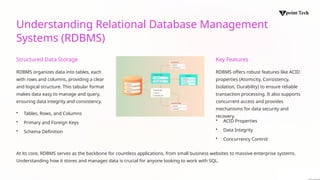
Understanding Relational Database Management
Systems (RDBMS)
Structured Data Storage
RDBMS organizes data into tables, each
with rows and columns, providing a clear
and logical structure. This tabular format
makes data easy to manage and query,
ensuring data integrity and consistency.
• Tables, Rows, and Columns
• Primary and Foreign Keys
• Schema Definition
Key Features
RDBMS offers robust features like ACID
properties (Atomicity, Consistency,
Isolation, Durability) to ensure reliable
transaction processing. It also supports
concurrent access and provides
mechanisms for data security and
recovery.
• ACID Properties
• Data Integrity
• Concurrency Control
At its core, RDBMS serves as the backbone for countless applications, from small business websites to massive enterprise systems.
Understanding how it stores and manages data is crucial for anyone looking to work with SQL.
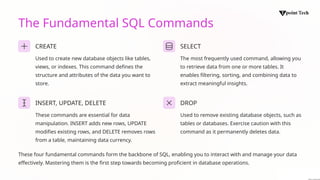
The Fundamental SQL Commands
CREATE
Used to create new database objects like tables,
views, or indexes. This command defines the
structure and attributes of the data you want to
store.
SELECT
The most frequently used command, allowing you
to retrieve data from one or more tables. It
enables filtering, sorting, and combining data to
extract meaningful insights.
INSERT, UPDATE, DELETE
These commands are essential for data
manipulation. INSERT adds new rows, UPDATE
modifies existing rows, and DELETE removes rows
from a table, maintaining data currency.
DROP
Used to remove existing database objects, such as
tables or databases. Exercise caution with this
command as it permanently deletes data.
These four fundamental commands form the backbone of SQL, enabling you to interact with and manage your data
effectively. Mastering them is the first step towards becoming proficient in database operations.
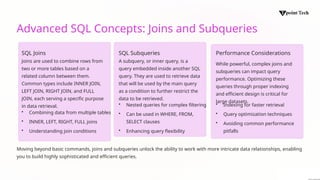
Advanced SQL Concepts: Joins and Subqueries
SQL Joins
Joins are used to combine rows from
two or more tables based on a
related column between them.
Common types include INNER JOIN,
LEFT JOIN, RIGHT JOIN, and FULL
JOIN, each serving a specific purpose
in data retrieval.
• Combining data from multiple tables
• INNER, LEFT, RIGHT, FULL joins
• Understanding join conditions
SQL Subqueries
A subquery, or inner query, is a
query embedded inside another SQL
query. They are used to retrieve data
that will be used by the main query
as a condition to further restrict the
data to be retrieved.
• Nested queries for complex filtering
• Can be used in WHERE, FROM,
SELECT clauses
• Enhancing query flexibility
Performance Considerations
While powerful, complex joins and
subqueries can impact query
performance. Optimizing these
queries through proper indexing
and efficient design is critical for
large datasets.
• Indexing for faster retrieval
• Query optimization techniques
• Avoiding common performance
pitfalls
Moving beyond basic commands, joins and subqueries unlock the ability to work with more intricate data relationships, enabling
you to build highly sophisticated and efficient queries.
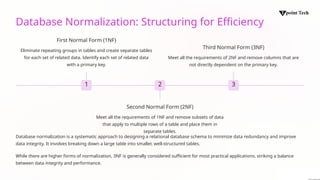
Database Normalization: Structuring for Efficiency
1
First Normal Form (1NF)
Eliminate repeating groups in tables and create separate tables
for each set of related data. Identify each set of related data
with a primary key.
2
Second Normal Form (2NF)
Meet all the requirements of 1NF and remove subsets of data
that apply to multiple rows of a table and place them in
separate tables.
3
Third Normal Form (3NF)
Meet all the requirements of 2NF and remove columns that are
not directly dependent on the primary key.
Database normalization is a systematic approach to designing a relational database schema to minimize data redundancy and improve
data integrity. It involves breaking down a large table into smaller, well-structured tables.
While there are higher forms of normalization, 3NF is generally considered sufficient for most practical applications, striking a balance
between data integrity and performance.
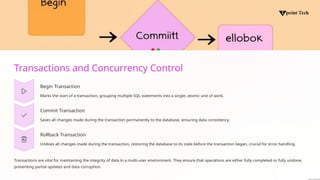
Transactions and Concurrency Control
Begin Transaction
Marks the start of a transaction, grouping multiple SQL statements into a single, atomic unit of work.
Commit Transaction
Saves all changes made during the transaction permanently to the database, ensuring data consistency.
Rollback Transaction
Undoes all changes made during the transaction, restoring the database to its state before the transaction began, crucial for error handling.
Transactions are vital for maintaining the integrity of data in a multi-user environment. They ensure that operations are either fully completed or fully undone,
preventing partial updates and data corruption.
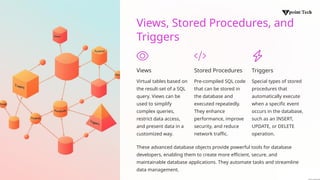
Views, Stored Procedures, and
Triggers
Views
Virtual tables based on
the result-set of a SQL
query. Views can be
used to simplify
complex queries,
restrict data access,
and present data in a
customized way.
Stored Procedures
Pre-compiled SQL code
that can be stored in
the database and
executed repeatedly.
They enhance
performance, improve
security, and reduce
network traffic.
Triggers
Special types of stored
procedures that
automatically execute
when a specific event
occurs in the database,
such as an INSERT,
UPDATE, or DELETE
operation.
These advanced database objects provide powerful tools for database
developers, enabling them to create more efficient, secure, and
maintainable database applications. They automate tasks and streamline
data management.
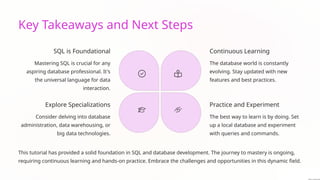
Key Takeaways and Next Steps
SQL is Foundational
Mastering SQL is crucial for any
aspiring database professional. It's
the universal language for data
interaction.
Continuous Learning
The database world is constantly
evolving. Stay updated with new
features and best practices.
Practice and Experiment
The best way to learn is by doing. Set
up a local database and experiment
with queries and commands.
Explore Specializations
Consider delving into database
administration, data warehousing, or
big data technologies.
This tutorial has provided a solid foundation in SQL and database development. The journey to mastery is ongoing,
requiring continuous learning and hands-on practice. Embrace the challenges and opportunities in this dynamic field.

Mastering-SQL-Your-Guide-to-Database-Development.pptx

  • 1.
    Mastering SQL: YourGuide to Database Development Welcome to this comprehensive SQL tutorial, designed to equip aspiring database developers and students with the essential knowledge and skills needed to navigate the world of relational databases. SQL, or Structured Query Language, is the foundational language for managing and manipulating data. This presentation will guide you through the core concepts, practical applications, and advanced techniques of SQL, transforming you into a proficient database professional. +91-9599086977 PY by Prakash Yadav www.tpointtech.com/sql-tutorial
  • 2.
    Understanding Relational DatabaseManagement Systems (RDBMS) Structured Data Storage RDBMS organizes data into tables, each with rows and columns, providing a clear and logical structure. This tabular format makes data easy to manage and query, ensuring data integrity and consistency. • Tables, Rows, and Columns • Primary and Foreign Keys • Schema Definition Key Features RDBMS offers robust features like ACID properties (Atomicity, Consistency, Isolation, Durability) to ensure reliable transaction processing. It also supports concurrent access and provides mechanisms for data security and recovery. • ACID Properties • Data Integrity • Concurrency Control At its core, RDBMS serves as the backbone for countless applications, from small business websites to massive enterprise systems. Understanding how it stores and manages data is crucial for anyone looking to work with SQL.
  • 3.
    The Fundamental SQLCommands CREATE Used to create new database objects like tables, views, or indexes. This command defines the structure and attributes of the data you want to store. SELECT The most frequently used command, allowing you to retrieve data from one or more tables. It enables filtering, sorting, and combining data to extract meaningful insights. INSERT, UPDATE, DELETE These commands are essential for data manipulation. INSERT adds new rows, UPDATE modifies existing rows, and DELETE removes rows from a table, maintaining data currency. DROP Used to remove existing database objects, such as tables or databases. Exercise caution with this command as it permanently deletes data. These four fundamental commands form the backbone of SQL, enabling you to interact with and manage your data effectively. Mastering them is the first step towards becoming proficient in database operations.
  • 4.
    Advanced SQL Concepts:Joins and Subqueries SQL Joins Joins are used to combine rows from two or more tables based on a related column between them. Common types include INNER JOIN, LEFT JOIN, RIGHT JOIN, and FULL JOIN, each serving a specific purpose in data retrieval. • Combining data from multiple tables • INNER, LEFT, RIGHT, FULL joins • Understanding join conditions SQL Subqueries A subquery, or inner query, is a query embedded inside another SQL query. They are used to retrieve data that will be used by the main query as a condition to further restrict the data to be retrieved. • Nested queries for complex filtering • Can be used in WHERE, FROM, SELECT clauses • Enhancing query flexibility Performance Considerations While powerful, complex joins and subqueries can impact query performance. Optimizing these queries through proper indexing and efficient design is critical for large datasets. • Indexing for faster retrieval • Query optimization techniques • Avoiding common performance pitfalls Moving beyond basic commands, joins and subqueries unlock the ability to work with more intricate data relationships, enabling you to build highly sophisticated and efficient queries.
  • 5.
    Database Normalization: Structuringfor Efficiency 1 First Normal Form (1NF) Eliminate repeating groups in tables and create separate tables for each set of related data. Identify each set of related data with a primary key. 2 Second Normal Form (2NF) Meet all the requirements of 1NF and remove subsets of data that apply to multiple rows of a table and place them in separate tables. 3 Third Normal Form (3NF) Meet all the requirements of 2NF and remove columns that are not directly dependent on the primary key. Database normalization is a systematic approach to designing a relational database schema to minimize data redundancy and improve data integrity. It involves breaking down a large table into smaller, well-structured tables. While there are higher forms of normalization, 3NF is generally considered sufficient for most practical applications, striking a balance between data integrity and performance.
  • 6.
    Transactions and ConcurrencyControl Begin Transaction Marks the start of a transaction, grouping multiple SQL statements into a single, atomic unit of work. Commit Transaction Saves all changes made during the transaction permanently to the database, ensuring data consistency. Rollback Transaction Undoes all changes made during the transaction, restoring the database to its state before the transaction began, crucial for error handling. Transactions are vital for maintaining the integrity of data in a multi-user environment. They ensure that operations are either fully completed or fully undone, preventing partial updates and data corruption.
  • 7.
    Views, Stored Procedures,and Triggers Views Virtual tables based on the result-set of a SQL query. Views can be used to simplify complex queries, restrict data access, and present data in a customized way. Stored Procedures Pre-compiled SQL code that can be stored in the database and executed repeatedly. They enhance performance, improve security, and reduce network traffic. Triggers Special types of stored procedures that automatically execute when a specific event occurs in the database, such as an INSERT, UPDATE, or DELETE operation. These advanced database objects provide powerful tools for database developers, enabling them to create more efficient, secure, and maintainable database applications. They automate tasks and streamline data management.
  • 8.
    Key Takeaways andNext Steps SQL is Foundational Mastering SQL is crucial for any aspiring database professional. It's the universal language for data interaction. Continuous Learning The database world is constantly evolving. Stay updated with new features and best practices. Practice and Experiment The best way to learn is by doing. Set up a local database and experiment with queries and commands. Explore Specializations Consider delving into database administration, data warehousing, or big data technologies. This tutorial has provided a solid foundation in SQL and database development. The journey to mastery is ongoing, requiring continuous learning and hands-on practice. Embrace the challenges and opportunities in this dynamic field.