Contact
About Us
Service
Home
Studio Shodwe
SOFTWARE
DEVELOPMET
Contact
About Us
Service
Home
Software development is the process of designing,
creating, testing, and maintaining software
applications. It involves translating user needs into
functioning code using programming languages,
frameworks, and tools.
The process follows a structured approach called the
Software Development Life Cycle (SDLC), which
includes phases like planning, analysis, design,
implementation, and maintenance. Software
development is crucial in driving innovation,
automating tasks, and enabling businesses to operate
efficiently.
INTRODUCTIONTOSOFTWARE
DEVELOPMENT
Contact
About Us
Service
Home
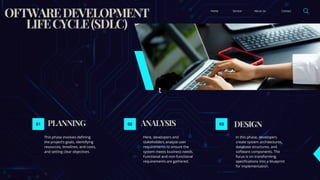
01
Here, developers and
stakeholders analyze user
requirements to ensure the
system meets business needs.
Functional and non-functional
requirements are gathered.
02
In this phase, developers
create system architectures,
database structures, and
software components. The
focus is on transforming
specifications into a blueprint
for implementation.
03
OFTWAREDEVELOPMENT
LIFECYCLE(SDLC)
t
This phase involves defining
the project’s goals, identifying
resources, timelines, and costs,
and setting clear objectives.
PLANNING ANALYSIS DESIGN
Contact
About Us
Service
Home
Agile methodology in software development emphasizes iterative
progress, flexibility, and collaboration. It breaks projects into small,
manageable increments called sprints, typically lasting 1-4 weeks.
Teams work together to deliver functional software at the end of
each sprint, promoting frequent feedback and adjustments.
01
Agile focuses on adaptability, allowing teams to respond to changing
requirements quickly. This is achieved through daily stand-up meetings,
regular reviews, and retrospectives, where teams assess their progress
and identify areas for improvement. It contrasts with traditional
methodologies that require strict, linear phases of development.
02
Frameworks like Scrum and Kanban are often used within Agile. Scrum
organizes work into time-boxed sprints, while Kanban emphasizes
continuous delivery and workflow visualization. Both approaches help
teams maintain efficiency and improve quality by delivering incremental,
usable software faster than traditional methods.
03
AGILEMETHODOLOGYIN
SOFTWAREDEVELOPMENT
Contact
About Us
Service
Home
SOFTWARE
DEVELOPERS
Contact
About Us
Service
Home
Studio Shodwe
THANK YOU

"Mastering Software Development; Building the Future of Innovation"

  • 1.
  • 2.
    Contact About Us Service Home Software developmentis the process of designing, creating, testing, and maintaining software applications. It involves translating user needs into functioning code using programming languages, frameworks, and tools. The process follows a structured approach called the Software Development Life Cycle (SDLC), which includes phases like planning, analysis, design, implementation, and maintenance. Software development is crucial in driving innovation, automating tasks, and enabling businesses to operate efficiently. INTRODUCTIONTOSOFTWARE DEVELOPMENT
  • 3.
    Contact About Us Service Home 01 Here, developersand stakeholders analyze user requirements to ensure the system meets business needs. Functional and non-functional requirements are gathered. 02 In this phase, developers create system architectures, database structures, and software components. The focus is on transforming specifications into a blueprint for implementation. 03 OFTWAREDEVELOPMENT LIFECYCLE(SDLC) t This phase involves defining the project’s goals, identifying resources, timelines, and costs, and setting clear objectives. PLANNING ANALYSIS DESIGN
  • 4.
    Contact About Us Service Home Agile methodologyin software development emphasizes iterative progress, flexibility, and collaboration. It breaks projects into small, manageable increments called sprints, typically lasting 1-4 weeks. Teams work together to deliver functional software at the end of each sprint, promoting frequent feedback and adjustments. 01 Agile focuses on adaptability, allowing teams to respond to changing requirements quickly. This is achieved through daily stand-up meetings, regular reviews, and retrospectives, where teams assess their progress and identify areas for improvement. It contrasts with traditional methodologies that require strict, linear phases of development. 02 Frameworks like Scrum and Kanban are often used within Agile. Scrum organizes work into time-boxed sprints, while Kanban emphasizes continuous delivery and workflow visualization. Both approaches help teams maintain efficiency and improve quality by delivering incremental, usable software faster than traditional methods. 03 AGILEMETHODOLOGYIN SOFTWAREDEVELOPMENT
  • 5.
  • 6.