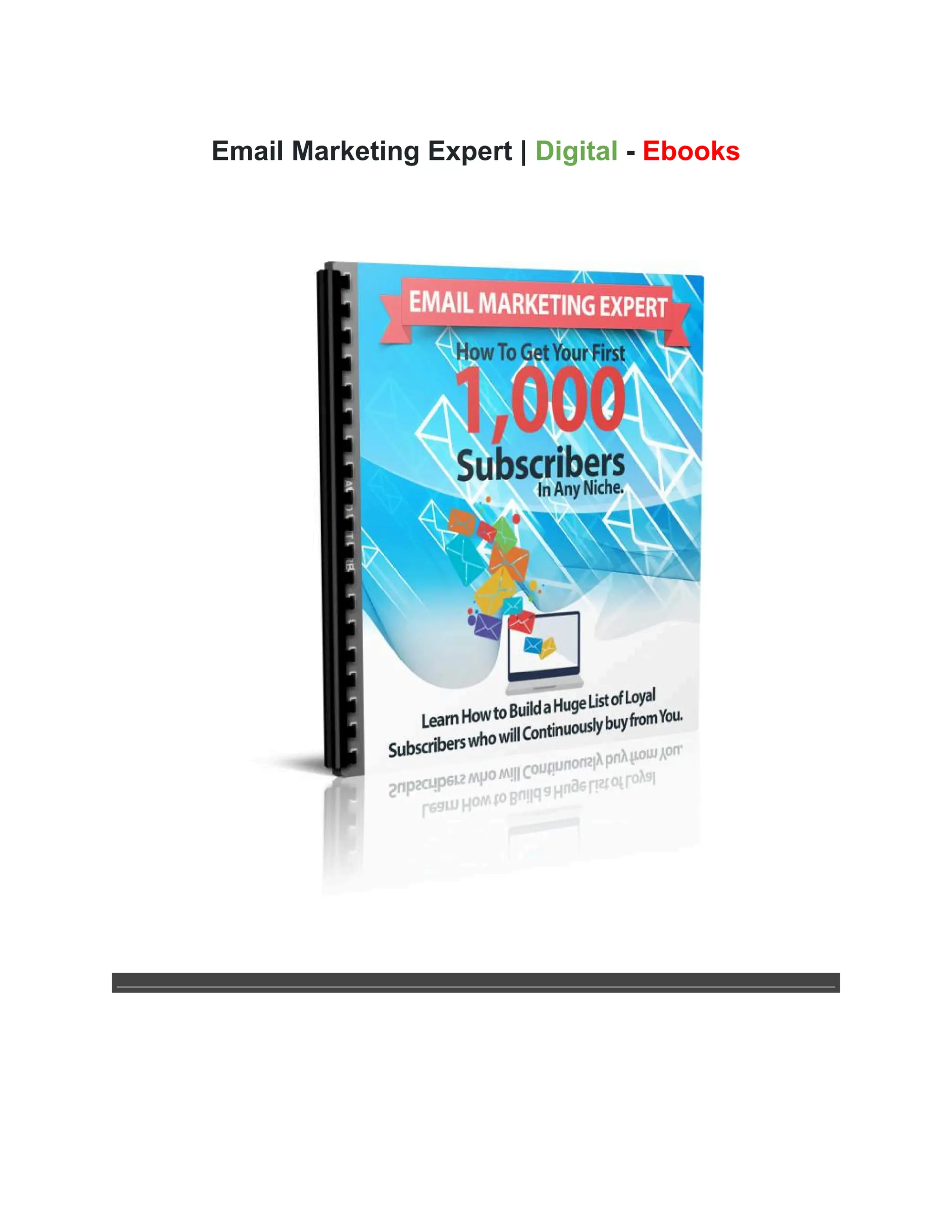
Email Marketing Expert | Digital - Ebooks
Table of Contents:
Step 1: Understanding the Basics
● What is Email Marketing?
● Why is Copywriting Important in Email Marketing?
● Key Elements of Effective Email Copywriting
Step 2: Knowing Your Audience
● Defining Your Target Audience
● Conducting Market Research
● Creating Buyer Personas
Step 3: Crafting Compelling Subject Lines
● Importance of Subject Lines
● Types of Subject Lines
● Tips for Writing Attention-Grabbing Subject Lines
Step 4: Writing Engaging Email Openers
● Introduction to Email Openers
● Techniques for Captivating Openers
● Examples of Effective Openers
Step 5: Developing Persuasive Body Copy
● Structuring Your Email Body
● Writing Clear and Concise Content
● Incorporating Persuasive Language and Calls-to-Action
Step 6: Using Visuals Effectively
● Importance of Visuals in Email Marketing
● Types of Visual Content
● Best Practices for Using Visuals in Emails
Step 7: Optimizing for Mobile Devices
● Mobile-Friendly Design Tips
● Testing Your Emails for Mobile Responsiveness
● Improving User Experience on Mobile Devices
Step 8: Personalization and Segmentation
● Benefits of Personalization in Email Marketing
● Strategies for Personalizing Emails
● Importance of Audience Segmentation
Step 9: A/B Testing and Analytics
● Understanding A/B Testing
● Conducting A/B Tests for Email Campaigns
● Interpreting Email Analytics and Metrics
Step 10: Building Relationships and Nurturing Leads
● Importance of Relationship Building in Email Marketing
● Strategies for Nurturing Leads Through Email
● Tips for Building Long-Term Customer Relationships
Conclusion: Taking Your Email Marketing Skills to the Next Level
● Recap of Key Concepts
● Additional Resources for Continuous Learning
● Final Thoughts and Encouragement
Introduction:
Welcome to "Mastering Email Marketing: A Beginner's Guide to Copywriting"! In this
ebook, we'll embark on a journey to transform you from a novice to an Email Marketing
Expert. Whether you're a business owner looking to enhance your marketing efforts or
an aspiring copywriter aiming to specialize in email campaigns, this guide is tailored just
for you.
Email marketing remains one of the most powerful tools in the digital marketing arsenal.
It allows businesses to directly engage with their audience, nurture leads, drive sales,
and build lasting relationships.
However, to harness the full potential of email marketing, you need more than just a list
of contacts and a generic message. You need a compelling copy that captivates,
persuades, and converts.
That's where the art and science of copywriting come into play. Copywriting isn't just
about stringing words together; it's about crafting messages that resonate with your
audience, elicit emotions, and drive action.
Whether you're writing a subject line that entices opens, an opener that hooks readers,
or a body copy that compels clicks, each element plays a crucial role in the success of
your email campaigns.
In this ebook, we'll dive deep into the fundamentals of email marketing and copywriting.
We'll explore how to understand your audience, craft compelling subject lines, write
engaging body copy, incorporate visuals effectively, optimize for mobile devices,
personalize content, conduct A/B testing, analyze metrics, and ultimately, build strong
relationships with your subscribers.
Throughout this journey, we'll provide practical tips, real-world examples, and actionable
strategies that you can implement right away. Whether you're completely new to email
marketing or looking to refine your skills, this ebook will serve as your comprehensive
guide to mastering the art of email copywriting.
So, are you ready to unlock the secrets of successful email marketing and become an
Email Marketing Expert? Let's dive in and start crafting emails that not only get noticed
but also drive results
Step 1: Understanding the Basics
Email marketing is a powerful digital marketing strategy that involves sending targeted
messages to a group of recipients via email. It's a direct and cost-effective way for
businesses to communicate with their audience, promote products or services, build
brand awareness, drive traffic to websites, and ultimately, generate leads and sales.
Why is Copywriting Important in Email Marketing?
Copywriting plays a pivotal role in the success of email marketing campaigns. It's the art
and science of crafting persuasive and compelling written content that resonates with
your audience and motivates them to take action. Here are several reasons why
copywriting is crucial in email marketing:
1. Capturing Attention: Effective copywriting grabs the reader's attention from the
moment they see the email subject line. It entices them to open the email and
engage with the content inside.
2. Communicating Value: Copywriting communicates the value proposition of your
products or services. It highlights benefits, addresses pain points, and convinces
recipients of the value they'll gain by taking the desired action.
3. Building Trust: Well-written copy establishes trust and credibility with your
audience. It reflects your brand's tone, voice, and personality, creating a cohesive
and trustworthy communication
Step 2: Knowing Your Audience
Understanding your audience is fundamental to successful email marketing. In this step,
we'll explore how to define your target audience, conduct market research, and create
buyer personas to tailor your email campaigns effectively
Defining Your Target Audience:
Your target audience consists of the specific group of people who are most likely to be
interested in your products or services. Defining this audience helps you tailor your
email content, messaging, and offers to resonate with their needs and preferences.
Key Steps in Defining Your Target Audience:
1. Demographic Information: Start by identifying demographic factors such as age,
gender, income level, education, occupation, and geographic location. These
details provide a basic understanding of who your audience is.
2. Psychographic Insights: Dive deeper into psychographic factors such as
interests, values, attitudes, lifestyles, and behaviors. Understand what motivates
your audience, their pain points, aspirations, and challenges.
3. Purchase Behavior: Analyze past purchase behavior to identify patterns,
preferences, and buying cycles. Understand how your audience makes
purchasing decisions and what influences their choices.
Step 3: Crafting Compelling Subject Lines
Subject lines are the gatekeepers of your emails. They determine whether your
subscribers will open and engage with your message or ignore it altogether. In this step,
we'll delve into the importance of subject lines, explore different types of subject lines,
and provide tips for writing attention-grabbing subject lines that compel action.
Importance of Subject Lines
Subject lines are critical because they are the first impression recipients have of your
email. They play a significant role in determining open rates and ultimately impact the
success of your email campaigns. Here's why subject lines are crucial:
1. First Impressions: Subject lines are the first thing recipients see in their inbox. A
compelling subject line can pique curiosity and entice them to open the email.
2. Open Rates: The effectiveness of your subject line directly affects open rates. A
well-crafted subject line can lead to higher open rates and increased
engagement.
3. Relevance: A relevant subject line that aligns with the content of the email
increases the chances of recipients engaging with the message.
4. Clarity and Conciseness: Subject lines should be clear, concise, and easy to
understand. They should convey the essence of the email in a few words.
Types of Subject Lines:
There are several types of subject lines you can use to capture attention and compel
opens. Here are some common types:
1. Benefit-Oriented: Highlight the benefits or value proposition of opening the email.
For example, "Unlock Exclusive Discounts Inside!"
2. Curiosity-Driven: Create curiosity by teasing a benefit or hinting at valuable
content. For example, "Discover the Secret to Success..."
3. Urgency and Scarcity: Create a sense of urgency or scarcity to encourage
immediate action. For example, "Limited Time Offer: Act Now!"
4. Personalized: Personalize subject lines with the recipient's name or personalized
content. For example, "John, Your Exclusive Invitation Awaits!"
5. Question-Based: Pose a question that intrigues recipients and prompts them to
open the email. For example, "Ready to Transform Your Marketing Strategy?"
Tips for Writing Attention-Grabbing Subject Lines:
Crafting attention-grabbing subject lines requires creativity, relevance, and strategic
thinking. Here are some tips to help you write compelling subject lines:
1. Be Clear and Concise: Keep subject lines short and to the point. Aim for 4-7
words that convey the essence of the email.
2. Create Urgency: Use words like "limited time," "act now," or "don't miss out" to
create a sense of urgency and encourage immediate action.
3. Personalize when Possible: Personalized subject lines using the recipient's name
or relevant information can increase open rates.
4. Use Power Words: Incorporate power words that evoke emotion or curiosity,
such as "exclusive," "free," "new," "discover," "secrets," and "limited."
5. Test and Iterate: A/B test different subject lines to see which ones resonate best
with your audience. Use data-driven insights to refine your approach.
6. Avoid Spam Triggers: Steer clear of spammy words or symbols that can trigger
spam filters and decrease deliverability.
Step 4: Writing Engaging Email Openers
Introduction to Email Openers:
In this section, we’ll dive into the crucial role that email openers play in grabbing your
reader’s attention right from the start. You’ll learn why a strong opener is essential for
the success of your email campaigns and how it sets the stage for effective
communication.
Techniques for Captivating Openers:
Discover a range of proven techniques for crafting openers that captivate your audience
and compel them to keep reading:
1. Personalization: Tailoring your opener to resonate with the recipient's interests or
experiences.
2. Curiosity: Using curiosity-inducing questions or statements to intrigue readers.
3. Relevance: Starting with information that directly relates to the recipient’s needs
or interests.
4. Emotion: Eliciting emotional responses through empathy, excitement, or urgency.
5. Storytelling: Engaging readers with a compelling narrative or anecdote.
6. Surprise: Unexpected elements that grab attention and spark curiosity.
Examples of Effective Openers:
Explore real-world examples of engaging email openers that utilize the techniques
mentioned above. These examples will inspire you and provide practical insights into
crafting your own captivating openers tailored to your audience and objectives.
Step 5: Developing Persuasive Body Copy
Structuring Your Email Body
Learn how to structure your email body effectively to keep readers engaged and drive
desired actions:
1. Introduction: Grab attention and set the tone.
2. Main Content: Provide value, address pain points, and showcase benefits.
3. Persuasive Elements: Incorporate persuasive language, testimonials, and social
proof.
4. Call-to-Action (CTA): Clearly state what action you want readers to take.
Writing Clear and Concise Content
Discover techniques for crafting clear and concise content that conveys your message
effectively:
1. Clarity: Use simple language and avoid jargon to ensure understanding.
2. Conciseness: Get to the point quickly and eliminate unnecessary words or
information.
3. Formatting: Use bullet points, subheadings, and visual elements to enhance
readability.
Incorporating Persuasive Language and Calls-to-Action:
Master the art of persuasion by using language that convinces and compels action:
1. Emotional Appeal: Appeal to emotions to connect with readers on a deeper level.
2. Benefits-Oriented: Focus on the benefits of your offer rather than just features.
3. Urgency and Scarcity: Create a sense of urgency or scarcity to prompt
immediate action.
4. CTA Optimization: Craft compelling calls-to-action that are clear, specific, and
easy to act upon.
Step 6: Using Visuals Effectively
Importance of Visuals in Email Marketing
Understand why visuals are a powerful tool in email marketing and how they can
enhance engagement and convey messages more effectively than text alone:
1. Attention-Grabbing: Visuals capture attention and make your emails stand out in
crowded inboxes.
2. Storytelling: Images and graphics can tell a story or convey emotions that
resonate with recipients.
3. Increased Engagement: Visuals can lead to higher click-through rates and
conversions compared to text-only emails.
4. Brand Identity: Consistent use of visuals helps reinforce brand identity and
recognition.
Types of Visual Content
Explore different types of visual content that can be used in emails to achieve various
marketing objectives:
1. Images: High-quality photos and graphics that complement your message.
2. Videos: Engaging videos that demonstrate products, share testimonials, or
provide valuable content.
3. Infographics: Visual representations of data or information for easy
understanding.
4. GIFs: Animated GIFs that add movement and visual interest to your emails.
5. Charts and Graphs: Visual data representations for illustrating trends or statistics.
Best Practices for Using Visuals in Emails
Learn how to use visuals effectively while adhering to best practices:
1. Relevance: Ensure visuals are relevant to your message and audience.
2. Optimization: Use optimized images and videos for faster loading times.
3. Accessibility: Provide alternative text (ALT text) for images to accommodate
visually impaired users.
4. Consistency: Maintain consistent branding and style across visual elements.
5. Mobile-Friendly: Ensure visuals are mobile-responsive for a seamless viewing
experience on all devices.
Step 7: Optimizing for Mobile Devices
In today's digital landscape, optimizing your emails for mobile devices is not just a
suggestion but a necessity. This step delves into mobile-friendly design tips, testing
strategies, and enhancing user experience on mobile devices.
Mobile-Friendly Design Tips
1. Responsive Layout: Use a responsive email design that adapts seamlessly to
different screen sizes and orientations.
2. Clear CTAs: Ensure your call-to-action buttons are easily tappable and
prominently displayed.
3. Readable Font: Use legible fonts and maintain a minimum font size of 14px for
optimal readability on mobile screens.
4. Single Column: Opt for a single-column layout to prevent horizontal scrolling and
improve content consumption.
5. Optimized Images: Compress images for faster loading times without
compromising quality.
6. Whitespace: Incorporate ample whitespace to improve visual hierarchy and
reduce clutter on smaller screens.
Testing Your Emails for Mobile Responsiveness:
1. Preview Tools: Use email preview tools to test how your emails render across
various devices and email clients.
2. Device Testing: Conduct real-device testing on different smartphones and tablets
to identify any layout or rendering issues.
3. User Testing: Gather feedback from actual users to assess the usability and
effectiveness of your mobile emails.
Improving User Experience on Mobile Devices
1. Fast Loading Times: Optimize loading speeds by minimizing file sizes and
leveraging browser caching.
2. Easy Navigation: Ensure intuitive navigation by using clear menus, buttons, and
links.
3. Touch-Friendly Elements: Make interactive elements like buttons and links large
enough for easy tapping.
4. Consistent Branding: Maintain consistent branding across desktop and mobile
versions to enhance brand recognition.
5. Mobile-Specific Content: Consider tailoring content specifically for mobile users,
such as shorter paragraphs and concise messaging.
Step 8: Personalization and Segmentation
Personalization and segmentation are key pillars of successful email marketing
campaigns. In this step, we'll explore the benefits of personalization, strategies for
effective personalization, and the importance of audience segmentation.
Benefits of Personalization in Email Marketing
1. Improved Engagement: Personalized emails resonate better with recipients,
leading to higher open rates, click-through rates, and conversions.
2. Enhanced Customer Experience: Tailoring content to individual preferences and
behavior shows that you understand and value your audience.
3. Increased Relevance: Personalization ensures that your emails are relevant and
timely, addressing specific needs and interests.
4. Building Relationships: Personalized communication fosters stronger
connections with your audience, leading to increased loyalty and retention.
Strategies for Personalizing Emails:
1. Dynamic Content: Use dynamic content blocks to customize email content based
on recipient data such as name, location, or past interactions.
2. Behavioral Targeting: Leverage data on user behavior, such as purchase history
or website interactions, to deliver personalized recommendations or offers.
3. Segmentation: Divide your audience into segments based on demographics,
preferences, engagement level, or lifecycle stage to deliver targeted and relevant
content.
4. Personalized Subject Lines: Craft personalized subject lines that grab attention
and entice recipients to open your emails.
5. Automated Workflows: Set up automated email workflows triggered by specific
actions or milestones to deliver personalized messages at the right time.
Importance of Audience Segmentation:
1. Relevance: Segmentation allows you to send content that is highly relevant to
each segment, increasing engagement and response rates.
2. Customized Messaging: Tailor your messaging and offers to match the needs
and interests of different audience segments.
3. Optimized Campaigns: Segmentation enables you to test and optimize
campaigns for each segment, leading to improved performance and ROI.
4. Targeted Campaigns: Create targeted campaigns that address specific goals or
challenges faced by different segments of your audience.
5. Retention and Loyalty: Personalized and segmented campaigns contribute to
increased customer satisfaction, loyalty, and long-term retention.
Step 9: A/B Testing and Analytics
A/B testing and analytics are powerful tools that can significantly enhance the
effectiveness of your email marketing campaigns. In this step, we'll explore what A/B
testing entails, how to conduct A/B tests for email campaigns, and the importance of
interpreting email analytics and metrics.
Understanding A/B Testing:
A/B testing, also known as split testing, involves comparing two versions of an element
(such as subject lines, CTAs, or content) to determine which one performs better in
terms of your defined goals, such as open rates, click-through rates, or conversions. The
purpose of A/B testing is to identify what resonates most with your audience and
optimize your campaigns accordingly.
Conducting A/B Tests for Email Campaigns:
1. Identify Test Variables: Choose the elements you want to test, such as subject
lines, email content, CTAs, or sending times.
2. Create Test Groups: Split your audience into two random groups (A and B) and
send each group a different version of the email with the test variable(s) as the
only difference.
3. Define Success Metrics: Determine the key metrics you'll use to measure the
success of your A/B test, such as open rates, click-through rates, conversion
rates, or revenue generated.
4. Run the Test: Send out the A/B test emails and monitor their performance over a
specific time period or until statistical significance is reached.
5. Analyzing Results: Compare the performance of the A and B versions based on
your defined success metrics. Determine which version performed better and
draw insights from the data collected.
6. Implement Changes: Use the insights gained from the A/B test to make informed
decisions and optimize future email campaigns for better results.
Interpreting Email Analytics and Metrics:
1. Open Rate: The percentage of recipients who opened your email. A high open
rate indicates that your subject line and sender name are effective in grabbing
attention.
2. Click-Through Rate (CTR): The percentage of recipients who clicked on a link or
CTA within your email. A higher CTR signifies that your content and CTAs are
compelling and engaging.
3. Conversion Rate: The percentage of recipients who completed a desired action,
such as making a purchase or filling out a form. A high conversion rate indicates
that your email content and offers are persuasive.
4. Bounce Rate: The percentage of emails that were not delivered successfully. A
high bounce rate may indicate issues with email deliverability or outdated email
lists.
5. Unsubscribe Rate: The percentage of recipients who unsubscribed from your
email list. Monitoring unsubscribe rates helps you gauge customer satisfaction
and email fatigue.
Step 10: Building Relationships and Nurturing Leads
Building strong relationships and nurturing leads are essential aspects of successful
email marketing. In this step, we'll explore the importance of relationship building,
strategies for nurturing leads through email, and tips for fostering long-term customer
relationships.
Importance of Relationship Building in Email Marketing:
1. Trust and Credibility: Building relationships with your audience helps establish
trust and credibility, making them more receptive to your messages and offers.
2. Customer Engagement: Strong relationships lead to higher levels of customer
engagement, resulting in increased open rates, click-through rates, and
conversions.
3. Repeat Business: Nurturing relationships with existing customers encourages
repeat business and fosters loyalty, leading to long-term revenue growth.
4. Referrals and Advocacy: Satisfied customers are more likely to refer others to
your business and act as brand advocates, amplifying your reach and impact.
Strategies for Nurturing Leads Through Email
1. Segmentation and Personalization: Segment your email list based on customer
preferences, behaviors, or lifecycle stages, and personalize content to meet their
specific needs.
2. Educational Content: Provide valuable and informative content that addresses
customer pain points, educates them about your products or services, and offers
solutions.
3. Lead Nurturing Workflows: Create automated email workflows that guide leads
through the sales funnel, providing relevant content at each stage to nurture and
convert them.
4. Engagement Campaigns: Run engagement campaigns such as surveys, polls, or
contests to interact with your audience, gather feedback, and encourage
participation.
5. Timely Follow-Ups: Follow up with leads promptly after interactions or inquiries,
providing further information, answering questions, and guiding them toward a
purchase decision.
6. Customer Feedback: Solicit and act on customer feedback to improve your
products, services, and overall customer experience.
Tips for Building Long-Term Customer Relationships
1. Consistent Communication: Maintain regular communication with your audience
through email newsletters, updates, and relevant content to stay top of mind.
2. Personalized Offers: Tailor offers and promotions based on customer
preferences and purchase history to provide personalized value.
3. Exceptional Customer Service: Provide exceptional customer service and
support, addressing inquiries, resolving issues promptly, and going the extra mile
to delight customers.
4. Surprise and Delight: Surprise customers with exclusive offers, discounts, or
personalized messages to show appreciation and reinforce loyalty.
5. Community Building: Foster a sense of community among your customers by
encouraging interaction, showcasing user-generated content, and facilitating
networking opportunities.
Conclusion: Taking Your Email Marketing Skills to the Next Level
Congratulations on completing this comprehensive guide to mastering email marketing!
You've gained valuable insights into various strategies, techniques, and best practices
that will empower you to take your email marketing skills to the next level. Let's recap
the key concepts covered, explore additional resources for continuous learning, and
share some final thoughts and encouragement.
Recap of Key Concepts
Throughout this ebook, you've learned:
1. The importance of crafting engaging email openers to capture attention from the
start.
2. Strategies for writing persuasive body copy that drives action and engagement.
3. The effective use of visuals to enhance the impact and appeal of your emails.
4. Optimizing emails for mobile devices to ensure a seamless user experience.
5. Personalization and segmentation techniques for delivering targeted and relevant
content.
6. A/B testing and analytics for optimizing campaign performance and driving
continuous improvement.
7. Building relationships and nurturing leads through strategic email
communication.
Additional Resources for Continuous Learning
To continue honing your email marketing skills and staying updated with industry
trends, consider exploring these additional resources:
1. Blogs and Websites: Follow reputable blogs and websites dedicated to email
marketing, such as HubSpot, Campaign Monitor, and Litmus.
2. Online Courses: Enroll in online courses or certifications to deepen your
understanding of email marketing strategies and tools.
3. Webinars and Workshops: Attend webinars and workshops hosted by industry
experts to gain practical insights and tips.
4. Networking Events: Join email marketing communities and attend networking
events to connect with peers, share experiences, and learn from others.
5. Email Marketing Tools: Explore and leverage advanced email marketing tools and
platforms to streamline your campaigns and improve results.
Final Thoughts and Encouragement:
As you continue your journey in email marketing, remember that it's a dynamic and
evolving field. Stay curious, experiment with new ideas, and don't be afraid to try
different approaches to see what works best for your audience and goals. Keep testing,
learning, and adapting to stay ahead of the curve and achieve success in your email
marketing endeavors.
Your dedication to mastering email marketing is commendable, and your efforts will
undoubtedly yield positive results for your business or organization. Embrace the
opportunities that email marketing offers to connect with your audience, build
meaningful relationships, and drive impactful outcomes.
Best of luck on your email marketing journey, and may your campaigns continue to
inspire, engage, and succeed!

"Mastering Email Marketing: A Beginner's Guide to Copywriting

  • 1.
    Email Marketing Expert| Digital - Ebooks
  • 2.
    Table of Contents: Step1: Understanding the Basics ● What is Email Marketing? ● Why is Copywriting Important in Email Marketing? ● Key Elements of Effective Email Copywriting Step 2: Knowing Your Audience ● Defining Your Target Audience ● Conducting Market Research ● Creating Buyer Personas Step 3: Crafting Compelling Subject Lines ● Importance of Subject Lines ● Types of Subject Lines ● Tips for Writing Attention-Grabbing Subject Lines Step 4: Writing Engaging Email Openers ● Introduction to Email Openers ● Techniques for Captivating Openers ● Examples of Effective Openers Step 5: Developing Persuasive Body Copy ● Structuring Your Email Body ● Writing Clear and Concise Content ● Incorporating Persuasive Language and Calls-to-Action Step 6: Using Visuals Effectively ● Importance of Visuals in Email Marketing ● Types of Visual Content ● Best Practices for Using Visuals in Emails
  • 3.
    Step 7: Optimizingfor Mobile Devices ● Mobile-Friendly Design Tips ● Testing Your Emails for Mobile Responsiveness ● Improving User Experience on Mobile Devices Step 8: Personalization and Segmentation ● Benefits of Personalization in Email Marketing ● Strategies for Personalizing Emails ● Importance of Audience Segmentation Step 9: A/B Testing and Analytics ● Understanding A/B Testing ● Conducting A/B Tests for Email Campaigns ● Interpreting Email Analytics and Metrics Step 10: Building Relationships and Nurturing Leads ● Importance of Relationship Building in Email Marketing ● Strategies for Nurturing Leads Through Email ● Tips for Building Long-Term Customer Relationships Conclusion: Taking Your Email Marketing Skills to the Next Level ● Recap of Key Concepts ● Additional Resources for Continuous Learning ● Final Thoughts and Encouragement
  • 4.
    Introduction: Welcome to "MasteringEmail Marketing: A Beginner's Guide to Copywriting"! In this ebook, we'll embark on a journey to transform you from a novice to an Email Marketing Expert. Whether you're a business owner looking to enhance your marketing efforts or an aspiring copywriter aiming to specialize in email campaigns, this guide is tailored just for you. Email marketing remains one of the most powerful tools in the digital marketing arsenal. It allows businesses to directly engage with their audience, nurture leads, drive sales, and build lasting relationships. However, to harness the full potential of email marketing, you need more than just a list of contacts and a generic message. You need a compelling copy that captivates, persuades, and converts. That's where the art and science of copywriting come into play. Copywriting isn't just about stringing words together; it's about crafting messages that resonate with your audience, elicit emotions, and drive action. Whether you're writing a subject line that entices opens, an opener that hooks readers, or a body copy that compels clicks, each element plays a crucial role in the success of your email campaigns. In this ebook, we'll dive deep into the fundamentals of email marketing and copywriting. We'll explore how to understand your audience, craft compelling subject lines, write engaging body copy, incorporate visuals effectively, optimize for mobile devices, personalize content, conduct A/B testing, analyze metrics, and ultimately, build strong relationships with your subscribers. Throughout this journey, we'll provide practical tips, real-world examples, and actionable strategies that you can implement right away. Whether you're completely new to email marketing or looking to refine your skills, this ebook will serve as your comprehensive guide to mastering the art of email copywriting. So, are you ready to unlock the secrets of successful email marketing and become an Email Marketing Expert? Let's dive in and start crafting emails that not only get noticed but also drive results
  • 5.
    Step 1: Understandingthe Basics Email marketing is a powerful digital marketing strategy that involves sending targeted messages to a group of recipients via email. It's a direct and cost-effective way for businesses to communicate with their audience, promote products or services, build brand awareness, drive traffic to websites, and ultimately, generate leads and sales. Why is Copywriting Important in Email Marketing? Copywriting plays a pivotal role in the success of email marketing campaigns. It's the art and science of crafting persuasive and compelling written content that resonates with your audience and motivates them to take action. Here are several reasons why copywriting is crucial in email marketing: 1. Capturing Attention: Effective copywriting grabs the reader's attention from the moment they see the email subject line. It entices them to open the email and engage with the content inside. 2. Communicating Value: Copywriting communicates the value proposition of your products or services. It highlights benefits, addresses pain points, and convinces recipients of the value they'll gain by taking the desired action. 3. Building Trust: Well-written copy establishes trust and credibility with your audience. It reflects your brand's tone, voice, and personality, creating a cohesive and trustworthy communication Step 2: Knowing Your Audience Understanding your audience is fundamental to successful email marketing. In this step, we'll explore how to define your target audience, conduct market research, and create buyer personas to tailor your email campaigns effectively
  • 6.
    Defining Your TargetAudience: Your target audience consists of the specific group of people who are most likely to be interested in your products or services. Defining this audience helps you tailor your email content, messaging, and offers to resonate with their needs and preferences. Key Steps in Defining Your Target Audience: 1. Demographic Information: Start by identifying demographic factors such as age, gender, income level, education, occupation, and geographic location. These details provide a basic understanding of who your audience is. 2. Psychographic Insights: Dive deeper into psychographic factors such as interests, values, attitudes, lifestyles, and behaviors. Understand what motivates your audience, their pain points, aspirations, and challenges. 3. Purchase Behavior: Analyze past purchase behavior to identify patterns, preferences, and buying cycles. Understand how your audience makes purchasing decisions and what influences their choices. Step 3: Crafting Compelling Subject Lines Subject lines are the gatekeepers of your emails. They determine whether your subscribers will open and engage with your message or ignore it altogether. In this step, we'll delve into the importance of subject lines, explore different types of subject lines, and provide tips for writing attention-grabbing subject lines that compel action. Importance of Subject Lines Subject lines are critical because they are the first impression recipients have of your email. They play a significant role in determining open rates and ultimately impact the success of your email campaigns. Here's why subject lines are crucial: 1. First Impressions: Subject lines are the first thing recipients see in their inbox. A compelling subject line can pique curiosity and entice them to open the email.
  • 7.
    2. Open Rates:The effectiveness of your subject line directly affects open rates. A well-crafted subject line can lead to higher open rates and increased engagement. 3. Relevance: A relevant subject line that aligns with the content of the email increases the chances of recipients engaging with the message. 4. Clarity and Conciseness: Subject lines should be clear, concise, and easy to understand. They should convey the essence of the email in a few words. Types of Subject Lines: There are several types of subject lines you can use to capture attention and compel opens. Here are some common types: 1. Benefit-Oriented: Highlight the benefits or value proposition of opening the email. For example, "Unlock Exclusive Discounts Inside!" 2. Curiosity-Driven: Create curiosity by teasing a benefit or hinting at valuable content. For example, "Discover the Secret to Success..." 3. Urgency and Scarcity: Create a sense of urgency or scarcity to encourage immediate action. For example, "Limited Time Offer: Act Now!" 4. Personalized: Personalize subject lines with the recipient's name or personalized content. For example, "John, Your Exclusive Invitation Awaits!" 5. Question-Based: Pose a question that intrigues recipients and prompts them to open the email. For example, "Ready to Transform Your Marketing Strategy?" Tips for Writing Attention-Grabbing Subject Lines: Crafting attention-grabbing subject lines requires creativity, relevance, and strategic thinking. Here are some tips to help you write compelling subject lines: 1. Be Clear and Concise: Keep subject lines short and to the point. Aim for 4-7 words that convey the essence of the email. 2. Create Urgency: Use words like "limited time," "act now," or "don't miss out" to create a sense of urgency and encourage immediate action.
  • 8.
    3. Personalize whenPossible: Personalized subject lines using the recipient's name or relevant information can increase open rates. 4. Use Power Words: Incorporate power words that evoke emotion or curiosity, such as "exclusive," "free," "new," "discover," "secrets," and "limited." 5. Test and Iterate: A/B test different subject lines to see which ones resonate best with your audience. Use data-driven insights to refine your approach. 6. Avoid Spam Triggers: Steer clear of spammy words or symbols that can trigger spam filters and decrease deliverability. Step 4: Writing Engaging Email Openers Introduction to Email Openers: In this section, we’ll dive into the crucial role that email openers play in grabbing your reader’s attention right from the start. You’ll learn why a strong opener is essential for the success of your email campaigns and how it sets the stage for effective communication. Techniques for Captivating Openers: Discover a range of proven techniques for crafting openers that captivate your audience and compel them to keep reading: 1. Personalization: Tailoring your opener to resonate with the recipient's interests or experiences. 2. Curiosity: Using curiosity-inducing questions or statements to intrigue readers. 3. Relevance: Starting with information that directly relates to the recipient’s needs or interests. 4. Emotion: Eliciting emotional responses through empathy, excitement, or urgency. 5. Storytelling: Engaging readers with a compelling narrative or anecdote. 6. Surprise: Unexpected elements that grab attention and spark curiosity.
  • 9.
    Examples of EffectiveOpeners: Explore real-world examples of engaging email openers that utilize the techniques mentioned above. These examples will inspire you and provide practical insights into crafting your own captivating openers tailored to your audience and objectives. Step 5: Developing Persuasive Body Copy Structuring Your Email Body Learn how to structure your email body effectively to keep readers engaged and drive desired actions: 1. Introduction: Grab attention and set the tone. 2. Main Content: Provide value, address pain points, and showcase benefits. 3. Persuasive Elements: Incorporate persuasive language, testimonials, and social proof. 4. Call-to-Action (CTA): Clearly state what action you want readers to take. Writing Clear and Concise Content Discover techniques for crafting clear and concise content that conveys your message effectively: 1. Clarity: Use simple language and avoid jargon to ensure understanding. 2. Conciseness: Get to the point quickly and eliminate unnecessary words or information. 3. Formatting: Use bullet points, subheadings, and visual elements to enhance readability.
  • 10.
    Incorporating Persuasive Languageand Calls-to-Action: Master the art of persuasion by using language that convinces and compels action: 1. Emotional Appeal: Appeal to emotions to connect with readers on a deeper level. 2. Benefits-Oriented: Focus on the benefits of your offer rather than just features. 3. Urgency and Scarcity: Create a sense of urgency or scarcity to prompt immediate action. 4. CTA Optimization: Craft compelling calls-to-action that are clear, specific, and easy to act upon. Step 6: Using Visuals Effectively Importance of Visuals in Email Marketing Understand why visuals are a powerful tool in email marketing and how they can enhance engagement and convey messages more effectively than text alone: 1. Attention-Grabbing: Visuals capture attention and make your emails stand out in crowded inboxes. 2. Storytelling: Images and graphics can tell a story or convey emotions that resonate with recipients. 3. Increased Engagement: Visuals can lead to higher click-through rates and conversions compared to text-only emails. 4. Brand Identity: Consistent use of visuals helps reinforce brand identity and recognition. Types of Visual Content Explore different types of visual content that can be used in emails to achieve various marketing objectives: 1. Images: High-quality photos and graphics that complement your message.
  • 11.
    2. Videos: Engagingvideos that demonstrate products, share testimonials, or provide valuable content. 3. Infographics: Visual representations of data or information for easy understanding. 4. GIFs: Animated GIFs that add movement and visual interest to your emails. 5. Charts and Graphs: Visual data representations for illustrating trends or statistics. Best Practices for Using Visuals in Emails Learn how to use visuals effectively while adhering to best practices: 1. Relevance: Ensure visuals are relevant to your message and audience. 2. Optimization: Use optimized images and videos for faster loading times. 3. Accessibility: Provide alternative text (ALT text) for images to accommodate visually impaired users. 4. Consistency: Maintain consistent branding and style across visual elements. 5. Mobile-Friendly: Ensure visuals are mobile-responsive for a seamless viewing experience on all devices. Step 7: Optimizing for Mobile Devices In today's digital landscape, optimizing your emails for mobile devices is not just a suggestion but a necessity. This step delves into mobile-friendly design tips, testing strategies, and enhancing user experience on mobile devices. Mobile-Friendly Design Tips 1. Responsive Layout: Use a responsive email design that adapts seamlessly to different screen sizes and orientations. 2. Clear CTAs: Ensure your call-to-action buttons are easily tappable and prominently displayed.
  • 12.
    3. Readable Font:Use legible fonts and maintain a minimum font size of 14px for optimal readability on mobile screens. 4. Single Column: Opt for a single-column layout to prevent horizontal scrolling and improve content consumption. 5. Optimized Images: Compress images for faster loading times without compromising quality. 6. Whitespace: Incorporate ample whitespace to improve visual hierarchy and reduce clutter on smaller screens. Testing Your Emails for Mobile Responsiveness: 1. Preview Tools: Use email preview tools to test how your emails render across various devices and email clients. 2. Device Testing: Conduct real-device testing on different smartphones and tablets to identify any layout or rendering issues. 3. User Testing: Gather feedback from actual users to assess the usability and effectiveness of your mobile emails. Improving User Experience on Mobile Devices 1. Fast Loading Times: Optimize loading speeds by minimizing file sizes and leveraging browser caching. 2. Easy Navigation: Ensure intuitive navigation by using clear menus, buttons, and links. 3. Touch-Friendly Elements: Make interactive elements like buttons and links large enough for easy tapping. 4. Consistent Branding: Maintain consistent branding across desktop and mobile versions to enhance brand recognition. 5. Mobile-Specific Content: Consider tailoring content specifically for mobile users, such as shorter paragraphs and concise messaging.
  • 13.
    Step 8: Personalizationand Segmentation Personalization and segmentation are key pillars of successful email marketing campaigns. In this step, we'll explore the benefits of personalization, strategies for effective personalization, and the importance of audience segmentation. Benefits of Personalization in Email Marketing 1. Improved Engagement: Personalized emails resonate better with recipients, leading to higher open rates, click-through rates, and conversions. 2. Enhanced Customer Experience: Tailoring content to individual preferences and behavior shows that you understand and value your audience. 3. Increased Relevance: Personalization ensures that your emails are relevant and timely, addressing specific needs and interests. 4. Building Relationships: Personalized communication fosters stronger connections with your audience, leading to increased loyalty and retention. Strategies for Personalizing Emails: 1. Dynamic Content: Use dynamic content blocks to customize email content based on recipient data such as name, location, or past interactions. 2. Behavioral Targeting: Leverage data on user behavior, such as purchase history or website interactions, to deliver personalized recommendations or offers. 3. Segmentation: Divide your audience into segments based on demographics, preferences, engagement level, or lifecycle stage to deliver targeted and relevant content. 4. Personalized Subject Lines: Craft personalized subject lines that grab attention and entice recipients to open your emails. 5. Automated Workflows: Set up automated email workflows triggered by specific actions or milestones to deliver personalized messages at the right time.
  • 14.
    Importance of AudienceSegmentation: 1. Relevance: Segmentation allows you to send content that is highly relevant to each segment, increasing engagement and response rates. 2. Customized Messaging: Tailor your messaging and offers to match the needs and interests of different audience segments. 3. Optimized Campaigns: Segmentation enables you to test and optimize campaigns for each segment, leading to improved performance and ROI. 4. Targeted Campaigns: Create targeted campaigns that address specific goals or challenges faced by different segments of your audience. 5. Retention and Loyalty: Personalized and segmented campaigns contribute to increased customer satisfaction, loyalty, and long-term retention. Step 9: A/B Testing and Analytics A/B testing and analytics are powerful tools that can significantly enhance the effectiveness of your email marketing campaigns. In this step, we'll explore what A/B testing entails, how to conduct A/B tests for email campaigns, and the importance of interpreting email analytics and metrics. Understanding A/B Testing: A/B testing, also known as split testing, involves comparing two versions of an element (such as subject lines, CTAs, or content) to determine which one performs better in terms of your defined goals, such as open rates, click-through rates, or conversions. The purpose of A/B testing is to identify what resonates most with your audience and optimize your campaigns accordingly. Conducting A/B Tests for Email Campaigns: 1. Identify Test Variables: Choose the elements you want to test, such as subject lines, email content, CTAs, or sending times.
  • 15.
    2. Create TestGroups: Split your audience into two random groups (A and B) and send each group a different version of the email with the test variable(s) as the only difference. 3. Define Success Metrics: Determine the key metrics you'll use to measure the success of your A/B test, such as open rates, click-through rates, conversion rates, or revenue generated. 4. Run the Test: Send out the A/B test emails and monitor their performance over a specific time period or until statistical significance is reached. 5. Analyzing Results: Compare the performance of the A and B versions based on your defined success metrics. Determine which version performed better and draw insights from the data collected. 6. Implement Changes: Use the insights gained from the A/B test to make informed decisions and optimize future email campaigns for better results. Interpreting Email Analytics and Metrics: 1. Open Rate: The percentage of recipients who opened your email. A high open rate indicates that your subject line and sender name are effective in grabbing attention. 2. Click-Through Rate (CTR): The percentage of recipients who clicked on a link or CTA within your email. A higher CTR signifies that your content and CTAs are compelling and engaging. 3. Conversion Rate: The percentage of recipients who completed a desired action, such as making a purchase or filling out a form. A high conversion rate indicates that your email content and offers are persuasive. 4. Bounce Rate: The percentage of emails that were not delivered successfully. A high bounce rate may indicate issues with email deliverability or outdated email lists. 5. Unsubscribe Rate: The percentage of recipients who unsubscribed from your email list. Monitoring unsubscribe rates helps you gauge customer satisfaction and email fatigue.
  • 16.
    Step 10: BuildingRelationships and Nurturing Leads Building strong relationships and nurturing leads are essential aspects of successful email marketing. In this step, we'll explore the importance of relationship building, strategies for nurturing leads through email, and tips for fostering long-term customer relationships. Importance of Relationship Building in Email Marketing: 1. Trust and Credibility: Building relationships with your audience helps establish trust and credibility, making them more receptive to your messages and offers. 2. Customer Engagement: Strong relationships lead to higher levels of customer engagement, resulting in increased open rates, click-through rates, and conversions. 3. Repeat Business: Nurturing relationships with existing customers encourages repeat business and fosters loyalty, leading to long-term revenue growth. 4. Referrals and Advocacy: Satisfied customers are more likely to refer others to your business and act as brand advocates, amplifying your reach and impact. Strategies for Nurturing Leads Through Email 1. Segmentation and Personalization: Segment your email list based on customer preferences, behaviors, or lifecycle stages, and personalize content to meet their specific needs. 2. Educational Content: Provide valuable and informative content that addresses customer pain points, educates them about your products or services, and offers solutions. 3. Lead Nurturing Workflows: Create automated email workflows that guide leads through the sales funnel, providing relevant content at each stage to nurture and convert them. 4. Engagement Campaigns: Run engagement campaigns such as surveys, polls, or contests to interact with your audience, gather feedback, and encourage participation.
  • 17.
    5. Timely Follow-Ups:Follow up with leads promptly after interactions or inquiries, providing further information, answering questions, and guiding them toward a purchase decision. 6. Customer Feedback: Solicit and act on customer feedback to improve your products, services, and overall customer experience. Tips for Building Long-Term Customer Relationships 1. Consistent Communication: Maintain regular communication with your audience through email newsletters, updates, and relevant content to stay top of mind. 2. Personalized Offers: Tailor offers and promotions based on customer preferences and purchase history to provide personalized value. 3. Exceptional Customer Service: Provide exceptional customer service and support, addressing inquiries, resolving issues promptly, and going the extra mile to delight customers. 4. Surprise and Delight: Surprise customers with exclusive offers, discounts, or personalized messages to show appreciation and reinforce loyalty. 5. Community Building: Foster a sense of community among your customers by encouraging interaction, showcasing user-generated content, and facilitating networking opportunities. Conclusion: Taking Your Email Marketing Skills to the Next Level Congratulations on completing this comprehensive guide to mastering email marketing! You've gained valuable insights into various strategies, techniques, and best practices that will empower you to take your email marketing skills to the next level. Let's recap the key concepts covered, explore additional resources for continuous learning, and share some final thoughts and encouragement. Recap of Key Concepts Throughout this ebook, you've learned:
  • 18.
    1. The importanceof crafting engaging email openers to capture attention from the start. 2. Strategies for writing persuasive body copy that drives action and engagement. 3. The effective use of visuals to enhance the impact and appeal of your emails. 4. Optimizing emails for mobile devices to ensure a seamless user experience. 5. Personalization and segmentation techniques for delivering targeted and relevant content. 6. A/B testing and analytics for optimizing campaign performance and driving continuous improvement. 7. Building relationships and nurturing leads through strategic email communication. Additional Resources for Continuous Learning To continue honing your email marketing skills and staying updated with industry trends, consider exploring these additional resources: 1. Blogs and Websites: Follow reputable blogs and websites dedicated to email marketing, such as HubSpot, Campaign Monitor, and Litmus. 2. Online Courses: Enroll in online courses or certifications to deepen your understanding of email marketing strategies and tools. 3. Webinars and Workshops: Attend webinars and workshops hosted by industry experts to gain practical insights and tips. 4. Networking Events: Join email marketing communities and attend networking events to connect with peers, share experiences, and learn from others. 5. Email Marketing Tools: Explore and leverage advanced email marketing tools and platforms to streamline your campaigns and improve results.
  • 19.
    Final Thoughts andEncouragement: As you continue your journey in email marketing, remember that it's a dynamic and evolving field. Stay curious, experiment with new ideas, and don't be afraid to try different approaches to see what works best for your audience and goals. Keep testing, learning, and adapting to stay ahead of the curve and achieve success in your email marketing endeavors. Your dedication to mastering email marketing is commendable, and your efforts will undoubtedly yield positive results for your business or organization. Embrace the opportunities that email marketing offers to connect with your audience, build meaningful relationships, and drive impactful outcomes. Best of luck on your email marketing journey, and may your campaigns continue to inspire, engage, and succeed!