I.
The transformation of
agricultural knowledges in the
Moyen Sébou, Morocco
Grangier Caroline 2012
Supervisor: Ben Page
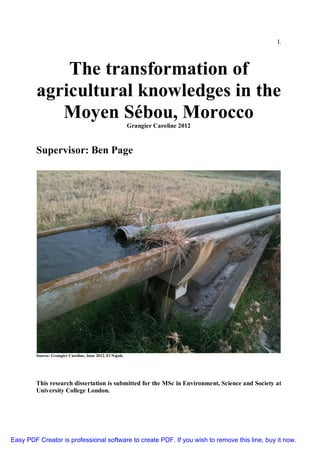
Source: Grangier Caroline, June 2012, El Najah.
This research dissertation is submitted for the MSc in Environment, Science and Society at
University College London.
Easy PDF Creator is professional software to create PDF. If you wish to remove this line, buy it now.
I.
Abstract
If poverty alleviation has been moved to the top of international organizations’ agendas, the most
efficient techniques through which to achieve it is still a source of controversy. Standard
concepts like the Sustainable Livelihood Framework are used to strengthen farmers’ tangible
(such as irrigation equipment) and intangible assets (like formal and informal knowledges and
social ties influencing the use tangible assets). The approach also helps to reinforce locals’
means of accessing to those knowledges and technologies through participatory activities. Being
depoliticized, those concepts miss, however, the crucial interplay between the actors who have a
role in shaping rural environment. Moreover, they do not consider the determinant
transformations done to knowledges when transferred into a new socio-environmental context.
Using interviews with Moroccan government representatives, local practitioners and
international donors, I evaluate, in this study, farmers’ opportunities to participate in the
development of the “Projet Moyen Sebou et Inaouen Aval” (PMSIA), while questionnaire
responses allow me to assess farmers’ formal and informal access to information on new
technology. Finally, drawing on ethnographic investigations, I look at the transformation of
information into meaningful new objects adapted to each group of actors within the irrigated
perimeter in the Moyen Sébou. Reviewing the historical circumstances of PMSIA’s
implementation and evolution under an international rural development campaign, I discuss my
results and interpretations to draw conclusions on the communication and reutilization of science
within the project.
Key words: Livelihood, Participation, Knowledge transformation, Irrigation, Morocco,
PMSIA project
Easy PDF Creator is professional software to create PDF. If you wish to remove this line, buy it now.
II.
Acknowledgements
For facilitating the fieldwork in Mohamedia and El Najah, thank you to Driss Al Amin, Ben
Mira Mohammed and Ahman Abdul Ahman; to Sukayna, Sana, Ilham and their family as well as
all the farmers in El Najah and Mohamedia.
For all the information on the project, the beneficiaries, coordinating my stay in Meknes and the
accompaniment in the douras, thank you to Abdel Aziz Anbari and Taha Labbaci
The trip to Agadir and my stay at the ENA would not have happened without the financial
support of the UF (Mr. Merioud and Mr. Ambari). I am very grateful for those opportunities.
Thank you also to Marcel Kuper from the CIRAD and Dominique Rollin from the Afeid for
helping to find this fieldwork and all the respondents from the administration (Mr. Ikama, and
Aloussi), the AFD (Mr. Baudran) and Cap Rural (Mr. Kemmoun and Mr. Labbaci) for taking the
time to explain to me the implementation and the development of the PMSIA project.
Finally, thank you to Ben Page for his availability at each step of this project and Rebecca
Collins for proofreading my dissertation.
This dissertation could not have been done without all of you.
¾ÝÇÓ ¿Ó ú ¾Ý ã ¾Ùë ú Ï
Easy PDF Creator is professional software to create PDF. If you wish to remove this line, buy it now.
III.
List of tables, figures and pictures
Tables
Table 1: Descriptive statistics for tangible assets for both Mohamedia and El Najah..................54
Table 2: Mohamedia: Distance to the source vs. ability to use canvas and involvement in the
association………………………………………..........................................................................58
Table 3: El Najah: Distance to the source vs. involvement in the association and knowing where
to find the material for drip irrigation………………………………………................................59
Figures
Figure 1: Spatial variability of rainfall in Morocco……………………………………………….3
Figure 2: Annual temperature average variations in the Morocco since the 1970s……………….4
Figure 3: Shift in precipitation period throughout the spring season (March-April-May) in the
1970s and the 2000s……………………………………………………………………….4
Figure 4: Shift in precipitation period thoughout the fall/winter season (October-November-
December) in the 1970s and the 2000s……………………………………………………5
Figure 5: Map of the region of study…………………………………………………………….11
Figure 6: Location of the PMSIA‘s sectors along the River Sebou……………………………...12
Figure 7: Location of the sector of study………………………………………………………...34
Figure 8: Land reallocation map used for farmers’ selection……………………………………37
Figure 9: Irrigation types in Mohamedia and El Najah ………………………………………....55
Figure 10: Percentages of farmers having tangible assets in Mohamedia and El Najah...............56
Figure 11: Percentages of farmers having intangible assets in Mohamedia and El Najah............57
Pictures
Picture 1: New drip irrigation system in Mohamedia (left)...........................................................65
Easy PDF Creator is professional software to create PDF. If you wish to remove this line, buy it now.
IV.
Picture 2: New drip irrigation system in Mohamedia (right).........................................................65
Picture 3: Hybridization of irrigation knowledge in Mohamedia……………………………......66
Picture 4: Calling a farmers’ meeting in El Najah……………………………………….............68
Picture 5: Farmers’ meeting in El Najah………………………………………............................68
Picture 6: Mediating a meeting at the DPA, Fez………………………………………...............69
Picture 7: Administration and practitioners’ meeting at the DPA, Fez………………………….69
Picture 8: Another adaptation of the hydraulic canvas into a meaningful wave pool…………...73
Easy PDF Creator is professional software to create PDF. If you wish to remove this line, buy it now.
V.
List of contents
Abstract...........................................................................................................................................I
Acknowledgement.........................................................................................................................II
List of tables, figures and pictures........................................................................................III-IV
List of contents..............................................................................................................................V
List of Abbreviations...................................................................................................................X
Introduction……………………………………………………………………………................1
First part
Chapter 1: Context and research questions………………………………………………...9-14
I. Introduction...………………………………………………………………………….....10
II. Presentation of the zone of study…………………………………………………….......10
The Project…………………………………………………………………….....10
III. Research questions………………………………………………………………….........12
1. Objectives ……………………………………………………………………….12
2. Research Questions ………………………………………………………….......13
IV. Conclusion…………………………………………………………………………….....14
Chapter 2: Literature review………………………………………………………………15-31
I. Introduction……………………………………………………………………………....16
II. Livelihood……………………………………………………………………………......16
1. Research on livelihood……………………………………………………….......16
Easy PDF Creator is professional software to create PDF. If you wish to remove this line, buy it now.
VI.
2. Livelihood and agriculture…………………………………………………….....18
3. Livelihood and agriculture in Morocco……………………………………........19
III. Participation…………………………………………………………………………..20-26
1. Research on participation………………………………………………………...20
2. Participation in agriculture……………………………………………………….22
3. Participation in agriculture in Morocco………………………………………….23
IV. Knowledge transformation…………………………………………………………...26-30
1. Research on knowledge transformation………………………………………….26
2. Knowledge transformation in agriculture………………………………………..28
3. Knowledge transformation in agriculture in Morocco…………………………29
V. Conclusion…………………………………………………………………………….....30
Chapter 3: Materials and Methods………………………………………………………...32-42
I. Introduction………………………………………………………………………………33
II. Area of study…………………………………………………………………………33-34
Administrative division of the chosen zone of study…………………………….33
III. Methodology………………………………………………………………………….34-42
1. Investigation tools………………………………………………………………..34
a. Ethnographic investigation………………………………………………34
b. Questionnaire with farmers………………………………………………35
i. Sampling…………………………………………………………36
Easy PDF Creator is professional software to create PDF. If you wish to remove this line, buy it now.
VII.
c. Semi-structured interviews with scientists and administrative
representative…………………………………………………………….37
i. Sampling…………………………………………………………38
2. Analytical tools…………………………………………………………………..38
a. Ethnographic investigation………………………………………………38
b. Questionnaire…………………………………………………………….39
c. Semi-structured interviews………………………………………………39
3. Social awareness activities……………………………………………….............39
a. Union des Fédérations’ initiative: Trip to Agadir………………..............39
b. Participatory feedback activity…………………………………..............40
c. Cap Rural and Lisode’s initiative: Role play workshop at the DPA in
Fez………………………………………………………..........................40
4. Ethics……………………………………………………………………………..41
5. Gain for partners, scientific community…………………………………………41
IV. Conclusion……………………………………………………………………………41-42
Second part: Results and Interpretations
Chapter 1: The plasticity of participation………………………………………………....44-53
I. Introduction………………………………………………………………………………45
II. Defining participation………………………………………………………………...46-48
1. Early definition…………………………………………………………………..46
2. Redefining participation with the constraints on the ground…………………….47
III. Distorted speech……………………………………………………………………...48-50
Easy PDF Creator is professional software to create PDF. If you wish to remove this line, buy it now.
VIII.
1. Scientific and social authority……………………………………………………48
2. The rise of the middle class……………………………………………………...49
IV. Conclusion……………………………………………………………………………50-51
Chapter 2: Accessing to power……………………………………………………………..52-62
I. Introduction………………………………………………………………………………53
II. Livelihood…………………………………………………………………………….53-60
1. Tangible assets…………………………………………………………………...53
2. Intangible assets………………………………………………………………….57
III. Poverty alleviation challenges………………………………………………………..60-62
1. Science-communication and information sharing……………………………….60
2. Individualism…………………………………………………………………….61
IV. Conclusion…………………………………………………………………………….....62
Chapter 3: The transformation of knowledge….................................................................63-73
I. Introduction……………………………………………………………………………....64
II. Transforming knowledges……………………………………………………………65-70
1. The transformation of drip irrigation…………………………………………….65
2. The transformation of the participatory approach……………………………….67
III. Knowledge management……………………………………………………………..70-72
1. Positioning knowledges……………………………………………………….....70
2. Decentralizing and reciprocating………………………………………………...71
IV. Conclusion…………………………………………………………………………….....72
Conclusion…………………………………………………………………………...............74-78
Easy PDF Creator is professional software to create PDF. If you wish to remove this line, buy it now.
IX.
I. Introduction..........................................................................................................................75
II. Mitigated results..................................................................................................................75
III. Controversial theories........................................................................................................76
IV. Conclusion……………………………………….............................................................77
List of references……………………………………………………………………………..79-87
Easy PDF Creator is professional software to create PDF. If you wish to remove this line, buy it now.
X.
List of abbreviations
Official
AFD: Agence Française du Développement (French Development Agency)
APR: Activists Participatory Research
AUEA: Association des Usagers des Eaux Agricoles (Association of Agricultural Water Users)
DFID: British department for international development
DPA: Direction Provinciale de L’Agriculture (Provincial Direction of Agriculture)
IMF: International Monetary Fund
MADRPM: Ministère de l’Agriculture, du Développement Rural et de la Pèche Maritime
(Ministry of Agriculture, Rural Development and Maritime Fishery)
PMSIA: Projet Moyen Sebou et Inaouen Aval
PRA: Participatory Rural Appraisal
SLF: Sustainable Livelihood Framework
SL: Sustainable Livelihood
UF: Union des Fédérations (Union of Federation)
UN: United Nations
Personal
Qaire: Questionnaires
Easy PDF Creator is professional software to create PDF. If you wish to remove this line, buy it now.
1
Introduction
Easy PDF Creator is professional software to create PDF. If you wish to remove this line, buy it now.
2
Across the scientific community there is recognition that managing the balance between fresh
water supply, food production and population growth is a fundamental challenge for the 21st
century. Integral to this challenge is negotiating the relationship between innovation in
agricultural technologies1
and their adaptation to the reality on the ground. Whilst developments
in irrigation systems might be forging ahead, they are only as useful as the ability to transfer the
knowledge of those new technologies effectively. At a basic level there is a relationship between
farmers, scientists and governmental representatives. This is about a meeting of minds: the minds
of farmers working in different socio-environmental contexts, the minds of national and
international experts who seek to improve the efficiency of irrigation practices and the minds of
governmental officials who grope to find a method to include farmers in rural development
projects. As such, I would argue that understanding how the knowledge of farmers, scientists and
governmental staff come together on the subject of irrigation expertise is a key aspect of
managing future agricultural productivity. In this respect, this thesis looks at their encounters in
the specific context of attempts to modernize irrigation practices through the “Projet Moyen
Sebou et Inaouen Aval” (PMSIA), a participatory development project in Morocco.
Despite its proximity to the Atlantic Ocean and its famously fertile plateaus, the Moroccan
climate is essentially arid, especially the eastern part of the Atlas Mountains. Rainfall is
relatively modest with the majority of the country receiving less than 500mm of rain annually
(FAO 2000). The spatial distribution of rainfall is, however, extremely unequal with certain
areas of the country, like Ouarzazate, nicknamed the door of the desert, receiving less than
1
I consider to be in the context of the dissertation about irrigation techniques
Easy PDF Creator is professional software to create PDF. If you wish to remove this line, buy it now.
3
100mm of rain per year while areas like Tetuan, has an average of more than 640mm annually
(Fig 1).
Figure1: Spatial variability of rainfall in Morocco
Source: Ministère de l’Agriculture, du Développement Rural et de la Pèche Maritime (MADRPM), 2000
The water stress on some regions is extreme, as 15% of the country receives almost 50% of the
annual rainfall amount (Debbarh and Badraoui 2002). It is a strategically important region for the
Moroccan government because it has an annual average rainfall of 550mm and is the only basin
of the country with a surplus of water resources. In addition to this spatial differentiation, there
has recently been throughout the country intra- and inter-annual modification of temperature and
rainfall events (Fig 2, 3 and 4). Shifting rainfall patterns and increasing periods of drought from
one to four per decade, has greatly affected the agricultural sector which supports more than 40%
Easy PDF Creator is professional software to create PDF. If you wish to remove this line, buy it now.
4
of the labour force of the country, employs about 80% of the rural population and represents on
average 20% of the country’s GDP (FAO 2000).
Figure 2: Annual temperature average variations in the Morocco since the 1970s
Source : C, Grangier and Z, Kehel working paper. Source of temperature and precipitation data: www.tutiempo.com
Figure 3: Shift in precipitation period throughout the spring season (March-April-May) in the
1970s and the 2000s
Source : C, Grangier and Z, Kehel working paper. Source of temperature and precipitation data: www.tutiempo.com
Easy PDF Creator is professional software to create PDF. If you wish to remove this line, buy it now.
5
Figure 4 : Shift in precipitation period thoughout the fall/winter season (October-November-
December) in the 1970s and the 2000s
Source: C, Grangier and Z, Kehel working paper. Source of temperature and precipitation data: www.tutiempo.com
As the majority of the population in Morocco depends on agriculture for their livelihood, natural
resources in the Moyen Sébou area have always been exploited intensively to satisfy the demand
for food production. Already in the 1930s, the French and Spanish colonial administrations saw
the importance of using the area efficiently to feed the empire and also satisfy its need for
drinking water. Since independence in 1956, the Moroccan government has continued the policy
started by the colonial authorities, encouraging the development of the water supply and
irrigation system throughout the country, reaching the record-breaking level of 1 million hectares
of irrigated land in 2000 (Debbarh and Badraoui 2002). Despite those important investments, the
state was soon overwhelmed by the cost and its inability to reimburse landowners led to a sudden
disengagement from water management forcing the farmers to take over a legal irrigation system
already in place.
Easy PDF Creator is professional software to create PDF. If you wish to remove this line, buy it now.
6
The struggle for bureaucratic power in Morocco has often impaired its ability to produce a
reliable seasonal harvest and meet economic imperatives. There is scope to add to the literature
on Morocco that tackles the question of how to develop a sustainable model of agriculture. Given
the mixed impacts of historical interventions in rural development projects in Morocco, it is ever
more relevant to work toward more cooperation between farming communities, scientists and
governmental representatives in order to develop social and economic strategies that can ensure
sustainable water management in the future. In order to fully explore and discuss the interactions
between farmers, scientists and governmental staff, this dissertation will be organized into two
parts. First, I analyse the context of implementation and development of the PMSIA project,
which will lead me to the aims and research questions that guide this study. Following a review
of the literature and the methodology, I present my analysis in the second part. Here, I discuss
the results and interpret them within a theoretical framework based on participation, livelihood
and knowledge transformation of drip irrigation, a recently implemented technique.
In rural development, the concepts of participation, livelihood and knowledge have, since the
80s, become the pillars of international organizations urging governments to involve locals in
development projects as a condition of access to international funds (Kaag et al. 2003). Despite
tremendous improvement, especially since the early 2000s, encounters between scientists,
governmental representatives and farmers have been challenging. Given the unclear definition of
participative methods, I will argue that each group of actors will have a specific method of
appropriation and transformation of information into new agricultural techniques. Using
ethnographic investigations, questionnaires and semi-structured interviews on participation, the
dismantlement and adaptation of information and the measurement of livelihood, I situate my
Easy PDF Creator is professional software to create PDF. If you wish to remove this line, buy it now.
7
study within the irrigated perimeter of the “Projet Moyen Sebou et Inaouen Aval” (PMSIA) in
order to offer a new perspective on information-sharing in agricultural research.
Easy PDF Creator is professional software to create PDF. If you wish to remove this line, buy it now.
8
Part I
Easy PDF Creator is professional software to create PDF. If you wish to remove this line, buy it now.
9
Chapter 1:
Context and
Research questions
Easy PDF Creator is professional software to create PDF. If you wish to remove this line, buy it now.
10
I. Introduction
The study of farmers’ participation has become so important that an entire body of literature was
developed to help farmers live better (World Bank 2000b). A working paper from the World
Bank in 2005 adds an important element to the definition of livelihood explaining it is about
“enhancing an individual’s or group’s capacity to make choices and transform those choices into
desired actions and outcomes” (World Bank 2005: 5). Despite the use of the concept of
livelihood or participation as a mean to access assets, there are still major disagreements in the
international scientific community about how to define participation, measure the degree of
participation for an individual or a group, and the influence of that participation on the adoption
new techniques to improve livelihood. Looking at the particular socio-political context of the
“Projet Moyen Sebou et Inaouen Aval”, I argue that transferred technologies as well as the
concept of participation evolves when confronted with the reality of decision-making processes
on the ground as well as to national and international interests. Analysing the PMSIA project as a
framework provides an opportunity to assess how scientific knowledges reach farmers and how
they are perceived and re-used in their socio-environmental context.
II. Presentation of the zone of study
The Project
The “Projet Moyen Sebou et Inaouen Aval” (PMSIA) is a two-phase project aiming at extending
an existing irrigated perimeter to increase agricultural production in the region. It is located
around 60km from Fez in the outskirt of the Rif Mountains between the Dam Idriss Ist
and the
plain of the Gharb (Fig 5). Phase I of the project, composed of sector II and III, is located
towards the plain of the Gharb, while phase II is in one part, downstream, after the Phase I area,
Easy PDF Creator is professional software to create PDF. If you wish to remove this line, buy it now.
11
towards the plain (sector I) and, in the other part, heads upstream from the limits of phase I up to
Dam Idriss Ist
(Sector IV and V) (Fig 6).
Figure 5: Map of the region of study
Source: Dissertation Anne Kristell Hin, 2008
Between 1995 and 2001, the “Ministère de l’Agriculture, du Développement Rural et de la Pèche
Maritime” (MADRPM), in cooperation with the “Agence Française du Développement” (AFD),
executed the preparatory work for the first phase of the project site covering 6500Ha (Kadiri
2008). This included clearing the stones from arable land, levelling the soil, the installation of the
hydraulic canvas in the whole perimeter and installing the common pumping stations before the
impoundment in 1998 for sector II and 2001 for sector III. The second phase has started the
preliminary preparation work in 2012 and represents 8500H.
Easy PDF Creator is professional software to create PDF. If you wish to remove this line, buy it now.
12
Figure 6: Location of the sectors along the River Sebou
Source: Collective fieldwork report “Institut des Régions Chaudes” IRC, CORBEL 2008
Supported by the 1990 law 2-90 on the participative management of the water supplies for
agriculture and the 1995 law 10-95 on the rationalization of water supply uses, each sector of the
project area was itself divided into “Associations des Usagers des Eaux Agricoles” (AUEA)
acting under the core umbrella of the “Union des Fédérations” (UF) responsible for the
management of the common components of the irrigated perimeter. The AUEAs, on the other
hand, have been created for local farmers using water for farming purposes to manage
themselves the distribution of the resource, the fee collection and the superficial repairs of the
hydraulic canvas within the association.
III. Research questions
1. Objectives
Phase I
Phase II
Easy PDF Creator is professional software to create PDF. If you wish to remove this line, buy it now.
13
Given the increasing scarcity of resources in Morocco, rural development projects like PMSIA,
have become relevant to local farming communities, scientists and government representatives.
Working in the similar perimeter, they promote the development of common social and
economic strategies to ensure the local appropriation of irrigation techniques. As such, this study
has four aims, which will explore to what extent farmers have participated in the development
and adjustment of the projects:
a. Evaluate what farmers, scientists and governmental representatives consider to be a
participative project
b. Assess the processes of science communication and information-sharing
c. Explore the development of tangible and intangible assets, signs of strengthening
livelihood
d. Look at farmers, scientists and governmental staff’s role in the dismantlement, transfer,
transformation and adaptation of the information when facing the reality on the ground
The aim of the dissertation is to evaluate the scale of participation existing within the PMSIA
project via the development of tangible and intangible assets influenced by the process of
knowledge transfer. Ultimately the aim will be broken down into 4 research questions.
2. Research questions
a. How is participation defined by each group of actors (farmers and scientists and
governmental representatives)?
b. How is information about new technologies communicated between and within groups of
actors?
Easy PDF Creator is professional software to create PDF. If you wish to remove this line, buy it now.
14
c. To what extent can a participatory approach strengthen farmers’ livelihood?
d. How do farmers, scientists and governmental representatives adapt and reuse shared-
information about new irrigation and development techniques?
IV.Conclusion
The implementation of the PMSIA project is coloured by the need for national and international
official actors to follow politico-economic strategies. As such, these are often not focused
enough on bottom-up investigations and analysis. This, in the end, does not offer an opportunity
for farmers, especially those less politically involved, to efficiently use their local knowledge and
fully participate in the development and the implementation of new agricultural techniques.
Indeed, data tend to be extracted and analyzed in scientific laboratories with the desire to find a
unique solution for the whole region. While recovery is a necessary step in delivering stability
for the area, it is also essential for different group of actors to be part of this change.
Negotiations are required between and within groups, in order to encourage farmers’
participation and thus to increase their agency in order to have better chances of adoption and
sustainability of new irrigation techniques. Existing projects in the Moyen Sébou put in place
strong foundations for capacity-building and setting up strategic techniques for water
management to achieve rapid development. However, I would also underline the need for
prioritizing sustainability in the long run by involving a range of socially and politically
connected farmers in the process of decision-making and data analysis. In the end, this is more
about rescaling the temporality of the project’s objective to long-term rural poverty alleviation
rather than racing to find the appropriate technical solution.
Easy PDF Creator is professional software to create PDF. If you wish to remove this line, buy it now.
15
Chapter 2:
Literature review
Easy PDF Creator is professional software to create PDF. If you wish to remove this line, buy it now.
16
I. Introduction
If rural development’s research used to be only an economic concern until the late 1970s, since
then studies of livelihood have taken a people-sensitive approach to help international experts
conduct exhaustive appraisals of the poor’s life conditions. In the process of strengthening means
of accessing assets, the scientific community has worked with participatory approaches to
alleviating poverty, especially in rural areas. Indeed, with earlier extractive methods it was
acknowledged that collecting data on the ground for foreigners to analyze away, was not the
most reliable way to gather information. Despite opening a space for humans/ environment
relations those techniques brought to the field of developmental research, participatory methods
were found to have shortcomings with regards to information-sharing in a social and scientific
context. People’s biases were first considered the central factor of the low adoption rate of new
materials, but the study of technological adaptations opened new academic routes to the field of
technology transfer. This literature review, which focuses on agricultural research in Morocco,
aims at discussing approaches to livelihood and the use of participatory practices as tools to
improve access to resources for farming communities. Considering participation’s oversights
with regards to unequal access to resources which the method could potentially reinforce, the
ambition of this chapter is to finish on a Science and Technology Studies perspective on the
transformation of information in rural, agricultural Morocco.
II. Livelihood
1. Research on livelihood
The study of livelihood is not new. In the 1940s, Evans-Pritchard and Polanyi (1977) developed
the concept in terms of an economic approach to humans’ interaction with their environment.
Easy PDF Creator is professional software to create PDF. If you wish to remove this line, buy it now.
17
Subscribing to a rather substantivist argument rooted in culturally produced economic behaviour,
Murray later argued that an approach to livelihood should be people-centred reflecting the
different facets of socio-economic context (Murray 2000). Indeed, in the 1980s, missing the
people aspect of broader theory, various international institutions including UNICEF and the
WCED participated in the development of livelihood’s definition. Since then, people-sensitive
methods and concepts have flourished in international debates, each time presented as assessing
means as well as changes in assets more reliably than the others.
Empowerment is one example of this linguistic battle. The term came from the Brazilian
humanitarian Freire in the early 1970s. For him, this concept related to the will to liberate the
poor and oppressed through education. Since then, empowerment has been reused by a wide
range of disciplines, retaining however, the sense of change in power status (Page and Czuba
1999; Hur 2006). Despite the utilization of this concept in most of the development-related
projects today, there are still significant disagreements in the scientific community as to how the
different levels of empowerment in a country are constituted, as well as how to measure the
degree of empowerment for an individual or a group within each level.
Finding empowerment a controversial and unreliable concept, I chose to use the concept
of livelihood to drive my dissertation. Following Sen’s work in 1985, livelihood was no longer a
structural concept but included people’s capacity and assets rather than an outsider’s observation
of their needs. Most development projects work on strengthening those components to help
people make efficient choices and take actions to implement those choices (World Bank 2005).
A challenge in investigating people’s livelihood is, more than the quantity of information to
Easy PDF Creator is professional software to create PDF. If you wish to remove this line, buy it now.
18
gather, the different methodologies to collect the relevant information and the range of actors to
question. Indeed, assets are the capitals on which people can act upon directly and be appraised
by experts in collaboration with a local community (World Bank 2005). The opportunity
structure, on the other hand, includes the formal and informal knowledges and regulatory
frameworks that govern legal interactions as well as culturally adequate behaviours. As such,
assessing local’s livelihood involves a different set of approaches and actors from the
government, the financial sector, local authority and farming community.
2. Livelihood and agriculture
In 1991, Chambers and Conway took the concept of livelihood further with the application to
rural development. Their study became a key reference in the development sector as an effective
method for scientists in conjunction with farming communities to evaluate the sustainability of
livelihoods. For the authors, “a livelihood comprises the capabilities, assets, and activities
required for a means of living” (Chambers and Conway 1991: 5-6). For them, this would include
the tangible assets composed of materials capacities. For a farmer it would include landholding,
stocks and machinery, among others assets which enable him and his family to become more
resilient to external shocks, like drought. Taking that definition a step further, livelihood would
also include intangible assets like formal and informal knowledges and social ties as well as the
ability to grasp the market dynamics, governmental and social institutions determining the entire
family’s strategies to cope with future stresses. Based on those elements, the British department
for international development (DFID) developed in 1999 the Sustainable Livelihoods Framework
(SLF) to assess rural populations’ social and economic strength (Farrington at al. 2002). Even if,
for Kaag et al. (2003), this technique can reveal aspects of farmers’ agency via the possession of
Easy PDF Creator is professional software to create PDF. If you wish to remove this line, buy it now.
19
tangible or intangible assets, the approach remains vague (Kaag et al. 2003; Acre 2003). For
other researchers like Brocklesby and Fisher as well as Toner, the precise conclusions cannot be
drawn from this unreliable approach since it does not propose a methodological path to compare
assets with one another and eventually arrive at ‘a sustained livelihood’ (Toner 2003; Brocklesby
and Fisher 2003). The SLF is not the first tentative from rural development scientists to try to
perfect a method of investigating the lives of the rural poor. In Morocco, 17 years after the first
seminar in Marrakesh on people-sensitive methods, international, national and local actors still
struggle to measure more than the economic component of people’s relationship to their
environment.
3. Livelihood and agriculture in Morocco
In the first decades of the 21st
century, the rate of water resources loss has become a major
concern in Morocco (Higgitt 2004). Combined research efforts and the need to expand the
agricultural sector, have led to the development of land and water management reforms. Starting
in the 1980s and 1990s, national reforestation, development of the watersheds, the intensive
construction of dams, the implementation of large, medium and small irrigated hydraulic
perimeters and soil and water conservation policies started shaping what would become the
Moroccan rural landscape. In a top-down perspective, authorities still considered farmers as
executive tools of the common goods (Fornage 2006; Houdret 2008). However, this centralized
approach reached to an end in the 1980s with the government’s inability to respond to the
financial crisis the Kingdom was going through. Some would suggest that this situation gave a
levee to international backers like the World Bank, to introduce a people sensitive approach as a
requirement for funds (Keita 2004).
Easy PDF Creator is professional software to create PDF. If you wish to remove this line, buy it now.
20
The concept spread in 1995 and 1999 with the organization of seminars on participation in
Marrakesh and Rabat. These illustrated the support of the Moroccan government for the
improvement of farmers’ livelihood (Kadiri et al. 2009). From 1995 to 2001, phase I of the
“Projet Moyen Sebou et Inaouen Aval” (PMSIA) was developed along these lines in order to
produce an irrigated area via a participative approach. Today in 2012, at the dawn of phase II of
the project, lessons were drawn from previous challenges in order to ensure progress continues to
be made toward more participation (Kemmoun et al. 2004). This would be a positive prospect, if
it was without the underlying national strategy of the Plan Maroc Vert (Lavieeco.com 2009). The
encouragement of a regionalization of agriculture, alongside national economic concerns,
remains a contradiction within attempts to strengthen farmers’ assets to independently improve
their livelihood.
In conclusion, this literature review on livelihood argues for the prevalence of a people-
centred approach which translates a broader perspective of the realities of agricultural life,
farmers’ capacities to access assets, and opportunities to manage water supplies for irrigation.
However, the concept is less convincing when it comes to the methodology with regard to its
implementation on the ground. The concept does not address the ambiguity of the terminology,
and it does not fully consider how the participatory nature of the tool grants access to and
strengthens assets.
III.Participation
1. Research on participation
Easy PDF Creator is professional software to create PDF. If you wish to remove this line, buy it now.
21
To address poverty, Chambers would claim the importance of focusing on experiments
undertaken by locals (Chambers and Leach 1987). “Unofficial research and network are more
practically oriented which is often more successful in terms of new adopters” (Chambers 1983:
91). Similarly, for Adely, the visual tools and simplified text used in participatory methods
would encourage dialogue in the community and reach out to illiterate people often left out by
former techniques (Adely 2004). Contrary to what Adely argued, Leeuwis would assert that
participatory approaches tend not to alleviate poverty but rather create a condescending
perspective of poverty, of noble savages lacking knowledges of what Korf and Oughton called
an “ideal speech situation or deliberation a facilitator would bring” (Leeuwis 2000; Adato and
Meinzen-Dick 2001; Korf and Oughton 2006: 284). For Chambers (1983), delegating parts of
the research to locals is essential as, trapped between ambition and work load, rural development
scientists tend to progressively distance themselves from the field. Urban-based, they engage in
little more than a quick visit to the roadside rural elite to check the ‘never negative’ progresses
reported by practitioners (Chambers 1983).
While Chambers and Adely responded to criticisms addressing the facilitator’s biases, a
second debate ran in parallel on what was claimed as the true causes of poverty: the access to
resources. As exposed by Freeman in the 1970s, and as has continued to be debated more
recently (Korf 2004), the locals who benefit from the attention, the advice and the technologies
are those with informational, organizational and material assets (Freeman 1975). Able to make
informed choices, these are the wealthiest among the local communities who have the
opportunity to facilitate or restrain research activities for the whole community. The poor on the
other hand, are, as Chamber (1983) explained, those that scientists almost never meet and who
Easy PDF Creator is professional software to create PDF. If you wish to remove this line, buy it now.
22
do not hear about means to access new assets. Brushing over this problem of access to resources
in a social authority context, participatory workshops are often appropriated by a dominant group
to keep and reinforce their control (Nelson and Wright 1995; Agarwal 2001; Mohan and Stokke
2000). As such, the gap between academic writing for scientific journals, the practitioner
gathering facts, the rural elite and the poor appears to be maintained by distinctive practices of
doing ‘rural development’, Srinivas has described as “the division of labor” (Srinivas 1975: 1390
in Chambers 1983; Ahmadvand et al.). In that perspective, it is necessary to acknowledge this
dynamic between scientists and within local communities, where two worlds work side by side,
are dependent on one another for their social and professional prosperity but which do not seem
to communicate with one another.
2. Participation in agriculture
Participatory methods of investigation have always been the object of controversies. In the
1960s, the Activists Participatory Research (APR) was used to gather political information from
people. Later on, this bottom-up movement would give birth to two different schools of thoughts
both promoting the necessity of local participation. One turned toward education while the other
looked at people’s engagement within the agricultural sector. If the APR method was later on
abandoned by agricultural researchers due to its strong political component, it nevertheless set
the foundation of the Participatory Rural Appraisal (PRA) technique used today in rural
development. Following the track of APR, various agricultural disciplines like the
“Agroecosystem Analysis, Applied Anthropology, Field Research on Farming System, and
Rapid Rural Appraisal” have developed their own participative approach whilst depoliticizing
their objectives (Chambers 1994: 3-4). Evolving from one another, they all brought important
Easy PDF Creator is professional software to create PDF. If you wish to remove this line, buy it now.
23
components to what would become in the late 1980s the Participatory Rural Appraisal (PRA)
method. It is, however, this neutral position which would later become its greatest weakness.
Indeed, as Bunch mentioned in 1982, “politicians have a great influence on whether or not
small farmers have the resources” (Bunch 1982: 6). Moser and Norton (2001) also emphasized
the danger of ignoring the local context of authority and social power when taking people as a
main source of data (Moser and Norton in 2001). In the same line of arguments, Mosse
illustrated the consequences of dismissing the authority context as restraining rather than
encouraging public speaking (Mosse 1994). Furthermore, Weinberger would talk about a
“Middle Class” effect the family of participatory approaches produces, to which the very rich
and very poor would not be the main contributors (Weinberger 2000). While these challenging
comments have not been answered yet, Chambers and his followers have continued to promote
the relevance of PRA to appraise local farming knowledges, convinced it is a necessary tool to
reduce the facilitator’s biases. Using semi-structured interviews and participatory workshops
amongst other techniques, rather than questionnaire surveys seen as collecting superficial
information, PRA was meant to enable scientists and facilitators to delegate the experimental
part of a research to farmers. Rescaling investigation from international staff to local farmers and
readdressing responsibilities within the writing and implementation of a rural development
project is what Chambers has claimed to be essential to reduce rural poverty and marginalization
in areas such as rural Morocco.
3. Participation in agriculture in Morocco
Easy PDF Creator is professional software to create PDF. If you wish to remove this line, buy it now.
24
Despite a challenging transition from a centralized, top-down perspective which governed
Morocco for decades, the disengagement of the state has opened up opportunities for new leaders
to emerge in rural development. With the national fresh water supplies diminishing at an
increasing rate, the implication of the state in the management of water has been up to the late
1990s very important (Kadiri 2008). Despite their will to move toward a decentralized chain-of-
command, seen after the creation of AUEAs, the ratification of laws on the right to meet as an
association (law 2-84 in the 1990s) and the organization of seminars in Marrakesh and Rabat in
1995 and 1999, early decisions contradicted the intention of the state to accompany rather than
dictate actions (Mollinga and Bolding 2004). Driven by national economic strategies based on
carrying capacity – when an equilibrium between human needs and nature’s ability to uphold
those needs is reached”, the Moroccan government developed an action plan to exploit natural
resources to the maximum a perimeter can support (Gregory et al. 2009: 65; Lavieeco.com
2009). Shifting the former human-environment opposition to a complex interplay where actors
negotiate the uses of the best arable soils, the Kingdom has followed comparable economic
perspective promoted in Canada (Ait Kadi 2002). Capitalizing on every meter square of
Canadian waters, it took only a few decades to eradicate the entire species of cod from the bays
of Newfoundland and Labrador (Bavington 2010). Similarly, thinking more about financial
returns and self-sufficiency than the welfare of local communities, national Moroccan authorities
have oriented their agenda toward the intensive development of the agricultural sector, and kept
developmental projects in line with this general strategy of carrying capacity (El Hasnaoui et al.
2002). Passing the bucket of responsibilities to each other, solutions to more local participation
tended to be pushed to the side. Furthermore, having to satisfy unclear international requirements
Easy PDF Creator is professional software to create PDF. If you wish to remove this line, buy it now.
25
on participation, all actors have had trouble with the new vocabulary on participation and its
concretization on the ground (El Alaoui 2004).
Struggling to trust this time-consuming and undefined method, decisions on local
governance used to end up between the hands of the local governmental representative, the
“Caïdat” and rural elites (Hunt 1989; Kadiri et al. 2010). However, in the 1980s, the sudden
disengagement of the state, with regards to water distribution for irrigation, fees collection and
system maintenance, put farmers in a challenging position. Having to take over some
responsibilities without being trained, organize in a governmentally enacted irrigation system
and in a hydraulic canvas they had not decided and had no control over, it took years for only a
few associations to run partially. In that context, as mentioned by Benjelloul (2001), a thorough
accompaniment of farming communities by the administration became, in the early 2000, a win-
win situation which could no longer be excluded. Having to co-finance mega-projects with
international organizations questioning intensively the Moroccan type of water management,
pointing at the lack of investment from local users, independence of the institutions in charge of
water management, the beginning of the century saw changes in local leadership. Farming
communities took a step forward and changed from beneficiaries to (for some) determinant
actors.
In conclusion, this review of the literature on participation argues for a delegation of the
experimental part of research to locals, which is a more sustainable method than a foreign
intervention. Providing that a range of pedagogical tools are used, it helps the world of
agriculture, politics and science to communicate on rural development. However, the concept
Easy PDF Creator is professional software to create PDF. If you wish to remove this line, buy it now.
26
appears to have shortcomings when it comes to addressing the access to resources in a context of
social, political and economic authority. Introducing this powerful approach without discussing
its weakness with regards to rural elites could result in its use by those same dominants to keep
their status within the community and strengthen inequalities between families. The difference
would then be between those accessing the information and those being left out of the process of
knowledge transfer.
IV. Knowledge transformation
1. Research on knowledge transformation
Technologies transferred to different countries are often not used in their initial form and at their
full initial technical and economic potential (Bosselmann 2006, Akrich et al 2002). For De Laet,
the transformation occurs when information about technologies travels. For her, knowledge
transfer is not a binary process (sent/received) but a series of phases the group of information
goes through before being transformed into a new object adapted to a new socio-environmental
context (De Laet 2002). The challenges of transferring a technology are well known to the
literature on development. Already in 1939 Schumpeter pointed at the necessary qualities of an
entrepreneur as the key to a high adoption rate, while in the 1980s Kedia and Bhagat (1988)
maintained that cultural differences were the explanation for nations’ resistance to new
technology. For Kedia and Bhagat, some nations (the developed ones) were more prone to
absorb new technologies than others (developing nations). Mapping nations based on a set of
factors like uncertainty avoidance, power distance, gender and social organization, they claimed
to have a representation of openness to novelty (Hofstede 1980; Kedia and Bhagat 1988). If this
Easy PDF Creator is professional software to create PDF. If you wish to remove this line, buy it now.
27
approach was once accepted, parts of the scientific community strongly disagreed with its
perspective.
The development of Science and Technology Studies in the 1960s and its growing
popularity with the work of Mackenzie and Wajcman in 1985 and Bijket et al in 1987 shifted
studies to examine objects’ relationship with their environment. Not accepting the ‘black box’
conception of technologies, Latour would consider the social processes which contribute to the
perception of a technology as mysterious art of science (Latour 19872
). Giving a voice to the
non-human, it emphasized technologies’ agency on their surrounding human and natural
environment (Callon 1986; Cayley 2009). De Laet illustrated the concept of fluidity of
technologies through the transformation of knowledge in her chapter on “Knowledge and
Technology Transfer”. Information, after travelling to Northern institutions are regrouped into
new objects and sent back to other destinations (De Laet 2002). It is the one-way
communication, dismissing the socio-environmental context, and the nature of knowledges to be
convertible which would challenge the implantation of new technologies. Pricing technological
knowledges rather than the physical material transferred, the World Bank, the United Nations or
the International Monetary Fund (IMF), soon realized the importance of holding on to this new
form of power. According to Fillips, those international organizations have progressively shifted
their expertise from providing technologies manage knowledges via practitioners, expert on rural
development concepts and practices (Fillip 2002). Because of the recent attention put on
2
The work of Bruno Latour and Michel Callon on knowledge practices and the agency of nature has been of a tremendous importance which I
would have liked the space to discuss here. Without forgetting to acknowledge these crucial theorists, I do not intend to use them as the principal
approach to my dissertation but as a support to my argument.
Easy PDF Creator is professional software to create PDF. If you wish to remove this line, buy it now.
28
knowledges, they have become a powerful means of influencing political agendas on sustainable
development, especially in agricultural research.
2. Knowledge transformation in agriculture
In the 21st
century, the development of the internet combined with the creation of thousands of
non-profit organizations working to alleviate rural poverty democratized the access to material
for modern irrigation (see the new affordable drip irrigation system in Casablanca). This could
have been the beginning of a revolution to strengthen farmers’ assets, if it was not for the
complex implementation processes remaining in the hands of development experts (Chatterton
and Chatterton. 1982). Farming communities without political voice and financial strength, as
Noltze et al argued, have not had the opportunity to contribute to these changes (Noltze et al.
2012). For Amin and Roberts, however, knowledge transfer does happen and is based on the
communities’ ability to use and transform information to generate new adapted technologies
(Amin and Roberts 2008). If we consider reports like the Washington Consensus on the creation
of a set of worldwide standard policies thought to be necessary for economic development, it
appears that local knowledges have yet to be included as an alternative solution (Bavington
2010; Symoniak 2010/2011). More than the preference for scientific knowledge, it is often
pointed out that there is a general imbalance in the flow of information, privileging knowledge
coming from Northern institutions at the expense of two-way shared-information (Bouazizi and
Belabbes 2002; Triantafillou and Risbjerg Nielsen 2001). As such, the participative methods
recently promoted appear to be a biased strategy against farming communities given that
information on agricultural practices is still controlled by international organizations (Collins and
Evans 2002). In that context, the knowledge emitters would have a significant influence on how
Easy PDF Creator is professional software to create PDF. If you wish to remove this line, buy it now.
29
information are translated into actions and how they would shape a rural landscape like in
Morocco.
3. Knowledge transformation in agriculture in Morocco
The international model of knowledge management was based on principles given by the World
Bank, the IMF and the UN (Forth World Water Forum 2006; Ruf and Valony 2007). Following
the similar directive of the Statement on Water and Sustainable Development, the Moroccan
government held seminars on the participative approach transmitting the new rules of
development in application throughout the kingdom (Margat and Treyer 2004). According to Ruf
and Valony, while general international agreements were initially associated with success, the
transfer of knowledge on the ground had mixed results (Zahry and Rchid 2002). In the late 80s,
people were organized throughout the country in administrative divisions (AUEA) with new
norms and referees to manage the water supplies (Ostrom 1992; Errahj et al. 2010). Sometimes
completely rejected by the farming communities, the rules of the associations were at best
transformed by the locals to adjust to the socio-environment context (Romagny and Riaux 2007;
Bekkari and Yepez del Castillo 2011). The different appropriations and inventions are, according
to Alter, a sign of a hybridization process (Alter 2000). As such, new forms of association with
the implementation of new governance rules was seen by Faysse et al. as a compromise between
the imposed governmental design and the realities in the field, and an important knowledge
transformation around the community of water users (Faysse et al. 2010). From that perspective,
studies have recently looked at the development of collectivities as a sign of adaptation in the
mechanisms of transferred knowledges and technologies in Morocco.
Easy PDF Creator is professional software to create PDF. If you wish to remove this line, buy it now.
30
In conclusion, the literature on the transformation of knowledge argues for a plasticity
and transformation of knowledge. It reveals the exclusion of a dialogue between emitters and
receivers when explaining the low rate of adoption of agricultural technologies. The technology
itself is not the scarce resource anymore, rather it is the underlying processes of implementation.
Still being in the hand of international decision-makers, they have determined when and which
technological outputs would appear in the Moroccan countryside but not the how, remaining
farmers’ expertise on the ground.
V. Conclusion
In the middle of the 19th
century, the economy of Morocco changed radically with an
exploitation of the countries’ resources and a development of irrigated perimeters by the
different waves of colons. After independence, the desire for self-sufficiency pushed the
Kingdom to specialize its agriculture and draw a new rural landscape. In the 1980s, the
Moroccan agricultural sector benefited from the international debate on participation and people-
centred approaches like sustainable livelihood (SL) which became the requirement to access to
international funds. Not considering the balance of power present in the communities, the family
of participatory approaches was soon used in ways which conflicted with its original aim of
poverty alleviation. In local scientific and political authority contexts, the rural poor did not have
the social, political or economic strength to speak publicly. Rather, it facilitated the
implementation of a nationally and internationally supported tool which dominant groups could
use to reinforce their local status through access to newly transferred technologies. Retaining the
patent and knowledge of the implementation of new farming techniques, the scientific
community reserves itself the right to decide to whom, when and which information will be
Easy PDF Creator is professional software to create PDF. If you wish to remove this line, buy it now.
31
shared. This power of knowledge, however, vanishes once the information is transmitted. Not
held to similar norms and rules of usage, the once beneficiaries become actors transforming
every bit of information into new objects meaningful to their socio-environmental reality.
Easy PDF Creator is professional software to create PDF. If you wish to remove this line, buy it now.
32
Chapter 3:
Materials and Methods
Easy PDF Creator is professional software to create PDF. If you wish to remove this line, buy it now.
33
I. Introduction
In the field of social sciences, people-centred approaches are the norm when conducting a study.
Gathering data of individual or group interactions with the “multidimensional reality of the daily
life” allows the capture of the nuances of a social, economical, political and environmental
context (Kaag et al 2003). Avoiding the sort of sectoral analysis of natural sciences investigation
techniques that tends to produce mechanical perception of reality, social science methods help to
develop understanding of how people relate to their environment. As such, in order to evaluate
the participation and the construction of information with regard to new agricultural techniques,
in this study I use a range of social science methodologies, such as ethnographic investigations,
questionnaires and semi-structured interviews. Among the different techniques available in
social science, I decided to work with those used on the ground to evaluate their efficiency at
collecting reliable data. The objective has been to evaluate the processes of sharing and
appropriating information existing in the Moyen Sébou project. The overriding aim has been to
understand how the governance of knowledge influences the development of tangible and
intangible assets by farmers as well as by internal scientists and administration representatives.
II. Area of study
Administrative division of the chosen zone of study
The zone of study is part of the third sector within the first phase of the project (Fig 5). Given the
nature of the dissertation on the appropriation of techniques and the modification of the concept
of participation, I found the phase II of the project at a too early stage to be looked at, especially
since the creation of AUEA has just started for those sectors.
Easy PDF Creator is professional software to create PDF. If you wish to remove this line, buy it now.
34
Figure 7: Location of the sector of study
Source: Kadiri 2008
Within phase I, sector three was the most interesting as it benefited from lighter foreign influence
after the preparatory work was achieved for that site. Finally, within the third sector, I selected
the two consecutive associations of El Najah (written Ennajah in figure 5) and Mohamedia
(written Mahammadia in figure 5), as they depend on the same watercourse for irrigation.
Moreover, the original system of water distribution based on taking turns appeared to be an
interesting element through which to compare the different adaptation strategies adopted by the
two associations.
III. Methodology
1. Investigation tools
a. Ethnographic investigation
Easy PDF Creator is professional software to create PDF. If you wish to remove this line, buy it now.
35
As a foreigner arriving to a Moroccan douar (smaller than a village, it is composed of one
extended family), it was important for me not to force contact with the community. As such, I
was introduced to the group of farmers and their family by a gatekeeper I met through the
institution working on the ground. The strengths of this approach were that it allowed me to
collect a first set of information on the farmers/scientists/ administration interactions and the
transmission of information between them without rushing the interaction. This method gave me
the chance to introduce myself in an informal setting while being able to discuss with the
different groups of actors on the implementation and the development of the PMSIA project.
The observations were focused on how the concept of participation is understood by each group,
adapted to the reality of the group and translated into actions. The field notes drew several
conclusions on the modes of communication between farmers, scientists and governmental
representatives in meetings and in the field. I also generated findings on the three groups’
responses with regard to the access, adaptation and transformation of information in a particular
socio-political context.
b. Questionnaire with farmers
To gather a wide range of information and prevent myself from depending only on my
observations, I also conducted a questionnaire with 32 farmers (17 in Mohamedia and 15 in El
Najah). The aim was to have farmers’ perspectives on their formal and informal opportunities to
participate in the implementation of the PMSIA project as well as the development of tangible
and intangible assets throughout the project. Using questionnaires with ethnographic
Easy PDF Creator is professional software to create PDF. If you wish to remove this line, buy it now.
36
investigation created an open space for me to have a methodology to collect information which
the questionnaires would not cover.
These methods also gave me the chance to focus on specific information on livelihood which
encouraged other farmers to approach, talk freely and understand the reasons behind my
presence. It also constituted an effective compromise, avoiding the overwhelming situation a
focus group could represent for a junior researcher. Finally, those two approaches were chosen to
avoid, being a young women working alone in an Islamic state, to be in one-on-one interviews
with men, a culturally inadequate situation.
Questionnaires are popular and have the advantage of gathering a large volume of information
(Bryman 2008). A challenge, however, will be the quality of the responses which might generate
superficial data and answer the research questions only superficially. To address this issue, I
decided to continue the study by conducting semi-structured interviews.
i. Sampling
The sampling was done randomly based on the irrigation source (private pumping vs. hydraulic
canvas vs. rain) the surface cultivated in the perimeter of the project and the distance from the
main pumping station (Figure 8). Based on land reallocation maps, I listed farmers and took a
representative percentage for each variable. The list was of 15 to 20 parcels’ numbers I kept
anonymous until the end to avoid being influenced by family names. It was only at the end of the
selection that I asked for farmers’ names and contact information from a member of the
association.
Easy PDF Creator is professional software to create PDF. If you wish to remove this line, buy it now.
37
Figure 8: Land reallocation map used for farmers’ selection (e.g.: Mohamedia)
Source: DPA, Fez
c. Semi-structured interviews with scientists and administrative representatives
To explore the communication processes of scientific technologies, I conducted 10 semi-
structured interviews with the scientists and administration representatives involved ranging
from 30 to 2 hours depending on the availability of the interviewee. The already-prepared main
points covered the concept of livelihood, participation and knowledge transfer. Based on their
answers, I explored the concrete opportunities for farmers’ participation in decision-making,
what scientists and government staff defines as a sustainable irrigation project, and to what
extent local knowledge is taken into consideration when writing and implementing irrigation
projects.
Pumping
station
Canvas
Easy PDF Creator is professional software to create PDF. If you wish to remove this line, buy it now.
38
Following the first interviews and my work with the groups of farmers, I returned to some
scientists and government representatives available to conduct a second semi-structured
interview (5). More than being an opportunity to go deeper into concepts overlooked in the first
interviews, I had the opportunity to address the distribution of information in a complex socio-
political context and the necessity of rescaling investigations into local experiments undertaken
by farmers in a way that might ultimately be more sustainable.
i. Sampling
There was no random sampling for the selection of the scientists and coordinators. The number
of people was too small for this kind of selection. Plus, each member of the scientific community
involved in the project had a specific role which needed to be considered in the analysis.
2. Analytical tools
a. Ethnographic investigation
The ethnographic interpretations were based on a diary I held throughout the fieldwork and
divided into sections afterward. The analysis of those sections focuses on the selection of the
beneficiaries at different events and the justifications behind such selection. Interpretations were
also drawn from discussions about the implementation of the project as well as the type of
information exchanged between actors when communicating, including the gesture and relation
of domination when communicating. Finally the possibility to observe events organized locally
gave me an opportunity to collection data on actors’ translation of participation into actions.
Easy PDF Creator is professional software to create PDF. If you wish to remove this line, buy it now.
39
b. Questionnaires
The questionnaire was composed of quantitative and qualitative questions. The quantitative data
were entered on an SPSS file and interpretations drawn from descriptive statistics and linear
regressions. The open questions were used according to my research questions on livelihood,
participation and knowledge, to support and or challenge my arguments.
c. Semi-structured interviews
I decided to take notes during the interviews when I saw the actor’s discomfort with regards to
recoding the sessions. Similarly to the ethnographic investigations and the open questions of the
questionnaire, the notes from the interviews were typed and then organized based on the similar
concepts of livelihood, participation and knowledges, I used later as references when supporting
or challenging an argument.
3. Social awareness activities
a. Union des Fédérations’ initiative: Trip to Agadir
The last set of methods was the participation to three social awareness events. The first activity
was a trip to Agadir organized by the UF to familiarize a group of farmers with irrigation, soil
conservation techniques and the advantages of working in a cooperative. My aim was to look at
the formal and informal opportunities for farmers to access to information about the trip before
leaving and the justifications behind the selection of the participants. Using ethnographic
investigation, I focused on the development of intangible assets via the trip. This activity could
serve to confront previous results on farmers’ participation and be used as empirical evidence of
Easy PDF Creator is professional software to create PDF. If you wish to remove this line, buy it now.
40
rural appraisal or as a relevant tool to tackle the problems identified by the questionnaires and
semi-structured interviews.
b. Feedback activity
This activity was an opportunity to conduct a participatory group work. During the trip I
proposed to the farmers from El Najar and Mohamedia to restitute the information learned to the
farmers who did not have the opportunity to participate to the trip. My role in this activity was to
propose the idea, a method and to record the activity. I decided not to facilitate and intervene
except if I was asked to in order to look at the interactions within groups of farmers as well as
their understanding of participation.
c. Cap Rural and Lisode’s initiative: Role play workshop at the DPA in Fez
The third event observed was a role-play session between scientists and governmental
representatives in an imaginary meeting. Each participant was given a farmer’s profile with his
abilities, limits and objectives during what was meant to be an imaginary farmers’ meeting. The
aim of the role play was for scientists and governmental staff to better understand the socio-
economic context of the farmers as well as their possibilities and constraints when making
decisions. My aim was to observe how this participative workshop articulated its aims and
outcomes, and what methods were used by an external and an internal research office (Cap Rural
in Morocco and Lisode in France, specialized in the development and support of public
participation processes) to transmit information to Moroccan practitioners and administrative
staff.
Easy PDF Creator is professional software to create PDF. If you wish to remove this line, buy it now.
41
4. Ethics
Throughout the fieldwork, I was as explicit as possible about the scope and the purpose of the
research, and the data collected with those who participated in the project. Whenever a
questionnaire was conducted or a workshop observed, I explained about confidentiality and
anonymity of the information gathered while avoiding technical definitions. Despite my
knowledge of Arabic, the language barrier made it difficult to interact with the farmers in the
douars. As a result, I conducted the interviews and questionnaires (translated in Arabic) with the
gatekeeper to facilitate communication. At the end of the study, reported to the institution the
results of the survey and workshop for them to have a social science perspective on the work
achieved in the perimeter.
5. Gain for partners, scientific community
An irrigation project could offer a solution to food security, and constitute a response to the
debates around the shortcomings of sustainable agricultural management. Several countries like
Morocco have proven with the “Projet Moyen Sebou et Inaouen Aval” (PMSIA) that the
development of efficient irrigation strategies could be successful. This example of movement
towards a more open, deliberative approach is, however, done in a particular framework where
scientific knowledge remains in the hands of the elite and participation a method not yet properly
defined. To develop a study looking at the construction of knowledge could help shift the
development of projects to more effective communicative processes.
IV. Conclusion
Easy PDF Creator is professional software to create PDF. If you wish to remove this line, buy it now.
42
The people-centred element of the social sciences is one of its greatest strengths, but is also
integral to the controversies that blemish the discipline. Because humans and their environment
are used as the base for analysis, results always miss a component as it is practically impossible
to consider all variables influencing behaviours. Moreover, in rural development, concepts like
participation, empowerment or livelihood tend to be merged and used in a rather interchangeable
ways by international organizations, researchers, experts, practitioners and farmers, affecting the
credibility and the reliability of the data collected. That said, social approaches remain, like any
other science, imperfect and as Sismondo (2009) would explain, studies using a social science
approach represent an accumulation of knowledge that compel experts to confront the realities
on which they agree. Each new observation, like in natural science, brings new information to
adjust results closer to a reality (Sismondo 2009). From that angle and based on a set of theories
on livelihood, participation and knowledge transfer, I aim at adding a social science component
to the project suggesting new perspective on different communicative processes.
Easy PDF Creator is professional software to create PDF. If you wish to remove this line, buy it now.
43
Part II
Easy PDF Creator is professional software to create PDF. If you wish to remove this line, buy it now.
44
Chapter 1:
The plasticity of participation
Easy PDF Creator is professional software to create PDF. If you wish to remove this line, buy it now.
45
I. Introduction
For Ahmadvand et al., “there are no Social Impact Assessment practitioners” since there are no
recognized institutions delivering such accreditation (Ahmadvand et al. 2009). Moreover, experts
conducting these assessments often have a natural science rather than a social science
background, which is seen as necessary for these kinds of methods (METAP 2002). Similarly,
participative appraisal’s expertise comes from an accumulation of interdisciplinary experiences
being acknowledged by peers who agree on the people-sensitiveness of the academic and
professional content of a practitioner’s background. Left unchallenged due to the international
uncertainty as to how the concept should be defined, as well as how to measure it, participation
users’ good judgment is often required to fill the gap of a flawed methodology. In that context
the definition of participation and its application on the ground remains in the hands of
practitioners.
Torn apart and adapted to context, the concept of participation was applied in different
ways to alleviate poverty. In order to demonstrate the plasticity of participatory approaches when
transferring knowledges, people’s understanding and adaptation of the method presented is
necessary. Moreover, at the moment of encounter between actors in spaces which are meant to
be open and depoliticized, the scientific and social authority context, attracting mainly the rural
middle class, is decisive when considering farmers’ representation. From that perspective, I
would argue that instead of reflecting the reality on the ground, they promote biased speeches
distorted by the participative methodology and the type of actors taking part in the activity.
Using semi-structured interviews and interactions between and within groups of farmers,
scientists and governmental representatives as illustrative materials, this chapter’s general
Easy PDF Creator is professional software to create PDF. If you wish to remove this line, buy it now.
46
objective is to look at how participation is understood, how information about new technologies
are communicated and who was involved in these processes within the “Projet Moyen Sebou et
Inaouen Aval” (PMSIA).
II. Defining Participation
1. Early definition
Despite the international and national interest in the family of participatory approaches in the late
1990s, on the ground the implementation of the PMSIA started with everything but a people-
centred perspective. The conferences in Marrakesh and Rabat came after the financial crisis of
the late 1980s-early 1990s which convinced the authorities to accept the international offer to
decentralize the management of water supplies for irrigation. Struggling with the implementation
on the ground, international actors and the Moroccan government put in place seminars in Rabat
to familiarize regional representatives with the international perspective of rural development
and resources management. Based on a hydraulic canvas initially built for a centralized
management, the people-centeredness of the project was a real challenge to conceive and define.
Composed of massive pumping stations requiring large and open channels, the design was hardly
compatible with the micro parcels characteristic of the perimeter. Without proper training but
with strong work experience, the administration representative left in the mid 1990s for the
village to present the project.
Gathering information about few dominant local farmers on their way to join the already
designed project was at the time enough to fulfil international requirements on farmers’
involvement in PMSIA. In that context of uncertainty and through a top-down perspective, the
Easy PDF Creator is professional software to create PDF. If you wish to remove this line, buy it now.
47
project initially spurned big exploitations along the river, which were already irrigating and
economically independent. Small farmers were also sidelined, since there were too many and not
politically influential to be included as strategic supporters. The project instead favoured the
locally connected rural elite, from which representatives were invited to join what was defined as
a participatory project.
2. Redefining participation with the constraints on the ground
Since then, the definition of participation has evolved, shifting away from pre-defined concepts.
In constant negotiations with donors on the decentralization of decisions, the administration has
become more confident with the vocabulary of participation and what they mean in term of
delegating responsibilities. Decentralizing water management left a space, especially since 2005,
for the emergence of new agents, including farmers. Represented by the “Union des
Fédérations” (UF), they have become essential actors to consider when taking actions within the
irrigated perimeter. Participation, as a consequence, evolved into the involvement of
representative actors in each sector, as Ait Kadi explained, where the provincial administration
and the UF had to adjust their respective duties to align with the underlying requirements of the
AFD (Ait Kadi 2002). Financially supported by the AFD, actions can, today, be taken
independently at the level of the UF. The union could, as such, mobilize its resources more
efficiently to organize for selected members, trips, training and workshops in order to allow them
to learn from other farmers in different irrigated perimeters around the country and abroad (see
the trip to France in 2008 and the trips to Tunisia, Settat and Agadir in 2012 to cite only a few).
Contracting research offices, the UF’s president and members of the council are now the master
builders on the ground. Protected by the internal regulations of the associations restraining the
Easy PDF Creator is professional software to create PDF. If you wish to remove this line, buy it now.
48
influence of the government (law 2-90) and reinforced by external funds, this rural elite has
gained significant independence which neither the administration, nor the hired research offices
seem to be able to contest. The administration and the representatives of the banking system are
today relegated to co-managing and co-financing research in the project area. Now, invited by
the UF to events, their responsibilities have been distinguished even more from other actors’
especially since the implementation of participatory methods.
III. Distorted speech of science-communication
1. Scientific and social authority
Due to political conflict, early forms of participatory methods depoliticized all activities. The
will to neutralize power relations became, as various studies show, the greatest criticism of this
family of approaches (Korf and Oughton 2006; Adato and Meinzen-Dick 2001.; Mosse 1994).
Contrary to what Chambers (1983) claims, they do not encourage but restrict participation due to
the social and scientific authority context. At the premises of the PMSIA project, as explained by
Kadiri et al., the weight of the administration and its local control via influential families permit
no opportunities for poor farmers to contest the social hierarchy (Kadiri et al. 2010). Illustrating
Moser & Norton (2001) and Leeuwis (2000)’s argument, today, the rural elite associated with the
PMSIA project, freed from governmental patronage, is reproducing a similar social hierarchy
keeping family members in key positions and ensuring their presence at events (Trip Agadir).
Without the tangible and intangible assets to strengthen their position when accessing
workshops, the poorest are situated too far on the social periphery to be listened to and do not
have enough information in hand to catch up with new transferred knowledges (Trip Agadir and
Feedback activity). Moreover, an understanding of the basics of recent irrigation and farming
Easy PDF Creator is professional software to create PDF. If you wish to remove this line, buy it now.
49
practices is often taken for granted in workshops organized by scientists. Certainly, all farmers
do agriculture and governmental staff work on rural development, but most of the poorest (who
represent a majority) are still engage in furrow irrigation and some of the urban-based staff
never had to practice irrigation at all, leaving the drip irrigation a system which is difficult to
visualize on site. Similarly, a certain level of academic competence is assumed, like reading a
map or synthesizing information (Trip Agadir, Workshop Lisode). This type of knowledge being
emphasized by scientists might be a stimulating practice for some officials, but meeting with
socially and scientifically renowned individuals and experts could also be an intimidating and
muting prospect for farming communities.
2. The rise of the middle class
The very poor living at the periphery of the association, away from the pumping station, are
often not part of the network sharing information on new technology. They are the last to hear
about trips and seminars, which they would probably not attend since they are held in cities
during office hours. Without the financial ability to pay for daily labour workers when it is
planting, irrigation or harvesting time, poor farmers found themselves stuck in a cycle of poverty
unable to increase their knowledge on new technologies (Qaire poor farmers in El Najah and
Feedback activity). Supporting what Weinberger (2000) argued in his study on the “Middle
Class” effect, the very rich working in the perimeter are largely absent in the project. With their
own source of irrigation from the river they cultivate enough land to be comparatively
competitive on local or international markets. To wait for economically weaker actors to match
the technological and financial difference between them is precious time they would rather spend
on expanding their own production. Moreover, the political disputes over water distribution are
Easy PDF Creator is professional software to create PDF. If you wish to remove this line, buy it now.
50
far from their enormous water needs compared to the average farmers in Mohamedia and El
Najah. Left with the rural elite, as mentioned Weinberger, participatory activities becomes an
extrapolation of a specific social stratum to the entire association, illustrating particular needs but
distorting the ideal speech Chambers promoted with the participatory rural appraisal approach
(Chambers 1994; Weinberger 2000). Rescaling investigation to delegate the experimental part of
research to the farming community has not yet been attempted in the project. Subscribing to
Chambers’ theoretical idea, using this method could improve farmers’ livelihood; I would
nevertheless underline, like Agarwal (2001), that in the PMSIA context, participatory tool could
be used by dominant groups to keep their status within the douars and village and further
increase already existing inequalities.
IV. Conclusion
Participation is not a fixed concept but has a wide range of application depending on the actors
sending and receiving information. Guided by the underlying international agreements, the
concept has evolved since the beginning of the PMSIA project. Being first employed in the
execution of directives, it progressively shifted toward a greater delegation but sectorization of
responsibilities between farmers, scientists and the administration. While the international levee
rebalanced official forces, on the ground the new local actors still retain information using rural
development tools to sharpen their knowledge of new technologies, leaving others with few, if
any, opportunities to strengthen their assets and challenge the order in place. Supporting
Chambers’ (1983) point on the principle of delegating parts of research, I would nevertheless,
agree more strongly with researchers like Mosse (1994), Agarwal (2001), or Weinberger (2000).
The premises of the PMSIA project illustrate the potential shortcomings of the participatory
Easy PDF Creator is professional software to create PDF. If you wish to remove this line, buy it now.
51
method. The local, national and international political contexts, as Moser & Norton (2001) and
Leeuwis (2000) already explained in their studies, tend to distort encounters between farmers,
administration staff and scientists.
Easy PDF Creator is professional software to create PDF. If you wish to remove this line, buy it now.
52
Chapter 2:
Accessing power
Easy PDF Creator is professional software to create PDF. If you wish to remove this line, buy it now.
53
I. Introduction
The Sustainable Livelihood Framework (SLF) is often criticized for being too technocratic and
individualist (Acre 2003). In contradiction with the underlying projects’ goal of strengthening
local associations, it emphasizes the acquisition of material over science communication and
access to information as signs of strengthening livelihood. Focusing on individual decision-
making, the appraisal tends to gloss over collective actions accomplished by farming
communities (Brocklesby and Fisher 2003). Fundamental to discussing the process of science
communication and information-sharing about new technologies within a community, addressing
the comparability of tangible and intangible assets would push the debate further. It would assess
to what extent the SLF uses participatory methods to reinforce farmers’ ability to make more
informed choices, which would improve their capacity to cope with future shocks. More than
evaluating tangible assets, however, it is about the formal and informal structures which allow
the use of those assets. As such, improving livelihood could have, I argue, consequences in
contradiction with the objectives of the “Projet Moyen Sebou et Inaouen Aval” (PMSIA). Not
only, would evaluating degrees of livelihood not be possible since assets are not comparable
within and between groups, it would push for social selection. Improving a handful of powerful
farmers’ livelihoods based on SLF would intensify inequalities with others unable to access new
technologies. In that context, these types of social assessment used by international development
projects’ would be an inadequate attempt to alleviate poverty.
II. Livelihood
1. Tangible Assets
Easy PDF Creator is professional software to create PDF. If you wish to remove this line, buy it now.
54
In this project I divided tangible assets into financial, legal or technological abilities respectively
materialized by money, legal documents and equipment. According to Table 1, collectively both
AUEAs of Mohamedia and El Najar appear to be extremely resilient, with almost 80% of the
farmers in the area irrigating, 72% not restricted by the bank to get a loan and 78% of people
having their land matriculated in the perimeter; the two farming communities’ livelihoods do not
seem to be threaten by external factors (Table 1).
Table 1: Descriptive statistics for tangible assets for both Mohamedia and El Najah
Variables Percentage
Irrigating 78% yes
22% no
Land Matriculated 78% yes
16% non
3% partially
3% do not know
No restrictions to get loans 72% yes
25% no
3% no answer
Ability to use the project hydraulic canvas 41% yes
59% no
Quality of the levelling 41% good
56% bad
3% no leveling
Parcels in drip irrigation3
13% yes
87% no
3
No-till practice was not considered in this chapter because of the low number of people having information, which was not enough to do
relevant statistics. When talking about technology, I refer only to drip and gravity-fed irrigation systems and materials.
Easy PDF Creator is professional software to create PDF. If you wish to remove this line, buy it now.
55
However, if analyzed separately, as in figure 6, conclusions differ. 40% of the farmers in El
Najar, mainly micro-parcel holders, do not irrigate at all and depending on climatic variations
(Qaires). Of the remaining 60%, 53% use private pumping from the Oued River and 7% use the
hydraulic canvas of the project. El Najah is an irrigated perimeter which tangible assets come
from bigger farms and represent individual successes, not from the associative work put in place
by the project (Qaires). In Mohamedia, having water to irrigate is also a tangible asset present in
the area, but this time it is brought by the project: 82% of the farmers interviewed used the
hydraulic system compared to 12% irrigating privately (Figure 6). In the light of this new
pattern, it was necessary to evaluate to what extent the two associations differ in term of other
tangible assets.
Figure 9: Irrigation types in Mohamedia and El Najah
As expected, the distribution of assets for each association draws different pictures of livelihood.
If Mohamedia seems to be for the most part matriculated, they are not as able as El Najah to
Easy PDF Creator is professional software to create PDF. If you wish to remove this line, buy it now.
56
access bank credit to increase their production. More surprising, while the levelling of the soil, a
necessary condition for the gravity-fed irrigation, was apparently done better in El Najah, they
are the ones least able to use the hydraulic canvas initially built for that type of irrigation. Results
indicate that there is water circulating in both associations from two different sources but, as
Toner (2003) already described with regard to the methodology proposed by the SLF, the
incomparability of the other assets leads to no substantive conclusions on each of the
associations’ degree of livelihood possible (figure 7).
Figure 10: Percentages of farmers having tangible assets in Mohamedia and El Najah
In that context, the analysis of livelihood provides wide range of information on factors
influencing people’s relation to their environment as Kagg et al. claim (2003). However,
supporting Toner’s (2003) arguments, we can see how assets are weighted differently and are not
necessarily comparable, a challenge when evaluating sustainable livelihood at a community
level, and a problem which intangible assets complicate even more.
Easy PDF Creator is professional software to create PDF. If you wish to remove this line, buy it now.
57
2. Intangible Assets
The concept of intangible assets is broad and methodologically undefined. In the context of this
dissertation I consider them to be the formal and informal knowledges and social ties which
influence people’s ability to use tangible assets. Due to an infinite number of variables, I decided
to limit them to four: (1) knowing the purpose of matriculating lands, necessary information
required by the bank when asking for a loan; (2) having other sources of money besides the bank
to evaluate financial and relational strength; (3) knowledge about drip irrigation systems, a new
technology to increase the production; and (4) actions taken to locally repair the hydraulic canvas
when broken, demonstrating one’s technological knowledge. Similarly to tangible assets, in
figure 8 the patterns between associations differ. While El Najah seems to have, as a community,
more intangible assets implemented given by formal institutions, like the bank or the
government, Mohamedia appears to have a better grip on the informal ways of getting
information like learning on site about repairs or where to find the material for drip irrigation.
Figure 11: Percentages of farmers having intangible assets in Mohamedia and El Najah
Easy PDF Creator is professional software to create PDF. If you wish to remove this line, buy it now.
58
Given that Mohamedia is generally more implicated in the project and the over-representation of
one family such results are not surprising. Deeper analysis4
would show that this family’s
privileged access to information and new technology is not representative of the whole situation
in the association but, nevertheless, illustrates very well Moser and Norton’s argument (2001).
Keeping away from political matters, the SLF methodology misses to consider the local interests
at play between the rural elites, national and international scientists and governmental staff
influencing academic studies as well as the development of the PMSIA project. Seeing the
recurrent inaccuracy of the results, I took a new perspective for the analysis, looking at the
relationship between the location of the land in the association, estimated from the DPA’s land-
reallocation maps (Figure 8) and the tangible and intangible assets chosen.
Table 2: Mohamedia: Distance to the source vs. ability to use canvas and involvement in the
association.
ANOVA
Sum of Squares df Mean Square F Sig.
UseCanvas Between Groups 2.063 3 .688 6.094 .008**
Within Groups 1.467 13 .113
Total 3.529 16
Involvement Between Groups 2.211 3 .737 4.735 .019*
Within Groups 2.024 13 .156
Total 4.235 16
44
An analysis I did not have the space to include in this dissertation but available with the questionnaires
Easy PDF Creator is professional software to create PDF. If you wish to remove this line, buy it now.
59
With a significance of less than .01 and .05 and a degree of freedom of 3 between groups, there
is a strong relationship between the distance to the water source, the ability to use the hydraulic
canvas implemented by the project and farmers’ involvement in the association of Mohamedia
(Table 2). The distance to the water source appears to be linked with the development of the
tangible asset: ability to use the project’s canvas and the intangible asset: involvement in the
association which contribute to strengthening the collective network and the communication of
agricultural related knowledges.
Table 3: El Najah: Distance to the source vs. involvement in the association and knowing where
to find the material for drip irrigation
ANOVA
Sum of Squares df Mean Square F Sig.
Involvement Between Groups .868 1 .868 4.129 .063
Within Groups 2.732 13 .210
Total 3.600 14
MaterialAvailDrip Between Groups 3.219 1 3.219 3.572 .081
Within Groups 11.714 13 .901
Total 14.933 14
In El Najah, however, according to table 3, the distance to the source is not significant with any
variables; the involvement in the association or with knowledges on the drip irrigation material
being the strongest but insignificant relationship (.063 and .081 respectively). The proximity of
the source does not influence the development of intangible assets like knowledges related to the
new irrigation technique and the involvement in the association of El Najah. Restrained from
Easy PDF Creator is professional software to create PDF. If you wish to remove this line, buy it now.
60
participating in the project due to water stealing between Mohamedia and El Najah, and broken
sections of the canvas, such results were expected. However, taking the analysis only in the
project context would drive wrong conclusions on the poor livelihood quality of El Najah, which
is not the case if considering individual initiatives.
III. Poverty alleviation challenges
1. Science-communication and information-sharing
According to Murray, SLF is a method which gathers a holistic set of data of farmers’ tangible
and intangible assets (Murray 2000). However, as demonstrated by Toner (2003), this approach
reflects individual strategies to access information about new technologies like drip irrigation. In
the PMSIA project, science communication is not carried out in a single way. Learning does not
only happen at the association or in the fields, but also on large exploitations, in factories in
throughout Morocco, at the bank, or at the administration’s offices among many other nodes of
information (Figures 7 and 8). As such, the quality and quantity of the knowledge on technology
would often depend on farmers’ ability to slalom within the formal and informal structures
available inside and outside the irrigated perimeter. In that context, exploring the study of a few
tangible and intangible assets, signs of a steady livelihood, like Chambers and Conway (1991)
promoted, might not offer a reliable picture of a community’s ability to make more informed
choices. Furthermore, given the participatory tool used in the SLF, often used by dominant
groups to keep their ties strong in the association, results could be biased against other social
groups (Part II, Ch 1). Like the selection of my participants in Mohamedia which over-
represented the dominant family, conclusions on farmers’ capacities to cope with future shocks
have to acknowledge the privileged access to information and technology to be more accurate.
Easy PDF Creator is professional software to create PDF. If you wish to remove this line, buy it now.
61
But, had it be more equitably done, like in El Najah, tables and graphs still remain too vague and
assets incomparable, as Acre (2003) suggests, to appreciate livelihood’s quality through anything
other than general statements (Table 2, 3 and 4). In that context, when sharpening elites’
knowledge, PMSIA’s tool could in the end work against the underlying objective of poverty
alleviation.
2. Individualism
Strengthening assets and means to access those assets with a participatory approach could,
indeed, increase already existing inequalities within a community. Before the start of the PMSIA
project, some exploitation along the river was found in El Najah, where farmers had already
irrigated their production via a private pumping system (Figure 6). The early steps of the
administration created a climate of suspicion toward their ability to fairly and reliably increase
farmers’ access to water (Ostrom 1992). After decades of a government-centralized agricultural
sector and mitigated development successes, individualism grew between farmers. At the
beginning of the project, rather than multiplying risks and workload when working collectively,
various farmers opted for the first come first served attitude (seeing the low rate of functional
association and actors holding powerful positions). A social gap fuelled by unequal access to
information we can see in the above results on Mohamedia and El Najah’s inter and intra
differences in tangible and intangible assets (Figure 7 and 8). This attitude, if still present in the
perimeter, is progressively tamed by the obligation to share water collectively, and the will to
develop collectivities (Kemmoun et al. 2004; Toumi 2008). Trips like the one in Agadir illustrate
how actors in the project promote the advantages of other associations, like in the region of the
Easy PDF Creator is professional software to create PDF. If you wish to remove this line, buy it now.
62
Souss-Massa-Drâa, irrigating hundreds of hectares in drip irrigation from a computerized system,
a quality now sought in the Moyen Sébou.
IV.Conclusion
The Sustainable Livelihood Framework is an individualist method emphasizing technological
assets as a sign of a strong livelihood. Supporting Arce’s (2003) argument, SLF can evaluate
material assets and the opportunity structure independently in a perimeter but cannot compare
between and within those groups of assets to accurately assess livelihood. According to the
results, there is a range of livelihoods in which farmers in Mohamedia and El Najah are engaged.
However, it would be wrong to take only tangible assets as a sign of success. Looking at the
associations through the project lens, El Najah has developed, despite their inability to use the
canvas, important intangible assets which might not be as present in Mohamedia. As such, and
considering the important individual actions, they should not be classified as the “non-irrigating”
second group of associations. Since information can be shared in different ways and assets
incommensurable, quality of life could not legitimately be ranked like international institutions
claim is possible. As Brocklesby and Fisher (2003) explain, that it would imprudent to draw
anything but broad conclusions on individual and, even more, on collective strategies; a caution
which seems to have been overlooked in rural or at least developmental research.
Easy PDF Creator is professional software to create PDF. If you wish to remove this line, buy it now.
63
Chapter 3:
The transformation of Knowledge
Easy PDF Creator is professional software to create PDF. If you wish to remove this line, buy it now.
64
I. Introduction
The non-human world, composed of tangible and intangible objects, is not fixed (Callon 1986).
Rather those objects are shaped by humans with whom they share their environment
(Bosselmann 2006). In this regard, I consider the concept of participation, as well as physical
technologies like drip irrigation systems, as delimited but fluid knowledges - knowledges, I
claim, to be in transformation when transferred from one actor to the other. When moved, they
enter an infinite cycle of transformation until they are considered obsolete. Travelling with
development experts, initial knowledges are disassembled in order to be communicated or passed
on, then assimilated by the beneficiaries who, later on, become actors when reconfiguring that
information into new objects. That said, I consider knowledges, as much as people, to be
independent but bound to a social, political and economic context. Some technologies or rural
development approaches prevail over others depending on international and national strategies.
The participatory management approach and drip irrigation practice have recently been
positioned by the scientific community as the knowledges that count to alleviate farmers’
poverty. However, according to Bavington’s study in 2010 on the preference of experts’
knowledge over lay knowledge, the transfer of information does not happen in a context of
reciprocity between locals and scientists. This is especially true if considering the development
of ‘Knowledge Banks’ held by the IMF and the World Bank (Fillip 2002). Taking the argument
further, this could leave no formal or informal opportunities for farmers to challenge the
imbalanced North-South flow of information, if it was not for some leaders’ ability to transform
imposed tangible and intangible knowledges into new objects adapted to the reality on the
ground.
Easy PDF Creator is professional software to create PDF. If you wish to remove this line, buy it now.
65
II. Transforming knowledges
1. Transforming drip Irrigation
Initially, the hydraulic canvas built by the administration after independence was designed for
centralized management. The design of the system, above the surface and of a large size, is not
adapted to the actual parcels’ fragmentation phenomenon in the area, nor is it secured enough to
ensure an equitable water distribution. The canvas was formally established by the
administration to support gravity-fed irrigation in the entire region. Even if this technique is still
practiced, the problems of levelling and the increasing rate of water scarcity convinced farmers
to progressively replace it by drip irrigation.
Picture 15
: New drip irrigation system in Picture 26
: New drip irrigation system in
Mohamedia (left) Mohamedia (right)
5
Looking left of the canvas
6
Looking right of the canvas
Sand dam
redirecting
water from
canvas to
basin A
Irrigation
system
redirectin
g water
from
basin A to
canvas
Basin A Former direction of waterWater coming
in Basin A
Easy PDF Creator is professional software to create PDF. If you wish to remove this line, buy it now.
66
Contrarily to what Amin and Roberts (2008) claimed on the collective nature of the
transformation of information, only some farmers did not wait for the administration to have a
coherent irrigation plan for the whole perimeter. Supporting Collins and Evans’ argument on the
new wave of technological “expertise coming from non-professional sources”, farmers went
ahead reassembling old and new irrigation knowledge into a new object (Collins and Evans
2002: 270; Picture 1 and 3). Transforming the primary function of the canvas, they are now
redirecting their allocated water to different basins to increase their chances to resist to external
factors like drought, a perspective in contraction with the destructive image of technologies
Schumpeter had in the 1930s (Schumpeter 1939).
Picture 3: Hybridization of irrigation knowledge in Mohamedia
Dirt Road
Rainfall
evacuation
channel
converted into
basin (B)
Canvas
Water alimentation
of basin B
Easy PDF Creator is professional software to create PDF. If you wish to remove this line, buy it now.
67
Farmers now store water either in a small part of their land or in the rainfall evacuation channels
dug by the administration. In order to transfer water, farmers also have an assemblage of pipes
which are either stationary or portable, confirming farmers’ adaptability Romagny and Riaux
described in their 2007 study. These examples represent other types of hybridization of
knowledge in the PMSIA project, Kadiri et al. (2009) and Faysse et al. (2010) already discussed
but with regard to the management of projects’ associations. This combination of techniques has
been farmers’ perspective on how to overcome the problems of water distribution and secure
their water supply for the small but constant inputs required for drip irrigation. Tangible
technologies are not the only ones being transformed by actors. The participative method has
also experienced multiple modifications between farmers as well as between scientists and
governmental staff.
2. Transforming participatory approach
The concept of participation is strongly influenced by the actors emitting and receiving the
information and has as such a wide range of application (Pictures 4 and 5 vs. 6 and 7). If the
PMSIA project started with a centralized, top-down perception of participation, changes have
been made, especially since 2005 (Fornage 2006). The progressive independence of the (UF)
also encouraged farmers outside the Union to mobilize and concretise their understanding of
information-sharing. The feedback meetings after the trip to Agadir were a relevant example of
their will and conception of participation to the project (Pictures 5 and 6). Using the speakers of
the mosque to call the meeting within several douars, the transmission of the scientific
information acquired during the trip, took place in the evening, in informal settings and between
farmers less involved in the Union. Here, is a clear illustration of De Laet’s argument (2002) on
Easy PDF Creator is professional software to create PDF. If you wish to remove this line, buy it now.
68
the dismantlement of knowledge and the re-aggregation of information into a new object. Indeed,
their feedback techniques were an assemblage of knowledges which were experimented at
different occasions since the beginning of the project. Using the mosque to gather people, was
retained the appropriate technique like in other associations. However, the meetings were
reduced to the level of the douar rather than conveying all douars at once, a long and tedious
task. The time of the meetings was also agreed to be suitable after working hours at 7pm and
done, except for some notes, all orally. Reducing the language barriers which could have
restrained some from intervening, farmers reassembled information into a form specific to
farmers’ needs and to their perceptions of participation and science-communication.
Picture 4: Calling a farmers’ Picture 5: Farmers’ meeting
meeting in El Najah in El Najah
In parallel, the cooperation between a Moroccan and a French research office, respectively Cap
Rural and Lisode with the Moroccan administration led to the development of workshops to
practice participation. Role plays, as in pictures 6 and 7, were proposed by Lisode to local
Easy PDF Creator is professional software to create PDF. If you wish to remove this line, buy it now.
69
practitioners and administration staff to increase their awareness of farmers’ abilities and
constraints when making decisions. Again, from an initial intention to explain the application
and implications of participatory methods, the team of Cap Rural with Lisode adapted the
reflexive exercise to the participants’ needs. Adopting a given farmer’s profile in an imaginary
farmers’ meeting, each participant was invited to read his or her motives, limits and constraints
in the context of the exercise. Based on real profiles, each participant could become familiar with
the reality on the ground before going and working on the site. While the mediator summarized
the key concepts on posters, key findings could be reiterated and linked to potential solutions.
The formal setting of the meeting in the administration’s offices during office hours and the use
of academic tools were another meaningful application of participation specific to those actors.
Picture 6: Mediating a meeting at the Picture 7: Administration and practitioners’ meeting
DPA, Fez at the DPA, Fez
Being transformed by knowledge emitters, participatory methods and the drip irrigation system
are continuously renewed when transferred. Both knowledges have been employed in various
combinations since their implementation to increase the agricultural production in order to
Easy PDF Creator is professional software to create PDF. If you wish to remove this line, buy it now.
70
alleviate poverty in the irrigated perimeter. Shifting from a simple human-environment
relationship to a complex interplay between several groups of actors and new technologies,
knowledges have become the real scarce resource to manage.
III. Knowledge management
1. Positioning knowledges
Bavington emphasized in Managed Annihilation the preference of certain scientific knowledge
over lay knowledge (Bavington 2010). Similarly, local farming habits are often not seen as new
technological objects but an inefficient utilization of the material and the available resources
(Kedia and Bhagat 1988). With technologies brought by experts, on the other hand, a threshold is
reached when there is equilibrium between human needs and the available natural resources
(Gregory et al. 2009). Just like in Canada where the development of new technologies in fishery
science was meant to ‘modernize’ locals’ practices, the implementation of new irrigation
techniques in the PMSIA project reframed familial organizations as local businesses in order to
stabilize agricultural productions in the region. Progressively shifting the relation between
humans and the environment, science positioned statements of technological truth as the way to
efficiently manage resources in the Moyen Sébou (Bavington 2010; Sismondo 1999). In
accordance with the national and international strategy of regionalization of the agricultural
sector, drip irrigation and participative methods are considered as the knowledges to use in the
area (Bosselmann 2006). Conforming to models of carrying capacity, the administration in
Morocco adopted economic strategies pushing for the rational utilization of resources to expand
even more than the agricultural sector (Ait Kadi 2002; International Fund for Agricultural
Development 2008). If ensuring the country’s self sufficiency in certain crops is a major political
Easy PDF Creator is professional software to create PDF. If you wish to remove this line, buy it now.
71
concern, less influential farmers could still participate in the analysis of economic and political
factors influencing the modification of their environment. This would contribute to, as Callon
explained in 1986, actors’ awareness of environmental fragility and the development of a
dialogue within and between interested groups with regard to its protection.
2. Decentralizing and Reciprocating
Given the preference for experts’ knowledge over farmers’ knowledge illustrated in the above
discussion, information is not transferred with the expectation of technological reciprocity
between scientists and farmers. Illustrating Bavington’s point (2010) but in a Moroccan context,
El Hasnaoui et al. 2002 maintain that even if farmers use a certain system to irrigate the land,
their understanding of scientific knowledge tends to be considered, from a carrying capacity
point of view, less efficient than expert outputs (Bavington 2010; El Hasnaoui et al. 2002). As
such, knowledge of technologies travels with scientists perpetuating an unbalanced flow of
information biased against farmers. Indeed, as De Laet explains (2002), technology transfer often
favours knowledges coming from Northern institutions rather than crediting local solutions
manageable by farming communities. Moreover, with the development of the internet and the
blooming of rural development not for profit organizations, access to material has never been
easier. Without the monopoly of tangible technologies, international organizations shifted their
expertise to managing implementation processes and conceptual knowledges they
parsimoniously spread in development projects via their experts, building what Fillips calls
knowledge banks (Fillips 2002). If the delegation component of events is now present in the
PMSIA project, the decentralization of information and the democratization of knowledge of
Easy PDF Creator is professional software to create PDF. If you wish to remove this line, buy it now.
72
implementation processes still remain in the hands of the scientists. It is only recently that
accompanying workshops were put in place to ensure a more sustainable project in the future.
IV. Conclusion
According to the PMSIA project, tangible and intangible objects are not immutable. Supporting
De Laet’s argument (2002), knowledges are transformed by actors into new meaningful assets.
Since their introduction in the irrigated perimeter of the Moyen Sébou, the concept of
participation and the new irrigation technique have started a cycle of transformations induced by
farmers, government representatives and scientists (Collins and Evans 2002). Individually, and
contrarily to what Amin and Roberts (2008) claimed, some actors have started the process of
hybridization of new and old available technologies into what they perceive to be an adapted
irrigation system to the reality on the ground, as well as developing their understanding of
science-communication and participation. Furthermore, shifting the human-environment
relationship from a familial to small businesses exploitation of resources, the introduction of
these new methods are in line with models of carrying capacity which the Moroccan kingdom
decided to adopt as a national strategy (El Hasnaoui et al. 2002). Being positioned as the
knowledge that counts to alleviate poverty and increase regional production, technologies have
often not been transferred in a context of reciprocity between all actors within the PMSIA
project. Even if recent initiatives gave some key practitioners or farmers the opportunity to be
independent, the democratization of knowledge transfer could focus even more on mutual
adaptation and build on the locally transformed technologies.
Easy PDF Creator is professional software to create PDF. If you wish to remove this line, buy it now.
73
Picture 8: Another adaptation of the hydraulic canvas into a meaningful wave pool
Source: Mohamedia June 2012 (Farah; Salma; Sophia and Sana)
Easy PDF Creator is professional software to create PDF. If you wish to remove this line, buy it now.
74
Conclusion
Easy PDF Creator is professional software to create PDF. If you wish to remove this line, buy it now.
75
I. Introduction
Among the scientific community, there is an agreement that rural development is a multi-faceted
issue which experts tackle from various perspectives but with the same underlying objective of
poverty alleviation. From a Science and Technology Studies perspective, knowledge transfer is a
challenging but relevant solution. Those new techniques are keystones in people’s attempts to
increase their material and financial assets, as long as their technological or social
implementation processes are adapted to the realities on the ground. Clearly, this is about the
negotiation within and between interested groups on the formal and informal participation in the
communication of agricultural science. Moreover, it is how actors receive and then transform
knowledge into new meaningful objects when sharing information. Framed by the “Projet
Moyen Sebou et Inaouen Aval” project’s hydraulic canvas and the administrative divisions,
AUEA, this dissertation looked at the implementation and development of a new irrigation as
well as the evolution of the participatory approach in the Moyen Sébou, each of which was
aimed at improving the livelihood of farmers in the area.
II. Mitigated results
PMSIA has been considered a participatory development project, even if the meaning of the
label has considerably changed since its definition in the late 1990s, shaped by international
perceptions of development and national economic strategies (Keitra 2004). Moving from
centralized decisions to a sectorization of responsibilities between administrative, scientific and
farming groups, the political landscape of the project saw new local actors emerging. Pressured
by international agreements and a recent national will to involve beneficiaries, a greater number
of farmers were directly engaged in the early 2000s. This gave the rural elite formal
Easy PDF Creator is professional software to create PDF. If you wish to remove this line, buy it now.
76
opportunities to manage the water supplies for irrigation and independently apply their
perception of participation through the organization of trips and trainings in new farming
technologies (Faysse et al 2010). Although intended to strengthen farmers’ tangible and
intangible assets, rural development knowledges are, however, often a privilege reserved for the
wealthiest. Pricing knowledge rather than equipment, the Global North understood the power of
information. Leaving no real options but to accept already designed technologies, Morocco
would only ever be a recipient of knowledge and technology if it was not for the continual
transformations and adaptation provincial and local leaders apply to the transferred technologies
(Romagny and Riaux 2007). The poorest, however, for whom those programs were originally
designated, often do not hear about these possibilities to improve their livelihood. Moreover, had
they been aware, they would have had to catch up with the newest materials. Lacking the
foundation of the project from which they were excluded, catching up with the new agricultural
techniques and international standards on participation is a technological gap which was
amplified with the development of the project.
III.Controversial theories
Since the 1980s, the concept of participation has been one of the major theoretical drivers of
developmental research. For the international community, centralized decision-making was
widely contested and the involvement of local communities in projects was a requirement for
financial cooperation. In theory, the set of participatory methods for which Chambers (1983) had
been a key advocate, is feasible but as been the object of controversies with regard to its
implementation in social and scientific authority context. Delegating the experimental part of
research to locals was meant to strengthen poor farmers’ assets and means to access those assets.
Easy PDF Creator is professional software to create PDF. If you wish to remove this line, buy it now.
77
On the ground, however, participation based on the Sustainable Livelihood Framework soon
revealed shortcomings and was criticized within the scientific community (Toner 2003). More
than reinforcing the rural elites’ knowledge and increasing social and financial inequalities
between people, the results produced cannot draw reliable interpretations from the collected data
(Kagg et al. 2003). Not only the SLF approach has been used to assess communities’ ability to
make effective choices despite being a reflection of individual economic strategies; the
methodology does not contain a methodological entry to compare assets and assess livelihood.
Valuing knowledges rather than physical technologies, international institutions recently took a
new stand to capitalize on carefully managing the flow of information transferred to rural elites
(De Laet 2002). In contrast, the farmers without political connections generally do not have the
opportunity to benefit from communications about new technologies; instead, they tend to learn
from some of the most engaged farmers and local leaders who constantly disassemble and
reassemble imposed social and technological schema into locally adapted technologies.
IV.Conclusion
Being the representation of a single stratum of the society some results illustrate clearly
Weinberger’s argument (2000) on how the participatory approach can produce distorted
perceptions of local needs. As Kadiri et al. (2010) explain, rural development tools do not reach
all farmers equitably and are used by dominant groups to keep and strengthen their tangible and
intangible assets. Indeed, as Kemmoun et al. (2004) point out, some developmental methods
increase already existing inequalities within the perimeter, allowing influential actors access to
new material but more importantly to the implementation processes. Viewed as the technologies
to improve farmers’ livelihoods, those knowledges are positioned in the Moyen Sébou by
Easy PDF Creator is professional software to create PDF. If you wish to remove this line, buy it now.
78
international and national institutions as statements of scientific truth to extend the irrigated
perimeter and increase production. Following an economic strategy based on carrying capacity,
the scientific community and the Moroccan government regionalized agriculture for a maximum
utilisation of resources. Shifting the relationship humans have with their environment from
simple familial cultivation to local businesses, this modernization changed people’s farming
practices to become more competitive. Practices implemented without concrete possibilities, as
Fillips claims, for locals to contest the amplification of knowledge banks in the Global North. In
that context, the participatory activities could appear to be a biased methodology if it was not for
the hybridization of old and new knowledges initiated by some local farmers, as Kadiri et al.
(2010) already saw in the reorganization of the PMSIA’s associations. Subscribing to De Laet’s
argument (2002) and pushing it further to debates on rural development, it is clear that some
farmers in the PMSIA project are the full-fledged leaders. They are those who, by the constant
transformation of knowledges into locally adapted new objects, will alleviate poverty in the
poorest areas.
Easy PDF Creator is professional software to create PDF. If you wish to remove this line, buy it now.
79
List of references
Easy PDF Creator is professional software to create PDF. If you wish to remove this line, buy it now.
80
Adato, M and Meinzen-Dick, R. 2001. Assessing the impact of Agricultural Research on Poverty
Using Sustainable Livelihood Framework. International Food Policy Research Institute
Adely, F. 2004. “Learning and Teaching about Participatory Development: The Practical and
Theoretical Challenges”. School of International and Public Affairs. Columbia University, USA
Agarwal, B. 2001 “Participatory exclusions, community forestry and gender: an analysis for
South Asia and a conceptual framework”. World Development. 29:1623–1648
Ahmadvand, M; Karami, E; Zamani, G.H and Vanclay, F. 2009. “Evaluating the use of Social
Impact Assessment in the context of agricultural development projects in Iran”. Environmental
Impact Assessment Review. 29: 399–407
Ait Kadi, M. 2002. “Irrigation water pricing in Morocco’s large scale irrigation projects”. Revue
Homme-Terre et Eau. 124 :25-35
Akirch, M; Callon, M and Latour, B. 2002. “The key to success in innovation, Part I: The art of
interessement”. International Journal of Innovation Management. 6(2): 187-206
Akirch, M; Callon, M and Latour, B. 2002. “The key to success in innovation, Part II: The art of
choosing good spokespersons.” International Journal of Innovation Management. 6(2): 207-225
Alter, N. 2000. “L’innovation ordinaire” Les fiches de lecture de la Chaire D.S.O [Accessed last
August 3rd 2012]. http://www.cnam.fr/lipsor/dso/articles/fiche/alter.html
Amin, A and Roberts, J. 2008. “Knowing in action: Beyond communities of practice”. Research
Policy. 37: 353-369
Arce, A. 2003. “Value contestations in development interventions: community development and
sustainable livelihoods approaches”. Community Development Journal. 38(3): 199–212
Bavington, D. Managed Annihilation: An Unnatural History of the Newfoundland Cod
Collapse. Vancouver: UBC Press, 2010
Bekkari, L and Yépez del Castillo, I. 2011. “L'appropriation du modèle d'association d'usagers
de l'eau par une communauté villageoise du Moyen Atlas au Maroc”. Cahiers Agricultures 20:
73-7
Benjelloul, M. 2001. Participation en Irrigation dans la petite et moyenne hydraulique. Bonn,
IAD
Bijker, W; Hughes, T and Pinch, T. (eds.) 1987. The Social Construction of Technological
Systems: New Directions in the Sociology and History of Technology. Cambridge
MA/London: MIT Press
Easy PDF Creator is professional software to create PDF. If you wish to remove this line, buy it now.
81
Bosselmann, K. 2006. “Poverty alleviation and environmental sustainability through improved
regimes of technology transfer”. Law, Environment and Development Journal. 2/1.
http://www.lead-journal.org/content/06019.pdf
Bouazizi, A and Belabbes, K. 2002. “Efficience productive de l’eau en irrigation au Maroc”.
Revue Homme-Terre et Eau. 124 :57-74
British Department for International Development. 1999 “Sustainable Livelihood Guidance
Sheets”, DFID, United Kingdom
Brocklesby, M.A and Fisher, E. 2003. “Community development in sustainable livelihoods
approaches-an introduction”. Community Development Journal. 38(3): 185–198
Bunch, R. 1982. Two Ears of Corn. Oklahoma City: World Neighbors
Burke, E. 1973. “Rural resistance and popular protest in Morocco: A study of the tribal rebellion
of 1911”. In: Revue de l'Occident musulman et de la Méditerranée. 13-14:193-206
Bryman, A. 2008. Social Research Methods 3rd
ed. Oxford: Oxford University Press
Callon, M. 1986. “Some elements of a sociology of translation: domestication of the scallops
and the fishermen of St Brieuc Bay”. Published in: Law, Power, Action and Belief: a new
sociology of knowledge? London, Routledge.
Callon, M. 1986. Some elements of a sociology of translation: domestication of the scallops and
the fishermen of St Brieuc Bay. First published in Power, action and belief: A new sociology of
knowledge Routledge, pp. 196-223
Cayley, D. 2009. Episode 5: Ulrich Beck and Bruno Latour. How To Think About Science. D.
Cayley. http://www.cbc.ca/ideas/episodes/2009/01/02/how-to-think-about-science-part-1---24-
listen/#, CBC: 50 minutes
Cayley, D. 2009. Episode 10: Brian Wynne. How To Think About Science. D. Cayley.
http://www.cbc.ca/ideas/episodes/2009/01/02/how-to-think-about-science-part-1---24-listen/#,
CBC: 50 minutes
Chambers, R. 1983. 1932-: Rural Development: Putting the Last First. London: Longman
Chambers, R. 1994 “The origins of practice of participatory rural appraisal”. World
Development. 22(7): 953-969
Chambers, R and Conway, G. 1991 “Sustainable rural livelihood: practical concepts for the 21st
century”, IDS Discussion Paper 296, IDS, United Kingdom
Chambers, R. and Leach, M. 1987. Trees to Meet Contingencies: Savings and Security for the
Rural Poor. IDS Discussion Paper 228
Easy PDF Creator is professional software to create PDF. If you wish to remove this line, buy it now.
82
Chatterton, B and Chatterton, L. 1982. “Failure in technology transfer. Are farmers
overlooked?”. Food Technology. 7(2): 141-155
Collins, H.M and Evans, R. 2002. “The third wave of science studies: Studies of expertise and
experience”. Social Studies of Science. 32(2): 235-296
Debbarh, A and Badraoui, M 2002. “Irrigation et environnement au Maroc: situation actuelle et
perspectives [en ligne]. In : Marlet S., Ruelle P. (eds). Vers une maîtrise des impacts
environnementaux de l’irrigation. Actes de l’atelier du PCSI, 28-29 mai 2002. Montpellier:
CIRAD, CEMAGREF, IRD”. [Accessed last: August 3rd
2012].
http://hal.cirad.fr/docs/00/17/98/40/PDF/Debbarh.pdf
De Laet, M (Ed.). 2002. Research in Science and Technology Studies: Knowledge and
Technology Transfer. Amsterdam. JAI An Imprint of Elsevier Science
Donald, P.F., Green R.E. and Heath M.F. 2001 “Agricultural intensification and the collapse of
Europe's farmland bird populations”. Proceedings of the Royal Society B. 268: 25 – 29.
El Alaoui, M. 2004. Les pratiques participatives des associations d’usagers de l’eau dans la
gestion de l’irrigation au Maroc : étude de cas en petite, moyenne et grande hydraulique, Actes
du Séminaire modernisation de l’agriculture irriguée. Projet Inco-Wademed, Rabat, du 19 au 23
avril 2004, p. 146-163
El Hasnaoui, A ; Boulassel, A and Raki, M. 2002. “Freins Socio-économiques à la valorisation
de l’eau dans les grands périmètres irrigues au Maroc”. Revue Homme-Terre et Eau. 124 :5-11
Errahj, M; Kemmoun, H; Belmoumene, K; Kuper, M; Kadiri, Z; Faysse, N; Imache, A and
Rollin, D. 2010. “Préparation participative de la composante « accompagnement des associations
d’irrigants du Moyen Sebou Inaouen Aval » pour le projet d’équipement de la deuxième tranche
d’irrigation du PMSIA” Rapport final. Meknès, Maroc
Evans-Pritchard, E.E. 1940. The Nuer: A description of the modes of livelihood and political
institutions of a Nilotic People. Oxford: Clarendon Press
FAO 2000. “Agriculture, trade and food security issues and options in the WTO negotiations
from the perspective of developing countries”. [Accessed last: August 3, 2012]
http://www.fao.org/docrep/003/x8731e/x8731e00.htm.
Farrington, J; Ramasut, T and Walker, J. 2002 “Sustainable Livelihoods Approaches in Urban
Areas: General Lessons, with illustrations from Indian cases”, Working Paper No. 162, ODI,
United Kingdom
Faysse, N ; Errahj, M ; Kuper, M and Mahdi, M. 2010. “Learning to voice? The evolving roles of
family farmers in the coordination of large-scale irrigation schemes in Morocco”. Water
Alternatives. 3(1): 48-67
Easy PDF Creator is professional software to create PDF. If you wish to remove this line, buy it now.
83
Fillip, B. 2002. “New Technologies and Knowledge for Sustainable Development: The
empowerment challenge”. Published in: Research in Science and Technology Studies. Vol 13:
181-210
Fornage, N. 2006 “Maroc, zone du Moyen Sebou: des agriculteurs au croisement des contraintes
locales et des enjeux de la globalisation”. Revue Afrique contemporaine. 219(3): 43–446
Fourth World Water Forum. MENA report.Mexico, 2006
Freeman, D.B. 1975. “Development strategies in Dual Economies: A Kenyan example”. African
Studies Review. 18(2): 17-33
Freire, P. 1968. Pedagogy of the Oppressed. New York: The Seabury Press
Grangier, C and Kehel, Z. Working Paper. “Climatic gradient around the Western Mediterranean
Basin”
Gregory, D; Johnston, R; Pratt, G; Watts, M.J and Whatmore, S. 2009. Dictionary of human
geography. Wiley-Blackwell
Herzenni, A. 2002 “Les ORMVA, les AUEA et la gestion participative de l’irrigation”. Revue
Homme-Terre et Eau. 124 :37-47
Higgitt, D.L. 2004. “Land degradation, conservation and globalization: A Mediterranean
perspective. Options Méditerranéennes, Series A”. 57: 71-78
Hirn, A. K. 2008. “Analyse Diagnostic d’une petite région du périmètre irrigué Moyen Sebou
Inaouen Aval sur les communes rurales de Sidi El Abed (Taounate) et Oulad Mimoun (Moulay
Yacoub), Moyen Sebou, Maroc”. Mémoire de fin d'étude AgroParisTech, Paris.
Hofstede, G. 1980. Culture's consequences: International differences in work-related values.
Beverly Hills, CA: Sage
Houdret, A. 2008 “Privatisation of irrigation water services: conflict, mediation and new
partnerships in the El Guerdane project, Morocco”. In Proceedings of the 13th IWRA World
Water Congress 2008, 1–4 September, Montpellier, France
Hunt, R.C. 1989. “Appropriate Social Organization? Water User Associations in Bureaucratic
Canal Irrigation Systems”. Human Organization. 48(1): 79-90
Hur, M.H. 2006. “Empowerment in term of theoretical perspectives: exploring a typology of the
process and components across disciplines”. Journal of Community Psychology. 34(5): 523-540
Hussein, K. 2002. Livelihoods Approaches Compared: A Multi-Agency Review of Current
Practice. Department for International Development/Overseas Development Institute: London
Easy PDF Creator is professional software to create PDF. If you wish to remove this line, buy it now.
84
International Fund for Agricultural Development. 2008. “Kingdom of Morocco: Country
strategic opportunities programme”. Paper presented to the Executive Board Ninety-fifth
Session, Rome, December
Keita, B. 2004. “Gestion Sociale de l’eau et projet de modernisation hydraulique dans une vallée
du haut atlas au Maroc: les Aït Hakim (des Aït Bouguemez)”. In : Richard, A ; Caron, P ;
Yamin, J,Y and Ruf, T. (eds). 2006. Coordinations hydrauliques et justices sociales. Actes du
séminaire, Novembre 2004, Montpellier, France. Cirad, Montpellier France, Colloques
Kaag, M; Van Berkel, R; Brons, J; DeBrujin, M; Van Dijk, H; De Haan, L; Nootebom, G and
Zoomers, A. 2003 “Poverty is Bad: Ways Forward in Livelihood Research”. CERES, Research
School for Resource Studies for Development, University of Utrecht
Kadiri, Z. 2008. “Gestion de l’eau d’irrigation et action collective : cas du périmètre du Moyen
Sebou Inouen Aval”. Publications thèse de Master of science du CIHEAM-IAMM, n°95,
Montpellier, France
Kadiri, Z; Kuper, M; Faysse, N and Errahj, M. 2009. Local transformation of a state-initiated
institutional innovation: the example of Water Users Associations in an irrigation scheme in
Morocco, Irrigation and Drainage, N° 58: 346–357
Kadiri, Z; Belmoumene, K; Kuper, M; Faysse, N; Tozy, M and Errahj, M. 2010. “L’innovation
institutionnelle dix ans plus tard : Quelles opportunités pour les agriculteurs, et quels
apprentissages pour les pouvoirs publics ? Le cas des associations d’irrigants au Nord du
Maroc”. ISDA 2010, Montpellier: France
Kedia, B.L and Bhagat, R.S. 1988. “Cultural constraints on transfer of technology across nations:
Implications for research in international and comparative management”. The Academy of
Management Review. 13(4): 559-571
Kemmoun H, Kuper M, Mahdi M, Errahj M. 2004. L’appropriation des ouvrages hydrauliques.
Des initiatives individuelles a` l’action collective. In Coordinations hydrauliques et justices
sociales. Proceedings of the 4th Pcsi seminar, November 2004, Cirad, Montpellier, France,
Richard-Ferroudji A, Caron P, Jamin JY, Ruf T (eds). CD-ROM. url: http://hal.archives-
ouvertes.fr/PCSI/fr/
Klooster, D. 2010. “Standardizing sustainable development? The Forest Stewardship Council’s
plantation policy review process as neoliberal environmental governance”. Geoforum. 41: 117–
129
Korf, B., 2004b. Making sense of bottom-up in rural development. In: van Huylenbrock, G.,
Verbeke, W., Lauwers, L. (Eds.), Role of Institutions in Rural Policies and Agricultural Markets.
Elsevier, Amsterdam, pp. 423–437
Easy PDF Creator is professional software to create PDF. If you wish to remove this line, buy it now.
85
Korf, B and Oughton, E. 2006. “Rethinking the European countryside – can we learn from the
South?. Journal of Rural Studies. 22:278-289
Latour, B. 1986. Laboratory Life: The Social Construction of Scientific Life. London: SAGE
Publication
Latour, B. 1987. Science in Action: How to Follow Scientists and Engineers through Society.
Milton Keynes: Open University Press
Lavieeco.com (2009) Lavieeco.com : portail officiel du journal La Vie éco. L’essentiel de
l’actualité du Maroc. [online] Available at: http://www.lavieeco.com [Accessed: 30 Aug 2012].
Leeuwis, C. 2000 “Reconceptualising participation for sustainable rural development: towards a
negotiation approach”. Development and Change. 31:939–959
MacKenzie, D and Wajcman, J (eds.) 1999. The Social Shaping of Technology: How the
Refrigerator Got Its Hum. Milton Keynes, Open University Press
Margat, J and Treyer, S. 2004. “L’eau des Méditerranéens: situation et perspectives”. Plan bleu.
MAP Technical Reports Series n° 158. Athènes: Programme des Nations unies pour
l’environnement (Pnue) ; Plan d’action pour la Méditerranée (Pam)
www.planbleu.org/publications/mts158.pdf
METAP. 2002. Evaluation and future development of the EIA system in the Islamic Republic of
Iran. Mediterranean Environmental Technical Assistance Programme
Ministère de l’Agriculture, du Développement Rural et de la Pèche Maritime (MADRPM). 2000.
http://www.agriculture.gov.ma/
Mohan, G and Stokke, K. 2000 “Participatory development and empowerment: the dangers of
localism”. Third World Quarterly. 21:247–268
Mollinga P and Bolding A. (eds) 2004. The Politics of Irrigation Reform: Contested Policy
Formulation and Implementation in Asia, Africa and Latin America. Ashgate: Aldershot,Hants,
UK
Moser, C and Norton, A. 2001. To Claim our Rights: livelihood security, human rights and
sustainable development. Overseas Development Institute
Mosse, D. 1994. “Authority, gender and knowledge: Theoretical reflections on the practice of
participatory rural appraisal”. Development and Change. 25: 497-526
Murray, C. 2000. “Changing Livelihood; The Free State, 1990s”. African Studies. 59(1): 115-142
Nelson, N., Wright, S., 1995. Power and Participatory Development—Theory and Practice. IT
Publications, London
Easy PDF Creator is professional software to create PDF. If you wish to remove this line, buy it now.
86
Noltze, M; Schwarze, S and Qaim, M. 2012. “Understanding the adoption of system
technologies in smallholder agriculture: The system of rice intensification (SRI) in Timor Leste”.
Agricultural Systems. 108: 64–73
Ostrom, E. 1992. Crafting institutions for self-governing irrigation systems. San Francisco,
Institute for contemporary studies
Page, N. and Czuba, C.E. 1999 “Empowerment: What is it?”. Journal of Extension. 37(5): 24–32
Pisani, J.A.D and Sandham, L.A. 2006. “Assessing the performance of SIA in the EIA context: a
case study of South Africa”. Environ Impact Assess Rev. 26(8):707–24
Polanyi, K. 1977 (edited by H.W. Pearson). The livelihood of Man. New York: Academic Press
Romagny, B and Riaux, J. 2007. “La gestion communautaire de l'eau agricole à l'épreuve des
politiques participatives: regards croisés Tunisie/Maroc / Community-based agricultural water
management in the light of participative policies: a cross-cultural look at cases in Tunisia and
Morocco”. Hydrological Sciences Journal. 52(6):1179-1196
Ruf, T and Valony, M-J. 2007. “Les contradictions de la gestion intégrée des ressources en eau
dans l’agriculture irriguée méditerranéenne”. Cahiers d’Agriculture. 16: 4
Schumpeter, J. 1939. Business Cycles: A Theoretical, Historical and Statistical Analysis of the
Capitalist Process. New York: McGraw Hill
Sen, A. 1985. Commodities and Capabilities. Amsterdam: North Holland
Sismondo, A . 2009. An Introduction to Science and Technology Studies. Wiley-Blackwell
Sletto, B. (2008). “The Knowledge that Counts: Institutional Identities, Policy Science, and the
Conflict Over Fire Management in the Gran Sabana, Venezuela”. World Development. 36(10):
1938-1955
Srinivas, M.N. 1976. The Remembered Village, Oxford University Press
Symoniak, J.D. 2010/2011. “The Washington Consensus”. New Voices in Public Policies. Vol 5
Toner, A. 2003 “The Possibility of Managing Sustainability: Exploring Sustainable Livelihood
Approaches in Relation to Two Interventions in Tanzania”. Bradford Center for International
Development, University of Bradford, United Kingdom.
Toumi, L. 2008. '' Formation Professionnelle Agricole et Lutte contre la Pauvreté en milieu rural
: Quelle Synergie à Développer?'' www.agropolis.fr/formation/pdf/Toumi-Larbi-2008.pdf
Easy PDF Creator is professional software to create PDF. If you wish to remove this line, buy it now.
87
Triantafillou, P and Risbjerg Nielsen, M. 2001. “Policing empowerment: The making of capable
subjects”. History of the Human Sciences. 14(2):63-86
United Nations. Agenda 21. Proc. of United Nations Conference on Environment &
Development, Brazil, Rio De Janerio. UN, 1992. Web. [Accessed last August 3, 2012]
http://www.un.org/esa/sustdev/documents/agenda21/english/Agenda21.pdf
Weinberger, K. 2000. Women’s Participation: An Economic Analysis in Rural Chad and
Paksitan. Peter Lang Verlag, Franfurt am Main
World Bank, 2000b. “Land and Real Estate Registration Project.” Project Appraisal Document.
Washington, DC: World Bank
World Bank, February 2005. “Measuring Empowerment in Practice: Structuring Analysis and
Framing Indicators” Policy Research Working Paper 3510. Washington, DC: World Bank
Wynne, B. 1996. “May the sheep safely graze? A reflexive view of the expert-lay knowledge
divide”. Published in: Risk, environment and modernity: Towards a new towards a new ecology.
B. Wynne, S. Lash and B. Szersynski. London, Sage 44-83
Zahry M.snd Rchid, M. M. 2002. “Impact de la formation des AUEA sur l’économie de l’eau et
la mise en valeur agricole” Revue Homme-Terre et Eau. 124 :47-52
Easy PDF Creator is professional software to create PDF. If you wish to remove this line, buy it now.

Master Thesis

  • 1.
    I. The transformation of agriculturalknowledges in the Moyen Sébou, Morocco Grangier Caroline 2012 Supervisor: Ben Page Source: Grangier Caroline, June 2012, El Najah. This research dissertation is submitted for the MSc in Environment, Science and Society at University College London. Easy PDF Creator is professional software to create PDF. If you wish to remove this line, buy it now.
  • 2.
    I. Abstract If poverty alleviationhas been moved to the top of international organizations’ agendas, the most efficient techniques through which to achieve it is still a source of controversy. Standard concepts like the Sustainable Livelihood Framework are used to strengthen farmers’ tangible (such as irrigation equipment) and intangible assets (like formal and informal knowledges and social ties influencing the use tangible assets). The approach also helps to reinforce locals’ means of accessing to those knowledges and technologies through participatory activities. Being depoliticized, those concepts miss, however, the crucial interplay between the actors who have a role in shaping rural environment. Moreover, they do not consider the determinant transformations done to knowledges when transferred into a new socio-environmental context. Using interviews with Moroccan government representatives, local practitioners and international donors, I evaluate, in this study, farmers’ opportunities to participate in the development of the “Projet Moyen Sebou et Inaouen Aval” (PMSIA), while questionnaire responses allow me to assess farmers’ formal and informal access to information on new technology. Finally, drawing on ethnographic investigations, I look at the transformation of information into meaningful new objects adapted to each group of actors within the irrigated perimeter in the Moyen Sébou. Reviewing the historical circumstances of PMSIA’s implementation and evolution under an international rural development campaign, I discuss my results and interpretations to draw conclusions on the communication and reutilization of science within the project. Key words: Livelihood, Participation, Knowledge transformation, Irrigation, Morocco, PMSIA project Easy PDF Creator is professional software to create PDF. If you wish to remove this line, buy it now.
  • 3.
    II. Acknowledgements For facilitating thefieldwork in Mohamedia and El Najah, thank you to Driss Al Amin, Ben Mira Mohammed and Ahman Abdul Ahman; to Sukayna, Sana, Ilham and their family as well as all the farmers in El Najah and Mohamedia. For all the information on the project, the beneficiaries, coordinating my stay in Meknes and the accompaniment in the douras, thank you to Abdel Aziz Anbari and Taha Labbaci The trip to Agadir and my stay at the ENA would not have happened without the financial support of the UF (Mr. Merioud and Mr. Ambari). I am very grateful for those opportunities. Thank you also to Marcel Kuper from the CIRAD and Dominique Rollin from the Afeid for helping to find this fieldwork and all the respondents from the administration (Mr. Ikama, and Aloussi), the AFD (Mr. Baudran) and Cap Rural (Mr. Kemmoun and Mr. Labbaci) for taking the time to explain to me the implementation and the development of the PMSIA project. Finally, thank you to Ben Page for his availability at each step of this project and Rebecca Collins for proofreading my dissertation. This dissertation could not have been done without all of you. ¾ÝÇÓ ¿Ó ú ¾Ý ã ¾Ùë ú Ï Easy PDF Creator is professional software to create PDF. If you wish to remove this line, buy it now.
  • 4.
    III. List of tables,figures and pictures Tables Table 1: Descriptive statistics for tangible assets for both Mohamedia and El Najah..................54 Table 2: Mohamedia: Distance to the source vs. ability to use canvas and involvement in the association………………………………………..........................................................................58 Table 3: El Najah: Distance to the source vs. involvement in the association and knowing where to find the material for drip irrigation………………………………………................................59 Figures Figure 1: Spatial variability of rainfall in Morocco……………………………………………….3 Figure 2: Annual temperature average variations in the Morocco since the 1970s……………….4 Figure 3: Shift in precipitation period throughout the spring season (March-April-May) in the 1970s and the 2000s……………………………………………………………………….4 Figure 4: Shift in precipitation period thoughout the fall/winter season (October-November- December) in the 1970s and the 2000s……………………………………………………5 Figure 5: Map of the region of study…………………………………………………………….11 Figure 6: Location of the PMSIA‘s sectors along the River Sebou……………………………...12 Figure 7: Location of the sector of study………………………………………………………...34 Figure 8: Land reallocation map used for farmers’ selection……………………………………37 Figure 9: Irrigation types in Mohamedia and El Najah ………………………………………....55 Figure 10: Percentages of farmers having tangible assets in Mohamedia and El Najah...............56 Figure 11: Percentages of farmers having intangible assets in Mohamedia and El Najah............57 Pictures Picture 1: New drip irrigation system in Mohamedia (left)...........................................................65 Easy PDF Creator is professional software to create PDF. If you wish to remove this line, buy it now.
  • 5.
    IV. Picture 2: Newdrip irrigation system in Mohamedia (right).........................................................65 Picture 3: Hybridization of irrigation knowledge in Mohamedia……………………………......66 Picture 4: Calling a farmers’ meeting in El Najah……………………………………….............68 Picture 5: Farmers’ meeting in El Najah………………………………………............................68 Picture 6: Mediating a meeting at the DPA, Fez………………………………………...............69 Picture 7: Administration and practitioners’ meeting at the DPA, Fez………………………….69 Picture 8: Another adaptation of the hydraulic canvas into a meaningful wave pool…………...73 Easy PDF Creator is professional software to create PDF. If you wish to remove this line, buy it now.
  • 6.
    V. List of contents Abstract...........................................................................................................................................I Acknowledgement.........................................................................................................................II Listof tables, figures and pictures........................................................................................III-IV List of contents..............................................................................................................................V List of Abbreviations...................................................................................................................X Introduction……………………………………………………………………………................1 First part Chapter 1: Context and research questions………………………………………………...9-14 I. Introduction...………………………………………………………………………….....10 II. Presentation of the zone of study…………………………………………………….......10 The Project…………………………………………………………………….....10 III. Research questions………………………………………………………………….........12 1. Objectives ……………………………………………………………………….12 2. Research Questions ………………………………………………………….......13 IV. Conclusion…………………………………………………………………………….....14 Chapter 2: Literature review………………………………………………………………15-31 I. Introduction……………………………………………………………………………....16 II. Livelihood……………………………………………………………………………......16 1. Research on livelihood……………………………………………………….......16 Easy PDF Creator is professional software to create PDF. If you wish to remove this line, buy it now.
  • 7.
    VI. 2. Livelihood andagriculture…………………………………………………….....18 3. Livelihood and agriculture in Morocco……………………………………........19 III. Participation…………………………………………………………………………..20-26 1. Research on participation………………………………………………………...20 2. Participation in agriculture……………………………………………………….22 3. Participation in agriculture in Morocco………………………………………….23 IV. Knowledge transformation…………………………………………………………...26-30 1. Research on knowledge transformation………………………………………….26 2. Knowledge transformation in agriculture………………………………………..28 3. Knowledge transformation in agriculture in Morocco…………………………29 V. Conclusion…………………………………………………………………………….....30 Chapter 3: Materials and Methods………………………………………………………...32-42 I. Introduction………………………………………………………………………………33 II. Area of study…………………………………………………………………………33-34 Administrative division of the chosen zone of study…………………………….33 III. Methodology………………………………………………………………………….34-42 1. Investigation tools………………………………………………………………..34 a. Ethnographic investigation………………………………………………34 b. Questionnaire with farmers………………………………………………35 i. Sampling…………………………………………………………36 Easy PDF Creator is professional software to create PDF. If you wish to remove this line, buy it now.
  • 8.
    VII. c. Semi-structured interviewswith scientists and administrative representative…………………………………………………………….37 i. Sampling…………………………………………………………38 2. Analytical tools…………………………………………………………………..38 a. Ethnographic investigation………………………………………………38 b. Questionnaire…………………………………………………………….39 c. Semi-structured interviews………………………………………………39 3. Social awareness activities……………………………………………….............39 a. Union des Fédérations’ initiative: Trip to Agadir………………..............39 b. Participatory feedback activity…………………………………..............40 c. Cap Rural and Lisode’s initiative: Role play workshop at the DPA in Fez………………………………………………………..........................40 4. Ethics……………………………………………………………………………..41 5. Gain for partners, scientific community…………………………………………41 IV. Conclusion……………………………………………………………………………41-42 Second part: Results and Interpretations Chapter 1: The plasticity of participation………………………………………………....44-53 I. Introduction………………………………………………………………………………45 II. Defining participation………………………………………………………………...46-48 1. Early definition…………………………………………………………………..46 2. Redefining participation with the constraints on the ground…………………….47 III. Distorted speech……………………………………………………………………...48-50 Easy PDF Creator is professional software to create PDF. If you wish to remove this line, buy it now.
  • 9.
    VIII. 1. Scientific andsocial authority……………………………………………………48 2. The rise of the middle class……………………………………………………...49 IV. Conclusion……………………………………………………………………………50-51 Chapter 2: Accessing to power……………………………………………………………..52-62 I. Introduction………………………………………………………………………………53 II. Livelihood…………………………………………………………………………….53-60 1. Tangible assets…………………………………………………………………...53 2. Intangible assets………………………………………………………………….57 III. Poverty alleviation challenges………………………………………………………..60-62 1. Science-communication and information sharing……………………………….60 2. Individualism…………………………………………………………………….61 IV. Conclusion…………………………………………………………………………….....62 Chapter 3: The transformation of knowledge….................................................................63-73 I. Introduction……………………………………………………………………………....64 II. Transforming knowledges……………………………………………………………65-70 1. The transformation of drip irrigation…………………………………………….65 2. The transformation of the participatory approach……………………………….67 III. Knowledge management……………………………………………………………..70-72 1. Positioning knowledges……………………………………………………….....70 2. Decentralizing and reciprocating………………………………………………...71 IV. Conclusion…………………………………………………………………………….....72 Conclusion…………………………………………………………………………...............74-78 Easy PDF Creator is professional software to create PDF. If you wish to remove this line, buy it now.
  • 10.
    IX. I. Introduction..........................................................................................................................75 II. Mitigatedresults..................................................................................................................75 III. Controversial theories........................................................................................................76 IV. Conclusion……………………………………….............................................................77 List of references……………………………………………………………………………..79-87 Easy PDF Creator is professional software to create PDF. If you wish to remove this line, buy it now.
  • 11.
    X. List of abbreviations Official AFD:Agence Française du Développement (French Development Agency) APR: Activists Participatory Research AUEA: Association des Usagers des Eaux Agricoles (Association of Agricultural Water Users) DFID: British department for international development DPA: Direction Provinciale de L’Agriculture (Provincial Direction of Agriculture) IMF: International Monetary Fund MADRPM: Ministère de l’Agriculture, du Développement Rural et de la Pèche Maritime (Ministry of Agriculture, Rural Development and Maritime Fishery) PMSIA: Projet Moyen Sebou et Inaouen Aval PRA: Participatory Rural Appraisal SLF: Sustainable Livelihood Framework SL: Sustainable Livelihood UF: Union des Fédérations (Union of Federation) UN: United Nations Personal Qaire: Questionnaires Easy PDF Creator is professional software to create PDF. If you wish to remove this line, buy it now.
  • 12.
    1 Introduction Easy PDF Creatoris professional software to create PDF. If you wish to remove this line, buy it now.
  • 13.
    2 Across the scientificcommunity there is recognition that managing the balance between fresh water supply, food production and population growth is a fundamental challenge for the 21st century. Integral to this challenge is negotiating the relationship between innovation in agricultural technologies1 and their adaptation to the reality on the ground. Whilst developments in irrigation systems might be forging ahead, they are only as useful as the ability to transfer the knowledge of those new technologies effectively. At a basic level there is a relationship between farmers, scientists and governmental representatives. This is about a meeting of minds: the minds of farmers working in different socio-environmental contexts, the minds of national and international experts who seek to improve the efficiency of irrigation practices and the minds of governmental officials who grope to find a method to include farmers in rural development projects. As such, I would argue that understanding how the knowledge of farmers, scientists and governmental staff come together on the subject of irrigation expertise is a key aspect of managing future agricultural productivity. In this respect, this thesis looks at their encounters in the specific context of attempts to modernize irrigation practices through the “Projet Moyen Sebou et Inaouen Aval” (PMSIA), a participatory development project in Morocco. Despite its proximity to the Atlantic Ocean and its famously fertile plateaus, the Moroccan climate is essentially arid, especially the eastern part of the Atlas Mountains. Rainfall is relatively modest with the majority of the country receiving less than 500mm of rain annually (FAO 2000). The spatial distribution of rainfall is, however, extremely unequal with certain areas of the country, like Ouarzazate, nicknamed the door of the desert, receiving less than 1 I consider to be in the context of the dissertation about irrigation techniques Easy PDF Creator is professional software to create PDF. If you wish to remove this line, buy it now.
  • 14.
    3 100mm of rainper year while areas like Tetuan, has an average of more than 640mm annually (Fig 1). Figure1: Spatial variability of rainfall in Morocco Source: Ministère de l’Agriculture, du Développement Rural et de la Pèche Maritime (MADRPM), 2000 The water stress on some regions is extreme, as 15% of the country receives almost 50% of the annual rainfall amount (Debbarh and Badraoui 2002). It is a strategically important region for the Moroccan government because it has an annual average rainfall of 550mm and is the only basin of the country with a surplus of water resources. In addition to this spatial differentiation, there has recently been throughout the country intra- and inter-annual modification of temperature and rainfall events (Fig 2, 3 and 4). Shifting rainfall patterns and increasing periods of drought from one to four per decade, has greatly affected the agricultural sector which supports more than 40% Easy PDF Creator is professional software to create PDF. If you wish to remove this line, buy it now.
  • 15.
    4 of the labourforce of the country, employs about 80% of the rural population and represents on average 20% of the country’s GDP (FAO 2000). Figure 2: Annual temperature average variations in the Morocco since the 1970s Source : C, Grangier and Z, Kehel working paper. Source of temperature and precipitation data: www.tutiempo.com Figure 3: Shift in precipitation period throughout the spring season (March-April-May) in the 1970s and the 2000s Source : C, Grangier and Z, Kehel working paper. Source of temperature and precipitation data: www.tutiempo.com Easy PDF Creator is professional software to create PDF. If you wish to remove this line, buy it now.
  • 16.
    5 Figure 4 :Shift in precipitation period thoughout the fall/winter season (October-November- December) in the 1970s and the 2000s Source: C, Grangier and Z, Kehel working paper. Source of temperature and precipitation data: www.tutiempo.com As the majority of the population in Morocco depends on agriculture for their livelihood, natural resources in the Moyen Sébou area have always been exploited intensively to satisfy the demand for food production. Already in the 1930s, the French and Spanish colonial administrations saw the importance of using the area efficiently to feed the empire and also satisfy its need for drinking water. Since independence in 1956, the Moroccan government has continued the policy started by the colonial authorities, encouraging the development of the water supply and irrigation system throughout the country, reaching the record-breaking level of 1 million hectares of irrigated land in 2000 (Debbarh and Badraoui 2002). Despite those important investments, the state was soon overwhelmed by the cost and its inability to reimburse landowners led to a sudden disengagement from water management forcing the farmers to take over a legal irrigation system already in place. Easy PDF Creator is professional software to create PDF. If you wish to remove this line, buy it now.
  • 17.
    6 The struggle forbureaucratic power in Morocco has often impaired its ability to produce a reliable seasonal harvest and meet economic imperatives. There is scope to add to the literature on Morocco that tackles the question of how to develop a sustainable model of agriculture. Given the mixed impacts of historical interventions in rural development projects in Morocco, it is ever more relevant to work toward more cooperation between farming communities, scientists and governmental representatives in order to develop social and economic strategies that can ensure sustainable water management in the future. In order to fully explore and discuss the interactions between farmers, scientists and governmental staff, this dissertation will be organized into two parts. First, I analyse the context of implementation and development of the PMSIA project, which will lead me to the aims and research questions that guide this study. Following a review of the literature and the methodology, I present my analysis in the second part. Here, I discuss the results and interpret them within a theoretical framework based on participation, livelihood and knowledge transformation of drip irrigation, a recently implemented technique. In rural development, the concepts of participation, livelihood and knowledge have, since the 80s, become the pillars of international organizations urging governments to involve locals in development projects as a condition of access to international funds (Kaag et al. 2003). Despite tremendous improvement, especially since the early 2000s, encounters between scientists, governmental representatives and farmers have been challenging. Given the unclear definition of participative methods, I will argue that each group of actors will have a specific method of appropriation and transformation of information into new agricultural techniques. Using ethnographic investigations, questionnaires and semi-structured interviews on participation, the dismantlement and adaptation of information and the measurement of livelihood, I situate my Easy PDF Creator is professional software to create PDF. If you wish to remove this line, buy it now.
  • 18.
    7 study within theirrigated perimeter of the “Projet Moyen Sebou et Inaouen Aval” (PMSIA) in order to offer a new perspective on information-sharing in agricultural research. Easy PDF Creator is professional software to create PDF. If you wish to remove this line, buy it now.
  • 19.
    8 Part I Easy PDFCreator is professional software to create PDF. If you wish to remove this line, buy it now.
  • 20.
    9 Chapter 1: Context and Researchquestions Easy PDF Creator is professional software to create PDF. If you wish to remove this line, buy it now.
  • 21.
    10 I. Introduction The studyof farmers’ participation has become so important that an entire body of literature was developed to help farmers live better (World Bank 2000b). A working paper from the World Bank in 2005 adds an important element to the definition of livelihood explaining it is about “enhancing an individual’s or group’s capacity to make choices and transform those choices into desired actions and outcomes” (World Bank 2005: 5). Despite the use of the concept of livelihood or participation as a mean to access assets, there are still major disagreements in the international scientific community about how to define participation, measure the degree of participation for an individual or a group, and the influence of that participation on the adoption new techniques to improve livelihood. Looking at the particular socio-political context of the “Projet Moyen Sebou et Inaouen Aval”, I argue that transferred technologies as well as the concept of participation evolves when confronted with the reality of decision-making processes on the ground as well as to national and international interests. Analysing the PMSIA project as a framework provides an opportunity to assess how scientific knowledges reach farmers and how they are perceived and re-used in their socio-environmental context. II. Presentation of the zone of study The Project The “Projet Moyen Sebou et Inaouen Aval” (PMSIA) is a two-phase project aiming at extending an existing irrigated perimeter to increase agricultural production in the region. It is located around 60km from Fez in the outskirt of the Rif Mountains between the Dam Idriss Ist and the plain of the Gharb (Fig 5). Phase I of the project, composed of sector II and III, is located towards the plain of the Gharb, while phase II is in one part, downstream, after the Phase I area, Easy PDF Creator is professional software to create PDF. If you wish to remove this line, buy it now.
  • 22.
    11 towards the plain(sector I) and, in the other part, heads upstream from the limits of phase I up to Dam Idriss Ist (Sector IV and V) (Fig 6). Figure 5: Map of the region of study Source: Dissertation Anne Kristell Hin, 2008 Between 1995 and 2001, the “Ministère de l’Agriculture, du Développement Rural et de la Pèche Maritime” (MADRPM), in cooperation with the “Agence Française du Développement” (AFD), executed the preparatory work for the first phase of the project site covering 6500Ha (Kadiri 2008). This included clearing the stones from arable land, levelling the soil, the installation of the hydraulic canvas in the whole perimeter and installing the common pumping stations before the impoundment in 1998 for sector II and 2001 for sector III. The second phase has started the preliminary preparation work in 2012 and represents 8500H. Easy PDF Creator is professional software to create PDF. If you wish to remove this line, buy it now.
  • 23.
    12 Figure 6: Locationof the sectors along the River Sebou Source: Collective fieldwork report “Institut des Régions Chaudes” IRC, CORBEL 2008 Supported by the 1990 law 2-90 on the participative management of the water supplies for agriculture and the 1995 law 10-95 on the rationalization of water supply uses, each sector of the project area was itself divided into “Associations des Usagers des Eaux Agricoles” (AUEA) acting under the core umbrella of the “Union des Fédérations” (UF) responsible for the management of the common components of the irrigated perimeter. The AUEAs, on the other hand, have been created for local farmers using water for farming purposes to manage themselves the distribution of the resource, the fee collection and the superficial repairs of the hydraulic canvas within the association. III. Research questions 1. Objectives Phase I Phase II Easy PDF Creator is professional software to create PDF. If you wish to remove this line, buy it now.
  • 24.
    13 Given the increasingscarcity of resources in Morocco, rural development projects like PMSIA, have become relevant to local farming communities, scientists and government representatives. Working in the similar perimeter, they promote the development of common social and economic strategies to ensure the local appropriation of irrigation techniques. As such, this study has four aims, which will explore to what extent farmers have participated in the development and adjustment of the projects: a. Evaluate what farmers, scientists and governmental representatives consider to be a participative project b. Assess the processes of science communication and information-sharing c. Explore the development of tangible and intangible assets, signs of strengthening livelihood d. Look at farmers, scientists and governmental staff’s role in the dismantlement, transfer, transformation and adaptation of the information when facing the reality on the ground The aim of the dissertation is to evaluate the scale of participation existing within the PMSIA project via the development of tangible and intangible assets influenced by the process of knowledge transfer. Ultimately the aim will be broken down into 4 research questions. 2. Research questions a. How is participation defined by each group of actors (farmers and scientists and governmental representatives)? b. How is information about new technologies communicated between and within groups of actors? Easy PDF Creator is professional software to create PDF. If you wish to remove this line, buy it now.
  • 25.
    14 c. To whatextent can a participatory approach strengthen farmers’ livelihood? d. How do farmers, scientists and governmental representatives adapt and reuse shared- information about new irrigation and development techniques? IV.Conclusion The implementation of the PMSIA project is coloured by the need for national and international official actors to follow politico-economic strategies. As such, these are often not focused enough on bottom-up investigations and analysis. This, in the end, does not offer an opportunity for farmers, especially those less politically involved, to efficiently use their local knowledge and fully participate in the development and the implementation of new agricultural techniques. Indeed, data tend to be extracted and analyzed in scientific laboratories with the desire to find a unique solution for the whole region. While recovery is a necessary step in delivering stability for the area, it is also essential for different group of actors to be part of this change. Negotiations are required between and within groups, in order to encourage farmers’ participation and thus to increase their agency in order to have better chances of adoption and sustainability of new irrigation techniques. Existing projects in the Moyen Sébou put in place strong foundations for capacity-building and setting up strategic techniques for water management to achieve rapid development. However, I would also underline the need for prioritizing sustainability in the long run by involving a range of socially and politically connected farmers in the process of decision-making and data analysis. In the end, this is more about rescaling the temporality of the project’s objective to long-term rural poverty alleviation rather than racing to find the appropriate technical solution. Easy PDF Creator is professional software to create PDF. If you wish to remove this line, buy it now.
  • 26.
    15 Chapter 2: Literature review EasyPDF Creator is professional software to create PDF. If you wish to remove this line, buy it now.
  • 27.
    16 I. Introduction If ruraldevelopment’s research used to be only an economic concern until the late 1970s, since then studies of livelihood have taken a people-sensitive approach to help international experts conduct exhaustive appraisals of the poor’s life conditions. In the process of strengthening means of accessing assets, the scientific community has worked with participatory approaches to alleviating poverty, especially in rural areas. Indeed, with earlier extractive methods it was acknowledged that collecting data on the ground for foreigners to analyze away, was not the most reliable way to gather information. Despite opening a space for humans/ environment relations those techniques brought to the field of developmental research, participatory methods were found to have shortcomings with regards to information-sharing in a social and scientific context. People’s biases were first considered the central factor of the low adoption rate of new materials, but the study of technological adaptations opened new academic routes to the field of technology transfer. This literature review, which focuses on agricultural research in Morocco, aims at discussing approaches to livelihood and the use of participatory practices as tools to improve access to resources for farming communities. Considering participation’s oversights with regards to unequal access to resources which the method could potentially reinforce, the ambition of this chapter is to finish on a Science and Technology Studies perspective on the transformation of information in rural, agricultural Morocco. II. Livelihood 1. Research on livelihood The study of livelihood is not new. In the 1940s, Evans-Pritchard and Polanyi (1977) developed the concept in terms of an economic approach to humans’ interaction with their environment. Easy PDF Creator is professional software to create PDF. If you wish to remove this line, buy it now.
  • 28.
    17 Subscribing to arather substantivist argument rooted in culturally produced economic behaviour, Murray later argued that an approach to livelihood should be people-centred reflecting the different facets of socio-economic context (Murray 2000). Indeed, in the 1980s, missing the people aspect of broader theory, various international institutions including UNICEF and the WCED participated in the development of livelihood’s definition. Since then, people-sensitive methods and concepts have flourished in international debates, each time presented as assessing means as well as changes in assets more reliably than the others. Empowerment is one example of this linguistic battle. The term came from the Brazilian humanitarian Freire in the early 1970s. For him, this concept related to the will to liberate the poor and oppressed through education. Since then, empowerment has been reused by a wide range of disciplines, retaining however, the sense of change in power status (Page and Czuba 1999; Hur 2006). Despite the utilization of this concept in most of the development-related projects today, there are still significant disagreements in the scientific community as to how the different levels of empowerment in a country are constituted, as well as how to measure the degree of empowerment for an individual or a group within each level. Finding empowerment a controversial and unreliable concept, I chose to use the concept of livelihood to drive my dissertation. Following Sen’s work in 1985, livelihood was no longer a structural concept but included people’s capacity and assets rather than an outsider’s observation of their needs. Most development projects work on strengthening those components to help people make efficient choices and take actions to implement those choices (World Bank 2005). A challenge in investigating people’s livelihood is, more than the quantity of information to Easy PDF Creator is professional software to create PDF. If you wish to remove this line, buy it now.
  • 29.
    18 gather, the differentmethodologies to collect the relevant information and the range of actors to question. Indeed, assets are the capitals on which people can act upon directly and be appraised by experts in collaboration with a local community (World Bank 2005). The opportunity structure, on the other hand, includes the formal and informal knowledges and regulatory frameworks that govern legal interactions as well as culturally adequate behaviours. As such, assessing local’s livelihood involves a different set of approaches and actors from the government, the financial sector, local authority and farming community. 2. Livelihood and agriculture In 1991, Chambers and Conway took the concept of livelihood further with the application to rural development. Their study became a key reference in the development sector as an effective method for scientists in conjunction with farming communities to evaluate the sustainability of livelihoods. For the authors, “a livelihood comprises the capabilities, assets, and activities required for a means of living” (Chambers and Conway 1991: 5-6). For them, this would include the tangible assets composed of materials capacities. For a farmer it would include landholding, stocks and machinery, among others assets which enable him and his family to become more resilient to external shocks, like drought. Taking that definition a step further, livelihood would also include intangible assets like formal and informal knowledges and social ties as well as the ability to grasp the market dynamics, governmental and social institutions determining the entire family’s strategies to cope with future stresses. Based on those elements, the British department for international development (DFID) developed in 1999 the Sustainable Livelihoods Framework (SLF) to assess rural populations’ social and economic strength (Farrington at al. 2002). Even if, for Kaag et al. (2003), this technique can reveal aspects of farmers’ agency via the possession of Easy PDF Creator is professional software to create PDF. If you wish to remove this line, buy it now.
  • 30.
    19 tangible or intangibleassets, the approach remains vague (Kaag et al. 2003; Acre 2003). For other researchers like Brocklesby and Fisher as well as Toner, the precise conclusions cannot be drawn from this unreliable approach since it does not propose a methodological path to compare assets with one another and eventually arrive at ‘a sustained livelihood’ (Toner 2003; Brocklesby and Fisher 2003). The SLF is not the first tentative from rural development scientists to try to perfect a method of investigating the lives of the rural poor. In Morocco, 17 years after the first seminar in Marrakesh on people-sensitive methods, international, national and local actors still struggle to measure more than the economic component of people’s relationship to their environment. 3. Livelihood and agriculture in Morocco In the first decades of the 21st century, the rate of water resources loss has become a major concern in Morocco (Higgitt 2004). Combined research efforts and the need to expand the agricultural sector, have led to the development of land and water management reforms. Starting in the 1980s and 1990s, national reforestation, development of the watersheds, the intensive construction of dams, the implementation of large, medium and small irrigated hydraulic perimeters and soil and water conservation policies started shaping what would become the Moroccan rural landscape. In a top-down perspective, authorities still considered farmers as executive tools of the common goods (Fornage 2006; Houdret 2008). However, this centralized approach reached to an end in the 1980s with the government’s inability to respond to the financial crisis the Kingdom was going through. Some would suggest that this situation gave a levee to international backers like the World Bank, to introduce a people sensitive approach as a requirement for funds (Keita 2004). Easy PDF Creator is professional software to create PDF. If you wish to remove this line, buy it now.
  • 31.
    20 The concept spreadin 1995 and 1999 with the organization of seminars on participation in Marrakesh and Rabat. These illustrated the support of the Moroccan government for the improvement of farmers’ livelihood (Kadiri et al. 2009). From 1995 to 2001, phase I of the “Projet Moyen Sebou et Inaouen Aval” (PMSIA) was developed along these lines in order to produce an irrigated area via a participative approach. Today in 2012, at the dawn of phase II of the project, lessons were drawn from previous challenges in order to ensure progress continues to be made toward more participation (Kemmoun et al. 2004). This would be a positive prospect, if it was without the underlying national strategy of the Plan Maroc Vert (Lavieeco.com 2009). The encouragement of a regionalization of agriculture, alongside national economic concerns, remains a contradiction within attempts to strengthen farmers’ assets to independently improve their livelihood. In conclusion, this literature review on livelihood argues for the prevalence of a people- centred approach which translates a broader perspective of the realities of agricultural life, farmers’ capacities to access assets, and opportunities to manage water supplies for irrigation. However, the concept is less convincing when it comes to the methodology with regard to its implementation on the ground. The concept does not address the ambiguity of the terminology, and it does not fully consider how the participatory nature of the tool grants access to and strengthens assets. III.Participation 1. Research on participation Easy PDF Creator is professional software to create PDF. If you wish to remove this line, buy it now.
  • 32.
    21 To address poverty,Chambers would claim the importance of focusing on experiments undertaken by locals (Chambers and Leach 1987). “Unofficial research and network are more practically oriented which is often more successful in terms of new adopters” (Chambers 1983: 91). Similarly, for Adely, the visual tools and simplified text used in participatory methods would encourage dialogue in the community and reach out to illiterate people often left out by former techniques (Adely 2004). Contrary to what Adely argued, Leeuwis would assert that participatory approaches tend not to alleviate poverty but rather create a condescending perspective of poverty, of noble savages lacking knowledges of what Korf and Oughton called an “ideal speech situation or deliberation a facilitator would bring” (Leeuwis 2000; Adato and Meinzen-Dick 2001; Korf and Oughton 2006: 284). For Chambers (1983), delegating parts of the research to locals is essential as, trapped between ambition and work load, rural development scientists tend to progressively distance themselves from the field. Urban-based, they engage in little more than a quick visit to the roadside rural elite to check the ‘never negative’ progresses reported by practitioners (Chambers 1983). While Chambers and Adely responded to criticisms addressing the facilitator’s biases, a second debate ran in parallel on what was claimed as the true causes of poverty: the access to resources. As exposed by Freeman in the 1970s, and as has continued to be debated more recently (Korf 2004), the locals who benefit from the attention, the advice and the technologies are those with informational, organizational and material assets (Freeman 1975). Able to make informed choices, these are the wealthiest among the local communities who have the opportunity to facilitate or restrain research activities for the whole community. The poor on the other hand, are, as Chamber (1983) explained, those that scientists almost never meet and who Easy PDF Creator is professional software to create PDF. If you wish to remove this line, buy it now.
  • 33.
    22 do not hearabout means to access new assets. Brushing over this problem of access to resources in a social authority context, participatory workshops are often appropriated by a dominant group to keep and reinforce their control (Nelson and Wright 1995; Agarwal 2001; Mohan and Stokke 2000). As such, the gap between academic writing for scientific journals, the practitioner gathering facts, the rural elite and the poor appears to be maintained by distinctive practices of doing ‘rural development’, Srinivas has described as “the division of labor” (Srinivas 1975: 1390 in Chambers 1983; Ahmadvand et al.). In that perspective, it is necessary to acknowledge this dynamic between scientists and within local communities, where two worlds work side by side, are dependent on one another for their social and professional prosperity but which do not seem to communicate with one another. 2. Participation in agriculture Participatory methods of investigation have always been the object of controversies. In the 1960s, the Activists Participatory Research (APR) was used to gather political information from people. Later on, this bottom-up movement would give birth to two different schools of thoughts both promoting the necessity of local participation. One turned toward education while the other looked at people’s engagement within the agricultural sector. If the APR method was later on abandoned by agricultural researchers due to its strong political component, it nevertheless set the foundation of the Participatory Rural Appraisal (PRA) technique used today in rural development. Following the track of APR, various agricultural disciplines like the “Agroecosystem Analysis, Applied Anthropology, Field Research on Farming System, and Rapid Rural Appraisal” have developed their own participative approach whilst depoliticizing their objectives (Chambers 1994: 3-4). Evolving from one another, they all brought important Easy PDF Creator is professional software to create PDF. If you wish to remove this line, buy it now.
  • 34.
    23 components to whatwould become in the late 1980s the Participatory Rural Appraisal (PRA) method. It is, however, this neutral position which would later become its greatest weakness. Indeed, as Bunch mentioned in 1982, “politicians have a great influence on whether or not small farmers have the resources” (Bunch 1982: 6). Moser and Norton (2001) also emphasized the danger of ignoring the local context of authority and social power when taking people as a main source of data (Moser and Norton in 2001). In the same line of arguments, Mosse illustrated the consequences of dismissing the authority context as restraining rather than encouraging public speaking (Mosse 1994). Furthermore, Weinberger would talk about a “Middle Class” effect the family of participatory approaches produces, to which the very rich and very poor would not be the main contributors (Weinberger 2000). While these challenging comments have not been answered yet, Chambers and his followers have continued to promote the relevance of PRA to appraise local farming knowledges, convinced it is a necessary tool to reduce the facilitator’s biases. Using semi-structured interviews and participatory workshops amongst other techniques, rather than questionnaire surveys seen as collecting superficial information, PRA was meant to enable scientists and facilitators to delegate the experimental part of a research to farmers. Rescaling investigation from international staff to local farmers and readdressing responsibilities within the writing and implementation of a rural development project is what Chambers has claimed to be essential to reduce rural poverty and marginalization in areas such as rural Morocco. 3. Participation in agriculture in Morocco Easy PDF Creator is professional software to create PDF. If you wish to remove this line, buy it now.
  • 35.
    24 Despite a challengingtransition from a centralized, top-down perspective which governed Morocco for decades, the disengagement of the state has opened up opportunities for new leaders to emerge in rural development. With the national fresh water supplies diminishing at an increasing rate, the implication of the state in the management of water has been up to the late 1990s very important (Kadiri 2008). Despite their will to move toward a decentralized chain-of- command, seen after the creation of AUEAs, the ratification of laws on the right to meet as an association (law 2-84 in the 1990s) and the organization of seminars in Marrakesh and Rabat in 1995 and 1999, early decisions contradicted the intention of the state to accompany rather than dictate actions (Mollinga and Bolding 2004). Driven by national economic strategies based on carrying capacity – when an equilibrium between human needs and nature’s ability to uphold those needs is reached”, the Moroccan government developed an action plan to exploit natural resources to the maximum a perimeter can support (Gregory et al. 2009: 65; Lavieeco.com 2009). Shifting the former human-environment opposition to a complex interplay where actors negotiate the uses of the best arable soils, the Kingdom has followed comparable economic perspective promoted in Canada (Ait Kadi 2002). Capitalizing on every meter square of Canadian waters, it took only a few decades to eradicate the entire species of cod from the bays of Newfoundland and Labrador (Bavington 2010). Similarly, thinking more about financial returns and self-sufficiency than the welfare of local communities, national Moroccan authorities have oriented their agenda toward the intensive development of the agricultural sector, and kept developmental projects in line with this general strategy of carrying capacity (El Hasnaoui et al. 2002). Passing the bucket of responsibilities to each other, solutions to more local participation tended to be pushed to the side. Furthermore, having to satisfy unclear international requirements Easy PDF Creator is professional software to create PDF. If you wish to remove this line, buy it now.
  • 36.
    25 on participation, allactors have had trouble with the new vocabulary on participation and its concretization on the ground (El Alaoui 2004). Struggling to trust this time-consuming and undefined method, decisions on local governance used to end up between the hands of the local governmental representative, the “Caïdat” and rural elites (Hunt 1989; Kadiri et al. 2010). However, in the 1980s, the sudden disengagement of the state, with regards to water distribution for irrigation, fees collection and system maintenance, put farmers in a challenging position. Having to take over some responsibilities without being trained, organize in a governmentally enacted irrigation system and in a hydraulic canvas they had not decided and had no control over, it took years for only a few associations to run partially. In that context, as mentioned by Benjelloul (2001), a thorough accompaniment of farming communities by the administration became, in the early 2000, a win- win situation which could no longer be excluded. Having to co-finance mega-projects with international organizations questioning intensively the Moroccan type of water management, pointing at the lack of investment from local users, independence of the institutions in charge of water management, the beginning of the century saw changes in local leadership. Farming communities took a step forward and changed from beneficiaries to (for some) determinant actors. In conclusion, this review of the literature on participation argues for a delegation of the experimental part of research to locals, which is a more sustainable method than a foreign intervention. Providing that a range of pedagogical tools are used, it helps the world of agriculture, politics and science to communicate on rural development. However, the concept Easy PDF Creator is professional software to create PDF. If you wish to remove this line, buy it now.
  • 37.
    26 appears to haveshortcomings when it comes to addressing the access to resources in a context of social, political and economic authority. Introducing this powerful approach without discussing its weakness with regards to rural elites could result in its use by those same dominants to keep their status within the community and strengthen inequalities between families. The difference would then be between those accessing the information and those being left out of the process of knowledge transfer. IV. Knowledge transformation 1. Research on knowledge transformation Technologies transferred to different countries are often not used in their initial form and at their full initial technical and economic potential (Bosselmann 2006, Akrich et al 2002). For De Laet, the transformation occurs when information about technologies travels. For her, knowledge transfer is not a binary process (sent/received) but a series of phases the group of information goes through before being transformed into a new object adapted to a new socio-environmental context (De Laet 2002). The challenges of transferring a technology are well known to the literature on development. Already in 1939 Schumpeter pointed at the necessary qualities of an entrepreneur as the key to a high adoption rate, while in the 1980s Kedia and Bhagat (1988) maintained that cultural differences were the explanation for nations’ resistance to new technology. For Kedia and Bhagat, some nations (the developed ones) were more prone to absorb new technologies than others (developing nations). Mapping nations based on a set of factors like uncertainty avoidance, power distance, gender and social organization, they claimed to have a representation of openness to novelty (Hofstede 1980; Kedia and Bhagat 1988). If this Easy PDF Creator is professional software to create PDF. If you wish to remove this line, buy it now.
  • 38.
    27 approach was onceaccepted, parts of the scientific community strongly disagreed with its perspective. The development of Science and Technology Studies in the 1960s and its growing popularity with the work of Mackenzie and Wajcman in 1985 and Bijket et al in 1987 shifted studies to examine objects’ relationship with their environment. Not accepting the ‘black box’ conception of technologies, Latour would consider the social processes which contribute to the perception of a technology as mysterious art of science (Latour 19872 ). Giving a voice to the non-human, it emphasized technologies’ agency on their surrounding human and natural environment (Callon 1986; Cayley 2009). De Laet illustrated the concept of fluidity of technologies through the transformation of knowledge in her chapter on “Knowledge and Technology Transfer”. Information, after travelling to Northern institutions are regrouped into new objects and sent back to other destinations (De Laet 2002). It is the one-way communication, dismissing the socio-environmental context, and the nature of knowledges to be convertible which would challenge the implantation of new technologies. Pricing technological knowledges rather than the physical material transferred, the World Bank, the United Nations or the International Monetary Fund (IMF), soon realized the importance of holding on to this new form of power. According to Fillips, those international organizations have progressively shifted their expertise from providing technologies manage knowledges via practitioners, expert on rural development concepts and practices (Fillip 2002). Because of the recent attention put on 2 The work of Bruno Latour and Michel Callon on knowledge practices and the agency of nature has been of a tremendous importance which I would have liked the space to discuss here. Without forgetting to acknowledge these crucial theorists, I do not intend to use them as the principal approach to my dissertation but as a support to my argument. Easy PDF Creator is professional software to create PDF. If you wish to remove this line, buy it now.
  • 39.
    28 knowledges, they havebecome a powerful means of influencing political agendas on sustainable development, especially in agricultural research. 2. Knowledge transformation in agriculture In the 21st century, the development of the internet combined with the creation of thousands of non-profit organizations working to alleviate rural poverty democratized the access to material for modern irrigation (see the new affordable drip irrigation system in Casablanca). This could have been the beginning of a revolution to strengthen farmers’ assets, if it was not for the complex implementation processes remaining in the hands of development experts (Chatterton and Chatterton. 1982). Farming communities without political voice and financial strength, as Noltze et al argued, have not had the opportunity to contribute to these changes (Noltze et al. 2012). For Amin and Roberts, however, knowledge transfer does happen and is based on the communities’ ability to use and transform information to generate new adapted technologies (Amin and Roberts 2008). If we consider reports like the Washington Consensus on the creation of a set of worldwide standard policies thought to be necessary for economic development, it appears that local knowledges have yet to be included as an alternative solution (Bavington 2010; Symoniak 2010/2011). More than the preference for scientific knowledge, it is often pointed out that there is a general imbalance in the flow of information, privileging knowledge coming from Northern institutions at the expense of two-way shared-information (Bouazizi and Belabbes 2002; Triantafillou and Risbjerg Nielsen 2001). As such, the participative methods recently promoted appear to be a biased strategy against farming communities given that information on agricultural practices is still controlled by international organizations (Collins and Evans 2002). In that context, the knowledge emitters would have a significant influence on how Easy PDF Creator is professional software to create PDF. If you wish to remove this line, buy it now.
  • 40.
    29 information are translatedinto actions and how they would shape a rural landscape like in Morocco. 3. Knowledge transformation in agriculture in Morocco The international model of knowledge management was based on principles given by the World Bank, the IMF and the UN (Forth World Water Forum 2006; Ruf and Valony 2007). Following the similar directive of the Statement on Water and Sustainable Development, the Moroccan government held seminars on the participative approach transmitting the new rules of development in application throughout the kingdom (Margat and Treyer 2004). According to Ruf and Valony, while general international agreements were initially associated with success, the transfer of knowledge on the ground had mixed results (Zahry and Rchid 2002). In the late 80s, people were organized throughout the country in administrative divisions (AUEA) with new norms and referees to manage the water supplies (Ostrom 1992; Errahj et al. 2010). Sometimes completely rejected by the farming communities, the rules of the associations were at best transformed by the locals to adjust to the socio-environment context (Romagny and Riaux 2007; Bekkari and Yepez del Castillo 2011). The different appropriations and inventions are, according to Alter, a sign of a hybridization process (Alter 2000). As such, new forms of association with the implementation of new governance rules was seen by Faysse et al. as a compromise between the imposed governmental design and the realities in the field, and an important knowledge transformation around the community of water users (Faysse et al. 2010). From that perspective, studies have recently looked at the development of collectivities as a sign of adaptation in the mechanisms of transferred knowledges and technologies in Morocco. Easy PDF Creator is professional software to create PDF. If you wish to remove this line, buy it now.
  • 41.
    30 In conclusion, theliterature on the transformation of knowledge argues for a plasticity and transformation of knowledge. It reveals the exclusion of a dialogue between emitters and receivers when explaining the low rate of adoption of agricultural technologies. The technology itself is not the scarce resource anymore, rather it is the underlying processes of implementation. Still being in the hand of international decision-makers, they have determined when and which technological outputs would appear in the Moroccan countryside but not the how, remaining farmers’ expertise on the ground. V. Conclusion In the middle of the 19th century, the economy of Morocco changed radically with an exploitation of the countries’ resources and a development of irrigated perimeters by the different waves of colons. After independence, the desire for self-sufficiency pushed the Kingdom to specialize its agriculture and draw a new rural landscape. In the 1980s, the Moroccan agricultural sector benefited from the international debate on participation and people- centred approaches like sustainable livelihood (SL) which became the requirement to access to international funds. Not considering the balance of power present in the communities, the family of participatory approaches was soon used in ways which conflicted with its original aim of poverty alleviation. In local scientific and political authority contexts, the rural poor did not have the social, political or economic strength to speak publicly. Rather, it facilitated the implementation of a nationally and internationally supported tool which dominant groups could use to reinforce their local status through access to newly transferred technologies. Retaining the patent and knowledge of the implementation of new farming techniques, the scientific community reserves itself the right to decide to whom, when and which information will be Easy PDF Creator is professional software to create PDF. If you wish to remove this line, buy it now.
  • 42.
    31 shared. This powerof knowledge, however, vanishes once the information is transmitted. Not held to similar norms and rules of usage, the once beneficiaries become actors transforming every bit of information into new objects meaningful to their socio-environmental reality. Easy PDF Creator is professional software to create PDF. If you wish to remove this line, buy it now.
  • 43.
    32 Chapter 3: Materials andMethods Easy PDF Creator is professional software to create PDF. If you wish to remove this line, buy it now.
  • 44.
    33 I. Introduction In thefield of social sciences, people-centred approaches are the norm when conducting a study. Gathering data of individual or group interactions with the “multidimensional reality of the daily life” allows the capture of the nuances of a social, economical, political and environmental context (Kaag et al 2003). Avoiding the sort of sectoral analysis of natural sciences investigation techniques that tends to produce mechanical perception of reality, social science methods help to develop understanding of how people relate to their environment. As such, in order to evaluate the participation and the construction of information with regard to new agricultural techniques, in this study I use a range of social science methodologies, such as ethnographic investigations, questionnaires and semi-structured interviews. Among the different techniques available in social science, I decided to work with those used on the ground to evaluate their efficiency at collecting reliable data. The objective has been to evaluate the processes of sharing and appropriating information existing in the Moyen Sébou project. The overriding aim has been to understand how the governance of knowledge influences the development of tangible and intangible assets by farmers as well as by internal scientists and administration representatives. II. Area of study Administrative division of the chosen zone of study The zone of study is part of the third sector within the first phase of the project (Fig 5). Given the nature of the dissertation on the appropriation of techniques and the modification of the concept of participation, I found the phase II of the project at a too early stage to be looked at, especially since the creation of AUEA has just started for those sectors. Easy PDF Creator is professional software to create PDF. If you wish to remove this line, buy it now.
  • 45.
    34 Figure 7: Locationof the sector of study Source: Kadiri 2008 Within phase I, sector three was the most interesting as it benefited from lighter foreign influence after the preparatory work was achieved for that site. Finally, within the third sector, I selected the two consecutive associations of El Najah (written Ennajah in figure 5) and Mohamedia (written Mahammadia in figure 5), as they depend on the same watercourse for irrigation. Moreover, the original system of water distribution based on taking turns appeared to be an interesting element through which to compare the different adaptation strategies adopted by the two associations. III. Methodology 1. Investigation tools a. Ethnographic investigation Easy PDF Creator is professional software to create PDF. If you wish to remove this line, buy it now.
  • 46.
    35 As a foreignerarriving to a Moroccan douar (smaller than a village, it is composed of one extended family), it was important for me not to force contact with the community. As such, I was introduced to the group of farmers and their family by a gatekeeper I met through the institution working on the ground. The strengths of this approach were that it allowed me to collect a first set of information on the farmers/scientists/ administration interactions and the transmission of information between them without rushing the interaction. This method gave me the chance to introduce myself in an informal setting while being able to discuss with the different groups of actors on the implementation and the development of the PMSIA project. The observations were focused on how the concept of participation is understood by each group, adapted to the reality of the group and translated into actions. The field notes drew several conclusions on the modes of communication between farmers, scientists and governmental representatives in meetings and in the field. I also generated findings on the three groups’ responses with regard to the access, adaptation and transformation of information in a particular socio-political context. b. Questionnaire with farmers To gather a wide range of information and prevent myself from depending only on my observations, I also conducted a questionnaire with 32 farmers (17 in Mohamedia and 15 in El Najah). The aim was to have farmers’ perspectives on their formal and informal opportunities to participate in the implementation of the PMSIA project as well as the development of tangible and intangible assets throughout the project. Using questionnaires with ethnographic Easy PDF Creator is professional software to create PDF. If you wish to remove this line, buy it now.
  • 47.
    36 investigation created anopen space for me to have a methodology to collect information which the questionnaires would not cover. These methods also gave me the chance to focus on specific information on livelihood which encouraged other farmers to approach, talk freely and understand the reasons behind my presence. It also constituted an effective compromise, avoiding the overwhelming situation a focus group could represent for a junior researcher. Finally, those two approaches were chosen to avoid, being a young women working alone in an Islamic state, to be in one-on-one interviews with men, a culturally inadequate situation. Questionnaires are popular and have the advantage of gathering a large volume of information (Bryman 2008). A challenge, however, will be the quality of the responses which might generate superficial data and answer the research questions only superficially. To address this issue, I decided to continue the study by conducting semi-structured interviews. i. Sampling The sampling was done randomly based on the irrigation source (private pumping vs. hydraulic canvas vs. rain) the surface cultivated in the perimeter of the project and the distance from the main pumping station (Figure 8). Based on land reallocation maps, I listed farmers and took a representative percentage for each variable. The list was of 15 to 20 parcels’ numbers I kept anonymous until the end to avoid being influenced by family names. It was only at the end of the selection that I asked for farmers’ names and contact information from a member of the association. Easy PDF Creator is professional software to create PDF. If you wish to remove this line, buy it now.
  • 48.
    37 Figure 8: Landreallocation map used for farmers’ selection (e.g.: Mohamedia) Source: DPA, Fez c. Semi-structured interviews with scientists and administrative representatives To explore the communication processes of scientific technologies, I conducted 10 semi- structured interviews with the scientists and administration representatives involved ranging from 30 to 2 hours depending on the availability of the interviewee. The already-prepared main points covered the concept of livelihood, participation and knowledge transfer. Based on their answers, I explored the concrete opportunities for farmers’ participation in decision-making, what scientists and government staff defines as a sustainable irrigation project, and to what extent local knowledge is taken into consideration when writing and implementing irrigation projects. Pumping station Canvas Easy PDF Creator is professional software to create PDF. If you wish to remove this line, buy it now.
  • 49.
    38 Following the firstinterviews and my work with the groups of farmers, I returned to some scientists and government representatives available to conduct a second semi-structured interview (5). More than being an opportunity to go deeper into concepts overlooked in the first interviews, I had the opportunity to address the distribution of information in a complex socio- political context and the necessity of rescaling investigations into local experiments undertaken by farmers in a way that might ultimately be more sustainable. i. Sampling There was no random sampling for the selection of the scientists and coordinators. The number of people was too small for this kind of selection. Plus, each member of the scientific community involved in the project had a specific role which needed to be considered in the analysis. 2. Analytical tools a. Ethnographic investigation The ethnographic interpretations were based on a diary I held throughout the fieldwork and divided into sections afterward. The analysis of those sections focuses on the selection of the beneficiaries at different events and the justifications behind such selection. Interpretations were also drawn from discussions about the implementation of the project as well as the type of information exchanged between actors when communicating, including the gesture and relation of domination when communicating. Finally the possibility to observe events organized locally gave me an opportunity to collection data on actors’ translation of participation into actions. Easy PDF Creator is professional software to create PDF. If you wish to remove this line, buy it now.
  • 50.
    39 b. Questionnaires The questionnairewas composed of quantitative and qualitative questions. The quantitative data were entered on an SPSS file and interpretations drawn from descriptive statistics and linear regressions. The open questions were used according to my research questions on livelihood, participation and knowledge, to support and or challenge my arguments. c. Semi-structured interviews I decided to take notes during the interviews when I saw the actor’s discomfort with regards to recoding the sessions. Similarly to the ethnographic investigations and the open questions of the questionnaire, the notes from the interviews were typed and then organized based on the similar concepts of livelihood, participation and knowledges, I used later as references when supporting or challenging an argument. 3. Social awareness activities a. Union des Fédérations’ initiative: Trip to Agadir The last set of methods was the participation to three social awareness events. The first activity was a trip to Agadir organized by the UF to familiarize a group of farmers with irrigation, soil conservation techniques and the advantages of working in a cooperative. My aim was to look at the formal and informal opportunities for farmers to access to information about the trip before leaving and the justifications behind the selection of the participants. Using ethnographic investigation, I focused on the development of intangible assets via the trip. This activity could serve to confront previous results on farmers’ participation and be used as empirical evidence of Easy PDF Creator is professional software to create PDF. If you wish to remove this line, buy it now.
  • 51.
    40 rural appraisal oras a relevant tool to tackle the problems identified by the questionnaires and semi-structured interviews. b. Feedback activity This activity was an opportunity to conduct a participatory group work. During the trip I proposed to the farmers from El Najar and Mohamedia to restitute the information learned to the farmers who did not have the opportunity to participate to the trip. My role in this activity was to propose the idea, a method and to record the activity. I decided not to facilitate and intervene except if I was asked to in order to look at the interactions within groups of farmers as well as their understanding of participation. c. Cap Rural and Lisode’s initiative: Role play workshop at the DPA in Fez The third event observed was a role-play session between scientists and governmental representatives in an imaginary meeting. Each participant was given a farmer’s profile with his abilities, limits and objectives during what was meant to be an imaginary farmers’ meeting. The aim of the role play was for scientists and governmental staff to better understand the socio- economic context of the farmers as well as their possibilities and constraints when making decisions. My aim was to observe how this participative workshop articulated its aims and outcomes, and what methods were used by an external and an internal research office (Cap Rural in Morocco and Lisode in France, specialized in the development and support of public participation processes) to transmit information to Moroccan practitioners and administrative staff. Easy PDF Creator is professional software to create PDF. If you wish to remove this line, buy it now.
  • 52.
    41 4. Ethics Throughout thefieldwork, I was as explicit as possible about the scope and the purpose of the research, and the data collected with those who participated in the project. Whenever a questionnaire was conducted or a workshop observed, I explained about confidentiality and anonymity of the information gathered while avoiding technical definitions. Despite my knowledge of Arabic, the language barrier made it difficult to interact with the farmers in the douars. As a result, I conducted the interviews and questionnaires (translated in Arabic) with the gatekeeper to facilitate communication. At the end of the study, reported to the institution the results of the survey and workshop for them to have a social science perspective on the work achieved in the perimeter. 5. Gain for partners, scientific community An irrigation project could offer a solution to food security, and constitute a response to the debates around the shortcomings of sustainable agricultural management. Several countries like Morocco have proven with the “Projet Moyen Sebou et Inaouen Aval” (PMSIA) that the development of efficient irrigation strategies could be successful. This example of movement towards a more open, deliberative approach is, however, done in a particular framework where scientific knowledge remains in the hands of the elite and participation a method not yet properly defined. To develop a study looking at the construction of knowledge could help shift the development of projects to more effective communicative processes. IV. Conclusion Easy PDF Creator is professional software to create PDF. If you wish to remove this line, buy it now.
  • 53.
    42 The people-centred elementof the social sciences is one of its greatest strengths, but is also integral to the controversies that blemish the discipline. Because humans and their environment are used as the base for analysis, results always miss a component as it is practically impossible to consider all variables influencing behaviours. Moreover, in rural development, concepts like participation, empowerment or livelihood tend to be merged and used in a rather interchangeable ways by international organizations, researchers, experts, practitioners and farmers, affecting the credibility and the reliability of the data collected. That said, social approaches remain, like any other science, imperfect and as Sismondo (2009) would explain, studies using a social science approach represent an accumulation of knowledge that compel experts to confront the realities on which they agree. Each new observation, like in natural science, brings new information to adjust results closer to a reality (Sismondo 2009). From that angle and based on a set of theories on livelihood, participation and knowledge transfer, I aim at adding a social science component to the project suggesting new perspective on different communicative processes. Easy PDF Creator is professional software to create PDF. If you wish to remove this line, buy it now.
  • 54.
    43 Part II Easy PDFCreator is professional software to create PDF. If you wish to remove this line, buy it now.
  • 55.
    44 Chapter 1: The plasticityof participation Easy PDF Creator is professional software to create PDF. If you wish to remove this line, buy it now.
  • 56.
    45 I. Introduction For Ahmadvandet al., “there are no Social Impact Assessment practitioners” since there are no recognized institutions delivering such accreditation (Ahmadvand et al. 2009). Moreover, experts conducting these assessments often have a natural science rather than a social science background, which is seen as necessary for these kinds of methods (METAP 2002). Similarly, participative appraisal’s expertise comes from an accumulation of interdisciplinary experiences being acknowledged by peers who agree on the people-sensitiveness of the academic and professional content of a practitioner’s background. Left unchallenged due to the international uncertainty as to how the concept should be defined, as well as how to measure it, participation users’ good judgment is often required to fill the gap of a flawed methodology. In that context the definition of participation and its application on the ground remains in the hands of practitioners. Torn apart and adapted to context, the concept of participation was applied in different ways to alleviate poverty. In order to demonstrate the plasticity of participatory approaches when transferring knowledges, people’s understanding and adaptation of the method presented is necessary. Moreover, at the moment of encounter between actors in spaces which are meant to be open and depoliticized, the scientific and social authority context, attracting mainly the rural middle class, is decisive when considering farmers’ representation. From that perspective, I would argue that instead of reflecting the reality on the ground, they promote biased speeches distorted by the participative methodology and the type of actors taking part in the activity. Using semi-structured interviews and interactions between and within groups of farmers, scientists and governmental representatives as illustrative materials, this chapter’s general Easy PDF Creator is professional software to create PDF. If you wish to remove this line, buy it now.
  • 57.
    46 objective is tolook at how participation is understood, how information about new technologies are communicated and who was involved in these processes within the “Projet Moyen Sebou et Inaouen Aval” (PMSIA). II. Defining Participation 1. Early definition Despite the international and national interest in the family of participatory approaches in the late 1990s, on the ground the implementation of the PMSIA started with everything but a people- centred perspective. The conferences in Marrakesh and Rabat came after the financial crisis of the late 1980s-early 1990s which convinced the authorities to accept the international offer to decentralize the management of water supplies for irrigation. Struggling with the implementation on the ground, international actors and the Moroccan government put in place seminars in Rabat to familiarize regional representatives with the international perspective of rural development and resources management. Based on a hydraulic canvas initially built for a centralized management, the people-centeredness of the project was a real challenge to conceive and define. Composed of massive pumping stations requiring large and open channels, the design was hardly compatible with the micro parcels characteristic of the perimeter. Without proper training but with strong work experience, the administration representative left in the mid 1990s for the village to present the project. Gathering information about few dominant local farmers on their way to join the already designed project was at the time enough to fulfil international requirements on farmers’ involvement in PMSIA. In that context of uncertainty and through a top-down perspective, the Easy PDF Creator is professional software to create PDF. If you wish to remove this line, buy it now.
  • 58.
    47 project initially spurnedbig exploitations along the river, which were already irrigating and economically independent. Small farmers were also sidelined, since there were too many and not politically influential to be included as strategic supporters. The project instead favoured the locally connected rural elite, from which representatives were invited to join what was defined as a participatory project. 2. Redefining participation with the constraints on the ground Since then, the definition of participation has evolved, shifting away from pre-defined concepts. In constant negotiations with donors on the decentralization of decisions, the administration has become more confident with the vocabulary of participation and what they mean in term of delegating responsibilities. Decentralizing water management left a space, especially since 2005, for the emergence of new agents, including farmers. Represented by the “Union des Fédérations” (UF), they have become essential actors to consider when taking actions within the irrigated perimeter. Participation, as a consequence, evolved into the involvement of representative actors in each sector, as Ait Kadi explained, where the provincial administration and the UF had to adjust their respective duties to align with the underlying requirements of the AFD (Ait Kadi 2002). Financially supported by the AFD, actions can, today, be taken independently at the level of the UF. The union could, as such, mobilize its resources more efficiently to organize for selected members, trips, training and workshops in order to allow them to learn from other farmers in different irrigated perimeters around the country and abroad (see the trip to France in 2008 and the trips to Tunisia, Settat and Agadir in 2012 to cite only a few). Contracting research offices, the UF’s president and members of the council are now the master builders on the ground. Protected by the internal regulations of the associations restraining the Easy PDF Creator is professional software to create PDF. If you wish to remove this line, buy it now.
  • 59.
    48 influence of thegovernment (law 2-90) and reinforced by external funds, this rural elite has gained significant independence which neither the administration, nor the hired research offices seem to be able to contest. The administration and the representatives of the banking system are today relegated to co-managing and co-financing research in the project area. Now, invited by the UF to events, their responsibilities have been distinguished even more from other actors’ especially since the implementation of participatory methods. III. Distorted speech of science-communication 1. Scientific and social authority Due to political conflict, early forms of participatory methods depoliticized all activities. The will to neutralize power relations became, as various studies show, the greatest criticism of this family of approaches (Korf and Oughton 2006; Adato and Meinzen-Dick 2001.; Mosse 1994). Contrary to what Chambers (1983) claims, they do not encourage but restrict participation due to the social and scientific authority context. At the premises of the PMSIA project, as explained by Kadiri et al., the weight of the administration and its local control via influential families permit no opportunities for poor farmers to contest the social hierarchy (Kadiri et al. 2010). Illustrating Moser & Norton (2001) and Leeuwis (2000)’s argument, today, the rural elite associated with the PMSIA project, freed from governmental patronage, is reproducing a similar social hierarchy keeping family members in key positions and ensuring their presence at events (Trip Agadir). Without the tangible and intangible assets to strengthen their position when accessing workshops, the poorest are situated too far on the social periphery to be listened to and do not have enough information in hand to catch up with new transferred knowledges (Trip Agadir and Feedback activity). Moreover, an understanding of the basics of recent irrigation and farming Easy PDF Creator is professional software to create PDF. If you wish to remove this line, buy it now.
  • 60.
    49 practices is oftentaken for granted in workshops organized by scientists. Certainly, all farmers do agriculture and governmental staff work on rural development, but most of the poorest (who represent a majority) are still engage in furrow irrigation and some of the urban-based staff never had to practice irrigation at all, leaving the drip irrigation a system which is difficult to visualize on site. Similarly, a certain level of academic competence is assumed, like reading a map or synthesizing information (Trip Agadir, Workshop Lisode). This type of knowledge being emphasized by scientists might be a stimulating practice for some officials, but meeting with socially and scientifically renowned individuals and experts could also be an intimidating and muting prospect for farming communities. 2. The rise of the middle class The very poor living at the periphery of the association, away from the pumping station, are often not part of the network sharing information on new technology. They are the last to hear about trips and seminars, which they would probably not attend since they are held in cities during office hours. Without the financial ability to pay for daily labour workers when it is planting, irrigation or harvesting time, poor farmers found themselves stuck in a cycle of poverty unable to increase their knowledge on new technologies (Qaire poor farmers in El Najah and Feedback activity). Supporting what Weinberger (2000) argued in his study on the “Middle Class” effect, the very rich working in the perimeter are largely absent in the project. With their own source of irrigation from the river they cultivate enough land to be comparatively competitive on local or international markets. To wait for economically weaker actors to match the technological and financial difference between them is precious time they would rather spend on expanding their own production. Moreover, the political disputes over water distribution are Easy PDF Creator is professional software to create PDF. If you wish to remove this line, buy it now.
  • 61.
    50 far from theirenormous water needs compared to the average farmers in Mohamedia and El Najah. Left with the rural elite, as mentioned Weinberger, participatory activities becomes an extrapolation of a specific social stratum to the entire association, illustrating particular needs but distorting the ideal speech Chambers promoted with the participatory rural appraisal approach (Chambers 1994; Weinberger 2000). Rescaling investigation to delegate the experimental part of research to the farming community has not yet been attempted in the project. Subscribing to Chambers’ theoretical idea, using this method could improve farmers’ livelihood; I would nevertheless underline, like Agarwal (2001), that in the PMSIA context, participatory tool could be used by dominant groups to keep their status within the douars and village and further increase already existing inequalities. IV. Conclusion Participation is not a fixed concept but has a wide range of application depending on the actors sending and receiving information. Guided by the underlying international agreements, the concept has evolved since the beginning of the PMSIA project. Being first employed in the execution of directives, it progressively shifted toward a greater delegation but sectorization of responsibilities between farmers, scientists and the administration. While the international levee rebalanced official forces, on the ground the new local actors still retain information using rural development tools to sharpen their knowledge of new technologies, leaving others with few, if any, opportunities to strengthen their assets and challenge the order in place. Supporting Chambers’ (1983) point on the principle of delegating parts of research, I would nevertheless, agree more strongly with researchers like Mosse (1994), Agarwal (2001), or Weinberger (2000). The premises of the PMSIA project illustrate the potential shortcomings of the participatory Easy PDF Creator is professional software to create PDF. If you wish to remove this line, buy it now.
  • 62.
    51 method. The local,national and international political contexts, as Moser & Norton (2001) and Leeuwis (2000) already explained in their studies, tend to distort encounters between farmers, administration staff and scientists. Easy PDF Creator is professional software to create PDF. If you wish to remove this line, buy it now.
  • 63.
    52 Chapter 2: Accessing power EasyPDF Creator is professional software to create PDF. If you wish to remove this line, buy it now.
  • 64.
    53 I. Introduction The SustainableLivelihood Framework (SLF) is often criticized for being too technocratic and individualist (Acre 2003). In contradiction with the underlying projects’ goal of strengthening local associations, it emphasizes the acquisition of material over science communication and access to information as signs of strengthening livelihood. Focusing on individual decision- making, the appraisal tends to gloss over collective actions accomplished by farming communities (Brocklesby and Fisher 2003). Fundamental to discussing the process of science communication and information-sharing about new technologies within a community, addressing the comparability of tangible and intangible assets would push the debate further. It would assess to what extent the SLF uses participatory methods to reinforce farmers’ ability to make more informed choices, which would improve their capacity to cope with future shocks. More than evaluating tangible assets, however, it is about the formal and informal structures which allow the use of those assets. As such, improving livelihood could have, I argue, consequences in contradiction with the objectives of the “Projet Moyen Sebou et Inaouen Aval” (PMSIA). Not only, would evaluating degrees of livelihood not be possible since assets are not comparable within and between groups, it would push for social selection. Improving a handful of powerful farmers’ livelihoods based on SLF would intensify inequalities with others unable to access new technologies. In that context, these types of social assessment used by international development projects’ would be an inadequate attempt to alleviate poverty. II. Livelihood 1. Tangible Assets Easy PDF Creator is professional software to create PDF. If you wish to remove this line, buy it now.
  • 65.
    54 In this projectI divided tangible assets into financial, legal or technological abilities respectively materialized by money, legal documents and equipment. According to Table 1, collectively both AUEAs of Mohamedia and El Najar appear to be extremely resilient, with almost 80% of the farmers in the area irrigating, 72% not restricted by the bank to get a loan and 78% of people having their land matriculated in the perimeter; the two farming communities’ livelihoods do not seem to be threaten by external factors (Table 1). Table 1: Descriptive statistics for tangible assets for both Mohamedia and El Najah Variables Percentage Irrigating 78% yes 22% no Land Matriculated 78% yes 16% non 3% partially 3% do not know No restrictions to get loans 72% yes 25% no 3% no answer Ability to use the project hydraulic canvas 41% yes 59% no Quality of the levelling 41% good 56% bad 3% no leveling Parcels in drip irrigation3 13% yes 87% no 3 No-till practice was not considered in this chapter because of the low number of people having information, which was not enough to do relevant statistics. When talking about technology, I refer only to drip and gravity-fed irrigation systems and materials. Easy PDF Creator is professional software to create PDF. If you wish to remove this line, buy it now.
  • 66.
    55 However, if analyzedseparately, as in figure 6, conclusions differ. 40% of the farmers in El Najar, mainly micro-parcel holders, do not irrigate at all and depending on climatic variations (Qaires). Of the remaining 60%, 53% use private pumping from the Oued River and 7% use the hydraulic canvas of the project. El Najah is an irrigated perimeter which tangible assets come from bigger farms and represent individual successes, not from the associative work put in place by the project (Qaires). In Mohamedia, having water to irrigate is also a tangible asset present in the area, but this time it is brought by the project: 82% of the farmers interviewed used the hydraulic system compared to 12% irrigating privately (Figure 6). In the light of this new pattern, it was necessary to evaluate to what extent the two associations differ in term of other tangible assets. Figure 9: Irrigation types in Mohamedia and El Najah As expected, the distribution of assets for each association draws different pictures of livelihood. If Mohamedia seems to be for the most part matriculated, they are not as able as El Najah to Easy PDF Creator is professional software to create PDF. If you wish to remove this line, buy it now.
  • 67.
    56 access bank creditto increase their production. More surprising, while the levelling of the soil, a necessary condition for the gravity-fed irrigation, was apparently done better in El Najah, they are the ones least able to use the hydraulic canvas initially built for that type of irrigation. Results indicate that there is water circulating in both associations from two different sources but, as Toner (2003) already described with regard to the methodology proposed by the SLF, the incomparability of the other assets leads to no substantive conclusions on each of the associations’ degree of livelihood possible (figure 7). Figure 10: Percentages of farmers having tangible assets in Mohamedia and El Najah In that context, the analysis of livelihood provides wide range of information on factors influencing people’s relation to their environment as Kagg et al. claim (2003). However, supporting Toner’s (2003) arguments, we can see how assets are weighted differently and are not necessarily comparable, a challenge when evaluating sustainable livelihood at a community level, and a problem which intangible assets complicate even more. Easy PDF Creator is professional software to create PDF. If you wish to remove this line, buy it now.
  • 68.
    57 2. Intangible Assets Theconcept of intangible assets is broad and methodologically undefined. In the context of this dissertation I consider them to be the formal and informal knowledges and social ties which influence people’s ability to use tangible assets. Due to an infinite number of variables, I decided to limit them to four: (1) knowing the purpose of matriculating lands, necessary information required by the bank when asking for a loan; (2) having other sources of money besides the bank to evaluate financial and relational strength; (3) knowledge about drip irrigation systems, a new technology to increase the production; and (4) actions taken to locally repair the hydraulic canvas when broken, demonstrating one’s technological knowledge. Similarly to tangible assets, in figure 8 the patterns between associations differ. While El Najah seems to have, as a community, more intangible assets implemented given by formal institutions, like the bank or the government, Mohamedia appears to have a better grip on the informal ways of getting information like learning on site about repairs or where to find the material for drip irrigation. Figure 11: Percentages of farmers having intangible assets in Mohamedia and El Najah Easy PDF Creator is professional software to create PDF. If you wish to remove this line, buy it now.
  • 69.
    58 Given that Mohamediais generally more implicated in the project and the over-representation of one family such results are not surprising. Deeper analysis4 would show that this family’s privileged access to information and new technology is not representative of the whole situation in the association but, nevertheless, illustrates very well Moser and Norton’s argument (2001). Keeping away from political matters, the SLF methodology misses to consider the local interests at play between the rural elites, national and international scientists and governmental staff influencing academic studies as well as the development of the PMSIA project. Seeing the recurrent inaccuracy of the results, I took a new perspective for the analysis, looking at the relationship between the location of the land in the association, estimated from the DPA’s land- reallocation maps (Figure 8) and the tangible and intangible assets chosen. Table 2: Mohamedia: Distance to the source vs. ability to use canvas and involvement in the association. ANOVA Sum of Squares df Mean Square F Sig. UseCanvas Between Groups 2.063 3 .688 6.094 .008** Within Groups 1.467 13 .113 Total 3.529 16 Involvement Between Groups 2.211 3 .737 4.735 .019* Within Groups 2.024 13 .156 Total 4.235 16 44 An analysis I did not have the space to include in this dissertation but available with the questionnaires Easy PDF Creator is professional software to create PDF. If you wish to remove this line, buy it now.
  • 70.
    59 With a significanceof less than .01 and .05 and a degree of freedom of 3 between groups, there is a strong relationship between the distance to the water source, the ability to use the hydraulic canvas implemented by the project and farmers’ involvement in the association of Mohamedia (Table 2). The distance to the water source appears to be linked with the development of the tangible asset: ability to use the project’s canvas and the intangible asset: involvement in the association which contribute to strengthening the collective network and the communication of agricultural related knowledges. Table 3: El Najah: Distance to the source vs. involvement in the association and knowing where to find the material for drip irrigation ANOVA Sum of Squares df Mean Square F Sig. Involvement Between Groups .868 1 .868 4.129 .063 Within Groups 2.732 13 .210 Total 3.600 14 MaterialAvailDrip Between Groups 3.219 1 3.219 3.572 .081 Within Groups 11.714 13 .901 Total 14.933 14 In El Najah, however, according to table 3, the distance to the source is not significant with any variables; the involvement in the association or with knowledges on the drip irrigation material being the strongest but insignificant relationship (.063 and .081 respectively). The proximity of the source does not influence the development of intangible assets like knowledges related to the new irrigation technique and the involvement in the association of El Najah. Restrained from Easy PDF Creator is professional software to create PDF. If you wish to remove this line, buy it now.
  • 71.
    60 participating in theproject due to water stealing between Mohamedia and El Najah, and broken sections of the canvas, such results were expected. However, taking the analysis only in the project context would drive wrong conclusions on the poor livelihood quality of El Najah, which is not the case if considering individual initiatives. III. Poverty alleviation challenges 1. Science-communication and information-sharing According to Murray, SLF is a method which gathers a holistic set of data of farmers’ tangible and intangible assets (Murray 2000). However, as demonstrated by Toner (2003), this approach reflects individual strategies to access information about new technologies like drip irrigation. In the PMSIA project, science communication is not carried out in a single way. Learning does not only happen at the association or in the fields, but also on large exploitations, in factories in throughout Morocco, at the bank, or at the administration’s offices among many other nodes of information (Figures 7 and 8). As such, the quality and quantity of the knowledge on technology would often depend on farmers’ ability to slalom within the formal and informal structures available inside and outside the irrigated perimeter. In that context, exploring the study of a few tangible and intangible assets, signs of a steady livelihood, like Chambers and Conway (1991) promoted, might not offer a reliable picture of a community’s ability to make more informed choices. Furthermore, given the participatory tool used in the SLF, often used by dominant groups to keep their ties strong in the association, results could be biased against other social groups (Part II, Ch 1). Like the selection of my participants in Mohamedia which over- represented the dominant family, conclusions on farmers’ capacities to cope with future shocks have to acknowledge the privileged access to information and technology to be more accurate. Easy PDF Creator is professional software to create PDF. If you wish to remove this line, buy it now.
  • 72.
    61 But, had itbe more equitably done, like in El Najah, tables and graphs still remain too vague and assets incomparable, as Acre (2003) suggests, to appreciate livelihood’s quality through anything other than general statements (Table 2, 3 and 4). In that context, when sharpening elites’ knowledge, PMSIA’s tool could in the end work against the underlying objective of poverty alleviation. 2. Individualism Strengthening assets and means to access those assets with a participatory approach could, indeed, increase already existing inequalities within a community. Before the start of the PMSIA project, some exploitation along the river was found in El Najah, where farmers had already irrigated their production via a private pumping system (Figure 6). The early steps of the administration created a climate of suspicion toward their ability to fairly and reliably increase farmers’ access to water (Ostrom 1992). After decades of a government-centralized agricultural sector and mitigated development successes, individualism grew between farmers. At the beginning of the project, rather than multiplying risks and workload when working collectively, various farmers opted for the first come first served attitude (seeing the low rate of functional association and actors holding powerful positions). A social gap fuelled by unequal access to information we can see in the above results on Mohamedia and El Najah’s inter and intra differences in tangible and intangible assets (Figure 7 and 8). This attitude, if still present in the perimeter, is progressively tamed by the obligation to share water collectively, and the will to develop collectivities (Kemmoun et al. 2004; Toumi 2008). Trips like the one in Agadir illustrate how actors in the project promote the advantages of other associations, like in the region of the Easy PDF Creator is professional software to create PDF. If you wish to remove this line, buy it now.
  • 73.
    62 Souss-Massa-Drâa, irrigating hundredsof hectares in drip irrigation from a computerized system, a quality now sought in the Moyen Sébou. IV.Conclusion The Sustainable Livelihood Framework is an individualist method emphasizing technological assets as a sign of a strong livelihood. Supporting Arce’s (2003) argument, SLF can evaluate material assets and the opportunity structure independently in a perimeter but cannot compare between and within those groups of assets to accurately assess livelihood. According to the results, there is a range of livelihoods in which farmers in Mohamedia and El Najah are engaged. However, it would be wrong to take only tangible assets as a sign of success. Looking at the associations through the project lens, El Najah has developed, despite their inability to use the canvas, important intangible assets which might not be as present in Mohamedia. As such, and considering the important individual actions, they should not be classified as the “non-irrigating” second group of associations. Since information can be shared in different ways and assets incommensurable, quality of life could not legitimately be ranked like international institutions claim is possible. As Brocklesby and Fisher (2003) explain, that it would imprudent to draw anything but broad conclusions on individual and, even more, on collective strategies; a caution which seems to have been overlooked in rural or at least developmental research. Easy PDF Creator is professional software to create PDF. If you wish to remove this line, buy it now.
  • 74.
    63 Chapter 3: The transformationof Knowledge Easy PDF Creator is professional software to create PDF. If you wish to remove this line, buy it now.
  • 75.
    64 I. Introduction The non-humanworld, composed of tangible and intangible objects, is not fixed (Callon 1986). Rather those objects are shaped by humans with whom they share their environment (Bosselmann 2006). In this regard, I consider the concept of participation, as well as physical technologies like drip irrigation systems, as delimited but fluid knowledges - knowledges, I claim, to be in transformation when transferred from one actor to the other. When moved, they enter an infinite cycle of transformation until they are considered obsolete. Travelling with development experts, initial knowledges are disassembled in order to be communicated or passed on, then assimilated by the beneficiaries who, later on, become actors when reconfiguring that information into new objects. That said, I consider knowledges, as much as people, to be independent but bound to a social, political and economic context. Some technologies or rural development approaches prevail over others depending on international and national strategies. The participatory management approach and drip irrigation practice have recently been positioned by the scientific community as the knowledges that count to alleviate farmers’ poverty. However, according to Bavington’s study in 2010 on the preference of experts’ knowledge over lay knowledge, the transfer of information does not happen in a context of reciprocity between locals and scientists. This is especially true if considering the development of ‘Knowledge Banks’ held by the IMF and the World Bank (Fillip 2002). Taking the argument further, this could leave no formal or informal opportunities for farmers to challenge the imbalanced North-South flow of information, if it was not for some leaders’ ability to transform imposed tangible and intangible knowledges into new objects adapted to the reality on the ground. Easy PDF Creator is professional software to create PDF. If you wish to remove this line, buy it now.
  • 76.
    65 II. Transforming knowledges 1.Transforming drip Irrigation Initially, the hydraulic canvas built by the administration after independence was designed for centralized management. The design of the system, above the surface and of a large size, is not adapted to the actual parcels’ fragmentation phenomenon in the area, nor is it secured enough to ensure an equitable water distribution. The canvas was formally established by the administration to support gravity-fed irrigation in the entire region. Even if this technique is still practiced, the problems of levelling and the increasing rate of water scarcity convinced farmers to progressively replace it by drip irrigation. Picture 15 : New drip irrigation system in Picture 26 : New drip irrigation system in Mohamedia (left) Mohamedia (right) 5 Looking left of the canvas 6 Looking right of the canvas Sand dam redirecting water from canvas to basin A Irrigation system redirectin g water from basin A to canvas Basin A Former direction of waterWater coming in Basin A Easy PDF Creator is professional software to create PDF. If you wish to remove this line, buy it now.
  • 77.
    66 Contrarily to whatAmin and Roberts (2008) claimed on the collective nature of the transformation of information, only some farmers did not wait for the administration to have a coherent irrigation plan for the whole perimeter. Supporting Collins and Evans’ argument on the new wave of technological “expertise coming from non-professional sources”, farmers went ahead reassembling old and new irrigation knowledge into a new object (Collins and Evans 2002: 270; Picture 1 and 3). Transforming the primary function of the canvas, they are now redirecting their allocated water to different basins to increase their chances to resist to external factors like drought, a perspective in contraction with the destructive image of technologies Schumpeter had in the 1930s (Schumpeter 1939). Picture 3: Hybridization of irrigation knowledge in Mohamedia Dirt Road Rainfall evacuation channel converted into basin (B) Canvas Water alimentation of basin B Easy PDF Creator is professional software to create PDF. If you wish to remove this line, buy it now.
  • 78.
    67 Farmers now storewater either in a small part of their land or in the rainfall evacuation channels dug by the administration. In order to transfer water, farmers also have an assemblage of pipes which are either stationary or portable, confirming farmers’ adaptability Romagny and Riaux described in their 2007 study. These examples represent other types of hybridization of knowledge in the PMSIA project, Kadiri et al. (2009) and Faysse et al. (2010) already discussed but with regard to the management of projects’ associations. This combination of techniques has been farmers’ perspective on how to overcome the problems of water distribution and secure their water supply for the small but constant inputs required for drip irrigation. Tangible technologies are not the only ones being transformed by actors. The participative method has also experienced multiple modifications between farmers as well as between scientists and governmental staff. 2. Transforming participatory approach The concept of participation is strongly influenced by the actors emitting and receiving the information and has as such a wide range of application (Pictures 4 and 5 vs. 6 and 7). If the PMSIA project started with a centralized, top-down perception of participation, changes have been made, especially since 2005 (Fornage 2006). The progressive independence of the (UF) also encouraged farmers outside the Union to mobilize and concretise their understanding of information-sharing. The feedback meetings after the trip to Agadir were a relevant example of their will and conception of participation to the project (Pictures 5 and 6). Using the speakers of the mosque to call the meeting within several douars, the transmission of the scientific information acquired during the trip, took place in the evening, in informal settings and between farmers less involved in the Union. Here, is a clear illustration of De Laet’s argument (2002) on Easy PDF Creator is professional software to create PDF. If you wish to remove this line, buy it now.
  • 79.
    68 the dismantlement ofknowledge and the re-aggregation of information into a new object. Indeed, their feedback techniques were an assemblage of knowledges which were experimented at different occasions since the beginning of the project. Using the mosque to gather people, was retained the appropriate technique like in other associations. However, the meetings were reduced to the level of the douar rather than conveying all douars at once, a long and tedious task. The time of the meetings was also agreed to be suitable after working hours at 7pm and done, except for some notes, all orally. Reducing the language barriers which could have restrained some from intervening, farmers reassembled information into a form specific to farmers’ needs and to their perceptions of participation and science-communication. Picture 4: Calling a farmers’ Picture 5: Farmers’ meeting meeting in El Najah in El Najah In parallel, the cooperation between a Moroccan and a French research office, respectively Cap Rural and Lisode with the Moroccan administration led to the development of workshops to practice participation. Role plays, as in pictures 6 and 7, were proposed by Lisode to local Easy PDF Creator is professional software to create PDF. If you wish to remove this line, buy it now.
  • 80.
    69 practitioners and administrationstaff to increase their awareness of farmers’ abilities and constraints when making decisions. Again, from an initial intention to explain the application and implications of participatory methods, the team of Cap Rural with Lisode adapted the reflexive exercise to the participants’ needs. Adopting a given farmer’s profile in an imaginary farmers’ meeting, each participant was invited to read his or her motives, limits and constraints in the context of the exercise. Based on real profiles, each participant could become familiar with the reality on the ground before going and working on the site. While the mediator summarized the key concepts on posters, key findings could be reiterated and linked to potential solutions. The formal setting of the meeting in the administration’s offices during office hours and the use of academic tools were another meaningful application of participation specific to those actors. Picture 6: Mediating a meeting at the Picture 7: Administration and practitioners’ meeting DPA, Fez at the DPA, Fez Being transformed by knowledge emitters, participatory methods and the drip irrigation system are continuously renewed when transferred. Both knowledges have been employed in various combinations since their implementation to increase the agricultural production in order to Easy PDF Creator is professional software to create PDF. If you wish to remove this line, buy it now.
  • 81.
    70 alleviate poverty inthe irrigated perimeter. Shifting from a simple human-environment relationship to a complex interplay between several groups of actors and new technologies, knowledges have become the real scarce resource to manage. III. Knowledge management 1. Positioning knowledges Bavington emphasized in Managed Annihilation the preference of certain scientific knowledge over lay knowledge (Bavington 2010). Similarly, local farming habits are often not seen as new technological objects but an inefficient utilization of the material and the available resources (Kedia and Bhagat 1988). With technologies brought by experts, on the other hand, a threshold is reached when there is equilibrium between human needs and the available natural resources (Gregory et al. 2009). Just like in Canada where the development of new technologies in fishery science was meant to ‘modernize’ locals’ practices, the implementation of new irrigation techniques in the PMSIA project reframed familial organizations as local businesses in order to stabilize agricultural productions in the region. Progressively shifting the relation between humans and the environment, science positioned statements of technological truth as the way to efficiently manage resources in the Moyen Sébou (Bavington 2010; Sismondo 1999). In accordance with the national and international strategy of regionalization of the agricultural sector, drip irrigation and participative methods are considered as the knowledges to use in the area (Bosselmann 2006). Conforming to models of carrying capacity, the administration in Morocco adopted economic strategies pushing for the rational utilization of resources to expand even more than the agricultural sector (Ait Kadi 2002; International Fund for Agricultural Development 2008). If ensuring the country’s self sufficiency in certain crops is a major political Easy PDF Creator is professional software to create PDF. If you wish to remove this line, buy it now.
  • 82.
    71 concern, less influentialfarmers could still participate in the analysis of economic and political factors influencing the modification of their environment. This would contribute to, as Callon explained in 1986, actors’ awareness of environmental fragility and the development of a dialogue within and between interested groups with regard to its protection. 2. Decentralizing and Reciprocating Given the preference for experts’ knowledge over farmers’ knowledge illustrated in the above discussion, information is not transferred with the expectation of technological reciprocity between scientists and farmers. Illustrating Bavington’s point (2010) but in a Moroccan context, El Hasnaoui et al. 2002 maintain that even if farmers use a certain system to irrigate the land, their understanding of scientific knowledge tends to be considered, from a carrying capacity point of view, less efficient than expert outputs (Bavington 2010; El Hasnaoui et al. 2002). As such, knowledge of technologies travels with scientists perpetuating an unbalanced flow of information biased against farmers. Indeed, as De Laet explains (2002), technology transfer often favours knowledges coming from Northern institutions rather than crediting local solutions manageable by farming communities. Moreover, with the development of the internet and the blooming of rural development not for profit organizations, access to material has never been easier. Without the monopoly of tangible technologies, international organizations shifted their expertise to managing implementation processes and conceptual knowledges they parsimoniously spread in development projects via their experts, building what Fillips calls knowledge banks (Fillips 2002). If the delegation component of events is now present in the PMSIA project, the decentralization of information and the democratization of knowledge of Easy PDF Creator is professional software to create PDF. If you wish to remove this line, buy it now.
  • 83.
    72 implementation processes stillremain in the hands of the scientists. It is only recently that accompanying workshops were put in place to ensure a more sustainable project in the future. IV. Conclusion According to the PMSIA project, tangible and intangible objects are not immutable. Supporting De Laet’s argument (2002), knowledges are transformed by actors into new meaningful assets. Since their introduction in the irrigated perimeter of the Moyen Sébou, the concept of participation and the new irrigation technique have started a cycle of transformations induced by farmers, government representatives and scientists (Collins and Evans 2002). Individually, and contrarily to what Amin and Roberts (2008) claimed, some actors have started the process of hybridization of new and old available technologies into what they perceive to be an adapted irrigation system to the reality on the ground, as well as developing their understanding of science-communication and participation. Furthermore, shifting the human-environment relationship from a familial to small businesses exploitation of resources, the introduction of these new methods are in line with models of carrying capacity which the Moroccan kingdom decided to adopt as a national strategy (El Hasnaoui et al. 2002). Being positioned as the knowledge that counts to alleviate poverty and increase regional production, technologies have often not been transferred in a context of reciprocity between all actors within the PMSIA project. Even if recent initiatives gave some key practitioners or farmers the opportunity to be independent, the democratization of knowledge transfer could focus even more on mutual adaptation and build on the locally transformed technologies. Easy PDF Creator is professional software to create PDF. If you wish to remove this line, buy it now.
  • 84.
    73 Picture 8: Anotheradaptation of the hydraulic canvas into a meaningful wave pool Source: Mohamedia June 2012 (Farah; Salma; Sophia and Sana) Easy PDF Creator is professional software to create PDF. If you wish to remove this line, buy it now.
  • 85.
    74 Conclusion Easy PDF Creatoris professional software to create PDF. If you wish to remove this line, buy it now.
  • 86.
    75 I. Introduction Among thescientific community, there is an agreement that rural development is a multi-faceted issue which experts tackle from various perspectives but with the same underlying objective of poverty alleviation. From a Science and Technology Studies perspective, knowledge transfer is a challenging but relevant solution. Those new techniques are keystones in people’s attempts to increase their material and financial assets, as long as their technological or social implementation processes are adapted to the realities on the ground. Clearly, this is about the negotiation within and between interested groups on the formal and informal participation in the communication of agricultural science. Moreover, it is how actors receive and then transform knowledge into new meaningful objects when sharing information. Framed by the “Projet Moyen Sebou et Inaouen Aval” project’s hydraulic canvas and the administrative divisions, AUEA, this dissertation looked at the implementation and development of a new irrigation as well as the evolution of the participatory approach in the Moyen Sébou, each of which was aimed at improving the livelihood of farmers in the area. II. Mitigated results PMSIA has been considered a participatory development project, even if the meaning of the label has considerably changed since its definition in the late 1990s, shaped by international perceptions of development and national economic strategies (Keitra 2004). Moving from centralized decisions to a sectorization of responsibilities between administrative, scientific and farming groups, the political landscape of the project saw new local actors emerging. Pressured by international agreements and a recent national will to involve beneficiaries, a greater number of farmers were directly engaged in the early 2000s. This gave the rural elite formal Easy PDF Creator is professional software to create PDF. If you wish to remove this line, buy it now.
  • 87.
    76 opportunities to managethe water supplies for irrigation and independently apply their perception of participation through the organization of trips and trainings in new farming technologies (Faysse et al 2010). Although intended to strengthen farmers’ tangible and intangible assets, rural development knowledges are, however, often a privilege reserved for the wealthiest. Pricing knowledge rather than equipment, the Global North understood the power of information. Leaving no real options but to accept already designed technologies, Morocco would only ever be a recipient of knowledge and technology if it was not for the continual transformations and adaptation provincial and local leaders apply to the transferred technologies (Romagny and Riaux 2007). The poorest, however, for whom those programs were originally designated, often do not hear about these possibilities to improve their livelihood. Moreover, had they been aware, they would have had to catch up with the newest materials. Lacking the foundation of the project from which they were excluded, catching up with the new agricultural techniques and international standards on participation is a technological gap which was amplified with the development of the project. III.Controversial theories Since the 1980s, the concept of participation has been one of the major theoretical drivers of developmental research. For the international community, centralized decision-making was widely contested and the involvement of local communities in projects was a requirement for financial cooperation. In theory, the set of participatory methods for which Chambers (1983) had been a key advocate, is feasible but as been the object of controversies with regard to its implementation in social and scientific authority context. Delegating the experimental part of research to locals was meant to strengthen poor farmers’ assets and means to access those assets. Easy PDF Creator is professional software to create PDF. If you wish to remove this line, buy it now.
  • 88.
    77 On the ground,however, participation based on the Sustainable Livelihood Framework soon revealed shortcomings and was criticized within the scientific community (Toner 2003). More than reinforcing the rural elites’ knowledge and increasing social and financial inequalities between people, the results produced cannot draw reliable interpretations from the collected data (Kagg et al. 2003). Not only the SLF approach has been used to assess communities’ ability to make effective choices despite being a reflection of individual economic strategies; the methodology does not contain a methodological entry to compare assets and assess livelihood. Valuing knowledges rather than physical technologies, international institutions recently took a new stand to capitalize on carefully managing the flow of information transferred to rural elites (De Laet 2002). In contrast, the farmers without political connections generally do not have the opportunity to benefit from communications about new technologies; instead, they tend to learn from some of the most engaged farmers and local leaders who constantly disassemble and reassemble imposed social and technological schema into locally adapted technologies. IV.Conclusion Being the representation of a single stratum of the society some results illustrate clearly Weinberger’s argument (2000) on how the participatory approach can produce distorted perceptions of local needs. As Kadiri et al. (2010) explain, rural development tools do not reach all farmers equitably and are used by dominant groups to keep and strengthen their tangible and intangible assets. Indeed, as Kemmoun et al. (2004) point out, some developmental methods increase already existing inequalities within the perimeter, allowing influential actors access to new material but more importantly to the implementation processes. Viewed as the technologies to improve farmers’ livelihoods, those knowledges are positioned in the Moyen Sébou by Easy PDF Creator is professional software to create PDF. If you wish to remove this line, buy it now.
  • 89.
    78 international and nationalinstitutions as statements of scientific truth to extend the irrigated perimeter and increase production. Following an economic strategy based on carrying capacity, the scientific community and the Moroccan government regionalized agriculture for a maximum utilisation of resources. Shifting the relationship humans have with their environment from simple familial cultivation to local businesses, this modernization changed people’s farming practices to become more competitive. Practices implemented without concrete possibilities, as Fillips claims, for locals to contest the amplification of knowledge banks in the Global North. In that context, the participatory activities could appear to be a biased methodology if it was not for the hybridization of old and new knowledges initiated by some local farmers, as Kadiri et al. (2010) already saw in the reorganization of the PMSIA’s associations. Subscribing to De Laet’s argument (2002) and pushing it further to debates on rural development, it is clear that some farmers in the PMSIA project are the full-fledged leaders. They are those who, by the constant transformation of knowledges into locally adapted new objects, will alleviate poverty in the poorest areas. Easy PDF Creator is professional software to create PDF. If you wish to remove this line, buy it now.
  • 90.
    79 List of references EasyPDF Creator is professional software to create PDF. If you wish to remove this line, buy it now.
  • 91.
    80 Adato, M andMeinzen-Dick, R. 2001. Assessing the impact of Agricultural Research on Poverty Using Sustainable Livelihood Framework. International Food Policy Research Institute Adely, F. 2004. “Learning and Teaching about Participatory Development: The Practical and Theoretical Challenges”. School of International and Public Affairs. Columbia University, USA Agarwal, B. 2001 “Participatory exclusions, community forestry and gender: an analysis for South Asia and a conceptual framework”. World Development. 29:1623–1648 Ahmadvand, M; Karami, E; Zamani, G.H and Vanclay, F. 2009. “Evaluating the use of Social Impact Assessment in the context of agricultural development projects in Iran”. Environmental Impact Assessment Review. 29: 399–407 Ait Kadi, M. 2002. “Irrigation water pricing in Morocco’s large scale irrigation projects”. Revue Homme-Terre et Eau. 124 :25-35 Akirch, M; Callon, M and Latour, B. 2002. “The key to success in innovation, Part I: The art of interessement”. International Journal of Innovation Management. 6(2): 187-206 Akirch, M; Callon, M and Latour, B. 2002. “The key to success in innovation, Part II: The art of choosing good spokespersons.” International Journal of Innovation Management. 6(2): 207-225 Alter, N. 2000. “L’innovation ordinaire” Les fiches de lecture de la Chaire D.S.O [Accessed last August 3rd 2012]. http://www.cnam.fr/lipsor/dso/articles/fiche/alter.html Amin, A and Roberts, J. 2008. “Knowing in action: Beyond communities of practice”. Research Policy. 37: 353-369 Arce, A. 2003. “Value contestations in development interventions: community development and sustainable livelihoods approaches”. Community Development Journal. 38(3): 199–212 Bavington, D. Managed Annihilation: An Unnatural History of the Newfoundland Cod Collapse. Vancouver: UBC Press, 2010 Bekkari, L and Yépez del Castillo, I. 2011. “L'appropriation du modèle d'association d'usagers de l'eau par une communauté villageoise du Moyen Atlas au Maroc”. Cahiers Agricultures 20: 73-7 Benjelloul, M. 2001. Participation en Irrigation dans la petite et moyenne hydraulique. Bonn, IAD Bijker, W; Hughes, T and Pinch, T. (eds.) 1987. The Social Construction of Technological Systems: New Directions in the Sociology and History of Technology. Cambridge MA/London: MIT Press Easy PDF Creator is professional software to create PDF. If you wish to remove this line, buy it now.
  • 92.
    81 Bosselmann, K. 2006.“Poverty alleviation and environmental sustainability through improved regimes of technology transfer”. Law, Environment and Development Journal. 2/1. http://www.lead-journal.org/content/06019.pdf Bouazizi, A and Belabbes, K. 2002. “Efficience productive de l’eau en irrigation au Maroc”. Revue Homme-Terre et Eau. 124 :57-74 British Department for International Development. 1999 “Sustainable Livelihood Guidance Sheets”, DFID, United Kingdom Brocklesby, M.A and Fisher, E. 2003. “Community development in sustainable livelihoods approaches-an introduction”. Community Development Journal. 38(3): 185–198 Bunch, R. 1982. Two Ears of Corn. Oklahoma City: World Neighbors Burke, E. 1973. “Rural resistance and popular protest in Morocco: A study of the tribal rebellion of 1911”. In: Revue de l'Occident musulman et de la Méditerranée. 13-14:193-206 Bryman, A. 2008. Social Research Methods 3rd ed. Oxford: Oxford University Press Callon, M. 1986. “Some elements of a sociology of translation: domestication of the scallops and the fishermen of St Brieuc Bay”. Published in: Law, Power, Action and Belief: a new sociology of knowledge? London, Routledge. Callon, M. 1986. Some elements of a sociology of translation: domestication of the scallops and the fishermen of St Brieuc Bay. First published in Power, action and belief: A new sociology of knowledge Routledge, pp. 196-223 Cayley, D. 2009. Episode 5: Ulrich Beck and Bruno Latour. How To Think About Science. D. Cayley. http://www.cbc.ca/ideas/episodes/2009/01/02/how-to-think-about-science-part-1---24- listen/#, CBC: 50 minutes Cayley, D. 2009. Episode 10: Brian Wynne. How To Think About Science. D. Cayley. http://www.cbc.ca/ideas/episodes/2009/01/02/how-to-think-about-science-part-1---24-listen/#, CBC: 50 minutes Chambers, R. 1983. 1932-: Rural Development: Putting the Last First. London: Longman Chambers, R. 1994 “The origins of practice of participatory rural appraisal”. World Development. 22(7): 953-969 Chambers, R and Conway, G. 1991 “Sustainable rural livelihood: practical concepts for the 21st century”, IDS Discussion Paper 296, IDS, United Kingdom Chambers, R. and Leach, M. 1987. Trees to Meet Contingencies: Savings and Security for the Rural Poor. IDS Discussion Paper 228 Easy PDF Creator is professional software to create PDF. If you wish to remove this line, buy it now.
  • 93.
    82 Chatterton, B andChatterton, L. 1982. “Failure in technology transfer. Are farmers overlooked?”. Food Technology. 7(2): 141-155 Collins, H.M and Evans, R. 2002. “The third wave of science studies: Studies of expertise and experience”. Social Studies of Science. 32(2): 235-296 Debbarh, A and Badraoui, M 2002. “Irrigation et environnement au Maroc: situation actuelle et perspectives [en ligne]. In : Marlet S., Ruelle P. (eds). Vers une maîtrise des impacts environnementaux de l’irrigation. Actes de l’atelier du PCSI, 28-29 mai 2002. Montpellier: CIRAD, CEMAGREF, IRD”. [Accessed last: August 3rd 2012]. http://hal.cirad.fr/docs/00/17/98/40/PDF/Debbarh.pdf De Laet, M (Ed.). 2002. Research in Science and Technology Studies: Knowledge and Technology Transfer. Amsterdam. JAI An Imprint of Elsevier Science Donald, P.F., Green R.E. and Heath M.F. 2001 “Agricultural intensification and the collapse of Europe's farmland bird populations”. Proceedings of the Royal Society B. 268: 25 – 29. El Alaoui, M. 2004. Les pratiques participatives des associations d’usagers de l’eau dans la gestion de l’irrigation au Maroc : étude de cas en petite, moyenne et grande hydraulique, Actes du Séminaire modernisation de l’agriculture irriguée. Projet Inco-Wademed, Rabat, du 19 au 23 avril 2004, p. 146-163 El Hasnaoui, A ; Boulassel, A and Raki, M. 2002. “Freins Socio-économiques à la valorisation de l’eau dans les grands périmètres irrigues au Maroc”. Revue Homme-Terre et Eau. 124 :5-11 Errahj, M; Kemmoun, H; Belmoumene, K; Kuper, M; Kadiri, Z; Faysse, N; Imache, A and Rollin, D. 2010. “Préparation participative de la composante « accompagnement des associations d’irrigants du Moyen Sebou Inaouen Aval » pour le projet d’équipement de la deuxième tranche d’irrigation du PMSIA” Rapport final. Meknès, Maroc Evans-Pritchard, E.E. 1940. The Nuer: A description of the modes of livelihood and political institutions of a Nilotic People. Oxford: Clarendon Press FAO 2000. “Agriculture, trade and food security issues and options in the WTO negotiations from the perspective of developing countries”. [Accessed last: August 3, 2012] http://www.fao.org/docrep/003/x8731e/x8731e00.htm. Farrington, J; Ramasut, T and Walker, J. 2002 “Sustainable Livelihoods Approaches in Urban Areas: General Lessons, with illustrations from Indian cases”, Working Paper No. 162, ODI, United Kingdom Faysse, N ; Errahj, M ; Kuper, M and Mahdi, M. 2010. “Learning to voice? The evolving roles of family farmers in the coordination of large-scale irrigation schemes in Morocco”. Water Alternatives. 3(1): 48-67 Easy PDF Creator is professional software to create PDF. If you wish to remove this line, buy it now.
  • 94.
    83 Fillip, B. 2002.“New Technologies and Knowledge for Sustainable Development: The empowerment challenge”. Published in: Research in Science and Technology Studies. Vol 13: 181-210 Fornage, N. 2006 “Maroc, zone du Moyen Sebou: des agriculteurs au croisement des contraintes locales et des enjeux de la globalisation”. Revue Afrique contemporaine. 219(3): 43–446 Fourth World Water Forum. MENA report.Mexico, 2006 Freeman, D.B. 1975. “Development strategies in Dual Economies: A Kenyan example”. African Studies Review. 18(2): 17-33 Freire, P. 1968. Pedagogy of the Oppressed. New York: The Seabury Press Grangier, C and Kehel, Z. Working Paper. “Climatic gradient around the Western Mediterranean Basin” Gregory, D; Johnston, R; Pratt, G; Watts, M.J and Whatmore, S. 2009. Dictionary of human geography. Wiley-Blackwell Herzenni, A. 2002 “Les ORMVA, les AUEA et la gestion participative de l’irrigation”. Revue Homme-Terre et Eau. 124 :37-47 Higgitt, D.L. 2004. “Land degradation, conservation and globalization: A Mediterranean perspective. Options Méditerranéennes, Series A”. 57: 71-78 Hirn, A. K. 2008. “Analyse Diagnostic d’une petite région du périmètre irrigué Moyen Sebou Inaouen Aval sur les communes rurales de Sidi El Abed (Taounate) et Oulad Mimoun (Moulay Yacoub), Moyen Sebou, Maroc”. Mémoire de fin d'étude AgroParisTech, Paris. Hofstede, G. 1980. Culture's consequences: International differences in work-related values. Beverly Hills, CA: Sage Houdret, A. 2008 “Privatisation of irrigation water services: conflict, mediation and new partnerships in the El Guerdane project, Morocco”. In Proceedings of the 13th IWRA World Water Congress 2008, 1–4 September, Montpellier, France Hunt, R.C. 1989. “Appropriate Social Organization? Water User Associations in Bureaucratic Canal Irrigation Systems”. Human Organization. 48(1): 79-90 Hur, M.H. 2006. “Empowerment in term of theoretical perspectives: exploring a typology of the process and components across disciplines”. Journal of Community Psychology. 34(5): 523-540 Hussein, K. 2002. Livelihoods Approaches Compared: A Multi-Agency Review of Current Practice. Department for International Development/Overseas Development Institute: London Easy PDF Creator is professional software to create PDF. If you wish to remove this line, buy it now.
  • 95.
    84 International Fund forAgricultural Development. 2008. “Kingdom of Morocco: Country strategic opportunities programme”. Paper presented to the Executive Board Ninety-fifth Session, Rome, December Keita, B. 2004. “Gestion Sociale de l’eau et projet de modernisation hydraulique dans une vallée du haut atlas au Maroc: les Aït Hakim (des Aït Bouguemez)”. In : Richard, A ; Caron, P ; Yamin, J,Y and Ruf, T. (eds). 2006. Coordinations hydrauliques et justices sociales. Actes du séminaire, Novembre 2004, Montpellier, France. Cirad, Montpellier France, Colloques Kaag, M; Van Berkel, R; Brons, J; DeBrujin, M; Van Dijk, H; De Haan, L; Nootebom, G and Zoomers, A. 2003 “Poverty is Bad: Ways Forward in Livelihood Research”. CERES, Research School for Resource Studies for Development, University of Utrecht Kadiri, Z. 2008. “Gestion de l’eau d’irrigation et action collective : cas du périmètre du Moyen Sebou Inouen Aval”. Publications thèse de Master of science du CIHEAM-IAMM, n°95, Montpellier, France Kadiri, Z; Kuper, M; Faysse, N and Errahj, M. 2009. Local transformation of a state-initiated institutional innovation: the example of Water Users Associations in an irrigation scheme in Morocco, Irrigation and Drainage, N° 58: 346–357 Kadiri, Z; Belmoumene, K; Kuper, M; Faysse, N; Tozy, M and Errahj, M. 2010. “L’innovation institutionnelle dix ans plus tard : Quelles opportunités pour les agriculteurs, et quels apprentissages pour les pouvoirs publics ? Le cas des associations d’irrigants au Nord du Maroc”. ISDA 2010, Montpellier: France Kedia, B.L and Bhagat, R.S. 1988. “Cultural constraints on transfer of technology across nations: Implications for research in international and comparative management”. The Academy of Management Review. 13(4): 559-571 Kemmoun H, Kuper M, Mahdi M, Errahj M. 2004. L’appropriation des ouvrages hydrauliques. Des initiatives individuelles a` l’action collective. In Coordinations hydrauliques et justices sociales. Proceedings of the 4th Pcsi seminar, November 2004, Cirad, Montpellier, France, Richard-Ferroudji A, Caron P, Jamin JY, Ruf T (eds). CD-ROM. url: http://hal.archives- ouvertes.fr/PCSI/fr/ Klooster, D. 2010. “Standardizing sustainable development? The Forest Stewardship Council’s plantation policy review process as neoliberal environmental governance”. Geoforum. 41: 117– 129 Korf, B., 2004b. Making sense of bottom-up in rural development. In: van Huylenbrock, G., Verbeke, W., Lauwers, L. (Eds.), Role of Institutions in Rural Policies and Agricultural Markets. Elsevier, Amsterdam, pp. 423–437 Easy PDF Creator is professional software to create PDF. If you wish to remove this line, buy it now.
  • 96.
    85 Korf, B andOughton, E. 2006. “Rethinking the European countryside – can we learn from the South?. Journal of Rural Studies. 22:278-289 Latour, B. 1986. Laboratory Life: The Social Construction of Scientific Life. London: SAGE Publication Latour, B. 1987. Science in Action: How to Follow Scientists and Engineers through Society. Milton Keynes: Open University Press Lavieeco.com (2009) Lavieeco.com : portail officiel du journal La Vie éco. L’essentiel de l’actualité du Maroc. [online] Available at: http://www.lavieeco.com [Accessed: 30 Aug 2012]. Leeuwis, C. 2000 “Reconceptualising participation for sustainable rural development: towards a negotiation approach”. Development and Change. 31:939–959 MacKenzie, D and Wajcman, J (eds.) 1999. The Social Shaping of Technology: How the Refrigerator Got Its Hum. Milton Keynes, Open University Press Margat, J and Treyer, S. 2004. “L’eau des Méditerranéens: situation et perspectives”. Plan bleu. MAP Technical Reports Series n° 158. Athènes: Programme des Nations unies pour l’environnement (Pnue) ; Plan d’action pour la Méditerranée (Pam) www.planbleu.org/publications/mts158.pdf METAP. 2002. Evaluation and future development of the EIA system in the Islamic Republic of Iran. Mediterranean Environmental Technical Assistance Programme Ministère de l’Agriculture, du Développement Rural et de la Pèche Maritime (MADRPM). 2000. http://www.agriculture.gov.ma/ Mohan, G and Stokke, K. 2000 “Participatory development and empowerment: the dangers of localism”. Third World Quarterly. 21:247–268 Mollinga P and Bolding A. (eds) 2004. The Politics of Irrigation Reform: Contested Policy Formulation and Implementation in Asia, Africa and Latin America. Ashgate: Aldershot,Hants, UK Moser, C and Norton, A. 2001. To Claim our Rights: livelihood security, human rights and sustainable development. Overseas Development Institute Mosse, D. 1994. “Authority, gender and knowledge: Theoretical reflections on the practice of participatory rural appraisal”. Development and Change. 25: 497-526 Murray, C. 2000. “Changing Livelihood; The Free State, 1990s”. African Studies. 59(1): 115-142 Nelson, N., Wright, S., 1995. Power and Participatory Development—Theory and Practice. IT Publications, London Easy PDF Creator is professional software to create PDF. If you wish to remove this line, buy it now.
  • 97.
    86 Noltze, M; Schwarze,S and Qaim, M. 2012. “Understanding the adoption of system technologies in smallholder agriculture: The system of rice intensification (SRI) in Timor Leste”. Agricultural Systems. 108: 64–73 Ostrom, E. 1992. Crafting institutions for self-governing irrigation systems. San Francisco, Institute for contemporary studies Page, N. and Czuba, C.E. 1999 “Empowerment: What is it?”. Journal of Extension. 37(5): 24–32 Pisani, J.A.D and Sandham, L.A. 2006. “Assessing the performance of SIA in the EIA context: a case study of South Africa”. Environ Impact Assess Rev. 26(8):707–24 Polanyi, K. 1977 (edited by H.W. Pearson). The livelihood of Man. New York: Academic Press Romagny, B and Riaux, J. 2007. “La gestion communautaire de l'eau agricole à l'épreuve des politiques participatives: regards croisés Tunisie/Maroc / Community-based agricultural water management in the light of participative policies: a cross-cultural look at cases in Tunisia and Morocco”. Hydrological Sciences Journal. 52(6):1179-1196 Ruf, T and Valony, M-J. 2007. “Les contradictions de la gestion intégrée des ressources en eau dans l’agriculture irriguée méditerranéenne”. Cahiers d’Agriculture. 16: 4 Schumpeter, J. 1939. Business Cycles: A Theoretical, Historical and Statistical Analysis of the Capitalist Process. New York: McGraw Hill Sen, A. 1985. Commodities and Capabilities. Amsterdam: North Holland Sismondo, A . 2009. An Introduction to Science and Technology Studies. Wiley-Blackwell Sletto, B. (2008). “The Knowledge that Counts: Institutional Identities, Policy Science, and the Conflict Over Fire Management in the Gran Sabana, Venezuela”. World Development. 36(10): 1938-1955 Srinivas, M.N. 1976. The Remembered Village, Oxford University Press Symoniak, J.D. 2010/2011. “The Washington Consensus”. New Voices in Public Policies. Vol 5 Toner, A. 2003 “The Possibility of Managing Sustainability: Exploring Sustainable Livelihood Approaches in Relation to Two Interventions in Tanzania”. Bradford Center for International Development, University of Bradford, United Kingdom. Toumi, L. 2008. '' Formation Professionnelle Agricole et Lutte contre la Pauvreté en milieu rural : Quelle Synergie à Développer?'' www.agropolis.fr/formation/pdf/Toumi-Larbi-2008.pdf Easy PDF Creator is professional software to create PDF. If you wish to remove this line, buy it now.
  • 98.
    87 Triantafillou, P andRisbjerg Nielsen, M. 2001. “Policing empowerment: The making of capable subjects”. History of the Human Sciences. 14(2):63-86 United Nations. Agenda 21. Proc. of United Nations Conference on Environment & Development, Brazil, Rio De Janerio. UN, 1992. Web. [Accessed last August 3, 2012] http://www.un.org/esa/sustdev/documents/agenda21/english/Agenda21.pdf Weinberger, K. 2000. Women’s Participation: An Economic Analysis in Rural Chad and Paksitan. Peter Lang Verlag, Franfurt am Main World Bank, 2000b. “Land and Real Estate Registration Project.” Project Appraisal Document. Washington, DC: World Bank World Bank, February 2005. “Measuring Empowerment in Practice: Structuring Analysis and Framing Indicators” Policy Research Working Paper 3510. Washington, DC: World Bank Wynne, B. 1996. “May the sheep safely graze? A reflexive view of the expert-lay knowledge divide”. Published in: Risk, environment and modernity: Towards a new towards a new ecology. B. Wynne, S. Lash and B. Szersynski. London, Sage 44-83 Zahry M.snd Rchid, M. M. 2002. “Impact de la formation des AUEA sur l’économie de l’eau et la mise en valeur agricole” Revue Homme-Terre et Eau. 124 :47-52 Easy PDF Creator is professional software to create PDF. If you wish to remove this line, buy it now.