Have you ever spent hours on a cross stitch project, only to look at the
back and cringe? Trust me, I've been there – and like you, I used to think
that messy backs were just part of the learning curve. (Even my local
stitching group insisted it didn't matter!) But here's what most stitchers
don't realise: a neater back doesn't just look better – it actually prevents
those frustrating knots, saves thread, and makes your finished pieces
look more professional from every angle.
After teaching hundreds of stitchers and making every mistake in the
book, I've discovered that achieving a clean back isn't about natural
talent or years of experience – it's about knowing a few simple
techniques that most traditional guides never mention. In this post, I'll
share the exact step-by-step method I use to create stunning cross-stitch
pieces that look just as beautiful on the back as they do on the front, plus
three game-changing tips that will transform the way you stitch forever.
Master Cross-Stitch: Beginner Tips to Perfect Your First Project
1. Getting Started: Essential Supplies
A. Must-Have Tools
Let's start with the backbone of any cross-stitch project – your essential
toolkit. First up: needles. Not just any needle will do. Cross-stitch
needles (tapestry needles) have a blunt tip and larger eye, making them
perfect for counted cross-stitch. Size 24 is your sweet spot for standard
14-count Aida fabric. Think of it as matching your shoes to your activity –
you wouldn't run a marathon in flip-flops, right?
Speaking of fabric, Aida cloth is your best friend as a beginner. This
even-weave fabric has visible squares that make counting stitches a
breeze. The "count" refers to the number of squares per inch – 14-count
is the Goldilocks zone for beginners, offering squares that aren't too tiny
or too large. White or cream colours are ideal for your first project, as
they make it easier to see your stitches and pattern details.
Your hoop or frame isn't just for show – it's your tension control centre. A
6-inch wooden hoop is perfect for most beginner projects. Think of it as
your project's personal yoga instructor, keeping everything stretched just
right. The wood grips fabric better than plastic, and the size is
manageable without being unwieldy.
For thread, stick with DMC-stranded cotton. It's the industry standard for
a reason – consistent colour, reliable quality, and available worldwide.
You'll typically use two strands for 14-count Aida, but here's a pro tip:
separate all six strands and recombine two for the smoothest look.
Don't underestimate the importance of scissors. Small, sharp embroidery
scissors make a world of difference. They help you get close to your
fabric for precise cuts without risking damage to your project. Those
kitchen scissors? They're better left for wrapping presents.
B. Optional Tools That Make Life Easier
While you can absolutely start with just the basics, certain tools can
transform your stitching experience from good to great. A needle
threader might seem unnecessary until you've spent 5 minutes trying to
thread your needle in poor light. The metal ones with the
diamond-shaped wire are inexpensive and can save your sanity.
Thread organisers and bobbins keep your floss tangle-free and
organised. Wind your thread onto labelled bobbins, and suddenly you're
not playing detective with similar colours anymore. Store them in a
plastic organiser, and you've got a professional-grade system for under
£20.
If you're over 40 or working on high-count fabric, a magnifying lamp isn't
just helpful – it's a game-changer. Look for one with adjustable
positioning and good LED lighting. Your eyes will thank you after those
longer stitching sessions.
Project bags protect your work-in-progress from dust, pet hair, and
coffee spills. Choose one with a clear side so you can see your project
without opening it. Plus, it makes your hobby portable – perfect for
stitching during lunch breaks or while travelling.
2. Understanding Your Pattern
A. Reading Pattern Symbols
Patterns can look like secret code at first glance, but they're actually
quite logical once you know the language. Each symbol on your pattern
represents one complete cross-stitch in a specific colour. The key
usually shows the DMC thread number alongside each symbol – think of
it as a colour-by-number for adults.
Most patterns have a centre point marked with arrows or bold lines. This
is your North Star, helping you position your design correctly on your
fabric. Always start from the centre and work your way out – it's like
building a puzzle from the middle.
Grid lines typically appear every 10 squares, making counting easier.
Use these as your checkpoints to ensure you're staying on track.
Nothing's worse than realising you're one square off after completing an
entire section.
B. Pattern Preparation
Before threading your first needle, take time to prepare your pattern
properly. Make a working copy – this isn't just being cautious, it's
practical. You'll mark it up, highlight sections, and possibly spill coffee on
it (we've all been there).
Marking your centre point is crucial. Fold your fabric in quarters to find
the centre, then mark it with a water-soluble pen or a simple needle and
thread. This temporary marker ensures you start in exactly the right spot.
Some stitchers swear by gridding their fabric – drawing or stitching lines
every 10 squares to match their pattern's grid. While time-consuming, it
can prevent counting errors and make your stitching more relaxing.
Think of it as creating a roadmap for your project.
3. Basic Techniques for Clean Results
A. Starting Your Thread
The way you start your thread can make or break your project's
appearance. The loop method is your secret weapon for a clean start –
it's like magic, creating a secure beginning without any bulky knots.
Simply cut your thread twice as long as usual, fold it in half, and thread
the folded end through your needle. When you start stitching, catch the
loose ends through the loop on your first stitch. Voilà – secure and flat!
For times when the loop method isn't practical (like when using an odd
number of threads), the waste knot technique is your next best friend.
Start with a knot about 3 inches from your thread end, come up from the
front where you'll eventually stitch, and work your way toward the knot.
Once you've secured your thread with several stitches, you can snip
away the knot and thread end.
Pin stitch is the professional's choice – a bit trickier to master but worth
learning. It creates virtually invisible starts and stops, making your work
look museum-worthy from both sides. Think of it as the ninja technique
of cross-stitch – stealthy and effective.
B. Perfect Stitching Form
The direction of your stitches matters more than you might think. Always
make your first diagonal in the same direction (usually bottom left to top
right), then cross back over. Consistency here creates a uniform,
professional appearance – like perfectly aligned tiles in a mosaic.
Tension is everything in cross-stitch. Too tight, and your fabric puckers;
too loose, and your stitches look sloppy. Aim for gentle tension that
keeps your stitches flat without distorting the fabric. Let your thread flow
naturally – no need to pull each stitch like you're winning a tug-of-war.
Twisted threads are the silent project killers. After each stitch, let your
needle and thread hang freely to untwist. Some stitchers use a magnetic
needle minder to "park" their needle while letting the thread unwind. Your
thread should lie flat against your fabric, not look like a tiny rope.
4. Common Beginner Mistakes (And How to Fix Them)
A. Prevention Tips
The number one rookie mistake? Using thread that's too long. Yes, it
seems efficient, but it leads to tangling and frustration. Stick to lengths
no longer than your forearm – about 18 inches. You'll spend less time
fighting knots and more time making actual progress.
Colour management can make or break your stitching flow. Instead of
jumping around your pattern, work in blocks of similar colours. It's like
painting – you wouldn't wash your brush after each stroke if you're using
the same colour, right? "Parking" your threads (leaving them hanging to
use later) can speed up your stitching significantly.
Keep those hands clean! Wash them before stitching and avoid snacking
during project time (we know it's tempting). Use a project cover when
you're not actively stitching. Think of your fabric as a white wedding
dress – you wouldn't eat spaghetti while wearing one.
B. Quick Fixes
Did you make a mistake? Don't panic. Wrong stitches can be carefully
removed using your needle or the blunt end of your scissors. Work
slowly from the back, one leg at a time. It's like performing a tiny surgery
– patience is crucial.
When you encounter knots (and you will), resist the urge to yank. Gently
work them out with your needle tip, or in worst-case scenarios, carefully
snip and start fresh. Sometimes accepting a small defeat saves the
entire battle.
Uneven stitches catch the eye like a neon sign. Fix them by removing
and restitching with consistent tension. Remember, it's better to fix
mistakes early than to let them haunt you throughout your project.
Click Here To Get Your Bees Cross Stitch Patterns
5. Project Management Skills
A. Setting Up for Success
Create a dedicated stitching space with good lighting and comfortable
seating. Natural daylight is best, but a good daylight lamp is worth its
weight in gold for evening stitching sessions. Position your light to come
over your non-dominant shoulder to prevent shadows.
Organization isn't just for neat freaks – it's for smart stitchers. Keep your
active threads on a thread drop card, your pattern within easy view
(pattern holders are worth considering), and your tools within arm's
reach. Think of it as setting up a chef's mise en place – everything in its
place makes the process flow smoothly.
Track your progress with photos or a stitching journal. Not only is it
satisfying to see how far you've come, but it also helps identify any
developing issues early. Some stitchers mark off completed sections on
their pattern with highlighters – different colours for different days or
weeks.
B. Maintaining Motivation
Large projects can feel overwhelming. Break them down into
manageable sections – maybe aim to complete one colour or one 10x10
grid square per session. Celebrate these small victories! They add up to
major progress.
Join online stitching communities on platforms like Reddit's r/CrossStitch
or Facebook groups. Sharing your progress, getting feedback, and
seeing others' work can provide motivation and solutions to common
problems. Plus, there's nothing like having people who understand your
excitement about finding the perfect shade of blue thread.
6. Finishing Techniques
A. During Your Project
Regular maintenance prevents major issues later. Secure your thread
ends as you go – no one wants to deal with 50 loose ends at project
completion. When ending a thread, run it under at least 4 existing
stitches on the back.
Store your project flat when possible, or gently rolled if necessary. Never
fold your work – those creases can be stubborn to remove. If you must
store it in a hoop, loosen the tension between sessions to prevent
permanent hoop marks.
B. Final Steps
The finishing touches transform your project from good to great.
Washing isn't optional – it's essential. Hand wash gently in lukewarm
water with mild soap designed for needlework. This removes oils from
your hands, potential stains, and any marking pen residue.
Press your piece face down on a thick towel, using a medium-hot iron.
Steam can help relax stubborn creases, but be careful with metallic
threads if you've used them. Think of it as giving your piece a spa day –
it deserves some pampering after all that work!
7. Next Steps and Advanced Preview
A. Building on Basics
Once you've mastered basic cross-stitches, you're ready to add some
flair to your projects. Backstitching is like adding the final pencil lines to a
painting – it creates definition and brings your piece to life. Start with
simple straight lines before attempting curves. The key is consistency in
stitch length and tension.
French knots strike fear into many stitchers' hearts, but they're not as
scary as they seem. Think of them as tiny twisted roses – wrap your
thread around your needle 2-3 times, keep tension steady, and insert
your needle slightly away from where you emerged. Practice on scrap
fabric first; even experienced stitchers do their "morning knots" to warm
up!
Colour blending opens up a whole new world of possibilities. By
alternating similar shades of thread, you can create stunning depth and
dimension. Start with simple two-colour blends before attempting more
complex combinations. It's like being a pixel artist, but with thread.
B. Project Ideas
Ready to level up from your first project? Consider a sampler that
incorporates different techniques. Traditional samplers weren't just for
show – they were learning tools that helped stitchers master new skills.
Modern versions might include your favourite quote surrounded by
various borders and decorative elements.
Size progression should be gradual. Moving from a 4-inch design to a
full coverage piece is like jumping from a kiddie pool to the ocean.
Instead, increase your project size by about 25% each time. This builds
confidence while maintaining manageable goals.
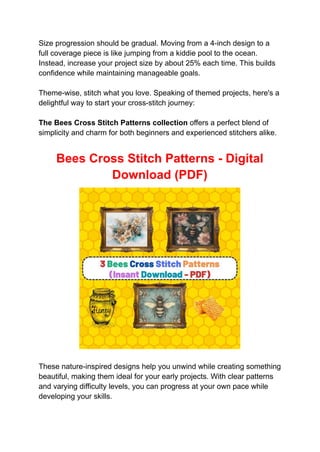
Theme-wise, stitch what you love. Speaking of themed projects, here's a
delightful way to start your cross-stitch journey:
The Bees Cross Stitch Patterns collection offers a perfect blend of
simplicity and charm for both beginners and experienced stitchers alike.
Bees Cross Stitch Patterns - Digital
Download (PDF)
These nature-inspired designs help you unwind while creating something
beautiful, making them ideal for your early projects. With clear patterns
and varying difficulty levels, you can progress at your own pace while
developing your skills.
Passionate about plants? Start with simple leaf patterns and work up to
detailed botanical illustrations. Love sci-fi? Begin with small space
elements before tackling that full-sized TARDIS. Personal connection to
your project significantly impacts motivation.
8. Troubleshooting Guide
A. Common Issues
Fabric puckering is often the result of tension troubles. If your fabric
looks like a topographical map, you're pulling too tight. Remember,
cross-stitch isn't a test of strength – gentle, consistent tension is key. To
fix minor puckering, try dampening and blocking your piece before
framing.
Colour bleeding can ruin weeks of work in minutes. Always test new
threads, especially reds and dark blues, on a scrap piece of fabric. If
you're working with potentially unstable colours, pre-wash your threads
or use colour catchers during the final wash. Think of it as insurance for
your artwork.
Pattern counting errors are like tiny mistakes in a math problem – they
compound over time. Use gridlines and counting pins to mark your
progress. When in doubt, count twice, stitch once. It's worth the extra
minute to prevent hours of frogging (removing stitches – "rip it, rip it").
B. When to Start Over
Sometimes starting over isn't admitting defeat – it's making a strategic
decision. If you're more than a few stitches off in your counting, or if your
fabric is damaged, starting fresh might save time and frustration in the
long run. Think of it as a dress rehearsal; the second attempt is often
better anyway.
Learning from mistakes is part of the journey. Keep a "lessons learned"
note in your project bag. Did you discover a better way to secure your
thread? Write it down. Found the perfect lighting setup? Document it.
Your future self will thank you.
Building confidence comes from acknowledging both successes and
failures. That slightly imperfect first project? It's not just a piece of
stitched fabric – it's a record of everything you've learned. Display it
proudly; every experienced stitcher started somewhere.
9. Resources and Community
A. Learning Resources
The cross-stitch community is incredibly generous with knowledge
sharing. YouTube channels like "Peacock & Fig" and "The Spruce
Crafts" offer excellent video tutorials for visual learners. Seeing
techniques in action can clarify written instructions that might seem
confusing.
Social media platforms, particularly Instagram and Pinterest, are
goldmines for inspiration and technical tips. Follow hashtags like
#crossstitch, #xstitch, and #modernembroidery to discover new patterns
and techniques. Many designers and experienced stitchers regularly
share tips and tutorials in their stories.
Pattern sources range from traditional to ultra-modern. Etsy is a treasure
trove of indie designers pushing creative boundaries. DMC's website
offers free patterns perfect for beginners. Local needlework shops often
provide classes and one-on-one guidance – invaluable resources for
hands-on learning.
B. Supply Sources
Quality supplies don't always mean premium prices. Online retailers like
123stitch.com and everythingcrossstitch.com offer competitive prices
and reliable quality. Sign up for newsletters to catch sales – building your
stash smartly saves money long-term.
Local needlework shops (LNS) might charge slightly more, but the
expertise and personalised service they offer is priceless. Many offer
stitch clubs or informal gathering times where you can learn from more
experienced stitchers. Think of it as investing in your crafting education.
Starter kits can be hit or miss. Look for ones that include quality Aida
fabric, branded floss (preferably DMC or Anchor), and proper
cross-stitch needles. Avoid kits with pre-printed patterns on fabric – they
don't teach proper counting techniques and often use inferior materials.
Remember, cross-stitch is a journey, not a race. Each project teaches
something new, whether it's a technique, colour theory, or simply
patience. Join the community, share your progress, and don't be afraid to
ask questions. We were all beginners once, and the joy of creating
something beautiful with needle and thread never gets old.
Click Here To Get Your Bees Cross Stitch Patterns
Master Cross-Stitch Beginner Tips to Perfect Your First Project.pdf

Master Cross-Stitch Beginner Tips to Perfect Your First Project.pdf

  • 1.
    Have you everspent hours on a cross stitch project, only to look at the back and cringe? Trust me, I've been there – and like you, I used to think that messy backs were just part of the learning curve. (Even my local stitching group insisted it didn't matter!) But here's what most stitchers don't realise: a neater back doesn't just look better – it actually prevents those frustrating knots, saves thread, and makes your finished pieces look more professional from every angle. After teaching hundreds of stitchers and making every mistake in the book, I've discovered that achieving a clean back isn't about natural talent or years of experience – it's about knowing a few simple techniques that most traditional guides never mention. In this post, I'll
  • 2.
    share the exactstep-by-step method I use to create stunning cross-stitch pieces that look just as beautiful on the back as they do on the front, plus three game-changing tips that will transform the way you stitch forever. Master Cross-Stitch: Beginner Tips to Perfect Your First Project 1. Getting Started: Essential Supplies A. Must-Have Tools Let's start with the backbone of any cross-stitch project – your essential toolkit. First up: needles. Not just any needle will do. Cross-stitch needles (tapestry needles) have a blunt tip and larger eye, making them perfect for counted cross-stitch. Size 24 is your sweet spot for standard 14-count Aida fabric. Think of it as matching your shoes to your activity – you wouldn't run a marathon in flip-flops, right? Speaking of fabric, Aida cloth is your best friend as a beginner. This even-weave fabric has visible squares that make counting stitches a breeze. The "count" refers to the number of squares per inch – 14-count is the Goldilocks zone for beginners, offering squares that aren't too tiny or too large. White or cream colours are ideal for your first project, as they make it easier to see your stitches and pattern details. Your hoop or frame isn't just for show – it's your tension control centre. A 6-inch wooden hoop is perfect for most beginner projects. Think of it as your project's personal yoga instructor, keeping everything stretched just right. The wood grips fabric better than plastic, and the size is manageable without being unwieldy. For thread, stick with DMC-stranded cotton. It's the industry standard for a reason – consistent colour, reliable quality, and available worldwide.
  • 3.
    You'll typically usetwo strands for 14-count Aida, but here's a pro tip: separate all six strands and recombine two for the smoothest look. Don't underestimate the importance of scissors. Small, sharp embroidery scissors make a world of difference. They help you get close to your fabric for precise cuts without risking damage to your project. Those kitchen scissors? They're better left for wrapping presents. B. Optional Tools That Make Life Easier While you can absolutely start with just the basics, certain tools can transform your stitching experience from good to great. A needle threader might seem unnecessary until you've spent 5 minutes trying to thread your needle in poor light. The metal ones with the diamond-shaped wire are inexpensive and can save your sanity. Thread organisers and bobbins keep your floss tangle-free and organised. Wind your thread onto labelled bobbins, and suddenly you're not playing detective with similar colours anymore. Store them in a plastic organiser, and you've got a professional-grade system for under £20. If you're over 40 or working on high-count fabric, a magnifying lamp isn't just helpful – it's a game-changer. Look for one with adjustable positioning and good LED lighting. Your eyes will thank you after those longer stitching sessions. Project bags protect your work-in-progress from dust, pet hair, and coffee spills. Choose one with a clear side so you can see your project without opening it. Plus, it makes your hobby portable – perfect for stitching during lunch breaks or while travelling.
  • 4.
    2. Understanding YourPattern A. Reading Pattern Symbols Patterns can look like secret code at first glance, but they're actually quite logical once you know the language. Each symbol on your pattern represents one complete cross-stitch in a specific colour. The key usually shows the DMC thread number alongside each symbol – think of it as a colour-by-number for adults. Most patterns have a centre point marked with arrows or bold lines. This is your North Star, helping you position your design correctly on your fabric. Always start from the centre and work your way out – it's like building a puzzle from the middle. Grid lines typically appear every 10 squares, making counting easier. Use these as your checkpoints to ensure you're staying on track. Nothing's worse than realising you're one square off after completing an entire section. B. Pattern Preparation Before threading your first needle, take time to prepare your pattern properly. Make a working copy – this isn't just being cautious, it's practical. You'll mark it up, highlight sections, and possibly spill coffee on it (we've all been there). Marking your centre point is crucial. Fold your fabric in quarters to find the centre, then mark it with a water-soluble pen or a simple needle and thread. This temporary marker ensures you start in exactly the right spot. Some stitchers swear by gridding their fabric – drawing or stitching lines every 10 squares to match their pattern's grid. While time-consuming, it can prevent counting errors and make your stitching more relaxing. Think of it as creating a roadmap for your project.
  • 5.
    3. Basic Techniquesfor Clean Results A. Starting Your Thread The way you start your thread can make or break your project's appearance. The loop method is your secret weapon for a clean start – it's like magic, creating a secure beginning without any bulky knots. Simply cut your thread twice as long as usual, fold it in half, and thread the folded end through your needle. When you start stitching, catch the loose ends through the loop on your first stitch. Voilà – secure and flat! For times when the loop method isn't practical (like when using an odd number of threads), the waste knot technique is your next best friend. Start with a knot about 3 inches from your thread end, come up from the front where you'll eventually stitch, and work your way toward the knot. Once you've secured your thread with several stitches, you can snip away the knot and thread end. Pin stitch is the professional's choice – a bit trickier to master but worth learning. It creates virtually invisible starts and stops, making your work look museum-worthy from both sides. Think of it as the ninja technique of cross-stitch – stealthy and effective. B. Perfect Stitching Form The direction of your stitches matters more than you might think. Always make your first diagonal in the same direction (usually bottom left to top right), then cross back over. Consistency here creates a uniform, professional appearance – like perfectly aligned tiles in a mosaic. Tension is everything in cross-stitch. Too tight, and your fabric puckers; too loose, and your stitches look sloppy. Aim for gentle tension that keeps your stitches flat without distorting the fabric. Let your thread flow naturally – no need to pull each stitch like you're winning a tug-of-war.
  • 6.
    Twisted threads arethe silent project killers. After each stitch, let your needle and thread hang freely to untwist. Some stitchers use a magnetic needle minder to "park" their needle while letting the thread unwind. Your thread should lie flat against your fabric, not look like a tiny rope. 4. Common Beginner Mistakes (And How to Fix Them) A. Prevention Tips The number one rookie mistake? Using thread that's too long. Yes, it seems efficient, but it leads to tangling and frustration. Stick to lengths no longer than your forearm – about 18 inches. You'll spend less time fighting knots and more time making actual progress. Colour management can make or break your stitching flow. Instead of jumping around your pattern, work in blocks of similar colours. It's like painting – you wouldn't wash your brush after each stroke if you're using the same colour, right? "Parking" your threads (leaving them hanging to use later) can speed up your stitching significantly. Keep those hands clean! Wash them before stitching and avoid snacking during project time (we know it's tempting). Use a project cover when you're not actively stitching. Think of your fabric as a white wedding dress – you wouldn't eat spaghetti while wearing one. B. Quick Fixes Did you make a mistake? Don't panic. Wrong stitches can be carefully removed using your needle or the blunt end of your scissors. Work slowly from the back, one leg at a time. It's like performing a tiny surgery – patience is crucial. When you encounter knots (and you will), resist the urge to yank. Gently work them out with your needle tip, or in worst-case scenarios, carefully
  • 7.
    snip and startfresh. Sometimes accepting a small defeat saves the entire battle. Uneven stitches catch the eye like a neon sign. Fix them by removing and restitching with consistent tension. Remember, it's better to fix mistakes early than to let them haunt you throughout your project. Click Here To Get Your Bees Cross Stitch Patterns 5. Project Management Skills A. Setting Up for Success Create a dedicated stitching space with good lighting and comfortable seating. Natural daylight is best, but a good daylight lamp is worth its weight in gold for evening stitching sessions. Position your light to come over your non-dominant shoulder to prevent shadows. Organization isn't just for neat freaks – it's for smart stitchers. Keep your active threads on a thread drop card, your pattern within easy view (pattern holders are worth considering), and your tools within arm's reach. Think of it as setting up a chef's mise en place – everything in its place makes the process flow smoothly. Track your progress with photos or a stitching journal. Not only is it satisfying to see how far you've come, but it also helps identify any developing issues early. Some stitchers mark off completed sections on their pattern with highlighters – different colours for different days or weeks.
  • 8.
    B. Maintaining Motivation Largeprojects can feel overwhelming. Break them down into manageable sections – maybe aim to complete one colour or one 10x10 grid square per session. Celebrate these small victories! They add up to major progress. Join online stitching communities on platforms like Reddit's r/CrossStitch or Facebook groups. Sharing your progress, getting feedback, and seeing others' work can provide motivation and solutions to common problems. Plus, there's nothing like having people who understand your excitement about finding the perfect shade of blue thread. 6. Finishing Techniques A. During Your Project Regular maintenance prevents major issues later. Secure your thread ends as you go – no one wants to deal with 50 loose ends at project completion. When ending a thread, run it under at least 4 existing stitches on the back. Store your project flat when possible, or gently rolled if necessary. Never fold your work – those creases can be stubborn to remove. If you must store it in a hoop, loosen the tension between sessions to prevent permanent hoop marks. B. Final Steps The finishing touches transform your project from good to great. Washing isn't optional – it's essential. Hand wash gently in lukewarm water with mild soap designed for needlework. This removes oils from your hands, potential stains, and any marking pen residue.
  • 9.
    Press your pieceface down on a thick towel, using a medium-hot iron. Steam can help relax stubborn creases, but be careful with metallic threads if you've used them. Think of it as giving your piece a spa day – it deserves some pampering after all that work! 7. Next Steps and Advanced Preview A. Building on Basics Once you've mastered basic cross-stitches, you're ready to add some flair to your projects. Backstitching is like adding the final pencil lines to a painting – it creates definition and brings your piece to life. Start with simple straight lines before attempting curves. The key is consistency in stitch length and tension. French knots strike fear into many stitchers' hearts, but they're not as scary as they seem. Think of them as tiny twisted roses – wrap your thread around your needle 2-3 times, keep tension steady, and insert your needle slightly away from where you emerged. Practice on scrap fabric first; even experienced stitchers do their "morning knots" to warm up! Colour blending opens up a whole new world of possibilities. By alternating similar shades of thread, you can create stunning depth and dimension. Start with simple two-colour blends before attempting more complex combinations. It's like being a pixel artist, but with thread. B. Project Ideas Ready to level up from your first project? Consider a sampler that incorporates different techniques. Traditional samplers weren't just for show – they were learning tools that helped stitchers master new skills. Modern versions might include your favourite quote surrounded by various borders and decorative elements.
  • 10.
    Size progression shouldbe gradual. Moving from a 4-inch design to a full coverage piece is like jumping from a kiddie pool to the ocean. Instead, increase your project size by about 25% each time. This builds confidence while maintaining manageable goals. Theme-wise, stitch what you love. Speaking of themed projects, here's a delightful way to start your cross-stitch journey: The Bees Cross Stitch Patterns collection offers a perfect blend of simplicity and charm for both beginners and experienced stitchers alike. Bees Cross Stitch Patterns - Digital Download (PDF) These nature-inspired designs help you unwind while creating something beautiful, making them ideal for your early projects. With clear patterns and varying difficulty levels, you can progress at your own pace while developing your skills.
  • 11.
    Passionate about plants?Start with simple leaf patterns and work up to detailed botanical illustrations. Love sci-fi? Begin with small space elements before tackling that full-sized TARDIS. Personal connection to your project significantly impacts motivation. 8. Troubleshooting Guide A. Common Issues Fabric puckering is often the result of tension troubles. If your fabric looks like a topographical map, you're pulling too tight. Remember, cross-stitch isn't a test of strength – gentle, consistent tension is key. To fix minor puckering, try dampening and blocking your piece before framing. Colour bleeding can ruin weeks of work in minutes. Always test new threads, especially reds and dark blues, on a scrap piece of fabric. If you're working with potentially unstable colours, pre-wash your threads or use colour catchers during the final wash. Think of it as insurance for your artwork. Pattern counting errors are like tiny mistakes in a math problem – they compound over time. Use gridlines and counting pins to mark your progress. When in doubt, count twice, stitch once. It's worth the extra minute to prevent hours of frogging (removing stitches – "rip it, rip it"). B. When to Start Over Sometimes starting over isn't admitting defeat – it's making a strategic decision. If you're more than a few stitches off in your counting, or if your fabric is damaged, starting fresh might save time and frustration in the long run. Think of it as a dress rehearsal; the second attempt is often better anyway.
  • 12.
    Learning from mistakesis part of the journey. Keep a "lessons learned" note in your project bag. Did you discover a better way to secure your thread? Write it down. Found the perfect lighting setup? Document it. Your future self will thank you. Building confidence comes from acknowledging both successes and failures. That slightly imperfect first project? It's not just a piece of stitched fabric – it's a record of everything you've learned. Display it proudly; every experienced stitcher started somewhere. 9. Resources and Community A. Learning Resources The cross-stitch community is incredibly generous with knowledge sharing. YouTube channels like "Peacock & Fig" and "The Spruce Crafts" offer excellent video tutorials for visual learners. Seeing techniques in action can clarify written instructions that might seem confusing. Social media platforms, particularly Instagram and Pinterest, are goldmines for inspiration and technical tips. Follow hashtags like #crossstitch, #xstitch, and #modernembroidery to discover new patterns and techniques. Many designers and experienced stitchers regularly share tips and tutorials in their stories. Pattern sources range from traditional to ultra-modern. Etsy is a treasure trove of indie designers pushing creative boundaries. DMC's website offers free patterns perfect for beginners. Local needlework shops often provide classes and one-on-one guidance – invaluable resources for hands-on learning.
  • 13.
    B. Supply Sources Qualitysupplies don't always mean premium prices. Online retailers like 123stitch.com and everythingcrossstitch.com offer competitive prices and reliable quality. Sign up for newsletters to catch sales – building your stash smartly saves money long-term. Local needlework shops (LNS) might charge slightly more, but the expertise and personalised service they offer is priceless. Many offer stitch clubs or informal gathering times where you can learn from more experienced stitchers. Think of it as investing in your crafting education. Starter kits can be hit or miss. Look for ones that include quality Aida fabric, branded floss (preferably DMC or Anchor), and proper cross-stitch needles. Avoid kits with pre-printed patterns on fabric – they don't teach proper counting techniques and often use inferior materials. Remember, cross-stitch is a journey, not a race. Each project teaches something new, whether it's a technique, colour theory, or simply patience. Join the community, share your progress, and don't be afraid to ask questions. We were all beginners once, and the joy of creating something beautiful with needle and thread never gets old. Click Here To Get Your Bees Cross Stitch Patterns