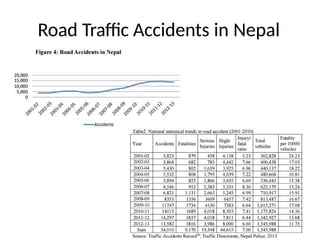
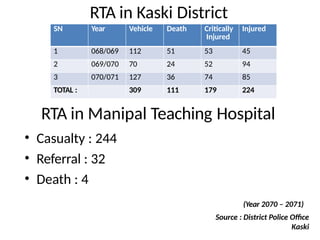
RTA in KaskiDistrict
RTA in Manipal Teaching Hospital
• Casualty : 244
• Referral : 32
• Death : 4
(Year 2070 – 2071)
Source : District Police Office
Kaski
SN Year Vehicle Death Critically
Injured
Injured
1 068/069 112 51 53 45
2 069/070 70 24 52 94
3 070/071 127 36 74 85
TOTAL : 309 111 179 224
5.
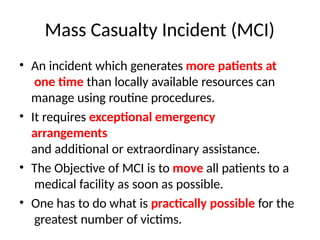
Mass Casualty Incident(MCI)
• An incident which generates more patients at
one time than locally available resources can
manage using routine procedures.
• It requires exceptional emergency
arrangements
and additional or extraordinary assistance.
• The Objective of MCI is to move all patients to a
medical facility as soon as possible.
• One has to do what is practically possible for the
greatest number of victims.
6.
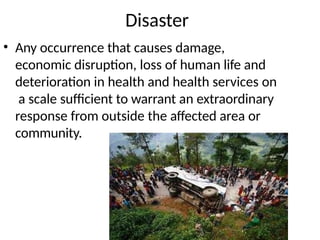
Disaster
• Any occurrencethat causes damage,
economic disruption, loss of human life and
deterioration in health and health services on
a scale sufficient to warrant an extraordinary
response from outside the affected area or
community.
7.
Characteristics of Disaster
1.The normal function of a community is
disrupted.
2. Disaster exceed the coping mechanism of
community.
3. The disruption is of such magnitude that
there is an inability to return to normal
functioning without external assistance.
8.
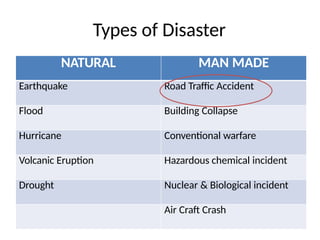
Types of Disaster
NATURALMAN MADE
Earthquake Road Traffic Accident
Flood Building Collapse
Hurricane Conventional warfare
Volcanic Eruption Hazardous chemical incident
Drought Nuclear & Biological incident
Air Craft Crash
9.
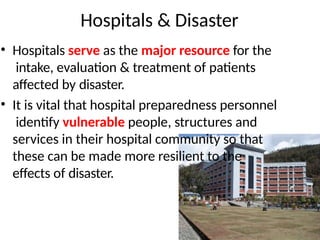
Hospitals & Disaster
•Hospitals serve as the major resource for the
intake, evaluation & treatment of patients
affected by disaster.
• It is vital that hospital preparedness personnel
identify vulnerable people, structures and
services in their hospital community so that
these can be made more resilient to the
effects of disaster.
10.
Issues to beaddressed by Hospital
1. Surge capacity for additional space for
treatment and evaluation.
2. Medication and supply stockpiles
3. Structural integrity
4. Trained staff
5. Response protocol and proper disaster
response procedures.
6. Functional hospital based disaster plan
11.
Role of Hospitalin Disaster Management
• A disaster will involve the entire hospital there
will be increased demands upon equipment and
personnel
• The hospital’s response will have to be managed
and coordinated
• Staff will need to be supported throughout
response and recovery.
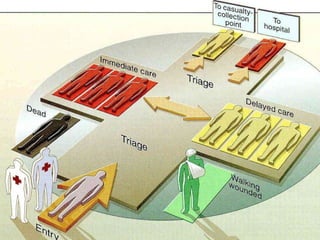
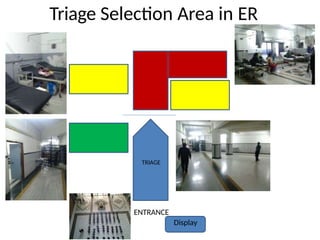
Triag
e
• [French, fromtrier, to sort]
• A method of quickly identifying victims who
have immediately life-threatening injuries
AND who have the best chance of
surviving.
• Aim of triage : To achieve the greatest
good for the greatest number of casualty
14.
Types of Triage
1.M.A.S.S. Triage : based on patients ability to move
2. S.T.A.R.T. Triage : determines severity of injuries
3. Advanced Triage : More fully assess injury priority
15.
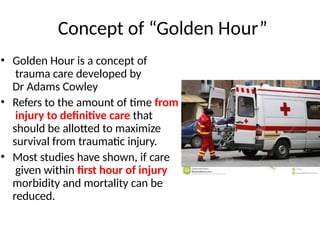
Concept of “GoldenHour”
• Golden Hour is a concept of
trauma care developed by
Dr Adams Cowley
• Refers to the amount of time from
injury to definitive care that
should be allotted to maximize
survival from traumatic injury.
• Most studies have shown, if care
given within first hour of injury
morbidity and mortality can be
reduced.
16.
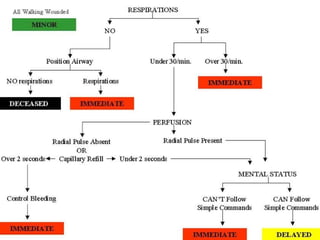
START Triage
• STARTstands for Simple Triage & Rapid
Treatment
• Rapid approach to triaging large numbers of
causalities
• Fast, Easy to use, Easy to remember
• Allows the most good for the most patients
with the least amount of resources.
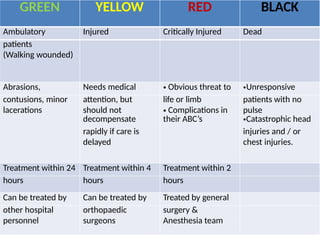
GREEN YELLOW REDBLACK
Ambulatory Injured Critically Injured Dead
patients
(Walking wounded)
Abrasions, Needs medical • Obvious threat to •Unresponsive
contusions, minor attention, but life or limb patients with no
lacerations should not
decompensate
• Complications in
their ABC’s
pulse
•Catastrophic head
rapidly if care is injuries and / or
delayed chest injuries.
Treatment within 24 Treatment within 4 Treatment within 2
hours hours hours
Can be treated by Can be treated by Treated by general
other hospital orthopaedic surgery &
personnel surgeons Anesthesia team
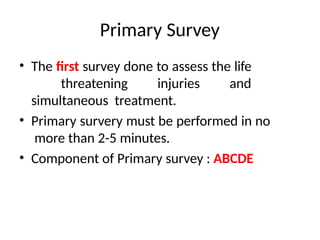
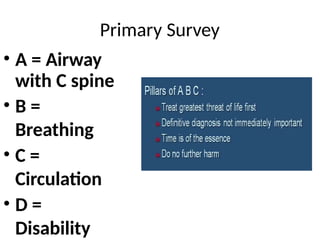
Primary Survey
• Thefirst survey done to assess the life
threatening injuries and
simultaneous treatment.
• Primary survery must be performed in no
more than 2-5 minutes.
• Component of Primary survey : ABCDE
23.
Primary Survey
• A= Airway
with C spine
• B =
Breathing
• C =
Circulation
• D =
Disability
24.
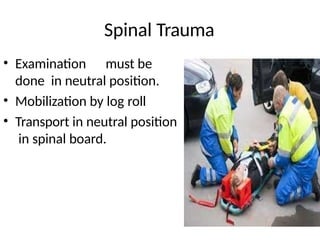
• Always assumeC-spine injury
– C spine protection.
• Assess airway. Can the patient talk & breath freely?
• Signs of airway obstruction
– Snoring or gurgling
– Stridor or abnormal breath sound
– Agitation
– Use of accessory muscles of ventilation
– Cyanosis
– Fracture (Facial & Cervical)
– Injury to the neck (larynx & trachea)
Airwa
y
25.
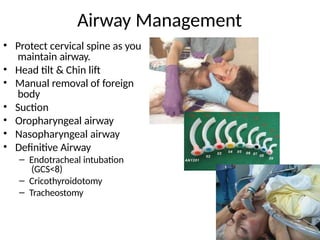
Airway Management
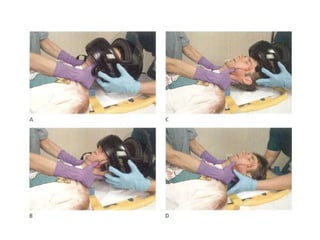
• Protectcervical spine as you
maintain airway.
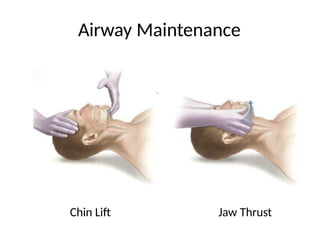
• Head tilt & Chin lift
• Manual removal of foreign
body
• Suction
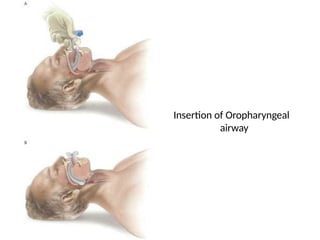
• Oropharyngeal airway
• Nasopharyngeal airway
• Definitive Airway
– Endotracheal intubation
(GCS<8)
– Cricothyroidotomy
– Tracheostomy
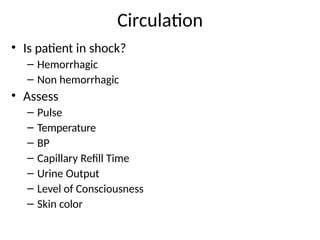
Circulation
• Is patientin shock?
– Hemorrhagic
– Non hemorrhagic
• Assess
– Pulse
– Temperature
– BP
– Capillary Refill Time
– Urine Output
– Level of Consciousness
– Skin color
32.
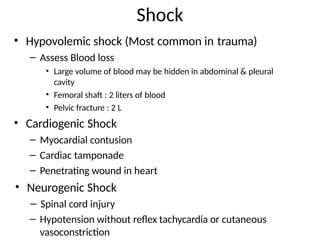
Shock
• Hypovolemic shock(Most common in trauma)
– Assess Blood loss
• Large volume of blood may be hidden in abdominal & pleural
cavity
• Femoral shaft : 2 liters of blood
• Pelvic fracture : 2 L
• Cardiogenic Shock
– Myocardial contusion
– Cardiac tamponade
– Penetrating wound in heart
• Neurogenic Shock
– Spinal cord injury
– Hypotension without reflex tachycardia or cutaneous
vasoconstriction
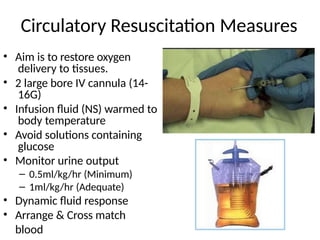
Circulatory Resuscitation Measures
•Aim is to restore oxygen
delivery to tissues.
• 2 large bore IV cannula (14-
16G)
• Infusion fluid (NS) warmed to
body temperature
• Avoid solutions containing
glucose
• Monitor urine output
– 0.5ml/kg/hr (Minimum)
– 1ml/kg/hr (Adequate)
• Dynamic fluid response
• Arrange & Cross match
blood
35.
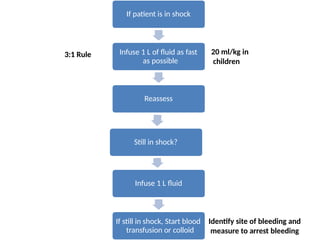
If patient isin shock
Infuse 1 L of fluid as fast
as possible
Reassess
Still in shock?
Infuse 1 L fluid
If still in shock, Start blood
transfusion or colloid
20 ml/kg in
children
3:1 Rule
Identify site of bleeding and
measure to arrest bleeding
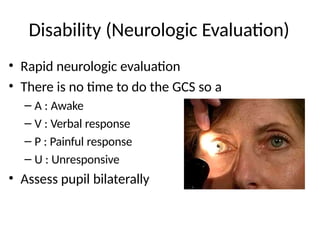
Disability (Neurologic Evaluation)
•Rapid neurologic evaluation
• There is no time to do the GCS so a
– A : Awake
– V : Verbal response
– P : Painful response
– U : Unresponsive
• Assess pupil bilaterally
39.
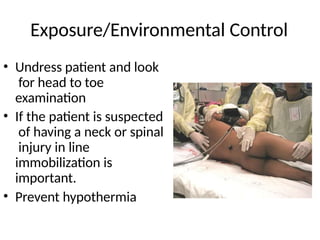
Exposure/Environmental Control
• Undresspatient and look
for head to toe
examination
• If the patient is suspected
of having a neck or spinal
injury in line
immobilization is
important.
• Prevent hypothermia
40.
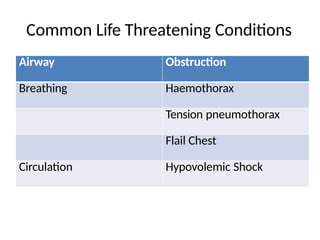
Common Life ThreateningConditions
Airway Obstruction
Breathing Haemothorax
Tension pneumothorax
Flail Chest
Circulation Hypovolemic Shock
Secondary Survey
• Secondarysurvey is undertaken when the
patient’s ABCs are stable
• To identify all minor injuries missed
in primary survey
• If any deterioration occurs must
be interrupted by Primary survey.
43.
Secondary Survey
• PatientHistory
• Head to Toe examination
• Complete neurological examination
• Diagnostic Tests
• Re-evaluation
44.
Patient History
• A– Allergies
• M – Medication currently used
• P – Pregnancy / Past Illness
• L – Last Meal
• E – Events
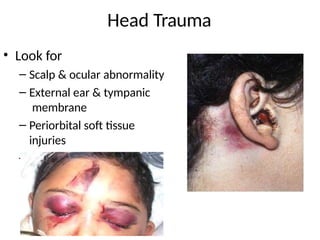
Head Trauma
• Remember..
–Isolated head trauma doesn’t causes hypotension.
– GCS < 8 : Severe Head Injury
– Cushing response is physiological but has poor
prognosis sign
48.
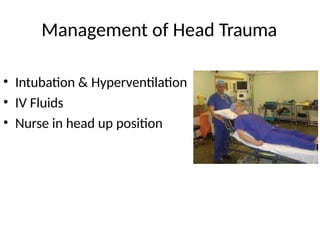
Management of HeadTrauma
• Intubation & Hyperventilation
• IV Fluids
• Nurse in head up position
49.
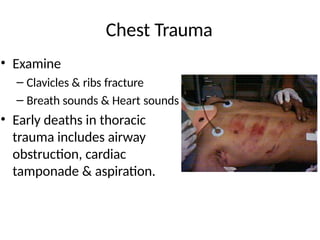
Chest Trauma
• Examine
–Clavicles & ribs fracture
– Breath sounds & Heart sounds
• Early deaths in thoracic
trauma includes airway
obstruction, cardiac
tamponade & aspiration.
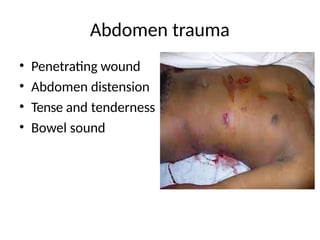
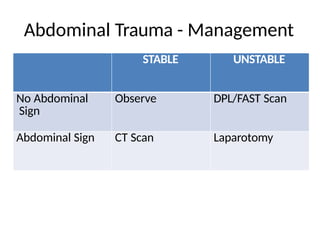
Abdominal Trauma
• Patientwith serious accident is considered to
have abdominal trauma until proved otherwise.
• Unrecognized abdominal injury remains
frequent preventable cause of death.
• 20% of patients with acute hemoperitoneum
have no sign of periotneal irritation at first
examination.
Mass Casualty Managementin ER -
Principles
1. Policies and Procedures
2. Emergency or Disaster Plan
3. Operating Theatre
4. Staffing Requirements of the ER
5. Overcrowding
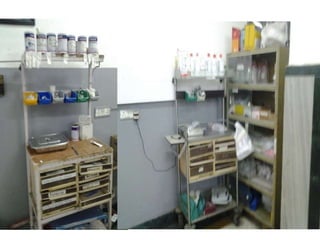
6. Equipment & Supplies of the ER
7. Contingency
8. Observation & Holding Area
9. Referral & Transfer
60.
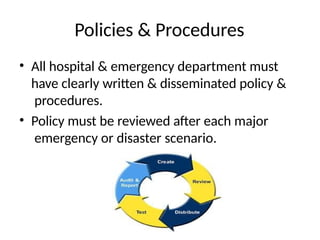
Policies & Procedures
•All hospital & emergency department must
have clearly written & disseminated policy &
procedures.
• Policy must be reviewed after each major
emergency or disaster scenario.
61.
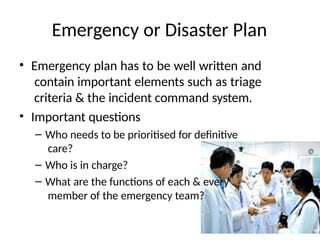
Emergency or DisasterPlan
• Emergency plan has to be well written and
contain important elements such as triage
criteria & the incident command system.
• Important questions
– Who needs to be prioritised for definitive
care?
– Who is in charge?
– What are the functions of each & every
member of the emergency team?
62.
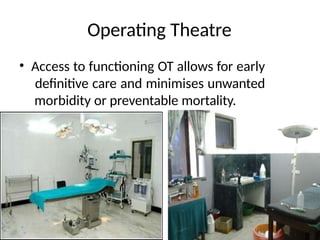
Operating Theatre
• Accessto functioning OT allows for early
definitive care and minimises unwanted
morbidity or preventable mortality.
63.
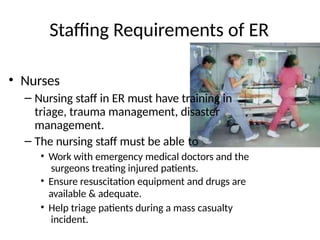
Staffing Requirements ofER
• Nurses
– Nursing staff in ER must have training in
triage, trauma management, disaster
management.
– The nursing staff must be able to
• Work with emergency medical doctors and the
surgeons treating injured patients.
• Ensure resuscitation equipment and drugs are
available & adequate.
• Help triage patients during a mass casualty
incident.
64.
Staffing Requirements ofER
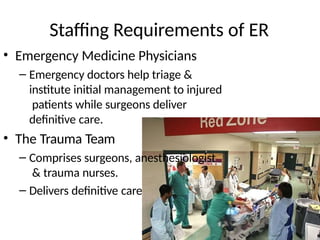
• Emergency Medicine Physicians
– Emergency doctors help triage &
institute initial management to injured
patients while surgeons deliver
definitive care.
• The Trauma Team
– Comprises surgeons, anesthesiologist
& trauma nurses.
– Delivers definitive care
65.
Overcrowdin
g
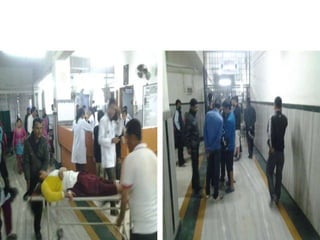
• In developingcountries, ER are lacking
resources for day-to-day problem even before
the occurrence of disaster.
• Modern principles of emergency medicine
don’t exist.
• After a mass casualty incident, hospital is
flooded with visitors which makes the working
environment chaotic and difficult which
needs to be controlled.
67.
Equipment & Supplies
•Airway devices
– Oxygen tanks, nasal prongs, oropharyngeal airway
devices, nasopharyngeal airway device
– Intubation equipments
• Management of Shock
– Surgical gauge pack, roll bandages, IV cannula,
crystalloids and colloid, Access to blood bank, Traction
splints
• Emergency Drugs
• The equipments & drugs should be in bulk and
readily available during mass casualty
incident.
69.
Contingency
• Planning isthe key to the proper response to a
mass casualty incident.
• Worst case scenario must be thought through
and procedures developed for each possibility.
70.
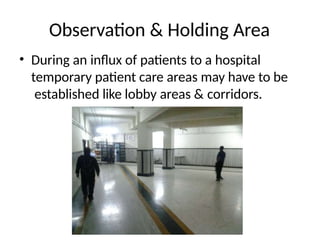
Observation & HoldingArea
• During an influx of patients to a hospital
temporary patient care areas may have to be
established like lobby areas & corridors.
71.
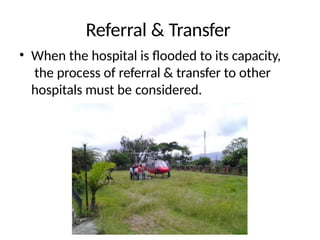
Referral & Transfer
•When the hospital is flooded to its capacity,
the process of referral & transfer to other
hospitals must be considered.
72.
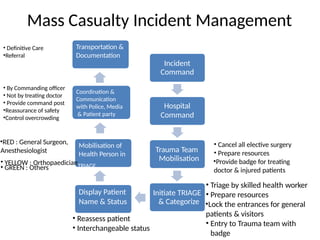
Mass Casualty IncidentManagement
Incident
Command
Hospital
Command
Trauma Team
Mobilisation
Initiate TRIAGE
& Categorize
• Cancel all elective surgery
• Prepare resources
•Provide badge for treating
doctor & injured patients
• Triage by skilled health worker
• Prepare resources
•Lock the entrances for general
patients & visitors
• Entry to Trauma team with
badge
Display Patient
Name & Status
• Reassess patient
• Interchangeable status
Mobilisation of
Health Person in
•RED : General Surgeon,
Anesthesiologist
• YELLOW : OrthopaedicianTRIAGE
• GREEN : Others
Coordination &
Communication
with Police, Media
& Patient party
• By Commanding officer
• Not by treating doctor
• Provide command post
•Reassurance of safety
•Control overcrowding
Transportation &
Documentation
• Definitive Care
•Referral
Conclusion
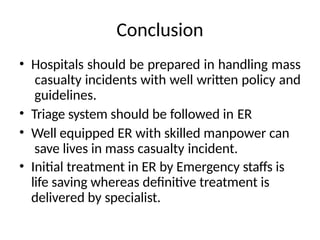
• Hospitals shouldbe prepared in handling mass
casualty incidents with well written policy and
guidelines.
• Triage system should be followed in ER
• Well equipped ER with skilled manpower can
save lives in mass casualty incident.
• Initial treatment in ER by Emergency staffs is
life saving whereas definitive treatment is
delivered by specialist.

![Triag
e
• [French, from trier, to sort]
• A method of quickly identifying victims who
have immediately life-threatening injuries
AND who have the best chance of
surviving.
• Aim of triage : To achieve the greatest
good for the greatest number of casualty](https://image.slidesharecdn.com/masscasualtymanagement-final-1708161513391-250623071552-267d66b8/85/masscasualtymanagement-final-173390-pptx-13-320.jpg)