Library Mashups Exploring new ways to deliver library data  Nicole C. Engard, Book Editor
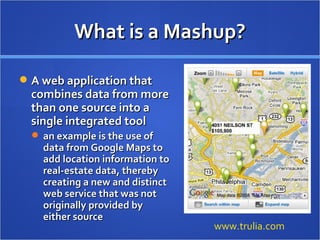
What is a Mashup? A web application that combines data from more than one source into a single integrated tool an example is the use of data from Google Maps to add location information to real-estate data, thereby creating a new and distinct web service that was not originally provided by either source www.trulia.com
Mashup Terminology Web Service a technology that enables information and communication exchange between different applications Application Programming Interface (API) a set of functions, procedures or classes for accessing a web service that allow a computer program to access and manipulate data on a web service the same way that a website interface lets the human user surf and dive into its content
Mashup Terminology REpresentational State Transfer (REST) the simplest and thus by far the most used protocol in the creation of mashups requests employ a URL containing the API parameters, and is transmitted using GET or POST over HTTP SOAP relies on international standards and protocols and has been adopted primarily in the enterprise world requires that both the requests sent by the service consumer and the answers returned by the service provider be wrapped in XML
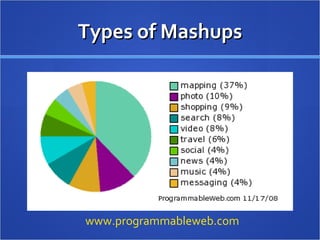
Types of Mashups www.programmableweb.com
Mashups and Libraries: Why? Provide better services to our patrons Added value to our websites and catalogs Promoting library services where the patrons are
Mashups and Libraries: How? Ask vendors for APIs Mashup library data with popular services Put your library out there Create RSS feeds for library content
Mashup Tools
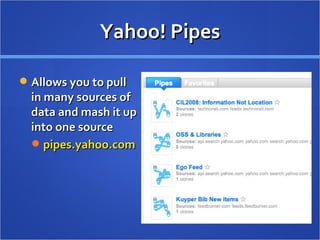
Yahoo! Pipes Allows you to pull in many sources of data and mash it up into one source  pipes.yahoo.com
Dapper Use Dapper to create new means for people to access your content. Create RSS feeds, widgets, and APIs with your content and links. www.dapper.net
Mashups for Fun & Function
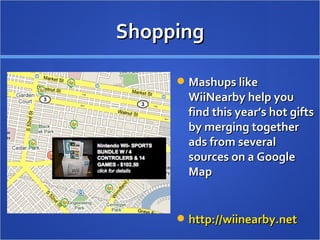
Shopping Mashups like WiiNearby help you find this year’s hot gifts by merging together ads from several sources on a Google Map http://wiinearby.net
Fun with Images Mash up your Flickr ( www.flickr.com ) images and create badges, posters, games and so much more  http://bighugelabs.com/flickr/
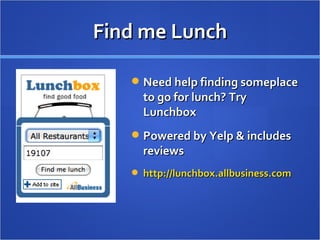
Find me Lunch Need help finding someplace to go for lunch? Try Lunchbox Powered by Yelp & includes reviews http://lunchbox.allbusiness.com
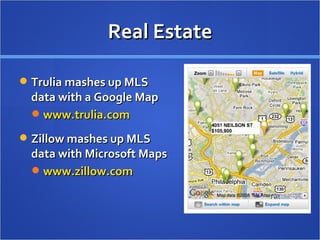
Real Estate Trulia mashes up MLS data with a Google Map www.trulia.com   Zillow mashes up MLS data with Microsoft Maps www.zillow.com
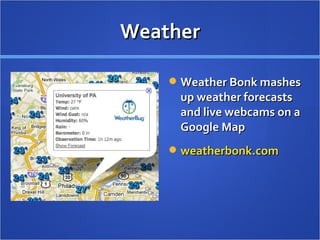
Weather Weather Bonk mashes up weather forecasts and live webcams on a Google Map weatherbonk.com
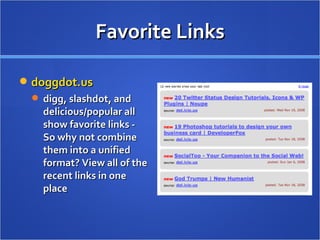
Favorite Links doggdot.us digg, slashdot, and delicious/popular all show favorite links - So why not combine them into a unified format? View all of the recent links in one place
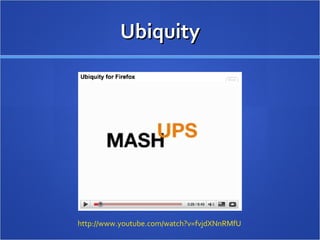
Ubiquity http://www.youtube.com/watch?v=fvjdXNnRMfU
Find More You can find more popular mashups by browsing at the ProgrammableWeb  http://www.programmableweb.com/popular
Mashups for Libraries
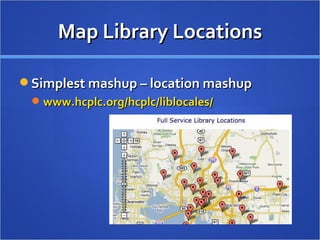
Map Library Locations Simplest mashup – location mashup www.hcplc.org/hcplc/liblocales/
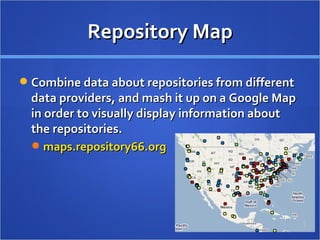
Repository Map Combine data about repositories from different data providers, and mash it up on a Google Map in order to visually display information about the repositories.  maps.repository66.org
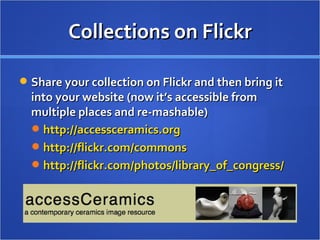
Collections on Flickr Share your collection on Flickr and then bring it into your website (now it’s accessible from multiple places and re-mashable) http://accessceramics.org   http://flickr.com/commons   http://flickr.com/photos/library_of_congress/
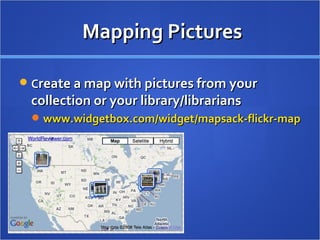
Mapping Pictures C reate a map with pictures from your collection or your library/librarians www.widgetbox.com/widget/mapsack-flickr-map
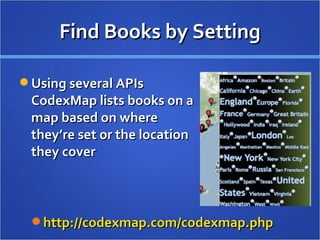
Find Books by Setting Using several APIs  CodexMap lists books on a  map based on where  they’re set or the location  they cover http://codexmap.com/codexmap.php
Website Mashups Join any service with an RSS feed Blogs, Wikis, Flickr, Calendars, Bookmarks, etc Delicious  www.chelmsfordlibrary.org/reference/consumer.html   www.chelmsfordlibrary.org/reference/consumers.html   (w/out) Flickr and Blog http://216.204.202.157/website/Default.aspx?alias=216.204.202.157/website/library
OPAC Mashups Can be harder than most others because of the proprietary nature of our systems What to do?  Work with vendors to get APIs to your data so you can re-mash it Find APIs that generate JavaScript because they can easily be integrated
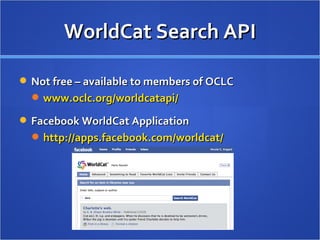
WorldCat Search API Not free – available to members of OCLC www.oclc.org/worldcatapi/   Facebook WorldCat Application http://apps.facebook.com/worldcat/
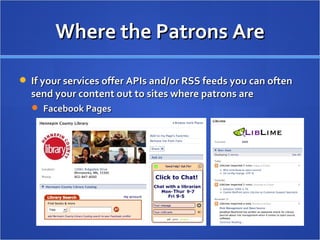
Where the Patrons Are If your services offer APIs and/or RSS feeds you can often send your content out to sites where patrons are  Facebook Pages
Mashup Tools Play Time
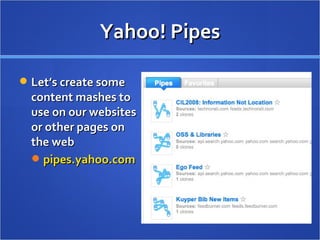
Yahoo! Pipes Let’s create some content mashes to use on our websites or other pages on the web pipes.yahoo.com
Learn More Library Mashups:  Exploring new ways to deliver library data  Edited by Nicole C. Engard Published by Information Today, Inc., 2009
Thank You Nicole C. Engard Open Source Evangelist, LibLime [email_address] The Book: Published by Information Today in 2009

Mashups for Libraries

  • 1.
    Library Mashups Exploringnew ways to deliver library data Nicole C. Engard, Book Editor
  • 2.
    What is aMashup? A web application that combines data from more than one source into a single integrated tool an example is the use of data from Google Maps to add location information to real-estate data, thereby creating a new and distinct web service that was not originally provided by either source www.trulia.com
  • 3.
    Mashup Terminology WebService a technology that enables information and communication exchange between different applications Application Programming Interface (API) a set of functions, procedures or classes for accessing a web service that allow a computer program to access and manipulate data on a web service the same way that a website interface lets the human user surf and dive into its content
  • 4.
    Mashup Terminology REpresentationalState Transfer (REST) the simplest and thus by far the most used protocol in the creation of mashups requests employ a URL containing the API parameters, and is transmitted using GET or POST over HTTP SOAP relies on international standards and protocols and has been adopted primarily in the enterprise world requires that both the requests sent by the service consumer and the answers returned by the service provider be wrapped in XML
  • 5.
    Types of Mashupswww.programmableweb.com
  • 6.
    Mashups and Libraries:Why? Provide better services to our patrons Added value to our websites and catalogs Promoting library services where the patrons are
  • 7.
    Mashups and Libraries:How? Ask vendors for APIs Mashup library data with popular services Put your library out there Create RSS feeds for library content
  • 8.
  • 9.
    Yahoo! Pipes Allowsyou to pull in many sources of data and mash it up into one source pipes.yahoo.com
  • 10.
    Dapper Use Dapperto create new means for people to access your content. Create RSS feeds, widgets, and APIs with your content and links. www.dapper.net
  • 11.
    Mashups for Fun& Function
  • 12.
    Shopping Mashups likeWiiNearby help you find this year’s hot gifts by merging together ads from several sources on a Google Map http://wiinearby.net
  • 13.
    Fun with ImagesMash up your Flickr ( www.flickr.com ) images and create badges, posters, games and so much more http://bighugelabs.com/flickr/
  • 14.
    Find me LunchNeed help finding someplace to go for lunch? Try Lunchbox Powered by Yelp & includes reviews http://lunchbox.allbusiness.com
  • 15.
    Real Estate Truliamashes up MLS data with a Google Map www.trulia.com Zillow mashes up MLS data with Microsoft Maps www.zillow.com
  • 16.
    Weather Weather Bonkmashes up weather forecasts and live webcams on a Google Map weatherbonk.com
  • 17.
    Favorite Links doggdot.usdigg, slashdot, and delicious/popular all show favorite links - So why not combine them into a unified format? View all of the recent links in one place
  • 18.
  • 19.
    Find More Youcan find more popular mashups by browsing at the ProgrammableWeb http://www.programmableweb.com/popular
  • 20.
  • 21.
    Map Library LocationsSimplest mashup – location mashup www.hcplc.org/hcplc/liblocales/
  • 22.
    Repository Map Combinedata about repositories from different data providers, and mash it up on a Google Map in order to visually display information about the repositories. maps.repository66.org
  • 23.
    Collections on FlickrShare your collection on Flickr and then bring it into your website (now it’s accessible from multiple places and re-mashable) http://accessceramics.org http://flickr.com/commons http://flickr.com/photos/library_of_congress/
  • 24.
    Mapping Pictures Create a map with pictures from your collection or your library/librarians www.widgetbox.com/widget/mapsack-flickr-map
  • 25.
    Find Books bySetting Using several APIs CodexMap lists books on a map based on where they’re set or the location they cover http://codexmap.com/codexmap.php
  • 26.
    Website Mashups Joinany service with an RSS feed Blogs, Wikis, Flickr, Calendars, Bookmarks, etc Delicious www.chelmsfordlibrary.org/reference/consumer.html www.chelmsfordlibrary.org/reference/consumers.html (w/out) Flickr and Blog http://216.204.202.157/website/Default.aspx?alias=216.204.202.157/website/library
  • 27.
    OPAC Mashups Canbe harder than most others because of the proprietary nature of our systems What to do? Work with vendors to get APIs to your data so you can re-mash it Find APIs that generate JavaScript because they can easily be integrated
  • 28.
    WorldCat Search APINot free – available to members of OCLC www.oclc.org/worldcatapi/ Facebook WorldCat Application http://apps.facebook.com/worldcat/
  • 29.
    Where the PatronsAre If your services offer APIs and/or RSS feeds you can often send your content out to sites where patrons are Facebook Pages
  • 30.
  • 31.
    Yahoo! Pipes Let’screate some content mashes to use on our websites or other pages on the web pipes.yahoo.com
  • 32.
    Learn More LibraryMashups: Exploring new ways to deliver library data Edited by Nicole C. Engard Published by Information Today, Inc., 2009
  • 33.
    Thank You NicoleC. Engard Open Source Evangelist, LibLime [email_address] The Book: Published by Information Today in 2009