MASH Requirements
for Safety Hardware
Chiara Dobrovolny, Ph.D.
Associate Research Scientist
Texas A&M Transportation Institute
October 17, 2018
2018 Transportation Short Course
College Station, Texas
Outline
•What is “MASH”?
•When is Implementation needed?
•Why is Implementation needed?
Outline
•What is “MASH”?
•When is Implementation needed?
•Why is Implementation needed?
Crash Testing Guidance
• Uniform guidance for testing roadside safety features
• Test matrices
• Vehicle type, impact speed, impact angle, impact location
• Evaluation criteria
Guideline Evolution
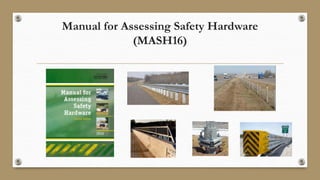
Manual for Assessing Safety Hardware
(MASH16)
Outline
•What is “MASH”?
•When is Implementation needed?
•Why is Implementation needed?
MASH Implementation Plan
2016: AASHTO Technical Committee on Roadside Safety (TCRS) and Federal Highway
Administration (FHWA) have adopted a new MASH implementation plan
For contracts on the National Highway System:
after December 31, 2019, only safety hardware evaluated using MASH 2016 are allowed
for new permanent installations
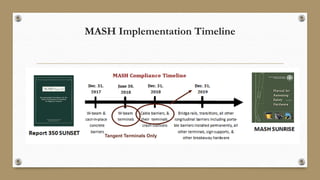
MASH Implementation Timeline
Tangent Terminals Only
TxDOT
Crashworthiness of Roadside Safety Hardware
(Memo June 2018)
• May 21, 2012, FHWA Memo: “States can certify that roadside
safety hardware has been tested by an accredited crash test
laboratory and meets MASH criteria, and can thus be eligible for
reimbursement”
• April 9, 2018, FHWA Memo: “it is the State’s responsibility to
determine crashworthiness and provides guidance on the process
the State can use”
TxDOT
Crashworthiness of Roadside Safety Hardware
(Memo June 2018)
• Hardware approved for use on TxDOT projects:
 Successfully crash tested per MASH16
 Approved for specific uses by FHWA
 Evaluated by TxDOT and identified as similar in strength and geometry to another rail
successfully crash tested per MASH16
• TxDOT to assess in-service performance of hardware initially determined
crashworthy under MASH
• Divisions and Districts will be surveyed annually for feedback on installing,
maintaining, and repairing hardware
TxDOT
Crashworthiness of Roadside Safety Hardware
(Memo June 2018)
Division of Record has records of the basis of acceptance
(available to FHWA upon request):
• Bridge Division
http://www.dot.state.tx.us/insdtdot/orgchart/cmd/cserve/standard/bridgee.htm#RAILINGSTANDARDS
• Design Division
http://www.dot.state.tx.us/insdtdot/orgchart/cmd/cserve/standard/rdwylse.htm
• Maintenance Division
https://www.txdot.gov/insdtdot/orgchart/cmd/cserve/standard/maintcad.htm
• Traffic Division
https://www.dot.state.tx.us/insdtdot/orgchart/cmd/cserve/standard/toc.htm
Outline
•What is “MASH”?
•When is Implementation needed?
•Why is Implementation needed?
Manual for Assessing Safety Hardware
(MASH)
• Next step in advancement & evolution of testing & evaluation
• Addresses changes in vehicle fleet & highway network
• Reflects advancements in knowledge & technology
• Will result in:
• Improved roadside safety hardware
• Enhanced safety for motorists
Key Changes in MASH
• Small Design Test Vehicle
• Weight increased from 1800 lb to 2425 lb
• 2nd percentile lightest vehicle (i.e., 98% of vehicles sold weigh more than 2425 lbs)
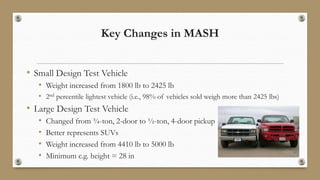
• Large Design Test Vehicle
• Changed from ¾-ton, 2-door to ½-ton, 4-door pickup
• Better represents SUVs
• Weight increased from 4410 lb to 5000 lb
• Minimum c.g. height = 28 in
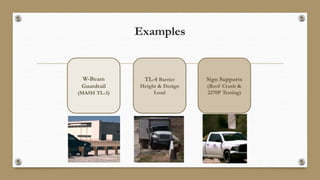
Sign Supports
(Roof Crush &
2270P Testing)
TL-4 Barrier
Height & Design
Load
W-Beam
Guardrail
(MASH TL-3)
Examples
Example #1
G4(2W) W-Beam Guardrail
MASH TL-3 Testing
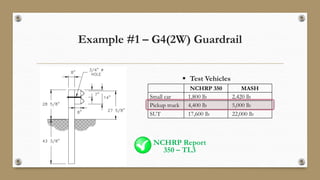
Example #1 – G4(2W) Guardrail
 Test Vehicles
NCHRP 350 MASH
Small car 1,800 lb 2,420 lb
Pickup truck 4,400 lb 5,000 lb
SUT 17,600 lb 22,000 lb
NCHRP Report
350 – TL3
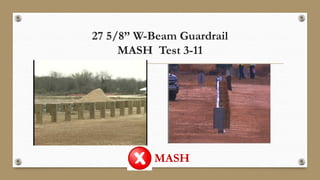
27 5/8” W-Beam Guardrail
MASH Test 3-11
MASH
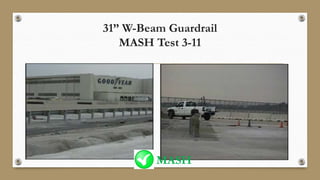
31” W-Beam Guardrail
MASH Test 3-11
MASH
Example #2
Test Level 4 (TL-4) Barrier
Barrier Height and Design Load
Requirements
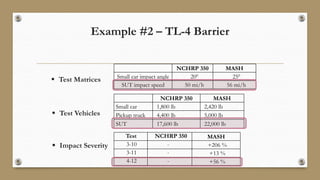
Example #2 – TL-4 Barrier
NCHRP 350 MASH
Small car impact angle 200 250
SUT impact speed 50 mi/h 56 mi/h
 Test Matrices
Test NCHRP 350 MASH
3-10 - +206 %
3-11 - +13 %
4-12 - +56 %
 Impact Severity
 Test Vehicles
NCHRP 350 MASH
Small car 1,800 lb 2,420 lb
Pickup truck 4,400 lb 5,000 lb
SUT 17,600 lb 22,000 lb
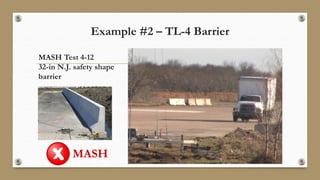
Example #2 – TL-4 Barrier
MASH Test 4-12
32-in N.J. safety shape
barrier
MASH
Example #2 – TL-4 Barrier
Sheikh and Bligh (2011) “Determination of Minimum Height and Lateral
Design Load for MASH Test Level 4 Bridge Rail”
 Minimum rail height for MASH TL-4 barriers = 36 inches
 Lateral impact load for MASH TL-4 significantly greater than
NCHRP Report 350 TL-4
36-inch tall barrier -- design impact load = 68 kips
42-inch tall barrier -- design impact load = 80 kips
Example #2 – TL-4 Barrier
MASH Test 4-12
36-in single slope
concrete barrier
MASH
Example #3
Sign Supports
Roof Crush and Pickup Truck
Vehicle Testing
Example #3 – Slip Base Sign Support
5.6” Roof Crush (> 4” MASH Criteria) MASH
NCHRP Report 350
Example #3 – Slip Base Sign Support
TxDOT Research Study 0-6363
Minimum Sign Area for Slip Base Supports
Sign Area
(ft2)
System
Nominal
Diameter (in)
Post Type
0 - 14 Wedge & Socket 2 BWG-13
14 – 24 Slip Base 2.5 BWG-10
24 – 36 Slip Base 2.5 Sch-80
Example #3 – Slip Base Sign Support
2.5” Roof Crush MASH
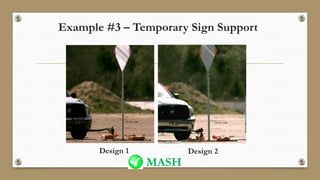
Example #3 – Temporary Sign Support
MASH
Example #3 – Temporary Sign Support
Design 1
MASH
Design 2
MASH Implementation Progress - TxDOT
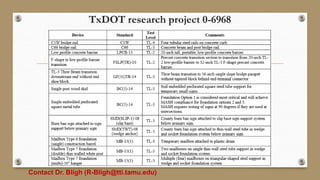
• TxDOT research project 0-6968
 Three year project
 Evaluate most roadside safety devices used in Texas
 Wade Odell at Wade.Odell@txdot.gov (RTI) or Dr. Bligh at R-Bligh@tti.tamu.edu (TTI)
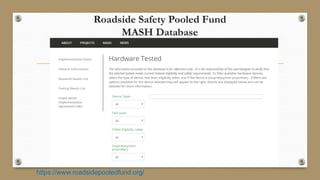
• Roadside Safety Pooled Fund (TxDOT is a member)
TxDOT research project 0-6968
Contact Dr. Bligh (R-Bligh@tti.tamu.edu)
TxDOT research project 0-6968
Contact Dr. Bligh (R-Bligh@tti.tamu.edu)
TxDOT research project 0-6968
Contact Dr. Bligh (R-Bligh@tti.tamu.edu)
Roadside Safety Pooled Fund
MASH Database
https://www.roadsidepooledfund.org/
Questions?
“MASH Requirements for Safety Hardware”
Chiara Dobrovolny, Ph.D.
Associate Research Scientist
Texas A&M Transportation Institute
Ph.: 979-845-8971
c-silvestri@tti.tamu.edu

Mash requirement

  • 1.
    MASH Requirements for SafetyHardware Chiara Dobrovolny, Ph.D. Associate Research Scientist Texas A&M Transportation Institute October 17, 2018 2018 Transportation Short Course College Station, Texas
  • 2.
    Outline •What is “MASH”? •Whenis Implementation needed? •Why is Implementation needed?
  • 3.
    Outline •What is “MASH”? •Whenis Implementation needed? •Why is Implementation needed?
  • 4.
    Crash Testing Guidance •Uniform guidance for testing roadside safety features • Test matrices • Vehicle type, impact speed, impact angle, impact location • Evaluation criteria
  • 5.
  • 6.
    Manual for AssessingSafety Hardware (MASH16)
  • 7.
    Outline •What is “MASH”? •Whenis Implementation needed? •Why is Implementation needed?
  • 8.
    MASH Implementation Plan 2016:AASHTO Technical Committee on Roadside Safety (TCRS) and Federal Highway Administration (FHWA) have adopted a new MASH implementation plan For contracts on the National Highway System: after December 31, 2019, only safety hardware evaluated using MASH 2016 are allowed for new permanent installations
  • 9.
  • 10.
    TxDOT Crashworthiness of RoadsideSafety Hardware (Memo June 2018) • May 21, 2012, FHWA Memo: “States can certify that roadside safety hardware has been tested by an accredited crash test laboratory and meets MASH criteria, and can thus be eligible for reimbursement” • April 9, 2018, FHWA Memo: “it is the State’s responsibility to determine crashworthiness and provides guidance on the process the State can use”
  • 11.
    TxDOT Crashworthiness of RoadsideSafety Hardware (Memo June 2018) • Hardware approved for use on TxDOT projects:  Successfully crash tested per MASH16  Approved for specific uses by FHWA  Evaluated by TxDOT and identified as similar in strength and geometry to another rail successfully crash tested per MASH16 • TxDOT to assess in-service performance of hardware initially determined crashworthy under MASH • Divisions and Districts will be surveyed annually for feedback on installing, maintaining, and repairing hardware
  • 12.
    TxDOT Crashworthiness of RoadsideSafety Hardware (Memo June 2018) Division of Record has records of the basis of acceptance (available to FHWA upon request): • Bridge Division http://www.dot.state.tx.us/insdtdot/orgchart/cmd/cserve/standard/bridgee.htm#RAILINGSTANDARDS • Design Division http://www.dot.state.tx.us/insdtdot/orgchart/cmd/cserve/standard/rdwylse.htm • Maintenance Division https://www.txdot.gov/insdtdot/orgchart/cmd/cserve/standard/maintcad.htm • Traffic Division https://www.dot.state.tx.us/insdtdot/orgchart/cmd/cserve/standard/toc.htm
  • 13.
    Outline •What is “MASH”? •Whenis Implementation needed? •Why is Implementation needed?
  • 14.
    Manual for AssessingSafety Hardware (MASH) • Next step in advancement & evolution of testing & evaluation • Addresses changes in vehicle fleet & highway network • Reflects advancements in knowledge & technology • Will result in: • Improved roadside safety hardware • Enhanced safety for motorists
  • 15.
    Key Changes inMASH • Small Design Test Vehicle • Weight increased from 1800 lb to 2425 lb • 2nd percentile lightest vehicle (i.e., 98% of vehicles sold weigh more than 2425 lbs) • Large Design Test Vehicle • Changed from ¾-ton, 2-door to ½-ton, 4-door pickup • Better represents SUVs • Weight increased from 4410 lb to 5000 lb • Minimum c.g. height = 28 in
  • 16.
    Sign Supports (Roof Crush& 2270P Testing) TL-4 Barrier Height & Design Load W-Beam Guardrail (MASH TL-3) Examples
  • 17.
    Example #1 G4(2W) W-BeamGuardrail MASH TL-3 Testing
  • 18.
    Example #1 –G4(2W) Guardrail  Test Vehicles NCHRP 350 MASH Small car 1,800 lb 2,420 lb Pickup truck 4,400 lb 5,000 lb SUT 17,600 lb 22,000 lb NCHRP Report 350 – TL3
  • 19.
    27 5/8” W-BeamGuardrail MASH Test 3-11 MASH
  • 20.
  • 21.
    Example #2 Test Level4 (TL-4) Barrier Barrier Height and Design Load Requirements
  • 22.
    Example #2 –TL-4 Barrier NCHRP 350 MASH Small car impact angle 200 250 SUT impact speed 50 mi/h 56 mi/h  Test Matrices Test NCHRP 350 MASH 3-10 - +206 % 3-11 - +13 % 4-12 - +56 %  Impact Severity  Test Vehicles NCHRP 350 MASH Small car 1,800 lb 2,420 lb Pickup truck 4,400 lb 5,000 lb SUT 17,600 lb 22,000 lb
  • 23.
    Example #2 –TL-4 Barrier MASH Test 4-12 32-in N.J. safety shape barrier MASH
  • 24.
    Example #2 –TL-4 Barrier Sheikh and Bligh (2011) “Determination of Minimum Height and Lateral Design Load for MASH Test Level 4 Bridge Rail”  Minimum rail height for MASH TL-4 barriers = 36 inches  Lateral impact load for MASH TL-4 significantly greater than NCHRP Report 350 TL-4 36-inch tall barrier -- design impact load = 68 kips 42-inch tall barrier -- design impact load = 80 kips
  • 25.
    Example #2 –TL-4 Barrier MASH Test 4-12 36-in single slope concrete barrier MASH
  • 26.
    Example #3 Sign Supports RoofCrush and Pickup Truck Vehicle Testing
  • 27.
    Example #3 –Slip Base Sign Support 5.6” Roof Crush (> 4” MASH Criteria) MASH NCHRP Report 350
  • 28.
    Example #3 –Slip Base Sign Support TxDOT Research Study 0-6363 Minimum Sign Area for Slip Base Supports Sign Area (ft2) System Nominal Diameter (in) Post Type 0 - 14 Wedge & Socket 2 BWG-13 14 – 24 Slip Base 2.5 BWG-10 24 – 36 Slip Base 2.5 Sch-80
  • 29.
    Example #3 –Slip Base Sign Support 2.5” Roof Crush MASH
  • 30.
    Example #3 –Temporary Sign Support MASH
  • 31.
    Example #3 –Temporary Sign Support Design 1 MASH Design 2
  • 32.
    MASH Implementation Progress- TxDOT • TxDOT research project 0-6968  Three year project  Evaluate most roadside safety devices used in Texas  Wade Odell at Wade.Odell@txdot.gov (RTI) or Dr. Bligh at R-Bligh@tti.tamu.edu (TTI) • Roadside Safety Pooled Fund (TxDOT is a member)
  • 33.
    TxDOT research project0-6968 Contact Dr. Bligh (R-Bligh@tti.tamu.edu)
  • 34.
    TxDOT research project0-6968 Contact Dr. Bligh (R-Bligh@tti.tamu.edu)
  • 35.
    TxDOT research project0-6968 Contact Dr. Bligh (R-Bligh@tti.tamu.edu)
  • 36.
    Roadside Safety PooledFund MASH Database https://www.roadsidepooledfund.org/
  • 38.
    Questions? “MASH Requirements forSafety Hardware” Chiara Dobrovolny, Ph.D. Associate Research Scientist Texas A&M Transportation Institute Ph.: 979-845-8971 c-silvestri@tti.tamu.edu