Jilaveanu Madalina
&
Marica Mirela
Working with mid-size companies, we often hear the
terms Sales and Marketing used together. In some
ways, this is logical because the two need to work
together. But in fact, they are two very different
functions and require very different skills.
The job of Sales is to “sell what’s in
stock”. The company has specific products or
services and the job of Sales is to sell those
things.
Sales develops relationships with customers
and/or channel partners. They knock down the doors,
overcome objections, negotiate prices and terms and
often work internally to be sure their customer’s
orders are filled.
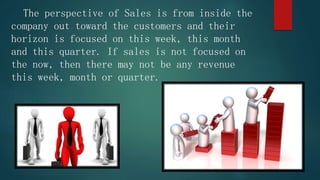
The perspective of Sales is from inside the
company out toward the customers and their
horizon is focused on this week, this month
and this quarter. If sales is not focused on
the now, then there may not be any revenue
this week, month or quarter.
A key job of Marketing is to understand the marketplace from
the perspective of the customer looking back towards the company
and helping lead the company where it should be in the future.
Marketing’s job is to direct the organization toward
the segments, or groups of customers and channels where
the company can profitably compete. It should help the
organization see how it needs to modify its product
offerings, pricing and communication so that it meets
the needs of the distribution channel or end customers.
Not even the best hunter can
bring home dinner if they are
shooting blanks at
decoys. Markets are constantly
changing. The job of marketing is
to stay ahead of the changes, and
help the hunters see where they
should be hunting and provide
them with the right ammunition.
If Marketing is only
focused on delivering the
ammunition for today, nobody
will see where the industry
is moving or where the
company needs to hunt next.
This limits growth.
Sales needs to be focused on the now. You can’t run a company unless
your sales team is focused on bringing in today’s business. But you
can’t really ask your Sales leaders where the company should go next
and to develop the 18 month plan to get there without losing focus on
today’s revenue.
Besides, if your sales executive was
really good at developing future-focused
business strategies and tying that strategy
to the plans and tools of marketing to make
it happen, they would be a marketing person
and not a now-focused sales person.
Text:
 http://www.salesandmarketing.co
m/
 http://www.diffen.com/difference
/Marketing_vs_Sales
 http://vendor-
mk.blogspot.ro/2010/11/diferenta-
intre-marketing-si-vanzari.html
Images:
 http://www.3hrlearning.com/marketing-vs-
sales/
http://grandeurresortservices.com/sales-
marketing/
 https://www.linkedin.com/pulse/201402221
80736-41666699-marketing-people-vs-sales-
people
http://genobz.com/2014/competencies-
required-sales-marketing-role/
http://www.photomint.com/sales-marketing/

Marketing & sales

  • 1.
  • 2.
    Working with mid-sizecompanies, we often hear the terms Sales and Marketing used together. In some ways, this is logical because the two need to work together. But in fact, they are two very different functions and require very different skills.
  • 3.
    The job ofSales is to “sell what’s in stock”. The company has specific products or services and the job of Sales is to sell those things. Sales develops relationships with customers and/or channel partners. They knock down the doors, overcome objections, negotiate prices and terms and often work internally to be sure their customer’s orders are filled.
  • 4.
    The perspective ofSales is from inside the company out toward the customers and their horizon is focused on this week, this month and this quarter. If sales is not focused on the now, then there may not be any revenue this week, month or quarter.
  • 5.
    A key jobof Marketing is to understand the marketplace from the perspective of the customer looking back towards the company and helping lead the company where it should be in the future.
  • 6.
    Marketing’s job isto direct the organization toward the segments, or groups of customers and channels where the company can profitably compete. It should help the organization see how it needs to modify its product offerings, pricing and communication so that it meets the needs of the distribution channel or end customers.
  • 7.
    Not even thebest hunter can bring home dinner if they are shooting blanks at decoys. Markets are constantly changing. The job of marketing is to stay ahead of the changes, and help the hunters see where they should be hunting and provide them with the right ammunition.
  • 8.
    If Marketing isonly focused on delivering the ammunition for today, nobody will see where the industry is moving or where the company needs to hunt next. This limits growth.
  • 9.
    Sales needs tobe focused on the now. You can’t run a company unless your sales team is focused on bringing in today’s business. But you can’t really ask your Sales leaders where the company should go next and to develop the 18 month plan to get there without losing focus on today’s revenue.
  • 10.
    Besides, if yoursales executive was really good at developing future-focused business strategies and tying that strategy to the plans and tools of marketing to make it happen, they would be a marketing person and not a now-focused sales person.
  • 11.
    Text:  http://www.salesandmarketing.co m/  http://www.diffen.com/difference /Marketing_vs_Sales http://vendor- mk.blogspot.ro/2010/11/diferenta- intre-marketing-si-vanzari.html Images:  http://www.3hrlearning.com/marketing-vs- sales/ http://grandeurresortservices.com/sales- marketing/  https://www.linkedin.com/pulse/201402221 80736-41666699-marketing-people-vs-sales- people http://genobz.com/2014/competencies- required-sales-marketing-role/ http://www.photomint.com/sales-marketing/