DEFINING MARKETING FOR
THE 21st CENTURY
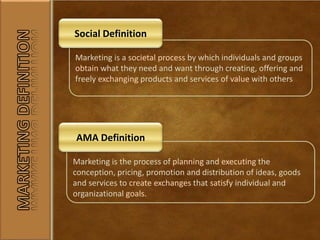
Marketing is a societal process by which individuals and groups
obtain what they need and want through creating, offering and
freely exchanging products and services of value with others
Social Definition
Marketing is the process of planning and executing the
conception, pricing, promotion and distribution of ideas, goods
and services to create exchanges that satisfy individual and
organizational goals.
AMA Definition
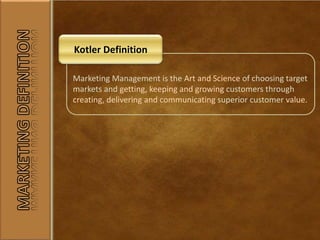
Marketing Management is the Art and Science of choosing target
markets and getting, keeping and growing customers through
creating, delivering and communicating superior customer value.
Kotler Definition
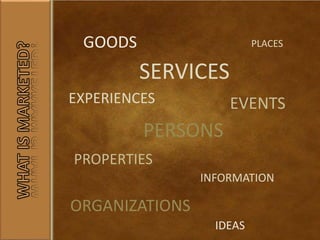
GOODS
SERVICES
EVENTSEXPERIENCES
PERSONS
PLACES
PROPERTIES
ORGANIZATIONS
INFORMATION
IDEAS
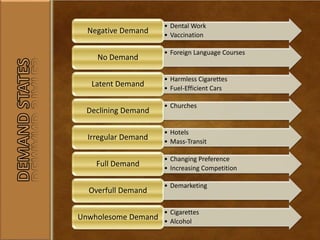
• Dental Work
• Vaccination
Negative Demand
• Foreign Language Courses
No Demand
• Harmless Cigarettes
• Fuel-Efficient Cars
Latent Demand
• Churches
Declining Demand
• Hotels
• Mass-Transit
Irregular Demand
• Changing Preference
• Increasing Competition
Full Demand
• Demarketing
Overfull Demand
• Cigarettes
• Alcohol
Unwholesome Demand
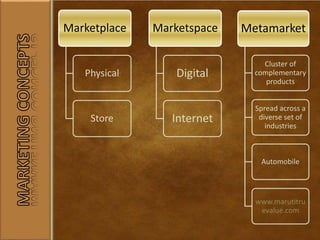
Marketplace
Physical
Store
Marketspace
Digital
Internet
Metamarket
Cluster of
complementary
products
Spread across a
diverse set of
industries
Automobile
www.marutitru
evalue.com
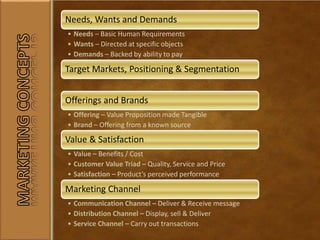
Needs, Wants and Demands
• Needs – Basic Human Requirements
• Wants – Directed at specific objects
• Demands – Backed by ability to pay
Target Markets, Positioning & Segmentation
Offerings and Brands
• Offering – Value Proposition made Tangible
• Brand – Offering from a known source
Value & Satisfaction
• Value – Benefits / Cost
• Customer Value Triad – Quality, Service and Price
• Satisfaction – Product’s perceived performance
Marketing Channel
• Communication Channel – Deliver & Receive message
• Distribution Channel – Display, sell & Deliver
• Service Channel – Carry out transactions
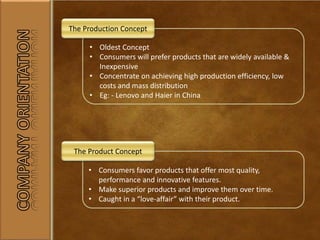
• Oldest Concept
• Consumers will prefer products that are widely available &
Inexpensive
• Concentrate on achieving high production efficiency, low
costs and mass distribution
• Eg: - Lenovo and Haier in China
The Production Concept
• Consumers favor products that offer most quality,
performance and innovative features.
• Make superior products and improve them over time.
• Caught in a “love-affair” with their product.
The Product Concept
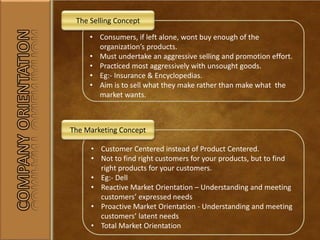
• Consumers, if left alone, wont buy enough of the
organization’s products.
• Must undertake an aggressive selling and promotion effort.
• Practiced most aggressively with unsought goods.
• Eg:- Insurance & Encyclopedias.
• Aim is to sell what they make rather than make what the
market wants.
The Selling Concept
• Customer Centered instead of Product Centered.
• Not to find right customers for your products, but to find
right products for your customers.
• Eg:- Dell
• Reactive Market Orientation – Understanding and meeting
customers’ expressed needs
• Proactive Market Orientation - Understanding and meeting
customers’ latent needs
• Total Market Orientation
The Marketing Concept
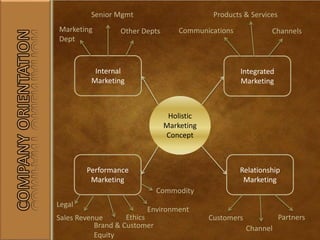
Holistic
Marketing
Concept
Internal
Marketing
Performance
Marketing
Relationship
Marketing
Integrated
Marketing
Customers
Channel
PartnersSales Revenue
Brand & Customer
Equity
Ethics
Environment
Legal
Commodity
Communications
Products & Services
ChannelsMarketing
Dept
Senior Mgmt
Other Depts
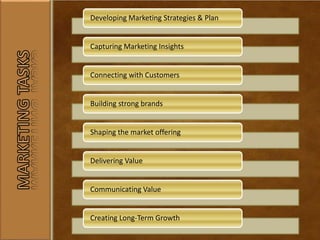
Developing Marketing Strategies & Plan
Capturing Marketing Insights
Connecting with Customers
Building strong brands
Shaping the market offering
Delivering Value
Communicating Value
Creating Long-Term Growth
THANK YOU

Marketing Management - Brief Complete Beginners Guide

  • 1.
  • 2.
    Marketing is asocietal process by which individuals and groups obtain what they need and want through creating, offering and freely exchanging products and services of value with others Social Definition Marketing is the process of planning and executing the conception, pricing, promotion and distribution of ideas, goods and services to create exchanges that satisfy individual and organizational goals. AMA Definition
  • 3.
    Marketing Management isthe Art and Science of choosing target markets and getting, keeping and growing customers through creating, delivering and communicating superior customer value. Kotler Definition
  • 4.
  • 5.
    • Dental Work •Vaccination Negative Demand • Foreign Language Courses No Demand • Harmless Cigarettes • Fuel-Efficient Cars Latent Demand • Churches Declining Demand • Hotels • Mass-Transit Irregular Demand • Changing Preference • Increasing Competition Full Demand • Demarketing Overfull Demand • Cigarettes • Alcohol Unwholesome Demand
  • 6.
  • 7.
    Needs, Wants andDemands • Needs – Basic Human Requirements • Wants – Directed at specific objects • Demands – Backed by ability to pay Target Markets, Positioning & Segmentation Offerings and Brands • Offering – Value Proposition made Tangible • Brand – Offering from a known source Value & Satisfaction • Value – Benefits / Cost • Customer Value Triad – Quality, Service and Price • Satisfaction – Product’s perceived performance Marketing Channel • Communication Channel – Deliver & Receive message • Distribution Channel – Display, sell & Deliver • Service Channel – Carry out transactions
  • 8.
    • Oldest Concept •Consumers will prefer products that are widely available & Inexpensive • Concentrate on achieving high production efficiency, low costs and mass distribution • Eg: - Lenovo and Haier in China The Production Concept • Consumers favor products that offer most quality, performance and innovative features. • Make superior products and improve them over time. • Caught in a “love-affair” with their product. The Product Concept
  • 9.
    • Consumers, ifleft alone, wont buy enough of the organization’s products. • Must undertake an aggressive selling and promotion effort. • Practiced most aggressively with unsought goods. • Eg:- Insurance & Encyclopedias. • Aim is to sell what they make rather than make what the market wants. The Selling Concept • Customer Centered instead of Product Centered. • Not to find right customers for your products, but to find right products for your customers. • Eg:- Dell • Reactive Market Orientation – Understanding and meeting customers’ expressed needs • Proactive Market Orientation - Understanding and meeting customers’ latent needs • Total Market Orientation The Marketing Concept
  • 10.
    Holistic Marketing Concept Internal Marketing Performance Marketing Relationship Marketing Integrated Marketing Customers Channel PartnersSales Revenue Brand &Customer Equity Ethics Environment Legal Commodity Communications Products & Services ChannelsMarketing Dept Senior Mgmt Other Depts
  • 11.
    Developing Marketing Strategies& Plan Capturing Marketing Insights Connecting with Customers Building strong brands Shaping the market offering Delivering Value Communicating Value Creating Long-Term Growth
  • 12.

Editor's Notes

  • #6 Demand States – Negative Demand – Dislike Product No Demand – Unaware or uninterested in the product Latent Demand – Strong need which cannot be satisfied by existing products Declining Demand – Experiences by all organizations. Irregular Demand – Season demand Full Demand – Firms are pleased with the volume of business Overfull Demand – Demand higher than what can be handled De Marketing – Reducing demand temporarily or permanently - Can be reduced by increasing prices, or reducing promotion and services. Unwholesome Demand – Products that attract organized effort to discourage consumption
  • #7 MetaMarket- - Cluster of complementary products which are closely related in the minds of the consumer but spread across industries.