MARKETING
CONSIDERATIONS
Table of contents
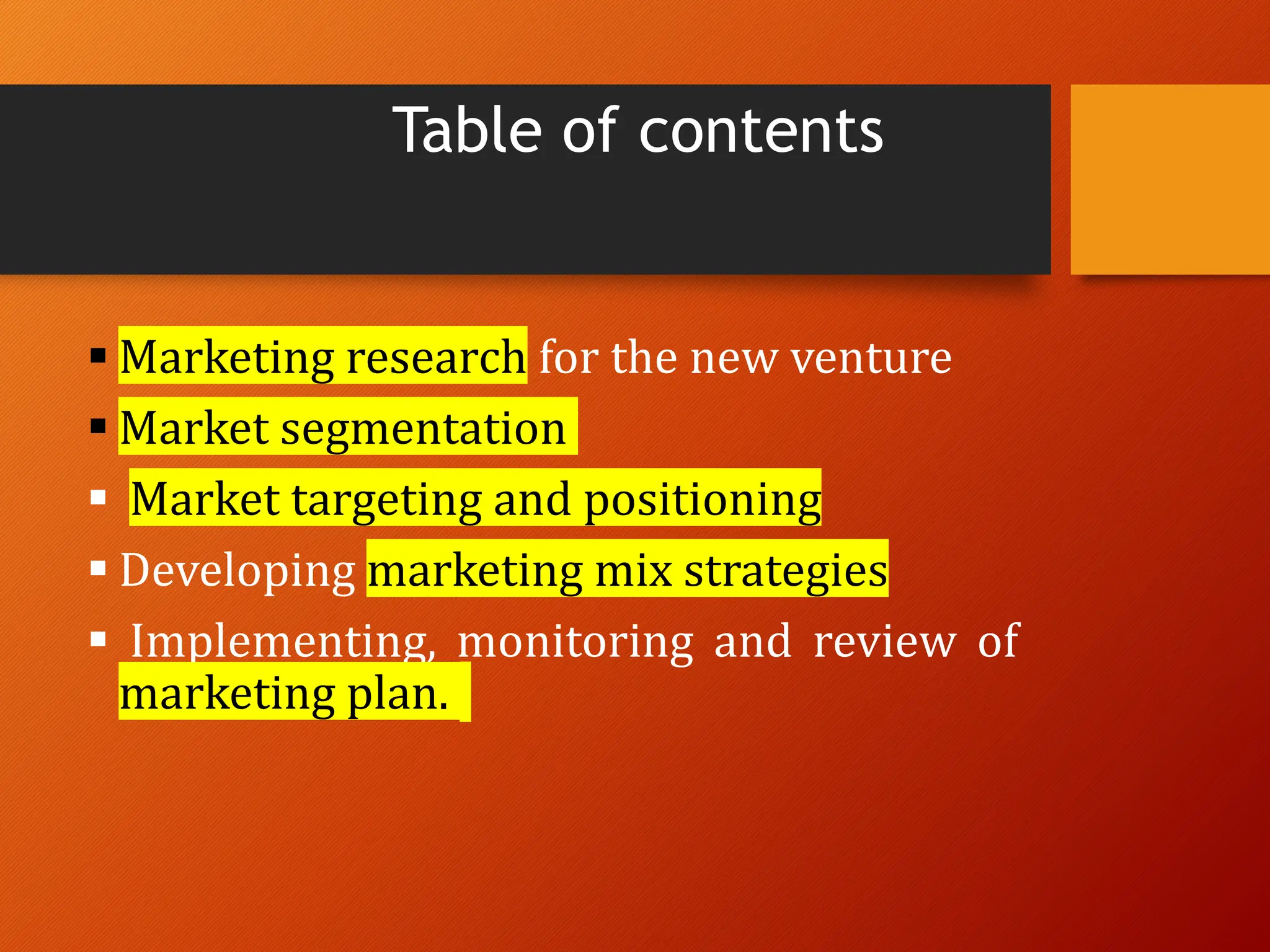
 Marketing research for the new venture
 Market segmentation
 Market targeting and positioning
 Developing marketing mix strategies
 Implementing, monitoring and review of
marketing plan.
Purpose Of Marketing Research
• Gain a more detailed understanding of consumers’ needs:
e.g., views on products’ prices, packaging, recent advertising campaigns
• Reduce the risk of product/business failure:
-there is no guarantee that any new idea will be
a commercial success
-Can help to achieve commercial success
• Forecast future trends:
-it can also be used to anticipate future customer needs
Types of Market Research
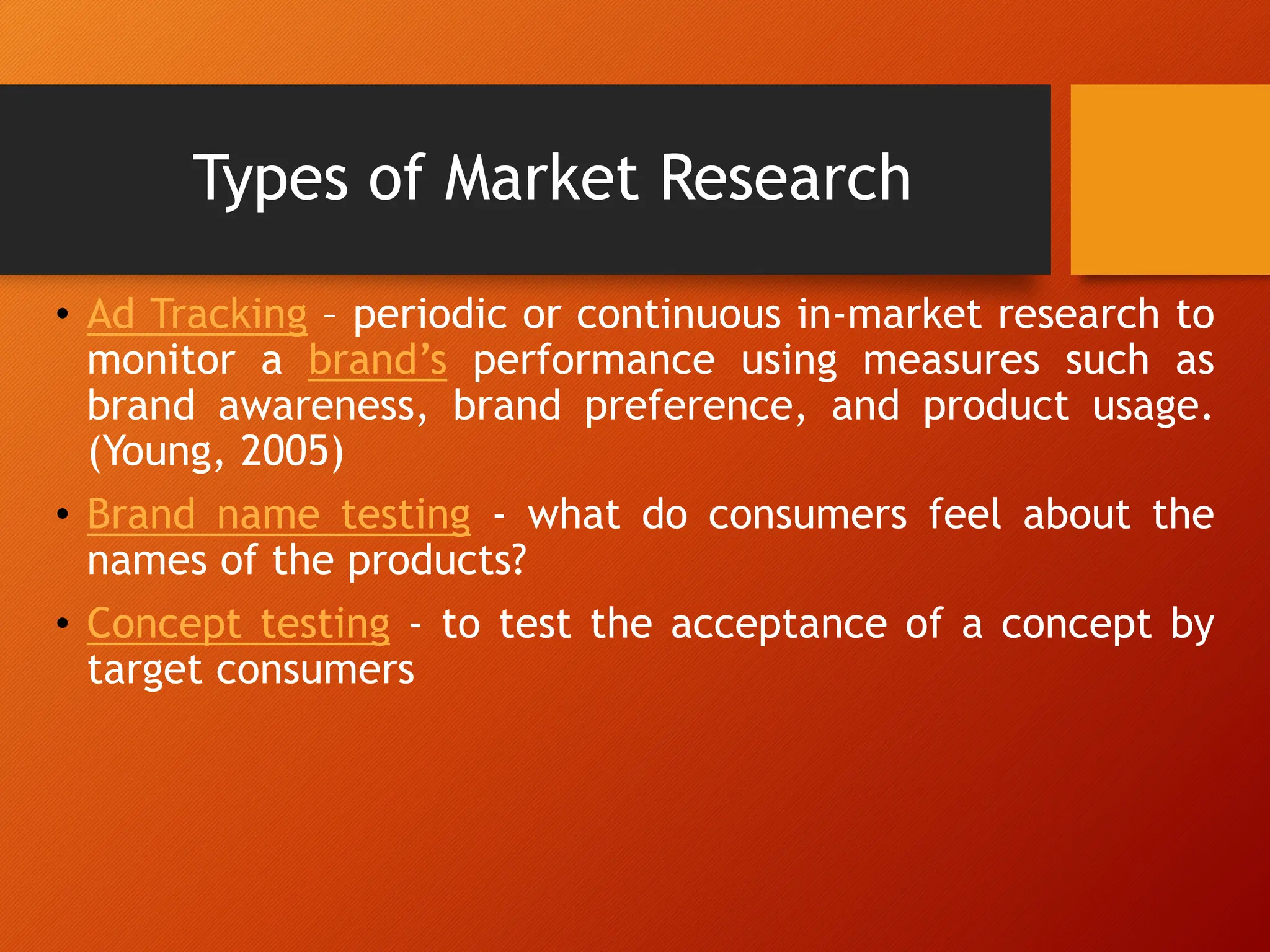
• Ad Tracking – periodic or continuous in-market research to
monitor a brand’s performance using measures such as
brand awareness, brand preference, and product usage.
(Young, 2005)
• Brand name testing - what do consumers feel about the
names of the products?
• Concept testing - to test the acceptance of a concept by
target consumers
Types of Market Research
Customer satisfaction research - quantitative or qualitative
studies that yields an understanding of a customer's satisfaction
with a transaction
Demand estimation - to determine the approximate level of
demand for the product
Distribution channel audits - to assess distributors’ and retailers’
attitudes toward a product, brand, or company
Mystery consumer or mystery shopping - An employee or
representative of the market research firm anonymously
contacts a salesperson and indicates he or she is shopping for a
product. The shopper then records the entire experience. This
method is often used for quality control or for researching
competitors' products.
Types of Market Research
Price elasticity testing - to determine how sensitive customers are to
changes
Sales forecasting - to determine the expected level of sales given the
demand. With respect to other factors like Advertising expenditure,
promotion etc.
Segmentation research - to determine the demographic, psychographic,
behavioural characteristics of potential buyers
Online panel - a group of individual who accepted to respond to
research online
Test marketing - a small-scale product launch used to determine the
acceptance of the product when it is introduced into a wider market
Viral Marketing Research - Estimates of Social Networking
are combined with estimates of selling effectiveness to estimate ROI on
specific combinations of messages and media.
5 key steps in Marketing
Research
1. Define the Problem
2. Collect the Data
3. Analyse and interpret the data
4. Reach a conclusion
5. Implement your research
Collect the Data
• There are two types of market research that can be
performed:
1. Primary research - involves collecting information from
sources directly by conducting interviews and surveys,
and by talking to customers and established
businesses.
2. Secondary research - involves collecting information
from sources where the primary research has already
been conducted. Such information includes industry
statistics, market research reports, news paper
articles, etc.
Collection methods and
techniques
• Qualitative research is where you seek an understanding
of why things are a certain way. For example, a
researcher may stop a shopper and ask them why they
bought a particular product or brand.
• Quantitative research refers to measuring market
phenomena in a numerical sense, such as when a bank
asks consumers to rate their service on a scale of one to
ten.
Simple Survey Method
• Experts Opinion Poll
• Reasoned Opinion-Delphi Technique
• Consumers Survey- Complete Enumeration Method
• Consumer Survey-Sample Survey Method
• End-user Method of Consumers Survey
Complex Statistical Methods:
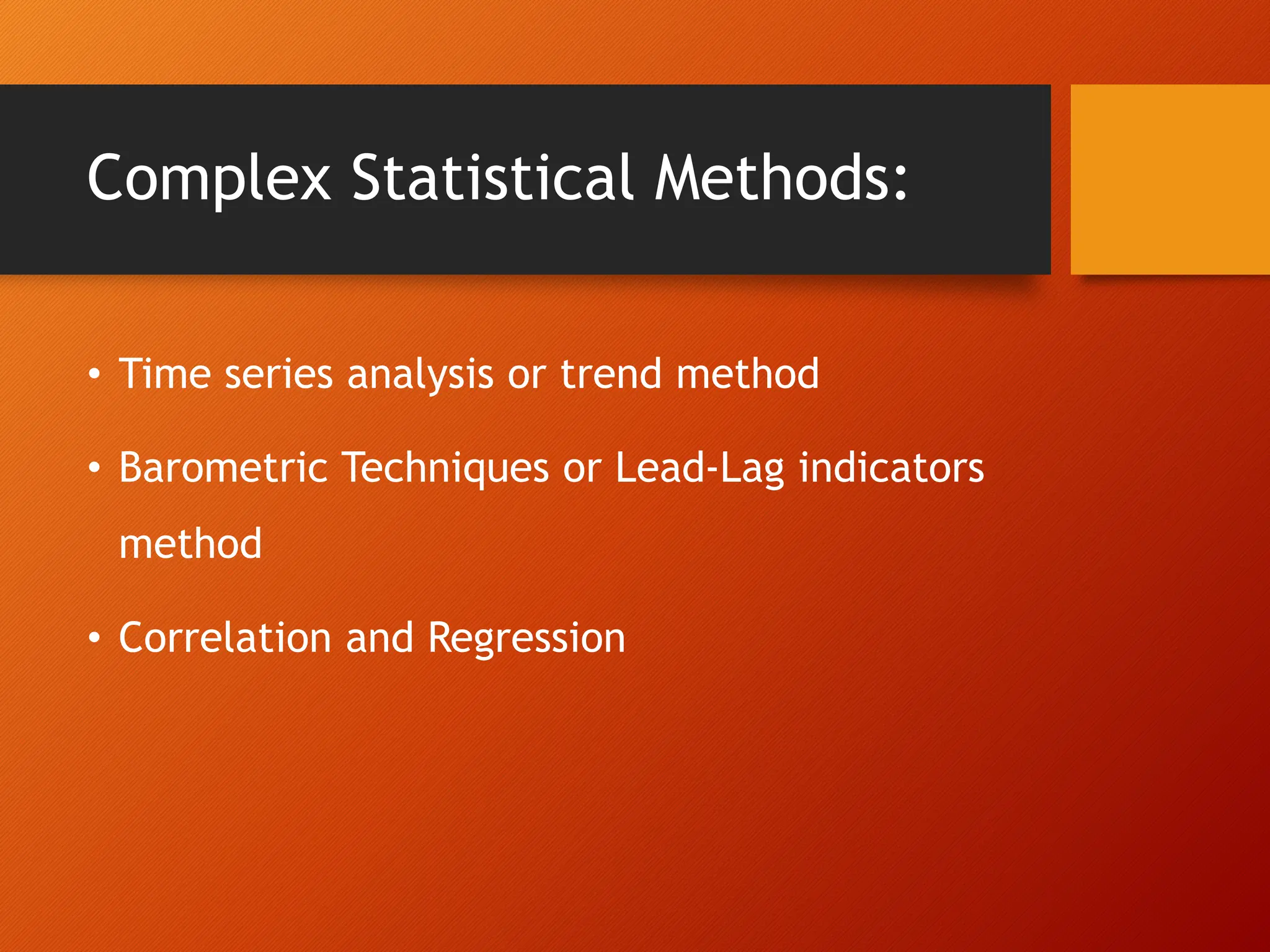
• Time series analysis or trend method
• Barometric Techniques or Lead-Lag indicators
method
• Correlation and Regression
(STP PROCESS)
SEGMENTATION, TARGETING &
POSITIONING
(STP PROCESS)
SEGMENTATION, TARGETING &
POSITIONING
• Segmentation - grouping consumers by some criteria.
• Targeting - choosing which group(s) to sell to.
• Positioning - consumer perception of a brand or product
relative to the perception of competing brands or products.
(STP PROCESS)
MARKET
SEGMENTATION METHODS
 Geographic Segmentation
 Demographic - group consumers based
on age, gender, race etc.
 Psychographic - divides a market into
different groups based on social class,
lifestyle, or personality characteristics
 Behavioral – Divides buyers into
segments based on consumer
knowledge, attitudes
(STP PROCESS)
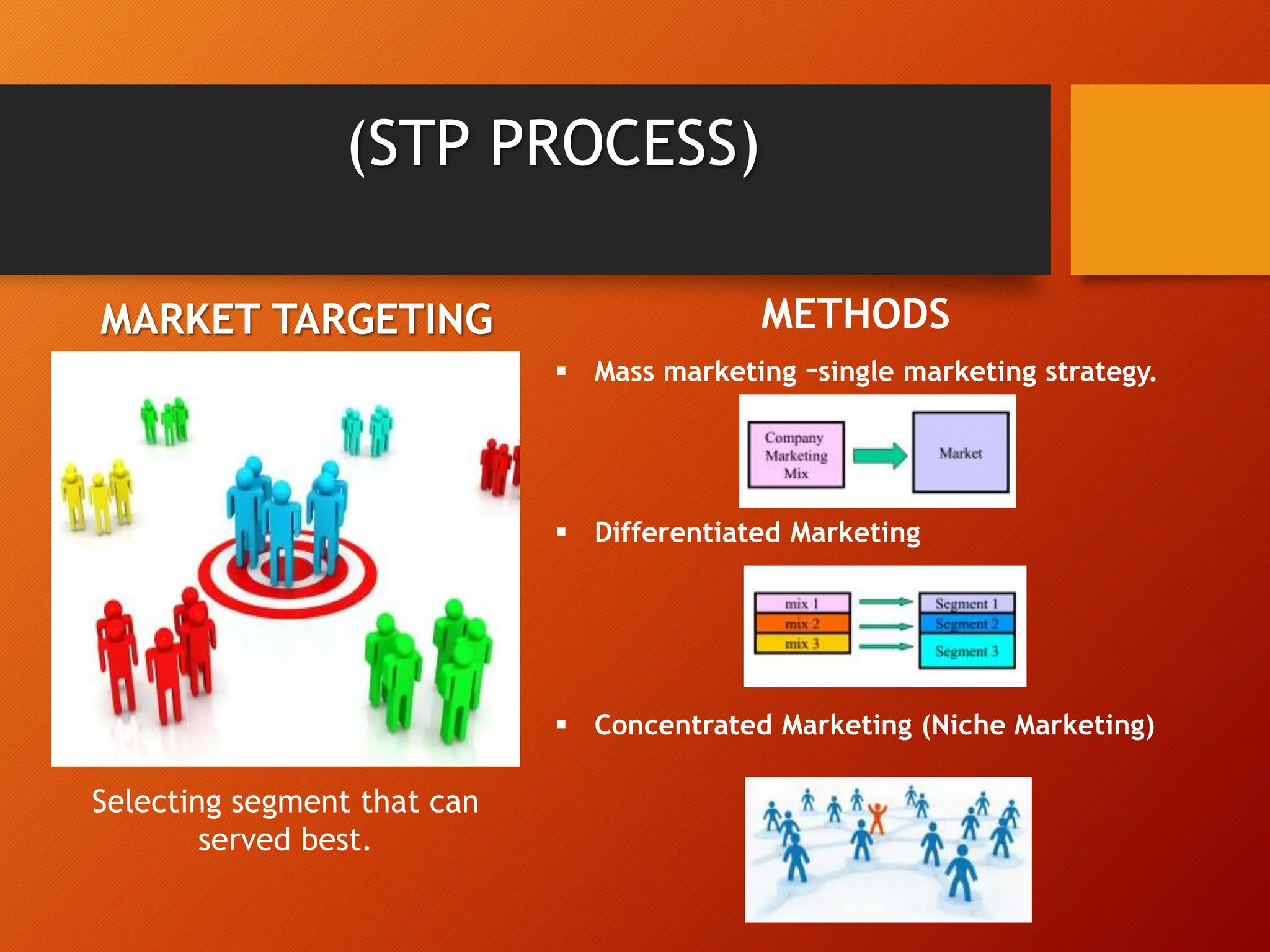
MARKET TARGETING METHODS
 Mass marketing –single marketing strategy.
 Differentiated Marketing
 Concentrated Marketing (Niche Marketing)
Selecting segment that can
served best.
(STP PROCESS)
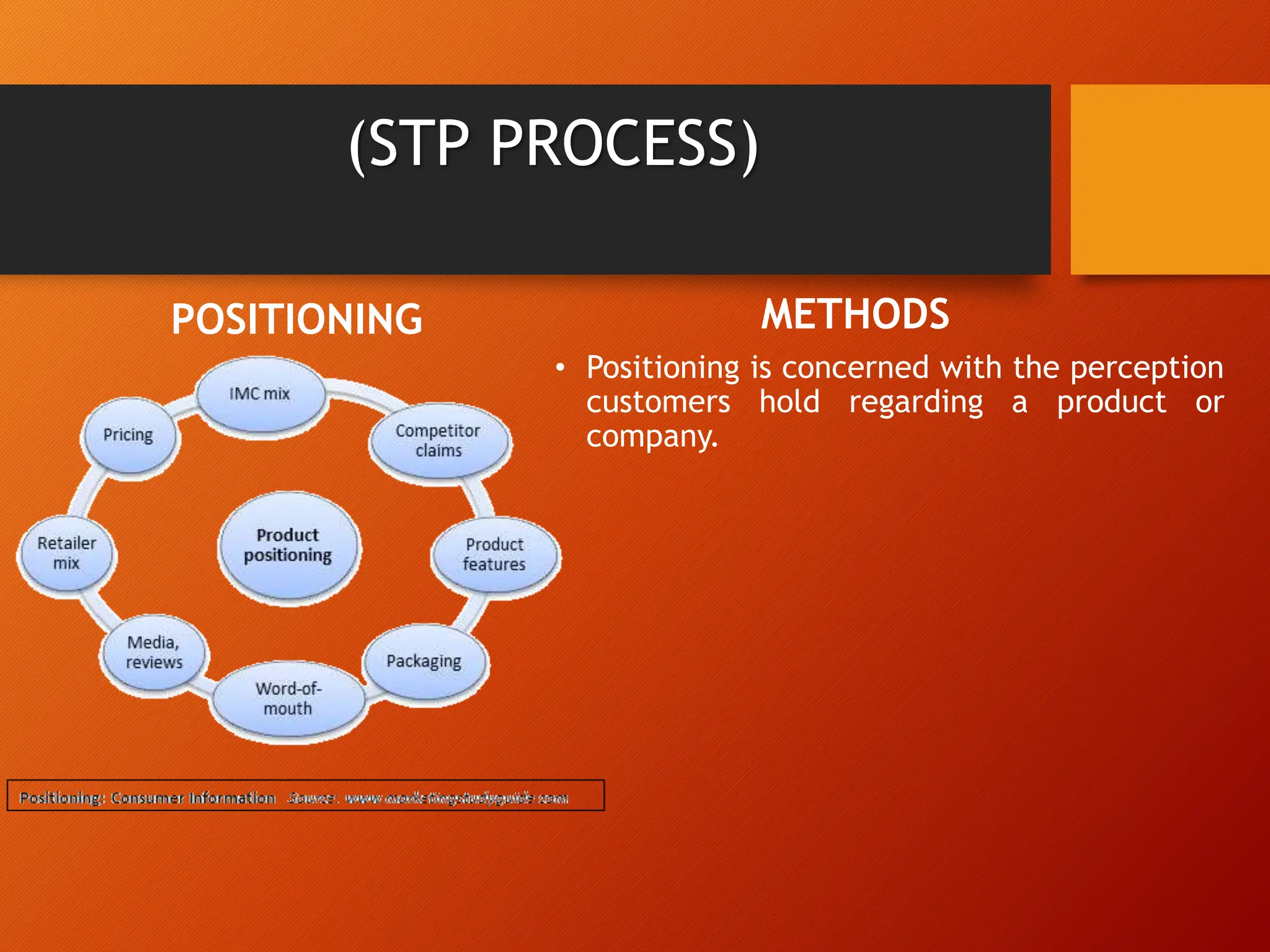
POSITIONING METHODS
• Positioning is concerned with the perception
customers hold regarding a product or
company.
MARKETING MIX STRATEGIES
Marketing Mix is a combination of marketing tools that a
company uses to satisfy their target customers and achieving
organizational goals:
• 7 P’s
• 4 P’s
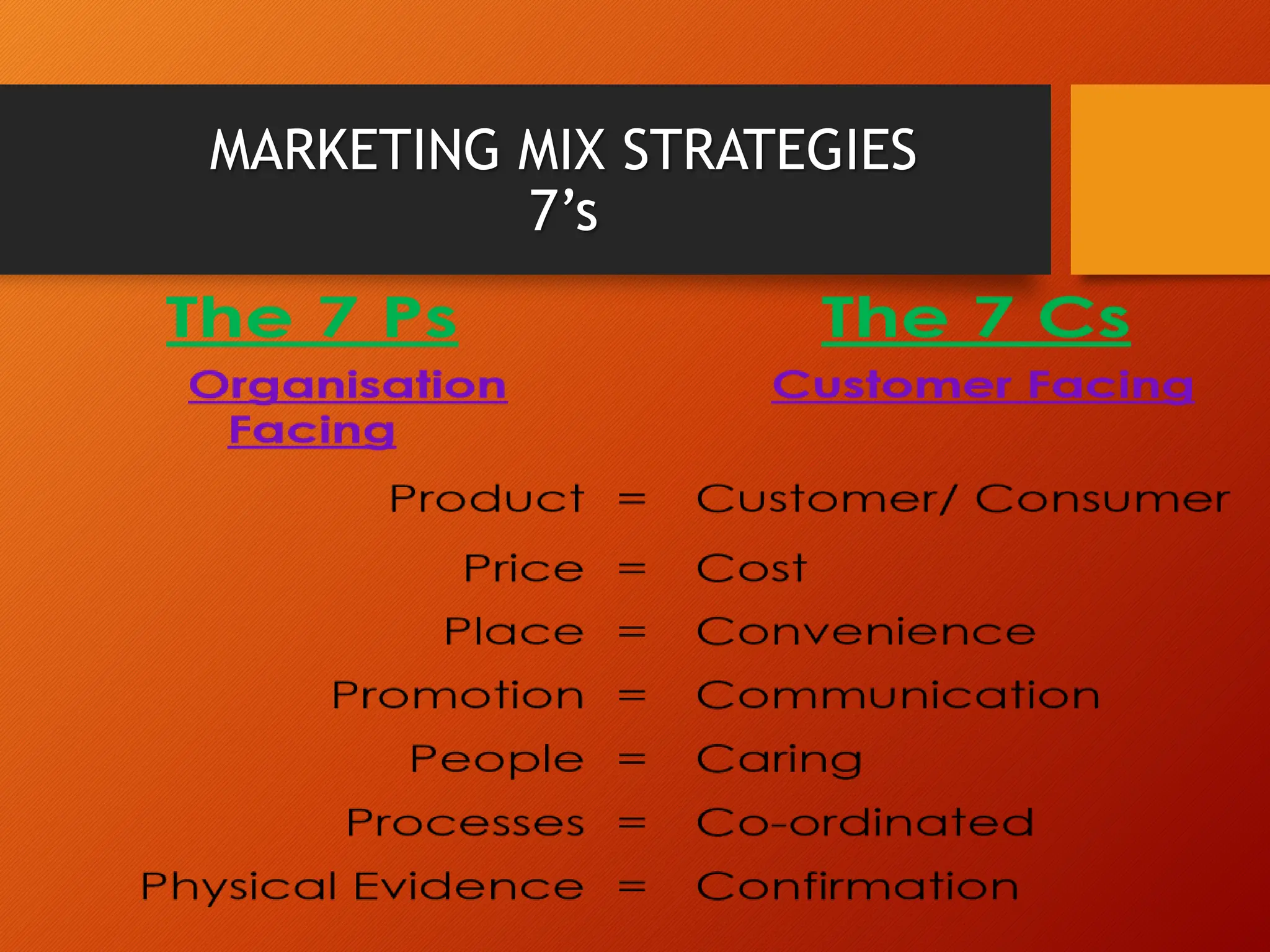
MARKETING MIX STRATEGIES
7’s
MARKETING MIX STRATEGIES
4’s
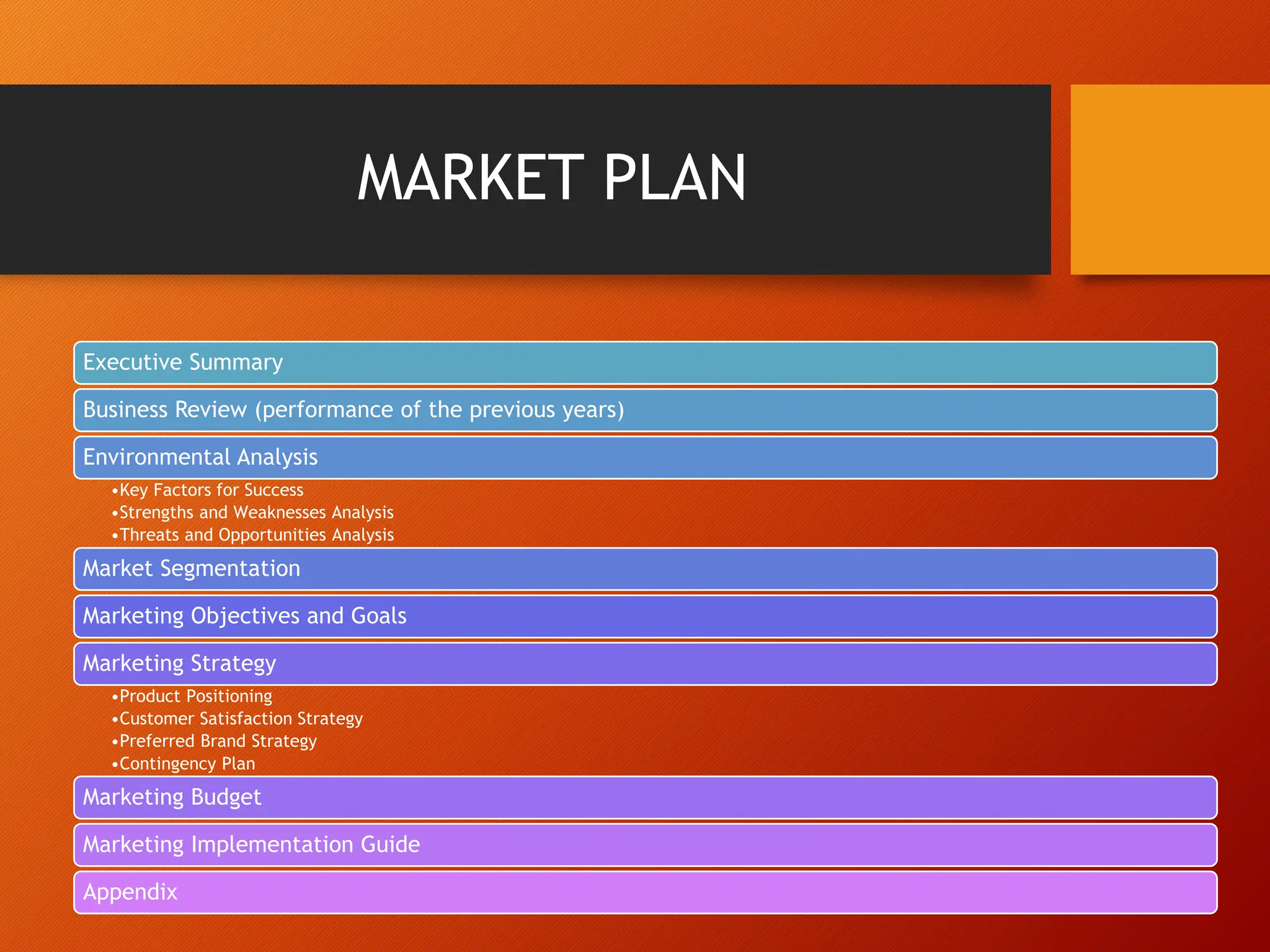
MARKET PLAN
Executive Summary
Business Review (performance of the previous years)
Environmental Analysis
•Key Factors for Success
•Strengths and Weaknesses Analysis
•Threats and Opportunities Analysis
Market Segmentation
Marketing Objectives and Goals
Marketing Strategy
•Product Positioning
•Customer Satisfaction Strategy
•Preferred Brand Strategy
•Contingency Plan
Marketing Budget
Marketing Implementation Guide
Appendix
Thank You

Marketing considerations.pptx is tell ab

  • 1.
  • 2.
    Table of contents Marketing research for the new venture  Market segmentation  Market targeting and positioning  Developing marketing mix strategies  Implementing, monitoring and review of marketing plan.
  • 3.
    Purpose Of MarketingResearch • Gain a more detailed understanding of consumers’ needs: e.g., views on products’ prices, packaging, recent advertising campaigns • Reduce the risk of product/business failure: -there is no guarantee that any new idea will be a commercial success -Can help to achieve commercial success • Forecast future trends: -it can also be used to anticipate future customer needs
  • 4.
    Types of MarketResearch • Ad Tracking – periodic or continuous in-market research to monitor a brand’s performance using measures such as brand awareness, brand preference, and product usage. (Young, 2005) • Brand name testing - what do consumers feel about the names of the products? • Concept testing - to test the acceptance of a concept by target consumers
  • 5.
    Types of MarketResearch Customer satisfaction research - quantitative or qualitative studies that yields an understanding of a customer's satisfaction with a transaction Demand estimation - to determine the approximate level of demand for the product Distribution channel audits - to assess distributors’ and retailers’ attitudes toward a product, brand, or company Mystery consumer or mystery shopping - An employee or representative of the market research firm anonymously contacts a salesperson and indicates he or she is shopping for a product. The shopper then records the entire experience. This method is often used for quality control or for researching competitors' products.
  • 6.
    Types of MarketResearch Price elasticity testing - to determine how sensitive customers are to changes Sales forecasting - to determine the expected level of sales given the demand. With respect to other factors like Advertising expenditure, promotion etc. Segmentation research - to determine the demographic, psychographic, behavioural characteristics of potential buyers Online panel - a group of individual who accepted to respond to research online Test marketing - a small-scale product launch used to determine the acceptance of the product when it is introduced into a wider market Viral Marketing Research - Estimates of Social Networking are combined with estimates of selling effectiveness to estimate ROI on specific combinations of messages and media.
  • 7.
    5 key stepsin Marketing Research 1. Define the Problem 2. Collect the Data 3. Analyse and interpret the data 4. Reach a conclusion 5. Implement your research
  • 8.
    Collect the Data •There are two types of market research that can be performed: 1. Primary research - involves collecting information from sources directly by conducting interviews and surveys, and by talking to customers and established businesses. 2. Secondary research - involves collecting information from sources where the primary research has already been conducted. Such information includes industry statistics, market research reports, news paper articles, etc.
  • 9.
    Collection methods and techniques •Qualitative research is where you seek an understanding of why things are a certain way. For example, a researcher may stop a shopper and ask them why they bought a particular product or brand. • Quantitative research refers to measuring market phenomena in a numerical sense, such as when a bank asks consumers to rate their service on a scale of one to ten.
  • 10.
    Simple Survey Method •Experts Opinion Poll • Reasoned Opinion-Delphi Technique • Consumers Survey- Complete Enumeration Method • Consumer Survey-Sample Survey Method • End-user Method of Consumers Survey
  • 11.
    Complex Statistical Methods: •Time series analysis or trend method • Barometric Techniques or Lead-Lag indicators method • Correlation and Regression
  • 12.
  • 13.
    (STP PROCESS) SEGMENTATION, TARGETING& POSITIONING • Segmentation - grouping consumers by some criteria. • Targeting - choosing which group(s) to sell to. • Positioning - consumer perception of a brand or product relative to the perception of competing brands or products.
  • 14.
    (STP PROCESS) MARKET SEGMENTATION METHODS Geographic Segmentation  Demographic - group consumers based on age, gender, race etc.  Psychographic - divides a market into different groups based on social class, lifestyle, or personality characteristics  Behavioral – Divides buyers into segments based on consumer knowledge, attitudes
  • 15.
    (STP PROCESS) MARKET TARGETINGMETHODS  Mass marketing –single marketing strategy.  Differentiated Marketing  Concentrated Marketing (Niche Marketing) Selecting segment that can served best.
  • 16.
    (STP PROCESS) POSITIONING METHODS •Positioning is concerned with the perception customers hold regarding a product or company.
  • 17.
    MARKETING MIX STRATEGIES MarketingMix is a combination of marketing tools that a company uses to satisfy their target customers and achieving organizational goals: • 7 P’s • 4 P’s
  • 18.
  • 19.
  • 20.
    MARKET PLAN Executive Summary BusinessReview (performance of the previous years) Environmental Analysis •Key Factors for Success •Strengths and Weaknesses Analysis •Threats and Opportunities Analysis Market Segmentation Marketing Objectives and Goals Marketing Strategy •Product Positioning •Customer Satisfaction Strategy •Preferred Brand Strategy •Contingency Plan Marketing Budget Marketing Implementation Guide Appendix
  • 21.