MARKET
INTEGRATION
Presented by: Arianne V. Obedece
Jumbled words
1.Tamrek
2.Tivercal
3.lobalg kertam
4.Goolrncmtaeiotn
5.Septyt
6. ldorw knab
7.Lore
The students will understand the Market integration
Appreciate the importance of market integration for
economic development and cooperation.
By the end of the discussion, students will have an
assessment based on what they have learned.
Objectives
MARKET INTEGRATION
By reducing trade barriers and harmonizing trade rules
and regulations, market integration refers to the
process of connecting national markets to create a
larger and more linked market. Trade agreement
negotiations help to facilitate this process, which may
take place at the international or regional levels.
Market integration has several advantages, including
increased commerce, economic growth, and
competition, which force businesses to innovate and
improve their efficiency to survive.
Role of international financial insitutions in the creation
of a global economy
After the Second World War, almost all countrieThere are
two types of international financial institutions:
intergovernmental and private.s around the world faced
the great challenge of bringing their feet back on the
ground. As a substitute to the unsuccessful League of
Nations, the United Nations (UN) was established on
October 24, 1945. Primarily, it was tasked to promote
international cooperation and to restore international
order. Earlier in 1944 at the Monetary and Financial
Conference in Bretton Woods, New Hamsphire (US), the
first government-sponsored international financial
institutions were established-the World Bank (WB) and
the International Monetary Fund (IMF).
The WB is an intergovernmental institution. Its aim is to
end extreme poverty and promote shared prosperity in a
sustainable way (worldbank.org). There are five
organizations that belong to the WB Group, namely, the
International Bank for Reconstruction and Development,
International Development Association, International
Financial Corporation, Multilateral Investment Guarantee
Agency, and International Center for Settlement and
Investment Disputes. These organizations facilitate the
granting of loans and financial assistance to developing
countries.
The IMF, also an intergovernmental institution, works to
foster global monetary cooperation, secure financial
stability, facilitate international trade, and
more(imf.org/en.About). Like the WB, it also grants
financial assistance and loans to developing countries.
In the 1960s, regional development banks were
established: the Asian Development Bank (ADB) in 1960
and the African Development Bank (AfDB) in 1964. These
two are intergovernmental financial institutions that were
created to spur social progress and economic growth in
order to address and reduce poverty. As financial
institutions, ADB and AfDB are anchored on the goal of
fostering sustainable development in their respective
member countries.
There are also private international financial institutions
such as Citigroup and Merrill Lynch. Citigroup is an
American multinational investment banking and financial
corporation. It is the fourth largest bank in the US
(citigroup.com). On the other hand, Merril Lynch is the
wealth management division of the Bank of America. Both
institutions provide investments, stocks, or financial loans.
History of global market intergration in the 20th century
Global market integration did not happen overnight. It was the result
of the establishment of a global
economy that involved the homogenization of trade and commerce. Prior to
trends in globalization of the 20h century, international trade and exchange of
goods and services were already practiced. Harvey (1990) sees that cities and
countries were able to extend their reach beyond borders and patterns of trade
and technology becauseof developments in shipping and navigation. This was
observable in the development of maritime transport throughout history.
Colonialism and imperialism rose as the new ways of putting order to the
economic interrelationships among countries. Equity, corporate ownership,
management subsidiaries, and central headquarters which supply and
distribute goods and services were established through colonialism. The
Spanish government in the 1600s, for instance, made use of its colonies like the
Philippines and Mexico as suppliers of its resources for trade.
The integration of the global market started when big
American corporations began to emerge after the Second
World War with the rise of new conglomerates. International
Telephone and Telegraph bought Avis Rent- a-Car,
Continental Banking, Sheraton Hotels, and Hartford Fire
Insurance (American History, 2018). Later, Japan and
Europe followed suit. Japanese global automobile
corporations like Toyota, Nissan and Isuzu took off after the
giant American companies flourished. These companies
prospered as the primary and global makers of trucks for the
Japanese military (Dower, 1992). Renault automobiles, a
French multinational automobile manufacturer,was also used
to help in the military post-war operations.
The rise of American, Japanese, and European global
corporations paved the way for the further development of
international trade. Iwan (2012) identifies the differences
among international, multinational, transnational, and global
companies:
International companies are importers and exporters with no
investment outside their home countries.
Multinational companies (MNCs) have investments in other
countries, but do not have a coordinated product offering in
each country. They are more focused on adapting their
products and services to each individual local market.
Global companies have investments and are present in many
countries. They typically market their products and services
to each individual local market.
Transnational companies (TNCs) are more complex
organizations that have investments in foreign operations,
have a central corporate facility but give decision-making,
research and development, and marketing powers to each
individual foreign market.
Literatures officially traced the start of the contemporary
market integration from the return of the Japanese and
European corporations to the global market. It was
acknowledged in 1974 that the major global economic actors
were MNCs. Collectively; they were described to be a
particular corporate form to dominate global production and
exchange (Neubauer, 2014). Caroll (2003) termed the
emergence of international, multinational, global and
transnational companies in the United States (US), the
European Union (EU), and Japan as the triad-the major
economies of the world.
Gereffi (2001) identifies three structural periods in the
existence of global corporations after the war. They are
investment-based period (1950-1970), trade-based period
(1970-1995), and digital globalization (1995 onwards). The
development of global corporations can be examined from the
sources and the levels of foreign direct investments (FDIs).
The development of global corporations can be attributed to
foreign direct investments (FDIs), which were once the
primary drivers of global corporate growth. In the 1960s,
FDIs were primarily driven by producer-driven commodities,
leading to concentrated capital in large-scale manufacturing.
However, digital globalization has impacted these
corporations, as technology has integrated production and
consumption, transforming the way corporations operate.
Since the 1990s, digital operations have driven various aspects
of corporate operations.
TYPES OF MARKET INTEGRATION
Horizontal
Integration
Vertical
Integration
Conglomeration
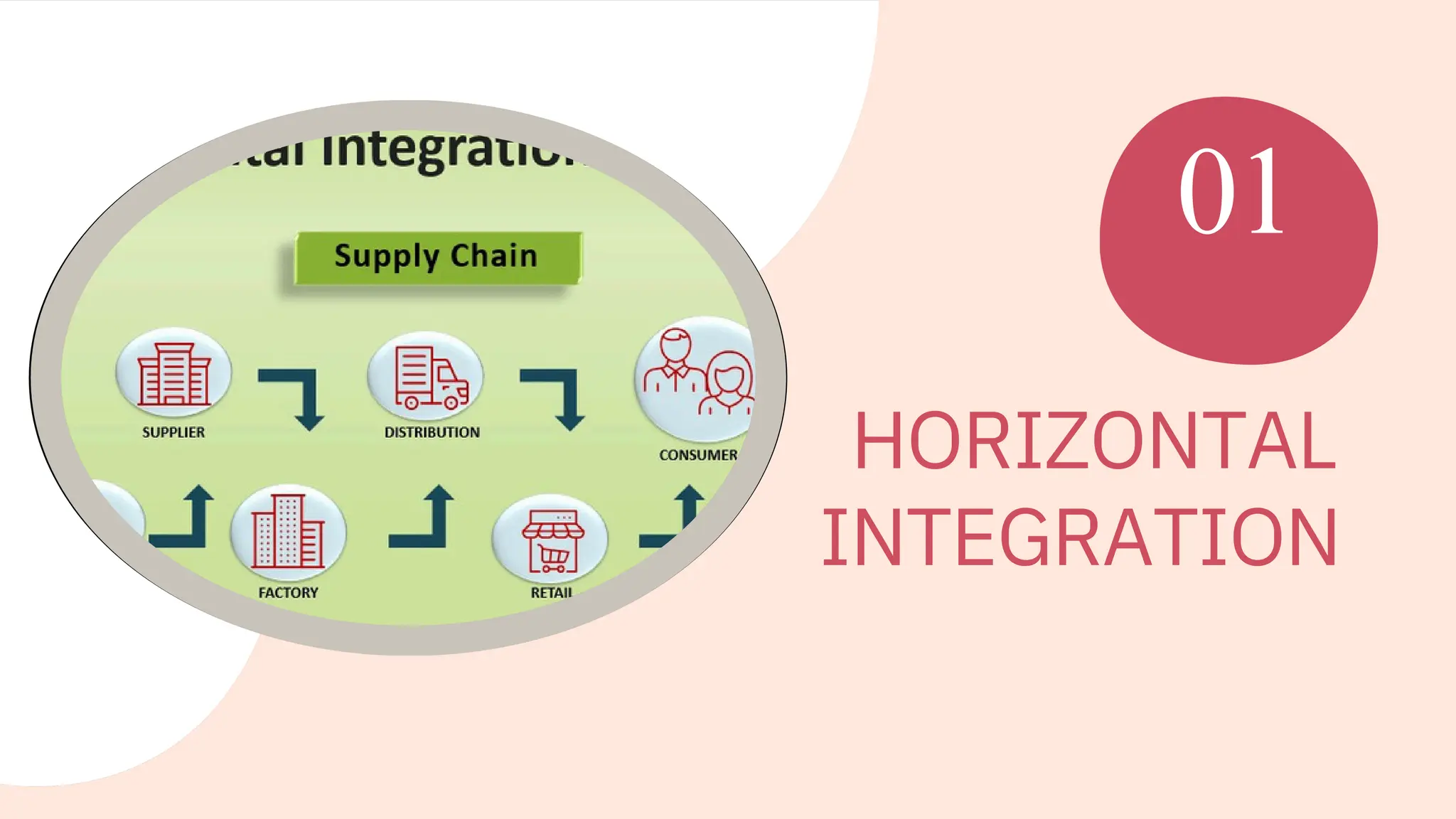
HORIZONTAL
INTEGRATION
01
This occurs when a firm or agency
gains control of other firms or agencies
performing similar marketing
functions at the same level in the
marketing sequence.In this type of
integration, some marketing
agenciescombine to form a union with
a view to reducing their effective
number and the extent of actual
competition in the market.
HORIZONTAL
INTEGRATION
It is advantageous for the members who join the group. In most
markets, there is a large number of agencies which do not
effectively compete with each other. This is indicative of some
element of horizontal integration. It leads to reduced cost of
marketing. In this reduced competition possible.
Example: Independent oil refineries coming
under U.S oil company
Buying out a competitor in a time bound way to
reduce competition. Gaining larger share of the
market and higher profits. Attaining economies
of scale.
Specializing in
the trade.
Effects of Horizontal Integration
1.
2.
3.
Lower costs.
Higher efficiency.
Increased ifferentiation.
4.Increased market power.
5.Reduced competition.
6. Access to new
markets.
7.Economics of scale.
8.Economics of scope.
international trade
Advantages of Horizontal Integration
1.Destroyed value.
2.Legal repercussions.
3.Reduced flexibility.
Disadvantages of the Horizontal
Integration
VERTICAL
INTEGRATION
02
VERTICAL
INTEGRATION
This occurs when a firm performs
more than one activity in the
sequence of the marketing process.
It is a linking together of two or
more functions inthe marketing
process within a single firm or
under a single ownership.
This type of integration makes it
possible to exercise control over
both quality and quantity of the
product from the beginning of the
production process until the
product is ready for the consumer.
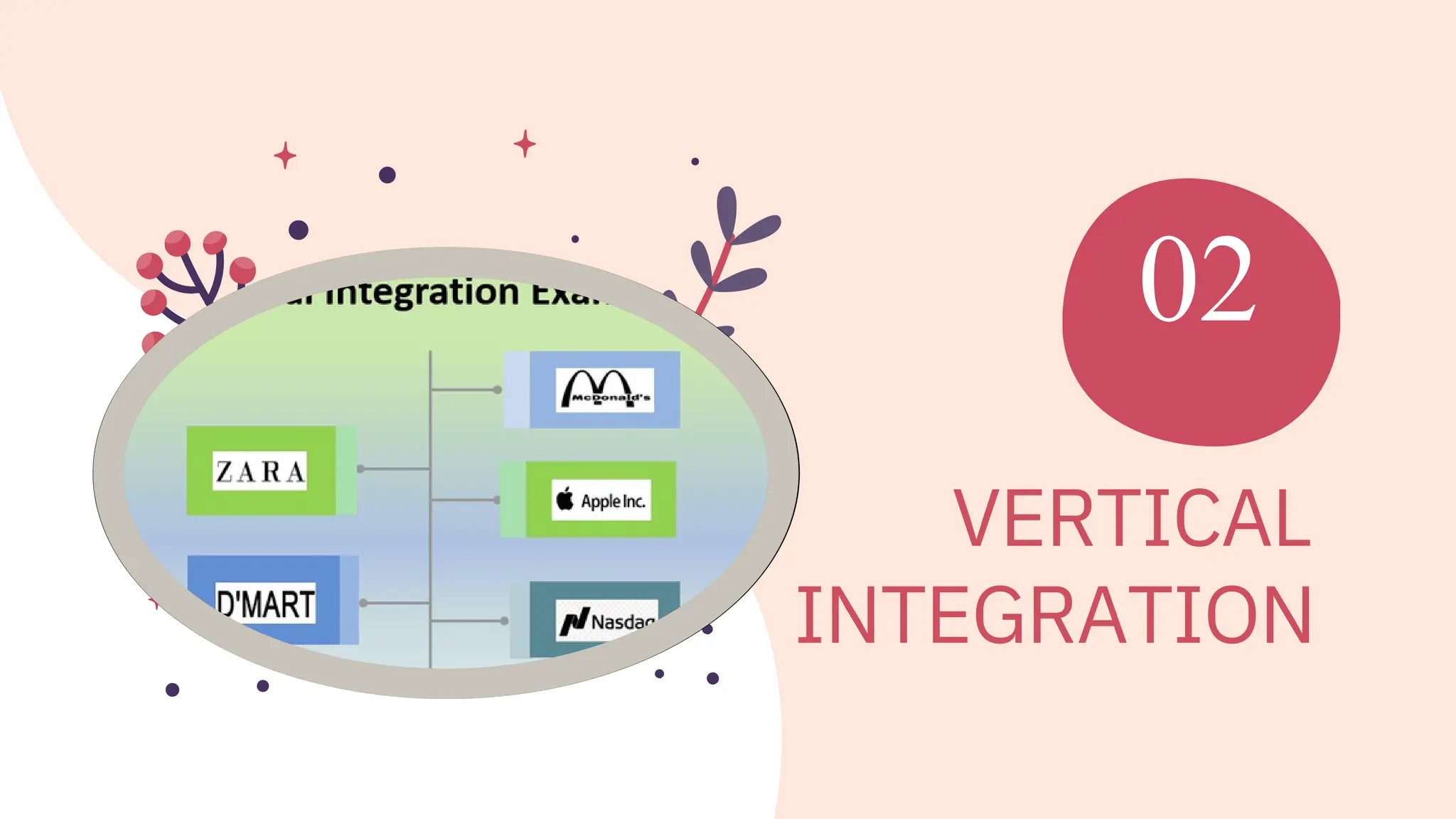
Example: Meat industry
buys all the functioning
plants needed for running
this meat
industry.
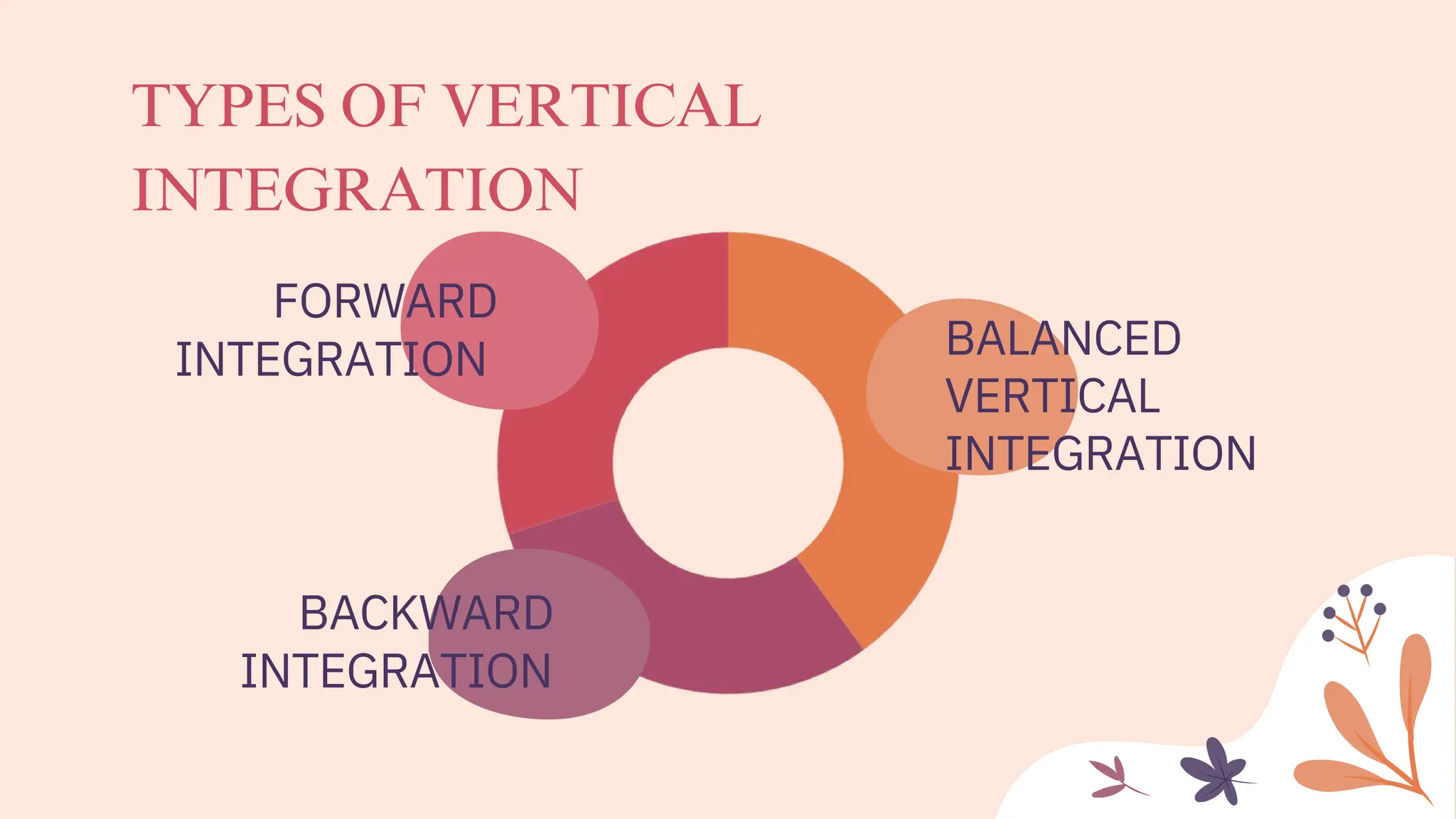
FORWARD
INTEGRATION
BACKWARD
INTEGRATION
BALANCED
VERTICAL
INTEGRATION
TYPES OF VERTICAL
INTEGRATION
FORWARD INTEGRATION
•
If a firm assumes another function of marketing which is
closer to the consumption function, it is a case of
forward integration.
Example: Wholesaler assuming the function of
retailing
.
BACKWARD INTEGRATION
•
This involves ownership or a combination of sources
of supply.
Example: When a processing firm assumes the function of
assembling/purchasing the produce from the villages.
BALANCED VERTICAL
INTEGRATION
• The third type of vertical integration is a combination of
the backward and the forward vertical integration.
Advantages of Vertical Integration
1.
2.
3.
4.
5.
6.
7.
It allows you to invest in assets that are highly specialized.
It gives you more control over your business.
It allows for positive differentiation. It
requires lower costs of transaction.
It offers more cost control. It ensures a high level of
certainty when it comes to quality.
It provides more competitive
advantages.
1.It can have capacity-balancing problems.
2. It can bring about more difficulties. 3. It
can result in decreased flexibility. 4.It can
create some barriers to market entry. 5. It
can cause confusion within the business. 6. It
requires a huge amount of money. 7.It
makes things more difficult.
Disadvantages of Vertical Integration
●More profits by taking up additional functions.
● Risk reduction through improved market coordination.
● Improvement in bargaining power and the prospects of influencing
prices.
●Lowering costs through achieving operational efficiency.
Effects of Vertical Integration
CONGLOMERATION
03
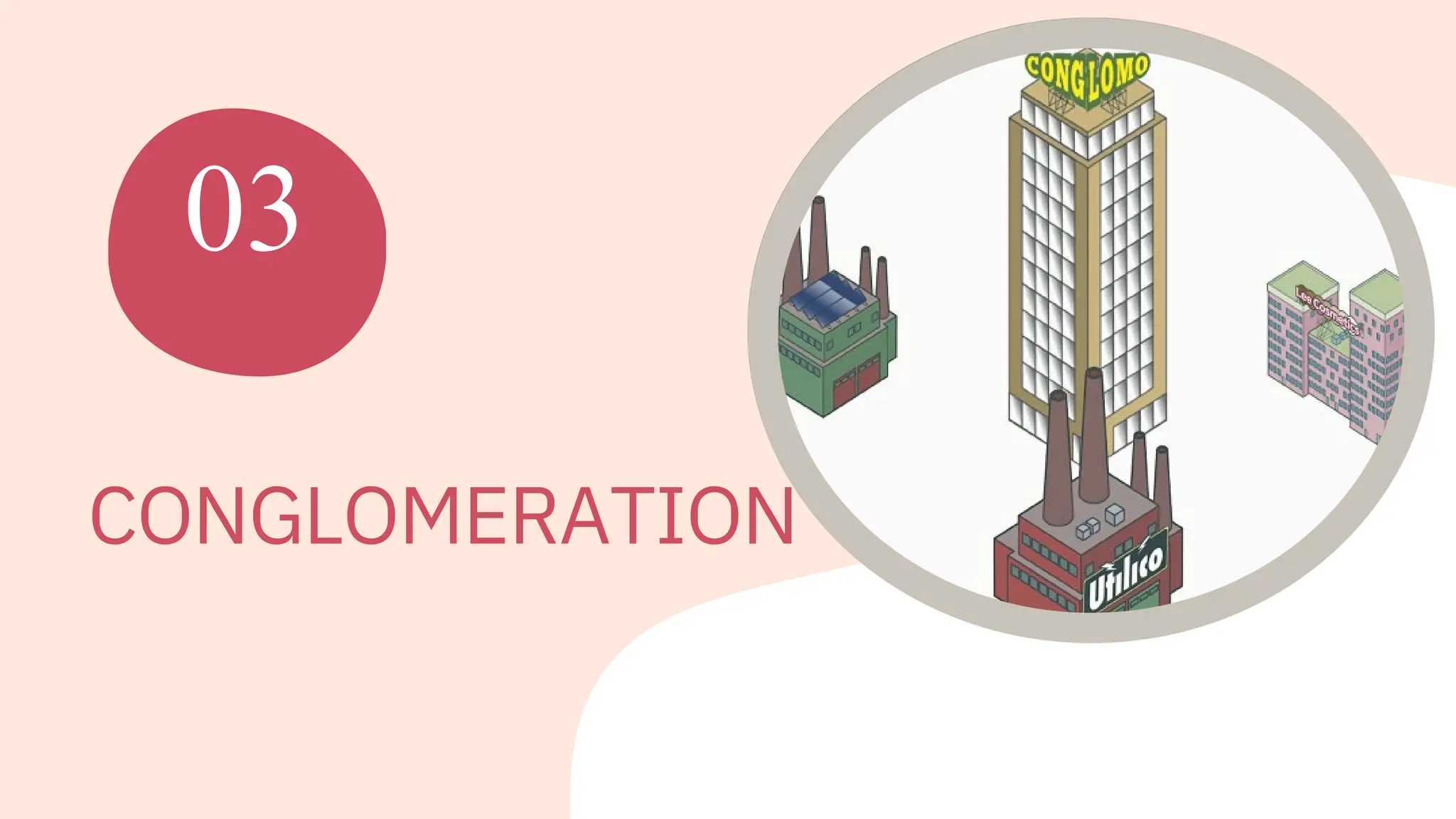
●A combination of agencies or activities not
directly related to each other may, when it
operates under a unified management, be
termed a conglomeration.
CONGLOMERATION
•
•
•
•
•
•
•
Hindustan unilever
ltd.
Delhi cloth and general mills.
Birla group.
Tatas.
J.K.group.
ITC.
NAFED.
Examples:
●Risk reduction through diversification.
●Acquisition of financial leverage.
●Empire – building urge.
Effects of Conglomeration
THANK YOU FOR
listening !

MARKET - NTEGRATION.....................

  • 1.
  • 2.
  • 3.
    The students willunderstand the Market integration Appreciate the importance of market integration for economic development and cooperation. By the end of the discussion, students will have an assessment based on what they have learned. Objectives
  • 4.
    MARKET INTEGRATION By reducingtrade barriers and harmonizing trade rules and regulations, market integration refers to the process of connecting national markets to create a larger and more linked market. Trade agreement negotiations help to facilitate this process, which may take place at the international or regional levels. Market integration has several advantages, including increased commerce, economic growth, and competition, which force businesses to innovate and improve their efficiency to survive.
  • 5.
    Role of internationalfinancial insitutions in the creation of a global economy After the Second World War, almost all countrieThere are two types of international financial institutions: intergovernmental and private.s around the world faced the great challenge of bringing their feet back on the ground. As a substitute to the unsuccessful League of Nations, the United Nations (UN) was established on October 24, 1945. Primarily, it was tasked to promote international cooperation and to restore international order. Earlier in 1944 at the Monetary and Financial Conference in Bretton Woods, New Hamsphire (US), the first government-sponsored international financial institutions were established-the World Bank (WB) and the International Monetary Fund (IMF).
  • 6.
    The WB isan intergovernmental institution. Its aim is to end extreme poverty and promote shared prosperity in a sustainable way (worldbank.org). There are five organizations that belong to the WB Group, namely, the International Bank for Reconstruction and Development, International Development Association, International Financial Corporation, Multilateral Investment Guarantee Agency, and International Center for Settlement and Investment Disputes. These organizations facilitate the granting of loans and financial assistance to developing countries. The IMF, also an intergovernmental institution, works to foster global monetary cooperation, secure financial stability, facilitate international trade, and more(imf.org/en.About). Like the WB, it also grants financial assistance and loans to developing countries.
  • 7.
    In the 1960s,regional development banks were established: the Asian Development Bank (ADB) in 1960 and the African Development Bank (AfDB) in 1964. These two are intergovernmental financial institutions that were created to spur social progress and economic growth in order to address and reduce poverty. As financial institutions, ADB and AfDB are anchored on the goal of fostering sustainable development in their respective member countries. There are also private international financial institutions such as Citigroup and Merrill Lynch. Citigroup is an American multinational investment banking and financial corporation. It is the fourth largest bank in the US (citigroup.com). On the other hand, Merril Lynch is the wealth management division of the Bank of America. Both institutions provide investments, stocks, or financial loans.
  • 8.
    History of globalmarket intergration in the 20th century Global market integration did not happen overnight. It was the result of the establishment of a global economy that involved the homogenization of trade and commerce. Prior to trends in globalization of the 20h century, international trade and exchange of goods and services were already practiced. Harvey (1990) sees that cities and countries were able to extend their reach beyond borders and patterns of trade and technology becauseof developments in shipping and navigation. This was observable in the development of maritime transport throughout history. Colonialism and imperialism rose as the new ways of putting order to the economic interrelationships among countries. Equity, corporate ownership, management subsidiaries, and central headquarters which supply and distribute goods and services were established through colonialism. The Spanish government in the 1600s, for instance, made use of its colonies like the Philippines and Mexico as suppliers of its resources for trade.
  • 9.
    The integration ofthe global market started when big American corporations began to emerge after the Second World War with the rise of new conglomerates. International Telephone and Telegraph bought Avis Rent- a-Car, Continental Banking, Sheraton Hotels, and Hartford Fire Insurance (American History, 2018). Later, Japan and Europe followed suit. Japanese global automobile corporations like Toyota, Nissan and Isuzu took off after the giant American companies flourished. These companies prospered as the primary and global makers of trucks for the Japanese military (Dower, 1992). Renault automobiles, a French multinational automobile manufacturer,was also used to help in the military post-war operations. The rise of American, Japanese, and European global corporations paved the way for the further development of international trade. Iwan (2012) identifies the differences among international, multinational, transnational, and global companies:
  • 10.
    International companies areimporters and exporters with no investment outside their home countries. Multinational companies (MNCs) have investments in other countries, but do not have a coordinated product offering in each country. They are more focused on adapting their products and services to each individual local market. Global companies have investments and are present in many countries. They typically market their products and services to each individual local market. Transnational companies (TNCs) are more complex organizations that have investments in foreign operations, have a central corporate facility but give decision-making, research and development, and marketing powers to each individual foreign market.
  • 11.
    Literatures officially tracedthe start of the contemporary market integration from the return of the Japanese and European corporations to the global market. It was acknowledged in 1974 that the major global economic actors were MNCs. Collectively; they were described to be a particular corporate form to dominate global production and exchange (Neubauer, 2014). Caroll (2003) termed the emergence of international, multinational, global and transnational companies in the United States (US), the European Union (EU), and Japan as the triad-the major economies of the world. Gereffi (2001) identifies three structural periods in the existence of global corporations after the war. They are investment-based period (1950-1970), trade-based period (1970-1995), and digital globalization (1995 onwards). The development of global corporations can be examined from the sources and the levels of foreign direct investments (FDIs).
  • 12.
    The development ofglobal corporations can be attributed to foreign direct investments (FDIs), which were once the primary drivers of global corporate growth. In the 1960s, FDIs were primarily driven by producer-driven commodities, leading to concentrated capital in large-scale manufacturing. However, digital globalization has impacted these corporations, as technology has integrated production and consumption, transforming the way corporations operate. Since the 1990s, digital operations have driven various aspects of corporate operations.
  • 13.
    TYPES OF MARKETINTEGRATION Horizontal Integration Vertical Integration Conglomeration
  • 14.
  • 15.
    This occurs whena firm or agency gains control of other firms or agencies performing similar marketing functions at the same level in the marketing sequence.In this type of integration, some marketing agenciescombine to form a union with a view to reducing their effective number and the extent of actual competition in the market. HORIZONTAL INTEGRATION
  • 16.
    It is advantageousfor the members who join the group. In most markets, there is a large number of agencies which do not effectively compete with each other. This is indicative of some element of horizontal integration. It leads to reduced cost of marketing. In this reduced competition possible.
  • 17.
    Example: Independent oilrefineries coming under U.S oil company
  • 18.
    Buying out acompetitor in a time bound way to reduce competition. Gaining larger share of the market and higher profits. Attaining economies of scale. Specializing in the trade. Effects of Horizontal Integration
  • 19.
    1. 2. 3. Lower costs. Higher efficiency. Increasedifferentiation. 4.Increased market power. 5.Reduced competition. 6. Access to new markets. 7.Economics of scale. 8.Economics of scope. international trade Advantages of Horizontal Integration
  • 20.
    1.Destroyed value. 2.Legal repercussions. 3.Reducedflexibility. Disadvantages of the Horizontal Integration
  • 21.
  • 22.
    VERTICAL INTEGRATION This occurs whena firm performs more than one activity in the sequence of the marketing process. It is a linking together of two or more functions inthe marketing process within a single firm or under a single ownership. This type of integration makes it possible to exercise control over both quality and quantity of the product from the beginning of the production process until the product is ready for the consumer.
  • 23.
    Example: Meat industry buysall the functioning plants needed for running this meat industry.
  • 24.
  • 25.
    FORWARD INTEGRATION • If afirm assumes another function of marketing which is closer to the consumption function, it is a case of forward integration. Example: Wholesaler assuming the function of retailing .
  • 26.
    BACKWARD INTEGRATION • This involvesownership or a combination of sources of supply. Example: When a processing firm assumes the function of assembling/purchasing the produce from the villages.
  • 27.
    BALANCED VERTICAL INTEGRATION • Thethird type of vertical integration is a combination of the backward and the forward vertical integration.
  • 28.
    Advantages of VerticalIntegration 1. 2. 3. 4. 5. 6. 7. It allows you to invest in assets that are highly specialized. It gives you more control over your business. It allows for positive differentiation. It requires lower costs of transaction. It offers more cost control. It ensures a high level of certainty when it comes to quality. It provides more competitive advantages.
  • 29.
    1.It can havecapacity-balancing problems. 2. It can bring about more difficulties. 3. It can result in decreased flexibility. 4.It can create some barriers to market entry. 5. It can cause confusion within the business. 6. It requires a huge amount of money. 7.It makes things more difficult. Disadvantages of Vertical Integration
  • 30.
    ●More profits bytaking up additional functions. ● Risk reduction through improved market coordination. ● Improvement in bargaining power and the prospects of influencing prices. ●Lowering costs through achieving operational efficiency. Effects of Vertical Integration
  • 31.
  • 32.
    ●A combination ofagencies or activities not directly related to each other may, when it operates under a unified management, be termed a conglomeration. CONGLOMERATION • • • • • • • Hindustan unilever ltd. Delhi cloth and general mills. Birla group. Tatas. J.K.group. ITC. NAFED. Examples:
  • 33.
    ●Risk reduction throughdiversification. ●Acquisition of financial leverage. ●Empire – building urge. Effects of Conglomeration
  • 34.