CONTEMPORARY
ART-BASED EDUCATION
  FOR TEENS IN THE
 CONTEMPORARY ART
      MUSEUM


    Marissa Wendolovske
MAIN QUESTION


How does contemporary art-based
 education contribute to creating
  lifelong learners and inquirers?
SUB-QUESTIONS
• What are some effective strategies museum
  educators use to teach contemporary art to
  high school students?

• More specifically, what are the strategies used
  by the Whitney Museum’s Youth Insights
  program and New Museum’s G:Class
  program?
HOW I FOUND MY TOPIC
• What about art education interests me most?
• What time period of art is the most appealing to
  me?
• What knowledge do I already have and what
  would I benefit from learning more about?
• Why is there such strong absence/distaste of
  contemporary art in K-12?
• What will be constructive to the future of art
  education?
• What would be most satisfying to my career?
MY K-12 CONTEMPORARY
 ART-BASED EDUCATION


         N/A
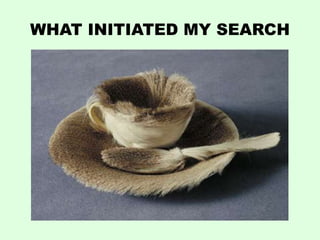
WHAT INITIATED MY SEARCH
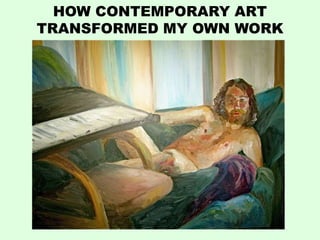
HOW CONTEMPORARY ART
TRANSFORMED MY OWN WORK
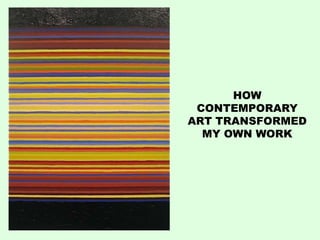
HOW
 CONTEMPORARY
ART TRANSFORMED
  MY OWN WORK
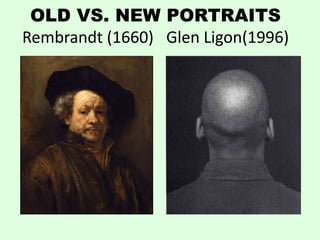
OLD VS. NEW PORTRAITS
Rembrandt (1660) Glen Ligon(1996)
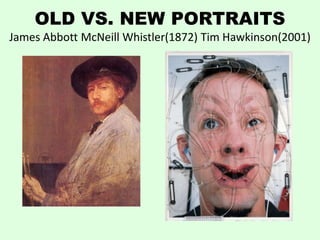
OLD VS. NEW PORTRAITS
James Abbott McNeill Whistler(1872) Tim Hawkinson(2001)
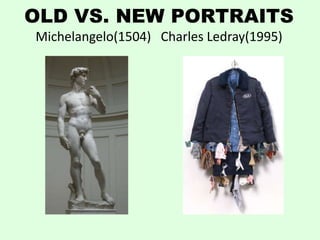
OLD VS. NEW PORTRAITS
Michelangelo(1504) Charles Ledray(1995)
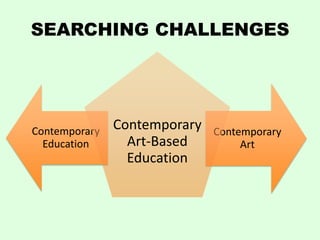
SEARCHING CHALLENGES


Contemporary   Contemporary   Contemporary
  Education      Art-Based         Art
                 Education
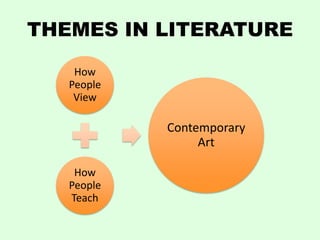
THEMES IN LITERATURE

    How
   People
    View

            Contemporary
                 Art

    How
   People
   Teach
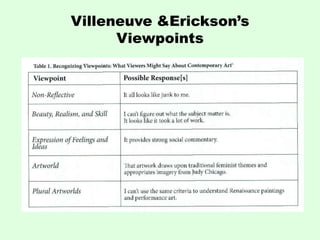
Villeneuve &Erickson’s
      Viewpoints
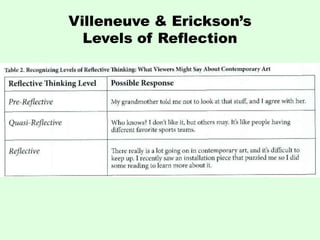
Villeneuve & Erickson’s
  Levels of Reflection
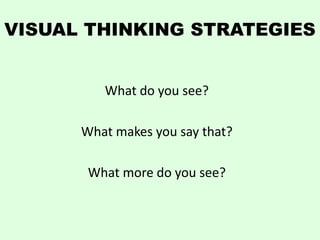
VISUAL THINKING STRATEGIES


         What do you see?

      What makes you say that?

       What more do you see?
CATEGORIZED SOURCES
     FOR HOW TO TEACH
• Gude’s Post Modern Principles

• Marshall’s Five Ways to Integrate

• Freedman’s Rethinking Creativity

• Barrett’s Approaches to Postmodern Art-
  Making
Gude’s
      Post-Modern Principles
•   Appropriation
•   Juxtaposition
•   Recontextualization
•   Layering
•   Interaction of Text & Image
•   Hybridity
•   Gazing
•   Representin’
Marshall’s
       Five Ways to Integrate
•   Depiction
•   Extension/Projection
•   Reformatting
•   Mimicry
•   Metaphor
Freedman’s
        Rethinking Creativity
•   Depends on Critical Reflection
•   Based on Interests
•   Learning Process
•   Functional
•   Social Activity
•   Involves Reproduction as Well as Production
•   Form of Leadership
Barrett’s Approaches to
    Postmodern Art-Making
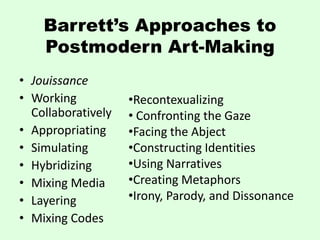
• Jouissance
• Working           •Recontexualizing
  Collaboratively   • Confronting the Gaze
• Appropriating     •Facing the Abject
• Simulating        •Constructing Identities
• Hybridizing       •Using Narratives
• Mixing Media      •Creating Metaphors
• Layering          •Irony, Parody, and Dissonance
• Mixing Codes
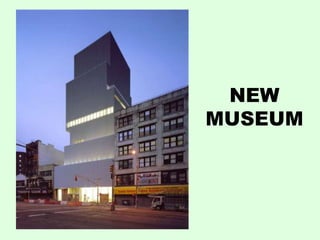
NEW
MUSEUM
G:Class

“The Global Classroom (G:Class) utilizes the
  Museum as a resource to enhance learning
  and engage high school students through the
  exploration of contemporary art connecting to
  local, global, and cultural issues that affect
  their lives.”

(http://www.gclass.org/)
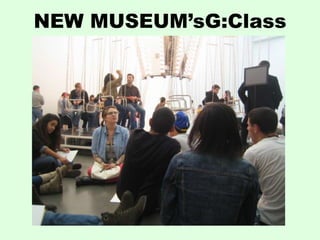
NEW MUSEUM’sG:Class
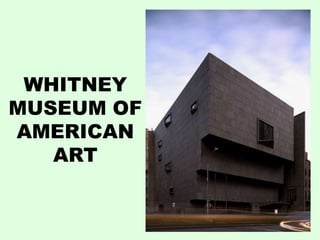
WHITNEY
MUSEUM OF
AMERICAN
   ART
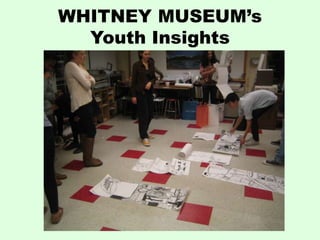
Youth Insights
YI Artists brings teens together with contemporary
   artists, providing opportunities to work
   collaboratively, discuss art critically, think
   creatively, and make art inspired by this
   exchange.

YI Writers teens work closely with contemporary
   artists to explore art and the connections
   between art and text through critical and creative
   writing.
(http://whitney.org/Education/Teens/GetInvolved)
WHITNEY MUSEUM’s
  Youth Insights
WHAT’S NEXT

• Continue to observe and collect data through
  photographs, videos, and voice recordings.

• Interviewing the educators; Carda Burke, Berry
  Stein, and Kimberley Mackensie.

• Possibly student teaching at NYC Museum School.

MARISSA_thesis1_12.11.2011

  • 1.
    CONTEMPORARY ART-BASED EDUCATION FOR TEENS IN THE CONTEMPORARY ART MUSEUM Marissa Wendolovske
  • 2.
    MAIN QUESTION How doescontemporary art-based education contribute to creating lifelong learners and inquirers?
  • 3.
    SUB-QUESTIONS • What aresome effective strategies museum educators use to teach contemporary art to high school students? • More specifically, what are the strategies used by the Whitney Museum’s Youth Insights program and New Museum’s G:Class program?
  • 4.
    HOW I FOUNDMY TOPIC • What about art education interests me most? • What time period of art is the most appealing to me? • What knowledge do I already have and what would I benefit from learning more about? • Why is there such strong absence/distaste of contemporary art in K-12? • What will be constructive to the future of art education? • What would be most satisfying to my career?
  • 5.
    MY K-12 CONTEMPORARY ART-BASED EDUCATION N/A
  • 6.
  • 7.
  • 8.
  • 9.
    OLD VS. NEWPORTRAITS Rembrandt (1660) Glen Ligon(1996)
  • 10.
    OLD VS. NEWPORTRAITS James Abbott McNeill Whistler(1872) Tim Hawkinson(2001)
  • 11.
    OLD VS. NEWPORTRAITS Michelangelo(1504) Charles Ledray(1995)
  • 12.
    SEARCHING CHALLENGES Contemporary Contemporary Contemporary Education Art-Based Art Education
  • 13.
    THEMES IN LITERATURE How People View Contemporary Art How People Teach
  • 14.
  • 15.
    Villeneuve & Erickson’s Levels of Reflection
  • 16.
    VISUAL THINKING STRATEGIES What do you see? What makes you say that? What more do you see?
  • 17.
    CATEGORIZED SOURCES FOR HOW TO TEACH • Gude’s Post Modern Principles • Marshall’s Five Ways to Integrate • Freedman’s Rethinking Creativity • Barrett’s Approaches to Postmodern Art- Making
  • 18.
    Gude’s Post-Modern Principles • Appropriation • Juxtaposition • Recontextualization • Layering • Interaction of Text & Image • Hybridity • Gazing • Representin’
  • 19.
    Marshall’s Five Ways to Integrate • Depiction • Extension/Projection • Reformatting • Mimicry • Metaphor
  • 20.
    Freedman’s Rethinking Creativity • Depends on Critical Reflection • Based on Interests • Learning Process • Functional • Social Activity • Involves Reproduction as Well as Production • Form of Leadership
  • 21.
    Barrett’s Approaches to Postmodern Art-Making • Jouissance • Working •Recontexualizing Collaboratively • Confronting the Gaze • Appropriating •Facing the Abject • Simulating •Constructing Identities • Hybridizing •Using Narratives • Mixing Media •Creating Metaphors • Layering •Irony, Parody, and Dissonance • Mixing Codes
  • 22.
  • 23.
    G:Class “The Global Classroom(G:Class) utilizes the Museum as a resource to enhance learning and engage high school students through the exploration of contemporary art connecting to local, global, and cultural issues that affect their lives.” (http://www.gclass.org/)
  • 24.
  • 25.
  • 26.
    Youth Insights YI Artistsbrings teens together with contemporary artists, providing opportunities to work collaboratively, discuss art critically, think creatively, and make art inspired by this exchange. YI Writers teens work closely with contemporary artists to explore art and the connections between art and text through critical and creative writing. (http://whitney.org/Education/Teens/GetInvolved)
  • 27.
    WHITNEY MUSEUM’s Youth Insights
  • 28.
    WHAT’S NEXT • Continueto observe and collect data through photographs, videos, and voice recordings. • Interviewing the educators; Carda Burke, Berry Stein, and Kimberley Mackensie. • Possibly student teaching at NYC Museum School.

Editor's Notes

  • #19 Briefly go over maybe describe one or two. This changed my thinking by allowing me to further understand the piece of art.The hybridityprinciple involves incorporating a mixture of media into artworks using whatever may be necessary to fully examine the subject matter of the artwork.
  • #20 Mimicry draws on copying the approaches of other disciplines. Using methods and tools from other subjects allows students to grasp from many resources in making art.
  • #21 Creativity becomes functional, in contemporary art especially, when the artwork changes the way a viewer sees or thinks about something in a way they never have before. This is found mainly in contemporary art when artists use principles such as appropriation, and using reproduction as a form of production they internalize pre-existing content to create new meaning through their artistic process.
  • #22 Facing the Abject: “The abject” refers to supposed unsavory aspects of life, especially concerning functions of the body.
  • #25 Describe Kimberley used VTS to get students to look further at the work. This is an installation piece by Carsten Holler for his exhibit called “Experience” at the New Museum.
  • #28 Interpretation of artists work. Students visited Dawns studio to see her work. Dawn came back for a visit to talk about panoramic views. Students then created their own panoramic views.2010 biennial artist dawn clements