STOP THE BLEED® Course
American College of Surgeons
Copyright © 2019 American College of Surgeons
STOPTHEBLEED.ORG
Version 2
STOP THE BLEED® is a registered trademark of the U.S. Department of Defense
SAVE A LIFE
The American
College of Surgeons
Committee on
Trauma
The Committee
on Tactical
Combat
Casualty Care
The National
Association of
Emergency Medical
Technicians
The American
College of
Emergency
Physicians
Some of the images shown
during this presentation may be
disturbing to some people.
Stop the Bleed Course v. 2.0 Introduction | A-Alert | B-Bleeding | C-Compression |
Why Do I Need This Training?
Introduction | A-Alert | B-Bleeding | C-Compression |
Stop the Bleed Course v. 2.0
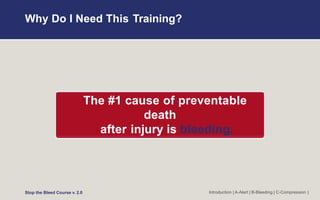
The #1 cause of preventable
death
after injury is bleeding.
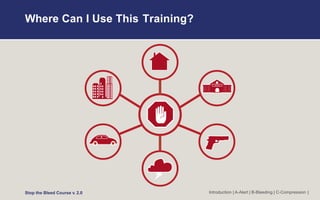
Where Can I Use This Training?
Introduction | A-Alert | B-Bleeding | C-Compression |
Stop the Bleed Course v. 2.0
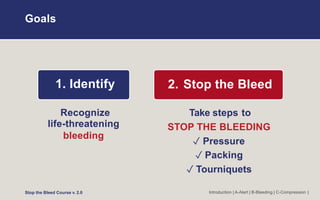
Goals
1. Identify
Recognize
life-threatening
bleeding
Introduction | A-Alert | B-Bleeding | C-Compression |
2. Stop the Bleed
Take steps to
STOP THE BLEEDING
✓ Pressure
✓ Packing
✓ Tourniquets
Stop the Bleed Course v. 2.0
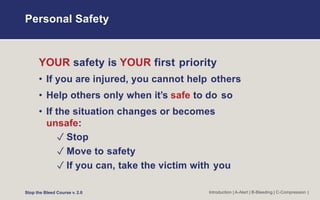
Personal Safety
Introduction | A-Alert | B-Bleeding | C-Compression |
YOUR safety is YOUR first priority
• If you are injured, you cannot help others
• Help others only when it’s safe to do so
• If the situation changes or becomes
unsafe:
✓ Stop
✓ Move to safety
✓ If you can, take the victim with you
Stop the Bleed Course v. 2.0
Personal Safety
Introduction | A-Alert | B-Bleeding | C-Compression |
YOUR safety is YOUR first priority
• Wear gloves if you can
• If you get blood on you, be sure to clean any
part of your body that the blood has touched
• Tell a health care provider that you got blood
on you, and follow his or her direction
Stop the Bleed Course v. 2.0
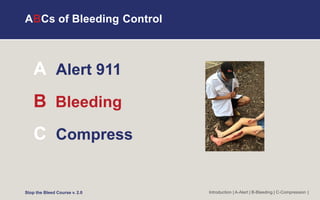
ABCs of Bleeding Control
A Alert 911
B Bleeding
C Compress
Introduction | A-Alert | B-Bleeding | C-Compression |
Stop the Bleed Course v. 2.0
ABCs of Bleeding Control
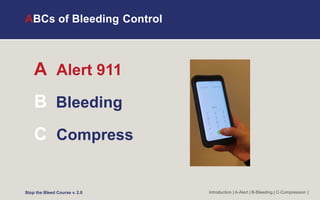
A Alert 911
B Bleeding
C Compress
Introduction | A-Alert | B-Bleeding | C-Compression |
Stop the Bleed Course v. 2.0
ABCs of Bleeding Control
A Alert 911
• Call 911
• Know your location
• Follow instructions provided by 911 operator
Introduction | A-Alert | B-Bleeding | C-Compression |
Stop the Bleed Course v. 2.0
ABCs of Bleeding Control
A Alert 911
B Bleeding
C Compress
Introduction | A-Alert | B-Bleeding | C-Compression |
Stop the Bleed Course v. 2.0
ABCs of Bleeding Control
B Bleeding
• Find source of bleeding
• Look for:
✓ Continuous bleeding
✓ Large-volume bleeding
✓ Pooling of blood
Introduction | A-Alert | B-Bleeding | C-Compression |
Stop the Bleed Course v. 2.0
ABCs of Bleeding Control
B Bleeding
• There may be multiple places the
victim is bleeding
• Clothing may also hide
life-threatening bleeding
Introduction | A-Alert | B-Bleeding | C-Compression |
Stop the Bleed Course v. 2.0
ABCs of Bleeding Control
Introduction | A-Alert | B-Bleeding | C-Compression |
Stop the Bleed Course v. 2.0
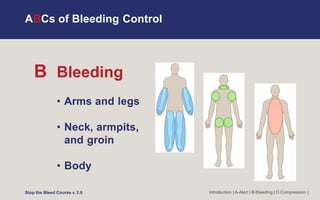
B Bleeding
• Arms and legs
• Neck, armpits,
and groin
• Body
ABCs of Bleeding Control
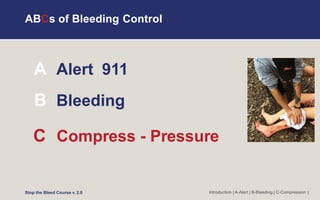
A Alert 911
B Bleeding
C Compress - Pressure
Introduction | A-Alert | B-Bleeding | C-Compression |
Stop the Bleed Course v. 2.0
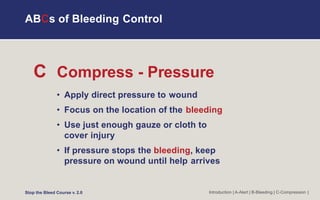
C Compress - Pressure
• Apply direct pressure to wound
• Focus on the location of the bleeding
• Use just enough gauze or cloth to
cover injury
• If pressure stops the bleeding, keep
pressure on wound until help arrives
Introduction | A-Alert | B-Bleeding | C-Compression |
ABCs of Bleeding Control
Stop the Bleed Course v. 2.0
ABCs of Bleeding Control
Introduction | A-Alert | B-Bleeding | C-Compression |
Stop the Bleed Course v. 2.0
ABCs of Bleeding Control
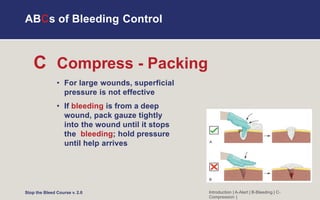
C Compress - Packing
• For large wounds, superficial
pressure is not effective
• If bleeding is from a deep
wound, pack gauze tightly
into the wound until it stops
the bleeding; hold pressure
until help arrives
Introduction | A-Alert | B-Bleeding | C-
Compression |
Stop the Bleed Course v. 2.0
ABCs of Bleeding Control
Introduction | A-Alert | B-Bleeding | C-Compression |
Stop the Bleed Course v. 2.0
ABCs of Bleeding Control
Introduction | A-Alert | B-Bleeding | C-Compression |
Stop the Bleed Course v. 2.0
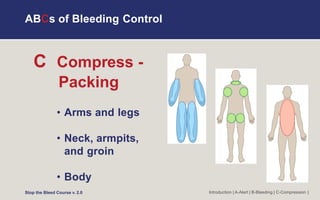
C Compress -
Packing
• Arms and legs
• Neck, armpits,
and groin
• Body
C Compress - T
ourniquet
• Apply 2 to 3 inches above wound
• Do not place over the elbow or knee
• Tighten tourniquet until bleeding stops
• Do NOT remove the tourniquet
Introduction | A-Alert | B-Bleeding | C-Compression |
ABCs of Bleeding Control
Stop the Bleed Course v. 2.0
C Compress - Tourniquet
• Can apply to others or on yourself
• Can be applied over clothes
• Tourniquets HURT
• A second tourniquet may be required to stop
the bleeding
Introduction | A-Alert | B-Bleeding | C-Compression |
ABCs of Bleeding Control
Stop the Bleed Course v. 2.0
ABCs of Bleeding Control
Introduction | A-Alert | B-Bleeding | C-Compression |
Stop the Bleed Course v. 2.0
ABCs of Bleeding Control
Introduction | A-Alert | B-Bleeding | C-Compression |
Stop the Bleed Course v. 2.0
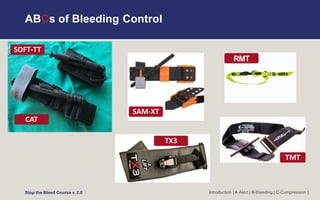
CAT
RMT
TX3
SAM-XT
TMT
CAT
SOFT-TT
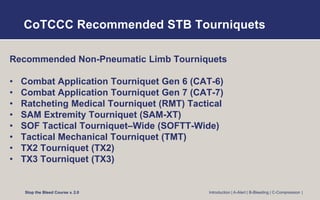
CoTCCC Recommended STB Tourniquets
Recommended Non-Pneumatic Limb Tourniquets
• Combat Application Tourniquet Gen 6 (CAT-6)
• Combat Application Tourniquet Gen 7 (CAT-7)
• Ratcheting Medical Tourniquet (RMT) Tactical
• SAM Extremity Tourniquet (SAM-XT)
• SOF Tactical Tourniquet–Wide (SOFTT-Wide)
• Tactical Mechanical Tourniquet (TMT)
• TX2 Tourniquet (TX2)
• TX3 Tourniquet (TX3)
Stop the Bleed Course v. 2.0 Introduction | A-Alert | B-Bleeding | C-Compression |
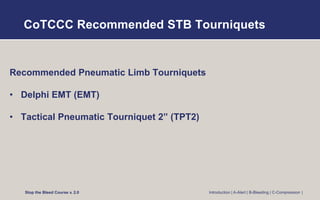
CoTCCC Recommended STB Tourniquets
Recommended Pneumatic Limb Tourniquets
• Delphi EMT (EMT)
• Tactical Pneumatic Tourniquet 2” (TPT2)
Stop the Bleed Course v. 2.0 Introduction | A-Alert | B-Bleeding | C-Compression |
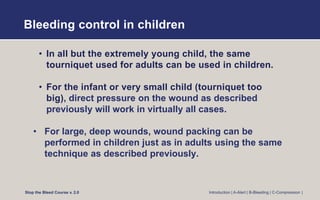
Bleeding control in children
• In all but the extremely young child, the same
tourniquet used for adults can be used in children.
• For the infant or very small child (tourniquet too
big), direct pressure on the wound as described
previously will work in virtually all cases.
• For large, deep wounds, wound packing can be
performed in children just as in adults using the same
technique as described previously.
Stop the Bleed Course v. 2.0 Introduction | A-Alert | B-Bleeding | C-Compression |
FAQs
• Impaled objects?
• Improvised tourniquets?
• Loss of arm or leg?
• Pain?
• Other questions?
Stop the Bleed Course v. 2.0 Introduction | A-Alert | B-Bleeding | C-Compression |
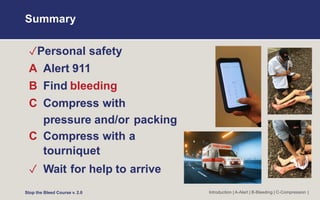
Summary
✓Personal safety
A Alert 911
B Find bleeding
C Compress with
pressure and/or packing
C Compress with a
tourniquet
✓ Wait for help to arrive
Stop the Bleed Course v. 2.0 Introduction | A-Alert | B-Bleeding | C-Compression |
For more information:
Stop the Bleed Course v. 2.0
STOPTHEBLEED.ORG
The only thing more tragic than a death…
is a death that could have been prevented.
Stop the Bleed Course v. 2.0

Manual STOP THE BLEED pdf.pdf

  • 1.
    STOP THE BLEED®Course American College of Surgeons Copyright © 2019 American College of Surgeons STOPTHEBLEED.ORG Version 2 STOP THE BLEED® is a registered trademark of the U.S. Department of Defense SAVE A LIFE
  • 2.
    The American College ofSurgeons Committee on Trauma The Committee on Tactical Combat Casualty Care The National Association of Emergency Medical Technicians The American College of Emergency Physicians
  • 3.
    Some of theimages shown during this presentation may be disturbing to some people. Stop the Bleed Course v. 2.0 Introduction | A-Alert | B-Bleeding | C-Compression |
  • 4.
    Why Do INeed This Training? Introduction | A-Alert | B-Bleeding | C-Compression | Stop the Bleed Course v. 2.0 The #1 cause of preventable death after injury is bleeding.
  • 5.
    Where Can IUse This Training? Introduction | A-Alert | B-Bleeding | C-Compression | Stop the Bleed Course v. 2.0
  • 6.
    Goals 1. Identify Recognize life-threatening bleeding Introduction |A-Alert | B-Bleeding | C-Compression | 2. Stop the Bleed Take steps to STOP THE BLEEDING ✓ Pressure ✓ Packing ✓ Tourniquets Stop the Bleed Course v. 2.0
  • 7.
    Personal Safety Introduction |A-Alert | B-Bleeding | C-Compression | YOUR safety is YOUR first priority • If you are injured, you cannot help others • Help others only when it’s safe to do so • If the situation changes or becomes unsafe: ✓ Stop ✓ Move to safety ✓ If you can, take the victim with you Stop the Bleed Course v. 2.0
  • 8.
    Personal Safety Introduction |A-Alert | B-Bleeding | C-Compression | YOUR safety is YOUR first priority • Wear gloves if you can • If you get blood on you, be sure to clean any part of your body that the blood has touched • Tell a health care provider that you got blood on you, and follow his or her direction Stop the Bleed Course v. 2.0
  • 9.
    ABCs of BleedingControl A Alert 911 B Bleeding C Compress Introduction | A-Alert | B-Bleeding | C-Compression | Stop the Bleed Course v. 2.0
  • 10.
    ABCs of BleedingControl A Alert 911 B Bleeding C Compress Introduction | A-Alert | B-Bleeding | C-Compression | Stop the Bleed Course v. 2.0
  • 11.
    ABCs of BleedingControl A Alert 911 • Call 911 • Know your location • Follow instructions provided by 911 operator Introduction | A-Alert | B-Bleeding | C-Compression | Stop the Bleed Course v. 2.0
  • 12.
    ABCs of BleedingControl A Alert 911 B Bleeding C Compress Introduction | A-Alert | B-Bleeding | C-Compression | Stop the Bleed Course v. 2.0
  • 13.
    ABCs of BleedingControl B Bleeding • Find source of bleeding • Look for: ✓ Continuous bleeding ✓ Large-volume bleeding ✓ Pooling of blood Introduction | A-Alert | B-Bleeding | C-Compression | Stop the Bleed Course v. 2.0
  • 14.
    ABCs of BleedingControl B Bleeding • There may be multiple places the victim is bleeding • Clothing may also hide life-threatening bleeding Introduction | A-Alert | B-Bleeding | C-Compression | Stop the Bleed Course v. 2.0
  • 15.
    ABCs of BleedingControl Introduction | A-Alert | B-Bleeding | C-Compression | Stop the Bleed Course v. 2.0 B Bleeding • Arms and legs • Neck, armpits, and groin • Body
  • 16.
    ABCs of BleedingControl A Alert 911 B Bleeding C Compress - Pressure Introduction | A-Alert | B-Bleeding | C-Compression | Stop the Bleed Course v. 2.0
  • 17.
    C Compress -Pressure • Apply direct pressure to wound • Focus on the location of the bleeding • Use just enough gauze or cloth to cover injury • If pressure stops the bleeding, keep pressure on wound until help arrives Introduction | A-Alert | B-Bleeding | C-Compression | ABCs of Bleeding Control Stop the Bleed Course v. 2.0
  • 18.
    ABCs of BleedingControl Introduction | A-Alert | B-Bleeding | C-Compression | Stop the Bleed Course v. 2.0
  • 19.
    ABCs of BleedingControl C Compress - Packing • For large wounds, superficial pressure is not effective • If bleeding is from a deep wound, pack gauze tightly into the wound until it stops the bleeding; hold pressure until help arrives Introduction | A-Alert | B-Bleeding | C- Compression | Stop the Bleed Course v. 2.0
  • 20.
    ABCs of BleedingControl Introduction | A-Alert | B-Bleeding | C-Compression | Stop the Bleed Course v. 2.0
  • 21.
    ABCs of BleedingControl Introduction | A-Alert | B-Bleeding | C-Compression | Stop the Bleed Course v. 2.0 C Compress - Packing • Arms and legs • Neck, armpits, and groin • Body
  • 22.
    C Compress -T ourniquet • Apply 2 to 3 inches above wound • Do not place over the elbow or knee • Tighten tourniquet until bleeding stops • Do NOT remove the tourniquet Introduction | A-Alert | B-Bleeding | C-Compression | ABCs of Bleeding Control Stop the Bleed Course v. 2.0
  • 23.
    C Compress -Tourniquet • Can apply to others or on yourself • Can be applied over clothes • Tourniquets HURT • A second tourniquet may be required to stop the bleeding Introduction | A-Alert | B-Bleeding | C-Compression | ABCs of Bleeding Control Stop the Bleed Course v. 2.0
  • 24.
    ABCs of BleedingControl Introduction | A-Alert | B-Bleeding | C-Compression | Stop the Bleed Course v. 2.0
  • 25.
    ABCs of BleedingControl Introduction | A-Alert | B-Bleeding | C-Compression | Stop the Bleed Course v. 2.0 CAT RMT TX3 SAM-XT TMT CAT SOFT-TT
  • 26.
    CoTCCC Recommended STBTourniquets Recommended Non-Pneumatic Limb Tourniquets • Combat Application Tourniquet Gen 6 (CAT-6) • Combat Application Tourniquet Gen 7 (CAT-7) • Ratcheting Medical Tourniquet (RMT) Tactical • SAM Extremity Tourniquet (SAM-XT) • SOF Tactical Tourniquet–Wide (SOFTT-Wide) • Tactical Mechanical Tourniquet (TMT) • TX2 Tourniquet (TX2) • TX3 Tourniquet (TX3) Stop the Bleed Course v. 2.0 Introduction | A-Alert | B-Bleeding | C-Compression |
  • 27.
    CoTCCC Recommended STBTourniquets Recommended Pneumatic Limb Tourniquets • Delphi EMT (EMT) • Tactical Pneumatic Tourniquet 2” (TPT2) Stop the Bleed Course v. 2.0 Introduction | A-Alert | B-Bleeding | C-Compression |
  • 28.
    Bleeding control inchildren • In all but the extremely young child, the same tourniquet used for adults can be used in children. • For the infant or very small child (tourniquet too big), direct pressure on the wound as described previously will work in virtually all cases. • For large, deep wounds, wound packing can be performed in children just as in adults using the same technique as described previously. Stop the Bleed Course v. 2.0 Introduction | A-Alert | B-Bleeding | C-Compression |
  • 29.
    FAQs • Impaled objects? •Improvised tourniquets? • Loss of arm or leg? • Pain? • Other questions? Stop the Bleed Course v. 2.0 Introduction | A-Alert | B-Bleeding | C-Compression |
  • 30.
    Summary ✓Personal safety A Alert911 B Find bleeding C Compress with pressure and/or packing C Compress with a tourniquet ✓ Wait for help to arrive Stop the Bleed Course v. 2.0 Introduction | A-Alert | B-Bleeding | C-Compression |
  • 31.
    For more information: Stopthe Bleed Course v. 2.0 STOPTHEBLEED.ORG
  • 32.
    The only thingmore tragic than a death… is a death that could have been prevented. Stop the Bleed Course v. 2.0