Manpower Planning
&
Job Analysis
Contents
• Concepts
• Objectives
• Characteristics
• Importance
• Types of manpower planning
• Process
• Example
• Factors affecting manpower planning
• Advantages
• Job analysis
• Job description
• Example
• Job specification
• Types of job analysis
• Job analysis program and its uses
• Methods of collecting job analysis information
MANPOWER
PLANNING
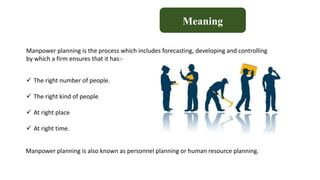
Meaning
Manpower planning is the process which includes forecasting, developing and controlling
by which a firm ensures that it has:-
 The right number of people.
 The right kind of people
 At right place
 At right time.
Manpower planning is also known as personnel planning or human resource planning.
Concept
 planning of manpower requirements
 planning of manpower supplies
Manpower planning involves two stages:
Objectives
 To utilize the present employees fully.
 To fill up future manpower requirements.
 To check the development of the employees for organizational growth.
 To achieve organizational goals in an efficient way.
 To manage and utilize resources properly and effectively.
Characteristics
 Future oriented.
 Continuous process
 Optimum utilization of human resources
 Right kinds and numbers
 Determination of demand and supply
 Environmental influence
Importance
 The first step towards manpower management.
 Using available assets for the implementation of the
business plans.
 Coordinates and controls various activities in the
organization.
 Efficient utilization & skilled labour.
 Higher productivity.
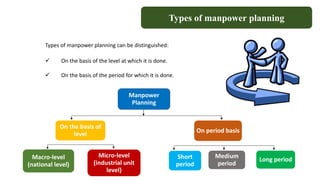
Types of manpower planning
Types of manpower planning can be distinguished:
 On the basis of the level at which it is done.
 On the basis of the period for which it is done.
On the basis of
level
On period basis
Macro-level
(national level)
Micro-level
(industrial unit
level)
Short
period
Medium
period
Long period
Manpower
Planning
Level based manpower planning :
 National level (macro level)
• central government plans for human resources for the entire nation.
• It anticipates the demand for and supply of human requirements at national level.
e.g. Government sectors
 Industrial level (micro level)
• In this level, planning is done to suit manpower needs of a particular industry.
e.g. engineering, heavy industries, paper industries, public utility, textile/chemical industries
Types of manpower planning (contd.)
Types of manpower planning (Contd.)
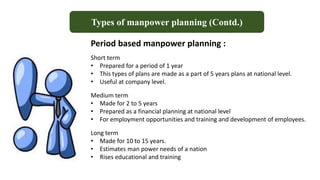
Period based manpower planning :
Short term
• Prepared for a period of 1 year
• This types of plans are made as a part of 5 years plans at national level.
• Useful at company level.
Medium term
• Made for 2 to 5 years
• Prepared as a financial planning at national level
• For employment opportunities and training and development of employees.
Long term
• Made for 10 to 15 years.
• Estimates man power needs of a nation
• Rises educational and training
Process
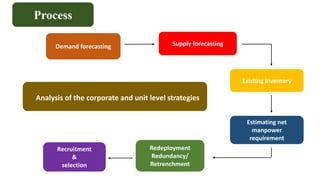
Demand forecasting Supply forecasting
Existing inventory
Estimating net
manpower
requirement
Redeployment
Redundancy/
Retrenchment
Recruitment
&
selection
Analysis of the corporate and unit level strategies
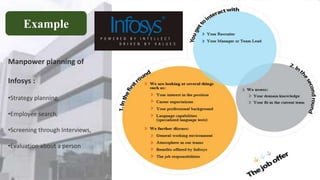
Manpower planning of
Infosys :
•Strategy planning,
•Employee search,
•Screening through Interviews,
•Evaluation about a person
Example
Manpower planning of McDonalds :
• Outsourcing the demand to local recruitment agencies.
• Each position has a job description outline.
• Career fairs.
• Local job centres.
• Offers online applications for the applicants to manage
the labour supply for its outlets.
Factors affecting manpower planning
Product mix :
• Optimum productive capacity and sales forecast
• Optimum utilization of human and material resources
Performance mix :
• Depends upon the working conditions, bonus schemes, suitable incentive plan, training program,
motivation etc.
• Motivation directly proportional to performance rate and inversely proportional to the labour capacity
Hour lost :
• If productive man hours lost are less, there available productive hours will be more and less manpower
will be needed.
Advantages
 Manpower planning ensures optimum use of available human resources.
 It is useful both for organization and nation.
 It generates facilities to educate people in the organization.
 It brings about fast economic developments.
 It boosts the geographical mobility of labor.
JOB
ANALYSIS &
DESCRIPTIO
N
• It is the first step in job evaluation and
requires investigation of each job skills and
personal attributes required to perform
the job satisfactorily.
• Determination of duties and positions and
characteristics of the people to hire for the
company.
Job analysis
Job description
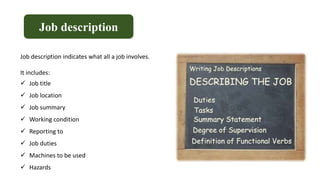
Job description indicates what all a job involves.
It includes:
 Job title
 Job location
 Job summary
 Working condition
 Reporting to
 Job duties
 Machines to be used
 Hazards
• She will be responsible and overall In-charge of
Nursing Services in a hospital or specialized centres
irrespective of the number of beds.
• She will carry out regular rounds of the hospital.
• She will ensure safe and efficient care rendered to
patients in various wards etc.
• She will prepare budgets for nursing services.
• She will be a member of various condemnation boards
for linen and other hospital stores.
• She will be responsible for counselling and guidance
of sub-ordinate staff.
Example for nursing
superintendent
Job specification
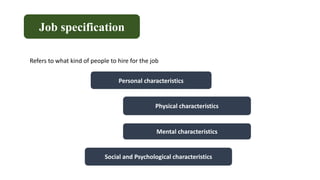
Refers to what kind of people to hire for the job
Personal characteristics
Physical characteristics
Mental characteristics
Social and Psychological characteristics
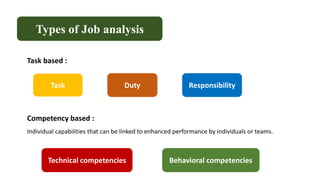
Types of Job analysis
Task based :
Competency based :
Individual capabilities that can be linked to enhanced performance by individuals or teams.
Task Duty Responsibility
Technical competencies Behavioral competencies
Job analysis program and its uses
 Recruitment and replacement
 Better utilization of workers
 Job restructuring
 Vocational Counselling
 Training
 Performance evaluation
 Occupational safety
Methods of collecting Job analysis
information
 Interview
 Questionnaires
 Observation
 Participant Diary/Logs
 Quantitative Job Analysis Techniques
 Using Multiple Sources of Information
manpower planning in management for students

manpower planning in management for students

  • 1.
  • 2.
    Contents • Concepts • Objectives •Characteristics • Importance • Types of manpower planning • Process • Example • Factors affecting manpower planning • Advantages • Job analysis • Job description • Example • Job specification • Types of job analysis • Job analysis program and its uses • Methods of collecting job analysis information
  • 3.
  • 4.
    Meaning Manpower planning isthe process which includes forecasting, developing and controlling by which a firm ensures that it has:-  The right number of people.  The right kind of people  At right place  At right time. Manpower planning is also known as personnel planning or human resource planning.
  • 5.
    Concept  planning ofmanpower requirements  planning of manpower supplies Manpower planning involves two stages:
  • 6.
    Objectives  To utilizethe present employees fully.  To fill up future manpower requirements.  To check the development of the employees for organizational growth.  To achieve organizational goals in an efficient way.  To manage and utilize resources properly and effectively.
  • 7.
    Characteristics  Future oriented. Continuous process  Optimum utilization of human resources  Right kinds and numbers  Determination of demand and supply  Environmental influence
  • 8.
    Importance  The firststep towards manpower management.  Using available assets for the implementation of the business plans.  Coordinates and controls various activities in the organization.  Efficient utilization & skilled labour.  Higher productivity.
  • 9.
    Types of manpowerplanning Types of manpower planning can be distinguished:  On the basis of the level at which it is done.  On the basis of the period for which it is done. On the basis of level On period basis Macro-level (national level) Micro-level (industrial unit level) Short period Medium period Long period Manpower Planning
  • 10.
    Level based manpowerplanning :  National level (macro level) • central government plans for human resources for the entire nation. • It anticipates the demand for and supply of human requirements at national level. e.g. Government sectors  Industrial level (micro level) • In this level, planning is done to suit manpower needs of a particular industry. e.g. engineering, heavy industries, paper industries, public utility, textile/chemical industries Types of manpower planning (contd.)
  • 11.
    Types of manpowerplanning (Contd.) Period based manpower planning : Short term • Prepared for a period of 1 year • This types of plans are made as a part of 5 years plans at national level. • Useful at company level. Medium term • Made for 2 to 5 years • Prepared as a financial planning at national level • For employment opportunities and training and development of employees. Long term • Made for 10 to 15 years. • Estimates man power needs of a nation • Rises educational and training
  • 12.
    Process Demand forecasting Supplyforecasting Existing inventory Estimating net manpower requirement Redeployment Redundancy/ Retrenchment Recruitment & selection Analysis of the corporate and unit level strategies
  • 13.
    Manpower planning of Infosys: •Strategy planning, •Employee search, •Screening through Interviews, •Evaluation about a person Example
  • 14.
    Manpower planning ofMcDonalds : • Outsourcing the demand to local recruitment agencies. • Each position has a job description outline. • Career fairs. • Local job centres. • Offers online applications for the applicants to manage the labour supply for its outlets.
  • 15.
    Factors affecting manpowerplanning Product mix : • Optimum productive capacity and sales forecast • Optimum utilization of human and material resources Performance mix : • Depends upon the working conditions, bonus schemes, suitable incentive plan, training program, motivation etc. • Motivation directly proportional to performance rate and inversely proportional to the labour capacity Hour lost : • If productive man hours lost are less, there available productive hours will be more and less manpower will be needed.
  • 16.
    Advantages  Manpower planningensures optimum use of available human resources.  It is useful both for organization and nation.  It generates facilities to educate people in the organization.  It brings about fast economic developments.  It boosts the geographical mobility of labor.
  • 17.
  • 18.
    • It isthe first step in job evaluation and requires investigation of each job skills and personal attributes required to perform the job satisfactorily. • Determination of duties and positions and characteristics of the people to hire for the company. Job analysis
  • 19.
    Job description Job descriptionindicates what all a job involves. It includes:  Job title  Job location  Job summary  Working condition  Reporting to  Job duties  Machines to be used  Hazards
  • 20.
    • She willbe responsible and overall In-charge of Nursing Services in a hospital or specialized centres irrespective of the number of beds. • She will carry out regular rounds of the hospital. • She will ensure safe and efficient care rendered to patients in various wards etc. • She will prepare budgets for nursing services. • She will be a member of various condemnation boards for linen and other hospital stores. • She will be responsible for counselling and guidance of sub-ordinate staff. Example for nursing superintendent
  • 21.
    Job specification Refers towhat kind of people to hire for the job Personal characteristics Physical characteristics Mental characteristics Social and Psychological characteristics
  • 22.
    Types of Jobanalysis Task based : Competency based : Individual capabilities that can be linked to enhanced performance by individuals or teams. Task Duty Responsibility Technical competencies Behavioral competencies
  • 23.
    Job analysis programand its uses  Recruitment and replacement  Better utilization of workers  Job restructuring  Vocational Counselling  Training  Performance evaluation  Occupational safety
  • 24.
    Methods of collectingJob analysis information  Interview  Questionnaires  Observation  Participant Diary/Logs  Quantitative Job Analysis Techniques  Using Multiple Sources of Information

Editor's Notes

  • #6 The first stage is concerned with the detailed “planning of manpower requirements for all types and levels of employees throughout the period of the plan,” and the second stage is concerned with “planning of manpower supplies to provide the organisation with the right types of people from all sources to meet the planned requirements.”
  • #13 Managerial Judgment, statistical techniques, econometric models, work study technique
  • #14 Internal/External sources, Primary Interview, Selection tests (Written tests), Face-to-face interview/Hr interview, Reference background analysis, Selection decision, Job offer/Call letter, Employment agreements, Evaluation