Managing intellectual liabilities by
service recovery
Harri Laihonen
University of Tampere
Virpi Sillanpää
Tampere University of Technology
Maiju Vuolle
Tampere University of Technology
12th International Forum on Knowledge Asset
Dynamics, St.Petersburg, 8 June 2017
Agenda
• Motivation and objectives of the study
• Research strategy
• Observations from the literature
• Results
• Conclusions
12th International Forum on Knowledge Asset
Dynamics, St.Petersburg, 8 June 2017
Motivation and objectives of the
study
• To develop IC organizations need to acknowledge the impact of
factors that are likely to depreciate value of intangible assets (Caddy
2000; Stam 2009; Garcia-Parra et al. 2009)
• Literature on ILs has been mainly theoretical – lack of practical
management studies
• Negative customer experiences can be considered as intellectual
liabilities having negative impact on organizations intellectual
capital
• Service recovery literature discusses components of unsuccessful
customer experience and ways of reacting to service failures in
order to turn them to positive result (e.g., Davidow, 2003; Grönroos, 2007; Liao, 2007;
Michel et al., 2009)
• By combining these two streams of literature, this paper aims to
answer to two research questions:
1) what are intellectual liabilities in customer encounters? and
2) how these intellectual liabilities could be better managed?
12th International Forum on Knowledge Asset
Dynamics, St.Petersburg, 8 June 2017
Research strategy
• Literature review
• Intellectual liabilities
• Service recovery literature
 Conceptual model
• Empirical research
• Thematic interviews (n=16) to identify key pitfalls and
practices of challenging customer encounters in three main
phases of customer journey in construction industry
• Two workshops in construction companies to reflect findings
and to improve and create new customer encounter practices
12th International Forum on Knowledge Asset
Dynamics, St.Petersburg, 8 June 2017
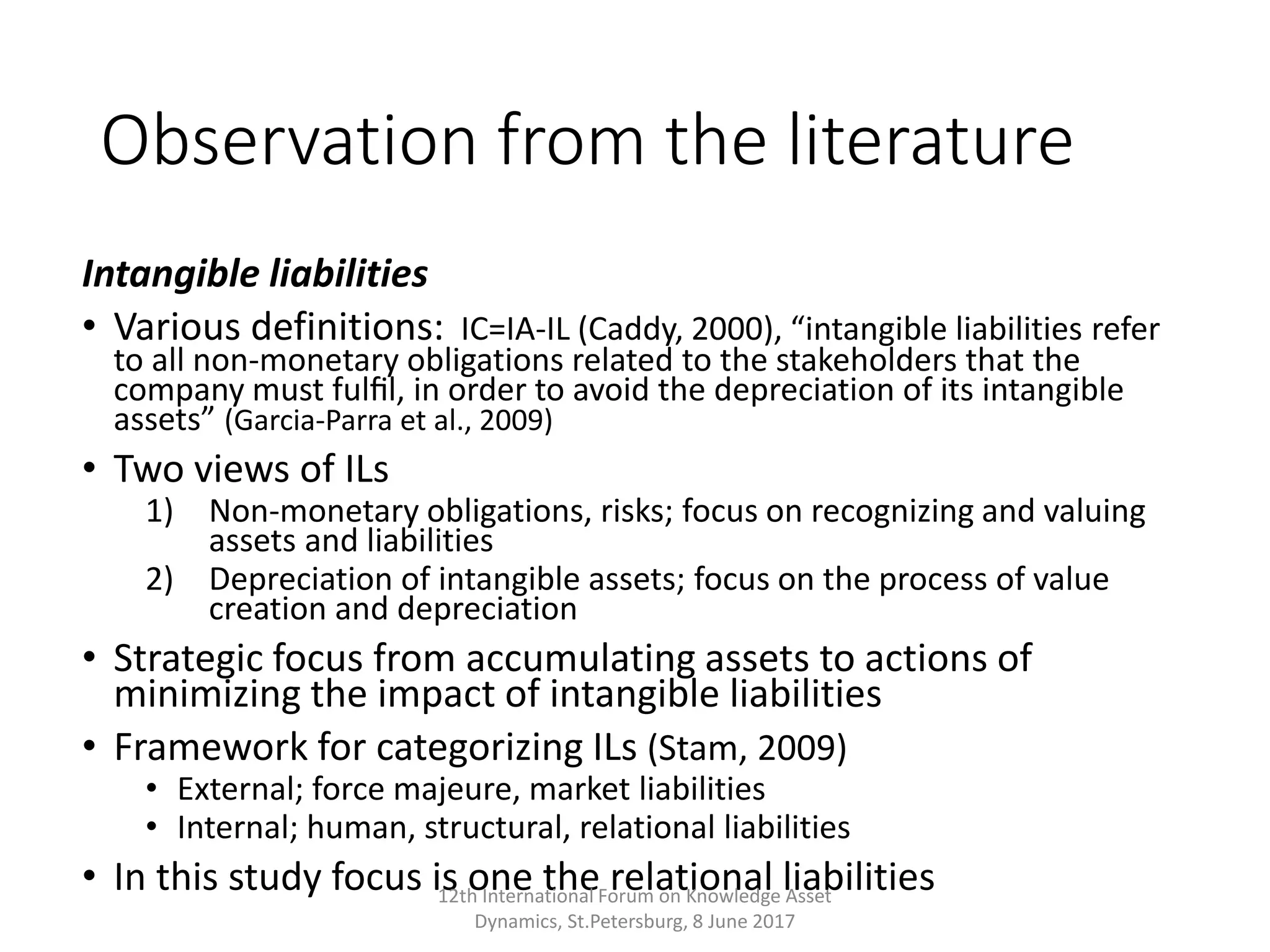
Observation from the literature
Intangible liabilities
• Various definitions: IC=IA-IL (Caddy, 2000), “intangible liabilities refer
to all non-monetary obligations related to the stakeholders that the
company must fulfil, in order to avoid the depreciation of its intangible
assets” (Garcia-Parra et al., 2009)
• Two views of ILs
1) Non-monetary obligations, risks; focus on recognizing and valuing
assets and liabilities
2) Depreciation of intangible assets; focus on the process of value
creation and depreciation
• Strategic focus from accumulating assets to actions of
minimizing the impact of intangible liabilities
• Framework for categorizing ILs (Stam, 2009)
• External; force majeure, market liabilities
• Internal; human, structural, relational liabilities
• In this study focus is one the relational liabilities12th International Forum on Knowledge Asset
Dynamics, St.Petersburg, 8 June 2017
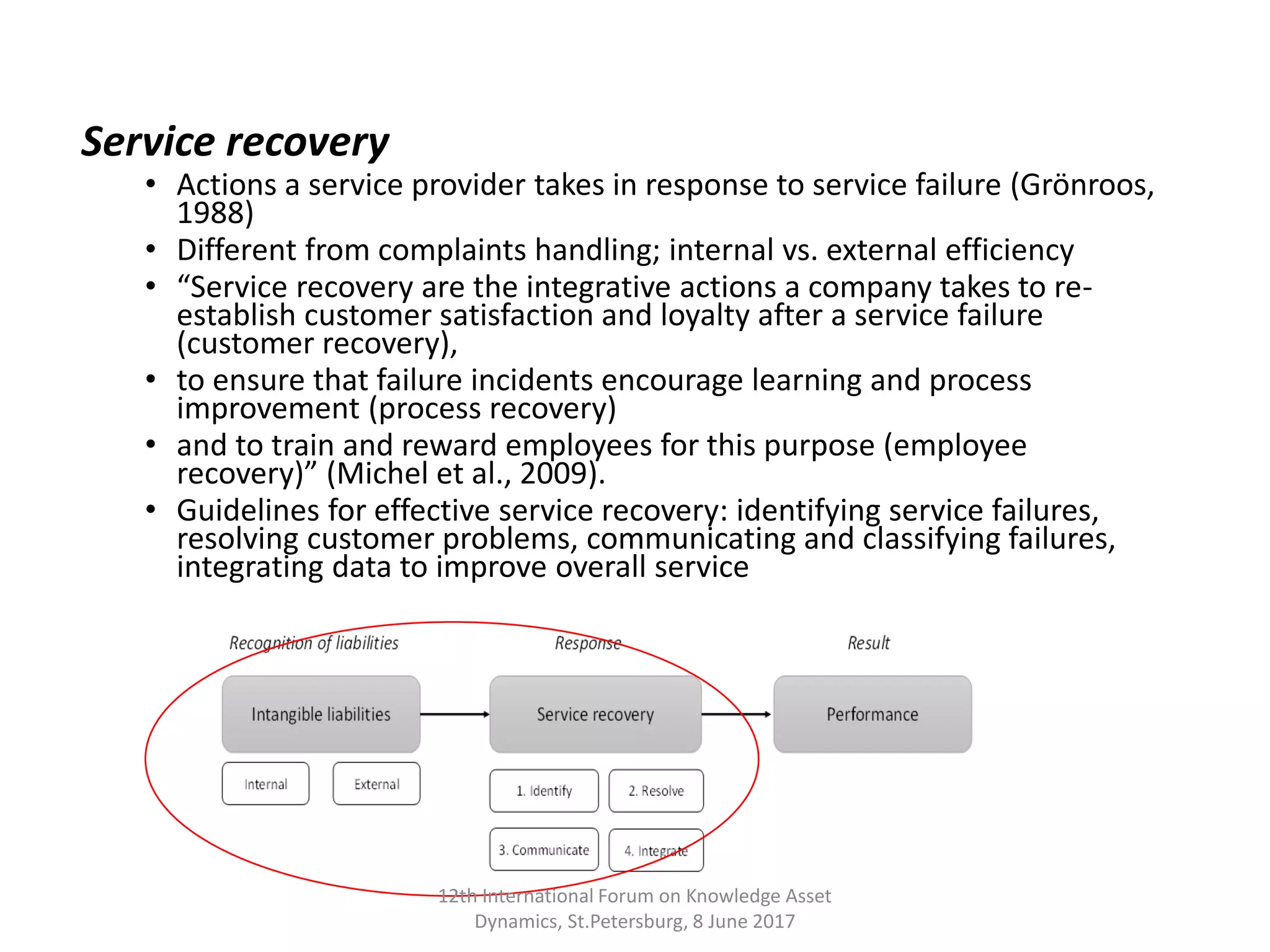
Service recovery
• Actions a service provider takes in response to service failure (Grönroos,
1988)
• Different from complaints handling; internal vs. external efficiency
• “Service recovery are the integrative actions a company takes to re-
establish customer satisfaction and loyalty after a service failure
(customer recovery),
• to ensure that failure incidents encourage learning and process
improvement (process recovery)
• and to train and reward employees for this purpose (employee
recovery)” (Michel et al., 2009).
• Guidelines for effective service recovery: identifying service failures,
resolving customer problems, communicating and classifying failures,
integrating data to improve overall service
12th International Forum on Knowledge Asset
Dynamics, St.Petersburg, 8 June 2017
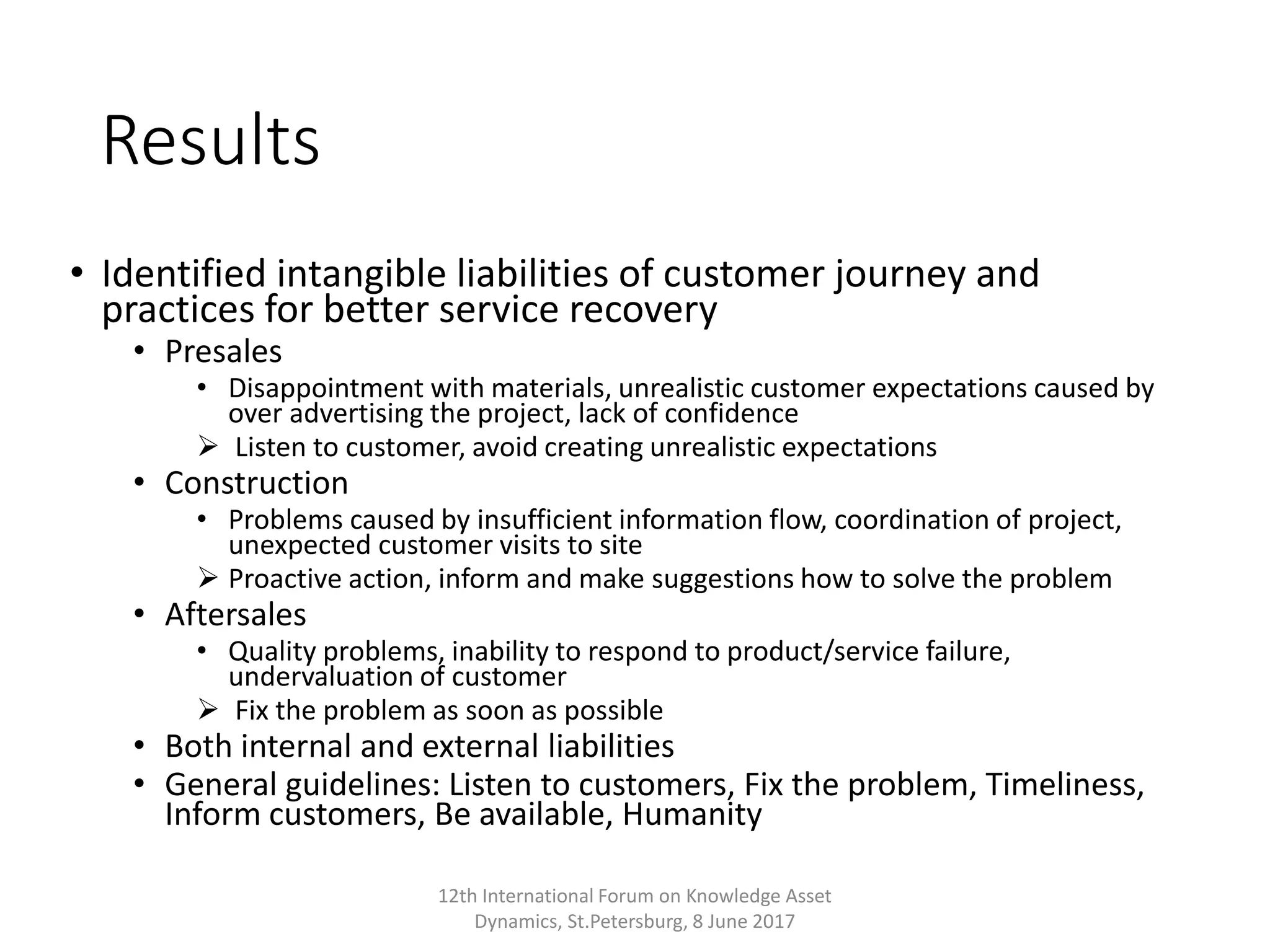
Results
• Identified intangible liabilities of customer journey and
practices for better service recovery
• Presales
• Disappointment with materials, unrealistic customer expectations caused by
over advertising the project, lack of confidence
 Listen to customer, avoid creating unrealistic expectations
• Construction
• Problems caused by insufficient information flow, coordination of project,
unexpected customer visits to site
 Proactive action, inform and make suggestions how to solve the problem
• Aftersales
• Quality problems, inability to respond to product/service failure,
undervaluation of customer
 Fix the problem as soon as possible
• Both internal and external liabilities
• General guidelines: Listen to customers, Fix the problem, Timeliness,
Inform customers, Be available, Humanity
12th International Forum on Knowledge Asset
Dynamics, St.Petersburg, 8 June 2017
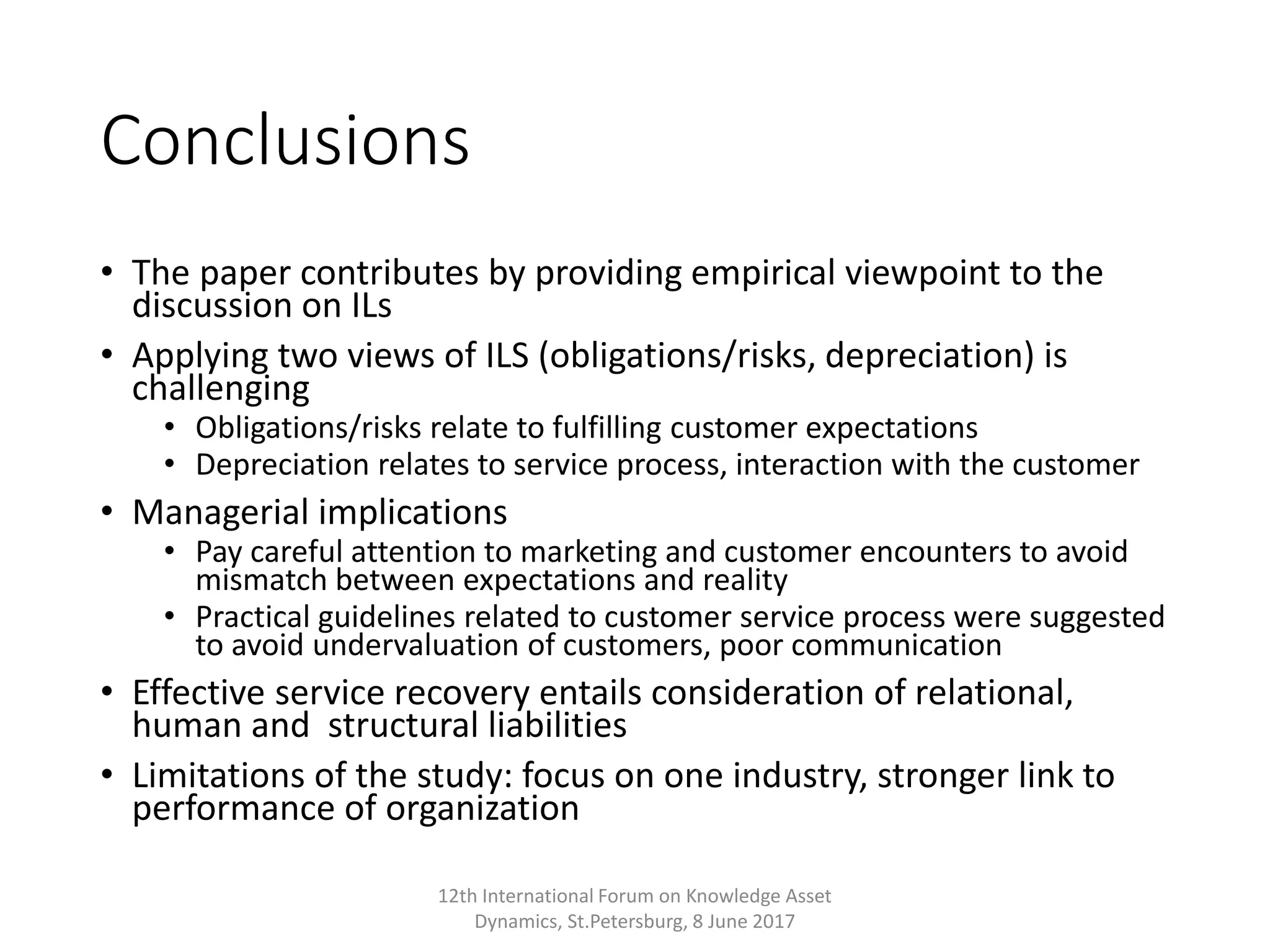
Conclusions
• The paper contributes by providing empirical viewpoint to the
discussion on ILs
• Applying two views of ILS (obligations/risks, depreciation) is
challenging
• Obligations/risks relate to fulfilling customer expectations
• Depreciation relates to service process, interaction with the customer
• Managerial implications
• Pay careful attention to marketing and customer encounters to avoid
mismatch between expectations and reality
• Practical guidelines related to customer service process were suggested
to avoid undervaluation of customers, poor communication
• Effective service recovery entails consideration of relational,
human and structural liabilities
• Limitations of the study: focus on one industry, stronger link to
performance of organization
12th International Forum on Knowledge Asset
Dynamics, St.Petersburg, 8 June 2017
Questions?
12th International Forum on Knowledge Asset
Dynamics, St.Petersburg, 8 June 2017
Virpi Sillanpää, virpi.sillanpaa@tut.fi
Harri Laihonen, harri.laihonen@uta.fi
Maiju Vuolle, maiju.vuolle@tut.fi
Thank you!

Managing intellectual liabilities by service recovery

  • 1.
    Managing intellectual liabilitiesby service recovery Harri Laihonen University of Tampere Virpi Sillanpää Tampere University of Technology Maiju Vuolle Tampere University of Technology 12th International Forum on Knowledge Asset Dynamics, St.Petersburg, 8 June 2017
  • 2.
    Agenda • Motivation andobjectives of the study • Research strategy • Observations from the literature • Results • Conclusions 12th International Forum on Knowledge Asset Dynamics, St.Petersburg, 8 June 2017
  • 3.
    Motivation and objectivesof the study • To develop IC organizations need to acknowledge the impact of factors that are likely to depreciate value of intangible assets (Caddy 2000; Stam 2009; Garcia-Parra et al. 2009) • Literature on ILs has been mainly theoretical – lack of practical management studies • Negative customer experiences can be considered as intellectual liabilities having negative impact on organizations intellectual capital • Service recovery literature discusses components of unsuccessful customer experience and ways of reacting to service failures in order to turn them to positive result (e.g., Davidow, 2003; Grönroos, 2007; Liao, 2007; Michel et al., 2009) • By combining these two streams of literature, this paper aims to answer to two research questions: 1) what are intellectual liabilities in customer encounters? and 2) how these intellectual liabilities could be better managed? 12th International Forum on Knowledge Asset Dynamics, St.Petersburg, 8 June 2017
  • 4.
    Research strategy • Literaturereview • Intellectual liabilities • Service recovery literature  Conceptual model • Empirical research • Thematic interviews (n=16) to identify key pitfalls and practices of challenging customer encounters in three main phases of customer journey in construction industry • Two workshops in construction companies to reflect findings and to improve and create new customer encounter practices 12th International Forum on Knowledge Asset Dynamics, St.Petersburg, 8 June 2017
  • 5.
    Observation from theliterature Intangible liabilities • Various definitions: IC=IA-IL (Caddy, 2000), “intangible liabilities refer to all non-monetary obligations related to the stakeholders that the company must fulfil, in order to avoid the depreciation of its intangible assets” (Garcia-Parra et al., 2009) • Two views of ILs 1) Non-monetary obligations, risks; focus on recognizing and valuing assets and liabilities 2) Depreciation of intangible assets; focus on the process of value creation and depreciation • Strategic focus from accumulating assets to actions of minimizing the impact of intangible liabilities • Framework for categorizing ILs (Stam, 2009) • External; force majeure, market liabilities • Internal; human, structural, relational liabilities • In this study focus is one the relational liabilities12th International Forum on Knowledge Asset Dynamics, St.Petersburg, 8 June 2017
  • 6.
    Service recovery • Actionsa service provider takes in response to service failure (Grönroos, 1988) • Different from complaints handling; internal vs. external efficiency • “Service recovery are the integrative actions a company takes to re- establish customer satisfaction and loyalty after a service failure (customer recovery), • to ensure that failure incidents encourage learning and process improvement (process recovery) • and to train and reward employees for this purpose (employee recovery)” (Michel et al., 2009). • Guidelines for effective service recovery: identifying service failures, resolving customer problems, communicating and classifying failures, integrating data to improve overall service 12th International Forum on Knowledge Asset Dynamics, St.Petersburg, 8 June 2017
  • 7.
    Results • Identified intangibleliabilities of customer journey and practices for better service recovery • Presales • Disappointment with materials, unrealistic customer expectations caused by over advertising the project, lack of confidence  Listen to customer, avoid creating unrealistic expectations • Construction • Problems caused by insufficient information flow, coordination of project, unexpected customer visits to site  Proactive action, inform and make suggestions how to solve the problem • Aftersales • Quality problems, inability to respond to product/service failure, undervaluation of customer  Fix the problem as soon as possible • Both internal and external liabilities • General guidelines: Listen to customers, Fix the problem, Timeliness, Inform customers, Be available, Humanity 12th International Forum on Knowledge Asset Dynamics, St.Petersburg, 8 June 2017
  • 8.
    Conclusions • The papercontributes by providing empirical viewpoint to the discussion on ILs • Applying two views of ILS (obligations/risks, depreciation) is challenging • Obligations/risks relate to fulfilling customer expectations • Depreciation relates to service process, interaction with the customer • Managerial implications • Pay careful attention to marketing and customer encounters to avoid mismatch between expectations and reality • Practical guidelines related to customer service process were suggested to avoid undervaluation of customers, poor communication • Effective service recovery entails consideration of relational, human and structural liabilities • Limitations of the study: focus on one industry, stronger link to performance of organization 12th International Forum on Knowledge Asset Dynamics, St.Petersburg, 8 June 2017
  • 9.
    Questions? 12th International Forumon Knowledge Asset Dynamics, St.Petersburg, 8 June 2017 Virpi Sillanpää, virpi.sillanpaa@tut.fi Harri Laihonen, harri.laihonen@uta.fi Maiju Vuolle, maiju.vuolle@tut.fi Thank you!