Management Information Systems 6th Edition Oz
Test Bank download pdf
https://testbankdeal.com/product/management-information-systems-6th-
edition-oz-test-bank/
Visit testbankdeal.com to explore and download the complete
collection of test banks or solution manuals!
Here are some recommended products for you. Click the link to
download, or explore more at testbankdeal.com
Management Information Systems 10th Edition Obrien Test
Bank
https://testbankdeal.com/product/management-information-systems-10th-
edition-obrien-test-bank/
Management Information Systems 10th Edition McLeod Test
Bank
https://testbankdeal.com/product/management-information-systems-10th-
edition-mcleod-test-bank/
Management Information Systems 13th Edition Laudon Test
Bank
https://testbankdeal.com/product/management-information-systems-13th-
edition-laudon-test-bank/
Americas History Concise Edition Volume 2 9th Edition
Edwards Test Bank
https://testbankdeal.com/product/americas-history-concise-edition-
volume-2-9th-edition-edwards-test-bank/
Gardners Art Through the Ages A Global History Vol 2 14th
Edition Kleiner Test Bank
https://testbankdeal.com/product/gardners-art-through-the-ages-a-
global-history-vol-2-14th-edition-kleiner-test-bank/
Analytical Mechanics 7th Edition Fowles Solutions Manual
https://testbankdeal.com/product/analytical-mechanics-7th-edition-
fowles-solutions-manual/
Consumer behaviour implications for Marketing strategy 7th
Edition Quester Test Bank
https://testbankdeal.com/product/consumer-behaviour-implications-for-
marketing-strategy-7th-edition-quester-test-bank/
Race and Ethnicity in the United States 8th Edition
Schaefer Test Bank
https://testbankdeal.com/product/race-and-ethnicity-in-the-united-
states-8th-edition-schaefer-test-bank/
Physical Chemistry Principles and Applications in
Biological Sciences 5th Edition Tinoco Solutions Manual
https://testbankdeal.com/product/physical-chemistry-principles-and-
applications-in-biological-sciences-5th-edition-tinoco-solutions-
manual/
Taxation of Business Entities 2017 8th Edition Spilker
Solutions Manual
https://testbankdeal.com/product/taxation-of-business-
entities-2017-8th-edition-spilker-solutions-manual/
Chapter 7: Databases and Data Warehouses
TRUE/FALSE
1. The impact of database technology on business can be easily overstated.
ANS: F PTS: 1 REF: 233
2. Inaccuracies hurt data integrity.
ANS: T PTS: 1 REF: 235
3. Multiple characters make up a record.
ANS: F PTS: 1 REF: 235
4. A database itself is a collection of several related files, but DBMSs do all the work—structuring files,
storing data, and linking records.
ANS: T PTS: 1 REF: 236
5. Data is accessed in a database by sending messages called “protocols,” which request data from
specific records and/or fields and direct the computer to display the results.
ANS: F PTS: 1 REF: 237
6. To retrieve records from a relational database, or to sort them, you must use a key.
ANS: T PTS: 1 REF: 239
7. Sometimes a key is composed of several records so that their combination provides a unique key.
ANS: F PTS: 1 REF: 239
8. Usually, a table in a relational database must have a primary key, and most relational DBMSs enforce
this rule.
ANS: T PTS: 1 REF: 239
9. Object-oriented databases (ODBs) do not store records, but data objects, which is an advantage for
quick updates of data sets and the relationships among them.
ANS: T PTS: 1 REF: 242
10. One of the most useful manipulations of object-oriented databases (ODBs) is the creation of a new
table from two or more other tables.
ANS: F PTS: 1 REF: 243
11. A schema describes the structure of the database being designed: the names and types of fields in each
record type and the general relationships among different sets of records or files.
ANS: T PTS: 1 REF: 244
12. The conceptual blueprint of the database is called an entity relationship diagram (ERD).
ANS: T PTS: 1 REF: 245
13. From a technical point of view, online databases that are used with Web browsers are different from
other databases.
ANS: F PTS: 1 REF: 247
14. A data warehouse is a large, typically relational, database that supports management decision making.
ANS: T PTS: 1 REF: 248
15. The larger the data warehouse, the larger the storage capacity, the greater the memory, and the greater
the processing power of the computers that are needed.
ANS: T PTS: 1 REF: 250
16. There are two phases involved in building a data warehouse from transactional data: extraction and
transforming.
ANS: F PTS: 1 REF: 251
17. Once the data warehouse is in operation, much of the ETL activity can be automated.
ANS: T PTS: 1 REF: 252
MULTIPLE CHOICE
1. There are two overall approaches to maintaining data: the traditional file approach—which has no
mechanism for tagging, retrieving, and manipulating data—and the ____, which does have this
mechanism.
a. database approach c. datafile approach
b. data approach d. indexed file approach
ANS: A PTS: 1 REF: 234
2. The very fact that manipulation of the data requires a programmer is probably the greatest
disadvantage of the ____.
a. information file approach c. database approach
b. file approach d. indexed file approach
ANS: B PTS: 1 REF: 234
3. Often, the traditional file approach to storing data leads to low ____.
a. data readability c. data integrity
b. data flexibility d. data capacity
ANS: C PTS: 1 REF: 235
4. In the database approach, data pieces are organized about ____.
a. indexes c. programs
b. characters d. entities
ANS: D PTS: 1 REF: 235
5. A collection of related records, such as all the records of a college’s students, is called a(n) ____.
a. field c. item
b. character d. file
ANS: D PTS: 1 REF: 235
6. Databases are stored on and processed from ____ storage devices, such as magnetic disks or DVDs.
a. internal access c. direct access
b. sequential access d. main access
ANS: C PTS: 1 REF: 237
7. A ____ is the general logical structure in which records are stored within a database and the method
used to establish relationships among the records.
a. database relationship c. database list
b. database model d. database catalog
ANS: B PTS: 1 REF: 238
8. To design a(n) ____, you need a clear idea of the different entities and how they relate.
a. relational database c. model database
b. file database d. object database
ANS: A PTS: 1 REF: 239
9. A(n) ____ is unique if the value (content) in that field appears only in one record.
a. entity c. object
b. key d. item
ANS: B PTS: 1 REF: 239
10. A ____ is the field by which records in a table are uniquely identified.
a. secondary key c. primary key
b. composite key d. main key
ANS: C PTS: 1 REF: 239
11. To link records from one table with records of another table, the tables must have at least one field in
common, and that field must be a ____ field for one of the tables.
a. composite key c. foreign key
b. main key d. primary key
ANS: D PTS: 1 REF: 240
12. A ____ can be maintained, for instance, for professors and students in a college database.
a. one-to-many relationship c. composite relationship
b. foreign relationship d. many-to-many relationship
ANS: D PTS: 1 REF: 241
13. The combined storage of both data and the procedures that manipulate them is referred to as ____.
a. compression c. encapsulation
b. packaging d. zipping
ANS: C PTS: 1 REF: 241
14. A(n) ____ is created “on the fly” as a result of a query and exists only for the duration the user wishes
to view it or to create a paper report from it.
a. join table c. object table
b. two-way table d. entity table
ANS: A PTS: 1 REF: 243
15. When building a new database, users must first build a schema (from the Greek word for “____”).
a. plan c. task
b. job d. work
ANS: A PTS: 1 REF: 244
16. Many ____ also allow a builder to positively indicate when a field is not unique, meaning that the
value in that field might be the same for more than one record.
a. languages c. models
b. DBMSs d. structures
ANS: B PTS: 1 REF: 244
17. ____ should first be done to decide which data should be collected and how it should be organized.
a. Report modeling c. Object structuring
b. Data structuring d. Data modeling
ANS: D PTS: 1 REF: 245
18. Effective ____ and design of each database involves the creation of a conceptual blueprint of the
database.
a. file modeling c. data modeling
b. file structuring d. data relating
ANS: C PTS: 1 REF: 245
19. All relationships and the various needs for ____ must be taken into account when designing the
database.
a. enquiries c. communications
b. programs d. reports
ANS: D PTS: 1 REF: 246
20. Many organizations have found that if they accumulate ____, they can use it for important
management decisions, such as researching market trends or tracking down fraud.
a. transaction indexes c. field tables
b. field indexes d. transaction data
ANS: D PTS: 1 REF: 248
21. ____ do not replace transactional databases, which are updated with daily transactions such as sales,
billing, cash receipts, and returns.
a. Data houses c. Data boxes
b. Data warehouses d. Relational databases
ANS: B PTS: 1 REF: 248
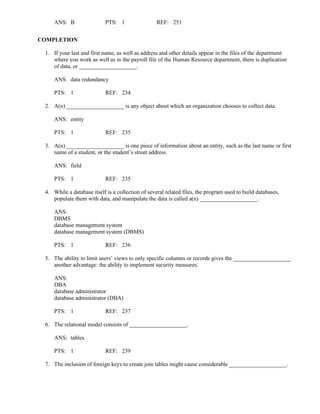
22. While a transactional database contains current data, which is disposed of after some time, the data in
____ is accumulated and might reflect many years of business activities.
a. data warehouses c. information bases
b. data carts d. information repositories
ANS: A PTS: 1 REF: 248
23. If ____ need to be used as one large data warehouse, special software tools can unify them and make
them appear as one large data warehouse.
a. data marts c. information marts
b. data carts d. information repositories
ANS: A PTS: 1 REF: 248
24. When management decides to build a ____, the IT staff must carefully consider the hardware,
software, and data involved in the effort.
a. network c. database network
b. data warehouse d. data house
ANS: B PTS: 1 REF: 250
25. Because of capacity needs, organizations often choose ____ to store and manage data warehouses.
a. midrange servers
b. high speed networks
c. mainframe computers with multiple CPUs
d. workstations
ANS: C PTS: 1 REF: 250
26. To uncover the valuable information contained in their data, organizations must use software that can
effectively “____” data warehouses.
a. house c. merge
b. cement d. mine
ANS: D PTS: 1 REF: 251
27. The designers of data warehouses must keep in mind ____: the ability of the data warehouse to grow
as the amount of the data and the processing needs grow.
a. flexibility c. capacity
b. reliability d. scalability
ANS: D PTS: 1 REF: 251
28. In the ____ phase of transferring data from a transactional database to a data warehouse, the builders
create the files from transactional databases and save them on the server that will hold the data
warehouse.
a. loading c. extraction
b. transformation d. injection
ANS: C PTS: 1 REF: 251
29. In the ____ phase of transferring data from a transactional database to a data warehouse, specialists
“cleanse” the data and modify it into a form that allows insertion into the data warehouse.
a. extraction c. injection
b. transformation d. loading
ANS: B PTS: 1 REF: 251
COMPLETION
1. If your last and first name, as well as address and other details appear in the files of the department
where you work as well as in the payroll file of the Human Resource department, there is duplication
of data, or ____________________.
ANS: data redundancy
PTS: 1 REF: 234
2. A(n) ____________________ is any object about which an organization chooses to collect data.
ANS: entity
PTS: 1 REF: 235
3. A(n) ____________________ is one piece of information about an entity, such as the last name or first
name of a student, or the student’s street address.
ANS: field
PTS: 1 REF: 235
4. While a database itself is a collection of several related files, the program used to build databases,
populate them with data, and manipulate the data is called a(n) ____________________.
ANS:
DBMS
database management system
database management system (DBMS)
PTS: 1 REF: 236
5. The ability to limit users’ views to only specific columns or records gives the ____________________
another advantage: the ability to implement security measures.
ANS:
DBA
database administrator
database administrator (DBA)
PTS: 1 REF: 237
6. The relational model consists of ____________________.
ANS: tables
PTS: 1 REF: 239
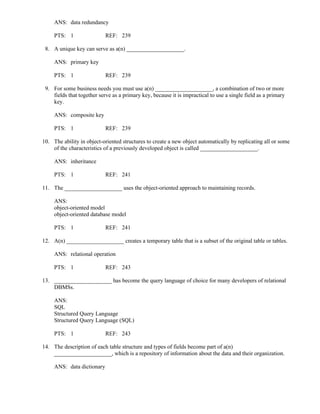
7. The inclusion of foreign keys to create join tables might cause considerable ____________________.
ANS: data redundancy
PTS: 1 REF: 239
8. A unique key can serve as a(n) ____________________.
ANS: primary key
PTS: 1 REF: 239
9. For some business needs you must use a(n) ____________________, a combination of two or more
fields that together serve as a primary key, because it is impractical to use a single field as a primary
key.
ANS: composite key
PTS: 1 REF: 239
10. The ability in object-oriented structures to create a new object automatically by replicating all or some
of the characteristics of a previously developed object is called ____________________.
ANS: inheritance
PTS: 1 REF: 241
11. The ____________________ uses the object-oriented approach to maintaining records.
ANS:
object-oriented model
object-oriented database model
PTS: 1 REF: 241
12. A(n) ____________________ creates a temporary table that is a subset of the original table or tables.
ANS: relational operation
PTS: 1 REF: 243
13. ____________________ has become the query language of choice for many developers of relational
DBMSs.
ANS:
SQL
Structured Query Language
Structured Query Language (SQL)
PTS: 1 REF: 243
14. The description of each table structure and types of fields become part of a(n)
____________________, which is a repository of information about the data and their organization.
ANS: data dictionary
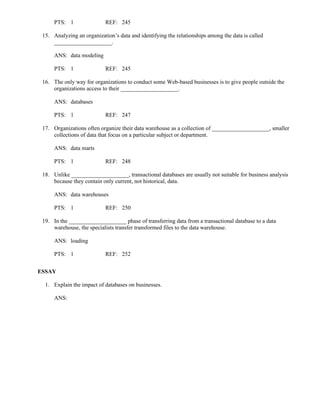
PTS: 1 REF: 245
15. Analyzing an organization’s data and identifying the relationships among the data is called
____________________.
ANS: data modeling
PTS: 1 REF: 245
16. The only way for organizations to conduct some Web-based businesses is to give people outside the
organizations access to their ____________________.
ANS: databases
PTS: 1 REF: 247
17. Organizations often organize their data warehouse as a collection of ____________________, smaller
collections of data that focus on a particular subject or department.
ANS: data marts
PTS: 1 REF: 248
18. Unlike ____________________, transactional databases are usually not suitable for business analysis
because they contain only current, not historical, data.
ANS: data warehouses
PTS: 1 REF: 250
19. In the ____________________ phase of transferring data from a transactional database to a data
warehouse, the specialists transfer transformed files to the data warehouse.
ANS: loading
PTS: 1 REF: 252
ESSAY
1. Explain the impact of databases on businesses.
ANS:
The impact of database technology on business cannot be overstated. Not only has it changed the way
almost every industry conducts business, but it has also created an information industry with
far-reaching effects on both our business and personal lives. Databases are behind the successful use of
automatic teller machines, increased efficiency in retail stores, almost every marketing effort, and the
numerous online search engines and web-based businesses. Combined with interactive Web pages on
the Internet, databases have made an immense contribution to commerce. Without them, there would
be no online banking, no online consumer catalogs, no online searches for information, no online stock
brokerages, and no online chat rooms. Their impact on business has allowed fewer people to complete
larger tasks, and their power has allowed organizations to learn more about us, as consumers, than we
might realize. Imagine: every time you enter the address of a Web site, a special program performs a
search in a huge database and matches your request with one of millions of addresses. Every time you
fill out an online form with details such as your address, phone number, Social Security number
(SSN), or credit-card number, a program feeds the data into a database, where each item is recorded
for further use.
PTS: 1 REF: 233
2. Discuss the security issues concerning databases.
ANS:
The use of databases raises security and privacy issues. The fact that data is stored only once in a
database for several different purposes does not mean that everyone with access to that database
should have access to all the data in it. Restricting access is easily dealt with by customizing menus for
different users and requiring users to enter codes that limit access to certain fields or records. As a
result, users have different views of the database.The ability to limit users’ views to only specific
columns or records gives the database administrator (DBA) another advantage: the ability to
implement security measures. The measures are implemented once for the database, rather than
multiple times for different files. For instance, while a human resource manager has access to all fields
of the employee file, the payroll personnel have access only to four fields of the employee file, and a
project manager has access only to the Name and Hours Worked fields. Views can be limited to
certain fields in a database, or certain records, or a combination of both.
PTS: 1 REF: 237
3. What are the main features of maintenance of a relational database?
ANS:
Maintenance of a relational database is relatively easy because each table is independent of the others,
although some tables are related to others. To add a customer record, the user accesses the Customer
table. To delete a record of a DVD, the user accesses the DVD table. The advantages of this model
makes relational database management systems the most popular in the software market. Virtually all
DBMSs currently on the market accommodate the relational model. This model is used in supply chain
management (SCM) systems and many other enterprise applications and local, individual ISs.
PTS: 1 REF: 239
4. What are the advantages to integrating SQL in a DBMS?
ANS:
There are several advantages to integrating SQL in a DBMS:
• With a standard language, users do not have to learn different sets of commands to create and
manipulate databases in different DBMSs.
• SQL statements can be embedded in widely used third-generation languages such as COBOL or C
and object-oriented languages such as C++ or Java, in which case these languages are called the “host
language.” The combination of highly tailored and efficient 3GL or object-oriented statements with
SQL statements increases the efficiency and effectiveness of applications accessing relational
databases.
• Because SQL statements are portable from one operating system to another, the programmer is not
forced to rewrite statements.
PTS: 1 REF: 243-244
5. What does metadata include?
ANS:
Metadata includes:
• The source of the data, including contact information.
• Tables that are related to the data.
• Field and index information, such as the size and type of the field (whether it is text or numeric), and
the ways the data is sorted.
• Programs and processes that use the data.
• Population rules: what is inserted, or updated, and how often.
PTS: 1 REF: 245
Discovering Diverse Content Through
Random Scribd Documents
must judge for himself; it may however be observed, that his
declarations cannot be said to be insincere, as his ideas on religion
seem never to have been fixed.
On the 1st of April new difficulties occurred. The Arab Sheiks
demanded an augmentation of the ration, and on its being refused,
openly threatened Eaton. He defied them as usual, and returned the
threat, by giving notice to the Sheik El Taib that if any mutiny arose,
he should instantly put him to death, as being the cause of it; they
were thus again brought to obedience. The expedition had now
reached the country anciently settled by the Greeks, and they
frequently passed extensive tracts covered with massive ruins. Of
the style and character of the architecture Eaton says nothing; he
knew but little of ancient history, and was totally unacquainted with
any of the fine arts; indeed, he was rather disposed to view a
magnificent monument of antiquity as a degrading memorial of
despotism. Of the wells and cisterns which he found among these
ruins, he however, as may be supposed, always speaks in grateful
terms. He confirms the accounts of the barrenness of the
surrounding country, from which we are led to form the opinion that
the wealth of these places must have been derived from commerce
with the interior of Africa.
On the 5th they encamped at Salliaum, near Cape Luco, one of the
few places mentioned by Eaton, which can be found on any map or
chart. By the 8th they had arrived within eighty miles of Bomba, and
had travelled about four hundred miles since leaving Alexandria.
They had now but six days provisions left, and Eaton was of course
most anxious to proceed; Hamet however objected, and resolved to
await the return of a messenger whom he meant to despatch to
Bomba. Eaton replied that if he stopped he must starve, and refused
to give out rations. The Arabs determined to seize them, and the
American drew up the Christians under arms in front of the
magazine tent. After some time spent by the two parties in eyeing
each other, the Arabs with Hamet at their head, prepared to make a
charge; some of the Greeks and Levantines quailed, the others and
the Americans stood firm; and Eaton advancing towards Hamet,
reproached him with his rashness. As usual the superior character
triumphed; the poor Prince embraced him, and on his promise to
distribute rations after they had marched, the camp was restored to
quiet.
On the 10th the messenger returned from Bomba, bringing the
agreeable intelligence that the American ships were lying off that
place; on the 15th they reached it, and what were the feelings of
Eaton to find there not a vessel, nor a human being, nor a drop of
water. The vessels had been seen, but had departed, probably
considering the expedition as having entirely failed, as the time
calculated for its arrival had long since elapsed. The provisions being
exhausted, imprecations now burst forth from the whole Mussulman
host on the Christians who had brought them to this terrible pass.
Even in this situation Eaton did not despair; he ordered fires to be
lighted on the hills as signals, and endeavored to devise some
means of getting his little army on to Derne. The next morning all
was confusion, and the Arabs were preparing severally to seek their
own safety, when a ship was descried bearing down for the place;
she proved to be the Argus, which had been sent with the sloop of
war Hornet from Malta, with seven thousand dollars in specie, and
supplies of provisions and ammunition. The supplies were
immediately landed and distributed, as also were those from the
Hornet, which arrived on the following day; and on the 23d the
expedition again took up its line of march in good spirits.
Of the vast region traversed by the expedition since leaving Egypt,
probably the only account in modern times is to be found in the
journal of Eaton; with the exception of a few tracts offering pasture
for cattle, it was totally barren, consisting of desert plains or rocky
ledges. On the day of leaving Bomba they saw the first stream or
spring of running water, having been hitherto supplied entirely from
wells and cisterns. They shortly after entered a beautiful and fertile
district; as they advanced signs of cultivation increased, and it
became necessary, in order to conciliate the inhabitants, to take
active measures to prevent marauding or wanton injury of property.
News arrived that Yusuf's army was approaching; but the prospect
of a conflict which animated Eaton, depressed the spirits of the
Prince in whose cause he was engaged, and served to excite the
avaricious propensities of his Arab allies. Hamet and his followers
again began their secret consultations. The Sheiks refused to
advance, and the Bedouins, who had joined as independent
partizans, remained within their tents. A promise of money by Eaton
however prevailed; they resumed their march, and on the 25th
encamped on an eminence overlooking Derne.
The country eastward of the Great Syrtis, forming the ancient
Cyrenaica, is now called Barca, and is divided into two provinces, of
which the capital of the western is Bengazi, a small town occupying
the site of the ancient Berenice; that of the eastern is Derne. Each
province is governed by a Bey, who is generally a member of the
royal family. The Province of Derne is beautiful and fertile, and is
considered the most valuable portion of the Tripoline dominions; it
produces in great luxuriance, grapes, figs, melons, bananas,
oranges, dates and other fruits of a tropical climate; and affords
good pasture for cattle, of which many are exported for the supply
of Malta and the Ionian Islands. The capital is a small and irregularly
built town, situated near the seashore, at the mouth of a valley
which extends for a considerable distance into the country; through
this valley rushes a mountain torrent, which in the rainy season
sometimes overflows the town, and in the summer is nearly dry;
water for the use of the inhabitants, and for irrigating the fields and
gardens, is however constantly and plentifully supplied by a spring
gushing from the side of a hill above the town. Its distance
(following the seashore) is about eight hundred miles from Tripoli,
from Alexandria about six hundred; and it is considered on good
grounds, as the remnant of Darnis, one of the principal ports of the
Cyrenaica. About fifty miles west of it, are the massive ruins and
extensive excavations which point out the spot formerly occupied by
the wealthy and polished Cyrene.
The only regular fortification of the place was a battery near the sea,
occupied by the Bey Mustapha, a cousin of the Pasha; his troops,
about eight hundred in number, occupied the adjoining houses, in
the walls of which they had pierced loopholes for their musquets. A
few temporary parapets had also been thrown up in positions not
covered by the battery. The inhabitants of the town were generally
in favor of Hamet; those surrounding the Bey's residence, if similarly
affected, were restrained by fear from any demonstration of their
feelings.
On the 26th of April, the day after the arrival of the expedition in
sight of Derne, Eaton sent a flag of truce to the Bey, demanding in
the name of Hamet as rightful Pasha of Tripoli, quiet passage
through the place, and provisions for his troops; promising in case of
compliance, that he should not be removed from his government.
The Bey instantly sent back the flag, with this short but expressive
answer—"Your head or mine." In the course of the night the Argus,
the Hornet, and the schooner Nautilus appeared; and on the 27th,
Eaton having succeeded with great difficulty in landing a field piece
from the latter vessel, determined on an immediate attack, it being
his object to gain possession of the town before the arrival of the
troops which were daily expected from Tripoli. Accordingly he
himself advanced with some of the Christians and Arabs down the
valley, towards the entrance of the place; Lieutenant O'Bannon with
six Americans and fifty other Christians took post to the eastward,
and brought the cannon to bear on the Bey's quarters; Hamet with
about a thousand Arabs occupied a ruined castle on the southwest
side of the town. At two o'clock the vessels stood in as near as
possible, and fired upon the battery and houses occupied by the
Tripolines. By this means, and by the active use of O'Bannon's field
piece, the battery was soon silenced, and the Bey's troops rushing
from their coverts upon Eaton's little band, which had now reached
the entrance of the place, succeeded in throwing them for a moment
into confusion. They were however speedily rallied, and being joined
by a few of O'Bannon's men, were brought to the charge; the
Tripolines were driven through the town to their former posts, which
they were however obliged immediately to abandon, the greater part
seeking refuge on the seashore, where they were exposed to the fire
from the vessels. The battery was seized by the Christians; and the
guns, found loaded and primed, were turned on the houses occupied
by the Bey and his few remaining followers. Hamet's troops had
remained very quiet during the affair, which was conducted almost
entirely by the Christians; when success had been assured, some of
them entered the town, which they began to pillage, others pursued
the fugitives. It is believed that they lost none of their number. The
Christians had fourteen killed, and several wounded; among the
latter was Eaton, who received a ball in his wrist on entering the
town.
Eaton was particularly anxious to secure the person of the Bey, with
a view to his exchange for Captain Bainbridge; but he had taken
refuge first in a Mosque, and afterwards in the Harem of an old and
respectable inhabitant, who had two years before sheltered Hamet
in a similar manner, when pursued by this same Bey. Preparations
were made by the Christians to drag him from his place of refuge;
but the inhabitants and the Arabs expressed so much dissatisfaction
at the contemplated insult to what they considered most sacred, that
it was found expedient to abandon the attempt. The proprietor of
the Harem, though in favor of Hamet, declared his readiness to die
rather than submit to such a disgrace. Eaton then attempted by
stratagems to draw the Bey forth from his asylum; but they failed,
and he at length escaped to the enemy, his protector afterwards
openly avowing that he had assisted him in so doing, as he had
formerly assisted Hamet.
Every exertion was then made to put Derne in a state of defence.
Hamet took possession of his former palace, and endeavored to
render it secure against any insurrectionary movement. Eaton
established himself in the battery; parapets were thrown up in
proper positions, and mounted with guns, to prevent the place from
being carried by a sudden attack. The Tripoline forces at length
appeared on the 4th of May, in number between two and three
thousand, under the command of Hassan Bey, with the Beys of
Bengazi, and Ogna, and Hadgi Ismain Bey, as commander of the
cavalry, acting under his orders. They took post about two miles
above the town, on each side of the valley, nearly in the positions
first occupied by Hamet's troops.
Hassan did not think proper to begin his operations immediately; at
length on the 13th his troops rushed down from each side of the
valley, upon a body of Hamet's cavalry which was posted below,
about a mile from the town. The Arabs received them with great
steadiness, and maintained their ground for some time, but being
overpowered, fled in disorder into the town. The Tripolines pursued,
and although galled by the musquetry from the houses, and by the
guns of the battery and ships wherever an opening presented itself,
they succeeded in reaching Hamet's palace. All was near being lost;
the Arabs were giving way in all directions; the Christians were too
few in number to quit their posts, and there was every prospect that
Hamet would soon be either killed or made prisoner. Eaton then
turned the guns of the battery upon the part of the town about the
palace, and some of the Tripolines being killed, a panic seized the
others, and they fled with precipitation, pursued by the Arabs, who
behaved gallantly on this occasion. Of the Tripolines about eighty
were killed or wounded; the loss on Hamet's side did not exceed
twelve.
This defeat so much dispirited the Tripolines, that all the exertions of
the Beys could not induce them for some time to make another
attack; the Arabs obstinately refusing to encamp near the town, or
to venture within reach of the cannon shot, with which they had
hitherto been entirely unacquainted. Hassan finding bold and open
measures ineffectual, resorted to others from which he anticipated
more success; he offered six thousand dollars for Eaton's head, and
double the sum for him if taken alive. This magnificent promise
however produced no effect, doubtless from an apprehension that
the task would be difficult, and the reward by no means certain. He
then engaged the services of two expert women, who engaged to
take off the troublesome infidel by poison; but Eaton having received
notice of their plans, took precautions which rendered them
ineffectual. The Beys in despair next endeavored to attain their
object by an assault, to be made under cover of the camels, which
were thus to form a moving parapet in front and on the flanks. But
this proposal was attended with no success, the Arabs being as little
inclined to risk the lives of their camels as their own. In this state of
things the Pasha's army began to disappear; desertions daily took
place, and on the 22d of May Eaton writes, "We want nothing but
cash to break up our enemy's camp without firing another shot."
Partial attempts were however made on the 28th of May and the
first three days of June, which were unsuccessful. On the 7th Hadgi
Ismain Bey, commander of the Tripoline cavalry, quitted his post with
some followers, and escaped to Egypt, carrying with him the military
chest. The Bey of Bengazi was also reported to be wavering, and
Eaton in his despatches to Commodore Barron, earnestly urged him
to send a few marines and some money, by means of which he
pledged himself soon to appear in Tripoli and liberate his captive
countrymen.
On the 10th the Tripoline forces received a large accession, and the
Beys determined to make a desperate effort. The action was begun
by some of their cavalry, who attempted to descend a pass leading
to the plain near the town; they were met by a body of Hamet's
mounted Arabs, which resisted the attack gallantly, and succeeded in
repelling it. Reinforcements appearing on each side, the action
became general, and it was supposed that at least five thousand
men were engaged. The Tripolines were driven off with some loss;
but pursuit was impossible, and Eaton was obliged still to remain,
hoping or rather wishing for the reinforcements he had so long
requested. At Bomba and since his arrival at Derne, he had received
communications from the commanding officer of the American forces
in the Mediterranean, which gave him great anxiety, and his situation
was every day becoming more uncertain and painful. His doubts
were however terminated on the 11th, when the frigate
Constellation entered the harbor, bringing despatches from Tripoli,
dated the 6th; in order to understand the nature of these several
communications, and of his feelings, it will be necessary to relate the
occurrences at and before that city since September 1804.
(To be continued.)
For the Southern Literary Messenger.
REMARKS ON A NOTE TO BLACKSTONE'S COMMENTARIES,
VOL. I, PAGE 423.
MR. WHITE,—I have read the Note on a passage in Blackstone's
Commentaries, which you gave us in your last, with some surprise. I
had supposed before, that no gentleman of any intelligence could be
found within the four corners of our state, who would seriously
undertake to maintain that our domestic slavery, which is obviously
the mere creature of our own positive law, is so right and proper in
itself, that we are under no obligation whatever to do any thing to
remove, or lessen it, as soon as we can. I had thought, indeed, that
it was a point conceded on all hands, that, wrong in its origin and
principle, it was to be justified, or rather excused, only by the stern
necessity which had imposed it upon us without our consent, and
which still prevented us from throwing it off at once, without a
degree of danger which we could not properly encounter. And, at
any rate, I had imagined that all of us were fully satisfied, by this
time, that it was an evil of such injurious influence upon our moral,
political, and civil interests, that we owed it to ourselves as well as
to our subjects, to reduce, and remove it, as soon, and as fast as
possible, consistently with the rights which we had created or
sanctioned by our laws; and with other considerations which we
were bound to regard. In all this, however, it seems, I was reckoning
without my host, the author of the article before me, who has come
forward, at this late hour, to assert the absolute rectitude and utility
of the system, with all the power of his pen. I do not, however, by
any means, feel disposed to question his perfect right to do so, or to
deny for a moment the ingenuity with which he has labored to
maintain his novel position. On the contrary, I freely acknowledge
both; but believing at the same time, as I do, that his reasonings are
false in their principle, and pernicious in their tendency, I must beg
leave to follow his annotations with a few remarks.
And first, the Annotator, after declaring that he has been impelled to
defend our domestic slavery "by a pious reverence for the
institutions of our forefathers," (a very honorable motive; but
strangely misapplied,) proceeds to say: "It is hardly necessary to
expose the sophistry by which Mr. Blackstone affects to prove that
slavery cannot have had a lawful origin. We do not pretend to trace
our title to its source. We have no call to sit in judgment between
the conquered African and his conqueror. We rest our defence on
principles which legitimate our title, whatever its origin may have
been. Yet it may not be amiss to say a few words to show the fallacy
of those plausible and imposing dogmas, with which we too often
suffer ourselves to be talked down." Now I have always regarded the
reasoning of Blackstone on this point as absolutely unanswerable;
and I am happy to know that I am not alone in my opinion of its
weight; for the late venerable Judge Tucker, I see, in his note upon
the same passage, (which I commend to all your readers,) after
quoting it at length, adds these words: "Thus by the most clear,
manly, and convincing reasoning, does this excellent author refute
every claim, upon which the practice of slavery is founded, or by
which it has been supposed to be justified, at least, in modern
times." I will not, however, too hastily conclude against the
Annotator's objections; but endeavor to weigh them with due care.
He proceeds thus: "Slavery," says Mr. Blackstone, "cannot originate
in compact, because the transaction excludes the idea of an
equivalent." This is the substance of Blackstone's argument on this
head; but does not give us a full idea of its force. His own statement
of it is as follows: "But secondly, it is said that slavery may begin
'jure civili' when one man sells himself to another. This, if only meant
of contracts to serve or work for another, is very just; but when
applied to strict slavery, in the sense of the laws of old Rome or
modern Barbary, is also impossible. Every sale implies a price, a quid
pro quo, an equivalent given to the seller in lieu of what he transfers
to the buyer; but what equivalent can be given for life and liberty,
both of which (in absolute slavery) are held to be in the master's
disposal? His property also, the very price he seems to receive,
devolves ipso facto to his master, the instant he becomes his slave.
In this case, therefore, the buyer gives nothing, and the seller
receives nothing: of what validity then can a sale be, which destroys
the very principles upon which all sales are founded?" Now this
seems to me to be pretty good logic; and how then does the
Annotator answer it? Why he says: "For an answer to this specious
fallacy, I shall content myself by referring you to the masterly essay
of Professor Dew, who has so clearly exposed it as to leave me
nothing to add." This is certainly judicious, and I cannot but
commend him for his prudence, at least, in thus turning over the
trouble of answering such an argument to another. How this latter
gentleman, however, (who must take the compliment cum onere,)
can have contrived to expose so clearly "the specious fallacy" which,
it seems, lurks in it, I confess I cannot imagine; as I have not his
"masterly essay" before me. No doubt his exposure must be clever;
but, with all due respect for him, it is plainly impossible that it can
be sound. As at present advised, therefore, I shall stick to
Blackstone, or rather to his reasoning, which, as far as I can see, no
human wit can ever refute.
But the Annotator takes upon himself to grapple with another
argument of Blackstone, which he states in these words: "The
commentator further tells us that slavery cannot lawfully originate in
conquest, as a commutation for the right to kill; because this right
rests on necessity, and this necessity plainly does not exist, because
the victor does not kill his adversary, but makes him captive." Now
this, too, I have heretofore taken for very sound logic; and why is it
not perfectly so? Why because, says the Annotator, the conqueror
may be in such a situation that he can only secure himself against
the future hostility of his conquered enemy, by killing, or by
enslaving him; and if he may enslave him himself, then he may hand
him over to another to deport him; which is the mildest mode of
doing the thing. Of course, "the mere captivity of his enemy does
not imply the security of the captor, should he allow his prisoner to
go free." And he illustrates his argument on this point, very prettily,
by a figure. "The snared tiger is in your power. You may kill—you
may cage him. Therefore, says Mr. Blackstone, you are under no
necessity to do either, and the noble beast has a fair claim to his
liberty." This is a dexterous turn; but unluckily it proceeds upon a
misconception of the true point of Blackstone's argument, which the
Annotator ought to have perceived is itself an answer to another.
The commentator, observe, is answering the argument of Justinian,
that slavery may arise "jure gentium," from a state of war; that is,
from the right of a captor to kill his enemy taken prisoner in battle.
"But it is an untrue position," says he, "when taken generally, that by
the law of nature or nations, a man may kill his enemy; he has only
a right to kill him in particular cases, in cases of absolute necessity
for self-defence; and it is plain this absolute necessity did not
subsist, since the victor did not actually kill him, but made him
prisoner." Now the answer is obviously complete, so far as regards
the point to which it applies. But, says the Annotator, it does not
settle the question. Perhaps not; nor does Blackstone say that it
does; but it settles the argument of Justinian; and that is all that,
considered as an answer, it was intended, or could be fairly required,
to do.
But why does it not even settle the question? Why, because, says
the Annotator, the conqueror has a right to dispose of his captive in
such a manner as to protect himself from his future hostility; and if
he may not kill, it does not follow that he may not enslave, or
transport him, provided it is necessary for his own security, to
dispose of him in that way. Very true; but this is new matter, which
demands perhaps a new answer; but does not at all invalidate the
former answer to the former argument. And with regard to this new
matter too, Blackstone has, in my opinion, very fairly answered it in
advance by what he immediately adds, but what the Annotator,
(inadvertently no doubt,) has kept back. Thus he adds: "War is itself
justifiable only on principles of self-preservation, and, therefore, it
gives no other right over prisoners, but merely to disable them from
doing harm to us, by confining their persons; much less can it give a
right to kill, torture, abuse, plunder, or even to enslave, an enemy,
when the war is over." To expand this sentence a little. You may,
says Blackstone, by the laws of war, put your enemy hors de
combat; but you must do it, by the law of humanity, which is a prior
and perpetual part of the same law of nature, with as little suffering
to him as possible, consistently with your own safety. You may then,
I grant you, take him prisoner, and "confine his person," that is, if
you cannot venture to discharge him on his parole; but "only while
the war lasts;" for the very foundation of your right to confine him
grows out of the war, and vanishes, of course, with the return of
peace.
Now it is obvious, I think, that this argument, duly considered, very
fairly answers, by anticipation, the new matter which the Annotator
has brought into view. For how, I ask, can a temporary right to
confine your captive durante bello, become the basis for the transfer
of an absolute right to enslave and deport him? Obviously, if I must
even grant that you can transfer your right of self-defence, or the
powers which it involves, to a neutral, (which I might well question,)
you can only transfer it to the extent to which you possess it
yourself. But your right over your prisoner of war ceases with your
war against the nation, or tribe, to which he belongs. And what
right, then, can you have to hand him over to an assignee, who you
know will continue his dominion over him, (and over his children
after him,) without putting it in your power again to restore him, as
in duty bound, upon the cessation of hostilities, to his family and
friends? Or what right can your assignee have to hold the prisoner
under your assignment, one moment after your right itself has run
out? Obviously, none at all. A holds a slave, who is to serve for the
life of B, but to be free afterwards, and sells him to C in fee simple;
what right has C to hold him after the death of B? Clearly none at
all.
There is no escaping from the force of this argument, as far as I can
see, but by maintaining, (as the Annotator indeed seems disposed to
do,) that barbarians can have no peace with each other; but that
war among them must be waged ad internecionem, to the point of
mutual extermination, or something equivalent. But this notion is
plainly more barbarous than the practice of the most barbarous
tribes that we have ever read, or heard of; for there is not one of
them that does not make peace, after its fashion; (or did not at
least, before our European slavers taught them a different lesson,)
and the act of making peace obviously implies that there can be,
and is, a reasonable security against future hostilities, without the
destruction of either party. And there is no tribe on earth, I suppose,
(or was not before the slave-trade began,) so absolutely and
desperately barbarous as to insist upon holding its captives after the
war is over, and the treaty of peace fairly ratified by a smoking
match, or a dance upon the green.
But the Annotator may yet say, (and does in fact,) that granting all
this, the captor may have been in the dilemma which he has
supposed, during the war; that is, he may have been obliged to kill
or sell his captives immediately, to save himself; and he puts a case
to illustrate his argument on this point. "When Colonel Campbell, at
the head of a few militia, stooped from the mountains of Virginia on
Carolina, and bore off the corps of Colonel Ferguson in his pounces,
had he been pursued and overtaken by Tarleton, he must have killed
his prisoners. He could not have held them, and to have enlarged
them would have been to sacrifice the lives of thousands. If, then,
he had had no place of refuge, he might have handed them over to
any custody, civilized or savage, in which they might have been
removed from the theatre of the war." But this case is obviously an
imaginary one; and such as could hardly have occurred in fact. It is
remarkable indeed that the Annotator could find no example in all
the romance of real life to suit the exigence of his argument; but
was compelled to fabricate one for the purpose; or at least to piece
out an actual occurrence, by a supplemental supposition or two of
his own; and even then could not make it serve his turn. Thus
Colonel Campbell was not "pursued and overtaken by Tarleton," and,
if he had been, would evidently have had to fight or surrender, and
could have had no time to think about the supposed alternative of
killing his prisoners, or handing them over to a third party, even if
one had been there to receive them. And if you vary the case a little,
so as to make him pursued, but not overtaken; the time that you will
thus give him to hand over his prisoners to others, will equally
suffice to enable him to escape with them himself. Or if you give him
time enough to hand them over; but not enough to escape with
them, (a point of nicety that is hardly conceivable,) then you also
allow the pursuing enemy time enough, in all probability, to come up
and recapture them from their new holders; the very thing to be
avoided. The case, therefore, is evidently altogether fanciful, and
proves nothing. At all events, it is quite clear that such a nodus as it
indicates could not have occurred in any single instance of the sale
of captives for slaves, by any African chief, to the master of a
Spanish ship. At least, it is quite fair to say that, in general, the mere
fact of the captor's having sold his captive, even during the war,
must be prima facie, if not conclusive evidence, that he could not
have been in the dilemma imagined, of being obliged to kill, or to
enslave him; for it must be obvious that if he had him so completely
in his power as to be able to bargain, sell, and deliver him to the
slaver, and to receive his money or goods stipulated for him in
return; he could not have been very closely pursued by any
barbarous Tarleton in his rear at the time, and could not have been
under any pressing necessity to do either the one thing, or the
other; but, for aught that appears, might have disposed of his
prisoner in some more humane manner. The onus probandi, then, or
burden of proof, to show that in point of fact the captor and vender
of any African slave, was, in any case whatever, in the precise
predicament supposed, must be on the Annotator; and can he bear
it? Hardly, I suppose. But of what avail, then, can it be to his
argument, that he can imagine or invent a case, (or a hundred
cases, if he likes,) in which there might have been a lawful origin of
slavery, when he evidently cannot show that any thing like it has
ever occurred in fact, from the first beginning of the slave trade
down to the present time?
Thus it appears that the reasoning of Blackstone to prove the
unlawfulness of slavery in its origin, is as strong as we have always
thought it; and very easily defends itself against all that any
ingenuity can urge against it. But say that it is not so; and grant, if
you please, for the sake of argument, that it is all "a specious
fallacy" indeed; what then? Does it follow that slavery as it exists in
our state, was just and lawful in its origin? By no means. For say
that Mr. Dew has by some miraculous effort of intellect, very clearly
established, in the face of Blackstone's demonstration, (and in the
face of our Bill of Rights also,) that a man can sell himself; can it be
shown that, in point of fact, any single one of the slaves who were
imported into our colony from the year 1620 to the revolution, had
actually sold himself to any one who claimed to be his owner? And
say, also, that the Annotator has proved, against the unanswerable
argument of his author, (and against the plainest principles of the
law of nature,) that a conqueror may justly enslave and export his
prisoner of war in any imaginable case whatever, can it be made to
appear that any one of the Africans brought to our shore was really
captured, and sold, in such a state of things? On the contrary, we
have unhappily the most ample evidence from history, that the
whole of our exotic slaves were either stolen from their native
woods, and brought away against their will, or under false and
fraudulent promises which were never performed; or bought for
swords and rum, (fit price for such articles!) from those who had
captured them, not in just and necessary wars of self-defence, but in
predatory hostilities, excited and fomented for the very purpose, by
the worst of pirates, the foulest and most deadly enemies of the
human race.
But passing from this "grave sophistry," as he calls it, of Blackstone,
the Annotator now comes to the consideration of those "principles"
on which he chooses to rest his defence of slavery, and "which," he
says, "legitimate our title, whatever its origin may have been." But
can any principles, I ask, do this? If slavery, as we have seen, is
clearly wrong in its origin; that is, if it is, in itself, a violation of the
law of nature, can any thing "legitimate" it; that is, make it lawful;
by that law? Is not the law of nature, like its author, immutable, and
eternal? And must not that, then, which is against this law in one
age, be equally against it in another, and in every succeeding age, to
the end of time? And if slavery, then, was unlawful in its origin, must
it not be so now, and continue to be so forever? Or, can the mere
lapse of time make it lawful? But that cannot alter the nature of
things. Indeed I may remind the Annotator, that our municipal law
even, while it legalizes slavery, does not allow any length of time to
bar a claim to freedom; and much less, then, can the law of nature,
which has no statute of limitations in its code.
But waiving this, let us see, for a moment, what these principles are
which the Annotator supposes may "legitimate our title, whatever its
origin may have been." What are they? Why, if I understand his view
of the subject, (though it is not, I think, very clearly conveyed,) it is
substantially this. By the decree of God, who has said, that "man
shall eat of the fruit of the earth by the sweat of his face," there
must always be a working class of men, in every country, who must
be satisfied to labor for their victuals and clothes; that being the
natural and impassable stint of their wages. It makes no manner of
odds, therefore, whether the members of this working class be free
or slave: if they are fed and clothed, it is all that they have a right to
expect, or any reason to demand. In point of fact, indeed, the slave
of this class is perhaps rather better off than the freeman; since he
is usually better fed and better clothed; and if he has no hope of any
thing better, he has no fear of any thing worse; and, upon the
whole, has a pretty considerable balance of comfort on his side. It
follows from all this, that his master may, very legitimately, hold him
down as a slave, ad indefinitum, (that is, till slavery "runs out" of
itself, as he thinks it may in time,) without feeling any qualm of
conscience in the case, or giving himself any trouble whatever about
the matter.
Now all this is doubtless very pretty, and very imposing! It has,
however, I acknowledge, some small mixture of truth in it; and if it
were offered merely by way of apology for our slavery, and as a set-
off against the gross caricatures of it which are sometimes drawn by
the ultras of the other side, and especially by our northern
abolitionists, I should hardly choose to criticise it too nicely. Indeed I
am happy to believe myself, that bad as the system unquestionably
is, it is yet not without some alleviating concomitants, which
materially soften its natural horrors, and may properly serve to make
us endure it with more patience, while we must. But if the Annotator
intends to go further than this, and to prove by these remarks, (as I
understand him to do,) that it is right and lawful; then I must protest
against the reasoning as utterly vain and irrelevant. For, granting all
his premises, (though there are certainly some rather strange and
startling propositions among them; yet granting them all for the sake
of argument,) I really cannot perceive how the conclusion follows
from them. For if I grant that there must be a working class, does it
follow that we have a right to determine by compulsion, or by
positive law, who shall compose that class? The decree of Divine
Providence, as quoted by the Annotator himself, is that "man," (that
is, that all men,) shall work for his bread. What right, then, has any
one portion, or set of men, to slip their own necks out of "the brazen
collar," (as he calls it,) of toil; and fasten it immoveably and
inexorably upon another? Is not this at once evading and altering, as
it were, the counsel of the Creator of all? And if I grant, also, that
the slave is happier than the free laborer, does it follow that his
master may lawfully hold him as such? Does the question of right
depend simply, or at all, upon the degree of happiness which the
laborer enjoys? And have I, then, a right to make any man work for
me, according to my will and pleasure, provided I take care to feed
and clothe him well, and make him as happy as any laborer can
expect to be? Would the Annotator think it exactly right to have such
a principle carried home to himself? But he would perhaps say, that I
must not take quite so great a range as that, but be satisfied to take
my man from "the working class." But who compose this working
class? All those, I presume, who have been reduced by the various
misfortunes of human life, to the hard necessity of laboring for
others, for their daily bread. But would any one of this class consent
to have the principle of compulsion brought to bear against him, and
surrender forever all hope and chance of "escaping to the upper air"
of a higher class? Certainly not. Then I must yet further take care, I
suppose, to see that my man whom I am to force to labor for me,
on the Annotator's principle, shall be black. So the question of right
turns at last upon the color of the skin. Admirable logic indeed!
But the Annotator thinks that he has found something like an
argument to prove the lawfulness of our slavery, in the text of his
author, who happens to say (on another point,) that, "by the law of
England, all single men between twelve years old and sixty, and
married ones under thirty years of age, and all single women
between twelve and forty, not having any visible livelihood, are
compellable by two justices to go out to service in husbandry, or
certain specified trades." "This," says he, "is as much as to say, they
who can only live by labor shall be made to labor. What more do we?
They compel him to choose a master. We appropriate his labor to a
master to whom use and a common interest attach him, and who is
generally the master of his choice. The wages of both are the
same"—to wit, victuals and clothes. And he adds afterwards, "It is
here; on this very point, of the necessity of forcing those to labor
who are unable to live honestly without labor, that we base the
defence of our system." This is pleasant indeed; but does not the
Annotator perceive that he has entirely mistaken the principle of the
English law, which is not, as he states it, that "they who can only live
by labor shall be made to labor;" but that those who can only live by
labor, and yet will not labor for themselves, and are, therefore, likely
to become chargeable to the parish, shall be made to labor for a
time, and for wages, until they have learned, in this way, to work
freely and willingly, for their own support. But, according to this
principle, it is easy to see that hundreds and thousands of our slaves
would be entitled to their freedom at once; for it cannot be
pretended that many of them at least would not be both able and
willing to labor for themselves; and if all, or the larger part of them,
would not, it can only be because their very slavery itself has
incapacitated them for voluntary toil. But can we, then, plead a
defect of theirs which is the consequence of our own act, to justify
that act, in this way? Surely this ground of defence must be
abandoned at once, as wholly untenable, and even dangerous in the
highest degree. At any rate, there is no reason to charge the English
law with countenancing our system. The English law says that a
freeman who can, and will not, work to support himself shall be
made to do so; in order that others may not be called upon to
support him. Our law says that all slaves shall be made to work for
their masters, whether they are able and willing to support
themselves, or not. Is the principle of both laws the same, or
entirely different?
But the Annotator finds an excellent reason why our mode of
compelling all slaves to work, should even be preferred to the
English one of compelling freemen to do so in particular cases; and
it is curious enough. I must give it in his own words: "That such
compulsion," says he, "is often necessary, all reason and experience
prove. But to a people jealous of freedom, it is a delicate question
whether such a power can be safely trusted to the municipal
authority. To make it effectual it must be a power dangerous to
liberty. It could never be carried into effect but by a degree of rigor
which must bow the spirit of the laborer, and effectually disqualify
him for the political functions of a sovereign citizen." This is truly
excellent. So, then, it would be dangerous to our liberty to have
such a law as that of England which allows, in certain cases, a
freeman who is likely to become a freebooter, or at least a hanger-
on upon the community, to be compelled to work for himself; and
not at all dangerous to that same liberty to compel one half of our
population to work for the other! It would, forsooth, "bow the spirit
of the laborer," (as if the vagabond had any spirit to bow,) and
"disqualify him for the political functions of a sovereign citizen;" and
so to prevent that occasional disqualification of a few, we must
systematically disqualify hundreds and thousands from performing
those same functions of freemen, which are so important and
interesting to the whole body politic! A notable expedient indeed to
preserve the purity and lustre of our liberty, from all possible danger
of destruction or decay!
Upon the whole, I must say that, in my judgment, the Annotator has
failed entirely either to invalidate Blackstone's argument against the
lawfulness of slavery in its origin, or to advance any principles
whatever which can legitimate it, as it exists in our state, at the
present time. I must not, however, by any means, be understood as
meaning to convey the idea that I consider it as altogether
indefensible before the tribunal of an impartial world. On the
contrary, I still hold, as I have always done, that under the peculiar
circumstances in which we find it amongst us, it is justifiable, or
rather excusable, upon the soundest principles of the law of nature;
and, more particularly, upon the principle of necessity and self-
defence. By the law of nature, I may take away the life of another
when I cannot otherwise defend my own. Of course, I may take
away his liberty in a like case; and, a fortiori, I may continue my
custody of his person, when he has been committed to my charge,
however wrongfully, by one in whose act I had no participation; and
when I cannot release him without hazarding my own safety, and his
too. To apply this principle to the subject before us; our fathers have
fastened this enormous evil upon us in the beginning without our
concurrence or consent; and we now find and feel it to be too great
and complicated for us to think of removing it at once. To
emancipate our slaves on the spot, would indeed, in all human
probability, be followed by the ruin of both parties; and would at
least be an experiment too tremendous in its aspect, and too
uncertain in its issue, to be rashly tried. In this state of things,
therefore, we may, I conceive, most rightfully and properly, continue
to hold them, as we would hold prisoners of war, whose persons, we
have seen, we may lawfully confine while it is necessary for us to do
so in order to protect ourselves from their hostilities; but whom, at
Welcome to our website – the perfect destination for book lovers and
knowledge seekers. We believe that every book holds a new world,
offering opportunities for learning, discovery, and personal growth.
That’s why we are dedicated to bringing you a diverse collection of
books, ranging from classic literature and specialized publications to
self-development guides and children's books.
More than just a book-buying platform, we strive to be a bridge
connecting you with timeless cultural and intellectual values. With an
elegant, user-friendly interface and a smart search system, you can
quickly find the books that best suit your interests. Additionally,
our special promotions and home delivery services help you save time
and fully enjoy the joy of reading.
Join us on a journey of knowledge exploration, passion nurturing, and
personal growth every day!
testbankdeal.com


Management Information Systems 6th Edition Oz Test Bank

  • 1.
    Management Information Systems6th Edition Oz Test Bank download pdf https://testbankdeal.com/product/management-information-systems-6th- edition-oz-test-bank/ Visit testbankdeal.com to explore and download the complete collection of test banks or solution manuals!
  • 2.
    Here are somerecommended products for you. Click the link to download, or explore more at testbankdeal.com Management Information Systems 10th Edition Obrien Test Bank https://testbankdeal.com/product/management-information-systems-10th- edition-obrien-test-bank/ Management Information Systems 10th Edition McLeod Test Bank https://testbankdeal.com/product/management-information-systems-10th- edition-mcleod-test-bank/ Management Information Systems 13th Edition Laudon Test Bank https://testbankdeal.com/product/management-information-systems-13th- edition-laudon-test-bank/ Americas History Concise Edition Volume 2 9th Edition Edwards Test Bank https://testbankdeal.com/product/americas-history-concise-edition- volume-2-9th-edition-edwards-test-bank/

  • 3.
    Gardners Art Throughthe Ages A Global History Vol 2 14th Edition Kleiner Test Bank https://testbankdeal.com/product/gardners-art-through-the-ages-a- global-history-vol-2-14th-edition-kleiner-test-bank/ Analytical Mechanics 7th Edition Fowles Solutions Manual https://testbankdeal.com/product/analytical-mechanics-7th-edition- fowles-solutions-manual/ Consumer behaviour implications for Marketing strategy 7th Edition Quester Test Bank https://testbankdeal.com/product/consumer-behaviour-implications-for- marketing-strategy-7th-edition-quester-test-bank/ Race and Ethnicity in the United States 8th Edition Schaefer Test Bank https://testbankdeal.com/product/race-and-ethnicity-in-the-united- states-8th-edition-schaefer-test-bank/ Physical Chemistry Principles and Applications in Biological Sciences 5th Edition Tinoco Solutions Manual https://testbankdeal.com/product/physical-chemistry-principles-and- applications-in-biological-sciences-5th-edition-tinoco-solutions- manual/
  • 4.
    Taxation of BusinessEntities 2017 8th Edition Spilker Solutions Manual https://testbankdeal.com/product/taxation-of-business- entities-2017-8th-edition-spilker-solutions-manual/
  • 5.
    Chapter 7: Databasesand Data Warehouses TRUE/FALSE 1. The impact of database technology on business can be easily overstated. ANS: F PTS: 1 REF: 233 2. Inaccuracies hurt data integrity. ANS: T PTS: 1 REF: 235 3. Multiple characters make up a record. ANS: F PTS: 1 REF: 235 4. A database itself is a collection of several related files, but DBMSs do all the work—structuring files, storing data, and linking records. ANS: T PTS: 1 REF: 236 5. Data is accessed in a database by sending messages called “protocols,” which request data from specific records and/or fields and direct the computer to display the results. ANS: F PTS: 1 REF: 237 6. To retrieve records from a relational database, or to sort them, you must use a key. ANS: T PTS: 1 REF: 239 7. Sometimes a key is composed of several records so that their combination provides a unique key. ANS: F PTS: 1 REF: 239 8. Usually, a table in a relational database must have a primary key, and most relational DBMSs enforce this rule. ANS: T PTS: 1 REF: 239 9. Object-oriented databases (ODBs) do not store records, but data objects, which is an advantage for quick updates of data sets and the relationships among them. ANS: T PTS: 1 REF: 242 10. One of the most useful manipulations of object-oriented databases (ODBs) is the creation of a new table from two or more other tables. ANS: F PTS: 1 REF: 243 11. A schema describes the structure of the database being designed: the names and types of fields in each record type and the general relationships among different sets of records or files.

  • 6.
    ANS: T PTS:1 REF: 244 12. The conceptual blueprint of the database is called an entity relationship diagram (ERD). ANS: T PTS: 1 REF: 245 13. From a technical point of view, online databases that are used with Web browsers are different from other databases. ANS: F PTS: 1 REF: 247 14. A data warehouse is a large, typically relational, database that supports management decision making. ANS: T PTS: 1 REF: 248 15. The larger the data warehouse, the larger the storage capacity, the greater the memory, and the greater the processing power of the computers that are needed. ANS: T PTS: 1 REF: 250 16. There are two phases involved in building a data warehouse from transactional data: extraction and transforming. ANS: F PTS: 1 REF: 251 17. Once the data warehouse is in operation, much of the ETL activity can be automated. ANS: T PTS: 1 REF: 252 MULTIPLE CHOICE 1. There are two overall approaches to maintaining data: the traditional file approach—which has no mechanism for tagging, retrieving, and manipulating data—and the ____, which does have this mechanism. a. database approach c. datafile approach b. data approach d. indexed file approach ANS: A PTS: 1 REF: 234 2. The very fact that manipulation of the data requires a programmer is probably the greatest disadvantage of the ____. a. information file approach c. database approach b. file approach d. indexed file approach ANS: B PTS: 1 REF: 234 3. Often, the traditional file approach to storing data leads to low ____. a. data readability c. data integrity b. data flexibility d. data capacity ANS: C PTS: 1 REF: 235 4. In the database approach, data pieces are organized about ____. a. indexes c. programs
  • 7.
    b. characters d.entities ANS: D PTS: 1 REF: 235 5. A collection of related records, such as all the records of a college’s students, is called a(n) ____. a. field c. item b. character d. file ANS: D PTS: 1 REF: 235 6. Databases are stored on and processed from ____ storage devices, such as magnetic disks or DVDs. a. internal access c. direct access b. sequential access d. main access ANS: C PTS: 1 REF: 237 7. A ____ is the general logical structure in which records are stored within a database and the method used to establish relationships among the records. a. database relationship c. database list b. database model d. database catalog ANS: B PTS: 1 REF: 238 8. To design a(n) ____, you need a clear idea of the different entities and how they relate. a. relational database c. model database b. file database d. object database ANS: A PTS: 1 REF: 239 9. A(n) ____ is unique if the value (content) in that field appears only in one record. a. entity c. object b. key d. item ANS: B PTS: 1 REF: 239 10. A ____ is the field by which records in a table are uniquely identified. a. secondary key c. primary key b. composite key d. main key ANS: C PTS: 1 REF: 239 11. To link records from one table with records of another table, the tables must have at least one field in common, and that field must be a ____ field for one of the tables. a. composite key c. foreign key b. main key d. primary key ANS: D PTS: 1 REF: 240 12. A ____ can be maintained, for instance, for professors and students in a college database. a. one-to-many relationship c. composite relationship b. foreign relationship d. many-to-many relationship ANS: D PTS: 1 REF: 241 13. The combined storage of both data and the procedures that manipulate them is referred to as ____. a. compression c. encapsulation b. packaging d. zipping
  • 8.
    ANS: C PTS:1 REF: 241 14. A(n) ____ is created “on the fly” as a result of a query and exists only for the duration the user wishes to view it or to create a paper report from it. a. join table c. object table b. two-way table d. entity table ANS: A PTS: 1 REF: 243 15. When building a new database, users must first build a schema (from the Greek word for “____”). a. plan c. task b. job d. work ANS: A PTS: 1 REF: 244 16. Many ____ also allow a builder to positively indicate when a field is not unique, meaning that the value in that field might be the same for more than one record. a. languages c. models b. DBMSs d. structures ANS: B PTS: 1 REF: 244 17. ____ should first be done to decide which data should be collected and how it should be organized. a. Report modeling c. Object structuring b. Data structuring d. Data modeling ANS: D PTS: 1 REF: 245 18. Effective ____ and design of each database involves the creation of a conceptual blueprint of the database. a. file modeling c. data modeling b. file structuring d. data relating ANS: C PTS: 1 REF: 245 19. All relationships and the various needs for ____ must be taken into account when designing the database. a. enquiries c. communications b. programs d. reports ANS: D PTS: 1 REF: 246 20. Many organizations have found that if they accumulate ____, they can use it for important management decisions, such as researching market trends or tracking down fraud. a. transaction indexes c. field tables b. field indexes d. transaction data ANS: D PTS: 1 REF: 248 21. ____ do not replace transactional databases, which are updated with daily transactions such as sales, billing, cash receipts, and returns. a. Data houses c. Data boxes b. Data warehouses d. Relational databases ANS: B PTS: 1 REF: 248
  • 9.
    22. While atransactional database contains current data, which is disposed of after some time, the data in ____ is accumulated and might reflect many years of business activities. a. data warehouses c. information bases b. data carts d. information repositories ANS: A PTS: 1 REF: 248 23. If ____ need to be used as one large data warehouse, special software tools can unify them and make them appear as one large data warehouse. a. data marts c. information marts b. data carts d. information repositories ANS: A PTS: 1 REF: 248 24. When management decides to build a ____, the IT staff must carefully consider the hardware, software, and data involved in the effort. a. network c. database network b. data warehouse d. data house ANS: B PTS: 1 REF: 250 25. Because of capacity needs, organizations often choose ____ to store and manage data warehouses. a. midrange servers b. high speed networks c. mainframe computers with multiple CPUs d. workstations ANS: C PTS: 1 REF: 250 26. To uncover the valuable information contained in their data, organizations must use software that can effectively “____” data warehouses. a. house c. merge b. cement d. mine ANS: D PTS: 1 REF: 251 27. The designers of data warehouses must keep in mind ____: the ability of the data warehouse to grow as the amount of the data and the processing needs grow. a. flexibility c. capacity b. reliability d. scalability ANS: D PTS: 1 REF: 251 28. In the ____ phase of transferring data from a transactional database to a data warehouse, the builders create the files from transactional databases and save them on the server that will hold the data warehouse. a. loading c. extraction b. transformation d. injection ANS: C PTS: 1 REF: 251 29. In the ____ phase of transferring data from a transactional database to a data warehouse, specialists “cleanse” the data and modify it into a form that allows insertion into the data warehouse. a. extraction c. injection b. transformation d. loading
  • 10.
    ANS: B PTS:1 REF: 251 COMPLETION 1. If your last and first name, as well as address and other details appear in the files of the department where you work as well as in the payroll file of the Human Resource department, there is duplication of data, or ____________________. ANS: data redundancy PTS: 1 REF: 234 2. A(n) ____________________ is any object about which an organization chooses to collect data. ANS: entity PTS: 1 REF: 235 3. A(n) ____________________ is one piece of information about an entity, such as the last name or first name of a student, or the student’s street address. ANS: field PTS: 1 REF: 235 4. While a database itself is a collection of several related files, the program used to build databases, populate them with data, and manipulate the data is called a(n) ____________________. ANS: DBMS database management system database management system (DBMS) PTS: 1 REF: 236 5. The ability to limit users’ views to only specific columns or records gives the ____________________ another advantage: the ability to implement security measures. ANS: DBA database administrator database administrator (DBA) PTS: 1 REF: 237 6. The relational model consists of ____________________. ANS: tables PTS: 1 REF: 239 7. The inclusion of foreign keys to create join tables might cause considerable ____________________.
  • 11.
    ANS: data redundancy PTS:1 REF: 239 8. A unique key can serve as a(n) ____________________. ANS: primary key PTS: 1 REF: 239 9. For some business needs you must use a(n) ____________________, a combination of two or more fields that together serve as a primary key, because it is impractical to use a single field as a primary key. ANS: composite key PTS: 1 REF: 239 10. The ability in object-oriented structures to create a new object automatically by replicating all or some of the characteristics of a previously developed object is called ____________________. ANS: inheritance PTS: 1 REF: 241 11. The ____________________ uses the object-oriented approach to maintaining records. ANS: object-oriented model object-oriented database model PTS: 1 REF: 241 12. A(n) ____________________ creates a temporary table that is a subset of the original table or tables. ANS: relational operation PTS: 1 REF: 243 13. ____________________ has become the query language of choice for many developers of relational DBMSs. ANS: SQL Structured Query Language Structured Query Language (SQL) PTS: 1 REF: 243 14. The description of each table structure and types of fields become part of a(n) ____________________, which is a repository of information about the data and their organization. ANS: data dictionary
  • 12.
    PTS: 1 REF:245 15. Analyzing an organization’s data and identifying the relationships among the data is called ____________________. ANS: data modeling PTS: 1 REF: 245 16. The only way for organizations to conduct some Web-based businesses is to give people outside the organizations access to their ____________________. ANS: databases PTS: 1 REF: 247 17. Organizations often organize their data warehouse as a collection of ____________________, smaller collections of data that focus on a particular subject or department. ANS: data marts PTS: 1 REF: 248 18. Unlike ____________________, transactional databases are usually not suitable for business analysis because they contain only current, not historical, data. ANS: data warehouses PTS: 1 REF: 250 19. In the ____________________ phase of transferring data from a transactional database to a data warehouse, the specialists transfer transformed files to the data warehouse. ANS: loading PTS: 1 REF: 252 ESSAY 1. Explain the impact of databases on businesses. ANS:
  • 13.
    The impact ofdatabase technology on business cannot be overstated. Not only has it changed the way almost every industry conducts business, but it has also created an information industry with far-reaching effects on both our business and personal lives. Databases are behind the successful use of automatic teller machines, increased efficiency in retail stores, almost every marketing effort, and the numerous online search engines and web-based businesses. Combined with interactive Web pages on the Internet, databases have made an immense contribution to commerce. Without them, there would be no online banking, no online consumer catalogs, no online searches for information, no online stock brokerages, and no online chat rooms. Their impact on business has allowed fewer people to complete larger tasks, and their power has allowed organizations to learn more about us, as consumers, than we might realize. Imagine: every time you enter the address of a Web site, a special program performs a search in a huge database and matches your request with one of millions of addresses. Every time you fill out an online form with details such as your address, phone number, Social Security number (SSN), or credit-card number, a program feeds the data into a database, where each item is recorded for further use. PTS: 1 REF: 233 2. Discuss the security issues concerning databases. ANS: The use of databases raises security and privacy issues. The fact that data is stored only once in a database for several different purposes does not mean that everyone with access to that database should have access to all the data in it. Restricting access is easily dealt with by customizing menus for different users and requiring users to enter codes that limit access to certain fields or records. As a result, users have different views of the database.The ability to limit users’ views to only specific columns or records gives the database administrator (DBA) another advantage: the ability to implement security measures. The measures are implemented once for the database, rather than multiple times for different files. For instance, while a human resource manager has access to all fields of the employee file, the payroll personnel have access only to four fields of the employee file, and a project manager has access only to the Name and Hours Worked fields. Views can be limited to certain fields in a database, or certain records, or a combination of both. PTS: 1 REF: 237 3. What are the main features of maintenance of a relational database? ANS: Maintenance of a relational database is relatively easy because each table is independent of the others, although some tables are related to others. To add a customer record, the user accesses the Customer table. To delete a record of a DVD, the user accesses the DVD table. The advantages of this model makes relational database management systems the most popular in the software market. Virtually all DBMSs currently on the market accommodate the relational model. This model is used in supply chain management (SCM) systems and many other enterprise applications and local, individual ISs. PTS: 1 REF: 239 4. What are the advantages to integrating SQL in a DBMS? ANS: There are several advantages to integrating SQL in a DBMS: • With a standard language, users do not have to learn different sets of commands to create and manipulate databases in different DBMSs.
  • 14.
    • SQL statementscan be embedded in widely used third-generation languages such as COBOL or C and object-oriented languages such as C++ or Java, in which case these languages are called the “host language.” The combination of highly tailored and efficient 3GL or object-oriented statements with SQL statements increases the efficiency and effectiveness of applications accessing relational databases. • Because SQL statements are portable from one operating system to another, the programmer is not forced to rewrite statements. PTS: 1 REF: 243-244 5. What does metadata include? ANS: Metadata includes: • The source of the data, including contact information. • Tables that are related to the data. • Field and index information, such as the size and type of the field (whether it is text or numeric), and the ways the data is sorted. • Programs and processes that use the data. • Population rules: what is inserted, or updated, and how often. PTS: 1 REF: 245
  • 15.
    Discovering Diverse ContentThrough Random Scribd Documents
  • 16.
    must judge forhimself; it may however be observed, that his declarations cannot be said to be insincere, as his ideas on religion seem never to have been fixed. On the 1st of April new difficulties occurred. The Arab Sheiks demanded an augmentation of the ration, and on its being refused, openly threatened Eaton. He defied them as usual, and returned the threat, by giving notice to the Sheik El Taib that if any mutiny arose, he should instantly put him to death, as being the cause of it; they were thus again brought to obedience. The expedition had now reached the country anciently settled by the Greeks, and they frequently passed extensive tracts covered with massive ruins. Of the style and character of the architecture Eaton says nothing; he knew but little of ancient history, and was totally unacquainted with any of the fine arts; indeed, he was rather disposed to view a magnificent monument of antiquity as a degrading memorial of despotism. Of the wells and cisterns which he found among these ruins, he however, as may be supposed, always speaks in grateful terms. He confirms the accounts of the barrenness of the surrounding country, from which we are led to form the opinion that the wealth of these places must have been derived from commerce with the interior of Africa. On the 5th they encamped at Salliaum, near Cape Luco, one of the few places mentioned by Eaton, which can be found on any map or chart. By the 8th they had arrived within eighty miles of Bomba, and had travelled about four hundred miles since leaving Alexandria. They had now but six days provisions left, and Eaton was of course most anxious to proceed; Hamet however objected, and resolved to await the return of a messenger whom he meant to despatch to Bomba. Eaton replied that if he stopped he must starve, and refused to give out rations. The Arabs determined to seize them, and the American drew up the Christians under arms in front of the magazine tent. After some time spent by the two parties in eyeing each other, the Arabs with Hamet at their head, prepared to make a charge; some of the Greeks and Levantines quailed, the others and
  • 17.
    the Americans stoodfirm; and Eaton advancing towards Hamet, reproached him with his rashness. As usual the superior character triumphed; the poor Prince embraced him, and on his promise to distribute rations after they had marched, the camp was restored to quiet. On the 10th the messenger returned from Bomba, bringing the agreeable intelligence that the American ships were lying off that place; on the 15th they reached it, and what were the feelings of Eaton to find there not a vessel, nor a human being, nor a drop of water. The vessels had been seen, but had departed, probably considering the expedition as having entirely failed, as the time calculated for its arrival had long since elapsed. The provisions being exhausted, imprecations now burst forth from the whole Mussulman host on the Christians who had brought them to this terrible pass. Even in this situation Eaton did not despair; he ordered fires to be lighted on the hills as signals, and endeavored to devise some means of getting his little army on to Derne. The next morning all was confusion, and the Arabs were preparing severally to seek their own safety, when a ship was descried bearing down for the place; she proved to be the Argus, which had been sent with the sloop of war Hornet from Malta, with seven thousand dollars in specie, and supplies of provisions and ammunition. The supplies were immediately landed and distributed, as also were those from the Hornet, which arrived on the following day; and on the 23d the expedition again took up its line of march in good spirits. Of the vast region traversed by the expedition since leaving Egypt, probably the only account in modern times is to be found in the journal of Eaton; with the exception of a few tracts offering pasture for cattle, it was totally barren, consisting of desert plains or rocky ledges. On the day of leaving Bomba they saw the first stream or spring of running water, having been hitherto supplied entirely from wells and cisterns. They shortly after entered a beautiful and fertile district; as they advanced signs of cultivation increased, and it became necessary, in order to conciliate the inhabitants, to take
  • 18.
    active measures toprevent marauding or wanton injury of property. News arrived that Yusuf's army was approaching; but the prospect of a conflict which animated Eaton, depressed the spirits of the Prince in whose cause he was engaged, and served to excite the avaricious propensities of his Arab allies. Hamet and his followers again began their secret consultations. The Sheiks refused to advance, and the Bedouins, who had joined as independent partizans, remained within their tents. A promise of money by Eaton however prevailed; they resumed their march, and on the 25th encamped on an eminence overlooking Derne. The country eastward of the Great Syrtis, forming the ancient Cyrenaica, is now called Barca, and is divided into two provinces, of which the capital of the western is Bengazi, a small town occupying the site of the ancient Berenice; that of the eastern is Derne. Each province is governed by a Bey, who is generally a member of the royal family. The Province of Derne is beautiful and fertile, and is considered the most valuable portion of the Tripoline dominions; it produces in great luxuriance, grapes, figs, melons, bananas, oranges, dates and other fruits of a tropical climate; and affords good pasture for cattle, of which many are exported for the supply of Malta and the Ionian Islands. The capital is a small and irregularly built town, situated near the seashore, at the mouth of a valley which extends for a considerable distance into the country; through this valley rushes a mountain torrent, which in the rainy season sometimes overflows the town, and in the summer is nearly dry; water for the use of the inhabitants, and for irrigating the fields and gardens, is however constantly and plentifully supplied by a spring gushing from the side of a hill above the town. Its distance (following the seashore) is about eight hundred miles from Tripoli, from Alexandria about six hundred; and it is considered on good grounds, as the remnant of Darnis, one of the principal ports of the Cyrenaica. About fifty miles west of it, are the massive ruins and extensive excavations which point out the spot formerly occupied by the wealthy and polished Cyrene.
  • 19.
    The only regularfortification of the place was a battery near the sea, occupied by the Bey Mustapha, a cousin of the Pasha; his troops, about eight hundred in number, occupied the adjoining houses, in the walls of which they had pierced loopholes for their musquets. A few temporary parapets had also been thrown up in positions not covered by the battery. The inhabitants of the town were generally in favor of Hamet; those surrounding the Bey's residence, if similarly affected, were restrained by fear from any demonstration of their feelings. On the 26th of April, the day after the arrival of the expedition in sight of Derne, Eaton sent a flag of truce to the Bey, demanding in the name of Hamet as rightful Pasha of Tripoli, quiet passage through the place, and provisions for his troops; promising in case of compliance, that he should not be removed from his government. The Bey instantly sent back the flag, with this short but expressive answer—"Your head or mine." In the course of the night the Argus, the Hornet, and the schooner Nautilus appeared; and on the 27th, Eaton having succeeded with great difficulty in landing a field piece from the latter vessel, determined on an immediate attack, it being his object to gain possession of the town before the arrival of the troops which were daily expected from Tripoli. Accordingly he himself advanced with some of the Christians and Arabs down the valley, towards the entrance of the place; Lieutenant O'Bannon with six Americans and fifty other Christians took post to the eastward, and brought the cannon to bear on the Bey's quarters; Hamet with about a thousand Arabs occupied a ruined castle on the southwest side of the town. At two o'clock the vessels stood in as near as possible, and fired upon the battery and houses occupied by the Tripolines. By this means, and by the active use of O'Bannon's field piece, the battery was soon silenced, and the Bey's troops rushing from their coverts upon Eaton's little band, which had now reached the entrance of the place, succeeded in throwing them for a moment into confusion. They were however speedily rallied, and being joined by a few of O'Bannon's men, were brought to the charge; the Tripolines were driven through the town to their former posts, which
  • 20.
    they were howeverobliged immediately to abandon, the greater part seeking refuge on the seashore, where they were exposed to the fire from the vessels. The battery was seized by the Christians; and the guns, found loaded and primed, were turned on the houses occupied by the Bey and his few remaining followers. Hamet's troops had remained very quiet during the affair, which was conducted almost entirely by the Christians; when success had been assured, some of them entered the town, which they began to pillage, others pursued the fugitives. It is believed that they lost none of their number. The Christians had fourteen killed, and several wounded; among the latter was Eaton, who received a ball in his wrist on entering the town. Eaton was particularly anxious to secure the person of the Bey, with a view to his exchange for Captain Bainbridge; but he had taken refuge first in a Mosque, and afterwards in the Harem of an old and respectable inhabitant, who had two years before sheltered Hamet in a similar manner, when pursued by this same Bey. Preparations were made by the Christians to drag him from his place of refuge; but the inhabitants and the Arabs expressed so much dissatisfaction at the contemplated insult to what they considered most sacred, that it was found expedient to abandon the attempt. The proprietor of the Harem, though in favor of Hamet, declared his readiness to die rather than submit to such a disgrace. Eaton then attempted by stratagems to draw the Bey forth from his asylum; but they failed, and he at length escaped to the enemy, his protector afterwards openly avowing that he had assisted him in so doing, as he had formerly assisted Hamet. Every exertion was then made to put Derne in a state of defence. Hamet took possession of his former palace, and endeavored to render it secure against any insurrectionary movement. Eaton established himself in the battery; parapets were thrown up in proper positions, and mounted with guns, to prevent the place from being carried by a sudden attack. The Tripoline forces at length appeared on the 4th of May, in number between two and three
  • 21.
    thousand, under thecommand of Hassan Bey, with the Beys of Bengazi, and Ogna, and Hadgi Ismain Bey, as commander of the cavalry, acting under his orders. They took post about two miles above the town, on each side of the valley, nearly in the positions first occupied by Hamet's troops. Hassan did not think proper to begin his operations immediately; at length on the 13th his troops rushed down from each side of the valley, upon a body of Hamet's cavalry which was posted below, about a mile from the town. The Arabs received them with great steadiness, and maintained their ground for some time, but being overpowered, fled in disorder into the town. The Tripolines pursued, and although galled by the musquetry from the houses, and by the guns of the battery and ships wherever an opening presented itself, they succeeded in reaching Hamet's palace. All was near being lost; the Arabs were giving way in all directions; the Christians were too few in number to quit their posts, and there was every prospect that Hamet would soon be either killed or made prisoner. Eaton then turned the guns of the battery upon the part of the town about the palace, and some of the Tripolines being killed, a panic seized the others, and they fled with precipitation, pursued by the Arabs, who behaved gallantly on this occasion. Of the Tripolines about eighty were killed or wounded; the loss on Hamet's side did not exceed twelve. This defeat so much dispirited the Tripolines, that all the exertions of the Beys could not induce them for some time to make another attack; the Arabs obstinately refusing to encamp near the town, or to venture within reach of the cannon shot, with which they had hitherto been entirely unacquainted. Hassan finding bold and open measures ineffectual, resorted to others from which he anticipated more success; he offered six thousand dollars for Eaton's head, and double the sum for him if taken alive. This magnificent promise however produced no effect, doubtless from an apprehension that the task would be difficult, and the reward by no means certain. He then engaged the services of two expert women, who engaged to
  • 22.
    take off thetroublesome infidel by poison; but Eaton having received notice of their plans, took precautions which rendered them ineffectual. The Beys in despair next endeavored to attain their object by an assault, to be made under cover of the camels, which were thus to form a moving parapet in front and on the flanks. But this proposal was attended with no success, the Arabs being as little inclined to risk the lives of their camels as their own. In this state of things the Pasha's army began to disappear; desertions daily took place, and on the 22d of May Eaton writes, "We want nothing but cash to break up our enemy's camp without firing another shot." Partial attempts were however made on the 28th of May and the first three days of June, which were unsuccessful. On the 7th Hadgi Ismain Bey, commander of the Tripoline cavalry, quitted his post with some followers, and escaped to Egypt, carrying with him the military chest. The Bey of Bengazi was also reported to be wavering, and Eaton in his despatches to Commodore Barron, earnestly urged him to send a few marines and some money, by means of which he pledged himself soon to appear in Tripoli and liberate his captive countrymen. On the 10th the Tripoline forces received a large accession, and the Beys determined to make a desperate effort. The action was begun by some of their cavalry, who attempted to descend a pass leading to the plain near the town; they were met by a body of Hamet's mounted Arabs, which resisted the attack gallantly, and succeeded in repelling it. Reinforcements appearing on each side, the action became general, and it was supposed that at least five thousand men were engaged. The Tripolines were driven off with some loss; but pursuit was impossible, and Eaton was obliged still to remain, hoping or rather wishing for the reinforcements he had so long requested. At Bomba and since his arrival at Derne, he had received communications from the commanding officer of the American forces in the Mediterranean, which gave him great anxiety, and his situation was every day becoming more uncertain and painful. His doubts were however terminated on the 11th, when the frigate
  • 23.
    Constellation entered theharbor, bringing despatches from Tripoli, dated the 6th; in order to understand the nature of these several communications, and of his feelings, it will be necessary to relate the occurrences at and before that city since September 1804.
  • 24.
    (To be continued.) Forthe Southern Literary Messenger. REMARKS ON A NOTE TO BLACKSTONE'S COMMENTARIES, VOL. I, PAGE 423. MR. WHITE,—I have read the Note on a passage in Blackstone's Commentaries, which you gave us in your last, with some surprise. I had supposed before, that no gentleman of any intelligence could be found within the four corners of our state, who would seriously undertake to maintain that our domestic slavery, which is obviously the mere creature of our own positive law, is so right and proper in itself, that we are under no obligation whatever to do any thing to remove, or lessen it, as soon as we can. I had thought, indeed, that it was a point conceded on all hands, that, wrong in its origin and principle, it was to be justified, or rather excused, only by the stern necessity which had imposed it upon us without our consent, and which still prevented us from throwing it off at once, without a degree of danger which we could not properly encounter. And, at any rate, I had imagined that all of us were fully satisfied, by this time, that it was an evil of such injurious influence upon our moral, political, and civil interests, that we owed it to ourselves as well as to our subjects, to reduce, and remove it, as soon, and as fast as possible, consistently with the rights which we had created or sanctioned by our laws; and with other considerations which we were bound to regard. In all this, however, it seems, I was reckoning without my host, the author of the article before me, who has come forward, at this late hour, to assert the absolute rectitude and utility
  • 25.
    of the system,with all the power of his pen. I do not, however, by any means, feel disposed to question his perfect right to do so, or to deny for a moment the ingenuity with which he has labored to maintain his novel position. On the contrary, I freely acknowledge both; but believing at the same time, as I do, that his reasonings are false in their principle, and pernicious in their tendency, I must beg leave to follow his annotations with a few remarks. And first, the Annotator, after declaring that he has been impelled to defend our domestic slavery "by a pious reverence for the institutions of our forefathers," (a very honorable motive; but strangely misapplied,) proceeds to say: "It is hardly necessary to expose the sophistry by which Mr. Blackstone affects to prove that slavery cannot have had a lawful origin. We do not pretend to trace our title to its source. We have no call to sit in judgment between the conquered African and his conqueror. We rest our defence on principles which legitimate our title, whatever its origin may have been. Yet it may not be amiss to say a few words to show the fallacy of those plausible and imposing dogmas, with which we too often suffer ourselves to be talked down." Now I have always regarded the reasoning of Blackstone on this point as absolutely unanswerable; and I am happy to know that I am not alone in my opinion of its weight; for the late venerable Judge Tucker, I see, in his note upon the same passage, (which I commend to all your readers,) after quoting it at length, adds these words: "Thus by the most clear, manly, and convincing reasoning, does this excellent author refute every claim, upon which the practice of slavery is founded, or by which it has been supposed to be justified, at least, in modern times." I will not, however, too hastily conclude against the Annotator's objections; but endeavor to weigh them with due care. He proceeds thus: "Slavery," says Mr. Blackstone, "cannot originate in compact, because the transaction excludes the idea of an equivalent." This is the substance of Blackstone's argument on this head; but does not give us a full idea of its force. His own statement of it is as follows: "But secondly, it is said that slavery may begin 'jure civili' when one man sells himself to another. This, if only meant
  • 26.
    of contracts toserve or work for another, is very just; but when applied to strict slavery, in the sense of the laws of old Rome or modern Barbary, is also impossible. Every sale implies a price, a quid pro quo, an equivalent given to the seller in lieu of what he transfers to the buyer; but what equivalent can be given for life and liberty, both of which (in absolute slavery) are held to be in the master's disposal? His property also, the very price he seems to receive, devolves ipso facto to his master, the instant he becomes his slave. In this case, therefore, the buyer gives nothing, and the seller receives nothing: of what validity then can a sale be, which destroys the very principles upon which all sales are founded?" Now this seems to me to be pretty good logic; and how then does the Annotator answer it? Why he says: "For an answer to this specious fallacy, I shall content myself by referring you to the masterly essay of Professor Dew, who has so clearly exposed it as to leave me nothing to add." This is certainly judicious, and I cannot but commend him for his prudence, at least, in thus turning over the trouble of answering such an argument to another. How this latter gentleman, however, (who must take the compliment cum onere,) can have contrived to expose so clearly "the specious fallacy" which, it seems, lurks in it, I confess I cannot imagine; as I have not his "masterly essay" before me. No doubt his exposure must be clever; but, with all due respect for him, it is plainly impossible that it can be sound. As at present advised, therefore, I shall stick to Blackstone, or rather to his reasoning, which, as far as I can see, no human wit can ever refute. But the Annotator takes upon himself to grapple with another argument of Blackstone, which he states in these words: "The commentator further tells us that slavery cannot lawfully originate in conquest, as a commutation for the right to kill; because this right rests on necessity, and this necessity plainly does not exist, because the victor does not kill his adversary, but makes him captive." Now this, too, I have heretofore taken for very sound logic; and why is it not perfectly so? Why because, says the Annotator, the conqueror may be in such a situation that he can only secure himself against
  • 27.
    the future hostilityof his conquered enemy, by killing, or by enslaving him; and if he may enslave him himself, then he may hand him over to another to deport him; which is the mildest mode of doing the thing. Of course, "the mere captivity of his enemy does not imply the security of the captor, should he allow his prisoner to go free." And he illustrates his argument on this point, very prettily, by a figure. "The snared tiger is in your power. You may kill—you may cage him. Therefore, says Mr. Blackstone, you are under no necessity to do either, and the noble beast has a fair claim to his liberty." This is a dexterous turn; but unluckily it proceeds upon a misconception of the true point of Blackstone's argument, which the Annotator ought to have perceived is itself an answer to another. The commentator, observe, is answering the argument of Justinian, that slavery may arise "jure gentium," from a state of war; that is, from the right of a captor to kill his enemy taken prisoner in battle. "But it is an untrue position," says he, "when taken generally, that by the law of nature or nations, a man may kill his enemy; he has only a right to kill him in particular cases, in cases of absolute necessity for self-defence; and it is plain this absolute necessity did not subsist, since the victor did not actually kill him, but made him prisoner." Now the answer is obviously complete, so far as regards the point to which it applies. But, says the Annotator, it does not settle the question. Perhaps not; nor does Blackstone say that it does; but it settles the argument of Justinian; and that is all that, considered as an answer, it was intended, or could be fairly required, to do. But why does it not even settle the question? Why, because, says the Annotator, the conqueror has a right to dispose of his captive in such a manner as to protect himself from his future hostility; and if he may not kill, it does not follow that he may not enslave, or transport him, provided it is necessary for his own security, to dispose of him in that way. Very true; but this is new matter, which demands perhaps a new answer; but does not at all invalidate the former answer to the former argument. And with regard to this new matter too, Blackstone has, in my opinion, very fairly answered it in
  • 28.
    advance by whathe immediately adds, but what the Annotator, (inadvertently no doubt,) has kept back. Thus he adds: "War is itself justifiable only on principles of self-preservation, and, therefore, it gives no other right over prisoners, but merely to disable them from doing harm to us, by confining their persons; much less can it give a right to kill, torture, abuse, plunder, or even to enslave, an enemy, when the war is over." To expand this sentence a little. You may, says Blackstone, by the laws of war, put your enemy hors de combat; but you must do it, by the law of humanity, which is a prior and perpetual part of the same law of nature, with as little suffering to him as possible, consistently with your own safety. You may then, I grant you, take him prisoner, and "confine his person," that is, if you cannot venture to discharge him on his parole; but "only while the war lasts;" for the very foundation of your right to confine him grows out of the war, and vanishes, of course, with the return of peace. Now it is obvious, I think, that this argument, duly considered, very fairly answers, by anticipation, the new matter which the Annotator has brought into view. For how, I ask, can a temporary right to confine your captive durante bello, become the basis for the transfer of an absolute right to enslave and deport him? Obviously, if I must even grant that you can transfer your right of self-defence, or the powers which it involves, to a neutral, (which I might well question,) you can only transfer it to the extent to which you possess it yourself. But your right over your prisoner of war ceases with your war against the nation, or tribe, to which he belongs. And what right, then, can you have to hand him over to an assignee, who you know will continue his dominion over him, (and over his children after him,) without putting it in your power again to restore him, as in duty bound, upon the cessation of hostilities, to his family and friends? Or what right can your assignee have to hold the prisoner under your assignment, one moment after your right itself has run out? Obviously, none at all. A holds a slave, who is to serve for the life of B, but to be free afterwards, and sells him to C in fee simple;
  • 29.
    what right hasC to hold him after the death of B? Clearly none at all. There is no escaping from the force of this argument, as far as I can see, but by maintaining, (as the Annotator indeed seems disposed to do,) that barbarians can have no peace with each other; but that war among them must be waged ad internecionem, to the point of mutual extermination, or something equivalent. But this notion is plainly more barbarous than the practice of the most barbarous tribes that we have ever read, or heard of; for there is not one of them that does not make peace, after its fashion; (or did not at least, before our European slavers taught them a different lesson,) and the act of making peace obviously implies that there can be, and is, a reasonable security against future hostilities, without the destruction of either party. And there is no tribe on earth, I suppose, (or was not before the slave-trade began,) so absolutely and desperately barbarous as to insist upon holding its captives after the war is over, and the treaty of peace fairly ratified by a smoking match, or a dance upon the green. But the Annotator may yet say, (and does in fact,) that granting all this, the captor may have been in the dilemma which he has supposed, during the war; that is, he may have been obliged to kill or sell his captives immediately, to save himself; and he puts a case to illustrate his argument on this point. "When Colonel Campbell, at the head of a few militia, stooped from the mountains of Virginia on Carolina, and bore off the corps of Colonel Ferguson in his pounces, had he been pursued and overtaken by Tarleton, he must have killed his prisoners. He could not have held them, and to have enlarged them would have been to sacrifice the lives of thousands. If, then, he had had no place of refuge, he might have handed them over to any custody, civilized or savage, in which they might have been removed from the theatre of the war." But this case is obviously an imaginary one; and such as could hardly have occurred in fact. It is remarkable indeed that the Annotator could find no example in all the romance of real life to suit the exigence of his argument; but
  • 30.
    was compelled tofabricate one for the purpose; or at least to piece out an actual occurrence, by a supplemental supposition or two of his own; and even then could not make it serve his turn. Thus Colonel Campbell was not "pursued and overtaken by Tarleton," and, if he had been, would evidently have had to fight or surrender, and could have had no time to think about the supposed alternative of killing his prisoners, or handing them over to a third party, even if one had been there to receive them. And if you vary the case a little, so as to make him pursued, but not overtaken; the time that you will thus give him to hand over his prisoners to others, will equally suffice to enable him to escape with them himself. Or if you give him time enough to hand them over; but not enough to escape with them, (a point of nicety that is hardly conceivable,) then you also allow the pursuing enemy time enough, in all probability, to come up and recapture them from their new holders; the very thing to be avoided. The case, therefore, is evidently altogether fanciful, and proves nothing. At all events, it is quite clear that such a nodus as it indicates could not have occurred in any single instance of the sale of captives for slaves, by any African chief, to the master of a Spanish ship. At least, it is quite fair to say that, in general, the mere fact of the captor's having sold his captive, even during the war, must be prima facie, if not conclusive evidence, that he could not have been in the dilemma imagined, of being obliged to kill, or to enslave him; for it must be obvious that if he had him so completely in his power as to be able to bargain, sell, and deliver him to the slaver, and to receive his money or goods stipulated for him in return; he could not have been very closely pursued by any barbarous Tarleton in his rear at the time, and could not have been under any pressing necessity to do either the one thing, or the other; but, for aught that appears, might have disposed of his prisoner in some more humane manner. The onus probandi, then, or burden of proof, to show that in point of fact the captor and vender of any African slave, was, in any case whatever, in the precise predicament supposed, must be on the Annotator; and can he bear it? Hardly, I suppose. But of what avail, then, can it be to his argument, that he can imagine or invent a case, (or a hundred
  • 31.
    cases, if helikes,) in which there might have been a lawful origin of slavery, when he evidently cannot show that any thing like it has ever occurred in fact, from the first beginning of the slave trade down to the present time? Thus it appears that the reasoning of Blackstone to prove the unlawfulness of slavery in its origin, is as strong as we have always thought it; and very easily defends itself against all that any ingenuity can urge against it. But say that it is not so; and grant, if you please, for the sake of argument, that it is all "a specious fallacy" indeed; what then? Does it follow that slavery as it exists in our state, was just and lawful in its origin? By no means. For say that Mr. Dew has by some miraculous effort of intellect, very clearly established, in the face of Blackstone's demonstration, (and in the face of our Bill of Rights also,) that a man can sell himself; can it be shown that, in point of fact, any single one of the slaves who were imported into our colony from the year 1620 to the revolution, had actually sold himself to any one who claimed to be his owner? And say, also, that the Annotator has proved, against the unanswerable argument of his author, (and against the plainest principles of the law of nature,) that a conqueror may justly enslave and export his prisoner of war in any imaginable case whatever, can it be made to appear that any one of the Africans brought to our shore was really captured, and sold, in such a state of things? On the contrary, we have unhappily the most ample evidence from history, that the whole of our exotic slaves were either stolen from their native woods, and brought away against their will, or under false and fraudulent promises which were never performed; or bought for swords and rum, (fit price for such articles!) from those who had captured them, not in just and necessary wars of self-defence, but in predatory hostilities, excited and fomented for the very purpose, by the worst of pirates, the foulest and most deadly enemies of the human race. But passing from this "grave sophistry," as he calls it, of Blackstone, the Annotator now comes to the consideration of those "principles"
  • 32.
    on which hechooses to rest his defence of slavery, and "which," he says, "legitimate our title, whatever its origin may have been." But can any principles, I ask, do this? If slavery, as we have seen, is clearly wrong in its origin; that is, if it is, in itself, a violation of the law of nature, can any thing "legitimate" it; that is, make it lawful; by that law? Is not the law of nature, like its author, immutable, and eternal? And must not that, then, which is against this law in one age, be equally against it in another, and in every succeeding age, to the end of time? And if slavery, then, was unlawful in its origin, must it not be so now, and continue to be so forever? Or, can the mere lapse of time make it lawful? But that cannot alter the nature of things. Indeed I may remind the Annotator, that our municipal law even, while it legalizes slavery, does not allow any length of time to bar a claim to freedom; and much less, then, can the law of nature, which has no statute of limitations in its code. But waiving this, let us see, for a moment, what these principles are which the Annotator supposes may "legitimate our title, whatever its origin may have been." What are they? Why, if I understand his view of the subject, (though it is not, I think, very clearly conveyed,) it is substantially this. By the decree of God, who has said, that "man shall eat of the fruit of the earth by the sweat of his face," there must always be a working class of men, in every country, who must be satisfied to labor for their victuals and clothes; that being the natural and impassable stint of their wages. It makes no manner of odds, therefore, whether the members of this working class be free or slave: if they are fed and clothed, it is all that they have a right to expect, or any reason to demand. In point of fact, indeed, the slave of this class is perhaps rather better off than the freeman; since he is usually better fed and better clothed; and if he has no hope of any thing better, he has no fear of any thing worse; and, upon the whole, has a pretty considerable balance of comfort on his side. It follows from all this, that his master may, very legitimately, hold him down as a slave, ad indefinitum, (that is, till slavery "runs out" of itself, as he thinks it may in time,) without feeling any qualm of
  • 33.
    conscience in thecase, or giving himself any trouble whatever about the matter. Now all this is doubtless very pretty, and very imposing! It has, however, I acknowledge, some small mixture of truth in it; and if it were offered merely by way of apology for our slavery, and as a set- off against the gross caricatures of it which are sometimes drawn by the ultras of the other side, and especially by our northern abolitionists, I should hardly choose to criticise it too nicely. Indeed I am happy to believe myself, that bad as the system unquestionably is, it is yet not without some alleviating concomitants, which materially soften its natural horrors, and may properly serve to make us endure it with more patience, while we must. But if the Annotator intends to go further than this, and to prove by these remarks, (as I understand him to do,) that it is right and lawful; then I must protest against the reasoning as utterly vain and irrelevant. For, granting all his premises, (though there are certainly some rather strange and startling propositions among them; yet granting them all for the sake of argument,) I really cannot perceive how the conclusion follows from them. For if I grant that there must be a working class, does it follow that we have a right to determine by compulsion, or by positive law, who shall compose that class? The decree of Divine Providence, as quoted by the Annotator himself, is that "man," (that is, that all men,) shall work for his bread. What right, then, has any one portion, or set of men, to slip their own necks out of "the brazen collar," (as he calls it,) of toil; and fasten it immoveably and inexorably upon another? Is not this at once evading and altering, as it were, the counsel of the Creator of all? And if I grant, also, that the slave is happier than the free laborer, does it follow that his master may lawfully hold him as such? Does the question of right depend simply, or at all, upon the degree of happiness which the laborer enjoys? And have I, then, a right to make any man work for me, according to my will and pleasure, provided I take care to feed and clothe him well, and make him as happy as any laborer can expect to be? Would the Annotator think it exactly right to have such a principle carried home to himself? But he would perhaps say, that I
  • 34.
    must not takequite so great a range as that, but be satisfied to take my man from "the working class." But who compose this working class? All those, I presume, who have been reduced by the various misfortunes of human life, to the hard necessity of laboring for others, for their daily bread. But would any one of this class consent to have the principle of compulsion brought to bear against him, and surrender forever all hope and chance of "escaping to the upper air" of a higher class? Certainly not. Then I must yet further take care, I suppose, to see that my man whom I am to force to labor for me, on the Annotator's principle, shall be black. So the question of right turns at last upon the color of the skin. Admirable logic indeed! But the Annotator thinks that he has found something like an argument to prove the lawfulness of our slavery, in the text of his author, who happens to say (on another point,) that, "by the law of England, all single men between twelve years old and sixty, and married ones under thirty years of age, and all single women between twelve and forty, not having any visible livelihood, are compellable by two justices to go out to service in husbandry, or certain specified trades." "This," says he, "is as much as to say, they who can only live by labor shall be made to labor. What more do we? They compel him to choose a master. We appropriate his labor to a master to whom use and a common interest attach him, and who is generally the master of his choice. The wages of both are the same"—to wit, victuals and clothes. And he adds afterwards, "It is here; on this very point, of the necessity of forcing those to labor who are unable to live honestly without labor, that we base the defence of our system." This is pleasant indeed; but does not the Annotator perceive that he has entirely mistaken the principle of the English law, which is not, as he states it, that "they who can only live by labor shall be made to labor;" but that those who can only live by labor, and yet will not labor for themselves, and are, therefore, likely to become chargeable to the parish, shall be made to labor for a time, and for wages, until they have learned, in this way, to work freely and willingly, for their own support. But, according to this principle, it is easy to see that hundreds and thousands of our slaves
  • 35.
    would be entitledto their freedom at once; for it cannot be pretended that many of them at least would not be both able and willing to labor for themselves; and if all, or the larger part of them, would not, it can only be because their very slavery itself has incapacitated them for voluntary toil. But can we, then, plead a defect of theirs which is the consequence of our own act, to justify that act, in this way? Surely this ground of defence must be abandoned at once, as wholly untenable, and even dangerous in the highest degree. At any rate, there is no reason to charge the English law with countenancing our system. The English law says that a freeman who can, and will not, work to support himself shall be made to do so; in order that others may not be called upon to support him. Our law says that all slaves shall be made to work for their masters, whether they are able and willing to support themselves, or not. Is the principle of both laws the same, or entirely different? But the Annotator finds an excellent reason why our mode of compelling all slaves to work, should even be preferred to the English one of compelling freemen to do so in particular cases; and it is curious enough. I must give it in his own words: "That such compulsion," says he, "is often necessary, all reason and experience prove. But to a people jealous of freedom, it is a delicate question whether such a power can be safely trusted to the municipal authority. To make it effectual it must be a power dangerous to liberty. It could never be carried into effect but by a degree of rigor which must bow the spirit of the laborer, and effectually disqualify him for the political functions of a sovereign citizen." This is truly excellent. So, then, it would be dangerous to our liberty to have such a law as that of England which allows, in certain cases, a freeman who is likely to become a freebooter, or at least a hanger- on upon the community, to be compelled to work for himself; and not at all dangerous to that same liberty to compel one half of our population to work for the other! It would, forsooth, "bow the spirit of the laborer," (as if the vagabond had any spirit to bow,) and "disqualify him for the political functions of a sovereign citizen;" and
  • 36.
    so to preventthat occasional disqualification of a few, we must systematically disqualify hundreds and thousands from performing those same functions of freemen, which are so important and interesting to the whole body politic! A notable expedient indeed to preserve the purity and lustre of our liberty, from all possible danger of destruction or decay! Upon the whole, I must say that, in my judgment, the Annotator has failed entirely either to invalidate Blackstone's argument against the lawfulness of slavery in its origin, or to advance any principles whatever which can legitimate it, as it exists in our state, at the present time. I must not, however, by any means, be understood as meaning to convey the idea that I consider it as altogether indefensible before the tribunal of an impartial world. On the contrary, I still hold, as I have always done, that under the peculiar circumstances in which we find it amongst us, it is justifiable, or rather excusable, upon the soundest principles of the law of nature; and, more particularly, upon the principle of necessity and self- defence. By the law of nature, I may take away the life of another when I cannot otherwise defend my own. Of course, I may take away his liberty in a like case; and, a fortiori, I may continue my custody of his person, when he has been committed to my charge, however wrongfully, by one in whose act I had no participation; and when I cannot release him without hazarding my own safety, and his too. To apply this principle to the subject before us; our fathers have fastened this enormous evil upon us in the beginning without our concurrence or consent; and we now find and feel it to be too great and complicated for us to think of removing it at once. To emancipate our slaves on the spot, would indeed, in all human probability, be followed by the ruin of both parties; and would at least be an experiment too tremendous in its aspect, and too uncertain in its issue, to be rashly tried. In this state of things, therefore, we may, I conceive, most rightfully and properly, continue to hold them, as we would hold prisoners of war, whose persons, we have seen, we may lawfully confine while it is necessary for us to do so in order to protect ourselves from their hostilities; but whom, at
  • 37.
    Welcome to ourwebsite – the perfect destination for book lovers and knowledge seekers. We believe that every book holds a new world, offering opportunities for learning, discovery, and personal growth. That’s why we are dedicated to bringing you a diverse collection of books, ranging from classic literature and specialized publications to self-development guides and children's books. More than just a book-buying platform, we strive to be a bridge connecting you with timeless cultural and intellectual values. With an elegant, user-friendly interface and a smart search system, you can quickly find the books that best suit your interests. Additionally, our special promotions and home delivery services help you save time and fully enjoy the joy of reading. Join us on a journey of knowledge exploration, passion nurturing, and personal growth every day! testbankdeal.com