1.1 © 2006 by Prentice Hall
1
Chapter
Managing the Digital
Firm
Firm
1.2 © 2006 by Prentice Hall
OBJECTIVES
Management Information Systems
Chapter 1 Managing the Digital Firm
• Explain why information systems are so
important today for business and management
• Evaluate the role of information systems in
today’s competitive business environment
• Assess the impact of the Internet and Internet
technology on business and government
1.3 © 2006 by Prentice Hall
• Define an information system from both a
technical and business perspective and
distinguish between computer literacy and
information systems literacy
• Identify the major management challenges to
building and using information systems
OBJECTIVES (Continued)
Management Information Systems
Chapter 1 Managing the Digital Firm
1.4 © 2006 by Prentice Hall
Management Information Systems
Chapter 1 Managing the Digital Firm
DaimlerChrysler Case
• Challenge: 104 plants, 37 countries, 14,000 suppliers
• Solutions: Integrated Volume Planning System connects
demand side of business with suppliers, reducing inventories.
• Powerway helps 3,400 suppliers track parts and quality,
reducing errors.
• Demonstrates IT’s role in operational excellence, better
quality products, and agility–time to market
• Illustrates the emerging digital firm landscape where
information can flow seamlessly among business partners to
create a superior customer experience
1.5 © 2006 by Prentice Hall
WHY INFORMATION SYSTEMS?
Management Information Systems
Chapter 1 Managing the Digital Firm
• Capital management
Capital management
• Foundation of doing business
Foundation of doing business
• Productivity
Productivity
• Strategic opportunity and advantage
Strategic opportunity and advantage
Why Information Systems Matter
There are four reasons why IT makes a difference to the
success of a business:
1.6 © 2006 by Prentice Hall
Management Information Systems
Chapter 1 Managing the Digital Firm
• IT is the largest single component of capital
investment in the United States.
• About $1.8 trillion is spent each year by American
businesses.
• Managers and business students need to know how
to invest this capital wisely.
• The success of your business in the future may
well depend on how you make IT investment
decisions.
Capital Management:
Capital Management:
WHY INFORMATION SYSTEMS?
1.7 © 2006 by Prentice Hall
Management Information Systems
Chapter 1 Managing the Digital Firm
Information Technology Capital Investment
Figure 1-1
WHY INFORMATION SYSTEMS?
Source: Based on the data in U.S. Department of
Commerce, Bureau of Economic Analysis, National
Income and Product Accounts, Tables 5.2 and 5.8,
2004.
1.8 © 2006 by Prentice Hall
Management Information Systems
Chapter 1 Managing the Digital Firm
• Most businesses today could not operate without
Most businesses today could not operate without
extensive use of information systems and
technologies.
technologies.
• IT can increase market share.
IT can increase market share.
• IT can help a business become a high-quality,
IT can help a business become a high-quality,
low-cost producer.
low-cost producer.
• IT is vital to the development of new products.
IT is vital to the development of new products.
Foundation of doing business:
WHY INFORMATION SYSTEMS?
1.9 © 2006 by Prentice Hall
Management Information Systems
Chapter 1 Managing the Digital Firm
The Interdependence between Organizations and
Information Systems
Information Systems
Figure 1-2
WHY INFORMATION SYSTEMS?
1.10 © 2006 by Prentice Hall
Management Information Systems
Chapter 1 Managing the Digital Firm
• IT is one of the most important tools managers
have to increase productivity and efficiency of
businesses.
• According to the Federal Reserve Bank, IT has
reduced the rate of inflation by 0.5 to 1% in the
last decade. For firms this means IT is a major
factor in reducing costs.
• It is estimated that IT has increased productivity
in the economy by about 1% in the last decade.
For firms this means IT is a major source of labor
and capital efficiency.
WHY INFORMATION SYSTEMS?
Productivity:
1.11 © 2006 by Prentice Hall
Management Information Systems
Chapter 1 Managing the Digital Firm
• Create competitive advantage: IT makes it
possible to develop competitive advantages.
• New Business Models: Dell Computer has built
its competitive advantage on an IT enabled build-
to-order business model that other firms have not
been able to imitate.
WHY INFORMATION SYSTEMS?
Strategic Opportunity and Advantage:
1.12 © 2006 by Prentice Hall
Management Information Systems
Chapter 1 Managing the Digital Firm
• Create new services: eBay has developed the
largest auction trading platform for millions of
individuals and businesses. Competitors have
not been able to imitate its success.
• Differentiate yourself from your competitors:
Amazon has become the largest book retailer in
the United States on the strength of its huge
online inventory and recommender system. It has
no rivals in size and scope.
WHY INFORMATION SYSTEMS?
Strategic Opportunity and Advantage:
1.13 © 2006 by Prentice Hall
Management Information Systems
Chapter 1 Managing the Digital Firm
• Carr has written that whatever advantages firms
build using IT can be easily copied by
competitors.
• This view is not supported by the evidence:
Amazon, eBay, Dell, Wal-Mart and Apple's
iTunes are just a few firms that have built and
maintained technology-based advantages.
How Much Does IT Matter?
WHY INFORMATION SYSTEMS?
1.14 © 2006 by Prentice Hall
Management Information Systems
Chapter 1 Managing the Digital Firm
• Commoditization of technology is typically a
spur to innovation and new business models,
products and services.
• Competitive advantage derives not from the
technology, but on how businesses use the
technology.
• Innovations in business processes,
management and organization are not easily
copied from one firm to another.
How Much Does IT Matter?
WHY INFORMATION SYSTEMS?
1.15 © 2006 by Prentice Hall
Management Information Systems
Chapter 1 Managing the Digital Firm
• Internet growth and technology convergence
• Transformation of the business enterprise
Why IT Now? Digital Convergence and the
Changing Business Environment
Growing impact of IT in business firms can be
assessed from the following five factors:
WHY INFORMATION SYSTEMS?
1.16 © 2006 by Prentice Hall
Management Information Systems
Chapter 1 Managing the Digital Firm
• Growth of a globally connected economy
• Growth of knowledge and information-based
economies
• Emergence of the digital firm
WHY INFORMATION SYSTEMS?
Why IT Now? Digital Convergence and the
Changing Business Environment (Continued)
1.17 © 2006 by Prentice Hall
Management Information Systems
Chapter 1 Managing the Digital Firm
• Growth of the Internet: 120 million online in the
United States, 500 million global users
• The Internet is bringing about a convergence of
telecommunications and computing: VoIP
telephones.
WHY INFORMATION SYSTEMS?
The Internet and Technology Convergence:
1.18 © 2006 by Prentice Hall
Management Information Systems
Chapter 1 Managing the Digital Firm
• Growth in e-business, e-commerce, and e-
government
• Internet is bringing about rapid changes in
markets and market structure: financial services
and banking such as eTrade.com.
• The Internet is making many traditional
business models obsolete: the corner music
store and video store.
WHY INFORMATION SYSTEMS?
The Internet and Technology Convergence:
1.19 © 2006 by Prentice Hall
Management Information Systems
Chapter 1 Managing the Digital Firm
• Flattening
• Decentralization
• Flexibility
WHY INFORMATION SYSTEMS?
Transformation of the Business Enterprise:
1.20 © 2006 by Prentice Hall
Management Information Systems
Chapter 1 Managing the Digital Firm
• Location independence
• Low transaction and coordination costs
• Empowerment
• Collaborative work and teamwork
WHY INFORMATION SYSTEMS?
Transformation of the Business Enterprise (Continued):
1.21 © 2006 by Prentice Hall
Management Information Systems
Chapter 1 Managing the Digital Firm
• Management and control in a global marketplace
• Competition in world markets
• Global workgroups
• Global delivery systems
WHY INFORMATION SYSTEMS?
Globalization:
1.22 © 2006 by Prentice Hall
Management Information Systems
Chapter 1 Managing the Digital Firm
• Knowledge and information-based economies
• New products and services
• Knowledge as a central productive and strategic
asset
WHY INFORMATION SYSTEMS?
Rise of the Information Economy:
1.23 © 2006 by Prentice Hall
Management Information Systems
Chapter 1 Managing the Digital Firm
• Time-based competition
• Shorter product life
• Turbulent environment
• Limited employee knowledge base
WHY INFORMATION SYSTEMS?
Rise of the Information Economy (Continued):
1.24 © 2006 by Prentice Hall
Management Information Systems
Chapter 1 Managing the Digital Firm
The Growth of the Information Economy
Figure 1-3
WHY INFORMATION SYSTEMS?
Source: U.S. Department of Commerce, Bureau of the
Census, Statistical Abstract of the United States, 2003,
Table 615; and Historical Statistics of the United States,
Colonial Times to 1970, Vol. 1, Series D, pp. 182-232.
1.25 © 2006 by Prentice Hall
Management Information Systems
Chapter 1 Managing the Digital Firm
• Digitally enabled relationships with customers,
suppliers, and employees
• Core business processes accomplished using
digital networks
• Digital management of key corporate assets
WHY INFORMATION SYSTEMS?
Emergence of the Digital Firm:
1.26 © 2006 by Prentice Hall
Management Information Systems
Chapter 1 Managing the Digital Firm
• Agile sensing and responding to environmental
changes
• Seamless flow of information within the firm, and
with strategic partners
WHY INFORMATION SYSTEMS?
Emergence of the Digital Firm (Continued):
1.27 © 2006 by Prentice Hall
Management Information Systems
Chapter 1 Managing the Digital Firm
The Emerging Digital Firm
Figure 1-4
WHY INFORMATION SYSTEMS?
1.28 © 2006 by Prentice Hall
PERSPECTIVES ON INFORMATION SYSTEMS
Management Information Systems
Chapter 1 Managing the Digital Firm
What Is an Information System?
Technology perspective:
Technology perspective: A set of interrelated
components that collect (or retrieve), process, store,
and distribute information to support decision
making and control in an organization
1.29 © 2006 by Prentice Hall
PERSPECTIVES ON INFORMATION SYSTEMS
Management Information Systems
Chapter 1 Managing the Digital Firm
What is an Information System? (Continued)
• Data: Streams of raw facts representing events
such as business transactions
• Information: Clusters of facts meaningful and
useful to human beings in the processes such as
making decisions
1.30 © 2006 by Prentice Hall
PERSPECTIVES ON INFORMATION SYSTEMS
Management Information Systems
Chapter 1 Managing the Digital Firm
Data and Information
Figure 1-5
1.31 © 2006 by Prentice Hall
PERSPECTIVES ON INFORMATION SYSTEMS
Management Information Systems
Chapter 1 Managing the Digital Firm
Functions of an Information System
Figure 1-6
1.32 © 2006 by Prentice Hall
Management Information Systems
Chapter 1 Managing the Digital Firm
• Rely on computer hardware and software
Rely on computer hardware and software
• Processing and disseminating information
Processing and disseminating information
• Fixed definitions of data and procedures
Fixed definitions of data and procedures
• Collecting, storing, and using information
Collecting, storing, and using information
PERSPECTIVES ON INFORMATION SYSTEMS
Computer-Based Information System (CBIS)
1.33 © 2006 by Prentice Hall
Management Information Systems
Chapter 1 Managing the Digital Firm
• Information systems are an organizational and
Information systems are an organizational and
management solution to business challenges that
arise from the business environment.
PERSPECTIVES ON INFORMATION SYSTEMS
Information systems are more than just technology.
Businesses invest in IS in order to create value and
increase profitability.
A Business Perspective on Information Systems
1.34 © 2006 by Prentice Hall
Management Information Systems
Chapter 1 Managing the Digital Firm
• Based on information technology but also require
Based on information technology but also require
significant investment in organizational and
management changes and innovations
• IS create value primarily by changing business
IS create value primarily by changing business
processes and management decision making.
PERSPECTIVES ON INFORMATION SYSTEMS
A Business Perspective on Information Systems
(Continued)
1.35 © 2006 by Prentice Hall
PERSPECTIVES ON INFORMATION SYSTEMS
Management Information Systems
Chapter 1 Managing the Digital Firm
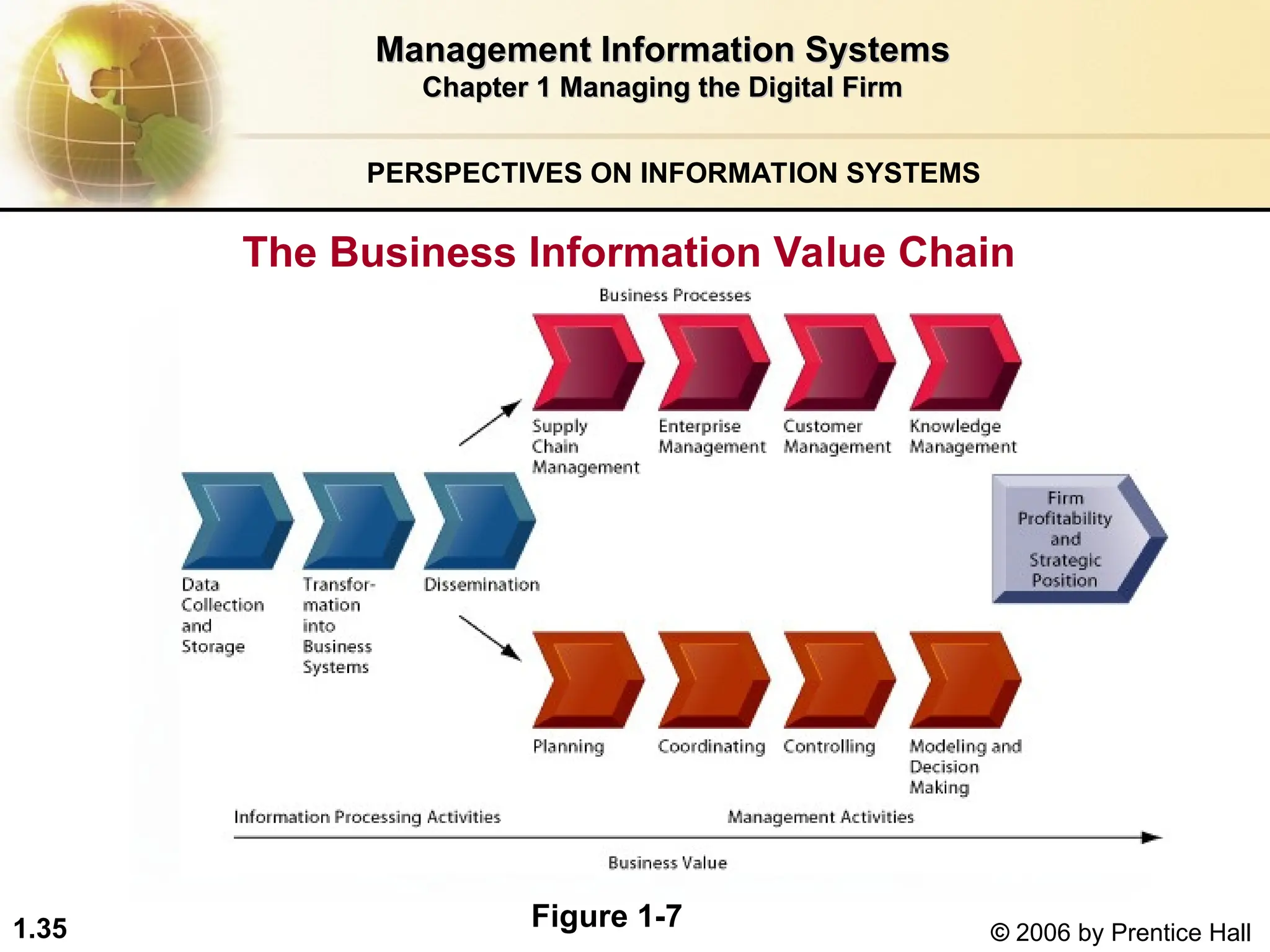
The Business Information Value Chain
Figure 1-7
1.36 © 2006 by Prentice Hall
PERSPECTIVES ON INFORMATION SYSTEMS
Management Information Systems
Chapter 1 Managing the Digital Firm
Information Systems Are More than Computers
Figure 1-8
1.37 © 2006 by Prentice Hall
Management Information Systems
Chapter 1 Managing the Digital Firm
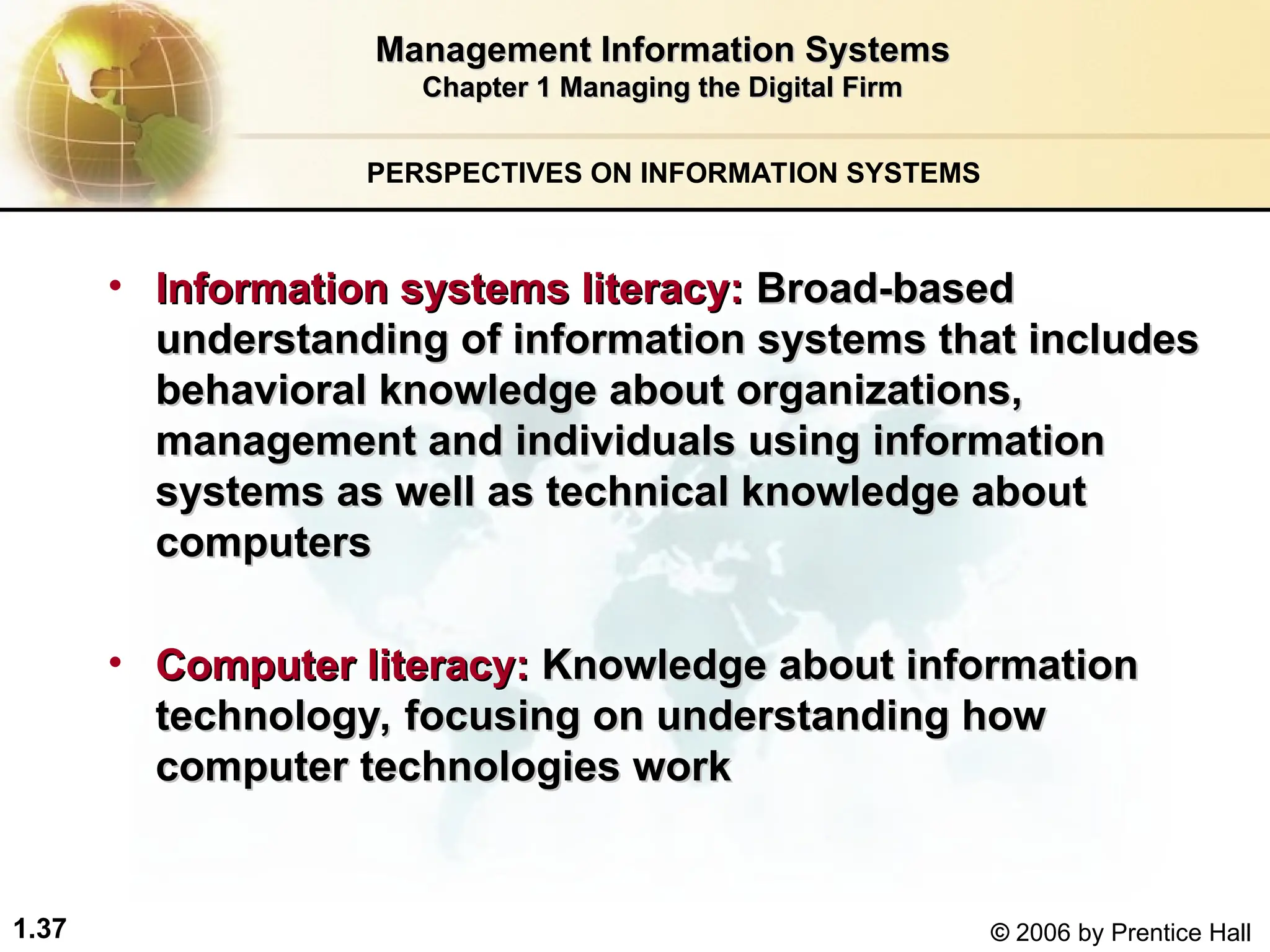
• Information systems literacy:
Information systems literacy: Broad-based
Broad-based
understanding of information systems that includes
behavioral knowledge about organizations,
management and individuals using information
systems as well as technical knowledge about
computers
computers
• Computer literacy:
Computer literacy: Knowledge about information
Knowledge about information
technology, focusing on understanding how
computer technologies work
PERSPECTIVES ON INFORMATION SYSTEMS
1.38 © 2006 by Prentice Hall
Management Information Systems
Chapter 1 Managing the Digital Firm
• Sales and marketing
Sales and marketing
• Manufacturing
Manufacturing
• Finance
Finance
• Accounting
Accounting
• Human resources
Human resources
PERSPECTIVES ON INFORMATION SYSTEMS
Major Business Functions Rely on Information Systems
1.39 © 2006 by Prentice Hall
Management Information Systems
Chapter 1 Managing the Digital Firm
Three Important Dimensions of Information Systems
• Organizations
• Managers
• Technology
PERSPECTIVES ON INFORMATION SYSTEMS
You will need to understand and balance these
dimensions of information systems in order to create
business value.
Dimensions of Information Systems
1.40 © 2006 by Prentice Hall
Management Information Systems
Chapter 1 Managing the Digital Firm
• People
• Structure
• Business processes
• Culture
• Politics
PERSPECTIVES ON INFORMATION SYSTEMS
The Organizational Dimension of Information Systems
1.41 © 2006 by Prentice Hall
Management Information Systems
Chapter 1 Managing the Digital Firm
Managers are:
• Sense makers
Sense makers
• Decision makers
Decision makers
• Planners
Planners
• Innovators of new processes
Innovators of new processes
• Leaders: set agendas
Leaders: set agendas
PERSPECTIVES ON INFORMATION SYSTEMS
The Management Dimension of Information Systems
1.42 © 2006 by Prentice Hall
Management Information Systems
Chapter 1 Managing the Digital Firm
PERSPECTIVES ON INFORMATION SYSTEMS
The Management Dimension of Information Systems
(Continued)
Managers who can understand the role of
information systems in creating business value are
the key ingredient to success with systems, and
cannot easily be replicated by your competitors.
1.43 © 2006 by Prentice Hall
Management Information Systems
Chapter 1 Managing the Digital Firm
• Hardware:
Hardware: Physical equipment
Physical equipment
• Software:
Software: Detailed preprogrammed instructions
Detailed preprogrammed instructions
• Storage:
Storage: Physical media for storing data and the
Physical media for storing data and the
software
software
PERSPECTIVES ON INFORMATION SYSTEMS
Information technology is one of the tools managers
use to cope with change:
The Technology Dimension of Information Systems
1.44 © 2006 by Prentice Hall
Management Information Systems
Chapter 1 Managing the Digital Firm
• Communications technology:
Communications technology: Transfers data
Transfers data
from one physical location to another
• Networks:
Networks: Links computers to share data or
Links computers to share data or
resources
resources
PERSPECTIVES ON INFORMATION SYSTEMS
The Technology Dimension of Information Systems
(Continued)
Managers need to know enough about information
technology to make intelligent decisions about how to
use it for creating business value.
1.45 © 2006 by Prentice Hall
Management Information Systems
Chapter 1 Managing the Digital Firm
Complementary assets:
• New business processes
• Management behavior
• Organizational culture
• Training
PERSPECTIVES ON INFORMATION SYSTEMS
Complementary Assets and Organizational Capital
1.46 © 2006 by Prentice Hall
Management Information Systems
Chapter 1 Managing the Digital Firm
• Supportive business culture that values efficiency
and effectiveness
• Efficient business processes, decentralization of
authority
• Highly distributed decision rights
• A strong information system (IS) development
team
PERSPECTIVES ON INFORMATION SYSTEMS
Organizational capital:
1.47 © 2006 by Prentice Hall
PERSPECTIVES ON INFORMATION SYSTEMS
Management Information Systems
Chapter 1 Managing the Digital Firm
Variation in Returns on Information Technology Investment
Figure 1-9
Source: Based on Erik Brynjolfsson and Lorin M.
Hitt, “Beyond Computation: Information
Technology, Organizational Transformation and
Business Performance.” Journal of Economic
Perspectives 14, no. 4 (Fall 2000). Used with
permission of the American Economic Association.
1.48 © 2006 by Prentice Hall
CONTEMPORARY APPROACHES TO INFORMATION SYSTEMS
Management Information Systems
Chapter 1 Managing the Digital Firm
Sociotechnical Systems
Optimize systems performance:
• Technology and organization
• Organizations mutually adjust to one another
until fit is satisfactory
1.49 © 2006 by Prentice Hall
CONTEMPORARY APPROACHES TO INFORMATION SYSTEMS
Management Information Systems
Chapter 1 Managing the Digital Firm
A Sociotechnical Perspective on Information Systems
Figure 1-11

Management information system chapter no one (management studies))

  • 1.
    1.1 © 2006by Prentice Hall 1 Chapter Managing the Digital Managing the Digital Firm Firm
  • 2.
    1.2 © 2006by Prentice Hall OBJECTIVES Management Information Systems Management Information Systems Chapter 1 Managing the Digital Firm Chapter 1 Managing the Digital Firm • Explain why information systems are so important today for business and management • Evaluate the role of information systems in today’s competitive business environment • Assess the impact of the Internet and Internet technology on business and government
  • 3.
    1.3 © 2006by Prentice Hall • Define an information system from both a technical and business perspective and distinguish between computer literacy and information systems literacy • Identify the major management challenges to building and using information systems OBJECTIVES (Continued) Management Information Systems Management Information Systems Chapter 1 Managing the Digital Firm Chapter 1 Managing the Digital Firm
  • 4.
    1.4 © 2006by Prentice Hall Management Information Systems Management Information Systems Chapter 1 Managing the Digital Firm Chapter 1 Managing the Digital Firm DaimlerChrysler Case • Challenge: 104 plants, 37 countries, 14,000 suppliers • Solutions: Integrated Volume Planning System connects demand side of business with suppliers, reducing inventories. • Powerway helps 3,400 suppliers track parts and quality, reducing errors. • Demonstrates IT’s role in operational excellence, better quality products, and agility–time to market • Illustrates the emerging digital firm landscape where information can flow seamlessly among business partners to create a superior customer experience
  • 5.
    1.5 © 2006by Prentice Hall WHY INFORMATION SYSTEMS? Management Information Systems Management Information Systems Chapter 1 Managing the Digital Firm Chapter 1 Managing the Digital Firm • Capital management Capital management • Foundation of doing business Foundation of doing business • Productivity Productivity • Strategic opportunity and advantage Strategic opportunity and advantage Why Information Systems Matter Why Information Systems Matter There are four reasons why IT makes a difference to the There are four reasons why IT makes a difference to the success of a business: success of a business:
  • 6.
    1.6 © 2006by Prentice Hall Management Information Systems Management Information Systems Chapter 1 Managing the Digital Firm Chapter 1 Managing the Digital Firm • IT is the largest single component of capital investment in the United States. • About $1.8 trillion is spent each year by American businesses. • Managers and business students need to know how to invest this capital wisely. • The success of your business in the future may well depend on how you make IT investment decisions. Capital Management: Capital Management: WHY INFORMATION SYSTEMS?
  • 7.
    1.7 © 2006by Prentice Hall Management Information Systems Management Information Systems Chapter 1 Managing the Digital Firm Chapter 1 Managing the Digital Firm Information Technology Capital Investment Information Technology Capital Investment Figure 1-1 WHY INFORMATION SYSTEMS? Source: Based on the data in U.S. Department of Commerce, Bureau of Economic Analysis, National Income and Product Accounts, Tables 5.2 and 5.8, 2004.
  • 8.
    1.8 © 2006by Prentice Hall Management Information Systems Management Information Systems Chapter 1 Managing the Digital Firm Chapter 1 Managing the Digital Firm • Most businesses today could not operate without Most businesses today could not operate without extensive use of information systems and extensive use of information systems and technologies. technologies. • IT can increase market share. IT can increase market share. • IT can help a business become a high-quality, IT can help a business become a high-quality, low-cost producer. low-cost producer. • IT is vital to the development of new products. IT is vital to the development of new products. Foundation of doing business: Foundation of doing business: WHY INFORMATION SYSTEMS?
  • 9.
    1.9 © 2006by Prentice Hall Management Information Systems Management Information Systems Chapter 1 Managing the Digital Firm Chapter 1 Managing the Digital Firm The Interdependence between Organizations and The Interdependence between Organizations and Information Systems Information Systems Figure 1-2 WHY INFORMATION SYSTEMS?
  • 10.
    1.10 © 2006by Prentice Hall Management Information Systems Management Information Systems Chapter 1 Managing the Digital Firm Chapter 1 Managing the Digital Firm • IT is one of the most important tools managers have to increase productivity and efficiency of businesses. • According to the Federal Reserve Bank, IT has reduced the rate of inflation by 0.5 to 1% in the last decade. For firms this means IT is a major factor in reducing costs. • It is estimated that IT has increased productivity in the economy by about 1% in the last decade. For firms this means IT is a major source of labor and capital efficiency. WHY INFORMATION SYSTEMS? Productivity:
  • 11.
    1.11 © 2006by Prentice Hall Management Information Systems Management Information Systems Chapter 1 Managing the Digital Firm Chapter 1 Managing the Digital Firm • Create competitive advantage: IT makes it possible to develop competitive advantages. • New Business Models: Dell Computer has built its competitive advantage on an IT enabled build- to-order business model that other firms have not been able to imitate. WHY INFORMATION SYSTEMS? Strategic Opportunity and Advantage:
  • 12.
    1.12 © 2006by Prentice Hall Management Information Systems Management Information Systems Chapter 1 Managing the Digital Firm Chapter 1 Managing the Digital Firm • Create new services: eBay has developed the largest auction trading platform for millions of individuals and businesses. Competitors have not been able to imitate its success. • Differentiate yourself from your competitors: Amazon has become the largest book retailer in the United States on the strength of its huge online inventory and recommender system. It has no rivals in size and scope. WHY INFORMATION SYSTEMS? Strategic Opportunity and Advantage:
  • 13.
    1.13 © 2006by Prentice Hall Management Information Systems Management Information Systems Chapter 1 Managing the Digital Firm Chapter 1 Managing the Digital Firm • Carr has written that whatever advantages firms build using IT can be easily copied by competitors. • This view is not supported by the evidence: Amazon, eBay, Dell, Wal-Mart and Apple's iTunes are just a few firms that have built and maintained technology-based advantages. How Much Does IT Matter? WHY INFORMATION SYSTEMS?
  • 14.
    1.14 © 2006by Prentice Hall Management Information Systems Management Information Systems Chapter 1 Managing the Digital Firm Chapter 1 Managing the Digital Firm • Commoditization of technology is typically a spur to innovation and new business models, products and services. • Competitive advantage derives not from the technology, but on how businesses use the technology. • Innovations in business processes, management and organization are not easily copied from one firm to another. How Much Does IT Matter? WHY INFORMATION SYSTEMS?
  • 15.
    1.15 © 2006by Prentice Hall Management Information Systems Management Information Systems Chapter 1 Managing the Digital Firm Chapter 1 Managing the Digital Firm • Internet growth and technology convergence • Transformation of the business enterprise Why IT Now? Digital Convergence and the Changing Business Environment Growing impact of IT in business firms can be assessed from the following five factors: WHY INFORMATION SYSTEMS?
  • 16.
    1.16 © 2006by Prentice Hall Management Information Systems Management Information Systems Chapter 1 Managing the Digital Firm Chapter 1 Managing the Digital Firm • Growth of a globally connected economy • Growth of knowledge and information-based economies • Emergence of the digital firm WHY INFORMATION SYSTEMS? Why IT Now? Digital Convergence and the Changing Business Environment (Continued)
  • 17.
    1.17 © 2006by Prentice Hall Management Information Systems Management Information Systems Chapter 1 Managing the Digital Firm Chapter 1 Managing the Digital Firm • Growth of the Internet: 120 million online in the United States, 500 million global users • The Internet is bringing about a convergence of telecommunications and computing: VoIP telephones. WHY INFORMATION SYSTEMS? The Internet and Technology Convergence:
  • 18.
    1.18 © 2006by Prentice Hall Management Information Systems Management Information Systems Chapter 1 Managing the Digital Firm Chapter 1 Managing the Digital Firm • Growth in e-business, e-commerce, and e- government • Internet is bringing about rapid changes in markets and market structure: financial services and banking such as eTrade.com. • The Internet is making many traditional business models obsolete: the corner music store and video store. WHY INFORMATION SYSTEMS? The Internet and Technology Convergence:
  • 19.
    1.19 © 2006by Prentice Hall Management Information Systems Management Information Systems Chapter 1 Managing the Digital Firm Chapter 1 Managing the Digital Firm • Flattening • Decentralization • Flexibility WHY INFORMATION SYSTEMS? Transformation of the Business Enterprise:
  • 20.
    1.20 © 2006by Prentice Hall Management Information Systems Management Information Systems Chapter 1 Managing the Digital Firm Chapter 1 Managing the Digital Firm • Location independence • Low transaction and coordination costs • Empowerment • Collaborative work and teamwork WHY INFORMATION SYSTEMS? Transformation of the Business Enterprise (Continued):
  • 21.
    1.21 © 2006by Prentice Hall Management Information Systems Management Information Systems Chapter 1 Managing the Digital Firm Chapter 1 Managing the Digital Firm • Management and control in a global marketplace • Competition in world markets • Global workgroups • Global delivery systems WHY INFORMATION SYSTEMS? Globalization:
  • 22.
    1.22 © 2006by Prentice Hall Management Information Systems Management Information Systems Chapter 1 Managing the Digital Firm Chapter 1 Managing the Digital Firm • Knowledge and information-based economies • New products and services • Knowledge as a central productive and strategic asset WHY INFORMATION SYSTEMS? Rise of the Information Economy:
  • 23.
    1.23 © 2006by Prentice Hall Management Information Systems Management Information Systems Chapter 1 Managing the Digital Firm Chapter 1 Managing the Digital Firm • Time-based competition • Shorter product life • Turbulent environment • Limited employee knowledge base WHY INFORMATION SYSTEMS? Rise of the Information Economy (Continued):
  • 24.
    1.24 © 2006by Prentice Hall Management Information Systems Management Information Systems Chapter 1 Managing the Digital Firm Chapter 1 Managing the Digital Firm The Growth of the Information Economy Figure 1-3 WHY INFORMATION SYSTEMS? Source: U.S. Department of Commerce, Bureau of the Census, Statistical Abstract of the United States, 2003, Table 615; and Historical Statistics of the United States, Colonial Times to 1970, Vol. 1, Series D, pp. 182-232.
  • 25.
    1.25 © 2006by Prentice Hall Management Information Systems Management Information Systems Chapter 1 Managing the Digital Firm Chapter 1 Managing the Digital Firm • Digitally enabled relationships with customers, suppliers, and employees • Core business processes accomplished using digital networks • Digital management of key corporate assets WHY INFORMATION SYSTEMS? Emergence of the Digital Firm:
  • 26.
    1.26 © 2006by Prentice Hall Management Information Systems Management Information Systems Chapter 1 Managing the Digital Firm Chapter 1 Managing the Digital Firm • Agile sensing and responding to environmental changes • Seamless flow of information within the firm, and with strategic partners WHY INFORMATION SYSTEMS? Emergence of the Digital Firm (Continued):
  • 27.
    1.27 © 2006by Prentice Hall Management Information Systems Management Information Systems Chapter 1 Managing the Digital Firm Chapter 1 Managing the Digital Firm The Emerging Digital Firm The Emerging Digital Firm Figure 1-4 WHY INFORMATION SYSTEMS?
  • 28.
    1.28 © 2006by Prentice Hall PERSPECTIVES ON INFORMATION SYSTEMS Management Information Systems Management Information Systems Chapter 1 Managing the Digital Firm Chapter 1 Managing the Digital Firm What Is an Information System? Technology perspective: Technology perspective: A set of interrelated components that collect (or retrieve), process, store, and distribute information to support decision making and control in an organization
  • 29.
    1.29 © 2006by Prentice Hall PERSPECTIVES ON INFORMATION SYSTEMS Management Information Systems Management Information Systems Chapter 1 Managing the Digital Firm Chapter 1 Managing the Digital Firm What is an Information System? (Continued) • Data: Streams of raw facts representing events such as business transactions • Information: Clusters of facts meaningful and useful to human beings in the processes such as making decisions
  • 30.
    1.30 © 2006by Prentice Hall PERSPECTIVES ON INFORMATION SYSTEMS Management Information Systems Management Information Systems Chapter 1 Managing the Digital Firm Chapter 1 Managing the Digital Firm Data and Information Figure 1-5
  • 31.
    1.31 © 2006by Prentice Hall PERSPECTIVES ON INFORMATION SYSTEMS Management Information Systems Management Information Systems Chapter 1 Managing the Digital Firm Chapter 1 Managing the Digital Firm Functions of an Information System Figure 1-6
  • 32.
    1.32 © 2006by Prentice Hall Management Information Systems Management Information Systems Chapter 1 Managing the Digital Firm Chapter 1 Managing the Digital Firm • Rely on computer hardware and software Rely on computer hardware and software • Processing and disseminating information Processing and disseminating information • Fixed definitions of data and procedures Fixed definitions of data and procedures • Collecting, storing, and using information Collecting, storing, and using information PERSPECTIVES ON INFORMATION SYSTEMS Computer-Based Information System (CBIS)
  • 33.
    1.33 © 2006by Prentice Hall Management Information Systems Management Information Systems Chapter 1 Managing the Digital Firm Chapter 1 Managing the Digital Firm • Information systems are an organizational and Information systems are an organizational and management solution to business challenges that management solution to business challenges that arise from the business environment. arise from the business environment. PERSPECTIVES ON INFORMATION SYSTEMS Information systems are more than just technology. Businesses invest in IS in order to create value and increase profitability. A Business Perspective on Information Systems
  • 34.
    1.34 © 2006by Prentice Hall Management Information Systems Management Information Systems Chapter 1 Managing the Digital Firm Chapter 1 Managing the Digital Firm • Based on information technology but also require Based on information technology but also require significant investment in organizational and significant investment in organizational and management changes and innovations management changes and innovations • IS create value primarily by changing business IS create value primarily by changing business processes and management decision making. processes and management decision making. PERSPECTIVES ON INFORMATION SYSTEMS A Business Perspective on Information Systems (Continued)
  • 35.
    1.35 © 2006by Prentice Hall PERSPECTIVES ON INFORMATION SYSTEMS Management Information Systems Management Information Systems Chapter 1 Managing the Digital Firm Chapter 1 Managing the Digital Firm The Business Information Value Chain Figure 1-7
  • 36.
    1.36 © 2006by Prentice Hall PERSPECTIVES ON INFORMATION SYSTEMS Management Information Systems Management Information Systems Chapter 1 Managing the Digital Firm Chapter 1 Managing the Digital Firm Information Systems Are More than Computers Figure 1-8
  • 37.
    1.37 © 2006by Prentice Hall Management Information Systems Management Information Systems Chapter 1 Managing the Digital Firm Chapter 1 Managing the Digital Firm • Information systems literacy: Information systems literacy: Broad-based Broad-based understanding of information systems that includes understanding of information systems that includes behavioral knowledge about organizations, behavioral knowledge about organizations, management and individuals using information management and individuals using information systems as well as technical knowledge about systems as well as technical knowledge about computers computers • Computer literacy: Computer literacy: Knowledge about information Knowledge about information technology, focusing on understanding how technology, focusing on understanding how computer technologies work computer technologies work PERSPECTIVES ON INFORMATION SYSTEMS
  • 38.
    1.38 © 2006by Prentice Hall Management Information Systems Management Information Systems Chapter 1 Managing the Digital Firm Chapter 1 Managing the Digital Firm • Sales and marketing Sales and marketing • Manufacturing Manufacturing • Finance Finance • Accounting Accounting • Human resources Human resources PERSPECTIVES ON INFORMATION SYSTEMS Major Business Functions Rely on Information Systems
  • 39.
    1.39 © 2006by Prentice Hall Management Information Systems Management Information Systems Chapter 1 Managing the Digital Firm Chapter 1 Managing the Digital Firm Three Important Dimensions of Information Systems • Organizations • Managers • Technology PERSPECTIVES ON INFORMATION SYSTEMS You will need to understand and balance these dimensions of information systems in order to create business value. Dimensions of Information Systems
  • 40.
    1.40 © 2006by Prentice Hall Management Information Systems Management Information Systems Chapter 1 Managing the Digital Firm Chapter 1 Managing the Digital Firm • People • Structure • Business processes • Culture • Politics PERSPECTIVES ON INFORMATION SYSTEMS The Organizational Dimension of Information Systems
  • 41.
    1.41 © 2006by Prentice Hall Management Information Systems Management Information Systems Chapter 1 Managing the Digital Firm Chapter 1 Managing the Digital Firm Managers are: • Sense makers Sense makers • Decision makers Decision makers • Planners Planners • Innovators of new processes Innovators of new processes • Leaders: set agendas Leaders: set agendas PERSPECTIVES ON INFORMATION SYSTEMS The Management Dimension of Information Systems
  • 42.
    1.42 © 2006by Prentice Hall Management Information Systems Management Information Systems Chapter 1 Managing the Digital Firm Chapter 1 Managing the Digital Firm PERSPECTIVES ON INFORMATION SYSTEMS The Management Dimension of Information Systems (Continued) Managers who can understand the role of Managers who can understand the role of information systems in creating business value are information systems in creating business value are the key ingredient to success with systems, and the key ingredient to success with systems, and cannot easily be replicated by your competitors. cannot easily be replicated by your competitors.
  • 43.
    1.43 © 2006by Prentice Hall Management Information Systems Management Information Systems Chapter 1 Managing the Digital Firm Chapter 1 Managing the Digital Firm • Hardware: Hardware: Physical equipment Physical equipment • Software: Software: Detailed preprogrammed instructions Detailed preprogrammed instructions • Storage: Storage: Physical media for storing data and the Physical media for storing data and the software software PERSPECTIVES ON INFORMATION SYSTEMS Information technology is one of the tools managers Information technology is one of the tools managers use to cope with change: use to cope with change: The Technology Dimension of Information Systems
  • 44.
    1.44 © 2006by Prentice Hall Management Information Systems Management Information Systems Chapter 1 Managing the Digital Firm Chapter 1 Managing the Digital Firm • Communications technology: Communications technology: Transfers data Transfers data from one physical location to another from one physical location to another • Networks: Networks: Links computers to share data or Links computers to share data or resources resources PERSPECTIVES ON INFORMATION SYSTEMS The Technology Dimension of Information Systems (Continued) Managers need to know enough about information Managers need to know enough about information technology to make intelligent decisions about how to technology to make intelligent decisions about how to use it for creating business value. use it for creating business value.
  • 45.
    1.45 © 2006by Prentice Hall Management Information Systems Management Information Systems Chapter 1 Managing the Digital Firm Chapter 1 Managing the Digital Firm Complementary assets: • New business processes • Management behavior • Organizational culture • Training PERSPECTIVES ON INFORMATION SYSTEMS Complementary Assets and Organizational Capital
  • 46.
    1.46 © 2006by Prentice Hall Management Information Systems Management Information Systems Chapter 1 Managing the Digital Firm Chapter 1 Managing the Digital Firm • Supportive business culture that values efficiency and effectiveness • Efficient business processes, decentralization of authority • Highly distributed decision rights • A strong information system (IS) development team PERSPECTIVES ON INFORMATION SYSTEMS Organizational capital:
  • 47.
    1.47 © 2006by Prentice Hall PERSPECTIVES ON INFORMATION SYSTEMS Management Information Systems Management Information Systems Chapter 1 Managing the Digital Firm Chapter 1 Managing the Digital Firm Variation in Returns on Information Technology Investment Figure 1-9 Source: Based on Erik Brynjolfsson and Lorin M. Hitt, “Beyond Computation: Information Technology, Organizational Transformation and Business Performance.” Journal of Economic Perspectives 14, no. 4 (Fall 2000). Used with permission of the American Economic Association.
  • 48.
    1.48 © 2006by Prentice Hall CONTEMPORARY APPROACHES TO INFORMATION SYSTEMS Management Information Systems Management Information Systems Chapter 1 Managing the Digital Firm Chapter 1 Managing the Digital Firm Sociotechnical Systems Optimize systems performance: • Technology and organization • Organizations mutually adjust to one another until fit is satisfactory
  • 49.
    1.49 © 2006by Prentice Hall CONTEMPORARY APPROACHES TO INFORMATION SYSTEMS Management Information Systems Management Information Systems Chapter 1 Managing the Digital Firm Chapter 1 Managing the Digital Firm A Sociotechnical Perspective on Information Systems Figure 1-11