Introduction
The managerial function of staffing involves manning
the organization structure through proper and
effective selection, appraisal and development of
the personnel to fill the roles assigned to the
employers/workforce.
Staffing
“Staffing is the process of identifying, recruiting, and hiring
eligible candidates for specific job positions within an
organization. It involves finding the right workers who
possess the necessary qualifications and experience to fulfill
various roles needed by the company.
Nature of Staffing
• Staffing is an important managerial function.
• Staffing is a continuous activity.
• The basis of staffing function is
efficient management of personnel.
• Staffing helps in placing right person
at the right job.
• Staffing is performed by all managers .
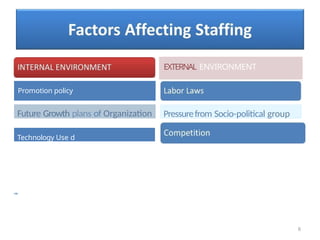
Promotion policy
Future Growth plans of Organization
Technology Use d
EXTERNAL ENVIRONMENT
Pressurefrom Socio-political group
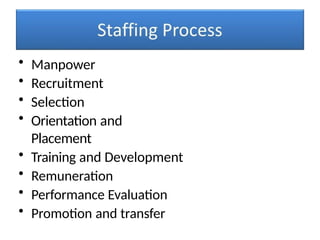
• Manpower
• Recruitment
• Selection
• Orientation and
Placement
• Training and Development
• Remuneration
• Performance Evaluation
• Promotion and transfer
Manpower Planning which is also called as Human
Resource Planning consists of putting right number
of people, right kind of people at the right place,
right time, doing the right things for which they are
suited for the achievement of goals of the
organization
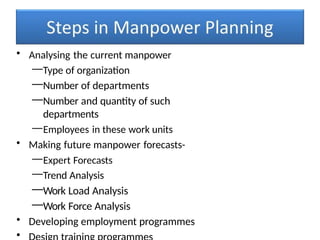
• Analysing the current manpower
—Type of organization
—Number of departments
—Number and quantity of such
departments
—Employees in these work units
• Making future manpower forecasts-
—Expert Forecasts
—Trend Analysis
—Work Load Analysis
—Work Force Analysis
• Developing employment programmes
•
• Key to managerial functions
• Efficient
• Motivation
• Better human relations
• Higher productivity
• Under Utilization of Manpower
• Degree of Absenteeism
• Lack of Education and Skilled Labour
• Manpower Control and Review
—Productivity = Output / Input.
— Employee Productivity = Total Production /
Total no. of employees
1. Internal Recruitment- is a recruitment which
takes place within the concern or organization.
Internal sources of recruitment are readily
available to an organization.
a)
Transfers
b)Promotions
c)Re-
employment
of ex-
employee
2. External Recruitment- External sources of recruitment have
to be solicited from outside the organization. But it
involves lot of time and money.
a)EmpIoyment at factory level
b)Advertisement
c)EmpIoyment exchanges
d) Employment agencies
e)EducationaI Institutions
f)Recommendations
g)Labor contractors
Employee Selection Process
Employee Selection is the process of putting right
men on right job. It is a procedure of matching
organizational requirements with the skills and
qualifications of peoole.
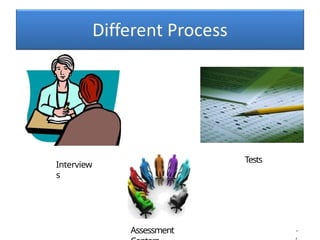
Interview
s
Assessment -
Tests
Interviews
• Every manager hired or promoted by a
company is interviewed by one or more people.
• Techniques used to improve the interviewing
process-
-Interviewer-What to look for?
-Should be prepared to ask the right
questions
-Conducting multiple interviews
-Just one aspect of selection
Primary aim of testing is to obtain data about applicants
that help predict their probable success as managers.
Some of the commonly used tests-
• Intelligence tests
• Proficiency and aptitude test
• Vocational test
• Personality test
• A technique for selecting and promoting managers.
• The usual center approach is to have candidates take part in a
series of exercises.
• During this period, they are observed and assessed
by psychologists or experienced managers.
• A typical assessment center-
a) Various
psychological tests
b)Management games
Placement
• Once the candidates are selected for the required job, they
have to be fitted as per the qualifications.
• Placement is said to be the process of fitting the
selected person at the right job or place, i.e. fitting
square pegs in square holes and round pegs in round
holes.
• Once he is fitted into the job, he is given the activities he
has to perform and also told about his duties.
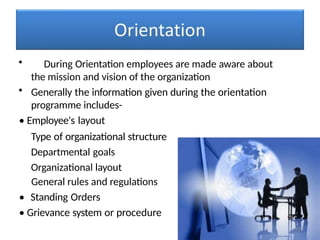
• During Orientation employees are made aware about
the mission and vision of the organization
• Generally the information given during the orientation
programme includes-
• Employee's layout
Type of organizational structure
Departmental goals
Organizational layout
General rules and regulations
• Standing Orders
• Grievance system or procedure
• Training of employees takes place after orientation
takes place. Training is the process of enhancing the
skills, capabilities and knowledge of employees for doing
a particular job.
• Training process moulds the thinking of employees and
leads to quality performance of employees. It is continuous
and never ending in nature.
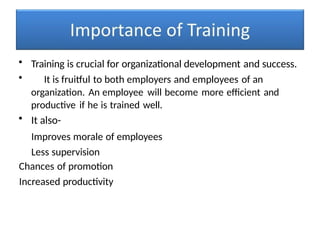
• Training is crucial for organizational development and success.
• It is fruitful to both employers and employees of an
organization. An employee will become more efficient and
productive if he is trained well.
• It also-
Improves morale of employees
Less supervision
Chances of promotion
Increased productivity
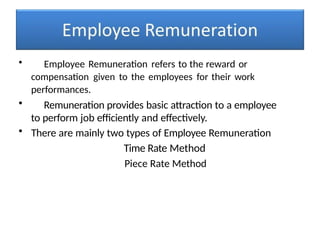
• Employee Remuneration refers to the reward or
compensation given to the employees for their work
performances.
• Remuneration provides basic attraction to a employee
to perform job efficiently and effectively.
• There are mainly two types of Employee Remuneration
Time Rate Method
Piece Rate Method

management function of staffing in human resource

  • 1.
    Introduction The managerial functionof staffing involves manning the organization structure through proper and effective selection, appraisal and development of the personnel to fill the roles assigned to the employers/workforce.
  • 2.
    Staffing “Staffing is theprocess of identifying, recruiting, and hiring eligible candidates for specific job positions within an organization. It involves finding the right workers who possess the necessary qualifications and experience to fulfill various roles needed by the company.
  • 3.
    Nature of Staffing •Staffing is an important managerial function. • Staffing is a continuous activity. • The basis of staffing function is efficient management of personnel. • Staffing helps in placing right person at the right job. • Staffing is performed by all managers .
  • 4.
    Promotion policy Future Growthplans of Organization Technology Use d EXTERNAL ENVIRONMENT Pressurefrom Socio-political group
  • 5.
    • Manpower • Recruitment •Selection • Orientation and Placement • Training and Development • Remuneration • Performance Evaluation • Promotion and transfer
  • 6.
    Manpower Planning whichis also called as Human Resource Planning consists of putting right number of people, right kind of people at the right place, right time, doing the right things for which they are suited for the achievement of goals of the organization
  • 7.
    • Analysing thecurrent manpower —Type of organization —Number of departments —Number and quantity of such departments —Employees in these work units • Making future manpower forecasts- —Expert Forecasts —Trend Analysis —Work Load Analysis —Work Force Analysis • Developing employment programmes •
  • 8.
    • Key tomanagerial functions • Efficient • Motivation • Better human relations • Higher productivity
  • 9.
    • Under Utilizationof Manpower • Degree of Absenteeism • Lack of Education and Skilled Labour • Manpower Control and Review —Productivity = Output / Input. — Employee Productivity = Total Production / Total no. of employees
  • 10.
    1. Internal Recruitment-is a recruitment which takes place within the concern or organization. Internal sources of recruitment are readily available to an organization. a) Transfers b)Promotions c)Re- employment of ex- employee
  • 11.
    2. External Recruitment-External sources of recruitment have to be solicited from outside the organization. But it involves lot of time and money. a)EmpIoyment at factory level b)Advertisement c)EmpIoyment exchanges d) Employment agencies e)EducationaI Institutions f)Recommendations g)Labor contractors
  • 12.
    Employee Selection Process EmployeeSelection is the process of putting right men on right job. It is a procedure of matching organizational requirements with the skills and qualifications of peoole.
  • 13.
  • 14.
    Interviews • Every managerhired or promoted by a company is interviewed by one or more people. • Techniques used to improve the interviewing process- -Interviewer-What to look for? -Should be prepared to ask the right questions -Conducting multiple interviews -Just one aspect of selection
  • 15.
    Primary aim oftesting is to obtain data about applicants that help predict their probable success as managers. Some of the commonly used tests- • Intelligence tests • Proficiency and aptitude test • Vocational test • Personality test
  • 16.
    • A techniquefor selecting and promoting managers. • The usual center approach is to have candidates take part in a series of exercises. • During this period, they are observed and assessed by psychologists or experienced managers. • A typical assessment center- a) Various psychological tests b)Management games
  • 18.
    Placement • Once thecandidates are selected for the required job, they have to be fitted as per the qualifications. • Placement is said to be the process of fitting the selected person at the right job or place, i.e. fitting square pegs in square holes and round pegs in round holes. • Once he is fitted into the job, he is given the activities he has to perform and also told about his duties.
  • 19.
    • During Orientationemployees are made aware about the mission and vision of the organization • Generally the information given during the orientation programme includes- • Employee's layout Type of organizational structure Departmental goals Organizational layout General rules and regulations • Standing Orders • Grievance system or procedure
  • 20.
    • Training ofemployees takes place after orientation takes place. Training is the process of enhancing the skills, capabilities and knowledge of employees for doing a particular job. • Training process moulds the thinking of employees and leads to quality performance of employees. It is continuous and never ending in nature.
  • 21.
    • Training iscrucial for organizational development and success. • It is fruitful to both employers and employees of an organization. An employee will become more efficient and productive if he is trained well. • It also- Improves morale of employees Less supervision Chances of promotion Increased productivity
  • 22.
    • Employee Remunerationrefers to the reward or compensation given to the employees for their work performances. • Remuneration provides basic attraction to a employee to perform job efficiently and effectively. • There are mainly two types of Employee Remuneration Time Rate Method Piece Rate Method