Visit https://testbankdeal.com to download the full version and
explore more testbank or solutions manual
Management A Practical Introduction 7th Edition
Kinicki Solutions Manual
_____ Click the link below to download _____
https://testbankdeal.com/product/management-a-practical-
introduction-7th-edition-kinicki-solutions-manual/
Explore and download more testbank or solutions manual at testbankdeal.com
Here are some recommended products that we believe you will be
interested in. You can click the link to download.
Management A Practical Introduction 7th Edition Kinicki
Test Bank
https://testbankdeal.com/product/management-a-practical-
introduction-7th-edition-kinicki-test-bank/
Management A Practical Introduction 6th Edition Kinicki
Solutions Manual
https://testbankdeal.com/product/management-a-practical-
introduction-6th-edition-kinicki-solutions-manual/
Management A Practical Introduction 8th edition Kinicki
Solutions Manual
https://testbankdeal.com/product/management-a-practical-
introduction-8th-edition-kinicki-solutions-manual/
Canadian Organizational Behaviour 7th Edition McShane Test
Bank
https://testbankdeal.com/product/canadian-organizational-
behaviour-7th-edition-mcshane-test-bank/
Strategic Marketing 1st Edition Mooradian Test Bank
https://testbankdeal.com/product/strategic-marketing-1st-edition-
mooradian-test-bank/
Marketing Research 6th Edition Burns Test Bank
https://testbankdeal.com/product/marketing-research-6th-edition-burns-
test-bank/
Horngrens Accounting Volume 2 Canadian 10th Edition Nobles
Solutions Manual
https://testbankdeal.com/product/horngrens-accounting-
volume-2-canadian-10th-edition-nobles-solutions-manual/
Children and Their Development Canadian 4th Edition Kail
Test Bank
https://testbankdeal.com/product/children-and-their-development-
canadian-4th-edition-kail-test-bank/
Shelly Cashman Series Microsoft Office 365 and Office 2016
Introductory 1st Edition Vermaat Test Bank
https://testbankdeal.com/product/shelly-cashman-series-microsoft-
office-365-and-office-2016-introductory-1st-edition-vermaat-test-bank/
Financial Markets and Institutions 9th Edition Madura Test
Bank
https://testbankdeal.com/product/financial-markets-and-
institutions-9th-edition-madura-test-bank/
7
Chapter
Individual & Group
Decision Making
How Managers Make Things Happen
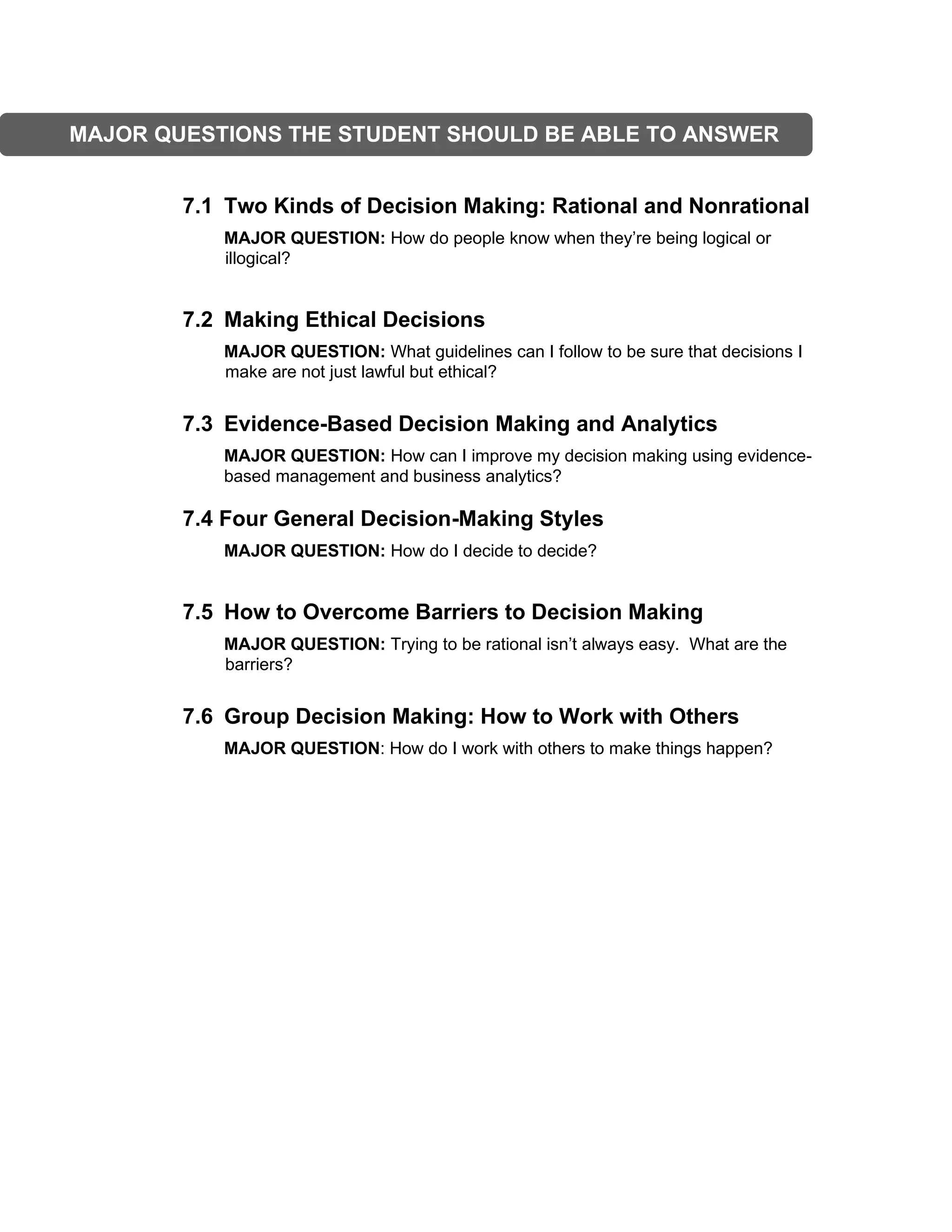
Major Questions the Student Should Be Able to Answer 2
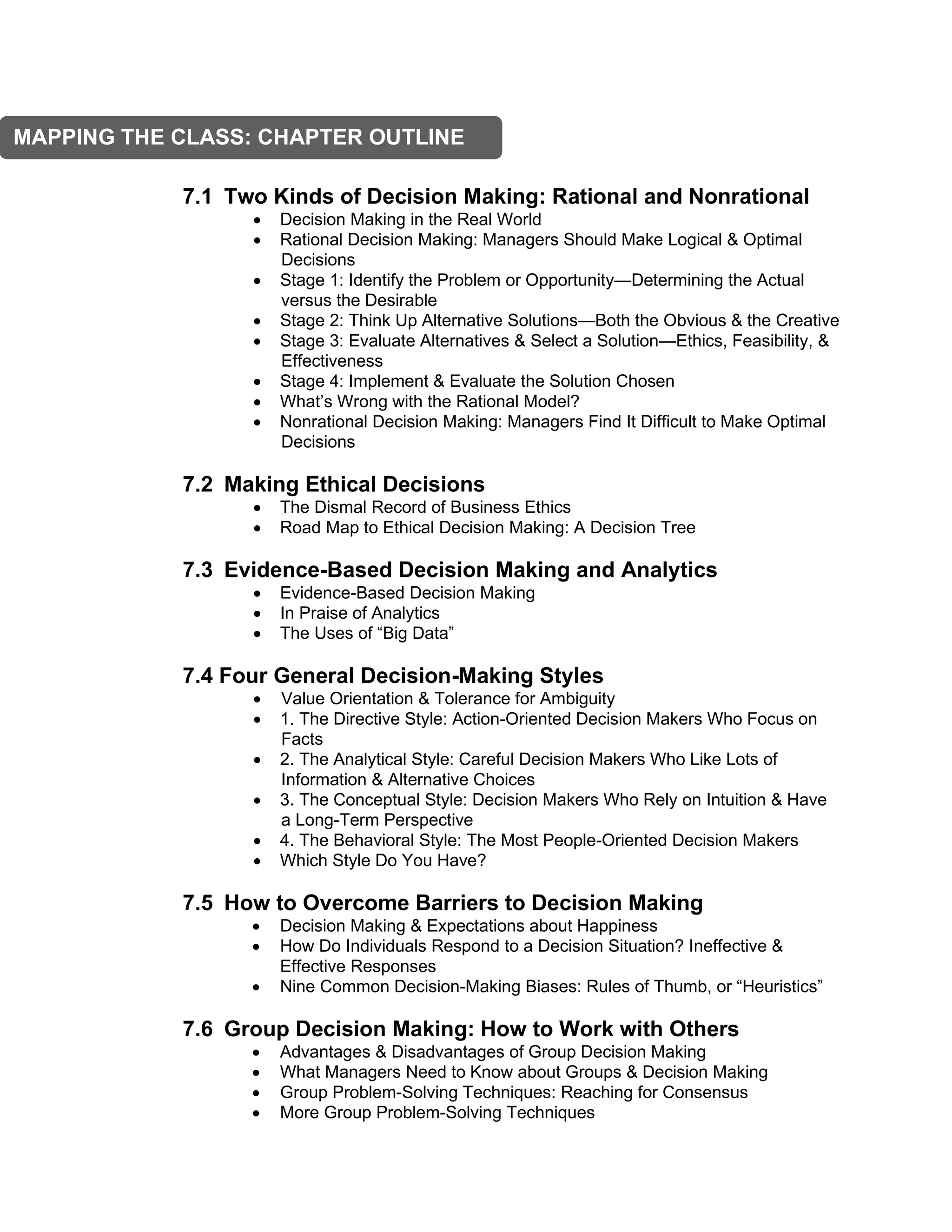
Mapping the Class: Chapter Outline 3
Overview of the Chapter 4
Classroom Outline 5
Challenge: Major Questions 39
Management in Action 41
Legal/Ethical Challenge 44
Group Exercises 46
Video Case 55
Manager’s Hot Seat 56
CHAPTER CONTENTS
7.1 Two Kinds of Decision Making: Rational and Nonrational
MAJOR QUESTION: How do people know when they’re being logical or
illogical?
7.2 Making Ethical Decisions
MAJOR QUESTION: What guidelines can I follow to be sure that decisions I
make are not just lawful but ethical?
7.3 Evidence-Based Decision Making and Analytics
MAJOR QUESTION: How can I improve my decision making using evidence-
based management and business analytics?
7.4 Four General Decision-Making Styles
MAJOR QUESTION: How do I decide to decide?
7.5 How to Overcome Barriers to Decision Making
MAJOR QUESTION: Trying to be rational isn’t always easy. What are the
barriers?
7.6 Group Decision Making: How to Work with Others
MAJOR QUESTION: How do I work with others to make things happen?
MAJOR QUESTIONS THE STUDENT SHOULD BE ABLE TO ANSWER
7.1 Two Kinds of Decision Making: Rational and Nonrational
• Decision Making in the Real World
• Rational Decision Making: Managers Should Make Logical & Optimal
Decisions
• Stage 1: Identify the Problem or Opportunity—Determining the Actual
versus the Desirable
• Stage 2: Think Up Alternative Solutions—Both the Obvious & the Creative
• Stage 3: Evaluate Alternatives & Select a Solution—Ethics, Feasibility, &
Effectiveness
• Stage 4: Implement & Evaluate the Solution Chosen
• What’s Wrong with the Rational Model?
• Nonrational Decision Making: Managers Find It Difficult to Make Optimal
Decisions
7.2 Making Ethical Decisions
• The Dismal Record of Business Ethics
• Road Map to Ethical Decision Making: A Decision Tree
7.3 Evidence-Based Decision Making and Analytics
• Evidence-Based Decision Making
• In Praise of Analytics
• The Uses of “Big Data”
7.4 Four General Decision-Making Styles
• Value Orientation & Tolerance for Ambiguity
• 1. The Directive Style: Action-Oriented Decision Makers Who Focus on
Facts
• 2. The Analytical Style: Careful Decision Makers Who Like Lots of
Information & Alternative Choices
• 3. The Conceptual Style: Decision Makers Who Rely on Intuition & Have
a Long-Term Perspective
• 4. The Behavioral Style: The Most People-Oriented Decision Makers
• Which Style Do You Have?
7.5 How to Overcome Barriers to Decision Making
• Decision Making & Expectations about Happiness
• How Do Individuals Respond to a Decision Situation? Ineffective &
Effective Responses
• Nine Common Decision-Making Biases: Rules of Thumb, or “Heuristics”
7.6 Group Decision Making: How to Work with Others
• Advantages & Disadvantages of Group Decision Making
• What Managers Need to Know about Groups & Decision Making
• Group Problem-Solving Techniques: Reaching for Consensus
• More Group Problem-Solving Techniques
MAPPING THE CLASS: CHAPTER OUTLINE
7.1 Two Kinds of Decision Making: Rational and Nonrational
Decision making, the process of identifying and choosing alternative
courses of action, may be rational, but often it is nonrational. Four steps
in making a rational decision are (1) identify the problem or opportunity,
(2) think up alternative solutions, (3) evaluate alternatives and select a
solution, and (4) implement and evaluate the solution chosen. Two
examples of nonrational models of decision making are (1) satisficing
and (2) intuition.
7.2 Making Ethical Decisions
Businesses have a dismal record of ethics. Many companies now have
an ethics officer, someone trained about matters of ethics in the
workplace. A graph known as a decision tree can help one make ethical
decisions. In addition, one should be aware of “the magnificent seven”
general moral principles for managers.
7.3 Evidence-Based Decision Making and Analytics
Evidence-based decision making brings rationality to the decision-
making process. This section describes seven principles for implementing
evidence-based management. Analytics has three key attributes: 1) use
of modeling, 2) having multiple applications, not just one; and 3) support
from the top.
7.4 Four General Decision-Making Styles
Decision-making styles reflect how one perceives and responds to
information. They can be directive, analytical, conceptual, or
behavioral.
7.5 How to Overcome Barriers to Decision Making
Responses to a decision situation may take the form of four ineffective
reactions: relaxed avoidance, relaxed change, defensive avoidance, or
panic; or three effective reactions: importance, credibility, or urgency.
Managers should also be aware of nine common decision-making biases.
7.6 Group Decision Making: How to Work with Others
Group decision making has five potential advantages and four potential
disadvantages. There are a number of characteristics of groups that a
manager should be aware of as group problem-solving techniques.
OVERVIEW OF THE CHAPTER
The Manager’s Toolbox: How Exceptional Managers Check to See If Their
Decisions Might Be Biased
An important part of a manager’s job is making decisions, but there are a variety of
biases that can cause you to make the wrong decision. You can fall victim to the
overconfidence bias when you are dealing with less familiar subjects. The prior-
hypothesis bias may cause you to make a decision based on your strong prior beliefs,
even when those beliefs are wrong. To overcome the ignoring-randomness bias, you
must be willing to attribute trends to random events. It is important to use a broad,
representative sample to avoid sampling biases. To avoid the hindsight bias, it is
important to remember than hindsight does not equal foresight.
Possible Topics for Discussion:
• Facing the hard facts about what works and what doesn’t, how able do you think
you are to make the tough decisions that effective managers have to make? Can
you describe an instance in which you were badly wrong about something or
someone?
• Do you believe these biases are more likely to occur with individual decision
making or group decision making? Explain your position.
• Identify your own strongly held beliefs which may have the ability to impact your
decision-making process. How can you overcome the tendency to fall victim to
the prior hypothesis bias for those beliefs?
• How could you determine if an event is just a random event or the sign of a
genuine trend?
Section 7.1 discusses four steps in the rational decision making process: (1) identify the
problem or opportunity, (2) think up alternative solutions, (3) evaluate alternatives and
select a solution, and (4) implement and evaluate the solution chosen. There is also a
discussion on the two nonrational models of decision making: (1) satisficing and (2)
intuition.
One way that you could begin your coverage of these topics is to have the students
read the Harvard Business Review article “SC Johnson’s CEO on Doing the Right
Thing, Even When It Hurts Business.” In this article, Fisk Johnson, SC Johnson CEO,
CLASSROOM OUTLINE
7.1 Two Kinds of Decision Making:
Rational & Nonrational (pp. 190-198)
How do people know when they’re being logical or illogical?
describes the firm’s decision to reformulate Saran Wrap over environmental concerns,
knowing that the reformulation was likely to negatively impact the product’s sales.
Article Citation:
Johnson, F. (2015). SC Johnson’s CEO on doing the right thing, even when it hurts
business. Harvard Business Review, 93(4), 33-36.
Product #: R1504A-PDF-ENG
Possible Topics for Discussion:
• Discuss why it can be so hard to be purely rational in the decision-making
process.
• Describe a time you used intuition to make a decision. Describe the advantages
and disadvantages of having used intuition to make this decision.
• Using the Harvard Business Review article “SC Johnson’s CEO on Doing the
Right Thing, Even When It Hurts Business” as your foundation, evaluate the
extent to which SC Johnson’s decision to reformulate Saran Wrap is an example
of rational decision making or nonrational decision making.
Major Idea Outline:
A. Decision Making Defined
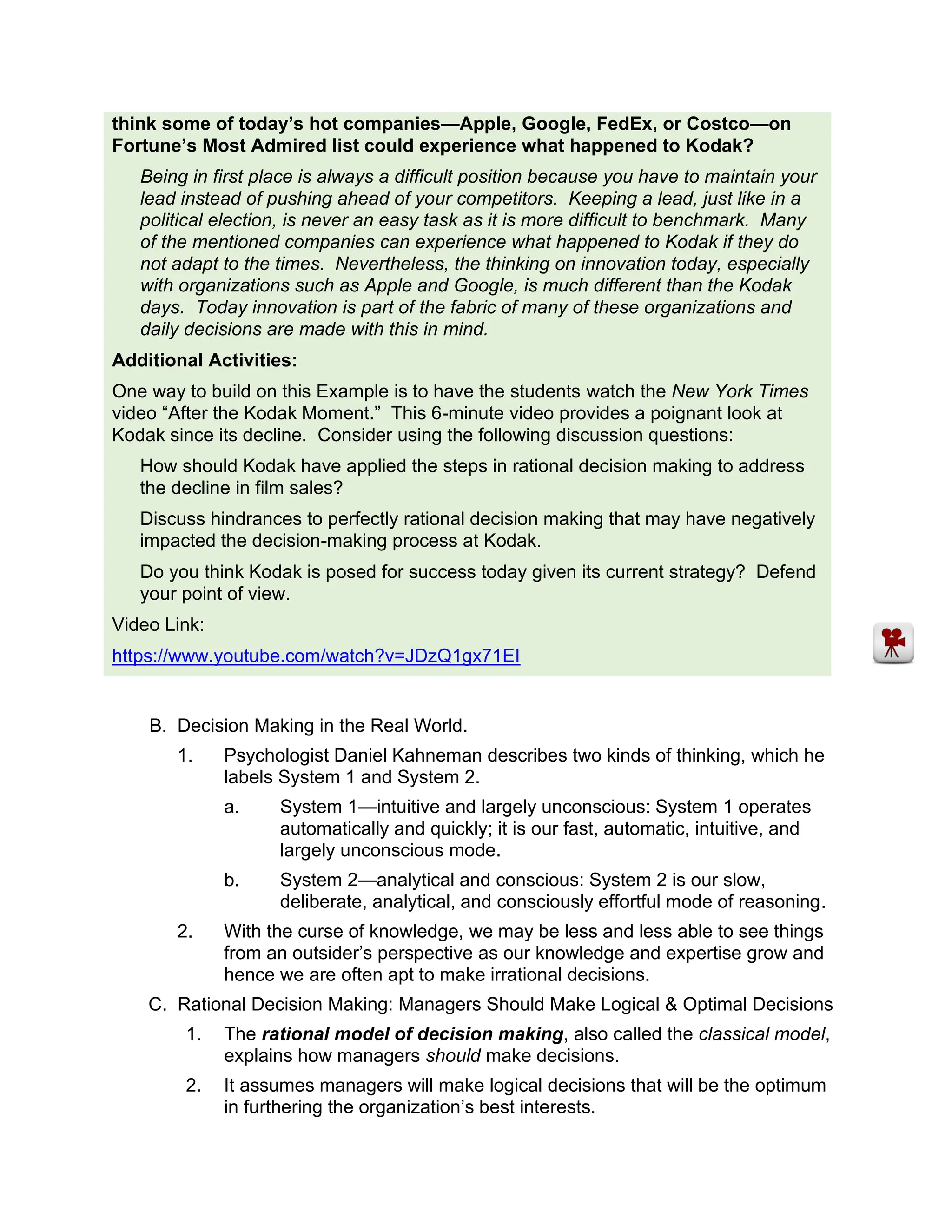
1. A decision is a choice made from among available alternatives.
2. Decision making is the process of identifying and choosing alternative
courses of action.
Interactive Classroom Material:
EXAMPLE: How Can Being the Best Affect Your Decision Making? (p. 190)
Kodak was one of the biggest companies of all time, but had to make some tough
decisions on innovation. Afraid to cannibalize its existing business—selling film—
Kodak continued to push forward with its present business model rather than look at
what the market wanted.
YOUR CALL
Is being in first place the most dangerous place for decision makers? Do you
think some of today’s hot companies—Apple, Google, FedEx, or Costco—on
Fortune’s Most Admired list could experience what happened to Kodak?
Being in first place is always a difficult position because you have to maintain your
lead instead of pushing ahead of your competitors. Keeping a lead, just like in a
political election, is never an easy task as it is more difficult to benchmark. Many
of the mentioned companies can experience what happened to Kodak if they do
not adapt to the times. Nevertheless, the thinking on innovation today, especially
with organizations such as Apple and Google, is much different than the Kodak
days. Today innovation is part of the fabric of many of these organizations and
daily decisions are made with this in mind.
Additional Activities:
One way to build on this Example is to have the students watch the New York Times
video “After the Kodak Moment.” This 6-minute video provides a poignant look at
Kodak since its decline. Consider using the following discussion questions:
How should Kodak have applied the steps in rational decision making to address
the decline in film sales?
Discuss hindrances to perfectly rational decision making that may have negatively
impacted the decision-making process at Kodak.
Do you think Kodak is posed for success today given its current strategy? Defend
your point of view.
Video Link:
https://www.youtube.com/watch?v=JDzQ1gx71EI
B. Decision Making in the Real World.
1. Psychologist Daniel Kahneman describes two kinds of thinking, which he
labels System 1 and System 2.
a. System 1—intuitive and largely unconscious: System 1 operates
automatically and quickly; it is our fast, automatic, intuitive, and
largely unconscious mode.
b. System 2—analytical and conscious: System 2 is our slow,
deliberate, analytical, and consciously effortful mode of reasoning.
2. With the curse of knowledge, we may be less and less able to see things
from an outsider’s perspective as our knowledge and expertise grow and
hence we are often apt to make irrational decisions.
C. Rational Decision Making: Managers Should Make Logical & Optimal Decisions
1. The rational model of decision making, also called the classical model,
explains how managers should make decisions.
2. It assumes managers will make logical decisions that will be the optimum
in furthering the organization’s best interests.
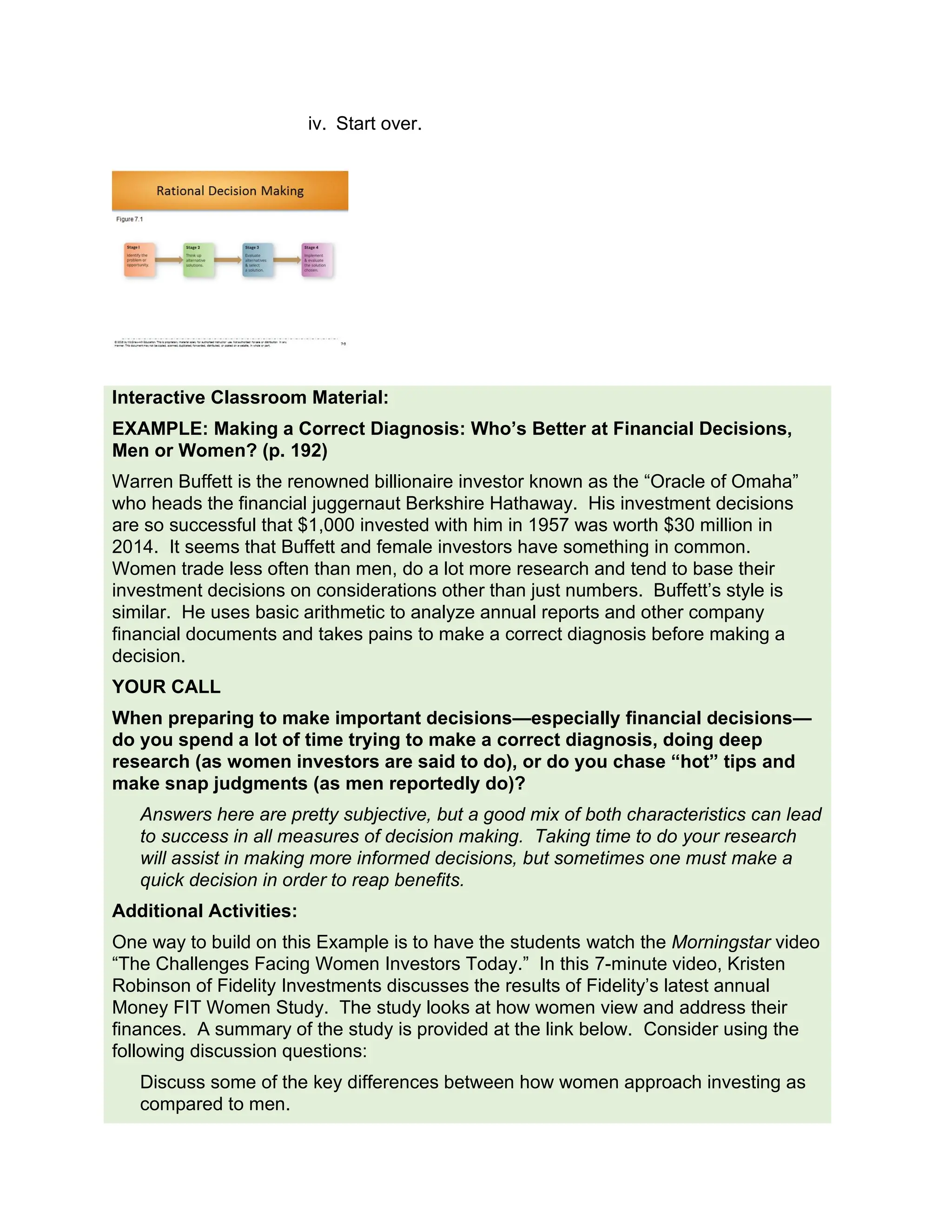
2. There are four stages associated with rational decision making.
a. Stage 1: Identify the problem or opportunity
(1) Problems are difficulties that inhibit the achievement of goals.
(2) Opportunities are situations that present possibilities for
exceeding existing goals.
(3) How to change conditions from the present to the desirable is a
matter of diagnosis – analyzing the underlying causes.
b. Stage 2: Think up alternative solutions – both the obvious and the
creative.
(1) After you’ve identified the problem or opportunity and diagnosed
its causes, you need to come up with alternative solutions.
c. Stage 3: Evaluate alternatives and select a solution – ethics,
feasibility, and effectiveness.
(1) Is it ethical? If it isn’t ethical, you shouldn’t give it a second look.
(2) Is it feasible? A proposed solution may not be feasible for a
variety of reasons.
(3) Is it ultimately effective? Short-term “good enough” solutions
may not be the best in the long term.
d. Stage 4: Implement and evaluate the solution chosen.
(1) With some decisions, implementation is usually straightforward.
(2) With other decisions, the implementation can be quite difficult.
(3) For implementation to be successful, you need to plan carefully
and be sensitive to those affected.
(4) You also need to follow-up and evaluate the results of the
decision and take action. If it is not working, some possibilities:
i. Give it more time.
ii. Change it slightly.
iii. Try another alternative.
iv. Start over.
Interactive Classroom Material:
EXAMPLE: Making a Correct Diagnosis: Who’s Better at Financial Decisions,
Men or Women? (p. 192)
Warren Buffett is the renowned billionaire investor known as the “Oracle of Omaha”
who heads the financial juggernaut Berkshire Hathaway. His investment decisions
are so successful that $1,000 invested with him in 1957 was worth $30 million in
2014. It seems that Buffett and female investors have something in common.
Women trade less often than men, do a lot more research and tend to base their
investment decisions on considerations other than just numbers. Buffett’s style is
similar. He uses basic arithmetic to analyze annual reports and other company
financial documents and takes pains to make a correct diagnosis before making a
decision.
YOUR CALL
When preparing to make important decisions—especially financial decisions—
do you spend a lot of time trying to make a correct diagnosis, doing deep
research (as women investors are said to do), or do you chase “hot” tips and
make snap judgments (as men reportedly do)?
Answers here are pretty subjective, but a good mix of both characteristics can lead
to success in all measures of decision making. Taking time to do your research
will assist in making more informed decisions, but sometimes one must make a
quick decision in order to reap benefits.
Additional Activities:
One way to build on this Example is to have the students watch the Morningstar video
“The Challenges Facing Women Investors Today.” In this 7-minute video, Kristen
Robinson of Fidelity Investments discusses the results of Fidelity’s latest annual
Money FIT Women Study. The study looks at how women view and address their
finances. A summary of the study is provided at the link below. Consider using the
following discussion questions:
Discuss some of the key differences between how women approach investing as
compared to men.
Assume you are an investment manager at Fidelity. How could you use the
results of this study to help attract more female clients and/or get female clients to
invest more aggressively?
Extrapolate the results of this study to make general conclusions about how
women might approach managerial decision making differently than men.
Video Link:
http://www.morningstar.com/cover/videocenter.aspx?id=701817
Report Link:
https://www.fidelity.com/bin-public/060_www_fidelity_com/documents/women-fit-
money-study.pdf
SELF-ASSESSMENT 7.1 (p. 193)
Assessing Your Problem-Solving Potential
Go to connect.mheducation.com and take Self-Assessment 7.1.
Student Questions:
1. What is the status of your problem-solving skills? Are you surprised by the
results?
Student responses will differ based on assessment results. Many students
will be surprised to see that their current approach to problem-solving may not
be as effective as they had thought. Others will be more assured that they are
on the right track.
2. Based on identifying the four lowest scored items on the assessment, what
can you do to improve your problem-solving skills? Explain.
Generally, individuals should consider long-term consequences associated
with implementing solutions, generate multiple outcomes when dealing with a
work problem and implement solutions in a timely and effective manner, with a
follow-up planned.
3. Reflect on a recent decision you made that did not turn out to your
satisfaction. Now, consider what you learned about the rational model and
your problem-solving skills and think through the decision for a second time.
What would you do differently based on these considerations?
Students should implement actual steps from the rational model and apply
them to their recent decision. They can then state which step or steps they
need to work on.
Additional Activities:
You can also consult the Connect Instructors Manual for the post-assessment activity
and corresponding PowerPoint slides used for this Self-Assessment in Connect. In
this activity, students can be divided into groups based on their scores on the
assessment. The groups can review the scenario on a slide provided in the slide
deck. Each group is to write a one-two paragraph speech that the CEO is to give to
the company’s employees that discusses the ethical dilemma presented. The class
should discuss as a whole based on each groups’ scores on the assessment. Have
the students consider if the scores affected the type of speech given
Interactive Classroom Material:
EXAMPLE: Faulty Implementation: Customer Service Is Often “Just Talk” (pp.
193-194)
One study found that only 6% of shoppers who experienced a problem with a retailer
contacted the company. However, 31% went on to tell friends, family, and colleagues
what had happened. Indeed, if 100 people have a bad experience, a retailer stands
to lose between 32 and 36 current or potential customers, according to the study.
YOUR CALL
What do you think the self-serve trend means for customer service?
Self-serve means that customer service may slowly become nonexistent, or
become computer-assisted service. Complaints now may be centered on
technological issues rather than human interactions. The result may still be the
same whereas a customer upset with a technology-assisted process may not shop
at a specific location, and may still complain to his or her friends and family.
However, this experience may not be as damaging to a company as a bad human
interaction.
Additional Activities:
One way to build on this Example is to have the students watch the ABC News
202/20 segment “How Ex-Customer Service Reps Say They Dealt with Unruly
Customers.” This 7-minute video profiles the decline of customer service, from the
perspective of customer service agents and customers. Consider using the following
discussion questions:
Discuss the reasons why it can be difficult to motivate customer service agents.
Before calling customer service, why might it be beneficial for customers to “step
inside the shoes of the customer service agent?”
Discuss how providing a more motivating work environment similar to that used by
Zappos might improve customer service.
Video Link:
http://abcnews.go.com/2020/video/customer-service-reps-dealt-unruly-customers-
29971362
Interactive Classroom Material:
EXAMPLE: Evaluation: The Boeing 787 Dreamliner, a Bet-the-Company
Decision (pp. 194-195)
When Boeing was losing business to its European rival Airbus, the company was
wracked by scandals involving Pentagon contracts, and rising fuel costs were
dramatically impacting the commercial airline industry. Boeing management made a
bold decision: It would build a new medium-sized commercial jet, the 787 Dreamliner.
First planned for a summer 2007 launch, the date was revised for 2008. Then the
company began encountering a number of problems. In October 2007, Boeing
announced it would no longer meet its May 2008 target date and was postponing its
first delivery to late fall of that year. It later changed the date to the first quarter of
2009, and then rescheduled it again – to the third quarter of 2009. Finally, the
Dreamliner had its first flight in December 2009 but was not put into service until
October 2011 – 3 years behind schedule.
YOUR CALL
How would you evaluate Boeing’s decisions? Do you think despite all the effort
on the 787-8 that the Dash Nine could cause Boeing to fail to break even on the
787-8, with airlines switching their orders to the newer aircraft? Was this a
risky bet-the-company decision?
Boeing is attempting to correct many of the issues with the 787-8 with the 787-9
(Dash Nine). There was some poor decision making on the 787-8, but that does
not mean that Boeing should not create a better aircraft for the market, if possible,
with the Dash Nine. This may be risky for the organization, but is the right thing to
do and may mean that the profits from the 787-9 can assist it with any losses with
the 787-8.
Additional Activities:
One way to build on this Example is to have the students read the Wall Street Journal
article “With Plates Full, Boeing and Airbus Plot Next Moves.” The article profiles
some of the strategic decisions being made by the rival firms. Consider using the
following discussion questions:
Using the rational decision making model, analyze whether it would be a good
decision for Boeing to focus on building a new jet to replace its out-of-production
757.
Discuss the hindrances to perfectly rational decision making that could have
impacted the 787 Dreamliner project.
Using the material from Chapter 6, perform a Porter’s Five Forces analysis on the
commercial jetliner industry. What are the key factors impacting the attractiveness
of this industry?
Article Citation:
Ostrower, J., & Wall, R. (2015, June 17). With plates full, Boeing and Airbus plot next
moves. Wall Street Journal Online.
ProQuest Document ID: 1689386772
http://www.wsj.com/articles/with-plates-full-boeing-and-airbus-plot-next-moves-
1434563188u
D. What’s Wrong with the Rational Model?
1. The rational model is prescriptive, describing how managers ought to make
decisions, not how managers actually make decisions.
2. The rational model makes three unrealistic assumptions:
a. Complete information, no uncertainty. Managers should have complete,
error-free information about all alternative courses of action and their
consequences.
b. Logical, unemotional analysis. Managers should have no prejudices or
emotional blind spots.
c. Best decision for the organization. Managers should choose the
alternative they believe will best benefit the organization.
E. Nonrational Decision Making: Managers Find It Difficult to Make Optimum
Decisions
1. Nonrational models of decision making explain how managers do
make decisions.
a. They assume that decision making is nearly always uncertain and risky
making it difficult for managers to make optimum decisions.
a. The nonrational models are descriptive rather than prescriptive; they
describe how managers actually make decisions.
2. Bounded rationality and the satisficing model: “satisfactory is good
enough.”
a. Herbert Simon’s research found that managers could not act truly
logically because their rationality was bounded by so many
restrictions.
b. Called bounded rationality, the concept suggests that the ability of
decision makers to be rational is limited by numerous constraints.
c. As a result, managers don’t make an exhaustive search for the best
alternative.
d. Instead, they follow the satisficing model—that is, managers seek
alternatives until they find one that is satisfactory, not optimal.
3. The Intuition Model: “It just feels right”
a. Going with your gut, or intuition, is making a choice without the use of
conscious thought or logical interference.
b. Sources of intuition are:
(1) expertise – a person’s explicit and tacit knowledge about a
person, situation, object or decision opportunity.
(2) feelings – the automatic, underlying emotions that a person
experiences about those same matters.
c. Intuition has at least two benefits:
(1) it can speed up decision making when deadlines are tight
(2) It can be helpful when resources are limited.
d. A drawback of intuition is that others may not see your logic, and
therefore be hard to convince.
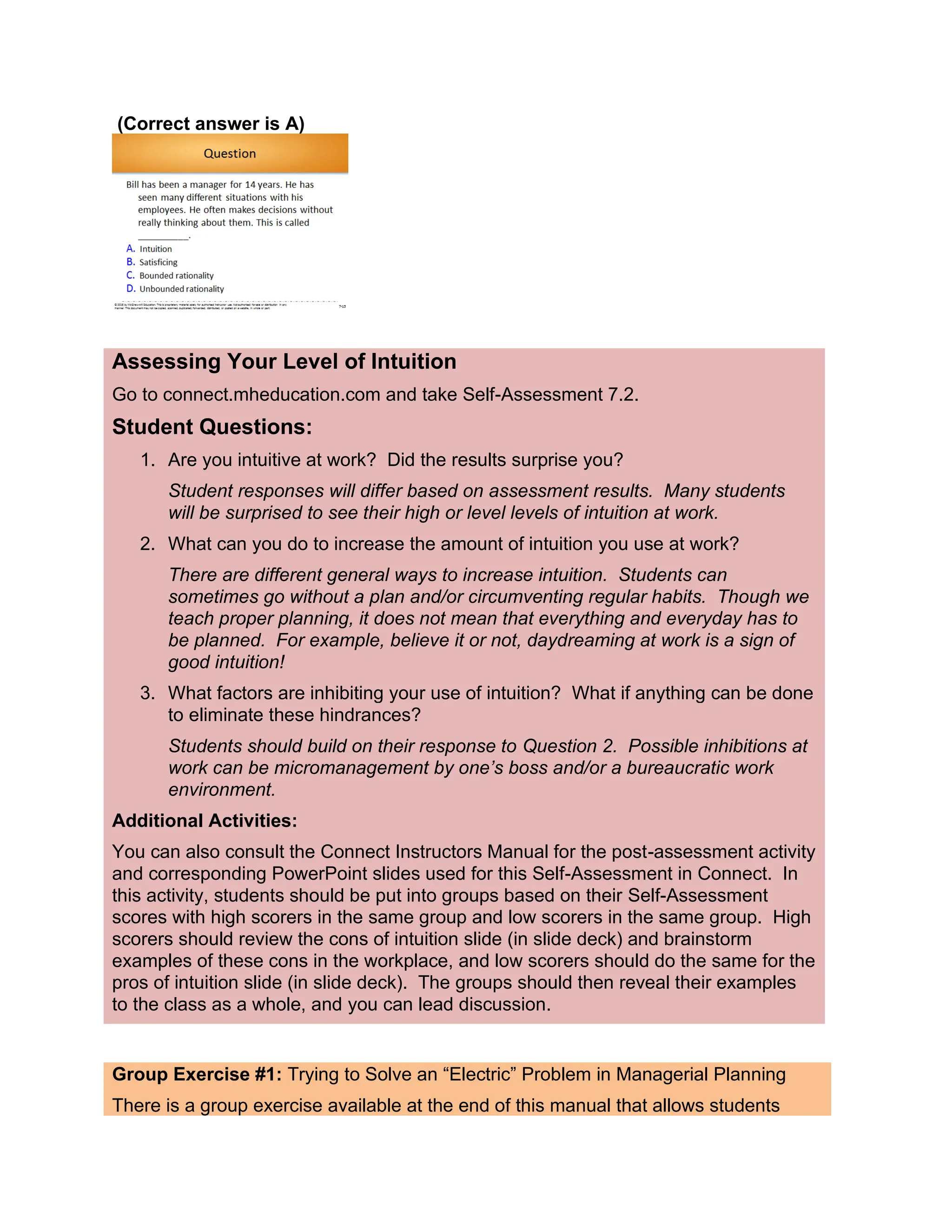
(Correct answer is A)
Assessing Your Level of Intuition
Go to connect.mheducation.com and take Self-Assessment 7.2.
Student Questions:
1. Are you intuitive at work? Did the results surprise you?
Student responses will differ based on assessment results. Many students
will be surprised to see their high or level levels of intuition at work.
2. What can you do to increase the amount of intuition you use at work?
There are different general ways to increase intuition. Students can
sometimes go without a plan and/or circumventing regular habits. Though we
teach proper planning, it does not mean that everything and everyday has to
be planned. For example, believe it or not, daydreaming at work is a sign of
good intuition!
3. What factors are inhibiting your use of intuition? What if anything can be done
to eliminate these hindrances?
Students should build on their response to Question 2. Possible inhibitions at
work can be micromanagement by one’s boss and/or a bureaucratic work
environment.
Additional Activities:
You can also consult the Connect Instructors Manual for the post-assessment activity
and corresponding PowerPoint slides used for this Self-Assessment in Connect. In
this activity, students should be put into groups based on their Self-Assessment
scores with high scorers in the same group and low scorers in the same group. High
scorers should review the cons of intuition slide (in slide deck) and brainstorm
examples of these cons in the workplace, and low scorers should do the same for the
pros of intuition slide (in slide deck). The groups should then reveal their examples
to the class as a whole, and you can lead discussion.
Group Exercise #1: Trying to Solve an “Electric” Problem in Managerial Planning
There is a group exercise available at the end of this manual that allows students
apply what they have learned about planning and problem-solving.
Exercise Objectives
• To assess a specific problem where planning is required.
• To arrive at a mutual and effective solution as a group, taking into
consideration different perspectives and different goals.
Section 7.2 discusses a decision tree, which can help one make ethical decisions. One
way that you could begin your coverage of these topics is to have the students read the
Harvard Business Review article “Is It Ever OK to Break a Promise?” This article is a
HBR Case Study and includes a fictional case and case commentary by industry
experts. In this case, a student must decide whether to break his promise and leave the
company that sponsored his MBA to be able to accept a dream job. Using this case
study would a relevant way for students to apply the ethical decision tree.
Article Citation:
Bearden, N., Oelschlegel, C., & Brown, J. (2014). Is it ever OK to break a promise?
Harvard Business Review, 92(9), 119-123.
Product #: R1409L-PDF-ENG
Possible Topics for Discussion:
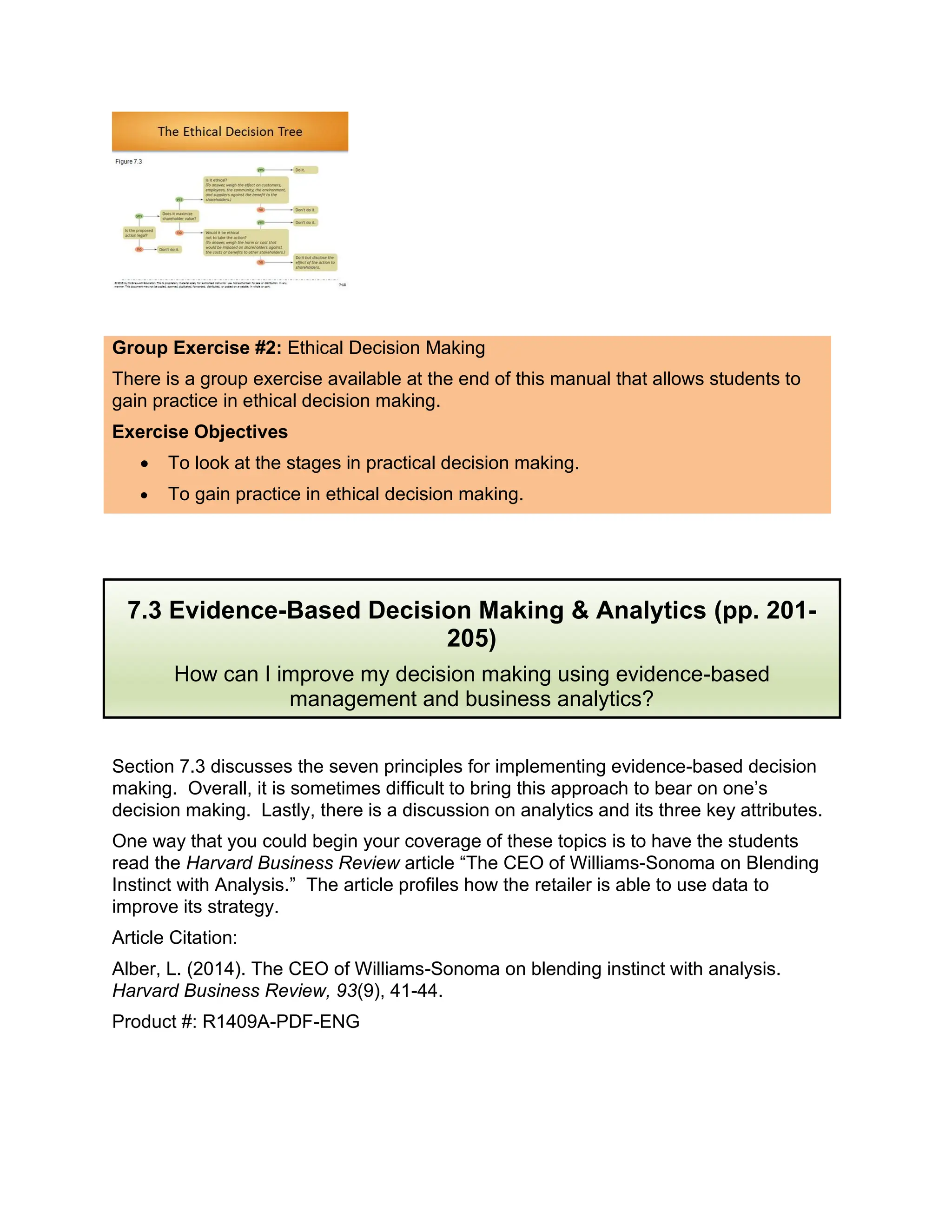
• Think of a time when you were not sure if a course of action you were
considering was ethical or not. How could you have applied the ethical decision
tree in Figure 7.3 to help you make a decision?
• What are the limitations of using the ethical decision tree presented in the
chapter?
• Using the Harvard Business Review article “Is It Ever OK to Break a Promise?”
as your foundation, apply the ethical decision tree from Figure 7.3 to provide
specific recommendations for how Sameer Hopskin should deal with the current
situation.
Major Idea Outline:
A. The Dismal Record of Business Ethics
1. Recent high-profile scandals have spurred interest in ethical decision
making.
7.2 Making Ethical Decisions (pp. 199-200)
What guidelines can I follow to be sure that decisions I make are not just
lawful but ethical?
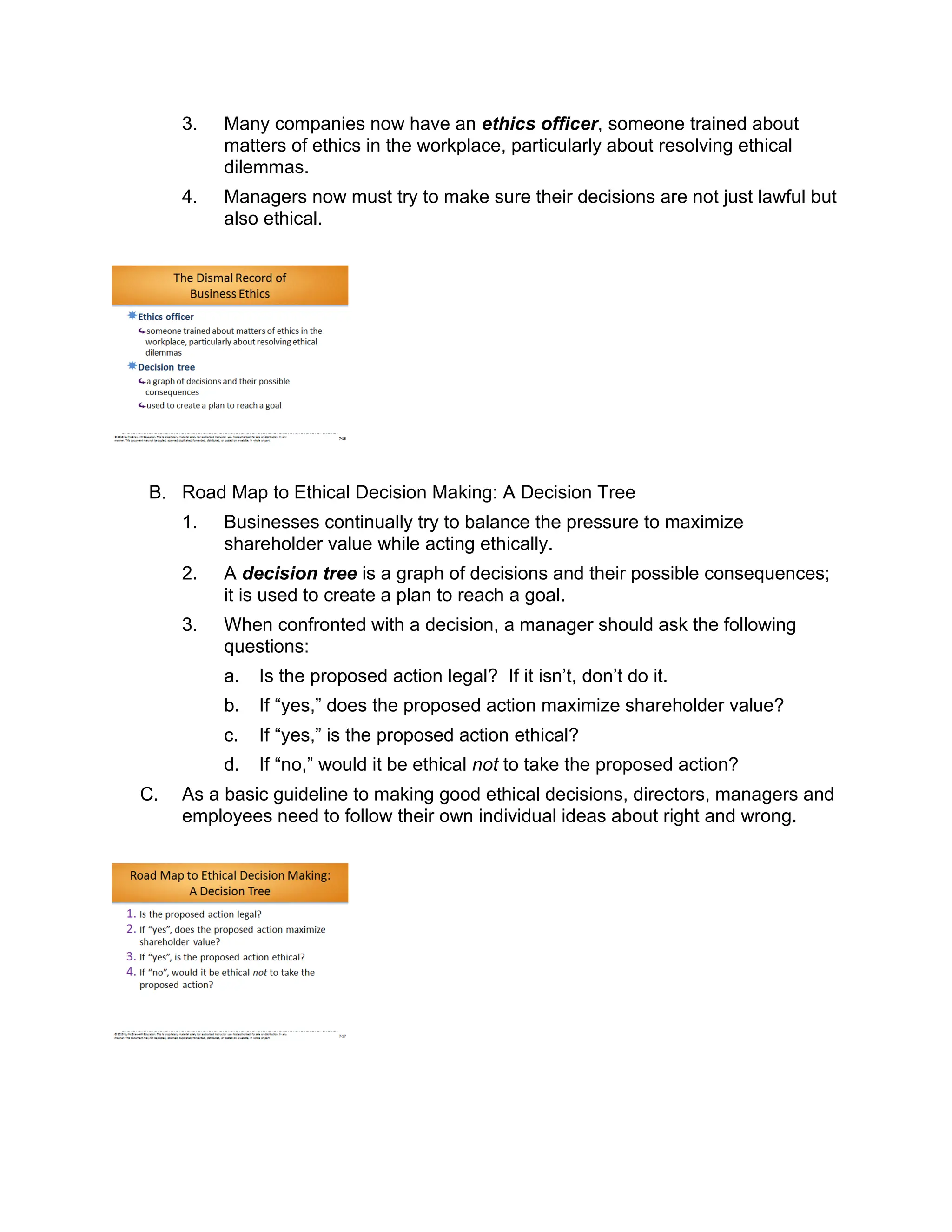
3. Many companies now have an ethics officer, someone trained about
matters of ethics in the workplace, particularly about resolving ethical
dilemmas.
4. Managers now must try to make sure their decisions are not just lawful but
also ethical.
B. Road Map to Ethical Decision Making: A Decision Tree
1. Businesses continually try to balance the pressure to maximize
shareholder value while acting ethically.
2. A decision tree is a graph of decisions and their possible consequences;
it is used to create a plan to reach a goal.
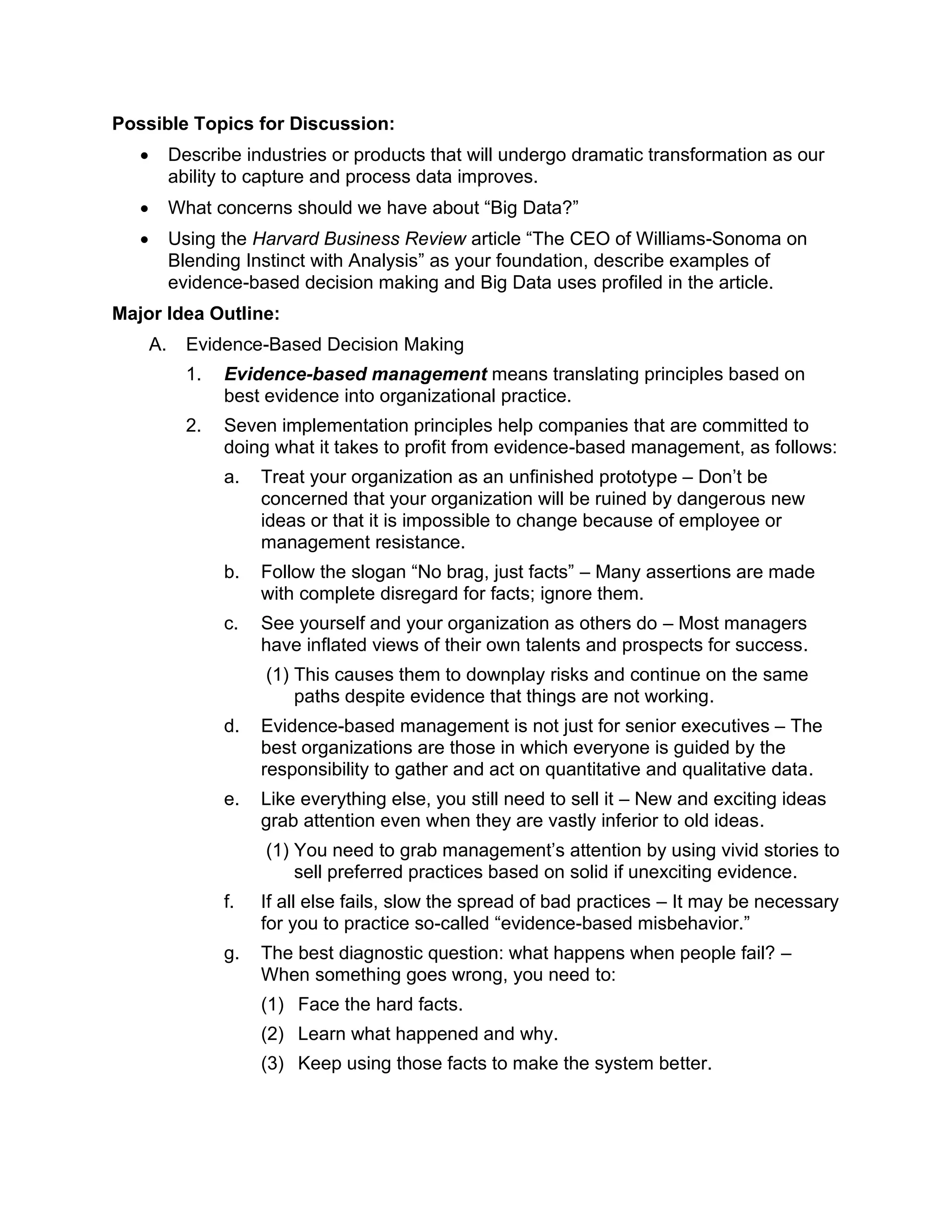
3. When confronted with a decision, a manager should ask the following
questions:
a. Is the proposed action legal? If it isn’t, don’t do it.
b. If “yes,” does the proposed action maximize shareholder value?
c. If “yes,” is the proposed action ethical?
d. If “no,” would it be ethical not to take the proposed action?
C. As a basic guideline to making good ethical decisions, directors, managers and
employees need to follow their own individual ideas about right and wrong.
Group Exercise #2: Ethical Decision Making
There is a group exercise available at the end of this manual that allows students to
gain practice in ethical decision making.
Exercise Objectives
• To look at the stages in practical decision making.
• To gain practice in ethical decision making.
Section 7.3 discusses the seven principles for implementing evidence-based decision
making. Overall, it is sometimes difficult to bring this approach to bear on one’s
decision making. Lastly, there is a discussion on analytics and its three key attributes.
One way that you could begin your coverage of these topics is to have the students
read the Harvard Business Review article “The CEO of Williams-Sonoma on Blending
Instinct with Analysis.” The article profiles how the retailer is able to use data to
improve its strategy.
Article Citation:
Alber, L. (2014). The CEO of Williams-Sonoma on blending instinct with analysis.
Harvard Business Review, 93(9), 41-44.
Product #: R1409A-PDF-ENG
7.3 Evidence-Based Decision Making & Analytics (pp. 201-
205)
How can I improve my decision making using evidence-based
management and business analytics?
Possible Topics for Discussion:
• Describe industries or products that will undergo dramatic transformation as our
ability to capture and process data improves.
• What concerns should we have about “Big Data?”
• Using the Harvard Business Review article “The CEO of Williams-Sonoma on
Blending Instinct with Analysis” as your foundation, describe examples of
evidence-based decision making and Big Data uses profiled in the article.
Major Idea Outline:
A. Evidence-Based Decision Making
1. Evidence-based management means translating principles based on
best evidence into organizational practice.
2. Seven implementation principles help companies that are committed to
doing what it takes to profit from evidence-based management, as follows:
a. Treat your organization as an unfinished prototype – Don’t be
concerned that your organization will be ruined by dangerous new
ideas or that it is impossible to change because of employee or
management resistance.
b. Follow the slogan “No brag, just facts” – Many assertions are made
with complete disregard for facts; ignore them.
c. See yourself and your organization as others do – Most managers
have inflated views of their own talents and prospects for success.
(1) This causes them to downplay risks and continue on the same
paths despite evidence that things are not working.
d. Evidence-based management is not just for senior executives – The
best organizations are those in which everyone is guided by the
responsibility to gather and act on quantitative and qualitative data.
e. Like everything else, you still need to sell it – New and exciting ideas
grab attention even when they are vastly inferior to old ideas.
(1) You need to grab management’s attention by using vivid stories to
sell preferred practices based on solid if unexciting evidence.
f. If all else fails, slow the spread of bad practices – It may be necessary
for you to practice so-called “evidence-based misbehavior.”
g. The best diagnostic question: what happens when people fail? –
When something goes wrong, you need to:
(1) Face the hard facts.
(2) Learn what happened and why.
(3) Keep using those facts to make the system better.
Another Random Scribd Document
with Unrelated Content
If the second copy is also defective, you may demand a refund
in writing without further opportunities to fix the problem.
1.F.4. Except for the limited right of replacement or refund set
forth in paragraph 1.F.3, this work is provided to you ‘AS-IS’,
WITH NO OTHER WARRANTIES OF ANY KIND, EXPRESS OR
IMPLIED, INCLUDING BUT NOT LIMITED TO WARRANTIES OF
MERCHANTABILITY OR FITNESS FOR ANY PURPOSE.
1.F.5. Some states do not allow disclaimers of certain implied
warranties or the exclusion or limitation of certain types of
damages. If any disclaimer or limitation set forth in this
agreement violates the law of the state applicable to this
agreement, the agreement shall be interpreted to make the
maximum disclaimer or limitation permitted by the applicable
state law. The invalidity or unenforceability of any provision of
this agreement shall not void the remaining provisions.
1.F.6. INDEMNITY - You agree to indemnify and hold the
Foundation, the trademark owner, any agent or employee of the
Foundation, anyone providing copies of Project Gutenberg™
electronic works in accordance with this agreement, and any
volunteers associated with the production, promotion and
distribution of Project Gutenberg™ electronic works, harmless
from all liability, costs and expenses, including legal fees, that
arise directly or indirectly from any of the following which you
do or cause to occur: (a) distribution of this or any Project
Gutenberg™ work, (b) alteration, modification, or additions or
deletions to any Project Gutenberg™ work, and (c) any Defect
you cause.
Section 2. Information about the Mission
of Project Gutenberg™
Project Gutenberg™ is synonymous with the free distribution of
electronic works in formats readable by the widest variety of
computers including obsolete, old, middle-aged and new
computers. It exists because of the efforts of hundreds of
volunteers and donations from people in all walks of life.
Volunteers and financial support to provide volunteers with the
assistance they need are critical to reaching Project
Gutenberg™’s goals and ensuring that the Project Gutenberg™
collection will remain freely available for generations to come. In
2001, the Project Gutenberg Literary Archive Foundation was
created to provide a secure and permanent future for Project
Gutenberg™ and future generations. To learn more about the
Project Gutenberg Literary Archive Foundation and how your
efforts and donations can help, see Sections 3 and 4 and the
Foundation information page at www.gutenberg.org.
Section 3. Information about the Project
Gutenberg Literary Archive Foundation
The Project Gutenberg Literary Archive Foundation is a non-
profit 501(c)(3) educational corporation organized under the
laws of the state of Mississippi and granted tax exempt status
by the Internal Revenue Service. The Foundation’s EIN or
federal tax identification number is 64-6221541. Contributions
to the Project Gutenberg Literary Archive Foundation are tax
deductible to the full extent permitted by U.S. federal laws and
your state’s laws.
The Foundation’s business office is located at 809 North 1500
West, Salt Lake City, UT 84116, (801) 596-1887. Email contact
links and up to date contact information can be found at the
Foundation’s website and official page at
www.gutenberg.org/contact
Section 4. Information about Donations to
the Project Gutenberg Literary Archive
Foundation
Project Gutenberg™ depends upon and cannot survive without
widespread public support and donations to carry out its mission
of increasing the number of public domain and licensed works
that can be freely distributed in machine-readable form
accessible by the widest array of equipment including outdated
equipment. Many small donations ($1 to $5,000) are particularly
important to maintaining tax exempt status with the IRS.
The Foundation is committed to complying with the laws
regulating charities and charitable donations in all 50 states of
the United States. Compliance requirements are not uniform
and it takes a considerable effort, much paperwork and many
fees to meet and keep up with these requirements. We do not
solicit donations in locations where we have not received written
confirmation of compliance. To SEND DONATIONS or determine
the status of compliance for any particular state visit
www.gutenberg.org/donate.
While we cannot and do not solicit contributions from states
where we have not met the solicitation requirements, we know
of no prohibition against accepting unsolicited donations from
donors in such states who approach us with offers to donate.
International donations are gratefully accepted, but we cannot
make any statements concerning tax treatment of donations
received from outside the United States. U.S. laws alone swamp
our small staff.
Please check the Project Gutenberg web pages for current
donation methods and addresses. Donations are accepted in a
number of other ways including checks, online payments and
credit card donations. To donate, please visit:
www.gutenberg.org/donate.
Section 5. General Information About
Project Gutenberg™ electronic works
Professor Michael S. Hart was the originator of the Project
Gutenberg™ concept of a library of electronic works that could
be freely shared with anyone. For forty years, he produced and
distributed Project Gutenberg™ eBooks with only a loose
network of volunteer support.
Project Gutenberg™ eBooks are often created from several
printed editions, all of which are confirmed as not protected by
copyright in the U.S. unless a copyright notice is included. Thus,
we do not necessarily keep eBooks in compliance with any
particular paper edition.
Most people start at our website which has the main PG search
facility: www.gutenberg.org.
This website includes information about Project Gutenberg™,
including how to make donations to the Project Gutenberg
Literary Archive Foundation, how to help produce our new
eBooks, and how to subscribe to our email newsletter to hear
about new eBooks.
Welcome to our website – the ideal destination for book lovers and
knowledge seekers. With a mission to inspire endlessly, we offer a
vast collection of books, ranging from classic literary works to
specialized publications, self-development books, and children's
literature. Each book is a new journey of discovery, expanding
knowledge and enriching the soul of the reade
Our website is not just a platform for buying books, but a bridge
connecting readers to the timeless values of culture and wisdom. With
an elegant, user-friendly interface and an intelligent search system,
we are committed to providing a quick and convenient shopping
experience. Additionally, our special promotions and home delivery
services ensure that you save time and fully enjoy the joy of reading.
Let us accompany you on the journey of exploring knowledge and
personal growth!
testbankdeal.com
Management A Practical Introduction 7th Edition Kinicki Solutions Manual

  • 1.
    Visit https://testbankdeal.com todownload the full version and explore more testbank or solutions manual Management A Practical Introduction 7th Edition Kinicki Solutions Manual _____ Click the link below to download _____ https://testbankdeal.com/product/management-a-practical- introduction-7th-edition-kinicki-solutions-manual/ Explore and download more testbank or solutions manual at testbankdeal.com
  • 2.
    Here are somerecommended products that we believe you will be interested in. You can click the link to download. Management A Practical Introduction 7th Edition Kinicki Test Bank https://testbankdeal.com/product/management-a-practical- introduction-7th-edition-kinicki-test-bank/ Management A Practical Introduction 6th Edition Kinicki Solutions Manual https://testbankdeal.com/product/management-a-practical- introduction-6th-edition-kinicki-solutions-manual/ Management A Practical Introduction 8th edition Kinicki Solutions Manual https://testbankdeal.com/product/management-a-practical- introduction-8th-edition-kinicki-solutions-manual/ Canadian Organizational Behaviour 7th Edition McShane Test Bank https://testbankdeal.com/product/canadian-organizational- behaviour-7th-edition-mcshane-test-bank/
  • 3.
    Strategic Marketing 1stEdition Mooradian Test Bank https://testbankdeal.com/product/strategic-marketing-1st-edition- mooradian-test-bank/ Marketing Research 6th Edition Burns Test Bank https://testbankdeal.com/product/marketing-research-6th-edition-burns- test-bank/ Horngrens Accounting Volume 2 Canadian 10th Edition Nobles Solutions Manual https://testbankdeal.com/product/horngrens-accounting- volume-2-canadian-10th-edition-nobles-solutions-manual/ Children and Their Development Canadian 4th Edition Kail Test Bank https://testbankdeal.com/product/children-and-their-development- canadian-4th-edition-kail-test-bank/ Shelly Cashman Series Microsoft Office 365 and Office 2016 Introductory 1st Edition Vermaat Test Bank https://testbankdeal.com/product/shelly-cashman-series-microsoft- office-365-and-office-2016-introductory-1st-edition-vermaat-test-bank/
  • 4.
    Financial Markets andInstitutions 9th Edition Madura Test Bank https://testbankdeal.com/product/financial-markets-and- institutions-9th-edition-madura-test-bank/
  • 5.
    7 Chapter Individual & Group DecisionMaking How Managers Make Things Happen Major Questions the Student Should Be Able to Answer 2 Mapping the Class: Chapter Outline 3 Overview of the Chapter 4 Classroom Outline 5 Challenge: Major Questions 39 Management in Action 41 Legal/Ethical Challenge 44 Group Exercises 46 Video Case 55 Manager’s Hot Seat 56 CHAPTER CONTENTS
  • 6.
    7.1 Two Kindsof Decision Making: Rational and Nonrational MAJOR QUESTION: How do people know when they’re being logical or illogical? 7.2 Making Ethical Decisions MAJOR QUESTION: What guidelines can I follow to be sure that decisions I make are not just lawful but ethical? 7.3 Evidence-Based Decision Making and Analytics MAJOR QUESTION: How can I improve my decision making using evidence- based management and business analytics? 7.4 Four General Decision-Making Styles MAJOR QUESTION: How do I decide to decide? 7.5 How to Overcome Barriers to Decision Making MAJOR QUESTION: Trying to be rational isn’t always easy. What are the barriers? 7.6 Group Decision Making: How to Work with Others MAJOR QUESTION: How do I work with others to make things happen? MAJOR QUESTIONS THE STUDENT SHOULD BE ABLE TO ANSWER
  • 7.
    7.1 Two Kindsof Decision Making: Rational and Nonrational • Decision Making in the Real World • Rational Decision Making: Managers Should Make Logical & Optimal Decisions • Stage 1: Identify the Problem or Opportunity—Determining the Actual versus the Desirable • Stage 2: Think Up Alternative Solutions—Both the Obvious & the Creative • Stage 3: Evaluate Alternatives & Select a Solution—Ethics, Feasibility, & Effectiveness • Stage 4: Implement & Evaluate the Solution Chosen • What’s Wrong with the Rational Model? • Nonrational Decision Making: Managers Find It Difficult to Make Optimal Decisions 7.2 Making Ethical Decisions • The Dismal Record of Business Ethics • Road Map to Ethical Decision Making: A Decision Tree 7.3 Evidence-Based Decision Making and Analytics • Evidence-Based Decision Making • In Praise of Analytics • The Uses of “Big Data” 7.4 Four General Decision-Making Styles • Value Orientation & Tolerance for Ambiguity • 1. The Directive Style: Action-Oriented Decision Makers Who Focus on Facts • 2. The Analytical Style: Careful Decision Makers Who Like Lots of Information & Alternative Choices • 3. The Conceptual Style: Decision Makers Who Rely on Intuition & Have a Long-Term Perspective • 4. The Behavioral Style: The Most People-Oriented Decision Makers • Which Style Do You Have? 7.5 How to Overcome Barriers to Decision Making • Decision Making & Expectations about Happiness • How Do Individuals Respond to a Decision Situation? Ineffective & Effective Responses • Nine Common Decision-Making Biases: Rules of Thumb, or “Heuristics” 7.6 Group Decision Making: How to Work with Others • Advantages & Disadvantages of Group Decision Making • What Managers Need to Know about Groups & Decision Making • Group Problem-Solving Techniques: Reaching for Consensus • More Group Problem-Solving Techniques MAPPING THE CLASS: CHAPTER OUTLINE
  • 8.
    7.1 Two Kindsof Decision Making: Rational and Nonrational Decision making, the process of identifying and choosing alternative courses of action, may be rational, but often it is nonrational. Four steps in making a rational decision are (1) identify the problem or opportunity, (2) think up alternative solutions, (3) evaluate alternatives and select a solution, and (4) implement and evaluate the solution chosen. Two examples of nonrational models of decision making are (1) satisficing and (2) intuition. 7.2 Making Ethical Decisions Businesses have a dismal record of ethics. Many companies now have an ethics officer, someone trained about matters of ethics in the workplace. A graph known as a decision tree can help one make ethical decisions. In addition, one should be aware of “the magnificent seven” general moral principles for managers. 7.3 Evidence-Based Decision Making and Analytics Evidence-based decision making brings rationality to the decision- making process. This section describes seven principles for implementing evidence-based management. Analytics has three key attributes: 1) use of modeling, 2) having multiple applications, not just one; and 3) support from the top. 7.4 Four General Decision-Making Styles Decision-making styles reflect how one perceives and responds to information. They can be directive, analytical, conceptual, or behavioral. 7.5 How to Overcome Barriers to Decision Making Responses to a decision situation may take the form of four ineffective reactions: relaxed avoidance, relaxed change, defensive avoidance, or panic; or three effective reactions: importance, credibility, or urgency. Managers should also be aware of nine common decision-making biases. 7.6 Group Decision Making: How to Work with Others Group decision making has five potential advantages and four potential disadvantages. There are a number of characteristics of groups that a manager should be aware of as group problem-solving techniques. OVERVIEW OF THE CHAPTER
  • 9.
    The Manager’s Toolbox:How Exceptional Managers Check to See If Their Decisions Might Be Biased An important part of a manager’s job is making decisions, but there are a variety of biases that can cause you to make the wrong decision. You can fall victim to the overconfidence bias when you are dealing with less familiar subjects. The prior- hypothesis bias may cause you to make a decision based on your strong prior beliefs, even when those beliefs are wrong. To overcome the ignoring-randomness bias, you must be willing to attribute trends to random events. It is important to use a broad, representative sample to avoid sampling biases. To avoid the hindsight bias, it is important to remember than hindsight does not equal foresight. Possible Topics for Discussion: • Facing the hard facts about what works and what doesn’t, how able do you think you are to make the tough decisions that effective managers have to make? Can you describe an instance in which you were badly wrong about something or someone? • Do you believe these biases are more likely to occur with individual decision making or group decision making? Explain your position. • Identify your own strongly held beliefs which may have the ability to impact your decision-making process. How can you overcome the tendency to fall victim to the prior hypothesis bias for those beliefs? • How could you determine if an event is just a random event or the sign of a genuine trend? Section 7.1 discusses four steps in the rational decision making process: (1) identify the problem or opportunity, (2) think up alternative solutions, (3) evaluate alternatives and select a solution, and (4) implement and evaluate the solution chosen. There is also a discussion on the two nonrational models of decision making: (1) satisficing and (2) intuition. One way that you could begin your coverage of these topics is to have the students read the Harvard Business Review article “SC Johnson’s CEO on Doing the Right Thing, Even When It Hurts Business.” In this article, Fisk Johnson, SC Johnson CEO, CLASSROOM OUTLINE 7.1 Two Kinds of Decision Making: Rational & Nonrational (pp. 190-198) How do people know when they’re being logical or illogical?
  • 10.
    describes the firm’sdecision to reformulate Saran Wrap over environmental concerns, knowing that the reformulation was likely to negatively impact the product’s sales. Article Citation: Johnson, F. (2015). SC Johnson’s CEO on doing the right thing, even when it hurts business. Harvard Business Review, 93(4), 33-36. Product #: R1504A-PDF-ENG Possible Topics for Discussion: • Discuss why it can be so hard to be purely rational in the decision-making process. • Describe a time you used intuition to make a decision. Describe the advantages and disadvantages of having used intuition to make this decision. • Using the Harvard Business Review article “SC Johnson’s CEO on Doing the Right Thing, Even When It Hurts Business” as your foundation, evaluate the extent to which SC Johnson’s decision to reformulate Saran Wrap is an example of rational decision making or nonrational decision making. Major Idea Outline: A. Decision Making Defined 1. A decision is a choice made from among available alternatives. 2. Decision making is the process of identifying and choosing alternative courses of action. Interactive Classroom Material: EXAMPLE: How Can Being the Best Affect Your Decision Making? (p. 190) Kodak was one of the biggest companies of all time, but had to make some tough decisions on innovation. Afraid to cannibalize its existing business—selling film— Kodak continued to push forward with its present business model rather than look at what the market wanted. YOUR CALL Is being in first place the most dangerous place for decision makers? Do you
  • 11.
    think some oftoday’s hot companies—Apple, Google, FedEx, or Costco—on Fortune’s Most Admired list could experience what happened to Kodak? Being in first place is always a difficult position because you have to maintain your lead instead of pushing ahead of your competitors. Keeping a lead, just like in a political election, is never an easy task as it is more difficult to benchmark. Many of the mentioned companies can experience what happened to Kodak if they do not adapt to the times. Nevertheless, the thinking on innovation today, especially with organizations such as Apple and Google, is much different than the Kodak days. Today innovation is part of the fabric of many of these organizations and daily decisions are made with this in mind. Additional Activities: One way to build on this Example is to have the students watch the New York Times video “After the Kodak Moment.” This 6-minute video provides a poignant look at Kodak since its decline. Consider using the following discussion questions: How should Kodak have applied the steps in rational decision making to address the decline in film sales? Discuss hindrances to perfectly rational decision making that may have negatively impacted the decision-making process at Kodak. Do you think Kodak is posed for success today given its current strategy? Defend your point of view. Video Link: https://www.youtube.com/watch?v=JDzQ1gx71EI B. Decision Making in the Real World. 1. Psychologist Daniel Kahneman describes two kinds of thinking, which he labels System 1 and System 2. a. System 1—intuitive and largely unconscious: System 1 operates automatically and quickly; it is our fast, automatic, intuitive, and largely unconscious mode. b. System 2—analytical and conscious: System 2 is our slow, deliberate, analytical, and consciously effortful mode of reasoning. 2. With the curse of knowledge, we may be less and less able to see things from an outsider’s perspective as our knowledge and expertise grow and hence we are often apt to make irrational decisions. C. Rational Decision Making: Managers Should Make Logical & Optimal Decisions 1. The rational model of decision making, also called the classical model, explains how managers should make decisions. 2. It assumes managers will make logical decisions that will be the optimum in furthering the organization’s best interests.
  • 12.
    2. There arefour stages associated with rational decision making. a. Stage 1: Identify the problem or opportunity (1) Problems are difficulties that inhibit the achievement of goals. (2) Opportunities are situations that present possibilities for exceeding existing goals. (3) How to change conditions from the present to the desirable is a matter of diagnosis – analyzing the underlying causes. b. Stage 2: Think up alternative solutions – both the obvious and the creative. (1) After you’ve identified the problem or opportunity and diagnosed its causes, you need to come up with alternative solutions. c. Stage 3: Evaluate alternatives and select a solution – ethics, feasibility, and effectiveness. (1) Is it ethical? If it isn’t ethical, you shouldn’t give it a second look. (2) Is it feasible? A proposed solution may not be feasible for a variety of reasons. (3) Is it ultimately effective? Short-term “good enough” solutions may not be the best in the long term. d. Stage 4: Implement and evaluate the solution chosen. (1) With some decisions, implementation is usually straightforward. (2) With other decisions, the implementation can be quite difficult. (3) For implementation to be successful, you need to plan carefully and be sensitive to those affected. (4) You also need to follow-up and evaluate the results of the decision and take action. If it is not working, some possibilities: i. Give it more time. ii. Change it slightly. iii. Try another alternative.
  • 13.
    iv. Start over. InteractiveClassroom Material: EXAMPLE: Making a Correct Diagnosis: Who’s Better at Financial Decisions, Men or Women? (p. 192) Warren Buffett is the renowned billionaire investor known as the “Oracle of Omaha” who heads the financial juggernaut Berkshire Hathaway. His investment decisions are so successful that $1,000 invested with him in 1957 was worth $30 million in 2014. It seems that Buffett and female investors have something in common. Women trade less often than men, do a lot more research and tend to base their investment decisions on considerations other than just numbers. Buffett’s style is similar. He uses basic arithmetic to analyze annual reports and other company financial documents and takes pains to make a correct diagnosis before making a decision. YOUR CALL When preparing to make important decisions—especially financial decisions— do you spend a lot of time trying to make a correct diagnosis, doing deep research (as women investors are said to do), or do you chase “hot” tips and make snap judgments (as men reportedly do)? Answers here are pretty subjective, but a good mix of both characteristics can lead to success in all measures of decision making. Taking time to do your research will assist in making more informed decisions, but sometimes one must make a quick decision in order to reap benefits. Additional Activities: One way to build on this Example is to have the students watch the Morningstar video “The Challenges Facing Women Investors Today.” In this 7-minute video, Kristen Robinson of Fidelity Investments discusses the results of Fidelity’s latest annual Money FIT Women Study. The study looks at how women view and address their finances. A summary of the study is provided at the link below. Consider using the following discussion questions: Discuss some of the key differences between how women approach investing as compared to men.
  • 14.
    Assume you arean investment manager at Fidelity. How could you use the results of this study to help attract more female clients and/or get female clients to invest more aggressively? Extrapolate the results of this study to make general conclusions about how women might approach managerial decision making differently than men. Video Link: http://www.morningstar.com/cover/videocenter.aspx?id=701817 Report Link: https://www.fidelity.com/bin-public/060_www_fidelity_com/documents/women-fit- money-study.pdf SELF-ASSESSMENT 7.1 (p. 193) Assessing Your Problem-Solving Potential Go to connect.mheducation.com and take Self-Assessment 7.1. Student Questions: 1. What is the status of your problem-solving skills? Are you surprised by the results? Student responses will differ based on assessment results. Many students will be surprised to see that their current approach to problem-solving may not be as effective as they had thought. Others will be more assured that they are on the right track. 2. Based on identifying the four lowest scored items on the assessment, what can you do to improve your problem-solving skills? Explain. Generally, individuals should consider long-term consequences associated with implementing solutions, generate multiple outcomes when dealing with a work problem and implement solutions in a timely and effective manner, with a follow-up planned. 3. Reflect on a recent decision you made that did not turn out to your satisfaction. Now, consider what you learned about the rational model and
  • 15.
    your problem-solving skillsand think through the decision for a second time. What would you do differently based on these considerations? Students should implement actual steps from the rational model and apply them to their recent decision. They can then state which step or steps they need to work on. Additional Activities: You can also consult the Connect Instructors Manual for the post-assessment activity and corresponding PowerPoint slides used for this Self-Assessment in Connect. In this activity, students can be divided into groups based on their scores on the assessment. The groups can review the scenario on a slide provided in the slide deck. Each group is to write a one-two paragraph speech that the CEO is to give to the company’s employees that discusses the ethical dilemma presented. The class should discuss as a whole based on each groups’ scores on the assessment. Have the students consider if the scores affected the type of speech given Interactive Classroom Material: EXAMPLE: Faulty Implementation: Customer Service Is Often “Just Talk” (pp. 193-194) One study found that only 6% of shoppers who experienced a problem with a retailer contacted the company. However, 31% went on to tell friends, family, and colleagues what had happened. Indeed, if 100 people have a bad experience, a retailer stands to lose between 32 and 36 current or potential customers, according to the study. YOUR CALL What do you think the self-serve trend means for customer service? Self-serve means that customer service may slowly become nonexistent, or become computer-assisted service. Complaints now may be centered on technological issues rather than human interactions. The result may still be the same whereas a customer upset with a technology-assisted process may not shop at a specific location, and may still complain to his or her friends and family. However, this experience may not be as damaging to a company as a bad human interaction. Additional Activities: One way to build on this Example is to have the students watch the ABC News 202/20 segment “How Ex-Customer Service Reps Say They Dealt with Unruly Customers.” This 7-minute video profiles the decline of customer service, from the perspective of customer service agents and customers. Consider using the following discussion questions: Discuss the reasons why it can be difficult to motivate customer service agents. Before calling customer service, why might it be beneficial for customers to “step inside the shoes of the customer service agent?”
  • 16.
    Discuss how providinga more motivating work environment similar to that used by Zappos might improve customer service. Video Link: http://abcnews.go.com/2020/video/customer-service-reps-dealt-unruly-customers- 29971362 Interactive Classroom Material: EXAMPLE: Evaluation: The Boeing 787 Dreamliner, a Bet-the-Company Decision (pp. 194-195) When Boeing was losing business to its European rival Airbus, the company was wracked by scandals involving Pentagon contracts, and rising fuel costs were dramatically impacting the commercial airline industry. Boeing management made a bold decision: It would build a new medium-sized commercial jet, the 787 Dreamliner. First planned for a summer 2007 launch, the date was revised for 2008. Then the company began encountering a number of problems. In October 2007, Boeing announced it would no longer meet its May 2008 target date and was postponing its first delivery to late fall of that year. It later changed the date to the first quarter of 2009, and then rescheduled it again – to the third quarter of 2009. Finally, the Dreamliner had its first flight in December 2009 but was not put into service until October 2011 – 3 years behind schedule. YOUR CALL How would you evaluate Boeing’s decisions? Do you think despite all the effort on the 787-8 that the Dash Nine could cause Boeing to fail to break even on the 787-8, with airlines switching their orders to the newer aircraft? Was this a risky bet-the-company decision? Boeing is attempting to correct many of the issues with the 787-8 with the 787-9 (Dash Nine). There was some poor decision making on the 787-8, but that does not mean that Boeing should not create a better aircraft for the market, if possible, with the Dash Nine. This may be risky for the organization, but is the right thing to do and may mean that the profits from the 787-9 can assist it with any losses with the 787-8. Additional Activities: One way to build on this Example is to have the students read the Wall Street Journal article “With Plates Full, Boeing and Airbus Plot Next Moves.” The article profiles some of the strategic decisions being made by the rival firms. Consider using the following discussion questions: Using the rational decision making model, analyze whether it would be a good decision for Boeing to focus on building a new jet to replace its out-of-production 757. Discuss the hindrances to perfectly rational decision making that could have
  • 17.
    impacted the 787Dreamliner project. Using the material from Chapter 6, perform a Porter’s Five Forces analysis on the commercial jetliner industry. What are the key factors impacting the attractiveness of this industry? Article Citation: Ostrower, J., & Wall, R. (2015, June 17). With plates full, Boeing and Airbus plot next moves. Wall Street Journal Online. ProQuest Document ID: 1689386772 http://www.wsj.com/articles/with-plates-full-boeing-and-airbus-plot-next-moves- 1434563188u D. What’s Wrong with the Rational Model? 1. The rational model is prescriptive, describing how managers ought to make decisions, not how managers actually make decisions. 2. The rational model makes three unrealistic assumptions: a. Complete information, no uncertainty. Managers should have complete, error-free information about all alternative courses of action and their consequences. b. Logical, unemotional analysis. Managers should have no prejudices or emotional blind spots. c. Best decision for the organization. Managers should choose the alternative they believe will best benefit the organization. E. Nonrational Decision Making: Managers Find It Difficult to Make Optimum Decisions 1. Nonrational models of decision making explain how managers do make decisions. a. They assume that decision making is nearly always uncertain and risky making it difficult for managers to make optimum decisions.
  • 18.
    a. The nonrationalmodels are descriptive rather than prescriptive; they describe how managers actually make decisions. 2. Bounded rationality and the satisficing model: “satisfactory is good enough.” a. Herbert Simon’s research found that managers could not act truly logically because their rationality was bounded by so many restrictions. b. Called bounded rationality, the concept suggests that the ability of decision makers to be rational is limited by numerous constraints. c. As a result, managers don’t make an exhaustive search for the best alternative. d. Instead, they follow the satisficing model—that is, managers seek alternatives until they find one that is satisfactory, not optimal.
  • 19.
    3. The IntuitionModel: “It just feels right” a. Going with your gut, or intuition, is making a choice without the use of conscious thought or logical interference. b. Sources of intuition are: (1) expertise – a person’s explicit and tacit knowledge about a person, situation, object or decision opportunity. (2) feelings – the automatic, underlying emotions that a person experiences about those same matters. c. Intuition has at least two benefits: (1) it can speed up decision making when deadlines are tight (2) It can be helpful when resources are limited. d. A drawback of intuition is that others may not see your logic, and therefore be hard to convince.
  • 20.
    (Correct answer isA) Assessing Your Level of Intuition Go to connect.mheducation.com and take Self-Assessment 7.2. Student Questions: 1. Are you intuitive at work? Did the results surprise you? Student responses will differ based on assessment results. Many students will be surprised to see their high or level levels of intuition at work. 2. What can you do to increase the amount of intuition you use at work? There are different general ways to increase intuition. Students can sometimes go without a plan and/or circumventing regular habits. Though we teach proper planning, it does not mean that everything and everyday has to be planned. For example, believe it or not, daydreaming at work is a sign of good intuition! 3. What factors are inhibiting your use of intuition? What if anything can be done to eliminate these hindrances? Students should build on their response to Question 2. Possible inhibitions at work can be micromanagement by one’s boss and/or a bureaucratic work environment. Additional Activities: You can also consult the Connect Instructors Manual for the post-assessment activity and corresponding PowerPoint slides used for this Self-Assessment in Connect. In this activity, students should be put into groups based on their Self-Assessment scores with high scorers in the same group and low scorers in the same group. High scorers should review the cons of intuition slide (in slide deck) and brainstorm examples of these cons in the workplace, and low scorers should do the same for the pros of intuition slide (in slide deck). The groups should then reveal their examples to the class as a whole, and you can lead discussion. Group Exercise #1: Trying to Solve an “Electric” Problem in Managerial Planning There is a group exercise available at the end of this manual that allows students
  • 21.
    apply what theyhave learned about planning and problem-solving. Exercise Objectives • To assess a specific problem where planning is required. • To arrive at a mutual and effective solution as a group, taking into consideration different perspectives and different goals. Section 7.2 discusses a decision tree, which can help one make ethical decisions. One way that you could begin your coverage of these topics is to have the students read the Harvard Business Review article “Is It Ever OK to Break a Promise?” This article is a HBR Case Study and includes a fictional case and case commentary by industry experts. In this case, a student must decide whether to break his promise and leave the company that sponsored his MBA to be able to accept a dream job. Using this case study would a relevant way for students to apply the ethical decision tree. Article Citation: Bearden, N., Oelschlegel, C., & Brown, J. (2014). Is it ever OK to break a promise? Harvard Business Review, 92(9), 119-123. Product #: R1409L-PDF-ENG Possible Topics for Discussion: • Think of a time when you were not sure if a course of action you were considering was ethical or not. How could you have applied the ethical decision tree in Figure 7.3 to help you make a decision? • What are the limitations of using the ethical decision tree presented in the chapter? • Using the Harvard Business Review article “Is It Ever OK to Break a Promise?” as your foundation, apply the ethical decision tree from Figure 7.3 to provide specific recommendations for how Sameer Hopskin should deal with the current situation. Major Idea Outline: A. The Dismal Record of Business Ethics 1. Recent high-profile scandals have spurred interest in ethical decision making. 7.2 Making Ethical Decisions (pp. 199-200) What guidelines can I follow to be sure that decisions I make are not just lawful but ethical?
  • 22.
    3. Many companiesnow have an ethics officer, someone trained about matters of ethics in the workplace, particularly about resolving ethical dilemmas. 4. Managers now must try to make sure their decisions are not just lawful but also ethical. B. Road Map to Ethical Decision Making: A Decision Tree 1. Businesses continually try to balance the pressure to maximize shareholder value while acting ethically. 2. A decision tree is a graph of decisions and their possible consequences; it is used to create a plan to reach a goal. 3. When confronted with a decision, a manager should ask the following questions: a. Is the proposed action legal? If it isn’t, don’t do it. b. If “yes,” does the proposed action maximize shareholder value? c. If “yes,” is the proposed action ethical? d. If “no,” would it be ethical not to take the proposed action? C. As a basic guideline to making good ethical decisions, directors, managers and employees need to follow their own individual ideas about right and wrong.
  • 23.
    Group Exercise #2:Ethical Decision Making There is a group exercise available at the end of this manual that allows students to gain practice in ethical decision making. Exercise Objectives • To look at the stages in practical decision making. • To gain practice in ethical decision making. Section 7.3 discusses the seven principles for implementing evidence-based decision making. Overall, it is sometimes difficult to bring this approach to bear on one’s decision making. Lastly, there is a discussion on analytics and its three key attributes. One way that you could begin your coverage of these topics is to have the students read the Harvard Business Review article “The CEO of Williams-Sonoma on Blending Instinct with Analysis.” The article profiles how the retailer is able to use data to improve its strategy. Article Citation: Alber, L. (2014). The CEO of Williams-Sonoma on blending instinct with analysis. Harvard Business Review, 93(9), 41-44. Product #: R1409A-PDF-ENG 7.3 Evidence-Based Decision Making & Analytics (pp. 201- 205) How can I improve my decision making using evidence-based management and business analytics?
  • 24.
    Possible Topics forDiscussion: • Describe industries or products that will undergo dramatic transformation as our ability to capture and process data improves. • What concerns should we have about “Big Data?” • Using the Harvard Business Review article “The CEO of Williams-Sonoma on Blending Instinct with Analysis” as your foundation, describe examples of evidence-based decision making and Big Data uses profiled in the article. Major Idea Outline: A. Evidence-Based Decision Making 1. Evidence-based management means translating principles based on best evidence into organizational practice. 2. Seven implementation principles help companies that are committed to doing what it takes to profit from evidence-based management, as follows: a. Treat your organization as an unfinished prototype – Don’t be concerned that your organization will be ruined by dangerous new ideas or that it is impossible to change because of employee or management resistance. b. Follow the slogan “No brag, just facts” – Many assertions are made with complete disregard for facts; ignore them. c. See yourself and your organization as others do – Most managers have inflated views of their own talents and prospects for success. (1) This causes them to downplay risks and continue on the same paths despite evidence that things are not working. d. Evidence-based management is not just for senior executives – The best organizations are those in which everyone is guided by the responsibility to gather and act on quantitative and qualitative data. e. Like everything else, you still need to sell it – New and exciting ideas grab attention even when they are vastly inferior to old ideas. (1) You need to grab management’s attention by using vivid stories to sell preferred practices based on solid if unexciting evidence. f. If all else fails, slow the spread of bad practices – It may be necessary for you to practice so-called “evidence-based misbehavior.” g. The best diagnostic question: what happens when people fail? – When something goes wrong, you need to: (1) Face the hard facts. (2) Learn what happened and why. (3) Keep using those facts to make the system better.
  • 25.
    Another Random ScribdDocument with Unrelated Content
  • 26.
    If the secondcopy is also defective, you may demand a refund in writing without further opportunities to fix the problem. 1.F.4. Except for the limited right of replacement or refund set forth in paragraph 1.F.3, this work is provided to you ‘AS-IS’, WITH NO OTHER WARRANTIES OF ANY KIND, EXPRESS OR IMPLIED, INCLUDING BUT NOT LIMITED TO WARRANTIES OF MERCHANTABILITY OR FITNESS FOR ANY PURPOSE. 1.F.5. Some states do not allow disclaimers of certain implied warranties or the exclusion or limitation of certain types of damages. If any disclaimer or limitation set forth in this agreement violates the law of the state applicable to this agreement, the agreement shall be interpreted to make the maximum disclaimer or limitation permitted by the applicable state law. The invalidity or unenforceability of any provision of this agreement shall not void the remaining provisions. 1.F.6. INDEMNITY - You agree to indemnify and hold the Foundation, the trademark owner, any agent or employee of the Foundation, anyone providing copies of Project Gutenberg™ electronic works in accordance with this agreement, and any volunteers associated with the production, promotion and distribution of Project Gutenberg™ electronic works, harmless from all liability, costs and expenses, including legal fees, that arise directly or indirectly from any of the following which you do or cause to occur: (a) distribution of this or any Project Gutenberg™ work, (b) alteration, modification, or additions or deletions to any Project Gutenberg™ work, and (c) any Defect you cause. Section 2. Information about the Mission of Project Gutenberg™
  • 27.
    Project Gutenberg™ issynonymous with the free distribution of electronic works in formats readable by the widest variety of computers including obsolete, old, middle-aged and new computers. It exists because of the efforts of hundreds of volunteers and donations from people in all walks of life. Volunteers and financial support to provide volunteers with the assistance they need are critical to reaching Project Gutenberg™’s goals and ensuring that the Project Gutenberg™ collection will remain freely available for generations to come. In 2001, the Project Gutenberg Literary Archive Foundation was created to provide a secure and permanent future for Project Gutenberg™ and future generations. To learn more about the Project Gutenberg Literary Archive Foundation and how your efforts and donations can help, see Sections 3 and 4 and the Foundation information page at www.gutenberg.org. Section 3. Information about the Project Gutenberg Literary Archive Foundation The Project Gutenberg Literary Archive Foundation is a non- profit 501(c)(3) educational corporation organized under the laws of the state of Mississippi and granted tax exempt status by the Internal Revenue Service. The Foundation’s EIN or federal tax identification number is 64-6221541. Contributions to the Project Gutenberg Literary Archive Foundation are tax deductible to the full extent permitted by U.S. federal laws and your state’s laws. The Foundation’s business office is located at 809 North 1500 West, Salt Lake City, UT 84116, (801) 596-1887. Email contact links and up to date contact information can be found at the Foundation’s website and official page at www.gutenberg.org/contact
  • 28.
    Section 4. Informationabout Donations to the Project Gutenberg Literary Archive Foundation Project Gutenberg™ depends upon and cannot survive without widespread public support and donations to carry out its mission of increasing the number of public domain and licensed works that can be freely distributed in machine-readable form accessible by the widest array of equipment including outdated equipment. Many small donations ($1 to $5,000) are particularly important to maintaining tax exempt status with the IRS. The Foundation is committed to complying with the laws regulating charities and charitable donations in all 50 states of the United States. Compliance requirements are not uniform and it takes a considerable effort, much paperwork and many fees to meet and keep up with these requirements. We do not solicit donations in locations where we have not received written confirmation of compliance. To SEND DONATIONS or determine the status of compliance for any particular state visit www.gutenberg.org/donate. While we cannot and do not solicit contributions from states where we have not met the solicitation requirements, we know of no prohibition against accepting unsolicited donations from donors in such states who approach us with offers to donate. International donations are gratefully accepted, but we cannot make any statements concerning tax treatment of donations received from outside the United States. U.S. laws alone swamp our small staff. Please check the Project Gutenberg web pages for current donation methods and addresses. Donations are accepted in a number of other ways including checks, online payments and
  • 29.
    credit card donations.To donate, please visit: www.gutenberg.org/donate. Section 5. General Information About Project Gutenberg™ electronic works Professor Michael S. Hart was the originator of the Project Gutenberg™ concept of a library of electronic works that could be freely shared with anyone. For forty years, he produced and distributed Project Gutenberg™ eBooks with only a loose network of volunteer support. Project Gutenberg™ eBooks are often created from several printed editions, all of which are confirmed as not protected by copyright in the U.S. unless a copyright notice is included. Thus, we do not necessarily keep eBooks in compliance with any particular paper edition. Most people start at our website which has the main PG search facility: www.gutenberg.org. This website includes information about Project Gutenberg™, including how to make donations to the Project Gutenberg Literary Archive Foundation, how to help produce our new eBooks, and how to subscribe to our email newsletter to hear about new eBooks.
  • 30.
    Welcome to ourwebsite – the ideal destination for book lovers and knowledge seekers. With a mission to inspire endlessly, we offer a vast collection of books, ranging from classic literary works to specialized publications, self-development books, and children's literature. Each book is a new journey of discovery, expanding knowledge and enriching the soul of the reade Our website is not just a platform for buying books, but a bridge connecting readers to the timeless values of culture and wisdom. With an elegant, user-friendly interface and an intelligent search system, we are committed to providing a quick and convenient shopping experience. Additionally, our special promotions and home delivery services ensure that you save time and fully enjoy the joy of reading. Let us accompany you on the journey of exploring knowledge and personal growth! testbankdeal.com