Management 10th Edition Robbins Solutions Manual
pdf download
https://testbankdeal.com/product/management-10th-edition-robbins-
solutions-manual/
Download more testbank from https://testbankdeal.com
Instant digital products (PDF, ePub, MOBI) available
Download now and explore formats that suit you...
Fundamentals of Management 10th Edition Robbins Solutions
Manual
https://testbankdeal.com/product/fundamentals-of-management-10th-
edition-robbins-solutions-manual/
testbankdeal.com
Fundamentals of Management 10th Edition Robbins Test Bank
https://testbankdeal.com/product/fundamentals-of-management-10th-
edition-robbins-test-bank/
testbankdeal.com
Management 12th Edition Robbins Solutions Manual
https://testbankdeal.com/product/management-12th-edition-robbins-
solutions-manual/
testbankdeal.com
Information Technology Auditing 3rd Edition Hall Test Bank
https://testbankdeal.com/product/information-technology-auditing-3rd-
edition-hall-test-bank/
testbankdeal.com
Elementary and Intermediate Algebra 4th Edition Sullivan
Solutions Manual
https://testbankdeal.com/product/elementary-and-intermediate-
algebra-4th-edition-sullivan-solutions-manual/
testbankdeal.com
Australian Financial Accounting 6th Edition Deegan Test
Bank
https://testbankdeal.com/product/australian-financial-accounting-6th-
edition-deegan-test-bank/
testbankdeal.com
Algebra and Trigonometry 10th Edition Sullivan Solutions
Manual
https://testbankdeal.com/product/algebra-and-trigonometry-10th-
edition-sullivan-solutions-manual/
testbankdeal.com
Managerial Accounting 5th Edition Braun Solutions Manual
https://testbankdeal.com/product/managerial-accounting-5th-edition-
braun-solutions-manual/
testbankdeal.com
21st Century Chemistry 1st Edition Waldron Test Bank
https://testbankdeal.com/product/21st-century-chemistry-1st-edition-
waldron-test-bank/
testbankdeal.com
Clinical Nursing Skills and Techniques 8th Edition Perry
Test Bank
https://testbankdeal.com/product/clinical-nursing-skills-and-
techniques-8th-edition-perry-test-bank/
testbankdeal.com
7-1
Copyright © 2012 Pearson Canada Inc., Toronto, Ontario.
Chapter 7
Foundations of Planning
In this chapter, we begin our study of the first of the management functions:
planning. Planning is important because it establishes what an organization is
doing. We’ll look at how managers set goals as well as how they establish plans.
After reading and studying this chapter you will achieve the following learning
outcomes.
LEARNING OUTCOMES
8.1 Define the nature and purpose of planning.
8.2 Understand how managers set goals and develop plans.
8.3 Discuss contemporary issues in planning
CHAPTER VIGNETTE
Your students may be familiar with the adage, “If you fail to plan, you plan to fail.”
Chapter 8 examines skills needed for effectiveness in the first of the four
management functions—planning. After learning about the purposes of planning,
students will discover how managers at different levels of an organization develop
plans and empower employees to participate in the planning process.
The chapter vignette tells the story of the Blue Man Group, one well known to
many students and how they needed to employ planning techniques to help them
deal with the transition from a small performance troupe to a much larger business
concept and brand. The first vignette asks the students to think about how planning
can help deal with the temporary loss of a group member due to illness, the third
focuses on issues relating to growth while the third vignette focuses on the failed
attempt to open Toronto.
CHAPTER OUTLINE
INTRODUCTION
Planning is one of the four functions of management. Fundamental
information about managerial planning is presented in this chapter; the
text discusses the nature and purposes of planning, strategies for
effective planning, and contemporary planning issues.
1. WHAT IS PLANNING?
Planning involves defining the organization’s goals, establishing an
overall strategy for achieving these goals, and developing a
comprehensive set of plans to integrate and coordinate organizational
work. The term planning as used in this chapter refers to formal planning.
A. Purposes of Planning.
Planning is important and serves many significant purposes.
1. Planning gives direction to the organization.
7-2
Copyright © 2012 Pearson Canada Inc., Toronto, Ontario.
2. Planning reduces uncertainty.
3. Planning reduces overlapping and wasteful activities.
4. Planning establishes the goals or standards that are used
in controlling.
B. Planning and Performance.
Research has shown we cannot assume organizations with formal
planning processes always outperform those organizations that
don’t have formal planning processes.
1. Generally speaking, however, formal planning is
associated with positive financial results.
3. HOW DO MANAGERS PLAN?
Planning is often called the primary management function because it
establishes the basis for all other functions. Planning involves two
important elements: goals and plans. Goals are desired outcomes for
individuals, groups, or entire organizations. Goals are objectives—the two
terms are used interchangeably. Plans are documents that outline how
goals are going to be met and that typically describe resource allocations,
schedules, and other necessary actions to accomplish the goals.
A. Approaches to Establishing Goals.
Goals can be established through a process of traditional goal
setting or through management by objectives:
1. Traditional goal setting is defined as the process
whereby goals are set at the top of the organization and
then broken down into sub goals for each level in an
organization.
a. Top managers are assumed to know what’s best
because they see the “big picture.”
b. These goals are also often largely nonoperational.
c. Specificity is achieved as each manager applies his
or her own set of interpretations and biases.
d. However, what often results is that objectives lose
clarity and unity as they move from top to bottom.
(See Exhibit 7-1)
e. When the hierarchy of objectives is clearly defined,
it forms an integrated means-end chain in which
higher- level objectives are linked to lower-level
objectives. These lower-level objectives serve as
the means for the accomplishment of the higher-
level objectives. And the goals at the lower levels
(means) must be achieved in order to reach the
goals at the next level (ends).
2. Management by objectives (MBO) is defined as a system
in which specific performance goals are jointly determined
by employees and their managers, progress toward
accomplishing these goals is periodically reviewed, and
rewards are allocated on the basis of this progress.
a. MBO consists of four elements:
1. Goal specificity
2. Participative decision-making
7-3
Copyright © 2012 Pearson Canada Inc., Toronto, Ontario.
3. Explicit time period
4. Performance feedback
b. MBO makes objectives operational through the
process by which they cascade down through the
organization.
c. Exhibit 7-2 lists the steps in a typical MBO
program.
d. Does MBO work? Studies of actual MBO programs
confirm that MBO can increase employee
performance and organizational productivity.
However, top- management commitment and
involvement are important contributions to the
success of an MBO program.
3. Characteristics of Well-Designed Goals (See Exhibit 7-3).
a. Written in terms of outcomes
b. Measurable and quantifiable
c. Clear as to a time frame
d. Challenging, but attainable
e. Written down
f. Communicated to all organizational members
4. Steps in Goals Setting—Five Steps.
a. Review the organization’s mission or the purpose
of an organization.
Goals should reflect what the mission statement
says.
b. Evaluate available resources.
c. Determine individually, or with input from others,
the goals.
d. Write down the goals and communicate them to all
who need to know.
e. Review results and whether goals are being met.
B. Developing Plans.
The process of developing plans is influenced by three
contingency factors and by the planning approach followed.
1. Types of Plans.
The most popular ways to describe organizational plans
are pictured in Exhibit 7-4. The characteristics include:
a. Breadth (strategic vs. operational)
(1) Strategic plans apply to the entire
organization, establish the organization’s overall
goals, and seek to position the organization in
terms of its environment.
(2) Operational plans are short term, specific,
and standing. They specify the details of how the
overall goals are to be achieved.
b. Time frame (short term vs. long term)
We define long-term plans as those with a time
frame beyond three years. We define short-term
7-4
Copyright © 2012 Pearson Canada Inc., Toronto, Ontario.
plans as those with a time frame of one year or
less.
c. Specificity (directional vs. specific)
(1) Specific plans are plans that are clearly
defined and that leave no room for interpretation.
They have clearly defined objectives. There’s no
ambiguity and no problem with misunderstanding.
(2) Directional plans are flexible plans that set
out general guidelines. They provide focus but don’t
lock managers into specific goals or courses of
action. (Exhibit 7–5 illustrates how specific and
directional planning differ, with the directional plan
indicating only the intent to get from “A” to “B” and
the specific plan identifying the exact route that one
would take to go from “A” to “B”.)
d. Frequency of use (single use vs. standing)
(1) A single-use plan is a one-time plan
specifically designed to meet the needs of a unique
situation.
(2) Standing plans are ongoing plans that
provide guidance for activities performed
repeatedly. Standing plans include policies, rules,
and procedures.
2. Contingency Factors in Planning.
a. Manager’s level in the organization. (See Exhibit 7-
6.) Operational planning usually dominates the
planning activities of lower-level managers. As
managers move up through the levels of the
organization, their planning becomes more strategy
oriented.
b. Degree of environmental uncertainty. The greater
the environmental uncertainty, the more plans
should be directional and emphasis placed on the
short term.
1) When uncertainty is high, plans should be
specific, but flexible.
2) Managers must be prepared to rework and
amend plans, or even to abandon their
plans.
c. Time frame of plans.
1) Commitment concept means that plans
should extend far enough to meet those
commitments made when the plans were
developed.
2) Planning for too long or for too short a time
period is inefficient and ineffective.
3. Approaches to Planning.
7-5
Copyright © 2012 Pearson Canada Inc., Toronto, Ontario.
a. Traditional Approach—planning was done entirely
by top-level managers who were often assisted by
a formal planning department.
b. Organizational Member Involvement—plans aren’t
handed down from one level to the next, but are
developed at the various levels to meet specific
needs.
4. CURRENT ISSUES IN PLANNING.
This section looks at criticisms of planning and how managers can plan
effectively in dynamic environments.
A. Criticisms of Planning.
Although planning is an important and popular managerial
function, five major arguments have been directed against
planning.
1. Planning may create rigidity. Formal planning may “lock”
an organization into specific goals and specific timetables
that were established under certain environmental
conditions. If the environment changes, managers may
believe they’re locked into the current plans.
2. Plans cannot be developed for a dynamic environment.
Managing under chaotic environmental conditions requires
flexibility, and that may mean not being tied to formal
plans.
3. Formal plans cannot replace intuition and creativity. The
formal planning process may emphasize the mechanics
and routines of planning and ignore important aspects.
4. Planning focuses managers’ attention on today’s
competition not on tomorrow’s survival. Formal planning
has a tendency to make managers focus on today’s
realities, not on tomorrow’s possibilities.
5. Formal planning reinforces success, which may lead to
failure. Because the "plans" have led to success, there
may be reluctance on the part of managers to change or
discard previously successful plans. "If it ain’t broke, why
fix it?"
B. Effective Planning in Dynamic Environments.
The external environment is constantly changing.
1. Managers want to develop plans that are specific, but
flexible.
2. Managers must recognize that planning is an ongoing
process, and they should be willing to change directions if
environmental conditions warrant.
3. Flexibility is particularly important.
4. Managers must stay alert to environmental changes that
could impact the effective implementation of plans and
make changes as needed.
7-6
Copyright © 2012 Pearson Canada Inc., Toronto, Ontario.
ANSWERS TO READING FOR
COMPREHENSION QUESTIONS
1. What are the benefits of planning?
Planning provides direction to managers and non-managers alike.
Planning reduces uncertainty by forcing managers to look ahead,
anticipate change, consider the impact of change, and develop
appropriate responses. Planning reduces overlapping and wasteful
activities. Planning establishes the goals or standards that are used in
controlling.
2. Contrast formal with informal planning.
In informal planning, very little, if anything, is written down. In formal
planning, there are written plans at various levels, people are assigned
responsibilities, there is a great deal of detail, etc. Formal planning
involves specific goals to be achieved within specific timetables.
3. Compare an organization's mission with its objectives.
Every organization has a mission that defines its purpose and answers
the question, “What business or businesses are we in?” In essence the
mission is a directional plan. The mission applies to the entire
organization, establishes the organization's overall objectives, and seeks
to position the organization in terms of its environment. Objectives are
tactical or specific "plans" that are quantified for achieving specific goals.
They can apply to individuals, work units, or the organization. The mission
cannot be accomplished without the accomplishment of objectives.
Objectives need a mission in order to be clear and coordinated.
4. Describe the differences between a) strategic and operational plans, b)
short and long-term plans, and c) specific and directional plans.
a) Strategic plans tend to cover a longer time frame and a broader view of
the organization and also include the formulation of goals, whereas
operational plans define ways to achieve the goals and tend to cover
shorter time periods.
b) Short-term plans are generally within a time frame of a year or less
while long terms plans are those with a time frame beyond three years.
c) Specific plans are plans that are clearly defined and do not leave room
for interpretation, whereas directional plans are more flexible, and
although they provide focus, they do not lock managers into specific goals
or courses of action.
5. Under what circumstances are short-term plans preferred? Under what
circumstances are specific plans preferred?
Short-term covers less than one year. Plans should extend far enough to
see through those commitments that are made today. The greater the
uncertainty, the more plans should be of the short-term variety. Shorter-
term plans allow for better accommodation of changes by providing more
flexibility.
7-7
Copyright © 2012 Pearson Canada Inc., Toronto, Ontario.
Specific plans have clearly defined objectives and leave no room
for misinterpretation. They should be used when conditions are relatively
certain and management can operate on some unchanging assumptions.
6. How can managers plan effectively in dynamic environments?
In a dynamic environment, managers need to develop plans that are
specific, yet flexible. Managers should recognize that planning is an
ongoing process and they should be willing to change direction if the
environment changes. As well, flattening the organizational hierarchy to
push responsibility to the lower levels of the organization can facilitate
planning.
ANSWERS TO LINKING CONCEPTS TO
PRACTICE QUESTIONS
1. If planning is so crucial, why do some managers choose not to do it?
What would you advise these managers?
Managers may choose not to do it because they don’t know how or they
claim they don’t have the time to do it. Others may say that it’s a waste of
time, and that the future is going to happen whether or not they plan. But,
all of these reasons do not discount the importance of planning. Every
manager should engage in planning.
2. Would a manager ever use informal planning?
In informal planning, nothing is written down, and there is little or no
sharing of goals with others. Informal planning is general and lacks
continuity. Although it’s more common in smaller organizations, where the
owner-manager has a vision of where he or she wants the business to go
and how to get there, informal planning does exist in some large
organizations as well. Informal planning can help set guidelines. It may
not be effective for either large projects or for large organizations.
3. Explain how planning involves decisions today that will have an impact
later.
Decisions that managers make as they plan will influence how activities
are organized, how employees are managed, and what controlling is
performed. So even as managers look to the future by planning, the
decisions they’re making as they plan will have an effect on the other
managerial activities.
4. How might planning in a not-for-profit organization such as the Canadian
Cancer Society differ from planning in a for-profit organization such as
Molson?
The process of planning itself won’t differ, but the content of the plans will
differ. The types of objectives that are established and the plans that are
formulated will be different because a not-for-profit organization isn’t
focused on profit objectives like the for-profit organization.
7-8
Copyright © 2012 Pearson Canada Inc., Toronto, Ontario.
5. What types of planning do you do in your personal life? Describe these
plans in terms of being (a) strategic or operational, (b) short- or long-term,
and (c) specific or directional.
Students’ responses to this will, of course, vary. Most will probably
mention planning for completing their education and may even mention
career planning. Encourage them to think in terms of their everyday lives
about the types of daily, weekly, monthly, or yearly planning they do.
6. “Organizations that fail to plan are planning to fail.” Do you agree or
disagree with this statement? Explain your position.
While managers (and anyone else) can advance reasons for why they
shouldn’t plan (because it’s inflexible, or doesn’t allow creativity and
intuition, for instance), planning helps one to prepare to meet the
challenges that may arise. Without a plan it becomes difficult to evaluate
how many employees are needed, how much inventory is needed, etc.
7. Will planning become more or less important to managers in the future?
Why?
Planning will probably become more important to managers in the future
because of the uncertainty present in the environment. There are so
many changes taking place in both the general and specific environments
of organizations, and many of these changes are taking place rapidly.
Planning helps managers cope with the uncertainties by forcing managers
to look ahead, anticipate change, consider the impact of the change, and
develop appropriate responses.
WORKING TOGETHER : TEAM BASED
EXERCISE
Helping Design a Training Program
This exercise asks students to develop goals for each of three stages of a project
to develop an Internet researching training program. The three stages of the
projects are: (1) researching corporate customer needs, (2) researching the
Internet for specific information sources and techniques that could be used in the
training module, and (3) designing and writing specific training modules.
This exercise is useful to provide students with experience in writing goals
and also to illustrate the characteristics of well-designed goals.
7-9
Copyright © 2012 Pearson Canada Inc., Toronto, Ontario.
Teaching Suggestions:
1. Break students into groups of three or four and have each group develop
3 goals for each stage.
2. Once all the groups have had an opportunity to develop their goals have
each group record their goals on a flipchart or on the board.
3. Referring to the characteristics of well-designed goals, ask the group to
indicate whether it meets the criteria of a well-designed goal.
For those goals that do not meet the criteria, have students offer suggestions as
to how the goal could be changed/reworded in order to make it more valuable
ETHICS IN ACTION
Ethical Dilemma Exercise: What Should Managers Do When Pressured to
Deliver Results?
Imagine that you are a district manager with Coca-Cola and you are being
promoted to a new position at the end of the month. Your area’s sales are an
important component of the corporation’s provincial and national sales goals.
However, this month’s sales are running below the planned level. Should you
ask area supermarkets to double their current monthly order and promise that
any unsold Coca-Cola products can be returned the following month?
Teaching Suggestions:
This exercise asks students to think about the challenges that managers often
face in terms of trying to achieve organization’s goals or pursue a strategic plan.
If this exercise is used to generate classroom discussion you may want to have
students discuss their views on how best to balance an individual’s goals with an
organization’s goals. There may be opposing views as to whether this would
constitute unethical behaviour. You may ask students their views on what
actions could be taken that would help address the situation and still be
considered within ethical boundaries.
CASE APPLICATION
Lend Lease Corporation
Managing Director Greg Clarke is trying to decide whether to put together a PCG
(project-control-group) for a development project his company is pursuing in
London. Would this level of planning help the project? What kind of team should
he consider putting together for the PCG and why? What might be the downsides
of using a PCG?
Answer: (Suggestion only, and should be developed by the instructor.)
A project-control-group (PCG) could be set up to engage in team planning to
outline the project. The team should be a mix of people with different interests:
developers, some members of the community, and possibly a few retailers who
might open stores in the complex. This group can set accountability standards
through using agendas, minutes, financial reviews, and other reports.
The downside of this approach is that the team may take on too much
ownership and insist on outcomes that may not be in the best interest of Lend
7-10
Copyright © 2012 Pearson Canada Inc., Toronto, Ontario.
Lease. Therefore, Clarke needs to emphasize that the role of the group is
advisory, and that they do not have decision-making autonomy.
Additional Discussion Questions:
1. What role do you think goals play in planning done at Lend Lease?
Explain.
Goals play a substantial role in Lend Lease’s planning. The goal of doing
something that has never been done before is Lend Lease’s guiding
philosophy, and it creates the standard that the business follows when
determining new projects and ventures.
2. How does Lend Lease illustrate effective planning in a dynamic
environment?
Planning involves defining the organization’s goals, establishing an
overall strategy for achieving those goals, and developing a
comprehensive set of plans to integrate and coordinate organizational
work. Lend Lease clearly defined its goal—to do things that have never
been done before—and began working to build the Bluewater shopping
complex in Kent, England.
3. What approach to developing plans does Lend Lease appear to follow?
Explain.
Lend Lease appears to follow formal planning. Specific goals with
deadlines were set, and the end result was the completion of the
Bluewater project early, under budget, and fully leased.
4. Would Lend Lease’s approach work in other organizations? Why or why
not?
This approach would work in many organizations that have the flexibility
and culture to allow for creativity and “thinking outside the box,” such as
Lend Lease. The goals of the organization would have to reflect the
desire to achieve something original or improve on the existing product
and/or service.
4. Lend Lease has a strong commitment to environmentally sustainable
development. (Check out its Web site for information on its core values.)
How might these core values affect planning efforts?
From the Web site: Commitment to Environmental Sustainable
Development. Lend Lease is committed to fostering environmental
sustainability in our activities and developments. The company prides
itself on it willingness to shoulder the responsibility of making a difference.
Our objective is to ensure a balance between economics, environment
and social goods to provide greater benefits to all. Our process is
predicated on total stakeholder involvement. This ensures that we
capture innovation, manage costs, and deliver ongoing benefits for all. It
is clear that Lend Lease’s focus on planning is driven by their
environmental concerns.
7-11
Copyright © 2012 Pearson Canada Inc., Toronto, Ontario.
DEVELOPING YOUR DIAGNOSTIC AND
ANALYTICAL SKILLS
Ready or Not…
Questions:
1. What role do you think goals might play in a company’s planning for any
potential avian flu outbreak? List some goals that you think might be
important?
Many companies have plans in place to respond to unforeseen events
like natural disasters to ensure that the company is able to continue to
operate to the best of its ability in terms of meeting the needs of
customers and employees.
The goals of maintaining the viability of a company and making
provisions for a safe and healthy workplace require both short-range and
long-range planning. As Deutsche Bank has realized, additional goals
might include ensuring that employees in infected zones do not carry the
disease to their co-workers, communicating medical news updates to
company employees in all of the company’s locations, and preparing for
economic slowdowns.
2. What types of plans might companies need for this situation (for instance,
short term, long term, or both)? Explain why you think these plans would
be important?
Short-term plans would be critical to allow companies to be able to
function and respond to the situation immediately. Long-term plans would
also come into play to address the future impact that might be felt in the
organization if significant losses or damages were experienced.
You may want to direct your students to the article “If You Fail to
Plan, You Plan to Fail,” by Representative Nita Lowey (D-N.Y.). This
article strikingly communicates the urgency of the need for organizational
planning under the threat of avian influenza and is an example of the type
of information every manager should know. The article can be found in
the July 14, 2006, issue of The Hill at
http://www.hillnews.com/thehill/export/TheHill/News/Frontpage/111505/lo
wy.html].
3. How does this scenario reflect planning in a dynamic environment? What
would managers need to do to make their planning effective in such an
environment?
This scenario is a prime example of how the external environment
surrounding an organization can constantly be changing and how
important it is for an organization to be able to respond to changes and
events in a timely manner. Planning can facilitate this process and allow
an organization to not only respond to changes but also to capitalize on
opportunities that might arise.
In a dynamic environment, managers need to develop plans that
are specific yet flexible. Managers should be alert to environmental
7-12
Copyright © 2012 Pearson Canada Inc., Toronto, Ontario.
changes that may impact implementation of plans and make changes as
needed. As well, allowing lower levels of the organization to have more
responsibility in terms of establishing goals and plans will improve the
overall effectiveness of planning and may also lead to innovation.
HBSC has already made arrangements for its employees to work
from their homes in case of a pandemic and is planning to divide work
among the company’s different locations. In order to have timely
contingency plans, managers must keep abreast of medical
developments and adjust their plans accordingly. They will need to
remain alert to changes in the environment and establish mechanisms to
examine their plans regularly.
4. What could other companies learn from Deutsche Bank’s and HSBC’s
experiences?
These two organizations have illustrated the fact that proactive planning is
possible and very much a necessity in today’s uncertain environment
considering the far-reaching effects that something like a pandemic could
have on an organization. Both organizations have used creative thinking
and innovation in making plans and have carefully considered the welfare
of their employees in the planning process.
5. Pick a company (any size, any kind, or any location) and describe how an
influenza pandemic might affect it. Now, develop plans for this company
to deal with such an outbreak.
You may want to divide your class into several teams and use this activity
as a group exercise. Encourage your students to think creatively in
developing their company’s plans to combat the effects of an influenza
outbreak. Remind students that they will want to make both short-term
and long-term plans in this situation.
Student answers may vary, however, most will identify the impact
that a pandemic would have on the workforce and their ability to deliver
products and services to customers.
DEVELOPING YOUR INTERPERSONAL SKILLS
Setting Goals
You are a store manager of a large supermarket and want to establish an MBO-
type program in your store. How would you go about setting goals in your new
position? Include examples of goals for the jobs of butcher, cashier, and bakery
manager?
Teaching Suggestions:
This exercise provides an opportunity to review the concept of MBO and the
advantages associated with using this type of goal setting. The elements
associated with such a program should also be reviewed; goal specificity,
participative decision-making, specific time periods, and performance feedback.
As well, the steps associated with establishing an MBO program should be
7-13
Copyright © 2012 Pearson Canada Inc., Toronto, Ontario.
mentioned as students discuss how they would go about establishing goals for
the various positions and the supermarket as a whole.
ADDITIONAL CHAPTER INFORMATION
With a turbulent economy and high levels of uncertainty, planning and strategic
planning, in particular, present difficult challenges for managers. The article
“There Is No Alternative to…” provides an interesting contemporary approach to
planning in an uncertain economy. Scenario planning was pioneered by Royal
Dutch/Shell to anticipate global changes. The article looks beyond scenario
planning in which “everything” is in a state of flux. The article can be found in
FastCompany, Issue 60, July 2002, Page 106 (By Ian Wylie). A link to this
source is [http://www.fastcompany.com/magazine/60/tina.html].
Another Random Scribd Document
with Unrelated Content
The Project Gutenberg eBook of
Erotopægnion, sive Priapeia Veterum et
Recentiorum
This ebook is for the use of anyone anywhere in the United
States and most other parts of the world at no cost and with
almost no restrictions whatsoever. You may copy it, give it away
or re-use it under the terms of the Project Gutenberg License
included with this ebook or online at www.gutenberg.org. If you
are not located in the United States, you will have to check the
laws of the country where you are located before using this
eBook.
Title: Erotopægnion, sive Priapeia Veterum et Recentiorum
Editor: François Noel
Release date: January 11, 2017 [eBook #53944]
Most recently updated: October 23, 2024
Language: Latin
Credits: Produced by Brian Coe and the Online Distributed
Proofreading Team at http://www.pgdp.net (This file
was
produced from images generously made available by
The
Internet Archive/American Libraries.)
*** START OF THE PROJECT GUTENBERG EBOOK EROTOPÆGNION,
SIVE PRIAPEIA VETERUM ET RECENTIORUM ***
Transcriber’s Note: This book has adult content!
The numbering of the poems in the first part is not to be relied upon. Due to a printer
error, there are two poems labelled with each of CVIII to CXVII inclusive, and some other
mistakes.
DIVO PRIAPO INVICTO
EROTOPÆGNION,
SIVE
PRIAPEIA
VETERUM
ET
RECENTIORUM.
VENERI JOCOSÆ SACRUM.
LUTETIÆ PARISIORUM,
Apud C.-F. PATRIS, Bibliopolam,
viâ vulgò dictâ quai Malaquais.
ANNO REIP. VI.
1798.
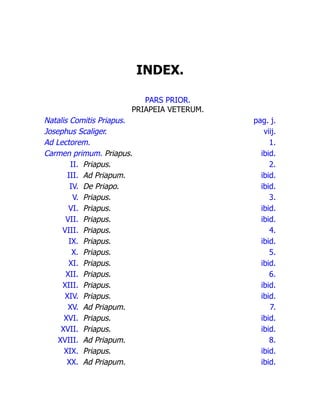
INDEX.
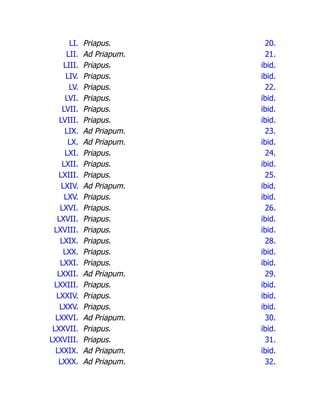
PARS PRIOR.
PRIAPEIA VETERUM.
Natalis Comitis Priapus. pag. j.
Josephus Scaliger. viij.
Ad Lectorem. 1.
Carmen primum. Priapus. ibid.
II. Priapus. 2.
III. Ad Priapum. ibid.
IV. De Priapo. ibid.
V. Priapus. 3.
VI. Priapus. ibid.
VII. Priapus. ibid.
VIII. Priapus. 4.
IX. Priapus. ibid.
X. Priapus. 5.
XI. Priapus. ibid.
XII. Priapus. 6.
XIII. Priapus. ibid.
XIV. Priapus. ibid.
XV. Ad Priapum. 7.
XVI. Priapus. ibid.
XVII. Priapus. ibid.
XVIII. Ad Priapum. 8.
XIX. Priapus. ibid.
XX. Ad Priapum. ibid.
XXI. Priapus. 9.
XXII. Priapus. ibid.
XXIII. Priapus. ibid.
XXIV. Priapus. ibid.
XXV. Priapus. 10.
XXVI. Ad Priapum. ibid.
XXVII. Priapus. 11.
XXVIII. Ad Priapum. ibid.
XXIX. Ad Priapum. ibid.
XXX. Priapus. 12.
XXXI. Priapus. ibid.
XXXII. Priapus. 13.
XXXIII. Ad Priapum. ibid.
XXXIV. Priapus. ibid.
XXXV. Priapus. 14.
XXXVI. Voti solutio. ibid.
XXXVII. Priapus. 15.
XXXVIII. Priapus. ibid.
XXXIX. Ad Priapum. 16.
XL. Priapus. ibid.
XLI. Ad Priapum. ibid.
XLII. Priapus. ibid.
XLIII. Priapus. 17.
XLIV. Priapus. ibid.
XLV. Priapus. ibid.
XLVI. Priapus. 18.
XLVII. Priapus. ibid.
XLVIII. Priapus. ibid.
XLIX. Ad Priapum. 19.
L. Priapus. ibid.
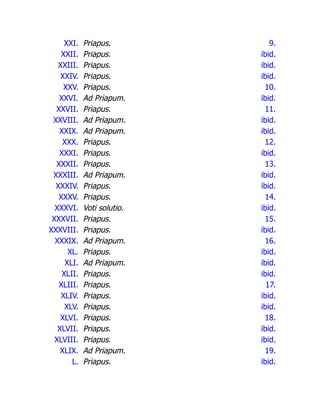
LI. Priapus. 20.
LII. Ad Priapum. 21.
LIII. Priapus. ibid.
LIV. Priapus. ibid.
LV. Priapus. 22.
LVI. Priapus. ibid.
LVII. Priapus. ibid.
LVIII. Priapus. ibid.
LIX. Ad Priapum. 23.
LX. Ad Priapum. ibid.
LXI. Priapus. 24.
LXII. Priapus. ibid.
LXIII. Priapus. 25.
LXIV. Ad Priapum. ibid.
LXV. Priapus. ibid.
LXVI. Priapus. 26.
LXVII. Priapus. ibid.
LXVIII. Priapus. ibid.
LXIX. Priapus. 28.
LXX. Priapus. ibid.
LXXI. Priapus. ibid.
LXXII. Ad Priapum. 29.
LXXIII. Priapus. ibid.
LXXIV. Priapus. ibid.
LXXV. Priapus. ibid.
LXXVI. Ad Priapum. 30.
LXXVII. Priapus. ibid.
LXXVIII. Priapus. 31.
LXXIX. Ad Priapum. ibid.
LXXX. Ad Priapum. 32.
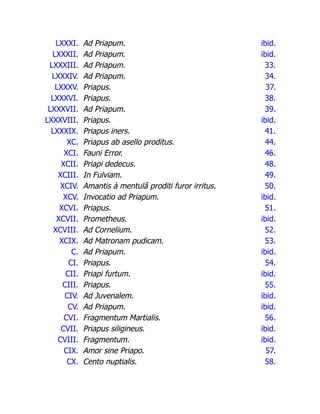
LXXXI. Ad Priapum. ibid.
LXXXII. Ad Priapum. ibid.
LXXXIII. Ad Priapum. 33.
LXXXIV. Ad Priapum. 34.
LXXXV. Priapus. 37.
LXXXVI. Priapus. 38.
LXXXVII. Ad Priapum. 39.
LXXXVIII. Priapus. ibid.
LXXXIX. Priapus iners. 41.
XC. Priapus ab asello proditus. 44.
XCI. Fauni Error. 46.
XCII. Priapi dedecus. 48.
XCIII. In Fulviam. 49.
XCIV. Amantis à mentulâ proditi furor irritus. 50.
XCV. Invocatio ad Priapum. ibid.
XCVI. Priapus. 51.
XCVII. Prometheus. ibid.
XCVIII. Ad Cornelium. 52.
XCIX. Ad Matronam pudicam. 53.
C. Ad Priapum. ibid.
CI. Priapus. 54.
CII. Priapi furtum. ibid.
CIII. Priapus. 55.
CIV. Ad Juvenalem. ibid.
CV. Ad Priapum. ibid.
CVI. Fragmentum Martialis. 56.
CVII. Priapus siligineus. ibid.
CVIII. Fragmentum. ibid.
CIX. Amor sine Priapo. 57.
CX. Cento nuptialis. 58.
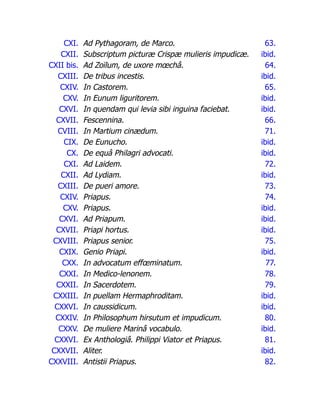
CXI. Ad Pythagoram, de Marco. 63.
CXII. Subscriptum picturæ Crispæ mulieris impudicæ. ibid.
CXII bis. Ad Zoïlum, de uxore mœchâ. 64.
CXIII. De tribus incestis. ibid.
CXIV. In Castorem. 65.
CXV. In Eunum liguritorem. ibid.
CXVI. In quendam qui levia sibi inguina faciebat. ibid.
CXVII. Fescennina. 66.
CVIII. In Martium cinædum. 71.
CIX. De Eunucho. ibid.
CX. De equâ Philagri advocati. ibid.
CXI. Ad Laidem. 72.
CXII. Ad Lydiam. ibid.
CXIII. De pueri amore. 73.
CXIV. Priapus. 74.
CXV. Priapus. ibid.
CXVI. Ad Priapum. ibid.
CXVII. Priapi hortus. ibid.
CXVIII. Priapus senior. 75.
CXIX. Genio Priapi. ibid.
CXX. In advocatum effœminatum. 77.
CXXI. In Medico-lenonem. 78.
CXXII. In Sacerdotem. 79.
CXXIII. In puellam Hermaphroditam. ibid.
CXXVI. In caussidicum. ibid.
CXXIV. In Philosophum hirsutum et impudicum. 80.
CXXV. De muliere Marinâ vocabulo. ibid.
CXXVI. Ex Anthologiâ. Philippi Viator et Priapus. 81.
CXXVII. Aliter. ibid.
CXXVIII. Antistii Priapus. 82.
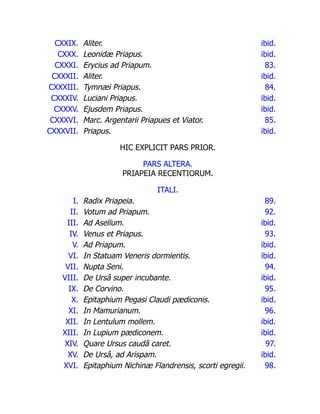
CXXIX. Aliter. ibid.
CXXX. Leonidæ Priapus. ibid.
CXXXI. Erycius ad Priapum. 83.
CXXXII. Aliter. ibid.
CXXXIII. Tymnæi Priapus. 84.
CXXXIV. Luciani Priapus. ibid.
CXXXV. Ejusdem Priapus. ibid.
CXXXVI. Marc. Argentarii Priapues et Viator. 85.
CXXXVII. Priapus. ibid.
HIC EXPLICIT PARS PRIOR.
PARS ALTERA.
PRIAPEIA RECENTIORUM.
ITALI.
I. Radix Priapeia. 89.
II. Votum ad Priapum. 92.
III. Ad Asellum. ibid.
IV. Venus et Priapus. 93.
V. Ad Priapum. ibid.
VI. In Statuam Veneris dormientis. ibid.
VII. Nupta Seni. 94.
VIII. De Ursâ super incubante. ibid.
IX. De Corvino. 95.
X. Epitaphium Pegasi Claudi pædiconis. ibid.
XI. In Mamurianum. 96.
XII. In Lentulum mollem. ibid.
XIII. In Lupium pædiconem. ibid.
XIV. Quare Ursus caudâ caret. 97.
XV. De Ursâ, ad Arispam. ibid.
XVI. Epitaphium Nichinæ Flandrensis, scorti egregii. 98.
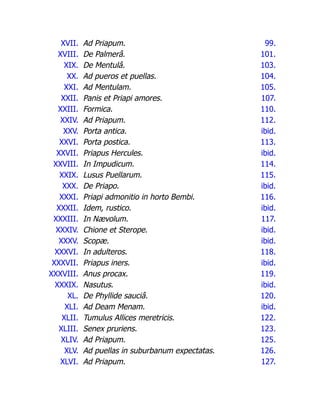
XVII. Ad Priapum. 99.
XVIII. De Palmerâ. 101.
XIX. De Mentulâ. 103.
XX. Ad pueros et puellas. 104.
XXI. Ad Mentulam. 105.
XXII. Panis et Priapi amores. 107.
XXIII. Formica. 110.
XXIV. Ad Priapum. 112.
XXV. Porta antica. ibid.
XXVI. Porta postica. 113.
XXVII. Priapus Hercules. ibid.
XXVIII. In Impudicum. 114.
XXIX. Lusus Puellarum. 115.
XXX. De Priapo. ibid.
XXXI. Priapi admonitio in horto Bembi. 116.
XXXII. Idem, rustico. ibid.
XXXIII. In Nævolum. 117.
XXXIV. Chione et Sterope. ibid.
XXXV. Scopæ. ibid.
XXXVI. In adulteros. 118.
XXXVII. Priapus iners. ibid.
XXXVIII. Anus procax. 119.
XXXIX. Nasutus. ibid.
XL. De Phyllide sauciâ. 120.
XLI. Ad Deam Menam. ibid.
XLII. Tumulus Allices meretricis. 122.
XLIII. Senex pruriens. 123.
XLIV. Ad Priapum. 125.
XLV. Ad puellas in suburbanum expectatas. 126.
XLVI. Ad Priapum. 127.
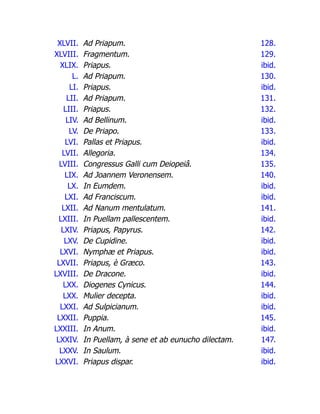
XLVII. Ad Priapum. 128.
XLVIII. Fragmentum. 129.
XLIX. Priapus. ibid.
L. Ad Priapum. 130.
LI. Priapus. ibid.
LII. Ad Priapum. 131.
LIII. Priapus. 132.
LIV. Ad Bellinum. ibid.
LV. De Priapo. 133.
LVI. Pallas et Priapus. ibid.
LVII. Allegoria. 134.
LVIII. Congressus Galli cum Deiopeiâ. 135.
LIX. Ad Joannem Veronensem. 140.
LX. In Eumdem. ibid.
LXI. Ad Franciscum. ibid.
LXII. Ad Nanum mentulatum. 141.
LXIII. In Puellam pallescentem. ibid.
LXIV. Priapus, Papyrus. 142.
LXV. De Cupidine. ibid.
LXVI. Nymphæ et Priapus. ibid.
LXVII. Priapus, è Græco. 143.
LXVIII. De Dracone. ibid.
LXX. Diogenes Cynicus. 144.
LXX. Mulier decepta. ibid.
LXXI. Ad Sulpicianum. ibid.
LXXII. Puppia. 145.
LXXIII. In Anum. ibid.
LXXIV. In Puellam, à sene et ab eunucho dilectam. 147.
LXXV. In Saulum. ibid.
LXXVI. Priapus dispar. ibid.
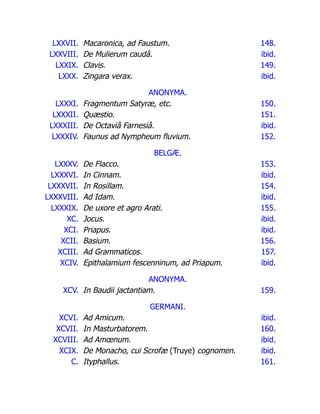
LXXVII. Macaronica, ad Faustum. 148.
LXXVIII. De Mulierum caudâ. ibid.
LXXIX. Clavis. 149.
LXXX. Zingara verax. ibid.
ANONYMA.
LXXXI. Fragmentum Satyræ, etc. 150.
LXXXII. Quæstio. 151.
LXXXIII. De Octaviâ Farnesiâ. ibid.
LXXXIV. Faunus ad Nympheum fluvium. 152.
BELGÆ.
LXXXV. De Flacco. 153.
LXXXVI. In Cinnam. ibid.
LXXXVII. In Rosillam. 154.
LXXXVIII. Ad Idam. ibid.
LXXXIX. De uxore et agro Arati. 155.
XC. Jocus. ibid.
XCI. Priapus. ibid.
XCII. Basium. 156.
XCIII. Ad Grammaticos. 157.
XCIV. Epithalamium fescenninum, ad Priapum. ibid.
ANONYMA.
XCV. In Baudii jactantiam. 159.
GERMANI.
XCVI. Ad Amicum. ibid.
XCVII. In Masturbatorem. 160.
XCVIII. Ad Amœnum. ibid.
XCIX. De Monacho, cui Scrofæ (Truye) cognomen. ibid.
C. Ityphallus. 161.
CI. Ænigma. 162.
CII. Panis, Penis. ibid.
ANONYMA.
CIII. Dactylus. ibid.
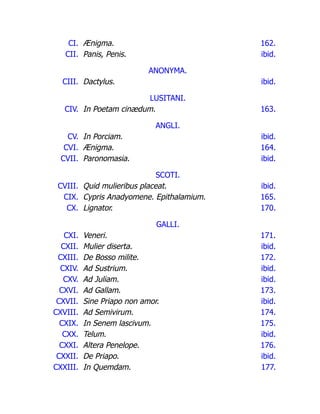
LUSITANI.
CIV. In Poetam cinædum. 163.
ANGLI.
CV. In Porciam. ibid.
CVI. Ænigma. 164.
CVII. Paronomasia. ibid.
SCOTI.
CVIII. Quid mulieribus placeat. ibid.
CIX. Cypris Anadyomene. Epithalamium. 165.
CX. Lignator. 170.
GALLI.
CXI. Veneri. 171.
CXII. Mulier diserta. ibid.
CXIII. De Bosso milite. 172.
CXIV. Ad Sustrium. ibid.
CXV. Ad Juliam. ibid.
CXVI. Ad Gallam. 173.
CXVII. Sine Priapo non amor. ibid.
CXVIII. Ad Semivirum. 174.
CXIX. In Senem lascivum. 175.
CXX. Telum. ibid.
CXXI. Altera Penelope. 176.
CXXII. De Priapo. ibid.
CXXIII. In Quemdam. 177.
CXXIV. In Miscellanea Accordii. ibid.
CXXV. Preces mentales. 178.
CXXVI. Naïas satyri victrix. 179.
CXXVII. Aretini Carminum versio latina. 180.
CXXVIII. Muscipula. 182.
CXXIX. In Rhodantidem, scortum. 183.
ANONYMA.
CXXX. Signa. 184.
CXXXI. Vir mingens. ibid.
CXXXII. Quid est Homo? ibid.
CXXXIII. In Caulneam. 185.
CXXXIV. In Priapos alatos. ibid.
CXXXV. In Phallos. ibid.
CXXXVI. Æneus serpens. ibid.
CXXXVII. Serpens tentator. 186.
CXXXVIII. De clavâ Herculis. ibid.
CXXXIX. Telum amoris. ibid.
CXL. Asellus Priapi victor. 187.
CXLI. Calamus. 188.
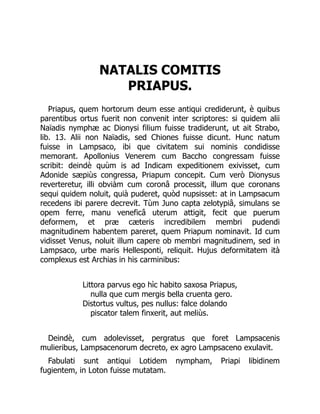
NATALIS COMITIS
PRIAPUS.
Priapus, quem hortorum deum esse antiqui crediderunt, è quibus
parentibus ortus fuerit non convenit inter scriptores: si quidem alii
Naïadis nymphæ ac Dionysi filium fuisse tradiderunt, ut ait Strabo,
lib. 13. Alii non Naïadis, sed Chiones fuisse dicunt. Hunc natum
fuisse in Lampsaco, ibi que civitatem sui nominis condidisse
memorant. Apollonius Venerem cum Baccho congressam fuisse
scribit: deindè quùm is ad Indicam expeditionem exivisset, cum
Adonide sæpiùs congressa, Priapum concepit. Cum verò Dionysus
reverteretur, illi obviàm cum coronâ processit, illum que coronans
sequi quidem noluit, quià puderet, quòd nupsisset: at in Lampsacum
recedens ibi parere decrevit. Tùm Juno capta zelotypiâ, simulans se
opem ferre, manu veneficâ uterum attigit, fecit que puerum
deformem, et præ cæteris incredibilem membri pudendi
magnitudinem habentem pareret, quem Priapum nominavit. Id cum
vidisset Venus, noluit illum capere ob membri magnitudinem, sed in
Lampsaco, urbe maris Hellesponti, reliquit. Hujus deformitatem ità
complexus est Archias in his carminibus:
Littora parvus ego hìc habito saxosa Priapus,
nulla que cum mergis bella cruenta gero.
Distortus vultus, pes nullus: falce dolando
piscator talem finxerit, aut meliùs.
Deindè, cum adolevisset, pergratus que foret Lampsacenis
mulieribus, Lampsacenorum decreto, ex agro Lampsaceno exulavit.
Fabulati sunt antiqui Lotidem nympham, Priapi libidinem
fugientem, in Loton fuisse mutatam.
Memoriæ prodidit Eusebius, in libro de falsâ religione, Priapum
aliquandò cum uno ex illis asellis, qui Bacchum in Indicam
expeditionem proficiscentem trans quemdam fluvium transvexêre, de
membri magnitudine decertâsse, (fuit autem tantum Asellorum
beneficium creditum, ut illi sint idcircò inter sydera relati, et alteri
eorum concessum est, ut loqui posset) qui cum victus fuisset,
victorem, ob invidiam, occidit. Mansit deindè ea consuetudo in
sacris, ut asinus Priapo, tanquàm invisum et invidiosum animal,
immolaretur.
Scripsit Ovidius libro 1 fastorum, per solemnitatem matris deorum,
ad quam omnes dii convenerant, post epulas lautissimas, Priapum
fuisse pudicitiæ Vestæ insidiatum. Nàm cum dii cæteri lusibus
indulgerent, Vesta que in molli herbâ somnum caperet, ab asino
Sileni excitata fuit, ne vim Priapi pateretur: tum verò deterritus fuit
ab incæptis Priapus, omnes que conciderunt insidiæ, et asinus ex eo
tempore Priapo mactatus fuit in sacrificiis.
Memoriæ proditum est ab antiquis rerum Ægyptiarum scriptoribus,
quòd Titanes insidiati Osiridi illum trucidârunt, atque partem suam
quisque clàm è domo abstulerunt: sola autem pudenda in fluvium
projecerunt, cum nemo vellet illa auferre. Isim resumpsisse membra
de captis Titanibus memorant, hominem que formâsse, ac dedisse
sacerdotibus sepeliendum. Solum virile membrum non potuisse
inveniri, quod imperatum est tanquàm deum coli, quod non modò
divinos honores ità fuit consecutum, sed etiam custodem hortorum
ac vinearum et omnium fructiferarum arborum putârunt, ultorem
que ac vindicem fascinantium.
Fuit portus Priapi nomine propè Dardaniam, et urbs ad mare sita,
quibus in locis eximiè Priapus colebatur.
Fuerunt qui memoriæ prodiderint Priapum fuisse virum
Lampsacenum, qui, cum haberet ingens instrumentum et facilè
paratum plantandis civibus, gratissimus fuerit mulieribus
Lampsacenis. Ea causa postmodò fuisse dicitur, ut Lampsacenorum
omnium cæterorum invidiam in se converterit, ac demùm ejectus
fuerit ex ipsâ insulâ. At illud facinus ægerrimè ferentibus mulieribus,
et pro se deos precantibus, cum post nonnullis interjectis temporibus
Lampsacenos gravissimus pudendorum membrorum morbus
invasisset, Dodonæum oraculum adeuntes percunctati sunt, an ullum
esset ejus morbi remedium. His responsum est morbum non priùs
cessaturum, quàm Priapum in patriam revocâssent: quod cum
fecissent, templa et sacrificia illi statuerunt, Priapum que hortorum
deum esse decreverunt.
Atque tot sunt de Priapo ab antiquis memoriæ prodita. Priapus
Naïadis et Dionysi filius dicitur, quià pro semine rerum naturalium
capitur. Dionysus enim sol est, aut calor, at Naïs humor, ut dictum
est, è quibus semina concipiuntur rerum naturalium. Quidam
Chiones filium putârunt, quià album sit, et lacti vel nivi simile rerum
propè omnium semen: nam Græci chiona nivem vocârunt. Qui
Veneris et Adonidis filium esse crediderunt, in idem denique
relabuntur, solis que differunt nominibus. Alii Priapum Bacchi ac
Veneris filium fuisse crediderunt, quià vinum propter calorem excitet
libidinem, ac deum putârunt Lampsaci ob fertilitatem et bonitatem
vinorum, quæ ibi nascerentur. Illius imago sinistrâ manu mentulam,
dextrâ falcem tenebat, quòd omnium nascentium temporis certi et
cuique concessi certa sit meta, quâ vitam abscindi necesse est.
Fuerunt tamen nonnulli, qui Priapum nullum esse alium quàm Pana
putaverint. Verùm vel nominis ipsius etymologia indicat Priapum esse
semen. Quòd Venus ipsum ob deformitatem in Lampsaco reliquit,
nihil aliud significat, nisi res multas naturæ esse necessarias, quas
tamen ob turpitudinem natura occultavit: sic pudenda hominum villis
occultantur, et sunt in parte corporis occultiore: sic anum modò intrà
nates occuluit, modò sub caudarum integumento locavit, modò ità
fecit occultum, ut in nonnullis eum dignoscere haud facile sit, ut in
piscibus modò non apparet omninò, ut in genere conchyliorum, et
testâ intectorum. Nam cum deformia sint, et ab ipsâ naturâ consultò
abscondita illa membra, tum turpia sunt illorum officia, quamvis
necessaria. Idcircò et nos aliquandò rei venereæ obscœnitatem ità
breviter expressimus:
Nil amor est aliud, Veneris quàm parva voluptas,
quæ simul expleta est, inficit ora rubor.
Deformis igitur et obscœnus Priapus jure optimo fingitur, quià
turpis est illa naturæ actio: et quam nemo prorsùs appeteret, nisi
illam cæcâ suavitate natura respersisset.
Mythologiæ lib. V. Cap. XV.
PARS PRIOR.
PRIAPEIA
VETERUM.
JOSEPHUS SCALIGER.
Scripserunt hujus argumenti poematia plures veterum, Catullus,
Tibullus, Ovidius, Petronius Arbiter, alii. Itaque ex eorum
epigrammatis totus hic liber concinnatus est, et conflatus ab eo qui
epigramma illud libro præposuit: Carminis incompti, etc.
Argumentum varium est: modò enim vel poeta, vel puella, vel viator,
vel villicus Priapum adloquitur. Interdùm ipse Priapus furibus
masculini et fœminini sexûs stuprum suadet, vel minatur. Sortem
suam miseratur de tentigine suâ, de furibus, de puellis lascivis super
inguina Priapi de nocte molentibus conqueritur, et alia plurima, etc.
AD LECTOREM.
Carminis incompti lusus lecture procaces,
conveniens Tatio pone supercilium.
Non soror hoc habitat Phœbi, non Vesta sacello,
nec quæ de patrio vertice nata Dea est:
sed ruber hortorum custos, membrosior æquo,
qui tectum nullis vestibus inguen habet.
Aut igitur tunicam parti prætende tegendæ,
aut quibus hanc oculis adspicis, ista lege.
CARMEN I.
AD PRIAPUM.
Ludens hæc ego teste te, Priape,
horto carmina digna, non libello,
scripsi non nimiùm laboriosè.
Nec Musas tamen, ut solent Poetæ
ad non virgineum locum vocavi.
Nam sensus mihi cor que defuisset,
castas, Pieridum chorum, sorores
auso ducere mentulam ad Priapi.
Ergò, quidquid id est, quod otiosus
templi parietibus tui notavi,
in partem accipias bonam rogamus.
II.
PRIAPUS.
Obscurè poteram tibi dicere, da mihi, quod tu
des licet assiduè, nil tamen indè perit.
Da mihi quod cupies frustrà dare forsitan olim,
cum tenet obsessas invida barba genas:
quod que Jovi dederat, qui raptus ab alite sacrâ,
miscet amatori pocula grata suo:
quod virgo primâ cupido dat nocte marito,
dum timet alterius vulnus inepta loci.
Simplicius multò est, da pædicare, latinè
dicere, quid faciam? Crassa Minerva mea est.
III.
AD PRIAPUM.
Obscœnis rigido Deo tabellas
ducens ex Elephantidos libellis
dat donum Lalage, rogat que tentes,
si pictas opus edat ad figuras.
IV.
DE PRIAPO.
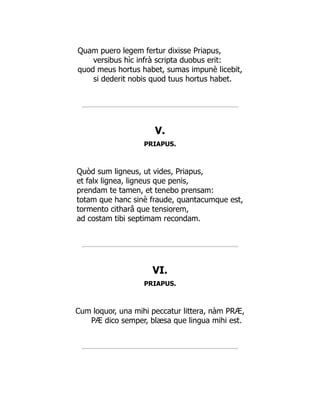
Quam puero legem fertur dixisse Priapus,
versibus hìc infrà scripta duobus erit:
quod meus hortus habet, sumas impunè licebit,
si dederit nobis quod tuus hortus habet.
V.
PRIAPUS.
Quòd sum ligneus, ut vides, Priapus,
et falx lignea, ligneus que penis,
prendam te tamen, et tenebo prensam:
totam que hanc sinè fraude, quantacumque est,
tormento citharâ que tensiorem,
ad costam tibi septimam recondam.
VI.
PRIAPUS.
Cum loquor, una mihi peccatur littera, nàm PRÆ,
PÆ dico semper, blæsa que lingua mihi est.
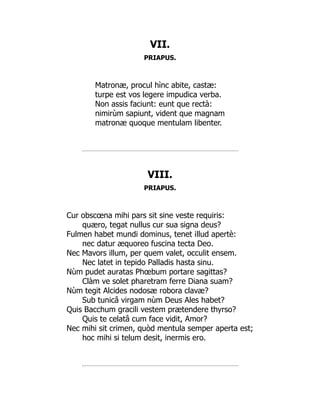
VII.
PRIAPUS.
Matronæ, procul hìnc abite, castæ:
turpe est vos legere impudica verba.
Non assis faciunt: eunt que rectà:
nimirùm sapiunt, vident que magnam
matronæ quoque mentulam libenter.
VIII.
PRIAPUS.
Cur obscœna mihi pars sit sine veste requiris:
quæro, tegat nullus cur sua signa deus?
Fulmen habet mundi dominus, tenet illud apertè:
nec datur æquoreo fuscina tecta Deo.
Nec Mavors illum, per quem valet, occulit ensem.
Nec latet in tepido Palladis hasta sinu.
Nùm pudet auratas Phœbum portare sagittas?
Clàm ve solet pharetram ferre Diana suam?
Nùm tegit Alcides nodosæ robora clavæ?
Sub tunicâ virgam nùm Deus Ales habet?
Quis Bacchum gracili vestem prætendere thyrso?
Quis te celatâ cum face vidit, Amor?
Nec mihi sit crimen, quòd mentula semper aperta est;
hoc mihi si telum desit, inermis ero.

Management 10th Edition Robbins Solutions Manual

  • 1.
    Management 10th EditionRobbins Solutions Manual pdf download https://testbankdeal.com/product/management-10th-edition-robbins- solutions-manual/ Download more testbank from https://testbankdeal.com
  • 2.
    Instant digital products(PDF, ePub, MOBI) available Download now and explore formats that suit you... Fundamentals of Management 10th Edition Robbins Solutions Manual https://testbankdeal.com/product/fundamentals-of-management-10th- edition-robbins-solutions-manual/ testbankdeal.com Fundamentals of Management 10th Edition Robbins Test Bank https://testbankdeal.com/product/fundamentals-of-management-10th- edition-robbins-test-bank/ testbankdeal.com Management 12th Edition Robbins Solutions Manual https://testbankdeal.com/product/management-12th-edition-robbins- solutions-manual/ testbankdeal.com Information Technology Auditing 3rd Edition Hall Test Bank https://testbankdeal.com/product/information-technology-auditing-3rd- edition-hall-test-bank/ testbankdeal.com
  • 3.
    Elementary and IntermediateAlgebra 4th Edition Sullivan Solutions Manual https://testbankdeal.com/product/elementary-and-intermediate- algebra-4th-edition-sullivan-solutions-manual/ testbankdeal.com Australian Financial Accounting 6th Edition Deegan Test Bank https://testbankdeal.com/product/australian-financial-accounting-6th- edition-deegan-test-bank/ testbankdeal.com Algebra and Trigonometry 10th Edition Sullivan Solutions Manual https://testbankdeal.com/product/algebra-and-trigonometry-10th- edition-sullivan-solutions-manual/ testbankdeal.com Managerial Accounting 5th Edition Braun Solutions Manual https://testbankdeal.com/product/managerial-accounting-5th-edition- braun-solutions-manual/ testbankdeal.com 21st Century Chemistry 1st Edition Waldron Test Bank https://testbankdeal.com/product/21st-century-chemistry-1st-edition- waldron-test-bank/ testbankdeal.com
  • 4.
    Clinical Nursing Skillsand Techniques 8th Edition Perry Test Bank https://testbankdeal.com/product/clinical-nursing-skills-and- techniques-8th-edition-perry-test-bank/ testbankdeal.com
  • 5.
    7-1 Copyright © 2012Pearson Canada Inc., Toronto, Ontario. Chapter 7 Foundations of Planning In this chapter, we begin our study of the first of the management functions: planning. Planning is important because it establishes what an organization is doing. We’ll look at how managers set goals as well as how they establish plans. After reading and studying this chapter you will achieve the following learning outcomes. LEARNING OUTCOMES 8.1 Define the nature and purpose of planning. 8.2 Understand how managers set goals and develop plans. 8.3 Discuss contemporary issues in planning CHAPTER VIGNETTE Your students may be familiar with the adage, “If you fail to plan, you plan to fail.” Chapter 8 examines skills needed for effectiveness in the first of the four management functions—planning. After learning about the purposes of planning, students will discover how managers at different levels of an organization develop plans and empower employees to participate in the planning process. The chapter vignette tells the story of the Blue Man Group, one well known to many students and how they needed to employ planning techniques to help them deal with the transition from a small performance troupe to a much larger business concept and brand. The first vignette asks the students to think about how planning can help deal with the temporary loss of a group member due to illness, the third focuses on issues relating to growth while the third vignette focuses on the failed attempt to open Toronto. CHAPTER OUTLINE INTRODUCTION Planning is one of the four functions of management. Fundamental information about managerial planning is presented in this chapter; the text discusses the nature and purposes of planning, strategies for effective planning, and contemporary planning issues. 1. WHAT IS PLANNING? Planning involves defining the organization’s goals, establishing an overall strategy for achieving these goals, and developing a comprehensive set of plans to integrate and coordinate organizational work. The term planning as used in this chapter refers to formal planning. A. Purposes of Planning. Planning is important and serves many significant purposes. 1. Planning gives direction to the organization.
  • 6.
    7-2 Copyright © 2012Pearson Canada Inc., Toronto, Ontario. 2. Planning reduces uncertainty. 3. Planning reduces overlapping and wasteful activities. 4. Planning establishes the goals or standards that are used in controlling. B. Planning and Performance. Research has shown we cannot assume organizations with formal planning processes always outperform those organizations that don’t have formal planning processes. 1. Generally speaking, however, formal planning is associated with positive financial results. 3. HOW DO MANAGERS PLAN? Planning is often called the primary management function because it establishes the basis for all other functions. Planning involves two important elements: goals and plans. Goals are desired outcomes for individuals, groups, or entire organizations. Goals are objectives—the two terms are used interchangeably. Plans are documents that outline how goals are going to be met and that typically describe resource allocations, schedules, and other necessary actions to accomplish the goals. A. Approaches to Establishing Goals. Goals can be established through a process of traditional goal setting or through management by objectives: 1. Traditional goal setting is defined as the process whereby goals are set at the top of the organization and then broken down into sub goals for each level in an organization. a. Top managers are assumed to know what’s best because they see the “big picture.” b. These goals are also often largely nonoperational. c. Specificity is achieved as each manager applies his or her own set of interpretations and biases. d. However, what often results is that objectives lose clarity and unity as they move from top to bottom. (See Exhibit 7-1) e. When the hierarchy of objectives is clearly defined, it forms an integrated means-end chain in which higher- level objectives are linked to lower-level objectives. These lower-level objectives serve as the means for the accomplishment of the higher- level objectives. And the goals at the lower levels (means) must be achieved in order to reach the goals at the next level (ends). 2. Management by objectives (MBO) is defined as a system in which specific performance goals are jointly determined by employees and their managers, progress toward accomplishing these goals is periodically reviewed, and rewards are allocated on the basis of this progress. a. MBO consists of four elements: 1. Goal specificity 2. Participative decision-making
  • 7.
    7-3 Copyright © 2012Pearson Canada Inc., Toronto, Ontario. 3. Explicit time period 4. Performance feedback b. MBO makes objectives operational through the process by which they cascade down through the organization. c. Exhibit 7-2 lists the steps in a typical MBO program. d. Does MBO work? Studies of actual MBO programs confirm that MBO can increase employee performance and organizational productivity. However, top- management commitment and involvement are important contributions to the success of an MBO program. 3. Characteristics of Well-Designed Goals (See Exhibit 7-3). a. Written in terms of outcomes b. Measurable and quantifiable c. Clear as to a time frame d. Challenging, but attainable e. Written down f. Communicated to all organizational members 4. Steps in Goals Setting—Five Steps. a. Review the organization’s mission or the purpose of an organization. Goals should reflect what the mission statement says. b. Evaluate available resources. c. Determine individually, or with input from others, the goals. d. Write down the goals and communicate them to all who need to know. e. Review results and whether goals are being met. B. Developing Plans. The process of developing plans is influenced by three contingency factors and by the planning approach followed. 1. Types of Plans. The most popular ways to describe organizational plans are pictured in Exhibit 7-4. The characteristics include: a. Breadth (strategic vs. operational) (1) Strategic plans apply to the entire organization, establish the organization’s overall goals, and seek to position the organization in terms of its environment. (2) Operational plans are short term, specific, and standing. They specify the details of how the overall goals are to be achieved. b. Time frame (short term vs. long term) We define long-term plans as those with a time frame beyond three years. We define short-term
  • 8.
    7-4 Copyright © 2012Pearson Canada Inc., Toronto, Ontario. plans as those with a time frame of one year or less. c. Specificity (directional vs. specific) (1) Specific plans are plans that are clearly defined and that leave no room for interpretation. They have clearly defined objectives. There’s no ambiguity and no problem with misunderstanding. (2) Directional plans are flexible plans that set out general guidelines. They provide focus but don’t lock managers into specific goals or courses of action. (Exhibit 7–5 illustrates how specific and directional planning differ, with the directional plan indicating only the intent to get from “A” to “B” and the specific plan identifying the exact route that one would take to go from “A” to “B”.) d. Frequency of use (single use vs. standing) (1) A single-use plan is a one-time plan specifically designed to meet the needs of a unique situation. (2) Standing plans are ongoing plans that provide guidance for activities performed repeatedly. Standing plans include policies, rules, and procedures. 2. Contingency Factors in Planning. a. Manager’s level in the organization. (See Exhibit 7- 6.) Operational planning usually dominates the planning activities of lower-level managers. As managers move up through the levels of the organization, their planning becomes more strategy oriented. b. Degree of environmental uncertainty. The greater the environmental uncertainty, the more plans should be directional and emphasis placed on the short term. 1) When uncertainty is high, plans should be specific, but flexible. 2) Managers must be prepared to rework and amend plans, or even to abandon their plans. c. Time frame of plans. 1) Commitment concept means that plans should extend far enough to meet those commitments made when the plans were developed. 2) Planning for too long or for too short a time period is inefficient and ineffective. 3. Approaches to Planning.
  • 9.
    7-5 Copyright © 2012Pearson Canada Inc., Toronto, Ontario. a. Traditional Approach—planning was done entirely by top-level managers who were often assisted by a formal planning department. b. Organizational Member Involvement—plans aren’t handed down from one level to the next, but are developed at the various levels to meet specific needs. 4. CURRENT ISSUES IN PLANNING. This section looks at criticisms of planning and how managers can plan effectively in dynamic environments. A. Criticisms of Planning. Although planning is an important and popular managerial function, five major arguments have been directed against planning. 1. Planning may create rigidity. Formal planning may “lock” an organization into specific goals and specific timetables that were established under certain environmental conditions. If the environment changes, managers may believe they’re locked into the current plans. 2. Plans cannot be developed for a dynamic environment. Managing under chaotic environmental conditions requires flexibility, and that may mean not being tied to formal plans. 3. Formal plans cannot replace intuition and creativity. The formal planning process may emphasize the mechanics and routines of planning and ignore important aspects. 4. Planning focuses managers’ attention on today’s competition not on tomorrow’s survival. Formal planning has a tendency to make managers focus on today’s realities, not on tomorrow’s possibilities. 5. Formal planning reinforces success, which may lead to failure. Because the "plans" have led to success, there may be reluctance on the part of managers to change or discard previously successful plans. "If it ain’t broke, why fix it?" B. Effective Planning in Dynamic Environments. The external environment is constantly changing. 1. Managers want to develop plans that are specific, but flexible. 2. Managers must recognize that planning is an ongoing process, and they should be willing to change directions if environmental conditions warrant. 3. Flexibility is particularly important. 4. Managers must stay alert to environmental changes that could impact the effective implementation of plans and make changes as needed.
  • 10.
    7-6 Copyright © 2012Pearson Canada Inc., Toronto, Ontario. ANSWERS TO READING FOR COMPREHENSION QUESTIONS 1. What are the benefits of planning? Planning provides direction to managers and non-managers alike. Planning reduces uncertainty by forcing managers to look ahead, anticipate change, consider the impact of change, and develop appropriate responses. Planning reduces overlapping and wasteful activities. Planning establishes the goals or standards that are used in controlling. 2. Contrast formal with informal planning. In informal planning, very little, if anything, is written down. In formal planning, there are written plans at various levels, people are assigned responsibilities, there is a great deal of detail, etc. Formal planning involves specific goals to be achieved within specific timetables. 3. Compare an organization's mission with its objectives. Every organization has a mission that defines its purpose and answers the question, “What business or businesses are we in?” In essence the mission is a directional plan. The mission applies to the entire organization, establishes the organization's overall objectives, and seeks to position the organization in terms of its environment. Objectives are tactical or specific "plans" that are quantified for achieving specific goals. They can apply to individuals, work units, or the organization. The mission cannot be accomplished without the accomplishment of objectives. Objectives need a mission in order to be clear and coordinated. 4. Describe the differences between a) strategic and operational plans, b) short and long-term plans, and c) specific and directional plans. a) Strategic plans tend to cover a longer time frame and a broader view of the organization and also include the formulation of goals, whereas operational plans define ways to achieve the goals and tend to cover shorter time periods. b) Short-term plans are generally within a time frame of a year or less while long terms plans are those with a time frame beyond three years. c) Specific plans are plans that are clearly defined and do not leave room for interpretation, whereas directional plans are more flexible, and although they provide focus, they do not lock managers into specific goals or courses of action. 5. Under what circumstances are short-term plans preferred? Under what circumstances are specific plans preferred? Short-term covers less than one year. Plans should extend far enough to see through those commitments that are made today. The greater the uncertainty, the more plans should be of the short-term variety. Shorter- term plans allow for better accommodation of changes by providing more flexibility.
  • 11.
    7-7 Copyright © 2012Pearson Canada Inc., Toronto, Ontario. Specific plans have clearly defined objectives and leave no room for misinterpretation. They should be used when conditions are relatively certain and management can operate on some unchanging assumptions. 6. How can managers plan effectively in dynamic environments? In a dynamic environment, managers need to develop plans that are specific, yet flexible. Managers should recognize that planning is an ongoing process and they should be willing to change direction if the environment changes. As well, flattening the organizational hierarchy to push responsibility to the lower levels of the organization can facilitate planning. ANSWERS TO LINKING CONCEPTS TO PRACTICE QUESTIONS 1. If planning is so crucial, why do some managers choose not to do it? What would you advise these managers? Managers may choose not to do it because they don’t know how or they claim they don’t have the time to do it. Others may say that it’s a waste of time, and that the future is going to happen whether or not they plan. But, all of these reasons do not discount the importance of planning. Every manager should engage in planning. 2. Would a manager ever use informal planning? In informal planning, nothing is written down, and there is little or no sharing of goals with others. Informal planning is general and lacks continuity. Although it’s more common in smaller organizations, where the owner-manager has a vision of where he or she wants the business to go and how to get there, informal planning does exist in some large organizations as well. Informal planning can help set guidelines. It may not be effective for either large projects or for large organizations. 3. Explain how planning involves decisions today that will have an impact later. Decisions that managers make as they plan will influence how activities are organized, how employees are managed, and what controlling is performed. So even as managers look to the future by planning, the decisions they’re making as they plan will have an effect on the other managerial activities. 4. How might planning in a not-for-profit organization such as the Canadian Cancer Society differ from planning in a for-profit organization such as Molson? The process of planning itself won’t differ, but the content of the plans will differ. The types of objectives that are established and the plans that are formulated will be different because a not-for-profit organization isn’t focused on profit objectives like the for-profit organization.
  • 12.
    7-8 Copyright © 2012Pearson Canada Inc., Toronto, Ontario. 5. What types of planning do you do in your personal life? Describe these plans in terms of being (a) strategic or operational, (b) short- or long-term, and (c) specific or directional. Students’ responses to this will, of course, vary. Most will probably mention planning for completing their education and may even mention career planning. Encourage them to think in terms of their everyday lives about the types of daily, weekly, monthly, or yearly planning they do. 6. “Organizations that fail to plan are planning to fail.” Do you agree or disagree with this statement? Explain your position. While managers (and anyone else) can advance reasons for why they shouldn’t plan (because it’s inflexible, or doesn’t allow creativity and intuition, for instance), planning helps one to prepare to meet the challenges that may arise. Without a plan it becomes difficult to evaluate how many employees are needed, how much inventory is needed, etc. 7. Will planning become more or less important to managers in the future? Why? Planning will probably become more important to managers in the future because of the uncertainty present in the environment. There are so many changes taking place in both the general and specific environments of organizations, and many of these changes are taking place rapidly. Planning helps managers cope with the uncertainties by forcing managers to look ahead, anticipate change, consider the impact of the change, and develop appropriate responses. WORKING TOGETHER : TEAM BASED EXERCISE Helping Design a Training Program This exercise asks students to develop goals for each of three stages of a project to develop an Internet researching training program. The three stages of the projects are: (1) researching corporate customer needs, (2) researching the Internet for specific information sources and techniques that could be used in the training module, and (3) designing and writing specific training modules. This exercise is useful to provide students with experience in writing goals and also to illustrate the characteristics of well-designed goals.
  • 13.
    7-9 Copyright © 2012Pearson Canada Inc., Toronto, Ontario. Teaching Suggestions: 1. Break students into groups of three or four and have each group develop 3 goals for each stage. 2. Once all the groups have had an opportunity to develop their goals have each group record their goals on a flipchart or on the board. 3. Referring to the characteristics of well-designed goals, ask the group to indicate whether it meets the criteria of a well-designed goal. For those goals that do not meet the criteria, have students offer suggestions as to how the goal could be changed/reworded in order to make it more valuable ETHICS IN ACTION Ethical Dilemma Exercise: What Should Managers Do When Pressured to Deliver Results? Imagine that you are a district manager with Coca-Cola and you are being promoted to a new position at the end of the month. Your area’s sales are an important component of the corporation’s provincial and national sales goals. However, this month’s sales are running below the planned level. Should you ask area supermarkets to double their current monthly order and promise that any unsold Coca-Cola products can be returned the following month? Teaching Suggestions: This exercise asks students to think about the challenges that managers often face in terms of trying to achieve organization’s goals or pursue a strategic plan. If this exercise is used to generate classroom discussion you may want to have students discuss their views on how best to balance an individual’s goals with an organization’s goals. There may be opposing views as to whether this would constitute unethical behaviour. You may ask students their views on what actions could be taken that would help address the situation and still be considered within ethical boundaries. CASE APPLICATION Lend Lease Corporation Managing Director Greg Clarke is trying to decide whether to put together a PCG (project-control-group) for a development project his company is pursuing in London. Would this level of planning help the project? What kind of team should he consider putting together for the PCG and why? What might be the downsides of using a PCG? Answer: (Suggestion only, and should be developed by the instructor.) A project-control-group (PCG) could be set up to engage in team planning to outline the project. The team should be a mix of people with different interests: developers, some members of the community, and possibly a few retailers who might open stores in the complex. This group can set accountability standards through using agendas, minutes, financial reviews, and other reports. The downside of this approach is that the team may take on too much ownership and insist on outcomes that may not be in the best interest of Lend
  • 14.
    7-10 Copyright © 2012Pearson Canada Inc., Toronto, Ontario. Lease. Therefore, Clarke needs to emphasize that the role of the group is advisory, and that they do not have decision-making autonomy. Additional Discussion Questions: 1. What role do you think goals play in planning done at Lend Lease? Explain. Goals play a substantial role in Lend Lease’s planning. The goal of doing something that has never been done before is Lend Lease’s guiding philosophy, and it creates the standard that the business follows when determining new projects and ventures. 2. How does Lend Lease illustrate effective planning in a dynamic environment? Planning involves defining the organization’s goals, establishing an overall strategy for achieving those goals, and developing a comprehensive set of plans to integrate and coordinate organizational work. Lend Lease clearly defined its goal—to do things that have never been done before—and began working to build the Bluewater shopping complex in Kent, England. 3. What approach to developing plans does Lend Lease appear to follow? Explain. Lend Lease appears to follow formal planning. Specific goals with deadlines were set, and the end result was the completion of the Bluewater project early, under budget, and fully leased. 4. Would Lend Lease’s approach work in other organizations? Why or why not? This approach would work in many organizations that have the flexibility and culture to allow for creativity and “thinking outside the box,” such as Lend Lease. The goals of the organization would have to reflect the desire to achieve something original or improve on the existing product and/or service. 4. Lend Lease has a strong commitment to environmentally sustainable development. (Check out its Web site for information on its core values.) How might these core values affect planning efforts? From the Web site: Commitment to Environmental Sustainable Development. Lend Lease is committed to fostering environmental sustainability in our activities and developments. The company prides itself on it willingness to shoulder the responsibility of making a difference. Our objective is to ensure a balance between economics, environment and social goods to provide greater benefits to all. Our process is predicated on total stakeholder involvement. This ensures that we capture innovation, manage costs, and deliver ongoing benefits for all. It is clear that Lend Lease’s focus on planning is driven by their environmental concerns.
  • 15.
    7-11 Copyright © 2012Pearson Canada Inc., Toronto, Ontario. DEVELOPING YOUR DIAGNOSTIC AND ANALYTICAL SKILLS Ready or Not… Questions: 1. What role do you think goals might play in a company’s planning for any potential avian flu outbreak? List some goals that you think might be important? Many companies have plans in place to respond to unforeseen events like natural disasters to ensure that the company is able to continue to operate to the best of its ability in terms of meeting the needs of customers and employees. The goals of maintaining the viability of a company and making provisions for a safe and healthy workplace require both short-range and long-range planning. As Deutsche Bank has realized, additional goals might include ensuring that employees in infected zones do not carry the disease to their co-workers, communicating medical news updates to company employees in all of the company’s locations, and preparing for economic slowdowns. 2. What types of plans might companies need for this situation (for instance, short term, long term, or both)? Explain why you think these plans would be important? Short-term plans would be critical to allow companies to be able to function and respond to the situation immediately. Long-term plans would also come into play to address the future impact that might be felt in the organization if significant losses or damages were experienced. You may want to direct your students to the article “If You Fail to Plan, You Plan to Fail,” by Representative Nita Lowey (D-N.Y.). This article strikingly communicates the urgency of the need for organizational planning under the threat of avian influenza and is an example of the type of information every manager should know. The article can be found in the July 14, 2006, issue of The Hill at http://www.hillnews.com/thehill/export/TheHill/News/Frontpage/111505/lo wy.html]. 3. How does this scenario reflect planning in a dynamic environment? What would managers need to do to make their planning effective in such an environment? This scenario is a prime example of how the external environment surrounding an organization can constantly be changing and how important it is for an organization to be able to respond to changes and events in a timely manner. Planning can facilitate this process and allow an organization to not only respond to changes but also to capitalize on opportunities that might arise. In a dynamic environment, managers need to develop plans that are specific yet flexible. Managers should be alert to environmental
  • 16.
    7-12 Copyright © 2012Pearson Canada Inc., Toronto, Ontario. changes that may impact implementation of plans and make changes as needed. As well, allowing lower levels of the organization to have more responsibility in terms of establishing goals and plans will improve the overall effectiveness of planning and may also lead to innovation. HBSC has already made arrangements for its employees to work from their homes in case of a pandemic and is planning to divide work among the company’s different locations. In order to have timely contingency plans, managers must keep abreast of medical developments and adjust their plans accordingly. They will need to remain alert to changes in the environment and establish mechanisms to examine their plans regularly. 4. What could other companies learn from Deutsche Bank’s and HSBC’s experiences? These two organizations have illustrated the fact that proactive planning is possible and very much a necessity in today’s uncertain environment considering the far-reaching effects that something like a pandemic could have on an organization. Both organizations have used creative thinking and innovation in making plans and have carefully considered the welfare of their employees in the planning process. 5. Pick a company (any size, any kind, or any location) and describe how an influenza pandemic might affect it. Now, develop plans for this company to deal with such an outbreak. You may want to divide your class into several teams and use this activity as a group exercise. Encourage your students to think creatively in developing their company’s plans to combat the effects of an influenza outbreak. Remind students that they will want to make both short-term and long-term plans in this situation. Student answers may vary, however, most will identify the impact that a pandemic would have on the workforce and their ability to deliver products and services to customers. DEVELOPING YOUR INTERPERSONAL SKILLS Setting Goals You are a store manager of a large supermarket and want to establish an MBO- type program in your store. How would you go about setting goals in your new position? Include examples of goals for the jobs of butcher, cashier, and bakery manager? Teaching Suggestions: This exercise provides an opportunity to review the concept of MBO and the advantages associated with using this type of goal setting. The elements associated with such a program should also be reviewed; goal specificity, participative decision-making, specific time periods, and performance feedback. As well, the steps associated with establishing an MBO program should be
  • 17.
    7-13 Copyright © 2012Pearson Canada Inc., Toronto, Ontario. mentioned as students discuss how they would go about establishing goals for the various positions and the supermarket as a whole. ADDITIONAL CHAPTER INFORMATION With a turbulent economy and high levels of uncertainty, planning and strategic planning, in particular, present difficult challenges for managers. The article “There Is No Alternative to…” provides an interesting contemporary approach to planning in an uncertain economy. Scenario planning was pioneered by Royal Dutch/Shell to anticipate global changes. The article looks beyond scenario planning in which “everything” is in a state of flux. The article can be found in FastCompany, Issue 60, July 2002, Page 106 (By Ian Wylie). A link to this source is [http://www.fastcompany.com/magazine/60/tina.html].
  • 18.
    Another Random ScribdDocument with Unrelated Content
  • 22.
    The Project GutenbergeBook of Erotopægnion, sive Priapeia Veterum et Recentiorum
  • 23.
    This ebook isfor the use of anyone anywhere in the United States and most other parts of the world at no cost and with almost no restrictions whatsoever. You may copy it, give it away or re-use it under the terms of the Project Gutenberg License included with this ebook or online at www.gutenberg.org. If you are not located in the United States, you will have to check the laws of the country where you are located before using this eBook. Title: Erotopægnion, sive Priapeia Veterum et Recentiorum Editor: François Noel Release date: January 11, 2017 [eBook #53944] Most recently updated: October 23, 2024 Language: Latin Credits: Produced by Brian Coe and the Online Distributed Proofreading Team at http://www.pgdp.net (This file was produced from images generously made available by The Internet Archive/American Libraries.) *** START OF THE PROJECT GUTENBERG EBOOK EROTOPÆGNION, SIVE PRIAPEIA VETERUM ET RECENTIORUM ***
  • 24.
    Transcriber’s Note: Thisbook has adult content! The numbering of the poems in the first part is not to be relied upon. Due to a printer error, there are two poems labelled with each of CVIII to CXVII inclusive, and some other mistakes.
  • 25.
    DIVO PRIAPO INVICTO EROTOPÆGNION, SIVE PRIAPEIA VETERUM ET RECENTIORUM. VENERIJOCOSÆ SACRUM. LUTETIÆ PARISIORUM, Apud C.-F. PATRIS, Bibliopolam, viâ vulgò dictâ quai Malaquais. ANNO REIP. VI. 1798.
  • 26.
    INDEX. PARS PRIOR. PRIAPEIA VETERUM. NatalisComitis Priapus. pag. j. Josephus Scaliger. viij. Ad Lectorem. 1. Carmen primum. Priapus. ibid. II. Priapus. 2. III. Ad Priapum. ibid. IV. De Priapo. ibid. V. Priapus. 3. VI. Priapus. ibid. VII. Priapus. ibid. VIII. Priapus. 4. IX. Priapus. ibid. X. Priapus. 5. XI. Priapus. ibid. XII. Priapus. 6. XIII. Priapus. ibid. XIV. Priapus. ibid. XV. Ad Priapum. 7. XVI. Priapus. ibid. XVII. Priapus. ibid. XVIII. Ad Priapum. 8. XIX. Priapus. ibid. XX. Ad Priapum. ibid.
  • 27.
    XXI. Priapus. 9. XXII.Priapus. ibid. XXIII. Priapus. ibid. XXIV. Priapus. ibid. XXV. Priapus. 10. XXVI. Ad Priapum. ibid. XXVII. Priapus. 11. XXVIII. Ad Priapum. ibid. XXIX. Ad Priapum. ibid. XXX. Priapus. 12. XXXI. Priapus. ibid. XXXII. Priapus. 13. XXXIII. Ad Priapum. ibid. XXXIV. Priapus. ibid. XXXV. Priapus. 14. XXXVI. Voti solutio. ibid. XXXVII. Priapus. 15. XXXVIII. Priapus. ibid. XXXIX. Ad Priapum. 16. XL. Priapus. ibid. XLI. Ad Priapum. ibid. XLII. Priapus. ibid. XLIII. Priapus. 17. XLIV. Priapus. ibid. XLV. Priapus. ibid. XLVI. Priapus. 18. XLVII. Priapus. ibid. XLVIII. Priapus. ibid. XLIX. Ad Priapum. 19. L. Priapus. ibid.
  • 28.
    LI. Priapus. 20. LII.Ad Priapum. 21. LIII. Priapus. ibid. LIV. Priapus. ibid. LV. Priapus. 22. LVI. Priapus. ibid. LVII. Priapus. ibid. LVIII. Priapus. ibid. LIX. Ad Priapum. 23. LX. Ad Priapum. ibid. LXI. Priapus. 24. LXII. Priapus. ibid. LXIII. Priapus. 25. LXIV. Ad Priapum. ibid. LXV. Priapus. ibid. LXVI. Priapus. 26. LXVII. Priapus. ibid. LXVIII. Priapus. ibid. LXIX. Priapus. 28. LXX. Priapus. ibid. LXXI. Priapus. ibid. LXXII. Ad Priapum. 29. LXXIII. Priapus. ibid. LXXIV. Priapus. ibid. LXXV. Priapus. ibid. LXXVI. Ad Priapum. 30. LXXVII. Priapus. ibid. LXXVIII. Priapus. 31. LXXIX. Ad Priapum. ibid. LXXX. Ad Priapum. 32.
  • 29.
    LXXXI. Ad Priapum.ibid. LXXXII. Ad Priapum. ibid. LXXXIII. Ad Priapum. 33. LXXXIV. Ad Priapum. 34. LXXXV. Priapus. 37. LXXXVI. Priapus. 38. LXXXVII. Ad Priapum. 39. LXXXVIII. Priapus. ibid. LXXXIX. Priapus iners. 41. XC. Priapus ab asello proditus. 44. XCI. Fauni Error. 46. XCII. Priapi dedecus. 48. XCIII. In Fulviam. 49. XCIV. Amantis à mentulâ proditi furor irritus. 50. XCV. Invocatio ad Priapum. ibid. XCVI. Priapus. 51. XCVII. Prometheus. ibid. XCVIII. Ad Cornelium. 52. XCIX. Ad Matronam pudicam. 53. C. Ad Priapum. ibid. CI. Priapus. 54. CII. Priapi furtum. ibid. CIII. Priapus. 55. CIV. Ad Juvenalem. ibid. CV. Ad Priapum. ibid. CVI. Fragmentum Martialis. 56. CVII. Priapus siligineus. ibid. CVIII. Fragmentum. ibid. CIX. Amor sine Priapo. 57. CX. Cento nuptialis. 58.
  • 30.
    CXI. Ad Pythagoram,de Marco. 63. CXII. Subscriptum picturæ Crispæ mulieris impudicæ. ibid. CXII bis. Ad Zoïlum, de uxore mœchâ. 64. CXIII. De tribus incestis. ibid. CXIV. In Castorem. 65. CXV. In Eunum liguritorem. ibid. CXVI. In quendam qui levia sibi inguina faciebat. ibid. CXVII. Fescennina. 66. CVIII. In Martium cinædum. 71. CIX. De Eunucho. ibid. CX. De equâ Philagri advocati. ibid. CXI. Ad Laidem. 72. CXII. Ad Lydiam. ibid. CXIII. De pueri amore. 73. CXIV. Priapus. 74. CXV. Priapus. ibid. CXVI. Ad Priapum. ibid. CXVII. Priapi hortus. ibid. CXVIII. Priapus senior. 75. CXIX. Genio Priapi. ibid. CXX. In advocatum effœminatum. 77. CXXI. In Medico-lenonem. 78. CXXII. In Sacerdotem. 79. CXXIII. In puellam Hermaphroditam. ibid. CXXVI. In caussidicum. ibid. CXXIV. In Philosophum hirsutum et impudicum. 80. CXXV. De muliere Marinâ vocabulo. ibid. CXXVI. Ex Anthologiâ. Philippi Viator et Priapus. 81. CXXVII. Aliter. ibid. CXXVIII. Antistii Priapus. 82.
  • 31.
    CXXIX. Aliter. ibid. CXXX.Leonidæ Priapus. ibid. CXXXI. Erycius ad Priapum. 83. CXXXII. Aliter. ibid. CXXXIII. Tymnæi Priapus. 84. CXXXIV. Luciani Priapus. ibid. CXXXV. Ejusdem Priapus. ibid. CXXXVI. Marc. Argentarii Priapues et Viator. 85. CXXXVII. Priapus. ibid. HIC EXPLICIT PARS PRIOR. PARS ALTERA. PRIAPEIA RECENTIORUM. ITALI. I. Radix Priapeia. 89. II. Votum ad Priapum. 92. III. Ad Asellum. ibid. IV. Venus et Priapus. 93. V. Ad Priapum. ibid. VI. In Statuam Veneris dormientis. ibid. VII. Nupta Seni. 94. VIII. De Ursâ super incubante. ibid. IX. De Corvino. 95. X. Epitaphium Pegasi Claudi pædiconis. ibid. XI. In Mamurianum. 96. XII. In Lentulum mollem. ibid. XIII. In Lupium pædiconem. ibid. XIV. Quare Ursus caudâ caret. 97. XV. De Ursâ, ad Arispam. ibid. XVI. Epitaphium Nichinæ Flandrensis, scorti egregii. 98.
  • 32.
    XVII. Ad Priapum.99. XVIII. De Palmerâ. 101. XIX. De Mentulâ. 103. XX. Ad pueros et puellas. 104. XXI. Ad Mentulam. 105. XXII. Panis et Priapi amores. 107. XXIII. Formica. 110. XXIV. Ad Priapum. 112. XXV. Porta antica. ibid. XXVI. Porta postica. 113. XXVII. Priapus Hercules. ibid. XXVIII. In Impudicum. 114. XXIX. Lusus Puellarum. 115. XXX. De Priapo. ibid. XXXI. Priapi admonitio in horto Bembi. 116. XXXII. Idem, rustico. ibid. XXXIII. In Nævolum. 117. XXXIV. Chione et Sterope. ibid. XXXV. Scopæ. ibid. XXXVI. In adulteros. 118. XXXVII. Priapus iners. ibid. XXXVIII. Anus procax. 119. XXXIX. Nasutus. ibid. XL. De Phyllide sauciâ. 120. XLI. Ad Deam Menam. ibid. XLII. Tumulus Allices meretricis. 122. XLIII. Senex pruriens. 123. XLIV. Ad Priapum. 125. XLV. Ad puellas in suburbanum expectatas. 126. XLVI. Ad Priapum. 127.
  • 33.
    XLVII. Ad Priapum.128. XLVIII. Fragmentum. 129. XLIX. Priapus. ibid. L. Ad Priapum. 130. LI. Priapus. ibid. LII. Ad Priapum. 131. LIII. Priapus. 132. LIV. Ad Bellinum. ibid. LV. De Priapo. 133. LVI. Pallas et Priapus. ibid. LVII. Allegoria. 134. LVIII. Congressus Galli cum Deiopeiâ. 135. LIX. Ad Joannem Veronensem. 140. LX. In Eumdem. ibid. LXI. Ad Franciscum. ibid. LXII. Ad Nanum mentulatum. 141. LXIII. In Puellam pallescentem. ibid. LXIV. Priapus, Papyrus. 142. LXV. De Cupidine. ibid. LXVI. Nymphæ et Priapus. ibid. LXVII. Priapus, è Græco. 143. LXVIII. De Dracone. ibid. LXX. Diogenes Cynicus. 144. LXX. Mulier decepta. ibid. LXXI. Ad Sulpicianum. ibid. LXXII. Puppia. 145. LXXIII. In Anum. ibid. LXXIV. In Puellam, à sene et ab eunucho dilectam. 147. LXXV. In Saulum. ibid. LXXVI. Priapus dispar. ibid.
  • 34.
    LXXVII. Macaronica, adFaustum. 148. LXXVIII. De Mulierum caudâ. ibid. LXXIX. Clavis. 149. LXXX. Zingara verax. ibid. ANONYMA. LXXXI. Fragmentum Satyræ, etc. 150. LXXXII. Quæstio. 151. LXXXIII. De Octaviâ Farnesiâ. ibid. LXXXIV. Faunus ad Nympheum fluvium. 152. BELGÆ. LXXXV. De Flacco. 153. LXXXVI. In Cinnam. ibid. LXXXVII. In Rosillam. 154. LXXXVIII. Ad Idam. ibid. LXXXIX. De uxore et agro Arati. 155. XC. Jocus. ibid. XCI. Priapus. ibid. XCII. Basium. 156. XCIII. Ad Grammaticos. 157. XCIV. Epithalamium fescenninum, ad Priapum. ibid. ANONYMA. XCV. In Baudii jactantiam. 159. GERMANI. XCVI. Ad Amicum. ibid. XCVII. In Masturbatorem. 160. XCVIII. Ad Amœnum. ibid. XCIX. De Monacho, cui Scrofæ (Truye) cognomen. ibid. C. Ityphallus. 161.
  • 35.
    CI. Ænigma. 162. CII.Panis, Penis. ibid. ANONYMA. CIII. Dactylus. ibid. LUSITANI. CIV. In Poetam cinædum. 163. ANGLI. CV. In Porciam. ibid. CVI. Ænigma. 164. CVII. Paronomasia. ibid. SCOTI. CVIII. Quid mulieribus placeat. ibid. CIX. Cypris Anadyomene. Epithalamium. 165. CX. Lignator. 170. GALLI. CXI. Veneri. 171. CXII. Mulier diserta. ibid. CXIII. De Bosso milite. 172. CXIV. Ad Sustrium. ibid. CXV. Ad Juliam. ibid. CXVI. Ad Gallam. 173. CXVII. Sine Priapo non amor. ibid. CXVIII. Ad Semivirum. 174. CXIX. In Senem lascivum. 175. CXX. Telum. ibid. CXXI. Altera Penelope. 176. CXXII. De Priapo. ibid. CXXIII. In Quemdam. 177.
  • 36.
    CXXIV. In MiscellaneaAccordii. ibid. CXXV. Preces mentales. 178. CXXVI. Naïas satyri victrix. 179. CXXVII. Aretini Carminum versio latina. 180. CXXVIII. Muscipula. 182. CXXIX. In Rhodantidem, scortum. 183. ANONYMA. CXXX. Signa. 184. CXXXI. Vir mingens. ibid. CXXXII. Quid est Homo? ibid. CXXXIII. In Caulneam. 185. CXXXIV. In Priapos alatos. ibid. CXXXV. In Phallos. ibid. CXXXVI. Æneus serpens. ibid. CXXXVII. Serpens tentator. 186. CXXXVIII. De clavâ Herculis. ibid. CXXXIX. Telum amoris. ibid. CXL. Asellus Priapi victor. 187. CXLI. Calamus. 188.
  • 37.
    NATALIS COMITIS PRIAPUS. Priapus, quemhortorum deum esse antiqui crediderunt, è quibus parentibus ortus fuerit non convenit inter scriptores: si quidem alii Naïadis nymphæ ac Dionysi filium fuisse tradiderunt, ut ait Strabo, lib. 13. Alii non Naïadis, sed Chiones fuisse dicunt. Hunc natum fuisse in Lampsaco, ibi que civitatem sui nominis condidisse memorant. Apollonius Venerem cum Baccho congressam fuisse scribit: deindè quùm is ad Indicam expeditionem exivisset, cum Adonide sæpiùs congressa, Priapum concepit. Cum verò Dionysus reverteretur, illi obviàm cum coronâ processit, illum que coronans sequi quidem noluit, quià puderet, quòd nupsisset: at in Lampsacum recedens ibi parere decrevit. Tùm Juno capta zelotypiâ, simulans se opem ferre, manu veneficâ uterum attigit, fecit que puerum deformem, et præ cæteris incredibilem membri pudendi magnitudinem habentem pareret, quem Priapum nominavit. Id cum vidisset Venus, noluit illum capere ob membri magnitudinem, sed in Lampsaco, urbe maris Hellesponti, reliquit. Hujus deformitatem ità complexus est Archias in his carminibus: Littora parvus ego hìc habito saxosa Priapus, nulla que cum mergis bella cruenta gero. Distortus vultus, pes nullus: falce dolando piscator talem finxerit, aut meliùs. Deindè, cum adolevisset, pergratus que foret Lampsacenis mulieribus, Lampsacenorum decreto, ex agro Lampsaceno exulavit. Fabulati sunt antiqui Lotidem nympham, Priapi libidinem fugientem, in Loton fuisse mutatam.
  • 38.
    Memoriæ prodidit Eusebius,in libro de falsâ religione, Priapum aliquandò cum uno ex illis asellis, qui Bacchum in Indicam expeditionem proficiscentem trans quemdam fluvium transvexêre, de membri magnitudine decertâsse, (fuit autem tantum Asellorum beneficium creditum, ut illi sint idcircò inter sydera relati, et alteri eorum concessum est, ut loqui posset) qui cum victus fuisset, victorem, ob invidiam, occidit. Mansit deindè ea consuetudo in sacris, ut asinus Priapo, tanquàm invisum et invidiosum animal, immolaretur. Scripsit Ovidius libro 1 fastorum, per solemnitatem matris deorum, ad quam omnes dii convenerant, post epulas lautissimas, Priapum fuisse pudicitiæ Vestæ insidiatum. Nàm cum dii cæteri lusibus indulgerent, Vesta que in molli herbâ somnum caperet, ab asino Sileni excitata fuit, ne vim Priapi pateretur: tum verò deterritus fuit ab incæptis Priapus, omnes que conciderunt insidiæ, et asinus ex eo tempore Priapo mactatus fuit in sacrificiis. Memoriæ proditum est ab antiquis rerum Ægyptiarum scriptoribus, quòd Titanes insidiati Osiridi illum trucidârunt, atque partem suam quisque clàm è domo abstulerunt: sola autem pudenda in fluvium projecerunt, cum nemo vellet illa auferre. Isim resumpsisse membra de captis Titanibus memorant, hominem que formâsse, ac dedisse sacerdotibus sepeliendum. Solum virile membrum non potuisse inveniri, quod imperatum est tanquàm deum coli, quod non modò divinos honores ità fuit consecutum, sed etiam custodem hortorum ac vinearum et omnium fructiferarum arborum putârunt, ultorem que ac vindicem fascinantium. Fuit portus Priapi nomine propè Dardaniam, et urbs ad mare sita, quibus in locis eximiè Priapus colebatur. Fuerunt qui memoriæ prodiderint Priapum fuisse virum Lampsacenum, qui, cum haberet ingens instrumentum et facilè paratum plantandis civibus, gratissimus fuerit mulieribus Lampsacenis. Ea causa postmodò fuisse dicitur, ut Lampsacenorum omnium cæterorum invidiam in se converterit, ac demùm ejectus fuerit ex ipsâ insulâ. At illud facinus ægerrimè ferentibus mulieribus,
  • 39.
    et pro sedeos precantibus, cum post nonnullis interjectis temporibus Lampsacenos gravissimus pudendorum membrorum morbus invasisset, Dodonæum oraculum adeuntes percunctati sunt, an ullum esset ejus morbi remedium. His responsum est morbum non priùs cessaturum, quàm Priapum in patriam revocâssent: quod cum fecissent, templa et sacrificia illi statuerunt, Priapum que hortorum deum esse decreverunt. Atque tot sunt de Priapo ab antiquis memoriæ prodita. Priapus Naïadis et Dionysi filius dicitur, quià pro semine rerum naturalium capitur. Dionysus enim sol est, aut calor, at Naïs humor, ut dictum est, è quibus semina concipiuntur rerum naturalium. Quidam Chiones filium putârunt, quià album sit, et lacti vel nivi simile rerum propè omnium semen: nam Græci chiona nivem vocârunt. Qui Veneris et Adonidis filium esse crediderunt, in idem denique relabuntur, solis que differunt nominibus. Alii Priapum Bacchi ac Veneris filium fuisse crediderunt, quià vinum propter calorem excitet libidinem, ac deum putârunt Lampsaci ob fertilitatem et bonitatem vinorum, quæ ibi nascerentur. Illius imago sinistrâ manu mentulam, dextrâ falcem tenebat, quòd omnium nascentium temporis certi et cuique concessi certa sit meta, quâ vitam abscindi necesse est. Fuerunt tamen nonnulli, qui Priapum nullum esse alium quàm Pana putaverint. Verùm vel nominis ipsius etymologia indicat Priapum esse semen. Quòd Venus ipsum ob deformitatem in Lampsaco reliquit, nihil aliud significat, nisi res multas naturæ esse necessarias, quas tamen ob turpitudinem natura occultavit: sic pudenda hominum villis occultantur, et sunt in parte corporis occultiore: sic anum modò intrà nates occuluit, modò sub caudarum integumento locavit, modò ità fecit occultum, ut in nonnullis eum dignoscere haud facile sit, ut in piscibus modò non apparet omninò, ut in genere conchyliorum, et testâ intectorum. Nam cum deformia sint, et ab ipsâ naturâ consultò abscondita illa membra, tum turpia sunt illorum officia, quamvis necessaria. Idcircò et nos aliquandò rei venereæ obscœnitatem ità breviter expressimus:
  • 40.
    Nil amor estaliud, Veneris quàm parva voluptas, quæ simul expleta est, inficit ora rubor. Deformis igitur et obscœnus Priapus jure optimo fingitur, quià turpis est illa naturæ actio: et quam nemo prorsùs appeteret, nisi illam cæcâ suavitate natura respersisset. Mythologiæ lib. V. Cap. XV.
  • 41.
    PARS PRIOR. PRIAPEIA VETERUM. JOSEPHUS SCALIGER. Scripserunthujus argumenti poematia plures veterum, Catullus, Tibullus, Ovidius, Petronius Arbiter, alii. Itaque ex eorum epigrammatis totus hic liber concinnatus est, et conflatus ab eo qui epigramma illud libro præposuit: Carminis incompti, etc. Argumentum varium est: modò enim vel poeta, vel puella, vel viator, vel villicus Priapum adloquitur. Interdùm ipse Priapus furibus masculini et fœminini sexûs stuprum suadet, vel minatur. Sortem suam miseratur de tentigine suâ, de furibus, de puellis lascivis super inguina Priapi de nocte molentibus conqueritur, et alia plurima, etc. AD LECTOREM.
  • 42.
    Carminis incompti lususlecture procaces, conveniens Tatio pone supercilium. Non soror hoc habitat Phœbi, non Vesta sacello, nec quæ de patrio vertice nata Dea est: sed ruber hortorum custos, membrosior æquo, qui tectum nullis vestibus inguen habet. Aut igitur tunicam parti prætende tegendæ, aut quibus hanc oculis adspicis, ista lege. CARMEN I. AD PRIAPUM. Ludens hæc ego teste te, Priape, horto carmina digna, non libello, scripsi non nimiùm laboriosè. Nec Musas tamen, ut solent Poetæ ad non virgineum locum vocavi. Nam sensus mihi cor que defuisset, castas, Pieridum chorum, sorores auso ducere mentulam ad Priapi. Ergò, quidquid id est, quod otiosus templi parietibus tui notavi, in partem accipias bonam rogamus. II. PRIAPUS.
  • 43.
    Obscurè poteram tibidicere, da mihi, quod tu des licet assiduè, nil tamen indè perit. Da mihi quod cupies frustrà dare forsitan olim, cum tenet obsessas invida barba genas: quod que Jovi dederat, qui raptus ab alite sacrâ, miscet amatori pocula grata suo: quod virgo primâ cupido dat nocte marito, dum timet alterius vulnus inepta loci. Simplicius multò est, da pædicare, latinè dicere, quid faciam? Crassa Minerva mea est. III. AD PRIAPUM. Obscœnis rigido Deo tabellas ducens ex Elephantidos libellis dat donum Lalage, rogat que tentes, si pictas opus edat ad figuras. IV. DE PRIAPO.
  • 44.
    Quam puero legemfertur dixisse Priapus, versibus hìc infrà scripta duobus erit: quod meus hortus habet, sumas impunè licebit, si dederit nobis quod tuus hortus habet. V. PRIAPUS. Quòd sum ligneus, ut vides, Priapus, et falx lignea, ligneus que penis, prendam te tamen, et tenebo prensam: totam que hanc sinè fraude, quantacumque est, tormento citharâ que tensiorem, ad costam tibi septimam recondam. VI. PRIAPUS. Cum loquor, una mihi peccatur littera, nàm PRÆ, PÆ dico semper, blæsa que lingua mihi est.
  • 45.
    VII. PRIAPUS. Matronæ, procul hìncabite, castæ: turpe est vos legere impudica verba. Non assis faciunt: eunt que rectà: nimirùm sapiunt, vident que magnam matronæ quoque mentulam libenter. VIII. PRIAPUS. Cur obscœna mihi pars sit sine veste requiris: quæro, tegat nullus cur sua signa deus? Fulmen habet mundi dominus, tenet illud apertè: nec datur æquoreo fuscina tecta Deo. Nec Mavors illum, per quem valet, occulit ensem. Nec latet in tepido Palladis hasta sinu. Nùm pudet auratas Phœbum portare sagittas? Clàm ve solet pharetram ferre Diana suam? Nùm tegit Alcides nodosæ robora clavæ? Sub tunicâ virgam nùm Deus Ales habet? Quis Bacchum gracili vestem prætendere thyrso? Quis te celatâ cum face vidit, Amor? Nec mihi sit crimen, quòd mentula semper aperta est; hoc mihi si telum desit, inermis ero.