Management 10th Edition Robbins Solutions Manual
download
https://testbankfan.com/product/management-10th-edition-robbins-
solutions-manual/
Explore and download more test bank or solution manual
at testbankfan.com
We believe these products will be a great fit for you. Click
the link to download now, or visit testbankfan.com
to discover even more!
Fundamentals of Management 10th Edition Robbins Solutions
Manual
https://testbankfan.com/product/fundamentals-of-management-10th-
edition-robbins-solutions-manual/
Fundamentals of Management 10th Edition Robbins Test Bank
https://testbankfan.com/product/fundamentals-of-management-10th-
edition-robbins-test-bank/
Management 12th Edition Robbins Solutions Manual
https://testbankfan.com/product/management-12th-edition-robbins-
solutions-manual/
Organic Chemistry Principles and Mechanisms 2nd Edition
Karty Solutions Manual
https://testbankfan.com/product/organic-chemistry-principles-and-
mechanisms-2nd-edition-karty-solutions-manual/
Ethics and Issues in Contemporary Nursing 2nd Edition
Burkhardt Test Bank
https://testbankfan.com/product/ethics-and-issues-in-contemporary-
nursing-2nd-edition-burkhardt-test-bank/
Supply Chain Management A Logistics Perspective 9th
Edition Coyle Test Bank
https://testbankfan.com/product/supply-chain-management-a-logistics-
perspective-9th-edition-coyle-test-bank/
ETHICS 1st Edition Camp Test Bank
https://testbankfan.com/product/ethics-1st-edition-camp-test-bank/
Organizational Behavior Improving Performance and
Commitment in the Workplace 5th Edition Colquitt Solutions
Manual
https://testbankfan.com/product/organizational-behavior-improving-
performance-and-commitment-in-the-workplace-5th-edition-colquitt-
solutions-manual/
Strategic Management Theory and Practice 4th Edition
Parnell Test Bank
https://testbankfan.com/product/strategic-management-theory-and-
practice-4th-edition-parnell-test-bank/
Effective Human Relations Interpersonal and Organizational
Applications 12th Edition Reece Test Bank
https://testbankfan.com/product/effective-human-relations-
interpersonal-and-organizational-applications-12th-edition-reece-test-
bank/
7-1
Copyright © 2012 Pearson Canada Inc., Toronto, Ontario.
Chapter 7
Foundations of Planning
In this chapter, we begin our study of the first of the management functions:
planning. Planning is important because it establishes what an organization is
doing. We’ll look at how managers set goals as well as how they establish plans.
After reading and studying this chapter you will achieve the following learning
outcomes.
LEARNING OUTCOMES
8.1 Define the nature and purpose of planning.
8.2 Understand how managers set goals and develop plans.
8.3 Discuss contemporary issues in planning
CHAPTER VIGNETTE
Your students may be familiar with the adage, “If you fail to plan, you plan to fail.”
Chapter 8 examines skills needed for effectiveness in the first of the four
management functions—planning. After learning about the purposes of planning,
students will discover how managers at different levels of an organization develop
plans and empower employees to participate in the planning process.
The chapter vignette tells the story of the Blue Man Group, one well known to
many students and how they needed to employ planning techniques to help them
deal with the transition from a small performance troupe to a much larger business
concept and brand. The first vignette asks the students to think about how planning
can help deal with the temporary loss of a group member due to illness, the third
focuses on issues relating to growth while the third vignette focuses on the failed
attempt to open Toronto.
CHAPTER OUTLINE
INTRODUCTION
Planning is one of the four functions of management. Fundamental
information about managerial planning is presented in this chapter; the
text discusses the nature and purposes of planning, strategies for
effective planning, and contemporary planning issues.
1. WHAT IS PLANNING?
Planning involves defining the organization’s goals, establishing an
overall strategy for achieving these goals, and developing a
comprehensive set of plans to integrate and coordinate organizational
work. The term planning as used in this chapter refers to formal planning.
A. Purposes of Planning.
Planning is important and serves many significant purposes.
1. Planning gives direction to the organization.
7-2
Copyright © 2012 Pearson Canada Inc., Toronto, Ontario.
2. Planning reduces uncertainty.
3. Planning reduces overlapping and wasteful activities.
4. Planning establishes the goals or standards that are used
in controlling.
B. Planning and Performance.
Research has shown we cannot assume organizations with formal
planning processes always outperform those organizations that
don’t have formal planning processes.
1. Generally speaking, however, formal planning is
associated with positive financial results.
3. HOW DO MANAGERS PLAN?
Planning is often called the primary management function because it
establishes the basis for all other functions. Planning involves two
important elements: goals and plans. Goals are desired outcomes for
individuals, groups, or entire organizations. Goals are objectives—the two
terms are used interchangeably. Plans are documents that outline how
goals are going to be met and that typically describe resource allocations,
schedules, and other necessary actions to accomplish the goals.
A. Approaches to Establishing Goals.
Goals can be established through a process of traditional goal
setting or through management by objectives:
1. Traditional goal setting is defined as the process
whereby goals are set at the top of the organization and
then broken down into sub goals for each level in an
organization.
a. Top managers are assumed to know what’s best
because they see the “big picture.”
b. These goals are also often largely nonoperational.
c. Specificity is achieved as each manager applies his
or her own set of interpretations and biases.
d. However, what often results is that objectives lose
clarity and unity as they move from top to bottom.
(See Exhibit 7-1)
e. When the hierarchy of objectives is clearly defined,
it forms an integrated means-end chain in which
higher- level objectives are linked to lower-level
objectives. These lower-level objectives serve as
the means for the accomplishment of the higher-
level objectives. And the goals at the lower levels
(means) must be achieved in order to reach the
goals at the next level (ends).
2. Management by objectives (MBO) is defined as a system
in which specific performance goals are jointly determined
by employees and their managers, progress toward
accomplishing these goals is periodically reviewed, and
rewards are allocated on the basis of this progress.
a. MBO consists of four elements:
1. Goal specificity
2. Participative decision-making
7-3
Copyright © 2012 Pearson Canada Inc., Toronto, Ontario.
3. Explicit time period
4. Performance feedback
b. MBO makes objectives operational through the
process by which they cascade down through the
organization.
c. Exhibit 7-2 lists the steps in a typical MBO
program.
d. Does MBO work? Studies of actual MBO programs
confirm that MBO can increase employee
performance and organizational productivity.
However, top- management commitment and
involvement are important contributions to the
success of an MBO program.
3. Characteristics of Well-Designed Goals (See Exhibit 7-3).
a. Written in terms of outcomes
b. Measurable and quantifiable
c. Clear as to a time frame
d. Challenging, but attainable
e. Written down
f. Communicated to all organizational members
4. Steps in Goals Setting—Five Steps.
a. Review the organization’s mission or the purpose
of an organization.
Goals should reflect what the mission statement
says.
b. Evaluate available resources.
c. Determine individually, or with input from others,
the goals.
d. Write down the goals and communicate them to all
who need to know.
e. Review results and whether goals are being met.
B. Developing Plans.
The process of developing plans is influenced by three
contingency factors and by the planning approach followed.
1. Types of Plans.
The most popular ways to describe organizational plans
are pictured in Exhibit 7-4. The characteristics include:
a. Breadth (strategic vs. operational)
(1) Strategic plans apply to the entire
organization, establish the organization’s overall
goals, and seek to position the organization in
terms of its environment.
(2) Operational plans are short term, specific,
and standing. They specify the details of how the
overall goals are to be achieved.
b. Time frame (short term vs. long term)
We define long-term plans as those with a time
frame beyond three years. We define short-term
7-4
Copyright © 2012 Pearson Canada Inc., Toronto, Ontario.
plans as those with a time frame of one year or
less.
c. Specificity (directional vs. specific)
(1) Specific plans are plans that are clearly
defined and that leave no room for interpretation.
They have clearly defined objectives. There’s no
ambiguity and no problem with misunderstanding.
(2) Directional plans are flexible plans that set
out general guidelines. They provide focus but don’t
lock managers into specific goals or courses of
action. (Exhibit 7–5 illustrates how specific and
directional planning differ, with the directional plan
indicating only the intent to get from “A” to “B” and
the specific plan identifying the exact route that one
would take to go from “A” to “B”.)
d. Frequency of use (single use vs. standing)
(1) A single-use plan is a one-time plan
specifically designed to meet the needs of a unique
situation.
(2) Standing plans are ongoing plans that
provide guidance for activities performed
repeatedly. Standing plans include policies, rules,
and procedures.
2. Contingency Factors in Planning.
a. Manager’s level in the organization. (See Exhibit 7-
6.) Operational planning usually dominates the
planning activities of lower-level managers. As
managers move up through the levels of the
organization, their planning becomes more strategy
oriented.
b. Degree of environmental uncertainty. The greater
the environmental uncertainty, the more plans
should be directional and emphasis placed on the
short term.
1) When uncertainty is high, plans should be
specific, but flexible.
2) Managers must be prepared to rework and
amend plans, or even to abandon their
plans.
c. Time frame of plans.
1) Commitment concept means that plans
should extend far enough to meet those
commitments made when the plans were
developed.
2) Planning for too long or for too short a time
period is inefficient and ineffective.
3. Approaches to Planning.
7-5
Copyright © 2012 Pearson Canada Inc., Toronto, Ontario.
a. Traditional Approach—planning was done entirely
by top-level managers who were often assisted by
a formal planning department.
b. Organizational Member Involvement—plans aren’t
handed down from one level to the next, but are
developed at the various levels to meet specific
needs.
4. CURRENT ISSUES IN PLANNING.
This section looks at criticisms of planning and how managers can plan
effectively in dynamic environments.
A. Criticisms of Planning.
Although planning is an important and popular managerial
function, five major arguments have been directed against
planning.
1. Planning may create rigidity. Formal planning may “lock”
an organization into specific goals and specific timetables
that were established under certain environmental
conditions. If the environment changes, managers may
believe they’re locked into the current plans.
2. Plans cannot be developed for a dynamic environment.
Managing under chaotic environmental conditions requires
flexibility, and that may mean not being tied to formal
plans.
3. Formal plans cannot replace intuition and creativity. The
formal planning process may emphasize the mechanics
and routines of planning and ignore important aspects.
4. Planning focuses managers’ attention on today’s
competition not on tomorrow’s survival. Formal planning
has a tendency to make managers focus on today’s
realities, not on tomorrow’s possibilities.
5. Formal planning reinforces success, which may lead to
failure. Because the "plans" have led to success, there
may be reluctance on the part of managers to change or
discard previously successful plans. "If it ain’t broke, why
fix it?"
B. Effective Planning in Dynamic Environments.
The external environment is constantly changing.
1. Managers want to develop plans that are specific, but
flexible.
2. Managers must recognize that planning is an ongoing
process, and they should be willing to change directions if
environmental conditions warrant.
3. Flexibility is particularly important.
4. Managers must stay alert to environmental changes that
could impact the effective implementation of plans and
make changes as needed.
7-6
Copyright © 2012 Pearson Canada Inc., Toronto, Ontario.
ANSWERS TO READING FOR
COMPREHENSION QUESTIONS
1. What are the benefits of planning?
Planning provides direction to managers and non-managers alike.
Planning reduces uncertainty by forcing managers to look ahead,
anticipate change, consider the impact of change, and develop
appropriate responses. Planning reduces overlapping and wasteful
activities. Planning establishes the goals or standards that are used in
controlling.
2. Contrast formal with informal planning.
In informal planning, very little, if anything, is written down. In formal
planning, there are written plans at various levels, people are assigned
responsibilities, there is a great deal of detail, etc. Formal planning
involves specific goals to be achieved within specific timetables.
3. Compare an organization's mission with its objectives.
Every organization has a mission that defines its purpose and answers
the question, “What business or businesses are we in?” In essence the
mission is a directional plan. The mission applies to the entire
organization, establishes the organization's overall objectives, and seeks
to position the organization in terms of its environment. Objectives are
tactical or specific "plans" that are quantified for achieving specific goals.
They can apply to individuals, work units, or the organization. The mission
cannot be accomplished without the accomplishment of objectives.
Objectives need a mission in order to be clear and coordinated.
4. Describe the differences between a) strategic and operational plans, b)
short and long-term plans, and c) specific and directional plans.
a) Strategic plans tend to cover a longer time frame and a broader view of
the organization and also include the formulation of goals, whereas
operational plans define ways to achieve the goals and tend to cover
shorter time periods.
b) Short-term plans are generally within a time frame of a year or less
while long terms plans are those with a time frame beyond three years.
c) Specific plans are plans that are clearly defined and do not leave room
for interpretation, whereas directional plans are more flexible, and
although they provide focus, they do not lock managers into specific goals
or courses of action.
5. Under what circumstances are short-term plans preferred? Under what
circumstances are specific plans preferred?
Short-term covers less than one year. Plans should extend far enough to
see through those commitments that are made today. The greater the
uncertainty, the more plans should be of the short-term variety. Shorter-
term plans allow for better accommodation of changes by providing more
flexibility.
7-7
Copyright © 2012 Pearson Canada Inc., Toronto, Ontario.
Specific plans have clearly defined objectives and leave no room
for misinterpretation. They should be used when conditions are relatively
certain and management can operate on some unchanging assumptions.
6. How can managers plan effectively in dynamic environments?
In a dynamic environment, managers need to develop plans that are
specific, yet flexible. Managers should recognize that planning is an
ongoing process and they should be willing to change direction if the
environment changes. As well, flattening the organizational hierarchy to
push responsibility to the lower levels of the organization can facilitate
planning.
ANSWERS TO LINKING CONCEPTS TO
PRACTICE QUESTIONS
1. If planning is so crucial, why do some managers choose not to do it?
What would you advise these managers?
Managers may choose not to do it because they don’t know how or they
claim they don’t have the time to do it. Others may say that it’s a waste of
time, and that the future is going to happen whether or not they plan. But,
all of these reasons do not discount the importance of planning. Every
manager should engage in planning.
2. Would a manager ever use informal planning?
In informal planning, nothing is written down, and there is little or no
sharing of goals with others. Informal planning is general and lacks
continuity. Although it’s more common in smaller organizations, where the
owner-manager has a vision of where he or she wants the business to go
and how to get there, informal planning does exist in some large
organizations as well. Informal planning can help set guidelines. It may
not be effective for either large projects or for large organizations.
3. Explain how planning involves decisions today that will have an impact
later.
Decisions that managers make as they plan will influence how activities
are organized, how employees are managed, and what controlling is
performed. So even as managers look to the future by planning, the
decisions they’re making as they plan will have an effect on the other
managerial activities.
4. How might planning in a not-for-profit organization such as the Canadian
Cancer Society differ from planning in a for-profit organization such as
Molson?
The process of planning itself won’t differ, but the content of the plans will
differ. The types of objectives that are established and the plans that are
formulated will be different because a not-for-profit organization isn’t
focused on profit objectives like the for-profit organization.
7-8
Copyright © 2012 Pearson Canada Inc., Toronto, Ontario.
5. What types of planning do you do in your personal life? Describe these
plans in terms of being (a) strategic or operational, (b) short- or long-term,
and (c) specific or directional.
Students’ responses to this will, of course, vary. Most will probably
mention planning for completing their education and may even mention
career planning. Encourage them to think in terms of their everyday lives
about the types of daily, weekly, monthly, or yearly planning they do.
6. “Organizations that fail to plan are planning to fail.” Do you agree or
disagree with this statement? Explain your position.
While managers (and anyone else) can advance reasons for why they
shouldn’t plan (because it’s inflexible, or doesn’t allow creativity and
intuition, for instance), planning helps one to prepare to meet the
challenges that may arise. Without a plan it becomes difficult to evaluate
how many employees are needed, how much inventory is needed, etc.
7. Will planning become more or less important to managers in the future?
Why?
Planning will probably become more important to managers in the future
because of the uncertainty present in the environment. There are so
many changes taking place in both the general and specific environments
of organizations, and many of these changes are taking place rapidly.
Planning helps managers cope with the uncertainties by forcing managers
to look ahead, anticipate change, consider the impact of the change, and
develop appropriate responses.
WORKING TOGETHER : TEAM BASED
EXERCISE
Helping Design a Training Program
This exercise asks students to develop goals for each of three stages of a project
to develop an Internet researching training program. The three stages of the
projects are: (1) researching corporate customer needs, (2) researching the
Internet for specific information sources and techniques that could be used in the
training module, and (3) designing and writing specific training modules.
This exercise is useful to provide students with experience in writing goals
and also to illustrate the characteristics of well-designed goals.
7-9
Copyright © 2012 Pearson Canada Inc., Toronto, Ontario.
Teaching Suggestions:
1. Break students into groups of three or four and have each group develop
3 goals for each stage.
2. Once all the groups have had an opportunity to develop their goals have
each group record their goals on a flipchart or on the board.
3. Referring to the characteristics of well-designed goals, ask the group to
indicate whether it meets the criteria of a well-designed goal.
For those goals that do not meet the criteria, have students offer suggestions as
to how the goal could be changed/reworded in order to make it more valuable
ETHICS IN ACTION
Ethical Dilemma Exercise: What Should Managers Do When Pressured to
Deliver Results?
Imagine that you are a district manager with Coca-Cola and you are being
promoted to a new position at the end of the month. Your area’s sales are an
important component of the corporation’s provincial and national sales goals.
However, this month’s sales are running below the planned level. Should you
ask area supermarkets to double their current monthly order and promise that
any unsold Coca-Cola products can be returned the following month?
Teaching Suggestions:
This exercise asks students to think about the challenges that managers often
face in terms of trying to achieve organization’s goals or pursue a strategic plan.
If this exercise is used to generate classroom discussion you may want to have
students discuss their views on how best to balance an individual’s goals with an
organization’s goals. There may be opposing views as to whether this would
constitute unethical behaviour. You may ask students their views on what
actions could be taken that would help address the situation and still be
considered within ethical boundaries.
CASE APPLICATION
Lend Lease Corporation
Managing Director Greg Clarke is trying to decide whether to put together a PCG
(project-control-group) for a development project his company is pursuing in
London. Would this level of planning help the project? What kind of team should
he consider putting together for the PCG and why? What might be the downsides
of using a PCG?
Answer: (Suggestion only, and should be developed by the instructor.)
A project-control-group (PCG) could be set up to engage in team planning to
outline the project. The team should be a mix of people with different interests:
developers, some members of the community, and possibly a few retailers who
might open stores in the complex. This group can set accountability standards
through using agendas, minutes, financial reviews, and other reports.
The downside of this approach is that the team may take on too much
ownership and insist on outcomes that may not be in the best interest of Lend
7-10
Copyright © 2012 Pearson Canada Inc., Toronto, Ontario.
Lease. Therefore, Clarke needs to emphasize that the role of the group is
advisory, and that they do not have decision-making autonomy.
Additional Discussion Questions:
1. What role do you think goals play in planning done at Lend Lease?
Explain.
Goals play a substantial role in Lend Lease’s planning. The goal of doing
something that has never been done before is Lend Lease’s guiding
philosophy, and it creates the standard that the business follows when
determining new projects and ventures.
2. How does Lend Lease illustrate effective planning in a dynamic
environment?
Planning involves defining the organization’s goals, establishing an
overall strategy for achieving those goals, and developing a
comprehensive set of plans to integrate and coordinate organizational
work. Lend Lease clearly defined its goal—to do things that have never
been done before—and began working to build the Bluewater shopping
complex in Kent, England.
3. What approach to developing plans does Lend Lease appear to follow?
Explain.
Lend Lease appears to follow formal planning. Specific goals with
deadlines were set, and the end result was the completion of the
Bluewater project early, under budget, and fully leased.
4. Would Lend Lease’s approach work in other organizations? Why or why
not?
This approach would work in many organizations that have the flexibility
and culture to allow for creativity and “thinking outside the box,” such as
Lend Lease. The goals of the organization would have to reflect the
desire to achieve something original or improve on the existing product
and/or service.
4. Lend Lease has a strong commitment to environmentally sustainable
development. (Check out its Web site for information on its core values.)
How might these core values affect planning efforts?
From the Web site: Commitment to Environmental Sustainable
Development. Lend Lease is committed to fostering environmental
sustainability in our activities and developments. The company prides
itself on it willingness to shoulder the responsibility of making a difference.
Our objective is to ensure a balance between economics, environment
and social goods to provide greater benefits to all. Our process is
predicated on total stakeholder involvement. This ensures that we
capture innovation, manage costs, and deliver ongoing benefits for all. It
is clear that Lend Lease’s focus on planning is driven by their
environmental concerns.
Visit https://testbankbell.com
now to explore a rich
collection of testbank,
solution manual and enjoy
exciting offers!
7-11
Copyright © 2012 Pearson Canada Inc., Toronto, Ontario.
DEVELOPING YOUR DIAGNOSTIC AND
ANALYTICAL SKILLS
Ready or Not…
Questions:
1. What role do you think goals might play in a company’s planning for any
potential avian flu outbreak? List some goals that you think might be
important?
Many companies have plans in place to respond to unforeseen events
like natural disasters to ensure that the company is able to continue to
operate to the best of its ability in terms of meeting the needs of
customers and employees.
The goals of maintaining the viability of a company and making
provisions for a safe and healthy workplace require both short-range and
long-range planning. As Deutsche Bank has realized, additional goals
might include ensuring that employees in infected zones do not carry the
disease to their co-workers, communicating medical news updates to
company employees in all of the company’s locations, and preparing for
economic slowdowns.
2. What types of plans might companies need for this situation (for instance,
short term, long term, or both)? Explain why you think these plans would
be important?
Short-term plans would be critical to allow companies to be able to
function and respond to the situation immediately. Long-term plans would
also come into play to address the future impact that might be felt in the
organization if significant losses or damages were experienced.
You may want to direct your students to the article “If You Fail to
Plan, You Plan to Fail,” by Representative Nita Lowey (D-N.Y.). This
article strikingly communicates the urgency of the need for organizational
planning under the threat of avian influenza and is an example of the type
of information every manager should know. The article can be found in
the July 14, 2006, issue of The Hill at
http://www.hillnews.com/thehill/export/TheHill/News/Frontpage/111505/lo
wy.html].
3. How does this scenario reflect planning in a dynamic environment? What
would managers need to do to make their planning effective in such an
environment?
This scenario is a prime example of how the external environment
surrounding an organization can constantly be changing and how
important it is for an organization to be able to respond to changes and
events in a timely manner. Planning can facilitate this process and allow
an organization to not only respond to changes but also to capitalize on
opportunities that might arise.
In a dynamic environment, managers need to develop plans that
are specific yet flexible. Managers should be alert to environmental
7-12
Copyright © 2012 Pearson Canada Inc., Toronto, Ontario.
changes that may impact implementation of plans and make changes as
needed. As well, allowing lower levels of the organization to have more
responsibility in terms of establishing goals and plans will improve the
overall effectiveness of planning and may also lead to innovation.
HBSC has already made arrangements for its employees to work
from their homes in case of a pandemic and is planning to divide work
among the company’s different locations. In order to have timely
contingency plans, managers must keep abreast of medical
developments and adjust their plans accordingly. They will need to
remain alert to changes in the environment and establish mechanisms to
examine their plans regularly.
4. What could other companies learn from Deutsche Bank’s and HSBC’s
experiences?
These two organizations have illustrated the fact that proactive planning is
possible and very much a necessity in today’s uncertain environment
considering the far-reaching effects that something like a pandemic could
have on an organization. Both organizations have used creative thinking
and innovation in making plans and have carefully considered the welfare
of their employees in the planning process.
5. Pick a company (any size, any kind, or any location) and describe how an
influenza pandemic might affect it. Now, develop plans for this company
to deal with such an outbreak.
You may want to divide your class into several teams and use this activity
as a group exercise. Encourage your students to think creatively in
developing their company’s plans to combat the effects of an influenza
outbreak. Remind students that they will want to make both short-term
and long-term plans in this situation.
Student answers may vary, however, most will identify the impact
that a pandemic would have on the workforce and their ability to deliver
products and services to customers.
DEVELOPING YOUR INTERPERSONAL SKILLS
Setting Goals
You are a store manager of a large supermarket and want to establish an MBO-
type program in your store. How would you go about setting goals in your new
position? Include examples of goals for the jobs of butcher, cashier, and bakery
manager?
Teaching Suggestions:
This exercise provides an opportunity to review the concept of MBO and the
advantages associated with using this type of goal setting. The elements
associated with such a program should also be reviewed; goal specificity,
participative decision-making, specific time periods, and performance feedback.
As well, the steps associated with establishing an MBO program should be
7-13
Copyright © 2012 Pearson Canada Inc., Toronto, Ontario.
mentioned as students discuss how they would go about establishing goals for
the various positions and the supermarket as a whole.
ADDITIONAL CHAPTER INFORMATION
With a turbulent economy and high levels of uncertainty, planning and strategic
planning, in particular, present difficult challenges for managers. The article
“There Is No Alternative to…” provides an interesting contemporary approach to
planning in an uncertain economy. Scenario planning was pioneered by Royal
Dutch/Shell to anticipate global changes. The article looks beyond scenario
planning in which “everything” is in a state of flux. The article can be found in
FastCompany, Issue 60, July 2002, Page 106 (By Ian Wylie). A link to this
source is [http://www.fastcompany.com/magazine/60/tina.html].
Other documents randomly have
different content
And this pleasant bowl among the mountains was also regarded as a
sanctuary, to which might fly such as had fallen into peril of life by
manslaughter, or such strangers as were everywhere else looked on
with suspicion. A story was told, and transmitted from father to son,
to account for this. It was to this effect. When St. David—or Dewi,
as the Welsh called him—left the synod of Brefi, in the Teify Vale, he
ascended the heights of the Craig Twrch, by Queen Helen's road,
and on passing the brow, looked down for the first time on the
fertile district bedded beneath him, engirdled by heathery mountains
at the time in the flush of autumn flower. It was as though a crimson
ribbon was drawn round the emerald bowl.
Then—so ran the tale—the spirit of prophecy came on the patriarch.
His soul was lifted up within him, and raising his hands in
benediction, he stood for a while as one entranced.
"Peace!" said he—and again, "Peace!" and once more, "Peace!" and
he added, "May the deluge of blood never reach thee!"
Then he fell to sobbing, and bowed his head on his knees.
His disciples, Ismael and Aiden, said, "Father, tell us why thou
weepest."
But David answered, "I see what will be. Till then may the peace of
David rest on this fair spot."
Now, in memory of this, it was ordained that no blood should be
spilled throughout the region; and that such as feared for their lives
could flee to it and be safe from pursuit, so long as they remained
within the sanctuary bounds. And the bounds were indicated by
crosses set up on the roads and at the head of every pass.
Consequently, the inhabitants of the Happy Valley knew that no
Welsh prince would harry there, that no slaughters could take place
there, no hostile forces invade the vale. There might ensue quarrels
between residents in the Happy Land, personal disputes might wax
keen; but so great was the dread of incurring the wrath of Dewi,
that such quarrels and disputes were always adjusted before
reaching extremities.
And this immunity from violence had brought upon the inhabitants
great prosperity. Such was a consequence of the benediction
pronounced by old Father David.
It was no wonder, therefore, that the inhabitants of the region
looked to him with peculiar reverence and almost fanatical love. Just
as in Tibet the Grand Lama never dies, for when one religious chief
pays the debt of nature, his spirit undergoes a new incarnation, so—
or almost so—was each successive Bishop of St. David's regarded as
the representative of the first great father, as invested with all his
rights, authority, and sanctity, as having a just and inalienable claim
on their hearts and on their allegiance.
But now a blow had fallen on the community that was staggering.
On the death of their Bishop Griffith, the church of St. David had
chosen as his successor Daniel, son of a former bishop, Sulien; but
the Normans had closed all avenues of egress from the peninsula, so
that he might not be consecrated, unless he would consent to swear
allegiance to the see of Canterbury and submission to the crown of
England, and this was doggedly resisted.
Menevia—another name for the St. David's headland—had
undergone many vicissitudes. The church had been burnt by Danes,
and its bishop and clergy massacred, but it had risen from its ruins,
and a new successor in spirit, in blood, in tongue, had filled the gap.
Now—suddenly, wholly unexpectedly, arrived Bernard, a Norman,
who could not speak a word of Welsh, and mumbled but broken
English, a man who had been hurried into Orders, the priesthood
and episcopal office, all in one day, and was thrust on the Welsh by
the mere will of the English King, in opposition to Canon law,
common decency, and without the consent of the diocese.
The ferment throughout South Wales was immense. Resentment
flamed in some hearts, others were quelled with despair. It was not
the clergy alone who were in consternation: all, of every class, felt
that their national rights had been invaded, and that in some way
they could not understand this appointment was a prelude to a great
disaster.
Although there had been dissensions among the princes, and strife
between tribes, the Church, their religion, had been the one bond of
union. There was a cessation of all discord across the sacred
threshold, and clergy and people were intimately united in feeling, in
interests, in belief. In the Celtic Church bishops and priests had
always been allowed to marry—a prelate of St. David's had frankly
erected a monument to the memory of two of his sons, which is still
to be seen there. Everywhere the parochial clergy, if parochial they
can be styled, where territorial limits were not defined had their
wives. They were consequently woven into one with the people by
the ties of blood.
Nowhere was the feeling of bitterness more poignant than in the
Happy Valley, where the intrusion of a stranger to the throne of
David was resented almost as a sacrilege. Deep in the hearts of the
people lay the resolve not to recognize the new bishop as a spiritual
father, one of the ecclesiastical lineage of Dewi.
Such was the condition of affairs, such the temper of the people,
when it was announced that Bernard was coming to visit the
sanctuary and there to initiate the correction of abuses.
Pabo, the Archpriest, showed less alarm than his flock. When he
heard that threats were whispered, that there was talk of resistance
to the intrusion, he went about among his people exhorting,
persuading against violence. Let Bernard be received with the
courtesy due to a visitor, and the respect which his office deserved.
A good many protested that they would not appear at Cynwyl lest
their presence should be construed as a recognition of his claim, and
they betook themselves to their mountain pastures, or remained at
home. Nevertheless, moved by curiosity, a considerable number of
men did gather on the ridge, about the church, watching the
approach of the bishop and his party. Women also were there in
numbers, children as well, only eager to see the sight. The men
were gloomy, silent, and wore their cloaks, beneath which they
carried cudgels.
The day was bright, and the sun flashed on the weapons and on the
armor of the harnessed men who were in the retinue of Bishop
Bernard, that entered the valley by Queen Helen's road, and
advanced leisurely towards the ridge occupied by the church and the
hovels that constituted the village.
The Welsh were never—they are not to this day—builders. Every fair
structure of stone in the country is due to the constructive genius of
the Normans. The native Celt loved to build of wood and wattle. His
churches, his domestic dwellings, his monasteries, his kingly halls, all
were of timber.
The tribesmen of Pabo stood in silence, observing the advancing
procession.
First came a couple of clerks, and after them two men-at-arms, then
rode Bernard, attended on one side by his interpreter, on the other
by his brother Rogier in full harness. Again clerks, and then a body
of men-at-arms.
The bishop was a middle-sized man with sandy hair, very pale eyes
with rings about the iris deeper in color than the iris itself—eyes that
seemed without depth, impossible to sound, as those of a bird. He
had narrow, straw-colored brows, a sharp, straight peak of a nose,
and thin lips—lips that hardly showed at all—his mouth resembling a
slit. The chin and jowl were strongly marked.
He wore on his head a cloth cap with two peaks, ending in tassels,
and with flaps to cover his ears, possibly as an imitation of a miter;
but outside a church, and engaged in no sacred function, he was of
course not vested. He had a purple-edged mantle over one shoulder,
and beneath it a dark cassock, and he was booted and spurred. One
of the clerks who preceded him carried his pastoral cross—for the
see of St. David's claimed archiepiscopal pre-eminence. In the midst
of the men-at-arms were sumpter mules carrying the ecclesiastical
purtenances of the bishop.
Not a cheer greeted Bernard as he reached the summit of the hill
and was in the midst of the people. He looked about with his pale,
inanimate eyes, and saw sulky faces and folded arms.
"Hey!" said he to his interpreter. "Yon fellow—he is the Archpriest, I
doubt not. Bid him come to me."
"I am at your service," said Pabo in Norman-French, which he had
acquired.
"That is well; hold my stirrup whilst I alight."
Pabo hesitated a moment, then complied.
"The guest," said he, "must be honored."
But an angry murmur passed through the throng of bystanders.
"You have a churlish set of parishioners," said Bernard, alighting.
"They must be taught good manners. Go, fetch me a seat."
Pabo went to the presbytery, and returned with a stool, that he
placed where indicated by the bishop.
The people looked at each other with undisguised dissatisfaction.
They did not approve of their chief holding the stirrup, or carrying a
stool for this foreign intruder. Their isolation in the midst of the
mountains, their immunity from war and ravage, had made them
tenacious of their liberties and proud, resistful to innovation, and
resolute in the maintenance of their dignity and that of their chief.
But a certain amount of concession was due to hospitality, and so
construed these acts could alone be tolerated. Nevertheless their
tempers were chafed, and there was no graciousness in the
demeanor of the bishop to allay suspicion, while the contemptuous
looks of his Norman attendants were calculated to exasperate.
"It is well," said Bernard, signing imperiously to Pabo to draw near.
"It is well that you can speak French."
"I have been in Brittany. I have visited Nantes and Rennes. I can
speak your language after a fashion."
"'Tis well. I am among jabbering jackdaws, and cannot comprehend
a word of their jargon. I do not desire to distort my mouth in the
attempt to acquire it."
"Then would it not have been as well had you remained in
Normandy or England?"
"I have other work to do than to study your tongue," said Bernard
with a laugh. "I am sent here by my august master, the fine clerk,
the great scholar, the puissant prince, to bring order where is
confusion."
"The aspect of this valley bespeaks confusion," interrupted Pabo,
with a curl of the lip.
"Do not break in on me with unmannered words," said the bishop. "I
am an apostle of morality where reigns mere license."
"License, my Sieur? I know my people; I have lived among them
from childhood. They are not perfect. They may not be saints, but I
cannot admit that a stranger who is newly come among us, who
cannot understand a word that we speak, is justified in thus
condemning us."
"We shall see that presently," exclaimed Bernard, "when we come to
particulars. I have heard concerning you. My lord and master, the
Beauclerk Henry, has his eyes and ears open. Ye are a dissolute set,
ye do not observe the Seven Degrees." Then aside to his chaplain:
"It is seven, not four, I think?"
"I pray you explain," said Pabo.
"Seven degrees," pursued Bernard. "I must have all the relationships
of the married men throughout the country gone into. This district of
Caio to commence with, then go on through the South of Wales—
through my diocese. I must have all inquired into; and if any man
shall have contracted an union within the forbidden degrees, if he
have taken to him a wife related by blood—consanguine, that is the
word, chaplain, eh?—or connected by marriage, affine—am I right,
chaplain?—or having contracted a spiritual relationship through
sponsorship at the font, or legal relation through guardianship—then
such marriages must be annulled, made void, and the issue
pronounced to be illegitimate."
"My good Lord!" gasped Pabo, turning deadly pale.
"Understand me," went on the bishop, turning his blear, ringed,
birdlike eyes about on the circle of those present, "if it shall chance
that persons have stood at the font to a child, then they have
thereby contracted a spiritual affinity—I am right, am I not chaplain?
—which acts as a barrier to marriage; and, if they have become
united, bastardizes their issue. Cousinship by blood, relationship
through marriage, all act in the same way to seven degrees—and
render unions void."
"Are you aware what you are about?" asked Pabo gravely. "In our
land, hemmed in by mountains, marriages are usually contracted
within the same tribe, and in the same district, so that the whole of
our people are more or less bound together into a family. A kinship
of some sort subsists between all. If you press this rule—and it is no
rule with us—you break up fully three-fourths of the families in this
country."
"And what if I do?"
"What! Separate husband and wife!"
"If the union has been unlawful."
"It has not been unlawful. Cousins have always among us been
allowed to marry. No nearer blood relations; and the rule of affinity
has never extended beyond a wife's sister. As to spiritual relationship
as a bar, it is a device of man. Why! to inquire into such matters is to
pry into every family, to introduce trouble into consciences, to offer
opportunity for all kinds of license."
"I care not. It is our Canon law."
"But we are not, we never have been, subject to your Canon law."
"You are so now. I, your head, have taken oath of allegiance to
Canterbury. Thereby I have bound you all."
Pabo's cheek darkened.
"I rely on you," proceeded the bishop. "You, as you say, have lived
here always. You can furnish me with particulars as to all the
marriages that have been contracted for the last fifty years."
"What! does the rule act retrospectively?"
"Ay. What is unlawful now was unlawful always."
"I will not give up—betray my people."
"You will be obedient to your bishop!"
Pabo bit his lip and looked down.
"This will entail a good deal of shifting of lands from hand to hand,
when sons discover that their fathers' wedlock was unlawful, and
that they are not qualified to inherit aught."
"You will cause incalculable evil!"
The bishop shrugged his shoulders.
"Lead on to the church," said he. "My chaplain, who is interpreter as
well, shall read my decree to your people—in Latin first and then in
Welsh. By the beard of Wilgefrotis! if you are obstructive, Archpriest,
I know how to call down lightning to fall on you."
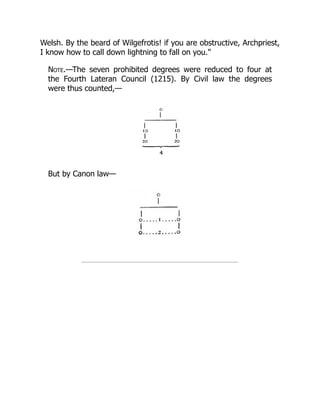
Note.—The seven prohibited degrees were reduced to four at
the Fourth Lateran Council (1215). By Civil law the degrees
were thus counted,—
But by Canon law—
CHAPTER IV
A HWYL
A Welsh church at the period of the Norman Conquest was much
what it had been from the time when Christianity had been adopted
by the Britons. It was of wood, as has been already stated.
The insular Celt could never apply himself to the quarrying and
shaping of stone.
The church of Cynwyl was oblong, built of split logs, roofed with
thatch. The eaves projected, so as to shelter the narrow windows
from the drift of rain, as these latter were unglazed. Only in the
chancel were they protected by sheep's amnion stretched on frames.
A gallows of timber standing at a short distance from the west end
supported the bell. This was neither circular nor cast, but was
oblong in shape, of hammered metal, and riveted. The tone emitted
was shrill and harsh, but perhaps was on this account better suited
to be heard at a distance than had it been deep in tone and musical
in note.
Rude although the exterior of the church was, the interior was by no
means deficient in beauty, but this beauty was limited to, or at least
concentrated on, the screen that divided the long hall into two
portions. There were no aisles, the only division into parts was
effected by the screen, that was pierced by a doorway in the middle.
This screen was, indeed, constructed of wood in compartments, and
each compartment was filed with an intricate and varied tracery of
plaited willow wands. It was the glory and the delight of the Celt to
expend his artistic effort on the devising and carrying out of some
original design in interlaced work—his knots and twists and lattice
were of incomparable beauty and originality. If he took to carving on
stone, it was to reproduce on the best tractable material his
delightful lacework of osiers.
The patterns of the compartments were not merely varied in plaits,
but color was skilfully introduced by the flexible rods having been
dyed by herbs or lichens, and a further variety was introduced by the
partial peeling of some of the wands in rings. Moreover, to heighten
the effect, in places flat pieces of wood like shuttles, but with
dragons' heads carved on them, were introduced among the plait as
a means of breaking continuity in design and allowing of a fresh
departure in pattern.
Within the screen a couple of oil-lamps burned, rendered necessary
by the dusk there produced by the membrane that covered the
windows. Here, beneath the altar, was preserved the abbatial staff of
the founder—a staff invested by popular belief with the miraculous
powers.
On the last day of April every year, this staff was solemnly brought
forth and carried up the river Annell, to a point where rested an
enormous boulder, fallen from the mountain crag, and resting beside
the stream, where it glanced and frothed over a slide of rock, in
which were depressions scooped by the water, but superstitiously
held to have been worn by the Apostle of Caio as he knelt in the
water at his prayers and recitation of the Psalter. Here the Archpriest
halted, and with the staff stirred the water. It was held that by this
means the Annell was assured to convey health and prosperity to
the basin of the Cothi, into which it discharged its blessed waters.
Hither were driven flocks and herds to have the crystal liquid
scooped from the hollows in the rock, and sprinkled over them, as
an effectual preservative against murrain.
The bishop occupied a stool within the screen. On this occasion he
had nothing further to do than proclaim his inflexible determination
to maintain the prohibition of marriage within the seven degrees for
the future, and to annul all such unions as fell within them, whether
naturally or artificially, and to illegitimatize all children the issue of
such marriages. It was the object of the Norman invaders to sow the
seed of discord among those whose land they coveted, to produce
such confusion in the transmission of estates as to enable them to
intervene and dispossess the native owners, not always at the point
of the sword, but also with the quill of the clerk.
The villagers had crowded into the sacred building, they stood or
knelt as densely as they could be packed, and through the open
door could be seen faces thronging to hear such words as might
reach them without. Every face wore an expression of suspicion,
alarm, or resentment. Pabo stood outside the screen upon a raised
step or platform, whence he was wont to read to or address his
congregation. It sustained a desk, on which reposed the Scriptures.
The bishop's chaplain occupied the center of the doorway through
the screen. He held a parchment in his hand, and he hastily read its
contents in Latin first, and then translated it into Welsh. Pabo was a
tall man, with dark hair and large deep eyes, soft as those of an ox,
yet capable of flashing fire. He was not over thirty-five years of age,
yet looked older, as there was gravity and intensity in his face
beyond his years. He was habited in a long woolen garment dyed
almost but not wholly black. He was hearkening to every word that
fell, his eyes fixed on the ground, his hands clenched, his lips closed,
lines forming in his face.
It escaped Bernard, behind the lattice-work, and incapable of
observing such phenomena, how integrally one, as a single body, the
tribesmen present were with their ecclesiastical and political
chieftain. Their eyes were riveted, not on the reader, but on the face
of Pabo. The least change in his expression, a contraction of the
brow, a quiver of the lip, a flush on the cheek, repeated itself in
every face.
Whilst the lection in Latin proceeded, the people could understand
no more of it than what might be discerned from its effect on their
Archpriest; but it was other when the chaplain rendered it into
every-day vernacular. Yet even then, they did not look to his lips.
They heard his words, but read the commentary on them in the face
of Pabo.
They understood now with what they were menaced. It was shown
to them, not obscurely. They knew as the allocution proceeded what
it involved if carried out: there were wives present whose sentence
of expulsion from their homes was pronounced, children who were
bastardized and disinherited, husbands whose dearest ties were to
be torn and snapped.
Not a sound was to be heard save the drone of the reader's voice;
till suddenly there came a gasp of pain—then a sob.
Again an awful hush. Men set their teeth and their brows contracted;
the muscles of their faces became knotted. Women held their palms
to their mouths. Appealing hands were stretched to Pabo, but he did
not stir.
Then, when the translation was ended, the chaplain looked round in
silence to Bernard, who made a sign with his hand and nodded.
In a loud and strident voice the chaplain proceeded: "By order of
Bernard, by the grace of God, and the favor of his Majesty the King,
Bishop of St. David's and Primate of all Wales—all such as have
contracted these unlawful unions shall be required within ten days
from this present to separate from the women with whom they have
lived as husbands, and shall not occupy the same house with them,
nor eat at the same board, under pain of excommunication. And it is
further decreed that in the event of contumacy, of delay in fulfilling
what is hereby required, or refusal to fulfil these lawful commands,
after warning, such contumacious person shall forfeit all his
possessions, whether in lands or in movable goods, or cattle—his
wearing apparel alone excepted; and such possessions shall be
divided into three equal portions, whereof one-third shall be
confiscated to the Crown, one-third shall fall to the Church
Metropolitan, and, again, one-third——" He raised his head. Then
Bernard moved forward in his seat that he might fix his eyes upon
Pabo; there was a lifting of his upper lip on one side, as he signed to
the chaplain to proceed: "And, again, one-third shall be adjudged as
a grace to the Informer." A moan swept through the congregation
like that which precedes the breaking of a storm, "To the Informer,"
repeated the chaplain; "who shall denounce to the Lord Bishop such
unions as have been effected in this district of Caio within the
forbidden degrees."
This last shaft pierced deepest of all. It invited, it encouraged,
treachery. It cast everywhere, into every family, the sparks that
would cause conflagration. It was calculated to dissolve all
friendships, to breed mistrust in every heart.
Then Pabo lifted his head.
His face was wet as though he had been weeping, but the drops
that ran over his cheeks fell, not from his glowing eyes, but from his
sweat-beaded brow.
He turned back the book that was on the desk and opened it. He
said no words of his own, but proceeded to read from the volume in
a voice deep, vibrating with emotion; and those who heard him
thrilled at his tones.
"Thus saith the Lord God. Behold, I, even I, will judge between the
fat cattle and between the lean cattle. Because ye have thrust with
side and with shoulder, and pushed all the diseased with your horns,
till ye have scattered them abroad; therefore will I save my flock,
and they shall no more be a prey; and I will judge between cattle
and cattle——"
"What doth he say? What readeth he?" asked the bishop of his
chaplain, whom he had beckoned to him.
Pabo heard his words, turned about and said—"I am reading the
oracle of God. Is that forbidden?" A woman in the congregation cried
out; another burst into sobs.
Pabo resumed the lection, and his voice unconsciously rose and fell
in a musical wail: "I will set up one shepherd over them, and he
shall feed them." At once—like a rising song, a mounting wave of
sound—came the voice of the people, as they caught the words that
rang in their hearts; they caught and repeated the words of the
reader after him—"One shepherd, and he shall feed them." And as
they recited in swelling and falling tones, they moved rhythmically,
with swaying bodies and raised and balanced arms. It was an
electric, a marvelous quiver of a common emotion that passed
through the entire congregation. It went further—it touched and
vibrated through those outside, near the door—it went further, it
affected those beyond, who knew not what was said.
Pabo continued—and his voice rolled as if in a chant—"I will set up
one shepherd over them, and he shall feed them—even my servant
David."
"David! He shall feed us—even he, our father—our father David!"
Those kneeling started to their feet, stretched their arms to heaven.
Their tears poured forth like rain, their voices, though broken by
sobs, swelled into a mighty volume of sound, thrilling with the
intensity of their distress, their hope, their fervor of faith—"Even he
shall come—God's servant David!" At the name, the loved name,
they broke into an ecstatic cry, "And I the Lord will be their God, and
my servant David a prince among them; I the Lord have spoken it."
[1] The chaplain translated. "He is uttering treason!" shouted
Bernard, starting up. "David a prince among them! We have no King
but Henry."
Then from without came cries, shouts, a rushing of feet, an angry
roar, and the clash of weapons.
[1] "A minnau yr Arglwydd a fyddaf yn Dduw iddynt, a'm gwas
Dafydd yn dywysog yn eu mysg; myfi yr Arglwydd a leferais
hyn."—Ez. xxxiv. 24.
CHAPTER V
THE FIRST BLOOD
"What is this uproar? What is being done?" asked Bernard in
agitation. "Look, Cadell! Is there no second door to this trap? Should
violence be attempted I can obtain no egress by the way I came in;
this church is stuffed with people. Shut the screen gates if they show
the least indication of attacking us. 'Sdeath! if it should occur to
them to fire this place——"
"They will not do so, on account of their own people that are in it."
"But—but what is the occasion of this noise? How is it I am here
without anyone to protect me? This should have been looked to. I
am not safe among these savages. It is an accursed bit of
negligence that shall be inquired into. What avails me having men-
at-arms if they do not protect me? Body of my life! Am not I the
King's emissary? Am not I a bishop? Am I to be held so cheap even
by my own men that I am allowed to run the risk of being torn to
pieces, or smoked out of a hole like this?"
"Do not fear, my Lord Bishop," said Cadell, his chaplain and
interpreter, who was himself quaking, "there is a door behind, in the
chancel wall. But methinks the danger is without; there is the
disturbance, and the congregation are pressing to get forth."
"Body of my life! I want to know what is happening. Here, quick,
you clumsy ass, you beggarly Welshman; Cadell, undo the clasp, the
brooch; I will have off this cope—and remove my miter. I will leave
them here. I shall be less conspicuous, if weapons are being
flourished and stones are flying."
The bishop speedily divested himself of his ecclesiastical attire, all
the while scolding, cursing his attendant, who was a Welshman by
birth, but who had passed into the service of the conquerors, and
knew very well that this would advance him in wealth, and ensure
for himself a fat benefice.
When the bishop had been freed of his vestments, the chaplain
unbolted a small side door, and both emerged from the church.
Outside all was in commotion. The populace was surging to and fro,
uttering cries and shouts. An attack had been made on the military
guard of the bishop—and these, for their mutual protection, had
retreated to the sumpter horses and mules, surrounded them, and
faced their assailants with swords brandished. About them, dense
and menacing, were the Welshmen of Caio, flourishing cudgels and
poles, and the women urging them on with cries.
Bernard found himself separated from his party by the dense ring of
armed peasants, infuriated by the wrongs they had endured and by
the appeals of the women. He could not see his men, save that now
and then the sun flashed on their swords as they were whirled
above the heads of the crowd. No blood seemed to have been shed
as yet—the Normans stood at bay. The Welsh peasants were
reluctant to approach too nearly to the terrible blades that whirled
and gleamed like lightning.
At the same instant that Bernard issued from the church, the bell
suspended between two beams was violently swung, and its clangor
rang out above the noise of the crowd. As if in answer to its
summons, from every side poured natives, who had apparently been
holding themselves in reserve; they were armed with scythes, axes,
and ox-goads. Some were in leather jerkins that would resist a
sword-cut or a pike-thrust, but the majority were in thick wadmel.
The congregation were also issuing from the west door of the
church, thick on each other's heels, and were vainly asking the
occasion of the disturbance.
It was some minutes before Pabo emerged into the open, and then
it was through the side door. He found the bishop there, livid, every
muscle of his face jerking with terror, vainly endeavoring to force his
chaplain to stand in front of and screen him.
"I hold you answerable for my safety," said Bernard, putting forth a
trembling hand and plucking at the Archpriest.
"And I for mine," cried the chaplain.
"Have no fear—none shall touch you," answered Pabo, addressing
the prelate. He disdained even to look at the interpreter.
"If any harm come to my men, you shall be held accountable. They
are King Henry's men; he lent them to me. He sent them to guard
my sacred person."
"And mine," said Cadell. "Our father in God cannot make himself
understood without me."
"You are in no danger," said Pabo.
Then the Archpriest stepped forward, went to the belfry, and
disengaged the rope from the hand of him who was jangling the
bell. With a loud, deep, sonorous voice, he called in their native
tongue to his tribesmen to be silent, to cease from aggression, and
to explain the cause of the tumult.
He was obeyed immediately. All noise ceased, save that caused by
the Normans, who continued to thunder menaces.
"Silence them also," said Pabo to the bishop.
"I—I have lost my voice," said the frightened prelate.
At the same moment the crowd parted, and a band of sturdy
peasants, carrying clubs, and one armed with a coulter, came
forward, drawing with them Rogier, the bishop's brother, and a
young and beautiful woman with disheveled hair and torn garments.
Her wrists had been bound behind her back, but one of the men
who drew her along with a great knife cut the thongs, and she
shook the fragments from her and extended her freed arms to the
priest.
"Pabo!"
"Morwen!" he exclaimed, recoiling in dismay.
"What is the meaning of this?" demanded the bishop. "Unhand my
brother, ye saucy curs!" But, though his meaning might be guessed
by those who gripped Rogier, they could not understand his words.
"What is the cause of this?" asked Bernard, addressing the Norman.
"Rogier, how comes this about?"
The Norman was spluttering with rage, and writhing in vain
endeavor to extricate himself from the men who held him. It was
apparent to Bernard that the right arm of the man had received
some injury, as he was powerless to employ it against his captors.
The rest of the soldiery were hemmed in and unable to go to his
assistance.
"Curse the hounds!" he yelled. "They have struck me over the
shoulder with their bludgeons, or by the soul of Rollo I would have
sent some of them to hell! What are my men about that they do not
attempt to release me?" he shouted. But through the ring of stout
weapons—a quadruple living hedge—his followers were unable to
pass; moreover, all considered their own safety to consist in keeping
together.
"What has caused this uproar?" asked the bishop. "Did they attack
you without provocation?"
"By the soul of the conqueror!" roared Rogier. "Can not a man look
at and kiss a pretty woman without these swine resenting it? Have
not I a right to carry her off if it please me to grace her with my
favor? Must these hogs interfere?"
"Brother, you have been indiscreet!"
"Not before your face, Bernard. I know better than that. I know
what is due to your sanctity of a few weeks. I waited like a decent
Christian till your back was turned. You need have known nothing
about it. And if, as we rode away, there was a woman behind my
knave on his horse, you would have shut one eye. But these
mongrels—these swine—resent it. Body of my life! Resent it!—an
honor conferred on one of their girls if a Norman condescend to look
with favor on her. Did not our gracious King Henry set us the
example with a Welsh prince's wench? And shall not we follow suit?"
"You are a fool, Rogier—at such a time, and so as to compromise
me."
"Who is to take you to task, brother?"
"I mean not that, but to risk my safety. To leave me unprotected in
the church, and to provoke a brawl without, that might have
produced serious consequences to me. Odd's life! Where is that
Cadell? Slinking away?"
"My lord, I have greater cause to fear than yourself. They bear me
bitterest hate."
"I care not. Speak for me to these curs. Bid them unhand my
brother. They have maimed him—maybe broken his arm. My brother,
a Norman, held as a common felon by these despicable serfs!"
"Bishop," said Pabo, stepping before Bernard.
"What have you to say?" asked the prelate suddenly.
The face of the Archpriest was stern and set, as though chiseled out
of alabaster.
"Are you aware what has been attempted while you were in God's
house? What the outrage is has been offered?"
"I know that my brother has been so light as to cast his eye on one
of your Welsh wenches."
"Lord bishop," said Pabo in hard tones, and the sound of his voice
was metallic as the bell, "he has insulted this noble woman. He
bound her hands behind her back and has endeavored to force her
onto a horse in spite of her resistance, her struggles—look at her
bruised and bleeding arms!—and to carry her away."
"Well, well, soldiers are not clerks and milk-sops."
"Do you know who she is?"
"I know not. Some saucy lass who ogled him, and he took her winks
as an invitation."
"Sieur!" thundered Pabo, and the veins in his brow turned black.
"She is the noblest, purest of women."
"Among broken sherds, a cracked pitcher is precious."
"Bishop, she is my wife!"
"Your wife!" jeered Bernard, leaned back, placed his hands to his
side, and laughed. "Priests have no wives; you mean your harlot."
In a moment the bishop was staggering back, and would have fallen
unless he had had the timber wall of the church to sustain him. In a
moment, maddened beyond endurance by the outrage, by the
words, by the demeanor of the prelate, in forgetfulness of the sacred
office of the man who insulted him, in forgetfulness of his own
sacred office, forgetful of everything save the slur cast on the one
dearest to him in the whole world, the one to whom he looked with
a reverence which from her extended to all womanhood, the
incandescent Welsh blood in his veins burst into sudden flame, and
he struck Bernard in the face, on the mouth that had slandered her
and insulted him. And the bishop reeled back and stood speechless,
with blear eyes fixed, his hands extended against the split logs, and
from his lips, cut with his teeth, blood was flowing.
Then, in the dead silence that ensued, an old hermit, clothed in
sackcloth, bareheaded, with long matted white hair, walking bent by
the aid of a staff—a man who for thirty years had occupied a cell on
the mountain-side without leaving it—stood forward before all, an
unwonted apparition; and slowly, painfully raising his distorted form,
he lifted hand and staff to heaven, and cried: "Wo, wo, wo to the
Blessed Valley! The peace of David, our father, is broken. Blood has
flowed in strife. That cometh which he foresaw, and over which he
wept. Wo! wo! wo!"
CHAPTER VI
THE SCROLL
The young, the thoughtless, were full of exultation over the rebuff
that the Normans, with their bishop, had encountered, but the older
and wiser men were grave and concerned. The Normans had indeed
withdrawn in sullen resentment, outnumbered, and incapable of
revenging on the spot and at once the disabled arm of their leader
and the broken tooth of their prelate. The old men knew very well
that matters would not rest thus; and they feared lest the events of
that day when the party of foreigners penetrated to the Blessed
Valley might prove the most fruitful in disastrous consequences it
had ever seen.
Native princes had respected the sanctuary of David, but an English
King and foreign adventurers were not likely to regard its privileges,
nor fear the wrath of the saint who had hitherto rendered it
inviolable. Bishop Bernard had at his back not only the whole
spiritual force of the Latin Church, the most highly concentrated and
practically organized in Christendom, but he was specially the
emissary of the English King, with all the physical power of the realm
to support him; and what was the prospect of a little green basin in
the mountains, isolated from the world, occupied by three thousand
people, belonging to the most loosely compacted Church that
existed, with no political force to maintain its right and champion its
independence—what chance had the sanctuary of David in Caio
against the resentment of the English King and the Roman Church?
Neither, as experience showed, was likely to pass over an affront.
One would sustain the other in exacting a severe chastisement.
The hermit, who after over thirty years of retirement in one cell, far
up the Mount Mallaen, had suddenly, and unsolicited, left his retreat
Welcome to our website – the perfect destination for book lovers and
knowledge seekers. We believe that every book holds a new world,
offering opportunities for learning, discovery, and personal growth.
That’s why we are dedicated to bringing you a diverse collection of
books, ranging from classic literature and specialized publications to
self-development guides and children's books.
More than just a book-buying platform, we strive to be a bridge
connecting you with timeless cultural and intellectual values. With an
elegant, user-friendly interface and a smart search system, you can
quickly find the books that best suit your interests. Additionally,
our special promotions and home delivery services help you save time
and fully enjoy the joy of reading.
Join us on a journey of knowledge exploration, passion nurturing, and
personal growth every day!
testbankfan.com


Management 10th Edition Robbins Solutions Manual

  • 1.
    Management 10th EditionRobbins Solutions Manual download https://testbankfan.com/product/management-10th-edition-robbins- solutions-manual/ Explore and download more test bank or solution manual at testbankfan.com
  • 2.
    We believe theseproducts will be a great fit for you. Click the link to download now, or visit testbankfan.com to discover even more! Fundamentals of Management 10th Edition Robbins Solutions Manual https://testbankfan.com/product/fundamentals-of-management-10th- edition-robbins-solutions-manual/ Fundamentals of Management 10th Edition Robbins Test Bank https://testbankfan.com/product/fundamentals-of-management-10th- edition-robbins-test-bank/ Management 12th Edition Robbins Solutions Manual https://testbankfan.com/product/management-12th-edition-robbins- solutions-manual/ Organic Chemistry Principles and Mechanisms 2nd Edition Karty Solutions Manual https://testbankfan.com/product/organic-chemistry-principles-and- mechanisms-2nd-edition-karty-solutions-manual/
  • 3.
    Ethics and Issuesin Contemporary Nursing 2nd Edition Burkhardt Test Bank https://testbankfan.com/product/ethics-and-issues-in-contemporary- nursing-2nd-edition-burkhardt-test-bank/ Supply Chain Management A Logistics Perspective 9th Edition Coyle Test Bank https://testbankfan.com/product/supply-chain-management-a-logistics- perspective-9th-edition-coyle-test-bank/ ETHICS 1st Edition Camp Test Bank https://testbankfan.com/product/ethics-1st-edition-camp-test-bank/ Organizational Behavior Improving Performance and Commitment in the Workplace 5th Edition Colquitt Solutions Manual https://testbankfan.com/product/organizational-behavior-improving- performance-and-commitment-in-the-workplace-5th-edition-colquitt- solutions-manual/ Strategic Management Theory and Practice 4th Edition Parnell Test Bank https://testbankfan.com/product/strategic-management-theory-and- practice-4th-edition-parnell-test-bank/
  • 4.
    Effective Human RelationsInterpersonal and Organizational Applications 12th Edition Reece Test Bank https://testbankfan.com/product/effective-human-relations- interpersonal-and-organizational-applications-12th-edition-reece-test- bank/
  • 5.
    7-1 Copyright © 2012Pearson Canada Inc., Toronto, Ontario. Chapter 7 Foundations of Planning In this chapter, we begin our study of the first of the management functions: planning. Planning is important because it establishes what an organization is doing. We’ll look at how managers set goals as well as how they establish plans. After reading and studying this chapter you will achieve the following learning outcomes. LEARNING OUTCOMES 8.1 Define the nature and purpose of planning. 8.2 Understand how managers set goals and develop plans. 8.3 Discuss contemporary issues in planning CHAPTER VIGNETTE Your students may be familiar with the adage, “If you fail to plan, you plan to fail.” Chapter 8 examines skills needed for effectiveness in the first of the four management functions—planning. After learning about the purposes of planning, students will discover how managers at different levels of an organization develop plans and empower employees to participate in the planning process. The chapter vignette tells the story of the Blue Man Group, one well known to many students and how they needed to employ planning techniques to help them deal with the transition from a small performance troupe to a much larger business concept and brand. The first vignette asks the students to think about how planning can help deal with the temporary loss of a group member due to illness, the third focuses on issues relating to growth while the third vignette focuses on the failed attempt to open Toronto. CHAPTER OUTLINE INTRODUCTION Planning is one of the four functions of management. Fundamental information about managerial planning is presented in this chapter; the text discusses the nature and purposes of planning, strategies for effective planning, and contemporary planning issues. 1. WHAT IS PLANNING? Planning involves defining the organization’s goals, establishing an overall strategy for achieving these goals, and developing a comprehensive set of plans to integrate and coordinate organizational work. The term planning as used in this chapter refers to formal planning. A. Purposes of Planning. Planning is important and serves many significant purposes. 1. Planning gives direction to the organization.
  • 6.
    7-2 Copyright © 2012Pearson Canada Inc., Toronto, Ontario. 2. Planning reduces uncertainty. 3. Planning reduces overlapping and wasteful activities. 4. Planning establishes the goals or standards that are used in controlling. B. Planning and Performance. Research has shown we cannot assume organizations with formal planning processes always outperform those organizations that don’t have formal planning processes. 1. Generally speaking, however, formal planning is associated with positive financial results. 3. HOW DO MANAGERS PLAN? Planning is often called the primary management function because it establishes the basis for all other functions. Planning involves two important elements: goals and plans. Goals are desired outcomes for individuals, groups, or entire organizations. Goals are objectives—the two terms are used interchangeably. Plans are documents that outline how goals are going to be met and that typically describe resource allocations, schedules, and other necessary actions to accomplish the goals. A. Approaches to Establishing Goals. Goals can be established through a process of traditional goal setting or through management by objectives: 1. Traditional goal setting is defined as the process whereby goals are set at the top of the organization and then broken down into sub goals for each level in an organization. a. Top managers are assumed to know what’s best because they see the “big picture.” b. These goals are also often largely nonoperational. c. Specificity is achieved as each manager applies his or her own set of interpretations and biases. d. However, what often results is that objectives lose clarity and unity as they move from top to bottom. (See Exhibit 7-1) e. When the hierarchy of objectives is clearly defined, it forms an integrated means-end chain in which higher- level objectives are linked to lower-level objectives. These lower-level objectives serve as the means for the accomplishment of the higher- level objectives. And the goals at the lower levels (means) must be achieved in order to reach the goals at the next level (ends). 2. Management by objectives (MBO) is defined as a system in which specific performance goals are jointly determined by employees and their managers, progress toward accomplishing these goals is periodically reviewed, and rewards are allocated on the basis of this progress. a. MBO consists of four elements: 1. Goal specificity 2. Participative decision-making
  • 7.
    7-3 Copyright © 2012Pearson Canada Inc., Toronto, Ontario. 3. Explicit time period 4. Performance feedback b. MBO makes objectives operational through the process by which they cascade down through the organization. c. Exhibit 7-2 lists the steps in a typical MBO program. d. Does MBO work? Studies of actual MBO programs confirm that MBO can increase employee performance and organizational productivity. However, top- management commitment and involvement are important contributions to the success of an MBO program. 3. Characteristics of Well-Designed Goals (See Exhibit 7-3). a. Written in terms of outcomes b. Measurable and quantifiable c. Clear as to a time frame d. Challenging, but attainable e. Written down f. Communicated to all organizational members 4. Steps in Goals Setting—Five Steps. a. Review the organization’s mission or the purpose of an organization. Goals should reflect what the mission statement says. b. Evaluate available resources. c. Determine individually, or with input from others, the goals. d. Write down the goals and communicate them to all who need to know. e. Review results and whether goals are being met. B. Developing Plans. The process of developing plans is influenced by three contingency factors and by the planning approach followed. 1. Types of Plans. The most popular ways to describe organizational plans are pictured in Exhibit 7-4. The characteristics include: a. Breadth (strategic vs. operational) (1) Strategic plans apply to the entire organization, establish the organization’s overall goals, and seek to position the organization in terms of its environment. (2) Operational plans are short term, specific, and standing. They specify the details of how the overall goals are to be achieved. b. Time frame (short term vs. long term) We define long-term plans as those with a time frame beyond three years. We define short-term
  • 8.
    7-4 Copyright © 2012Pearson Canada Inc., Toronto, Ontario. plans as those with a time frame of one year or less. c. Specificity (directional vs. specific) (1) Specific plans are plans that are clearly defined and that leave no room for interpretation. They have clearly defined objectives. There’s no ambiguity and no problem with misunderstanding. (2) Directional plans are flexible plans that set out general guidelines. They provide focus but don’t lock managers into specific goals or courses of action. (Exhibit 7–5 illustrates how specific and directional planning differ, with the directional plan indicating only the intent to get from “A” to “B” and the specific plan identifying the exact route that one would take to go from “A” to “B”.) d. Frequency of use (single use vs. standing) (1) A single-use plan is a one-time plan specifically designed to meet the needs of a unique situation. (2) Standing plans are ongoing plans that provide guidance for activities performed repeatedly. Standing plans include policies, rules, and procedures. 2. Contingency Factors in Planning. a. Manager’s level in the organization. (See Exhibit 7- 6.) Operational planning usually dominates the planning activities of lower-level managers. As managers move up through the levels of the organization, their planning becomes more strategy oriented. b. Degree of environmental uncertainty. The greater the environmental uncertainty, the more plans should be directional and emphasis placed on the short term. 1) When uncertainty is high, plans should be specific, but flexible. 2) Managers must be prepared to rework and amend plans, or even to abandon their plans. c. Time frame of plans. 1) Commitment concept means that plans should extend far enough to meet those commitments made when the plans were developed. 2) Planning for too long or for too short a time period is inefficient and ineffective. 3. Approaches to Planning.
  • 9.
    7-5 Copyright © 2012Pearson Canada Inc., Toronto, Ontario. a. Traditional Approach—planning was done entirely by top-level managers who were often assisted by a formal planning department. b. Organizational Member Involvement—plans aren’t handed down from one level to the next, but are developed at the various levels to meet specific needs. 4. CURRENT ISSUES IN PLANNING. This section looks at criticisms of planning and how managers can plan effectively in dynamic environments. A. Criticisms of Planning. Although planning is an important and popular managerial function, five major arguments have been directed against planning. 1. Planning may create rigidity. Formal planning may “lock” an organization into specific goals and specific timetables that were established under certain environmental conditions. If the environment changes, managers may believe they’re locked into the current plans. 2. Plans cannot be developed for a dynamic environment. Managing under chaotic environmental conditions requires flexibility, and that may mean not being tied to formal plans. 3. Formal plans cannot replace intuition and creativity. The formal planning process may emphasize the mechanics and routines of planning and ignore important aspects. 4. Planning focuses managers’ attention on today’s competition not on tomorrow’s survival. Formal planning has a tendency to make managers focus on today’s realities, not on tomorrow’s possibilities. 5. Formal planning reinforces success, which may lead to failure. Because the "plans" have led to success, there may be reluctance on the part of managers to change or discard previously successful plans. "If it ain’t broke, why fix it?" B. Effective Planning in Dynamic Environments. The external environment is constantly changing. 1. Managers want to develop plans that are specific, but flexible. 2. Managers must recognize that planning is an ongoing process, and they should be willing to change directions if environmental conditions warrant. 3. Flexibility is particularly important. 4. Managers must stay alert to environmental changes that could impact the effective implementation of plans and make changes as needed.
  • 10.
    7-6 Copyright © 2012Pearson Canada Inc., Toronto, Ontario. ANSWERS TO READING FOR COMPREHENSION QUESTIONS 1. What are the benefits of planning? Planning provides direction to managers and non-managers alike. Planning reduces uncertainty by forcing managers to look ahead, anticipate change, consider the impact of change, and develop appropriate responses. Planning reduces overlapping and wasteful activities. Planning establishes the goals or standards that are used in controlling. 2. Contrast formal with informal planning. In informal planning, very little, if anything, is written down. In formal planning, there are written plans at various levels, people are assigned responsibilities, there is a great deal of detail, etc. Formal planning involves specific goals to be achieved within specific timetables. 3. Compare an organization's mission with its objectives. Every organization has a mission that defines its purpose and answers the question, “What business or businesses are we in?” In essence the mission is a directional plan. The mission applies to the entire organization, establishes the organization's overall objectives, and seeks to position the organization in terms of its environment. Objectives are tactical or specific "plans" that are quantified for achieving specific goals. They can apply to individuals, work units, or the organization. The mission cannot be accomplished without the accomplishment of objectives. Objectives need a mission in order to be clear and coordinated. 4. Describe the differences between a) strategic and operational plans, b) short and long-term plans, and c) specific and directional plans. a) Strategic plans tend to cover a longer time frame and a broader view of the organization and also include the formulation of goals, whereas operational plans define ways to achieve the goals and tend to cover shorter time periods. b) Short-term plans are generally within a time frame of a year or less while long terms plans are those with a time frame beyond three years. c) Specific plans are plans that are clearly defined and do not leave room for interpretation, whereas directional plans are more flexible, and although they provide focus, they do not lock managers into specific goals or courses of action. 5. Under what circumstances are short-term plans preferred? Under what circumstances are specific plans preferred? Short-term covers less than one year. Plans should extend far enough to see through those commitments that are made today. The greater the uncertainty, the more plans should be of the short-term variety. Shorter- term plans allow for better accommodation of changes by providing more flexibility.
  • 11.
    7-7 Copyright © 2012Pearson Canada Inc., Toronto, Ontario. Specific plans have clearly defined objectives and leave no room for misinterpretation. They should be used when conditions are relatively certain and management can operate on some unchanging assumptions. 6. How can managers plan effectively in dynamic environments? In a dynamic environment, managers need to develop plans that are specific, yet flexible. Managers should recognize that planning is an ongoing process and they should be willing to change direction if the environment changes. As well, flattening the organizational hierarchy to push responsibility to the lower levels of the organization can facilitate planning. ANSWERS TO LINKING CONCEPTS TO PRACTICE QUESTIONS 1. If planning is so crucial, why do some managers choose not to do it? What would you advise these managers? Managers may choose not to do it because they don’t know how or they claim they don’t have the time to do it. Others may say that it’s a waste of time, and that the future is going to happen whether or not they plan. But, all of these reasons do not discount the importance of planning. Every manager should engage in planning. 2. Would a manager ever use informal planning? In informal planning, nothing is written down, and there is little or no sharing of goals with others. Informal planning is general and lacks continuity. Although it’s more common in smaller organizations, where the owner-manager has a vision of where he or she wants the business to go and how to get there, informal planning does exist in some large organizations as well. Informal planning can help set guidelines. It may not be effective for either large projects or for large organizations. 3. Explain how planning involves decisions today that will have an impact later. Decisions that managers make as they plan will influence how activities are organized, how employees are managed, and what controlling is performed. So even as managers look to the future by planning, the decisions they’re making as they plan will have an effect on the other managerial activities. 4. How might planning in a not-for-profit organization such as the Canadian Cancer Society differ from planning in a for-profit organization such as Molson? The process of planning itself won’t differ, but the content of the plans will differ. The types of objectives that are established and the plans that are formulated will be different because a not-for-profit organization isn’t focused on profit objectives like the for-profit organization.
  • 12.
    7-8 Copyright © 2012Pearson Canada Inc., Toronto, Ontario. 5. What types of planning do you do in your personal life? Describe these plans in terms of being (a) strategic or operational, (b) short- or long-term, and (c) specific or directional. Students’ responses to this will, of course, vary. Most will probably mention planning for completing their education and may even mention career planning. Encourage them to think in terms of their everyday lives about the types of daily, weekly, monthly, or yearly planning they do. 6. “Organizations that fail to plan are planning to fail.” Do you agree or disagree with this statement? Explain your position. While managers (and anyone else) can advance reasons for why they shouldn’t plan (because it’s inflexible, or doesn’t allow creativity and intuition, for instance), planning helps one to prepare to meet the challenges that may arise. Without a plan it becomes difficult to evaluate how many employees are needed, how much inventory is needed, etc. 7. Will planning become more or less important to managers in the future? Why? Planning will probably become more important to managers in the future because of the uncertainty present in the environment. There are so many changes taking place in both the general and specific environments of organizations, and many of these changes are taking place rapidly. Planning helps managers cope with the uncertainties by forcing managers to look ahead, anticipate change, consider the impact of the change, and develop appropriate responses. WORKING TOGETHER : TEAM BASED EXERCISE Helping Design a Training Program This exercise asks students to develop goals for each of three stages of a project to develop an Internet researching training program. The three stages of the projects are: (1) researching corporate customer needs, (2) researching the Internet for specific information sources and techniques that could be used in the training module, and (3) designing and writing specific training modules. This exercise is useful to provide students with experience in writing goals and also to illustrate the characteristics of well-designed goals.
  • 13.
    7-9 Copyright © 2012Pearson Canada Inc., Toronto, Ontario. Teaching Suggestions: 1. Break students into groups of three or four and have each group develop 3 goals for each stage. 2. Once all the groups have had an opportunity to develop their goals have each group record their goals on a flipchart or on the board. 3. Referring to the characteristics of well-designed goals, ask the group to indicate whether it meets the criteria of a well-designed goal. For those goals that do not meet the criteria, have students offer suggestions as to how the goal could be changed/reworded in order to make it more valuable ETHICS IN ACTION Ethical Dilemma Exercise: What Should Managers Do When Pressured to Deliver Results? Imagine that you are a district manager with Coca-Cola and you are being promoted to a new position at the end of the month. Your area’s sales are an important component of the corporation’s provincial and national sales goals. However, this month’s sales are running below the planned level. Should you ask area supermarkets to double their current monthly order and promise that any unsold Coca-Cola products can be returned the following month? Teaching Suggestions: This exercise asks students to think about the challenges that managers often face in terms of trying to achieve organization’s goals or pursue a strategic plan. If this exercise is used to generate classroom discussion you may want to have students discuss their views on how best to balance an individual’s goals with an organization’s goals. There may be opposing views as to whether this would constitute unethical behaviour. You may ask students their views on what actions could be taken that would help address the situation and still be considered within ethical boundaries. CASE APPLICATION Lend Lease Corporation Managing Director Greg Clarke is trying to decide whether to put together a PCG (project-control-group) for a development project his company is pursuing in London. Would this level of planning help the project? What kind of team should he consider putting together for the PCG and why? What might be the downsides of using a PCG? Answer: (Suggestion only, and should be developed by the instructor.) A project-control-group (PCG) could be set up to engage in team planning to outline the project. The team should be a mix of people with different interests: developers, some members of the community, and possibly a few retailers who might open stores in the complex. This group can set accountability standards through using agendas, minutes, financial reviews, and other reports. The downside of this approach is that the team may take on too much ownership and insist on outcomes that may not be in the best interest of Lend
  • 14.
    7-10 Copyright © 2012Pearson Canada Inc., Toronto, Ontario. Lease. Therefore, Clarke needs to emphasize that the role of the group is advisory, and that they do not have decision-making autonomy. Additional Discussion Questions: 1. What role do you think goals play in planning done at Lend Lease? Explain. Goals play a substantial role in Lend Lease’s planning. The goal of doing something that has never been done before is Lend Lease’s guiding philosophy, and it creates the standard that the business follows when determining new projects and ventures. 2. How does Lend Lease illustrate effective planning in a dynamic environment? Planning involves defining the organization’s goals, establishing an overall strategy for achieving those goals, and developing a comprehensive set of plans to integrate and coordinate organizational work. Lend Lease clearly defined its goal—to do things that have never been done before—and began working to build the Bluewater shopping complex in Kent, England. 3. What approach to developing plans does Lend Lease appear to follow? Explain. Lend Lease appears to follow formal planning. Specific goals with deadlines were set, and the end result was the completion of the Bluewater project early, under budget, and fully leased. 4. Would Lend Lease’s approach work in other organizations? Why or why not? This approach would work in many organizations that have the flexibility and culture to allow for creativity and “thinking outside the box,” such as Lend Lease. The goals of the organization would have to reflect the desire to achieve something original or improve on the existing product and/or service. 4. Lend Lease has a strong commitment to environmentally sustainable development. (Check out its Web site for information on its core values.) How might these core values affect planning efforts? From the Web site: Commitment to Environmental Sustainable Development. Lend Lease is committed to fostering environmental sustainability in our activities and developments. The company prides itself on it willingness to shoulder the responsibility of making a difference. Our objective is to ensure a balance between economics, environment and social goods to provide greater benefits to all. Our process is predicated on total stakeholder involvement. This ensures that we capture innovation, manage costs, and deliver ongoing benefits for all. It is clear that Lend Lease’s focus on planning is driven by their environmental concerns.
  • 15.
    Visit https://testbankbell.com now toexplore a rich collection of testbank, solution manual and enjoy exciting offers!
  • 16.
    7-11 Copyright © 2012Pearson Canada Inc., Toronto, Ontario. DEVELOPING YOUR DIAGNOSTIC AND ANALYTICAL SKILLS Ready or Not… Questions: 1. What role do you think goals might play in a company’s planning for any potential avian flu outbreak? List some goals that you think might be important? Many companies have plans in place to respond to unforeseen events like natural disasters to ensure that the company is able to continue to operate to the best of its ability in terms of meeting the needs of customers and employees. The goals of maintaining the viability of a company and making provisions for a safe and healthy workplace require both short-range and long-range planning. As Deutsche Bank has realized, additional goals might include ensuring that employees in infected zones do not carry the disease to their co-workers, communicating medical news updates to company employees in all of the company’s locations, and preparing for economic slowdowns. 2. What types of plans might companies need for this situation (for instance, short term, long term, or both)? Explain why you think these plans would be important? Short-term plans would be critical to allow companies to be able to function and respond to the situation immediately. Long-term plans would also come into play to address the future impact that might be felt in the organization if significant losses or damages were experienced. You may want to direct your students to the article “If You Fail to Plan, You Plan to Fail,” by Representative Nita Lowey (D-N.Y.). This article strikingly communicates the urgency of the need for organizational planning under the threat of avian influenza and is an example of the type of information every manager should know. The article can be found in the July 14, 2006, issue of The Hill at http://www.hillnews.com/thehill/export/TheHill/News/Frontpage/111505/lo wy.html]. 3. How does this scenario reflect planning in a dynamic environment? What would managers need to do to make their planning effective in such an environment? This scenario is a prime example of how the external environment surrounding an organization can constantly be changing and how important it is for an organization to be able to respond to changes and events in a timely manner. Planning can facilitate this process and allow an organization to not only respond to changes but also to capitalize on opportunities that might arise. In a dynamic environment, managers need to develop plans that are specific yet flexible. Managers should be alert to environmental
  • 17.
    7-12 Copyright © 2012Pearson Canada Inc., Toronto, Ontario. changes that may impact implementation of plans and make changes as needed. As well, allowing lower levels of the organization to have more responsibility in terms of establishing goals and plans will improve the overall effectiveness of planning and may also lead to innovation. HBSC has already made arrangements for its employees to work from their homes in case of a pandemic and is planning to divide work among the company’s different locations. In order to have timely contingency plans, managers must keep abreast of medical developments and adjust their plans accordingly. They will need to remain alert to changes in the environment and establish mechanisms to examine their plans regularly. 4. What could other companies learn from Deutsche Bank’s and HSBC’s experiences? These two organizations have illustrated the fact that proactive planning is possible and very much a necessity in today’s uncertain environment considering the far-reaching effects that something like a pandemic could have on an organization. Both organizations have used creative thinking and innovation in making plans and have carefully considered the welfare of their employees in the planning process. 5. Pick a company (any size, any kind, or any location) and describe how an influenza pandemic might affect it. Now, develop plans for this company to deal with such an outbreak. You may want to divide your class into several teams and use this activity as a group exercise. Encourage your students to think creatively in developing their company’s plans to combat the effects of an influenza outbreak. Remind students that they will want to make both short-term and long-term plans in this situation. Student answers may vary, however, most will identify the impact that a pandemic would have on the workforce and their ability to deliver products and services to customers. DEVELOPING YOUR INTERPERSONAL SKILLS Setting Goals You are a store manager of a large supermarket and want to establish an MBO- type program in your store. How would you go about setting goals in your new position? Include examples of goals for the jobs of butcher, cashier, and bakery manager? Teaching Suggestions: This exercise provides an opportunity to review the concept of MBO and the advantages associated with using this type of goal setting. The elements associated with such a program should also be reviewed; goal specificity, participative decision-making, specific time periods, and performance feedback. As well, the steps associated with establishing an MBO program should be
  • 18.
    7-13 Copyright © 2012Pearson Canada Inc., Toronto, Ontario. mentioned as students discuss how they would go about establishing goals for the various positions and the supermarket as a whole. ADDITIONAL CHAPTER INFORMATION With a turbulent economy and high levels of uncertainty, planning and strategic planning, in particular, present difficult challenges for managers. The article “There Is No Alternative to…” provides an interesting contemporary approach to planning in an uncertain economy. Scenario planning was pioneered by Royal Dutch/Shell to anticipate global changes. The article looks beyond scenario planning in which “everything” is in a state of flux. The article can be found in FastCompany, Issue 60, July 2002, Page 106 (By Ian Wylie). A link to this source is [http://www.fastcompany.com/magazine/60/tina.html].
  • 19.
    Other documents randomlyhave different content
  • 20.
    And this pleasantbowl among the mountains was also regarded as a sanctuary, to which might fly such as had fallen into peril of life by manslaughter, or such strangers as were everywhere else looked on with suspicion. A story was told, and transmitted from father to son, to account for this. It was to this effect. When St. David—or Dewi, as the Welsh called him—left the synod of Brefi, in the Teify Vale, he ascended the heights of the Craig Twrch, by Queen Helen's road, and on passing the brow, looked down for the first time on the fertile district bedded beneath him, engirdled by heathery mountains at the time in the flush of autumn flower. It was as though a crimson ribbon was drawn round the emerald bowl. Then—so ran the tale—the spirit of prophecy came on the patriarch. His soul was lifted up within him, and raising his hands in benediction, he stood for a while as one entranced. "Peace!" said he—and again, "Peace!" and once more, "Peace!" and he added, "May the deluge of blood never reach thee!" Then he fell to sobbing, and bowed his head on his knees. His disciples, Ismael and Aiden, said, "Father, tell us why thou weepest." But David answered, "I see what will be. Till then may the peace of David rest on this fair spot." Now, in memory of this, it was ordained that no blood should be spilled throughout the region; and that such as feared for their lives could flee to it and be safe from pursuit, so long as they remained within the sanctuary bounds. And the bounds were indicated by crosses set up on the roads and at the head of every pass. Consequently, the inhabitants of the Happy Valley knew that no Welsh prince would harry there, that no slaughters could take place there, no hostile forces invade the vale. There might ensue quarrels between residents in the Happy Land, personal disputes might wax keen; but so great was the dread of incurring the wrath of Dewi,
  • 21.
    that such quarrelsand disputes were always adjusted before reaching extremities. And this immunity from violence had brought upon the inhabitants great prosperity. Such was a consequence of the benediction pronounced by old Father David. It was no wonder, therefore, that the inhabitants of the region looked to him with peculiar reverence and almost fanatical love. Just as in Tibet the Grand Lama never dies, for when one religious chief pays the debt of nature, his spirit undergoes a new incarnation, so— or almost so—was each successive Bishop of St. David's regarded as the representative of the first great father, as invested with all his rights, authority, and sanctity, as having a just and inalienable claim on their hearts and on their allegiance. But now a blow had fallen on the community that was staggering. On the death of their Bishop Griffith, the church of St. David had chosen as his successor Daniel, son of a former bishop, Sulien; but the Normans had closed all avenues of egress from the peninsula, so that he might not be consecrated, unless he would consent to swear allegiance to the see of Canterbury and submission to the crown of England, and this was doggedly resisted. Menevia—another name for the St. David's headland—had undergone many vicissitudes. The church had been burnt by Danes, and its bishop and clergy massacred, but it had risen from its ruins, and a new successor in spirit, in blood, in tongue, had filled the gap. Now—suddenly, wholly unexpectedly, arrived Bernard, a Norman, who could not speak a word of Welsh, and mumbled but broken English, a man who had been hurried into Orders, the priesthood and episcopal office, all in one day, and was thrust on the Welsh by the mere will of the English King, in opposition to Canon law, common decency, and without the consent of the diocese. The ferment throughout South Wales was immense. Resentment flamed in some hearts, others were quelled with despair. It was not
  • 22.
    the clergy alonewho were in consternation: all, of every class, felt that their national rights had been invaded, and that in some way they could not understand this appointment was a prelude to a great disaster. Although there had been dissensions among the princes, and strife between tribes, the Church, their religion, had been the one bond of union. There was a cessation of all discord across the sacred threshold, and clergy and people were intimately united in feeling, in interests, in belief. In the Celtic Church bishops and priests had always been allowed to marry—a prelate of St. David's had frankly erected a monument to the memory of two of his sons, which is still to be seen there. Everywhere the parochial clergy, if parochial they can be styled, where territorial limits were not defined had their wives. They were consequently woven into one with the people by the ties of blood. Nowhere was the feeling of bitterness more poignant than in the Happy Valley, where the intrusion of a stranger to the throne of David was resented almost as a sacrilege. Deep in the hearts of the people lay the resolve not to recognize the new bishop as a spiritual father, one of the ecclesiastical lineage of Dewi. Such was the condition of affairs, such the temper of the people, when it was announced that Bernard was coming to visit the sanctuary and there to initiate the correction of abuses. Pabo, the Archpriest, showed less alarm than his flock. When he heard that threats were whispered, that there was talk of resistance to the intrusion, he went about among his people exhorting, persuading against violence. Let Bernard be received with the courtesy due to a visitor, and the respect which his office deserved. A good many protested that they would not appear at Cynwyl lest their presence should be construed as a recognition of his claim, and they betook themselves to their mountain pastures, or remained at home. Nevertheless, moved by curiosity, a considerable number of
  • 23.
    men did gatheron the ridge, about the church, watching the approach of the bishop and his party. Women also were there in numbers, children as well, only eager to see the sight. The men were gloomy, silent, and wore their cloaks, beneath which they carried cudgels. The day was bright, and the sun flashed on the weapons and on the armor of the harnessed men who were in the retinue of Bishop Bernard, that entered the valley by Queen Helen's road, and advanced leisurely towards the ridge occupied by the church and the hovels that constituted the village. The Welsh were never—they are not to this day—builders. Every fair structure of stone in the country is due to the constructive genius of the Normans. The native Celt loved to build of wood and wattle. His churches, his domestic dwellings, his monasteries, his kingly halls, all were of timber. The tribesmen of Pabo stood in silence, observing the advancing procession. First came a couple of clerks, and after them two men-at-arms, then rode Bernard, attended on one side by his interpreter, on the other by his brother Rogier in full harness. Again clerks, and then a body of men-at-arms. The bishop was a middle-sized man with sandy hair, very pale eyes with rings about the iris deeper in color than the iris itself—eyes that seemed without depth, impossible to sound, as those of a bird. He had narrow, straw-colored brows, a sharp, straight peak of a nose, and thin lips—lips that hardly showed at all—his mouth resembling a slit. The chin and jowl were strongly marked. He wore on his head a cloth cap with two peaks, ending in tassels, and with flaps to cover his ears, possibly as an imitation of a miter; but outside a church, and engaged in no sacred function, he was of course not vested. He had a purple-edged mantle over one shoulder, and beneath it a dark cassock, and he was booted and spurred. One
  • 24.
    of the clerkswho preceded him carried his pastoral cross—for the see of St. David's claimed archiepiscopal pre-eminence. In the midst of the men-at-arms were sumpter mules carrying the ecclesiastical purtenances of the bishop. Not a cheer greeted Bernard as he reached the summit of the hill and was in the midst of the people. He looked about with his pale, inanimate eyes, and saw sulky faces and folded arms. "Hey!" said he to his interpreter. "Yon fellow—he is the Archpriest, I doubt not. Bid him come to me." "I am at your service," said Pabo in Norman-French, which he had acquired. "That is well; hold my stirrup whilst I alight." Pabo hesitated a moment, then complied. "The guest," said he, "must be honored." But an angry murmur passed through the throng of bystanders. "You have a churlish set of parishioners," said Bernard, alighting. "They must be taught good manners. Go, fetch me a seat." Pabo went to the presbytery, and returned with a stool, that he placed where indicated by the bishop. The people looked at each other with undisguised dissatisfaction. They did not approve of their chief holding the stirrup, or carrying a stool for this foreign intruder. Their isolation in the midst of the mountains, their immunity from war and ravage, had made them tenacious of their liberties and proud, resistful to innovation, and resolute in the maintenance of their dignity and that of their chief. But a certain amount of concession was due to hospitality, and so construed these acts could alone be tolerated. Nevertheless their tempers were chafed, and there was no graciousness in the
  • 25.
    demeanor of thebishop to allay suspicion, while the contemptuous looks of his Norman attendants were calculated to exasperate. "It is well," said Bernard, signing imperiously to Pabo to draw near. "It is well that you can speak French." "I have been in Brittany. I have visited Nantes and Rennes. I can speak your language after a fashion." "'Tis well. I am among jabbering jackdaws, and cannot comprehend a word of their jargon. I do not desire to distort my mouth in the attempt to acquire it." "Then would it not have been as well had you remained in Normandy or England?" "I have other work to do than to study your tongue," said Bernard with a laugh. "I am sent here by my august master, the fine clerk, the great scholar, the puissant prince, to bring order where is confusion." "The aspect of this valley bespeaks confusion," interrupted Pabo, with a curl of the lip. "Do not break in on me with unmannered words," said the bishop. "I am an apostle of morality where reigns mere license." "License, my Sieur? I know my people; I have lived among them from childhood. They are not perfect. They may not be saints, but I cannot admit that a stranger who is newly come among us, who cannot understand a word that we speak, is justified in thus condemning us." "We shall see that presently," exclaimed Bernard, "when we come to particulars. I have heard concerning you. My lord and master, the Beauclerk Henry, has his eyes and ears open. Ye are a dissolute set, ye do not observe the Seven Degrees." Then aside to his chaplain: "It is seven, not four, I think?"
  • 26.
    "I pray youexplain," said Pabo. "Seven degrees," pursued Bernard. "I must have all the relationships of the married men throughout the country gone into. This district of Caio to commence with, then go on through the South of Wales— through my diocese. I must have all inquired into; and if any man shall have contracted an union within the forbidden degrees, if he have taken to him a wife related by blood—consanguine, that is the word, chaplain, eh?—or connected by marriage, affine—am I right, chaplain?—or having contracted a spiritual relationship through sponsorship at the font, or legal relation through guardianship—then such marriages must be annulled, made void, and the issue pronounced to be illegitimate." "My good Lord!" gasped Pabo, turning deadly pale. "Understand me," went on the bishop, turning his blear, ringed, birdlike eyes about on the circle of those present, "if it shall chance that persons have stood at the font to a child, then they have thereby contracted a spiritual affinity—I am right, am I not chaplain? —which acts as a barrier to marriage; and, if they have become united, bastardizes their issue. Cousinship by blood, relationship through marriage, all act in the same way to seven degrees—and render unions void." "Are you aware what you are about?" asked Pabo gravely. "In our land, hemmed in by mountains, marriages are usually contracted within the same tribe, and in the same district, so that the whole of our people are more or less bound together into a family. A kinship of some sort subsists between all. If you press this rule—and it is no rule with us—you break up fully three-fourths of the families in this country." "And what if I do?" "What! Separate husband and wife!" "If the union has been unlawful."
  • 27.
    "It has notbeen unlawful. Cousins have always among us been allowed to marry. No nearer blood relations; and the rule of affinity has never extended beyond a wife's sister. As to spiritual relationship as a bar, it is a device of man. Why! to inquire into such matters is to pry into every family, to introduce trouble into consciences, to offer opportunity for all kinds of license." "I care not. It is our Canon law." "But we are not, we never have been, subject to your Canon law." "You are so now. I, your head, have taken oath of allegiance to Canterbury. Thereby I have bound you all." Pabo's cheek darkened. "I rely on you," proceeded the bishop. "You, as you say, have lived here always. You can furnish me with particulars as to all the marriages that have been contracted for the last fifty years." "What! does the rule act retrospectively?" "Ay. What is unlawful now was unlawful always." "I will not give up—betray my people." "You will be obedient to your bishop!" Pabo bit his lip and looked down. "This will entail a good deal of shifting of lands from hand to hand, when sons discover that their fathers' wedlock was unlawful, and that they are not qualified to inherit aught." "You will cause incalculable evil!" The bishop shrugged his shoulders. "Lead on to the church," said he. "My chaplain, who is interpreter as well, shall read my decree to your people—in Latin first and then in
  • 28.
    Welsh. By thebeard of Wilgefrotis! if you are obstructive, Archpriest, I know how to call down lightning to fall on you." Note.—The seven prohibited degrees were reduced to four at the Fourth Lateran Council (1215). By Civil law the degrees were thus counted,— But by Canon law—
  • 29.
    CHAPTER IV A HWYL AWelsh church at the period of the Norman Conquest was much what it had been from the time when Christianity had been adopted by the Britons. It was of wood, as has been already stated. The insular Celt could never apply himself to the quarrying and shaping of stone. The church of Cynwyl was oblong, built of split logs, roofed with thatch. The eaves projected, so as to shelter the narrow windows from the drift of rain, as these latter were unglazed. Only in the chancel were they protected by sheep's amnion stretched on frames. A gallows of timber standing at a short distance from the west end supported the bell. This was neither circular nor cast, but was oblong in shape, of hammered metal, and riveted. The tone emitted was shrill and harsh, but perhaps was on this account better suited to be heard at a distance than had it been deep in tone and musical in note. Rude although the exterior of the church was, the interior was by no means deficient in beauty, but this beauty was limited to, or at least concentrated on, the screen that divided the long hall into two portions. There were no aisles, the only division into parts was effected by the screen, that was pierced by a doorway in the middle. This screen was, indeed, constructed of wood in compartments, and each compartment was filed with an intricate and varied tracery of plaited willow wands. It was the glory and the delight of the Celt to expend his artistic effort on the devising and carrying out of some original design in interlaced work—his knots and twists and lattice
  • 30.
    were of incomparablebeauty and originality. If he took to carving on stone, it was to reproduce on the best tractable material his delightful lacework of osiers. The patterns of the compartments were not merely varied in plaits, but color was skilfully introduced by the flexible rods having been dyed by herbs or lichens, and a further variety was introduced by the partial peeling of some of the wands in rings. Moreover, to heighten the effect, in places flat pieces of wood like shuttles, but with dragons' heads carved on them, were introduced among the plait as a means of breaking continuity in design and allowing of a fresh departure in pattern. Within the screen a couple of oil-lamps burned, rendered necessary by the dusk there produced by the membrane that covered the windows. Here, beneath the altar, was preserved the abbatial staff of the founder—a staff invested by popular belief with the miraculous powers. On the last day of April every year, this staff was solemnly brought forth and carried up the river Annell, to a point where rested an enormous boulder, fallen from the mountain crag, and resting beside the stream, where it glanced and frothed over a slide of rock, in which were depressions scooped by the water, but superstitiously held to have been worn by the Apostle of Caio as he knelt in the water at his prayers and recitation of the Psalter. Here the Archpriest halted, and with the staff stirred the water. It was held that by this means the Annell was assured to convey health and prosperity to the basin of the Cothi, into which it discharged its blessed waters. Hither were driven flocks and herds to have the crystal liquid scooped from the hollows in the rock, and sprinkled over them, as an effectual preservative against murrain. The bishop occupied a stool within the screen. On this occasion he had nothing further to do than proclaim his inflexible determination to maintain the prohibition of marriage within the seven degrees for the future, and to annul all such unions as fell within them, whether
  • 31.
    naturally or artificially,and to illegitimatize all children the issue of such marriages. It was the object of the Norman invaders to sow the seed of discord among those whose land they coveted, to produce such confusion in the transmission of estates as to enable them to intervene and dispossess the native owners, not always at the point of the sword, but also with the quill of the clerk. The villagers had crowded into the sacred building, they stood or knelt as densely as they could be packed, and through the open door could be seen faces thronging to hear such words as might reach them without. Every face wore an expression of suspicion, alarm, or resentment. Pabo stood outside the screen upon a raised step or platform, whence he was wont to read to or address his congregation. It sustained a desk, on which reposed the Scriptures. The bishop's chaplain occupied the center of the doorway through the screen. He held a parchment in his hand, and he hastily read its contents in Latin first, and then translated it into Welsh. Pabo was a tall man, with dark hair and large deep eyes, soft as those of an ox, yet capable of flashing fire. He was not over thirty-five years of age, yet looked older, as there was gravity and intensity in his face beyond his years. He was habited in a long woolen garment dyed almost but not wholly black. He was hearkening to every word that fell, his eyes fixed on the ground, his hands clenched, his lips closed, lines forming in his face. It escaped Bernard, behind the lattice-work, and incapable of observing such phenomena, how integrally one, as a single body, the tribesmen present were with their ecclesiastical and political chieftain. Their eyes were riveted, not on the reader, but on the face of Pabo. The least change in his expression, a contraction of the brow, a quiver of the lip, a flush on the cheek, repeated itself in every face. Whilst the lection in Latin proceeded, the people could understand no more of it than what might be discerned from its effect on their Archpriest; but it was other when the chaplain rendered it into
  • 32.
    every-day vernacular. Yeteven then, they did not look to his lips. They heard his words, but read the commentary on them in the face of Pabo. They understood now with what they were menaced. It was shown to them, not obscurely. They knew as the allocution proceeded what it involved if carried out: there were wives present whose sentence of expulsion from their homes was pronounced, children who were bastardized and disinherited, husbands whose dearest ties were to be torn and snapped. Not a sound was to be heard save the drone of the reader's voice; till suddenly there came a gasp of pain—then a sob. Again an awful hush. Men set their teeth and their brows contracted; the muscles of their faces became knotted. Women held their palms to their mouths. Appealing hands were stretched to Pabo, but he did not stir. Then, when the translation was ended, the chaplain looked round in silence to Bernard, who made a sign with his hand and nodded. In a loud and strident voice the chaplain proceeded: "By order of Bernard, by the grace of God, and the favor of his Majesty the King, Bishop of St. David's and Primate of all Wales—all such as have contracted these unlawful unions shall be required within ten days from this present to separate from the women with whom they have lived as husbands, and shall not occupy the same house with them, nor eat at the same board, under pain of excommunication. And it is further decreed that in the event of contumacy, of delay in fulfilling what is hereby required, or refusal to fulfil these lawful commands, after warning, such contumacious person shall forfeit all his possessions, whether in lands or in movable goods, or cattle—his wearing apparel alone excepted; and such possessions shall be divided into three equal portions, whereof one-third shall be confiscated to the Crown, one-third shall fall to the Church Metropolitan, and, again, one-third——" He raised his head. Then
  • 33.
    Bernard moved forwardin his seat that he might fix his eyes upon Pabo; there was a lifting of his upper lip on one side, as he signed to the chaplain to proceed: "And, again, one-third shall be adjudged as a grace to the Informer." A moan swept through the congregation like that which precedes the breaking of a storm, "To the Informer," repeated the chaplain; "who shall denounce to the Lord Bishop such unions as have been effected in this district of Caio within the forbidden degrees." This last shaft pierced deepest of all. It invited, it encouraged, treachery. It cast everywhere, into every family, the sparks that would cause conflagration. It was calculated to dissolve all friendships, to breed mistrust in every heart. Then Pabo lifted his head. His face was wet as though he had been weeping, but the drops that ran over his cheeks fell, not from his glowing eyes, but from his sweat-beaded brow. He turned back the book that was on the desk and opened it. He said no words of his own, but proceeded to read from the volume in a voice deep, vibrating with emotion; and those who heard him thrilled at his tones. "Thus saith the Lord God. Behold, I, even I, will judge between the fat cattle and between the lean cattle. Because ye have thrust with side and with shoulder, and pushed all the diseased with your horns, till ye have scattered them abroad; therefore will I save my flock, and they shall no more be a prey; and I will judge between cattle and cattle——" "What doth he say? What readeth he?" asked the bishop of his chaplain, whom he had beckoned to him. Pabo heard his words, turned about and said—"I am reading the oracle of God. Is that forbidden?" A woman in the congregation cried out; another burst into sobs.
  • 34.
    Pabo resumed thelection, and his voice unconsciously rose and fell in a musical wail: "I will set up one shepherd over them, and he shall feed them." At once—like a rising song, a mounting wave of sound—came the voice of the people, as they caught the words that rang in their hearts; they caught and repeated the words of the reader after him—"One shepherd, and he shall feed them." And as they recited in swelling and falling tones, they moved rhythmically, with swaying bodies and raised and balanced arms. It was an electric, a marvelous quiver of a common emotion that passed through the entire congregation. It went further—it touched and vibrated through those outside, near the door—it went further, it affected those beyond, who knew not what was said. Pabo continued—and his voice rolled as if in a chant—"I will set up one shepherd over them, and he shall feed them—even my servant David." "David! He shall feed us—even he, our father—our father David!" Those kneeling started to their feet, stretched their arms to heaven. Their tears poured forth like rain, their voices, though broken by sobs, swelled into a mighty volume of sound, thrilling with the intensity of their distress, their hope, their fervor of faith—"Even he shall come—God's servant David!" At the name, the loved name, they broke into an ecstatic cry, "And I the Lord will be their God, and my servant David a prince among them; I the Lord have spoken it." [1] The chaplain translated. "He is uttering treason!" shouted Bernard, starting up. "David a prince among them! We have no King but Henry." Then from without came cries, shouts, a rushing of feet, an angry roar, and the clash of weapons. [1] "A minnau yr Arglwydd a fyddaf yn Dduw iddynt, a'm gwas Dafydd yn dywysog yn eu mysg; myfi yr Arglwydd a leferais hyn."—Ez. xxxiv. 24.
  • 36.
    CHAPTER V THE FIRSTBLOOD "What is this uproar? What is being done?" asked Bernard in agitation. "Look, Cadell! Is there no second door to this trap? Should violence be attempted I can obtain no egress by the way I came in; this church is stuffed with people. Shut the screen gates if they show the least indication of attacking us. 'Sdeath! if it should occur to them to fire this place——" "They will not do so, on account of their own people that are in it." "But—but what is the occasion of this noise? How is it I am here without anyone to protect me? This should have been looked to. I am not safe among these savages. It is an accursed bit of negligence that shall be inquired into. What avails me having men- at-arms if they do not protect me? Body of my life! Am not I the King's emissary? Am not I a bishop? Am I to be held so cheap even by my own men that I am allowed to run the risk of being torn to pieces, or smoked out of a hole like this?" "Do not fear, my Lord Bishop," said Cadell, his chaplain and interpreter, who was himself quaking, "there is a door behind, in the chancel wall. But methinks the danger is without; there is the disturbance, and the congregation are pressing to get forth." "Body of my life! I want to know what is happening. Here, quick, you clumsy ass, you beggarly Welshman; Cadell, undo the clasp, the brooch; I will have off this cope—and remove my miter. I will leave them here. I shall be less conspicuous, if weapons are being flourished and stones are flying."
  • 37.
    The bishop speedilydivested himself of his ecclesiastical attire, all the while scolding, cursing his attendant, who was a Welshman by birth, but who had passed into the service of the conquerors, and knew very well that this would advance him in wealth, and ensure for himself a fat benefice. When the bishop had been freed of his vestments, the chaplain unbolted a small side door, and both emerged from the church. Outside all was in commotion. The populace was surging to and fro, uttering cries and shouts. An attack had been made on the military guard of the bishop—and these, for their mutual protection, had retreated to the sumpter horses and mules, surrounded them, and faced their assailants with swords brandished. About them, dense and menacing, were the Welshmen of Caio, flourishing cudgels and poles, and the women urging them on with cries. Bernard found himself separated from his party by the dense ring of armed peasants, infuriated by the wrongs they had endured and by the appeals of the women. He could not see his men, save that now and then the sun flashed on their swords as they were whirled above the heads of the crowd. No blood seemed to have been shed as yet—the Normans stood at bay. The Welsh peasants were reluctant to approach too nearly to the terrible blades that whirled and gleamed like lightning. At the same instant that Bernard issued from the church, the bell suspended between two beams was violently swung, and its clangor rang out above the noise of the crowd. As if in answer to its summons, from every side poured natives, who had apparently been holding themselves in reserve; they were armed with scythes, axes, and ox-goads. Some were in leather jerkins that would resist a sword-cut or a pike-thrust, but the majority were in thick wadmel. The congregation were also issuing from the west door of the church, thick on each other's heels, and were vainly asking the occasion of the disturbance.
  • 38.
    It was someminutes before Pabo emerged into the open, and then it was through the side door. He found the bishop there, livid, every muscle of his face jerking with terror, vainly endeavoring to force his chaplain to stand in front of and screen him. "I hold you answerable for my safety," said Bernard, putting forth a trembling hand and plucking at the Archpriest. "And I for mine," cried the chaplain. "Have no fear—none shall touch you," answered Pabo, addressing the prelate. He disdained even to look at the interpreter. "If any harm come to my men, you shall be held accountable. They are King Henry's men; he lent them to me. He sent them to guard my sacred person." "And mine," said Cadell. "Our father in God cannot make himself understood without me." "You are in no danger," said Pabo. Then the Archpriest stepped forward, went to the belfry, and disengaged the rope from the hand of him who was jangling the bell. With a loud, deep, sonorous voice, he called in their native tongue to his tribesmen to be silent, to cease from aggression, and to explain the cause of the tumult. He was obeyed immediately. All noise ceased, save that caused by the Normans, who continued to thunder menaces. "Silence them also," said Pabo to the bishop. "I—I have lost my voice," said the frightened prelate. At the same moment the crowd parted, and a band of sturdy peasants, carrying clubs, and one armed with a coulter, came forward, drawing with them Rogier, the bishop's brother, and a young and beautiful woman with disheveled hair and torn garments. Her wrists had been bound behind her back, but one of the men
  • 39.
    who drew heralong with a great knife cut the thongs, and she shook the fragments from her and extended her freed arms to the priest. "Pabo!" "Morwen!" he exclaimed, recoiling in dismay. "What is the meaning of this?" demanded the bishop. "Unhand my brother, ye saucy curs!" But, though his meaning might be guessed by those who gripped Rogier, they could not understand his words. "What is the cause of this?" asked Bernard, addressing the Norman. "Rogier, how comes this about?" The Norman was spluttering with rage, and writhing in vain endeavor to extricate himself from the men who held him. It was apparent to Bernard that the right arm of the man had received some injury, as he was powerless to employ it against his captors. The rest of the soldiery were hemmed in and unable to go to his assistance. "Curse the hounds!" he yelled. "They have struck me over the shoulder with their bludgeons, or by the soul of Rollo I would have sent some of them to hell! What are my men about that they do not attempt to release me?" he shouted. But through the ring of stout weapons—a quadruple living hedge—his followers were unable to pass; moreover, all considered their own safety to consist in keeping together. "What has caused this uproar?" asked the bishop. "Did they attack you without provocation?" "By the soul of the conqueror!" roared Rogier. "Can not a man look at and kiss a pretty woman without these swine resenting it? Have not I a right to carry her off if it please me to grace her with my favor? Must these hogs interfere?" "Brother, you have been indiscreet!"
  • 40.
    "Not before yourface, Bernard. I know better than that. I know what is due to your sanctity of a few weeks. I waited like a decent Christian till your back was turned. You need have known nothing about it. And if, as we rode away, there was a woman behind my knave on his horse, you would have shut one eye. But these mongrels—these swine—resent it. Body of my life! Resent it!—an honor conferred on one of their girls if a Norman condescend to look with favor on her. Did not our gracious King Henry set us the example with a Welsh prince's wench? And shall not we follow suit?" "You are a fool, Rogier—at such a time, and so as to compromise me." "Who is to take you to task, brother?" "I mean not that, but to risk my safety. To leave me unprotected in the church, and to provoke a brawl without, that might have produced serious consequences to me. Odd's life! Where is that Cadell? Slinking away?" "My lord, I have greater cause to fear than yourself. They bear me bitterest hate." "I care not. Speak for me to these curs. Bid them unhand my brother. They have maimed him—maybe broken his arm. My brother, a Norman, held as a common felon by these despicable serfs!" "Bishop," said Pabo, stepping before Bernard. "What have you to say?" asked the prelate suddenly. The face of the Archpriest was stern and set, as though chiseled out of alabaster. "Are you aware what has been attempted while you were in God's house? What the outrage is has been offered?" "I know that my brother has been so light as to cast his eye on one of your Welsh wenches."
  • 41.
    "Lord bishop," saidPabo in hard tones, and the sound of his voice was metallic as the bell, "he has insulted this noble woman. He bound her hands behind her back and has endeavored to force her onto a horse in spite of her resistance, her struggles—look at her bruised and bleeding arms!—and to carry her away." "Well, well, soldiers are not clerks and milk-sops." "Do you know who she is?" "I know not. Some saucy lass who ogled him, and he took her winks as an invitation." "Sieur!" thundered Pabo, and the veins in his brow turned black. "She is the noblest, purest of women." "Among broken sherds, a cracked pitcher is precious." "Bishop, she is my wife!" "Your wife!" jeered Bernard, leaned back, placed his hands to his side, and laughed. "Priests have no wives; you mean your harlot." In a moment the bishop was staggering back, and would have fallen unless he had had the timber wall of the church to sustain him. In a moment, maddened beyond endurance by the outrage, by the words, by the demeanor of the prelate, in forgetfulness of the sacred office of the man who insulted him, in forgetfulness of his own sacred office, forgetful of everything save the slur cast on the one dearest to him in the whole world, the one to whom he looked with a reverence which from her extended to all womanhood, the incandescent Welsh blood in his veins burst into sudden flame, and he struck Bernard in the face, on the mouth that had slandered her and insulted him. And the bishop reeled back and stood speechless, with blear eyes fixed, his hands extended against the split logs, and from his lips, cut with his teeth, blood was flowing. Then, in the dead silence that ensued, an old hermit, clothed in sackcloth, bareheaded, with long matted white hair, walking bent by
  • 42.
    the aid ofa staff—a man who for thirty years had occupied a cell on the mountain-side without leaving it—stood forward before all, an unwonted apparition; and slowly, painfully raising his distorted form, he lifted hand and staff to heaven, and cried: "Wo, wo, wo to the Blessed Valley! The peace of David, our father, is broken. Blood has flowed in strife. That cometh which he foresaw, and over which he wept. Wo! wo! wo!"
  • 43.
    CHAPTER VI THE SCROLL Theyoung, the thoughtless, were full of exultation over the rebuff that the Normans, with their bishop, had encountered, but the older and wiser men were grave and concerned. The Normans had indeed withdrawn in sullen resentment, outnumbered, and incapable of revenging on the spot and at once the disabled arm of their leader and the broken tooth of their prelate. The old men knew very well that matters would not rest thus; and they feared lest the events of that day when the party of foreigners penetrated to the Blessed Valley might prove the most fruitful in disastrous consequences it had ever seen. Native princes had respected the sanctuary of David, but an English King and foreign adventurers were not likely to regard its privileges, nor fear the wrath of the saint who had hitherto rendered it inviolable. Bishop Bernard had at his back not only the whole spiritual force of the Latin Church, the most highly concentrated and practically organized in Christendom, but he was specially the emissary of the English King, with all the physical power of the realm to support him; and what was the prospect of a little green basin in the mountains, isolated from the world, occupied by three thousand people, belonging to the most loosely compacted Church that existed, with no political force to maintain its right and champion its independence—what chance had the sanctuary of David in Caio against the resentment of the English King and the Roman Church? Neither, as experience showed, was likely to pass over an affront. One would sustain the other in exacting a severe chastisement. The hermit, who after over thirty years of retirement in one cell, far up the Mount Mallaen, had suddenly, and unsolicited, left his retreat
  • 44.
    Welcome to ourwebsite – the perfect destination for book lovers and knowledge seekers. We believe that every book holds a new world, offering opportunities for learning, discovery, and personal growth. That’s why we are dedicated to bringing you a diverse collection of books, ranging from classic literature and specialized publications to self-development guides and children's books. More than just a book-buying platform, we strive to be a bridge connecting you with timeless cultural and intellectual values. With an elegant, user-friendly interface and a smart search system, you can quickly find the books that best suit your interests. Additionally, our special promotions and home delivery services help you save time and fully enjoy the joy of reading. Join us on a journey of knowledge exploration, passion nurturing, and personal growth every day! testbankfan.com