Report of Malaysia
Paper Industry
Year 2012
By The Malaysian Pulp and Paper
Manufacturer Association
(MPPMA)
Malaysia Participants
1.  Mr Tan Chaik Phoay – Muda Paper Mills, Tasek
2.  Mr Wong Peng Khoon – Muda Paper Mills, Kajang
3.  Ms Lee Hooi Fung – Nibong Tebal Paper Mill
4.  Mr Mohamad Razi Bin Idris – Pascorp Paper
Industries
5.  Mr Chua Keat Lee – Malaysian Newsprint Industries
Malaysia Facts
•  Consists of : West & East Malaysia with 13 states and 3 federal territory
•  Area : 329,847 Square Kilometer
•  Length : West Malaysia 748 km (465 mi) SSE-NNW & 322 km (200 mi) ENE-WSW
: East Malaysia ( Sabah )12 km (256 mi) E-W & 328 km (204 mi) N – S
: East Malaysia ( Sarawak ) 679 km (422 mi) NNE-SSW & 254 km (158 mi) ESE-WNW
•  Population ( 2012 ) : 29.2 Mil
•  Ethnic Groups : Malay , Chinese, Indian, Others
•  Capital City : Kuala Lumpur
•  GDP 2012: USD 472.9 bil; USD 16,186 per capita
•  Language: Bahasa Malaysia (official), English (widely used in business), Mandarin, Tamil and Iban
•  Local currency: Ringgit (MYR)
Source :- Encyclopedia of Nation
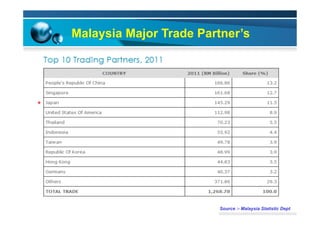
Malaysia Major Trade Partner’s
*
Source :- Malaysia Statistic Dept
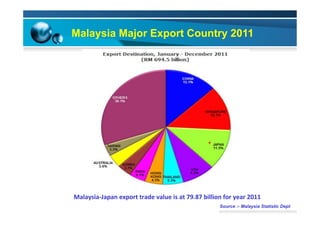
Malaysia Major Export Country 2011
*
Source :- Malaysia Statistic Dept
*
Malaysia-Japan	export	trade	value	is	at	79.87	billion	for	year	2011
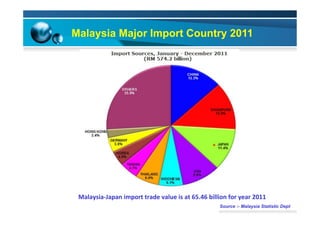
Malaysia Major Import Country 2011
Source :- Malaysia Statistic Dept
Malaysia-Japan	import	trade	value	is	at	65.46	billion	for	year	2011		
*
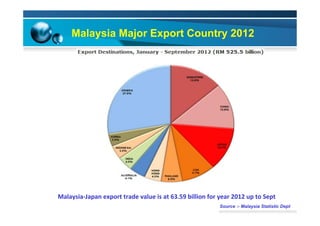
Malaysia Major Export Country 2012
*
Source :- Malaysia Statistic Dept
*
Malaysia-Japan	export	trade	value	is	at	63.59	billion	for	year	2012	up	to	Sept
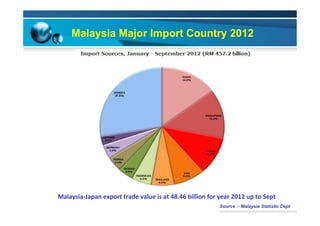
Malaysia Major Import Country 2012
Source :- Malaysia Statistic Dept
*
Malaysia-Japan	export	trade	value	is	at	48.46	billion	for	year	2012	up	to	Sept
Malaysia Paper Manufacturing Industry
Comprises 3 sub-sectors :
-  Paper Manufacturing
-  Paper Products
-  Printing and Publishing
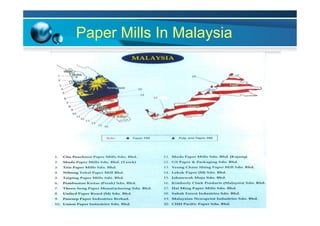
Paper Mills In Malaysia
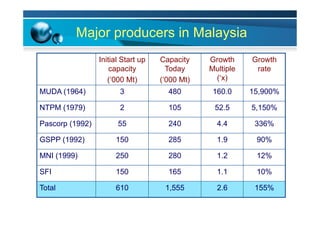
Major producers in Malaysia
Initial Start up
capacity
(‘000 Mt)
Capacity
Today
(‘000 Mt)
Growth
Multiple
(‘x)
Growth
rate
MUDA (1964) 3 480 160.0 15,900%
NTPM (1979) 2 105 52.5 5,150%
Pascorp (1992) 55 240 4.4 336%
GSPP (1992) 150 285 1.9 90%
MNI (1999) 250 280 1.2 12%
SFI 150 165 1.1 10%
Total 610 1,555 2.6 155%
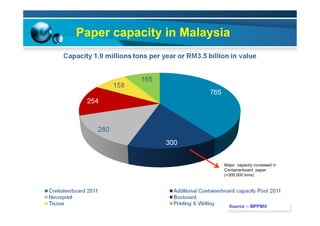
Paper capacity in Malaysia
Major capacity increased in
Containerboard paper
(+300,000 tons)
Source :- MPPMA
Paper – Supply & Demand
(‘Mil Tons)
Source :- MPPMA
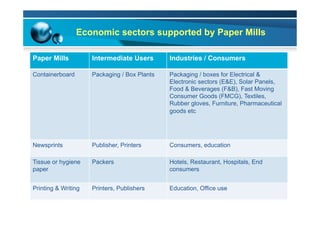
Economic sectors supported by Paper Mills
Paper Mills Intermediate Users Industries / Consumers
Containerboard Packaging / Box Plants Packaging / boxes for Electrical &
Electronic sectors (E&E), Solar Panels,
Food & Beverages (F&B), Fast Moving
Consumer Goods (FMCG), Textiles,
Rubber gloves, Furniture, Pharmaceutical
goods etc
Newsprints Publisher, Printers Consumers, education
Tissue or hygiene
paper
Packers Hotels, Restaurant, Hospitals, End
consumers
Printing & Writing Printers, Publishers Education, Office use
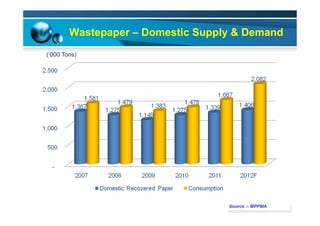
Wastepaper – Domestic Supply & Demand
Source :- MPPMA
(‘000 Tons)
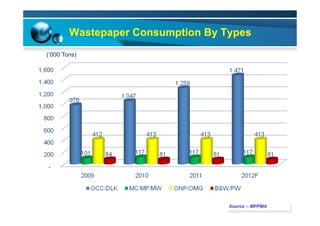
Wastepaper Consumption By Types
Source :- MPPMA
(‘000 Tons)
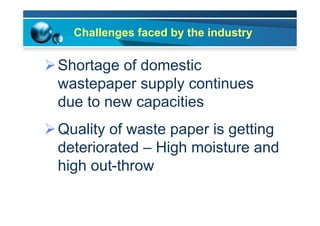
Challenges faced by the industry
Ø Shortage of domestic
wastepaper supply continues
due to new capacities
Ø Quality of waste paper is getting
deteriorated – High moisture and
high out-throw
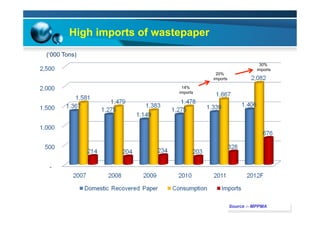
High imports of wastepaper
Source :- MPPMA
(‘000 Tons)
20%
imports
30%
imports
14%
imports
Paper Recycling
System Malaysia
Year 2012
By The Malaysian Pulp and Paper
Manufacturer Association
(MPPMA)
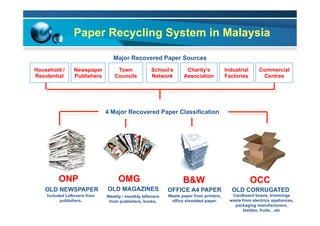
Paper Recycling System in Malaysia
ONP
OLD NEWSPAPER
B&W
OFFICE A4 PAPER
OMG
OLD MAGAZINES
OCC
OLD CORRUGATED
Household /
Residential
Commercial
Centres
Newspaper
Publishers
School’s
Network
Charity’s
Association
Industrial
Factories
Town
Councils
Major Recovered Paper Sources
4 Major Recovered Paper Classification
Included Leftovers from
publishers,
Weekly / monthly leftovers
from publishers, books,
Waste paper from printers,
office shredded paper,
Cardboard boxes, trimmings
waste from electrics appliances,
packaging manufacturers,
textiles, fruits…etc
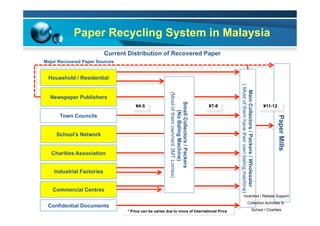
Paper Recycling System in Malaysia
Household / Residential
Commercial Centres
Newspaper Publishers
School’s Network
Charities Association
Industrial Factories
Town Councils
Major Recovered Paper Sources
PaperMills
MainCollectors/Packers/Wholesaler
(Mostofthemhavetheirownbalingmachine)
Current Distribution of Recovered Paper
SmallCollectors/Packers
(NoBalingMachine)
(Mostofthemown/rent3MTLorries)
Confidential Documents
¥4-5 ¥7-8 ¥11-12
* Price can be varies due to move of International Price
Incentive / Rebate Support
Collection Activities to
School / Charities
Paper Recycling System in Malaysia
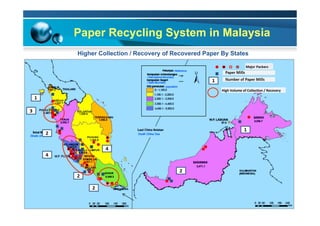
High	Volume	of	CollecIon	/	Recovery
Higher Collection / Recovery of Recovered Paper By States
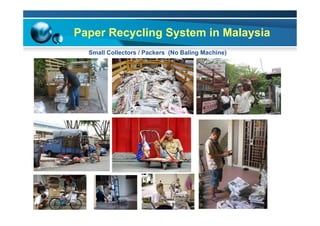
Paper Recycling System in Malaysia
Small Collectors / Packers (No Baling Machine)
What We Learn From This Training
•  JPA & JRPA have a very active roles in promoting the recycling system in Japan
•  Active association memberships as advisor roles in promoting recycling program in
each of the designated areas.
•  A strong / active action / Implementation Group such as Paper Recycling Promotion
Center by JRPA
•  Noted that Japan have a very details classification of recycle waste for the residential,
business and industrial communities / channel (Implemented since 1974)
•  Effective Recycling Message to the Public / Residences with A Good Government
Support & Local Municipals
•  Japan Local municipals providing the facilities to the communities to ensure the
success of the recycling system.
•  Good & Pro-active cooperation between paper mills and recycling industries in
sharing information and relationship business trust.
•  A very matured legal system of Paper Recycling system established since 1974 or
during the Pre-Edo
•  We need an on-going process to promote recycling program in all levels
•  Paper mills in Japan have created a very strong quality control of waste at
wholesalers level and then to the collectors (reduce the incoming check of waste at
paper mill)
What can we work/promote from now?
1.  Exploring more public awareness of recycling of waste in all channels which can
provide immediate impact towards the recovery of waste collection and quality
incoming of the waste ( Example : schools, industrials, commercial, and residence
areas)
2.  Recently, some of the waste paper have been exported out from Malaysia which was
reported by local customs. This definitely are some of the potential issue facing
which reduce the rate of local collection recovery rate. (Working with local customs
authorities to reduce the exporting of waste due to local shortage)
3.  Paper mills in Malaysia, receiving most of the left-over / poor quality of in-coming
waste from the wholesaler ( mainly OCC segment). We need get more guidelines or
process details to overcome the in-coming from the wholesalers.
4.  Malaysia’s waste paper specification need to be revise to Japan classification which
can have a significant improvement on the quality of the waste papers collected. (Pre-
print brochures, leaflets, sharing information to household, PTA…etc)
5.  Looking at under-recovered areas / states in Malaysia which having a significant
growth due to the developments by the state government ( East Malaysia : Sabah &
Sarawak)
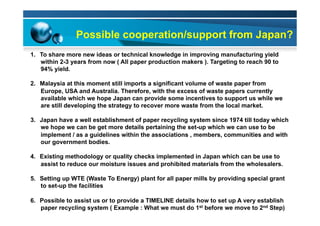
Possible cooperation/support from Japan?
1.  To share more new ideas or technical knowledge in improving manufacturing yield
within 2-3 years from now ( All paper production makers ). Targeting to reach 90 to
94% yield.
2.  Malaysia at this moment still imports a significant volume of waste paper from
Europe, USA and Australia. Therefore, with the excess of waste papers currently
available which we hope Japan can provide some incentives to support us while we
are still developing the strategy to recover more waste from the local market.
3.  Japan have a well establishment of paper recycling system since 1974 till today which
we hope we can be get more details pertaining the set-up which we can use to be
implement / as a guidelines within the associations , members, communities and with
our government bodies.
4.  Existing methodology or quality checks implemented in Japan which can be use to
assist to reduce our moisture issues and prohibited materials from the wholesalers.
5.  Setting up WTE (Waste To Energy) plant for all paper mills by providing special grant
to set-up the facilities
6.  Possible to assist us or to provide a TIMELINE details how to set up A very establish
paper recycling system ( Example : What we must do 1st before we move to 2nd Step)
Thank You
Year 2012
Keep Malaysia Beautiful
Focused on recycling, recycling behaviours, recycling
processes, and the circular economy in Malaysia
We look forward to hearing from you soon!
adrienna@keepmalaysiabeautiful.org

Malaysia Paper Industry 2012

  • 1.
    Report of Malaysia PaperIndustry Year 2012 By The Malaysian Pulp and Paper Manufacturer Association (MPPMA)
  • 2.
    Malaysia Participants 1.  MrTan Chaik Phoay – Muda Paper Mills, Tasek 2.  Mr Wong Peng Khoon – Muda Paper Mills, Kajang 3.  Ms Lee Hooi Fung – Nibong Tebal Paper Mill 4.  Mr Mohamad Razi Bin Idris – Pascorp Paper Industries 5.  Mr Chua Keat Lee – Malaysian Newsprint Industries
  • 3.
    Malaysia Facts •  Consistsof : West & East Malaysia with 13 states and 3 federal territory •  Area : 329,847 Square Kilometer •  Length : West Malaysia 748 km (465 mi) SSE-NNW & 322 km (200 mi) ENE-WSW : East Malaysia ( Sabah )12 km (256 mi) E-W & 328 km (204 mi) N – S : East Malaysia ( Sarawak ) 679 km (422 mi) NNE-SSW & 254 km (158 mi) ESE-WNW •  Population ( 2012 ) : 29.2 Mil •  Ethnic Groups : Malay , Chinese, Indian, Others •  Capital City : Kuala Lumpur •  GDP 2012: USD 472.9 bil; USD 16,186 per capita •  Language: Bahasa Malaysia (official), English (widely used in business), Mandarin, Tamil and Iban •  Local currency: Ringgit (MYR) Source :- Encyclopedia of Nation
  • 4.
    Malaysia Major TradePartner’s * Source :- Malaysia Statistic Dept
  • 5.
    Malaysia Major ExportCountry 2011 * Source :- Malaysia Statistic Dept * Malaysia-Japan export trade value is at 79.87 billion for year 2011
  • 6.
    Malaysia Major ImportCountry 2011 Source :- Malaysia Statistic Dept Malaysia-Japan import trade value is at 65.46 billion for year 2011 *
  • 7.
    Malaysia Major ExportCountry 2012 * Source :- Malaysia Statistic Dept * Malaysia-Japan export trade value is at 63.59 billion for year 2012 up to Sept
  • 8.
    Malaysia Major ImportCountry 2012 Source :- Malaysia Statistic Dept * Malaysia-Japan export trade value is at 48.46 billion for year 2012 up to Sept
  • 9.
    Malaysia Paper ManufacturingIndustry Comprises 3 sub-sectors : -  Paper Manufacturing -  Paper Products -  Printing and Publishing
  • 10.
  • 11.
    Major producers inMalaysia Initial Start up capacity (‘000 Mt) Capacity Today (‘000 Mt) Growth Multiple (‘x) Growth rate MUDA (1964) 3 480 160.0 15,900% NTPM (1979) 2 105 52.5 5,150% Pascorp (1992) 55 240 4.4 336% GSPP (1992) 150 285 1.9 90% MNI (1999) 250 280 1.2 12% SFI 150 165 1.1 10% Total 610 1,555 2.6 155%
  • 12.
    Paper capacity inMalaysia Major capacity increased in Containerboard paper (+300,000 tons) Source :- MPPMA
  • 13.
    Paper – Supply& Demand (‘Mil Tons) Source :- MPPMA
  • 14.
    Economic sectors supportedby Paper Mills Paper Mills Intermediate Users Industries / Consumers Containerboard Packaging / Box Plants Packaging / boxes for Electrical & Electronic sectors (E&E), Solar Panels, Food & Beverages (F&B), Fast Moving Consumer Goods (FMCG), Textiles, Rubber gloves, Furniture, Pharmaceutical goods etc Newsprints Publisher, Printers Consumers, education Tissue or hygiene paper Packers Hotels, Restaurant, Hospitals, End consumers Printing & Writing Printers, Publishers Education, Office use
  • 15.
    Wastepaper – DomesticSupply & Demand Source :- MPPMA (‘000 Tons)
  • 16.
    Wastepaper Consumption ByTypes Source :- MPPMA (‘000 Tons)
  • 17.
    Challenges faced bythe industry Ø Shortage of domestic wastepaper supply continues due to new capacities Ø Quality of waste paper is getting deteriorated – High moisture and high out-throw
  • 18.
    High imports ofwastepaper Source :- MPPMA (‘000 Tons) 20% imports 30% imports 14% imports
  • 19.
    Paper Recycling System Malaysia Year2012 By The Malaysian Pulp and Paper Manufacturer Association (MPPMA)
  • 20.
    Paper Recycling Systemin Malaysia ONP OLD NEWSPAPER B&W OFFICE A4 PAPER OMG OLD MAGAZINES OCC OLD CORRUGATED Household / Residential Commercial Centres Newspaper Publishers School’s Network Charity’s Association Industrial Factories Town Councils Major Recovered Paper Sources 4 Major Recovered Paper Classification Included Leftovers from publishers, Weekly / monthly leftovers from publishers, books, Waste paper from printers, office shredded paper, Cardboard boxes, trimmings waste from electrics appliances, packaging manufacturers, textiles, fruits…etc
  • 21.
    Paper Recycling Systemin Malaysia Household / Residential Commercial Centres Newspaper Publishers School’s Network Charities Association Industrial Factories Town Councils Major Recovered Paper Sources PaperMills MainCollectors/Packers/Wholesaler (Mostofthemhavetheirownbalingmachine) Current Distribution of Recovered Paper SmallCollectors/Packers (NoBalingMachine) (Mostofthemown/rent3MTLorries) Confidential Documents ¥4-5 ¥7-8 ¥11-12 * Price can be varies due to move of International Price Incentive / Rebate Support Collection Activities to School / Charities
  • 22.
    Paper Recycling Systemin Malaysia High Volume of CollecIon / Recovery Higher Collection / Recovery of Recovered Paper By States
  • 23.
    Paper Recycling Systemin Malaysia Small Collectors / Packers (No Baling Machine)
  • 24.
    What We LearnFrom This Training •  JPA & JRPA have a very active roles in promoting the recycling system in Japan •  Active association memberships as advisor roles in promoting recycling program in each of the designated areas. •  A strong / active action / Implementation Group such as Paper Recycling Promotion Center by JRPA •  Noted that Japan have a very details classification of recycle waste for the residential, business and industrial communities / channel (Implemented since 1974) •  Effective Recycling Message to the Public / Residences with A Good Government Support & Local Municipals •  Japan Local municipals providing the facilities to the communities to ensure the success of the recycling system. •  Good & Pro-active cooperation between paper mills and recycling industries in sharing information and relationship business trust. •  A very matured legal system of Paper Recycling system established since 1974 or during the Pre-Edo •  We need an on-going process to promote recycling program in all levels •  Paper mills in Japan have created a very strong quality control of waste at wholesalers level and then to the collectors (reduce the incoming check of waste at paper mill)
  • 25.
    What can wework/promote from now? 1.  Exploring more public awareness of recycling of waste in all channels which can provide immediate impact towards the recovery of waste collection and quality incoming of the waste ( Example : schools, industrials, commercial, and residence areas) 2.  Recently, some of the waste paper have been exported out from Malaysia which was reported by local customs. This definitely are some of the potential issue facing which reduce the rate of local collection recovery rate. (Working with local customs authorities to reduce the exporting of waste due to local shortage) 3.  Paper mills in Malaysia, receiving most of the left-over / poor quality of in-coming waste from the wholesaler ( mainly OCC segment). We need get more guidelines or process details to overcome the in-coming from the wholesalers. 4.  Malaysia’s waste paper specification need to be revise to Japan classification which can have a significant improvement on the quality of the waste papers collected. (Pre- print brochures, leaflets, sharing information to household, PTA…etc) 5.  Looking at under-recovered areas / states in Malaysia which having a significant growth due to the developments by the state government ( East Malaysia : Sabah & Sarawak)
  • 26.
    Possible cooperation/support fromJapan? 1.  To share more new ideas or technical knowledge in improving manufacturing yield within 2-3 years from now ( All paper production makers ). Targeting to reach 90 to 94% yield. 2.  Malaysia at this moment still imports a significant volume of waste paper from Europe, USA and Australia. Therefore, with the excess of waste papers currently available which we hope Japan can provide some incentives to support us while we are still developing the strategy to recover more waste from the local market. 3.  Japan have a well establishment of paper recycling system since 1974 till today which we hope we can be get more details pertaining the set-up which we can use to be implement / as a guidelines within the associations , members, communities and with our government bodies. 4.  Existing methodology or quality checks implemented in Japan which can be use to assist to reduce our moisture issues and prohibited materials from the wholesalers. 5.  Setting up WTE (Waste To Energy) plant for all paper mills by providing special grant to set-up the facilities 6.  Possible to assist us or to provide a TIMELINE details how to set up A very establish paper recycling system ( Example : What we must do 1st before we move to 2nd Step)
  • 27.
  • 28.
    Keep Malaysia Beautiful Focusedon recycling, recycling behaviours, recycling processes, and the circular economy in Malaysia We look forward to hearing from you soon! adrienna@keepmalaysiabeautiful.org