MAINTENANCE AND WELFARE OF PARENTS AND
SENIOR CITIZENS ACT, 2007

Capt. S.K.BHANDARI
&
THE ASFIC TEAM

Page 1
Ageing – In Indian Tradition
 Ancient Philosophy speaks of Ashramas.

 Jara (old age) one of the four reasons of Buddha’s
penance
 Vedanta argues to attain Moksha through Ashrama

specific Purushartha.
 Moksha – freedom from miseries of life-cycle including
those of old age.
 Joint family ensured the process of life long care giving

Page 2
New Challenges
 Urbanization, migration, better education

 Changing world : changing family roles - need for

readjustment.
Rising elderly population
 Women elderly outnumber male
 Rising Dependency Ratio
Strains on joint family system and traditional care giving
mechanism

Page 3
Ageing: A Demographic Profile

Population 60+

20 million in 1950 5.4%
57 million in 1991 6.8%
70.6 million in 2001 6.9%

Ageing: Demographic Profile

80
60
40
20
0

57 million

70.6 million

Population
20 million

1950

1991

2001

Page 4
Ageing: Demographic Profile
 Population projections (2006-2026)
83.5 million in 2006
94.8 million by2011
118 million by 2016
143.7 million in 2021
173.1 million in 2026

7.5%
8.3%
9.3%
10.7%
12.4%
173.1

million

200
150

70.6
20

143.7

57

100
50
0
2006

2011

2016

Population 60+

2021

2026

Page 5
Ageing: Demographic Profile - Contd..

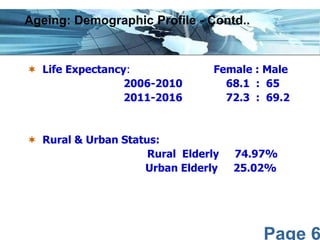
 Life Expectancy:
2006-2010
2011-2016

Female : Male
68.1 : 65
72.3 : 69.2

 Rural & Urban Status:
Rural Elderly
Urban Elderly

74.97%
25.02%

Page 6
Ageing India (Highlights)

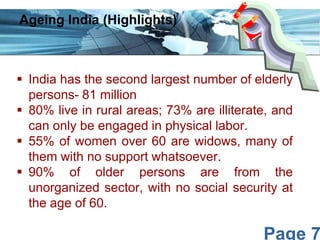
 India has the second largest number of elderly
persons- 81 million
 80% live in rural areas; 73% are illiterate, and
can only be engaged in physical labor.
 55% of women over 60 are widows, many of
them with no support whatsoever.
 90% of older persons are from the
unorganized sector, with no social security at
the age of 60.

Page 7
Ageing India (Demographic profile)
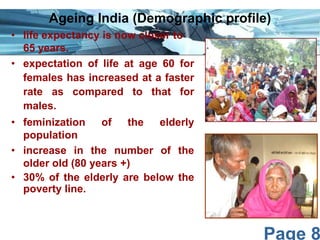
• life expectancy is now closer to
65 years.
• expectation of life at age 60 for
females has increased at a faster
rate as compared to that for
males.
• feminization
of
the
elderly
population
• increase in the number of the
older old (80 years +)
• 30% of the elderly are below the
poverty line.

Page 8
ISSUES & CHALLENGES
Emotional turmoil
Growing
frailty &
dependency

Social
isolation &
alienation

Financial
crisis
Widowhood

Lack of health
care
Increase in
morbidity

Page 9
Statutory Provisions
 Article 41 of the Constitution provides –
The State shall, within the limits make effective
provision for securing the right to work, to education
and to public assistance in case of unemployment, old
age...
 Hindu Adoption and Maintenance Act, 1956
Maintenance of aged and infirm parents obligatory
 Muslim Personal Law
Provides for care and support of parents
 Criminal Procedure Code (Cr.P.C.)1973
Also ensures maintenance of parents by children

Page 10
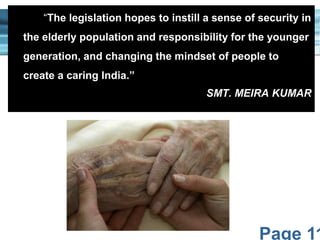
“The legislation hopes to instill a sense of security in
the elderly population and responsibility for the younger
generation, and changing the mindset of people to
create a caring India.”
SMT. MEIRA KUMAR

Page 11
Purpose of the Act
The Act provides for :

• effective mechanism for parents and senior citizens to
claim need-based maintenance from their children/grand
children , relatives;

• Maintenance claim for the benefit of those senior citizens,
who do not have children, grand children or relatives.

• proper mechanism for protection and care of senior
citizens

Page 12
Maintenance and Welfare of Parents and
Senior Citizens Act, 2007
Two Major Aspects

Children/Relatives

Central/State
Government

Maintenance
Welfare
Parents (No Age Bar) &
Senior Citizens

Senior Citizens, 60+Yrs

Page 13
Salient Features
Maintenance of Parents and Senior Citizens (Chapter II)
Establishment of Old Age Homes (Chapter III)
Provisions For Medical Care Of Senior Citizens (Chapter
IV)
Protection of life and Property of Senior Citizens
(Chapter V)
Offences and Procedure For Trial (Chapter VI)

Role of State Governments (Miscellaneous) Chapter VII)

Page 14
Maintenance of Parents and Senior Citizens
(Chapter II)
• Application for maintenance (Sec-5(1))

• Provision for interim maintenance allowance (Sec-5(2)
• Amount of Maintenance to be determined on inquiry (Sec5(3)

• Monthly allowance for maintenance shall be disposed
within 90 days (Sec-5(4))

• Fine and/or imprisonment up to one month if monthly
maintenance is not paid (Sec-5 (8))

• The Tribunal may refer the case to Conciliation Officer
before hearing an application (Sec-6(6)

Page 15
Maintenance of Parents and Senior
Citizens (Chapter II) Contd..
 Constitution of Maintenance Tribunal (Sec-7)
 Summary Procedure in Case of Inquiry (Sec-8)
 The Tribunal shall have all the powers of Civil Court for taking

evidence, the attendance of witness
 It shall be deemed as a Civil Court for all purposes of Section

195 and Chapter XXVI of Code of Criminal Procedures 1973
 The Tribunal may choose special knowledgeable person to

assist in adjudicating and deciding upon any claim for
maintenance

Page 16
Maintenance of Parents and Senior
Citizens (Chapter II) Contd..
 Maintenance Officer
o The State Government may designate District Social Welfare
Officer as Maintenance Officer to represent the parent during
proceedings of Tribunal/Appellate Tribunal (Sec-18(1))

o He may also function as a Conciliation Officer to settle the
case amicably (Sec- 6(6))

 Non Representation by Lawyers (Sec-17)

Page 17
Maintenance of Parents and Senior Citizens
(Chapter II) Contd..

Tribunals
Maintenance Tribunal
(Sec-7(1))

Appellate Tribunal
(Sec-15(1))

Presided over by Officer not
below the rank of SubDivisional Officer of State,
(Sec-7(2))

Presided over by an Officer
not below the rank of District
Magistrate, (Sec-15(2))

Summary procedure in case
of inquiry, (Sec-8(1))

Senior citizens may appeal
within 60 days from the date
of order Sec-16(1)

Order for maintenance,
Sec-9(1), shall not exceed
Rs. 10,000/month, Sec-9(2)

Order of the AT shall be final
Sec-16(5); Time period is one
month, Sec-16(6)

Page 18
Establishment of Old Age Homes (Chapter-III)

• The State Government may Establish

• at least one old age Home in each District for indigent senior
citizens, Sec-19(1);

• Prescribe a Scheme for Maintenance of old age Homes Sec19(2)

• Minimum standards of services, Sec-19(2)

Page 19
Provision for Medical Care of Senior Citizens
(Chapter-IV)
The State Government shall ensure, (Sec-20)
 Beds for all Senior Citizens in Government and Aided

hospitals
 Separate queues

 Facility for treatment of chronic elderly diseases and

Research in this respect to be expanded
 Earmarked facilities in every District Hospital for

Geriatric patients headed by a Medical Officer

Page 20
Protection of Life and Property of Senior
Citizens (Chapter-V)
• The State Government shall prescribe a comprehensive
Action Plan for protection of life and property. (Sec22(2))
• The State Government shall take all measures to
ensure,
 Wide publicity, awareness at regular intervals. (Sec-21(i))
 Periodic sensitization and awareness training on the issues related to

the Act. (Sec-21(ii))
 Coordination between the services provided by the concerned

Departments dealing with Law, Home Affairs, Health and Welfare etc.
(Sec-21(iii))

Page 21
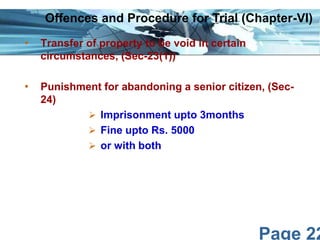
Offences and Procedure for Trial (Chapter-VI)
•

Transfer of property to be void in certain
circumstances, (Sec-23(1))

•

Punishment for abandoning a senior citizen, (Sec24)
 Imprisonment upto 3months
 Fine upto Rs. 5000
 or with both

Page 22
Role of the State Government
•

The State Government shall notify the date of enforcement of
the Act in the State

•

The State Government shall make rules for carrying out the
proposes of the Act.

•

They shall constitute Maintenance Tribunals within six months
from the date of enforcement of the Act and Appellate
Tribunals.

•

To designate the presiding officers of the
Maintenance/Appellate Tribunals and the Maintenance Officer.

•

To establish old age homes & to prescribe a scheme for
management of old age homes, including the standards and
services to provided.

Page 23
Role of the State Government
Contd…

• To provide medical support to senior citizens as
envisaged in Chapter IV of the Act

• To prescribe a comprehensive action plan for providing
protection of life and property of senior citizens.

• To remove any difficulties in implementation of the Act
through a notification in the Official Gazette.

Page 24
Role of the State Government
Contd.
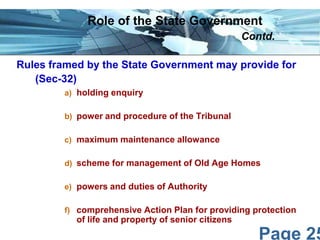
Rules framed by the State Government may provide for
(Sec-32)
a) holding enquiry
b) power and procedure of the Tribunal
c) maximum maintenance allowance
d) scheme for management of Old Age Homes
e) powers and duties of Authority
f) comprehensive Action Plan for providing protection

of life and property of senior citizens

Page 25
Role of NGOs
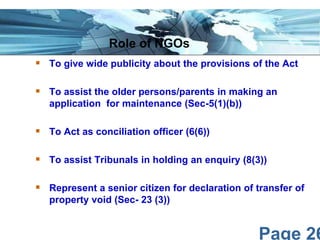
 To give wide publicity about the provisions of the Act
 To assist the older persons/parents in making an
application for maintenance (Sec-5(1)(b))

 To Act as conciliation officer (6(6))
 To assist Tribunals in holding an enquiry (8(3))

 Represent a senior citizen for declaration of transfer of
property void (Sec- 23 (3))

Page 26
Role of Central Government
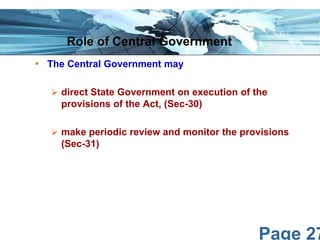
• The Central Government may
 direct State Government on execution of the

provisions of the Act, (Sec-30)
 make periodic review and monitor the provisions

(Sec-31)

Page 27
REFLECTIONS
• Is The Act Really Instilling A Sense Of Security
In The Elderly?
• Can We Coerce Anyone With Fear Of
Punishment To Look After parents?
• Is The Seemingly Affectionate Behavior Of The
Relatives And Caretakers A Result Of Care Or
Scare?

Page 28
:IMPORTANT QUESTION:

IS THE MAINTENANCE ACT
THE ANSWER TO THIS
SOCIAL EVIL?

Page 29
• There is no denying that the elderly are being
marginalized, ignored, and abused.
• Some steps need to be taken to deal with the
situation.
• Long-term strengthening of social values and
family ties is what needs to be the focus of our
work.

Page 30
THANK YOU

Page 31

Maintenance act skb m

  • 1.
    MAINTENANCE AND WELFAREOF PARENTS AND SENIOR CITIZENS ACT, 2007 Capt. S.K.BHANDARI & THE ASFIC TEAM Page 1
  • 2.
    Ageing – InIndian Tradition  Ancient Philosophy speaks of Ashramas.  Jara (old age) one of the four reasons of Buddha’s penance  Vedanta argues to attain Moksha through Ashrama specific Purushartha.  Moksha – freedom from miseries of life-cycle including those of old age.  Joint family ensured the process of life long care giving Page 2
  • 3.
    New Challenges  Urbanization,migration, better education  Changing world : changing family roles - need for readjustment. Rising elderly population  Women elderly outnumber male  Rising Dependency Ratio Strains on joint family system and traditional care giving mechanism Page 3
  • 4.
    Ageing: A DemographicProfile Population 60+ 20 million in 1950 5.4% 57 million in 1991 6.8% 70.6 million in 2001 6.9% Ageing: Demographic Profile 80 60 40 20 0 57 million 70.6 million Population 20 million 1950 1991 2001 Page 4
  • 5.
    Ageing: Demographic Profile Population projections (2006-2026) 83.5 million in 2006 94.8 million by2011 118 million by 2016 143.7 million in 2021 173.1 million in 2026 7.5% 8.3% 9.3% 10.7% 12.4% 173.1 million 200 150 70.6 20 143.7 57 100 50 0 2006 2011 2016 Population 60+ 2021 2026 Page 5
  • 6.
    Ageing: Demographic Profile- Contd..  Life Expectancy: 2006-2010 2011-2016 Female : Male 68.1 : 65 72.3 : 69.2  Rural & Urban Status: Rural Elderly Urban Elderly 74.97% 25.02% Page 6
  • 7.
    Ageing India (Highlights) India has the second largest number of elderly persons- 81 million  80% live in rural areas; 73% are illiterate, and can only be engaged in physical labor.  55% of women over 60 are widows, many of them with no support whatsoever.  90% of older persons are from the unorganized sector, with no social security at the age of 60. Page 7
  • 8.
    Ageing India (Demographicprofile) • life expectancy is now closer to 65 years. • expectation of life at age 60 for females has increased at a faster rate as compared to that for males. • feminization of the elderly population • increase in the number of the older old (80 years +) • 30% of the elderly are below the poverty line. Page 8
  • 9.
    ISSUES & CHALLENGES Emotionalturmoil Growing frailty & dependency Social isolation & alienation Financial crisis Widowhood Lack of health care Increase in morbidity Page 9
  • 10.
    Statutory Provisions  Article41 of the Constitution provides – The State shall, within the limits make effective provision for securing the right to work, to education and to public assistance in case of unemployment, old age...  Hindu Adoption and Maintenance Act, 1956 Maintenance of aged and infirm parents obligatory  Muslim Personal Law Provides for care and support of parents  Criminal Procedure Code (Cr.P.C.)1973 Also ensures maintenance of parents by children Page 10
  • 11.
    “The legislation hopesto instill a sense of security in the elderly population and responsibility for the younger generation, and changing the mindset of people to create a caring India.” SMT. MEIRA KUMAR Page 11
  • 12.
    Purpose of theAct The Act provides for : • effective mechanism for parents and senior citizens to claim need-based maintenance from their children/grand children , relatives; • Maintenance claim for the benefit of those senior citizens, who do not have children, grand children or relatives. • proper mechanism for protection and care of senior citizens Page 12
  • 13.
    Maintenance and Welfareof Parents and Senior Citizens Act, 2007 Two Major Aspects Children/Relatives Central/State Government Maintenance Welfare Parents (No Age Bar) & Senior Citizens Senior Citizens, 60+Yrs Page 13
  • 14.
    Salient Features Maintenance ofParents and Senior Citizens (Chapter II) Establishment of Old Age Homes (Chapter III) Provisions For Medical Care Of Senior Citizens (Chapter IV) Protection of life and Property of Senior Citizens (Chapter V) Offences and Procedure For Trial (Chapter VI) Role of State Governments (Miscellaneous) Chapter VII) Page 14
  • 15.
    Maintenance of Parentsand Senior Citizens (Chapter II) • Application for maintenance (Sec-5(1)) • Provision for interim maintenance allowance (Sec-5(2) • Amount of Maintenance to be determined on inquiry (Sec5(3) • Monthly allowance for maintenance shall be disposed within 90 days (Sec-5(4)) • Fine and/or imprisonment up to one month if monthly maintenance is not paid (Sec-5 (8)) • The Tribunal may refer the case to Conciliation Officer before hearing an application (Sec-6(6) Page 15
  • 16.
    Maintenance of Parentsand Senior Citizens (Chapter II) Contd..  Constitution of Maintenance Tribunal (Sec-7)  Summary Procedure in Case of Inquiry (Sec-8)  The Tribunal shall have all the powers of Civil Court for taking evidence, the attendance of witness  It shall be deemed as a Civil Court for all purposes of Section 195 and Chapter XXVI of Code of Criminal Procedures 1973  The Tribunal may choose special knowledgeable person to assist in adjudicating and deciding upon any claim for maintenance Page 16
  • 17.
    Maintenance of Parentsand Senior Citizens (Chapter II) Contd..  Maintenance Officer o The State Government may designate District Social Welfare Officer as Maintenance Officer to represent the parent during proceedings of Tribunal/Appellate Tribunal (Sec-18(1)) o He may also function as a Conciliation Officer to settle the case amicably (Sec- 6(6))  Non Representation by Lawyers (Sec-17) Page 17
  • 18.
    Maintenance of Parentsand Senior Citizens (Chapter II) Contd.. Tribunals Maintenance Tribunal (Sec-7(1)) Appellate Tribunal (Sec-15(1)) Presided over by Officer not below the rank of SubDivisional Officer of State, (Sec-7(2)) Presided over by an Officer not below the rank of District Magistrate, (Sec-15(2)) Summary procedure in case of inquiry, (Sec-8(1)) Senior citizens may appeal within 60 days from the date of order Sec-16(1) Order for maintenance, Sec-9(1), shall not exceed Rs. 10,000/month, Sec-9(2) Order of the AT shall be final Sec-16(5); Time period is one month, Sec-16(6) Page 18
  • 19.
    Establishment of OldAge Homes (Chapter-III) • The State Government may Establish • at least one old age Home in each District for indigent senior citizens, Sec-19(1); • Prescribe a Scheme for Maintenance of old age Homes Sec19(2) • Minimum standards of services, Sec-19(2) Page 19
  • 20.
    Provision for MedicalCare of Senior Citizens (Chapter-IV) The State Government shall ensure, (Sec-20)  Beds for all Senior Citizens in Government and Aided hospitals  Separate queues  Facility for treatment of chronic elderly diseases and Research in this respect to be expanded  Earmarked facilities in every District Hospital for Geriatric patients headed by a Medical Officer Page 20
  • 21.
    Protection of Lifeand Property of Senior Citizens (Chapter-V) • The State Government shall prescribe a comprehensive Action Plan for protection of life and property. (Sec22(2)) • The State Government shall take all measures to ensure,  Wide publicity, awareness at regular intervals. (Sec-21(i))  Periodic sensitization and awareness training on the issues related to the Act. (Sec-21(ii))  Coordination between the services provided by the concerned Departments dealing with Law, Home Affairs, Health and Welfare etc. (Sec-21(iii)) Page 21
  • 22.
    Offences and Procedurefor Trial (Chapter-VI) • Transfer of property to be void in certain circumstances, (Sec-23(1)) • Punishment for abandoning a senior citizen, (Sec24)  Imprisonment upto 3months  Fine upto Rs. 5000  or with both Page 22
  • 23.
    Role of theState Government • The State Government shall notify the date of enforcement of the Act in the State • The State Government shall make rules for carrying out the proposes of the Act. • They shall constitute Maintenance Tribunals within six months from the date of enforcement of the Act and Appellate Tribunals. • To designate the presiding officers of the Maintenance/Appellate Tribunals and the Maintenance Officer. • To establish old age homes & to prescribe a scheme for management of old age homes, including the standards and services to provided. Page 23
  • 24.
    Role of theState Government Contd… • To provide medical support to senior citizens as envisaged in Chapter IV of the Act • To prescribe a comprehensive action plan for providing protection of life and property of senior citizens. • To remove any difficulties in implementation of the Act through a notification in the Official Gazette. Page 24
  • 25.
    Role of theState Government Contd. Rules framed by the State Government may provide for (Sec-32) a) holding enquiry b) power and procedure of the Tribunal c) maximum maintenance allowance d) scheme for management of Old Age Homes e) powers and duties of Authority f) comprehensive Action Plan for providing protection of life and property of senior citizens Page 25
  • 26.
    Role of NGOs To give wide publicity about the provisions of the Act  To assist the older persons/parents in making an application for maintenance (Sec-5(1)(b))  To Act as conciliation officer (6(6))  To assist Tribunals in holding an enquiry (8(3))  Represent a senior citizen for declaration of transfer of property void (Sec- 23 (3)) Page 26
  • 27.
    Role of CentralGovernment • The Central Government may  direct State Government on execution of the provisions of the Act, (Sec-30)  make periodic review and monitor the provisions (Sec-31) Page 27
  • 28.
    REFLECTIONS • Is TheAct Really Instilling A Sense Of Security In The Elderly? • Can We Coerce Anyone With Fear Of Punishment To Look After parents? • Is The Seemingly Affectionate Behavior Of The Relatives And Caretakers A Result Of Care Or Scare? Page 28
  • 29.
    :IMPORTANT QUESTION: IS THEMAINTENANCE ACT THE ANSWER TO THIS SOCIAL EVIL? Page 29
  • 30.
    • There isno denying that the elderly are being marginalized, ignored, and abused. • Some steps need to be taken to deal with the situation. • Long-term strengthening of social values and family ties is what needs to be the focus of our work. Page 30
  • 31.