Maintaining Large Scale Julia Ecosystems
Chris Rackauckas, VP of Modeling and Simulation @ JuliaHub, Research Affiliate @ MIT
Building an ecosystem is a large project over many years. In this talk I’ll share
● Opinions: built with time and experience
● Practice: some Julia-specific tips for improving maintainability
● Tools: you cannot do it all by yourself
Agenda
Who am I?
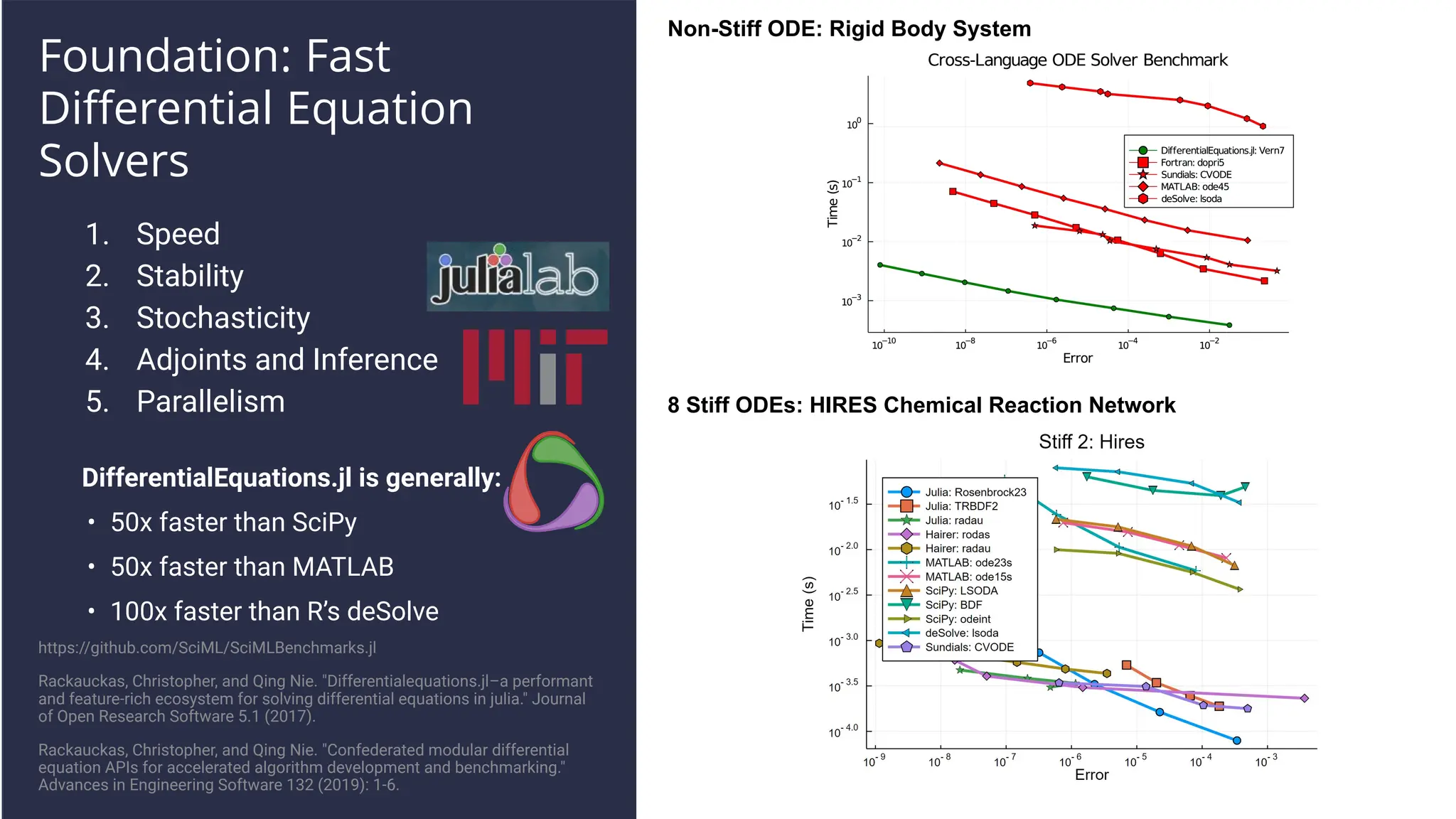
DifferentialEquations.jl is generally:
• 50x faster than SciPy
• 50x faster than MATLAB
• 100x faster than R’s deSolve
, Christopher, and Qing Nie. "Confederated modular differential equation APIs for accelerated algorithm
development and benchmarking." Advances in Engineering Software 132 (2019): 1-6.
Foundation: Fast
Differential Equation
Solvers
https://github.com/SciML/SciMLBenchmarks.jl
Rackauckas, Christopher, and Qing Nie. "Differentialequations.jl–a performant
and feature-rich ecosystem for solving differential equations in julia." Journal
of Open Research Software 5.1 (2017).
Rackauckas, Christopher, and Qing Nie. "Confederated modular differential
equation APIs for accelerated algorithm development and benchmarking."
Advances in Engineering Software 132 (2019): 1-6.
1. Speed
2. Stability
3. Stochasticity
4. Adjoints and Inference
5. Parallelism
Non-Stiff ODE: Rigid Body System
8 Stiff ODEs: HIRES Chemical Reaction Network
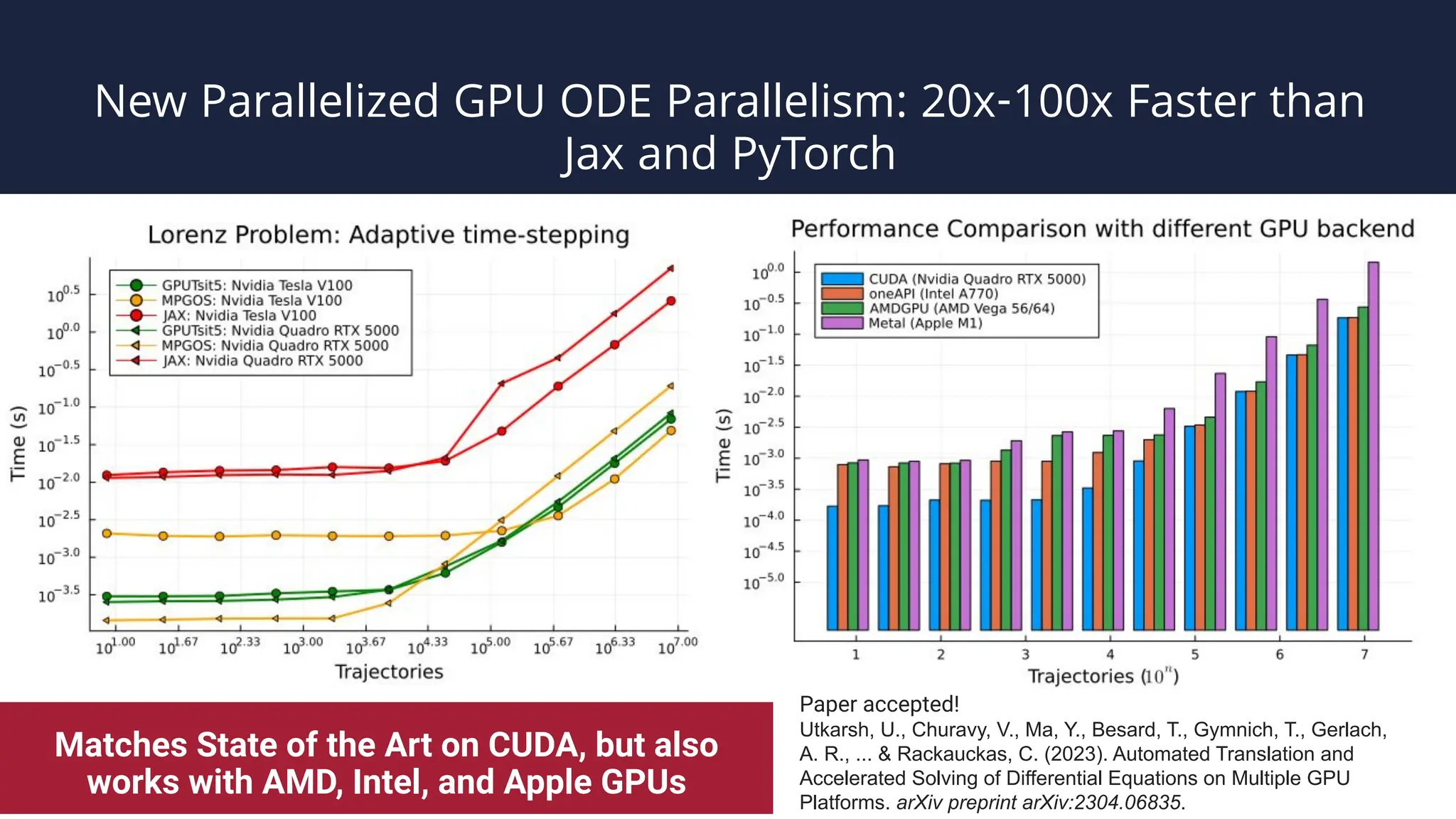
New Parallelized GPU ODE Parallelism: 20x-100x Faster than
Jax and PyTorch
Matches State of the Art on CUDA, but also
works with AMD, Intel, and Apple GPUs
Paper accepted!
Utkarsh, U., Churavy, V., Ma, Y., Besard, T., Gymnich, T., Gerlach,
A. R., ... & Rackauckas, C. (2023). Automated Translation and
Accelerated Solving of Differential Equations on Multiple GPU
Platforms. arXiv preprint arXiv:2304.06835.
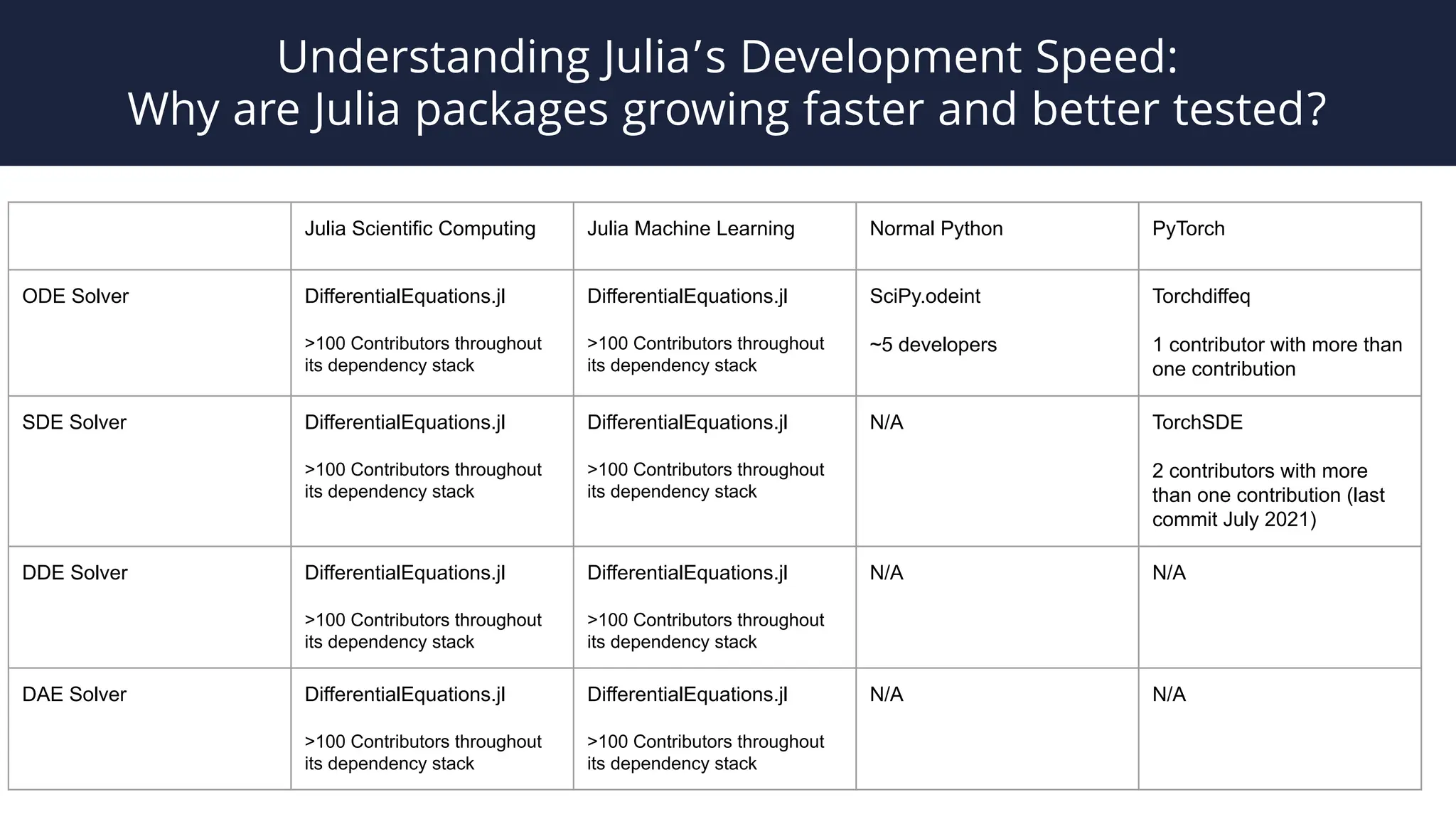
Understanding Julia’s Development Speed:
Why are Julia packages growing faster and better tested?
Julia Scientific Computing Julia Machine Learning Normal Python PyTorch
ODE Solver DifferentialEquations.jl
>100 Contributors throughout
its dependency stack
DifferentialEquations.jl
>100 Contributors throughout
its dependency stack
SciPy.odeint
~5 developers
Torchdiffeq
1 contributor with more than
one contribution
SDE Solver DifferentialEquations.jl
>100 Contributors throughout
its dependency stack
DifferentialEquations.jl
>100 Contributors throughout
its dependency stack
N/A TorchSDE
2 contributors with more
than one contribution (last
commit July 2021)
DDE Solver DifferentialEquations.jl
>100 Contributors throughout
its dependency stack
DifferentialEquations.jl
>100 Contributors throughout
its dependency stack
N/A N/A
DAE Solver DifferentialEquations.jl
>100 Contributors throughout
its dependency stack
DifferentialEquations.jl
>100 Contributors throughout
its dependency stack
N/A N/A
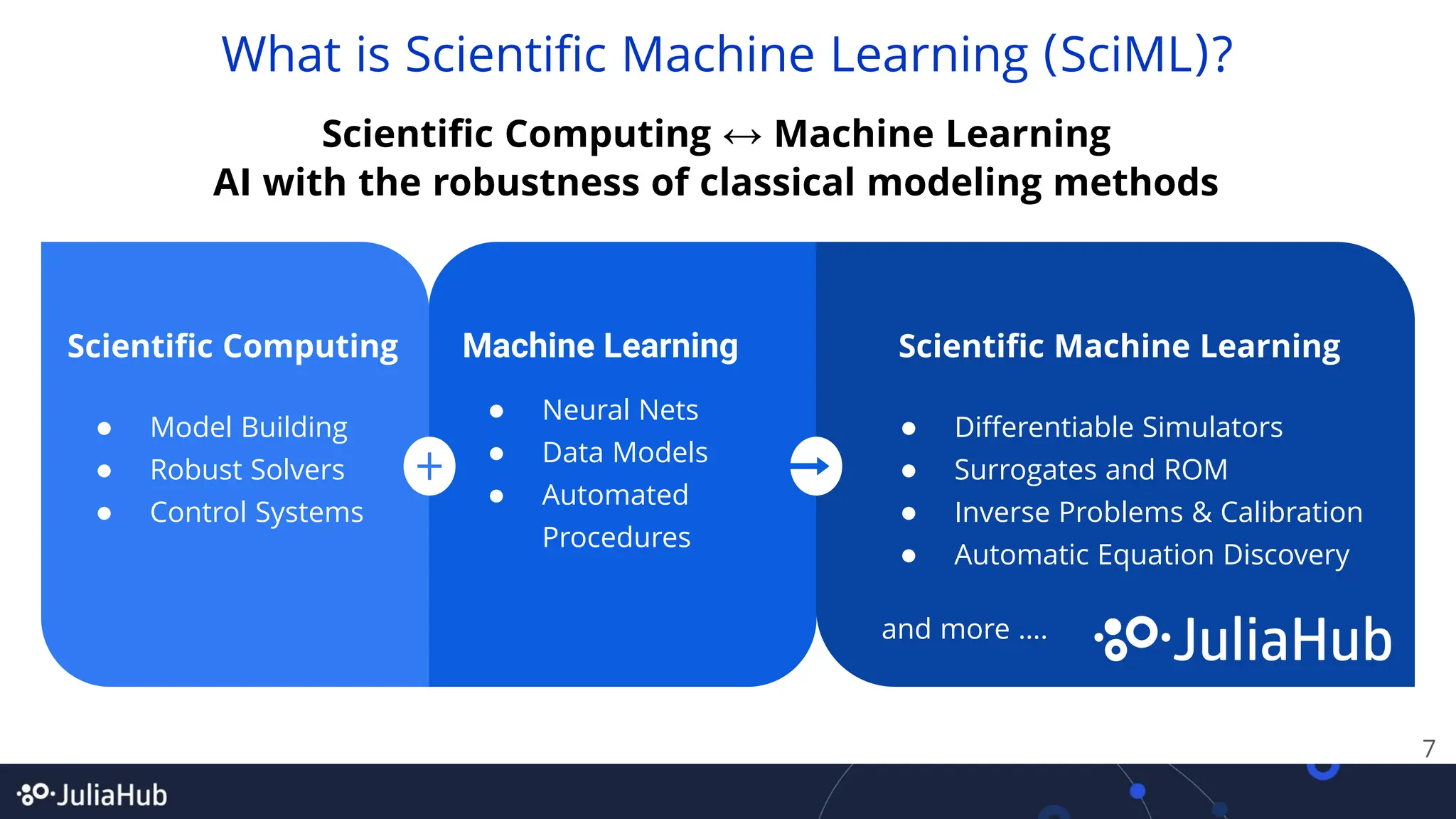
What is Scientific Machine Learning (SciML)?
Scientific Computing ↔ Machine Learning
AI with the robustness of classical modeling methods
Machine Learning
● Neural Nets
● Data Models
● Automated
Procedures
Scientific Computing Scientific Machine Learning
● Model Building
● Robust Solvers
● Control Systems
● Differentiable Simulators
● Surrogates and ROM
● Inverse Problems & Calibration
● Automatic Equation Discovery
and more ….
7
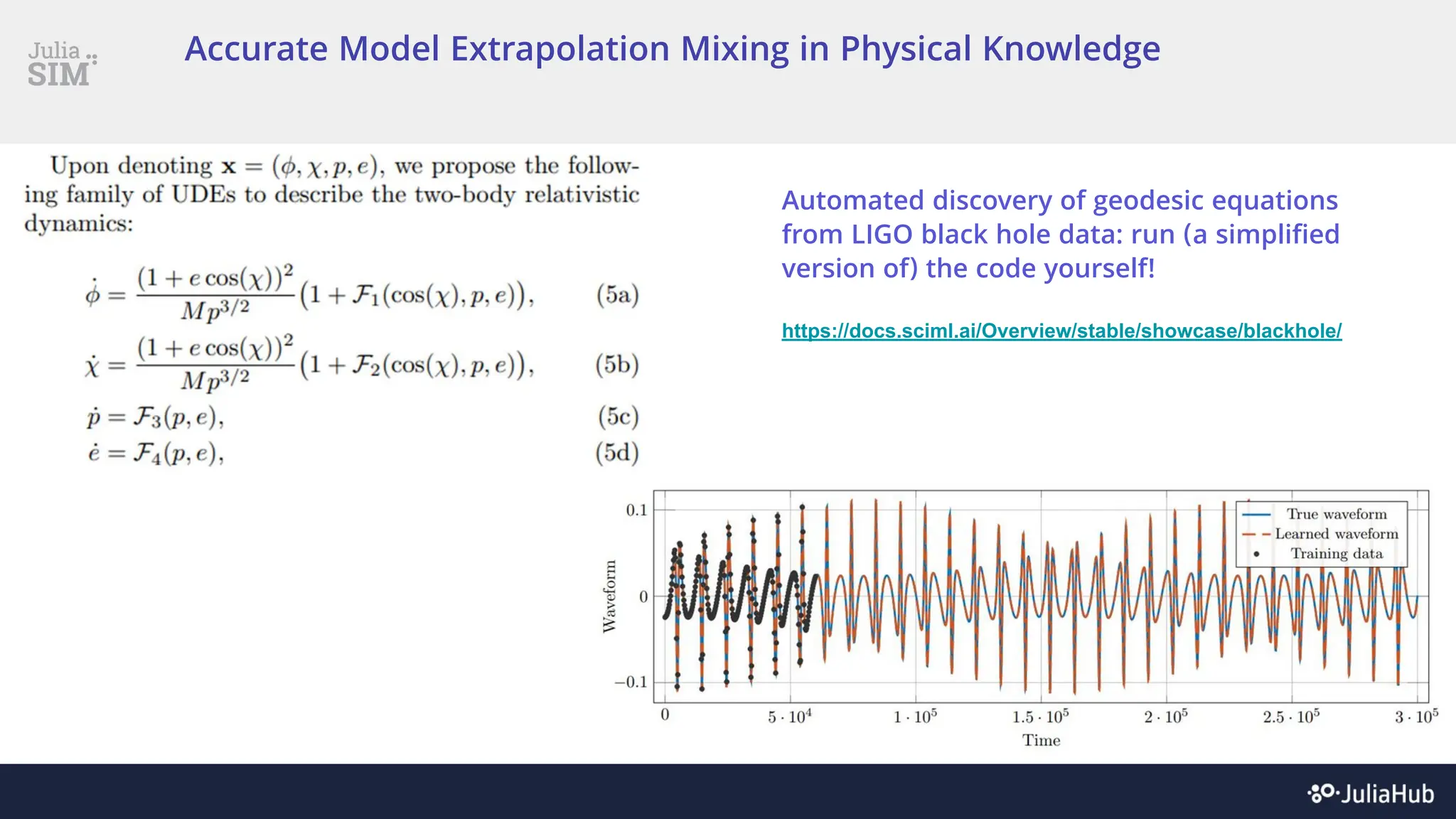
Accurate Model Extrapolation Mixing in Physical Knowledge
Automated discovery of geodesic equations
from LIGO black hole data: run (a simplified
version of) the code yourself!
https://docs.sciml.ai/Overview/stable/showcase/blackhole/
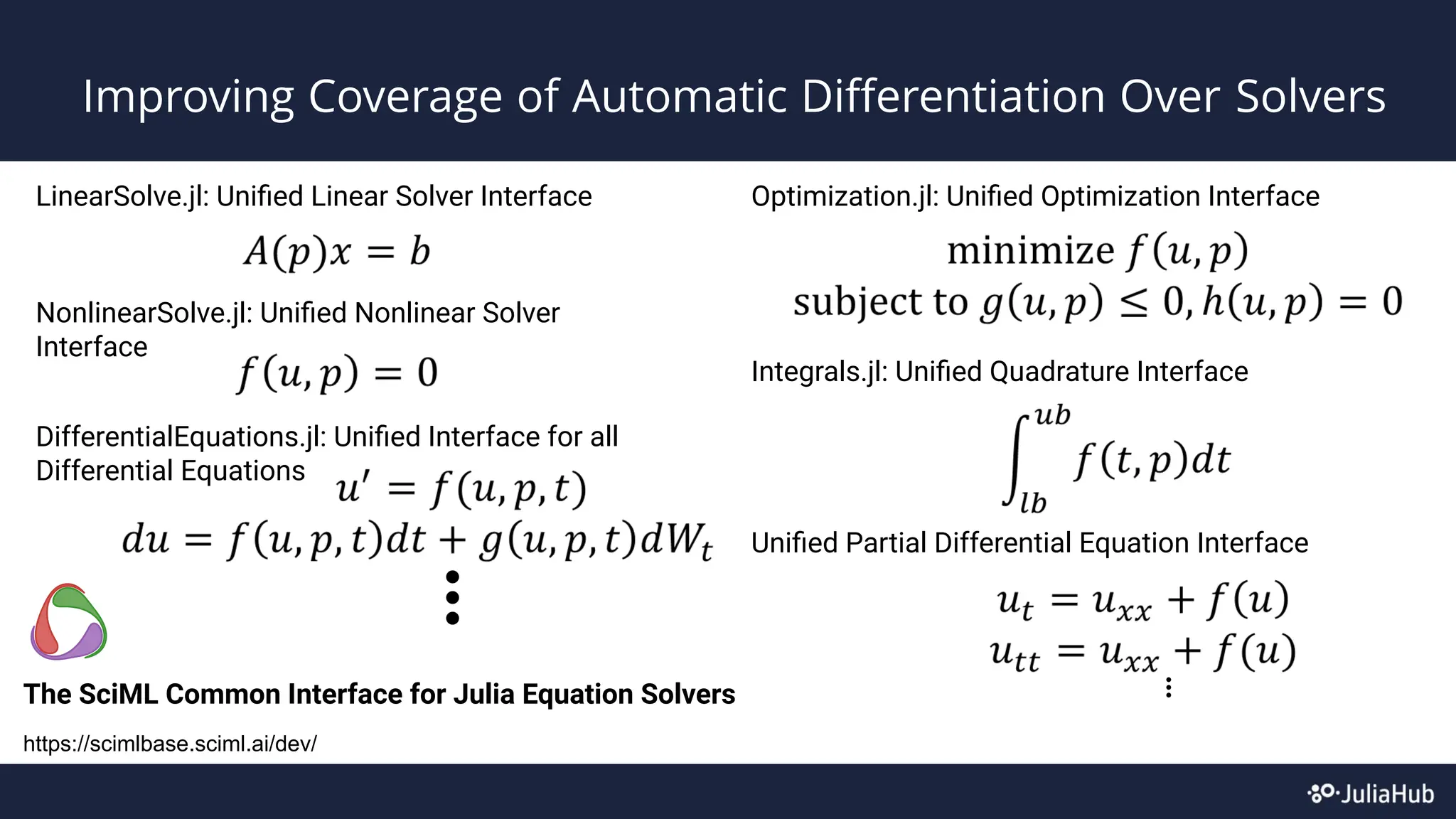
Improving Coverage of Automatic Differentiation Over Solvers
https://scimlbase.sciml.ai/dev/
The SciML Common Interface for Julia Equation Solvers
LinearSolve.jl: Unified Linear Solver Interface
NonlinearSolve.jl: Unified Nonlinear Solver
Interface
DifferentialEquations.jl: Unified Interface for all
Differential Equations
Optimization.jl: Unified Optimization Interface
Integrals.jl: Unified Quadrature Interface
Unified Partial Differential Equation Interface
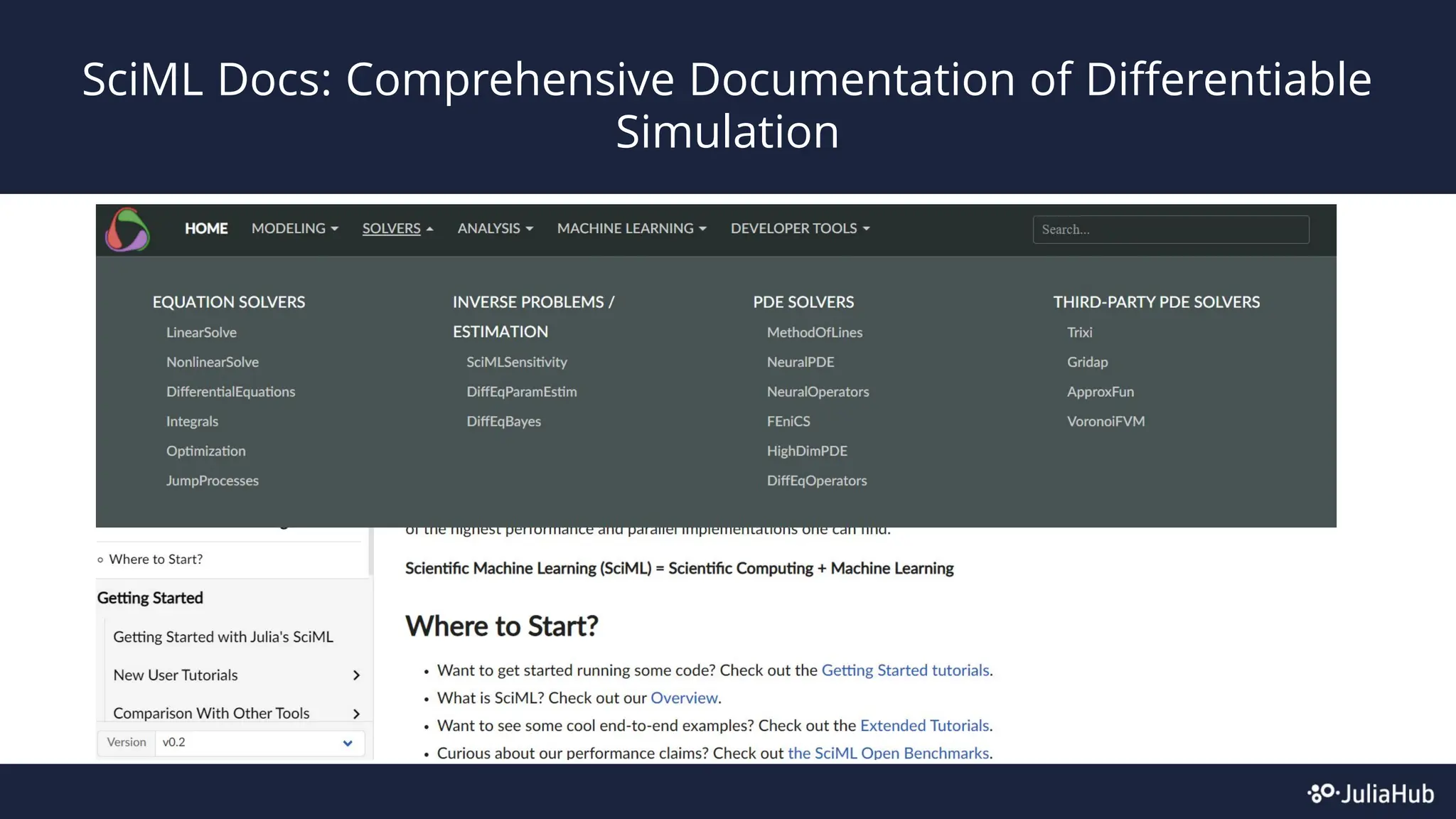
SciML Docs: Comprehensive Documentation of Differentiable
Simulation
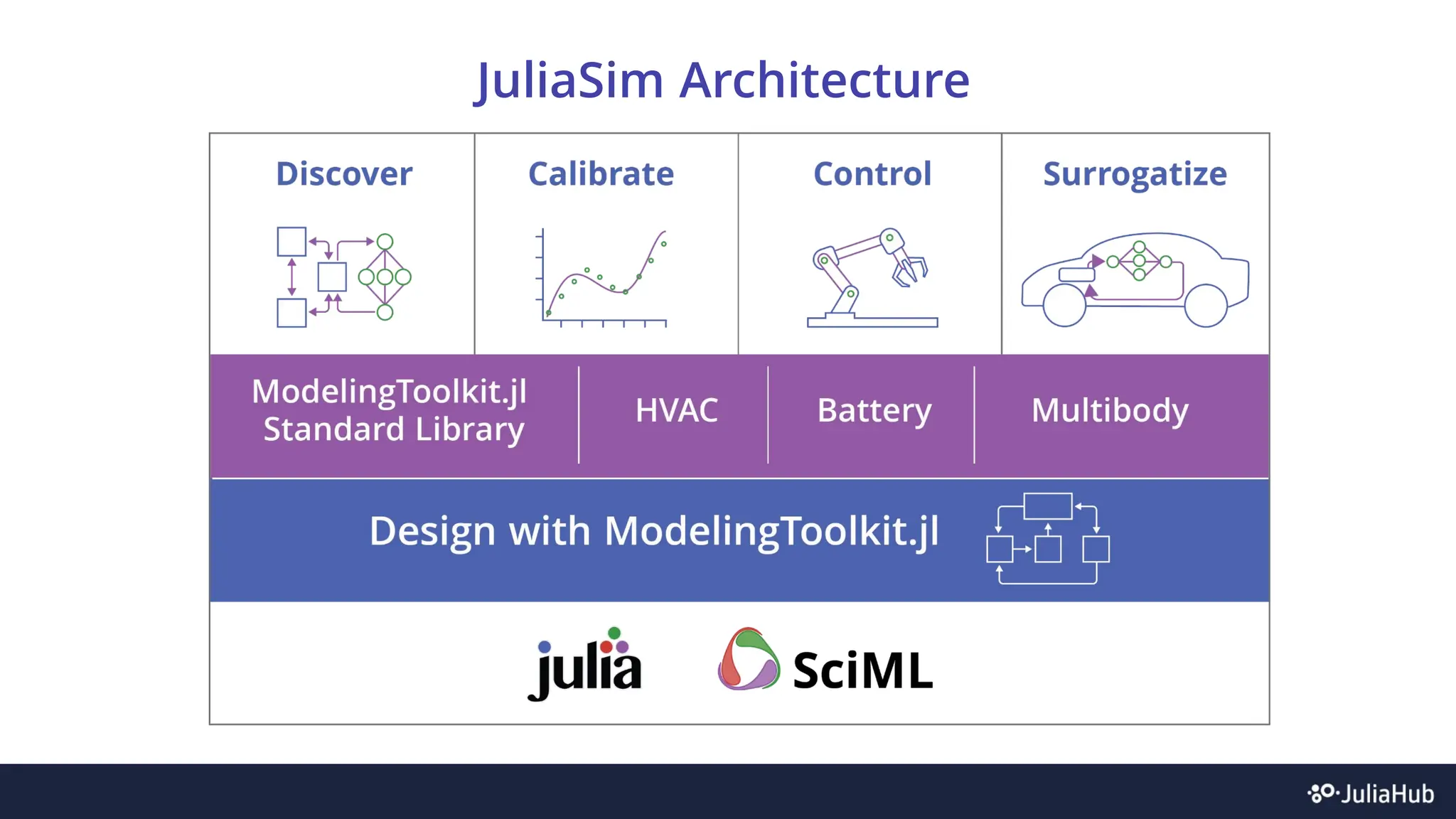
JuliaSim Architecture
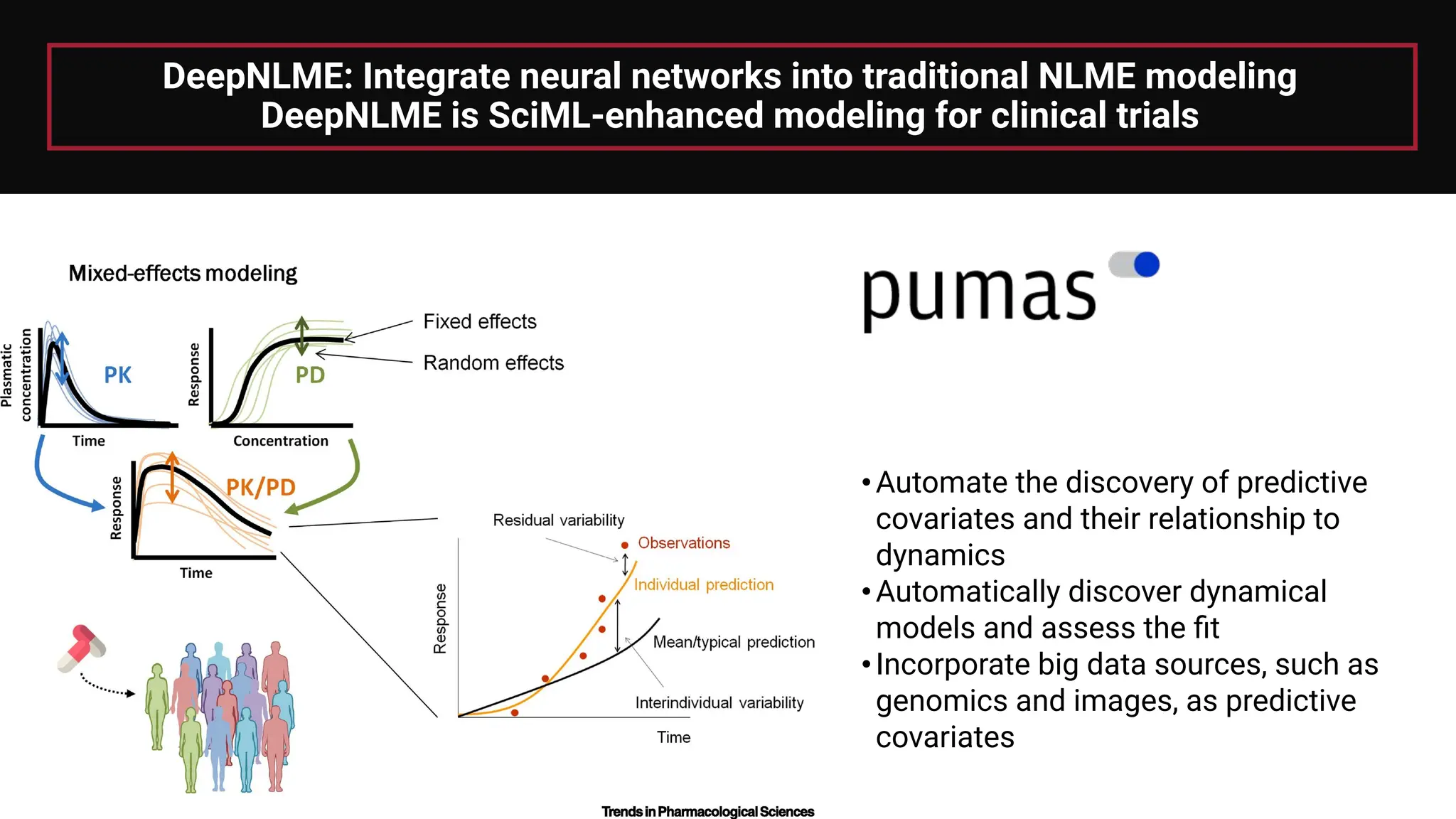
DeepNLME: Integrate neural networks into traditional NLME modeling
DeepNLME is SciML-enhanced modeling for clinical trials
•Automate the discovery of predictive
covariates and their relationship to
dynamics
•Automatically discover dynamical
models and assess the fit
•Incorporate big data sources, such as
genomics and images, as predictive
covariates
We have been using Pumas software for our
pharmacometric needs to support our development
decisions and regulatory submissions.
Pumas software has surpassed our expectations on its accuracy and ease of use. We are
encouraged by its capability of supporting different types of pharmacometric analyses within
one software. Pumas has emerged as our "go-to" tool for most of our analyses in recent
months. We also work with Pumas-AI on drug development consulting. We are impressed by
the quality and breadth of the experience of Pumas-AI scientists in collaborating with us on
modeling and simulation projects across our pipeline spanning investigational therapeutics
and vaccines at various stages of clinical development
Husain A. PhD (2020)
Director, Head of Clinical Pharmacology and Pharmacometrics,
Moderna Therapeutics, Inc
The Impact of Pumas (PharmacUtical Modeling And Simulation)
“ Built on SciML
How to develop:
Always Forwards,
Never Backwards
You will never be able to grow maintainer support beyond yourself if you do not
trust your test suite to carry you forward.
● If you do not feel comfortable blind merging a small bugfix that passes all
tests, that is a sign you do not trust your tests
● Trusting your tests will teach you what your tests are missing
Principle 1: trust your tests
The different kinds of tests
● Unit tests: small tests which test a single piece / behavior of the software
○ Good to have, but actually not the most important!
● Integration tests: tests which tests how the different parts integrate
○ The most important tests
● Interface tests: tests which demonstrate that the interface is as expected
● Regression tests: tests that the behavior of the software does not change
● Downstream tests: tests that your user’s code doesn’t break
○ Second most important tests
The Julia Lab provides buildkite scripts for many alternative hardwares:
● NVIDIA GPUs
● AMD GPUs
● Intel GPUs
● Mac M-Series
Ask and you shall receive.
Tests for Alternative Hardware
Parallelize your tests by grouping then with environment variables
● Allow people to easily run a subset of tests
● Run tests in parallel on CI
● Allow downstream to run a subset of tests
● Make every test an independent runnable script (SafeTestsets.jl)
See OrdinaryDiffEq.jl as a complex example!
Using Test Groups for Parallelism
Force your documentation to act as interface tests
● Differentiate examples vs tutorials
● Establish doctests
● Cover real-world workflows
● Get more compute if you need to
Documentation as Tests
● Implement basic features that you may even thing are too basic for you
○ Examples: DiffEq’s solve(prob), ANOVA
● 90% of users use the most basic 10% of the code
● Let people grow with you
○ That undergrad may one day be your most helpful maintainer!
● Listen to your audience when they say something is hard
● Write a lot of tutorials, and turn any repeated structures into tutorials
● Make your error messages read your beginner user’s minds
* I stole this phrase from Mike Tiller
Principle 2: Make simple things easy, complex things possible*
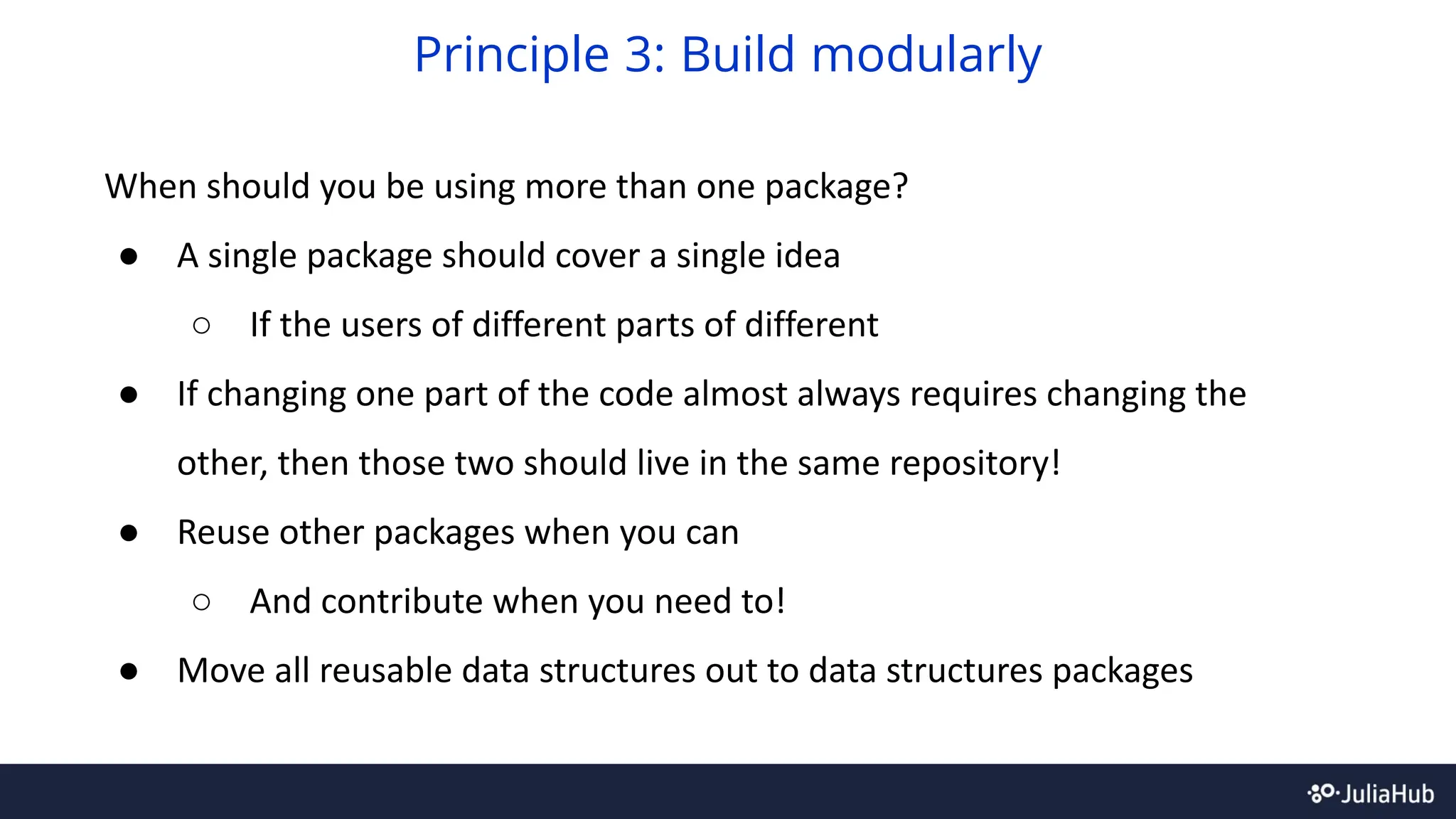
When should you be using more than one package?
● A single package should cover a single idea
○ If the users of different parts of different
● If changing one part of the code almost always requires changing the
other, then those two should live in the same repository!
● Reuse other packages when you can
○ And contribute when you need to!
● Move all reusable data structures out to data structures packages
Principle 3: Build modularly
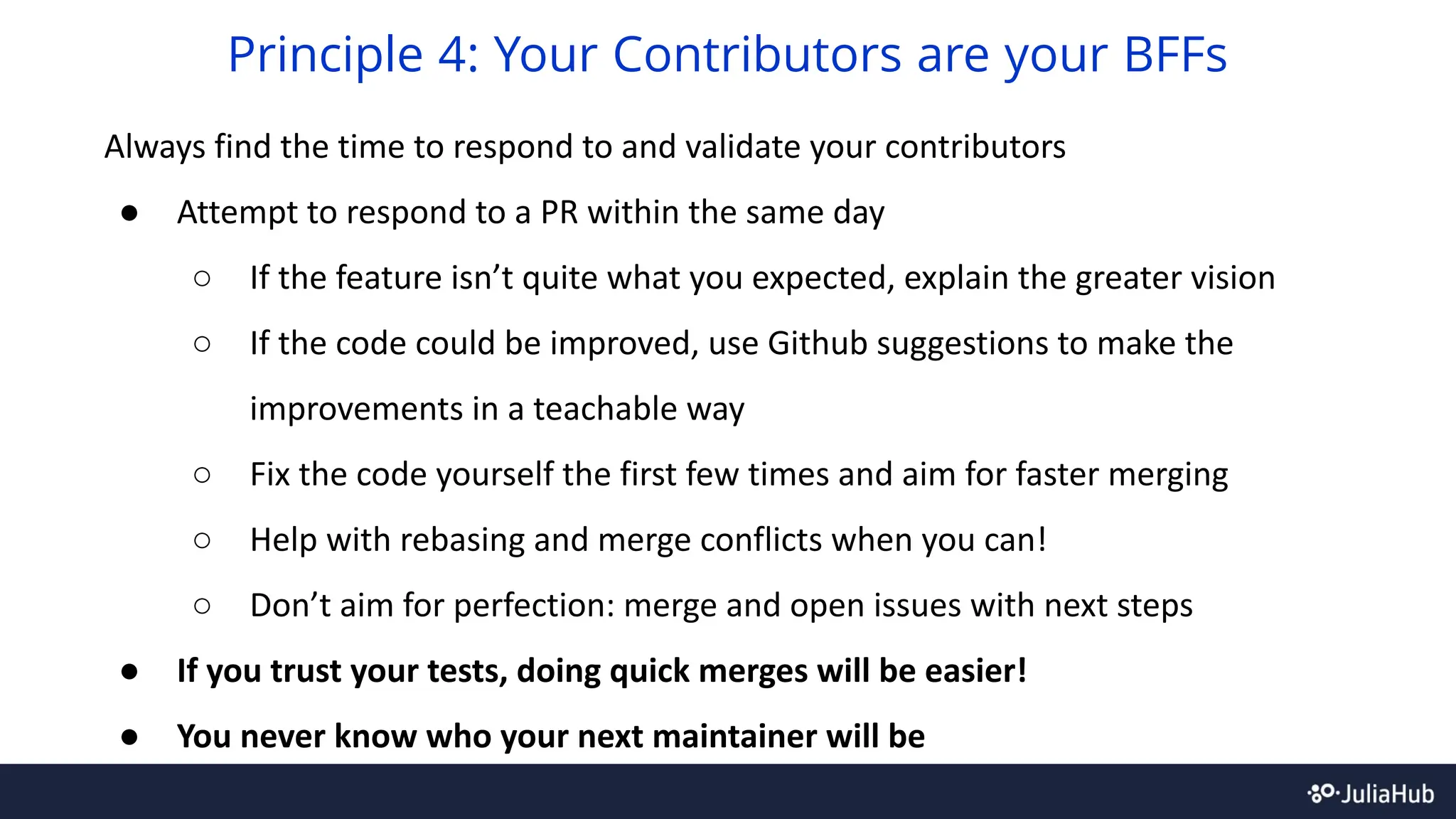
Always find the time to respond to and validate your contributors
● Attempt to respond to a PR within the same day
○ If the feature isn’t quite what you expected, explain the greater vision
○ If the code could be improved, use Github suggestions to make the
improvements in a teachable way
○ Fix the code yourself the first few times and aim for faster merging
○ Help with rebasing and merge conflicts when you can!
○ Don’t aim for perfection: merge and open issues with next steps
● If you trust your tests, doing quick merges will be easier!
● You never know who your next maintainer will be
Principle 4: Your Contributors are your BFFs
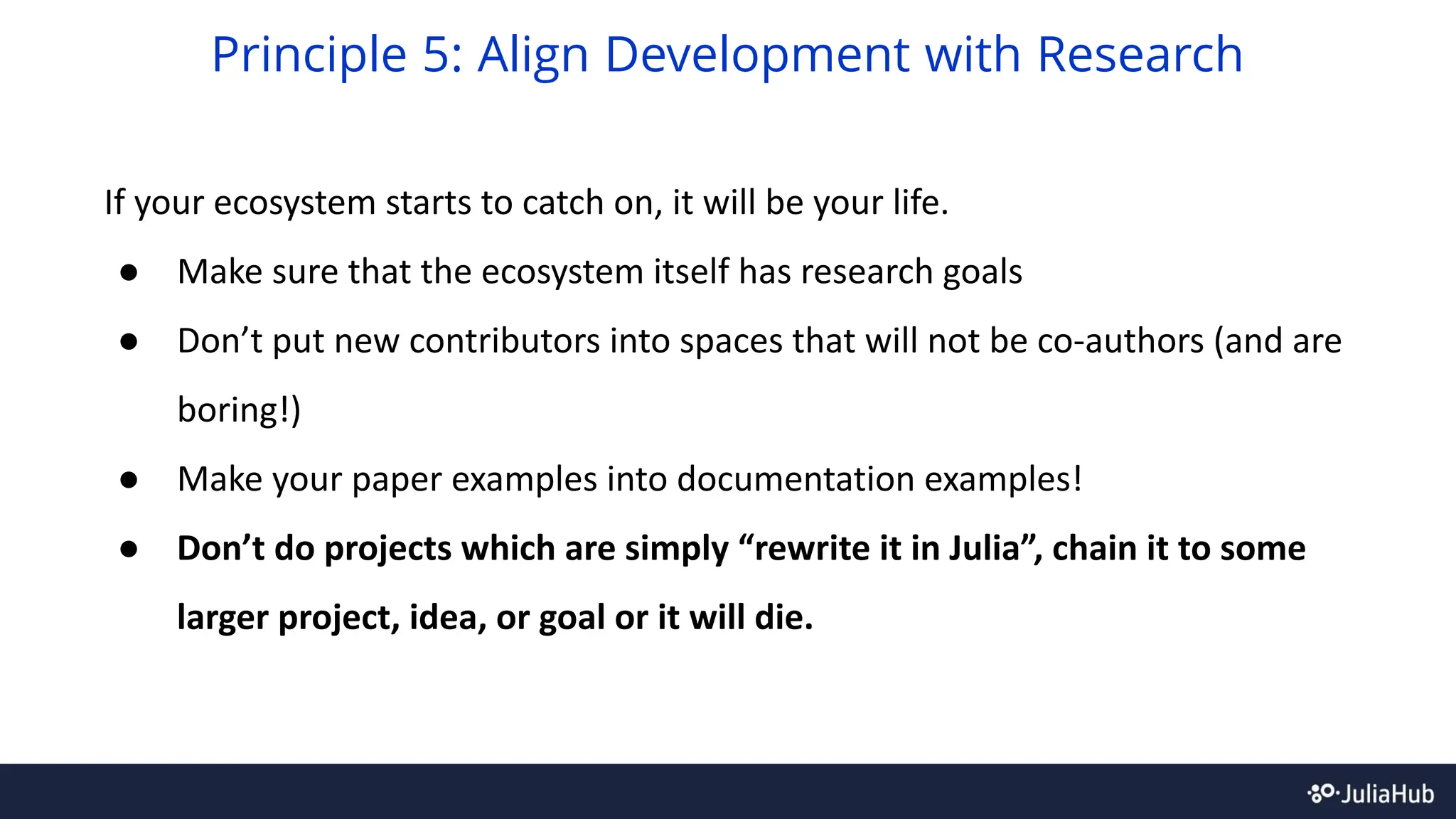
If your ecosystem starts to catch on, it will be your life.
● Make sure that the ecosystem itself has research goals
● Don’t put new contributors into spaces that will not be co-authors (and are
boring!)
● Make your paper examples into documentation examples!
● Don’t do projects which are simply “rewrite it in Julia”, chain it to some
larger project, idea, or goal or it will die.
Principle 5: Align Development with Research
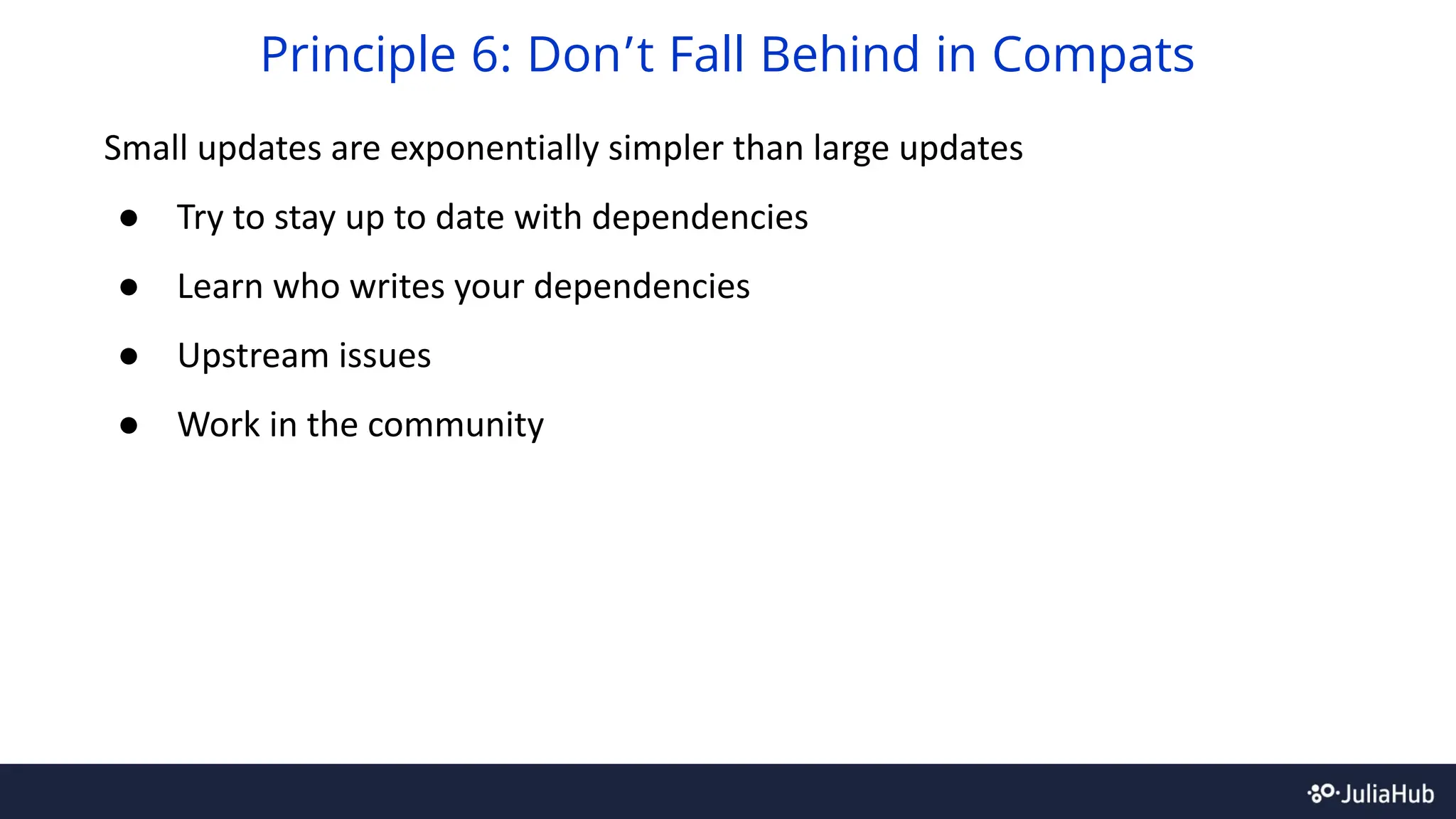
Small updates are exponentially simpler than large updates
● Try to stay up to date with dependencies
● Learn who writes your dependencies
● Upstream issues
● Work in the community
Principle 6: Don’t Fall Behind in Compats
If you are developing the ecosystem, you want to keep a global view of how
users will interact with your packages.
● Users should always use environments
● You as a developer shouldn’t: you should see what the naive user gets!
Testing and Manifests: Should you use one?
Give users the benefit of the doubt: they are (hopefully) smart people
● If many people are asking the same question, it’s missing a tutorial
● If many people are writing the same weird code, then there’s bad
documentation somewhere
○ Ask how they found out
● Solve people’s problems and then ask them to contribute to the
documentation
● Know when to pull the plug on a help vampire
Principle 7: Listen To Your Users As If They Are Smart
A lot of people think that the interface is “the easy part”... NO!
● Writing a solver takes some expertise, but has a “local” view
● Creating an interface requires a global view of how everyone will see your
packages, learn about your packages, and ultimately use your packages.
● Moral of the story: spend most of your time thinking about interfaces, and
don’t leave this portion to the contributors.
Principle 8: Interfaces Are The Hardest Part
Establishing an interface takes the following steps:
● Document how the interface is supposed to work
○ Clearly define what is public vs private
● Write the first 3 instantiations of the interface
● Write a higher level call (solve) which calls to a lower level call (__solve)
and have users extend the lower level interface. This allows a high level
that forces uniformization
○ Make high level error messages
● Religiously refine the interface and listen to your contributors
Establishing Interfaces
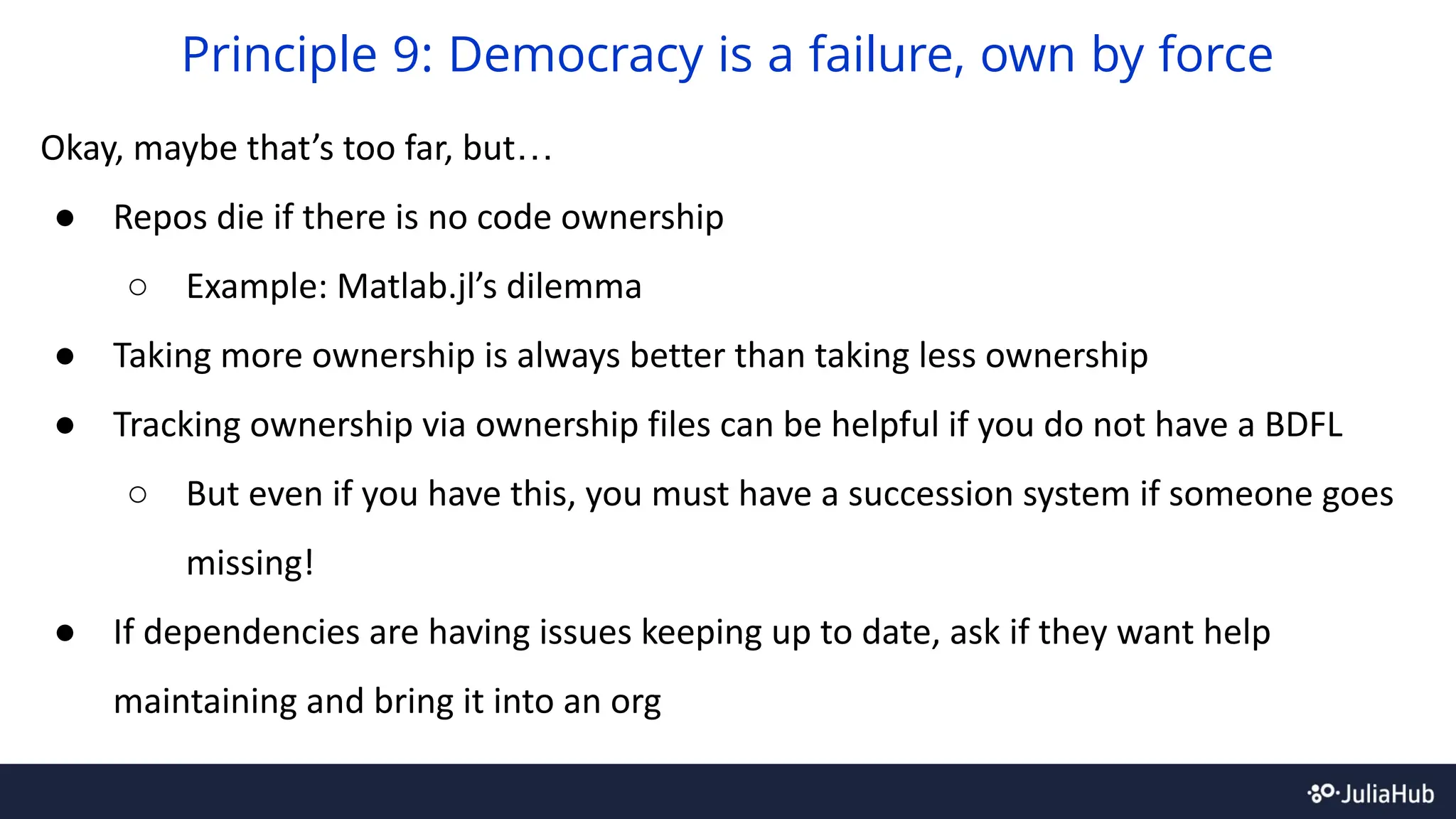
Okay, maybe that’s too far, but…
● Repos die if there is no code ownership
○ Example: Matlab.jl’s dilemma
● Taking more ownership is always better than taking less ownership
● Tracking ownership via ownership files can be helpful if you do not have a BDFL
○ But even if you have this, you must have a succession system if someone goes
missing!
● If dependencies are having issues keeping up to date, ask if they want help
maintaining and bring it into an org
Principle 9: Democracy is a failure, own by force
Thanks!

Maintaining Large Scale Julia Ecosystems

  • 1.
    Maintaining Large ScaleJulia Ecosystems Chris Rackauckas, VP of Modeling and Simulation @ JuliaHub, Research Affiliate @ MIT
  • 2.
    Building an ecosystemis a large project over many years. In this talk I’ll share ● Opinions: built with time and experience ● Practice: some Julia-specific tips for improving maintainability ● Tools: you cannot do it all by yourself Agenda
  • 3.
  • 4.
    DifferentialEquations.jl is generally: •50x faster than SciPy • 50x faster than MATLAB • 100x faster than R’s deSolve , Christopher, and Qing Nie. "Confederated modular differential equation APIs for accelerated algorithm development and benchmarking." Advances in Engineering Software 132 (2019): 1-6. Foundation: Fast Differential Equation Solvers https://github.com/SciML/SciMLBenchmarks.jl Rackauckas, Christopher, and Qing Nie. "Differentialequations.jl–a performant and feature-rich ecosystem for solving differential equations in julia." Journal of Open Research Software 5.1 (2017). Rackauckas, Christopher, and Qing Nie. "Confederated modular differential equation APIs for accelerated algorithm development and benchmarking." Advances in Engineering Software 132 (2019): 1-6. 1. Speed 2. Stability 3. Stochasticity 4. Adjoints and Inference 5. Parallelism Non-Stiff ODE: Rigid Body System 8 Stiff ODEs: HIRES Chemical Reaction Network
  • 5.
    New Parallelized GPUODE Parallelism: 20x-100x Faster than Jax and PyTorch Matches State of the Art on CUDA, but also works with AMD, Intel, and Apple GPUs Paper accepted! Utkarsh, U., Churavy, V., Ma, Y., Besard, T., Gymnich, T., Gerlach, A. R., ... & Rackauckas, C. (2023). Automated Translation and Accelerated Solving of Differential Equations on Multiple GPU Platforms. arXiv preprint arXiv:2304.06835.
  • 6.
    Understanding Julia’s DevelopmentSpeed: Why are Julia packages growing faster and better tested? Julia Scientific Computing Julia Machine Learning Normal Python PyTorch ODE Solver DifferentialEquations.jl >100 Contributors throughout its dependency stack DifferentialEquations.jl >100 Contributors throughout its dependency stack SciPy.odeint ~5 developers Torchdiffeq 1 contributor with more than one contribution SDE Solver DifferentialEquations.jl >100 Contributors throughout its dependency stack DifferentialEquations.jl >100 Contributors throughout its dependency stack N/A TorchSDE 2 contributors with more than one contribution (last commit July 2021) DDE Solver DifferentialEquations.jl >100 Contributors throughout its dependency stack DifferentialEquations.jl >100 Contributors throughout its dependency stack N/A N/A DAE Solver DifferentialEquations.jl >100 Contributors throughout its dependency stack DifferentialEquations.jl >100 Contributors throughout its dependency stack N/A N/A
  • 7.
    What is ScientificMachine Learning (SciML)? Scientific Computing ↔ Machine Learning AI with the robustness of classical modeling methods Machine Learning ● Neural Nets ● Data Models ● Automated Procedures Scientific Computing Scientific Machine Learning ● Model Building ● Robust Solvers ● Control Systems ● Differentiable Simulators ● Surrogates and ROM ● Inverse Problems & Calibration ● Automatic Equation Discovery and more …. 7
  • 8.
    Accurate Model ExtrapolationMixing in Physical Knowledge Automated discovery of geodesic equations from LIGO black hole data: run (a simplified version of) the code yourself! https://docs.sciml.ai/Overview/stable/showcase/blackhole/
  • 9.
    Improving Coverage ofAutomatic Differentiation Over Solvers https://scimlbase.sciml.ai/dev/ The SciML Common Interface for Julia Equation Solvers LinearSolve.jl: Unified Linear Solver Interface NonlinearSolve.jl: Unified Nonlinear Solver Interface DifferentialEquations.jl: Unified Interface for all Differential Equations Optimization.jl: Unified Optimization Interface Integrals.jl: Unified Quadrature Interface Unified Partial Differential Equation Interface
  • 10.
    SciML Docs: ComprehensiveDocumentation of Differentiable Simulation
  • 11.
  • 13.
    DeepNLME: Integrate neuralnetworks into traditional NLME modeling DeepNLME is SciML-enhanced modeling for clinical trials •Automate the discovery of predictive covariates and their relationship to dynamics •Automatically discover dynamical models and assess the fit •Incorporate big data sources, such as genomics and images, as predictive covariates
  • 14.
    We have beenusing Pumas software for our pharmacometric needs to support our development decisions and regulatory submissions. Pumas software has surpassed our expectations on its accuracy and ease of use. We are encouraged by its capability of supporting different types of pharmacometric analyses within one software. Pumas has emerged as our "go-to" tool for most of our analyses in recent months. We also work with Pumas-AI on drug development consulting. We are impressed by the quality and breadth of the experience of Pumas-AI scientists in collaborating with us on modeling and simulation projects across our pipeline spanning investigational therapeutics and vaccines at various stages of clinical development Husain A. PhD (2020) Director, Head of Clinical Pharmacology and Pharmacometrics, Moderna Therapeutics, Inc The Impact of Pumas (PharmacUtical Modeling And Simulation) “ Built on SciML
  • 15.
    How to develop: AlwaysForwards, Never Backwards
  • 16.
    You will neverbe able to grow maintainer support beyond yourself if you do not trust your test suite to carry you forward. ● If you do not feel comfortable blind merging a small bugfix that passes all tests, that is a sign you do not trust your tests ● Trusting your tests will teach you what your tests are missing Principle 1: trust your tests
  • 17.
    The different kindsof tests ● Unit tests: small tests which test a single piece / behavior of the software ○ Good to have, but actually not the most important! ● Integration tests: tests which tests how the different parts integrate ○ The most important tests ● Interface tests: tests which demonstrate that the interface is as expected ● Regression tests: tests that the behavior of the software does not change ● Downstream tests: tests that your user’s code doesn’t break ○ Second most important tests
  • 18.
    The Julia Labprovides buildkite scripts for many alternative hardwares: ● NVIDIA GPUs ● AMD GPUs ● Intel GPUs ● Mac M-Series Ask and you shall receive. Tests for Alternative Hardware
  • 19.
    Parallelize your testsby grouping then with environment variables ● Allow people to easily run a subset of tests ● Run tests in parallel on CI ● Allow downstream to run a subset of tests ● Make every test an independent runnable script (SafeTestsets.jl) See OrdinaryDiffEq.jl as a complex example! Using Test Groups for Parallelism
  • 20.
    Force your documentationto act as interface tests ● Differentiate examples vs tutorials ● Establish doctests ● Cover real-world workflows ● Get more compute if you need to Documentation as Tests
  • 21.
    ● Implement basicfeatures that you may even thing are too basic for you ○ Examples: DiffEq’s solve(prob), ANOVA ● 90% of users use the most basic 10% of the code ● Let people grow with you ○ That undergrad may one day be your most helpful maintainer! ● Listen to your audience when they say something is hard ● Write a lot of tutorials, and turn any repeated structures into tutorials ● Make your error messages read your beginner user’s minds * I stole this phrase from Mike Tiller Principle 2: Make simple things easy, complex things possible*
  • 22.
    When should yoube using more than one package? ● A single package should cover a single idea ○ If the users of different parts of different ● If changing one part of the code almost always requires changing the other, then those two should live in the same repository! ● Reuse other packages when you can ○ And contribute when you need to! ● Move all reusable data structures out to data structures packages Principle 3: Build modularly
  • 23.
    Always find thetime to respond to and validate your contributors ● Attempt to respond to a PR within the same day ○ If the feature isn’t quite what you expected, explain the greater vision ○ If the code could be improved, use Github suggestions to make the improvements in a teachable way ○ Fix the code yourself the first few times and aim for faster merging ○ Help with rebasing and merge conflicts when you can! ○ Don’t aim for perfection: merge and open issues with next steps ● If you trust your tests, doing quick merges will be easier! ● You never know who your next maintainer will be Principle 4: Your Contributors are your BFFs
  • 24.
    If your ecosystemstarts to catch on, it will be your life. ● Make sure that the ecosystem itself has research goals ● Don’t put new contributors into spaces that will not be co-authors (and are boring!) ● Make your paper examples into documentation examples! ● Don’t do projects which are simply “rewrite it in Julia”, chain it to some larger project, idea, or goal or it will die. Principle 5: Align Development with Research
  • 25.
    Small updates areexponentially simpler than large updates ● Try to stay up to date with dependencies ● Learn who writes your dependencies ● Upstream issues ● Work in the community Principle 6: Don’t Fall Behind in Compats
  • 26.
    If you aredeveloping the ecosystem, you want to keep a global view of how users will interact with your packages. ● Users should always use environments ● You as a developer shouldn’t: you should see what the naive user gets! Testing and Manifests: Should you use one?
  • 27.
    Give users thebenefit of the doubt: they are (hopefully) smart people ● If many people are asking the same question, it’s missing a tutorial ● If many people are writing the same weird code, then there’s bad documentation somewhere ○ Ask how they found out ● Solve people’s problems and then ask them to contribute to the documentation ● Know when to pull the plug on a help vampire Principle 7: Listen To Your Users As If They Are Smart
  • 28.
    A lot ofpeople think that the interface is “the easy part”... NO! ● Writing a solver takes some expertise, but has a “local” view ● Creating an interface requires a global view of how everyone will see your packages, learn about your packages, and ultimately use your packages. ● Moral of the story: spend most of your time thinking about interfaces, and don’t leave this portion to the contributors. Principle 8: Interfaces Are The Hardest Part
  • 29.
    Establishing an interfacetakes the following steps: ● Document how the interface is supposed to work ○ Clearly define what is public vs private ● Write the first 3 instantiations of the interface ● Write a higher level call (solve) which calls to a lower level call (__solve) and have users extend the lower level interface. This allows a high level that forces uniformization ○ Make high level error messages ● Religiously refine the interface and listen to your contributors Establishing Interfaces
  • 30.
    Okay, maybe that’stoo far, but… ● Repos die if there is no code ownership ○ Example: Matlab.jl’s dilemma ● Taking more ownership is always better than taking less ownership ● Tracking ownership via ownership files can be helpful if you do not have a BDFL ○ But even if you have this, you must have a succession system if someone goes missing! ● If dependencies are having issues keeping up to date, ask if they want help maintaining and bring it into an org Principle 9: Democracy is a failure, own by force
  • 31.