Desalination
GROUP (16)
presented to prof.Khalid Ramzy 2025
Introduction
What is desalination?
It can be defined as any process which removes

excess salts and minerals from water (or) the chemical
process of changing seawater into potable water are
called desalination.
Why Desalination?
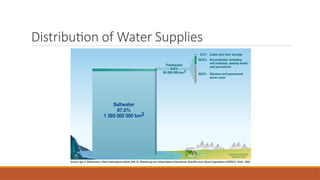
75% of the Earth’s surface is covered by water but 97.5% of that water is salty
Only 2.5% is fresh water
of the world’s population lives in countries with insufficient fresh water
resources
The existing fresh water resources are decreasing
Desalination can play a large role in increasing the supply of fresh water in both
developing and developed nations
Distribution of Water Supplies
Desalination technologies
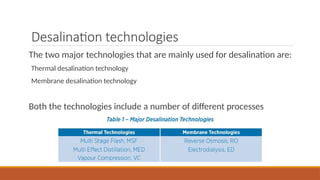
The two major technologies that are mainly used for desalination are:
Thermal desalination technology
Membrane desalination technology
Both the technologies include a number of different processes
Desalination technologies
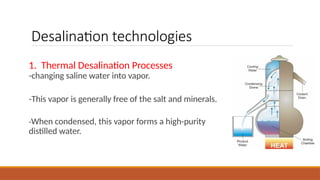
1. Thermal Desalination Processes
-changing saline water into vapor.
-This vapor is generally free of the salt and minerals.
-When condensed, this vapor forms a high-purity
distilled water.
Desalination technologies
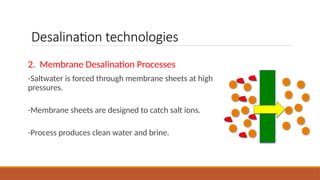
2. Membrane Desalination Processes
-Saltwater is forced through membrane sheets at high
pressures.
-Membrane sheets are designed to catch salt ions.
-Process produces clean water and brine.
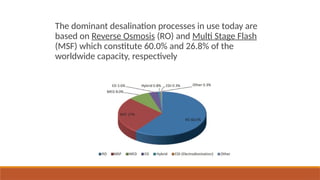
The dominant desalination processes in use today are
based on Reverse Osmosis (RO) and Multi Stage Flash
(MSF) which constitute 60.0% and 26.8% of the
worldwide capacity, respectively
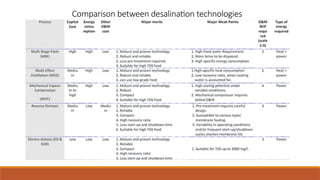
Comparison between desalination technologies
multistage flash desalination
PRESENTED BY MOHAMED SAMY
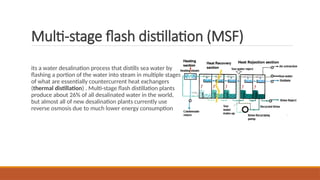
Multi-stage flash distillation (MSF)
its a water desalination process that distills sea water by
flashing a portion of the water into steam in multiple stages
of what are essentially countercurrent heat exchangers
(thermal distillation) . Multi-stage flash distillation plants
produce about 26% of all desalinated water in the world,
but almost all of new desalination plants currently use
reverse osmosis due to much lower energy consumption
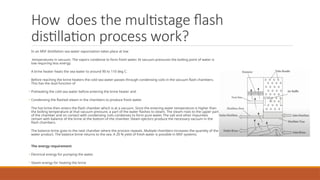
How does the multistage flash
distillation process work?
In an MSF distillation sea water vaporization takes place at low
temperatures in vacuum. The vapors condense to form fresh water. At vacuum pressures the boiling point of water is
low requiring less energy.
A brine heater heats the sea water to around 90 to 110 deg C.
Before reaching the brine heaters the cold sea water passes through condensing coils in the vacuum flash chambers.
This has the dual function of
• Preheating the cold sea water before entering the brine heater and
• Condensing the flashed steam in the chambers to produce fresh water.
The hot brine then enters the flash chamber which is at a vacuum. Since the entering water temperature is higher than
the boiling temperature at that vacuum pressure, a part of the water flashes to steam. The steam rises to the upper part
of the chamber and on contact with condensing coils condenses to form pure water. The salt and other impurities
remain with balance of the brine at the bottom of the chamber. Steam ejectors produce the necessary vacuum in the
flash chambers.
The balance brine goes to the next chamber where the process repeats. Multiple chambers increases the quantity of the
water product. The balance brine returns to the sea. A 20 % yield of fresh water is possible in MSF systems.
The energy requirement
• Electrical energy for pumping the water.
• Steam energy for heating the brine.
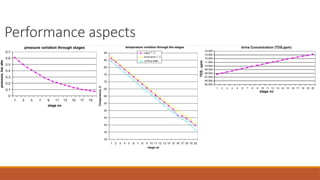
Performance aspects
Solar Desalination
PRESENTED BY/ AHMED MAGDY ISMAIL MOHAMED
Some Background Info
Direct solar desalination system
• Briefing
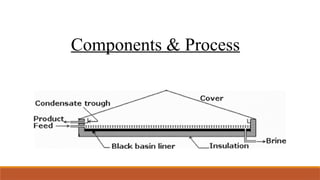
Single basin type solar still
Components & Process
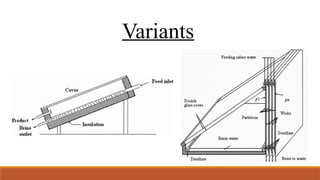
Variants
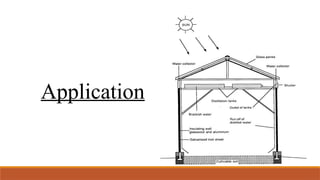
Application
Limitations
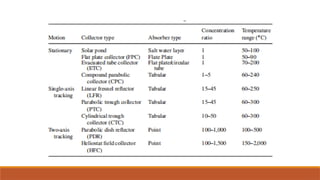
Devices for Converting Solar
Radiation into Thermal Energy
Suitable for Desalination
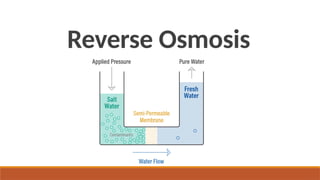
Reverse Osmosis
To understand the purpose and process of Reverse Osmosis you must first understand the naturally
occurring process of Osmosis.
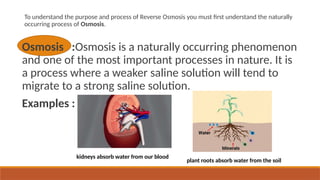
Osmosis :Osmosis is a naturally occurring phenomenon
and one of the most important processes in nature. It is
a process where a weaker saline solution will tend to
migrate to a strong saline solution.
Examples :
kidneys absorb water from our blood
plant roots absorb water from the soil
What is Reverse Osmosis?
Reverse Osmosis is a technology that is used to remove a large majority of contaminants from water
by pushing the water under pressure through a semi-permeable membrane.
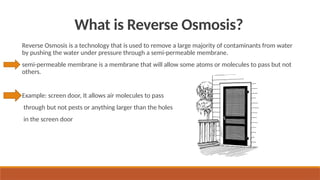
semi-permeable membrane is a membrane that will allow some atoms or molecules to pass but not
others.
Example: screen door, It allows air molecules to pass
through but not pests or anything larger than the holes
in the screen door
How does Reverse Osmosis work?
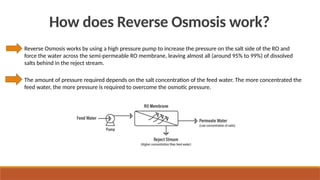
Reverse Osmosis works by using a high pressure pump to increase the pressure on the salt side of the RO and
force the water across the semi-permeable RO membrane, leaving almost all (around 95% to 99%) of dissolved
salts behind in the reject stream.
The amount of pressure required depends on the salt concentration of the feed water. The more concentrated the
feed water, the more pressure is required to overcome the osmotic pressure.
What contaminants will Reverse
Osmosis remove from water?
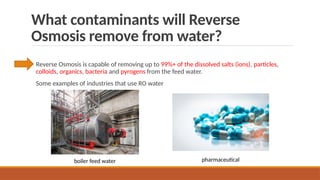
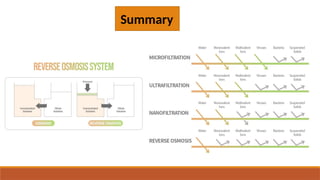
Reverse Osmosis is capable of removing up to 99%+ of the dissolved salts (ions), particles,
colloids, organics, bacteria and pyrogens from the feed water.
Some examples of industries that use RO water
pharmaceutical
boiler feed water
Summary
Electrodialysis
PRESENTED BY : MOHAMED ABD ELHADY AHMED
WHAT IS
ELECTRODIALYSIS ?
ELECTRODIALYSIS
PROCESSES
ADVANTAGES AND
DISADVANTAGES
APPLICATION
S

Main Coresssssccccccccsccccccccccssssssss.pptx

  • 1.
  • 2.
  • 3.
    What is desalination? Itcan be defined as any process which removes excess salts and minerals from water (or) the chemical process of changing seawater into potable water are called desalination.
  • 4.
    Why Desalination? 75% ofthe Earth’s surface is covered by water but 97.5% of that water is salty Only 2.5% is fresh water of the world’s population lives in countries with insufficient fresh water resources The existing fresh water resources are decreasing Desalination can play a large role in increasing the supply of fresh water in both developing and developed nations
  • 5.
  • 6.
    Desalination technologies The twomajor technologies that are mainly used for desalination are: Thermal desalination technology Membrane desalination technology Both the technologies include a number of different processes
  • 7.
    Desalination technologies 1. ThermalDesalination Processes -changing saline water into vapor. -This vapor is generally free of the salt and minerals. -When condensed, this vapor forms a high-purity distilled water.
  • 8.
    Desalination technologies 2. MembraneDesalination Processes -Saltwater is forced through membrane sheets at high pressures. -Membrane sheets are designed to catch salt ions. -Process produces clean water and brine.
  • 9.
    The dominant desalinationprocesses in use today are based on Reverse Osmosis (RO) and Multi Stage Flash (MSF) which constitute 60.0% and 26.8% of the worldwide capacity, respectively
  • 10.
  • 11.
  • 12.
    Multi-stage flash distillation(MSF) its a water desalination process that distills sea water by flashing a portion of the water into steam in multiple stages of what are essentially countercurrent heat exchangers (thermal distillation) . Multi-stage flash distillation plants produce about 26% of all desalinated water in the world, but almost all of new desalination plants currently use reverse osmosis due to much lower energy consumption
  • 13.
    How does themultistage flash distillation process work? In an MSF distillation sea water vaporization takes place at low temperatures in vacuum. The vapors condense to form fresh water. At vacuum pressures the boiling point of water is low requiring less energy. A brine heater heats the sea water to around 90 to 110 deg C. Before reaching the brine heaters the cold sea water passes through condensing coils in the vacuum flash chambers. This has the dual function of • Preheating the cold sea water before entering the brine heater and • Condensing the flashed steam in the chambers to produce fresh water. The hot brine then enters the flash chamber which is at a vacuum. Since the entering water temperature is higher than the boiling temperature at that vacuum pressure, a part of the water flashes to steam. The steam rises to the upper part of the chamber and on contact with condensing coils condenses to form pure water. The salt and other impurities remain with balance of the brine at the bottom of the chamber. Steam ejectors produce the necessary vacuum in the flash chambers. The balance brine goes to the next chamber where the process repeats. Multiple chambers increases the quantity of the water product. The balance brine returns to the sea. A 20 % yield of fresh water is possible in MSF systems. The energy requirement • Electrical energy for pumping the water. • Steam energy for heating the brine.
  • 14.
  • 15.
    Solar Desalination PRESENTED BY/AHMED MAGDY ISMAIL MOHAMED
  • 16.
  • 17.
    Direct solar desalinationsystem • Briefing
  • 18.
    Single basin typesolar still
  • 19.
  • 20.
  • 21.
  • 22.
  • 23.
    Devices for ConvertingSolar Radiation into Thermal Energy Suitable for Desalination
  • 25.
  • 26.
    To understand thepurpose and process of Reverse Osmosis you must first understand the naturally occurring process of Osmosis. Osmosis :Osmosis is a naturally occurring phenomenon and one of the most important processes in nature. It is a process where a weaker saline solution will tend to migrate to a strong saline solution. Examples : kidneys absorb water from our blood plant roots absorb water from the soil
  • 27.
    What is ReverseOsmosis? Reverse Osmosis is a technology that is used to remove a large majority of contaminants from water by pushing the water under pressure through a semi-permeable membrane. semi-permeable membrane is a membrane that will allow some atoms or molecules to pass but not others. Example: screen door, It allows air molecules to pass through but not pests or anything larger than the holes in the screen door
  • 28.
    How does ReverseOsmosis work? Reverse Osmosis works by using a high pressure pump to increase the pressure on the salt side of the RO and force the water across the semi-permeable RO membrane, leaving almost all (around 95% to 99%) of dissolved salts behind in the reject stream. The amount of pressure required depends on the salt concentration of the feed water. The more concentrated the feed water, the more pressure is required to overcome the osmotic pressure.
  • 29.
    What contaminants willReverse Osmosis remove from water? Reverse Osmosis is capable of removing up to 99%+ of the dissolved salts (ions), particles, colloids, organics, bacteria and pyrogens from the feed water. Some examples of industries that use RO water pharmaceutical boiler feed water
  • 30.
  • 31.
    Electrodialysis PRESENTED BY :MOHAMED ABD ELHADY AHMED
  • 32.
  • 33.
  • 36.
  • 37.