Vol 10, No. 6   June 2009


                    Rs.15
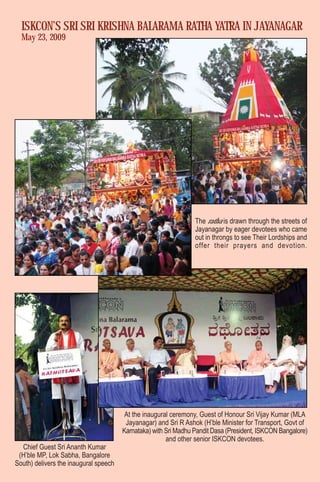
ISKCON’S SRI SRI KRISHNA BALARAMA RATHA YATRA IN JAYANAGAR
  May 23, 2009


                                                                 The ratha is drawn through the streets of
                                                                 Jayanagar by eager devotees who came
                                                                 out in throngs to see Their Lordships and
                                                                 offer their prayers and devotion.


                                        At the inaugural ceremony, Guest of Honour Sri Vijay Kumar (MLA
                                        Jayanagar) and Sri R Ashok (H’ble Minister for Transport, Govt of
                                       Karnataka) with Sri Madhu Pandit Dasa (President, ISKCON Bangalore)
                                                       and other senior ISKCON devotees.
  Chief Guest Sri Ananth Kumar
 (H’ble MP, Lok Sabha, Bangalore
South) delivers the inaugural speech
Vol 10, No.6                          June 2009


                                                                CONTENTS

                                             The Soul’s Fall                                     4
                                             Srila Prabhupada Speaks Out                         8
                                             When Science Points to Spirituality                10
                                             Defining the Divine, East and West                 12

  His Divine Grace A. C. Bhaktivedanta
  Swami Prabhupada, Founder-
  Acharya of the International Society
  for Krishna Consciousness, came to          Please chant...
  America in 1965, at age 69, to fulfill      Hare Krishna Hare Krishna Krishna Krishna Hare Hare
                                                Hare Rama Hare Rama Rama Rama Hare Hare
  his spiritual master’s request that he
                                                                                   ...and be happy!
  teach the science of Krishna
  consciousness throughout the English-
                                             Published and owned by Sankirtana Seva Trust,
  speaking world. In a dozen years he        editing by Chamari Devi Dasi.
  published some seventy volumes of          Layout, design and graphics by ISKCON Design
  translation and commentary on India’s      Group, Bangalore.
  Vedic literature, and these are now        For all information contact: Editor, Krishna
  standard in universities worldwide.        Voice, SST, Hare Krishna Hill, Chord Road,
                                             Bangalore - 560 010 INDIA Phone: 91-80-2347
  Meanwhile, travelling almost nonstop,      1956, 91-80-2357 8346 Fax: 91-80-2357 8625.
  Srila Prabhupada moulded his
                                             © 2009 Sankirtana Seva Trust, Bangalore. All
  international society into a world wide    Krishna art and the works of Srila Prabhupada
  confederation of ashramas, schools,        are © BBT International.
  temples and farm communities. He           All rights reserved throughout the world.
  passed away in 1977, in Vrindavana,        Reproduction in any manner is strictly
                                             prohibited.
  the place most sacred to Lord Krishna.
                                             Printed for ISKCON, Bangalore, at Manipal
  His disciples and followers are carrying
                                             Printers (P) Ltd., Manipal.
  forward the movement he started.
                                             Cover pages-4         Text pages-20
Krishna Voice, June 2009                                                                              3
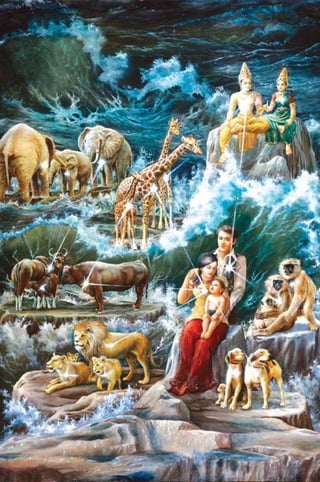
The Soul's Fall
       Responding to our desire, Krishna gives us a chance to forget Him.
                                      A lecture given in Tokyo, on April 20, 1972
                            by His Divine Grace A.C. Bhaktivedanta Swami Prabhupada
                   Founder-Acharya of the International Society for Krishna Consciousness
                                                      sri-suka uvaca
                                     atma-mayam rte rajan parasyanubhavatmanah
                                 na ghatetartha-sambandhah svapna-drastur ivanjasa
Sri Sukadeva Gosvami said: O king, unless one is influenced by the energy of the Supreme Personality of Godhead,
there is no meaning to the relationship of the pure soul in pure consciousness with the material body. That
relationship is just like a dreamer's seeing his own body working.
                                                                                           —Srimad-Bhagavatam 2.9.1
Many people inquire, "How did the living entity, who was with Krishna, fall into the material world?" That question
is answered here. The living entity's condition is simply the influence of the material energy; actually he has not
fallen. An example is given: The moon appears to be moving when clouds pass in front of it. Actually, the moon
is not moving. Similarly, the living entity, because he is a spiritual spark of the Supreme, has not fallen. But he is
thinking, "I am fallen. I am material. I am this body."
The body has no connection with the soul. We can experience this. The body is changing, dying, but I am the
same. The idea that we have a connection with the body is due to the handling of the illusory energy of Krishna.
That illusory energy develops when we forget Krishna.
In other words, our illusory identification with the body is simply due to our forgetfulness. We wanted to forget;
we wanted to give up Krishna and enjoy the material world. Therefore Krishna is giving us the chance. For example,
when you play a part in a drama, if you feel, "I am king," then you can talk very nicely. And if you feel, "I am
Karandhara*," then you cannot play a king so nicely. The feelings must be there. If you are playing the part of a
king, you must believe you are the king and have his courage. You have to forget that you are Karandhara. Then
you can play the part very nicely, and the audience will appreciate. But if you think simultaneously, "I am Karandhara,
and I am playing the part of the king," then you cannot play.
So because we wanted to play the part of Krishna, the enjoyer, Krishna is giving us the chance—"You feel like
Me." The feeling that "I am master, I am king, I am Krishna, I am God" is created by Krishna: "All right. You want
to play the part of a king. I shall train you in such a way."
The director of a play tries to create the feelings within you for the part you are playing. In my younger age I played
in a drama about Lord Chaitanya. Our director, Amritlal Bose, repeatedly said, especially to me, "Feel like that."
So when we performed under his direction, all the people in the audience were crying. The play was artificial, but
the effect on the audience was so nice.
Similarly, we have nothing to do with the material world, but we have been trained by the illusory energy in such
a way that we think, "I am Indian," "I am American," "I am a brahmana," "I am a shudra," "I am this," "I am that,"
"I have to do this," "I have so many duties." These are all illusions. We have nothing to do with all this nonsense,
but still we are taking it very seriously: "I have to do like that. I am this. I am that."
That is explained here. Atmamayam rte rajan parasyanubhavat-manah: "Unless one is influenced by the energy
of the Supreme Personality of Godhead, there is no meaning to the relationship of the pure soul in pure consciousness
with the material body."
The example is given of a man dreaming. "Oh, there is a tiger, a tiger! Save me!" He is crying. An awake man
observing may say, "Where is the tiger? Why are you crying?" But the dreaming man is actually feeling, "The tiger
has attacked me."
Therefore this example is given: na ghatetartha-sambandhah. There cannot be any meaning of the relationship
of the soul and the body except that it is like a dreaming man creating a situation. He is dreaming there is a tiger,
and he is creating a fearful situation. Actually there is no cause of fear. There is no tiger. The situation is created
by a dream.
Similarly, we have created the material world and material activity. People are running around—"Oh, I am the
*A disciple in the audience.
Krishna Voice, June 2009                                                                                             5
manager. I am the factory owner. I am this, I am that. We know his politics. We have to defeat our competitors."
All these things are created just as a man creates a situation in a dream—svapna-drastur ivanjasa.
So when someone asks, "When did we come into contact with the material nature?" the answer is that we have
not come into contact. By the influence of the external energy we think we are in contact. Actually we are not fallen.
We cannot be fallen. We have simply created a situation. Rather, we have not created a situation; Krishna has
given us a situation. Because we wanted to imitate Krishna, Krishna has given an opportunity: "All right. You want
to imitate. You want to be an imitation king on the stage. So feel like this. Play like this. Do like this. People will
applaud—'Oh, a very nice king.' "
Everyone in the material world is playing some part. "I want to be prime minister." "I want to become a very big
business magnate." "I want to be a leader." "I want to be a philosopher." "I want to be a scientist." They are trying
to play all these nonsense parts, and Krishna is giving the opportunity—"All right."
But these things are all nonsense. Simply dreaming. When you dream, the next moment the dream is gone, and
everything in the dream is finished. No more tiger, no more jungle. Similarly, as long as the body continues, I think,
"I am a responsible leader. I am this. I am that." But as soon as the body is finished, these ideas are gone.
Krishna says, mrtyu sarva-haras caham: "I am death. I take everything away." Just think of our past life. Suppose
I was a king or something like that. From Bhrgu-samhita it was ascertained that I was a big physician in my last
life, with a spotless character, no sins. I don't know. It may be. But I have no remembrance that I was a physician.
So what do we know? I might have been a very big influential physician, with a good practice, but where is it all
now? All gone.
So our contact with matter is just like a dream. We are not fallen. Therefore, at any moment we can revive our
Krishna consciousness. We become liberated as soon as we understand, "I have nothing to do with matter. I am
simply Krishna's eternal servant." Sometimes when a fearful dream becomes intolerable, we break the dream.
Similarly, we can break the material connection at any moment as soon as we come to the point of Krishna
consciousness. "Oh, Krishna is my eternal master. I am His servant." That's all. That is the way.
Actually we are not fallen. We cannot be fallen. The same example: Actually there is no tiger; it is dreaming.
Similarly, our fallen condition is also dreaming. We are not fallen. We can simply give up that illusory condition at
any moment.
So if you study all these verses very nicely, you will get all this knowledge quickly. Now what is the purport?
[A disciple reads:] "Maharaja Parikshit's question as to how a living entity began his material life, although he
is apart from the material body and mind, is perfectly answered. The spirit soul is distinct from the material
conception of his life, but he is absorbed in such a material conception because of being influenced by the external
energy of the Lord, called atma-maya. This has been already explained in the First Canto in connection with
Vyasadeva's realization of the Supreme Lord and His external energy. The external energy is controlled by the
Lord and the living entities are controlled by the external energy."
Prabhupada: Krishna says, mam eva ye prapadyante mayam etam taranti te: "As soon as one surrenders unto
Me, he has no more illusion." People are conditioned, encaged. Mayavadis, or impersonalists, undergo austerities
and penances just to become liberated. Yogis also try to become "one." So many endeavors are going on. But
the simple process is that as soon as you surrender you are not fallen. "It was illusion. I was dreaming. I am
Krishna's." By thinking in this way, one immediately becomes liberated. Immediately. Within a second.
Liberation can be attained within a second, provided we abide by the order of Krishna. Sarva-dharman parityajya
mam ekam saranam vraja. This is the position. We are not fallen. We are thinking we are fallen. So we have to
give up this nonsense thinking. Then we are liberated.
Is there any difficulty in understanding this point? Just see how important this verse is. It is already there, but you
are not reading. Read each verse; read every day carefully. Try to assimilate, understand, and you will get more
profit—every day a hundred yards forward. They are such important verses. How nicely composed by Vyasadeva!
In two lines the whole thing is explained. This is called shastra.
Read the purport.
[The disciple reads:] "The external energy is controlled by the Lord, and the living entities are controlled by the
external energy—by the will of the Lord. Therefore, although the living entity is purely conscious in his pure state,
he is subordinate to the will of the Lord in being influenced by the external energy of the Lord. In the Bhagavad-
gita (15.15) also the same thing is confirmed; the Lord is present within the heart of every living entity, and all the
living entity's consciousness and forgetfulness are influenced by the Lord."
Prabhupada: Now, people may ask, "Why does Krishna within the heart give one type of consciousness to one
6                                                                                               Krishna Voice, June 2009
and a different type of consciousness to another?" That is His kindness. I wanted to forget Krishna, so Krishna is
giving the appropriate consciousness: "All right, you can forget Me in this way."
The karmis, or ordinary materialists, the Mayavadis, and the so-called yogis wanted to forget Krishna. So Krishna
is giving them intelligence: "All right. You forget Me like this." And if you want to revive your relationship with
Krishna, He will give you intelligence. Dadami buddhi-yogam tam yena mam upayanti te: "I shall give you intelligence
to come to Me." Ye yatha mam prapadyante. As you want, Krishna gives you facility.
Go on reading.
[Disciple reads:] "Now the next question automatically made will be why the Lord influences the living entity to
such consciousness and forgetfulness. The answer is that the Lord clearly wishes that every living entity be in
his pure consciousness as the part and parcel of the Lord and thus be engaged in the loving service of the Lord
as he is constitutionally made; but because the living entity is partially independent also, he may not be willing to
serve the Lord, but may try to become as independent as the Lord is. All the nondevotee living entities are desirous
of becoming equally as powerful as the Lord, although they are not fit to become so."
Prabhupada: The living entity will never be God, but we see that by the influence of the illusory energy many
people think, "I am God," or "I shall become God by pressing my nose like this." This is going on. But they will
never be able to become God. That is not possible. If everyone can become God, then there is no meaning of
God.
Karmis say, "I shall become a millionaire. I shall become a trillionaire. I shall become head of state. I shall become
prime minister." They struggle to attain these things.
And for yogis to think, "I shall become God" is simply another struggle. It is illusion. Krishna may give them some
yogic success. In India there is a rascal who makes gold appear. And people are after him—"Oh, he is God, he
is God." By producing a little gold, he becomes God.
Another yogi makes two rasagullas [sweets] appear. So by producing two rasagullas, four cents' worth, he becomes
God. You see? This is illusion. I can purchase two rasagullas from the market for four cents, so he has become
God for four cents. People think, "Oh, he is God. He can produce rasagullas." They have no sense. I can produce
rasagullas in our kitchen. But rascals think, "Oh, this yogi is wonderful."
So Krishna gives a person some power of yogic siddhi, or perfection, and the person thinks, "I have become God."
And some flatterers think, "Oh, you are God." Such yogis are in the same dream as the karmis. And as soon as
death comes, everything is finished—your Godhood and everything, finished. Now comes doghood. And another
dream: "I am dog." First of all "I am God," then "I am dog." This is going on.
Therefore Bhaktivinoda Thakura has said, (miche) mayar bose, jaccho bhese: "Why are you being washed away
by the waves of maya? Just stand up." (Jiv) Krishna-das, ei biswas, korle to ar duhkho nai. "Simply stay fixed on
this point: 'I am an eternal servant of Krishna.' Then there is no more dream." And if you allow yourself to be
washed away, Krishna gives you facility: "All right, come on. Be washed away."
Then?
[Disciple reads:] "The living entities are illusioned by the will of the Lord because they wanted to become like
Him. Like a person who thinks of becoming a king without possessing the necessary qualifications, similarly, when
the living entity desires to become the Lord Himself, he is put in a condition of dreaming that he is a king. Therefore
the first sinful will of the living entity is to become the Lord, and the consequent will of the Lord is that the living
entity forget his actual life and thus dream of the land of utopia where he may become one like the Lord. The child
cries to have the moon from the mother, and the mother gives the child a mirror to satisfy the crying and disturbing
child with the reflection of the moon. Similarly the crying child of the Lord is given over to the reflection, the material
world, to lord it over as a karmi and to give this up in frustration to become one with the Lord. Both these stages
are dreaming illusions only. There is no necessity of tracing out the history of when the living entity desired this.
But the fact is that as soon as he desired it, he was put under the control of atma-maya by the direction of the
Lord. Therefore the living entity in his material condition is dreaming falsely that this is 'mine' and this is 'I.' The
dream is that the conditioned soul thinks of his material body as 'I' or falsely thinks that he is the lord and that
everything in connection with that material body is 'mine.' Thus only in dream does the misconception of 'I and
mine' persist life after life. This continues life after life, as long as the living entity is not purely conscious of his
identity as the subordinate part and parcel of the Lord.
"In his pure consciousness, however, there is no such misconceived dream, and in that pure conscious state the
living entity does not forget that he is never the Lord, but he is eternally the servitor of the Lord in transcendental
love."
Prabhupada: Thank you very much.
Krishna Voice, June 2009                                                                                                 7
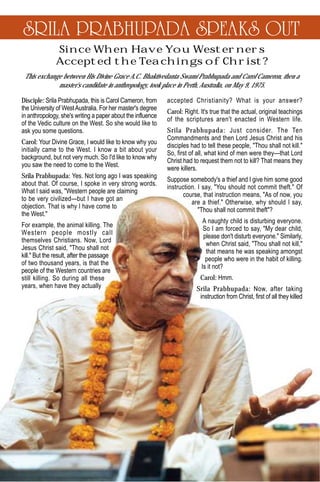
SRILA PRABHUPADA SPEAKS OUT
               Since When Have You Westerners
               Accepted the Teachings of Christ?
 This exchange between His Divine Grace A.C. Bhaktivedanta Swami Prabhupada and Carol Cameron, then a
             master's candidate in anthropology, took place in Perth, Australia, on May 9, 1975.

Disciple: Srila Prabhupada, this is Carol Cameron, from      accepted Christianity? What is your answer?
the University of West Australia. For her master's degree
                                                             Carol: Right. It's true that the actual, original teachings
in anthropology, she's writing a paper about the influence
                                                             of the scriptures aren't enacted in Western life.
of the Vedic culture on the West. So she would like to
ask you some questions.                                      Srila Prabhupada: Just consider. The Ten
                                                             Commandments and then Lord Jesus Christ and his
Carol: Your Divine Grace, I would like to know why you
                                                             disciples had to tell these people, "Thou shall not kill."
initially came to the West. I know a bit about your
                                                             So, first of all, what kind of men were they—that Lord
background, but not very much. So I'd like to know why
                                                             Christ had to request them not to kill? That means they
you saw the need to come to the West.
                                                             were killers.
Srila Prabhupada: Yes. Not long ago I was speaking
                                                             Suppose somebody's a thief and I give him some good
about that. Of course, I spoke in very strong words.
                                                             instruction. I say, "You should not commit theft." Of
What I said was, "Western people are claiming
                                                                    course, that instruction means, "As of now, you
to be very civilized—but I have got an
                                                                       are a thief." Otherwise, why should I say,
objection. That is why I have come to
                                                                          "Thou shall not commit theft"?
the West."
                                                                            A naughty child is disturbing everyone.
For example, the animal killing. The
                                                                            So I am forced to say, "My dear child,
Western people mostly call
                                                                            please don't disturb everyone." Similarly,
themselves Christians. Now, Lord
                                                                             when Christ said, "Thou shall not kill,"
Jesus Christ said, "Thou shall not
                                                                             that means he was speaking amongst
kill." But the result, after the passage
                                                                             people who were in the habit of killing.
of two thousand years, is that the
                                                                           Is it not?
people of the Western countries are
still killing. So during all these                                         Carol: Hmm.
years, when have they actually                                           Srila Prabhupada: Now, after taking
                                                                          instruction from Christ, first of all they killed
Christ. They let him be put to death. That means they             systematically killing? The order is, "Thou shall not kill."
could not understand the instruction. Therefore, their
                                                                  Carol: This matter reminds me of the Gita, you know?—
first business was to kill the instructor. And following
                                                                  where Arjuna is on the battlefield, about to commit an
that, two thousand years have passed—and still they
                                                                  organized sort of killing against his relatives.
are killing. So, since when have they accepted the
teachings of Lord Christ? Can you answer this?                    Srila Prabhupada: No. Arjuna's relatives were on the
                                                                  battlefield, attacking. The cows, pigs, and chickens are
Carol: So you think the Christian faith hasn't been
                                                                  not on the battlefield, attacking. You cannot compare
reflected in the behavior of Western people?
                                                                  Arjuna's killing to your killing.
Srila Prabhupada: This is obvious. You are maintaining
                                                                  Two thousand years have passed, but to date you have
huge slaughterhouses—regular killing. So although you
took instruction from Christ—"Thou shall not kill"—you            not been able to accept the instruction of Lord Jesus
first of all killed him, and still you are maintaining this       Christ. And you are all claiming that you are Christian.
killing business. You are killing the animals, and every          But since when did you accept Christianity? That is my
now and then you are declaring wars amongst                       question. Because as far as I can see, you have
yourselves.                                                       disobeyed the order of Christ. So now that two thousand
                                                                  years have passed, when did you accept? Hmm? Who
So the killing business is going on regularly. Not just in        will answer this question?
big wars but also in your regular daily life. You are
maintaining big, big slaughterhouses. So, again, since            Disciple: Never.
when have you Westerners actually accepted the                    Srila Prabhupada: Hmm?
instructions of Christ? That I want to know. What is that
date?                                                             Disciple: They never accepted.

Carol: Your Divine Grace, do you see any hope for the             Carol: Hmm. Your Divine Grace, what is the main part
world? We seem to be moving towards destruction.                  of your philosophy? Is it based on the Vedanta?

Srila Prabhupada: First, you just explain.                        Srila Prabhupada: This is no question of philosophy.
                                                                  You Westerners could not accept Jesus' simple
Disciple: Srila Prabhupada is asking you, When did                instruction. Where is the question of philosophy?
this civilization actually accept the teachings of Christ?
                                                                  Carol: I think it is a question of love.
Carol: When have they? Overall, never at all. Only in
small pockets. Overall, never.                                    Srila Prabhupada: Yes. You Westerners have no love.
                                                                  You cannot understand the basic principle of life and
Srila Prabhupada: Then why are you claiming that you              morality, Jesus Christ's instruction that "Thou shall not
are Christian? For instance, you are wearing a crucifix.          kill." So how can you become a philosopher?
You Westerners often keep or wear a crucifix, yet that
sign actually means that you killed Christ. The crucifix          Carol: How is the question of love to be understood?
is the symbol that you so-called followers of Christ killed       Between people, or through some sort of inner
Christ. Many, many people in the priestly order carry             communication with a higher self?
the crucifix. The crucifix is the sign that Lord Jesus            Disciple: Srila Prabhupada is saying that until we
Christ was killed. Is it not?                                     Westerners accept Christ's simplest, most basic
Carol: It is, but that symbol is also used to signify his         instruction about showing love to all God's creatures,
triumph, or resurrection.                                         we cannot talk about philosophy. Nor can we talk about
                                                                  love.
Srila Prabhupada: [Warily:] Maybe. [Laughter.] But
mainly, that symbol shows how you killed Lord Jesus               Srila Prabhupada: You Westerners have no love,
Christ. That is the sign. That reminds you that you killed        because you are accustomed to kill. Philosophy begins
your spiritual master. You accuse the Jewish people—              when you know that everyone is part and parcel of God
"They killed him"—but you also killed him, and you are            and everyone should be given full facility to live, without
still killing. Although, of course, you like to call yourselves   danger of being injured or killed for anyone else's
Christian. Therefore, I want to know—you are a learned            personal benefit. Panditah sama-darsinah: A pandita,
scholar—since when did you start abiding by the order             a true philosopher or learned scholar, sees every living
of Lord Jesus Christ? That is my question. Since when?            being equally—as a spirit soul, part and parcel of God.
                                                                  So fools and rascals cannot become philosophers.
Carol: When did I?                                                Those who are learned scholars—thoughtful—they can
Srila Prabhupada: Every one of you—throughout the                 become philosophers. But if one has no knowledge how
Western countries. And if you claim you have actually             to behave toward other living entities, what is the meaning
abided by the order of Jesus Christ, then why are you             of his becoming a "philosopher"?
Krishna Voice, June 2009                                                                                                     9
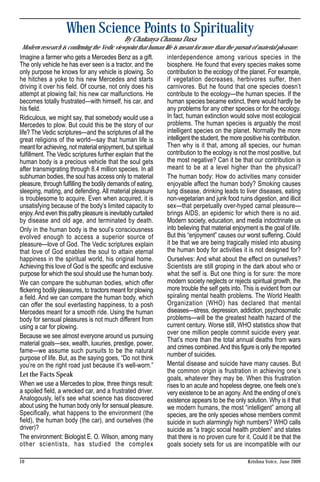
When Science Points to Spirituality
                                              By Chaitanya Charana Dasa
Modern research is confirming the Vedic viewpoint that human life is meant for more than the pursuit of material pleasure.
Imagine a farmer who gets a Mercedes Benz as a gift.            interdependence among various species in the
The only vehicle he has ever seen is a tractor, and the         biosphere. He found that every species makes some
only purpose he knows for any vehicle is plowing. So            contribution to the ecology of the planet. For example,
he hitches a yoke to his new Mercedes and starts                if vegetation decreases, herbivores suffer, then
driving it over his field. Of course, not only does his         carnivores. But he found that one species doesn’t
attempt at plowing fail; his new car malfunctions. He           contribute to the ecology—the human species. If the
becomes totally frustrated—with himself, his car, and           human species became extinct, there would hardly be
his field.                                                      any problems for any other species or for the ecology.
Ridiculous, we might say, that somebody would use a             In fact, human extinction would solve most ecological
Mercedes to plow. But could this be the story of our            problems. The human species is arguably the most
life? The Vedic scriptures—and the scriptures of all the        intelligent species on the planet. Normally the more
great religions of the world—say that human life is             intelligent the student, the more positive his contribution.
meant for achieving, not material enjoyment, but spiritual      Then why is it that, among all species, our human
fulfillment. The Vedic scriptures further explain that the      contribution to the ecology is not the most positive, but
human body is a precious vehicle that the soul gets             the most negative? Can it be that our contribution is
after transmigrating through 8.4 million species. In all        meant to be at a level higher than the physical?
subhuman bodies, the soul has access only to material           The human body: How do activities many consider
pleasure, through fulfilling the bodily demands of eating,      enjoyable affect the human body? Smoking causes
sleeping, mating, and defending. All material pleasure          lung disease, drinking leads to liver diseases, eating
is troublesome to acquire. Even when acquired, it is            non-vegetarian and junk food ruins digestion, and illicit
unsatisfying because of the body’s limited capacity to          sex—that perpetually over-hyped carnal pleasure—
enjoy. And even this paltry pleasure is inevitably curtailed    brings AIDS, an epidemic for which there is no aid.
by disease and old age, and terminated by death.                Modern society, education, and media indoctrinate us
Only in the human body is the soul’s consciousness              into believing that material enjoyment is the goal of life.
evolved enough to access a superior source of                   But this “enjoyment” causes our worst suffering. Could
pleasure—love of God. The Vedic scriptures explain              it be that we are being tragically misled into abusing
that love of God enables the soul to attain eternal             the human body for activities it is not designed for?
happiness in the spiritual world, his original home.            Ourselves: And what about the effect on ourselves?
Achieving this love of God is the specific and exclusive        Scientists are still groping in the dark about who or
purpose for which the soul should use the human body.           what the self is. But one thing is for sure: the more
We can compare the subhuman bodies, which offer                 modern society neglects or rejects spiritual growth, the
flickering bodily pleasures, to tractors meant for plowing      more trouble the self gets into. This is evident from our
a field. And we can compare the human body, which               spiraling mental health problems. The World Health
can offer the soul everlasting happiness, to a posh             Organization (WHO) has declared that mental
Mercedes meant for a smooth ride. Using the human               diseases—stress, depression, addiction, psychosomatic
body for sensual pleasures is not much different from           problems—will be the greatest health hazard of the
using a car for plowing.                                        current century. Worse still, WHO statistics show that
                                                                over one million people commit suicide every year.
Because we see almost everyone around us pursuing
                                                                That’s more than the total annual deaths from wars
material goals—sex, wealth, luxuries, prestige, power,
                                                                and crimes combined. And this figure is only the reported
fame—we assume such pursuits to be the natural
                                                                number of suicides.
purpose of life. But, as the saying goes, “Do not think
you’re on the right road just because it’s well-worn.”          Mental disease and suicide have many causes. But
                                                                the common origin is frustration in achieving one’s
Let the Facts Speak
                                                                goals, whatever they may be. When this frustration
When we use a Mercedes to plow, three things result:            rises to an acute and hopeless degree, one feels one’s
a spoiled field, a wrecked car, and a frustrated driver.        very existence to be an agony. And the ending of one’s
Analogously, let’s see what science has discovered              existence appears to be the only solution. Why is it that
about using the human body only for sensual pleasure.           we modern humans, the most “intelligent” among all
Specifically, what happens to the environment (the              species, are the only species whose members commit
field), the human body (the car), and ourselves (the            suicide in such alarmingly high numbers? WHO calls
driver)?                                                        suicide as “a tragic social health problem” and states
The environment: Biologist E. O. Wilson, among many             that there is no proven cure for it. Could it be that the
other scientists, has studied the complex                       goals society sets for us are incompatible with our

10                                                                                                  Krishna Voice, June 2009
selves and invite the frustration that leads to mental       and habits. Patrick Glynn of George Washington
health problems and ultimately suicide?                      University writes in his book God: The Evidence that
See and Believe                                              surveys show that those who don’t attend spiritual
                                                             prayer meetings are four times more prone to suicide
How does channeling human energy for spiritual
                                                             than those who do so. Further, the giving up of such
elevation affect ecology, human health, and the self?
                                                             meetings has been found to be the best predictor of
Lets see what science says.
                                                             suicide, better even than unemployment. These findings
Ecology: Most environmental problems have arisen             indicate that spirituality provides inner joy, which frees
from the materialism and consumerism that has                people from the uncontrollable and insatiable craving
accompanied the decline of spirituality and its inherent     for external pleasures that leads to addictions and
self-restraint. Therefore the following quote from Alan      suicides. Such findings have inspired some modern
Durning of the World Watch Institute represents what         thinkers to echo the Vedic conclusion that spirituality
many scientists consider to be the only hope for saving      is not just a part of our life; it is the essence of our life.
the environment: “In a fragile biosphere, the ultimate       Stephen Covey, well-known author of the Seven Habits
fate of humanity may depend on whether we can                series, aptly remarks, “We are not human beings on a
cultivate a deeper sense of self-restraint, founded on       spiritual journey. We are spiritual beings on a human
a widespread ethic of limiting consumption and finding       journey.”
non-material enrichment.” All forms of non-material
                                                             What Are We Waiting For?
enrichment—prayer, meditation, yoga, chanting the
holy names—clearly point to a spiritual dimension to         Science is clearly showing that human life spent for
life. And this spiritual dimension is most comprehensively   material enjoyment is ecologically, physically, and
explained in the Vedic scriptures. In fact, the Vedanta-     spiritually disharmonious and disastrous. Science is
sutra begins with a clarion call: athato brahma jijnasa,     also strongly indicating that when we strive for spiritual
“Now therefore [now that you have a human body],             happiness, we benefit our planet and our body too. The
devote yourself to spiritual enquiry.” (Vedanta-sutra        Vedic scriptures offer us a balanced program of material
1.1)                                                         regulation and spiritual growth for achieving the highest
                                                             potential of human life. Bhagavad-gita (6.17) states
Human health: The current epidemic of indulgence-
                                                             that regulation in eating, sleeping, work, and recreation,
born diseases shows that universal scriptural injunctions
                                                             coupled with spiritual practices, paves the way to
for self-restraint—sobriety (no intoxication) and
                                                             freedom from all material miseries. The most potent
continence (no illicit sex), for example—are sound
                                                             and practical spiritual practice for the modern age is
health advice too. Herbert Benson of the Harvard
                                                             the chanting of the Hare Krishna maha-mantra. By
Medical School, citing extensive research on the physical
                                                             chanting we can achieve a state of happiness that will
and mental benefits of spiritual living, states that the
                                                             fully satisfy us, and we will never be disturbed by any
human body and mind are “wired for God.” Not only
                                                             material upheaval. (Bhagavad-gita 6.22)
that, a survey published in Reader’s Digest (January
2001) stated that believers in God live an average of        It’s time to stop using the Mercedes for plowing. It’s
eleven years more than nonbelievers.                         time to put our human vehicle into gear by chanting
                                                             Hare Krishna. Then we can speed along the highway
The self: And what about the self? Science has come
                                                             of devotional service, back to our long-lost home with
up with a precious finding: spirituality is a sure solace
                                                             Krishna.
for the self. Survey after survey has shown that spiritual
practices protect people from self-destructive behavior


Krishna Voice, June 2009                                                                                                11
“The Bhagavad-gita teaches a pantheistic view of God,”                                                                                                                                              to reconcile monotheism and pantheism. From a
he said, his confidence and years of learning clear from
his authoritative tone. “The massive vishvarupa—Krishna’s
universal form, which encompasses all material
                                                                Defining the Divine, East and West                      By Satyaraja Dasa
                                                                                                                                                                                                    Vaishnava point of view, panentheism has some
                                                                                                                                                                                                    redeeming features. For example, Krishna says in the
                                                                                                                                                                                                    Bhagavatam (11.15.35–36), “I exist within everything as
phenomena, including time—tells us much about God in                                                                                                                                                the Supersoul and outside of everything in My all-pervading
the Gita.”                                                      that all other forms of reality are either modes (or               enable the less intelligent [and neophytes] to adjust to         feature.” The Gita (6.30) encourages us to see everything
                                                                appearances) of it or identical with it.”                          the idea of the Lord’s having form. But factually the Lord       in Krishna and Krishna in everything: yo mam pashyati
His friend, another scholar of some renown, seemed to
                                                                                                                                   has no material form.” Thus, the universal manifestation         sarvatra sarvam ca mayi pashyati. And the Brahma-
disagree.                                                       This is clearly a Western articulation of God as Brahman.
                                                                                                                                   of the Supreme is meant to take practitioners from an            samhita (5.35) tells us, “All universes exist in Him [Krishna],
“The Gita goes beyond pantheism. It shows us how to             The Vedas describe Brahman as a transcendent                                                                                        and He is present in His fullness in every atom.” Clearly
                                                                                                                                   impersonal understanding of the Absolute to a more
perceive God in all things. The Tenth Chapter, especially,      impersonal divinity. The Rig Veda, in particular, tells us                                                                          these are all panentheistic statements.
                                                                                                                                   developed, personal conception of Lord, and to help them
shows us how Krishna is the superlative exemplar in             in a prayer known as the Purusha-sukta (10.90.4) that
                                                                                                                                   realize that while He has no material form, He does have         Now, for God to fit within everything He would have to
seventy categories, how He exists in the perceivable            Brahman, here in a more personalized form, expanded
                                                                                                                                   a spiritual form.                                                be smaller than the smallest, and for everything to fit
world.”                                                         a portion of Himself as the created world, where He exists,
                                                                without personality or form, as its essence. This is perhaps       Because this universal vision of the Lord equates God            within Him, He would have to be larger than the largest.
A third colleague gave his considered opinion as well:          the earliest reference to pantheism—even if it doesn’t             with the phenomenal world—that is, as being wholly               He would have to simultaneously be both, inconceivably.
“The Gita ultimately teaches bhakti, devotion to Krishna,       use that word—in any religious literature, East or West.           amalgamated with, or inseparable from, visible nature—           In fact, this is precisely how He is described in numerous
the supreme personal Deity. In this sense, it is not unlike                                                                        it is a form of pantheism, and one needs to go further to        scriptural passages. The Svetashvatara Upanishad (3.9),
the great monotheistic traditions of the West. I think you’ve   In the Gita, one can find hints of pantheism (specifically                                                                          for example, tells us that God is smaller than the smallest
                                                                                                                                   understand God’s spiritual nature. A pantheist who fails
both missed the point.”                                         God’s oneness with the universe) in the Seventh Chapter,                                                                            and larger than the largest (anor aniyan mahato mahiyan).
                                                                                                                                   to look beyond the complex, majestic manifestations of
                                                                where Krishna identifies Himself with various material                                                                              The Gita tells us that God is both the smallest (anor
I was attending a panel discussion at a conference of the                                                                          matter may even be regarded as atheistic, having
                                                                phenomena: He is the taste of water, the light of the sun                                                                           aniyamsam, 8.9) and the greatest (vibhum, 10.12), and
American Academy of Religion, and as I sat back and                                                                                overlooked their all-attractive, transcendent, personal
                                                                and the moon, the sound in ether, the ability in man, and                                                                           it also reveals that all beings are in Krishna (mat-sthani-
listened, I noted that all three scholars were correct, each                                                                       source.
                                                                so on. A closer look, however, shows that these are                                                                                 sarva-bhutani, 9.4).
in his own way. I considered deeply their individual            manifestations of His energy and He stands quite apart             That being said, a more liberal view of pantheism can
perspectives, and I realized something: The Gita has it         from them. Still, He does say that He is, in a sense,              also be found in the teachings of the Gita. Srila                The alternate side of the same concept, that God is within
all!                                                            everything that exists (vasudevah sarvam iti), and the             Prabhupada writes:                                               everything, brings us to the subject of Paramatma.
In the West, theologians tend to speak of God in three          Gita’s Ninth Chapter tends to confirm this fact. (See texts                                                                         Panentheism, in this case, might be considered a Western
                                                                                                                                   “Pantheism in its higher status does not permit the student      equivalent for Paramatma realization, wherein one views
ways, using the terms pantheism, panentheism, and               4, 5, 6, 16–18.)
                                                                                                                                   to form an impersonal conception of the Absolute Truth,          Krishna (or His expansion Vishnu) as all-pervading—
monotheism, with a few variations in between. That is to        The Lord elucidates His all-pervasive nature again in              but it extends the conception of the Absolute Truth into
say, Western theology speaks of God (1) as impersonal,                                                                                                                                              existing within every human heart and, indeed, within
                                                                Chapter Ten, identifying Himself with the best of everything:      the field of the so-called material energy. Everything           every atom. This is a more localized, personal feature of
diffused throughout all we see and beyond, or as nature         He is Shiva, the ocean, the lion, Garuda, the Himalayas,           created by the material energy can be dovetailed with
itself, (2) as existing both within and outside everything,                                                                                                                                         the Lord, as compared with the pantheistic Brahman
                                                                the letter A, inexhaustible time, Brahma, truth itself, victory,   the Absolute by an attitude of service, which is the essential   conception. But all is not so easy.
or (3) as the Supreme Being, omnipotent, omniscient,            adventure, and so on. But clearly, again, this is not all          part of the living energy. The pure devotee of the Lord
and all the rest.                                               there is to Krishna, and He says so Himself by describing          knows the art of converting everything into its spiritual        There are differences between panentheism, as commonly
Those familiar with Srila Prabhupada’s Bhagavad-gita            all of the above, and more, as a “mere indication” of His          existence by this service attitude, and only in that             understood, and the Vaishnava conception of Paramatma.
As It Is will immediately recognize the correlation between     glory (esha tuddeshatah proktah, 10.40) and but a spark            devotional way can the theory of pantheism be perfected.”        While the similarity of “God in all” exists in both, Paramatma
these conceptions of God and Brahman, Paramatma,                of His splendor (mama tejo ’msha-sambhavam, 10.41).                                                                                 goes much further, putting a “face” on panentheism’s
                                                                                                                                   (Srimad-Bhagavatam 2.1.20, Purport)                              God. The critical factor here is form. Both the Gita and
and Bhagavan, the three levels of Godhead expressed             A pantheistic view seems somewhat more apparent in
most succinctly in the Srimad-Bhagavatam (1.2.11):                                                                                 Here Prabhupada suggests that the pantheistic perspective        the Bhagavatam (2.2.9–11), especially, are quite specific
                                                                the Gita’s Eleventh Chapter, wherein the Lord reveals                                                                               about Vishnu as He appears in every atom: “He has four
“Learned transcendentalists who know the Absolute Truth                                                                            may be an imperfect preliminary stage that can lead to
                                                                His Universal Form (vishvarupa). Details of this form                                                                               hands carrying a lotus, a wheel of a chariot, a conch
call this nondual substance Brahman, Paramatma, and                                                                                a more mature or complete realization of the Absolute
                                                                appear in the Srimad-Bhagavatam, Second Canto,                                                                                      shell, and a club, respectively. His mouth expresses His
Bhagavan.”                                                                                                                         Truth as something far greater than can be found in
                                                                particularly in chapters one and six. Here we learn that                                                                            happiness. His eyes spread like the petals of a lotus, and
                                                                                                                                   material nature. This correlates with the Vaishnava view
Pantheism and Brahman                                           “the gigantic manifestation of the phenomenal material                                                                              His garments, yellowish like the saffron of a kadamba
                                                                                                                                   of Brahman realization as a low-rung, impersonal
                                                                world as a whole is the personal body of the Absolute                                                                               flower, are bedecked with valuable jewels, and He wears
Pantheism is understood in several related ways. First                                                                             conception of God.
                                                                Truth . . .” (2.1.24), and that, “the sphere of outer space                                                                         a glowing headdress and earrings.”
of all, pantheism equates God with nature, saying that          constitutes His eye pits, and the eyeball is the sun as the        Panentheism and Paramatma
He exists as everything and that everything is God. In          power of seeing. His eyelids are both the day and night,                                                                            Moreover, while the panentheistic view holds that
Greek, pan = all, and theos = God. According to this view,                                                                         While the Gita views pantheism as immature or incomplete,        everything is in God and sometimes that God is in
                                                                and in the movements of His eyebrows, Lord Brahma                  it more readily embraces a panentheistic view, seeing all
the universe, including all matter and energy, is a             and similar personalities reside.” (2.1.31) In this way the                                                                         everything, it is never quite clear about the relationship
metaphysical entity that is more than what we perceive.                                                                            things as imbued with God’s presence and all things as           between God perceived in nature and the transcendent
                                                                Bhagavatam goes on to deliver an elaborate meditation              being in God as well. As opposed to pantheism, which
The pantheistic “God”—both impersonal and nontheistic           on the Absolute, allowing practitioners to virtually “see”                                                                          being who is the source of all we see.
(if we consider the usual sense of theism)—is entirely                                                                             sees God as everything, panentheism sees God in
                                                                Him in the material world.                                         everything (pan = all, en = in, and theos = God) or              The Bhagavatam and the Gita give us a much more
immanent, or close by, if only we had the eyes to see it.
                                                                However, the Bhagavatam (1.3.30) is clear: “The                    everything in God. The word is used in both ways.                developed, or shall we say sophisticated, idea about this
The doctrine of pantheism often goes further, espousing         conception of the virat universal form of the Lord, as                                                                              source. Those Vaishnava texts tell us that Krishna is the
“a belief that every existing entity is only one Being, and                                                                        The term panentheism is attributed to German philosopher         root of all divine manifestations and that Paramatma is
                                                                appearing in the material world, is imaginary. It is to            Karl Christian Friedrich Krause (1781–1832), who wanted
12                                                                                                Krishna Voice, June 2009             Krishna Voice, June 2009                                                                                                 13
an emanation from that original source, partaking fully       this, Graham M. Schweig, associate professor of
of His transcendent nature. The omnipotent Supreme            religious studies at Christopher Newport University,
Person can reproduce His essential being by appearing         Virginia, calls the Gita’s Vaishnavism “polymorphic
in “an extended personal form of Himself,” as                 monotheism,” that is, a theology that recognizes many
Prabhupada describes Paramatma. Thus, if we may               forms (ananta-rupa) of the one, single, unitary divinity.
offer new terminology to the Western theological
                                                              Since it is here stated that God has many forms, one
tradition, let us call the theology of Paramatma “Personal
                                                              could superficially accuse the tradition of polytheism.
Extensionism.” This differs both from the view that God
                                                              But those who understand the tradition well know that
is in one sense identical with all that is (pantheism) and
                                                              it hereby merely acknowledges God’s capacity to be
that He is impersonally within all things we see
                                                              in many places and forms at the same time. This is not
(panentheism). But this is still not monotheism proper.
                                                              to say that all forms are God’s. The Vedic literature is
Monotheism and Bhagavan                                       quite clear about what constitutes a form of the Supreme
                                                              Lord, and only those are to be worshiped.
When scholars talk about “the three great monotheistic
traditions,” they are usually not talking about               The Gita promotes the worship of one Supreme
Vaishnavism or the tradition of the Bhagavad-gita.            Personality of Godhead, also known as Bhagavan.
Rather, they are talking about Judaism, Christianity,
                                                              But the monotheistic worship of Bhagavan, lovingly
and Islam. But if they would look just a little beneath
                                                              adored as Krishna or Vishnu, is unique in the history
the surface, they would perhaps find the earliest
                                                              of religions, for here we actually get to see, or visualize,
monotheistic tradition.
                                                              the Lord of our prayers. If the scriptures place a face
True, one should be cautious when applying the terms          on Paramatma, as He exists within every atom, they
of one set of religious traditions to another with its own    do so much more for Sri Krishna. Devotees become
history, insights, and ways of thinking about spirituality.   privy to His numerous ecstatic features and His day-
People who identify with the Judeo-Christian tradition        to-day activities with eternal associates in the spiritual
have very particular ideas in mind when they refer to         world.
monotheism, and that should be respected. The same
                                                              Three Aspects of the Same Truth
might be said about the terms pantheism and
panentheism. But given that caveat, the God of the            I would agree with the three scholars mentioned in the
Gita is clearly a Supreme Being and the recipient of          beginning of this article, accepting their diverse views.
monotheistic worship: Krishna is described as God of          Like the first of these well-meaning men, I acknowledge
gods (10.14), the origin of all other gods (10.12), the       that the Gita promotes a type of pantheism, God’s
primeval person (11.38), the Lord of the worlds (5.29),       presence as a metaphysical dimension of nature. But
the creator and sustainer of everything (8.9), and on         I would hasten to add that the Gita’s pantheism goes
and on. As Krishna says, no one is equal to or greater        beyond the kind we usually hear about in the West. It
than Him (11.43).                                             shows us that there is a person behind the divinity
                                                              perceivable in the natural world. I agree, too, that the
Krishna’s supremacy is so blatant, in fact, that one
                                                              Gita shows us a form of panentheism, sharing with its
wonders why there would be any question at all. Perhaps
                                                              readers God’s immanence and how we might perceive
it is because He is contrasted with other gods—
                                                              that immanence in our day-to-day lives. And finally, of
demigods, or specially empowered beings—who serve
                                                              course, I agree with the third scholar most of all—that
as universal administrators. Indeed, this is why various
                                                              the Gita’s ultimate teaching is bhakti, or devotion to a
forms of Indian religion are often described as
                                                              Supreme Personal Godhead. This is the Gita’s crowning
polytheistic, or endorsing the worship of many gods.
                                                              glory.
But, at least in terms of the Gita, such charges cannot
stand. Though other gods may exist, Krishna is clearly        What I disagree with is how the three scholars address
supreme.                                                      the Gita’s diversity. The Gita gives us several views of
                                                              God, all legitimate and each revealing different aspects
Biblical scholars might want to stop us here, claiming
                                                              of the divine. It’s not that if one of these aspects is
that, since other gods are even acknowledged, the
                                                              correct then the others must be wrong. Rather, the Gita
Gita’s religion is not really monotheism in the traditional
                                                              revels in multi-faceted reality, taking its readers from
sense of the word. It should be remembered, however,
                                                              fundamental conceptions of the Absolute Truth to
that early Israelite tribes practiced “monolatry” as
                                                              Krishna, the Supreme Personality of Godhead.
opposed to strict monotheism: they worshiped one
Supreme God among many. And besides, as already               Brahman, Paramatma, and Bhagavan are three aspects
stated, we use the term monotheism with caution.              of that same Truth, manifesting variously according to
                                                              the realization and wisdom of the practitioner. Those
It should also be noted that the Gita’s monotheism is
                                                              who approach God through knowledge tend to realize
distinct, deserving terminology of its own. Apropos of
14                                                                                                Krishna Voice, June 2009
His eternality aspect, and in perfection this is Brahman    3 One who sees “God as all” (pantheism) could easily
realization. Yogis and mystics meditate on the Lord in      make the common mistake of identifying oneself with
the heart, and the highest point of such meditation is      God, since every individual is clearly part of “all.”
called Paramatma realization. This is where one realizes    Similarly, one who sees “God in all” (panentheism)
not only eternality but the ultimate end of all knowledge   might just as easily see the divine in oneself and
as well. Finally, the highest and most inclusive theistic   mistakenly identify with God. But one who has these
pursuits culminate in devotion to God. Those who adopt      realizations along with Bhagavan realization, worshiping
this process focus on Bhagavan, the worship of whom         God in a spirit of monotheism, is less likely to fall prey
leads to divine love. Here one reaps the benefit of all     to this misconception.
other processes, affording the practitioner the zenith
of not only eternity and knowledge, but bliss as well.      4 Graham M. Schweig, “Krishna, the Intimate Divinity,”
This is the best that pantheism, panentheism, and           in Edwin F. Bryant and Maria L. Ekstrand, eds., 2004.
monotheism have to offer.                                   The Hare Krishna Movement: The Postcharismatic
1 H. P. Owen. 1971. Concepts of Deity (London:              Fate of a Religious Transplant (New York: Columbia
Macmillan).                                                 University Press).
2 Philip Clayton and Arthur Peacocke, eds. 2004. In         5 Ultimately, as Dr. Schweig points out, the tradition
Whom We Live and Move and Have Our Being:                   can be seen as polymorphic bi-monotheism, since it
Panentheistic Reflections on God’s Presence in a            acknowledges a dual-gendered divinity whose ultimate
Scientific World (Grand Rapids, MI.: Eerdmans).             manifestation is Sri Sri Radha-Krishna. See ibid.

                Fasting                                                     Festivals
        Jun 19     Ekadashi                                 Jun 22     Srila Bhaktivinoda Thakura -
        Jun 20     break fast                                          Disappearance
                                                                       fasting till noon
        Jul 3      Ekadashi
        Jul 4      break fast                               Jun 24     Jagannatha Puri Ratha Yatra


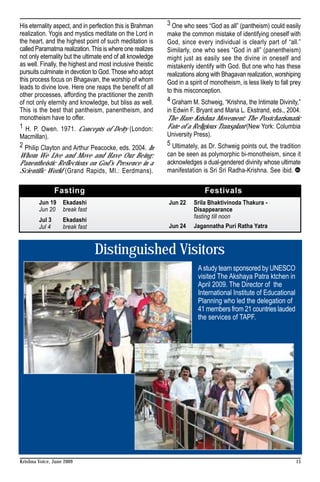
                                Distinguished Visitors
                                                                         A study team sponsored by UNESCO
                                                                         visited The Akshaya Patra ktchen in
                                                                         April 2009. The Director of the
                                                                         International Institute of Educational
                                                                         Planning who led the delegation of
                                                                         41 members from 21 countries lauded
                                                                         the services of TAPF.


Krishna Voice, June 2009                                                                                           15
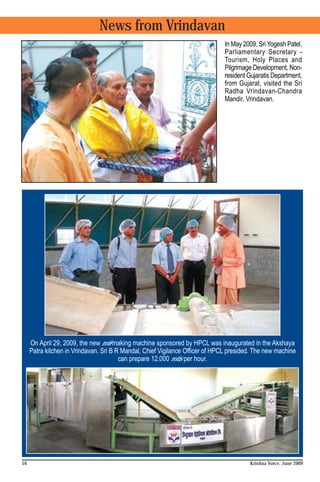
News from Vrindavan
                                                                               In May 2009, Sri Yogesh Patel,
                                                                               Parliamentary Secretary -
                                                                               Tourism, Holy Places and
                                                                               Pilgrimage Development, Non-
                                                                               resident Gujaratis Department,
                                                                               from Gujarat, visited the Sri
                                                                               Radha Vrindavan-Chandra
                                                                               Mandir, Vrindavan.


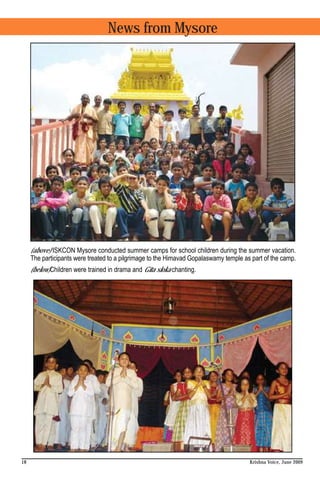
     On April 29, 2009, the new roti-making machine sponsored by HPCL was inaugurated in the Akshaya
     Patra kitchen in Vrindavan. Sri B R Mandal, Chief Vigilance Officer of HPCL presided. The new machine
                                        can prepare 12,000 rotis per hour.


16                                                                                      Krishna Voice, June 2009
News from Mysore


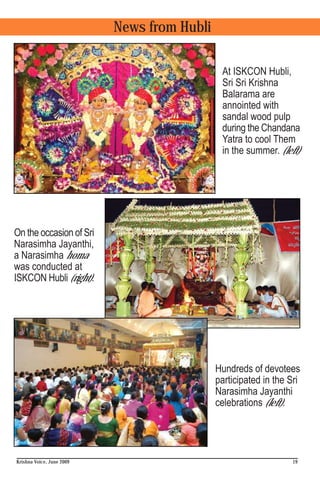
     (above) ISKCON Mysore conducted summer camps for school children during the summer vacation.
     The participants were treated to a pilgrimage to the Himavad Gopalaswamy temple as part of the camp.
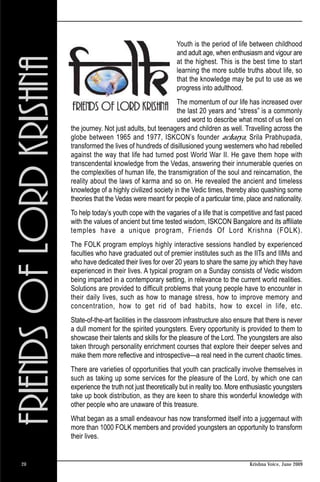
     (below)Children were trained in drama and Gita sloka chanting.


18                                                                                     Krishna Voice, June 2009
News from Hubli

                                              At ISKCON Hubli,
                                              Sri Sri Krishna
                                              Balarama are
                                              annointed with
                                              sandal wood pulp
                                              during the Chandana
                                              Yatra to cool Them
                                              in the summer. (left)


On the occasion of Sri
Narasimha Jayanthi,
a Narasimha homa
was conducted at
ISKCON Hubli (right).


                                             Hundreds of devotees
                                             participated in the Sri
                                             Narasimha Jayanthi
                                             celebrations (left).


Krishna Voice, June 2009                                          19
Youth is the period of life between childhood
                                               and adult age, when enthusiasm and vigour are
                                               at the highest. This is the best time to start
                                               learning the more subtle truths about life, so
                                               that the knowledge may be put to use as we
                                               progress into adulthood.
                                              The momentum of our life has increased over
                                              the last 20 years and “stress” is a commonly
                                              used word to describe what most of us feel on
     the journey. Not just adults, but teenagers and children as well. Travelling across the
     globe between 1965 and 1977, ISKCON’s founder acharya, Srila Prabhupada,
     transformed the lives of hundreds of disillusioned young westerners who had rebelled
     against the way that life had turned post World War II. He gave them hope with
     transcendental knowledge from the Vedas, answering their innumerable queries on
     the complexities of human life, the transmigration of the soul and reincarnation, the
     reality about the laws of karma and so on. He revealed the ancient and timeless
     knowledge of a highly civilized society in the Vedic times, thereby also quashing some
     theories that the Vedas were meant for people of a particular time, place and nationality.
     To help today’s youth cope with the vagaries of a life that is competitive and fast paced
     with the values of ancient but time tested wisdom, ISKCON Bangalore and its affiliate
     temples have a unique program, Friends Of Lord Krishna (FOLK).
     The FOLK program employs highly interactive sessions handled by experienced
     faculties who have graduated out of premier institutes such as the IITs and IIMs and
     who have dedicated their lives for over 20 years to share the same joy which they have
     experienced in their lives. A typical program on a Sunday consists of Vedic wisdom
     being imparted in a contemporary setting, in relevance to the current world realities.
     Solutions are provided to difficult problems that young people have to encounter in
     their daily lives, such as how to manage stress, how to improve memory and
     concentration, how to get rid of bad habits, how to excel in life, etc.
     State-of-the-art facilities in the classroom infrastructure also ensure that there is never
     a dull moment for the spirited youngsters. Every opportunity is provided to them to
     showcase their talents and skills for the pleasure of the Lord. The youngsters are also
     taken through personality enrichment courses that explore their deeper selves and
     make them more reflective and introspective—a real need in the current chaotic times.
     There are varieties of opportunities that youth can practically involve themselves in
     such as taking up some services for the pleasure of the Lord, by which one can
     experience the truth not just theoretically but in reality too. More enthusiastic youngsters
     take up book distribution, as they are keen to share this wonderful knowledge with
     other people who are unaware of this treasure.
     What began as a small endeavour has now transformed itself into a juggernaut with
     more than 1000 FOLK members and provided youngsters an opportunity to transform
     their lives.


20                                                                          Krishna Voice, June 2009
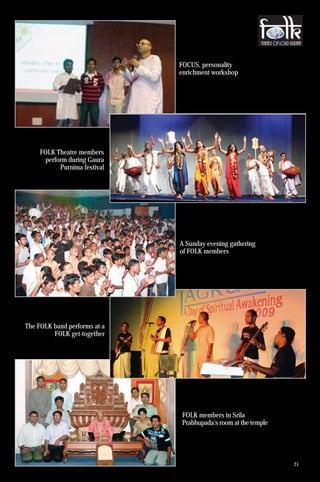
FOCUS, personality
                              enrichment workshop


    FOLK Theatre members
      perform during Gaura
           Purnima festival


                              A Sunday evening gathering
                              of FOLK members


The FOLK band performs at a
         FOLK get-together


                              FOLK members in Srila
                              Prabhupada’s room at the temple


                                                                21
There are a million reasons to participate in our programmes!
                                  In order to guide the youth to find the way to a peaceful,
                                  meaningful and rewarding life and overcome dissatisfaction,
                                  quarrels, stress and other negative emotions.
                                  programmes bring the wisdom of ancient India will fill this
                                  need. The personality enrichment workshops, based on
                                  these ancient texts, enable individuals from all walks of
                                  life to become more focused, cultivate positive value
     systems, develop interpersonal skills, increase operational skills and enhance personal
     growth.
     Presently there are many programmes like Focus, Yoga Retreat, Art of Mind Control,
     Secrets of Success etc.
     FOLK hostels are now open at multiple locations
     across the city, offering affordable accommodation to
     bachelors who wish to stay with like-minded people
     in an environment that is friendly, encouraging and
     cultured. A boon for people who want to make their
     life meaningful and are interested in higher taste and
     good values, these residential havens help the youth
     develop emotional balance and hence concentrate
     better on their studies / work as they will learn to manage stress better.
     The delicious vegetarian cuisine — prepared with utmost cleanliness and served with love
     three times a day, is a delight.
     FOLK hostel members live a healthy lifestyle in a no-smoke, no-drink environment. They
     have access to spiritual practices which reduce the anxiety levels and hence help direct
     their energy effectively.
     Living with people from diverse backgrounds gives them an opportunity to improve
     communication skills, learn new languages, to share resources and hence build relationships.
     They also encourage the youth to develop training and teaming skills.
                                             FOLK has its own interesting website
                                             www.folknet.in. There are articles on Lord Krishna,
                                             Bhagavad-gita As It Is, Srila Prabhupada, science
                                             and spirituality and so on. A visitor can download
                                             Srila Prabhupada’s kirtanas, lectures and videos,
                                             daily quotes and wallpapers. There is also a gallery
                                             with pictures of festivals and FOLK events.
     FOLK Forum www.folknet.in/forum
     The FOLK programme services include an online forum where one can get their philosophical
     queries answered. The queries are classified under various threads. These queries can
     be viewed by all registered users.
     Comments about FOLK events, the philosophy of Krishna Consciousness etc can be also
     posted on this forum.
     FOLK Newsletter
     There is also a fortnightly online FOLK newsletter which has updates on ISKCON Bangalore’s
     festivals and other events.
     For more information on the FOLK programmes, please contact: folk@folknet.in
     OR 9902830818
22                                                                          Krishna Voice, June 2009
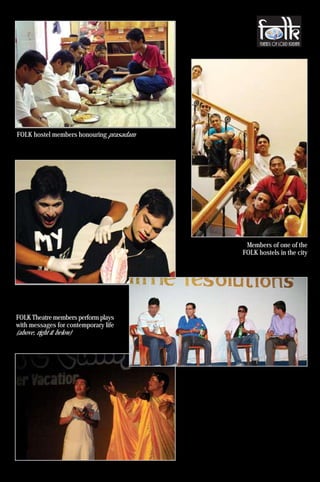
FOLK hostel members honouring prasadam


                                          Members of one of the
                                         FOLK hostels in the city


FOLK Theatre members perform plays
with messages for contemporary life
(above, right & below)


                                                            39
Krishna Voice Monthly Magazine, June 2009 Vol10, No.6 Price Rs 15/-
     Posted on 5th or 10th of the Month at MBC, Manipal, License to post without prepayment No. WPP(CO-8), Reg No. KA/BGGPO
     2521/ 2009-11, Registered with Registrar of Newspapers for India under No. RNI 71022/99, Posted at MBC, Manipal, 576104.


24

Madhu Pandit - Krishna voice 2009 06(jun)

  • 1.
    Vol 10, No.6 June 2009 Rs.15
  • 2.
    ISKCON’S SRI SRIKRISHNA BALARAMA RATHA YATRA IN JAYANAGAR May 23, 2009 The ratha is drawn through the streets of Jayanagar by eager devotees who came out in throngs to see Their Lordships and offer their prayers and devotion. At the inaugural ceremony, Guest of Honour Sri Vijay Kumar (MLA Jayanagar) and Sri R Ashok (H’ble Minister for Transport, Govt of Karnataka) with Sri Madhu Pandit Dasa (President, ISKCON Bangalore) and other senior ISKCON devotees. Chief Guest Sri Ananth Kumar (H’ble MP, Lok Sabha, Bangalore South) delivers the inaugural speech
  • 3.
    Vol 10, No.6 June 2009 CONTENTS The Soul’s Fall 4 Srila Prabhupada Speaks Out 8 When Science Points to Spirituality 10 Defining the Divine, East and West 12 His Divine Grace A. C. Bhaktivedanta Swami Prabhupada, Founder- Acharya of the International Society for Krishna Consciousness, came to Please chant... America in 1965, at age 69, to fulfill Hare Krishna Hare Krishna Krishna Krishna Hare Hare Hare Rama Hare Rama Rama Rama Hare Hare his spiritual master’s request that he ...and be happy! teach the science of Krishna consciousness throughout the English- Published and owned by Sankirtana Seva Trust, speaking world. In a dozen years he editing by Chamari Devi Dasi. published some seventy volumes of Layout, design and graphics by ISKCON Design translation and commentary on India’s Group, Bangalore. Vedic literature, and these are now For all information contact: Editor, Krishna standard in universities worldwide. Voice, SST, Hare Krishna Hill, Chord Road, Bangalore - 560 010 INDIA Phone: 91-80-2347 Meanwhile, travelling almost nonstop, 1956, 91-80-2357 8346 Fax: 91-80-2357 8625. Srila Prabhupada moulded his © 2009 Sankirtana Seva Trust, Bangalore. All international society into a world wide Krishna art and the works of Srila Prabhupada confederation of ashramas, schools, are © BBT International. temples and farm communities. He All rights reserved throughout the world. passed away in 1977, in Vrindavana, Reproduction in any manner is strictly prohibited. the place most sacred to Lord Krishna. Printed for ISKCON, Bangalore, at Manipal His disciples and followers are carrying Printers (P) Ltd., Manipal. forward the movement he started. Cover pages-4 Text pages-20 Krishna Voice, June 2009 3
  • 5.
    The Soul's Fall Responding to our desire, Krishna gives us a chance to forget Him. A lecture given in Tokyo, on April 20, 1972 by His Divine Grace A.C. Bhaktivedanta Swami Prabhupada Founder-Acharya of the International Society for Krishna Consciousness sri-suka uvaca atma-mayam rte rajan parasyanubhavatmanah na ghatetartha-sambandhah svapna-drastur ivanjasa Sri Sukadeva Gosvami said: O king, unless one is influenced by the energy of the Supreme Personality of Godhead, there is no meaning to the relationship of the pure soul in pure consciousness with the material body. That relationship is just like a dreamer's seeing his own body working. —Srimad-Bhagavatam 2.9.1 Many people inquire, "How did the living entity, who was with Krishna, fall into the material world?" That question is answered here. The living entity's condition is simply the influence of the material energy; actually he has not fallen. An example is given: The moon appears to be moving when clouds pass in front of it. Actually, the moon is not moving. Similarly, the living entity, because he is a spiritual spark of the Supreme, has not fallen. But he is thinking, "I am fallen. I am material. I am this body." The body has no connection with the soul. We can experience this. The body is changing, dying, but I am the same. The idea that we have a connection with the body is due to the handling of the illusory energy of Krishna. That illusory energy develops when we forget Krishna. In other words, our illusory identification with the body is simply due to our forgetfulness. We wanted to forget; we wanted to give up Krishna and enjoy the material world. Therefore Krishna is giving us the chance. For example, when you play a part in a drama, if you feel, "I am king," then you can talk very nicely. And if you feel, "I am Karandhara*," then you cannot play a king so nicely. The feelings must be there. If you are playing the part of a king, you must believe you are the king and have his courage. You have to forget that you are Karandhara. Then you can play the part very nicely, and the audience will appreciate. But if you think simultaneously, "I am Karandhara, and I am playing the part of the king," then you cannot play. So because we wanted to play the part of Krishna, the enjoyer, Krishna is giving us the chance—"You feel like Me." The feeling that "I am master, I am king, I am Krishna, I am God" is created by Krishna: "All right. You want to play the part of a king. I shall train you in such a way." The director of a play tries to create the feelings within you for the part you are playing. In my younger age I played in a drama about Lord Chaitanya. Our director, Amritlal Bose, repeatedly said, especially to me, "Feel like that." So when we performed under his direction, all the people in the audience were crying. The play was artificial, but the effect on the audience was so nice. Similarly, we have nothing to do with the material world, but we have been trained by the illusory energy in such a way that we think, "I am Indian," "I am American," "I am a brahmana," "I am a shudra," "I am this," "I am that," "I have to do this," "I have so many duties." These are all illusions. We have nothing to do with all this nonsense, but still we are taking it very seriously: "I have to do like that. I am this. I am that." That is explained here. Atmamayam rte rajan parasyanubhavat-manah: "Unless one is influenced by the energy of the Supreme Personality of Godhead, there is no meaning to the relationship of the pure soul in pure consciousness with the material body." The example is given of a man dreaming. "Oh, there is a tiger, a tiger! Save me!" He is crying. An awake man observing may say, "Where is the tiger? Why are you crying?" But the dreaming man is actually feeling, "The tiger has attacked me." Therefore this example is given: na ghatetartha-sambandhah. There cannot be any meaning of the relationship of the soul and the body except that it is like a dreaming man creating a situation. He is dreaming there is a tiger, and he is creating a fearful situation. Actually there is no cause of fear. There is no tiger. The situation is created by a dream. Similarly, we have created the material world and material activity. People are running around—"Oh, I am the *A disciple in the audience. Krishna Voice, June 2009 5
  • 6.
    manager. I amthe factory owner. I am this, I am that. We know his politics. We have to defeat our competitors." All these things are created just as a man creates a situation in a dream—svapna-drastur ivanjasa. So when someone asks, "When did we come into contact with the material nature?" the answer is that we have not come into contact. By the influence of the external energy we think we are in contact. Actually we are not fallen. We cannot be fallen. We have simply created a situation. Rather, we have not created a situation; Krishna has given us a situation. Because we wanted to imitate Krishna, Krishna has given an opportunity: "All right. You want to imitate. You want to be an imitation king on the stage. So feel like this. Play like this. Do like this. People will applaud—'Oh, a very nice king.' " Everyone in the material world is playing some part. "I want to be prime minister." "I want to become a very big business magnate." "I want to be a leader." "I want to be a philosopher." "I want to be a scientist." They are trying to play all these nonsense parts, and Krishna is giving the opportunity—"All right." But these things are all nonsense. Simply dreaming. When you dream, the next moment the dream is gone, and everything in the dream is finished. No more tiger, no more jungle. Similarly, as long as the body continues, I think, "I am a responsible leader. I am this. I am that." But as soon as the body is finished, these ideas are gone. Krishna says, mrtyu sarva-haras caham: "I am death. I take everything away." Just think of our past life. Suppose I was a king or something like that. From Bhrgu-samhita it was ascertained that I was a big physician in my last life, with a spotless character, no sins. I don't know. It may be. But I have no remembrance that I was a physician. So what do we know? I might have been a very big influential physician, with a good practice, but where is it all now? All gone. So our contact with matter is just like a dream. We are not fallen. Therefore, at any moment we can revive our Krishna consciousness. We become liberated as soon as we understand, "I have nothing to do with matter. I am simply Krishna's eternal servant." Sometimes when a fearful dream becomes intolerable, we break the dream. Similarly, we can break the material connection at any moment as soon as we come to the point of Krishna consciousness. "Oh, Krishna is my eternal master. I am His servant." That's all. That is the way. Actually we are not fallen. We cannot be fallen. The same example: Actually there is no tiger; it is dreaming. Similarly, our fallen condition is also dreaming. We are not fallen. We can simply give up that illusory condition at any moment. So if you study all these verses very nicely, you will get all this knowledge quickly. Now what is the purport? [A disciple reads:] "Maharaja Parikshit's question as to how a living entity began his material life, although he is apart from the material body and mind, is perfectly answered. The spirit soul is distinct from the material conception of his life, but he is absorbed in such a material conception because of being influenced by the external energy of the Lord, called atma-maya. This has been already explained in the First Canto in connection with Vyasadeva's realization of the Supreme Lord and His external energy. The external energy is controlled by the Lord and the living entities are controlled by the external energy." Prabhupada: Krishna says, mam eva ye prapadyante mayam etam taranti te: "As soon as one surrenders unto Me, he has no more illusion." People are conditioned, encaged. Mayavadis, or impersonalists, undergo austerities and penances just to become liberated. Yogis also try to become "one." So many endeavors are going on. But the simple process is that as soon as you surrender you are not fallen. "It was illusion. I was dreaming. I am Krishna's." By thinking in this way, one immediately becomes liberated. Immediately. Within a second. Liberation can be attained within a second, provided we abide by the order of Krishna. Sarva-dharman parityajya mam ekam saranam vraja. This is the position. We are not fallen. We are thinking we are fallen. So we have to give up this nonsense thinking. Then we are liberated. Is there any difficulty in understanding this point? Just see how important this verse is. It is already there, but you are not reading. Read each verse; read every day carefully. Try to assimilate, understand, and you will get more profit—every day a hundred yards forward. They are such important verses. How nicely composed by Vyasadeva! In two lines the whole thing is explained. This is called shastra. Read the purport. [The disciple reads:] "The external energy is controlled by the Lord, and the living entities are controlled by the external energy—by the will of the Lord. Therefore, although the living entity is purely conscious in his pure state, he is subordinate to the will of the Lord in being influenced by the external energy of the Lord. In the Bhagavad- gita (15.15) also the same thing is confirmed; the Lord is present within the heart of every living entity, and all the living entity's consciousness and forgetfulness are influenced by the Lord." Prabhupada: Now, people may ask, "Why does Krishna within the heart give one type of consciousness to one 6 Krishna Voice, June 2009
  • 7.
    and a differenttype of consciousness to another?" That is His kindness. I wanted to forget Krishna, so Krishna is giving the appropriate consciousness: "All right, you can forget Me in this way." The karmis, or ordinary materialists, the Mayavadis, and the so-called yogis wanted to forget Krishna. So Krishna is giving them intelligence: "All right. You forget Me like this." And if you want to revive your relationship with Krishna, He will give you intelligence. Dadami buddhi-yogam tam yena mam upayanti te: "I shall give you intelligence to come to Me." Ye yatha mam prapadyante. As you want, Krishna gives you facility. Go on reading. [Disciple reads:] "Now the next question automatically made will be why the Lord influences the living entity to such consciousness and forgetfulness. The answer is that the Lord clearly wishes that every living entity be in his pure consciousness as the part and parcel of the Lord and thus be engaged in the loving service of the Lord as he is constitutionally made; but because the living entity is partially independent also, he may not be willing to serve the Lord, but may try to become as independent as the Lord is. All the nondevotee living entities are desirous of becoming equally as powerful as the Lord, although they are not fit to become so." Prabhupada: The living entity will never be God, but we see that by the influence of the illusory energy many people think, "I am God," or "I shall become God by pressing my nose like this." This is going on. But they will never be able to become God. That is not possible. If everyone can become God, then there is no meaning of God. Karmis say, "I shall become a millionaire. I shall become a trillionaire. I shall become head of state. I shall become prime minister." They struggle to attain these things. And for yogis to think, "I shall become God" is simply another struggle. It is illusion. Krishna may give them some yogic success. In India there is a rascal who makes gold appear. And people are after him—"Oh, he is God, he is God." By producing a little gold, he becomes God. Another yogi makes two rasagullas [sweets] appear. So by producing two rasagullas, four cents' worth, he becomes God. You see? This is illusion. I can purchase two rasagullas from the market for four cents, so he has become God for four cents. People think, "Oh, he is God. He can produce rasagullas." They have no sense. I can produce rasagullas in our kitchen. But rascals think, "Oh, this yogi is wonderful." So Krishna gives a person some power of yogic siddhi, or perfection, and the person thinks, "I have become God." And some flatterers think, "Oh, you are God." Such yogis are in the same dream as the karmis. And as soon as death comes, everything is finished—your Godhood and everything, finished. Now comes doghood. And another dream: "I am dog." First of all "I am God," then "I am dog." This is going on. Therefore Bhaktivinoda Thakura has said, (miche) mayar bose, jaccho bhese: "Why are you being washed away by the waves of maya? Just stand up." (Jiv) Krishna-das, ei biswas, korle to ar duhkho nai. "Simply stay fixed on this point: 'I am an eternal servant of Krishna.' Then there is no more dream." And if you allow yourself to be washed away, Krishna gives you facility: "All right, come on. Be washed away." Then? [Disciple reads:] "The living entities are illusioned by the will of the Lord because they wanted to become like Him. Like a person who thinks of becoming a king without possessing the necessary qualifications, similarly, when the living entity desires to become the Lord Himself, he is put in a condition of dreaming that he is a king. Therefore the first sinful will of the living entity is to become the Lord, and the consequent will of the Lord is that the living entity forget his actual life and thus dream of the land of utopia where he may become one like the Lord. The child cries to have the moon from the mother, and the mother gives the child a mirror to satisfy the crying and disturbing child with the reflection of the moon. Similarly the crying child of the Lord is given over to the reflection, the material world, to lord it over as a karmi and to give this up in frustration to become one with the Lord. Both these stages are dreaming illusions only. There is no necessity of tracing out the history of when the living entity desired this. But the fact is that as soon as he desired it, he was put under the control of atma-maya by the direction of the Lord. Therefore the living entity in his material condition is dreaming falsely that this is 'mine' and this is 'I.' The dream is that the conditioned soul thinks of his material body as 'I' or falsely thinks that he is the lord and that everything in connection with that material body is 'mine.' Thus only in dream does the misconception of 'I and mine' persist life after life. This continues life after life, as long as the living entity is not purely conscious of his identity as the subordinate part and parcel of the Lord. "In his pure consciousness, however, there is no such misconceived dream, and in that pure conscious state the living entity does not forget that he is never the Lord, but he is eternally the servitor of the Lord in transcendental love." Prabhupada: Thank you very much. Krishna Voice, June 2009 7
  • 8.
    SRILA PRABHUPADA SPEAKSOUT Since When Have You Westerners Accepted the Teachings of Christ? This exchange between His Divine Grace A.C. Bhaktivedanta Swami Prabhupada and Carol Cameron, then a master's candidate in anthropology, took place in Perth, Australia, on May 9, 1975. Disciple: Srila Prabhupada, this is Carol Cameron, from accepted Christianity? What is your answer? the University of West Australia. For her master's degree Carol: Right. It's true that the actual, original teachings in anthropology, she's writing a paper about the influence of the scriptures aren't enacted in Western life. of the Vedic culture on the West. So she would like to ask you some questions. Srila Prabhupada: Just consider. The Ten Commandments and then Lord Jesus Christ and his Carol: Your Divine Grace, I would like to know why you disciples had to tell these people, "Thou shall not kill." initially came to the West. I know a bit about your So, first of all, what kind of men were they—that Lord background, but not very much. So I'd like to know why Christ had to request them not to kill? That means they you saw the need to come to the West. were killers. Srila Prabhupada: Yes. Not long ago I was speaking Suppose somebody's a thief and I give him some good about that. Of course, I spoke in very strong words. instruction. I say, "You should not commit theft." Of What I said was, "Western people are claiming course, that instruction means, "As of now, you to be very civilized—but I have got an are a thief." Otherwise, why should I say, objection. That is why I have come to "Thou shall not commit theft"? the West." A naughty child is disturbing everyone. For example, the animal killing. The So I am forced to say, "My dear child, Western people mostly call please don't disturb everyone." Similarly, themselves Christians. Now, Lord when Christ said, "Thou shall not kill," Jesus Christ said, "Thou shall not that means he was speaking amongst kill." But the result, after the passage people who were in the habit of killing. of two thousand years, is that the Is it not? people of the Western countries are still killing. So during all these Carol: Hmm. years, when have they actually Srila Prabhupada: Now, after taking instruction from Christ, first of all they killed
  • 9.
    Christ. They lethim be put to death. That means they systematically killing? The order is, "Thou shall not kill." could not understand the instruction. Therefore, their Carol: This matter reminds me of the Gita, you know?— first business was to kill the instructor. And following where Arjuna is on the battlefield, about to commit an that, two thousand years have passed—and still they organized sort of killing against his relatives. are killing. So, since when have they accepted the teachings of Lord Christ? Can you answer this? Srila Prabhupada: No. Arjuna's relatives were on the battlefield, attacking. The cows, pigs, and chickens are Carol: So you think the Christian faith hasn't been not on the battlefield, attacking. You cannot compare reflected in the behavior of Western people? Arjuna's killing to your killing. Srila Prabhupada: This is obvious. You are maintaining Two thousand years have passed, but to date you have huge slaughterhouses—regular killing. So although you took instruction from Christ—"Thou shall not kill"—you not been able to accept the instruction of Lord Jesus first of all killed him, and still you are maintaining this Christ. And you are all claiming that you are Christian. killing business. You are killing the animals, and every But since when did you accept Christianity? That is my now and then you are declaring wars amongst question. Because as far as I can see, you have yourselves. disobeyed the order of Christ. So now that two thousand years have passed, when did you accept? Hmm? Who So the killing business is going on regularly. Not just in will answer this question? big wars but also in your regular daily life. You are maintaining big, big slaughterhouses. So, again, since Disciple: Never. when have you Westerners actually accepted the Srila Prabhupada: Hmm? instructions of Christ? That I want to know. What is that date? Disciple: They never accepted. Carol: Your Divine Grace, do you see any hope for the Carol: Hmm. Your Divine Grace, what is the main part world? We seem to be moving towards destruction. of your philosophy? Is it based on the Vedanta? Srila Prabhupada: First, you just explain. Srila Prabhupada: This is no question of philosophy. You Westerners could not accept Jesus' simple Disciple: Srila Prabhupada is asking you, When did instruction. Where is the question of philosophy? this civilization actually accept the teachings of Christ? Carol: I think it is a question of love. Carol: When have they? Overall, never at all. Only in small pockets. Overall, never. Srila Prabhupada: Yes. You Westerners have no love. You cannot understand the basic principle of life and Srila Prabhupada: Then why are you claiming that you morality, Jesus Christ's instruction that "Thou shall not are Christian? For instance, you are wearing a crucifix. kill." So how can you become a philosopher? You Westerners often keep or wear a crucifix, yet that sign actually means that you killed Christ. The crucifix Carol: How is the question of love to be understood? is the symbol that you so-called followers of Christ killed Between people, or through some sort of inner Christ. Many, many people in the priestly order carry communication with a higher self? the crucifix. The crucifix is the sign that Lord Jesus Disciple: Srila Prabhupada is saying that until we Christ was killed. Is it not? Westerners accept Christ's simplest, most basic Carol: It is, but that symbol is also used to signify his instruction about showing love to all God's creatures, triumph, or resurrection. we cannot talk about philosophy. Nor can we talk about love. Srila Prabhupada: [Warily:] Maybe. [Laughter.] But mainly, that symbol shows how you killed Lord Jesus Srila Prabhupada: You Westerners have no love, Christ. That is the sign. That reminds you that you killed because you are accustomed to kill. Philosophy begins your spiritual master. You accuse the Jewish people— when you know that everyone is part and parcel of God "They killed him"—but you also killed him, and you are and everyone should be given full facility to live, without still killing. Although, of course, you like to call yourselves danger of being injured or killed for anyone else's Christian. Therefore, I want to know—you are a learned personal benefit. Panditah sama-darsinah: A pandita, scholar—since when did you start abiding by the order a true philosopher or learned scholar, sees every living of Lord Jesus Christ? That is my question. Since when? being equally—as a spirit soul, part and parcel of God. So fools and rascals cannot become philosophers. Carol: When did I? Those who are learned scholars—thoughtful—they can Srila Prabhupada: Every one of you—throughout the become philosophers. But if one has no knowledge how Western countries. And if you claim you have actually to behave toward other living entities, what is the meaning abided by the order of Jesus Christ, then why are you of his becoming a "philosopher"? Krishna Voice, June 2009 9
  • 10.
    When Science Pointsto Spirituality By Chaitanya Charana Dasa Modern research is confirming the Vedic viewpoint that human life is meant for more than the pursuit of material pleasure. Imagine a farmer who gets a Mercedes Benz as a gift. interdependence among various species in the The only vehicle he has ever seen is a tractor, and the biosphere. He found that every species makes some only purpose he knows for any vehicle is plowing. So contribution to the ecology of the planet. For example, he hitches a yoke to his new Mercedes and starts if vegetation decreases, herbivores suffer, then driving it over his field. Of course, not only does his carnivores. But he found that one species doesn’t attempt at plowing fail; his new car malfunctions. He contribute to the ecology—the human species. If the becomes totally frustrated—with himself, his car, and human species became extinct, there would hardly be his field. any problems for any other species or for the ecology. Ridiculous, we might say, that somebody would use a In fact, human extinction would solve most ecological Mercedes to plow. But could this be the story of our problems. The human species is arguably the most life? The Vedic scriptures—and the scriptures of all the intelligent species on the planet. Normally the more great religions of the world—say that human life is intelligent the student, the more positive his contribution. meant for achieving, not material enjoyment, but spiritual Then why is it that, among all species, our human fulfillment. The Vedic scriptures further explain that the contribution to the ecology is not the most positive, but human body is a precious vehicle that the soul gets the most negative? Can it be that our contribution is after transmigrating through 8.4 million species. In all meant to be at a level higher than the physical? subhuman bodies, the soul has access only to material The human body: How do activities many consider pleasure, through fulfilling the bodily demands of eating, enjoyable affect the human body? Smoking causes sleeping, mating, and defending. All material pleasure lung disease, drinking leads to liver diseases, eating is troublesome to acquire. Even when acquired, it is non-vegetarian and junk food ruins digestion, and illicit unsatisfying because of the body’s limited capacity to sex—that perpetually over-hyped carnal pleasure— enjoy. And even this paltry pleasure is inevitably curtailed brings AIDS, an epidemic for which there is no aid. by disease and old age, and terminated by death. Modern society, education, and media indoctrinate us Only in the human body is the soul’s consciousness into believing that material enjoyment is the goal of life. evolved enough to access a superior source of But this “enjoyment” causes our worst suffering. Could pleasure—love of God. The Vedic scriptures explain it be that we are being tragically misled into abusing that love of God enables the soul to attain eternal the human body for activities it is not designed for? happiness in the spiritual world, his original home. Ourselves: And what about the effect on ourselves? Achieving this love of God is the specific and exclusive Scientists are still groping in the dark about who or purpose for which the soul should use the human body. what the self is. But one thing is for sure: the more We can compare the subhuman bodies, which offer modern society neglects or rejects spiritual growth, the flickering bodily pleasures, to tractors meant for plowing more trouble the self gets into. This is evident from our a field. And we can compare the human body, which spiraling mental health problems. The World Health can offer the soul everlasting happiness, to a posh Organization (WHO) has declared that mental Mercedes meant for a smooth ride. Using the human diseases—stress, depression, addiction, psychosomatic body for sensual pleasures is not much different from problems—will be the greatest health hazard of the using a car for plowing. current century. Worse still, WHO statistics show that over one million people commit suicide every year. Because we see almost everyone around us pursuing That’s more than the total annual deaths from wars material goals—sex, wealth, luxuries, prestige, power, and crimes combined. And this figure is only the reported fame—we assume such pursuits to be the natural number of suicides. purpose of life. But, as the saying goes, “Do not think you’re on the right road just because it’s well-worn.” Mental disease and suicide have many causes. But the common origin is frustration in achieving one’s Let the Facts Speak goals, whatever they may be. When this frustration When we use a Mercedes to plow, three things result: rises to an acute and hopeless degree, one feels one’s a spoiled field, a wrecked car, and a frustrated driver. very existence to be an agony. And the ending of one’s Analogously, let’s see what science has discovered existence appears to be the only solution. Why is it that about using the human body only for sensual pleasure. we modern humans, the most “intelligent” among all Specifically, what happens to the environment (the species, are the only species whose members commit field), the human body (the car), and ourselves (the suicide in such alarmingly high numbers? WHO calls driver)? suicide as “a tragic social health problem” and states The environment: Biologist E. O. Wilson, among many that there is no proven cure for it. Could it be that the other scientists, has studied the complex goals society sets for us are incompatible with our 10 Krishna Voice, June 2009
  • 11.
    selves and invitethe frustration that leads to mental and habits. Patrick Glynn of George Washington health problems and ultimately suicide? University writes in his book God: The Evidence that See and Believe surveys show that those who don’t attend spiritual prayer meetings are four times more prone to suicide How does channeling human energy for spiritual than those who do so. Further, the giving up of such elevation affect ecology, human health, and the self? meetings has been found to be the best predictor of Lets see what science says. suicide, better even than unemployment. These findings Ecology: Most environmental problems have arisen indicate that spirituality provides inner joy, which frees from the materialism and consumerism that has people from the uncontrollable and insatiable craving accompanied the decline of spirituality and its inherent for external pleasures that leads to addictions and self-restraint. Therefore the following quote from Alan suicides. Such findings have inspired some modern Durning of the World Watch Institute represents what thinkers to echo the Vedic conclusion that spirituality many scientists consider to be the only hope for saving is not just a part of our life; it is the essence of our life. the environment: “In a fragile biosphere, the ultimate Stephen Covey, well-known author of the Seven Habits fate of humanity may depend on whether we can series, aptly remarks, “We are not human beings on a cultivate a deeper sense of self-restraint, founded on spiritual journey. We are spiritual beings on a human a widespread ethic of limiting consumption and finding journey.” non-material enrichment.” All forms of non-material What Are We Waiting For? enrichment—prayer, meditation, yoga, chanting the holy names—clearly point to a spiritual dimension to Science is clearly showing that human life spent for life. And this spiritual dimension is most comprehensively material enjoyment is ecologically, physically, and explained in the Vedic scriptures. In fact, the Vedanta- spiritually disharmonious and disastrous. Science is sutra begins with a clarion call: athato brahma jijnasa, also strongly indicating that when we strive for spiritual “Now therefore [now that you have a human body], happiness, we benefit our planet and our body too. The devote yourself to spiritual enquiry.” (Vedanta-sutra Vedic scriptures offer us a balanced program of material 1.1) regulation and spiritual growth for achieving the highest potential of human life. Bhagavad-gita (6.17) states Human health: The current epidemic of indulgence- that regulation in eating, sleeping, work, and recreation, born diseases shows that universal scriptural injunctions coupled with spiritual practices, paves the way to for self-restraint—sobriety (no intoxication) and freedom from all material miseries. The most potent continence (no illicit sex), for example—are sound and practical spiritual practice for the modern age is health advice too. Herbert Benson of the Harvard the chanting of the Hare Krishna maha-mantra. By Medical School, citing extensive research on the physical chanting we can achieve a state of happiness that will and mental benefits of spiritual living, states that the fully satisfy us, and we will never be disturbed by any human body and mind are “wired for God.” Not only material upheaval. (Bhagavad-gita 6.22) that, a survey published in Reader’s Digest (January 2001) stated that believers in God live an average of It’s time to stop using the Mercedes for plowing. It’s eleven years more than nonbelievers. time to put our human vehicle into gear by chanting Hare Krishna. Then we can speed along the highway The self: And what about the self? Science has come of devotional service, back to our long-lost home with up with a precious finding: spirituality is a sure solace Krishna. for the self. Survey after survey has shown that spiritual practices protect people from self-destructive behavior Krishna Voice, June 2009 11
  • 12.
    “The Bhagavad-gita teachesa pantheistic view of God,” to reconcile monotheism and pantheism. From a he said, his confidence and years of learning clear from his authoritative tone. “The massive vishvarupa—Krishna’s universal form, which encompasses all material Defining the Divine, East and West By Satyaraja Dasa Vaishnava point of view, panentheism has some redeeming features. For example, Krishna says in the Bhagavatam (11.15.35–36), “I exist within everything as phenomena, including time—tells us much about God in the Supersoul and outside of everything in My all-pervading the Gita.” that all other forms of reality are either modes (or enable the less intelligent [and neophytes] to adjust to feature.” The Gita (6.30) encourages us to see everything appearances) of it or identical with it.” the idea of the Lord’s having form. But factually the Lord in Krishna and Krishna in everything: yo mam pashyati His friend, another scholar of some renown, seemed to has no material form.” Thus, the universal manifestation sarvatra sarvam ca mayi pashyati. And the Brahma- disagree. This is clearly a Western articulation of God as Brahman. of the Supreme is meant to take practitioners from an samhita (5.35) tells us, “All universes exist in Him [Krishna], “The Gita goes beyond pantheism. It shows us how to The Vedas describe Brahman as a transcendent and He is present in His fullness in every atom.” Clearly impersonal understanding of the Absolute to a more perceive God in all things. The Tenth Chapter, especially, impersonal divinity. The Rig Veda, in particular, tells us these are all panentheistic statements. developed, personal conception of Lord, and to help them shows us how Krishna is the superlative exemplar in in a prayer known as the Purusha-sukta (10.90.4) that realize that while He has no material form, He does have Now, for God to fit within everything He would have to seventy categories, how He exists in the perceivable Brahman, here in a more personalized form, expanded a spiritual form. be smaller than the smallest, and for everything to fit world.” a portion of Himself as the created world, where He exists, without personality or form, as its essence. This is perhaps Because this universal vision of the Lord equates God within Him, He would have to be larger than the largest. A third colleague gave his considered opinion as well: the earliest reference to pantheism—even if it doesn’t with the phenomenal world—that is, as being wholly He would have to simultaneously be both, inconceivably. “The Gita ultimately teaches bhakti, devotion to Krishna, use that word—in any religious literature, East or West. amalgamated with, or inseparable from, visible nature— In fact, this is precisely how He is described in numerous the supreme personal Deity. In this sense, it is not unlike it is a form of pantheism, and one needs to go further to scriptural passages. The Svetashvatara Upanishad (3.9), the great monotheistic traditions of the West. I think you’ve In the Gita, one can find hints of pantheism (specifically for example, tells us that God is smaller than the smallest understand God’s spiritual nature. A pantheist who fails both missed the point.” God’s oneness with the universe) in the Seventh Chapter, and larger than the largest (anor aniyan mahato mahiyan). to look beyond the complex, majestic manifestations of where Krishna identifies Himself with various material The Gita tells us that God is both the smallest (anor I was attending a panel discussion at a conference of the matter may even be regarded as atheistic, having phenomena: He is the taste of water, the light of the sun aniyamsam, 8.9) and the greatest (vibhum, 10.12), and American Academy of Religion, and as I sat back and overlooked their all-attractive, transcendent, personal and the moon, the sound in ether, the ability in man, and it also reveals that all beings are in Krishna (mat-sthani- listened, I noted that all three scholars were correct, each source. so on. A closer look, however, shows that these are sarva-bhutani, 9.4). in his own way. I considered deeply their individual manifestations of His energy and He stands quite apart That being said, a more liberal view of pantheism can perspectives, and I realized something: The Gita has it from them. Still, He does say that He is, in a sense, also be found in the teachings of the Gita. Srila The alternate side of the same concept, that God is within all! everything that exists (vasudevah sarvam iti), and the Prabhupada writes: everything, brings us to the subject of Paramatma. In the West, theologians tend to speak of God in three Gita’s Ninth Chapter tends to confirm this fact. (See texts Panentheism, in this case, might be considered a Western “Pantheism in its higher status does not permit the student equivalent for Paramatma realization, wherein one views ways, using the terms pantheism, panentheism, and 4, 5, 6, 16–18.) to form an impersonal conception of the Absolute Truth, Krishna (or His expansion Vishnu) as all-pervading— monotheism, with a few variations in between. That is to The Lord elucidates His all-pervasive nature again in but it extends the conception of the Absolute Truth into say, Western theology speaks of God (1) as impersonal, existing within every human heart and, indeed, within Chapter Ten, identifying Himself with the best of everything: the field of the so-called material energy. Everything every atom. This is a more localized, personal feature of diffused throughout all we see and beyond, or as nature He is Shiva, the ocean, the lion, Garuda, the Himalayas, created by the material energy can be dovetailed with itself, (2) as existing both within and outside everything, the Lord, as compared with the pantheistic Brahman the letter A, inexhaustible time, Brahma, truth itself, victory, the Absolute by an attitude of service, which is the essential conception. But all is not so easy. or (3) as the Supreme Being, omnipotent, omniscient, adventure, and so on. But clearly, again, this is not all part of the living energy. The pure devotee of the Lord and all the rest. there is to Krishna, and He says so Himself by describing knows the art of converting everything into its spiritual There are differences between panentheism, as commonly Those familiar with Srila Prabhupada’s Bhagavad-gita all of the above, and more, as a “mere indication” of His existence by this service attitude, and only in that understood, and the Vaishnava conception of Paramatma. As It Is will immediately recognize the correlation between glory (esha tuddeshatah proktah, 10.40) and but a spark devotional way can the theory of pantheism be perfected.” While the similarity of “God in all” exists in both, Paramatma these conceptions of God and Brahman, Paramatma, of His splendor (mama tejo ’msha-sambhavam, 10.41). goes much further, putting a “face” on panentheism’s (Srimad-Bhagavatam 2.1.20, Purport) God. The critical factor here is form. Both the Gita and and Bhagavan, the three levels of Godhead expressed A pantheistic view seems somewhat more apparent in most succinctly in the Srimad-Bhagavatam (1.2.11): Here Prabhupada suggests that the pantheistic perspective the Bhagavatam (2.2.9–11), especially, are quite specific the Gita’s Eleventh Chapter, wherein the Lord reveals about Vishnu as He appears in every atom: “He has four “Learned transcendentalists who know the Absolute Truth may be an imperfect preliminary stage that can lead to His Universal Form (vishvarupa). Details of this form hands carrying a lotus, a wheel of a chariot, a conch call this nondual substance Brahman, Paramatma, and a more mature or complete realization of the Absolute appear in the Srimad-Bhagavatam, Second Canto, shell, and a club, respectively. His mouth expresses His Bhagavan.” Truth as something far greater than can be found in particularly in chapters one and six. Here we learn that happiness. His eyes spread like the petals of a lotus, and material nature. This correlates with the Vaishnava view Pantheism and Brahman “the gigantic manifestation of the phenomenal material His garments, yellowish like the saffron of a kadamba of Brahman realization as a low-rung, impersonal world as a whole is the personal body of the Absolute flower, are bedecked with valuable jewels, and He wears Pantheism is understood in several related ways. First conception of God. Truth . . .” (2.1.24), and that, “the sphere of outer space a glowing headdress and earrings.” of all, pantheism equates God with nature, saying that constitutes His eye pits, and the eyeball is the sun as the Panentheism and Paramatma He exists as everything and that everything is God. In power of seeing. His eyelids are both the day and night, Moreover, while the panentheistic view holds that Greek, pan = all, and theos = God. According to this view, While the Gita views pantheism as immature or incomplete, everything is in God and sometimes that God is in and in the movements of His eyebrows, Lord Brahma it more readily embraces a panentheistic view, seeing all the universe, including all matter and energy, is a and similar personalities reside.” (2.1.31) In this way the everything, it is never quite clear about the relationship metaphysical entity that is more than what we perceive. things as imbued with God’s presence and all things as between God perceived in nature and the transcendent Bhagavatam goes on to deliver an elaborate meditation being in God as well. As opposed to pantheism, which The pantheistic “God”—both impersonal and nontheistic on the Absolute, allowing practitioners to virtually “see” being who is the source of all we see. (if we consider the usual sense of theism)—is entirely sees God as everything, panentheism sees God in Him in the material world. everything (pan = all, en = in, and theos = God) or The Bhagavatam and the Gita give us a much more immanent, or close by, if only we had the eyes to see it. However, the Bhagavatam (1.3.30) is clear: “The everything in God. The word is used in both ways. developed, or shall we say sophisticated, idea about this The doctrine of pantheism often goes further, espousing conception of the virat universal form of the Lord, as source. Those Vaishnava texts tell us that Krishna is the “a belief that every existing entity is only one Being, and The term panentheism is attributed to German philosopher root of all divine manifestations and that Paramatma is appearing in the material world, is imaginary. It is to Karl Christian Friedrich Krause (1781–1832), who wanted 12 Krishna Voice, June 2009 Krishna Voice, June 2009 13
  • 13.
    an emanation fromthat original source, partaking fully this, Graham M. Schweig, associate professor of of His transcendent nature. The omnipotent Supreme religious studies at Christopher Newport University, Person can reproduce His essential being by appearing Virginia, calls the Gita’s Vaishnavism “polymorphic in “an extended personal form of Himself,” as monotheism,” that is, a theology that recognizes many Prabhupada describes Paramatma. Thus, if we may forms (ananta-rupa) of the one, single, unitary divinity. offer new terminology to the Western theological Since it is here stated that God has many forms, one tradition, let us call the theology of Paramatma “Personal could superficially accuse the tradition of polytheism. Extensionism.” This differs both from the view that God But those who understand the tradition well know that is in one sense identical with all that is (pantheism) and it hereby merely acknowledges God’s capacity to be that He is impersonally within all things we see in many places and forms at the same time. This is not (panentheism). But this is still not monotheism proper. to say that all forms are God’s. The Vedic literature is Monotheism and Bhagavan quite clear about what constitutes a form of the Supreme Lord, and only those are to be worshiped. When scholars talk about “the three great monotheistic traditions,” they are usually not talking about The Gita promotes the worship of one Supreme Vaishnavism or the tradition of the Bhagavad-gita. Personality of Godhead, also known as Bhagavan. Rather, they are talking about Judaism, Christianity, But the monotheistic worship of Bhagavan, lovingly and Islam. But if they would look just a little beneath adored as Krishna or Vishnu, is unique in the history the surface, they would perhaps find the earliest of religions, for here we actually get to see, or visualize, monotheistic tradition. the Lord of our prayers. If the scriptures place a face True, one should be cautious when applying the terms on Paramatma, as He exists within every atom, they of one set of religious traditions to another with its own do so much more for Sri Krishna. Devotees become history, insights, and ways of thinking about spirituality. privy to His numerous ecstatic features and His day- People who identify with the Judeo-Christian tradition to-day activities with eternal associates in the spiritual have very particular ideas in mind when they refer to world. monotheism, and that should be respected. The same Three Aspects of the Same Truth might be said about the terms pantheism and panentheism. But given that caveat, the God of the I would agree with the three scholars mentioned in the Gita is clearly a Supreme Being and the recipient of beginning of this article, accepting their diverse views. monotheistic worship: Krishna is described as God of Like the first of these well-meaning men, I acknowledge gods (10.14), the origin of all other gods (10.12), the that the Gita promotes a type of pantheism, God’s primeval person (11.38), the Lord of the worlds (5.29), presence as a metaphysical dimension of nature. But the creator and sustainer of everything (8.9), and on I would hasten to add that the Gita’s pantheism goes and on. As Krishna says, no one is equal to or greater beyond the kind we usually hear about in the West. It than Him (11.43). shows us that there is a person behind the divinity perceivable in the natural world. I agree, too, that the Krishna’s supremacy is so blatant, in fact, that one Gita shows us a form of panentheism, sharing with its wonders why there would be any question at all. Perhaps readers God’s immanence and how we might perceive it is because He is contrasted with other gods— that immanence in our day-to-day lives. And finally, of demigods, or specially empowered beings—who serve course, I agree with the third scholar most of all—that as universal administrators. Indeed, this is why various the Gita’s ultimate teaching is bhakti, or devotion to a forms of Indian religion are often described as Supreme Personal Godhead. This is the Gita’s crowning polytheistic, or endorsing the worship of many gods. glory. But, at least in terms of the Gita, such charges cannot stand. Though other gods may exist, Krishna is clearly What I disagree with is how the three scholars address supreme. the Gita’s diversity. The Gita gives us several views of God, all legitimate and each revealing different aspects Biblical scholars might want to stop us here, claiming of the divine. It’s not that if one of these aspects is that, since other gods are even acknowledged, the correct then the others must be wrong. Rather, the Gita Gita’s religion is not really monotheism in the traditional revels in multi-faceted reality, taking its readers from sense of the word. It should be remembered, however, fundamental conceptions of the Absolute Truth to that early Israelite tribes practiced “monolatry” as Krishna, the Supreme Personality of Godhead. opposed to strict monotheism: they worshiped one Supreme God among many. And besides, as already Brahman, Paramatma, and Bhagavan are three aspects stated, we use the term monotheism with caution. of that same Truth, manifesting variously according to the realization and wisdom of the practitioner. Those It should also be noted that the Gita’s monotheism is who approach God through knowledge tend to realize distinct, deserving terminology of its own. Apropos of 14 Krishna Voice, June 2009
  • 14.
    His eternality aspect,and in perfection this is Brahman 3 One who sees “God as all” (pantheism) could easily realization. Yogis and mystics meditate on the Lord in make the common mistake of identifying oneself with the heart, and the highest point of such meditation is God, since every individual is clearly part of “all.” called Paramatma realization. This is where one realizes Similarly, one who sees “God in all” (panentheism) not only eternality but the ultimate end of all knowledge might just as easily see the divine in oneself and as well. Finally, the highest and most inclusive theistic mistakenly identify with God. But one who has these pursuits culminate in devotion to God. Those who adopt realizations along with Bhagavan realization, worshiping this process focus on Bhagavan, the worship of whom God in a spirit of monotheism, is less likely to fall prey leads to divine love. Here one reaps the benefit of all to this misconception. other processes, affording the practitioner the zenith of not only eternity and knowledge, but bliss as well. 4 Graham M. Schweig, “Krishna, the Intimate Divinity,” This is the best that pantheism, panentheism, and in Edwin F. Bryant and Maria L. Ekstrand, eds., 2004. monotheism have to offer. The Hare Krishna Movement: The Postcharismatic 1 H. P. Owen. 1971. Concepts of Deity (London: Fate of a Religious Transplant (New York: Columbia Macmillan). University Press). 2 Philip Clayton and Arthur Peacocke, eds. 2004. In 5 Ultimately, as Dr. Schweig points out, the tradition Whom We Live and Move and Have Our Being: can be seen as polymorphic bi-monotheism, since it Panentheistic Reflections on God’s Presence in a acknowledges a dual-gendered divinity whose ultimate Scientific World (Grand Rapids, MI.: Eerdmans). manifestation is Sri Sri Radha-Krishna. See ibid. Fasting Festivals Jun 19 Ekadashi Jun 22 Srila Bhaktivinoda Thakura - Jun 20 break fast Disappearance fasting till noon Jul 3 Ekadashi Jul 4 break fast Jun 24 Jagannatha Puri Ratha Yatra Distinguished Visitors A study team sponsored by UNESCO visited The Akshaya Patra ktchen in April 2009. The Director of the International Institute of Educational Planning who led the delegation of 41 members from 21 countries lauded the services of TAPF. Krishna Voice, June 2009 15
  • 15.
    News from Vrindavan In May 2009, Sri Yogesh Patel, Parliamentary Secretary - Tourism, Holy Places and Pilgrimage Development, Non- resident Gujaratis Department, from Gujarat, visited the Sri Radha Vrindavan-Chandra Mandir, Vrindavan. On April 29, 2009, the new roti-making machine sponsored by HPCL was inaugurated in the Akshaya Patra kitchen in Vrindavan. Sri B R Mandal, Chief Vigilance Officer of HPCL presided. The new machine can prepare 12,000 rotis per hour. 16 Krishna Voice, June 2009
  • 16.
    News from Mysore (above) ISKCON Mysore conducted summer camps for school children during the summer vacation. The participants were treated to a pilgrimage to the Himavad Gopalaswamy temple as part of the camp. (below)Children were trained in drama and Gita sloka chanting. 18 Krishna Voice, June 2009
  • 17.
    News from Hubli At ISKCON Hubli, Sri Sri Krishna Balarama are annointed with sandal wood pulp during the Chandana Yatra to cool Them in the summer. (left) On the occasion of Sri Narasimha Jayanthi, a Narasimha homa was conducted at ISKCON Hubli (right). Hundreds of devotees participated in the Sri Narasimha Jayanthi celebrations (left). Krishna Voice, June 2009 19
  • 18.
    Youth is theperiod of life between childhood and adult age, when enthusiasm and vigour are at the highest. This is the best time to start learning the more subtle truths about life, so that the knowledge may be put to use as we progress into adulthood. The momentum of our life has increased over the last 20 years and “stress” is a commonly used word to describe what most of us feel on the journey. Not just adults, but teenagers and children as well. Travelling across the globe between 1965 and 1977, ISKCON’s founder acharya, Srila Prabhupada, transformed the lives of hundreds of disillusioned young westerners who had rebelled against the way that life had turned post World War II. He gave them hope with transcendental knowledge from the Vedas, answering their innumerable queries on the complexities of human life, the transmigration of the soul and reincarnation, the reality about the laws of karma and so on. He revealed the ancient and timeless knowledge of a highly civilized society in the Vedic times, thereby also quashing some theories that the Vedas were meant for people of a particular time, place and nationality. To help today’s youth cope with the vagaries of a life that is competitive and fast paced with the values of ancient but time tested wisdom, ISKCON Bangalore and its affiliate temples have a unique program, Friends Of Lord Krishna (FOLK). The FOLK program employs highly interactive sessions handled by experienced faculties who have graduated out of premier institutes such as the IITs and IIMs and who have dedicated their lives for over 20 years to share the same joy which they have experienced in their lives. A typical program on a Sunday consists of Vedic wisdom being imparted in a contemporary setting, in relevance to the current world realities. Solutions are provided to difficult problems that young people have to encounter in their daily lives, such as how to manage stress, how to improve memory and concentration, how to get rid of bad habits, how to excel in life, etc. State-of-the-art facilities in the classroom infrastructure also ensure that there is never a dull moment for the spirited youngsters. Every opportunity is provided to them to showcase their talents and skills for the pleasure of the Lord. The youngsters are also taken through personality enrichment courses that explore their deeper selves and make them more reflective and introspective—a real need in the current chaotic times. There are varieties of opportunities that youth can practically involve themselves in such as taking up some services for the pleasure of the Lord, by which one can experience the truth not just theoretically but in reality too. More enthusiastic youngsters take up book distribution, as they are keen to share this wonderful knowledge with other people who are unaware of this treasure. What began as a small endeavour has now transformed itself into a juggernaut with more than 1000 FOLK members and provided youngsters an opportunity to transform their lives. 20 Krishna Voice, June 2009
  • 19.
    FOCUS, personality enrichment workshop FOLK Theatre members perform during Gaura Purnima festival A Sunday evening gathering of FOLK members The FOLK band performs at a FOLK get-together FOLK members in Srila Prabhupada’s room at the temple 21
  • 20.
    There are amillion reasons to participate in our programmes! In order to guide the youth to find the way to a peaceful, meaningful and rewarding life and overcome dissatisfaction, quarrels, stress and other negative emotions. programmes bring the wisdom of ancient India will fill this need. The personality enrichment workshops, based on these ancient texts, enable individuals from all walks of life to become more focused, cultivate positive value systems, develop interpersonal skills, increase operational skills and enhance personal growth. Presently there are many programmes like Focus, Yoga Retreat, Art of Mind Control, Secrets of Success etc. FOLK hostels are now open at multiple locations across the city, offering affordable accommodation to bachelors who wish to stay with like-minded people in an environment that is friendly, encouraging and cultured. A boon for people who want to make their life meaningful and are interested in higher taste and good values, these residential havens help the youth develop emotional balance and hence concentrate better on their studies / work as they will learn to manage stress better. The delicious vegetarian cuisine — prepared with utmost cleanliness and served with love three times a day, is a delight. FOLK hostel members live a healthy lifestyle in a no-smoke, no-drink environment. They have access to spiritual practices which reduce the anxiety levels and hence help direct their energy effectively. Living with people from diverse backgrounds gives them an opportunity to improve communication skills, learn new languages, to share resources and hence build relationships. They also encourage the youth to develop training and teaming skills. FOLK has its own interesting website www.folknet.in. There are articles on Lord Krishna, Bhagavad-gita As It Is, Srila Prabhupada, science and spirituality and so on. A visitor can download Srila Prabhupada’s kirtanas, lectures and videos, daily quotes and wallpapers. There is also a gallery with pictures of festivals and FOLK events. FOLK Forum www.folknet.in/forum The FOLK programme services include an online forum where one can get their philosophical queries answered. The queries are classified under various threads. These queries can be viewed by all registered users. Comments about FOLK events, the philosophy of Krishna Consciousness etc can be also posted on this forum. FOLK Newsletter There is also a fortnightly online FOLK newsletter which has updates on ISKCON Bangalore’s festivals and other events. For more information on the FOLK programmes, please contact: folk@folknet.in OR 9902830818 22 Krishna Voice, June 2009
  • 21.
    FOLK hostel membershonouring prasadam Members of one of the FOLK hostels in the city FOLK Theatre members perform plays with messages for contemporary life (above, right & below) 39
  • 22.
    Krishna Voice MonthlyMagazine, June 2009 Vol10, No.6 Price Rs 15/- Posted on 5th or 10th of the Month at MBC, Manipal, License to post without prepayment No. WPP(CO-8), Reg No. KA/BGGPO 2521/ 2009-11, Registered with Registrar of Newspapers for India under No. RNI 71022/99, Posted at MBC, Manipal, 576104. 24