Madeleva Society
Steering Committee
April 23, 2010
Reforming General
Education
at Saint Mary’s
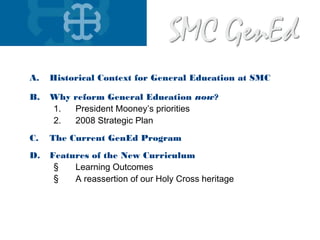
A. Historical Context for General Education at SMC
B. Why reform General Education now?
1. President Mooney’s priorities
2. 2008 Strategic Plan
C. The Current GenEd Program
D. Features of the New Curriculum
§ Learning Outcomes
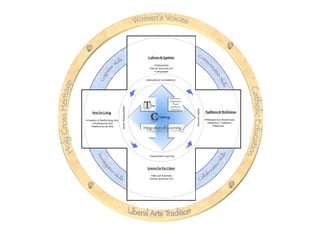
§ A reassertion of our Holy Cross heritage
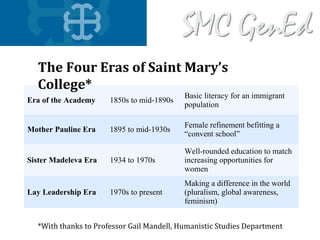
Era of the Academy 1850s to mid-1890s
Basic literacy for an immigrant
population
Mother Pauline Era 1895 to mid-1930s
Female refinement befitting a
“convent school”
Sister Madeleva Era 1934 to 1970s
Well-rounded education to match
increasing opportunities for
women
Lay Leadership Era 1970s to present
Making a difference in the world
(pluralism, global awareness,
feminism)
The Four Eras of Saint Mary’s
College*
*With thanks to Professor Gail Mandell, Humanistic Studies Department
BA, 1959-
1960•16 hours of theology
•15 of philosophy
•12 of English
•8 of lab science
•6 of history
•6 of social science
•6 of fine arts
•5 of math
•up to 16 of foreign
language
90 hours!
BA, 2008-
2009
•6 hours of religious studies
•3 of philosophy
•3 of English
•8 of lab science
•3 of history
•6 of social science
•3 of fine arts
•3 or 4 of math
•8 of foreign language
•9 hours of additional courses
•Writing Proficiency
53 hours
“The General Education Program will be re-examined, re-
articulated, and re-configured. General Education touches
every Saint Mary’s student and the articulation of its content
telegraphs to our students the elements that the College judges
to be essential to a Saint Mary’s education.….As we design an
improved General Education Program, we will have our eyes on
the total education we provide our students. Hence, during this
process, we will reinforce Saint Mary’s learning goals and
articulate the learning outcomes we hope to achieve in the four
years our students are with us.”
—The Path to Leadership 2012
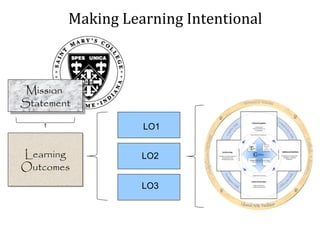
LO1
LO2
LO3
Making Learning Intentional
MissionMission
StatementStatement
MissionMission
StatementStatement
Learning
Outcomes
Learning
Outcomes
aa Knowledge Acquisition & Integration of LearningKnowledge Acquisition & Integration of Learning
bb Cognitive & Communicative SkillsCognitive & Communicative Skills
cc Intercultural Competence & Social ResponsibilityIntercultural Competence & Social Responsibility
aa Knowledge Acquisition & Integration of LearningKnowledge Acquisition & Integration of Learning
bb Cognitive & Communicative SkillsCognitive & Communicative Skills
cc Intercultural Competence & Social ResponsibilityIntercultural Competence & Social Responsibility
Catholic education in the liberal arts tradition
values knowledge for its own sake and affirms
the interconnectedness of all learning.
Therefore….
A Saint Mary’s student exhibits sound knowledge of the
formation of human identities, the development and
functioning of diverse cultures and social groupings, the
practice of creative artistry, the multi-faceted nature of
religion and the Catholic tradition, the complexity of
fundamental philosophical questions, and the intricate
workings of the natural world.
Knowledge Acquisition & Integration of LearningKnowledge Acquisition & Integration of Learning
A Saint Mary’s student demonstrates the ability to look at
issues from multiple perspectives, recognizing the effect
that differences in areas such as gender, religion, values,
culture and privilege can have on the ways that people
interpret and act in the world; and she makes connections
across disparate settings and areas of study.
Knowledge Acquisition & Integration of LearningKnowledge Acquisition & Integration of Learning
aa Knowledge Acquisition & Integration of LearningKnowledge Acquisition & Integration of Learning
bb Cognitive & Communicative SkillsCognitive & Communicative Skills
cc Intercultural Competence & Social ResponsibilityIntercultural Competence & Social Responsibility
As a women’s college, Saint Mary’s
emphasizes the value of women’s voices and
their distinctive contribution to intellectual life.
Therefore….
A Saint Mary’s student masters a broad set of sophisticated
intellectual skills, including critical thinking, careful
interpretation of complex texts and artifacts, accurate
evaluation of data, investigative problem solving, quantitative
reasoning, historical sensitivity, and technological and
information literacy. She reflects analytically on her
experience as a woman, on the contributions of women’s
voices, and on constructions of gender.
Cognitive & Communicative SkillsCognitive & Communicative Skills
A Saint Mary's student communicates her ideas, insights,
thought processes, and conclusions with accuracy,
competence, and style in various media and contexts.
Cognitive & Communicative SkillsCognitive & Communicative Skills
aa Knowledge Acquisition & Integration of LearningKnowledge Acquisition & Integration of Learning
bb Cognitive Skills & Communicative AbilitiesCognitive Skills & Communicative Abilities
cc Intercultural Competence & Social ResponsibilityIntercultural Competence & Social Responsibility
Furthermore, as a Catholic women’s college, Saint
Mary’s fosters respect and compassion for all
persons and honors leadership that improves the
human community. Therefore….
A Saint Mary’s student develops reflective and
collaborative skills that enable her to learn from and
participate in dialogue with diverse people and cultures.
She does this by attaining competence in another
language and by study and experience that reveal both
cultural differences and the connections joining people in a
global society.
Intercultural Competence & Social ResponsibilityIntercultural Competence & Social Responsibility
In keeping with the mission of the Sisters of the Holy
Cross and their stance in solidarity with the poor and
powerless, a Saint Mary’s student will evaluate social
conditions, discern human needs, and be able to respond
as an agent of change.
Intercultural Competence & Social ResponsibilityIntercultural Competence & Social Responsibility
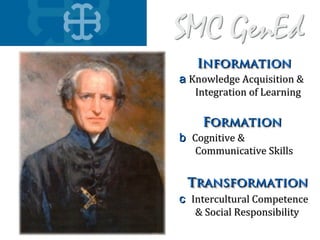
aa Knowledge Acquisition &Knowledge Acquisition &
Integration of LearningIntegration of Learning
bb Cognitive &Cognitive &
Communicative SkillsCommunicative Skills
cc Intercultural CompetenceIntercultural Competence
& Social Responsibility& Social Responsibility
InformationInformation
FormationFormation
TransformationTransformation
LO1
LO2LO3
Questions or Discussion

Madeleva society

  • 1.
    Madeleva Society Steering Committee April23, 2010 Reforming General Education at Saint Mary’s
  • 2.
    A. Historical Contextfor General Education at SMC B. Why reform General Education now? 1. President Mooney’s priorities 2. 2008 Strategic Plan C. The Current GenEd Program D. Features of the New Curriculum § Learning Outcomes § A reassertion of our Holy Cross heritage
  • 3.
    Era of theAcademy 1850s to mid-1890s Basic literacy for an immigrant population Mother Pauline Era 1895 to mid-1930s Female refinement befitting a “convent school” Sister Madeleva Era 1934 to 1970s Well-rounded education to match increasing opportunities for women Lay Leadership Era 1970s to present Making a difference in the world (pluralism, global awareness, feminism) The Four Eras of Saint Mary’s College* *With thanks to Professor Gail Mandell, Humanistic Studies Department
  • 4.
    BA, 1959- 1960•16 hoursof theology •15 of philosophy •12 of English •8 of lab science •6 of history •6 of social science •6 of fine arts •5 of math •up to 16 of foreign language 90 hours! BA, 2008- 2009 •6 hours of religious studies •3 of philosophy •3 of English •8 of lab science •3 of history •6 of social science •3 of fine arts •3 or 4 of math •8 of foreign language •9 hours of additional courses •Writing Proficiency 53 hours
  • 5.
    “The General EducationProgram will be re-examined, re- articulated, and re-configured. General Education touches every Saint Mary’s student and the articulation of its content telegraphs to our students the elements that the College judges to be essential to a Saint Mary’s education.….As we design an improved General Education Program, we will have our eyes on the total education we provide our students. Hence, during this process, we will reinforce Saint Mary’s learning goals and articulate the learning outcomes we hope to achieve in the four years our students are with us.” —The Path to Leadership 2012
  • 6.
  • 7.
    aa Knowledge Acquisition& Integration of LearningKnowledge Acquisition & Integration of Learning bb Cognitive & Communicative SkillsCognitive & Communicative Skills cc Intercultural Competence & Social ResponsibilityIntercultural Competence & Social Responsibility
  • 8.
    aa Knowledge Acquisition& Integration of LearningKnowledge Acquisition & Integration of Learning bb Cognitive & Communicative SkillsCognitive & Communicative Skills cc Intercultural Competence & Social ResponsibilityIntercultural Competence & Social Responsibility Catholic education in the liberal arts tradition values knowledge for its own sake and affirms the interconnectedness of all learning. Therefore….
  • 9.
    A Saint Mary’sstudent exhibits sound knowledge of the formation of human identities, the development and functioning of diverse cultures and social groupings, the practice of creative artistry, the multi-faceted nature of religion and the Catholic tradition, the complexity of fundamental philosophical questions, and the intricate workings of the natural world. Knowledge Acquisition & Integration of LearningKnowledge Acquisition & Integration of Learning
  • 10.
    A Saint Mary’sstudent demonstrates the ability to look at issues from multiple perspectives, recognizing the effect that differences in areas such as gender, religion, values, culture and privilege can have on the ways that people interpret and act in the world; and she makes connections across disparate settings and areas of study. Knowledge Acquisition & Integration of LearningKnowledge Acquisition & Integration of Learning
  • 11.
    aa Knowledge Acquisition& Integration of LearningKnowledge Acquisition & Integration of Learning bb Cognitive & Communicative SkillsCognitive & Communicative Skills cc Intercultural Competence & Social ResponsibilityIntercultural Competence & Social Responsibility As a women’s college, Saint Mary’s emphasizes the value of women’s voices and their distinctive contribution to intellectual life. Therefore….
  • 12.
    A Saint Mary’sstudent masters a broad set of sophisticated intellectual skills, including critical thinking, careful interpretation of complex texts and artifacts, accurate evaluation of data, investigative problem solving, quantitative reasoning, historical sensitivity, and technological and information literacy. She reflects analytically on her experience as a woman, on the contributions of women’s voices, and on constructions of gender. Cognitive & Communicative SkillsCognitive & Communicative Skills
  • 13.
    A Saint Mary'sstudent communicates her ideas, insights, thought processes, and conclusions with accuracy, competence, and style in various media and contexts. Cognitive & Communicative SkillsCognitive & Communicative Skills
  • 14.
    aa Knowledge Acquisition& Integration of LearningKnowledge Acquisition & Integration of Learning bb Cognitive Skills & Communicative AbilitiesCognitive Skills & Communicative Abilities cc Intercultural Competence & Social ResponsibilityIntercultural Competence & Social Responsibility Furthermore, as a Catholic women’s college, Saint Mary’s fosters respect and compassion for all persons and honors leadership that improves the human community. Therefore….
  • 15.
    A Saint Mary’sstudent develops reflective and collaborative skills that enable her to learn from and participate in dialogue with diverse people and cultures. She does this by attaining competence in another language and by study and experience that reveal both cultural differences and the connections joining people in a global society. Intercultural Competence & Social ResponsibilityIntercultural Competence & Social Responsibility
  • 16.
    In keeping withthe mission of the Sisters of the Holy Cross and their stance in solidarity with the poor and powerless, a Saint Mary’s student will evaluate social conditions, discern human needs, and be able to respond as an agent of change. Intercultural Competence & Social ResponsibilityIntercultural Competence & Social Responsibility
  • 17.
    aa Knowledge Acquisition&Knowledge Acquisition & Integration of LearningIntegration of Learning bb Cognitive &Cognitive & Communicative SkillsCommunicative Skills cc Intercultural CompetenceIntercultural Competence & Social Responsibility& Social Responsibility InformationInformation FormationFormation TransformationTransformation
  • 23.
  • 28.