#13/ 19, 1st Floor, Municipal Colony, Kangayanellore Road, Gandhi Nagar, Vellore – 6.
Off: 0416-2247353 / 6066663 Mo: +91 9500218218
Website: www.shakastech.com, Email - id: shakastech@gmail.com,
info@shakastech.com
MADAM: Effective and Efficient Behavior-based Android Malware Detection and
Prevention
ABSTRACT:
Android users are constantly threatened by an increasing number of malicious
applications (apps), generically called malware. Malware constitutes a serious threat to user
privacy, money, device and file integrity. In this paper we note that, by studying their actions,
we can classify malware into a small number of behavioral classes, each of which performs a
limited set of misbehaviors that characterize them. These misbehaviors can be defined by
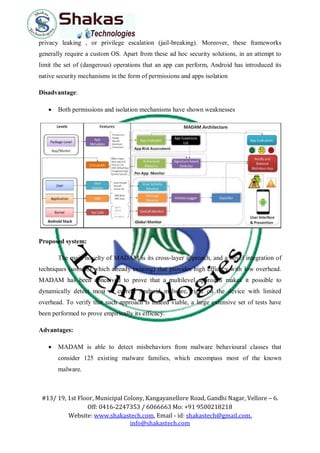
monitoring features belonging to different Android levels. In this paper we present MADAM,
a novel host-based malware detection system for Android devices which simultaneously
analyzes and correlates features at four levels: kernel, application, user and package, to detect
and stop malicious behaviours. MADAM has been designed to take into account those
behaviors characteristics of almost every real malware which can be found in the wild.
MADAM detects and effectively blocks more than 96% of malicious apps, which come from
three large datasets with about 2,800 apps, by exploiting the cooperation of two parallel
classifiers and a behavioural signature-based detector. Extensive experiments, which also
includes the analysis of a testbed of 9,804 genuine apps, have been conducted to show the
low false alarm rate, the negligible performance overhead and limited battery consumption.
Existing system:
It has been recently reported1 that almost 60% of existing malware send stealthy
premiumrate SMS messages. Most of these behaviors are exhibited by a category of apps
called Trojanized that can be found in online marketplaces not controlled by Google.
However, also Google Play, the official market for Android apps, has hosted apps which have
been found to be malicious2. Along with the vast increase of Android malware, several
security solutions have been proposed by the research community, spanning from static or
dynamic analysis of apps, to applying security policies enforcing data security, to run-time
enforcement. However, these solutions still present significant drawbacks. In particular, they
are attack-specific, i.e. they usually focus on and tackle a single kind of security attack, e.g.
#13/ 19, 1st Floor, Municipal Colony, Kangayanellore Road, Gandhi Nagar, Vellore – 6.
Off: 0416-2247353 / 6066663 Mo: +91 9500218218
Website: www.shakastech.com, Email - id: shakastech@gmail.com,
info@shakastech.com
privacy leaking , or privilege escalation (jail-breaking). Moreover, these frameworks
generally require a custom OS. Apart from these ad hoc security solutions, in an attempt to
limit the set of (dangerous) operations that an app can perform, Android has introduced its
native security mechanisms in the form of permissions and apps isolation
Disadvantage:
 Both permissions and isolation mechanisms have shown weaknesses
Proposed system:
The main novelty of MADAM is its cross-layer approach, and a novel integration of
techniques (some of which already existing) that provides high efficacy with low overhead.
MADAM has been conceived to prove that a multilevel approach makes it possible to
dynamically detect most of current Android malware, right on the device with limited
overhead. To verify that such approach is indeed viable, a large extensive set of tests have
been performed to prove empirically its efficacy.
Advantages:
 MADAM is able to detect misbehaviors from malware behavioural classes that
consider 125 existing malware families, which encompass most of the known
malware.
#13/ 19, 1st Floor, Municipal Colony, Kangayanellore Road, Gandhi Nagar, Vellore – 6.
Off: 0416-2247353 / 6066663 Mo: +91 9500218218
Website: www.shakastech.com, Email - id: shakastech@gmail.com,
info@shakastech.com
 To the best of our knowledge, MADAM is the first system which aims at detecting
and stopping at run-time any kind of malware, without focusing on a specific security
threat, using a behavior-based and multi-level approach. Not only the accuracy of the
runtime detection of MADAM is very high, but it also achieves low performance
(1.4%) and energy overhead (4%).
Conclusion:
Starting from the end of 2011, attackers have increased their efforts toward Android
smartphones and tablets, producing and distributing hundreds of thousands of malicious apps.
These apps threaten the user data privacy, money and device integrity, and are difficult to
detect since they apparently behave as genuine apps bringing no harm. This paper proposes
MADAM, a multi-level host based malware detector for Android devices.
Hardware Specification:
 System : Pentium IV 2.4 GHz.
 Hard Disk : 40 GB.
 Floppy Drive : 44 Mb.
 Monitor : 15 VGA Colour.
 Mouse : Logitech
 Ram : 512 Mb.
 MOBILE : ANDROID
Software Specification:
 Operating system : Windows 7.
 Coding Language : Java 1.7
 Tool Kit : Android 2.3 ABOVE
 IDE : Android Studio
#13/ 19, 1st Floor, Municipal Colony, Kangayanellore Road, Gandhi Nagar, Vellore – 6.
Off: 0416-2247353 / 6066663 Mo: +91 9500218218
Website: www.shakastech.com, Email - id: shakastech@gmail.com,
info@shakastech.com
REFERENCE:
1. “Global mobile statistics 2014 part a: Mobile subscribers; handset market share;
mobile operators,” http://mobiforge.com/ research-analysis/globalmobile- statistics-
2014-part-a-mobilesubscribers- handset-market-share-mobileoperators, 2014.
2. “Sophos mobile security threat reports,” 2014, last Accessed: 20 November 2014.
[Online]. Available: http://www.sophos.com/ en-us/threat-center/mobilesecurity-
threat-report.aspx
3. M. G. Christian Funk, “Kaspersky security bullettin 2013,” December 2013. [Online].
Available: http://media.kaspersky. com/pdf/KSB 2013 EN.pdf
4. Reina, A. Fattori, and L. Cavallaro, “A system call-centric analysis and stimulation
technique to automatically reconstruct android malware behaviors,” EuroSec, April,
2013.
5. S. Bugiel, L. Davi, A. Dmitrienko, T. Fischer, A. Sadeghi, and B. Shastry, “Towards
taming privilege-escalation attacks on android,” in 19th Annual Network and
Distributed System Security Symposium, NDSS 2012, San Diego, California, USA,
February 5-8, 2012, 2012.

Madam effective and efficient behavior based android malware detection and prevention

  • 1.
    #13/ 19, 1stFloor, Municipal Colony, Kangayanellore Road, Gandhi Nagar, Vellore – 6. Off: 0416-2247353 / 6066663 Mo: +91 9500218218 Website: www.shakastech.com, Email - id: shakastech@gmail.com, info@shakastech.com MADAM: Effective and Efficient Behavior-based Android Malware Detection and Prevention ABSTRACT: Android users are constantly threatened by an increasing number of malicious applications (apps), generically called malware. Malware constitutes a serious threat to user privacy, money, device and file integrity. In this paper we note that, by studying their actions, we can classify malware into a small number of behavioral classes, each of which performs a limited set of misbehaviors that characterize them. These misbehaviors can be defined by monitoring features belonging to different Android levels. In this paper we present MADAM, a novel host-based malware detection system for Android devices which simultaneously analyzes and correlates features at four levels: kernel, application, user and package, to detect and stop malicious behaviours. MADAM has been designed to take into account those behaviors characteristics of almost every real malware which can be found in the wild. MADAM detects and effectively blocks more than 96% of malicious apps, which come from three large datasets with about 2,800 apps, by exploiting the cooperation of two parallel classifiers and a behavioural signature-based detector. Extensive experiments, which also includes the analysis of a testbed of 9,804 genuine apps, have been conducted to show the low false alarm rate, the negligible performance overhead and limited battery consumption. Existing system: It has been recently reported1 that almost 60% of existing malware send stealthy premiumrate SMS messages. Most of these behaviors are exhibited by a category of apps called Trojanized that can be found in online marketplaces not controlled by Google. However, also Google Play, the official market for Android apps, has hosted apps which have been found to be malicious2. Along with the vast increase of Android malware, several security solutions have been proposed by the research community, spanning from static or dynamic analysis of apps, to applying security policies enforcing data security, to run-time enforcement. However, these solutions still present significant drawbacks. In particular, they are attack-specific, i.e. they usually focus on and tackle a single kind of security attack, e.g.
  • 2.
    #13/ 19, 1stFloor, Municipal Colony, Kangayanellore Road, Gandhi Nagar, Vellore – 6. Off: 0416-2247353 / 6066663 Mo: +91 9500218218 Website: www.shakastech.com, Email - id: shakastech@gmail.com, info@shakastech.com privacy leaking , or privilege escalation (jail-breaking). Moreover, these frameworks generally require a custom OS. Apart from these ad hoc security solutions, in an attempt to limit the set of (dangerous) operations that an app can perform, Android has introduced its native security mechanisms in the form of permissions and apps isolation Disadvantage:  Both permissions and isolation mechanisms have shown weaknesses Proposed system: The main novelty of MADAM is its cross-layer approach, and a novel integration of techniques (some of which already existing) that provides high efficacy with low overhead. MADAM has been conceived to prove that a multilevel approach makes it possible to dynamically detect most of current Android malware, right on the device with limited overhead. To verify that such approach is indeed viable, a large extensive set of tests have been performed to prove empirically its efficacy. Advantages:  MADAM is able to detect misbehaviors from malware behavioural classes that consider 125 existing malware families, which encompass most of the known malware.
  • 3.
    #13/ 19, 1stFloor, Municipal Colony, Kangayanellore Road, Gandhi Nagar, Vellore – 6. Off: 0416-2247353 / 6066663 Mo: +91 9500218218 Website: www.shakastech.com, Email - id: shakastech@gmail.com, info@shakastech.com  To the best of our knowledge, MADAM is the first system which aims at detecting and stopping at run-time any kind of malware, without focusing on a specific security threat, using a behavior-based and multi-level approach. Not only the accuracy of the runtime detection of MADAM is very high, but it also achieves low performance (1.4%) and energy overhead (4%). Conclusion: Starting from the end of 2011, attackers have increased their efforts toward Android smartphones and tablets, producing and distributing hundreds of thousands of malicious apps. These apps threaten the user data privacy, money and device integrity, and are difficult to detect since they apparently behave as genuine apps bringing no harm. This paper proposes MADAM, a multi-level host based malware detector for Android devices. Hardware Specification:  System : Pentium IV 2.4 GHz.  Hard Disk : 40 GB.  Floppy Drive : 44 Mb.  Monitor : 15 VGA Colour.  Mouse : Logitech  Ram : 512 Mb.  MOBILE : ANDROID Software Specification:  Operating system : Windows 7.  Coding Language : Java 1.7  Tool Kit : Android 2.3 ABOVE  IDE : Android Studio
  • 4.
    #13/ 19, 1stFloor, Municipal Colony, Kangayanellore Road, Gandhi Nagar, Vellore – 6. Off: 0416-2247353 / 6066663 Mo: +91 9500218218 Website: www.shakastech.com, Email - id: shakastech@gmail.com, info@shakastech.com REFERENCE: 1. “Global mobile statistics 2014 part a: Mobile subscribers; handset market share; mobile operators,” http://mobiforge.com/ research-analysis/globalmobile- statistics- 2014-part-a-mobilesubscribers- handset-market-share-mobileoperators, 2014. 2. “Sophos mobile security threat reports,” 2014, last Accessed: 20 November 2014. [Online]. Available: http://www.sophos.com/ en-us/threat-center/mobilesecurity- threat-report.aspx 3. M. G. Christian Funk, “Kaspersky security bullettin 2013,” December 2013. [Online]. Available: http://media.kaspersky. com/pdf/KSB 2013 EN.pdf 4. Reina, A. Fattori, and L. Cavallaro, “A system call-centric analysis and stimulation technique to automatically reconstruct android malware behaviors,” EuroSec, April, 2013. 5. S. Bugiel, L. Davi, A. Dmitrienko, T. Fischer, A. Sadeghi, and B. Shastry, “Towards taming privilege-escalation attacks on android,” in 19th Annual Network and Distributed System Security Symposium, NDSS 2012, San Diego, California, USA, February 5-8, 2012, 2012.