Minimum Approach Distance
(MAD)
What is MAD?
• Minimum Approach Distance (MAD) – The minimum boundary an employee must
maintain from an energized conductor at all times. No employee shall approach or take
any conductive object closer to an overhead hazard than the established minimum
approach distance.
• How close can we work beneath or around powerline before we are breaching the MAD?
Why is MAD Important?
• Your safety as well as the people around you.
• Allows us to safely work beneath and around
powerlines.
• OSHA compliance.
• YOU MUST KNOW THE REQUIRED MAD FOR YOUR
JOB SITE IF YOU ARE WORKING UNDER/AROUND
ANY POWERLINES BEFORE YOU START WORK.
• If you don’t know or have questions, please
contact your supervisor before starting work.
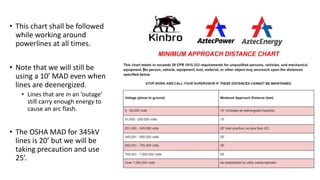
• This chart shall be followed
while working around
powerlines at all times.
• Note that we will still be
using a 10’ MAD even when
lines are deenergized.
• Lines that are in an ‘outage’
still carry enough energy to
cause an arc flash.
• The OSHA MAD for 345kV
lines is 20’ but we will be
taking precaution and use
25’.
How to Determine MAD and Safe
Working Height
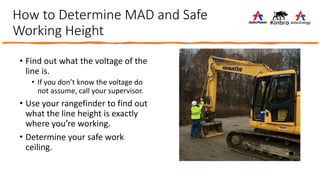
• Find out what the voltage of the
line is.
• If you don’t know the voltage do
not assume, call your supervisor.
• Use your rangefinder to find out
what the line height is exactly
where you’re working.
• Determine your safe work
ceiling.
What is your Work Ceiling?
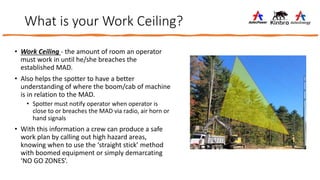
• Work Ceiling - the amount of room an operator
must work in until he/she breaches the
established MAD.
• Also helps the spotter to have a better
understanding of where the boom/cab of machine
is in relation to the MAD.
• Spotter must notify operator when operator is
close to or breaches the MAD via radio, air horn or
hand signals
• With this information a crew can produce a safe
work plan by calling out high hazard areas,
knowing when to use the ‘straight stick’ method
with boomed equipment or simply demarcating
‘NO GO ZONES’.
For example:
For example:
For example:
For example:
For example:
5’7 Work Ceiling
For example:
Knowing Your Line Height
• Depending on the weather conditions and voltage, the powerline might sag
(1’–5’) throughout the day. Look out for the following factors:
• Lines with more voltage have a higher
tendency to sag
• Hot/humid days
• Fog and rain cause a higher chance of
induction
• Working in wetlands or dense swamp
areas
• It is a good practice to shoot your lines throughout the day, so you know
your work ceiling is accurate.
• Before you start work, around mid day, afternoon.
• Be aware of the grade changes in your work zone.
• Be sure to record any change in the work plan on your JSA.
Dumping Material
• This also applies to subcontracted
dump trucks delivering material or a
rock truck.
• Ask the driver how tall the cab is and
the body is when it is fully lifted.
• Specify the height of the line and
exactly what you want the driver to
do.
• Determine whether it is safe to dump
at that location, have the driver raise
halfway to avoid MAD breach or if
there is not enough height dump at a
different location.
What should you do if you if a line is too low or
the operator doesn’t feel comfortable working?
• DO NOT WORK.
• Call your supervisor, management will act in order to work
safely:
• Request a change in the construction plan
• Some lines can be raised or flagged
• Guy wires can be removed from the area
• Request an outage or non-reclosing state
• Use insulating protective equipment
• Have a qualified lineman onsite to spot
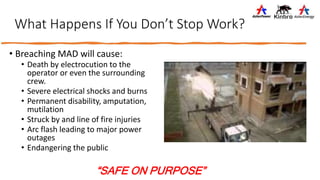
What Happens If You Don’t Stop Work?
• Breaching MAD will cause:
• Death by electrocution to the
operator or even the surrounding
crew.
• Severe electrical shocks and burns
• Permanent disability, amputation,
mutilation
• Struck by and line of fire injuries
• Arc flash leading to major power
outages
• Endangering the public
“SAFE ON PURPOSE”

MAD Training.pptx

  • 1.
  • 2.
    What is MAD? •Minimum Approach Distance (MAD) – The minimum boundary an employee must maintain from an energized conductor at all times. No employee shall approach or take any conductive object closer to an overhead hazard than the established minimum approach distance. • How close can we work beneath or around powerline before we are breaching the MAD?
  • 3.
    Why is MADImportant? • Your safety as well as the people around you. • Allows us to safely work beneath and around powerlines. • OSHA compliance. • YOU MUST KNOW THE REQUIRED MAD FOR YOUR JOB SITE IF YOU ARE WORKING UNDER/AROUND ANY POWERLINES BEFORE YOU START WORK. • If you don’t know or have questions, please contact your supervisor before starting work.
  • 4.
    • This chartshall be followed while working around powerlines at all times. • Note that we will still be using a 10’ MAD even when lines are deenergized. • Lines that are in an ‘outage’ still carry enough energy to cause an arc flash. • The OSHA MAD for 345kV lines is 20’ but we will be taking precaution and use 25’.
  • 5.
    How to DetermineMAD and Safe Working Height • Find out what the voltage of the line is. • If you don’t know the voltage do not assume, call your supervisor. • Use your rangefinder to find out what the line height is exactly where you’re working. • Determine your safe work ceiling.
  • 6.
    What is yourWork Ceiling? • Work Ceiling - the amount of room an operator must work in until he/she breaches the established MAD. • Also helps the spotter to have a better understanding of where the boom/cab of machine is in relation to the MAD. • Spotter must notify operator when operator is close to or breaches the MAD via radio, air horn or hand signals • With this information a crew can produce a safe work plan by calling out high hazard areas, knowing when to use the ‘straight stick’ method with boomed equipment or simply demarcating ‘NO GO ZONES’.
  • 7.
  • 8.
  • 9.
  • 10.
  • 11.
  • 12.
  • 13.
    Knowing Your LineHeight • Depending on the weather conditions and voltage, the powerline might sag (1’–5’) throughout the day. Look out for the following factors: • Lines with more voltage have a higher tendency to sag • Hot/humid days • Fog and rain cause a higher chance of induction • Working in wetlands or dense swamp areas • It is a good practice to shoot your lines throughout the day, so you know your work ceiling is accurate. • Before you start work, around mid day, afternoon. • Be aware of the grade changes in your work zone. • Be sure to record any change in the work plan on your JSA.
  • 14.
    Dumping Material • Thisalso applies to subcontracted dump trucks delivering material or a rock truck. • Ask the driver how tall the cab is and the body is when it is fully lifted. • Specify the height of the line and exactly what you want the driver to do. • Determine whether it is safe to dump at that location, have the driver raise halfway to avoid MAD breach or if there is not enough height dump at a different location.
  • 15.
    What should youdo if you if a line is too low or the operator doesn’t feel comfortable working? • DO NOT WORK. • Call your supervisor, management will act in order to work safely: • Request a change in the construction plan • Some lines can be raised or flagged • Guy wires can be removed from the area • Request an outage or non-reclosing state • Use insulating protective equipment • Have a qualified lineman onsite to spot
  • 16.
    What Happens IfYou Don’t Stop Work? • Breaching MAD will cause: • Death by electrocution to the operator or even the surrounding crew. • Severe electrical shocks and burns • Permanent disability, amputation, mutilation • Struck by and line of fire injuries • Arc flash leading to major power outages • Endangering the public “SAFE ON PURPOSE”