Macro Social Work Practice Advocacy In Action 1st Edition Carolyn J Tice
Macro Social Work Practice Advocacy In Action 1st Edition Carolyn J Tice
Macro Social Work Practice Advocacy In Action 1st Edition Carolyn J Tice
Macro Social Work Practice Advocacy In Action 1st Edition Carolyn J Tice
Macro Social Work Practice Advocacy In Action 1st Edition Carolyn J Tice
1.
Macro Social WorkPractice Advocacy In Action
1st Edition Carolyn J Tice download
https://ebookbell.com/product/macro-social-work-practice-
advocacy-in-action-1st-edition-carolyn-j-tice-44165256
Explore and download more ebooks at ebookbell.com
2.
Here are somerecommended products that we believe you will be
interested in. You can click the link to download.
Social Work Macro Practice 5th Edition Netting F Ellen
https://ebookbell.com/product/social-work-macro-practice-5th-edition-
netting-f-ellen-4754580
Social Work Macro Practice 5th F Ellen Netting Et Al
https://ebookbell.com/product/social-work-macro-practice-5th-f-ellen-
netting-et-al-7156642
Social Work Macro Practice 6th F Ellen Netting Peter M Kettner Steve L
Mcmurtry M Lori Thomas
https://ebookbell.com/product/social-work-macro-practice-6th-f-ellen-
netting-peter-m-kettner-steve-l-mcmurtry-m-lori-thomas-10010712
Social Work Macro Practice 6th Edition 6th Edition M Lori Thomaspeter
M Kettnerf Ellen Nettingsteve L Mcmurtry
https://ebookbell.com/product/social-work-macro-practice-6th-
edition-6th-edition-m-lori-thomaspeter-m-kettnerf-ellen-nettingsteve-
l-mcmurtry-22467484
3.
The Practice OfMacro Social Work 4th Edition William G Brueggemann
https://ebookbell.com/product/the-practice-of-macro-social-work-4th-
edition-william-g-brueggemann-4178376
Macro Practice In Social Work For The 21st Century Bridging The
Macromicro Divide 2nd Edition Steve Burghardt
https://ebookbell.com/product/macro-practice-in-social-work-for-
the-21st-century-bridging-the-macromicro-divide-2nd-edition-steve-
burghardt-49456030
Social Capital Political Participation And Migration In Europe Making
Multicultural Democracy Work Migration Minorities And Citizenship
Laura Morales
https://ebookbell.com/product/social-capital-political-participation-
and-migration-in-europe-making-multicultural-democracy-work-migration-
minorities-and-citizenship-laura-morales-2208318
Social Capital Political Participation And Migration In Europe Making
Multicultural Democracy Work Laura Morales
https://ebookbell.com/product/social-capital-political-participation-
and-migration-in-europe-making-multicultural-democracy-work-laura-
morales-5363426
Nano Meets Macro Social Perspectives On Nanoscience And Nanotechnology
Kamilla Kjlberg Fern Wickson
https://ebookbell.com/product/nano-meets-macro-social-perspectives-on-
nanoscience-and-nanotechnology-kamilla-kjlberg-fern-wickson-4421946
6.
Council on SocialWork Education
(CSWE) 2015 Educational Policy and
Accreditation Standards
The Council on Social Work Education (CSWE) uses the Educational Policy and Accreditation
Standards (EPAS) for accreditation purposes in Bachelor’s level (BSW) and Master’s level (MSW)
social work programs. These standards support academic excellence by establishing a basis for profes-
sional competence. They permit programs to design their curriculum, using both traditional and pro-
gressive methods and models, by balancing requirements that promote comparable outcomes across
all programs.
All social work students are required by the CSWE to develop the 9 Educational Policy
Competencies to the extent that students are able to demonstrate the integration and application of
the competencies in practice. Students’ ability to demonstrate the level of competence necessary to
enter professional practice is taken as a reflection of their program’s success in helping them achieving
their goals.
The grid below shows how our book addresses the 9 competencies and the practice behaviors
within each as they are relevant and applied to macro practice in social work.
The 9 Competencies and the Practice Behaviors Chapter reference
Competency 1: Demonstrate Ethical and Professional Behavior
A. Make ethical decisions by applying the standards of the NASW Code
of Ethics, relevant laws and regulations, models for ethical decision-
making, ethical conduct of research, and additional codes of ethics as
appropriate to context
1, 2, 4, 5, 6, 7, 8, 9,
10, 11, 13
B. Use reflection and self-regulation to manage personal values and
maintain professionalism in practice situations
1, 2, 4, 5, 6, 7, 9,
10, 13
C. Demonstrate professional demeanor in behavior; appearance; and oral,
written, and electronic communication
9, 10
D. Use technology ethically and appropriately to facilitate practice
outcomes
9, 10
E. Use supervision and consultation to guide professional judgment and
behavior
2, 4, 5, 6, 8, 9, 12
Competency 2: Engage in Diversity and Difference in Practice
A. Apply and communicate understanding of the importance of diversity
and difference in shaping life experiences in practice at the micro,
mezzo, and macro levels
1, 3, 4, 5, 7, 8, 9, 10,
11, 13
B. Present themselves as learners and engage clients and constituencies
as experts on their own experience
4, 5, 6, 7, 9, 10
7.
C. Apply self-awarenessand self-regulation to manage the influence
of personal biases and values in working with diverse clients and
constituencies
6, 7, 8, 9, 10, 13
Competency 3: Advance Human Rights and Social, Economic, and
Environmental Justice
A. Apply their understanding of social, economic, and environmental
justice to advocate for human rights at the individual and system levels
2, 3, 4, 6, 7, 8, 9, 11,
13, 14
B. Engage in practices that advance social, economic, and environmental
justice
2, 4, 7, 8, 9, 10, 13
Competency 4: Engage in Practice-informed Research and Research-
informed Practice
A. Use practice experience and theory to inform scientific inquiry and
research
10, 11, 13
B. Apply critical thinking to engage in analysis of quantitative and
qualitative research methods and research findings
7, 9, 10
C. Use and translate research evidence to inform and improve practice,
policy, and service delivery
9, 10, 12
Competency 5: Engage in Policy Practice
A. Identify social policy at the local, state, and federal level that impacts
well-being, service delivery, and access to social services
3, 6, 8, 9
B. Assess how social welfare and economic policies impact the delivery
of and access to social services
2, 4, 5, 6, 9, 10, 12
C. Apply critical thinking to analyze, formulate, and advocate policies
that advance human rights and social, economic, and environmental
justice
1, 2, 4, 5, 7, 8, 9, 13
Competency 6: Engage with Individuals, Families, Groups, Organizations,
and Communities
A. Apply knowledge of human behavior and the social environment,
person-in-environment, and other multidisciplinary theoretical
frameworks to engage with clients and constituencies
1, 2, 4, 5, 6, 8, 9
B. Use empathy, reflection, and interpersonal skills to effectively engage
diverse clients and constituencies
1, 5, 6, 7, 9, 10, 14
Competency 7: Assess Individuals, Families, Groups, Organizations, and
Communities
A. Collect and organize data, and apply critical thinking to interpret
information from clients and constituencies
5, 7, 10, 14
8.
B. Apply knowledgeof human behavior and the social environment,
person-in-environment, and other multidisciplinary theoretical
frameworks in the analysis of assessment data from clients and
constituencies
1, 2, 3, 4, 5, 6, 7,
9, 12
C. Develop mutually agreed-on intervention goals and objectives based
on the critical assessment of strengths, needs, and challenges within
clients and constituencies
4, 5, 6, 9
D. Select appropriate intervention strategies based on the assessment,
research knowledge, and values and preferences of clients and
constituencies
4, 6, 7, 9, 10
Competency 8: Intervene with Individuals, Families, Groups,
Organizations, and Communities
A. Critically choose and implement interventions to achieve practice
goals and enhance capacities of clients and constituencies
3, 4, 5, 6, 7, 8, 11, 13
B. Apply knowledge of human behavior and the social environment,
person-in-environment, and other multidisciplinary theoretical
frameworks in interventions with clients and constituencies
2, 4, 5, 6, 8
C. Use inter-professional collaboration as appropriate to achieve
beneficial practice outcomes
1, 2, 6, 8
D. Negotiate, mediate, and advocate with and on behalf of diverse clients
and constituencies
1, 4, 6, 7, 8, 9, 13
E. Facilitate effective transitions and endings that advance mutually
agreed-on goals
5, 6, 8
Competency 9: Evaluate Practice with Individuals, Families, Groups,
Organizations, and Communities
A. Select and use appropriate methods for evaluation of outcomes 10
B. Apply knowledge of human behavior and the social environment,
person-in-environment, and other multidisciplinary theoretical
frameworks in the evaluation of outcomes
1, 2, 4, 5, 6, 8, 9
C. Critically analyze, monitor, and evaluate intervention and program
processes and outcomes
5, 6, 8, 12
D. Apply evaluation findings to improve practice effectiveness at the
micro, mezzo, and macro levels
5, 6, 7, 8, 9, 10, 14
In honor ofand with heartfelt thanks to Team Tice-Captain George,
and of course Miss Jeanne.
CJT
With love to Joan, Noah, Jacob, and Andrew for your
everlasting influence on my life.
DDL
In honor of Aaron and his many fans, including Kyle, Jessica, Mike,
and Emilee. Your spirit, grace, and humility have been and
will continue to be transformative!
LEC
Sara Miller McCune founded SAGE Publishing in 1965 to support
the dissemination of usable knowledge and educate a global
community. SAGE publishes more than 1000 journals and over
600 new books each year, spanning a wide range of subject areas.
Our growing selection of library products includes archives, data,
case studies and video. SAGE remains majority owned by our
founder and after her lifetime will become owned by a charitable
trust that secures the company’s continued independence.
Los Angeles | London | New Delhi | Singapore | Washington DC | Melbourne
11.
Macro Social Work
Practice
Advocacyin Action
Carolyn J. Tice
University of Maryland, Baltimore County
Dennis D. Long
Xavier University
Lisa E. Cox
Stockton University
Detailed Contents
PREFACE xv
ACKNOWLEDGMENTSxvii
ABOUT THE AUTHORS xix
CHAPTER 1 A Historical Perspective of Macro Practice
and Advocacy 1
WHAT IS MACRO PRACTICE? 2
WHAT DOES MACRO SOCIAL WORK PRACTICE MEAN? 2
THE HISTORICAL CONTEXT OF MACRO PRACTICE 4
The Progressive Era: Mary Richmond 4
The Expansion of Social Work in the 1920s to 1940s 7
The 1950s and Early 1960s 8
The Mid-1960s to Late 1970s 10
The 1980s and Reaganomics 11
The 1990s 13
The 2000s 14
From 2008 Onward 15
THE UNIQUE CONTRIBUTIONS OF MACRO PRACTICE 16
THE SOCIAL WORK VALUES OF MACRO PRACTICE 17
ADVOCACY AND EMPOWERMENT 19
CHAPTER 2 Contemporary Macro Practice Perspectives 24
PLANNED CHANGE PROCESS AND CONTEMPORARY
PERSPECTIVES AND ORIENTATIONS 24
THE PROBLEM-CENTERED APPROACH 26
THE STRENGTHS PERSPECTIVE 32
ECOLOGICAL THEORY 35
EMPOWERMENT 38
SYSTEMS THEORY 40
PERSON-IN-ENVIRONMENT 41
ADVOCACY MODEL 41
A COMMUNITY-BASED PRACTICE ORIENTATION 42
INTEGRATING PERSPECTIVES AND ORIENTATIONS
WITH MACRO PRACTICE 45
The Value Base 47
Interprofessional Practice 48
ETHICAL CONSIDERATIONS 49
CHAPTER 3 Engage Diversity and Difference 52
DEFINING DIVERSITY AND DIFFERENCE 55
THE ROLE OF CULTURAL COMPETENCE AND CULTURAL
HUMILITY IN MACRO PRACTICE 57
14.
WHAT IS INTERSECTIONALITYIN
MACRO PRACTICE? 60
IMPLICIT AND EXPLICIT BIASES 61
INCLUSION 63
ENVIRONMENTAL JUSTICE 67
Domestic Examples 69
International Examples 70
Social and Economic Justice 70
CHAPTER 4 An Advocacy Model for Dynamic Practice 75
WHAT IS ADVOCACY? 75
ADVOCACY AND ETHICS 78
ADVOCACY AND MACRO PRACTICE 82
Develop Alternative Strategies 83
Collect Evidence 83
Understand Power 84
Take a Risk 85
Persistence 86
THE ADVOCACY PRACTICE AND POLICY MODEL (APPM) 87
THEORETICAL FOUNDATION OF THE
ADVOCACY PRACTICE AND POLICY MODEL 88
HOW THE APPM APPLIES TO MACRO PRACTICE 90
CHAPTER 5 Understanding and Enriching
Organizational Life 95
THE RELEVANCE OF ORGANIZATIONS IN
SOCIAL WORK 95
THE CONCEPT OF ORGANIZATION 97
TYPES OF ORGANIZATIONS 98
Public and Nonprofit Organizations 99
For-Profit Organizations 100
Self-Help Groups 100
Formal and Informal Organizations 100
UNDERSTANDING ORGANIZATIONS USING
THEORIES AND PERSPECTIVES 101
HOW ORGANIZATIONS FUNCTION 104
HUMAN DIVERSITY AND HUMAN SERVICE
ORGANIZATIONS 105
Respect for Ansuya and Diversity 105
NASW Code of Ethics 105
ORGANIZATION AS A SYSTEM 106
Social Systems 106
Human Service Organizations 108
Organizational Culture 109
An Illustration Promoting the Dignity of Consumers:
The Virtues of Karen’s Korner 109
A Contemporary Illustration of Aspects of
Organizational Culture 112
ORGANIZATIONAL DEVELOPERS 112
Organizational Development 113
The Role of the Organizational Developer 113
Organizational Politics and Change 115
15.
EMPOWERMENT 117
Organizational ChangeFrom Within
the Organization 120
ETHICAL ISSUES THAT OCCUR WITHIN
ORGANIZATIONS 120
CHAPTER 6 Exploring the Concept of Communities
and Community Practice 123
HOW ARE COMMUNITIES DEFINED? 123
Community as Nonplace, Sharing, or Collective
Affiliation 124
Self-Help/Mutual-Aid Groups as Community 124
Geographic Communities 125
Nonplace Communities 125
FUNCTIONS OF COMMUNITIES 127
SOCIAL WORK AND COMMUNITY PRACTICE 129
Trends in Community Practice 130
OVERVIEW AND HISTORY OF COMMUNITY PRACTICE
AND ORGANIZING 131
The Settlement House Movement 132
Community Chest and the United Way 133
International Community Development 133
The Civil Rights Movement and the War on Poverty 134
USEFUL THEORETICAL PERSPECTIVES IN COMMUNITY
PRACTICE STRATEGIES 135
Collaboration, Campaign, and Contest Strategies 136
Current Community Action Groups 137
Roles for Social Work in Community Practice 139
APPLYING THE ADVOCACY PRACTICE AND POLICY
MODEL TO COMMUNITY PRACTICE 140
Economic and Social Justice 141
Supportive Environment 142
Human Needs and Rights 142
Political Access 144
PRINCIPLES ON USING A STRENGTHS PERSPECTIVE 145
USING COMMUNITY ORGANIZATION THEORY TO
IMPROVE PRACTICE 148
CONSIDER ETHICAL ISSUES ASSOCIATED WITH
COMMUNITY PRACTICE 149
CHAPTER 7 Social Planning 153
WHAT IS SOCIAL PLANNING? 154
CONSUMER PARTICIPATION IN SOCIAL PLANNING 156
WAYS OF APPROACHING SOCIAL PLANNING 157
Rational Model 157
Political Model 158
Empowerment Model 159
Strengths Model 160
ADVOCACY MODEL 161
Economic and Social Justice 161
Supportive Environment 162
Human Needs and Rights 163
Political Access 163
16.
PRACTICAL CONSIDERATIONS INMACRO SOCIAL WORK
PRACTICE 165
STRATEGIC PLANNING FROM AN ORGANIZATIONAL
STANDPOINT 166
The SWOT Analysis 166
Task Environment 167
Constructing Mission and Vision Statements 168
Marketing 169
SOCIAL PLANNING PROCESS 170
A Three-Phase Model 171
THE NIMBY PHENOMENON 172
RESOURCE CONSIDERATIONS IN SOCIAL PLANNING 173
SOCIAL PLANNING AS A COOPERATIVE EDUCATIONAL
PROCESS 173
PLANNING FOR SUSTAINABLE DEVELOPMENT 175
CHAPTER 8 Administration and Leadership: Building on
Advocacy and Strengths 178
WHAT IS ADMINISTRATION? 179
ADMINISTRATIVE ROLES 181
Leader 181
Decision Maker 182
Mediator 183
Collaborator 184
Politician 185
ADMINISTRATIVE TASKS 186
Planning 186
Human Resource Development 187
Supervision 188
Resource Acquisition 189
Evaluation 190
SOCIAL WORK ADMINISTRATION FROM A STRENGTHS
PERSPECTIVE 191
Stay Consumer Centered 191
Conduct Holistic Assessment 192
Know the Agency’s Story 192
Maintain the Focus 193
THE ADVOCACY PRACTICE AND POLICY MODEL
AND SOCIAL WORK ADMINISTRATION 193
ETHICAL CONSIDERATIONS 197
CHAPTER 9 Policy Practice, Political Persuasion, and
Advocacy 202
POLICY PRACTICE, POLITICAL PERSUASION,
AND ADVOCACY 203
DEFINING SOCIAL POLICY 204
THE PROBLEM-CENTERED APPROACH 206
THE POLICY PROCESS FROM A STRENGTHS
PERSPECTIVE 208
The Strengths Perspective and Policy Analysis 209
17.
THE ADVOCACY PRACTICEAND POLICY MODEL
AND POLICY PRACTICE 213
KNOWING THE POLITICAL PROCESS 214
THINKING AND ACTING POLITICALLY 215
INFLUENCING THE POLITICAL PROCESS 217
Getting Information About Legislative Proposals 217
Using Information From Policy Groups 217
Tracking Proposed Legislation 218
Building Relationships With Legislators and Their Staff 218
Obtaining Funding 219
Lobbying 219
PROFESSIONAL SKILLS IN POLICY PRACTICE 220
Communication 220
Collaboration 222
Assessment 222
Critical Thinking 222
ETHICAL CONSIDERATIONS 223
CHAPTER 10 Using Technology in Social Work Practice 226
ADVANCES IN TECHNOLOGY AND SOCIAL MEDIA 226
THE USE OF TECHNOLOGY BY SOCIAL WORKERS 228
Websites 228
Social Media 229
E-mail 229
Texting 229
ADVOCACY SUITES 231
THE ADVOCACY PRACTICE AND POLICY MODEL AND
TECHNOLOGY 231
Economic and Social Justice 232
Supportive Environment 233
Human Needs and Rights 235
Political Access 235
ETHICAL ISSUES ASSOCIATED WITH TECHNOLOGY 237
Confidentiality 237
Boundaries and Dual Relationships 239
Ethical Considerations 240
Informed Consent 242
FUTURE USE OF TECHNOLOGY IN SOCIAL
WORK PRACTICE 244
CHAPTER 11 Informing Macro Practice With Research 248
WHAT IS EVIDENCE-BASED RESEARCH
MACRO PRACTICE? 249
The Logic of Scientific Inquiry 251
QUANTITATIVE VS. QUALITATIVE ANALYSES 252
Quantitative Analysis 252
Qualitative Analysis 252
ETHICAL DILEMMAS IN RESEARCH STRATEGIES 254
Organizations 254
Communities 255
Societal 255
18.
INFUSING RESEARCH FINDINGSINTO MACRO PRACTICE 256
Placing Research on the Agenda 256
Political Realities in Organizations, Communities,
and Society 257
Addressing Cultural Competence: Diversity
and Difference 257
Using Research Findings to Advocate for Change 259
DISSEMINATION OF RESEARCH FINDINGS 260
CHAPTER 12 Evaluating Macro Change 264
WHAT IS EVALUATION? 264
Traditional Approaches to Social Research 265
FUNDING SOURCES AND RESEARCH 268
Unit of Analysis: Organizations, Communities,
and Society 269
Decision Making in Evaluative Research 270
Advocacy Strategies Related to Evidence-Based
Macro Practice 271
PARTICIPATORY RESEARCH AND POLICY
AND PRACTICE 272
Types of Participatory Research 272
A Participatory Research Case Examined:
Welfare Reform 276
Criticism of Participatory Research 278
Consumer Participation in Research 278
Participatory Research and Advocacy 279
Advocacy and Strengths-Oriented Measures
in Macro-Level Change 280
ETHICAL CONSIDERATIONS 281
CHAPTER 13 Advocacy for Human Rights and Social,
Economic, and Environmental Justice 285
VALUES BASE OF SOCIAL WORK 286
POLITICAL ACTIVISM 288
POLITICAL LEANINGS 290
HUMAN RIGHTS AND SOCIAL, ECONOMIC, AND
ENVIRONMENTAL JUSTICE 292
APPLY THE ADVOCACY PRACTICE AND POLICY
MODEL (APPM) 294
ADVOCACY STRATEGIES FOR HUMAN RIGHTS AND
SOCIAL, ECONOMIC, AND ENVIRONMENTAL JUSTICE 299
CHAPTER 14 Assessing Your Macro Practice Skills 304
MACRO PRACTICE AS A LIFELONG CALLING 304
ENGAGING IN SELF-ASSESSMENT 306
Using Reflection to Assess and Enhance
Macro Practice Skills 306
Accepting and Using Feedback 308
Expanding and Improving a Macro Skill Base 309
RECOGNIZING STRENGTHS IN MACRO
PRACTICE ROLES 309
19.
ADVOCACY STARTS WITHSELF 313
Quantitative vs. Qualitative Research Processes 314
THE VALUE OF NETWORKING, PARTNERSHIPS, AND
COLLABORATIONS 316
STAY CURRENT THROUGH READING 317
APPENDIX 321
GLOSSARY 323
REFERENCES 331
INDEX 347
21.
xv
Preface
Macro social workpractice maximizes opportunities for change at the orga-
nizational, community, societal, and global levels. Using a “big picture
outlook,” Macro Social Work Practice: Advocacy in Action examines the context
of contemporary social issues that often involve the redistribution of power and
privilege—a signature aspect of social work education and practice. Readers are
challenged throughout chapters to enact advocacy, informed by key orientations
and perspectives and grounded in timely and relevant examples and causes (e.g.,
refugee services and gun violence).
As a primary/core text, this coauthored book’s unique contribution involves
the contextualization of macro practice. Historical content and current prac-
tice examples link personal or individual and community needs to public issues
through macro intervention. An emphasis is placed on engaging students in macro
practice using the tenets of the advocacy policy and practice model (APPM) that
highlight the inclusion of economic and social justice, supportive environment,
human needs and rights, and political access.
More specifically, this book was written for social work professionals aspiring
to enhance and develop professional abilities and skills in macro-level change.
Because the primary focus is on knowledge, values, and skills applicable to gen-
eralist social practice, Macro Social Work Practice: Advocacy in Action is intended
primarily for upper-level practice courses in the undergraduate curriculum and
foundation coursework in practice at the graduate (MSW) level.
For the sake of students, materials are presented in an orderly, structured
fashion that is both theoretical and applied in nature. At the beginning of each
chapter, students can review a list of the topics to be examined. Each chapter
concludes with a brief summary, a list of key terms, discussion questions, exercises,
and online references.
Instructors will appreciate the time and attention given to the relationship
between macro practice and other related perspectives and orientations (e.g.,
strengths perspective, empowerment theory, problem solving, and the ecologi-
cal perspective). Professors who traditionally approach macro practice from
a community-organizing tradition will be excited about the primacy given to
community-based practice and social justice advocacy. Colleagues who embrace
macro practice in the form of multiple social work roles and through multilevel
activities should also be pleased. For those interested in the pragmatic aspects of
social work policy-practice, every effort has been made to provide readers with
hands-on, practical suggestions and with skills for embracing basic tenets of a
strengths perspective in macro-level intervention.
Finally, the notion of consumerism in relation to social work practice and
policy is embraced as a dominant feature throughout the text. The word consumer
is offered in the spirit of empowerment and is intended as an acknowledgment of
the strengths and rights possessed by the people who come to our agencies and
organizations for services.
23.
xvii
Acknowledgments
The authors wishto thank the following reviewers for their valuable feedback
during the development of this book:
Sheila Dennis, MSW, PhD, Indiana University
Kim Dotson, MSW, LCSW, MSSW, Indiana University MSW Direct
Angela Kaiser, Oakland University
Benjamin Malczyk, MSW, PhD, University of Nebraska at Kearney
Dianna B. Parrish, LPN, LCSW, Mary Baldwin University
Jason Anthony Plummer, California State University, Los Angeles
Kim Releford, Indiana University School of Social Work
C. Shane Robbins, University of Mississippi
Lynda Sowbel, PhD, LCSW-C, BSW Program Director, Hood College
Glenn Stone, Ball State University
Tracy Wharton, PhD, LCSW, University of Central Florida
Additionally, the authors wish to acknowledge and give a very special thanks
to Dr. John D. Morison for his intellectual contributions that have facilitated
and contributed to the publication of this book. Carolyn Tice would also like to
thank Amy Cruz, 2019 UMBC graduate, for her office support. Lisa Cox would
also like to thank Allyson Crawford, 2019 Stockton University graduate, for her
assistance.
25.
xix
About the Authors
CarolynJ. Tice, DSW, ACSW, Professor and the Associate Dean of the
Baccalaureate Social Work Program, School of Social Work, University of
Maryland since July 2002. Her prior appointment was chair of the Department of
Social Work, Ohio University, a position she held for 9 years. Currently, Dr. Tice
teaches a First-Year Seminar and social welfare policy. She received her BSW
from West Virginia University, earned an MSW from Temple University, and
completed her DSW at the University of Pennsylvania, where she worked with
Hmong refugees. The coauthor of numerous books and peer-reviewed articles,
Dr. Tice’s scholarship focuses primarily on the development of critical thinking
skills and social work practice and policy from a strengths perspective. She is on
the editorial board of the Journal of Teaching in Social Work and serves as a book
prospectus reviewer for Wadsworth and John Wiley. In 2008, she was named
a Fulbright specialist and traveled to Mongolia to assist in the development of
social work programs. Other international social work experiences include pro-
gram development in Botswana, India, Portugal, Taiwan, Vietnam, and China.
Dr. Tice is a member of the Council of Social Work Education, the Association of
Baccalaureate Social Work Program Directors, the National Association of Social
Workers, and the Friends Committee on National Legislation.
For leisure, Dr. Tice operates Olde Friends, a booth in an antique store located
on the southern New Jersey coastline. E-mail: tice@umbc.edu.
DennisD.Long, PhD,ACSW,Professor and the Associate Dean of the College
of Social Sciences,Health,and Education,Xavier University (Cincinnati,Ohio).
Dr. Long previously served as Professor and Chair of the Department of Social
Work at Xavier University and, from 2006 to 2012, was a Professor and Chair
of the Department of Social Work at the University of North Carolina at
Charlotte.He received his BA in sociology and psychology from Ohio Northern
University, MSW from The Ohio State University, and PhD in sociology from
the University of Cincinnati. The coauthor of numerous other books and arti-
cles, Dr. Long’s scholarship and teaching have been in the area of macro social
work with special interests in community-based and international practice. He
serves on the editorial board of the Journal of Teaching in Social Work and has
been a longstanding member of the National Association of Social Workers
and Council on Social Work Education. Over the years, Dr. Long has provided
leadership on numerous community and national boards, including the Butler
County Mental Health Board, Oesterlen Services for Youth, Charlotte Family
Housing, and the National Board of Examiners in Optometry. E-mail: longd3@
xavier.edu.
Lisa E. Cox, PhD, LCSW, MSW, Professor of Social Work and Gerontology
in Stockton University’s School of Social Behavioral Sciences, Social
Work Program. Prior to 1999, Dr. Cox held a joint appointment at Virginia
26.
xx Macro SocialWork Practice
Commonwealth University’s (VCU’s) School of Medicine and School of Social
Work. For 11 years, Dr. Cox served as a pioneering AIDS clinical trial social
worker with the National Institute of Allergy and Infectious Disease–funded
Terry Beirn Community Programs for Clinical Research on AIDS. Dr. Cox
received BA degrees in history/political science and Spanish from Bridgewater
College, as well as her Graduate Certificate in Aging Studies and MSW and
PhD degrees from VCU. Since 2007, she has served as Research Chair, Fellow,
and Research Scholar for The Stockton Center on Successful Aging. Dr. Cox
teaches undergraduate- and graduate-level classes in social work practice, ger-
ontology (Aging Spirituality; Clinical Gerontological Social Work Practice),
HIV/AIDS, research, psychopathology, and cultural neuroscience, and she has
co-led study tours to Costa Rica.She has been a faculty scholar with the national
Geriatric Education Center and is a governor appointee to the New Jersey Board
of Social Work Examiners.
Dr. Cox is a longstanding member of the National Association of Social
Workers (NASW) and has shared her vast practice experience by holding numer-
ous leadership roles within NASW: National Advisory Board member to the
Spectrum HIV/AIDS Project, Chair of the Health Specialty Practice Section,
Standards for Social Work Practice in Health Care Settings Task Force expert,
Long-Term Care Liaison to The Joint Commission on Health Care, and Unit
Chairperson. Dr. Cox has presented her scholarship nationally and internation-
ally. She has authored four other books, several book chapters, and journal arti-
cles focused on health social work, gerontology, international social work, social
support, and medication adherence. Leisure time is spent playing the piano and
enjoying sports, films, and opera. E-mail: lisa.cox@stockton.edu.
27.
1
1
A Historical Perspectiveof Macro
Practice and Advocacy
LIAM DEVELOPS A COMMUNITY-BASED
READING PROGRAM
Liam is a community development coordinator in southern
West Virginia. In this role, Liam was responsible for collaborat-
ing with consumers and community stakeholders to ensure
their needs and wants were addressed. This required inter-
personal skills, analysis, critical thinking, concise writing, data
gathering and analysis, and attention to details. In response
to consumers, Liam planned a community-wide effort, and
after-school district data revealed that 75% of the county’s
elementary school students were reading below grade level.
Relying on his social work skills, Liam collaborated with public
school teachers, child welfare social workers, and parents to
organize a community-based reading program for elementary
school children.
Throughout the program’s development, Liam worked
closely with his advisory board to ensure that they were
well informed on the project status. He also developed a
network of funders associated with local businesses and
the faith-based community. Throughout his project inter-
actions, Liam demonstrated an array of skills associated
with macro practice: community organizing, community
development, planning, administration, financial manage-
ment, analytical thinking, and grant writing. For example,
he organized a breakfast for funders and created a list
of possible fundraising activities with people assuming
responsibilities for the various activities. He followed up
by writing an article for the local newspaper that described
the fundraising projects and solicited additional support
from the community.
Liam’s personal qualities also enhanced his work with
others on the reading program. Specifically, Liam’s pro-
gram collaborators described him as energetic, committed,
humorous, persistent, and motivated. Liam’s activities dem-
onstrated an array of skills that blended interpersonal inter-
actions with his ability to analyze need, gather resources,
and articulate goals.
LEARNING
OBJECTIVES
After reading this chapter,
you should be able to:
1. Define macro practice
and explain its
meaning to social work
practice
2. Describe the historical
context of macro
practice
3. Understand the unique
contributions of macro
practice
4. Define the social
work values of macro
practice
5. Connect macro
practice with advocacy
and empowerment
28.
2 MACRO SOCIALWORK PRACTICE
WHAT IS MACRO PRACTICE?
Although Liam’s work on the reading program demonstrates an array of macro-
related social work skills, you may still be grappling with the question, “What is
macro practice?” Indeed, practitioners and educators often differ when asked to
define macro social work practice. If you were to ask the instructors in your program
for their definition, you might be surprised at the variety of responses. Definitions
would most likely vary depending on the era of the social worker’s professional
education, the program from which he or she graduated, and his or her practice
experiences (Hill, Erickson, Donaldson, Fogel, Ferguson, 2017).
For many social workers educated in the 1950s, 1960s, and 1970s, the term
macro practice probably still seems somewhat foreign. These social workers are
more familiar with the notions of social casework (Perlman, 1957), environmental
work (Hollis, 1972), innovation and change with organizations and communities
(Rothman, Erlich, Teresa, 1976), social welfare administration and research
(Friedlander, 1976), and group work for social reform (Roberts Northen, 1976).
It would not be unusual for social workers of this era to perceive macro social work
in terms of community organization, administration, research, or policy develop-
ment. Much of this same language continues to be used today, as social workers
have a propensity to define macro practice in terms of the roles they enact or the
functions they perform (Reisch, 2016).
Time to Think 1.1
Macro social workers often enact several roles. In nonprofit organizations, like the Red Cross or
a social service agency, they are often organization leaders responsible for staff, volunteer, and
financial management. They are also community organizers who form movements or groups to
challenge social issues like the opioid crisis or the need for adequate community-based mental
health services. Advocacy is often the foundation of macro social work. Such advocacy can range
from mobilizing groups around concerns, like environmental justice, or a particular policy that will
affect a vulnerable population. Embedded in all advocacy action are themes of human rights and
social, economic, and environmental justice. How do your academic strengths and professional
interests complement the roles of macro practice?
WHAT DOES MACRO SOCIAL WORK
PRACTICE MEAN?
Macro means large-scale or big. In social work, it involves the ability to see and
intervene in the big picture, specifically with larger systems in the socioeco-
nomic environment. Macro social work practice can include collaboration with
consumers of services to strengthen and maximize opportunities for people at
4 MACRO SOCIALWORK PRACTICE
THE HISTORICAL CONTEXT OF
MACRO PRACTICE
Throughout the years, social work practice has been concerned with promoting
social reform and social justice to advance the well-being of people. Some of the
first writings associated with the profession of social work provide insight into
the importance of affecting larger structural issues in the lives of consumers. As
a student of social work, take some time to acquaint yourself with some of the
influential writers in the field—the “ghosts” of social work past. Take time to
review the contributions of historic social workers such as Jane Addams, Mary
Ellen Richmond, Frances Perkins, Dorothy Height, and George Haynes. There
is no substitute for reading the original words and impressions of these great
authors and innovators.
Be forewarned that the following historical overview emphasizes social deter-
minism. There is an underlying assumption about the importance of social forces
(such as historical occurrences, political climate, and economic circumstances) in
affecting people’s desire and ability to engage in large-scale social change. Such an
outlook is useful for ascertaining the various factors involved in helping to shape
and better understanding the methods and forms of macro social work practice
over the past century.
The Progressive Era: Mary Richmond
Mary Richmond (1861–1928) is often described as one of the eminent found-
ers of social work. In Social Diagnosis (1917), Richmond describes social work as
consisting of a common body of knowledge based on collecting and understanding
information, especially social evidence. Richmond was one of the first social work-
ers to advocate for a more comprehensive method of inquiry and intervention,
including a “wider view of self” (p. 368). Such an approach embraced an analysis
of various forms of human relations, consideration of the social situation and sur-
roundings, inquiries concerning social agencies, and an appreciation of economic
conditions and neighborhood improvement (pp. 369–370).
While acknowledging that a majority of social workers at the turn of the
20th century engaged in casework, aimed at “the betterment of individuals and
families,” Richmond clearly recognized the need for “betterment of the mass”
(p. 25). But what is meant by betterment? The term implies strengthening,
improving—making “better off.” At a very early stage in the development of our
profession, Richmond acknowledges, “Mass betterment and individual better-
ment are interdependent,” with the need for “social reform and social case work
of necessity progressing together” (p. 25).
For Richmond, the movement from a focus on the individual to an emphasis
on social concerns was directly attributable to the influence of the charity organi-
zations. New methods emphasizing “social” diagnosis or the problems and issues
associated with life conditions and living circumstances were born from cam-
paigns by a number of social activists working to improve housing, promote child
labor reform, and prevent the spread of diseases like tuberculosis. Richmond notes
31.
CHAPTER 1 AHistorical Perspective of Macro Practice and Advocacy 5
that in charity organizations, “some of [the] earli-
est leaders had grasped the idea of the sympathetic
study of the individual in his [or her] social envi-
ronment” (p. 32). Undoubtedly, as social activists
worked to strengthen opportunities and economic
means for their consumers of services, casework
“had at its command more varied resources, adapt-
able to individual situations.” As a consequence,
“the diagnosis of those situations assumed [a] fresh
[and broader] importance” (p. 32).
Mary Richmond is one of the best-known
leaders of the Charity Organization Society
(COS) movement, which was grounded in convic-
tions derived from England. Leaders of the COS
often “believed that many poor people were unwor-
thy, so that applicants for aid should be carefully
investigated. Records were to be kept about each
case, and a central registry was developed to ensure
that no person received aid from more than one
source” (Suppes Wells, 2003, p. 87). These written records eventually became
important sources of documentation for use in advocating for social change and
reform. Many would argue that these early efforts to advocate for reform on the
basis of documented human need constituted the beginning of community welfare
planning in the United States and eventually gave rise to what we now know as
the community-based United Way system.
The relationship between human need, casework, and social reform is an
interesting and profound theme when we consider the emergence of macro social
work practice. Richmond was astute in advancing the argument that necessity,
as evidenced by human struggle, was a driving force for social reform and ulti-
mately responsible for reshaping casework into “social” casework. If Richmond’s
perceptions are correct, then the movement of social work practice toward a more
structural, macro orientation is directly related to consumer plight and not merely
a philosophical position fashioned by progressive professionals.
Characterized by intense industrialization and massive immigration, the era
from 1900 to 1920 was a decisive period for rethinking and reconstituting social
services in the United States. As Mary Richmond was redefining casework, Jane
Addams’s Hull House became a model for the settlement movement in large
urban areas across the nation. In addition to providing a wide array of goods
and services in the poorest neighborhoods, settlement houses and the settlement
movement “concentrated on the totality of problems in a single geographical
area . . . the central focus was on the experiences, thinking, and actions of local
populations that could affect broad social and economic reform” (Haynes
Holmes, 1994, p. 65).
Settlement houses were neighborhood houses or community centers. In
addition to addressing the everyday needs of local residents, they often provided
recreational, instructional, and community programs (Federico, 1973, p. 170).
PHOTO 1.2
Recognition is
given to Mary
Richmond for her
contribution to
the social work
profession.
Library
of
Congress
Prints
and
Photographs
Division
Washington,
D.C.
20540
USA
http://hdl.loc.gov/loc.pnp/pp.print
32.
6 MACRO SOCIALWORK PRACTICE
From a macro perspective, settlement houses established a place for people to
meet, express ideas, share concerns, and pool their strengths. From this new,
informal setting emerged leadership in identifying, specifying, and organizing to
meet the issues of the day.
Indeed, the very origins of group work are often traced to the settlement
movement. Today, many people simply see group work as synonymous with group
therapy. For settlement workers, however, group meetings were not merely a
medium to educate and treat people but also a forum for exploring community-
based needs. In other social work classes, you will learn more about the multiple
functions and purposes of group work. Here, it is important to make a mental
note that group work is a valuable method for promoting larger scale change and
an important means of promoting collective action.
It is noteworthy that although charity workers and volunteers had been hearing
the struggles and misfortunes of individuals for some time, the formation of settle-
ment houses was instrumental in identifying and advancing a united voice from
consumers. At settlement houses, social workers could listen and learn directly
from the mouths of people living in turmoil. This resulted in new, often group-
determined ways of identifying opportunities and contemplating social change.
Given this context, it is not surprising that charity workers began to think of
help as something more than face-to-face assistance to the poor for the purpose of
addressing basic, everyday needs. What emerged was a penchant to seek ways to
improve the neighborhood for the common good of its inhabitants. “This meant,
in other words, both strengthening the community’s capabilities and improving
social conditions, policies, and services” (Perlman Gurin, 1972, p. 36).
At the settlement house, people—individuals, families, volunteers, workers,
community leaders, philanthropists—had a place to congregate, interact, and
converse. What developed was a newfound community association—a “coming
together.” This constituted the birth of community organizing, a term that is
used in social work to describe efforts to strengthen community participation
and integration. Recognition of community organizing as an area of practice
reflects an important conceptual shift in thinking about the delivery of social
services. For social work practice, additional credence was given to structural
change and to widening the scope of practice beyond treatment of the individual
person and family.
Time to Think 1.2
A university student center can be conceptualized as a dedicated place for students to “come
together” to examine and discuss student needs in a university community. Does your univer-
sity student center serve as a location for students, staff, and faculty members to congregate,
interact, meet, and enter dialogue, both formally and informally, about students and university
needs? If not, why not?
33.
CHAPTER 1 AHistorical Perspective of Macro Practice and Advocacy 7
In summary, within the first 30 years of the 20th century, the origins of social
casework, group work, community organizing, and planning were established in
the United States. Many social workers continue to perceive themselves as case-
workers, group workers, or community organizers. Caseworkers adhere to a more
individual, case-by-case focus, whereas group workers and community organizers
are more closely aligned with themes of social reform.
The Expansion of Social Work in the 1920s to 1940s
The social and environmental conditions of consumers have historically
helped to shape social work practice. Indeed, the stock market crash of 1929
and the subsequent Great Depression constituted significant social events that
altered how most Americans, including social workers, viewed human need.
As Garvin and Tropman (1992) suggest, “The Great Depression was a cata-
clysmic event in U.S. society and ushered in the era of public development”
(p. 21). For those still harboring negativism toward the underprivileged and
doubts about public responsibility for social conditions, the Great Depression
represented a time for reconceptualization. Economic crisis and massive
unemployment signaled the start of a new era for social work. Suddenly, with-
out much warning, most citizens of the United States realized that the very
fabric of our society required strengthening and enrichment to preserve both
individual and common good.
Simply stated, work was not available during the Depression, regardless of an
individual’s motivation or will. Banks had failed; finding one’s next meal was a
challenge—and not just for the “other Americans.” In cities, the homeless built
small settlements of cardboard and tar paper shacks. In rural areas, farmers, many
of whom had gone into debt to purchase land and machinery, could not make
a living selling their crops. The United States was in trouble, and widespread
unemployment necessitated immediate and decisive societal action.
Eventually, a federal response to this economic catastrophe came in the
form of President Franklin Delano Roosevelt’s New Deal. A myriad of public
works and relief programs, the New Deal had as its backbone the passage of
the Social Security Act of 1935. Social workers such as Harry L. Hopkins, who
became a top adviser and New Deal administrator for Roosevelt, played an
active role in the creation and implementation of New Deal legislation, poli-
cies, and social programming. To this day, the Social Security Act continues
to fund many of the public assistance and entitlement programs that exist to
help children and families.
The 1930s and 1940s were characterized by an ideological shift. Stimulated by
the conditions of the Depression, “The [lingering] emphasis of the twenties upon
the individual’s responsibility for his or her own destiny could not hold up under the
circumstances of the thirties” (Garvin Cox, 1995, p. 86). People in the United
States, now more than ever, came to realize the value of government interven-
tion in strengthening the country’s faltering socioeconomic system. Extensive and
readily observable deprivation prompted citizens to view poverty as a public issue
rather than a private trouble and resulted in the establishment of forms of social
insurance, public assistance, and a variety of health and welfare services. This was
34.
8 MACRO SOCIALWORK PRACTICE
a crucial period in the history of the United States, as intensive social planning and
programming signified society as a legitimate unit of analysis for change.
The advent of World War II and deployment of troops to two battlefronts
instilled solidarity in the minds of the American people and promoted a strong
federal government and national leadership. First and foremost, national threat
demanded a societal response. Individuals were called upon to sacrifice for the
common good in many ways—via military service, work in factories, and public
service, as well as through the rationing of goods. Patriotism evoked an “all for
one and one for all” mentality that accentuated the goal of winning a world war
and served to downplay societal divisions.
Once again, the concept of social welfare and the perception of control over
human need (public vs. private) were being shaped by social events and occur-
rences as depression and war provided the broader societal context. The New
Deal and World War II years opened the gates for a flood of social legislation
and federal initiatives.
It is important to note that societal need and crisis often give rise to creativity
and ingenuity among people. Human strengths flourish, individually and col-
lectively, when necessary for the greater good. Times of distress can bring out
the best in people. Need is often the precursor to invention, with people finding
new and ingenious ways to rally when called upon. “A severely adverse event can
serve as a ‘wake-up call’ . . . signaling that it is time to make significant changes”
(McMillen, 1999, p. 459). People often benefit from adversity because they are
forced to reevaluate their beliefs about the world and human potential.
During the 1930s and 1940s, social work became a national enterprise. As
a result of the proliferation of domestic programs, social workers became heav-
ily engaged in what would now be called social planning and social research.
Social workers, like other Americans, had acquired a newfound appreciation for
strengthening a high-order social system—our society. Although macro practice
was not yet a term in social work vocabulary, the idea of macro social work practice
was certainly taking shape and being formed.
The 1950s and Early 1960s
Some social historians point to the 1950s as the dormancy stage of social activ-
ism in the United States. Preceding decades had seen the federal government as
an active participant in social-economic intervention. Now, with the war over, a
“back-to-work” mentality held sway. It was once again seen as the responsibility
of individuals and families to provide for the necessities of life.
Women played a major role in winning World War II. They were introduced
to the labor force in great numbers during the 1930s and 1940s for employment
in the military-industrial complex and as replacements for men serving in the
military. It was during this period that many women demonstrated a newfound
versatility and resourcefulness in balancing the demands of employment outside
of the home with those of child rearing. But in the 1950s, with the war still a
recent memory, it was time for families to reunite and redefine the nature of
family—particularly in relationship to work.
35.
CHAPTER 1 AHistorical Perspective of Macro Practice and Advocacy 9
From a macro perspective, “the period between the Great Depression and the
1950’s was not a good one for the women’s movement. The conservative swing
after the war discouraged militancy among women. Even the League of Women
Voters, hardly a radical organization, showed a decline in membership during
this time” (Garvin Cox, 1995, p. 88). Men had returned from overseas and
reasserted their social and occupational dominance in a postwar economic system.
Meanwhile, on the political front, fueled by Senator Eugene McCarthy’s
attack on those he deemed to be communists or “soft on communism,” the vir-
tues of social programs were coming under heavy scrutiny. Consequently, “the
1950s saw an increasingly virulent series of attacks on public welfare and health
insurance, both viewed as overtures to an un-American welfare state” (Axinn
Levin, 1975, p. 235). Despite lingering unemployment, public sentiment grew in
the 1950s for curtailment and reduction of the welfare rolls.
Although few would depict the 1950s as a progressive era with respect to
large-scale social change, one of the most powerful court rulings in the history of
the United States occurred in 1954 in the form of Brown v. Board of Education of
Topeka. Amid a postwar sense of overall self-satisfaction, economic laissez-faire,
and political conservatism emerged a decisive civil rights action from the U.S.
Supreme Court. In a unanimous decision, the Court ruled that segregation of
children in public schools on the basis of race, even when physical facilities and
other “tangible factors” were equal, deprives the children of the minority group
of equal educational opportunities (Rothenberg, 1998, p. 430). Hence, segrega-
tion in schools was struck down as a deprivation of equal protection under the
Constitution as provided in the Fourteenth Amendment.
Although the 1950s and early 1960s hardly represented a radical age in
American development, there was an emerging recognition of the need to create
employment opportunities for the poor and upgrade the employment skills of
the impoverished. At first, poverty was seen as “spotty” and regional in nature. In
response, the Regional Redevelopment Act of 1961 targeted the development of
new industry in areas suffering from a depletion of natural resources or a decline
in the demand for traditional products (Axinn Levin, 1975, p. 238). By the
mid-1960s, however, research was demonstrating that poverty was not limited to
any one geographic locale but could be readily linked to economic and racial dis-
crimination. “The Civil Rights Act of 1964 included a section prohibiting racial,
sexual, or ethnic discrimination in employment and established an enforcement
mechanism, the Equal Employment Opportunity Commission” (Axinn Levin,
1975, p. 239).
Many historians consider the election in 1960 of John F. Kennedy as presi-
dent of the United States over Richard Nixon particularly noteworthy. Although
Kennedy served as president for only 3 years, his election signified a refocusing
on the role of the national government in improving the lives of all citizens.
Many of you may be familiar with the challenge President Kennedy issued in his
inaugural address: “Ask not what your country can do for you; ask what you can
do for your country.”
The 1960s also experienced an enormous increase in the number of people
receiving public assistance, largely in the form of Aid to Families with Dependent
36.
10 MACRO SOCIALWORK PRACTICE
Children (AFDC). The expansion of welfare rolls—the growing numbers of
people applying for and receiving public assistance—revealed the magnitude
of poverty in America and provided a gauge for measuring it. In an attempt to
understand more fully the impact of social forces on joblessness, social scientists
turned to the examination of racial discrimination and structural unemployment
as dominant poverty-producing factors.
As the civil rights movement gained momentum and worked to strengthen
the position and status of racial minorities, Michael Harrington (1962) and oth-
ers educated citizens about “the other America.” Harrington’s portrayal of the
economic misfortunes of the downtrodden helped to dispel the myth that those
experiencing poverty somehow deserved their suffering.
The 1960s was a time of change in the nation. The movement for women’s
rights, civil rights for people of color, an increase in tolerance and understanding
for differences and diversity, and technological breakthroughs were significant
trends that marked the decade. Although affluence for most Americans increased,
there was also a growing sense of social conscience. The outcome of this was the
need for social and structural change that would address the disadvantaged groups
being left behind.
Time to Think 1.3
Congressman John Lewis, representing the Fifth District of Georgia, is a prominent civil rights
leader. He was a Freedom Rider in 1960 and one of the Big Six civil rights leaders as chairman
of the Student Nonviolent Coordinating Committee (SNCC) from 1963 to 1966. Read about the
March 7, 1965, Bloody Sunday events to learn how Lewis made history in Selma, Alabama, along
with 600 marchers. What are the overarching themes of Lewis’s long-lasting activism? Consider
how they related to macro skills and strategies related to macro practice.
The Mid-1960s to Late 1970s
During the mid-1960s, the profession of social work, in a not-so-subtle way,
shifted its outlook toward helping. Remember, this was a period of appreciable
social change and upheaval in the United States. Citizens of all ages were ques-
tioning the role of the United States in the Vietnam War. Riots were occurring
in urban ghettos, civil rights demonstrations abounded, and women were seeking
liberation in new ways. Other Americans struggled with the presence of social-
economic inequality, particularly amid an observable material abundance in the
United States.
Indeed, the mid- to late 1960s was a time when the very ideological tenets
of capitalism came under scrutiny, as many people found that simply making
money for its own sake was neither sufficient for happiness nor a noble endeavor
in its own right. In this climate, social welfare, too, found itself in the midst
37.
CHAPTER 1 AHistorical Perspective of Macro Practice and Advocacy 11
of a shift—a reconceptualization from charity to social justice (Romanyshyn,
1971). Once again, many people began to see and believe that large-scale social
change was necessary to truly improve and strengthen the well-being of the
underprivileged.
President Lyndon Johnson’s 1964 declaration of a War on Poverty ultimately
led to the creation of important societal and community efforts to bolster the
nation and improve the general welfare of all its people. These initiatives included
Volunteers in Service to America (VISTA), a domestic version of the Peace Corps;
the Job Corps, an employment training program for school dropouts; and Head
Start, a preschool educational program.
Massive expenditures on social programs inevitably prompted public and
political scrutiny concerning the effectiveness of these programs and services. By
the early 1970s, under President Richard M. Nixon, a more conservative, tra-
ditional approach began to reemerge, questioning community-building efforts
and giving preference to a philosophy of self-help, individual responsibility, and
private initiatives (Trattner, 1989, p. 305).
Although few would view the Nixon years (1968–1974) as a time of appre-
ciable social advancement in the United States, President Nixon did in fact
support—and even initiated—some interesting social policies with broad, wide-
ranging implications. For example, it was during the Nixon administration that
Daniel Patrick Moynihan proposed a guaranteed income for families via the
Family Assistance Plan (FAP). Although never passed into law and widely criti-
cized for the meagerness of its income allowances for the poor, the FAP repre-
sented the beginnings of a movement toward economic redistribution and a form
of negative income tax. More important, the FAP signified that the role of the
federal government in improving the lives of Americans had not been totally set
aside, even by conservatives.
Life in the United States in the mid- to late 1970s was characterized by high
inflation, rising unemployment, an aging population, and a mounting concern
about overtaxation. Although many politicians (including President Jimmy
Carter and Massachusetts Senator Edward Kennedy) and various labor organi-
zations (such as the AFL-CIO) sought a workable national health care plan for
Americans, little large-scale social change took place. Instead, by the late 1970s,
the optimism of the mid- to late 1960s had given way to a sense of skepticism and
doubt (Trattner, 1989, pp. 323–324).
The 1980s and Reaganomics
The election of Ronald Reagan as president in 1980 can best be summarized as an
attack on the welfare state in the United States. The mood of politics and public
opinion had clearly moved toward a belief “that taxes and government programs
are to blame for the deep-rooted problems in the economy” (Piven Cloward,
1982, p. 13). Instead of advancing policies aimed at improving and strengthening
social conditions as a way of eliminating poverty and injustice, human services and
programs were now perceived simply as a “safety net.” Government was seen as
a costly intrusion into the lives of Americans that ideally would be minimized or
38.
12 MACRO SOCIALWORK PRACTICE
eliminated. If social programs were to exist at all, they should be tailored to help-
ing only those in the direst circumstances. Social services were a last resort. In this
view, it was time for Americans to “pull themselves up by their own bootstraps”
and not look to the government for assistance. Most of the spending cuts fell on
public service employment, public welfare programs, low-income housing, and
food stamp programs.
The crux of Reagan’s argument during the 1980s hinged on a belief that tax
cuts and benefits for wealthy Americans would create an upward flow of income
and monies that in turn would eventually “trickle down” to all Americans via a
robust, healthy economy. In other words, followers of “Reaganomics” believed
that as people became richer, economic opportunities (new business) and jobs
would abound, even for disenfranchised citizens.
Unfortunately, Reagan’s attack on the welfare state in America was particu-
larly harsh and punitive for women and children. Abramovitz (1989) notes, “The
administration’s decision to restrict AFDC eligibility, weaken work incentives,
intensify work requirements, and otherwise shrink the program represented the
beginning of the latest shift in the strategy for ‘encouraging’ AFDC mothers to
work” (p. 362). Mandating that single mothers work, while ignoring the lack
of affordable child day-care services and family health benefits, was both ill-
conceived and often punitive to children and parents alike. The irony was that
while Reagan sought ways to strengthen the economic system, poor people were
asked to do more with less. The decrease in health care and sustenance made for
challenging life conditions and called social work into action.
During the Reagan years, efforts involving macro social work practice
turned to challenging the premises and misconceptions of conservative ideol-
ogy and thinking. With special-interest groups, labor unions, various think
tanks, and political action committees gaining power and exercising growing
political and legislative influence in the United States, social workers acquired
a new respect for the value of participation in the political sphere. As a result
of Reagan’s attack on public welfare, social workers became keenly aware of
the importance of political activism. Legislative lobbying and support for the
participation of consumers of social services in the political process became a
focal point—one born largely of necessity.
Once again, social workers and social work educators were at the forefront of
this movement as they initiated voter registration and political awareness cam-
paigns with a focus on consumers of services as a source of power. There was a
beginning appreciation for the idea that political action could be driven by and
owned by consumers.
By the very nature of our practice, social workers often have firsthand knowl-
edge of the stories of people in need. Disillusioned by a seemingly uncaring and
underfunded system, consumers of social services often feel powerless and alien-
ated. Consumers, questioning whether their voice or vote really counts, struggle
to see the relevance of becoming politically involved. Social workers gave credence
to the premise that when organized and informed, consumers can capture the
attention and appreciation of politicians and policymakers.
39.
CHAPTER 1 AHistorical Perspective of Macro Practice and Advocacy 13
The 1990s
In 1994, conservative Republicans achieved a major political victory as their party
gained control of the U.S. House of Representatives. Built on the ideological
foundation created in the 1980s by Ronald Reagan, and expressed in the newly
written conservative rhetoric of House Speaker Newt Gingrich’s “Contract for
America,” the mood of the country had seemingly become crystallized. Dominant
beliefs included a continued emphasis on fiscal responsibility through the curtail-
ment of government spending, a punitive outlook suggesting that only the very
neediest should receive public assistance, an emphasis on traditional family struc-
ture and values, a reaffirmation of the primacy of work, and a desire for local or
private control over human services (Long, 2000, pp. 64–66).
Although elected on a platform emphasizing social reform, improvement of
social conditions for the poor, and the need for nationalized health care insur-
ance, President Bill Clinton went on to sign into law one of the most restrictive
pieces of social legislation in U.S. history—the Personal Responsibility and Work
Opportunity Reconciliation Act of 1996. Labeled as “new federalism,” this piece
of legislation exacerbated the plight of the poor by reducing federal spending for
low-income people by a projected $55 million over 6 years and further shifting
social responsibility for the needy from the federal government to state, local, and
private entities.
Although the 1990s were economically prosperous for many, with an unusu-
ally low unemployment rate, prosperity fell far short of reaching all Americans.
The growth in the labor market involved the proliferation of low-wage service
positions characterized by limited access to medical coverage, quality child care,
or other family-friendly benefits.
During the 1990s, time restrictions, such as 5-year restrictions on receiving
benefits, were instituted that systematically drove consumers of public assistance
from governmental rolls. Many Americans supported this move as fiscally respon-
sible and as necessary to foster economic self-sufficiency by prying the poor away
from dependency on the government. Unfortunately, the human consequences—
both positive and negative—of forcing people in need off welfare remain largely
unknown. How the poor fared through welfare reform, the real-life experiences
and consequences of the legislation, clearly took a back seat to welfare reform’s
cost-saving benefits for the federal budget.
Many people would assert that social welfare programs and services are less
needed during times of economic well-being. At face value, this argument would
seem credible, but social workers know that certain segments of society (those
who are only marginally employable, children, persons restricted by disabilities
or by health conditions, and older adults) struggle to meet everyday needs even
during prosperous times. Thus, although a strong economy provides employment
to those capable of making the transition to work, “advocacy on behalf of those
who cannot work is essential” (Cancian, 2001, p. 312). In addition, “poor access
to education and training, racism and other forms of discrimination, and local job
market conditions are among the factors that limit employment opportunities”
(Cancian, 2001, p. 312).
40.
14 MACRO SOCIALWORK PRACTICE
The 2000s
The tragedies of September 11, 2001, have most likely changed forever the
American way of life and the manner in which Americans view human vulner-
ability and populations-at-risk. The deadly use of commercial aircraft by ter-
rorists to destroy the World Trade Center and attack the Pentagon awakened a
sleepy nation to the need for modernized security measures at airports and to the
realities of 21st-century warfare. In addition, the subsequent use of anthrax as
a biochemical weapon confirmed that Americans could be attacked in a variety
of ways.
Out of these atrocities emerged a unique and unprecedented spirit of patrio-
tism, unity, and rekindled spirit toward giving to others in the United States. In
the first 2 months alone following the attacks on September 11, over $1 billion
was donated to the American Red Cross and other associations for use in disaster
relief. From catastrophe emerged an impulse toward charitable giving, born of the
belief that terrorism could strike any of us at any given moment. The attacks on
the United States during 2001 exposed the fragile nature of human existence in a
graphic and televised manner.
In this way, at the dawn of the new millennium, the United States was
abruptly drawn into the international scene. With little warning, Americans were
introduced to a relatively new enemy: international terrorists. Economic resources,
technological capabilities, and military might be quickly called upon to protect
our homeland and preserve the American way of life. President George W. Bush
acted promptly to reenergize the military-industrial complex in the United States
to mount an unprecedented War on Terrorism.
On both a national and a global scale, the September 11 attacks demon-
strate how, particularly in dire circumstances, Republicans and Democrats, allies
and unlikely friends, even total strangers can be quickly called upon to bring
their powers and capabilities to bear in combating a crisis. Unfortunately, when
Americans began providing support and resources to the War on Terrorism or
to aid victims of September 11, giving to other charitable efforts predictably suf-
fered. Mobilizing and directing the assets and strengths of Americans, for what-
ever cause, serves to push other issues aside. The buildup of military forces and
homeland defense diverts funding from social issues and causes. From a structural
viewpoint, it is a matter of priorities and of selectively tapping into a community
or society’s energy and synergy.
Time to Think 1.4
The Society for Social Work Research (SSWR) was founded in 1994 to support the research
conducted by social workers, social work students, and social welfare professionals (www.sswr
.org). Review SSWR’s mission statement and consider at least three ways in which the association
supports the research agendas of social workers.
41.
CHAPTER 1 AHistorical Perspective of Macro Practice and Advocacy 15
From 2008 Onward
Barack Hussein Obama, a Democrat, was elected the 44th president of the
United States in November 2008 and was inaugurated to office January 20,
2009. As a former community organizer, Obama holds a unique position in
American history as the first multiracial president born in Hawaii. In his
first term of office, President Obama addressed a financial crisis by introduc-
ing a stimulus package and a partial extension of the Bush tax cuts. He also
reformed health care by passing the Patient Protection and Affordable Care
Act, commonly known as Obamacare. In terms of judicial appointments,
President Obama named Elena Kagan and Sonia Sotomayor to the Supreme
Court, the latter of whom was the first Hispanic American to serve on the
nation’s highest court.
When reelected in 2012, Obama was active on domestic and international
issues. As a longstanding advocate for lesbian, gay, bisexual, and transgender
(LGBT) people, his administration stopped defending the Defense of Marriage
Act, which denied federal recognition to same-sex couples. This action helped to
clear the way for the Supreme Court’s decision in the 2015 Obergefell v. Hodges
case that ruled the fundamental right to marry is guaranteed to same-sex couples.
Internationally, President Obama signed the Paris Agreement, along with 55
other countries, to curb global emissions.
Much of what President Obama accomplished over his 8 years in office was
upended by the November 2016 election of Donald Trump, a Republican, an
American businessman, and a reality television personality. Upon taking office,
President Trump worked with congressional republicans to repeal the Affordable
Care Act as he withdrew from the Paris Agreement and rolled back the Cuba
Thaw policy of easing restrictions with Cuba.
Infusing his campaign slogan, “Make America Great Again,” throughout
his administration, President Trump ushered the Tax Cuts and Job Acts. Major
elements of this tax reform reduce taxes
for business and individuals, introduce
a personal tax simplification by increas-
ing standard deduction and family credit,
eliminate personal exemptions, and limit
mortgage interest deductions. Although
many average Americans experienced
only a modest tax break, businesses owners
were afforded substantial tax reductions.
When considering both the Obama
and Trump presidencies, the influence of
interest groups becomes obvious. Health-
care advocacy groups and other organiza-
tions that supported extended health-care
coverage advocated for reform by spending millions of dollars on advertising,
conducting town hall meetings, and educating and organizing people in their
communities. In opposition were pharmaceuticals, insurers, and health-care com-
panies. Thus, the last administration and the current interest groups, in line with
PHOTO 1.3
The nation’s
policies influence
social work
practice.
Pool
/
Pool/
Getty
Images
42.
16 MACRO SOCIALWORK PRACTICE
political parties, established battlegrounds for political control of legislation and
elected officials.
THE UNIQUE CONTRIBUTIONS OF
MACRO PRACTICE
Several interesting observations emerge when examining the past century plus in
relation to large-scale social change and social welfare. Foremost, the impetus and
support for macro-level social work have weathered a somewhat nonlinear, to-and-
fro course in U.S. history. There have been bursts of progress, when social workers
and consumers of services have successfully moved forward to advance laws, poli-
cies, and programs promoting structural change for the needy. Conversely, there
have been periods of stagnation, when society and social work practice have been
consumed with promoting personal responsibility and individual achievement.
And, although many would point to shifts in ideological winds (conservative vs.
liberal) as a primary influence on such fluctuations, in fact, the destiny of macro
social work practice and social reform seems particularly sensitive to specific, less
rational, social-economic conditions.
As examples, it is clear that war, catastrophe, economic crisis (depression, unem-
ployment, stock market failure), demographic changes (population shifts, family
composition, immigration), and international threat (war and terrorism) have the
potential to affect public and professional sentiment concerning the importance
of systemic, structural change in developing community and societal assets. If this
assertion is accurate, then aspiring social workers would be wise to prepare for stormy
seas. Yes, there will be times of smooth sailing for macro-level change. Conversely,
social workers will have to endure steadfast waters dedicated to helping consumers
cope and survive. Regardless of the social-historical era, it is important to remem-
ber that promoting consumer strengths and resolution of problems cannot be fully
addressed “by small-scale solutions no matter how well intentioned our motivations
. . . [instead] we must abandon those assumptions that constrict our policy responses
so we can think and act boldly” (Reisch Gorin, 2001, p. 16).
As an example of the impact of technological innovation, many social work-
ers are turning to the Internet as a mechanism for promoting social change.
Communication via the Internet can be an effective means of educating oth-
ers about social concerns, promoting people’s strengths, and coordinating social
advocacy. The Internet can be a timely source of information about various social
issues and causes. It can also facilitate ongoing dialogue between colleagues and
constituent groups. Information and communication are two important sources
of power in relation to macro-level social change (Williams, 2016).
While social workers conscientiously strive each day to include macro activities
in their practice, the profession as a whole is dedicated to finding ways to pro-
mote human dignity and improve social conditions. The National Association of
Social Workers (NASW) and the Council on Social Work Education (CSWE)
are two important professional organizations putting forward a macro view, both
within the profession and in society as a whole. And, although social work has his-
torically demonstrated a dedication to large-scale change, social-historical context
43.
CHAPTER 1 AHistorical Perspective of Macro Practice and Advocacy 17
often helps shape the forms this commitment takes. Hence, the doctrines, policies,
and publications of the NASW and the CSWE serve as compasses in guiding us
and keeping us focused on our professional identity.
One of the most profound documents for describing the mission of and ratio-
nale for social work is the NASW Code of Ethics (2017). Here, you can read the
first paragraph of the preamble of the Code of Ethics, with key words underscored.
These terms highlight the “macro” elements of practice and serve as a reminder
that social work is more encompassing than our “do-good” image “of helping
individuals and families to persevere.”
The primary mission of the social work profession is to enhance human
well-being and help meet the basic human needs of all people, with
particular attention to the needs and empowerment of people who are
vulnerable, oppressed, and living in poverty. A historic and defining
feature of social work is the profession’s focus on individual well-being
in a social context and the well-being of society. Fundamental to social
work is attention to the environmental forces that create, contribute to,
and address problems in living. (p. 1)
Copyrighted material reprinted with permission from
the National Association of Social Workers, Inc.
First and foremost, social workers are called upon “to enhance human well-
being.” This is not limited to the welfare of individuals and single families; it
also involves “a social context” and “the well-being of society” in general. Social
workers differ from other helping professionals in their focus on environmental
forces and their ability to “address problems [and strengths] in living” overall. The
“social” in “social work” connotes change for and with larger systems, including
groups of people, organizations, communities, and society.
THE SOCIAL WORK VALUES OF
MACRO PRACTICE
The mission of social work is based on a foundation of core values (see
Figure 1.1). Throughout the history of the social work profession, the following
values have guided the purpose of social work values, including macro practice:
Service: Social workers are often engaged in both working with individuals,
micro practice, while helping address social problems on a larger scale.This
integration of micro and macro practice necessitates that social workers
bring person-in-environment to all interventions with consumers.
Social Justice: The value of social justice embodies the notion of
equality, fairness, and the distribution of power and privilege. With this
in mind, social workers often focus macro practice on the conditions
confronting vulnerable, underresourced, marginalized populations and their
communities with a focus on redistribution.
44.
18 MACRO SOCIALWORK PRACTICE
FIGURE 1.1
Social Work Values and Macro Practice
Macro
Practice
Service
Social
Justice
Dignity
and Worth
of the
Person
Importance
of Human
Relationships
Integrity
Competence
Dignity and Worth of the Person: Social workers recognize, respect, honor,
and defend the right of people to make decisions that affect their lives.
Often referred to as “self-determination,” social workers are called upon to
reflect on their values and beliefs to better understand conflict, the integrity
of others, and freedom to choose.
Importance of Human Relationships: Social workers place human
relationships at the core of their practice. Building on evidence-based
interventions, macro practice engages in strategies across multiple consumer
systems that ensure collaborations and partnerships.
Integrity: Reflecting the character of individual social workers and the
social work profession in general, integrity embraces a constant sense of
trustworthiness in all interactions. Centering on consumers and their
communities, integrity highlights the reliability of social workers to view
social issues in a multidivisional fashion.
Competence: Through critical and analytical thinking, social workers
as macro practitioners contemplate and intervene based on decisions
45.
CHAPTER 1 AHistorical Perspective of Macro Practice and Advocacy 19
supported by information, data, and resources that coincide with the
wants and needs of consumers in their communities. With a focus on
both process and accountability, macro interventions are based on a
comprehensive understanding of systems and anticipated change results.
The value base of social work emphasizes the intersectionality of social work
skill competency, micro and macro practice, knowledge of self, and professional
commitment to human rights and social, economic, and environmental justice.
Seen in totality, macro practice challenges complex realities by working from a
strong core of professional values to facilitate the decision making with consumers
in their communities (Azzopardi McNeill, 2016).
ADVOCACY AND EMPOWERMENT
Special attention should be given to language in the NASW Code of Ethics (2017)
pointing to “the empowerment of people.” Empowerment is a key term for under-
standing and directing our efforts in terms of consumer-based “macro” change.
In a general way, empowerment refers to the central and direct involvement of
consumers in defining, determining, and advocating on behalf of their own strug-
gles, strengths, and future to influence and effect change. Social workers facilitate
the empowerment of others by finding ways in which consumers of services can
design and implement advocacy activities that accentuate their own unique assets
in addressing needs (Mellinger, 2017). Integral to this process is the redistribution
of power from those with privilege and resources to those without.
Empowerment involves planned action and liberation. When consumers exer-
cise the ability to plan, advocate, and create social change, they gain control over
their life circumstances. Frequently, politicians and policymakers make decisions
“for the sake of clients.” As well intentioned as this may seem, the net effect of such
a paternalistic approach runs counter to self-determination and prevents consumers
from using their own capabilities to gain access to power in the social environment.
The empowerment approach emphasizes promoting social and economic
justice. A major goal of social work practice involves helping consumers to explore
and find ways to secure resources and enrich their lives. Social-economic justice
also involves empowering consumers to become stakeholders in decision-making
processes. Social-economic justice is an ideal condition, connoting a sense of even-
handedness or fairness in which “every person regardless of position in society has
fundamental human rights such as freedom, safety, privacy, an adequate standard
of living, health care, and education” (Council on Social Work Education, 2015).
Practitioners know that when consumers take charge of advocacy actions and the
change process, creativity and zeal for finding solutions soon follow. Over time,
the entire helping relationship becomes more collaborative:
As a strategy for social work practice,empowerment necessitates
collaboration with informal groups,such as family and neighbors,and
formal networks,such as agencies and organizations.The result is collective
power that maximizes existing strengths and resources while tapping
potential sources of renewal and change.(Cox,Tice, Long,2019,p.45)
46.
20 MACRO SOCIALWORK PRACTICE
Using an empowerment approach, which is also examined in Chapter 2, consumers
advocate for rights,services,and resources with assistance from social workers,rather
than social workers acting on behalf of consumers. Emerging from this process is a
sense of self-determination underpinned by power.
You have probably noticed a preference in this book for the term consumer
over client. Although this distinction may seem minor, it embraces the spirit of
empowerment and a commitment to finding and supporting advocacy strategies
to advance the status of people and their communities being served. By defini-
tion, consumers are acknowledged as possessing certain rights, privileges, and
power. As consumers, people expect quality service and feel free to advocate for
rights. By contrast, clients are seen as people who are being treated by profes-
sionals and are in need of professional expertise. The term consumer suggests that
by virtue of being users of services, people are entitled to exert influence, power,
and control over their situation.
Using the term consumer in relation to human services has negative conno-
tations, too. Many people, including helping professionals, associate the term
consumer with a business orientation. In an attempt to sell goods and products,
for example, marketing and advertising professionals would like us to believe
that “the consumer is always right.” This philosophy is put forward in order
to maximize financial gain. Yet, we know that consumers are not always right.
In addition, consumers often struggle to gain control over product delivery
and quality. For many people, accentuating consumer rights in the business
world is seen as a strategy for boosting sales, not an earnest effort toward
empowerment.
Given these limitations, the term consumer is given preference in this book.
The quest for people to take control over their own lives, individually and col-
lectively, lies at the heart of social work practice. The term consumer, at least
in part, captures this spirit. It is important in human services to promote and
legitimize the consumer-driven nature of social work practice whenever pos-
sible. Toward this end, consumer seems more desirable and more positive than
client or patient.
As a social worker, you will probably be surprised to learn how commonly peo-
ple in power design and implement programs and policies without even the most
basic sort of consultation with the consumer. It is a condescending practice—a
“we know what is best for you” approach. Control is the salient factor whenever
people in positions of power make decisions for others.
You will discover that social workers are particularly skillful in assessing
peril for individuals, groups of people, and communities. In macro practice,
there is a special sensitivity to populations-at-risk, groups of people who
are vulnerable to (at risk of) oppression, discrimination, and/or exploitation.
Traditionally, populations-at-risk have been defined in the United States in
terms of gender, race, ethnicity, disability, sexual orientation, employability,
and age. However, this is far from an exhaustive list. Many factors beyond the
typical social-economic and demographic considerations can place people in
various forms of jeopardy.
47.
CHAPTER 1 AHistorical Perspective of Macro Practice and Advocacy 21
As just one example, are college students a potential “population-at-risk”?
By virtue of your status as a college student, are you confronted with obstacles
and unique forms of exploitation? Take a moment to see if you can identify a
few of these hazards. Have you ever attempted to rent an apartment? Is being
a college student a disadvantage or advantage? How? What about those irritat-
ing phone calls from credit card companies? Do you think that college students
are targeted as inexperienced buyers prone to accumulating large debts at high
interest rates?
Social work’s commitment to enhance well-being and promote social-
economic justice reaches far beyond problem-solving strategies focusing on
change with individuals and families. In subsequent chapters, a heavy emphasis is
placed on the ability of social workers to encourage and advance collective action
with a special eye focused on strengths—the abilities of people to grow, learn,
and change—and asset building—the enrichment of resources and capabilities
in organizations, communities, and society.
Visit www.edge.sagepub.com/ticemacro to help you accomplish your
coursework goals in an easy-to-use learning environment
S U M M A R Y
In this first chapter, a host of concepts and
terms (macro practice, advocacy, consumer,
strengths, empowerment, and social-economic-
environmental justice, among others) have been
introduced for your consideration. In subsequent
chapters, these notions will be further defined,
elaborated upon, and applied to practice.
You have also been given a social-historical
overview of macro-level change in the United
States. We have made the case that opportunities
for larger scale social change are often contingent
on the social-economic-environmental conditions
of any given time period. This is a reality that con-
fronts all social workers in the macro aspects of
their practice.
Finally, the concepts of advocacy and empow-
erment were briefly introduced. Subsequent chap-
ters are dedicated to a more detailed examination
of the many realities associated with implement-
ing various orientations and perspectives (e.g.,
problem solving, strengths orientation, empow-
erment, and ecological theory) in everyday social
work activities.
T O P 1 0 K E Y C O N C E P T S
Code of Ethics 17
consumers 2
empowerment approach 19
macro social work practice 2
National Association of Social
Workers (NASW) 16
populations-at-risk 20
social action 3
social planning 3
social work values 17
strengths 14
48.
22 MACRO SOCIALWORK PRACTICE
D I S C U S S I O N Q U E S T I O N S
1. Please reread Liam’s work as a community
development coordinator in southern West
Virginia. How would you define the macro
social work practice Liam is doing? What key
concepts and skills did you employ to define
his macro practice with a community and
population-at-risk?
2. This chapter provides you with a
historical overview of macro social. What
historical time is of most interest to you
and why?
3. Describe an advocacy activity taking place
in the United States today. Define who is
engaged in the advocacy action and why.
What types of actions are being taken and
what do you perceive to be the goal of the
advocacy?
4. Describe a time when you felt empowered at
home with your family, in your employment
situation, or while a college student. What
feelings emerged from your sense of control
in a particular situation? What did you learn
from the overall experience?
5. Review the values of the social work
profession. Which value is easiest for you to
embrace and which one is more difficult for
you to understand in the context of your life?
Take time to reflect upon your responses to
better understand yourself in the context of
social work practice.
E X E R C I S E S
1. Ask a social work practitioner for a
definition of macro social work practice.
Encourage this person to give you some
examples of activities they perform
that involve macro practice. Finally, ask
what percentage of the social worker’s work
week is devoted to macro practice activities.
Discuss your results with classmates and
contemplate how many hours per week
you hope to be engaged in macro social
work practice. How does macro social work
practice fit into your idea of a professional
social worker?
2. On your next visit to a social service
agency, take special notice of the
terminology surrounding the delivery of
services. Are the people participating in
services called consumers, clients, patients,
or some other name? If the term consumer
is not being used, consider introducing
it as a part of everyday practice. What is
the reaction of others? Does the notion
of consumerism have any relevance at
the agency? If so, how? Do staff and
administrators have any sense of what
consumers really want to be called?
3. Attend an agency-based group meeting
and focus your attention on consumer
participation. How much, if any, of the
group’s dialogue is directed toward efforts for
larger scale (social) change in organizations,
in the community, or at the societal level?
Who seems to be in control of the group’s
agenda, and for what reasons? How could the
group be more consumer driven?
4. As a student, you are also a consumer.
What kinds of counseling and intervention
programs are provided at your university?
Investigate how many social workers
are employed in these programs. What
opportunities exist for student representation
on boards, councils, and other governing
bodies of university entities, including those
at your counseling center(s)? Identify the
ways in which your university encourages
49.
CHAPTER 1 AHistorical Perspective of Macro Practice and Advocacy 23
a student (consumer) voice and empowers
students in the life of your school.
5. Watch one of the following films with your
family and friends. What is the theme of
the film you selected and how does it relate
to key concepts introduced in this chapter?
Possible films: Gandhi, John Q, Boys Don’t
Cry, Do the Right Thing, Philadelphia, Erin
Brockovich, and Best Boy.
6. Several recent advocacy movements have
been led by students. Malala Yousafzai began
a movement for the right of all children to
education. Patrisse Cullors, Alicia Garza, and
Opal Tometi formed the Black Lives Matter
movement, which campaigns against violence
and systemic racism toward black people.
After the February 14, 2018, mass shooting
at Marjory Stoneman Douglas High
School in Parkland, Florida, students began
campaigning for gun control legislation and
founded the advocacy group Never Again
MSD. Read additional information on these
advocacy movements led by students.Then,
search for other movements orchestrated
by young people that resulted in societal
change. Are there any common themes in
these movements? How do those themes
correspond to social work values and macro
practice?
O N L I N E R E S O U R C E S
—
— The Association for Community
Organization and Social Administration
(www.acosa.org): A membership organization
for community organizers, activists, and
nonprofit administrators; community
builders; and policy practitioners.
— The Council on Social Work Education
(www.cswe.org): The national accrediting
body of social work programs. Includes the
Education Policy and Academic Standards
(EPAS) for undergraduate and graduate
programs.
— Encyclopedia of Social Work (www.socialwork
.oxfordre.com): Defines social work practice
and the other key concepts described in this
chapter.
— Influential Women in the History (https://
www.naswfoundation.org/Our-Work/
NASW-Social-Work-Pioneers/NASW-
Social-Workers-Pioneers-Bio-Index):
Provides a list and description of the
most influential women in the history of
social work.
— National Association of Social Workers
(www.socialworkers.org): The professional
organization of social worker in the
United States. Approves the profession’s Code
of Ethics.
50.
24
2
Contemporary Macro Practice
Perspectives
JUANADVOCATES FOR GUN CONTROL
LEGISLATION
Juan is a social worker at a community behavioral intervention
agency serving school-aged children. During the past year,
an emotionally distraught student entered a middle school
in Juan’s district with an assault rifle and seriously wounded
two students. Thankfully, the two students survived. However,
many students, teachers, staff members, and family members
have suffered emotionally as a result of the traumatic event. In
Juan’s therapeutic role, he is working with the survivors of this
ordeal. In addition, in the wake of this and other school-based
shootings, an appreciable number of students, teachers, and
parents have initiated efforts to advance state and federal leg-
islation to regulate the possession of assault rifles. Although
primarily a therapist, Juan is revisioning his role and practice
as a social worker at his agency. He has begun examining
research about gun control, preventative best practices, and
school shootings. Juan also has identified emerging strengths
from his clients and various affected community members as
they share their experience, thoughts, emotions, and perspec-
tives. With his colleagues and supervisors at the behavioral
intervention center, Juan is exploring and has initiated active
dialogue about appropriate, professional ways to advocate
with clients and community members to influence gun control
policies and legislation in a meaningful manner.
PLANNED CHANGE PROCESS AND
CONTEMPORARY PERSPECTIVES
AND ORIENTATIONS
In present-day language, the planned changed process provides
social workers with a framework (e.g., engagement, assessment,
planning, implementation, and evaluation) to assist consumers of
services to address needs (Cox, Tice, Long, 2019). Such frame-
works and processes are predicated on client self-determination
and provide steps and an outline to guide social work relation-
ships and practice with consumers of services. Although planned
LEARNING
OBJECTIVES
After reading this chapter,
you should be able to
1. Identify and
understand
contemporary
perspectives and
orientations for use in
macro-level practice
2. Examine how
contemporary
perspectives and
approaches can
be integrated and
useful in both
problem-oriented and
strengths-based macro
change
3. Identify and consider
ethical issues
and dilemmas in
relationship to macro
social work practice
26 MACRO SOCIALWORK PRACTICE
multitude of lenses for viewing larger scale change. An eclectic approach allows
social workers to draw upon various applicable outlooks and perspectives when
assessing and promoting social change.
THE PROBLEM-CENTERED APPROACH
Macro practice is often developed in response to social rather than personal prob-
lems. For example, a community recognizes a growing problem with truancy in
its middle and high schools. A school social worker facilitates a collaborative
partnership between concerned parents, students having been truant, concerned
classmates, elected officials, area clergy members, and teachers. The result is a
multidimensional response. The group’s collaboration results in extending morn-
ing free play in the gymnasium, providing program alternatives (e.g., work experi-
ences, after-school offerings, and community service), developing an antibullying
initiative, and offering peer advising.
Unfortunately, the relationship between social problems and macro prac-
tice interventions is often complex, and not all social problems generate macro
practice interventions. Sometimes social workers label a condition or situation as
insurmountable or a phenomenon to be dealt with later in the context of future
problems. A social problem, in this sense, is a condition that affects the quality
of life for large groups of people and/or is of concern to economically or socially
powerful people but can’t be readily addressed or resolved.
Time to Think 2.1
Unfortunately, large-scale change (e.g., through policy and legislative initiatives) often occurs in
the wake of tragedy and loss. The voice of victims and survivors can be very powerful in planned
change efforts involving macro-level change. Gun control is a very controversial issue in the
United States, as illustrated in the opening case. As a social worker, could you support consumers
to advocate for gun control legislation if you personally opposed such laws?
It is important to keep in mind that problem definition is often shaped by a
set of societal and personal values that reflect the preference of those in power
and holding a decision-making capacity. Thus, a condition is labeled as a problem
partially on the basis of analysis and often times based on the beliefs and values of
people in powerful positions. For example, the high cost of prescribed drugs may
be a significant problem for people with chronic health conditions and limited
access to health insurance. Conversely, high drug costs may be of little concern
to drug companies and officials, as these industries and their executives stand to
profit from the overpriced drugs.
To further illustrate the problem-centered approach, read the following
situation, noting the information that appears most important or significant. Even
53.
CHAPTER 2 ContemporaryMacro Practice Perspectives 27
though you may desire additional information, think of what immediately comes
to mind in terms of how you might start working on this situation.
A board member from a rural AIDS task force expresses her anxiety
about writing a grant for a community education program. Although the
agency’s board of directors has approved the grant submission, she fears
that the rural community, with its geographic isolation, high poverty
rates, conservative political officials, and fundamentalist religious views, is
not prepared for AIDS education in the local high school. Nevertheless,
the board member also knows that the number of people affected by
HIV/AIDS is increasing dramatically in the tri-county region.
The information in this situation is very limited, but often it takes only a few
data points to stimulate thinking about what is wrong, what are the community
issues, and what may be the area’s failings. A list of problems or deficits and begin-
ning assumptions soon emerges. For the most part, the picture is one of problems
and program barriers. Problems are emphasized as being most relevant and sig-
nificant, rather than the positive attributes and areas of strength of the rural com-
munity. Indeed, in many ways, social workers are often prompted to document or
translate the story told to us by consumers of services and community members
into professional language, jargon largely consisting of problems and deficits to
which some form of intervention can be applied (Blundo, 2001).
The preoccupation with problems and human deficits, for example, what is
broken or has failed in organizations and communities, has traditionally domi-
nated the attention of social work assessment and practice. For micro and macro
change, the problem-centered orientation is often associated with a medical/
pathology/scientific paradigm that underlies the traditional social work theories,
practice models, and educational materials found in many social work curricula. In
practice, many factors need to be considered in the social worker’s problem assess-
ment. Although the format changes from one agency or work setting to another,
the problem assessment process follows a similar procedure across a variety of set-
tings. Problem-based planned change typically involves an analytical framework
with some version of the following steps:
1. Identification and Statement of the Problem. The majority of social
problems can be constructed as the interlocking relationship between three
parts: (1) existence of a social condition or situation, (2) people’s evaluation
of the situation or condition as problematic, and (3) the reasons advanced
to support the evaluation (Pincus Minahon, 1973, pp. 103–104).
Consider a young, single mother who has three children under 8 years of
age and a high absentee rate at the chemical factory where she works. The
factory manager is concerned with the pattern of missed work. The mother
needs reliable child care, especially when school is closed or dismissed early.
The children long to be with their mother and enjoy playing with one another.
A social worker, employed in the Employee Assistance Program at the factory,
is contacted regarding the mother’s work absences. The social worker at the
54.
28 MACRO SOCIALWORK PRACTICE
elementary school notices that the children are often tardy in arriving at school.
The challenge is to examine the three components of the problem and identify
the presenting problem—the reason that brings the consumer to the social worker
(Pincus Minahon, 1973, p. 106).
The presenting problem should be considered from a dual perspective: as a
private situation and as a public issue. A private problem is one that has a direct
impact on an individual’s quality of life or life opportunities— for example, failing
health or limited work skills. The social worker must be aware that private situa-
tions are often created or exacerbated by a public problem or issue. For example, a
person’s failing health (a private situation) may be directly related to limited access
to health care (a public problem). Thus, problem definition often links micro
social work practice with the need for macro interventions. Austin, Anthony,
Knee, and Mathias (2016) suggest that practitioners experience micro-informed
macro practice as well as macro-informed micro practice and develop crossover
skills involving communication, relationship building, advocacy, and leadership.
2. Analysis of the Dynamics of the Social Situation. At this stage, the
social worker expands the problem statement to include the relevant
social systems that define the situation. For example, in the presenting
problem involving a female single parent, which systems are relevant
to the problem? Considerations might include the absence of social
support—the father, family members, the school, community resources
for daycare, and a lack of state and federal support for daycare.
This broad picture attempts to capture all of the individuals and systems
affected by the defined presenting problem. Analyzing or mapping the problem
in this way assesses the dynamics of a problematic social situation. To accomplish
this, the social worker applies current theories, perspectives, and social work con-
cepts to explain and explore individual behavior, system responses, and societal
responsibility. The problem assessment and analysis phase provides the founda-
tion and direction for the remainder of the planned change, sometimes referred
to as the problem-solving process.
3. Establishing Goals and Targets. The social worker continues to build a
relationship and work with the consumer(s) of services to establish goals
for the defined problem situation. The goals, short term and long term,
must be relevant to the consumer and centered on values, choice, and
the self-determination of the consumer as well as feasibility given the
available resources and the systems involved.
4. Determining Tasks and Strategies. The reason for the problem
assessment is to design strategies that affect a course of action toward
change. The costs and benefits of various strategies and the anticipated
outcomes are weighed in order for the social worker and the consumer
to determine action steps, ascertain the sequence for such actions, and
establish reasonable goals for desired change. The social worker provides
relevant information and perspectives allowing the consumer of services
Ropes.—There are variousropes to hoist and lower sails, called
haulyards (pronounced halliards). There are also other ropes of great
importance, especially those called the sheets, which are to haul in
the sails, and make them stand to the wind. In a yacht, the mainsail
has sometimes a sheet each side; and sometimes only one sheet
reeved through double blocks, which travel on an iron rod, called “a
horse,” from side to side. The jib has two sheets, the starboard and
port (right and left). The foresail has the same, except in some
instances, when it has but one sheet working on a traveller, like the
mainsail. The topsail has only one, which is rove through a sheave at
the end of the gaff and a block at the throat of the gaff, and then
down to a cleat or fastening place on the deck. Signal haulyards are
for hauling up the colours, and pass through a small sheave, in the
truck (10), at the end of the topmast. The ensign haulyards are
reeved through a small block at the peak end, and lead down to the
boom. The other ropes on board a yacht are for the support of the
spars, and are called “standing rigging,” while those used for the sails
are called “running rigging.”
TOPMAST AND FORETOPMAST STAY.
57.
SAILING A YACHT.
Ifthe reader has paid attention to our instructions, he ought now to
be pretty well conversant with build, rigging, spars, and sails of a
yacht; the next thing, therefore, is to explain the actual practical
sailing of a yacht. The number of hands must depend on the tonnage
of the boat and the number of sails. It is best to have a steersman,
and one hand for each sail. Our yacht is now lying at anchor, or
moorings, which consists of a chain and buoy, fastened to a heavy
anchor sunk in the bed of the river. Having got on board, by means
of the little boat called a “dingy,” we first unloose the fore and
mainsail, and forestaysail; haul out the jib on the bowsprit, ready for
hoisting; hoist the colours, with the name of the yacht or club to
which she belongs, to the gaff-end; and stand by to hoist the
canvass. We will suppose it just past high water, the yacht swinging
ebb, and the wind up stream; we shall, therefore, have tide with us,
and the wind against us. We now hoist the throat and peak halliards,
till the former is well up block to block; then, by hauling at the peak-
halliards till the after part of the sail is taut (tight), the mainsail is
set, and she swings head to wind. The next thing is to hoist the
forestaysail and the jib, which must be well purchased up, and the
sheet well hauled in, before we can get her on the wind, i. e. sail
close up to the wind. The ropes must now be coiled up, and hung on
the cleat belonging to each. Our canvass being now up, we may cast
off, slack out the mainsail, haul in jibsheet on the contrary tack to
which we intend to sail, and we are under weigh.
We have already told the reader that “starboard” means right, and
“port” means left. Formerly, the word “larboard” was used for left;
but, owing to the similarity between the two words starboard and
larboard, the word port was substituted for the latter. A boat is said
to be on the starboard tack, when the wind is blowing from the
starboard side; the port side is then called the lee side, and the
starboard the weather side. She is on the port tack when the wind
blows from the port side, which is then called the weather side, and
the starboard the lee side. When in steering she is brought nearer
58.
the wind, sheis said to “luff;” and when further from it, to “bear
away.” When the helm is put so as to cause the boat to luff, the helm
is “put up;” when it causes the boat to bear away, it is “put down,” or
a-lee.
Proceeding to our cruise, we must haul the jib-sheet well in, put the
helm up, and sail close to the wind; as, the wind being against us,
we shall have to “beat up,” that is, sail in a zigzag direction. In sailing
close to the wind, we must always take care not to sail too close, but
always keep the canvass quite full. Upon the skill of the steersman,
mainly depend the motions of the boat; he must endeavour to attain
the happy medium of keeping the boat close to the wind, and yet not
allowing the canvass to shake. The practised yachtsman feels with
his helm every variation of the wind, and meets it with a turn to port
or starboard; but the young sailor would do well to watch the colour
at the masthead, and, by keeping it in a line with the gaff, he will not
steer very wildly. We are now getting near the opposite bank from
whence we started, and must therefore tack. If the boat is quick in
stays (i. e. will go round quickly), and the bottom is not muddy, and
is deep enough for the boat, we may go pretty close to the bank
before we tack; but if she is a slow tub, we must begin in good time.
First, we must see that all the canvass is quite full; then the mainsail
must be hauled to the middle of the boat, or amidships, and the
helm put gradually down. When she is head to wind, let fly the
jibsheet; if she is on the starboard tack, haul in the port foresheet
taut, which is called backing the foresail; the wind, by blowing on the
foresail, assists the boat round. When she begins to fill on the other
tack, cast off the port (now the weather) foresheet, and haul in the
leesheet and also the jibsheet, and trim the mainsail (i. e. let go, or
haul in, the mainsheet), according to the direction of the wind. If
when the boat is in stays, or head to wind, she moves neither way,
put the helm amidships; if she moves back, put the helm the
contrary way to what you had it before, resuming its former position
when she moves on again. When the wind gets more on our beam (i.
e. blows directly across us), we may slack out the canvass a little;
the more aft it blows, so much more we must square our sails. There
59.
is a heavycloud in the wind’s eye, that admonishes us that a squall
is brewing, and the dark ripple of the water to windward tells us that
it will soon be here. Keep her well full, that as the squall strikes her
she may have good way on; and luff into the wind as soon as the
squall begins: and if she does not right at once, let go jib and
foresheets; if that fails, cast off the mainsheet, and send a hand to
stand by the fore and jib halliards, which must be let go when the
squall becomes violent. We must now reef the mainsail; to effect
this, allow plenty of room for driving to leeward; set taut the
“topping-lift,” a rope which hoists up the end of the boom; lower the
halliards; hook at the end of the boom an earring which is higher up
in the sail, and tie up the reef-points; then, having set up our
mainsail, hoisted a smaller jib, and drawn in the foresheet, we are
under sail again.
We must take care always to observe the rules of sailing, when
meeting with another yacht. Whichever boat is running free must
make way for one close hauled; for a boat when close hauled cannot
conveniently alter her course, but when she is running free she is
always able to move to which side she pleases. As we get into wider
water, we shall find more swell, that impedes the boat to windward;
but, if the waves be long enough, there is a way of easing her over
them, by putting down the helm slightly, just before the highest of
them strikes her bow; thus, by stopping the boat’s way, she strikes
the sea with less violence.
BRINGING UP.
Our destination outward bound being in sight, we must prepare to
bring up. The anchor must be got on deck; the cable passed through
the hawsehole, and shackled or fastened to the anchor, with its stock
made ready and secured; then suspended over the bowsprit shrouds,
and made ready to let go. Lower the head-sails, put down the helm
till she is head to wind, and when she is fairly stopped we may drop
the anchor.
60.
MAKING SNUG.
The mainsailmay now be triced up, with the peak lowered, and with
the helm to one quarter or the other, according as the tide sets; we
may then hope to lie securely as long as we choose.
GOING BACK.
In getting under weigh once more, first haul the cable short; get all
the canvass ready to set up; weigh anchor, and, as the wind is fair,
set the head sails first and the mainsail afterwards; the peak should
not be too high in running, nor the back of the mainsail fast, but
raised slightly to let the wind into the head sails. The tide is now
against us; we must, therefore, keep out of the strength of it as
much as possible.
JIBING.
In rounding the next point we shall jib, or jibe, one of the most
difficult manœuvres in sailing; for in doing so there is danger of
broaching-to, so as to run on shore; of being swept overboard by the
boom as it passes from side to side; and of carrying away or
snapping the boom itself. To avoid these mischances, give the shore
a wide berth; take in the mainsheet, keeping its coils clear for
running out; trice up the tack of the mainsail, and if the breeze is
strong, lower the peak; you may then put your helm to the opposite
side to which the boom swings, and, on the instant the mainsail has
traversed to the other side, change your helm to the reverse and
meet her;—this prevents the broaching-to which would otherwise
occur.
BRINGING UP AT MOORINGS.
61.
We are stillagainst the tide, and our moorings are in sight. To bring
her up handsomely calls for more skill than even handling her well.
Our object now must be to lay her still at the moorings from whence
we started, and at the same time to have enough way to reach
them. In our present case it will be best to round her to about an
hundred yards short of the moorings, and, when head to wind, lower
the mainsail, leaving the head sails standing—this with putting up the
helm will bring her head round again—then take in the jib, and, if
she has way enough, the foresail also; and with the opposing tide we
may steer our craft so steadily to the buoy as to take it on board with
ease.
Having informed the young sailor of what is necessary to be done on
board, we will now impress on his mind a few useful nautical terms
and maxims, which may lead to the preservation of life and limb.
OF THE MARINERS’ COMPASS, AND VARIOUS NAUTICAL
TERMS.
62.
The ancients, whoseonly guides over the trackless waters were the
heavenly bodies, so often obscured by clouds, could not venture far
from shore. It is the compass which has enabled us to steer boldly
across the deep. The directive power of the loadstone has been long
known to the Chinese, and it was brought over to Europe about the
year 1260. The communication of the magnetic power to steel and
suspending it on a pivot, is undoubtedly an European invention. The
compass is composed of a magnetic needle suspended freely on a
pivot, and supporting a card marked with the thirty-two points of
direction into which the horizon is divided, and which are thence
called the points of the compass. The needle always points nearly
north, and the direction of the boat may be easily seen by looking at
the card. The whole apparatus on board a ship is enclosed in a box
with a glass cover, to allow the card to be seen without being
disturbed by the wind. This box is also sometimes suspended, to
prevent the needle being affected by the motion of the vessel. The
whole is then placed at the binnacle, in sight of the helmsman. In the
inside of that part of the compass-box which is directly in a line with
the bow, is a clear black stroke, called the lubber line, which the
helmsman uses to keep his course; that is, he must always keep the
point of the card which indicates her course pointing at the lubber
line. Every young yachtsman must learn to box the compass; that is,
to repeat all its points in order.
CAUTIONS AND DIRECTIONS.
1. Never leave anything in the gangway, and keep the decks clear.
2. Coil up all ropes; and have a place for everything, and everything
in its place.
3. Take care that in tacking or jibing the boom does not knock you
overboard.
4. Stand clear of ropes’ ends and blocks flying about, when you are
tacking, and the sails shaking.
63.
5. Keep agood look out ahead, and also for squalls, which may
generally be observed to windward.
6. Always obey the orders of the steersman promptly.
7. Keep all your standing rigging taut.
8. When the boat is on the wind, sit on the weather side.
9. Should the boat capsize, keep yourself clear of the rigging, and
swim ashore.
The young yachtsman should on no account attempt to take
command of a boat till he is thoroughly experienced, and should
never go in one without having at least one experienced hand on
board; he should also always have his eyes open to what is going on,
and be ever ready to lend assistance with the greatest promptitude.
Quickness and agility are the characteristics of a sailor; without
these, numerous would be the losses at sea. The casting off or
belaying a rope quickly, is often attended with the most important
consequences, in which the losing or saving of life may be
concerned; and we would therefore advise all who are emulous of
being sailors, to be attentive to their duties, quick in their evolutions,
and steady in all their doings.
NAUTICAL TERMS.
Aback, the situation of the sails when the wind presses their surfaces
against the mast.
Abaft, towards the stern; e.g., abaft the mainmast, behind the
mainmast.
About, on the other tack; going about, tacking.
Abreast, alongside of.
Adrift, broken from moorings.
64.
Afloat, on thesurface of the water.
Ahead, in the direction of the vessel’s head.
Amidships, in the middle of the vessel.
Apeak, when the cable is hove taut, so as to bring the vessel nearly
over the anchor.
Astern, in the direction of her stern.
Avast, an order to stop.
Athwart, across—as “thwart hawse.”
Backstays, ropes running from topmast and top-gallantmast to her
sides.
Ballast, heavy materials placed in the bottom of the boat, to bring
her low in the water.
Beacon, a post or buoy placed over a shallow bank, to warn vessels.
Bearings, the widest part of the vessel below the upper deck. The
bearings of an object is its direction according to the points of the
compass.
Belay, to; to make a rope fast.
Bend, to; is to make a sail fast to the yard, or a cable to the anchor.
Berth, the place where the vessel lies; a man’s sleeping place on
board.
Bulwarks, the woodworks of a vessel above deck; also the wooden
partition between cabins.
Bunting, the woollen stuff of which ships’ colours are made.
Buoy, a floating cask or piece of wood.
Cabin, the after part of the vessel in which the officers live.
65.
Capstan, a machineplaced perpendicularly on deck, round which the
cable is passed, in order to hoist the anchor. It is moved round with
bars of wood stuck into it, which are called handspikes or
capstanbars.
Cathead, large pieces of wood over the bow, having sheaves within
them, by which the anchor is hoisted or lowered.
Cleat, pieces of wood on which ropes are belayed.
Combings, raised woodwork round the hatches, to prevent the water
going down to the hold.
Companion, ladder leading down to the state cabins.
Davits, rods of timber or iron, with sheaves or blocks at their ends,
projecting over a vessel’s side or stern, to hoist boats up to.
Draught, the depth of water which a vessel requires to float her.
Feather, to; to lift the blade of the oar horizontally as it comes out of
the water.
Fenders, pieces of wood or rope hanging over the side of a boat, to
keep it from chafing.
Fathom, six feet.
Flat, a sheet is said to be hauled flat, when it is hauled down close.
Fore and Aft, lengthwise with the vessel.
Forecastle, the part of the vessel before the foremast.
Foul Anchor, when the cable has a turn round the anchor.
Gaff, a spar to which the head of a fore and aft sail is bent.
Gage, depth of water in a vessel—this water is called “bilge water.”
Gangway, that part of a vessel’s side through which people pass in
and out of the vessel.
66.
Gaskets, pieces ofrope or plaited stuff, used to fasten the sail to the
yard when it is furled.
Give way, to; to row more forcibly.
Grapnel, a small anchor with several claws, generally four, used to
secure boats.
Gunwale, (pron. Gun’el,) the upper rail of a boat or vessel.
Gybe, or Jibe, to; to shift over the boom of a fore-and-aft sail.
Halliards, ropes used for hoisting or lowering yards and sails.
Hatchway, an opening of the deck.
Hatches, the coverings of hatchways.
Hawser, a large rope.
Helm, the steering apparatus.
Hold water, to; to stop the progress of a boat, by keeping the oars in
the water.
Jib, a triangular headsail.
Jib-boom, a spar rigged out beyond the bowsprit.
Jurymast, a temporary mast rigged in the place of a lost one.
Lee Board, a board fitted to the lee side of flat-bottomed boats, to
prevent their drifting to leeward.
Log, a journal of the proceedings of a vessel; also a line with a
triangular piece of board, called the log ship, which is cast overboard
to ascertain the ship’s rate of sailing.
Luff, to; to steer the boat nearer the wind.
Lurch, the sudden rolling of a vessel to one side.
67.
Marling-spike, an ironpin sharpened at one end, to separate the
strands of a rope.
Martingale, or Dolphin-striker, a short perpendicular spar under the
bowsprit’s end.
Miss stays, to fail going about.
Oakum, pieces of yarn picked to pieces, used for caulking.
Overhaul, to; when a rope is passed through two blocks, in order to
make a tackle, the rope which is hauled on is called the fall; if one of
the blocks gets loose, the act of hauling on the rope between the
blocks, in order to separate them, is called overhauling.
Painter, a rope attached to the bow of a boat.
Pendant, a long narrow flag at the mast-head.
Quarter, that part of the vessel between the stern and the main
chains.
Ratlines (pron. Rat’lin’s,) ropes fastened across the shrouds, like the
steps of a ladder.
Scud, to; to drive along before a gale with no sail, or only enough to
keep her ahead of the sea. Also, low thin clouds flying swiftly before
the wind.
Spanker, or Driver, the after sail of a ship or bark. It is fore and aft
sail set with a boom and gaff.
Splice, to; to join two ropes together by entwining their strands; a
rope is generally formed of three strands twisted together.
Spring, to; to split a mast.
Stays, large ropes leading from the masthead forward.
Staysail, a sail hoisted on a stay.
68.
Steerage, the partof the between decks just before the after cabin.
Stretcher, pieces of wood placed across a boat’s bottom for the
rowers to put their feet against.
Surge, large swelling waves breaking over rocks.
Taut, tight.
Throat, the inner edge of the gaff which embraces the mast.
Unbend, to; to untie.
Unmoor, to; to heave up one anchor, or to unfasten the ship from her
moorings.
Vane, a piece of bunting flying at the masthead to show the direction
of the wind.
Waist, the part of the upper deck between the quarterdeck and
forecastle.
Wake, the path that a ship leaves behind her in the water.
Wear, to; to come round on the other side of the wind without
backing.
Let A B be the vessel, G the direction of
the wind; A B is sailing in the direction B
69.
C, and wantsto change her course to A
D; if she tacks, she traverses the
direction C H D; if she wears, she goes
off from the wind in the direction C E D.
70.
SKATING.
Skating is oneof the finest gymnastic exercises, by which man, as
Klopstock says, “like the Homeric gods, strides with winged feet over
the sea transmuted into solid ground.” It is one of the healthiest
exercises, bringing the body into action by a great variety of motions.
The art is mentioned in the Edda, written eight hundred years ago, in
which the god Uller is represented as distinguished by beauty,
arrows, and skates.
71.
SKATING.
It is notknown at what period skating was introduced into England,
but there are indications of it in the thirteenth century, for Fitz
Stephen, in his History of London, says, that it was in that time
customary, when the ice was sufficiently strong, for the young
citizens of London to fasten the leg-bones of animals under the soles
of the feet by tying them round the ancles, and then taking a pole
shod with iron into their hands, they pushed themselves forward by
striking it against the ice, and moved with a celerity equal to a bird
flying through the air or an arrow from a cross-bow.
72.
Fitz Stephen describesanother kind of diversion on the ice in these
words, which may be acceptable to the young reader. He says:
“Others make a seat of ice as large as a millstone, and having placed
one of their companions on it, they draw him along, when it
sometimes happens that moving in slippery places they all fall down
together, which is rare sport, provided no harm be engendered.” Ibral
mentions, that in his time it was customary to use sledges, which
being extended from the centre by means of a strong rope, those
who are seated on them are moved round with great rapidity.
The use of the modern skate is supposed to have been brought from
Holland, and for many years skating has been exercised with much
elegance in England and in Scotland. Somehow or other, we do not
of late years have those severe frosts which enable the skater to
practise his art with vigour; but there is now a skating club in London
who anticipate trips to Holland during the winter months, where the
art may be practised in all its perfection.
In early days we were “prodigiously,” as Dominie Sampson would say,
fond of the sport. Our first attempts were made during the great
frost in 1813-14, which lasted eleven weeks, and during which time
there was a fair on the Thames, and skating was practised in a most
delightful manner. One of the finest and most beautiful skaters of
that period was Robert Fergusson, a Scotchman, who had been a
“gentleman of means,” in the early part of his life, but having shot,
horsed, tandem’d, dog’d, and skated away his substance, was so
reduced as to become a teacher of his favourite art, and near the
water works of old London Bridge, on the west side, he pitched his
tent during the frost, inviting “gentlemen,” who could afford a
“crown” to become his pupils in the art of “Land flying,” as he termed
it. He boasted of having taught the Prince of Wales, and he sported
the three ostrich feathers and “Ich dien” over his canvas. To him in
youthful ardour we repaired, and the substance of his teachings we
subjoin for the special benefit of our young friends.
The first maxim of Fergusson to his pupils was, “Throw fear to the
dogs;” the next, “Put on your skates securely;” and the third, “Keep
73.
your balance:” andpremising this as a “start,” I shall now describe
the various kinds of skates, and the methods of using them.
THE SKATE.
There are various kinds of skates. Some, such as the Dutch skates,
are very large and somewhat cumbersome, but very safe for those
who skate with heavy loads on their shoulders, as they do in Holland,
Denmark, and Russia. In these the iron often projects above six
inches from the wood, and curls up towards the shin-bone above a
foot, that the skater may glide the more easily over the hillocks of
snow common to large expanses of ice.
Some skates are what are called fluted, that is, they have a groove
running along the centre of the iron, which are the best for
beginners, as they take a better hold of the ice. The plain skates
have no such groove, and are better adapted for those who have
partially acquired the art, as with them the utmost velocity and
elegance of movement may be performed.[4]
[4] Fluted skates, however, are dangerous for any but those of light
weight, as the cut ice is apt to “ball” in the groove, and so to throw the
wearer, if he leans on one side.
The iron of the skate, which lies under the foot, is called its blade;
this varies in different kinds of skates, and the practised professor of
74.
skating will choosea high or a low bladed skate, according to the
nature of the ice; but the beginner should never use a skate whose
blade is more than three quarters of an inch in depth and a quarter
of an inch in breadth, for when the blades are deeper than this, the
balance of the body is not so easily preserved, and the ancles are
liable to be sprained or twisted.
PUTTING ON THE SKATES.
In putting on the skate, the “youngster” should kneel on one knee
and fasten the skate on the foot of the other leg. If he should have a
high laced boot, called in the eastern counties a “high-low,” he will
find such an excellent support to the whole machinery. Or if he can
provide himself with a “skate boot,” in which the skate and shoe are
all of a piece, he will do better. Such skates were invented in the
great frost about seven years ago, but just as they were coming in
the frost went out; but they can still be procured. At all events, the
skater should bear in mind that the skate must be fastened securely
and firmly to the foot, by being well fastened to the heel and sole of
the boot by means of the screw and points, and well, but not
clumsily, strapped round the ancle, exactly so tight as to confine the
foot without hurting it or impeding the motions of the ancle joints.
There is a new skate now in use by the London Skating Club, called
the elastic skate, or spring skate, in which a spring is introduced at
the bottom of the foot, which keeps it fast in every part. Skates are
also now made of gutta percha, and these are well worthy the notice
of the young skater.
HOW TO START UPON THE INSIDE EDGE.
Having risen to the perpendicular, the learner should first ascertain,
by moving his feet about on the ice, whether the skates are firmly
and comfortably fixed on his feet. He should then walk a little on
them, supporting himself by a light pole about six feet in length,
having an iron spike at its end. Having in this manner got a little
75.
used to thefeel of the skate on his foot, he
should then endeavour to throw away all fear
and strike out slowly with the right foot,
leaning on the inside edge of the skate, and
making the pressure greatest at that part of
the skate opposite the ball of the great toe, at
the same time bending slightly forward. When
the skate has moved about a yard forward in
this manner, the left foot should be brought to
the ice in precisely similar manner. The figure
represents the skater starting and proceeding on the inside edge.
MOVEMENT ON THE OUTSIDE EDGE.
Having practised on the inside edge for some days, to get used to
the skates, the learner may afterwards attempt the “outside edge,”
which is nothing more than throwing themselves upon the outer
edge of the skate, and making the balance of the body bend to that
side which will necessarily enable them to form a semicircle. In this
much assistance will be derived by placing a bag of lead shot in the
pocket next to the foot employed in making the outside stroke, which
will produce an artificial poise of the body at first very useful. At the
commencement of the outside stroke the knee of the employed leg
should be a little bent, and gradually brought to a rectilineal position
when the stroke is completed. The best method of getting to the
“outside edge” is to form the circle inwards—say with the right foot
and with considerable force; in the course of this, place the left foot
down in front of the right, and lean powerfully on the outside of the
left heel. A little practice and confidence in his balance will enable
the student to lift his right foot, and hang it behind while he
proceeds to cut outside with his left foot. Let him then stop, and
begin the inward circle with the left foot, and slip down the outer
edge of the right heel in the same way.
The young skater has now learned to balance himself, and can
venture to strike out at once to the right, on the heel of the right
76.
foot, keeping theleft suspended behind, with its toe closely pointed
to the heel of the right. As he advances, the left must be brought
past the inside of the right with a slight jerk; this slight jerk produces
an opposing balancing motion of the body; the right foot then quickly
poises, first on the outside of the heel, and then on the inside of its
toe, and by placing the left foot down before it, and striking outside
to the left, giving at the same time a slight push with the inside of
the right toe, he passes from right to left. Having learned this much,
the skater will proceed to change from left to right, and then from
right to left again, without any trouble. To skate “outside edge”
properly, the toe of the suspended foot must be pointed close to the
ice behind the other, and kept there until the foot be regained, when
it must be brought sharply round to the change. The skater must
keep himself erect, leaning most on the heel.
This mode of skating having been acquired, an endless variety of
figures, devices, and modes of movement may be practised; such as
“the roll,” the figure of 3, of 6, or of 8, “the spread-eagle,” “the
mercury,” “the backward outside edge,” “the circle,” “the waltz,” “the
minuet,” “the pirouette,” “the quadrille,” c.
The first step towards figure skating is the
FORWARD ROLL,
which is performed in the manner already prescribed in the directions
on the “outside edge.” To perform it gracefully, the skater should
bring his left shoulder forward, throw his right arm back, look over
that shoulder, and boldly incline his body to that side, proceeding
alternately, with ease, grace, and deliberation. When he wishes to
stop, he should bring both his feet together, and stop gradually; or
he may stop suddenly, by pressing on the heels of his skates, taking
care not to throw his toes up too much, or he will cut “all-fours.”
THE DUTCH ROLL
77.
is so calledfrom the motion being used in Holland by the travelling
and trading classes in their common avocation. The figures it
presents on the ice are small segments of very large circles; which
enables the skater to diverge but very slightly from the right line of
his course, and consequently accelerates his progress.
THE FIGURE OF EIGHT.
This is composed by merely finishing the great circles, of which the
above segments form a part. To produce it, when the skater comes
to the finish of the stroke on the right foot, he should throw the left
quite across it, which will make him bear hard on the outside of the
right skate, from which he must immediately strike. By completing
the circle in this manner on each leg, the figure subjoined is
performed.
THE FIGURE OF THREE.
78.
This is performedprincipally on the inside edge backwards. The head
of the 3 is formed of half a small circle on the heel of the outside
edge; but when the circle is nearly completed, the skater leans
suddenly forward, and rests on the same toe inside, and a backward
motion is produced, which develops the tail of the 3. The right
legged figure is that of the 3 in its natural position, and the figure
made by the left leg is the same figure reversed; as per example. In
these evolutions, the motion is not, strictly speaking, backwards, but
rather sideways, as his face and body are always in the direction of
his motions.
THE BACK ROLL.
By the “back roll,” as it is termed, the skater moves from one foot to
the other alternately. His face is turned towards the left shoulder. The
inside of the left skate bears on the ice, and the skater immediately
strikes from it to the outside back of the other, by pressing it into the
ice as forcibly as he can at the toe. The “back cross roll” is performed
in a similar manner, the stroke being from the outside, instead of the
inside of the skate.
The above motions combine the elements of skating, and having
acquired these, the learner may perform an infinite variety of
79.
movements, such as“the cornua ammonis,” “the Dutch maze,” “the
fish,” “the kite,” “the true lovers’ knot,” c.; with any other devices
his imagination may suggest. He may also engage in the quadrille or
waltz, and exhibit his person in every variety of graceful form, at the
same time that he exercises every muscle of the body.
GENERAL DIRECTIONS TO BE FOLLOWED BY PERSONS
LEARNING TO SKATE.
1. Let your dress fit closely, but at the same time be of sufficient
ease to ensure freedom of motion. Neither skirts to coats nor full
trowsers should be worn.
2. Let flannel be worn next the skin by the delicate, and an extra
under-garment by the robust. Let the chest be well defended against
the cold. A piece of brown paper laid between the waistcoat and shirt
is one of the best chest protectors.
3. Be careful in venturing upon the ice, unless it be sufficiently strong
to bear the weight of the number that flock to it; and watch for the
increase of numbers, that you may retire before danger ensues.
4. Avoid rough and very smooth ice, and look carefully out for
obstructions thereon; such as small twigs of trees, stones, or
“hobbles;” as well as for rotten ice, cracks where the ice has risen
higher on one side than the other, or holes. Should you suddenly
come upon rotten ice, do not stop, but pass over it as rapidly as
possible. Should you fall down upon it, roll lengthwise towards the
firmer part, without attempting to stand or walk upon it.
5. Should the skater fall into a hole, he should extend his pole or
stick across it, and hold on to it till assistance arrives: should he have
no stick, he may extend his arms horizontally across the edges of the
ice, till a rope can be thrown to him.
6. After an unlucky immersion in the water, the unfortunate skater
should immediately take off his skates, and, if able, run home as
80.
quickly as hecan. He should then pull off all his wet clothes, take a
tablespoonful of brandy in a glass of hot water, rub himself
thoroughly with dry towels, and go to bed.
81.
SLIDING.
What can bejollier or more enjoyable than sliding for an hour upon a
crisp wintry morning, when the snow is lying three inches deep on
the ground? You may say what you please about the pleasures of
skating, but if you talk for an hour you’ll never convince us that
there’s more fun in it than in sliding. We confess we gaze with
admiration at a man twisting about on the ice like a teetotum on a
ricketty tea-tray, and that when, like a crab, he goes backwards or
waltzes round on one foot, while the other is gracefully poised in the
air, we feel a pleasure in looking at him; but then, after watching a
party of skaters for a short time, we begin to wonder how it is that
they all look so solemn, as if each man were engaged on such an
important task that he could not speak a word to his neighbour, and
then we come to the conclusion that there is more display than real
jolly pleasure in skating, and that the highly-trained skater goes
through his evolutions rather in the hope of affording satisfaction to
the spectators than of deriving enjoyment himself, for we defy any
jolly-tempered fellow to feel jovial on a winter morning in company
without laughing and shouting with glee at any person he comes
across.
Therefore, when on turning from the mystic movements of a troup of
skaters to a party of sliders, we hear them laugh and shout at each
other, “now, then, keep the pot boiling,” and other choice sentences,
and when we see a broad grin of pleasure plainly depicted on their
rosy faces, we cannot but think that the enjoyment of sliding shows
itself in a far more demonstrative manner than skating, and that
more pleasure is derived from looking at a crowd of merry urchins
going gaily down a slide than in seeing quadrilles danced, or names
cut on the ice, by a band of skilled pâtineurs.
We also like sliding on account of its simplicity. All that its devotees
require is a good sharp frost. What care they for ice? The hobnails in
82.
London boys’ bootssoon produce a shiny slippery surface, and in a
short time a respectable slide is made out of the drippings from a
water-can, which a servant may have filled at the pump the day
before.
There are, we are sure, few English lads who do not know how to
slide. It seems to come as a matter of course to most boys; but still,
lest there be some benighted youth to whom the pleasures of the
slide are still unknown, we must insert a few hints on the subject.
Take a sharp run of about ten yards, and as soon as you feel that
you are upon the slide, push the sole of the left foot as far along as
you can, making the weight of the body rest almost upon it. You will
then slide away, the right foot following without any effort on your
part. We say advisedly do not push your foot until you feel well upon
the slide, for if you are not very careful about this point you will
endeavour to slide on that part of the earth which is not slippery, and
although the momentum may impel you as far as the slippery
portion, yet your progress will not be very great, as the force which
was required to carry you along the whole length of the slide is partly
wasted by the resistance which, at the start-off, the hard earth offers
to your foot. Then, we have seen many boys in their first attempts to
slide, place the heel upon the slide before the toe. The consequence
is that they either fall over, or else only slip along a few yards, for a
moment’s reflection will show that much greater force can be exerted
by pushing the sole along than is exerted when the heel takes its
place, and in the latter case, instead of the weight of the body
assisting one’s progress, it probably causes the youthful tyro to fall
backwards upon Mother Earth, and to wonder how it happens that
he does not get on so well at first as other boys.
And now surmising that the slider is proficient in the first rudiments
of the art, let us enumerate a few of the feats which a slider may
perform while on the glassy track.
Foremost amongst these stands the postman’s knock, in which a boy
slides upon one foot only, while with the other he gives double taps
83.
quickly upon theice, in imitation of the noise made by the red-
coated messenger at our street doors. This, however, should not be
attempted until the performer is well on the slide, or the result will
probably be that he’ll measure his length upon the ground. This is
also known as “knocking at the cobbler’s door.”
Then comes the “carambole,” which consists in the slider sinking
down two or three times during his journey, and rising as he reaches
its termination; unless, however, he is very careful the weight of his
body will drag him down altogether, and he will continue his journey
on another portion of his frame, rather than on his feet. But the best
accomplishment to be performed on a slide is the game known as
“turnpikes.” Two stones or bricks are placed on the slide, with
sufficient distance between them for a boy’s foot to pass through.
The turnpike, thus roughly made, is to be kept by one of the party.
Off start the sliders, taking care to pass through the pike, without
displacing or even touching its walls. Woe betide the unlucky wight
whose foot infringes this rule! He is instantly turned off the slide, and
has to wait until some other incautious player commits a like offence,
and is thus compelled to take his place.
Such are a few of the feats performed by adepts in this graceful art.
Most lads, however, will be able to invent many more for themselves,
and numerous are the sports that can be indulged in.
Swimming is themost useful of all athletic accomplishments, as by it
human life is frequently saved which might have been sacrificed. It is
also useful in the development of muscular strength, as well as
highly beneficial to the nervous system, and repairs the vital
functions when falling into decline. In places near the sea or rivers,
to know how to swim is an indispensable accomplishment. The
ancients, particularly the Greeks, held the art in such high estimation
as to bestow rewards upon the most perfect swimmers.
From the little familiarity with immersion in water which the
inhabitants of our over-grown towns and cities possess, a very great
proportion of the English population are but little acquainted with the
art of swimming, and with the mode in which they should conduct
themselves when risk of drowning presents itself. The English, above
all other persons, should be good swimmers, exposed as they are by
their insular situation, and commercial pursuits, and disposition to
visit other lands, so frequently to perils by sea; yet, while most towns
on the Continent abound in baths and swimming-schools, in British
towns they are still few in number.
Most animals have a natural aptitude for swimming, not found in
man; for they will at once swim when even first thrown into the
water; but it must be noticed that the motions they then employ
much more resemble their ordinary movements of progression than
those made use of by men under similar circumstances.
The children of many uncivilized nations, especially in warm climates,
frequent the water from an early age, and seem almost to swim by
instinct. The remarkable powers of endurance, agility, and strength
manifested while in the water by many individuals of savage tribes
are well known,—powers which often enable them to come off
victorious in struggles with some of the fiercest inhabitants of those
rivers and coasts.
The art of swimming is by no means difficult of attainment, and
several authors have supplied directions to facilitate its acquisition.
Above all things, self-confidence (not rashness leading into danger) is
86.
required; and, whenthis is possessed, all difficulty soon ceases. Dr.
Franklin, himself an expert swimmer, recommends that at first a
familiarity with the buoyant power of water should be gained; and to
acquire this, he directs the learner, after advancing into the water
breast high, to turn round, so as to bring his face to the shore: he is
then to let an egg fall in the water, which, being white, will be seen
at the bottom. His object must now be, by diving down with his eyes
open, to reach and bring up the egg. He will easily perceive that
there is no danger in this experiment, as the water gets shallower, of
course, towards the shore, and because whenever he likes, by
depressing his feet, he can raise his head again above water.
The thing that will most strike beginners will be the great difficulty
they experience in forcing themselves through the water to reach the
egg, in consequence of the great resistance the water itself offers to
their progress: and this is indeed the practical lesson derivable from
the experiment; for the learner becomes aware of the very great
sustaining or supporting power of water, and hence has confidence.
This sustaining power of water is shown under many circumstances:
thus, a stone which on land requires two men to remove it, might in
water be easily carried by one. A man might walk without harm on
broken glass in deep water, because his weight is supported by the
water. This knowledge of fluid support constitutes the groundwork of
all efforts in swimming, or in self-preservation from drowning.
Should a person accidentally fall into the water, provided he retained
his presence of mind, a knowledge of the above facts would save
him probably from a “watery grave.” The body being but very slightly
heavier than the volume of water it displaces, will, with a very slight
motion of the hands under water, float. When the chest is thoroughly
inflated with air, it is lighter than water, and floats naturally, having
half the head above water; so that the person exposed to danger has
only to turn upon his back, in order that that half, consisting of his
face, with the mouth and nostrils, be above the water line.
But to float thus upon the water, the greatest care must be taken not
to elevate the arms or other parts above its surface; and it is in
87.
remembering this caution,that presence of mind in the time of
dangers confers so much benefit; for, in the moment of terror, a
person thrown into the water almost instinctively stretches out his
hands aloft to grasp at some object, thereby depriving himself of a
means of proceeding which would frequently keep him afloat until
succour arrived. By elevating any part of the body in this way, we
remove it from the support afforded by the water, and thus render
sinking inevitable.
Dr. Arnot, in allusion to this subject, says that many persons are
drowned who might be saved, for the following reasons:—
1. From their believing that their constant exertions are necessary to
preserve the body from sinking, and their hence assuming the
position of a swimmer, with the face downwards, in which the whole
head must be kept out of the water, in order to enable them to
breathe; whereas, when lying on the back, only the face need be
above the water.
2. From the groundless fear that water entering by the ears may
drown as if it entered by the mouth or nose, and their employing
exertions to prevent this.
3. The keeping of the hands above water, already alluded to.
4. Neglecting to take the opportunity of the intervals of the waves
passing over the head, to renew the air in their chest by an
inspiration.
5. Their not knowing the importance of keeping the chest as full of
air as possible, which has nearly the same effect as tying a bladder
full of air around the neck would have.
But although floating in water is sufficient to preserve from
immediate danger, this will not alone enable us to swim. To swim,
does not mean simply to float, but to progress; and progression by
this means depends, like the flight of birds, upon the law in
Mechanics of every action being followed by a corresponding
88.
Welcome to ourwebsite – the perfect destination for book lovers and
knowledge seekers. We believe that every book holds a new world,
offering opportunities for learning, discovery, and personal growth.
That’s why we are dedicated to bringing you a diverse collection of
books, ranging from classic literature and specialized publications to
self-development guides and children's books.
More than just a book-buying platform, we strive to be a bridge
connecting you with timeless cultural and intellectual values. With an
elegant, user-friendly interface and a smart search system, you can
quickly find the books that best suit your interests. Additionally,
our special promotions and home delivery services help you save time
and fully enjoy the joy of reading.
Join us on a journey of knowledge exploration, passion nurturing, and
personal growth every day!
ebookbell.com


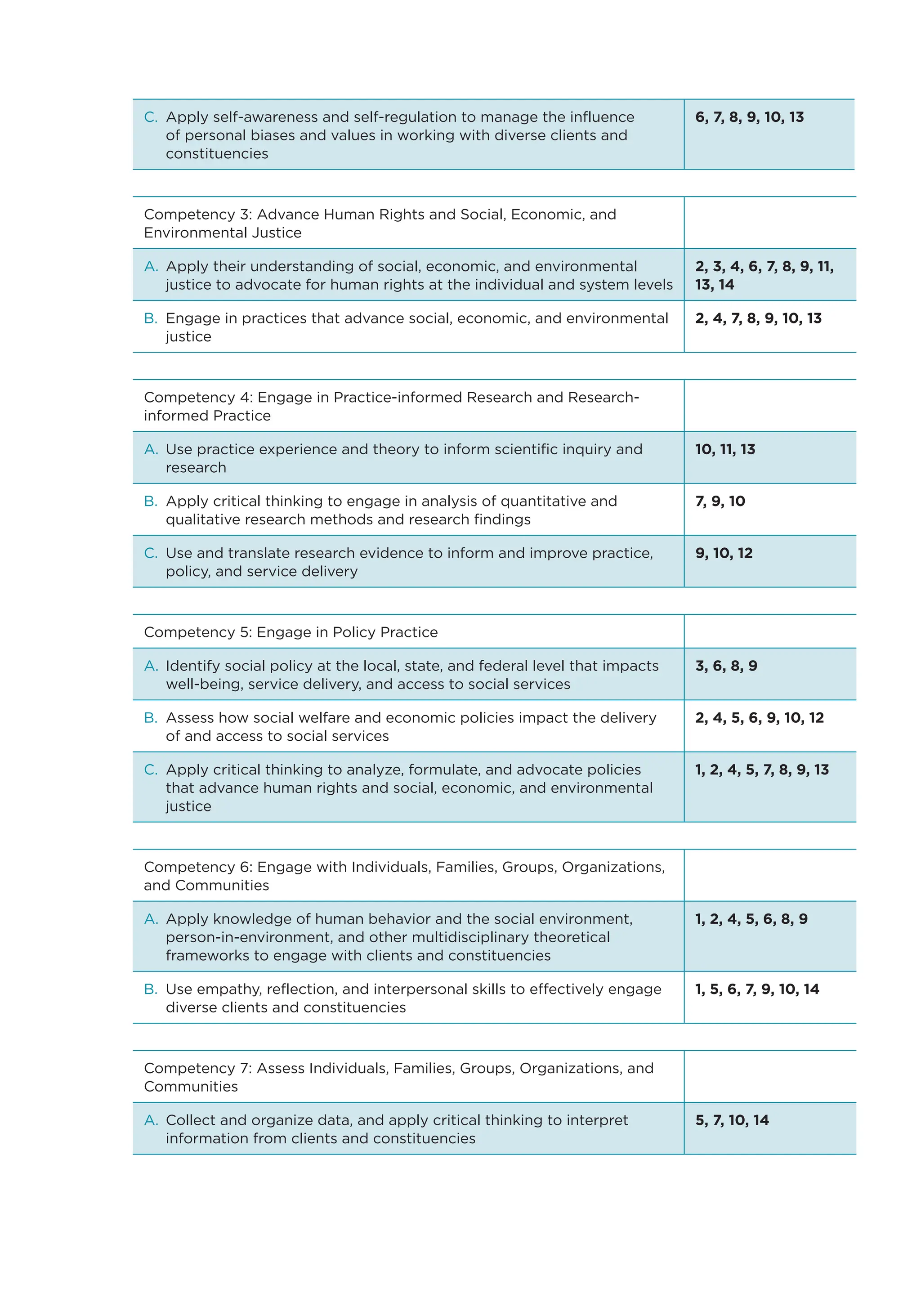



![Copyright © 2020 by SAGE Publications, Inc.
All rights reserved. Except as permitted by U.S. copyright
law, no part of this work may be reproduced or distributed
in any form or by any means, or stored in a database or
retrieval system, without permission in writing from the
publisher.
All third party trademarks referenced or depicted herein
are included solely for the purpose of illustration and are
the property of their respective owners. Reference to these
trademarks in no way indicates any relationship with, or
endorsement by, the trademark owner.
Printed in the United States of America
Library of Congress Cataloging-in-Publication Data
Names: Tice, Carolyn J., author. | Long, Dennis D., author. |
Cox, Lisa E., author.
Title: Macro social work practice : advocacy in action /
Carolyn J. Tice, Dennis D. Long, Lisa E. Cox.
Description: First Edition. | Thousand Oaks : SAGE
Publications, [2019] | Includes bibliographical references
and index.
Identifiers: LCCN 2019011937 | ISBN 9781506388410
(pbk. : alk. paper)
Subjects: LCSH: Social service. | Macrosociology.
Classification: LCC HV41 .T543 2019 | DDC 361.3/2—dc23
LC record available at https://lccn.loc.gov/2019011937
This book is printed on acid-free paper.
19 20 21 22 23 10 9 8 7 6 5 4 3 2 1
FOR INFORMATION:
SAGE Publications, Inc.
2455 Teller Road
Thousand Oaks, California 91320
E-mail: order@sagepub.com
SAGE Publications Ltd.
1 Oliver’s Yard
55 City Road
London EC1Y 1SP
United Kingdom
SAGE Publications India Pvt. Ltd.
B 1/I 1 Mohan Cooperative Industrial Area
Mathura Road, New Delhi 110 044
India
SAGE Publications Asia-Pacific Pte. Ltd.
18 Cross Street
#10-10/11/12
China Square Central
Singapore 048423
Acquisitions Editor: Joshua Perigo
Editorial Assistant:
Noelle Cumberbatch
Content Development Editor: Alissa Nance
Production Editor: Tracy Buyan
Copy Editor: Gillian Dickens
Typesetter: CM Digitals (P) Ltd.
Proofreader: Annette Van Devsen
Indexer: Celia McCoy
Cover Designer: Candice Harman
Marketing Manager: Zina Craft](https://image.slidesharecdn.com/22082628-250605150313-f4a74584/75/Macro-Social-Work-Practice-Advocacy-In-Action-1st-Edition-Carolyn-J-Tice-12-2048.jpg)
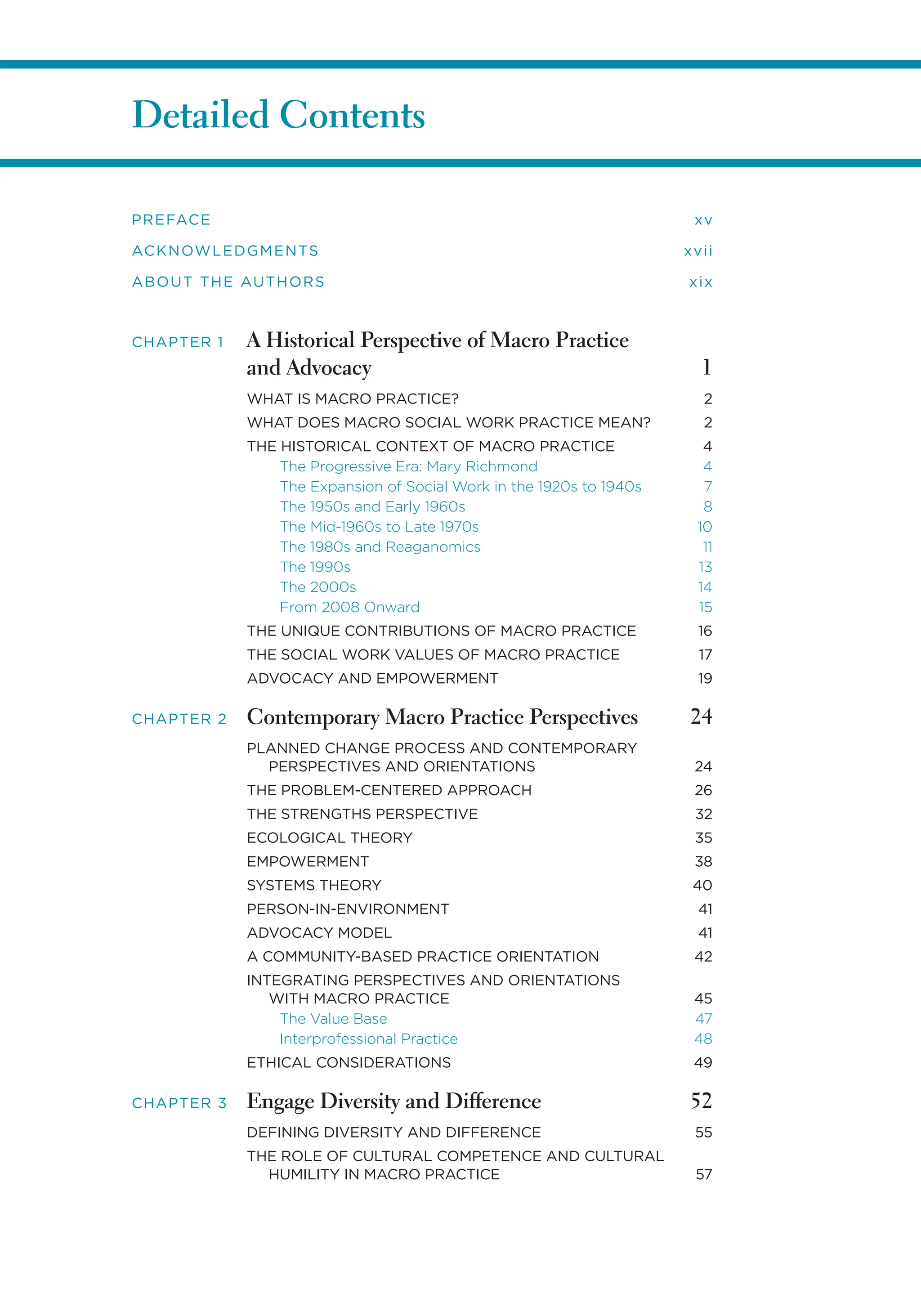












![CHAPTER 1 A Historical Perspective of Macro Practice and Advocacy 5
that in charity organizations, “some of [the] earli-
est leaders had grasped the idea of the sympathetic
study of the individual in his [or her] social envi-
ronment” (p. 32). Undoubtedly, as social activists
worked to strengthen opportunities and economic
means for their consumers of services, casework
“had at its command more varied resources, adapt-
able to individual situations.” As a consequence,
“the diagnosis of those situations assumed [a] fresh
[and broader] importance” (p. 32).
Mary Richmond is one of the best-known
leaders of the Charity Organization Society
(COS) movement, which was grounded in convic-
tions derived from England. Leaders of the COS
often “believed that many poor people were unwor-
thy, so that applicants for aid should be carefully
investigated. Records were to be kept about each
case, and a central registry was developed to ensure
that no person received aid from more than one
source” (Suppes Wells, 2003, p. 87). These written records eventually became
important sources of documentation for use in advocating for social change and
reform. Many would argue that these early efforts to advocate for reform on the
basis of documented human need constituted the beginning of community welfare
planning in the United States and eventually gave rise to what we now know as
the community-based United Way system.
The relationship between human need, casework, and social reform is an
interesting and profound theme when we consider the emergence of macro social
work practice. Richmond was astute in advancing the argument that necessity,
as evidenced by human struggle, was a driving force for social reform and ulti-
mately responsible for reshaping casework into “social” casework. If Richmond’s
perceptions are correct, then the movement of social work practice toward a more
structural, macro orientation is directly related to consumer plight and not merely
a philosophical position fashioned by progressive professionals.
Characterized by intense industrialization and massive immigration, the era
from 1900 to 1920 was a decisive period for rethinking and reconstituting social
services in the United States. As Mary Richmond was redefining casework, Jane
Addams’s Hull House became a model for the settlement movement in large
urban areas across the nation. In addition to providing a wide array of goods
and services in the poorest neighborhoods, settlement houses and the settlement
movement “concentrated on the totality of problems in a single geographical
area . . . the central focus was on the experiences, thinking, and actions of local
populations that could affect broad social and economic reform” (Haynes
Holmes, 1994, p. 65).
Settlement houses were neighborhood houses or community centers. In
addition to addressing the everyday needs of local residents, they often provided
recreational, instructional, and community programs (Federico, 1973, p. 170).
PHOTO 1.2
Recognition is
given to Mary
Richmond for her
contribution to
the social work
profession.
Library
of
Congress
Prints
and
Photographs
Division
Washington,
D.C.
20540
USA
http://hdl.loc.gov/loc.pnp/pp.print](https://image.slidesharecdn.com/22082628-250605150313-f4a74584/75/Macro-Social-Work-Practice-Advocacy-In-Action-1st-Edition-Carolyn-J-Tice-31-2048.jpg)
![CHAPTER 1 A Historical Perspective of Macro Practice and Advocacy 7
In summary, within the first 30 years of the 20th century, the origins of social
casework, group work, community organizing, and planning were established in
the United States. Many social workers continue to perceive themselves as case-
workers, group workers, or community organizers. Caseworkers adhere to a more
individual, case-by-case focus, whereas group workers and community organizers
are more closely aligned with themes of social reform.
The Expansion of Social Work in the 1920s to 1940s
The social and environmental conditions of consumers have historically
helped to shape social work practice. Indeed, the stock market crash of 1929
and the subsequent Great Depression constituted significant social events that
altered how most Americans, including social workers, viewed human need.
As Garvin and Tropman (1992) suggest, “The Great Depression was a cata-
clysmic event in U.S. society and ushered in the era of public development”
(p. 21). For those still harboring negativism toward the underprivileged and
doubts about public responsibility for social conditions, the Great Depression
represented a time for reconceptualization. Economic crisis and massive
unemployment signaled the start of a new era for social work. Suddenly, with-
out much warning, most citizens of the United States realized that the very
fabric of our society required strengthening and enrichment to preserve both
individual and common good.
Simply stated, work was not available during the Depression, regardless of an
individual’s motivation or will. Banks had failed; finding one’s next meal was a
challenge—and not just for the “other Americans.” In cities, the homeless built
small settlements of cardboard and tar paper shacks. In rural areas, farmers, many
of whom had gone into debt to purchase land and machinery, could not make
a living selling their crops. The United States was in trouble, and widespread
unemployment necessitated immediate and decisive societal action.
Eventually, a federal response to this economic catastrophe came in the
form of President Franklin Delano Roosevelt’s New Deal. A myriad of public
works and relief programs, the New Deal had as its backbone the passage of
the Social Security Act of 1935. Social workers such as Harry L. Hopkins, who
became a top adviser and New Deal administrator for Roosevelt, played an
active role in the creation and implementation of New Deal legislation, poli-
cies, and social programming. To this day, the Social Security Act continues
to fund many of the public assistance and entitlement programs that exist to
help children and families.
The 1930s and 1940s were characterized by an ideological shift. Stimulated by
the conditions of the Depression, “The [lingering] emphasis of the twenties upon
the individual’s responsibility for his or her own destiny could not hold up under the
circumstances of the thirties” (Garvin Cox, 1995, p. 86). People in the United
States, now more than ever, came to realize the value of government interven-
tion in strengthening the country’s faltering socioeconomic system. Extensive and
readily observable deprivation prompted citizens to view poverty as a public issue
rather than a private trouble and resulted in the establishment of forms of social
insurance, public assistance, and a variety of health and welfare services. This was](https://image.slidesharecdn.com/22082628-250605150313-f4a74584/75/Macro-Social-Work-Practice-Advocacy-In-Action-1st-Edition-Carolyn-J-Tice-33-2048.jpg)



![16 MACRO SOCIAL WORK PRACTICE
political parties, established battlegrounds for political control of legislation and
elected officials.
THE UNIQUE CONTRIBUTIONS OF
MACRO PRACTICE
Several interesting observations emerge when examining the past century plus in
relation to large-scale social change and social welfare. Foremost, the impetus and
support for macro-level social work have weathered a somewhat nonlinear, to-and-
fro course in U.S. history. There have been bursts of progress, when social workers
and consumers of services have successfully moved forward to advance laws, poli-
cies, and programs promoting structural change for the needy. Conversely, there
have been periods of stagnation, when society and social work practice have been
consumed with promoting personal responsibility and individual achievement.
And, although many would point to shifts in ideological winds (conservative vs.
liberal) as a primary influence on such fluctuations, in fact, the destiny of macro
social work practice and social reform seems particularly sensitive to specific, less
rational, social-economic conditions.
As examples, it is clear that war, catastrophe, economic crisis (depression, unem-
ployment, stock market failure), demographic changes (population shifts, family
composition, immigration), and international threat (war and terrorism) have the
potential to affect public and professional sentiment concerning the importance
of systemic, structural change in developing community and societal assets. If this
assertion is accurate, then aspiring social workers would be wise to prepare for stormy
seas. Yes, there will be times of smooth sailing for macro-level change. Conversely,
social workers will have to endure steadfast waters dedicated to helping consumers
cope and survive. Regardless of the social-historical era, it is important to remem-
ber that promoting consumer strengths and resolution of problems cannot be fully
addressed “by small-scale solutions no matter how well intentioned our motivations
. . . [instead] we must abandon those assumptions that constrict our policy responses
so we can think and act boldly” (Reisch Gorin, 2001, p. 16).
As an example of the impact of technological innovation, many social work-
ers are turning to the Internet as a mechanism for promoting social change.
Communication via the Internet can be an effective means of educating oth-
ers about social concerns, promoting people’s strengths, and coordinating social
advocacy. The Internet can be a timely source of information about various social
issues and causes. It can also facilitate ongoing dialogue between colleagues and
constituent groups. Information and communication are two important sources
of power in relation to macro-level social change (Williams, 2016).
While social workers conscientiously strive each day to include macro activities
in their practice, the profession as a whole is dedicated to finding ways to pro-
mote human dignity and improve social conditions. The National Association of
Social Workers (NASW) and the Council on Social Work Education (CSWE)
are two important professional organizations putting forward a macro view, both
within the profession and in society as a whole. And, although social work has his-
torically demonstrated a dedication to large-scale change, social-historical context](https://image.slidesharecdn.com/22082628-250605150313-f4a74584/75/Macro-Social-Work-Practice-Advocacy-In-Action-1st-Edition-Carolyn-J-Tice-42-2048.jpg)
![CHAPTER 1 A Historical Perspective of Macro Practice and Advocacy 17
often helps shape the forms this commitment takes. Hence, the doctrines, policies,
and publications of the NASW and the CSWE serve as compasses in guiding us
and keeping us focused on our professional identity.
One of the most profound documents for describing the mission of and ratio-
nale for social work is the NASW Code of Ethics (2017). Here, you can read the
first paragraph of the preamble of the Code of Ethics, with key words underscored.
These terms highlight the “macro” elements of practice and serve as a reminder
that social work is more encompassing than our “do-good” image “of helping
individuals and families to persevere.”
The primary mission of the social work profession is to enhance human
well-being and help meet the basic human needs of all people, with
particular attention to the needs and empowerment of people who are
vulnerable, oppressed, and living in poverty. A historic and defining
feature of social work is the profession’s focus on individual well-being
in a social context and the well-being of society. Fundamental to social
work is attention to the environmental forces that create, contribute to,
and address problems in living. (p. 1)
Copyrighted material reprinted with permission from
the National Association of Social Workers, Inc.
First and foremost, social workers are called upon “to enhance human well-
being.” This is not limited to the welfare of individuals and single families; it
also involves “a social context” and “the well-being of society” in general. Social
workers differ from other helping professionals in their focus on environmental
forces and their ability to “address problems [and strengths] in living” overall. The
“social” in “social work” connotes change for and with larger systems, including
groups of people, organizations, communities, and society.
THE SOCIAL WORK VALUES OF
MACRO PRACTICE
The mission of social work is based on a foundation of core values (see
Figure 1.1). Throughout the history of the social work profession, the following
values have guided the purpose of social work values, including macro practice:
Service: Social workers are often engaged in both working with individuals,
micro practice, while helping address social problems on a larger scale.This
integration of micro and macro practice necessitates that social workers
bring person-in-environment to all interventions with consumers.
Social Justice: The value of social justice embodies the notion of
equality, fairness, and the distribution of power and privilege. With this
in mind, social workers often focus macro practice on the conditions
confronting vulnerable, underresourced, marginalized populations and their
communities with a focus on redistribution.](https://image.slidesharecdn.com/22082628-250605150313-f4a74584/75/Macro-Social-Work-Practice-Advocacy-In-Action-1st-Edition-Carolyn-J-Tice-43-2048.jpg)




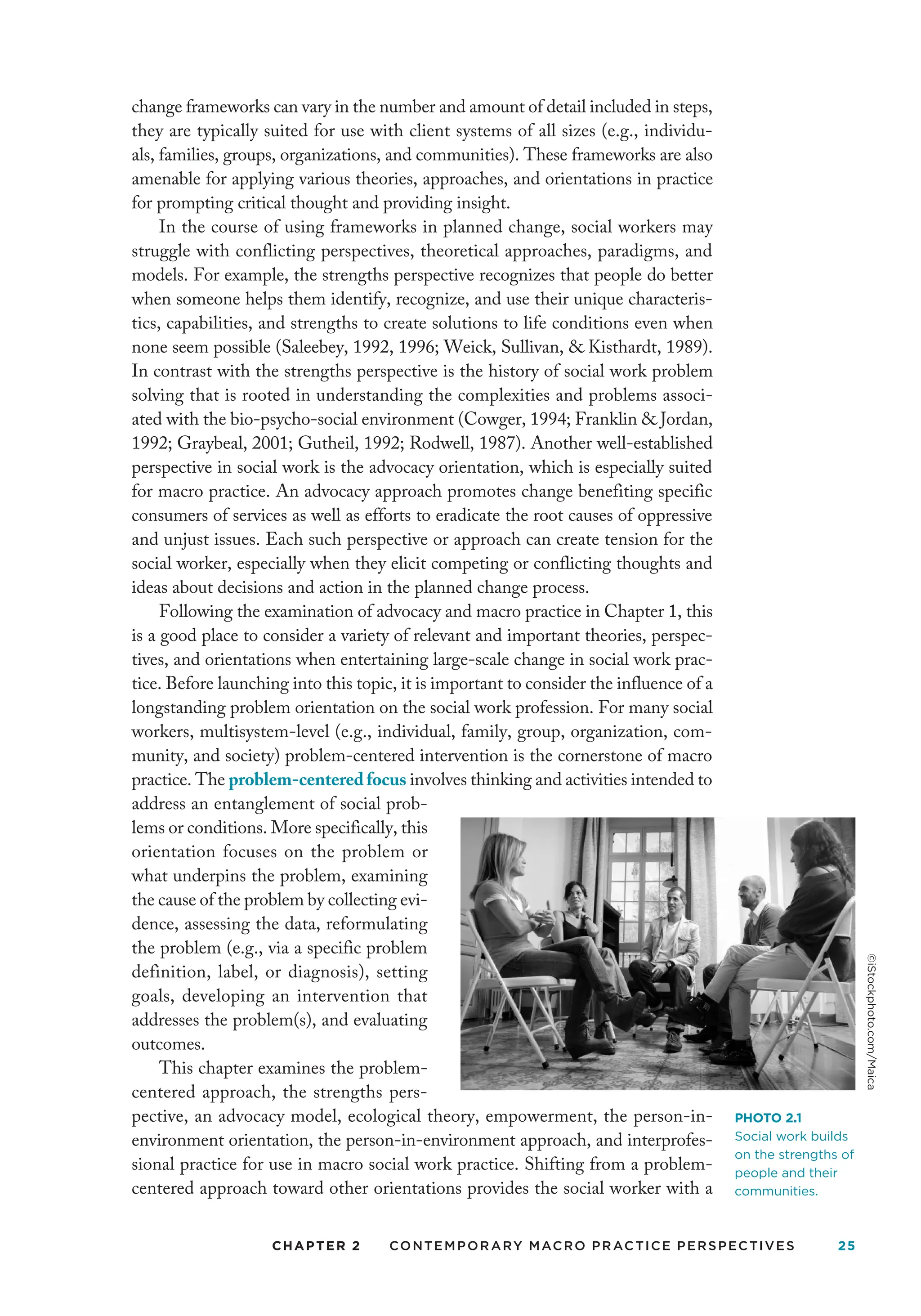












![your balance:” and premising this as a “start,” I shall now describe
the various kinds of skates, and the methods of using them.
THE SKATE.
There are various kinds of skates. Some, such as the Dutch skates,
are very large and somewhat cumbersome, but very safe for those
who skate with heavy loads on their shoulders, as they do in Holland,
Denmark, and Russia. In these the iron often projects above six
inches from the wood, and curls up towards the shin-bone above a
foot, that the skater may glide the more easily over the hillocks of
snow common to large expanses of ice.
Some skates are what are called fluted, that is, they have a groove
running along the centre of the iron, which are the best for
beginners, as they take a better hold of the ice. The plain skates
have no such groove, and are better adapted for those who have
partially acquired the art, as with them the utmost velocity and
elegance of movement may be performed.[4]
[4] Fluted skates, however, are dangerous for any but those of light
weight, as the cut ice is apt to “ball” in the groove, and so to throw the
wearer, if he leans on one side.
The iron of the skate, which lies under the foot, is called its blade;
this varies in different kinds of skates, and the practised professor of](https://image.slidesharecdn.com/22082628-250605150313-f4a74584/75/Macro-Social-Work-Practice-Advocacy-In-Action-1st-Edition-Carolyn-J-Tice-73-2048.jpg)