Machine Learning in iOS: Core ML and
its Applications
Megatask Web
Machine Learning
Machine Learning (ML) is a branch of artificial intelligence (AI)
that empowers computer systems to learn and improve from
experience without being explicitly programmed. The essence
of machine learning lies in the ability of algorithms to recognize
patterns, make predictions, and adapt their behavior based on
data inputs.
In traditional programming, humans define explicit instructions
for a computer to execute specific tasks. In contrast, machine
learning algorithms enable computers to analyze vast datasets,
identify patterns, and make decisions or predictions
autonomously. This capability is particularly valuable in handling
complex and dynamic scenarios where rule-based programming
may be impractical or unfeasible.
Overview of Machine Learning Integration in iOS
Machine Learning (ML) integration in iOS is seamlessly embedded across the operating system,
applications, and development frameworks. Apple's Core ML framework allows on-device model
inference, supporting various model formats. iOS features, including Siri, Face ID, and QuickType
Keyboard, leverage ML for enhanced functionality. Augmented Reality experiences benefit from ML
integration with ARKit.
Core ML Framework:
● Purpose: Core ML is Apple's dedicated framework for integrating machine learning
models into iOS applications.
● Compatibility: It supports a variety of machine learning model formats, including
TensorFlow, ONNX, Keras, and scikit-learn.
● On-Device Inference: Core ML enables on-device model inference, allowing apps to
make predictions without relying on external servers.
iOS Features Enhanced by Machine Learning:
● Siri: Apple's virtual assistant Siri utilizes machine learning for natural language
processing, enabling more accurate and context-aware responses.
● Face ID: The facial recognition technology employed in Face ID uses machine learning
algorithms to adapt to changes in a user's appearance over time.
● QuickType Keyboard: Machine learning is employed to predict the next word or phrase
a user is likely to type, improving typing speed and accuracy.
What is Core ML
Core ML is a framework developed by Apple that enables the integration of machine learning models into iOS,
macOS, watchOS, and tvOS applications. Introduced in 2017, Core ML facilitates on-device machine learning
inference, allowing apps to run models locally without the need for a constant internet connection. This framework
supports a variety of pre-trained machine learning models and is designed to be efficient and user-friendly for
developers.
Key features of Core ML include:
Versatility: Core ML supports a range of machine learning model formats, such as TensorFlow, ONNX, Keras,
and scikit-learn, making it flexible and adaptable to various model architectures.
On-Device Processing: One of the primary advantages of Core ML is its capability to perform machine learning
inference directly on the device. This ensures faster response times, enhances user privacy by keeping
data on the device, and reduces reliance on server-side processing.
Optimized Performance: Core ML is optimized for Apple's hardware, providing high-performance execution of
machine learning models. This optimization results in efficient use of system resources and improved
energy efficiency.
Seamless Integration with Apple Ecosystem: Core ML seamlessly integrates with other Apple technologies,
including Vision for image and video analysis, Natural Language Processing for text analysis, and ARKit
for augmented reality applications.
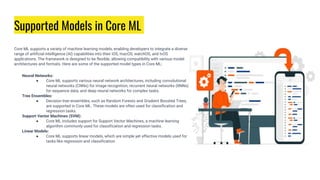
Supported Models in Core ML
Core ML supports a variety of machine learning models, enabling developers to integrate a diverse
range of artificial intelligence (AI) capabilities into their iOS, macOS, watchOS, and tvOS
applications. The framework is designed to be flexible, allowing compatibility with various model
architectures and formats. Here are some of the supported model types in Core ML:
Neural Networks:
● Core ML supports various neural network architectures, including convolutional
neural networks (CNNs) for image recognition, recurrent neural networks (RNNs)
for sequence data, and deep neural networks for complex tasks.
Tree Ensembles:
● Decision tree ensembles, such as Random Forests and Gradient Boosted Trees,
are supported in Core ML. These models are often used for classification and
regression tasks.
Support Vector Machines (SVM):
● Core ML includes support for Support Vector Machines, a machine learning
algorithm commonly used for classification and regression tasks.
Linear Models:
● Core ML supports linear models, which are simple yet effective models used for
tasks like regression and classification.
Benefits of Using Core ML
Using Core ML in iOS applications offers several benefits, making it a powerful framework for integrating
machine learning models into your projects. Here are some key advantages:
On-Device Inference:
● Core ML enables on-device model inference, allowing applications to make predictions
without relying on external servers. This results in faster response times and ensures
functionality even in offline scenarios.
Performance Optimization:
● Core ML is optimized for Apple's hardware, leading to efficient execution of machine
learning models. This optimization enhances the overall performance of the application,
providing a smoother user experience.
Energy Efficiency:
● By performing machine learning tasks directly on the device, Core ML reduces the need for
continuous communication with external servers. This not only improves response times
but also contributes to energy efficiency, conserving device battery life.
Seamless Integration with Apple Ecosystem:
● Core ML seamlessly integrates with other Apple technologies, such as Vision for image and
video analysis, Natural Language Processing for text analysis, and ARKit for augmented
reality applications. This integration facilitates the creation of comprehensive and feature-
rich applications.
Versatility in Model Formats:
● Core ML supports a variety of machine learning model formats, including TensorFlow,
ONNX, Keras, and scikit-learn. This versatility allows developers to choose models that best
suit their specific needs and workflows.
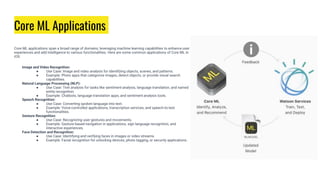
Core ML Applications
Core ML applications span a broad range of domains, leveraging machine learning capabilities to enhance user
experiences and add intelligence to various functionalities. Here are some common applications of Core ML in
iOS:
Image and Video Recognition:
● Use Case: Image and video analysis for identifying objects, scenes, and patterns.
● Example: Photo apps that categorize images, detect objects, or provide visual search
capabilities.
Natural Language Processing (NLP):
● Use Case: Text analysis for tasks like sentiment analysis, language translation, and named
entity recognition.
● Example: Chatbots, language translation apps, and sentiment analysis tools.
Speech Recognition:
● Use Case: Converting spoken language into text.
● Example: Voice-controlled applications, transcription services, and speech-to-text
functionalities.
Gesture Recognition:
● Use Case: Recognizing user gestures and movements.
● Example: Gesture-based navigation in applications, sign language recognition, and
interactive experiences.
Face Detection and Recognition:
● Use Case: Identifying and verifying faces in images or video streams.
● Example: Facial recognition for unlocking devices, photo tagging, or security applications.
Core ML in APP Development
Core ML plays a crucial role in app development, empowering developers to integrate machine learning capabilities
seamlessly into their iOS applications. Here's how Core ML is utilized in the app development process:
Model Integration:
● Purpose: Developers integrate pre-trained machine learning models into their iOS apps using Core
ML.
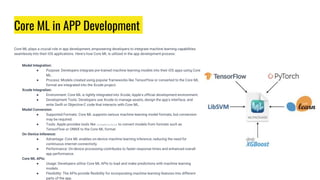
● Process: Models created using popular frameworks like TensorFlow or converted to the Core ML
format are integrated into the Xcode project.
Xcode Integration:
● Environment: Core ML is tightly integrated into Xcode, Apple's official development environment.
● Development Tools: Developers use Xcode to manage assets, design the app's interface, and
write Swift or Objective-C code that interacts with Core ML.
Model Conversion:
● Supported Formats: Core ML supports various machine learning model formats, but conversion
may be required.
● Tools: Apple provides tools like coremltools to convert models from formats such as
TensorFlow or ONNX to the Core ML format.
On-Device Inference:
● Advantage: Core ML enables on-device machine learning inference, reducing the need for
continuous internet connectivity.
● Performance: On-device processing contributes to faster response times and enhanced overall
app performance.
Core ML APIs:
● Usage: Developers utilize Core ML APIs to load and make predictions with machine learning
models.
● Flexibility: The APIs provide flexibility for incorporating machine learning features into different
parts of the app.
Future Trends in Core ML
Core ML plays a crucial role in app development, empowering developers to integrate machine learning
capabilities seamlessly into their iOS applications. Here's how Core ML is utilized in the app development
process:
Model Integration:
● Purpose:Developers integrate pre-trained machine learning models into their iOS
apps using Core ML.
● Process: Models created using popular frameworks like TensorFlow or converted to
the Core ML format are integrated into the Xcode project.
Xcode Integration:
● Environment: Core ML is tightly integrated into Xcode, Apple's official development
environment.
● Development Tools: Developers use Xcode to manage assets, design the app's
interface, and write Swift or Objective-C code that interacts with Core ML.
Model Conversion:
● Supported Formats: Core ML supports various machine learning model formats, but
conversion may be required.
● Tools: Apple provides tools like coremltools to convert models from formats such
as TensorFlow or ONNX to the Core ML format.
On-Device Inference:
● Advantage: Core ML enables on-device machine learning inference, reducing the need
for continuous internet connectivity.
● Performance: On-device processing contributes to faster response times and
enhanced overall app performance.
Connect with us
Contact Megatask Web for Personalized iOS App Development Solutions!
Are you looking to iOS App Development Service ? Megatask Web is here to help with our expert iOS App Development Services.
How to Reach Us:
📞 Call us at +971-545871570 for a personalized consultation.
📧 Send us an email at info@megataskweb.com to discuss your PPC needs.
Visit Our Website:
🌐 Explore our services at https://megataskweb.com/service/ios-development
Transform your digital marketing strategy with Megatask Web's PPC expertise. Let's elevate your brand visibility and drive conversions
together!
Thank you

Machine Learning in iOS_ Core ML and its Applications.pptx

  • 1.
    Machine Learning iniOS: Core ML and its Applications Megatask Web
  • 2.
    Machine Learning Machine Learning(ML) is a branch of artificial intelligence (AI) that empowers computer systems to learn and improve from experience without being explicitly programmed. The essence of machine learning lies in the ability of algorithms to recognize patterns, make predictions, and adapt their behavior based on data inputs. In traditional programming, humans define explicit instructions for a computer to execute specific tasks. In contrast, machine learning algorithms enable computers to analyze vast datasets, identify patterns, and make decisions or predictions autonomously. This capability is particularly valuable in handling complex and dynamic scenarios where rule-based programming may be impractical or unfeasible.
  • 3.
    Overview of MachineLearning Integration in iOS Machine Learning (ML) integration in iOS is seamlessly embedded across the operating system, applications, and development frameworks. Apple's Core ML framework allows on-device model inference, supporting various model formats. iOS features, including Siri, Face ID, and QuickType Keyboard, leverage ML for enhanced functionality. Augmented Reality experiences benefit from ML integration with ARKit. Core ML Framework: ● Purpose: Core ML is Apple's dedicated framework for integrating machine learning models into iOS applications. ● Compatibility: It supports a variety of machine learning model formats, including TensorFlow, ONNX, Keras, and scikit-learn. ● On-Device Inference: Core ML enables on-device model inference, allowing apps to make predictions without relying on external servers. iOS Features Enhanced by Machine Learning: ● Siri: Apple's virtual assistant Siri utilizes machine learning for natural language processing, enabling more accurate and context-aware responses. ● Face ID: The facial recognition technology employed in Face ID uses machine learning algorithms to adapt to changes in a user's appearance over time. ● QuickType Keyboard: Machine learning is employed to predict the next word or phrase a user is likely to type, improving typing speed and accuracy.
  • 4.
    What is CoreML Core ML is a framework developed by Apple that enables the integration of machine learning models into iOS, macOS, watchOS, and tvOS applications. Introduced in 2017, Core ML facilitates on-device machine learning inference, allowing apps to run models locally without the need for a constant internet connection. This framework supports a variety of pre-trained machine learning models and is designed to be efficient and user-friendly for developers. Key features of Core ML include: Versatility: Core ML supports a range of machine learning model formats, such as TensorFlow, ONNX, Keras, and scikit-learn, making it flexible and adaptable to various model architectures. On-Device Processing: One of the primary advantages of Core ML is its capability to perform machine learning inference directly on the device. This ensures faster response times, enhances user privacy by keeping data on the device, and reduces reliance on server-side processing. Optimized Performance: Core ML is optimized for Apple's hardware, providing high-performance execution of machine learning models. This optimization results in efficient use of system resources and improved energy efficiency. Seamless Integration with Apple Ecosystem: Core ML seamlessly integrates with other Apple technologies, including Vision for image and video analysis, Natural Language Processing for text analysis, and ARKit for augmented reality applications.
  • 5.
    Supported Models inCore ML Core ML supports a variety of machine learning models, enabling developers to integrate a diverse range of artificial intelligence (AI) capabilities into their iOS, macOS, watchOS, and tvOS applications. The framework is designed to be flexible, allowing compatibility with various model architectures and formats. Here are some of the supported model types in Core ML: Neural Networks: ● Core ML supports various neural network architectures, including convolutional neural networks (CNNs) for image recognition, recurrent neural networks (RNNs) for sequence data, and deep neural networks for complex tasks. Tree Ensembles: ● Decision tree ensembles, such as Random Forests and Gradient Boosted Trees, are supported in Core ML. These models are often used for classification and regression tasks. Support Vector Machines (SVM): ● Core ML includes support for Support Vector Machines, a machine learning algorithm commonly used for classification and regression tasks. Linear Models: ● Core ML supports linear models, which are simple yet effective models used for tasks like regression and classification.
  • 6.
    Benefits of UsingCore ML Using Core ML in iOS applications offers several benefits, making it a powerful framework for integrating machine learning models into your projects. Here are some key advantages: On-Device Inference: ● Core ML enables on-device model inference, allowing applications to make predictions without relying on external servers. This results in faster response times and ensures functionality even in offline scenarios. Performance Optimization: ● Core ML is optimized for Apple's hardware, leading to efficient execution of machine learning models. This optimization enhances the overall performance of the application, providing a smoother user experience. Energy Efficiency: ● By performing machine learning tasks directly on the device, Core ML reduces the need for continuous communication with external servers. This not only improves response times but also contributes to energy efficiency, conserving device battery life. Seamless Integration with Apple Ecosystem: ● Core ML seamlessly integrates with other Apple technologies, such as Vision for image and video analysis, Natural Language Processing for text analysis, and ARKit for augmented reality applications. This integration facilitates the creation of comprehensive and feature- rich applications. Versatility in Model Formats: ● Core ML supports a variety of machine learning model formats, including TensorFlow, ONNX, Keras, and scikit-learn. This versatility allows developers to choose models that best suit their specific needs and workflows.
  • 7.
    Core ML Applications CoreML applications span a broad range of domains, leveraging machine learning capabilities to enhance user experiences and add intelligence to various functionalities. Here are some common applications of Core ML in iOS: Image and Video Recognition: ● Use Case: Image and video analysis for identifying objects, scenes, and patterns. ● Example: Photo apps that categorize images, detect objects, or provide visual search capabilities. Natural Language Processing (NLP): ● Use Case: Text analysis for tasks like sentiment analysis, language translation, and named entity recognition. ● Example: Chatbots, language translation apps, and sentiment analysis tools. Speech Recognition: ● Use Case: Converting spoken language into text. ● Example: Voice-controlled applications, transcription services, and speech-to-text functionalities. Gesture Recognition: ● Use Case: Recognizing user gestures and movements. ● Example: Gesture-based navigation in applications, sign language recognition, and interactive experiences. Face Detection and Recognition: ● Use Case: Identifying and verifying faces in images or video streams. ● Example: Facial recognition for unlocking devices, photo tagging, or security applications.
  • 8.
    Core ML inAPP Development Core ML plays a crucial role in app development, empowering developers to integrate machine learning capabilities seamlessly into their iOS applications. Here's how Core ML is utilized in the app development process: Model Integration: ● Purpose: Developers integrate pre-trained machine learning models into their iOS apps using Core ML. ● Process: Models created using popular frameworks like TensorFlow or converted to the Core ML format are integrated into the Xcode project. Xcode Integration: ● Environment: Core ML is tightly integrated into Xcode, Apple's official development environment. ● Development Tools: Developers use Xcode to manage assets, design the app's interface, and write Swift or Objective-C code that interacts with Core ML. Model Conversion: ● Supported Formats: Core ML supports various machine learning model formats, but conversion may be required. ● Tools: Apple provides tools like coremltools to convert models from formats such as TensorFlow or ONNX to the Core ML format. On-Device Inference: ● Advantage: Core ML enables on-device machine learning inference, reducing the need for continuous internet connectivity. ● Performance: On-device processing contributes to faster response times and enhanced overall app performance. Core ML APIs: ● Usage: Developers utilize Core ML APIs to load and make predictions with machine learning models. ● Flexibility: The APIs provide flexibility for incorporating machine learning features into different parts of the app.
  • 9.
    Future Trends inCore ML Core ML plays a crucial role in app development, empowering developers to integrate machine learning capabilities seamlessly into their iOS applications. Here's how Core ML is utilized in the app development process: Model Integration: ● Purpose:Developers integrate pre-trained machine learning models into their iOS apps using Core ML. ● Process: Models created using popular frameworks like TensorFlow or converted to the Core ML format are integrated into the Xcode project. Xcode Integration: ● Environment: Core ML is tightly integrated into Xcode, Apple's official development environment. ● Development Tools: Developers use Xcode to manage assets, design the app's interface, and write Swift or Objective-C code that interacts with Core ML. Model Conversion: ● Supported Formats: Core ML supports various machine learning model formats, but conversion may be required. ● Tools: Apple provides tools like coremltools to convert models from formats such as TensorFlow or ONNX to the Core ML format. On-Device Inference: ● Advantage: Core ML enables on-device machine learning inference, reducing the need for continuous internet connectivity. ● Performance: On-device processing contributes to faster response times and enhanced overall app performance.
  • 10.
    Connect with us ContactMegatask Web for Personalized iOS App Development Solutions! Are you looking to iOS App Development Service ? Megatask Web is here to help with our expert iOS App Development Services. How to Reach Us: 📞 Call us at +971-545871570 for a personalized consultation. 📧 Send us an email at info@megataskweb.com to discuss your PPC needs. Visit Our Website: 🌐 Explore our services at https://megataskweb.com/service/ios-development Transform your digital marketing strategy with Megatask Web's PPC expertise. Let's elevate your brand visibility and drive conversions together!
  • 11.