SOFT COMPUTING
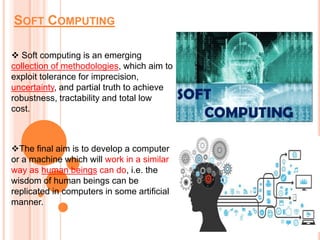
 Soft computing is an emerging
collection of methodologies, which aim to
exploit tolerance for imprecision,
uncertainty, and partial truth to achieve
robustness, tractability and total low
cost.
The final aim is to develop a computer
or a machine which will work in a similar
way as human beings can do, i.e. the
wisdom of human beings can be
replicated in computers in some artificial
manner.
What is MACHINE LEARNING?
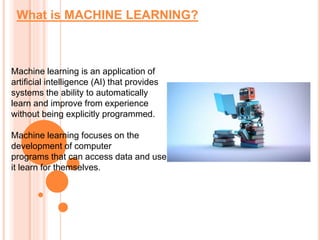
Machine learning is an application of
artificial intelligence (AI) that provides
systems the ability to automatically
learn and improve from experience
without being explicitly programmed.
Machine learning focuses on the
development of computer
programs that can access data and use
it learn for themselves.
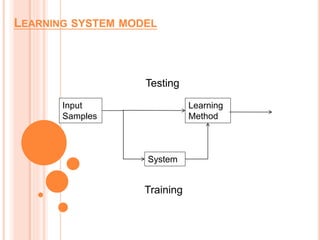
LEARNING SYSTEM MODEL
Input
Samples
Learning
Method
System
Testing
Training
MACHINE LEARNING ALGORITHMS
According to a recent study, machine learning algorithms are
expected to replace 25% of the jobs across the world, in the next
10 years.
Machine learning applications are highly automated and self-
modifying which continue to improve over time with minimal human
intervention as they learn with more data.
To address the complex nature of various real world data
problems, specialized machine learning algorithms have been
developed that solve these problems perfectly.
MACHINE LEARNING ALGORITHMS
The following algorithms will be discussed in this
presentation:
1. Supervised Learning
2. Unsupervised Learning
3. Reinforcement Learning
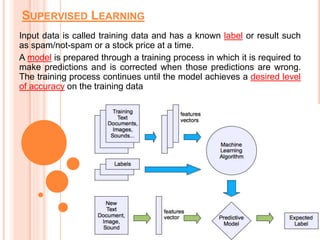
SUPERVISED LEARNING
Input data is called training data and has a known label or result such
as spam/not-spam or a stock price at a time.
A model is prepared through a training process in which it is required to
make predictions and is corrected when those predictions are wrong.
The training process continues until the model achieves a desired level
of accuracy on the training data
REGRESSION ALGORITHMS
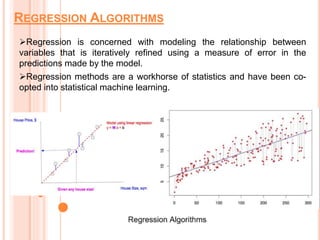
Regression is concerned with modeling the relationship between
variables that is iteratively refined using a measure of error in the
predictions made by the model.
Regression methods are a workhorse of statistics and have been co-
opted into statistical machine learning.
UNSUPERVISED LEARNING
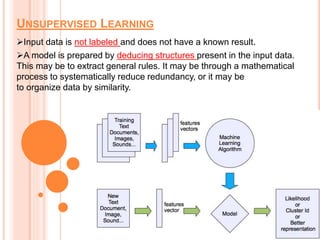
Input data is not labeled and does not have a known result.
A model is prepared by deducing structures present in the input data.
This may be to extract general rules. It may be through a mathematical
process to systematically reduce redundancy, or it may be
to organize data by similarity.
K-MEANS CLUSTERING ALGORITHM
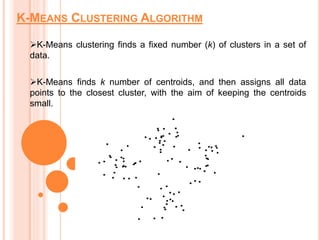
K-Means clustering finds a fixed number (k) of clusters in a set of
data.
K-Means finds k number of centroids, and then assigns all data
points to the closest cluster, with the aim of keeping the centroids
small.
APRIORI ALGORITHM
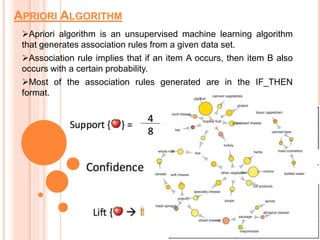
Apriori algorithm is an unsupervised machine learning algorithm
that generates association rules from a given data set.
Association rule implies that if an item A occurs, then item B also
occurs with a certain probability.
Most of the association rules generated are in the IF_THEN
format.
REINFORCEMENT LEARNING
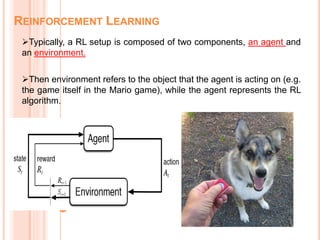
Typically, a RL setup is composed of two components, an agent and
an environment.
Then environment refers to the object that the agent is acting on (e.g.
the game itself in the Mario game), while the agent represents the RL
algorithm.
MACHINE LEARNING, AI & DEEP LEARNING
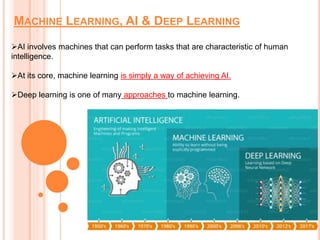
AI involves machines that can perform tasks that are characteristic of human
intelligence.
At its core, machine learning is simply a way of achieving AI.
Deep learning is one of many approaches to machine learning.
APPLICATIONS
Virtual Personal Assistants.
-Siri, Alexa, Google Now
Social Media Services
-People you may know
-Face Recognition
Search Engine Result Refining.
Product Recommendations.
-Amazon
-Flipkart
Spam Filtering
Machine learning

Machine learning

  • 2.
    SOFT COMPUTING  Softcomputing is an emerging collection of methodologies, which aim to exploit tolerance for imprecision, uncertainty, and partial truth to achieve robustness, tractability and total low cost. The final aim is to develop a computer or a machine which will work in a similar way as human beings can do, i.e. the wisdom of human beings can be replicated in computers in some artificial manner.
  • 3.
    What is MACHINELEARNING? Machine learning is an application of artificial intelligence (AI) that provides systems the ability to automatically learn and improve from experience without being explicitly programmed. Machine learning focuses on the development of computer programs that can access data and use it learn for themselves.
  • 4.
  • 5.
    MACHINE LEARNING ALGORITHMS Accordingto a recent study, machine learning algorithms are expected to replace 25% of the jobs across the world, in the next 10 years. Machine learning applications are highly automated and self- modifying which continue to improve over time with minimal human intervention as they learn with more data. To address the complex nature of various real world data problems, specialized machine learning algorithms have been developed that solve these problems perfectly.
  • 6.
    MACHINE LEARNING ALGORITHMS Thefollowing algorithms will be discussed in this presentation: 1. Supervised Learning 2. Unsupervised Learning 3. Reinforcement Learning
  • 7.
    SUPERVISED LEARNING Input datais called training data and has a known label or result such as spam/not-spam or a stock price at a time. A model is prepared through a training process in which it is required to make predictions and is corrected when those predictions are wrong. The training process continues until the model achieves a desired level of accuracy on the training data
  • 8.
    REGRESSION ALGORITHMS Regression isconcerned with modeling the relationship between variables that is iteratively refined using a measure of error in the predictions made by the model. Regression methods are a workhorse of statistics and have been co- opted into statistical machine learning.
  • 9.
    UNSUPERVISED LEARNING Input datais not labeled and does not have a known result. A model is prepared by deducing structures present in the input data. This may be to extract general rules. It may be through a mathematical process to systematically reduce redundancy, or it may be to organize data by similarity.
  • 10.
    K-MEANS CLUSTERING ALGORITHM K-Meansclustering finds a fixed number (k) of clusters in a set of data. K-Means finds k number of centroids, and then assigns all data points to the closest cluster, with the aim of keeping the centroids small.
  • 11.
    APRIORI ALGORITHM Apriori algorithmis an unsupervised machine learning algorithm that generates association rules from a given data set. Association rule implies that if an item A occurs, then item B also occurs with a certain probability. Most of the association rules generated are in the IF_THEN format.
  • 12.
    REINFORCEMENT LEARNING Typically, aRL setup is composed of two components, an agent and an environment. Then environment refers to the object that the agent is acting on (e.g. the game itself in the Mario game), while the agent represents the RL algorithm.
  • 13.
    MACHINE LEARNING, AI& DEEP LEARNING AI involves machines that can perform tasks that are characteristic of human intelligence. At its core, machine learning is simply a way of achieving AI. Deep learning is one of many approaches to machine learning.
  • 14.
    APPLICATIONS Virtual Personal Assistants. -Siri,Alexa, Google Now Social Media Services -People you may know -Face Recognition Search Engine Result Refining. Product Recommendations. -Amazon -Flipkart Spam Filtering