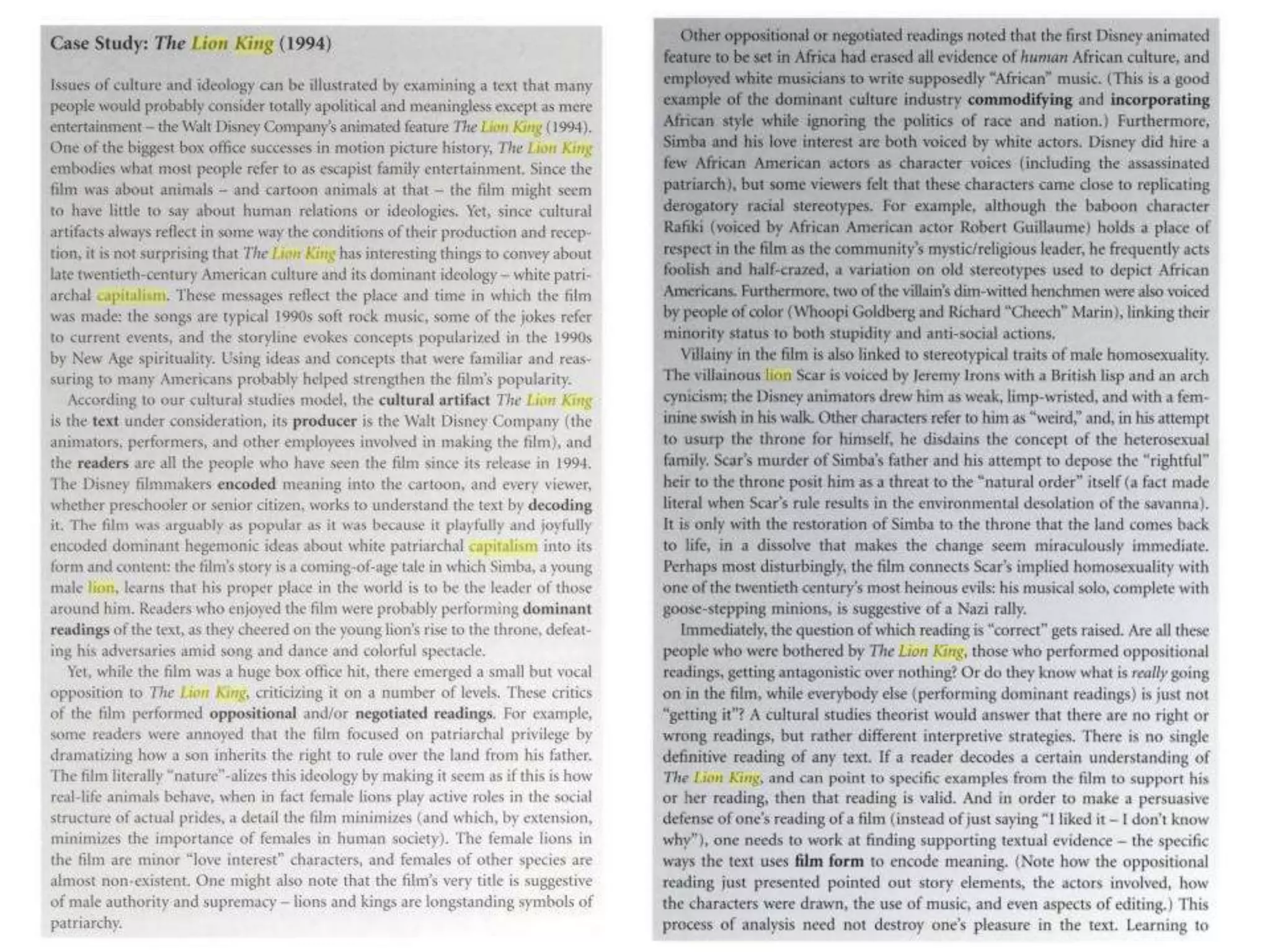
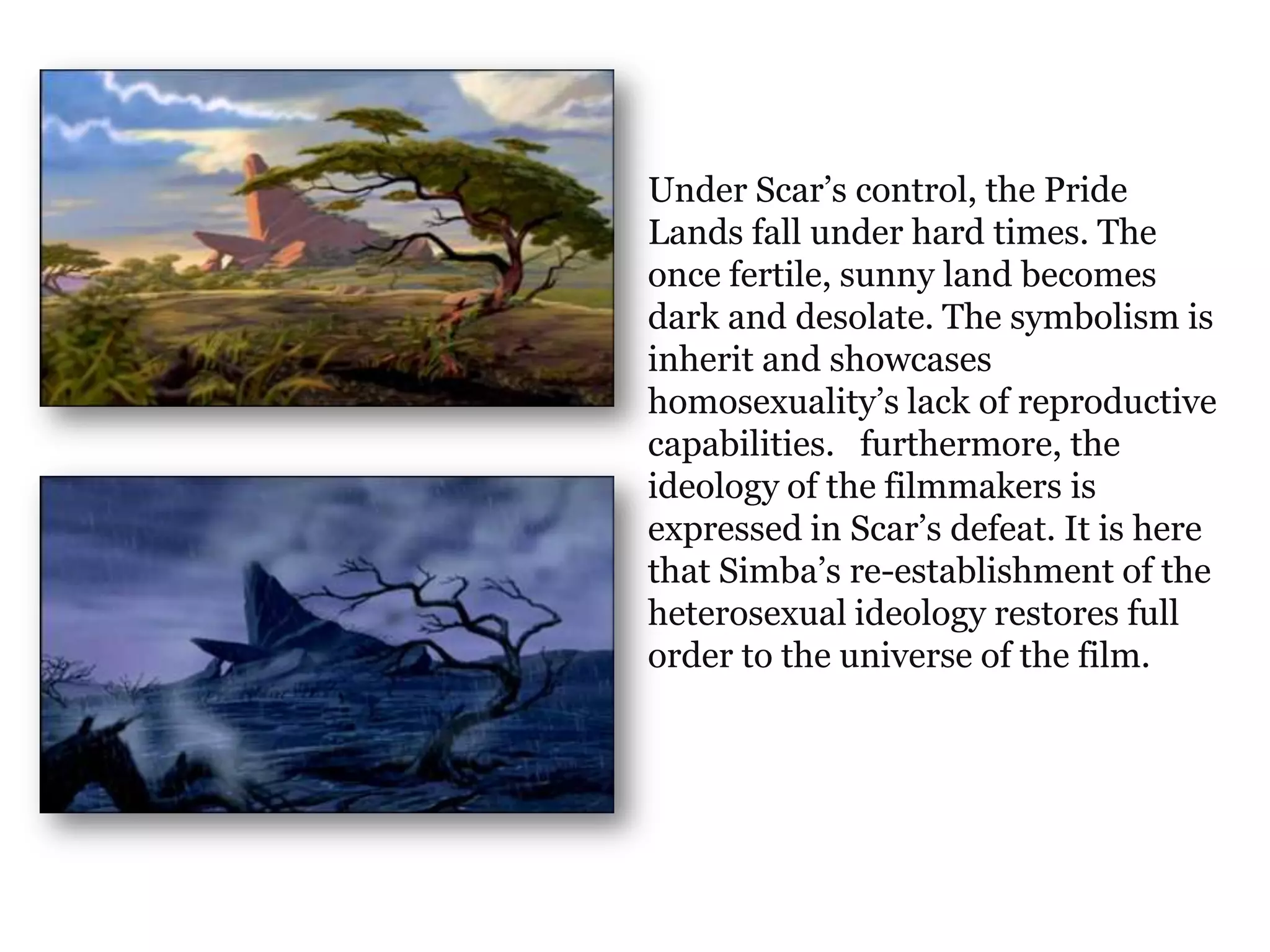
Under Scar’s control, the Pride
Lands fall under hard times. The
once fertile, sunny land becomes
dark and desolate. The symbolism is
inherit and showcases
homosexuality’s lack of reproductive
capabilities. furthermore, the
ideology of the filmmakers is
expressed in Scar’s defeat. It is here
that Simba’s re-establishment of the
heterosexual ideology restores full
order to the universe of the film.
Mac101   week 9 - ideology

Mac101 week 9 - ideology

  • 5.
    Under Scar’s control,the Pride Lands fall under hard times. The once fertile, sunny land becomes dark and desolate. The symbolism is inherit and showcases homosexuality’s lack of reproductive capabilities. furthermore, the ideology of the filmmakers is expressed in Scar’s defeat. It is here that Simba’s re-establishment of the heterosexual ideology restores full order to the universe of the film.

Editor's Notes

  • #5 THE LION KING's inherent fascism is more frightening for its obsession with leadership. Disney's worship of one-man dictatorship, usually quaintly monarchist, is decidedly unrestrained in THE LION KING. The movie is bracketed by two elaborate sequences showing all the animals of the "kingdom" flocking to see the newborn heir to the throne: we are treated to labored pomp and ceremony, as birds soar through the mists and long rows of ungulates bow down to their devourer/king, all accompanied by portentous African-sounding music. We are meant to be as much in awe of the king's glory and power as the animators clearly are.But pure spectacle does not suffice to get the message across to Disney's satisfaction. Mufasa, the king, spends half the movie impressing on his son, Simba, the duties and indispensability of the king, on whom the entire natural order seems to rest: in bland eco-speak, he explains that the king maintains "the delicate balance of nature." Unaccountably, this is eventually borne out. When the wrong king comes to power, the lush savanna becomes a wasteland from which even the rain-clouds flee. The king's importance extends to the very firmament. Mufasa explains that the stars are the spirits of past kings who guide the present one (putting a monarchist spin on traditional African ancestor worship). In the daytime, the sun is called into service; taken to Castle Rock, Simba is told that the king's domain, the Prideland, extends wherever the sun shines. Simba, listening to James Earl Jones's regal baritone, grows excited about his future role. He spends his time dreaming of his future power and singing show-stoppers like "I Can't Wait to be King."This thinly disguised Oedipal longing puts an ace up the sleeve of Scar, Mufasa's evil and covetous brother. He plots with hyenas to put Simba in the path of a stampeding herd of wildebeest, a mishap which he uses as cover to kill Mufasa when the king tries to rescue his son. Scar convinces Simba that he is responsible for his own father's death. Simba, with a child's fear that one's wishes can have bad effects in the real world, readily accepts the blame. Flayed by a remorse that takes him most of the movie to overcome, he flees the kingdom, eventually found by a warthog-meerkat pair who raise him.Meanwhile, Scar takes over. As the Bad Leader he brings the kingdom to ruin. Mannered and aristocratic, and clearly not producing heirs like his more manly brother, he is pointedly gay. He is also a rationalist and utilitarian, coveting the absolute power of kingship but not buying into its mystique. He exerts a corrupting influence on the young, skillfully putting all sorts of ideas into Simba's head. Worst of all, he willingly enters into an unholy alliance with the hyenas, a teeming brood of half-starved scavengers ghettoized in a "dark region." Taken as a whole, he represents that bête-noir of contemporary right-wingers, the Liberal Politician.Previously, Scar had goaded Simba to disobey his father and enter the prohibited "dark region." We tumble with the lion cub and his girlfriend into space that is suddenly enclosed, vertical and without vegetation, an "elephant graveyard" amid the cliffs. The huge elephant skeletons resemble the burnt-out shells of tall buildings, or perhaps the postindustrial remains of hulking machinery. Simba, on a dare, starts to enter a huge skull, only to be frozen in his tracks by eerie laughter. In classic hooligan fashion, three hyenas emerge and start circling Simba, taunting and threatening him. It's clear that Simba is on the wrong side of the tracks, in a bad neighborhood, surrounded by "the projects" — he's caught in the inner city.The hyenas speak in "street voices" provided by Whoopi Goldberg and Cheech Marin and clearly represent poor blacks and Hispanics. They are also stereotypical gang members, inherently criminal, cutthroat and mercenary — brawling with each other when not united by a common victim. As scavengers whose own neighborhood offers slim pickings, they eagerly accept handouts. Scar provides them: he gains the hyena's loyalty by promising them a steady stream of meat, thus creating the Welfare State.After he usurps the throne, Scar lets the hyenas out of the "dark region" and into the Prideland, to the horror of the other species. Catastrophe follows: the lions' resources are squandered by the lazy and rapacious hyenas, who, in turn, harass the lions with petty terror. The balance of nature is upset: the herds flee, the water dries up, and the landscape soon resembles the wasteland of the elephant graveyard. The hyenas carry their blight with them; having brought down the productive ecosystem that used to provide them with scraps, their starvation only worsens. They offend Scar, who cares only about his power, by voicing nostalgia for the Mufasa regime which kept them in their place.The lionesses, witnessing the devastation all about them, are strangely passive — even though they do all of the hunting and are collectively strong enough to kick the asses of Scar and his praetorian guard of hyenas. Instead, they abandon all hope until they rediscover Simba, the rightful heir, whom they had thought dead. By this time, Simba is utterly useless by any standard, having spent his youth doing nothing but dancing around eating bugs. But no matter: he functions as the Leader — and without a Leader, even groups who possess all of the apparent power are in reality helpless.Others join in this mystical valuation of the Leader. In life, Mufasa had emphasized the importance of bloodline. In death, his ghost visits Simba to cajole him to "remember who you are" and not to break the line of kingly succession, despite his lack of training. (Unlike the more sensible ghost of Hamlet's father, Mufasa forgets to tell the guilt-ridden Simba that the father was really murdered by Scar, a revelation that would have instantly put an end to Simba's paralyzing angst.) A baboon shaman on retainer to the royal family also encourages the youth to return, explaining that Mufasa "lives on" in Simba (the shaman's motives are at least explicable: his status took a nasty drop during Scar's regime). Caught in a medieval mindset, everyone seems convinced that the ascension of the rightful heir, in itself, will reestablish harmony. The writers and animators work hard to prove them right: when Simba takes over, the waters return. Male power becomes sanctioned by the cosmos, secure even in the face of apparent obsolescence.Simba conquers Scar in the prescribed Disney manner: through pure exertion of will. Simba is teetering on the brink of death when Scar gloatingly reveals the truth about Mufasa's death. Simba leaps forward in a sudden surge of energy and subdues his uncle, who promptly sells out the hyenas. Demonstrating kingly mercy, Simba spares Scar — who, of course, tries one more backstab before he's done in by angry and betrayed hyenas, the very unsavory types he has spent his years pandering to. A fitting end to the Liberal Politician.THE LION KING has a clear political agenda: end the welfare state, barricade the suburbs against the inner city, and replace liberal politicians with true, authoritarian leaders. It works: Simba's kingdom becomes once again green and stuffed with prey. The hyenas remain quarantined in their ghetto; the balance of nature, each species in its own habitat, becomes restored. The urban poor are evidently as unassimilable to mainstream U.S. society as Jews were to the society of Hitler's dreams. THE LION KING's recap of classically fascist themes bodes ill. Since Disney's animated extravaganzas reappeared with THE LITTLE MERMAID, they have been a weirdly accurate barometer of the "national political mood," including a brief liberal flourish around the time of Clinton's election.
  • #6 Disney's 1980s features reflected the neo-conservative preoccupation with personal morality and "family values." They consist mainly of family dramas, bent on achieving proper heterosexual couple bonding despite the odds. The female leads in all three are restless and eager to escape their fathers' realms, an impulse which puts them in danger until they arrive safely into their husbands' arms. The males are all, at first, unworthy of full patriarchal responsibility but, in true PINOCCHIO fashion, overcome their weaknesses and, through exertions of will, defeat their foes and become fit successors to their wives' fathers. But there to thwart this happy outcome, simultaneously trying to usurp heterosexual power and distract the hero from the heroine, is that neocon bugaboo — the gay male. In an age when anti-semitism has fallen out of vogue and Communism, not taken seriously, he has to bear the full brunt of fascist animus.At first glance, Ursula, the villain in THE LITTLE MERMAID, seems a woman; on closer inspection, however, the Sea Witch resembles a flamboyant, Divine-ly inspired drag queen. Her octopus-like lower half further renders her gender ambiguous: the first view of her tentacles emerging from the darkness is played up for shock value (not unlike a similar view in THE CRYING GAME). Ursula eventually pulls off a drag queen's coup. She takes on the appearance of a svelte brunette, speaks with the Little Mermaid's stolen voice (solving a chronic problem for female impersonators), and seduces the virile young prince into marrying her. She reveals the deception by literally splitting the seams of her disguise, emerging in her opulent glory; she manages to reduce the hypermasculine Sea King to a pathetic plant and only gets defeated when the virile prince impales her with the prow of a ship, thus contrasting his erect phallus with her flaccid ones. Her threat to heterosexual pair-bonding and patriarchal power is thus laid to rest.The gay villain of BEAUTY AND THE BEAST is, by contrast, hypermasculine. Gaston, vain and preening, covets heterosexual status in pursuing Belle, the beauty of the title; but he constantly ignores both her and the trio of blonde bombshells that swoon over him. He is only truly interested in male gazes, and blossoms in the midst of his all-male lodge, where he sings a showstopper celebrating his own masculinity. Provided, like The Fox, with an elastic, high-contact companion, he is the epitome of camp. Mainly a figure of comic relief, he's hard to take very seriously. The true evil of BEAUTY AND THE BEAST, in fact, lies elsewhere: in the sexual dysfunction of the hero, who suffers from what clinicians call "infantile narcissism." The witch's curse simply brings his fetishism — in which inanimate objects are endowed with ego-fulfilling life — out into the open, transforming his castle into something like Pee Wee's Playhouse. Constant parallels between his actions and Gaston's link his condition with Gaston's more deeply entrenched sexual deviance. He finally breaks the curse — defeating Gaston and restoring his realm to "normal" — by embracing a prosaic heterosexuality with Belle.BEAUTY AND THE BEAST is a men's movement response to feminist nagging. It is engorged with anxiety that masculinity might be a mask for homosexuality; or that natural male narcissism might forever alienate the women that feminism has made so intolerant. In the end, it is a plea that women understand and love men's "beasts within" (their inner "wild men"), and help mother them into maturity. It is early 1990s wish fulfillment.ALLADIN represents a surprising liberal aberration from Disney's right-wing trajectory. To be sure, the villain is still gay: Jafar is dark, effeminate, and prissily evil; Scar simply repeats Jafar in the shape of a lion. Jafar, however, very much acts the role of a gay man's gay villain, twisted by his desire for heterosexual power and his consequent self-enclosure in the closet. Advisor to the sultan, he is a Roy Cohn type with Leopold-and-Loeb overtones. He is counterpoised, moreover, to a healthier gay icon: the Genie, who, with Robin Williams's voice, flames across the screen in a one-man cabaret show. (Of course, a male genie is already sexually suspect in a culture whose TV-sitcom associations mark genies as female.) The Genie shifts gender several times and uses his transformative powers to generally wreak havoc on social categories, making street urchins into princes.The other heroes are hippie twenty-somethings. Princess Jasmine wants to "break the rules" of her restrictive society. Aladdin woos her by taking her on a "magic carpet ride" to "a whole new world," a barely concealed acid trip. In the end, Aladdin renounces power by setting the Genie free from his lamp (releasing him from the closet, as it were). Happily, renouncing power ends up winning it for him, as he is put next in line for the sultanship. (He will no doubt be a cool sultan, treating his subjects to free concerts and, if possible, high-fat chunky ice-cream.)Aladdin is everything Clinton was supposed to have been: of the people, hippie-ish, a friend to gays, and willing to renounce "politics as usual." ALLADIN embodies other liberalish themes: a sympathy with the urban poor, and an understanding of crime (like stealing) as a response to circumstances. Above all, ALLADIN embodies that strange liberal vision of social justice as nothing more than an United States in which Horatio Alger stories can once again come true.With THE LION KING, the liberals have been ousted, in sync with the real conservative agenda of Clintonism and, more recently, with the Newt juggernaut: with its get-tough crime bill, its welfare reform, and its promises to restore to the middle class its lost paradise of 50s suburbia. The reclamation of suburbia, with its "traditional" values, forms the core of THE LION KING's story. Mufasa, it should be remembered, reigns over a rather odd kingdom: namely, of things he eats. There are no other lions in evidence (save Scar, his free-loading brother), and the lionesses are all dutiful domestic servants. Like a suburbanite ruling over a kingdom of appliances, cars, and household technology, Mufasa lords over a realm of consumables.Simba, like Aladdin, goes the 1960s counterculture route. In THE LION KING, this is more clearly a shift in styles of consumption: from big-ticket antelope to brightly colored, smallscale, shiny designer insects. His pseudoparents, a meerkat and warthog, engage in an "alternative lifestyle," living as a couple to the exclusion of females of their own species. Their motto is slacker and multi-cultural: the Swahili "hakunamatada" — "who cares?" When Simba's former betrothed appears, he seems ready for free love. In the end, however, he is successfully exhorted to give up his irresponsible "alternative" lifestyle and, in one stroke, reclaim his "traditional" values and his father's kingdom. If we want to recreate the paradise of the 1950s, we have but to conquer the liberals and their decadent lifestyles.In the 50 years since Walt Disney made PINOCCHIO, history has gone his way — that is to say, the wrong way. Resource-draining, environment-destroying suburbs have sprawled out of control, creating a centrifugal force that has not only reinforced segregation by race and income, but atomized humans to an unheard of extent. U.S. visions of collective action, both of the privileged and the oppressed, have almost completely decomposed into fascist fantasies of blood and soil. As the stockpiles of arms build up behind the ever more pervasive barricades, we are told that what everybody wants — and deeply needs — is a great leader.It is an index of Walt Disney's success that THE LION KING and its social message could be explained without any reference to him. PINOCCHIO is impossible to imagine without the man behind it, with his psychic imbalances and ideological preoccupations; the fascism in PINOCCHIO came straight from Uncle Walt's heart. By contrast, THE LION KING was made by a studio run by Jews; the music was written by gays; many of the characters were voiced by respected black actors; and the writers were liberal enough to give the film a "multicultural" veneer. Its underlying fascism is not so much the product of a demonic individual. It simplyreflects the "American reality" — a reality whose ugliness is not hard to discern below the slick surface of bland music and cute, fuzzy animals.
  • #8 The Lion KingThose who dwell in the regions of Africa and India where there are lions do not see this animal in the imperial nomenclature as being “the king.” Animal life in the jungle is not hierarchically ordered in terms of imperial ranking. The lion is considered one of the more dangerous among other dangerous animals. But in the western imperialist imaginary, particularly the British, it is telling that one of the most dangerous of animals is deemed the “king” of the beasts. There seems to be in this choice a relation-ship between the menacing quality of dangerousness and being a king. To be a “king”, it seems, one has to be the most dangerous of all other dangers, a far from endearing quality. But this is lost to those who have been so imperialistically educated that they admire kings and kingdoms, empires and conquest. In the Disney film there is an interplay between the concept of the lion as “king” of the beasts and the lion used as a symbol of regal British imperialism. Hence The Lion King, this tale, which I will argue, is also cultural imperialism and racism as household mass entertainment.The film is set in “Pride Rock” which is situated in Africa. It is in Africa where the myth of British royal subterfuge, cunning and envy, as well as smug correctness, take place, and it is also against Africa and Africans. The use of Africa as the rightful dwelling place, the home and domain of British imperialism, is the legitimation of British imperialism which occupied and violated and underdeveloped Africa64 for centuries. But in this film the rightful British imperial presence magically makes every thing green and fecund, and the birds and beasts are happy and contented. Tranquility pervades. This is the direct opposite to the despoilation and devastation of Africa enacted by Euro-imperial greed.There are two principal lions in the story, the blonde lion who is the rightful and good king, and his blackmaned evil conniving brother who wants to usurp the kingdom and be king. In the Euro-supremacist hierarchy of superiority and inferiority, “black” is equated with evil while “white” (blonde?) is associated with everything good. In the history of European violation of Africa and Africans, Africa has been deemed “the dark continent,” and its peoples have been derogatively coloured “black.” In racist cultural ideation a quality of evil was imputed in this coloration of perception, and Africans were Euro-renamed “blacks,” both uncivilized and untrustworthy at the same time. And this sentiment pertaining to blackness and evil is reproduced in The Lion King. Not only are African animals appropriated in the telling of this imperial story which is colonizingly set in Africa, the “black” lion epitomizes evil. Here blackness is treacherous, and in this manner of thinking those who are deemed “black” are also suspect. Mainstream American racism is in tact here.The evil black lion collaborates with another set of African animals, the hyaenas who are deemed so dreadful that even lions, we are asked to believe, are terrified of them. These dreaded loud chortling garrulous hyaenas turn out to have African American voices and accents, one of which is the voice of Whoopy Goldberg, a popular African American woman celebrity and actor. The greatest source of terror, this infers, comes from Africans and their diasporic progeny who have been abusively relegated to hyaenas. This is a late 20th century American Disney entertainment production. In it there seems to have been little change in the racist vilification of Africa and Africans since the unholy era of the enslavement of these peoples in self-styled freedom-loving democratic America-the-Good.Appropriations abound in this film. Indigenous African psychic power is used by a composite African-Trinidadian carricatured court servant who blesses the young king-to-be, Simba, and is the medium through which Simba later is allowed to see the living speaking reflection of his dead father in a pool in the African countryside. The African who is not dreaded is he who serves the imperial majestic occupying order, he who brings the indigenous ancient wisdom of his people to enhance royal British wellbeing. He is the colonized African, both servant and diviner, and hence useful - unlike the garrulous demanding conniving frightening hyaenas, the demonized natives. In the end when Simba boldly does what royal intrigues celebrate, when he wages battle with his conniving treacherous uncle, the black lion, and is victorious, the land which has been drought stricken bursts into fecund growth and bloom, and all is happy that Simba, the rightful heir to the throne, is crowned the imperial one, the king. This is an unadulterated grandiose imperialist fantasy, and deception. It is similar to the story the young Simba tells of the stars one night in his wanderings outside of the imperium, Pride Rock. Stars, Simba says, quoting from his father, are what kings become when they die. They look down on the world, keeping watch to make sure all is well for everyone on earth. A cosmic imperial order informs now the entire universe.The loyal court is happy and they sing a chorus celebrating their good fortune. But the chorus, sung by the African Jamaican, Jimmy Cliff, is also an appropriation. It is lifted from a Swahili celebratory song which is sung when the oppressor and oppression have been removed: “Acuna ma tata, everything will be alright.” Here it is used to do just the opposite. Everything will be alright for British imperial interests. And this has never translated in the history of British-European imperialism in Africa to mean any good for Africa or Africans. It is the vulgar re-writing of history in praise of cultural imperialism and racism.This is some of what is popularly consumed in the consumption mania of the consciousness industry. The reified mind sees no problems with these issues since the reified mind is an imperialist-racist construct. The eye which is blinded by the glitter of surface meanings looks approvingly at the play of images. Whether it is aware of what is really happening, or not, it finds no cause for concern since much of what it sees it has already inculcated as the way things are.