Quarter 2- Module 6
Light
Objective: Investigate the reflection
properties of light using plane mirrors.
Content Standard: The learners demonstrate an
understanding of the images formed by the different
types of mirrors and lenses.
Predict the qualitative characteristics (orientation, type,
and magnification) of images formed by plane and
curved mirrors and lenses. (S10-FE-Iig-50)
MELC 1: Investigate the reflection properties of light
using plane mirrors.
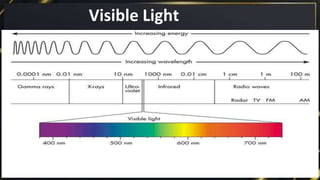
Visible Light
Visible Light
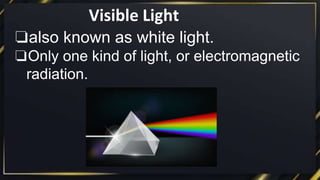
❏also known as white light.
❏Only one kind of light, or electromagnetic
radiation.
Visible Light
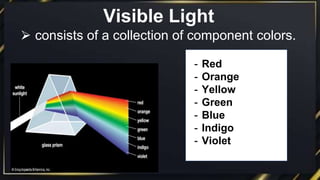
⮚ consists of a collection of component colors.
- Red
- Orange
- Yellow
- Green
- Blue
- Indigo
- Violet
Dispersion
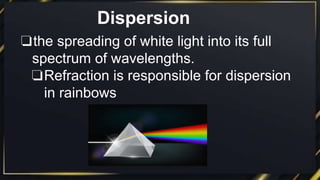
❏the spreading of white light into its full
spectrum of wavelengths.
❏Refraction is responsible for dispersion
in rainbows
Dispersion
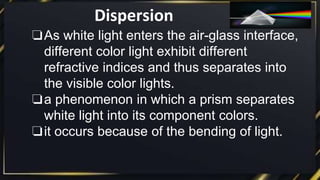
❏As white light enters the air-glass interface,
different color light exhibit different
refractive indices and thus separates into
the visible color lights.
❏a phenomenon in which a prism separates
white light into its component colors.
❏it occurs because of the bending of light.
Visible
Light
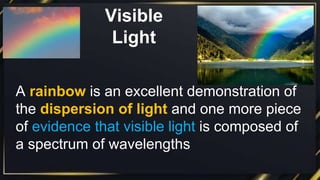
A rainbow is an excellent demonstration of
the dispersion of light and one more piece
of evidence that visible light is composed of
a spectrum of wavelengths
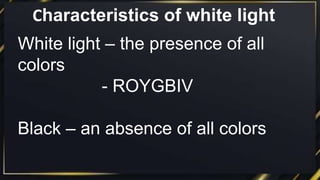
Characteristics of white light
White light – the presence of all
colors
- ROYGBIV
Black – an absence of all colors
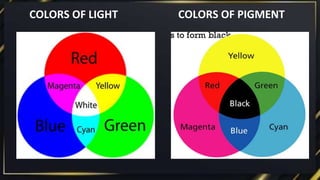
COLORS OF LIGHT COLORS OF PIGMENT
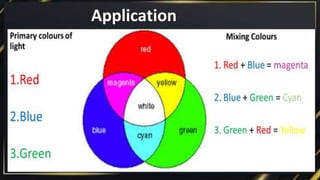
Application
Application
Other Colors:
Orange evokes enthusiasm and is a great color for exercise rooms.
Black: is best used as an accent color to give depth to a scheme.
Brown: is earthy and makes people feel relaxed and comfortable.
Grey: is versatile, and influences feelings of security and
intelligence.
The color we choose for our surroundings can have a powerful
impact on our moods.
Yellow – The depression killer.
❏People with depression could also benefit
from yellow color therapy.
❏People with a difficult digestion can treat
this with yellow light. This color is
associated with the stomach, liver, and
intestines.
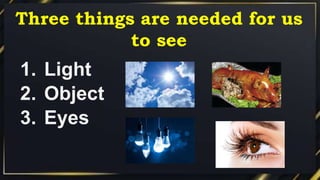
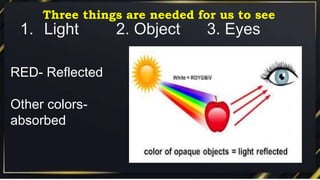
1. Light
2. Object
3. Eyes
Three things are needed for us
to see
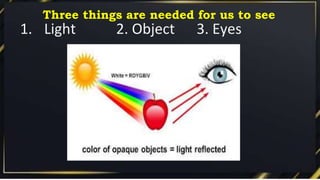
1. Light 2. Object 3. Eyes
Three things are needed for us to see
1. Light 2. Object 3. Eyes
Three things are needed for us to see
RED- Reflected
Other colors-
absorbed
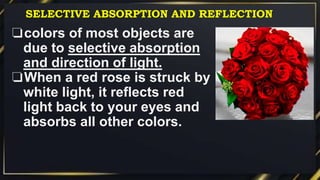
❏colors of most objects are
due to selective absorption
and direction of light.
❏When a red rose is struck by
white light, it reflects red
light back to your eyes and
absorbs all other colors.
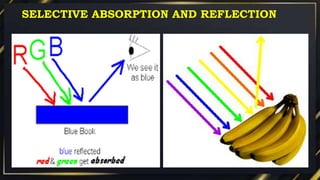
SELECTIVE ABSORPTION AND REFLECTION
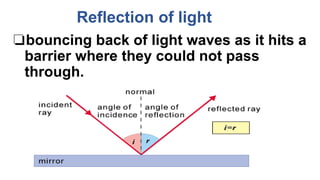
Reflection of light
❏bouncing back of light waves as it hits a
barrier where they could not pass
through.
Reflection
Reflection of light
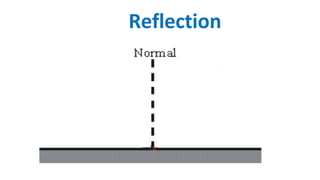
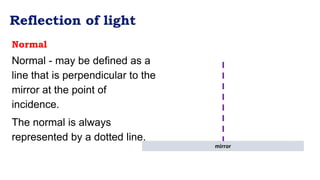
Normal
Normal - may be defined as a
line that is perpendicular to the
mirror at the point of
incidence.
The normal is always
represented by a dotted line.
mirror
Reflection of light
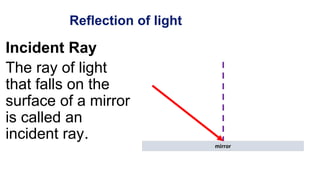
Incident Ray
The ray of light
that falls on the
surface of a mirror
is called an
incident ray.
mirror
Reflection of light
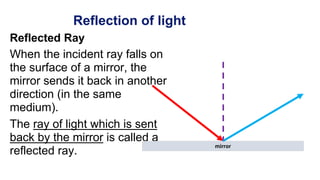
Reflected Ray
When the incident ray falls on
the surface of a mirror, the
mirror sends it back in another
direction (in the same
medium).
The ray of light which is sent
back by the mirror is called a
reflected ray.
mirror
Reflection of light
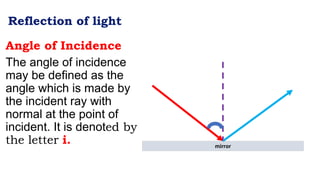
Angle of Incidence
The angle of incidence
may be defined as the
angle which is made by
the incident ray with
normal at the point of
incident. It is denoted by
the letter i. mirror
Reflection of light
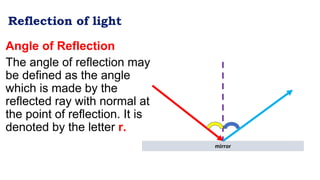
Angle of Reflection
The angle of reflection may
be defined as the angle
which is made by the
reflected ray with normal at
the point of reflection. It is
denoted by the letter r.
mirror
Reflection of light
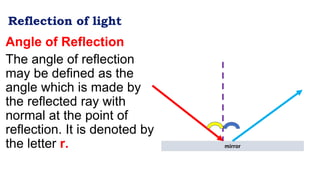
Angle of Reflection
The angle of reflection
may be defined as the
angle which is made by
the reflected ray with
normal at the point of
reflection. It is denoted by
the letter r. mirror
Reflection of light
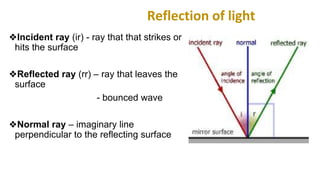
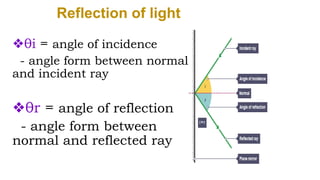
❖Incident ray (ir) - ray that that strikes or
hits the surface
❖Reflected ray (rr) – ray that leaves the
surface
- bounced wave
❖Normal ray – imaginary line
perpendicular to the reflecting surface
Reflection of light
❖θi = angle of incidence
- angle form between normal
and incident ray
❖θr = angle of reflection
- angle form between
normal and reflected ray
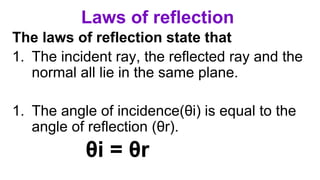
Laws of reflection
The laws of reflection state that
1. The incident ray, the reflected ray and the
normal all lie in the same plane.
1. The angle of incidence(θi) is equal to the
angle of reflection (θr).
θi = θr
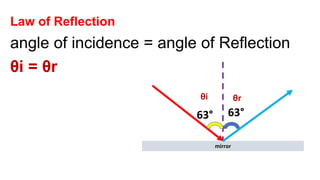
Law of Reflection
angle of incidence = angle of Reflection
θi = θr
mirror
63° 63°
θi θr
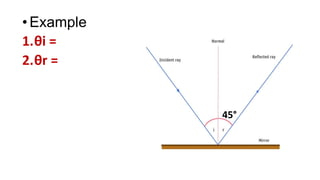
•Example
1.θi =
2.θr =
45°
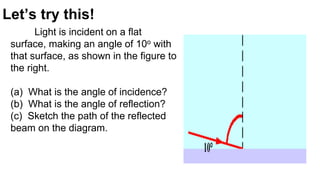
Let’s try this!
Light is incident on a flat
surface, making an angle of 10o with
that surface, as shown in the figure to
the right.
(a) What is the angle of incidence?
(b) What is the angle of reflection?
(c) Sketch the path of the reflected
beam on the diagram.
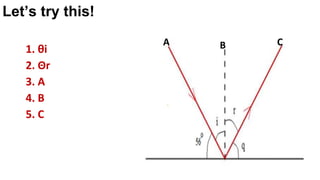
1. θi
2. Θr
3. A
4. B
5. C
A B C
Let’s try this!
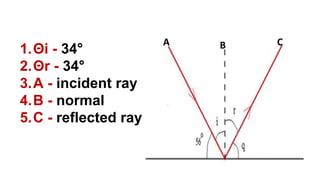
1.Θi - 34°
2.Θr - 34°
3.A - incident ray
4.B - normal
5.C - reflected ray
A B C
Types of reflection
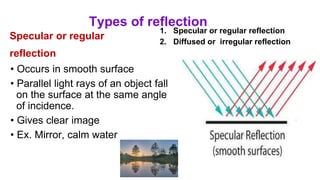
Specular or regular
reflection
• Occurs in smooth surface
• Parallel light rays of an object fall
on the surface at the same angle
of incidence.
• Gives clear image
• Ex. Mirror, calm water
1. Specular or regular reflection
2. Diffused or irregular reflection
Types of reflection
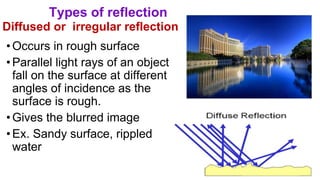
Diffused or irregular reflection
• Occurs in rough surface
•Parallel light rays of an object
fall on the surface at different
angles of incidence as the
surface is rough.
• Gives the blurred image
•Ex. Sandy surface, rippled
water
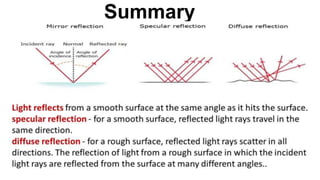
Summary
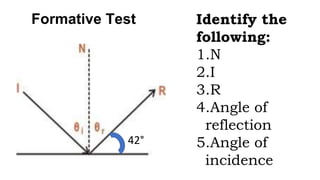
42°
Identify the
following:
1.N
2.I
3.R
4.Angle of
reflection
5.Angle of
incidence
Formative Test
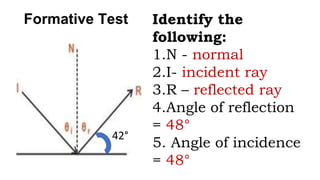
42°
Identify the
following:
1.N - normal
2.I- incident ray
3.R – reflected ray
4.Angle of reflection
= 48°
5. Angle of incidence
= 48°
Formative Test

M6_Plane mirror.pptx

  • 2.
    Quarter 2- Module6 Light Objective: Investigate the reflection properties of light using plane mirrors.
  • 3.
    Content Standard: Thelearners demonstrate an understanding of the images formed by the different types of mirrors and lenses. Predict the qualitative characteristics (orientation, type, and magnification) of images formed by plane and curved mirrors and lenses. (S10-FE-Iig-50) MELC 1: Investigate the reflection properties of light using plane mirrors.
  • 4.
  • 5.
    Visible Light ❏also knownas white light. ❏Only one kind of light, or electromagnetic radiation.
  • 6.
    Visible Light ⮚ consistsof a collection of component colors. - Red - Orange - Yellow - Green - Blue - Indigo - Violet
  • 7.
    Dispersion ❏the spreading ofwhite light into its full spectrum of wavelengths. ❏Refraction is responsible for dispersion in rainbows
  • 8.
    Dispersion ❏As white lightenters the air-glass interface, different color light exhibit different refractive indices and thus separates into the visible color lights. ❏a phenomenon in which a prism separates white light into its component colors. ❏it occurs because of the bending of light.
  • 9.
    Visible Light A rainbow isan excellent demonstration of the dispersion of light and one more piece of evidence that visible light is composed of a spectrum of wavelengths
  • 10.
    Characteristics of whitelight White light – the presence of all colors - ROYGBIV Black – an absence of all colors
  • 11.
    COLORS OF LIGHTCOLORS OF PIGMENT
  • 12.
  • 13.
    Application Other Colors: Orange evokesenthusiasm and is a great color for exercise rooms. Black: is best used as an accent color to give depth to a scheme. Brown: is earthy and makes people feel relaxed and comfortable. Grey: is versatile, and influences feelings of security and intelligence. The color we choose for our surroundings can have a powerful impact on our moods.
  • 14.
    Yellow – Thedepression killer. ❏People with depression could also benefit from yellow color therapy. ❏People with a difficult digestion can treat this with yellow light. This color is associated with the stomach, liver, and intestines.
  • 15.
    1. Light 2. Object 3.Eyes Three things are needed for us to see
  • 16.
    1. Light 2.Object 3. Eyes Three things are needed for us to see
  • 17.
    1. Light 2.Object 3. Eyes Three things are needed for us to see RED- Reflected Other colors- absorbed
  • 18.
    ❏colors of mostobjects are due to selective absorption and direction of light. ❏When a red rose is struck by white light, it reflects red light back to your eyes and absorbs all other colors. SELECTIVE ABSORPTION AND REFLECTION
  • 19.
  • 20.
    Reflection of light ❏bouncingback of light waves as it hits a barrier where they could not pass through.
  • 21.
  • 22.
    Reflection of light Normal Normal- may be defined as a line that is perpendicular to the mirror at the point of incidence. The normal is always represented by a dotted line. mirror
  • 23.
    Reflection of light IncidentRay The ray of light that falls on the surface of a mirror is called an incident ray. mirror
  • 24.
    Reflection of light ReflectedRay When the incident ray falls on the surface of a mirror, the mirror sends it back in another direction (in the same medium). The ray of light which is sent back by the mirror is called a reflected ray. mirror
  • 25.
    Reflection of light Angleof Incidence The angle of incidence may be defined as the angle which is made by the incident ray with normal at the point of incident. It is denoted by the letter i. mirror
  • 26.
    Reflection of light Angleof Reflection The angle of reflection may be defined as the angle which is made by the reflected ray with normal at the point of reflection. It is denoted by the letter r. mirror
  • 27.
    Reflection of light Angleof Reflection The angle of reflection may be defined as the angle which is made by the reflected ray with normal at the point of reflection. It is denoted by the letter r. mirror
  • 28.
    Reflection of light ❖Incidentray (ir) - ray that that strikes or hits the surface ❖Reflected ray (rr) – ray that leaves the surface - bounced wave ❖Normal ray – imaginary line perpendicular to the reflecting surface
  • 29.
    Reflection of light ❖θi= angle of incidence - angle form between normal and incident ray ❖θr = angle of reflection - angle form between normal and reflected ray
  • 30.
    Laws of reflection Thelaws of reflection state that 1. The incident ray, the reflected ray and the normal all lie in the same plane. 1. The angle of incidence(θi) is equal to the angle of reflection (θr). θi = θr
  • 31.
    Law of Reflection angleof incidence = angle of Reflection θi = θr mirror 63° 63° θi θr
  • 32.
  • 33.
    Let’s try this! Lightis incident on a flat surface, making an angle of 10o with that surface, as shown in the figure to the right. (a) What is the angle of incidence? (b) What is the angle of reflection? (c) Sketch the path of the reflected beam on the diagram.
  • 34.
    1. θi 2. Θr 3.A 4. B 5. C A B C Let’s try this!
  • 35.
    1.Θi - 34° 2.Θr- 34° 3.A - incident ray 4.B - normal 5.C - reflected ray A B C
  • 36.
    Types of reflection Specularor regular reflection • Occurs in smooth surface • Parallel light rays of an object fall on the surface at the same angle of incidence. • Gives clear image • Ex. Mirror, calm water 1. Specular or regular reflection 2. Diffused or irregular reflection
  • 37.
    Types of reflection Diffusedor irregular reflection • Occurs in rough surface •Parallel light rays of an object fall on the surface at different angles of incidence as the surface is rough. • Gives the blurred image •Ex. Sandy surface, rippled water
  • 38.
  • 39.
  • 40.
    42° Identify the following: 1.N -normal 2.I- incident ray 3.R – reflected ray 4.Angle of reflection = 48° 5. Angle of incidence = 48° Formative Test