AECM Annual Seminar
Berlin
19 June 2015
Building a conducive environment for
innovative SMEs
Lucia Cusmano
Senior Economist
Secretary to OECD Working Party on SMEs and Entrepreneurship (WPSMEE)
OECD Centre for SMEs, Entrepreneurship & Local Development (CFE)
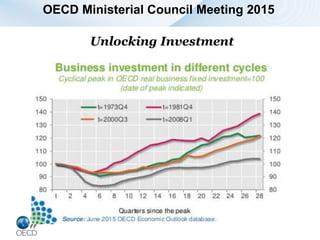
OECD Ministerial Council Meeting 2015
Unlocking Investment
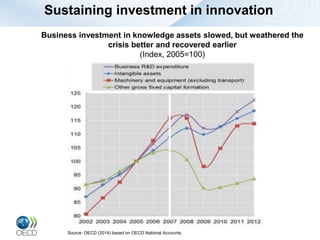
Sustaining investment in innovation
Business investment in knowledge assets slowed, but weathered the
crisis better and recovered earlier
(Index, 2005=100)
Source: OECD (2014) based on OECD National Accounts.
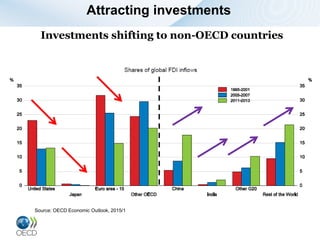
Attracting investments
Investments shifting to non-OECD countries
Source: OECD Economic Outlook, 2015/1
Channelling liquidity into productive investments
The puzzle
 Stock market boom: asset prices rising in response to zero
interest rates and quantitative easing
 Stagnating productive investments: uncertainty and high
risk perceived by investors
 Emergence of new financing instruments: expanding (from
a low basis) and engaging new (sometimes unexperienced)
investors
 Growth capital gap for businesses: heavy reliance on
traditional debt to fulfill investment needs
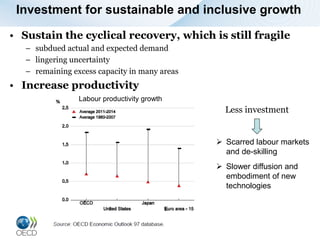
Investment for sustainable and inclusive growth
• Sustain the cyclical recovery, which is still fragile
– subdued actual and expected demand
– lingering uncertainty
– remaining excess capacity in many areas
• Increase productivity
Labour productivity growth
Less investment
 Scarred labour markets
and de-skilling
 Slower diffusion and
embodiment of new
technologies
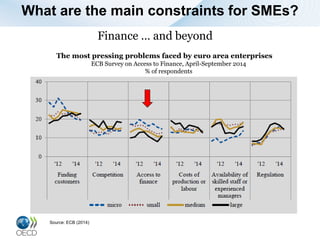
What are the main constraints for SMEs?
Finance … and beyond
The most pressing problems faced by euro area enterprises
ECB Survey on Access to Finance, April-September 2014
% of respondents
Source: ECB (2014)
The business environment matters
(and so structural reforms)
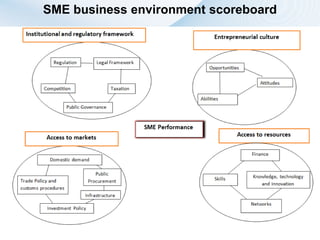
Main components of importance for SMEs
• Navigating and complying with
regulation
• Dealing with taxation
• Protecting rights and enforcing
contracts
• Building trust in institutions and
public services
• Implementing anti-corruption
practices
• Standing fair competition
• Finding customers
• Overcoming barriers to
international markets
• Accessing public markets
• Accessing finance
• Finding appropriate skills
• Sourcing knowledge,
technology and innovation
• Managing intellectual assets
• Managing energy costs
OECD project on
Benchmarking policies for stronger SME performance
Objectives
• Enable countries to benchmark their SME performance and SME
business environment conditions internationally, and draw links with
policies.
• Fill an important information gap on SMEs.
Pilot project (2015-16)
Phase 1. SME business environment scoreboard for OECD countries
Phase 2. Comparative assessment of selected policies targeted to SMEs in
pilot countries (Canada, Israel, Portugal and the UK)
SME business environment scoreboard
Thank you
Lucia.cusmano@oecd.org

AECM Annual Event 2015 - Lucia Cusmano

  • 1.
    AECM Annual Seminar Berlin 19June 2015 Building a conducive environment for innovative SMEs Lucia Cusmano Senior Economist Secretary to OECD Working Party on SMEs and Entrepreneurship (WPSMEE) OECD Centre for SMEs, Entrepreneurship & Local Development (CFE)
  • 2.
    OECD Ministerial CouncilMeeting 2015 Unlocking Investment
  • 3.
    Sustaining investment ininnovation Business investment in knowledge assets slowed, but weathered the crisis better and recovered earlier (Index, 2005=100) Source: OECD (2014) based on OECD National Accounts.
  • 4.
    Attracting investments Investments shiftingto non-OECD countries Source: OECD Economic Outlook, 2015/1
  • 5.
    Channelling liquidity intoproductive investments The puzzle  Stock market boom: asset prices rising in response to zero interest rates and quantitative easing  Stagnating productive investments: uncertainty and high risk perceived by investors  Emergence of new financing instruments: expanding (from a low basis) and engaging new (sometimes unexperienced) investors  Growth capital gap for businesses: heavy reliance on traditional debt to fulfill investment needs
  • 6.
    Investment for sustainableand inclusive growth • Sustain the cyclical recovery, which is still fragile – subdued actual and expected demand – lingering uncertainty – remaining excess capacity in many areas • Increase productivity Labour productivity growth Less investment  Scarred labour markets and de-skilling  Slower diffusion and embodiment of new technologies
  • 7.
    What are themain constraints for SMEs? Finance … and beyond The most pressing problems faced by euro area enterprises ECB Survey on Access to Finance, April-September 2014 % of respondents Source: ECB (2014)
  • 8.
    The business environmentmatters (and so structural reforms) Main components of importance for SMEs • Navigating and complying with regulation • Dealing with taxation • Protecting rights and enforcing contracts • Building trust in institutions and public services • Implementing anti-corruption practices • Standing fair competition • Finding customers • Overcoming barriers to international markets • Accessing public markets • Accessing finance • Finding appropriate skills • Sourcing knowledge, technology and innovation • Managing intellectual assets • Managing energy costs
  • 9.
    OECD project on Benchmarkingpolicies for stronger SME performance Objectives • Enable countries to benchmark their SME performance and SME business environment conditions internationally, and draw links with policies. • Fill an important information gap on SMEs. Pilot project (2015-16) Phase 1. SME business environment scoreboard for OECD countries Phase 2. Comparative assessment of selected policies targeted to SMEs in pilot countries (Canada, Israel, Portugal and the UK)
  • 10.
  • 11.