Lesson 8
Lesson 1:
1. What to say when you meet new
people;
2. How to compliment people in
different times of the day;
3. How to use the verb “to be” in the
Simple Present.
We have already seen:
Lesson 2:
1. Family members;
2. Possessive case;
3. Simple Present.
We have already seen:
Lesson 3:
1. Alphabet;
2. Physical and psychological
characteristics;
3. Simple Present and Present
Continuous.
We have already seen:
Lesson 4:
Cup Song – Anna Kendrick
We have already seen:
Lesson 5:
● Daily routine;
● Personal, demonstrative, possessive
adjetive and possessive pronouns.
We have already seen:
Lesson 6:
● Numbers;
● Hours;
● Food (breakfast, lunch and dinner).
We have already seen:
Lesson 7:
Movie – Make it Happen
We have already seen:
And now, on Lesson 8...
● Food (fruits and vegetables)
● Likes and dislikes
● Articles
Let's start with the
vocabulary...
Likes and
Dislikes
A: Do you like chicken?
B: Yes, I do. / No, I don't.
Likes and
Dislikes
O que são os “likes and
dislikes”? São expressões
usadas para dizer do que
gostamos e do que não.
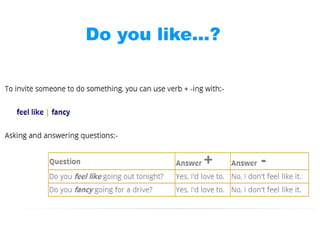
Do you like...?
Do you like...?
Articles
Primeiro as boas notícias: há
apenas três artigos em inglês!
São eles:
● “a”, “an” e “the”.
Indefinite articles - “a” and
“an” (determiners)
Os artigos “a” e “an” são o que chamamos de
INDEFINIDOS, porque eles falam para alguém não
específico. Em português temos exemplos de artigos
indefinidos:
Um, uma
Uns, umas
Ou seja, em Português, diferentemente do Inglês,
temos artigos variando em gênero e número (feminino
e masculino, singular e plural).
Indefinite articles - “a” and
“an” (determiners)
O significado de “a” e de “an” é o
mesmo, o que muda na hora de os
utilizarmos é a palavra subsequente.
Por exemplo:
"I saw an elephant this morning."
"I ate a banana for lunch."
O uso está ligado ao SOM.
Indefinite articles - “a” and
“an” (determiners)
Eles também são usados quando nos
referimos à profissões.
Exemplo:
"I am an English teacher."
"I am a b"I am an English teacher."
"I am a builder."uilder."
Definite Article - the
(determiners)
Quando à pronúncia, há duas formas
de pronunciarmos o termo “the”,
podendo ser “dã” ou “dii”.
Quanto ao uso veremos a seguir as
situações nas quais usamos este tipo
de artigo.
Definite Article - the
(determiners)
We use the when you have already
mentioned the thing you are talking
about.
For example:
"She's got two children; a girl and a
boy. The girl's eight and the boy's
fourteen."
Definite Article - the
(determiners)
We use the to talk about geographical
points on the globe.
For example:
the North Pole, the equator
Definite Article - the
(determiners)
We use the to talk about rivers,
oceans and seas
For example:
the Nile, the Pacific, the English
channel
Definite Article - the
(determiners)
We also use the before certain nouns
when we know there is only one of a
particular thing.
For example:
the rain, the sun, the wind, the world,
the earth, the White House etc..
Definite Article - the
(determiners)
However if you want to describe a particular
instance of these you should use a/an.
For example:
"I could hear the wind." / "There's a cold wind
blowing."
"What are your plans for the future?" / "She has
a promising future ahead of her."
Definite Article - the
(determiners)
The is also used to say that a particular person or
thing being mentioned is the best, most famous, etc.
In this use, 'the' is usually given strong pronunciation
whether or not it preceeds a vowel:
For example:
"Harry's Bar is the place to go."
"You don't mean you met the Tony Blair, do you?"
Definite Article - the
(determiners)
Note - The doesn't mean all:-
For example:
"The books are expensive." = (Not all books are
expensive, just the ones I'm talking about.)
"Books are expensive." = (All books are expensive.)
No Articles
Há também situações em que não usamos artigo
algum, como veremos a seguir.
We usually use no article to talk about things in
general:-
Inflation is rising.
People are worried about rising crime. (Note! People
generally, so no article)
No Articles
You do not use an article when talking about sports.
For example:
My son plays football.
Tennis is expensive.
No Articles
You do not use an article before uncountable nouns
when talking about them generally.
For example:
Information is important to any organisation.
Coffee is bad for you.
No Articles
You do not use an article before uncountable nouns
when talking about them generally.
For example:
Information is important to any organisation.
Coffee is bad for you.
No Articles
You do not use an article before the names of countries
except where they indicate multiple areas or contain the
words (state(s), kindom, republic, union). Kingdom, state,
republic and union are nouns, so they need an article.
For example:
No article - Italy, Mexico, Bolivia, England
Use the - the UK (United Kingdom), the USA (United States
of America), the Irish Republic
Multiple areas! the Netherlands, the Philippines, the British
Isles
Exercise
1- LOOK AT THE FACES AND COMPLETE WITH
LIKE Smile OR DON'T LIKE Unhappy:
a. I ______ hamburgers.
b. I ______ pizza.
c. I ________ dumplings.
d. I ________ sushi.
e. I ________ fried rice.
f. I _______ noodles.
g. I _________ cake.
Exercise
Choose the correct (and most natural-sounding) response to complete each
sentence:
1. Q: Is dad picking us up today?
A: Nope, _________________ mom's picking us up.
● NO ARTICLE
● a
● the
2. Q: Who's that?
A: That's _________________ guy I told you about last week.
● a
● the
● NO ARTICLE
3. Q: Why are you so upset?
A: I'm not upset. You're _________________ one who's upset.
● the
● a
● NO ARTICLE

LTW - Basic English I - Lesson 8

  • 1.
  • 2.
    Lesson 1: 1. Whatto say when you meet new people; 2. How to compliment people in different times of the day; 3. How to use the verb “to be” in the Simple Present. We have already seen:
  • 3.
    Lesson 2: 1. Familymembers; 2. Possessive case; 3. Simple Present. We have already seen:
  • 4.
    Lesson 3: 1. Alphabet; 2.Physical and psychological characteristics; 3. Simple Present and Present Continuous. We have already seen:
  • 5.
    Lesson 4: Cup Song– Anna Kendrick We have already seen:
  • 6.
    Lesson 5: ● Dailyroutine; ● Personal, demonstrative, possessive adjetive and possessive pronouns. We have already seen:
  • 7.
    Lesson 6: ● Numbers; ●Hours; ● Food (breakfast, lunch and dinner). We have already seen:
  • 8.
    Lesson 7: Movie –Make it Happen We have already seen:
  • 9.
    And now, onLesson 8... ● Food (fruits and vegetables) ● Likes and dislikes ● Articles
  • 10.
    Let's start withthe vocabulary...
  • 13.
    Likes and Dislikes A: Doyou like chicken? B: Yes, I do. / No, I don't.
  • 14.
    Likes and Dislikes O quesão os “likes and dislikes”? São expressões usadas para dizer do que gostamos e do que não.
  • 15.
  • 17.
  • 18.
    Articles Primeiro as boasnotícias: há apenas três artigos em inglês! São eles: ● “a”, “an” e “the”.
  • 19.
    Indefinite articles -“a” and “an” (determiners) Os artigos “a” e “an” são o que chamamos de INDEFINIDOS, porque eles falam para alguém não específico. Em português temos exemplos de artigos indefinidos: Um, uma Uns, umas Ou seja, em Português, diferentemente do Inglês, temos artigos variando em gênero e número (feminino e masculino, singular e plural).
  • 20.
    Indefinite articles -“a” and “an” (determiners) O significado de “a” e de “an” é o mesmo, o que muda na hora de os utilizarmos é a palavra subsequente. Por exemplo: "I saw an elephant this morning." "I ate a banana for lunch." O uso está ligado ao SOM.
  • 21.
    Indefinite articles -“a” and “an” (determiners) Eles também são usados quando nos referimos à profissões. Exemplo: "I am an English teacher." "I am a b"I am an English teacher." "I am a builder."uilder."
  • 22.
    Definite Article -the (determiners) Quando à pronúncia, há duas formas de pronunciarmos o termo “the”, podendo ser “dã” ou “dii”. Quanto ao uso veremos a seguir as situações nas quais usamos este tipo de artigo.
  • 23.
    Definite Article -the (determiners) We use the when you have already mentioned the thing you are talking about. For example: "She's got two children; a girl and a boy. The girl's eight and the boy's fourteen."
  • 24.
    Definite Article -the (determiners) We use the to talk about geographical points on the globe. For example: the North Pole, the equator
  • 25.
    Definite Article -the (determiners) We use the to talk about rivers, oceans and seas For example: the Nile, the Pacific, the English channel
  • 26.
    Definite Article -the (determiners) We also use the before certain nouns when we know there is only one of a particular thing. For example: the rain, the sun, the wind, the world, the earth, the White House etc..
  • 27.
    Definite Article -the (determiners) However if you want to describe a particular instance of these you should use a/an. For example: "I could hear the wind." / "There's a cold wind blowing." "What are your plans for the future?" / "She has a promising future ahead of her."
  • 28.
    Definite Article -the (determiners) The is also used to say that a particular person or thing being mentioned is the best, most famous, etc. In this use, 'the' is usually given strong pronunciation whether or not it preceeds a vowel: For example: "Harry's Bar is the place to go." "You don't mean you met the Tony Blair, do you?"
  • 29.
    Definite Article -the (determiners) Note - The doesn't mean all:- For example: "The books are expensive." = (Not all books are expensive, just the ones I'm talking about.) "Books are expensive." = (All books are expensive.)
  • 30.
    No Articles Há tambémsituações em que não usamos artigo algum, como veremos a seguir. We usually use no article to talk about things in general:- Inflation is rising. People are worried about rising crime. (Note! People generally, so no article)
  • 31.
    No Articles You donot use an article when talking about sports. For example: My son plays football. Tennis is expensive.
  • 32.
    No Articles You donot use an article before uncountable nouns when talking about them generally. For example: Information is important to any organisation. Coffee is bad for you.
  • 33.
    No Articles You donot use an article before uncountable nouns when talking about them generally. For example: Information is important to any organisation. Coffee is bad for you.
  • 34.
    No Articles You donot use an article before the names of countries except where they indicate multiple areas or contain the words (state(s), kindom, republic, union). Kingdom, state, republic and union are nouns, so they need an article. For example: No article - Italy, Mexico, Bolivia, England Use the - the UK (United Kingdom), the USA (United States of America), the Irish Republic Multiple areas! the Netherlands, the Philippines, the British Isles
  • 35.
    Exercise 1- LOOK ATTHE FACES AND COMPLETE WITH LIKE Smile OR DON'T LIKE Unhappy: a. I ______ hamburgers. b. I ______ pizza. c. I ________ dumplings. d. I ________ sushi. e. I ________ fried rice. f. I _______ noodles. g. I _________ cake.
  • 36.
    Exercise Choose the correct(and most natural-sounding) response to complete each sentence: 1. Q: Is dad picking us up today? A: Nope, _________________ mom's picking us up. ● NO ARTICLE ● a ● the 2. Q: Who's that? A: That's _________________ guy I told you about last week. ● a ● the ● NO ARTICLE 3. Q: Why are you so upset? A: I'm not upset. You're _________________ one who's upset. ● the ● a ● NO ARTICLE