Campus SorocabaCampus Sorocaba
LERIS-Laboratory of Studies in Networks, Innovation and Software
www.leris.sor. ufscar.br
Federal University of São Carlos - Sorocaba, Brazil
Pedro F Zanetti, Luciana A M Zaina, and Fábio L Verdi
An Approach for Supporting P2PAn Approach for Supporting P2P
Collaborative Communication Based onCollaborative Communication Based on
Learning ProfileLearning Profile
Available in:
• Draft: http://www.dcomp.sor.ufscar.br/lzaina/papers/IJLT2013draft.pdf
• Final Version: http://www.inderscience.com/info/inarticle.php?artid=52826
BrazilBrazil
IntroductionIntroduction
 Technological topics:
 Miniaturization of computational devices:
 advances in communication technologies;
 wide range of applications in several fields.
 Scenarios where communication is more localized:
 without the need of the Internet infrastructure.
 Collaborative peer-to-peer (P2P) interaction:
 exchange files.
 e-Learning topics:
 Learning style:
 may be reported by different dimensions achieving diverse
aspects of students preferences.
BrazilBrazil
Paper ObjectivePaper Objective
 An approach for supporting P2P collaborative
communication based on learning profile.
 share and exchange learning objects;
 it is considered the learning profile and topics of interest of the
students involved in the process;
 a relationship between the learning profiles and the learning
objects is drawn upon the linkage of student’s learning
preferences and fields of the fields.
 Two application was developed:
 Mobile: Android platform using Bluetooth technology to
evaluate the proposal.
 Cloud: to retrieve learning objects, their respective metadata
and the student’s learner profile from an Amazon cloud to the
device.
BrazilBrazil
Related ConceptsRelated Concepts
 Important issues to support the approach:
 Learning profiles
 Learning objects
 Collaborative communication
BrazilBrazil
Learning ProfileLearning Profile
 The learning style involves the strategies that a student tends to
apply frequently to a given teaching situation.
 The Felder-Silverman Learning Style Model is describe by
dimensions of Learning and Teaching Styles, creating a
relationship to learning styles and teaching strategies that could
be adopted to support the student learning style.
 The Felder-Silverman model was selected to this work, because
it's close relationship to learning styles and teaching strategies,
resulting in an adherence between these aspects.
BrazilBrazil
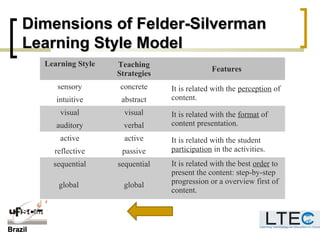
Dimensions of Felder-SilvermanDimensions of Felder-Silverman
Learning Style ModelLearning Style Model
Learning Style Teaching
Strategies
Features
sensory concrete It is related with the perception of
content.intuitive abstract
visual visual It is related with the format of
content presentation.auditory verbal
active active It is related with the student
participation in the activities.reflective passive
sequential sequential It is related with the best order to
present the content: step-by-step
progression or a overview first of
content.
global global
BrazilBrazil
Learning ObjectLearning Object
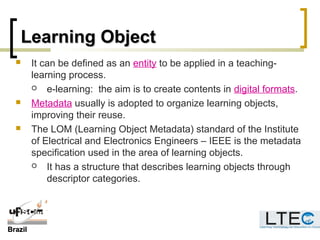
 It can be defined as an entity to be applied in a teaching-
learning process.
 e-learning: the aim is to create contents in digital formats.
 Metadata usually is adopted to organize learning objects,
improving their reuse.
 The LOM (Learning Object Metadata) standard of the Institute
of Electrical and Electronics Engineers – IEEE is the metadata
specification used in the area of learning objects.
 It has a structure that describes learning objects through
descriptor categories.
BrazilBrazil
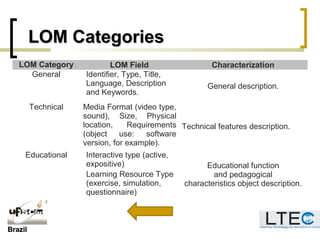
LOM CategoriesLOM Categories
LOM Category LOM Field Characterization
General Identifier, Type, Title,
Language, Description
and Keywords.
General description.
Technical Media Format (video type,
sound), Size, Physical
location, Requirements
(object use: software
version, for example).
Technical features description.
Educational Interactive type (active,
expositive) Educational function
and pedagogical
characteristics object description.
Learning Resource Type
(exercise, simulation,
questionnaire)
BrazilBrazil
Collaborative CommunicationCollaborative Communication
 Two types:
 Local level:
 considers a collaborative communication when the most
of the features to support collaboration occurs at local
level;
 functions such as routing, name service, finding context
and message forwarding are performed without the use
of a global network infrastructure.
 Global infrastructure:
 uses a global infrastructure (Internet, for
example) adopting the services provided by such
infrastructure.
BrazilBrazil
The ApproachThe Approach
 Requirements:
 The student learning profile is:
 a part of student model and splits the student learning
profile into three categories, based on Felder and
Silverman dimensions:
 Perception, Participation e Presentation Format
 The learning objects available on the collaborative
communication must be cataloged using LOM standard.
BrazilBrazil
The ModulesThe Modules
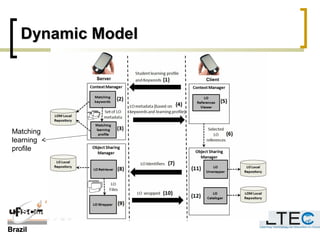
 Context Manager is responsible for providing the
communication and the interaction between both P2P
elements of the application: client and server.
 In the server side it deals with the matching and
retrieval procedures whilst in the client side it
presents the learning objects retrieved from the
server.
 Object Sharing Manager manages the object sharing
between applications and devices, wrap and unwrap
objects; and save and request objects.
BrazilBrazil
Dynamic ModelDynamic Model
Matching
learning
profile
BrazilBrazil
Validation’s Approach (1)Validation’s Approach (1)
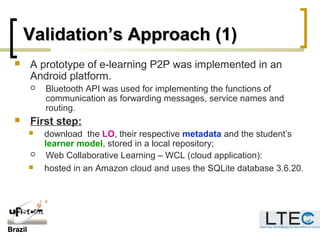
 A prototype of e-learning P2P was implemented in an
Android platform.
 Bluetooth API was used for implementing the functions of
communication as forwarding messages, service names and
routing.
 First step:
 download the LO, their respective metadata and the student’s
learner model, stored in a local repository;
 Web Collaborative Learning – WCL (cloud application):
 hosted in an Amazon cloud and uses the SQLite database 3.6.20.
BrazilBrazil
Validation’s Approach (2)Validation’s Approach (2)
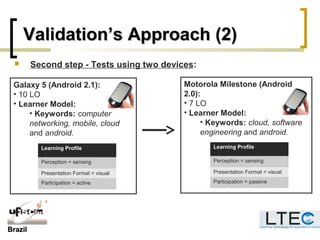
 Second step - Tests using two devices:
Galaxy 5 (Android 2.1):
• 10 LO
• Learner Model:
• Keywords: computer
networking, mobile, cloud
and android.
Learning Profile
Perception = sensing
Presentation Format = visual
Participation = active
Motorola Milestone (Android
2.0):
• 7 LO
• Learner Model:
• Keywords: cloud, software
engineering and android.
Learning Profile
Perception = sensing
Presentation Format = visual
Participation = passive
BrazilBrazil
Validation’s Approach (3)Validation’s Approach (3)
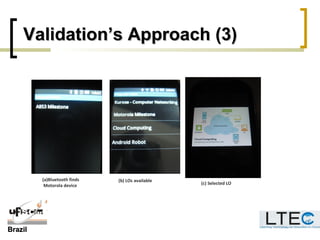
(a)Bluetooth finds
Motorola device
(b) LOs available
(c) Selected LO
BrazilBrazil
Conclusions and future worksConclusions and future works
 The focus concerns in the student’s learning profile and
its linkage to learning objects for automatic content
exchanging.
 Further works:
 adding new features to the matching process to
consider other elements beyond of learning profile:
physical localization and device resources (memory,
processor, screen size etc);
 investigating the usage of different protocols to
transfer data such as protocol buffers and thrift .
Campus SorocabaCampus Sorocaba
Thanks!Thanks!
lzaina@ufscar.brlzaina@ufscar.br
http://www.dcomp.sor.ufscar.br/lzainahttp://www.dcomp.sor.ufscar.br/lzaina
facebook.com/zaina.lucianafacebook.com/zaina.luciana
BrazilBrazil
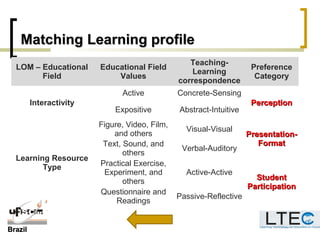
MatchingMatching Learning profileLearning profile
LOM – Educational
Field
Educational Field
Values
Teaching-
Learning
correspondence
Preference
Category
Interactivity
Active Concrete-Sensing
PerceptionPerception
Expositive Abstract-Intuitive
Learning Resource
Type
Figure, Video, Film,
and others
Visual-Visual
Presentation-Presentation-
FormatFormatText, Sound, and
others
Verbal-Auditory
Practical Exercise,
Experiment, and
others
Active-Active
StudentStudent
ParticipationParticipation
Questionnaire and
Readings
Passive-Reflective

An Approach for Supporting P2P Collaborative Communication Based on Learning Profile

  • 1.
    Campus SorocabaCampus Sorocaba LERIS-Laboratoryof Studies in Networks, Innovation and Software www.leris.sor. ufscar.br Federal University of São Carlos - Sorocaba, Brazil Pedro F Zanetti, Luciana A M Zaina, and Fábio L Verdi An Approach for Supporting P2PAn Approach for Supporting P2P Collaborative Communication Based onCollaborative Communication Based on Learning ProfileLearning Profile Available in: • Draft: http://www.dcomp.sor.ufscar.br/lzaina/papers/IJLT2013draft.pdf • Final Version: http://www.inderscience.com/info/inarticle.php?artid=52826
  • 2.
    BrazilBrazil IntroductionIntroduction  Technological topics: Miniaturization of computational devices:  advances in communication technologies;  wide range of applications in several fields.  Scenarios where communication is more localized:  without the need of the Internet infrastructure.  Collaborative peer-to-peer (P2P) interaction:  exchange files.  e-Learning topics:  Learning style:  may be reported by different dimensions achieving diverse aspects of students preferences.
  • 3.
    BrazilBrazil Paper ObjectivePaper Objective An approach for supporting P2P collaborative communication based on learning profile.  share and exchange learning objects;  it is considered the learning profile and topics of interest of the students involved in the process;  a relationship between the learning profiles and the learning objects is drawn upon the linkage of student’s learning preferences and fields of the fields.  Two application was developed:  Mobile: Android platform using Bluetooth technology to evaluate the proposal.  Cloud: to retrieve learning objects, their respective metadata and the student’s learner profile from an Amazon cloud to the device.
  • 4.
    BrazilBrazil Related ConceptsRelated Concepts Important issues to support the approach:  Learning profiles  Learning objects  Collaborative communication
  • 5.
    BrazilBrazil Learning ProfileLearning Profile The learning style involves the strategies that a student tends to apply frequently to a given teaching situation.  The Felder-Silverman Learning Style Model is describe by dimensions of Learning and Teaching Styles, creating a relationship to learning styles and teaching strategies that could be adopted to support the student learning style.  The Felder-Silverman model was selected to this work, because it's close relationship to learning styles and teaching strategies, resulting in an adherence between these aspects.
  • 6.
    BrazilBrazil Dimensions of Felder-SilvermanDimensionsof Felder-Silverman Learning Style ModelLearning Style Model Learning Style Teaching Strategies Features sensory concrete It is related with the perception of content.intuitive abstract visual visual It is related with the format of content presentation.auditory verbal active active It is related with the student participation in the activities.reflective passive sequential sequential It is related with the best order to present the content: step-by-step progression or a overview first of content. global global
  • 7.
    BrazilBrazil Learning ObjectLearning Object It can be defined as an entity to be applied in a teaching- learning process.  e-learning: the aim is to create contents in digital formats.  Metadata usually is adopted to organize learning objects, improving their reuse.  The LOM (Learning Object Metadata) standard of the Institute of Electrical and Electronics Engineers – IEEE is the metadata specification used in the area of learning objects.  It has a structure that describes learning objects through descriptor categories.
  • 8.
    BrazilBrazil LOM CategoriesLOM Categories LOMCategory LOM Field Characterization General Identifier, Type, Title, Language, Description and Keywords. General description. Technical Media Format (video type, sound), Size, Physical location, Requirements (object use: software version, for example). Technical features description. Educational Interactive type (active, expositive) Educational function and pedagogical characteristics object description. Learning Resource Type (exercise, simulation, questionnaire)
  • 9.
    BrazilBrazil Collaborative CommunicationCollaborative Communication Two types:  Local level:  considers a collaborative communication when the most of the features to support collaboration occurs at local level;  functions such as routing, name service, finding context and message forwarding are performed without the use of a global network infrastructure.  Global infrastructure:  uses a global infrastructure (Internet, for example) adopting the services provided by such infrastructure.
  • 10.
    BrazilBrazil The ApproachThe Approach Requirements:  The student learning profile is:  a part of student model and splits the student learning profile into three categories, based on Felder and Silverman dimensions:  Perception, Participation e Presentation Format  The learning objects available on the collaborative communication must be cataloged using LOM standard.
  • 11.
    BrazilBrazil The ModulesThe Modules Context Manager is responsible for providing the communication and the interaction between both P2P elements of the application: client and server.  In the server side it deals with the matching and retrieval procedures whilst in the client side it presents the learning objects retrieved from the server.  Object Sharing Manager manages the object sharing between applications and devices, wrap and unwrap objects; and save and request objects.
  • 12.
  • 13.
    BrazilBrazil Validation’s Approach (1)Validation’sApproach (1)  A prototype of e-learning P2P was implemented in an Android platform.  Bluetooth API was used for implementing the functions of communication as forwarding messages, service names and routing.  First step:  download the LO, their respective metadata and the student’s learner model, stored in a local repository;  Web Collaborative Learning – WCL (cloud application):  hosted in an Amazon cloud and uses the SQLite database 3.6.20.
  • 14.
    BrazilBrazil Validation’s Approach (2)Validation’sApproach (2)  Second step - Tests using two devices: Galaxy 5 (Android 2.1): • 10 LO • Learner Model: • Keywords: computer networking, mobile, cloud and android. Learning Profile Perception = sensing Presentation Format = visual Participation = active Motorola Milestone (Android 2.0): • 7 LO • Learner Model: • Keywords: cloud, software engineering and android. Learning Profile Perception = sensing Presentation Format = visual Participation = passive
  • 15.
    BrazilBrazil Validation’s Approach (3)Validation’sApproach (3) (a)Bluetooth finds Motorola device (b) LOs available (c) Selected LO
  • 16.
    BrazilBrazil Conclusions and futureworksConclusions and future works  The focus concerns in the student’s learning profile and its linkage to learning objects for automatic content exchanging.  Further works:  adding new features to the matching process to consider other elements beyond of learning profile: physical localization and device resources (memory, processor, screen size etc);  investigating the usage of different protocols to transfer data such as protocol buffers and thrift .
  • 17.
  • 18.
    BrazilBrazil MatchingMatching Learning profileLearningprofile LOM – Educational Field Educational Field Values Teaching- Learning correspondence Preference Category Interactivity Active Concrete-Sensing PerceptionPerception Expositive Abstract-Intuitive Learning Resource Type Figure, Video, Film, and others Visual-Visual Presentation-Presentation- FormatFormatText, Sound, and others Verbal-Auditory Practical Exercise, Experiment, and others Active-Active StudentStudent ParticipationParticipation Questionnaire and Readings Passive-Reflective

Editor's Notes

  • #11 The questionnarie...
  • #12 The questionnarie...