
The Evolution of E-Learning


            Jennifer Lim
             @mystudiouslife
        mystudiouslife@gmail.com
E-Learning
• Terms widely used without a standardized meaning
• Guri-Rosenblit & Gros (2011) – use of various web
  applications of technologies esp. in learning
  environments
• Mayes & de Freitas (2004) – use of technology to
  improve learning experience
• Similar terms used: Internet mediated learning, web-
  based learning, virtual learning, distance
  learning, online education
Learning Management
       System (LMS)
• E-learning is associated with Learning Management
  System (LMS) (Raja Maznah, 2004)
• LMS widely used in higher education as Course
  Management System (CMS)
• Educators manage coursework content and
  learners
• Learners get course information, lecture notes and
  submit assignments
• LMS is designed to be in educators’ control rather
  than learners’ control
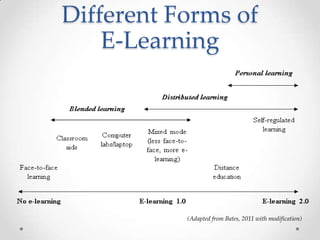
Different Forms of
    E-Learning


           (Adapted from Bates, 2011 with modification)
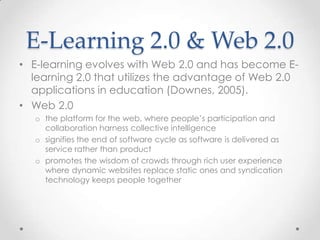
E-Learning 2.0 & Web 2.0
• E-learning evolves with Web 2.0 and has become E-
  learning 2.0 that utilizes the advantage of Web 2.0
  applications in education (Downes, 2005).
• Web 2.0
   o the platform for the web, where people’s participation and
     collaboration harness collective intelligence
   o signifies the end of software cycle as software is delivered as
     service rather than product
   o promotes the wisdom of crowds through rich user experience
     where dynamic websites replace static ones and syndication
     technology keeps people together
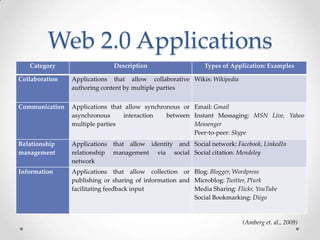
Web 2.0 Applications
   Category                   Description                    Types of Application: Examples

Collaboration   Applications that allow collaborative Wikis: Wikipedia
                authoring content by multiple parties


Communication   Applications that allow synchronous or Email: Gmail
                asynchronous     interaction   between Instant Messaging: MSN Live, Yahoo
                multiple parties                       Messenger
                                                       Peer-to-peer: Skype
Relationship    Applications that allow identity and Social network: Facebook, LinkedIn
management      relationship management via social Social citation: Mendeley
                network
Information     Applications that allow collection or Blog: Blogger, Wordpress
                publishing or sharing of information and Microblog: Twitter, Plurk
                facilitating feedback input              Media Sharing: Flickr, YouTube
                                                         Social Bookmarking: Diigo


                                                                           (Amberg et. al., 2009)
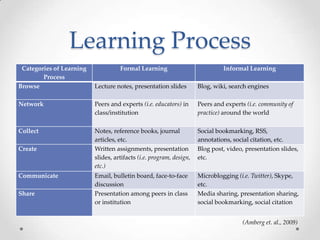
Learning Process
 Categories of Learning             Formal Learning                           Informal Learning
        Process
Browse                    Lecture notes, presentation slides         Blog, wiki, search engines

Network                   Peers and experts (i.e. educators) in      Peers and experts (i.e. community of
                          class/institution                          practice) around the world

Collect                   Notes, reference books, journal            Social bookmarking, RSS,
                          articles, etc.                             annotations, social citation, etc.
Create                    Written assignments, presentation          Blog post, video, presentation slides,
                          slides, artifacts (i.e. program, design,   etc.
                          etc.)
Communicate               Email, bulletin board, face-to-face        Microblogging (i.e. Twitter), Skype,
                          discussion                                 etc.
Share                     Presentation among peers in class          Media sharing, presentation sharing,
                          or institution                             social bookmarking, social citation


                                                                                     (Amberg et. al., 2009)
Learner Autonomy
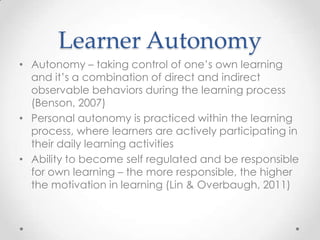
• Autonomy – taking control of one’s own learning
  and it’s a combination of direct and indirect
  observable behaviors during the learning process
  (Benson, 2007)
• Personal autonomy is practiced within the learning
  process, where learners are actively participating in
  their daily learning activities
• Ability to become self regulated and be responsible
  for own learning – the more responsible, the higher
  the motivation in learning (Lin & Overbaugh, 2011)
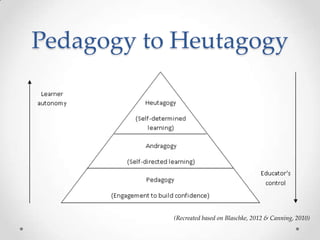
Pedagogy to Heutagogy


           (Recreated based on Blaschke, 2012 & Canning, 2010)
References
•   Amberg, M., Reinhardt, M., Haushahn, M., & Hofmann, P. (2009). Designing an Integrated Web-
    based Personal Learning Environment based on the Crucial Success Factors of Social Networks.
    Research, Reflections and Innovations in Integrating ICT in Education, 1, 1075–1080.
•   Bates, T. (2011). Understanding Web 2.0 and its Implications for E-Learning. Web 2.0-Based E-
    Learning: Applying Social Informatics for Tertiary Teaching, 21-42.
•   Benson, P. (2007). Autonomy and its role in learning. International Handbook of English
    Language Teaching (pp. 733–745). Springer.
•   Blaschke, L. (2012). Heutagogy and lifelong learning: A review of heutagogical practice and
    self-determined learning. The International Review of Research in Open and Distance
    Learning, 13(1), 56-71.
•   Canning, N. (2010). Playing with heutagogy: exploring strategies to empower mature learners in
    higher education. Journal of Further and Higher Education, 34(1), 59-71.
    doi:10.1080/03098770903477102
•   Downes, S. (2005). E-Learning 2.0. eLearn Magazine. Retrieved from
    http://www.elearnmag.org/subpage.cfm?section=articles&article=29-1
•   Guri-Rosenblit, Sarah, & Gros, B. (2011). E-Learning: Confusing Terminology, Research Gaps and
    Inherent Challenges. The Journal Of Distance Education / Revue De L’ÉDucation à
    Distance, 25(1).
•   Lin, S., & Overbaugh, R. C. (2011). Autonomy of participation and ICT literacy in a self-directed
    learning environment (SDLE). Quality & Quantity, 1-13. Springer Netherlands. doi:10.1007/s11135-
    011-9505-2
•   Mayes, T., & de Freitas, S. (2004). JISC e-learning models desk study. Retrieved June
    27, 2011, from http://www.jisc.org.uk/uploaded_documents/Stage 2 Learning Models (Version
    1).pdf
•   Raja Maznah, R. H. (2004). eLearning in Higher Education Institutions in Malaysia. E-
    mentor, 5(7), 72-75.
Thank You
    Any comment or question, please send to
mystudiouslife@gmail.com or Twitter @mystudiouslife

The Evolution of E-learning

  • 1.
    The Evolution ofE-Learning Jennifer Lim @mystudiouslife mystudiouslife@gmail.com
  • 2.
    E-Learning • Terms widelyused without a standardized meaning • Guri-Rosenblit & Gros (2011) – use of various web applications of technologies esp. in learning environments • Mayes & de Freitas (2004) – use of technology to improve learning experience • Similar terms used: Internet mediated learning, web- based learning, virtual learning, distance learning, online education
  • 3.
    Learning Management System (LMS) • E-learning is associated with Learning Management System (LMS) (Raja Maznah, 2004) • LMS widely used in higher education as Course Management System (CMS) • Educators manage coursework content and learners • Learners get course information, lecture notes and submit assignments • LMS is designed to be in educators’ control rather than learners’ control
  • 4.
    Different Forms of E-Learning (Adapted from Bates, 2011 with modification)
  • 5.
    E-Learning 2.0 &Web 2.0 • E-learning evolves with Web 2.0 and has become E- learning 2.0 that utilizes the advantage of Web 2.0 applications in education (Downes, 2005). • Web 2.0 o the platform for the web, where people’s participation and collaboration harness collective intelligence o signifies the end of software cycle as software is delivered as service rather than product o promotes the wisdom of crowds through rich user experience where dynamic websites replace static ones and syndication technology keeps people together
  • 6.
    Web 2.0 Applications Category Description Types of Application: Examples Collaboration Applications that allow collaborative Wikis: Wikipedia authoring content by multiple parties Communication Applications that allow synchronous or Email: Gmail asynchronous interaction between Instant Messaging: MSN Live, Yahoo multiple parties Messenger Peer-to-peer: Skype Relationship Applications that allow identity and Social network: Facebook, LinkedIn management relationship management via social Social citation: Mendeley network Information Applications that allow collection or Blog: Blogger, Wordpress publishing or sharing of information and Microblog: Twitter, Plurk facilitating feedback input Media Sharing: Flickr, YouTube Social Bookmarking: Diigo (Amberg et. al., 2009)
  • 7.
    Learning Process Categoriesof Learning Formal Learning Informal Learning Process Browse Lecture notes, presentation slides Blog, wiki, search engines Network Peers and experts (i.e. educators) in Peers and experts (i.e. community of class/institution practice) around the world Collect Notes, reference books, journal Social bookmarking, RSS, articles, etc. annotations, social citation, etc. Create Written assignments, presentation Blog post, video, presentation slides, slides, artifacts (i.e. program, design, etc. etc.) Communicate Email, bulletin board, face-to-face Microblogging (i.e. Twitter), Skype, discussion etc. Share Presentation among peers in class Media sharing, presentation sharing, or institution social bookmarking, social citation (Amberg et. al., 2009)
  • 8.
    Learner Autonomy • Autonomy– taking control of one’s own learning and it’s a combination of direct and indirect observable behaviors during the learning process (Benson, 2007) • Personal autonomy is practiced within the learning process, where learners are actively participating in their daily learning activities • Ability to become self regulated and be responsible for own learning – the more responsible, the higher the motivation in learning (Lin & Overbaugh, 2011)
  • 9.
    Pedagogy to Heutagogy (Recreated based on Blaschke, 2012 & Canning, 2010)
  • 10.
    References • Amberg, M., Reinhardt, M., Haushahn, M., & Hofmann, P. (2009). Designing an Integrated Web- based Personal Learning Environment based on the Crucial Success Factors of Social Networks. Research, Reflections and Innovations in Integrating ICT in Education, 1, 1075–1080. • Bates, T. (2011). Understanding Web 2.0 and its Implications for E-Learning. Web 2.0-Based E- Learning: Applying Social Informatics for Tertiary Teaching, 21-42. • Benson, P. (2007). Autonomy and its role in learning. International Handbook of English Language Teaching (pp. 733–745). Springer. • Blaschke, L. (2012). Heutagogy and lifelong learning: A review of heutagogical practice and self-determined learning. The International Review of Research in Open and Distance Learning, 13(1), 56-71. • Canning, N. (2010). Playing with heutagogy: exploring strategies to empower mature learners in higher education. Journal of Further and Higher Education, 34(1), 59-71. doi:10.1080/03098770903477102 • Downes, S. (2005). E-Learning 2.0. eLearn Magazine. Retrieved from http://www.elearnmag.org/subpage.cfm?section=articles&article=29-1 • Guri-Rosenblit, Sarah, & Gros, B. (2011). E-Learning: Confusing Terminology, Research Gaps and Inherent Challenges. The Journal Of Distance Education / Revue De L’ÉDucation à Distance, 25(1). • Lin, S., & Overbaugh, R. C. (2011). Autonomy of participation and ICT literacy in a self-directed learning environment (SDLE). Quality & Quantity, 1-13. Springer Netherlands. doi:10.1007/s11135- 011-9505-2 • Mayes, T., & de Freitas, S. (2004). JISC e-learning models desk study. Retrieved June 27, 2011, from http://www.jisc.org.uk/uploaded_documents/Stage 2 Learning Models (Version 1).pdf • Raja Maznah, R. H. (2004). eLearning in Higher Education Institutions in Malaysia. E- mentor, 5(7), 72-75.
  • 11.
    Thank You Any comment or question, please send to mystudiouslife@gmail.com or Twitter @mystudiouslife

Editor's Notes

  • #3 E-learning is widely used without a standardized meaning to everyone.According to Guri-Rosenblit & Gros, e-learning is defined to be the use of various web applications of technologies esp. in learning environments.According to Mayes & de Freitas, it is defined as the use of technology to improve learning experience.Some associated e-learning to distance learning but some argue that they are not the same though their functions may overlap in certain situation.Other similar terms that are commonly used: internet mediated learning, web-based learning, virtual learning, distance learning, online education. These terms may or may not be synonym with e-learng.
  • #4 The ambiguity of meanings signifies the different perceptions among many to define what e-learning means to them.To most learners and educators in higher education today, especially in Malaysia, e-learning is associated to Learning Management System. LMS is widely used in higher education as Course Management System where educators manage coursework content and learners activities through one platform.Similarly, learners get course information, lecture notes and assignments from LMS. Generally, LMS is designed to be in educators’ control rather than learners’ control.
  • #5 There are many forms of e-learning available – there is face-to-face learning where electronic medium is used. Then we move to blended learning where we use classroom aids such as slide projector, computer labs/laptop and then we have the now famous type of blended learning where we use mixed mode with less face-to-face and more e-learning. Mixed mode learning is the beginning of the next stage called distributed learning where distance education is gaining popularity today.With the rapid development of the Web technology today, we see the e-learning evolves to become e-learning 2.0 where the focus is more towards personal learning environment and the practice of self-regulated learning
  • #6 Today e-learning has evolved with the Web 2.0 technology and become what we called the e-learning 2.0 that utilizes the advantage of Web 2.0 applications in education.So, what is Web 2.0?It is the platform for the web, where people’s participation and collaboration can harness the collective intelligence through the driving force of data.It also signifies the end of software cycle as software is delivered as service rather than product.Web 2.0 promotes the wisdom of the crowd through rich user experience where dynamic websites replace static ones and syndication technology keeps people together.
  • #7 According to Amberg et al, web 2.0 applications can be categorized into four: collaboration, communication, relationship management and information.Collaboration are the applications that allow collaborative authoring content by multiple parties. One good example is the Wiki.Communications are those that allow both synchronous and asynchronous interaction between multiple parties.Relationship management as the name suggested allows a person to manage his/her online identity via social network.Information enables collection, publishing or sharing of information and facilitating feedback
  • #8 The learning process actually consist of both formal and informal learning. Amberg argues that the web 2.0 applications can be implemented in the learning process, especially the informal one.
  • #9 The ultimate goal of utilizing the web 2.0 applications in the learning process is actually to help learners to become autonomous in their own learning process.Autonomy is defined as taking control of one’s own learning and it’s a combination of direct and indirect observable behaviors during the learning process. Personal autonomy is practices within the learning process where learners are actively participating in their daily learning activities.To become autonomous, a leaner must have the ability to become self regulated and willingness to take responsibilities for their own learning, hence the more responsible the learner, the higher their motivation in their own learning.
  • #10 This figure depicts the progression from pedagogy to heutagogy in relation to the levels of learner autonomy and educator’s control.Pedagogy is the most commonly known leading and teaching theory – it concerns more about the transfer of information and skills between the educators and learners.The purpose of pedagogy is to build learners’ confidence (especially young learners) in the learning process.While pedagogy is a way to allow educator in control of the learning process and course structure, adult learners should require less educator’s control and structure as they have already built their confidence in early school years.With that in mind, the term andragogy, made popular by Knowles, is used to explain the theory of adult learning as an alternative to pedagogy.Andragogy is about learner autonomy and self responsibility in learning – let the learners decide on what, why and how to learn and at the same time maintaining their level of motivation to learn on their own.While andragogy promotes self directed learning, there is a more holistic approach called heutagogy as an extension of andragogy in promoting self determined learning.Heutagogy concerns about the development of learners’ capabilities and competencies to learn on their own with the desire to go beyond what is required in the learning process. In another word, heutagogy ultimately promotes lifelong learning capabilities to learners.