LSST 2017 Project & Community Workshop
DM/Community Interaction Strategy
Mario Juric <mjuric@astro.washington.edu>
August 14th, 2017.
The Need for Community Interaction (1/2)
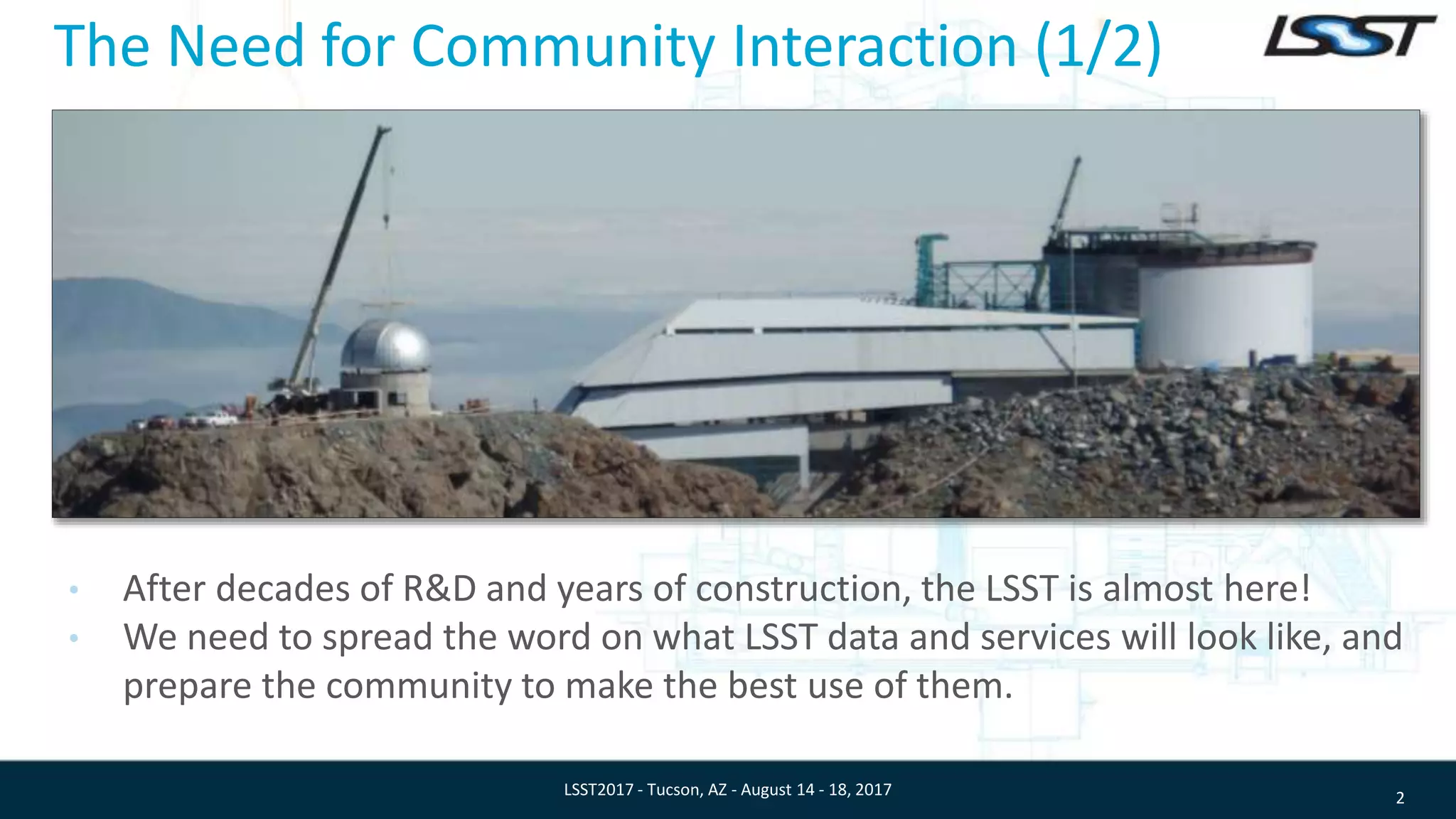
• After decades of R&D and years of construction, the LSST is almost here!
• We need to spread the word on what LSST data and services will look like, and
prepare the community to make the best use of them.
2LSST2017 - Tucson, AZ - August 14 - 18, 2017
The Need for Community Interaction (2/2)
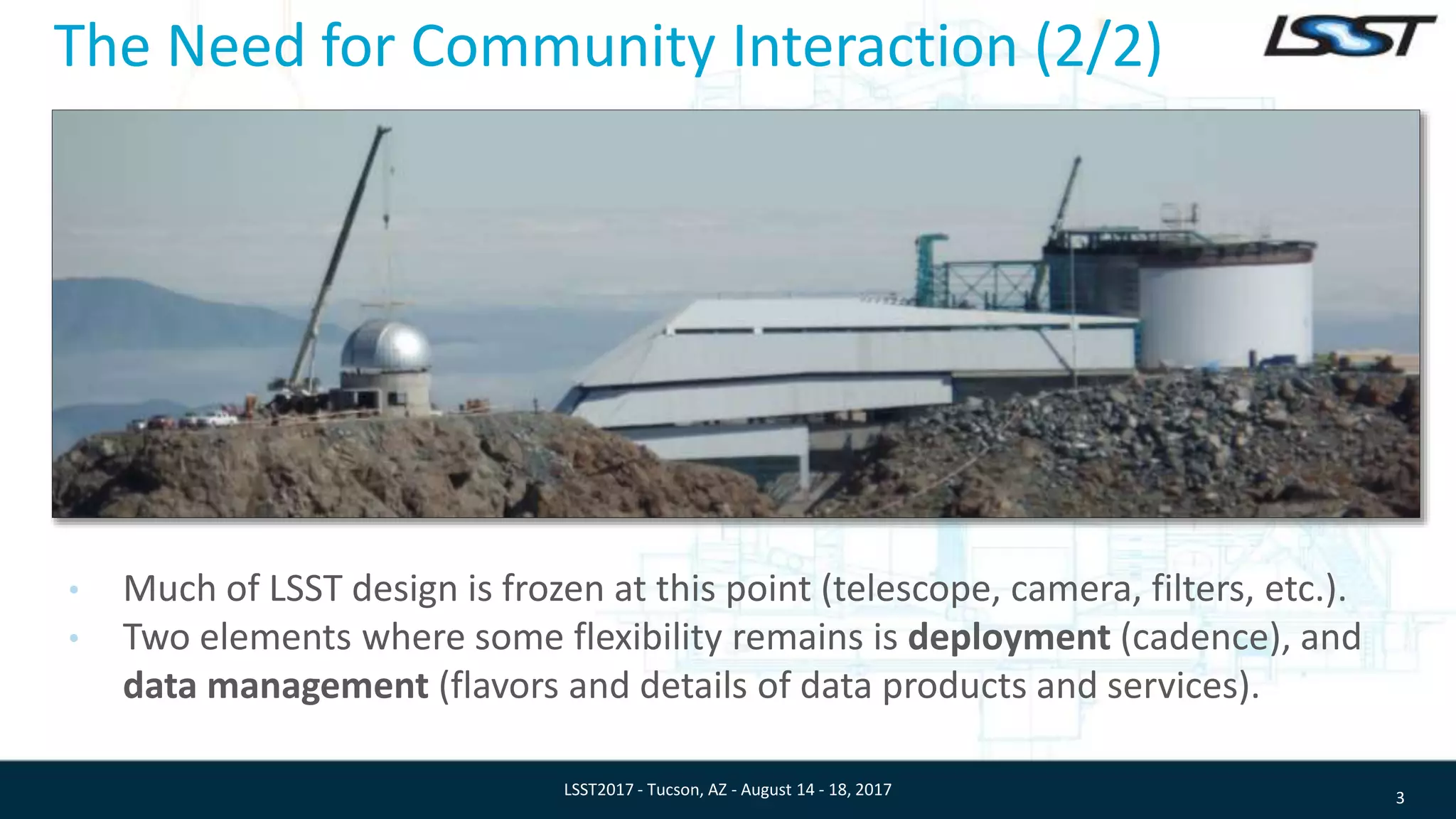
• Much of LSST design is frozen at this point (telescope, camera, filters, etc.).
• Two elements where some flexibility remains is deployment (cadence), and
data management (flavors and details of data products and services).
3LSST2017 - Tucson, AZ - August 14 - 18, 2017
Data Management
• DM Mission: “Stand up
operable, maintainable, quality
services to deliver high-quality
LSST data products for science
and education, all on time and
within reasonable cost.”
(http://ls.st/ldm-294)
4LSST2017 - Tucson, AZ - August 14 - 18, 2017
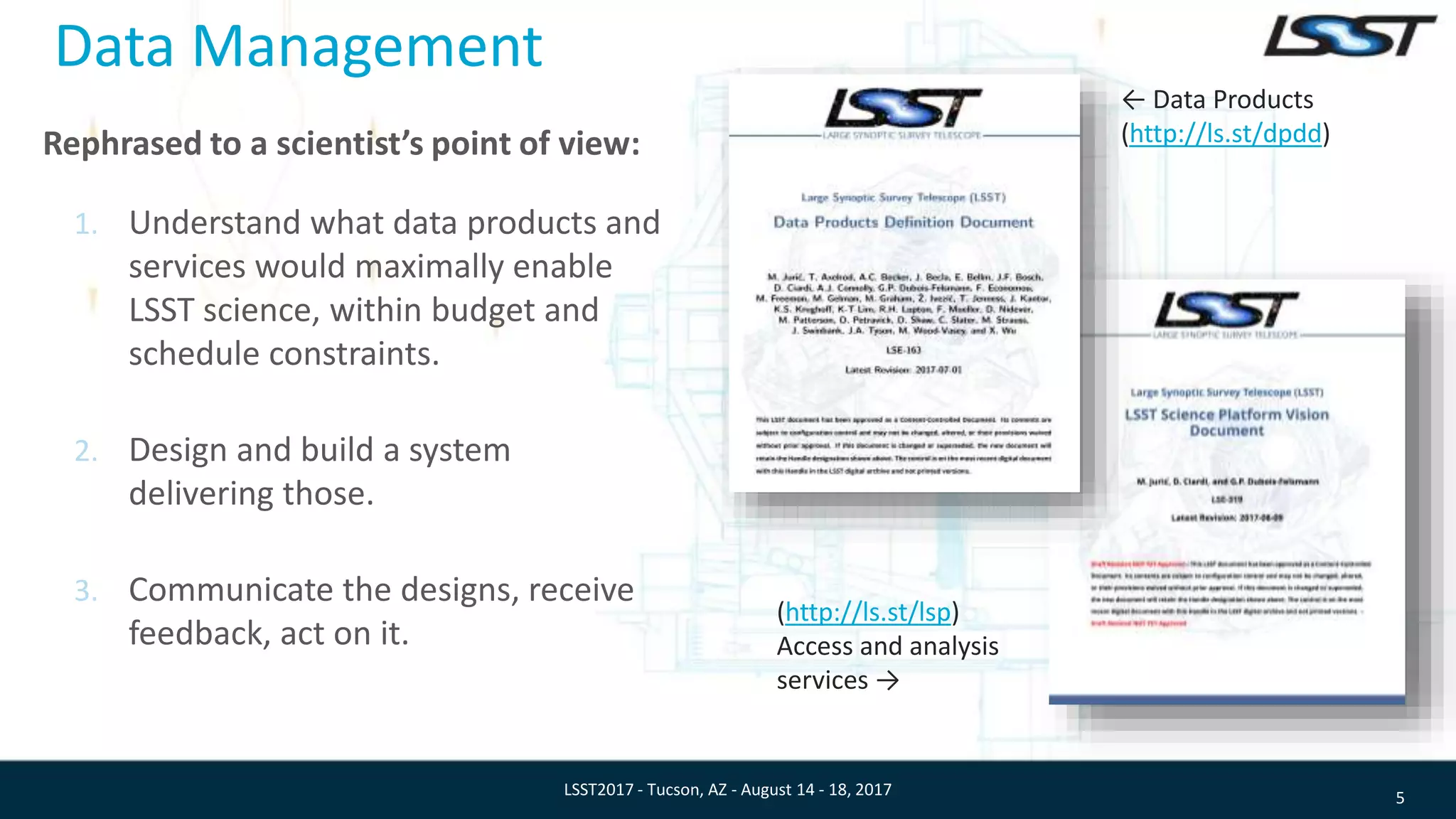
← Data Products
(http://ls.st/dpdd)
(http://ls.st/lsp)
Access and analysis
services →
Data Management
Rephrased to a scientist’s point of view:
1. Understand what data products and
services would maximally enable
LSST science, within budget and
schedule constraints.
2. Design and build a system
delivering those.
3. Communicate the designs, receive
feedback, act on it.
5LSST2017 - Tucson, AZ - August 14 - 18, 2017
← Data Products
(http://ls.st/dpdd)
(http://ls.st/lsp)
Access and analysis
services →
Organization of DM-Comm’ty Interactions
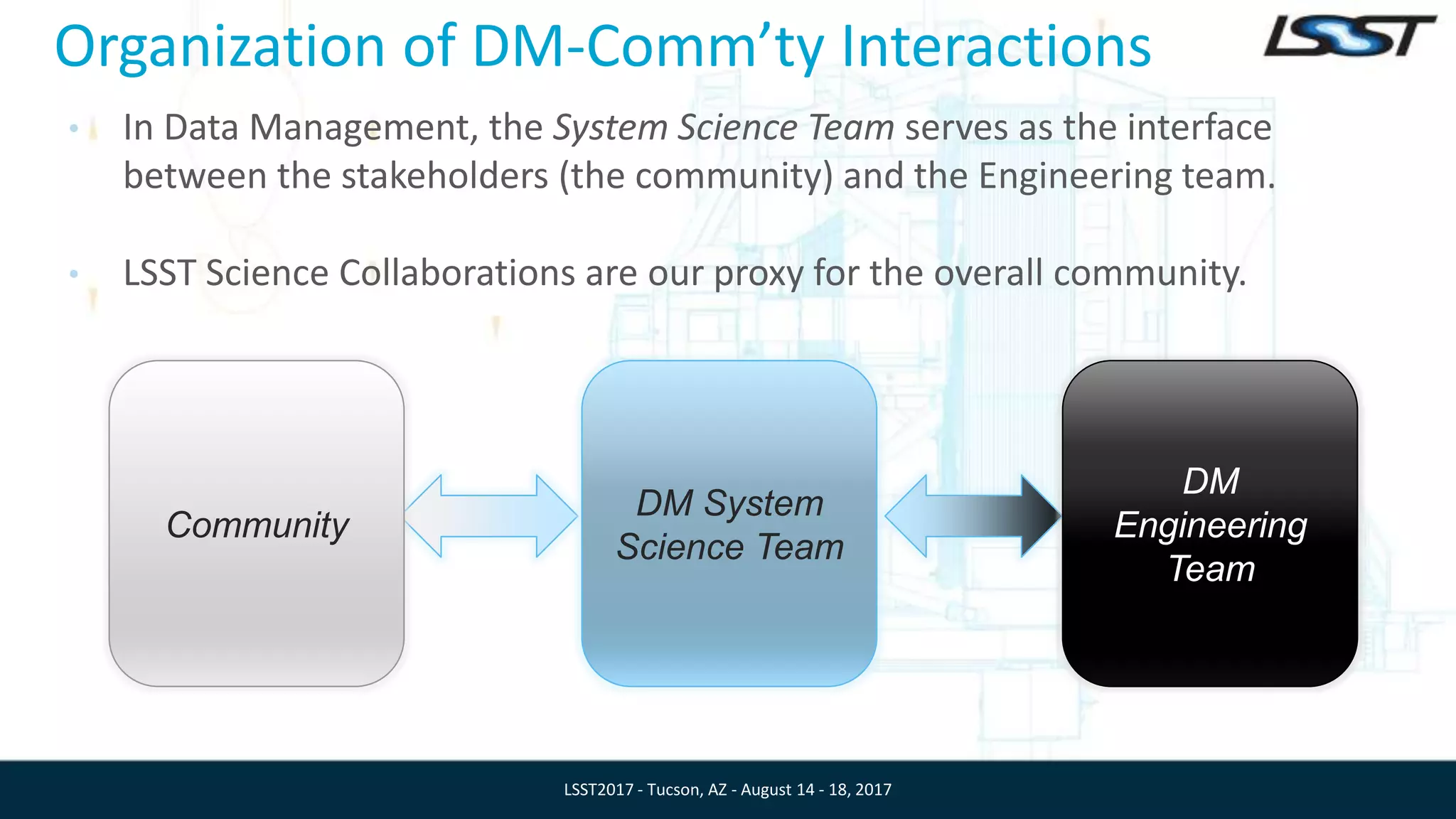
• In Data Management, the System Science Team serves as the interface
between the stakeholders (the community) and the Engineering team.
• LSST Science Collaborations are our proxy for the overall community.
DM System
Science Team
DM
Engineering
Team
Community
LSST2017 - Tucson, AZ - August 14 - 18, 2017
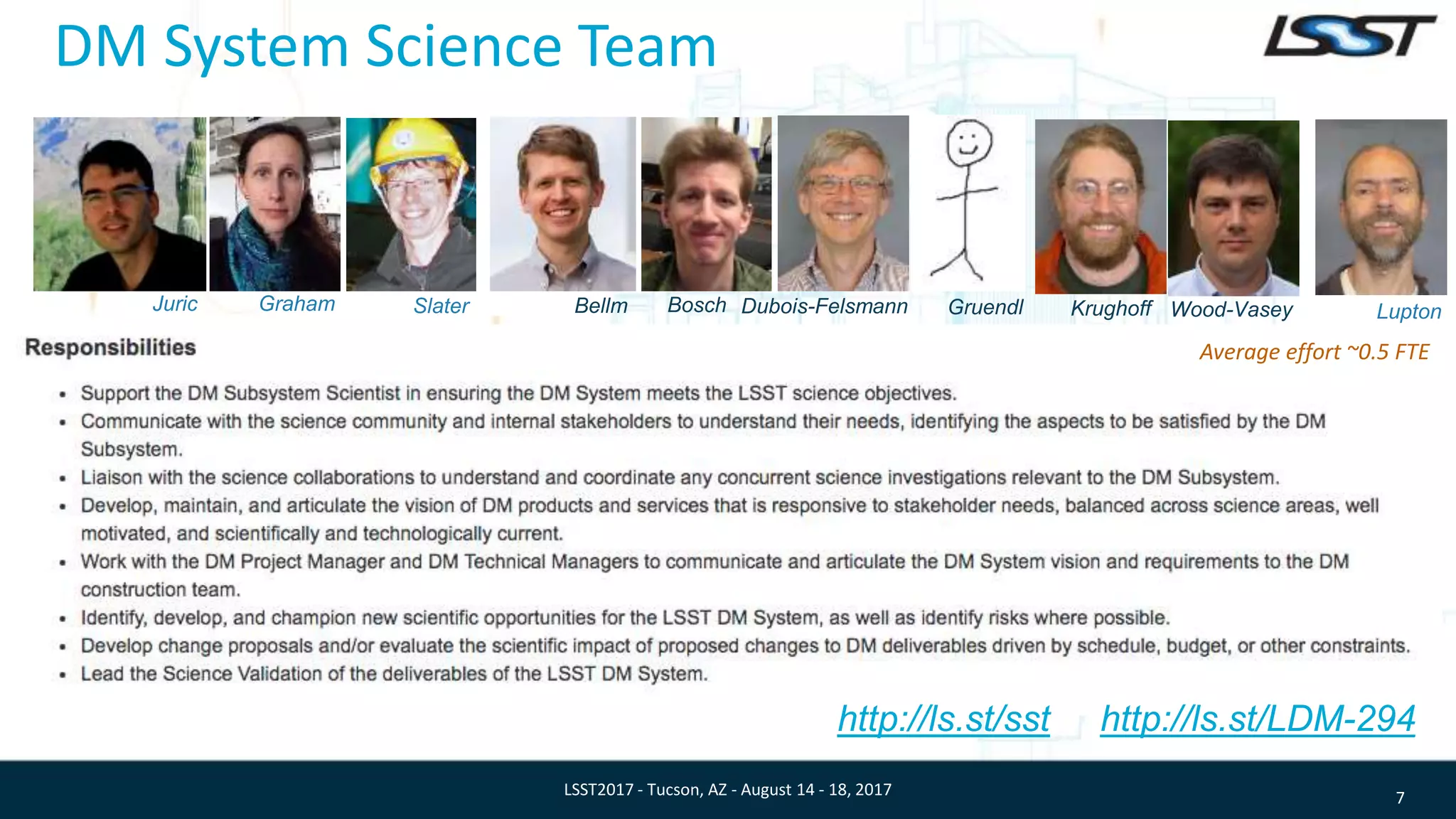
DM System Science Team
7
From http://ls.st/sst o, http://ls.st/LDM-294)
LSST2017 - Tucson, AZ - August 14 - 18, 2017
Juric Graham Slater Bellm Bosch Wood-VaseyDubois-Felsmann Gruendl Lupton
Average effort ~0.5 FTE
Krughoff
Typical Communication Modes
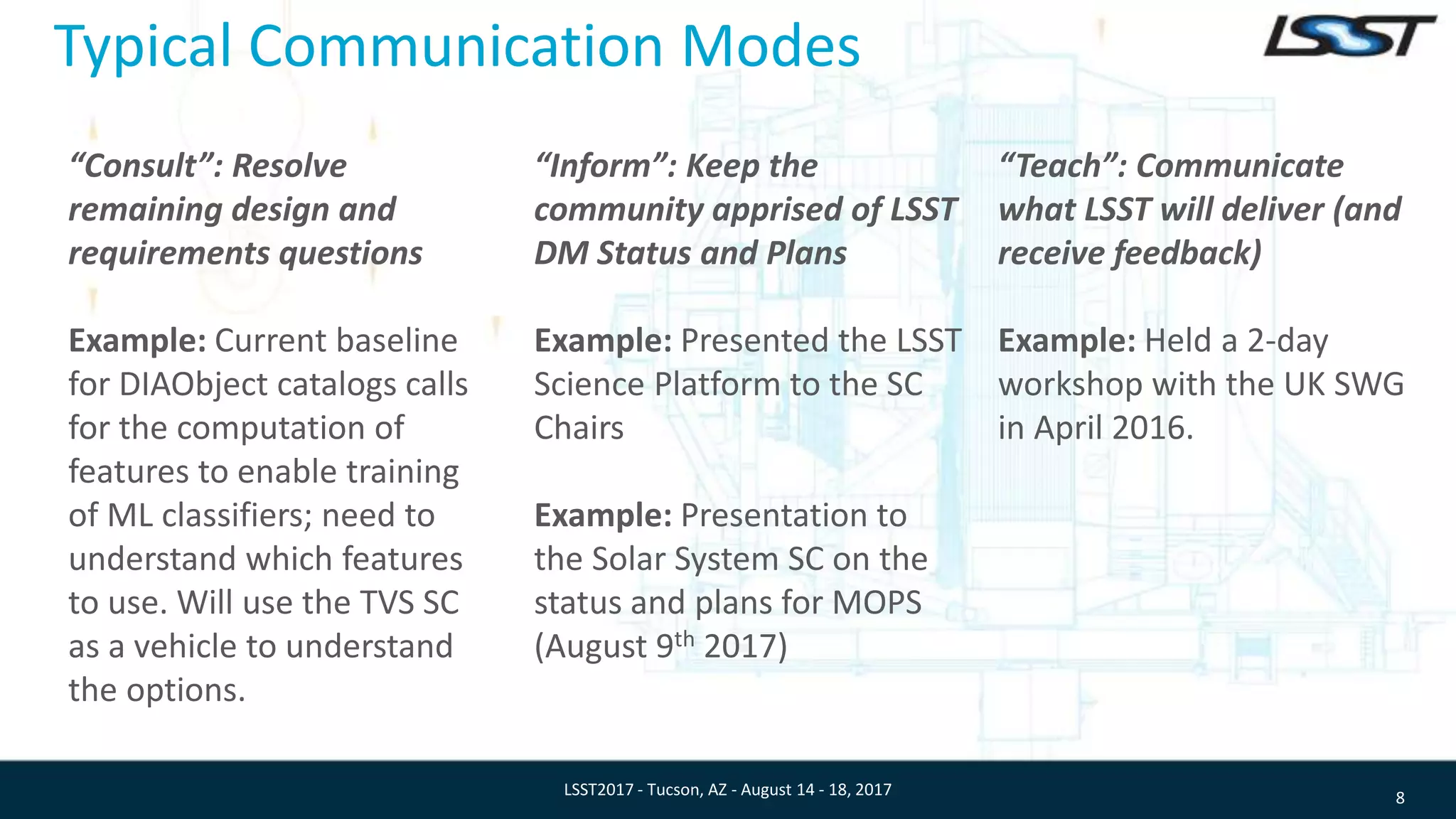
“Consult”: Resolve
remaining design and
requirements questions
Example: Current baseline
for DIAObject catalogs calls
for the computation of
features to enable training
of ML classifiers; need to
understand which features
to use. Will use the TVS SC
as a vehicle to understand
the options.
8LSST2017 - Tucson, AZ - August 14 - 18, 2017
“Inform”: Keep the
community apprised of LSST
DM Status and Plans
Example: Presented the LSST
Science Platform to the SC
Chairs
Example: Presentation to
the Solar System SC on the
status and plans for MOPS
(August 9th 2017)
“Teach”: Communicate
what LSST will deliver (and
receive feedback)
Example: Held a 2-day
workshop with the UK SWG
in April 2016.
Points of Contact
• Community: We use the LSST Science Collaborations as a proxy for the overall
community. Advantages:
• Leverages SC organization; communicate/organize through the Chair, rather
than individually with members
• Note: some special considerations for int’l contributors’ communities (e.g.,
Chile, UK, France)
• DM: Designated Points of Contact (liaisons)
• Every SC has (or will have) a member of the DM SST who designated as their
liaison.
• These PoCs work with SC chairs satisfy both DM and SC needs.
• They’re meant to be generally “plugged in” to collaboration work and plans,
so they can identify and advise both the Project and the SCs on potential
issues.
9LSST2017 - Tucson, AZ - August 14 - 18, 2017
Primary Communication Channels
Meetings, Conferences,
Workshops
Opportunity to reach large
audiences at once. Reaches
broad communities.
Example: Chilean LSST
Science workshop,
December 2016. French LSST
Science Workshop, June
1027. DPS Town-Hall
meetings.
10LSST2017 - Tucson, AZ - August 14 - 18, 2017
Collaboration Telecons (incl.
SWG telecons)
Opportunity to keep the SC
appraised of DM progress &
understand SC plans.
Example: Attending DESC
leadership telecons.
Mailing lists and
community.lsst.org
General discussion venue.
Example: Discussions on
(various) DESC mailing lists
on LSST plans for
photometric redshifts.
+ a well organized and maintained website
SS
T
PoC (or
DMSS)
Po
C
Issues and Work in Progress
• DM is still implementing all aspects. Not all liaisons have been named,
or they haven’t started attending collaboration telecons. Delayed by the
DM replan work, but hope to finish this fall.
• Some aspects still missing, a website being a key one (next slide).
• Need to better differentiate between different communities, and
appropriately use communication tools we have available (see following
slides)
• Resources remain an issue; it’s (too) easy to neglect communication.
11LSST2017 - Tucson, AZ - August 14 - 18, 2017
Thinking Ahead: LSST Data Website
• Our lsst.org website is largely aimed towards the general
science-oriented public
• To complete the DM communication structure, we’d
benefit from a science products-oriented one
• http://dm.lsst.org (though currently too software
oriented; see next slide)
• Place to learn about the planned data products
and services
• Links to existing simulated products, prototype
services
• Place to learn about DM development plans and
progress
• Place to learn about Community interaction
mechanisms and tools (points of contact, tools,
etc.)
• Data-related publications, presentations
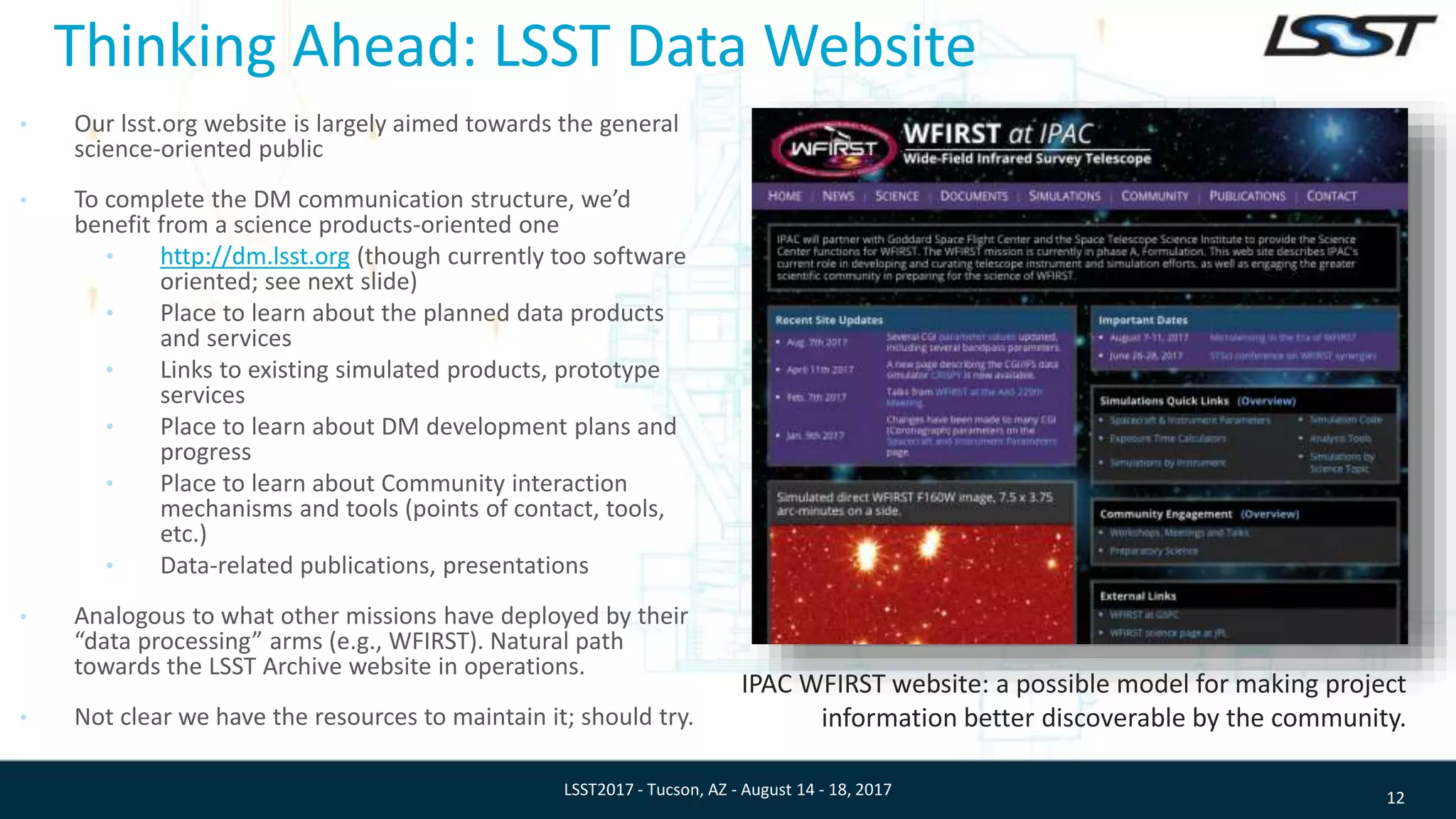
• Analogous to what other missions have deployed by their
“data processing” arms (e.g., WFIRST). Natural path
towards the LSST Archive website in operations.
• Not clear we have the resources to maintain it; should try.
12LSST2017 - Tucson, AZ - August 14 - 18, 2017
IPAC WFIRST website: a possible model for making project
information better discoverable by the community.
Thinking Ahead: LSST Community vs. LSST Stack Community
• We’re beginning to distinguish between the “LSST Community” and the ”LSST Stack Community”.
• 1. LSST Community: the community of scientists interested in using LSST data and services
for research.
• 2. LSST Stack Community: the community of people interested in running or modifying the
LSST processing software.
• The two overlap, but have (sometimes significantly) different expectations or needs.
• The former is likely to be significantly larger.
• E.g., compare the number of people who have used SDSS data, vs. who have run Photo.
• We’ve so far put the emphasis on supporting community #2. This had the effect of sometimes
confusing or giving the wrong impression to community #1.
• E.g., a typical LSST user will not be expected to use the LSST stack or reduce the data themselves.
Most users shouldn’t be trying to build it.
• We haven’t yet offered LSST-like simulated datasets, emphasized data model documentation,
broadly offered LSST-reprocessed data, and similar products. These may be more interesting to
community #1.
• We need to support both communities, with appropriate mechanisms.
13LSST2017 - Tucson, AZ - August 14 - 18, 2017
Summary
• DM is putting into place an organized community interaction
effort, in order to fulfill the Construction mandate to deliver data
products and services the community needs, within budget and
schedule constraints.
• The effort is led by the DM System Science Team, centered
around designated liaisons, with Science Collaborations serving as
an organized proxy for the overall community.
• Not all aspects have been established yet (e.g., website) as
resources remain an issue, but progress is being made.
14LSST2017 - Tucson, AZ - August 14 - 18, 2017
Backups
15LSST2017 - Tucson, AZ - August 14 - 18, 2017
How should this work in practice
• The collaboration chairs have monthly meetings with the PST; a chance to discuss
high-level issues (this is broader than just DM)
• The Chairs pass this information to the collaborations
• DM Liaisons will attend regular collaboration telecons. A chance to connect on a
weekly or fortnightly basis.
• This will not be a one-size-fits all arrangement; all collaborations are subtly
different (some require more than one liaison, depending on DM needs)
• We are looking into establishing (at least) a quarterly “DM status update” calls with
each science collaboration. The Solar System SC meeting last week may be a good
model.
• A chance for any collaboration member to be kept appraised of DM progress
16LSST2017 - Tucson, AZ - August 14 - 18, 2017
Supporting Contributions to DM Software
• Most LSST DM software is open source and available on github
• For those interested in trying the LSST codes (as well as our own developers),
we’ve made extensive documentation available on how to install and run it.
For example:
• http://developer.lsst.io
• http://pipelines.lsst.io
• We’re open to community interaction and contributions to the LSST software,
with a number of mechanisms to enable these:
• Bug reports and contributions: Github Issues
• StackOverflow-like message board: http://community.lsst.org
• Real-time chat: Slack
17LSST2017 - Tucson, AZ - August 14 - 18, 2017

LSST DM/Community Interaction Strategy

  • 1.
    LSST 2017 Project& Community Workshop DM/Community Interaction Strategy Mario Juric <mjuric@astro.washington.edu> August 14th, 2017.
  • 2.
    The Need forCommunity Interaction (1/2) • After decades of R&D and years of construction, the LSST is almost here! • We need to spread the word on what LSST data and services will look like, and prepare the community to make the best use of them. 2LSST2017 - Tucson, AZ - August 14 - 18, 2017
  • 3.
    The Need forCommunity Interaction (2/2) • Much of LSST design is frozen at this point (telescope, camera, filters, etc.). • Two elements where some flexibility remains is deployment (cadence), and data management (flavors and details of data products and services). 3LSST2017 - Tucson, AZ - August 14 - 18, 2017
  • 4.
    Data Management • DMMission: “Stand up operable, maintainable, quality services to deliver high-quality LSST data products for science and education, all on time and within reasonable cost.” (http://ls.st/ldm-294) 4LSST2017 - Tucson, AZ - August 14 - 18, 2017 ← Data Products (http://ls.st/dpdd) (http://ls.st/lsp) Access and analysis services →
  • 5.
    Data Management Rephrased toa scientist’s point of view: 1. Understand what data products and services would maximally enable LSST science, within budget and schedule constraints. 2. Design and build a system delivering those. 3. Communicate the designs, receive feedback, act on it. 5LSST2017 - Tucson, AZ - August 14 - 18, 2017 ← Data Products (http://ls.st/dpdd) (http://ls.st/lsp) Access and analysis services →
  • 6.
    Organization of DM-Comm’tyInteractions • In Data Management, the System Science Team serves as the interface between the stakeholders (the community) and the Engineering team. • LSST Science Collaborations are our proxy for the overall community. DM System Science Team DM Engineering Team Community LSST2017 - Tucson, AZ - August 14 - 18, 2017
  • 7.
    DM System ScienceTeam 7 From http://ls.st/sst o, http://ls.st/LDM-294) LSST2017 - Tucson, AZ - August 14 - 18, 2017 Juric Graham Slater Bellm Bosch Wood-VaseyDubois-Felsmann Gruendl Lupton Average effort ~0.5 FTE Krughoff
  • 8.
    Typical Communication Modes “Consult”:Resolve remaining design and requirements questions Example: Current baseline for DIAObject catalogs calls for the computation of features to enable training of ML classifiers; need to understand which features to use. Will use the TVS SC as a vehicle to understand the options. 8LSST2017 - Tucson, AZ - August 14 - 18, 2017 “Inform”: Keep the community apprised of LSST DM Status and Plans Example: Presented the LSST Science Platform to the SC Chairs Example: Presentation to the Solar System SC on the status and plans for MOPS (August 9th 2017) “Teach”: Communicate what LSST will deliver (and receive feedback) Example: Held a 2-day workshop with the UK SWG in April 2016.
  • 9.
    Points of Contact •Community: We use the LSST Science Collaborations as a proxy for the overall community. Advantages: • Leverages SC organization; communicate/organize through the Chair, rather than individually with members • Note: some special considerations for int’l contributors’ communities (e.g., Chile, UK, France) • DM: Designated Points of Contact (liaisons) • Every SC has (or will have) a member of the DM SST who designated as their liaison. • These PoCs work with SC chairs satisfy both DM and SC needs. • They’re meant to be generally “plugged in” to collaboration work and plans, so they can identify and advise both the Project and the SCs on potential issues. 9LSST2017 - Tucson, AZ - August 14 - 18, 2017
  • 10.
    Primary Communication Channels Meetings,Conferences, Workshops Opportunity to reach large audiences at once. Reaches broad communities. Example: Chilean LSST Science workshop, December 2016. French LSST Science Workshop, June 1027. DPS Town-Hall meetings. 10LSST2017 - Tucson, AZ - August 14 - 18, 2017 Collaboration Telecons (incl. SWG telecons) Opportunity to keep the SC appraised of DM progress & understand SC plans. Example: Attending DESC leadership telecons. Mailing lists and community.lsst.org General discussion venue. Example: Discussions on (various) DESC mailing lists on LSST plans for photometric redshifts. + a well organized and maintained website SS T PoC (or DMSS) Po C
  • 11.
    Issues and Workin Progress • DM is still implementing all aspects. Not all liaisons have been named, or they haven’t started attending collaboration telecons. Delayed by the DM replan work, but hope to finish this fall. • Some aspects still missing, a website being a key one (next slide). • Need to better differentiate between different communities, and appropriately use communication tools we have available (see following slides) • Resources remain an issue; it’s (too) easy to neglect communication. 11LSST2017 - Tucson, AZ - August 14 - 18, 2017
  • 12.
    Thinking Ahead: LSSTData Website • Our lsst.org website is largely aimed towards the general science-oriented public • To complete the DM communication structure, we’d benefit from a science products-oriented one • http://dm.lsst.org (though currently too software oriented; see next slide) • Place to learn about the planned data products and services • Links to existing simulated products, prototype services • Place to learn about DM development plans and progress • Place to learn about Community interaction mechanisms and tools (points of contact, tools, etc.) • Data-related publications, presentations • Analogous to what other missions have deployed by their “data processing” arms (e.g., WFIRST). Natural path towards the LSST Archive website in operations. • Not clear we have the resources to maintain it; should try. 12LSST2017 - Tucson, AZ - August 14 - 18, 2017 IPAC WFIRST website: a possible model for making project information better discoverable by the community.
  • 13.
    Thinking Ahead: LSSTCommunity vs. LSST Stack Community • We’re beginning to distinguish between the “LSST Community” and the ”LSST Stack Community”. • 1. LSST Community: the community of scientists interested in using LSST data and services for research. • 2. LSST Stack Community: the community of people interested in running or modifying the LSST processing software. • The two overlap, but have (sometimes significantly) different expectations or needs. • The former is likely to be significantly larger. • E.g., compare the number of people who have used SDSS data, vs. who have run Photo. • We’ve so far put the emphasis on supporting community #2. This had the effect of sometimes confusing or giving the wrong impression to community #1. • E.g., a typical LSST user will not be expected to use the LSST stack or reduce the data themselves. Most users shouldn’t be trying to build it. • We haven’t yet offered LSST-like simulated datasets, emphasized data model documentation, broadly offered LSST-reprocessed data, and similar products. These may be more interesting to community #1. • We need to support both communities, with appropriate mechanisms. 13LSST2017 - Tucson, AZ - August 14 - 18, 2017
  • 14.
    Summary • DM isputting into place an organized community interaction effort, in order to fulfill the Construction mandate to deliver data products and services the community needs, within budget and schedule constraints. • The effort is led by the DM System Science Team, centered around designated liaisons, with Science Collaborations serving as an organized proxy for the overall community. • Not all aspects have been established yet (e.g., website) as resources remain an issue, but progress is being made. 14LSST2017 - Tucson, AZ - August 14 - 18, 2017
  • 15.
    Backups 15LSST2017 - Tucson,AZ - August 14 - 18, 2017
  • 16.
    How should thiswork in practice • The collaboration chairs have monthly meetings with the PST; a chance to discuss high-level issues (this is broader than just DM) • The Chairs pass this information to the collaborations • DM Liaisons will attend regular collaboration telecons. A chance to connect on a weekly or fortnightly basis. • This will not be a one-size-fits all arrangement; all collaborations are subtly different (some require more than one liaison, depending on DM needs) • We are looking into establishing (at least) a quarterly “DM status update” calls with each science collaboration. The Solar System SC meeting last week may be a good model. • A chance for any collaboration member to be kept appraised of DM progress 16LSST2017 - Tucson, AZ - August 14 - 18, 2017
  • 17.
    Supporting Contributions toDM Software • Most LSST DM software is open source and available on github • For those interested in trying the LSST codes (as well as our own developers), we’ve made extensive documentation available on how to install and run it. For example: • http://developer.lsst.io • http://pipelines.lsst.io • We’re open to community interaction and contributions to the LSST software, with a number of mechanisms to enable these: • Bug reports and contributions: Github Issues • StackOverflow-like message board: http://community.lsst.org • Real-time chat: Slack 17LSST2017 - Tucson, AZ - August 14 - 18, 2017