Case Studies in Biblical Leaders
 Does everyone make mistakes?
 "For in many things we all stumble"
(James 3:2)
 Of course, we all make mistakes, but
mistakes do not need to define us.
 Self-correcting leaders rise from their
failures to achieve success.
Erwin Lutzer wrote an
excellent little book
entitled, Failure: The
Back Door to Success.
His book emphasizes
two facts: one is that we
all fail, and two, failure
can be used by God to
bring about success.
The key to avoiding failure is to do
nothing, say nothing, and be nothing.
Nothing was not good enough for Peter.
He failed often but he got back up and
finally became the leader Jesus knew he
would be.
Self-correcting leaders are evident
wherever leaders accomplish significant
achievements despite prior failures.
Have you ever made a mistake that
taught you a valuable lesson?
Good leaders take risks, which by nature
will eventually lead to a less than
optimal outcome. Average leaders don’t
take risks because they are dominated
by the fear of failure.
Robert Schuller once said, “It’s better to
do something imperfectly, than to do
nothing perfectly.”
Frank J. Ruck once observed, “When
people don’t make mistakes, I’m
uncomfortable. They’re not reaching out
and growing.”
At some point every leader will fail while
attempting to do something worthwhile.
The self-correcting leader will rebound
from failures.
God even uses our failures to accomplish
His purposes in our lives:
“And we know all things work together
for good to those who love God, to
those who are called according to His
purpose” (Rom. 8:28).
Despite his best intentions, Peter often
found himself desiring to do one thing,
but practicing something else.
Others who knew Peter may not have
seen leadership potential in him, but
Jesus called him to be a disciple:
John 1:42 (NKJV)
And he brought him to Jesus.
Now when Jesus looked at him, He said,
“You are Simon the son of Jonah. You shall
be called Cephas” (which is translated, A
Stone).
The Greek word for “looked” suggest the
idea of a penetrating look that sees the real
person and not just the exterior.
What would you consider to be one of
Peter’s greatest moments?
Many people would say it was when “he
walked on the water to go to Jesus”
(Matt. 14:29).
But just as he is experiencing his
greatest moment, he also suffers a
humiliating moment of failure.
Matthew 14:30 (NKJV)
But when he saw that the wind was
boisterous,he was afraid; and beginning
to sink he cried out, saying, “Lord, save
me!”
Olle Bovin said, “You have to be brave
enough to fail as a leader.”
In another moment of glory Peter
confessed, “You are the Christ, the Son
of the living God” (Matt. 16:16).
But when Jesus began to explain what
this meant, “Peter took Him aside and
began to rebuke Him saying, ‘Far be it
from You, Lord; this shall not happen to
You!’” (Matt. 16:22).
On the Mount of Transfiguration Peter
saw Jesus in all His glory, along with
Moses and Elijah. Peter failed to
comprehend the significance of the
moment and said, “Master it is good for
us to be here; and let us make three
tabernacles: one for You, one for Moses,
and one for Elijah” (Luke 9:33).
At the Passover meal Peter still had not
learned the lesson to speak less and
listen more. When Jesus was going to
wash the feet of the disciples, Peter
initially refused.
“Peter said to Him, ‘You shall never
wash my feet!” (John 13:8)
Jesus said to him,
“If I do not wash
you, you have no
part with Me.”
Simon Peter said
to Him, “Lord,
not my feet only,
but also my
hands and my
head!” (John 13:9)
At the Passover meal, Jesus warned
Peter what was about to happen. “Peter
said to Him, ‘Lord, why can I not follow
You now? I will lay down my life for
Your sake.’ Jesus answered him, ‘Will
you lay down your life for My sake?
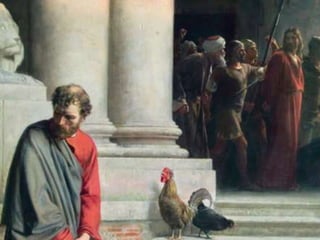
Most assuredly, I say to you, the rooster
shall not crow till you have denied me
three times.’” (John 13:37-38)
If walking on the water was one of
Peter’s greatest moments, what would
you say is one of Peter’s greatest
failures?
Matthew 26:73-75 (NKJV)
73 And a little later those who stood by came up
and said to Peter, “Surely you also are one of
them, for your speech betrays you.”
74 Then he began to curse and swear, saying, “I
do not know the Man!”
Immediately a rooster crowed. 75 And Peter
remembered the word of Jesus who had said to
him, “Before the rooster crows, you will deny Me
three times.” So he went out and wept bitterly.
What would you do with someone who failed
you so miserably?
What did Jesus do?
17 He said to him the third time, “Simon, son of
Jonah, do you love Me?” Peter was grieved
because He said to him the third time, “Do you
love Me?”
And he said to Him, “Lord, You know all things;
You know that I love You.”
Jesus said to him, “Feed My sheep.” (Jn. 21:17-18)
Peter had dropped the ball, but Jesus put
him back in the game, He gave Peter a
second chance.
 First, identify our need to make a
correction in our life.
 Second, recognize the Lord at work in
our lives.
 Third, renew our relationship with
Christ in words and actions.
 Last, remain focused on the task
before them rather than getting
involved in other incidentals.
LS 613 Chapter 22

LS 613 Chapter 22

  • 1.
    Case Studies inBiblical Leaders
  • 2.
     Does everyonemake mistakes?  "For in many things we all stumble" (James 3:2)  Of course, we all make mistakes, but mistakes do not need to define us.  Self-correcting leaders rise from their failures to achieve success.
  • 3.
    Erwin Lutzer wrotean excellent little book entitled, Failure: The Back Door to Success. His book emphasizes two facts: one is that we all fail, and two, failure can be used by God to bring about success.
  • 4.
    The key toavoiding failure is to do nothing, say nothing, and be nothing. Nothing was not good enough for Peter. He failed often but he got back up and finally became the leader Jesus knew he would be.
  • 5.
    Self-correcting leaders areevident wherever leaders accomplish significant achievements despite prior failures. Have you ever made a mistake that taught you a valuable lesson?
  • 6.
    Good leaders takerisks, which by nature will eventually lead to a less than optimal outcome. Average leaders don’t take risks because they are dominated by the fear of failure. Robert Schuller once said, “It’s better to do something imperfectly, than to do nothing perfectly.”
  • 7.
    Frank J. Ruckonce observed, “When people don’t make mistakes, I’m uncomfortable. They’re not reaching out and growing.” At some point every leader will fail while attempting to do something worthwhile.
  • 8.
    The self-correcting leaderwill rebound from failures. God even uses our failures to accomplish His purposes in our lives: “And we know all things work together for good to those who love God, to those who are called according to His purpose” (Rom. 8:28).
  • 9.
    Despite his bestintentions, Peter often found himself desiring to do one thing, but practicing something else. Others who knew Peter may not have seen leadership potential in him, but Jesus called him to be a disciple:
  • 10.
    John 1:42 (NKJV) Andhe brought him to Jesus. Now when Jesus looked at him, He said, “You are Simon the son of Jonah. You shall be called Cephas” (which is translated, A Stone). The Greek word for “looked” suggest the idea of a penetrating look that sees the real person and not just the exterior.
  • 11.
    What would youconsider to be one of Peter’s greatest moments? Many people would say it was when “he walked on the water to go to Jesus” (Matt. 14:29). But just as he is experiencing his greatest moment, he also suffers a humiliating moment of failure.
  • 12.
    Matthew 14:30 (NKJV) Butwhen he saw that the wind was boisterous,he was afraid; and beginning to sink he cried out, saying, “Lord, save me!” Olle Bovin said, “You have to be brave enough to fail as a leader.”
  • 13.
    In another momentof glory Peter confessed, “You are the Christ, the Son of the living God” (Matt. 16:16). But when Jesus began to explain what this meant, “Peter took Him aside and began to rebuke Him saying, ‘Far be it from You, Lord; this shall not happen to You!’” (Matt. 16:22).
  • 14.
    On the Mountof Transfiguration Peter saw Jesus in all His glory, along with Moses and Elijah. Peter failed to comprehend the significance of the moment and said, “Master it is good for us to be here; and let us make three tabernacles: one for You, one for Moses, and one for Elijah” (Luke 9:33).
  • 15.
    At the Passovermeal Peter still had not learned the lesson to speak less and listen more. When Jesus was going to wash the feet of the disciples, Peter initially refused. “Peter said to Him, ‘You shall never wash my feet!” (John 13:8)
  • 16.
    Jesus said tohim, “If I do not wash you, you have no part with Me.” Simon Peter said to Him, “Lord, not my feet only, but also my hands and my head!” (John 13:9)
  • 17.
    At the Passovermeal, Jesus warned Peter what was about to happen. “Peter said to Him, ‘Lord, why can I not follow You now? I will lay down my life for Your sake.’ Jesus answered him, ‘Will you lay down your life for My sake? Most assuredly, I say to you, the rooster shall not crow till you have denied me three times.’” (John 13:37-38)
  • 18.
    If walking onthe water was one of Peter’s greatest moments, what would you say is one of Peter’s greatest failures?
  • 20.
    Matthew 26:73-75 (NKJV) 73And a little later those who stood by came up and said to Peter, “Surely you also are one of them, for your speech betrays you.” 74 Then he began to curse and swear, saying, “I do not know the Man!” Immediately a rooster crowed. 75 And Peter remembered the word of Jesus who had said to him, “Before the rooster crows, you will deny Me three times.” So he went out and wept bitterly.
  • 21.
    What would youdo with someone who failed you so miserably? What did Jesus do? 17 He said to him the third time, “Simon, son of Jonah, do you love Me?” Peter was grieved because He said to him the third time, “Do you love Me?” And he said to Him, “Lord, You know all things; You know that I love You.” Jesus said to him, “Feed My sheep.” (Jn. 21:17-18)
  • 22.
    Peter had droppedthe ball, but Jesus put him back in the game, He gave Peter a second chance.
  • 24.
     First, identifyour need to make a correction in our life.  Second, recognize the Lord at work in our lives.  Third, renew our relationship with Christ in words and actions.  Last, remain focused on the task before them rather than getting involved in other incidentals.