Ali R. Rahimi,MD,FACP,AGSF
Professor of Medicine
Mercer University School of Medicine
Clinical Professor
University of Georgia School of Pharmacy
Pain Management
in the Geriatric Population
Pain:
 Webster:
 a : usu. localized physical suffering associated
with a bodily disorder; also : a basic bodily
sensation induced by a noxious stimulus,
received by naked nerve endings, characterized
by physical discomfort (as pricking, throbbing, or
aching), and typically leading to evasive action
 b : acute mental or emotional distress or suffering
 Urandictionary.com:
 What happens when you reach into the blender to
dislodge a stuck icecube without unplugging it
first.
Pain & elderly
 Pain is what many people say they fear most
about dying.
 Pain is undertreated at the end of life
 Older patients are likely to have a increased pain
threshold but to be less toleant to severe pain.
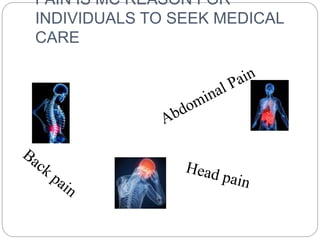
PAIN IS MC REASON FOR
INDIVIDUALS TO SEEK MEDICAL
CARE
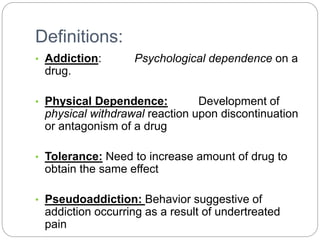
Definitions:
• Addiction: Psychological dependence on a
drug.
• Physical Dependence: Development of
physical withdrawal reaction upon discontinuation
or antagonism of a drug
• Tolerance: Need to increase amount of drug to
obtain the same effect
• Pseudoaddiction: Behavior suggestive of
addiction occurring as a result of undertreated
pain
Pain can be assoc w/:
 Psychologic and physical disability
 a source of individual suffering
 Familial distress
Pain in nursing home patients
• 30% reported daily pain
• 26% of these patients received no analgesia
• Only 26% of them received strong opioids
 What predicted inadequate pain management?
1 Advanced age: >85 years old
2 Poor cognitive function
3 Minority status
 Bernabei (1998), N = 13,625 cancer patients
Obstacles of geriatric pain
management:
1. Accessibility to treatment
2. $$$
3. SEs
4. Comorbidities
 Ex- NSAID use in pt w/ HTN or heart disease
 Ex- Acetominophen use in Liver dz pt
5. Interactions with the current meds
6. Pts with cognitive impairments
7. The assumption that pain is normal party of
aging
8. Practitioner’s bias (pain seeker..)
9. fear of legal repercussions…
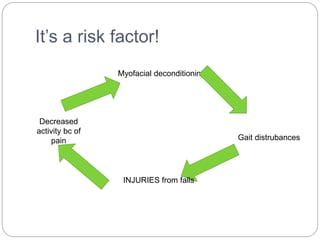
It’s a risk factor!
Decreased
activity bc of
pain
Myofacial deconditioning
Gait distrubances
INJURIES from falls
Types of pain:
 Nociceptive pain- Nerves responding appropriately
to a painful stimulus
 Neuropathic pain- results from NS dysfunction,
and may originate
centrally or peripherally
 Somatic pain- originates in the skin, bones, myo,
and connective tissue, and
usually is located
specifically.
 Visceral pain- originated in internal body
structures and organs, and is
located more
genearlly.
Neuropathic pain:
• Origin:
 Nerve damage
• Palliates/potentiates:
 Set off by unusual stimuli, light touch, wind on skin,
shaving (trigeminal neuralgia)
• Quality:
 Electric, burning, tingling, pins & needles, shooting
(system isn’t working right)
• Radiation:
 Nerve-related pattern
Nociceptive Pain:
• Origin:
 Tissue damage
• Palliates/potentiates:
 Worse with stress, pressure
 Responds better to opioids, NSAIDs
• Quality:
 Sharp, dull, stabbing, pressure, ache, throbbing
• Radiation:
 Occasionally radiates (less well-defined), but not
along an obvious nerve distribution
Easier to treat than
Neuropathic!!
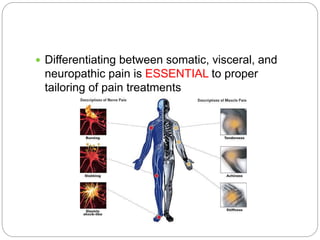
 Differentiating between somatic, visceral, and
neuropathic pain is ESSENTIAL to proper
tailoring of pain treatments
Specific Goals:
 1- determining the presence and cause of pain
 2- identifying exacerbaing comorbidities
 3- reviewing beliefs, attitudes and expectations
regarding pain
 Overall: to decrease pain and increase
function and quality of life!
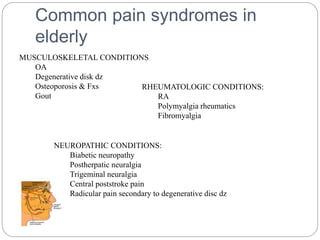
Common pain syndromes in
elderly
MUSCULOSKELETAL CONDITIONS
OA
Degenerative disk dz
Osteoporosis & Fxs
Gout
NEUROPATHIC CONDITIONS:
Biabetic neuropathy
Postherpatic neuralgia
Trigeminal neuralgia
Central poststroke pain
Radicular pain secondary to degenerative disc dz
RHEUMATOLOGIC CONDITIONS:
RA
Polymyalgia rheumatics
Fibromyalgia
Aging takes a toll…
 In the PNS:
 Loss of myelinated and unmyelinated fibers
 Axonal atrophy common
 Nerve conduction and endoneural blood flow are
reduced w/ age
 Less nerve regeneration observed
 progressive loss of serotonergic and noradrenergic
neurons in the superficial lamina of the spinal dorsal
horn, and bc serotonin and norepineph have
important roles in the descending inhibitory control
pathways, such a loss may upset the natural
endogenous pain-suppressing mechanisms.
 Therefore, pain treatment of the elderly obviously
differs from that of young patients!
Models of the prevalence of pain
 1- Pain increases with age and then decreases at older ages
(ie, 70 and beond). They suppose that this pain typically has a
mechanical etiologic component and possibly is assoc with the
occupational envioroment
 2- pain increases with age. This has a mechanical etilogic
component but also an assoc with increasing prevalence of
degenerative dz, particulary at older ages.
 3- age-independent pain that (obviously) lacks a mechanical
etiologic component. (ie- risk factors that are constant
throughout the life course)
 4- A decrease in pain prevalence at older ages. It is not clear
whether the trajectory is caused by age-related changes in pain
and pain perception, or by changes in pain reportin.
Effect of age on human (via clinical
observation):
 Clinical observation examples:
 increased incidence of silent MI in elderly patients
 atypical presntation of an inflamed appendix,
(absence of RLQ pain)
 Study example: (pg 208)
 Yunis compared elderly and young patients with
fibromyalgia. They found that chronic head aches,
anxiety, tension, mental stress and poor sleep were all
less common in the elderly patients w this condition.
Lonliness and pain
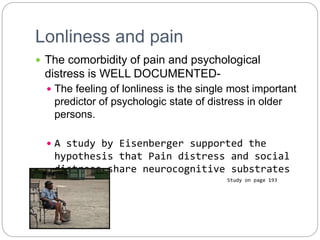
 The comorbidity of pain and psychological
distress is WELL DOCUMENTED-
 The feeling of lonliness is the single most important
predictor of psychologic state of distress in older
persons.
 A study by Eisenberger supported the
hypothesis that Pain distress and social
distress share neurocognitive substrates
Study on page 193
Sleep and pain
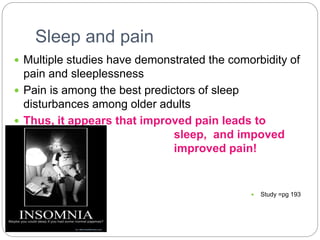
 Multiple studies have demonstrated the comorbidity of
pain and sleeplessness
 Pain is among the best predictors of sleep
disturbances among older adults
 Thus, it appears that improved pain leads to
improved sleep, and impoved
sleep leads to improved pain!
 Study =pg 193
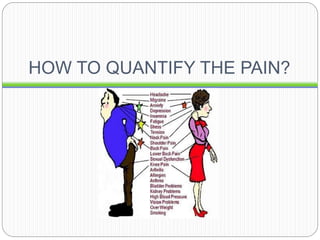
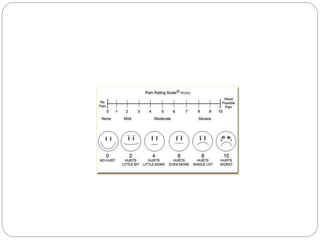
HOW TO QUANTIFY THE PAIN?
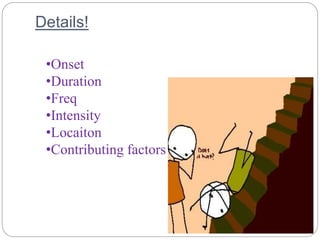
Details!
•Onset
•Duration
•Freq
•Intensity
•Locaiton
•Contributing factors
Troubleshooting pain
assessment:
 Demented/Confused patient:
 Have to look for:
Agitation, agressiveness, etc.
Pain control vs quality of life
 OVERALL GOAL:
 to abolish pain with minimal adverse effects.
 Ex- Patient with COPD and pain:
o Cant treat their pain too vigorously bc we will
exacerbate the COPD symptoms
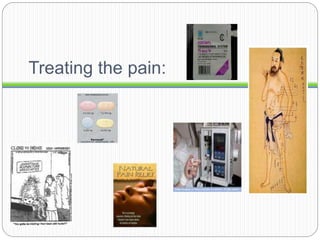
Treating the pain:
Pharmacologic approaches:
 Opiods
 Anti-inflammatory agents (asa, NSAIDS,
cyclooxygenase [COX-2] inhinitors, steroids)
 Acetaminophen
 Tramadol
 Myo relaxants
 Tricyclic antidepressants
 SRIs
 Antielileptic drugs (AEDs)
Non-pharmocologic approaches:
Behavioral therapy
Spiritual counseling
Physical therapy
Psychotherapy
Splinting
Surgical correction
Cold packs
Meditation
Support groups
Radiation therapy
Acupuncture
Hypnosis
Cultural healing
rituals
Heat packs
Prayer
Community
resources
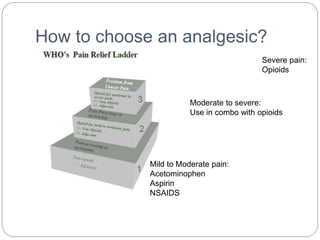
How to choose an analgesic?
Mild to Moderate pain:
Acetominophen
Aspirin
NSAIDS
Moderate to severe:
Use in combo with opioids
Severe pain:
Opioids
Drug Classes
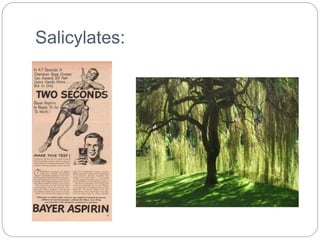
Salicylates:
Salicylates
 Analgesic, antipyretic, anti-inflammatory and anti-rheumatic
activity.
 MOA:
 Inhibits prostaglandin synthesis producing analgesic.
 antiplatelet effect by inhibiting the production of thromboxane
 Much higher levels needed for anti-inflammatory effect than for anti-
platelet, anti-pyretic and analgesic effects.
 Metab: Gut & plasma (ASA); liver (salicylate) CYP450
 Excrition: renal
 Can cause: GI irritation and bleeding.
 Use w caution in ppl with hx of gastric or peptic ulcercs.
Acetominophen
 analgesic and antipyretic agent
 MOA:
 Inhibits central prostaglandin synthesis with minimal inhibition of
peripheral prostaglandin synthesis
 Antipyretic effect by direct action on the hypothalamic heat-regulating
center
 Benefits:
 Absorbed rapidly
 No gastric mucosa effects
 No effect on platelet aggregation
 Metab by liver
 Excretion: urine (metabolites can accumulate w renal impairment)
 Hepatotoxic Can take 500-1000mg orally q 6hr
Older pts and Pts with liver dz: do not exceed 2g/
NSAIDS
 Antipyretic, analgesic and anti-inflammatory
properties
 MOA:
 Reduce central and peripheral prostaglandin synthesis but
they do not inhibit the effects of the prostaglandins
already present, resulting in analgesia, followed by
relatively delayed anti-inflammatory effects.
 Metab: liver
 Excretion: urine
 Adverse effects:
 n/v, bleeding
 Hepato and nephrotoxicity
1.5 times higher risk of GI bleeding
(more so in the elderly)
Concurrent use of PPI for
prevention
NSAID: 18 available in the US
 All NSAIDS have similar mechanism of action BUT
differ in:
 Potencies
 Time to onset
 Duration
 Response among patients
 Common uses:
 After surgeries
 Painful chronic conditions (ex- OA)
 Benefit more notable when used in combo w an
opiod.
 Opiod SEs like sedation, n/v decreased when used w
NSAID
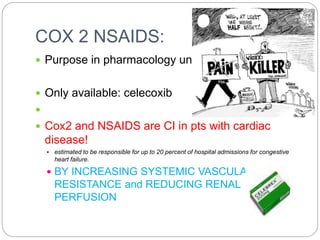
COX 2 NSAIDS:
 Purpose in pharmacology unclear
 Only available: celecoxib

 Cox2 and NSAIDS are CI in pts with cardiac
disease!
 estimated to be responsible for up to 20 percent of hospital admissions for congestive
heart failure.
 BY INCREASING SYSTEMIC VASCULAR
RESISTANCE and REDUCING RENAL
PERFUSION
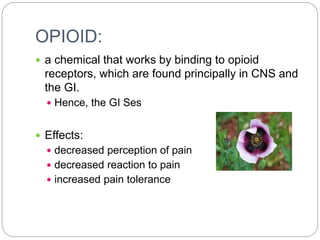
OPIOID:
 a chemical that works by binding to opioid
receptors, which are found principally in CNS and
the GI.
 Hence, the GI Ses
 Effects:
 decreased perception of pain
 decreased reaction to pain
 increased pain tolerance
Opioids
 Cornerstone of the analgesic regimen for mod-
sev pain
• MC ones:
• Morphine
• Oxycodone
• Hydromorphone
• Transdermal fentanyl
3 Main Opioid receptors:
 Mu, delta and kappa receptors.
 Mu agonists: produce analgesia
affect numerous body systems
influence mood & reward behavior
 Delta agonists produce analgesia
not a lot on market
 Kappa agonists produce analgesia
may cause less resp depression and miosis
psych effects, can produce dysphoria
 Opioids LACK the adverse renal, and
hematologic effects of NSAIDs
 MU-receptor agonists are MC used
 although drugs may interact with more than one
type of receptor.
 Ex- the mu receptor antagonist and kappa
receptor agonist drugs were deigned to cause
less respiratory depression.
Opioids pharmacokinetics
 Pharmacokinetic properties of an opioid can dictate the
circumstance which they are appropriate in:
Ex- Lipid-soluble drug such as fentanyl, which diffuse rapidly acros the BBB,
are preferable if analgesia is required immediately before a short, painful
procedure.
 Elimination half life very short:
 So, steady state reached in a day or less!
 Thus, you can adjust the dose daily knowing we are
seeing it’s effect.
Adverse effects:
 Respiratory depression
 sedation
 N/V
 Constipation
 Urinary retention
 Itching
1. Respiratory depression
 Caused by directly acting on respiratory center
 Naloxone is specifically used to counteract life-
threatening depression of the central nervous system
and respiratory system
 Therapeutic doses of morphine can affect:
 Resp rate, minute volume tidal exchange
 Although, tolerance to this effect is usually
achieved with repeated doses of opioids.
 Avoid/Monitor in pts with:
 Imparied resp function
 Sleep apnea
 Or bronchial asthma
Not common if begin
with low dose and
titrate upward!!
2. Nausea and vomiting
 MC SE
 Likely due to changing blood serum levels , not
problem @ steady state
 The freq of nausea and vomiting is higher in
ambulaory patients (vestibular component?)
 Antiemetics (metoclopramide or droperidol) can
be used along with the opioid.
3. Constipation:
 Acts on receoptors of GI tract and spinal cord
 to produce decrease in peristalsis and intestinal
secretions
 Tolerance to this effect is not common-
 Result- prescribe prophylactic laxatives
 … use stood softener AND a stimulant laxative.
4. Urinary retention
 causes increased smooth muscle tone
 increases sphincter tone
5. Itching
 Mechanism not fully known~
 Hypot: related to the release of histamine from mast
cells.
 If itching is with rash- consider allergy.
 Can use an antihistamine to treat this
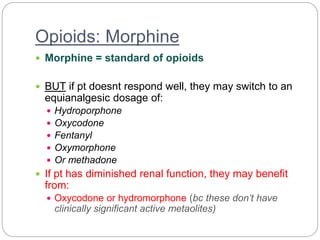
Opioids: Morphine
 Morphine = standard of opioids
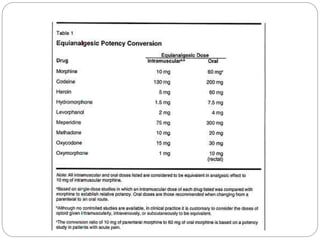
 BUT if pt doesnt respond well, they may switch to an
equianalgesic dosage of:
 Hydroporphone
 Oxycodone
 Fentanyl
 Oxymorphone
 Or methadone
 If pt has diminished renal function, they may benefit
from:
 Oxycodone or hydromorphone (bc these don’t have
clinically significant active metaolites)
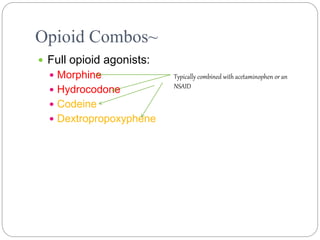
Opioid Combos~
 Full opioid agonists:
 Morphine
 Hydrocodone
 Codeine
 Dextropropoxyphene
Typically combined with acetaminophen or an
NSAID
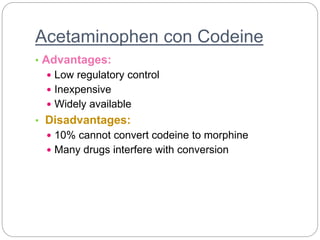
Acetaminophen con Codeine
• Advantages:
 Low regulatory control
 Inexpensive
 Widely available
• Disadvantages:
 10% cannot convert codeine to morphine
 Many drugs interfere with conversion
Acetaminophen with Oxycodone,
Hydrocodone
• Oxycodone combination contains 325 mg
acetaminophen
• Hydrocodone combination contains 500 mg
acetaminophen
• No clear advantage between the two
Three mu=receptor agonist to avoid
whenever possible!! ..
1. Meperidine
2. Propoxyphene
3. codeine
1.Meperidine (DEMEROL)
 Low potency relative to morphine
 A short duration of action – so have to dose it
more frequently
 And a toxic metabolite (normeperidine)
 Ex- meperidine 75mg = 5-7.5 mg of morphine
 can cause irritability and seizures
2. Propoxyphene (DARVOCET)
 treat mild to mod pain
1. Toxicities assoc with it’s primary metabolite:
norpropoxyphene
 can cause cardiotoxicity and pulmonary edema
2. Half life: 6-12 hour;Metabolite half life 30-36 hours
 Pts with Dec Renal function or pts getting repeat
doses: higher risk
3. Puts geriatric pts at higher risks of falls (d/t CNS
effects)
1. [study found that propoxy users have twofold higher risk for hip frature compared with
nonusers of analgesics]
4. ALSO, it has no clinical advantage over nonopioid
PG 289
3. Codeine
 Must be converted to morphine by means of the
cytochrome P-450 pathway to provide analgesia.
 Lots of Caucasians are poor metabolizers of this
isoenzyme -thus cant make the conversion!
 So, they do not get any of the codeine’s benefit
but still suffer the Side effects.
Principles of opioid use:
1. No ceiling effect
2. Dose to pain relief without side effects
3. Give orally when possible
4. Sub-cutaneous administration is basically
equivalent to intravenous (and preferable)
5. Treat constipation prophylactically
6. Full opioid agonists are best choice for severe
pain..
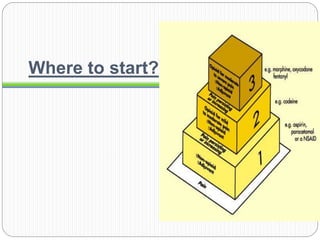
Where to start?
Treating Chronic pain:
Basal pain medicine plus a different therapy for
spikes:
 Predictable spikes - Short-acting agent prior to
event
 Unpredictable spikes - Short-acting agent readily
available (prn)
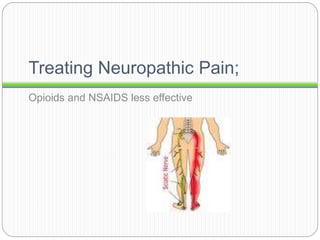
Treating Neuropathic Pain;
Opioids and NSAIDS less effective
Classes of Agents
1. Tricyclic for dysesthetic pain
2. Anticonvulsants for shooting pain
3. Steroids to decrease peri-tumor edema
Tricyclic for dysesthetic pain
 Dysesthesia is pain not experienced by a normal
nervous system.
 Eg- neuropathic burning from chemotherapy
 Considered "Dante-esque" pain.
• Amitriptyline
• Nortriptyline
• Desipramine
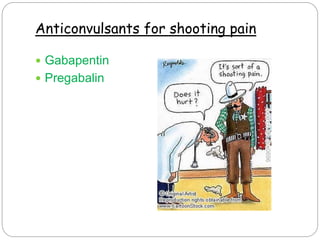
Anticonvulsants for shooting pain
 Gabapentin
 Pregabalin
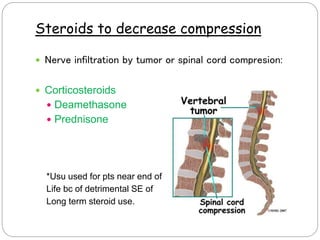
Steroids to decrease compression
 Nerve infiltration by tumor or spinal cord compresion:
 Corticosteroids
 Deamethasone
 Prednisone
*Usu used for pts near end of
Life bc of detrimental SE of
Long term steroid use.
Opioid analgesics available in US
 Mu agonists
 Alfentanil
 Codeine
 Hydrocodone
 Ydromorphone
 Fentanyl
 Levorphanol
 Meperidine
 Methadone
 Morphine
 Opium
 Oxycodone
 Oxymorphone
 Remifentanil
 Sufentanil
 Tramadol
 Kappa agonist/mu
antagonist
 Butorphanol
 Nalbuphine
 Pentazocine
 Mu antagonists
 Nalmefene
 Naloxone
 Naltrexone
 Mu partial agonist/kappa
antagonist
 Buprenorphine
When to refer:
 Pain not respsoning to opoiods at typical doses
 Neuropathic pain not responding to first line
treatments
 Comples methadone management issues
 Intolerable side effects from oral opioids
 Severe pain from bone mets
 For a surgical or anesthesia-based procedure,
intrathecal pump, nerve block, or rhizotomy
When to admit:
 For severe exacerbation of pain that is not
responsive to previous stable oral opioid around-
the-clock plus breakthrough doses.
 Pateints whose pain is so severe that they
cannont be cased for at home
 Uncontrollable side effects from opioids, including
nausea, vomiting, and altered mental status
Good to know..
 Older individuals tend to be more sensitive to
benzodiazepines and opiods.
 Pain from bone mets more susceptible to NSAID
pain relief than opioids
 The 1998 guidelines recommended earlier use of
narcotics than is typical for treatment of younger
patients because of the significant toxicities assoc
with NSAIDS.
Trigeminal neuralgia
 Characterized by: severe, unilateral facial pain
described as lancinating electrics shock-like jolts
in one or more distributions of the trigeminal
nerve.
 Maxillary and Mandibular divisions = MC
 Careful clinical evaluation and MRI is
recommended
Postherpetic neuralgia
 Follows outbreak of Herpes zoster
 Sensory findings:
 Allodynia (wind against skin hurts, sheet on area
hurts etc) hyperalgesia
Post stroke pain
 An underrecognized consequence following
storke
 May present as shoulder pain in the paretic limb
or present as central poststroke pain.
 Characterized as pain that is severe and
persistnet w accompanying sensory abmomalities
 Ex- the guy from Oceanside.
Metastatic bone pain
 Bone pain that is worse at night, when laying
down or not assoc with acute injury
 Pain that gradually but rapidly increase in
intensity or with weight-bearking or activity.
 Freq sites:
 Hips, vertebrae, femur, ribs, and skull
Temporal Arteritis:
 More than 95% of TA are ppl >50
 Presentation:
 New onset headache, malaise, scalp tenderness
and jaw claudication
 PE: indurated temporal arterly that is tender with a
diminihed or abent pulse
 Irreversible bliness is consequence of untreted..
So timely assesment and tx is
Pain perception in rats:
 When nociception is tested in mice using an
electrical current, it seems that there are age
related changes in nociception .
 The graphic representaion of electical thresholds
needed to induce a vocal reponse was of a U-
shap pattern. (high pain tolerance in young and
old- lower in the middle aged)
Effect of age on human experimental
pain
 50 studies total
 21 concluded an increase in pain threshold with
advancing age
 3 reporeted a decrease
 17 noted no change
 However,
 Temporal vs Spatial summation:
 It was fround that temopral summation to a heat pain
stimulus, for example, is more pronounced in the elderly
as compared with younger subjects. Whereas spatial
summation is not significantly influenced by age.

lower, upper and middlepain-management-2010.ppt

  • 1.
    Ali R. Rahimi,MD,FACP,AGSF Professorof Medicine Mercer University School of Medicine Clinical Professor University of Georgia School of Pharmacy Pain Management in the Geriatric Population
  • 2.
    Pain:  Webster:  a: usu. localized physical suffering associated with a bodily disorder; also : a basic bodily sensation induced by a noxious stimulus, received by naked nerve endings, characterized by physical discomfort (as pricking, throbbing, or aching), and typically leading to evasive action  b : acute mental or emotional distress or suffering  Urandictionary.com:  What happens when you reach into the blender to dislodge a stuck icecube without unplugging it first.
  • 3.
    Pain & elderly Pain is what many people say they fear most about dying.  Pain is undertreated at the end of life  Older patients are likely to have a increased pain threshold but to be less toleant to severe pain.
  • 4.
    PAIN IS MCREASON FOR INDIVIDUALS TO SEEK MEDICAL CARE
  • 5.
    Definitions: • Addiction: Psychologicaldependence on a drug. • Physical Dependence: Development of physical withdrawal reaction upon discontinuation or antagonism of a drug • Tolerance: Need to increase amount of drug to obtain the same effect • Pseudoaddiction: Behavior suggestive of addiction occurring as a result of undertreated pain
  • 6.
    Pain can beassoc w/:  Psychologic and physical disability  a source of individual suffering  Familial distress
  • 7.
    Pain in nursinghome patients • 30% reported daily pain • 26% of these patients received no analgesia • Only 26% of them received strong opioids  What predicted inadequate pain management? 1 Advanced age: >85 years old 2 Poor cognitive function 3 Minority status  Bernabei (1998), N = 13,625 cancer patients
  • 8.
    Obstacles of geriatricpain management: 1. Accessibility to treatment 2. $$$ 3. SEs 4. Comorbidities  Ex- NSAID use in pt w/ HTN or heart disease  Ex- Acetominophen use in Liver dz pt 5. Interactions with the current meds 6. Pts with cognitive impairments 7. The assumption that pain is normal party of aging 8. Practitioner’s bias (pain seeker..) 9. fear of legal repercussions…
  • 9.
    It’s a riskfactor! Decreased activity bc of pain Myofacial deconditioning Gait distrubances INJURIES from falls
  • 10.
    Types of pain: Nociceptive pain- Nerves responding appropriately to a painful stimulus  Neuropathic pain- results from NS dysfunction, and may originate centrally or peripherally  Somatic pain- originates in the skin, bones, myo, and connective tissue, and usually is located specifically.  Visceral pain- originated in internal body structures and organs, and is located more genearlly.
  • 11.
    Neuropathic pain: • Origin: Nerve damage • Palliates/potentiates:  Set off by unusual stimuli, light touch, wind on skin, shaving (trigeminal neuralgia) • Quality:  Electric, burning, tingling, pins & needles, shooting (system isn’t working right) • Radiation:  Nerve-related pattern
  • 12.
    Nociceptive Pain: • Origin: Tissue damage • Palliates/potentiates:  Worse with stress, pressure  Responds better to opioids, NSAIDs • Quality:  Sharp, dull, stabbing, pressure, ache, throbbing • Radiation:  Occasionally radiates (less well-defined), but not along an obvious nerve distribution Easier to treat than Neuropathic!!
  • 13.
     Differentiating betweensomatic, visceral, and neuropathic pain is ESSENTIAL to proper tailoring of pain treatments
  • 14.
    Specific Goals:  1-determining the presence and cause of pain  2- identifying exacerbaing comorbidities  3- reviewing beliefs, attitudes and expectations regarding pain  Overall: to decrease pain and increase function and quality of life!
  • 15.
    Common pain syndromesin elderly MUSCULOSKELETAL CONDITIONS OA Degenerative disk dz Osteoporosis & Fxs Gout NEUROPATHIC CONDITIONS: Biabetic neuropathy Postherpatic neuralgia Trigeminal neuralgia Central poststroke pain Radicular pain secondary to degenerative disc dz RHEUMATOLOGIC CONDITIONS: RA Polymyalgia rheumatics Fibromyalgia
  • 16.
    Aging takes atoll…  In the PNS:  Loss of myelinated and unmyelinated fibers  Axonal atrophy common  Nerve conduction and endoneural blood flow are reduced w/ age  Less nerve regeneration observed  progressive loss of serotonergic and noradrenergic neurons in the superficial lamina of the spinal dorsal horn, and bc serotonin and norepineph have important roles in the descending inhibitory control pathways, such a loss may upset the natural endogenous pain-suppressing mechanisms.  Therefore, pain treatment of the elderly obviously differs from that of young patients!
  • 17.
    Models of theprevalence of pain  1- Pain increases with age and then decreases at older ages (ie, 70 and beond). They suppose that this pain typically has a mechanical etiologic component and possibly is assoc with the occupational envioroment  2- pain increases with age. This has a mechanical etilogic component but also an assoc with increasing prevalence of degenerative dz, particulary at older ages.  3- age-independent pain that (obviously) lacks a mechanical etiologic component. (ie- risk factors that are constant throughout the life course)  4- A decrease in pain prevalence at older ages. It is not clear whether the trajectory is caused by age-related changes in pain and pain perception, or by changes in pain reportin.
  • 18.
    Effect of ageon human (via clinical observation):  Clinical observation examples:  increased incidence of silent MI in elderly patients  atypical presntation of an inflamed appendix, (absence of RLQ pain)  Study example: (pg 208)  Yunis compared elderly and young patients with fibromyalgia. They found that chronic head aches, anxiety, tension, mental stress and poor sleep were all less common in the elderly patients w this condition.
  • 19.
    Lonliness and pain The comorbidity of pain and psychological distress is WELL DOCUMENTED-  The feeling of lonliness is the single most important predictor of psychologic state of distress in older persons.  A study by Eisenberger supported the hypothesis that Pain distress and social distress share neurocognitive substrates Study on page 193
  • 20.
    Sleep and pain Multiple studies have demonstrated the comorbidity of pain and sleeplessness  Pain is among the best predictors of sleep disturbances among older adults  Thus, it appears that improved pain leads to improved sleep, and impoved sleep leads to improved pain!  Study =pg 193
  • 21.
    HOW TO QUANTIFYTHE PAIN?
  • 22.
  • 23.
    Troubleshooting pain assessment:  Demented/Confusedpatient:  Have to look for: Agitation, agressiveness, etc.
  • 24.
    Pain control vsquality of life  OVERALL GOAL:  to abolish pain with minimal adverse effects.  Ex- Patient with COPD and pain: o Cant treat their pain too vigorously bc we will exacerbate the COPD symptoms
  • 25.
  • 26.
    Pharmacologic approaches:  Opiods Anti-inflammatory agents (asa, NSAIDS, cyclooxygenase [COX-2] inhinitors, steroids)  Acetaminophen  Tramadol  Myo relaxants  Tricyclic antidepressants  SRIs  Antielileptic drugs (AEDs)
  • 27.
    Non-pharmocologic approaches: Behavioral therapy Spiritualcounseling Physical therapy Psychotherapy Splinting Surgical correction Cold packs Meditation Support groups Radiation therapy Acupuncture Hypnosis Cultural healing rituals Heat packs Prayer Community resources
  • 28.
    How to choosean analgesic? Mild to Moderate pain: Acetominophen Aspirin NSAIDS Moderate to severe: Use in combo with opioids Severe pain: Opioids
  • 29.
  • 30.
  • 31.
    Salicylates  Analgesic, antipyretic,anti-inflammatory and anti-rheumatic activity.  MOA:  Inhibits prostaglandin synthesis producing analgesic.  antiplatelet effect by inhibiting the production of thromboxane  Much higher levels needed for anti-inflammatory effect than for anti- platelet, anti-pyretic and analgesic effects.  Metab: Gut & plasma (ASA); liver (salicylate) CYP450  Excrition: renal  Can cause: GI irritation and bleeding.  Use w caution in ppl with hx of gastric or peptic ulcercs.
  • 32.
    Acetominophen  analgesic andantipyretic agent  MOA:  Inhibits central prostaglandin synthesis with minimal inhibition of peripheral prostaglandin synthesis  Antipyretic effect by direct action on the hypothalamic heat-regulating center  Benefits:  Absorbed rapidly  No gastric mucosa effects  No effect on platelet aggregation  Metab by liver  Excretion: urine (metabolites can accumulate w renal impairment)  Hepatotoxic Can take 500-1000mg orally q 6hr Older pts and Pts with liver dz: do not exceed 2g/
  • 33.
    NSAIDS  Antipyretic, analgesicand anti-inflammatory properties  MOA:  Reduce central and peripheral prostaglandin synthesis but they do not inhibit the effects of the prostaglandins already present, resulting in analgesia, followed by relatively delayed anti-inflammatory effects.  Metab: liver  Excretion: urine  Adverse effects:  n/v, bleeding  Hepato and nephrotoxicity 1.5 times higher risk of GI bleeding (more so in the elderly) Concurrent use of PPI for prevention
  • 34.
    NSAID: 18 availablein the US  All NSAIDS have similar mechanism of action BUT differ in:  Potencies  Time to onset  Duration  Response among patients  Common uses:  After surgeries  Painful chronic conditions (ex- OA)  Benefit more notable when used in combo w an opiod.  Opiod SEs like sedation, n/v decreased when used w NSAID
  • 35.
    COX 2 NSAIDS: Purpose in pharmacology unclear  Only available: celecoxib   Cox2 and NSAIDS are CI in pts with cardiac disease!  estimated to be responsible for up to 20 percent of hospital admissions for congestive heart failure.  BY INCREASING SYSTEMIC VASCULAR RESISTANCE and REDUCING RENAL PERFUSION
  • 36.
    OPIOID:  a chemicalthat works by binding to opioid receptors, which are found principally in CNS and the GI.  Hence, the GI Ses  Effects:  decreased perception of pain  decreased reaction to pain  increased pain tolerance
  • 37.
    Opioids  Cornerstone ofthe analgesic regimen for mod- sev pain • MC ones: • Morphine • Oxycodone • Hydromorphone • Transdermal fentanyl
  • 38.
    3 Main Opioidreceptors:  Mu, delta and kappa receptors.  Mu agonists: produce analgesia affect numerous body systems influence mood & reward behavior  Delta agonists produce analgesia not a lot on market  Kappa agonists produce analgesia may cause less resp depression and miosis psych effects, can produce dysphoria  Opioids LACK the adverse renal, and hematologic effects of NSAIDs
  • 39.
     MU-receptor agonistsare MC used  although drugs may interact with more than one type of receptor.  Ex- the mu receptor antagonist and kappa receptor agonist drugs were deigned to cause less respiratory depression.
  • 40.
    Opioids pharmacokinetics  Pharmacokineticproperties of an opioid can dictate the circumstance which they are appropriate in: Ex- Lipid-soluble drug such as fentanyl, which diffuse rapidly acros the BBB, are preferable if analgesia is required immediately before a short, painful procedure.  Elimination half life very short:  So, steady state reached in a day or less!  Thus, you can adjust the dose daily knowing we are seeing it’s effect.
  • 41.
    Adverse effects:  Respiratorydepression  sedation  N/V  Constipation  Urinary retention  Itching
  • 42.
    1. Respiratory depression Caused by directly acting on respiratory center  Naloxone is specifically used to counteract life- threatening depression of the central nervous system and respiratory system  Therapeutic doses of morphine can affect:  Resp rate, minute volume tidal exchange  Although, tolerance to this effect is usually achieved with repeated doses of opioids.  Avoid/Monitor in pts with:  Imparied resp function  Sleep apnea  Or bronchial asthma Not common if begin with low dose and titrate upward!!
  • 43.
    2. Nausea andvomiting  MC SE  Likely due to changing blood serum levels , not problem @ steady state  The freq of nausea and vomiting is higher in ambulaory patients (vestibular component?)  Antiemetics (metoclopramide or droperidol) can be used along with the opioid.
  • 44.
    3. Constipation:  Actson receoptors of GI tract and spinal cord  to produce decrease in peristalsis and intestinal secretions  Tolerance to this effect is not common-  Result- prescribe prophylactic laxatives  … use stood softener AND a stimulant laxative.
  • 45.
    4. Urinary retention causes increased smooth muscle tone  increases sphincter tone
  • 46.
    5. Itching  Mechanismnot fully known~  Hypot: related to the release of histamine from mast cells.  If itching is with rash- consider allergy.  Can use an antihistamine to treat this
  • 47.
    Opioids: Morphine  Morphine= standard of opioids  BUT if pt doesnt respond well, they may switch to an equianalgesic dosage of:  Hydroporphone  Oxycodone  Fentanyl  Oxymorphone  Or methadone  If pt has diminished renal function, they may benefit from:  Oxycodone or hydromorphone (bc these don’t have clinically significant active metaolites)
  • 49.
    Opioid Combos~  Fullopioid agonists:  Morphine  Hydrocodone  Codeine  Dextropropoxyphene Typically combined with acetaminophen or an NSAID
  • 50.
    Acetaminophen con Codeine •Advantages:  Low regulatory control  Inexpensive  Widely available • Disadvantages:  10% cannot convert codeine to morphine  Many drugs interfere with conversion
  • 51.
    Acetaminophen with Oxycodone, Hydrocodone •Oxycodone combination contains 325 mg acetaminophen • Hydrocodone combination contains 500 mg acetaminophen • No clear advantage between the two
  • 52.
    Three mu=receptor agonistto avoid whenever possible!! .. 1. Meperidine 2. Propoxyphene 3. codeine
  • 53.
    1.Meperidine (DEMEROL)  Lowpotency relative to morphine  A short duration of action – so have to dose it more frequently  And a toxic metabolite (normeperidine)  Ex- meperidine 75mg = 5-7.5 mg of morphine  can cause irritability and seizures
  • 54.
    2. Propoxyphene (DARVOCET) treat mild to mod pain 1. Toxicities assoc with it’s primary metabolite: norpropoxyphene  can cause cardiotoxicity and pulmonary edema 2. Half life: 6-12 hour;Metabolite half life 30-36 hours  Pts with Dec Renal function or pts getting repeat doses: higher risk 3. Puts geriatric pts at higher risks of falls (d/t CNS effects) 1. [study found that propoxy users have twofold higher risk for hip frature compared with nonusers of analgesics] 4. ALSO, it has no clinical advantage over nonopioid PG 289
  • 55.
    3. Codeine  Mustbe converted to morphine by means of the cytochrome P-450 pathway to provide analgesia.  Lots of Caucasians are poor metabolizers of this isoenzyme -thus cant make the conversion!  So, they do not get any of the codeine’s benefit but still suffer the Side effects.
  • 56.
    Principles of opioiduse: 1. No ceiling effect 2. Dose to pain relief without side effects 3. Give orally when possible 4. Sub-cutaneous administration is basically equivalent to intravenous (and preferable) 5. Treat constipation prophylactically 6. Full opioid agonists are best choice for severe pain..
  • 57.
  • 58.
    Treating Chronic pain: Basalpain medicine plus a different therapy for spikes:  Predictable spikes - Short-acting agent prior to event  Unpredictable spikes - Short-acting agent readily available (prn)
  • 60.
    Treating Neuropathic Pain; Opioidsand NSAIDS less effective
  • 61.
    Classes of Agents 1.Tricyclic for dysesthetic pain 2. Anticonvulsants for shooting pain 3. Steroids to decrease peri-tumor edema
  • 62.
    Tricyclic for dysestheticpain  Dysesthesia is pain not experienced by a normal nervous system.  Eg- neuropathic burning from chemotherapy  Considered "Dante-esque" pain. • Amitriptyline • Nortriptyline • Desipramine
  • 63.
    Anticonvulsants for shootingpain  Gabapentin  Pregabalin
  • 64.
    Steroids to decreasecompression  Nerve infiltration by tumor or spinal cord compresion:  Corticosteroids  Deamethasone  Prednisone *Usu used for pts near end of Life bc of detrimental SE of Long term steroid use.
  • 65.
    Opioid analgesics availablein US  Mu agonists  Alfentanil  Codeine  Hydrocodone  Ydromorphone  Fentanyl  Levorphanol  Meperidine  Methadone  Morphine  Opium  Oxycodone  Oxymorphone  Remifentanil  Sufentanil  Tramadol  Kappa agonist/mu antagonist  Butorphanol  Nalbuphine  Pentazocine  Mu antagonists  Nalmefene  Naloxone  Naltrexone  Mu partial agonist/kappa antagonist  Buprenorphine
  • 66.
    When to refer: Pain not respsoning to opoiods at typical doses  Neuropathic pain not responding to first line treatments  Comples methadone management issues  Intolerable side effects from oral opioids  Severe pain from bone mets  For a surgical or anesthesia-based procedure, intrathecal pump, nerve block, or rhizotomy
  • 67.
    When to admit: For severe exacerbation of pain that is not responsive to previous stable oral opioid around- the-clock plus breakthrough doses.  Pateints whose pain is so severe that they cannont be cased for at home  Uncontrollable side effects from opioids, including nausea, vomiting, and altered mental status
  • 68.
    Good to know.. Older individuals tend to be more sensitive to benzodiazepines and opiods.  Pain from bone mets more susceptible to NSAID pain relief than opioids  The 1998 guidelines recommended earlier use of narcotics than is typical for treatment of younger patients because of the significant toxicities assoc with NSAIDS.
  • 70.
    Trigeminal neuralgia  Characterizedby: severe, unilateral facial pain described as lancinating electrics shock-like jolts in one or more distributions of the trigeminal nerve.  Maxillary and Mandibular divisions = MC  Careful clinical evaluation and MRI is recommended
  • 72.
    Postherpetic neuralgia  Followsoutbreak of Herpes zoster  Sensory findings:  Allodynia (wind against skin hurts, sheet on area hurts etc) hyperalgesia
  • 73.
    Post stroke pain An underrecognized consequence following storke  May present as shoulder pain in the paretic limb or present as central poststroke pain.  Characterized as pain that is severe and persistnet w accompanying sensory abmomalities  Ex- the guy from Oceanside.
  • 74.
    Metastatic bone pain Bone pain that is worse at night, when laying down or not assoc with acute injury  Pain that gradually but rapidly increase in intensity or with weight-bearking or activity.  Freq sites:  Hips, vertebrae, femur, ribs, and skull
  • 75.
    Temporal Arteritis:  Morethan 95% of TA are ppl >50  Presentation:  New onset headache, malaise, scalp tenderness and jaw claudication  PE: indurated temporal arterly that is tender with a diminihed or abent pulse  Irreversible bliness is consequence of untreted.. So timely assesment and tx is
  • 76.
    Pain perception inrats:  When nociception is tested in mice using an electrical current, it seems that there are age related changes in nociception .  The graphic representaion of electical thresholds needed to induce a vocal reponse was of a U- shap pattern. (high pain tolerance in young and old- lower in the middle aged)
  • 77.
    Effect of ageon human experimental pain  50 studies total  21 concluded an increase in pain threshold with advancing age  3 reporeted a decrease  17 noted no change  However,  Temporal vs Spatial summation:  It was fround that temopral summation to a heat pain stimulus, for example, is more pronounced in the elderly as compared with younger subjects. Whereas spatial summation is not significantly influenced by age.

Editor's Notes

  • #3 A subjective, unpleasant, sensory, and emotional experience assoc with actual or potential tissue damage, or described in terms of such damage
  • #5 3 of the 20 most common reasons for outpatient department office visits
  • #8 “AGS reports that 18% of people 65 and over are taking analgesic medications regularty (several times a week), and 63% of those had taken presciption pain medications for more than 6 mo.”
  • #9 although MDs have been successfully sued for undertreatment as well.
  • #11 Central example- phantom pain or post CVA pain
  • #18 There has been research to support all 4 models
  • #21 Pg 193
  • #28 Behavioral includes: biofeedback (BFB), CBT, hypnosis, relaxation techniques, psychoanalytic theray, distration techniques, guided imagery, and progresive myo relaxation CAM: acupuncture, yoga, tai chi, gi gong herbal therapy meditation, music therapy, massage, reiki/therapeutic touch, and prayer.
  • #29 The who’s analgesic stepping laddar.
  • #32 Thromboxane- which under normal circumstances binds platelet molecules together to create a patch over damage of the walls within blood vessels.
  • #33 Not antiinflammatory No adverse effects on gastric mucosa and platelet function like salycylates. Good drug but problem is that ppl overlook the recommended dose limits. And a lot patients take it with their opiod analgesics which contain acetaminophen. Excretion: urine (metabolites can accumulate w renal impairment) Use with caution in ppl with: liver disease, chronic alcoholism, and malnutrition.
  • #36 Other cox 2s were removed from market due to safety questions (bc all others ones were assoc with increased risk of MI)
  • #37 Opium poppy
  • #38 Opioid is prefered name for this class of analgesics bc nartotic is primarily a legal term used to refer to drugs from various pharmacologic clase and is assoc w important psychological barriers to pain management.
  • #42 Itching due to histamine release?
  • #43 Usually, co2 stimulates the central chemoreceptors which tell your body to breath.. BUT OPIOIDS shift the co2 response curve so that the level of co2 needed to stimulate respiration becomes higher. Naoloxone is pretty short acting, so we usually put the patient on a drip.
  • #44 N&V relate more to changing blood serum levels of opioids than the steady state dose
  • #48 e—kwi-en-al-gez-ic
  • #49 The dosages of any full opioid agonist used to control pain can be converted into an equivalent dose of any other opioid. In this way, 24-hours opioid requrements and dosing regimens established using shorter action opioid medicatnions can be translatee into equivalent dosages of longer-acting medicaitons or formulations.
  • #51 Codeine is the pro drug. Gets converted to morpheine
  • #53 mu= most common used
  • #54 Normeperidine can cause irritability and seizures
  • #55 289
  • #57 the dose of opioid is not limited by the toxicities of the acetaminophen, asa, or NSAID component of cobo preparations.
  • #59 Ex- give some med before changing bandage Allow enough time to allow maximal effect (45 minutes for most oral opioids).
  • #62 An example of dysesthetic pain would be? (e.g., neuropathy from chemotherapy) An example of shooting pain? (e.g., spinal compression from tumor)
  • #63 Dante’s inferno The terminology used to describe it is usually interchangeable with descriptions of Hell in classic literature.
  • #77 Pg 204
  • #78 Pg 206 temporal vs summative??