PYTHON
SESSION: CONTROL STRUCTURES IN PYTHON
PREPARED BY:
Anub A
CONTENTS
REVIEW OF LAST CLASS
CONDITIONAL STATEMENTS
ITERATIVE STATEMNETS
CONTROL STRUCTURES
IF , IF ELSE , IF ELIF
IF , IF ELSE , IF ELE IF
Prepared By : Anub A
Review
• Keywords and Identifier
• Python Comments
• Python Variables
• Python Data Types
• Python Type Conversion
• Python I/O and Import
• Python Operators
• Python Namespace
Prepared By : Anub A
CONTROL STRUCTURES
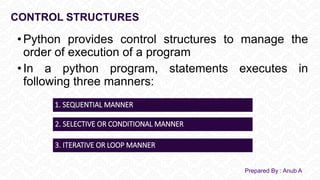
• Python provides control structures to manage the
order of execution of a program
• In a python program, statements executes in
following three manners:
Prepared By : Anub A
1. SEQUENTIAL MANNER
2. SELECTIVE OR CONDITIONAL MANNER
3. ITERATIVE OR LOOP MANNER
SEQUENTIAL MANNER
Prepared By : Anub A
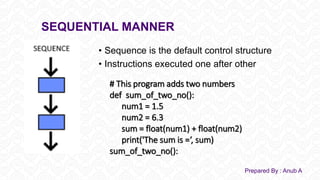
• Sequence is the default control structure
• Instructions executed one after other
# This program adds two numbers
def sum_of_two_no():
num1 = 1.5
num2 = 6.3
sum = float(num1) + float(num2)
print('The sum is =‘, sum)
sum_of_two_no():
SELECTIVE OR CONDITIONAL
Prepared By : Anub A
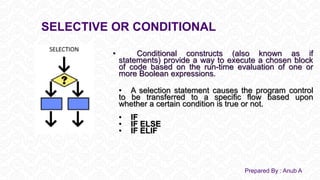
• Conditional constructs (also known as if
statements) provide a way to execute a chosen block
of code based on the run-time evaluation of one or
more Boolean expressions.
• A selection statement causes the program control
to be transferred to a specific flow based upon
whether a certain condition is true or not.
• IF
• IF ELSE
• IF ELIF
Each condition is a Boolean expression, and each body
contains one or more commands that are to be executed
conditionally.
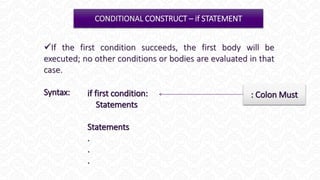
If the first condition succeeds, the first body will be
executed; no other conditions or bodies are evaluated in that
case.
CONSTRUCT – if STATEMENT
if first condition:
Statements
Statements
.
.
.
: Colon Must
If the first condition succeeds, the first body will be
executed; no other conditions or bodies are evaluated in that
case.
Syntax:
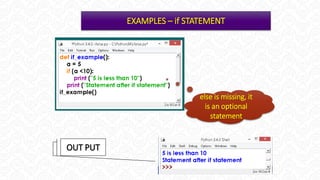
EXAMPLES – if STATEMENT
OUT PUT
else is missing, it
is an optional
statement
CONSTRUCT – if else STATEMENT
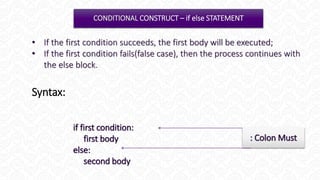
if first condition:
first body
else:
second body
: Colon Must
• If the first condition succeeds, the first body will be executed;
• If the first condition fails(false case), then the process continues with
the else block.
Syntax:
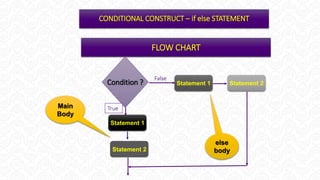
CONDITIONAL CONSTRUCT – if else STATEMENT
FLOW CHART
Condition ? Statement 1 Statement 2
Statement 1
Statement 2
False
True
else
body
Main
Body
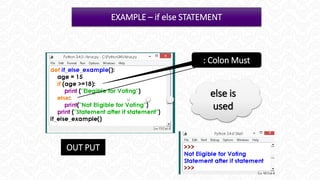
EXAMPLE – if else STATEMENT
OUT PUT
else is
used
: Colon Must
CONDITIONAL CONSTRUCT – if elif STATEMENT
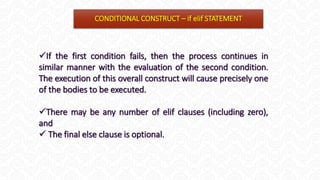
If the first condition fails, then the process continues in
similar manner with the evaluation of the second condition.
The execution of this overall construct will cause precisely one
of the bodies to be executed.
There may be any number of elif clauses (including zero),
and
 The final else clause is optional.
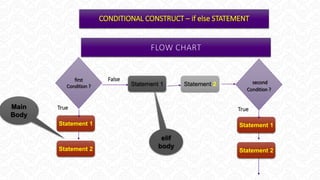
CONDITIONAL CONSTRUCT – if else STATEMENT
second
Condition ?
Statement 1 Statement 2
Statement 1
Statement 2
True
elif
body
Main
Body
first
Condition ?
False
Statement 1
Statement 2
True
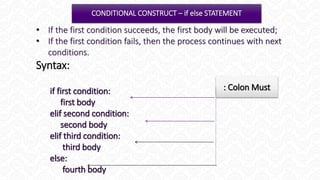
CONDITIONAL CONSTRUCT – if else STATEMENT
if first condition:
first body
elif second condition:
second body
elif third condition:
third body
else:
fourth body
: Colon Must
• If the first condition succeeds, the first body will be executed;
• If the first condition fails, then the process continues with next
conditions.
Syntax:
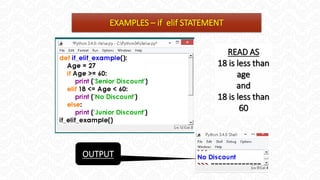
EXAMPLES – if elif STATEMENT
READ AS
18 is less than
age
and
18 is less than
60
OUTPUT
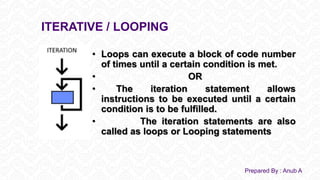
ITERATIVE / LOOPING
Prepared By : Anub A
• Loops can execute a block of code number
of times until a certain condition is met.
• OR
• The iteration statement allows
instructions to be executed until a certain
condition is to be fulfilled.
• The iteration statements are also
called as loops or Looping statements
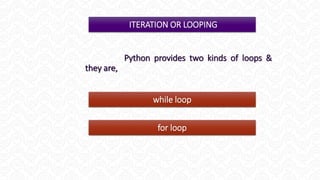
ITERATION OR LOOPING
Python provides two kinds of loops &
they are,
for loop
while loop
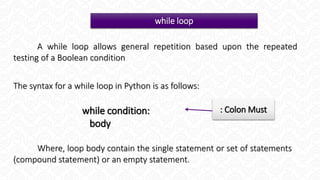
while loop
A while loop allows general repetition based upon the repeated
testing of a Boolean condition
The syntax for a while loop in Python is as follows:
while condition:
body
Where, loop body contain the single statement or set of statements
(compound statement) or an empty statement.
: Colon Must
while loop
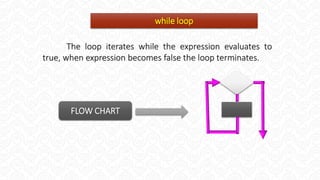
The loop iterates while the expression evaluates to
true, when expression becomes false the loop terminates.
FLOW CHART
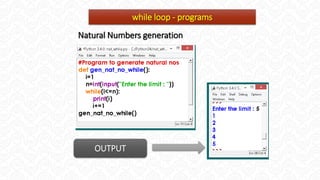
while loop - programs
OUTPUT
Natural Numbers generation
for LOOP
 Python’s for-loop syntax is a more convenient alternative to a
while loop when iterating through a series of elements.
 The for-loop syntax can be used on any type of iterable structure,
such as a list, tuple str, set, dict, or file
Syntax or general format of for loop is,
for element in iterable:
body
for LOOP
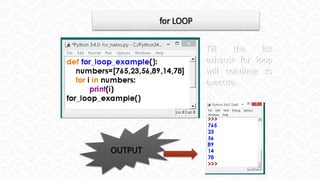
OUTPUT
Till the list
exhaust for loop
will continue to
execute.
for LOOP - range KEYWORD
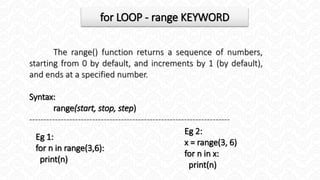
The range() function returns a sequence of numbers,
starting from 0 by default, and increments by 1 (by default),
and ends at a specified number.
Syntax:
range(start, stop, step)
----------------------------------------------------------------------
Eg 1:
for n in range(3,6):
print(n)
Eg 2:
x = range(3, 6)
for n in x:
print(n)
for LOOP - range KEYWORD
OUTPUT
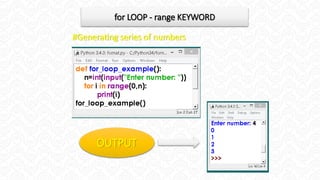
#Generating series of numbers
Q & A
Prepared By : Anub A
ThankYou
Prepared By : Anub A

class interview demo

  • 1.
    PYTHON SESSION: CONTROL STRUCTURESIN PYTHON PREPARED BY: Anub A
  • 2.
    CONTENTS REVIEW OF LASTCLASS CONDITIONAL STATEMENTS ITERATIVE STATEMNETS CONTROL STRUCTURES IF , IF ELSE , IF ELIF IF , IF ELSE , IF ELE IF Prepared By : Anub A
  • 3.
    Review • Keywords andIdentifier • Python Comments • Python Variables • Python Data Types • Python Type Conversion • Python I/O and Import • Python Operators • Python Namespace Prepared By : Anub A
  • 4.
    CONTROL STRUCTURES • Pythonprovides control structures to manage the order of execution of a program • In a python program, statements executes in following three manners: Prepared By : Anub A 1. SEQUENTIAL MANNER 2. SELECTIVE OR CONDITIONAL MANNER 3. ITERATIVE OR LOOP MANNER
  • 5.
    SEQUENTIAL MANNER Prepared By: Anub A • Sequence is the default control structure • Instructions executed one after other # This program adds two numbers def sum_of_two_no(): num1 = 1.5 num2 = 6.3 sum = float(num1) + float(num2) print('The sum is =‘, sum) sum_of_two_no():
  • 6.
    SELECTIVE OR CONDITIONAL PreparedBy : Anub A • Conditional constructs (also known as if statements) provide a way to execute a chosen block of code based on the run-time evaluation of one or more Boolean expressions. • A selection statement causes the program control to be transferred to a specific flow based upon whether a certain condition is true or not. • IF • IF ELSE • IF ELIF
  • 7.
    Each condition isa Boolean expression, and each body contains one or more commands that are to be executed conditionally. If the first condition succeeds, the first body will be executed; no other conditions or bodies are evaluated in that case.
  • 8.
    CONSTRUCT – ifSTATEMENT if first condition: Statements Statements . . . : Colon Must If the first condition succeeds, the first body will be executed; no other conditions or bodies are evaluated in that case. Syntax:
  • 9.
    EXAMPLES – ifSTATEMENT OUT PUT else is missing, it is an optional statement
  • 10.
    CONSTRUCT – ifelse STATEMENT if first condition: first body else: second body : Colon Must • If the first condition succeeds, the first body will be executed; • If the first condition fails(false case), then the process continues with the else block. Syntax:
  • 11.
    CONDITIONAL CONSTRUCT –if else STATEMENT FLOW CHART Condition ? Statement 1 Statement 2 Statement 1 Statement 2 False True else body Main Body
  • 12.
    EXAMPLE – ifelse STATEMENT OUT PUT else is used : Colon Must
  • 13.
    CONDITIONAL CONSTRUCT –if elif STATEMENT If the first condition fails, then the process continues in similar manner with the evaluation of the second condition. The execution of this overall construct will cause precisely one of the bodies to be executed. There may be any number of elif clauses (including zero), and  The final else clause is optional.
  • 14.
    CONDITIONAL CONSTRUCT –if else STATEMENT second Condition ? Statement 1 Statement 2 Statement 1 Statement 2 True elif body Main Body first Condition ? False Statement 1 Statement 2 True
  • 15.
    CONDITIONAL CONSTRUCT –if else STATEMENT if first condition: first body elif second condition: second body elif third condition: third body else: fourth body : Colon Must • If the first condition succeeds, the first body will be executed; • If the first condition fails, then the process continues with next conditions. Syntax:
  • 16.
    EXAMPLES – ifelif STATEMENT READ AS 18 is less than age and 18 is less than 60 OUTPUT
  • 17.
    ITERATIVE / LOOPING PreparedBy : Anub A • Loops can execute a block of code number of times until a certain condition is met. • OR • The iteration statement allows instructions to be executed until a certain condition is to be fulfilled. • The iteration statements are also called as loops or Looping statements
  • 18.
    ITERATION OR LOOPING Pythonprovides two kinds of loops & they are, for loop while loop
  • 19.
    while loop A whileloop allows general repetition based upon the repeated testing of a Boolean condition The syntax for a while loop in Python is as follows: while condition: body Where, loop body contain the single statement or set of statements (compound statement) or an empty statement. : Colon Must
  • 20.
    while loop The loopiterates while the expression evaluates to true, when expression becomes false the loop terminates. FLOW CHART
  • 21.
    while loop -programs OUTPUT Natural Numbers generation
  • 22.
    for LOOP  Python’sfor-loop syntax is a more convenient alternative to a while loop when iterating through a series of elements.  The for-loop syntax can be used on any type of iterable structure, such as a list, tuple str, set, dict, or file Syntax or general format of for loop is, for element in iterable: body
  • 23.
    for LOOP OUTPUT Till thelist exhaust for loop will continue to execute.
  • 24.
    for LOOP -range KEYWORD The range() function returns a sequence of numbers, starting from 0 by default, and increments by 1 (by default), and ends at a specified number. Syntax: range(start, stop, step) ---------------------------------------------------------------------- Eg 1: for n in range(3,6): print(n) Eg 2: x = range(3, 6) for n in x: print(n)
  • 25.
    for LOOP -range KEYWORD OUTPUT #Generating series of numbers
  • 26.
    Q & A PreparedBy : Anub A
  • 27.