CSE 1101- Introduction to Computer
Looking Inside into Computer System
Objectives
A complete computer system
Four phases of the information processing cycle
Four categories of computer hardware
Units of measure for computer memory and storage
Common input and output devices
Storage devices
Two main categories of computer software
Difference between data, information and program
Role of user with PC
A complete computer system
1. Hardware
It refers to the physical and visible components.
2. Software
It is used to control a computer.
3. Data
Any set of characters that is gathered and translated for
some purpose, usually analysis.
4. Users
Differences between Hardware and Software?
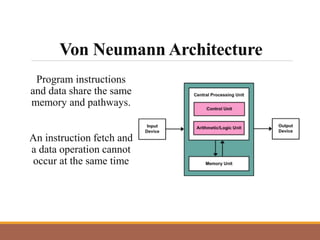
Von Neumann Architecture
Program instructions
and data share the same
memory and pathways.
An instruction fetch and
a data operation cannot
occur at the same time
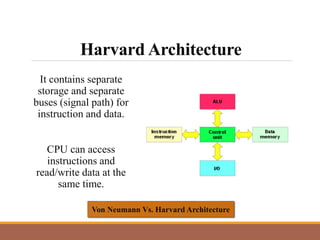
Harvard Architecture
It contains separate
storage and separate
buses (signal path) for
instruction and data.
CPU can access
instructions and
read/write data at the
same time.
Von Neumann Vs. Harvard Architecture
Four phases of the information
processing cycle
1. Input
Computer receives data from input source by user or a program
2. Processing
After receiving data, here the computer performs actions on the data
like mathematical operations or logical comparisons etc. as per being
instructed by user or a program.
3. Output
After processing the data computer has generated information that now
can be sent to output.
4. Storage
After processing the data, computer can also store the data into an
storage device for future use.
Four categories of computer
hardware
1. Input Devices:
For raw data input.
2. Processing Devices:
To process raw data to generate useful information.
3. Output Devices:
To disseminate data and information.
4. Memory/Storage Devices:
Like memory devices but they are different as storage devices
can keep data when the computer is turned off, can be used to store data
both by a program and an user.
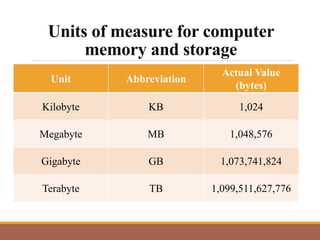
Units of measure for computer
memory and storage
Unit Abbreviation
Actual Value
(bytes)
Kilobyte KB 1,024
Megabyte MB 1,048,576
Gigabyte GB 1,073,741,824
Terabyte TB 1,099,511,627,776
Common input and output devices
Input devices
◦ Keyboard, Mouse, microphone
◦ Trackball, touchpad, joystick
◦ Scanner, digital camera
Output devices
◦ Monitor, printer
◦ Speaker
Both input and output devices
◦ Communication devices e.g. modem
Communication Devices
Networking is the process of connecting one computer to
another.
Modem: A modem converts digital (computer readable) data
to analog signals (e.g., telephone, television) and analog to
digital.
Network interface cards (NICs): Digital-to-digital hardware
components that allow communication and can uniquely
identify the computing device on the network.
Primary Memory
RAM (Random Access Memory)
◦ It is the fastest type of memory.
◦ It is a temporal storage memory. RAM is volatile that only
retains all the data as long as the computer powered.
◦ RAM stores the currently processed data from the CPU and
sends them to the graphics unit.
ROM (Read Only Memory)
◦ “Non-Volatile Memory” that retains data without the flow of
electricity.
◦ ROM comes with pre-written by the computer manufacturer to
hold the instructions for booting-up the computer.
Storage Device
Magnetic storage
• Magnetic disks (Device: removable disk drive)
o E.g. Floppy disks
• Hard disk (device: non removable Hard drive)
Optical storage
• Compact Disk (CD)(device: CD-ROM, CD-RW)
• Digital Video Disk (DVD) (device: DVD players)
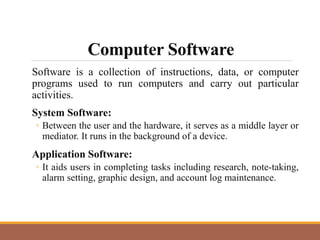
Computer Software
Software is a collection of instructions, data, or computer
programs used to run computers and carry out particular
activities.
System Software:
◦ Between the user and the hardware, it serves as a middle layer or
mediator. It runs in the background of a device.
Application Software:
◦ It aids users in completing tasks including research, note-taking,
alarm setting, graphic design, and account log maintenance.
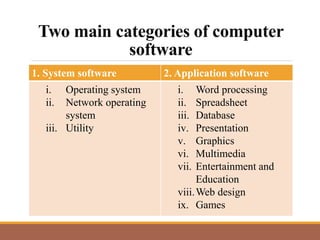
Two main categories of computer
software
1. System software 2. Application software
i. Operating system
ii. Network operating
system
iii. Utility
i. Word processing
ii. Spreadsheet
iii. Database
iv. Presentation
v. Graphics
vi. Multimedia
vii. Entertainment and
Education
viii.Web design
ix. Games
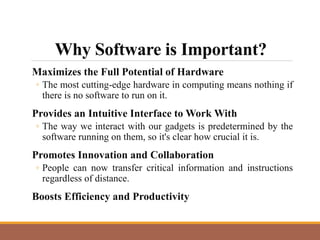
Why Software is Important?
Maximizes the Full Potential of Hardware
◦ The most cutting-edge hardware in computing means nothing if
there is no software to run on it.
Provides an Intuitive Interface to Work With
◦ The way we interact with our gadgets is predetermined by the
software running on them, so it's clear how crucial it is.
Promotes Innovation and Collaboration
◦ People can now transfer critical information and instructions
regardless of distance.
Boosts Efficiency and Productivity
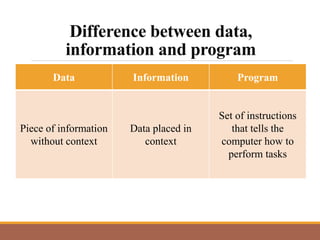
Difference between data,
information and program
Data Information Program
Piece of information
without context
Data placed in
context
Set of instructions
that tells the
computer how to
perform tasks
Role of user with a PC
Setting up the system
Installing Software
Running Program
Managing Files
File hierarchy
File manager
Thank You!!!

Looking inside into computer system

  • 1.
    CSE 1101- Introductionto Computer Looking Inside into Computer System
  • 2.
    Objectives A complete computersystem Four phases of the information processing cycle Four categories of computer hardware Units of measure for computer memory and storage Common input and output devices Storage devices Two main categories of computer software Difference between data, information and program Role of user with PC
  • 3.
    A complete computersystem 1. Hardware It refers to the physical and visible components. 2. Software It is used to control a computer. 3. Data Any set of characters that is gathered and translated for some purpose, usually analysis. 4. Users Differences between Hardware and Software?
  • 4.
    Von Neumann Architecture Programinstructions and data share the same memory and pathways. An instruction fetch and a data operation cannot occur at the same time
  • 5.
    Harvard Architecture It containsseparate storage and separate buses (signal path) for instruction and data. CPU can access instructions and read/write data at the same time. Von Neumann Vs. Harvard Architecture
  • 6.
    Four phases ofthe information processing cycle 1. Input Computer receives data from input source by user or a program 2. Processing After receiving data, here the computer performs actions on the data like mathematical operations or logical comparisons etc. as per being instructed by user or a program. 3. Output After processing the data computer has generated information that now can be sent to output. 4. Storage After processing the data, computer can also store the data into an storage device for future use.
  • 7.
    Four categories ofcomputer hardware 1. Input Devices: For raw data input. 2. Processing Devices: To process raw data to generate useful information. 3. Output Devices: To disseminate data and information. 4. Memory/Storage Devices: Like memory devices but they are different as storage devices can keep data when the computer is turned off, can be used to store data both by a program and an user.
  • 8.
    Units of measurefor computer memory and storage Unit Abbreviation Actual Value (bytes) Kilobyte KB 1,024 Megabyte MB 1,048,576 Gigabyte GB 1,073,741,824 Terabyte TB 1,099,511,627,776
  • 9.
    Common input andoutput devices Input devices ◦ Keyboard, Mouse, microphone ◦ Trackball, touchpad, joystick ◦ Scanner, digital camera Output devices ◦ Monitor, printer ◦ Speaker Both input and output devices ◦ Communication devices e.g. modem
  • 10.
    Communication Devices Networking isthe process of connecting one computer to another. Modem: A modem converts digital (computer readable) data to analog signals (e.g., telephone, television) and analog to digital. Network interface cards (NICs): Digital-to-digital hardware components that allow communication and can uniquely identify the computing device on the network.
  • 11.
    Primary Memory RAM (RandomAccess Memory) ◦ It is the fastest type of memory. ◦ It is a temporal storage memory. RAM is volatile that only retains all the data as long as the computer powered. ◦ RAM stores the currently processed data from the CPU and sends them to the graphics unit. ROM (Read Only Memory) ◦ “Non-Volatile Memory” that retains data without the flow of electricity. ◦ ROM comes with pre-written by the computer manufacturer to hold the instructions for booting-up the computer.
  • 12.
    Storage Device Magnetic storage •Magnetic disks (Device: removable disk drive) o E.g. Floppy disks • Hard disk (device: non removable Hard drive) Optical storage • Compact Disk (CD)(device: CD-ROM, CD-RW) • Digital Video Disk (DVD) (device: DVD players)
  • 13.
    Computer Software Software isa collection of instructions, data, or computer programs used to run computers and carry out particular activities. System Software: ◦ Between the user and the hardware, it serves as a middle layer or mediator. It runs in the background of a device. Application Software: ◦ It aids users in completing tasks including research, note-taking, alarm setting, graphic design, and account log maintenance.
  • 14.
    Two main categoriesof computer software 1. System software 2. Application software i. Operating system ii. Network operating system iii. Utility i. Word processing ii. Spreadsheet iii. Database iv. Presentation v. Graphics vi. Multimedia vii. Entertainment and Education viii.Web design ix. Games
  • 15.
    Why Software isImportant? Maximizes the Full Potential of Hardware ◦ The most cutting-edge hardware in computing means nothing if there is no software to run on it. Provides an Intuitive Interface to Work With ◦ The way we interact with our gadgets is predetermined by the software running on them, so it's clear how crucial it is. Promotes Innovation and Collaboration ◦ People can now transfer critical information and instructions regardless of distance. Boosts Efficiency and Productivity
  • 16.
    Difference between data, informationand program Data Information Program Piece of information without context Data placed in context Set of instructions that tells the computer how to perform tasks
  • 17.
    Role of userwith a PC Setting up the system Installing Software Running Program Managing Files File hierarchy File manager
  • 18.