London’s 8 Royal Parks
© Stuart Mitchell
Bushy Park
   Location:
      Borough of Richmond, South
       West London
      Adjacent to the former royal
       residence of Hampton Court in a
       bend of the River Thames,
      Bordered to the north by
       Teddington
      Allotments and playgrounds


   Character:
      Size - 1,100 acres, 2nd largest Royal Park
      Mix of formal landscaping, woodland, grassland, streams and ponds
      Water Gardens and grand Chestnut Avenue form significant features
      Dotted with sports pitches - 4 local cricket clubs, a hockey club and a rugby club
      Allotments and playgrounds
Bushy Park
   Attractions:
      Diana Fountain, an imposing golden statue representing Arethusa, a Greek nymph.
       Found at the southern end of…
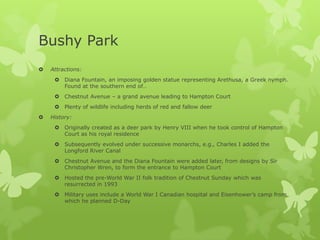
      Chestnut Avenue – a grand avenue leading to Hampton Court
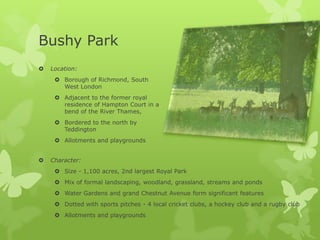
      Plenty of wildlife including herds of red and fallow deer
   History:
      Originally created as a deer park by Henry VIII when he took control of Hampton
       Court as his royal residence
      Subsequently evolved under successive monarchs, e.g., Charles I added the
       Longford River Canal
      Chestnut Avenue and the Diana Fountain were added later, from designs by Sir
       Christopher Wren, to form the entrance to Hampton Court
      Hosted the pre-World War II folk tradition of Chestnut Sunday which was
       resurrected in 1993
      Military uses include a World War I Canadian hospital and Eisenhower’s camp from
       which he planned D-Day
Richmond Park
   Location:
      Borough of Richmond, South
       West London
      An expanse of land just south of
       the River Thames
      Between the town of Richmond
       itself, neighbouring Kingston
       Upon Thames to the South and
       Wimbledon and Wimbledon
       Common to the West.
   Character:
      Size - 2,500 acres, the largest Royal Park, the largest park in London, the
       second largest walled park in the UK
      Over twice the size of Bushy
      A designated National Nature Reserve and a Site of Special Scientific
       Interest
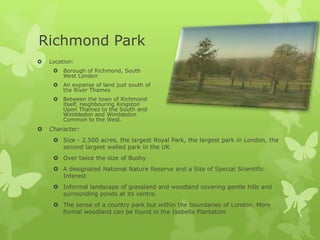
      Informal landscape of grassland and woodland covering gentle hills and
       surrounding ponds at its centre.
      The sense of a country park but within the boundaries of London. More
       formal woodland can be found in the Isabella Plantation
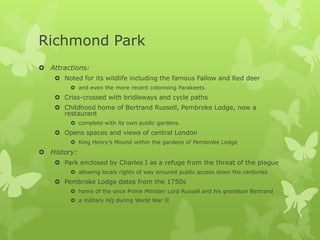
Richmond Park
 Attractions:
     Noted for its wildlife including the famous Fallow and Red deer
          and even the more recent colonising Parakeets.
     Criss-crossed with bridleways and cycle paths
     Childhood home of Bertrand Russell, Pembroke Lodge, now a
      restaurant
          complete with its own public gardens.
     Opens spaces and views of central London
          King Henry’s Mound within the gardens of Pembroke Lodge
 History:
     Park enclosed by Charles I as a refuge from the threat of the plague
          allowing locals rights of way ensured public access down the centuries
     Pembroke Lodge dates from the 1750s
          home of the once Prime Minister Lord Russell and his grandson Bertrand
          a military HQ during World War II
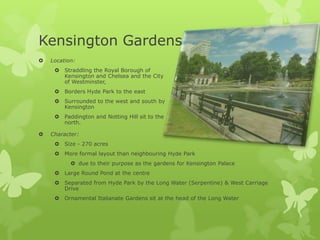
Kensington Gardens
   Location:
      Straddling the Royal Borough of
       Kensington and Chelsea and the City
       of Westminster,
      Borders Hyde Park to the east
      Surrounded to the west and south by
       Kensington
      Paddington and Notting Hill sit to the
       north.

   Character:
      Size - 270 acres
      More formal layout than neighbouring Hyde Park
            due to their purpose as the gardens for Kensington Palace
      Large Round Pond at the centre
      Separated from Hyde Park by the Long Water (Serpentine) & West Carriage
       Drive
      Ornamental Italianate Gardens sit at the head of the Long Water
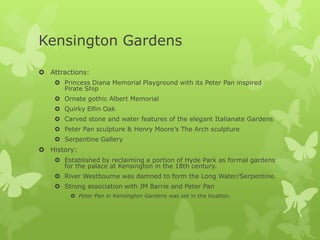
Kensington Gardens

 Attractions:
     Princess Diana Memorial Playground with its Peter Pan inspired
      Pirate Ship
     Ornate gothic Albert Memorial
     Quirky Elfin Oak
     Carved stone and water features of the elegant Italianate Gardens
     Peter Pan sculpture & Henry Moore’s The Arch sculpture
     Serpentine Gallery
 History:
     Established by reclaiming a portion of Hyde Park as formal gardens
      for the palace at Kensington in the 18th century.
     River Westbourne was damned to form the Long Water/Serpentine.
     Strong association with JM Barrie and Peter Pan
         Peter Pan in Kensington Gardens was set in the location.
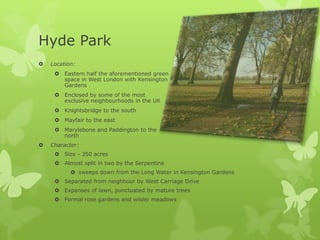
Hyde Park
   Location:
      Eastern half the aforementioned green
       space in West London with Kensington
       Gardens
      Enclosed by some of the most
       exclusive neighbourhoods in the UK
      Knightsbridge to the south
      Mayfair to the east
      Marylebone and Paddington to the
       north
   Character:
      Size - 350 acres
      Almost split in two by the Serpentine
            sweeps down from the Long Water in Kensington Gardens
      Separated from neighbour by West Carriage Drive
      Expanses of lawn, punctuated by mature trees
      Formal rose gardens and wilder meadows
Hyde Park
   Attractions:
      Speakers Corner, where all-comers can voice their opinions


      Open air concerts;
           notably the Rolling Stones in 1969 and Blur during the closing of the 2012
            Olympics.
      Diana, Princess of Wales, Fountain just beside the Serpentine
      Memorial to the victims of the 7/7 bombings
   History:
      Originally the possession of Westminster Abbey
      Then owned by Henry VIII as a deer park
      James I allowed the public in
      Mid 18th century, it was landscaped as part of the changes that spawned
       Kensington Gardens
      Serpentine was formed at this time by damning the River Westbourne
      Site of the Great Exhibition of 1851 and Crystal Palace
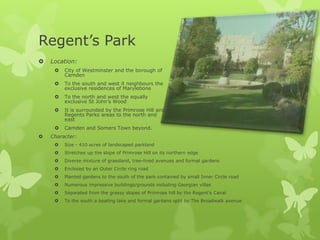
Regent’s Park
   Location:
        City of Westminster and the borough of
         Camden
        To the south and west it neighbours the
         exclusive residences of Marylebone
        To the north and west the equally
         exclusive St John’s Wood
        It is surrounded by the Primrose Hill and
         Regents Parks areas to the north and
         east
        Camden and Somers Town beyond.
   Character:
        Size - 410 acres of landscaped parkland
        Stretches up the slope of Primrose Hill on its northern edge
        Diverse mixture of grassland, tree-lined avenues and formal gardens
        Enclosed by an Outer Circle ring road
        Planted gardens to the south of the park contained by small Inner Circle road
        Numerous impressive buildings/grounds including Georgian villas
        Separated from the grassy slopes of Primrose hill by the Regent’s Canal
        To the south a boating lake and formal gardens split by The Broadwalk avenue
Regent’s Park
   Attractions:
        London Zoo sits entirely within the park
        Open Air Theatre stages productions throughout the summer
        Tennis centre, a sports centre at The Hub, a boating lake and playgrounds
        Primrose Hill offers panoramic views of central London
        Planted formal gardens such as Queen Mary’s Rose Garden in the Inner Circle
        Organic Wildlife Garden just outside
        The park’s buildings include the US Ambassador’s Residence and Regent’s College
   History:
        Henry VIII dissolved the abbey at Barking
        Previously Tyburn Manor, named after the eponymous river
        As Marylebone Park, it was first a deer park and then leased farmland
        Prince Regent (later George IV) commissioned John Nash to re-designed the park and
         the surrounding area to form a neighbourhood of palaces and grand Georgian terraces
        In 1811 the park was landscaped with the Regent’s Canal, the lake, avenues and villas
        The Georgian building boom spawned Marylebone, Mayfair and St James’s
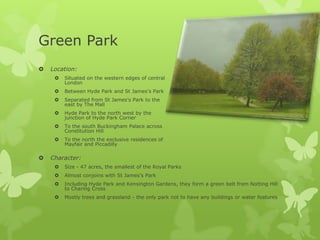
Green Park
   Location:
        Situated on the western edges of central
         London
        Between Hyde Park and St James’s Park
        Separated from St James’s Park to the
         east by The Mall
        Hyde Park to the north west by the
         junction of Hyde Park Corner
        To the south Buckingham Palace across
         Constitution Hill
        To the north the exclusive residences of
         Mayfair and Piccadilly

   Character:
        Size - 47 acres, the smallest of the Royal Parks
        Almost conjoins with St James’s Park
        Including Hyde Park and Kensington Gardens, they form a green belt from Notting Hill
         to Charing Cross
        Mostly trees and grassland - the only park not to have any buildings or water features
Green Park

 Attractions:
    Impressive Spring daffodil display
    Refuge from the hubbub of the surrounding city
    Canada Memorial (to Canadian soldiers of the world wars)
 History:
    Burial ground for the patients of St James’s leper hospital
    Charles II enclosed the park as Upper St James’s Park in the
     late 17th century
    John Nash remodelled the park in 1820 alongside neighbouring
     St James’s park for George IV
    Over the centuries it became popular as an outdoor
     entertainment space
    The park had been home to a number of buildings including two
     temples both destroyed by firework displays
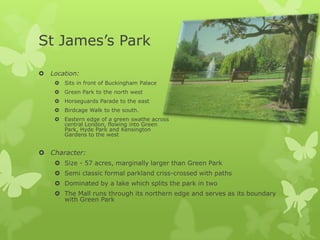
St James’s Park

   Location:
      Sits in front of Buckingham Palace
      Green Park to the north west
      Horseguards Parade to the east
      Birdcage Walk to the south.
      Eastern edge of a green swathe across
       central London, flowing into Green
       Park, Hyde Park and Kensington
       Gardens to the west


 Character:
      Size - 57 acres, marginally larger than Green Park
      Semi classic formal parkland criss-crossed with paths
      Dominated by a lake which splits the park in two
      The Mall runs through its northern edge and serves as its boundary
       with Green Park
St James’s Park
   Attractions:
        Surrounded by attractions such as Buckingham Palace, The Mall (the ceremonial route
         to the palace) and Horseguards Parade
        The flower beds of the Memorial Gardens just outside Buckingham Palace
        Stunning views of the palace from numerous vantage points
        St James’s Park lake with its wildfowl including pelicans
   History:
        Established by Henry VIII on the marshy banks of the old River Tyburn
            to the west of what was referred to as York Place (now Whitehall)
            with the intention of creating gardens for a new royal palace there
        Drained and landscaped under the reign of James I who kept exotic animals on them
        Landscaped and formalised further by Charles II, taking influences from French Royal
         Gardens
        In 19th century, the Prince Regent commissioned John Nash to once again re-
         landscape the park
            introducing more organic, romantic and winding features, turning the canal into a lake
            Created The Mall as a stately approach to Buckingham Palace
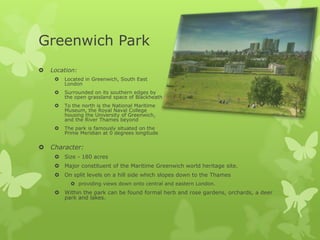
Greenwich Park
   Location:
        Located in Greenwich, South East
         London
        Surrounded on its southern edges by
         the open grassland space of Blackheath
        To the north is the National Maritime
         Museum, the Royal Naval College
         housing the University of Greenwich,
         and the River Thames beyond
        The park is famously situated on the
         Prime Meridian at 0 degrees longitude


   Character:
      Size - 180 acres
      Major constituent of the Maritime Greenwich world heritage site.
      On split levels on a hill side which slopes down to the Thames
            providing views down onto central and eastern London.
      Within the park can be found formal herb and rose gardens, orchards, a deer
       park and lakes.
Greenwich Park
   Attractions:
        Royal Observatory - historical and scientific hub at the heart of the park
                  the origin of the Prime Meridian (which runs through the park)
                  a branch of the Maritime Museum
        Glimpses of deer
        Famous sundial and view Roman ruins
        Tennis courts and boating lake
   History:
        Dating from 1433 Greenwich is the oldest of the Royal Parks as well as being the first to be
         enclosed
        Acquired by Henry VI in the 15th century
        Charles II created the Royal Observatory (with the help of Sir Christopher Wren)
                  On the site of the derelict Greenwich Castle (originally built by Duke of Gloucester).
        The buildings known as the Royal Naval college today originated as Greenwich hospital and
                  On the site of the Tudor Palace of Placentia (birthplace and home to Tudor monarchs) in the late
                   17th century.
        The area was turned into a deer park by Henry VIII, who was born in the adjoining palace
        Enclosed by James I when they were formally landscaped in the 17th century
Useful Links

 Further Information
    The Royal Parks
    The Royal Parks on Wikipedia
    Visit London
 Moving to the areas:
    Estate Agents Knightsbridge
    Estate Agents Marylebone
    Estate Agents Mayfair
    Estate Agents Regent’s Park
    Wimbledon Flats

London’s 8 royal parks

  • 1.
    London’s 8 RoyalParks © Stuart Mitchell
  • 2.
    Bushy Park  Location:  Borough of Richmond, South West London  Adjacent to the former royal residence of Hampton Court in a bend of the River Thames,  Bordered to the north by Teddington  Allotments and playgrounds  Character:  Size - 1,100 acres, 2nd largest Royal Park  Mix of formal landscaping, woodland, grassland, streams and ponds  Water Gardens and grand Chestnut Avenue form significant features  Dotted with sports pitches - 4 local cricket clubs, a hockey club and a rugby club  Allotments and playgrounds
  • 3.
    Bushy Park  Attractions:  Diana Fountain, an imposing golden statue representing Arethusa, a Greek nymph. Found at the southern end of…  Chestnut Avenue – a grand avenue leading to Hampton Court  Plenty of wildlife including herds of red and fallow deer  History:  Originally created as a deer park by Henry VIII when he took control of Hampton Court as his royal residence  Subsequently evolved under successive monarchs, e.g., Charles I added the Longford River Canal  Chestnut Avenue and the Diana Fountain were added later, from designs by Sir Christopher Wren, to form the entrance to Hampton Court  Hosted the pre-World War II folk tradition of Chestnut Sunday which was resurrected in 1993  Military uses include a World War I Canadian hospital and Eisenhower’s camp from which he planned D-Day
  • 4.
    Richmond Park  Location:  Borough of Richmond, South West London  An expanse of land just south of the River Thames  Between the town of Richmond itself, neighbouring Kingston Upon Thames to the South and Wimbledon and Wimbledon Common to the West.  Character:  Size - 2,500 acres, the largest Royal Park, the largest park in London, the second largest walled park in the UK  Over twice the size of Bushy  A designated National Nature Reserve and a Site of Special Scientific Interest  Informal landscape of grassland and woodland covering gentle hills and surrounding ponds at its centre.  The sense of a country park but within the boundaries of London. More formal woodland can be found in the Isabella Plantation
  • 5.
    Richmond Park  Attractions:  Noted for its wildlife including the famous Fallow and Red deer  and even the more recent colonising Parakeets.  Criss-crossed with bridleways and cycle paths  Childhood home of Bertrand Russell, Pembroke Lodge, now a restaurant  complete with its own public gardens.  Opens spaces and views of central London  King Henry’s Mound within the gardens of Pembroke Lodge  History:  Park enclosed by Charles I as a refuge from the threat of the plague  allowing locals rights of way ensured public access down the centuries  Pembroke Lodge dates from the 1750s  home of the once Prime Minister Lord Russell and his grandson Bertrand  a military HQ during World War II
  • 6.
    Kensington Gardens  Location:  Straddling the Royal Borough of Kensington and Chelsea and the City of Westminster,  Borders Hyde Park to the east  Surrounded to the west and south by Kensington  Paddington and Notting Hill sit to the north.  Character:  Size - 270 acres  More formal layout than neighbouring Hyde Park  due to their purpose as the gardens for Kensington Palace  Large Round Pond at the centre  Separated from Hyde Park by the Long Water (Serpentine) & West Carriage Drive  Ornamental Italianate Gardens sit at the head of the Long Water
  • 7.
    Kensington Gardens  Attractions:  Princess Diana Memorial Playground with its Peter Pan inspired Pirate Ship  Ornate gothic Albert Memorial  Quirky Elfin Oak  Carved stone and water features of the elegant Italianate Gardens  Peter Pan sculpture & Henry Moore’s The Arch sculpture  Serpentine Gallery  History:  Established by reclaiming a portion of Hyde Park as formal gardens for the palace at Kensington in the 18th century.  River Westbourne was damned to form the Long Water/Serpentine.  Strong association with JM Barrie and Peter Pan  Peter Pan in Kensington Gardens was set in the location.
  • 8.
    Hyde Park  Location:  Eastern half the aforementioned green space in West London with Kensington Gardens  Enclosed by some of the most exclusive neighbourhoods in the UK  Knightsbridge to the south  Mayfair to the east  Marylebone and Paddington to the north  Character:  Size - 350 acres  Almost split in two by the Serpentine  sweeps down from the Long Water in Kensington Gardens  Separated from neighbour by West Carriage Drive  Expanses of lawn, punctuated by mature trees  Formal rose gardens and wilder meadows
  • 9.
    Hyde Park  Attractions:  Speakers Corner, where all-comers can voice their opinions  Open air concerts;  notably the Rolling Stones in 1969 and Blur during the closing of the 2012 Olympics.  Diana, Princess of Wales, Fountain just beside the Serpentine  Memorial to the victims of the 7/7 bombings  History:  Originally the possession of Westminster Abbey  Then owned by Henry VIII as a deer park  James I allowed the public in  Mid 18th century, it was landscaped as part of the changes that spawned Kensington Gardens  Serpentine was formed at this time by damning the River Westbourne  Site of the Great Exhibition of 1851 and Crystal Palace
  • 10.
    Regent’s Park  Location:  City of Westminster and the borough of Camden  To the south and west it neighbours the exclusive residences of Marylebone  To the north and west the equally exclusive St John’s Wood  It is surrounded by the Primrose Hill and Regents Parks areas to the north and east  Camden and Somers Town beyond.  Character:  Size - 410 acres of landscaped parkland  Stretches up the slope of Primrose Hill on its northern edge  Diverse mixture of grassland, tree-lined avenues and formal gardens  Enclosed by an Outer Circle ring road  Planted gardens to the south of the park contained by small Inner Circle road  Numerous impressive buildings/grounds including Georgian villas  Separated from the grassy slopes of Primrose hill by the Regent’s Canal  To the south a boating lake and formal gardens split by The Broadwalk avenue
  • 11.
    Regent’s Park  Attractions:  London Zoo sits entirely within the park  Open Air Theatre stages productions throughout the summer  Tennis centre, a sports centre at The Hub, a boating lake and playgrounds  Primrose Hill offers panoramic views of central London  Planted formal gardens such as Queen Mary’s Rose Garden in the Inner Circle  Organic Wildlife Garden just outside  The park’s buildings include the US Ambassador’s Residence and Regent’s College  History:  Henry VIII dissolved the abbey at Barking  Previously Tyburn Manor, named after the eponymous river  As Marylebone Park, it was first a deer park and then leased farmland  Prince Regent (later George IV) commissioned John Nash to re-designed the park and the surrounding area to form a neighbourhood of palaces and grand Georgian terraces  In 1811 the park was landscaped with the Regent’s Canal, the lake, avenues and villas  The Georgian building boom spawned Marylebone, Mayfair and St James’s
  • 12.
    Green Park  Location:  Situated on the western edges of central London  Between Hyde Park and St James’s Park  Separated from St James’s Park to the east by The Mall  Hyde Park to the north west by the junction of Hyde Park Corner  To the south Buckingham Palace across Constitution Hill  To the north the exclusive residences of Mayfair and Piccadilly  Character:  Size - 47 acres, the smallest of the Royal Parks  Almost conjoins with St James’s Park  Including Hyde Park and Kensington Gardens, they form a green belt from Notting Hill to Charing Cross  Mostly trees and grassland - the only park not to have any buildings or water features
  • 13.
    Green Park  Attractions:  Impressive Spring daffodil display  Refuge from the hubbub of the surrounding city  Canada Memorial (to Canadian soldiers of the world wars)  History:  Burial ground for the patients of St James’s leper hospital  Charles II enclosed the park as Upper St James’s Park in the late 17th century  John Nash remodelled the park in 1820 alongside neighbouring St James’s park for George IV  Over the centuries it became popular as an outdoor entertainment space  The park had been home to a number of buildings including two temples both destroyed by firework displays
  • 14.
    St James’s Park  Location:  Sits in front of Buckingham Palace  Green Park to the north west  Horseguards Parade to the east  Birdcage Walk to the south.  Eastern edge of a green swathe across central London, flowing into Green Park, Hyde Park and Kensington Gardens to the west  Character:  Size - 57 acres, marginally larger than Green Park  Semi classic formal parkland criss-crossed with paths  Dominated by a lake which splits the park in two  The Mall runs through its northern edge and serves as its boundary with Green Park
  • 15.
    St James’s Park  Attractions:  Surrounded by attractions such as Buckingham Palace, The Mall (the ceremonial route to the palace) and Horseguards Parade  The flower beds of the Memorial Gardens just outside Buckingham Palace  Stunning views of the palace from numerous vantage points  St James’s Park lake with its wildfowl including pelicans  History:  Established by Henry VIII on the marshy banks of the old River Tyburn  to the west of what was referred to as York Place (now Whitehall)  with the intention of creating gardens for a new royal palace there  Drained and landscaped under the reign of James I who kept exotic animals on them  Landscaped and formalised further by Charles II, taking influences from French Royal Gardens  In 19th century, the Prince Regent commissioned John Nash to once again re- landscape the park  introducing more organic, romantic and winding features, turning the canal into a lake  Created The Mall as a stately approach to Buckingham Palace
  • 16.
    Greenwich Park  Location:  Located in Greenwich, South East London  Surrounded on its southern edges by the open grassland space of Blackheath  To the north is the National Maritime Museum, the Royal Naval College housing the University of Greenwich, and the River Thames beyond  The park is famously situated on the Prime Meridian at 0 degrees longitude  Character:  Size - 180 acres  Major constituent of the Maritime Greenwich world heritage site.  On split levels on a hill side which slopes down to the Thames  providing views down onto central and eastern London.  Within the park can be found formal herb and rose gardens, orchards, a deer park and lakes.
  • 17.
    Greenwich Park  Attractions:  Royal Observatory - historical and scientific hub at the heart of the park  the origin of the Prime Meridian (which runs through the park)  a branch of the Maritime Museum  Glimpses of deer  Famous sundial and view Roman ruins  Tennis courts and boating lake  History:  Dating from 1433 Greenwich is the oldest of the Royal Parks as well as being the first to be enclosed  Acquired by Henry VI in the 15th century  Charles II created the Royal Observatory (with the help of Sir Christopher Wren)  On the site of the derelict Greenwich Castle (originally built by Duke of Gloucester).  The buildings known as the Royal Naval college today originated as Greenwich hospital and  On the site of the Tudor Palace of Placentia (birthplace and home to Tudor monarchs) in the late 17th century.  The area was turned into a deer park by Henry VIII, who was born in the adjoining palace  Enclosed by James I when they were formally landscaped in the 17th century
  • 18.
    Useful Links  FurtherInformation  The Royal Parks  The Royal Parks on Wikipedia  Visit London  Moving to the areas:  Estate Agents Knightsbridge  Estate Agents Marylebone  Estate Agents Mayfair  Estate Agents Regent’s Park  Wimbledon Flats