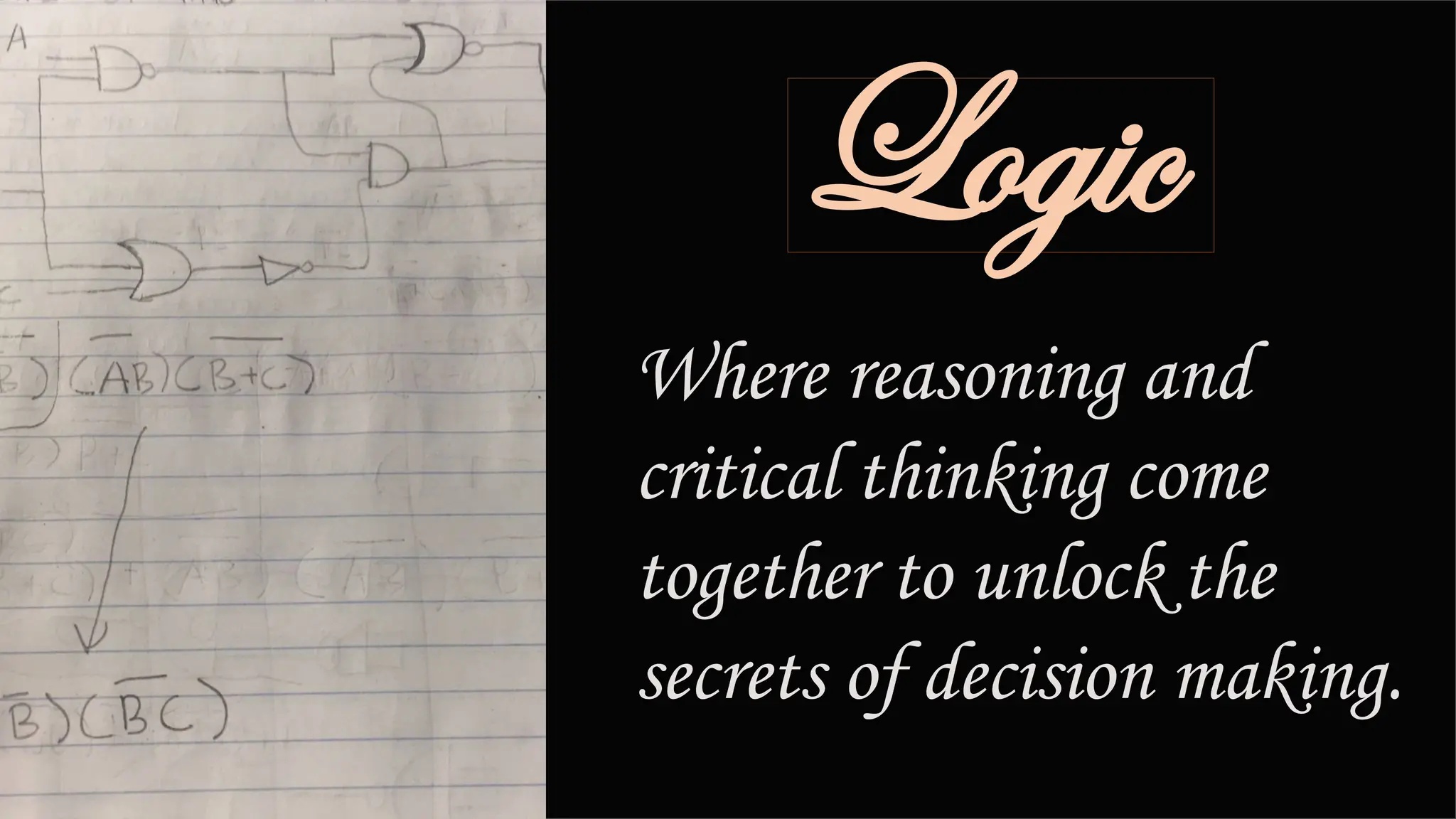
Logic
Where reasoning and
critical thinking come
together to unlock the
secrets of decision making.
Definition of Logic
Logic is the systematic study of valid
arguments and reasoning. It provides
a framework for evaluating the
consistency and validity of ideas and
statements.
Types of Logic
Deductive Logic
Deductive logic involves
drawing specific
conclusions from
general premises. It is
used to prove or
disprove hypotheses
through a series of
logical steps.
Inductive Logic
Inductive logic moves
from specific
observations to general
conclusions. It helps us
make predictions and
form hypotheses based
on patterns and evidence.
Importance of Logic in
Decision Making
1 Critical Thinking
Logic fosters critical
thinking skills,
enabling us to assess
information
objectively, analyze
arguments, and
make well-reasoned
judgments.
2 Problem-Solving
By applying logical
reasoning, we can
break down complex
problems, identify
potential solutions,
and evaluate their
feasibility.
3
Clear and Effective
Communication
Logic enhances our
ability to express ideas
coherently, structure
arguments, and avoid
fallacious reasoning,
leading to more
persuasive
communication.
Appeal to
Ignorance
Arguing that a
claim is true or
false simply
because it has
not been
proven or
disproven.
Ad Hominem
Attacking the
person
making an
argument
instead of
addressing
the argument
itself.
Straw Man
Distorting or
misrepresenting
someone's
argument to
make it easier
to attack or
refute.
False Cause
Incorrectly
assuming that
one event
causes
another based
on a mere
correlation.
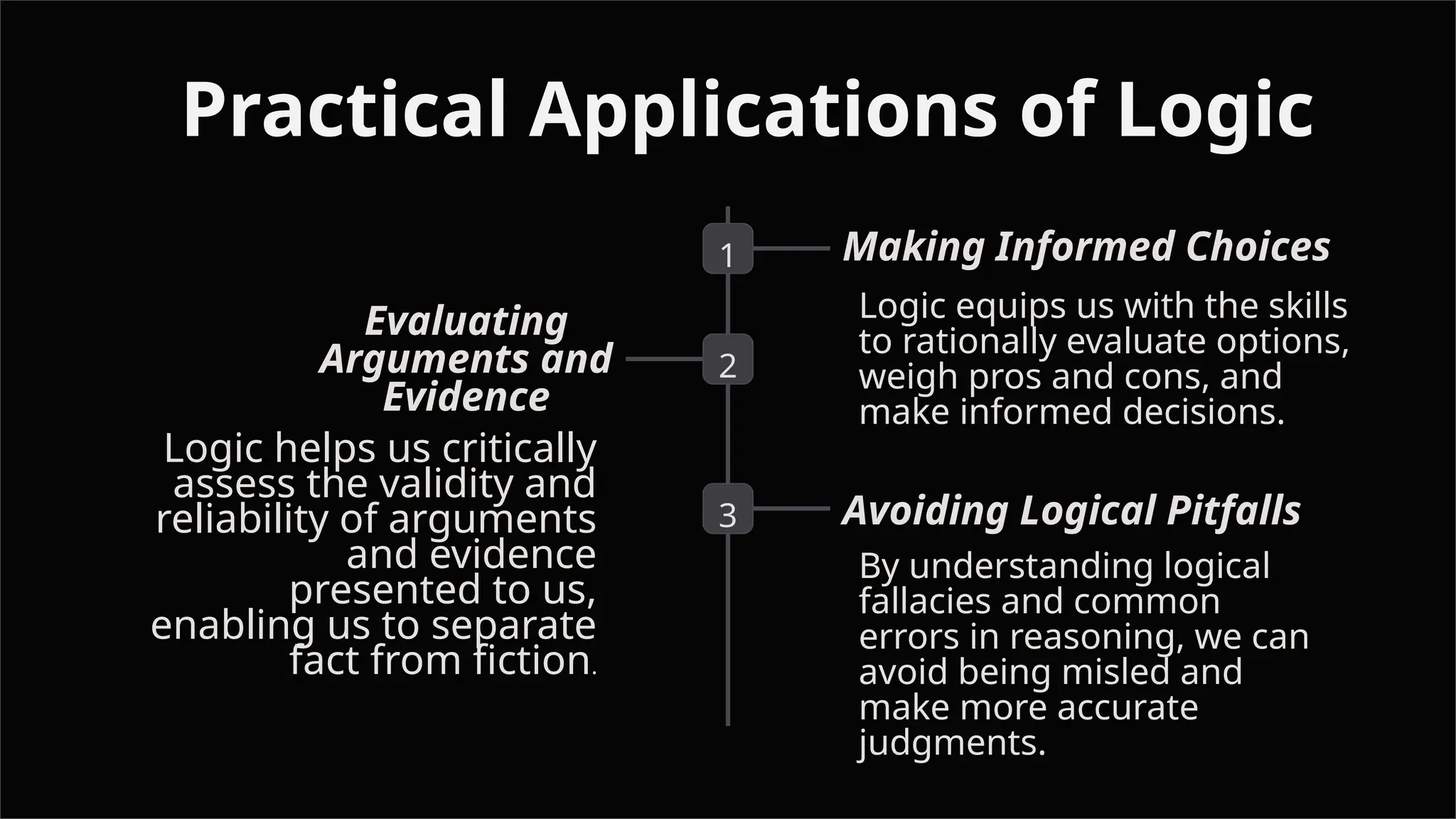
Practical Applications of Logic
1 Making Informed Choices
Logic equips us with the skills
to rationally evaluate options,
weigh pros and cons, and
make informed decisions.
2
Evaluating
Arguments and
Evidence
Logic helps us critically
assess the validity and
reliability of arguments
and evidence
presented to us,
enabling us to separate
fact from fiction.
3 Avoiding Logical Pitfalls
By understanding logical
fallacies and common
errors in reasoning, we can
avoid being misled and
make more accurate
judgments.
Logic is a powerful tool that
empowers us to think critically
and make sound decisions. It
enhances our ability to
navigate the complexities of
life and contributes to a more
rational and informed society.

Logic .pptx

  • 1.
    Logic Where reasoning and criticalthinking come together to unlock the secrets of decision making.
  • 2.
    Definition of Logic Logicis the systematic study of valid arguments and reasoning. It provides a framework for evaluating the consistency and validity of ideas and statements.
  • 3.
    Types of Logic DeductiveLogic Deductive logic involves drawing specific conclusions from general premises. It is used to prove or disprove hypotheses through a series of logical steps. Inductive Logic Inductive logic moves from specific observations to general conclusions. It helps us make predictions and form hypotheses based on patterns and evidence.
  • 4.
    Importance of Logicin Decision Making 1 Critical Thinking Logic fosters critical thinking skills, enabling us to assess information objectively, analyze arguments, and make well-reasoned judgments. 2 Problem-Solving By applying logical reasoning, we can break down complex problems, identify potential solutions, and evaluate their feasibility. 3 Clear and Effective Communication Logic enhances our ability to express ideas coherently, structure arguments, and avoid fallacious reasoning, leading to more persuasive communication.
  • 5.
    Appeal to Ignorance Arguing thata claim is true or false simply because it has not been proven or disproven. Ad Hominem Attacking the person making an argument instead of addressing the argument itself. Straw Man Distorting or misrepresenting someone's argument to make it easier to attack or refute. False Cause Incorrectly assuming that one event causes another based on a mere correlation.
  • 6.
    Practical Applications ofLogic 1 Making Informed Choices Logic equips us with the skills to rationally evaluate options, weigh pros and cons, and make informed decisions. 2 Evaluating Arguments and Evidence Logic helps us critically assess the validity and reliability of arguments and evidence presented to us, enabling us to separate fact from fiction. 3 Avoiding Logical Pitfalls By understanding logical fallacies and common errors in reasoning, we can avoid being misled and make more accurate judgments.
  • 7.
    Logic is apowerful tool that empowers us to think critically and make sound decisions. It enhances our ability to navigate the complexities of life and contributes to a more rational and informed society.