LOGBOOK FOR INDUSTRIAL
SUPERVISION AND TRAINING-A LOOK
AT PAPER AND DIGITAL LOGBOOKS.

Olubodun, O.J.
University of Lagos,
College of Medicine,
Faculty of Dental Sciences,
Lagos Nigeria.
INTRODUCTION &
BACKGROUND
Technical and Vocational Education

                                      Google Images
and Industrial Training.

Paper and Digital Logbooks.

What are they used for?

Rationale for this Study.

Kind of industrial training experience.
Questions
In the end we should be able to answer the
  following questions:
   What is logbook and the types that are available.
   What are the differences between paper and
    digital logbooks.
   How can logbook contribute to supervision and
    training?
   What is BT logbook?
Types of Logbooks
Logbook as:
•Paper     Logbook
•Digital
       logbook which could be a software and non-
software, accessible either offline or online.
•As   technological Devices.
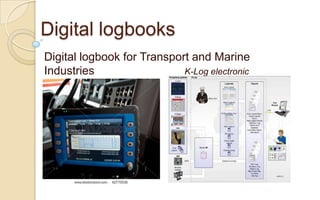
Digital logbooks
Digital logbook for Transport and Marine
Industries                  K-Log electronic
Logbook
Digital logbook
Allowing no video, picture and audio option
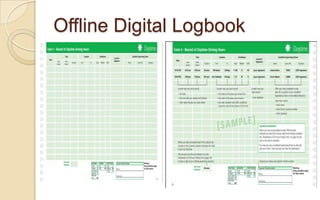
Offline Digital Logbook
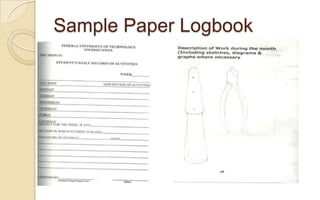
Space Limitation for Paper
Logbook
Sample Paper Logbook
Highlight of findings
   Limited spaces for description of lab activities taught and performed.
   No spaces in some cases for drawing.
   Burden of having to carrying logbook around every day and from one department of posting to
    another.
   Entries are limited to description and drawing of lab procedures.
   Logbook becomes rough and untidy as a result of making changes to entries earlier made.
   Logbook becomes torn because of carrying it from one department of posting to another.
   Unwillingness on the part of students to share ideas on entries made to logbook.
   School supervisors unable to see logbook until students are back to school at the end of
    programme and hence cannot follow progress of student’s learning experiences.
   Industrial supervisors show limited understanding of the best ways to pass comments on
    student’s work.
   Entries are sometimes made in a rough paper before transferring it to the main logbook which
    sometimes may be lost.
   Students could make changes at will and sometimes entries may not reflect the actual learning
    experiences gained at work.
   Students sometimes present ‘doctored’ report at the end of the programme which does not
    represent the actual learning experiences.
   Students have difficulties making drawings and may ‘mess’ up pages and leave them rough.
BT Digital Logbook
BT Digital Logbook
 Google and Blogger account pages
Twitter Sign-up and Entry
Page
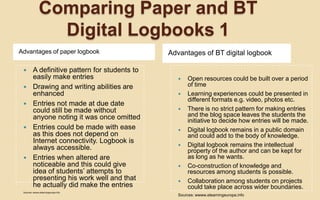
Comparing Paper and BT
                 Digital Logbooks 1
Advantages of paper logbook                     Advantages of BT digital logbook

        A definitive pattern for students to
         easily make entries                          Open resources could be built over a period
        Drawing and writing abilities are             of time
         enhanced                                     Learning experiences could be presented in
                                                       different formats e.g. video, photos etc.
        Entries not made at due date
         could still be made without                  There is no strict pattern for making entries
         anyone noting it was once omitted             and the blog space leaves the students the
                                                       initiative to decide how entries will be made.
        Entries could be made with ease              Digital logbook remains in a public domain
         as this does not depend on                    and could add to the body of knowledge.
         Internet connectivity. Logbook is
         always accessible.                           Digital logbook remains the intellectual
                                                       property of the author and can be kept for
        Entries when altered are                      as long as he wants.
         noticeable and this could give               Co-construction of knowledge and
         idea of students’ attempts to                 resources among students is possible.
         presenting his work well and that            Collaboration among students on projects
         he actually did make the entries              could take place across wider boundaries.
 Sources: wwww.elearningeuropa.info
                                                   Sources: wwww.elearningeuropa.info
Comparing Paper and BT Digital
         Logbooks 2
Constraints of BTdigital logbook                    Constraints of paper logbook
    Students need to have training on the use         Insufficient space for description of learning
     of blog and twitter and devices for making         experiences.
     video and entry.
                                                       Learning experiences can only be
    Poor Internet connectivity could hinder or         represented by drawing and writing
     delay entries and uploading files may pose
     serious difficulties                              Learning experiences cannot easily be
                                                        shared among students and with others like
    Extra cost for procuring Internet services.        teachers back in the school
    Students could fine tune entries and give         Paper logbook subject to being torn as it is
     false impression of skills acquired                carried from one supervisors to another
    Students could easily be assisted by               during deployment and re-deployment.
     anyone if entries could earn him higher           Students could lose logbook if not well kept.
     marks by his assessor.
                                                       Making changes to entries could leave
    Students could upload works not done by            logbook rough and untidy.
     him from any sources and claiming it is his
     work.                                             Student do not have freedom to make
                                                        entries of learning experiences in a way he
    Student’s ability to hand drawing which is a       chooses. There is strict pattern for making
     required skill in dental technology training       entries
     could be limited.
                                                    Source: wwww.elearningeuropa.info
 Source: wwww.elearningeuropa.info
Sequence of a Dental Lab
Procedure.
Acrylic Denture Repair
Model Making Procedure
Logbook as training and
supervision Manual
It serves as a training manual for supervisors to guide
students learning activities by correcting entries made into their
logbook and by having idea of progress made and the
constraints had when learning a procedure.
It affords the students the spaces for clearly explaining the
details of procedures mastered.
It affords the industrial supervisors the opportunity for
ascertaining level of progress made by the students in
understanding a procedure.
It affords the students the opportunity of noting the connection
between experiences learnt in the school and those at the
industrial training centres
It affords the students the opportunity of building a pool of
resources for future reference.
It is a tool for collaboration.
Conclusion
   Logbook is very important in technical and vocational training and in all other professions
    where technical skills are required of a professional. For example in the health sector a
    medical surgeon in an operation theatre need to be dexterous in the use of tools and
    equipment for his work. Professionals in the engineering profession and other laboratory
    related arts need to develop manual dexterity for manipulation of materials for handling tools
    and equipment and for doing something. Industrial training or similar training programmes is
    always necessary for students of vocational training schools in order to merge theory with
    practice in real life situation.
   The use of logbook for students to represent experiences gained during industrial training and
    therefore put them in perspective is one among so many other reasons that make the use of
    logbook an important aspect of industrial training. Paper based logbook is however not the
    best in today’s technology driven society. This study found that digital logbook if well untilised
    will be more suitable for learners of the present technology age most of who already could
    operate some of the common technological devices like phones, computer and other hand-
    held devices for making entries into a digital logbook. Although technical and vocational
    education schools and colleges have not embraced the use of digital logbook it is hoped that
    sooner than later it will be embraced.
   The future of technical and vocational education training (TVET) will be positively impacted
    with students’ industrial training using digital logbook for collaborative learning and for creation
    of open resources. BT logbook is a novel idea for digitizing industrial training experiences. It
    cost little or nothing and provides many opportunities for students both for personal use or
    school work. The school may not need to have a web presence to have their students use BT
    logbook and so schools from poor countries could use it as well.
References
 http://www.shutterstock.com/pic-42770536/stock-photo-an-
  electronic-logbook-for-truck-drivers-keeps-track-of-the-hours-of-
  service.html
 http://www.elogbook.net/
 http://elearningeuropa.info/en/blogs/blog-twitter-digital-logbook
 http://dentaltechnigeria.blogspot.com/2011/10/improvised-method-
  for-acrylic-denture.html#links
 Paper Logbook School of Health Sciences Ijebu-Ilese Ogun State
  Nigeria
 Olufemi, O (2012) Dental Lab Procedure. Prosthetic lab. College of
  Medicine, University of Lagos. Nigeria.
 Google image Industrial training Site
 http://www.km.kongsberg.com/ks/web/nokbg0240.nsf/AllWeb/68C3B
  566F8C26076C125723B00534423?OpenDocument
Thank you for Listening.
      ojolubodun@cmul.edu.ng

Logbook For Industrial Supervision and Training- A Look at Paper and Digital Logbook.

  • 1.
    LOGBOOK FOR INDUSTRIAL SUPERVISIONAND TRAINING-A LOOK AT PAPER AND DIGITAL LOGBOOKS. Olubodun, O.J. University of Lagos, College of Medicine, Faculty of Dental Sciences, Lagos Nigeria.
  • 2.
    INTRODUCTION & BACKGROUND Technical andVocational Education Google Images and Industrial Training. Paper and Digital Logbooks. What are they used for? Rationale for this Study. Kind of industrial training experience.
  • 3.
    Questions In the endwe should be able to answer the following questions:  What is logbook and the types that are available.  What are the differences between paper and digital logbooks.  How can logbook contribute to supervision and training?  What is BT logbook?
  • 4.
    Types of Logbooks Logbookas: •Paper Logbook •Digital logbook which could be a software and non- software, accessible either offline or online. •As technological Devices.
  • 5.
    Digital logbooks Digital logbookfor Transport and Marine Industries K-Log electronic Logbook
  • 6.
    Digital logbook Allowing novideo, picture and audio option
  • 7.
  • 8.
  • 9.
    Space Limitation forPaper Logbook
  • 10.
  • 11.
    Highlight of findings  Limited spaces for description of lab activities taught and performed.  No spaces in some cases for drawing.  Burden of having to carrying logbook around every day and from one department of posting to another.  Entries are limited to description and drawing of lab procedures.  Logbook becomes rough and untidy as a result of making changes to entries earlier made.  Logbook becomes torn because of carrying it from one department of posting to another.  Unwillingness on the part of students to share ideas on entries made to logbook.  School supervisors unable to see logbook until students are back to school at the end of programme and hence cannot follow progress of student’s learning experiences.  Industrial supervisors show limited understanding of the best ways to pass comments on student’s work.  Entries are sometimes made in a rough paper before transferring it to the main logbook which sometimes may be lost.  Students could make changes at will and sometimes entries may not reflect the actual learning experiences gained at work.  Students sometimes present ‘doctored’ report at the end of the programme which does not represent the actual learning experiences.  Students have difficulties making drawings and may ‘mess’ up pages and leave them rough.
  • 12.
  • 13.
    BT Digital Logbook Google and Blogger account pages
  • 14.
  • 15.
    Comparing Paper andBT Digital Logbooks 1 Advantages of paper logbook Advantages of BT digital logbook  A definitive pattern for students to easily make entries  Open resources could be built over a period  Drawing and writing abilities are of time enhanced  Learning experiences could be presented in different formats e.g. video, photos etc.  Entries not made at due date could still be made without  There is no strict pattern for making entries anyone noting it was once omitted and the blog space leaves the students the initiative to decide how entries will be made.  Entries could be made with ease  Digital logbook remains in a public domain as this does not depend on and could add to the body of knowledge. Internet connectivity. Logbook is always accessible.  Digital logbook remains the intellectual property of the author and can be kept for  Entries when altered are as long as he wants. noticeable and this could give  Co-construction of knowledge and idea of students’ attempts to resources among students is possible. presenting his work well and that  Collaboration among students on projects he actually did make the entries could take place across wider boundaries. Sources: wwww.elearningeuropa.info Sources: wwww.elearningeuropa.info
  • 16.
    Comparing Paper andBT Digital Logbooks 2 Constraints of BTdigital logbook Constraints of paper logbook  Students need to have training on the use  Insufficient space for description of learning of blog and twitter and devices for making experiences. video and entry.  Learning experiences can only be  Poor Internet connectivity could hinder or represented by drawing and writing delay entries and uploading files may pose serious difficulties  Learning experiences cannot easily be shared among students and with others like  Extra cost for procuring Internet services. teachers back in the school  Students could fine tune entries and give  Paper logbook subject to being torn as it is false impression of skills acquired carried from one supervisors to another  Students could easily be assisted by during deployment and re-deployment. anyone if entries could earn him higher  Students could lose logbook if not well kept. marks by his assessor.  Making changes to entries could leave  Students could upload works not done by logbook rough and untidy. him from any sources and claiming it is his work.  Student do not have freedom to make entries of learning experiences in a way he  Student’s ability to hand drawing which is a chooses. There is strict pattern for making required skill in dental technology training entries could be limited. Source: wwww.elearningeuropa.info Source: wwww.elearningeuropa.info
  • 17.
    Sequence of aDental Lab Procedure. Acrylic Denture Repair
  • 18.
  • 19.
    Logbook as trainingand supervision Manual It serves as a training manual for supervisors to guide students learning activities by correcting entries made into their logbook and by having idea of progress made and the constraints had when learning a procedure. It affords the students the spaces for clearly explaining the details of procedures mastered. It affords the industrial supervisors the opportunity for ascertaining level of progress made by the students in understanding a procedure. It affords the students the opportunity of noting the connection between experiences learnt in the school and those at the industrial training centres It affords the students the opportunity of building a pool of resources for future reference. It is a tool for collaboration.
  • 20.
    Conclusion  Logbook is very important in technical and vocational training and in all other professions where technical skills are required of a professional. For example in the health sector a medical surgeon in an operation theatre need to be dexterous in the use of tools and equipment for his work. Professionals in the engineering profession and other laboratory related arts need to develop manual dexterity for manipulation of materials for handling tools and equipment and for doing something. Industrial training or similar training programmes is always necessary for students of vocational training schools in order to merge theory with practice in real life situation.  The use of logbook for students to represent experiences gained during industrial training and therefore put them in perspective is one among so many other reasons that make the use of logbook an important aspect of industrial training. Paper based logbook is however not the best in today’s technology driven society. This study found that digital logbook if well untilised will be more suitable for learners of the present technology age most of who already could operate some of the common technological devices like phones, computer and other hand- held devices for making entries into a digital logbook. Although technical and vocational education schools and colleges have not embraced the use of digital logbook it is hoped that sooner than later it will be embraced.  The future of technical and vocational education training (TVET) will be positively impacted with students’ industrial training using digital logbook for collaborative learning and for creation of open resources. BT logbook is a novel idea for digitizing industrial training experiences. It cost little or nothing and provides many opportunities for students both for personal use or school work. The school may not need to have a web presence to have their students use BT logbook and so schools from poor countries could use it as well.
  • 21.
    References  http://www.shutterstock.com/pic-42770536/stock-photo-an- electronic-logbook-for-truck-drivers-keeps-track-of-the-hours-of- service.html  http://www.elogbook.net/  http://elearningeuropa.info/en/blogs/blog-twitter-digital-logbook  http://dentaltechnigeria.blogspot.com/2011/10/improvised-method- for-acrylic-denture.html#links  Paper Logbook School of Health Sciences Ijebu-Ilese Ogun State Nigeria  Olufemi, O (2012) Dental Lab Procedure. Prosthetic lab. College of Medicine, University of Lagos. Nigeria.  Google image Industrial training Site  http://www.km.kongsberg.com/ks/web/nokbg0240.nsf/AllWeb/68C3B 566F8C26076C125723B00534423?OpenDocument
  • 22.
    Thank you forListening. ojolubodun@cmul.edu.ng

Editor's Notes

  • #20 As a training manual logbook provides a lot of opportunities namely: It provides a compendium of details of learners experiences, progress made in skill acquisition; stages and details of learning progression, it is a platform for connecting learner and teacher for interaction,