Local Development
Stakater is an open-source experts
company enabling enterprises to realize the
full potential of digital services and
integration, by assisting their journey
across Strategy, Development and
Operations on Kubernetes.
What is
Stakater?
© Stakater - Confidential and Proprietary
Our Geographical Footprint
Czech Republic Canada
Sweden
Headquarter
Pakistan Australia India
Confidential and Proprietary
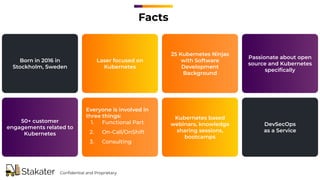
Facts
Born in 2016 in
Stockholm, Sweden
Laser focused on
Kubernetes
25 Kubernetes Ninjas
with Software
Development
Background
Passionate about open
source and Kubernetes
specifically
50+ customer
engagements related to
Kubernetes
Everyone is involved in
three things:
1. Functional Part
2. On-Call/OnShift
3. Consulting
Kubernetes based
webinars, knowledge
sharing sessions,
bootcamps
DevSecOps
as a Service
Confidential and Proprietary
● CEO @ Stakater
● Container platform evangelist & fullstack
developer & architect and instructor (13+)
● Technical Expertise: Java, Go, Docker,
Kubernetes, OpenShift, Spring, Jenkins,
Maven/Gradle, Kafka, Helm, Angular, React,
Yarn/NPM.
● Methods: DevOps, CI & CD, Microservices,
GitOps, Test automation, DDD, CQRS,
Microfrontends, Integrations.
● Explore the github profile for contributions in
Kubernetes ecosystem:
https://github.com/stakater
About me
Confidential and Proprietary
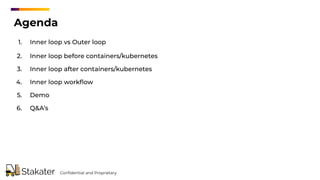
Agenda
1. Inner loop vs Outer loop
2. Inner loop before containers/kubernetes
3. Inner loop after containers/kubernetes
4. Inner loop workflow
5. Demo
6. Q&A’s
Confidential and Proprietary
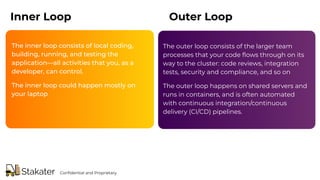
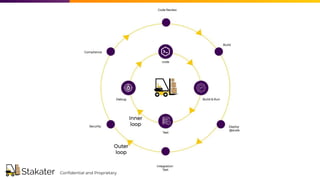
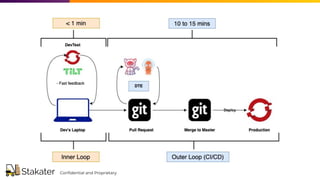
Inner Loop
The inner loop consists of local coding,
building, running, and testing the
application—all activities that you, as a
developer, can control.
The inner loop could happen mostly on
your laptop
Outer Loop
The outer loop consists of the larger team
processes that your code flows through on its
way to the cluster: code reviews, integration
tests, security and compliance, and so on
The outer loop happens on shared servers and
runs in containers, and is often automated
with continuous integration/continuous
delivery (CI/CD) pipelines.
Confidential and Proprietary
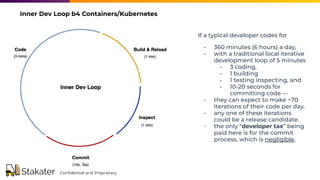
Inner Dev Loop b4 Containers/Kubernetes
If a typical developer codes for
- 360 minutes (6 hours) a day,
- with a traditional local iterative
development loop of 5 minutes
- 3 coding,
- 1 building
- 1 testing inspecting, and
- 10-20 seconds for
committing code —
- they can expect to make ~70
iterations of their code per day.
- any one of these iterations
could be a release candidate.
- the only “developer tax” being
paid here is for the commit
process, which is negligible.
Confidential and Proprietary
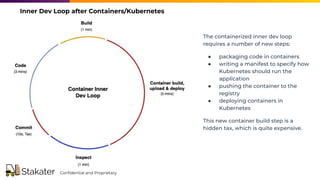
The containerized inner dev loop
requires a number of new steps:
● packaging code in containers
● writing a manifest to specify how
Kubernetes should run the
application
● pushing the container to the
registry
● deploying containers in
Kubernetes
This new container build step is a
hidden tax, which is quite expensive.
Inner Dev Loop after Containers/Kubernetes
Confidential and Proprietary
Demo
https://docs.cloud.stakater.com/content/sre/local-development/tilt/step-by-step-guide.html
Q&A
Confidential and Proprietary
hello@stakater.com
www.stakater.com
github.com/stakater
medium.com/stakater
youtube.com/channel/UCl9t7syUHPc2XXnuOiimZbg
linkedin.com/company/stakater
meetup.com/Stockholm-FullStack-SecDevOps-Engineering-Meetup/
Contact Us
Confidential and Proprietary

Local Development.pdf

  • 1.
  • 2.
    Stakater is anopen-source experts company enabling enterprises to realize the full potential of digital services and integration, by assisting their journey across Strategy, Development and Operations on Kubernetes. What is Stakater? © Stakater - Confidential and Proprietary
  • 3.
    Our Geographical Footprint CzechRepublic Canada Sweden Headquarter Pakistan Australia India Confidential and Proprietary
  • 4.
    Facts Born in 2016in Stockholm, Sweden Laser focused on Kubernetes 25 Kubernetes Ninjas with Software Development Background Passionate about open source and Kubernetes specifically 50+ customer engagements related to Kubernetes Everyone is involved in three things: 1. Functional Part 2. On-Call/OnShift 3. Consulting Kubernetes based webinars, knowledge sharing sessions, bootcamps DevSecOps as a Service Confidential and Proprietary
  • 5.
    ● CEO @Stakater ● Container platform evangelist & fullstack developer & architect and instructor (13+) ● Technical Expertise: Java, Go, Docker, Kubernetes, OpenShift, Spring, Jenkins, Maven/Gradle, Kafka, Helm, Angular, React, Yarn/NPM. ● Methods: DevOps, CI & CD, Microservices, GitOps, Test automation, DDD, CQRS, Microfrontends, Integrations. ● Explore the github profile for contributions in Kubernetes ecosystem: https://github.com/stakater About me Confidential and Proprietary
  • 6.
    Agenda 1. Inner loopvs Outer loop 2. Inner loop before containers/kubernetes 3. Inner loop after containers/kubernetes 4. Inner loop workflow 5. Demo 6. Q&A’s Confidential and Proprietary
  • 7.
    Inner Loop The innerloop consists of local coding, building, running, and testing the application—all activities that you, as a developer, can control. The inner loop could happen mostly on your laptop Outer Loop The outer loop consists of the larger team processes that your code flows through on its way to the cluster: code reviews, integration tests, security and compliance, and so on The outer loop happens on shared servers and runs in containers, and is often automated with continuous integration/continuous delivery (CI/CD) pipelines. Confidential and Proprietary
  • 8.
  • 9.
    Inner Dev Loopb4 Containers/Kubernetes If a typical developer codes for - 360 minutes (6 hours) a day, - with a traditional local iterative development loop of 5 minutes - 3 coding, - 1 building - 1 testing inspecting, and - 10-20 seconds for committing code — - they can expect to make ~70 iterations of their code per day. - any one of these iterations could be a release candidate. - the only “developer tax” being paid here is for the commit process, which is negligible. Confidential and Proprietary
  • 10.
    The containerized innerdev loop requires a number of new steps: ● packaging code in containers ● writing a manifest to specify how Kubernetes should run the application ● pushing the container to the registry ● deploying containers in Kubernetes This new container build step is a hidden tax, which is quite expensive. Inner Dev Loop after Containers/Kubernetes Confidential and Proprietary
  • 11.
  • 12.
  • 13.
  • 14.
  • 15.